The Date: 7 July 1996 The Venue: Ocean Center; Daytona Beach, Florida The Commentary: “The American Dream” Dusty Rhodes, Mike Tenay, Bobby “The Brain” Heenan, and Tony Schiavone The Referee: Randy Anderson The Stakes: Six-man tag team match to repel the Outsiders’ invasion
The Build-Up: On 4 September 1995, World Championship Wrestling (WCW) changed the shape of the wrestling industry by airing the first episode of WCW Monday Nitro, a weekly broadcast that included the unexpected WCW debut of Lex Luger and kicked off the start of the “Monday Night Wars” as the show ran in direct competition to the World Wrestling Federation’s (WWF) Raw is War. Over the course of a staggering eighty-four weeks, WCW would dominate this ratings war thanks to signing a number of wrestling’s biggest names to lucrative contracts; two of the most prominent of these were Scott Hall (formerly WWF’s Razor Ramon) and Kevin Nash (formally Diesel), who regularly gatecrashed WCW programming to declare war on the organisation, assumedly as “Outsiders” sent explicitly by the WWF to disrupt WCW. Though this was later downplayed to avoid legal issues, the two constantly hassled WCW Executive Vice President Eric Bischoff and goaded him into forming a three-man team to face the duo and their mysterious “third man” at Bash at the Beach. A random drawing saw Sting, Lex Lugar and “Macho Man” Randy Savage chosen to oppose the Outsiders, but Hall and Nash refused to reveal the identity of their third man until the show; although Sting was initially said to be up for the big turn, the mystery man turned out to be the legendary Hulk Hogan, whose act was becoming a bit stale by that point. Hogan’s turn to the dark side legitimately shocked the wrestling world and reinvigorated his career; rechristened “Hollywood” Hogan, the once colourful wrestling hero led the New World Order (nWo) in hijacking WCW’s programming as the WCW World Heavyweight Champion, eventually leading to a year-long storyline where Sting underwent a complete character change to oppose Hogan in their infamousStarrcade match. While the nWo eventually outlived its welcome, there’s no denying the impact this match had on the wrestling industry; it made WCW must-see television and forced the WWF to undergo a dramatic change of attitude to outpace and ultimately dethrone their competition and it all started here with this iconic three-on-two tag team match.
The Match: I find it interesting looking back at the Outsiders’ arrival in WCW; even Michael Buffer’s introduction hypes up how the duo threatens the sanctity, the very existence, of the company, which I find a little amusing. You’re seriously telling me that two men are really that much of a threat? Admittedly, I haven’t watched the weeks leading up to Bash at the Beach but it seemed all the two did was interfere in matches, attack a few wrestlers, and accost Bischoff while claiming to have a third man in their posse. These days, an invading team would be at least three men to start with, if not six to eight, and would constantly disrupt programming, attacking everyone and destroying the ringside area, but back then all it took was a former bodyguard-turned-disappointing World Champion and an upper mid-carder with a tragic drinking problem to threaten the stability of one of the biggest wrestling companies in the United States at the time. After weeks of speculation and anticipation bout the duo’s third man, Hall and Nash sauntered to the ring by themselves; even I, with little exposure to WCW or even the WWF back in my fledgling wrestling fan days, was aware of the nWo and Hulk Hogan’s turn to the dark side thanks to WCW’s Nintendo 64 videogames, which featured “Hollywood” Hogan and his black-and-white cohorts in prominent roles, but WCW were determined to drag the reveal out for maximum impact. Naturally, the commentary team were more than a little biased towards the WCW competitors and “Mean” Gene Okerlund was less than impressed at their lack of a partner; however, the duo was completely unfazed maintained their arrogance even in the face of the two-on-three disadvantage they would be in throughout the match.
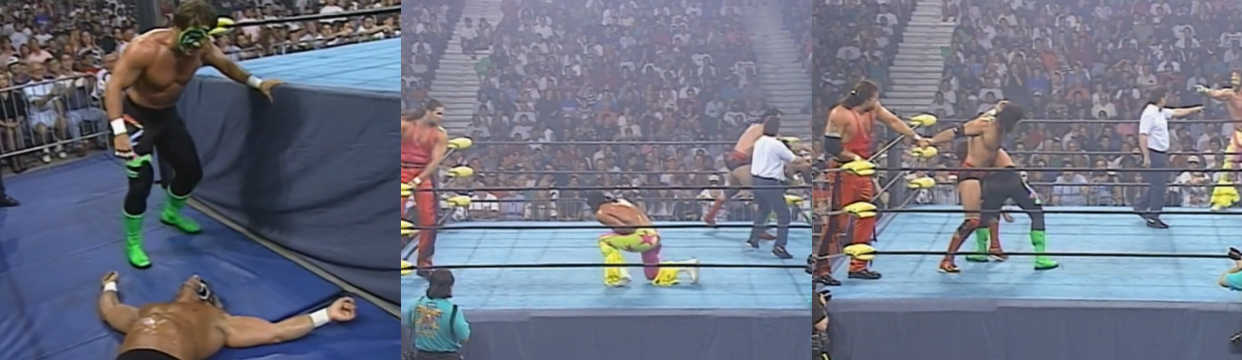
With Luger taken out, the Outsiders worked over Sting’s ribs and cheated for an advantage.
Sting, Luger, and Savage came to the ring together, so united as a team that they even wore matching face paint, and things quickly got tense as Luger and Hall got into a slanging match all while the commentary team bickered distrustfully amongst themselves since the Outsiders had done such a good job of sowing dissension throughout WCW. Hall and Luger started the match; Hall disrespectfully tossed his toothpick in Luger’s face, earning him a good ol’ slap to the jaw and a forearm shot across the forehead despite beating on Luger in the early going. Luger was all fired up, even taking a cheap shot at Nash, but Sting was forced to save him from a Nash headlock with a Stinger Splash in the corner. Unfortunately, Luger bashed his head on the ring post, evening the odds as doctors stretchered him away. Regardless, Sting went after Hall in a flurry, bashing his head off the mat, planting him with an Inverted Atomic Drop and a facebuster, but Hall was able to counter Savage’s top-rope axehandle with a shot to the gut. Rather than tagging out, Hall goaded Sting, distracting the referee and allowing Nash to hit Savage with Snake Eyes, but he immediately recovered to clothesline Hall to the mat for the first near fall of the match. Hall tagged in Nash; Savage (accompanied by Rhodes’ shouts of “Who be bad now?!”) used his quickness at first but the big man shut him down with some slow shots and a big body slam. Thankfully, Savage avoided an elbow drop and tagged in Sting, but he immediately took a beating in the corner from some repeated elbow strikes before being choked by Nash’s long, unstable leg. Sting countered a whip into the opposite corner and floored Nash with a dropkick but couldn’t get him over for a sunset flip pin and ate a lifting choke for his troubles. Hall tagged back in, hitting his trademark Fallaway Slam for a two count, but Nash came back in for a Big Boot and starting working over Sting’s ribs. Sting was able to duck under a clothesline and hit a low dropkick to bring Nash to the mat, but Hall tagged in to cut off both his opponents before dropping a bunch of elbows before wrapping the Stinger up in the Abdominal Stretch (with an assist from Nash) to really milk the crowd. Even when Nash slipped in behind the referee’s back to take over the hold and continue to work over Sting’s ribs and Sting was able to break free, he was too hurt to make the tag and got cut off again by Hall, who scored a two count of a clothesline.
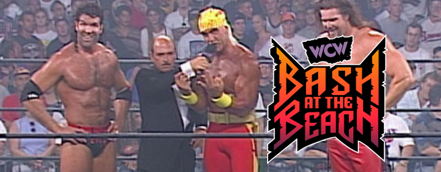
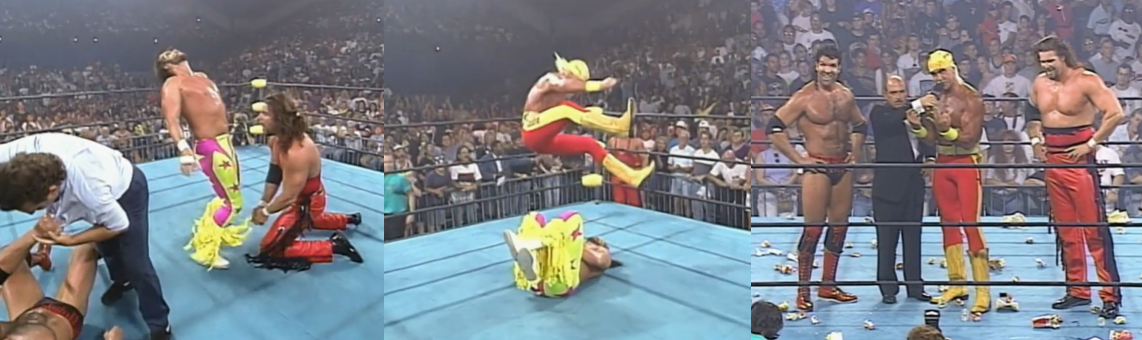
Savage’s comeback was cut short by Hogan’s shocking turn and the infamous formation of the nWo!
After a brief sleeper hold, Hall dumped Sting to the outside, where Savage threatened to attack Nash with a steel chair when the Outsider made a move towards Sting. Back in the ring, Sting continued to play “face-in-peril”, eating a big Sidewalk Slam from Nash but kicking out at two, who was so frustrated that he rammed Sting’s head into the corner. Sting finally started to mount a comeback with a bunch of punches and leapt at the big man with a standing crossbody to tag in Savage. The crowd erupted as the Macho Man took out Hall, smacked his head into Nash’s, and started pounding away on Nash, landing repeated top-rope axehandles on Hall. A shot to the balls shut down Savage’s assault, however, leaving all four men lying; the crowd erupted again as Hulk Hogan came to the ring, presumably to help his fellow WCW teammates out, but instead chose to Hogan hit the Atomic Leg Drop on the prone Savage, twice, before high-fiving Hall and Nash. Hogan tossed the referee from the ring, hit another Atomic Leg Drop on Savage and then pinned the Macho Man as Hall made the three count. The crowd wasn’t really sure how to react at first but, as the smirking trio celebrated, cups and other trash started to fill the ring; one enraged fan even tried to rush them, only to be rightfully beaten down as a result. In the aftermath, Okerlund demanded answers from Hogan, who cut a scathing tirade against WCW, its fans, and heralding the birth of the “New World Organisation”. Finally having had enough to the fans and the businessmen taking his fame and popularity for granted, Hogan vowed to tear WCW down and destroy everything in his path to dominate the industry, with the three men absolutely revelling in the crowd’s disgusted reaction. Honestly, the match wasn’t too much to shout about; it was a fairly standard tag team bout, with the bad guys cheating for an advantage and setting up Savage for a big hot tag, but the ending is what makes it truly memorable. Once Hogan came to the ring, I think you could probably guess that he was going to turn (Heenan screaming “Who’s side is he on?!” didn’t help…) so it might’ve been better if he’d come out alongside, say, Luger to cast a bit more doubt over him and the after match promo was a bit long-winded, but there’s no denying that this marked a significant turning point for all involved.
The Aftermath: Of course, this event saw the birth of the nWo and Hogan’s transformation into the arrogant, embittered “Hollywood” Hogan. The nWo immediately reinforced their message over the next few weeks by brutally assaulting WCW wrestlers after their matches and backstage, before establishing their dominance when Hogan captured the WCW Championship from the Giant at the next pay-per-view event, Hog Wild. Soon enough, the nWo became the hottest thing not just in WCW but the wrestling world; audience tuned in every week to see what they’d get up to next, who would join the increasingly growing group, and bought their t-shirts and merchandise by the thousands. The nWo proved so popular that Bischoff proposed giving them their own television show, but this fell through and an nWo-centric pay-per-view proved less than successful. As established, during the nWo’s first year, their greatest threat loomed in the rafters as Sting bided his time before challenging Hogan, but Hogan’s revived career wouldn’t be so easily upended. Even as the nWo splintered into other factions and began to wind down, WCW continued to milk the group for all it’s worth; they were such a prominent faction that, when Hogan, Hall, and Nash finally returned to the WWF in 2002, they were brought in as the nWo for a short-lived and poorly-handled revival. Although the group was officially disbanded later in 2002, they continued to make sporadic appearances; generally represented as the original three, sometimes alongside their “sixth member”, X-Pac, the nWo bizarrely defended Sting during his WrestleMania match against Triple H and were inducted into the World Wrestling Entertainment (WWE) Hall of Fame in 2020.
My Rating:
⭐⭐⭐
Rating: 3 out of 5.
Pretty Good
What did you think to the clash between WCW’s defenders and the invading Outsiders? Were you excited by Hall and Nash’s shocking appearance in WCW at the time? Who did you think the third man was going to be? What was your reaction when it turned out to be Hulk Hogan? Were you a fan of the nWo and, if so, who were your favourite members of the super group? What are some of your favourite matches and moments from WCW’s Bash at the Beach pay-per-views? Whatever your thoughts on the nWo, Bash at the Beach, and WCW, feel free to voice them below.
The Date: 18 November 2001 The Venue: Greensboro Coliseum Complex; Greensboro, North Carolina The Commentary: Gorilla Monsoon and Jesse “The Body” Ventura The Referee: Joey Marella The Stipulation: Ten-man elimination tag team match The Competitors: Team Hogan (WWF Champion Hulk Hogan, Bam Bam Bigelow, Don “The Rock” Muraco, Ken Patera, and “Mr. Wonderful” Paul Orndorff), Team André (André the Giant, “The Natural” Butch Reed, King Kong Bundy, One Man Gang, and “Ravishing” Rick Rude)
The Build-Up: Over its many decades as the dominating force in sports entertainment, World Wrestling Entertainment (WWE) has been known for creating some of the industry’s most successful competitors, changing the face of pay-per-view entertainment, and delivering genre-defining match types and wrestling cards. In 1987, the World Wrestling Federation (WWF, as it was known then) had taken their first step towards global domination with the successful gamble that was WrestleMania, a pay-per-view showcase of their greatest talent that brought the organisation into the mainstream with celebrity cameos. With the National Wrestling Alliance (NWA) due to broadcast their Starrcade event over the Thanksgiving weekend, WWF chairman Vince McMahon add the Survivor Series event to the WWF’s calendar and strong-armed many cable companies into showing his event instead of Starrcade or risk losing out on WrestleMania IV. The entire event was comprised of four ten-man elimination tag team matches, with the main event pitting WWF Champion Hulk Hogan and his team against bitter rival André the Giant and his team of bad guys (or “heels”). The motivation behind the two forming teams and squaring off came from André’s heel turn earlier that year, which saw him memorably challenge the Hulkster at WrestleMania III only to be planted with an iconic body slam. Since André was managed by one of wrestling’s greatest heel managers, Bobby “The Brain” Heenan, it made sense for him to ally with Heenan’s smorgasbord of man-mountain wrestlers, though Hogan wasn’t short on allies either, with the recently debuting Bam Bam Bigelow and the now-righteous (or “babyface”) Ken Patera joining Hogan’s team to get some payback against Heenan and his goons.
The Match: Honestly, I’ve had an on-again, off-again relationship with the Survivor Series over my many years as a wrestling fan. When there’s an actual storyline behind it and the teams make sense, it can be a fun concept but, often, the WWE cobble together teams just because the event is coming up and they even stupidly diluted the concept by having a separate Bragging Rights event that really should’ve just been merged with the traditional Survivor Series card. The WWE fluctuates its focus on tag teams at the best of times and large teams (or “stables”) of wrestlers are difficult to come by in the modern WWE landscape, which can make justifying a ten-man elimination match difficult. However, when it works and is used sparingly, it can be a unique concept and, from what I can tell from my research, it made sense to form these two massive teams and extend the Hogan/André rivalry in a way that both protected the latter, whose health was deteriorating rapidly at this point, and build anticipation for their inevitable rematch for the WWF Championship. The match began with Heenan in the ring giving a special introduction to the “Eighth Wonder of the World”, who lumbered to the ring and greeted his teammates. Jesse Venture raised the question of whether Hulk Hogan could truly trust Paul Orndorff who, until recently had been more of a heel, teasing the potential for dissention within Hogan’s team but, when interviewed by “Mean” Gene Okerlund backstage, Team Hogan seemed incredibly fired up for the match. Each man made his way to the ring to an ever-increasing rapture from the crowd, which exploded into a crescendo as the Hulkster came down the aisle way carrying Ol’ Glory, his focus squarely on André (and playing to the audience).
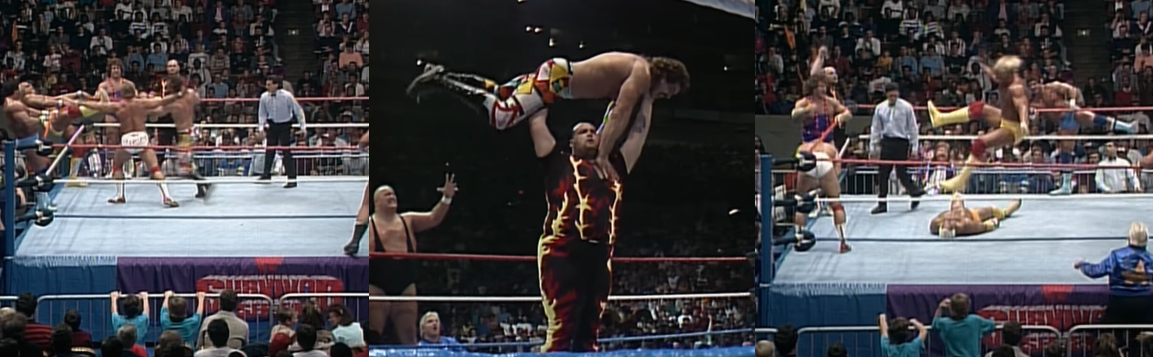
Although Rick Rude took the brunt of the early assault, it was Butch Reed who was the first to be eliminated.
Don Muraco and Rick Rude started the match for their respective teams, with the two exchanging blows in the corner before Rude took advantage with an eye rake. A boot to the gut cut off Rude’s attack, however, and Rude tagged in Paul Orndorff, who came off the top rope with an elbow strike. A shot to the gut and a knee strike saw Rude on the receiving end of more offense before Orndorff rammed him head-first into Hogan’s boot and tagged in the champion. Hogan planted Rude with a clothesline and then dropped three elbows in quick succession before tagging in Bam Bam Bigelow, slamming Rude and setting him up for a big body splash from Bigelow, which he followed with a military press before tagging in Ken Patera. Although Patera attacked right away, Rude was able to collapse in his corner, finally allowing another heel, Butch Reed, to get in the ring. Reed didn’t fare too well, however, easily being taken down and rolled up into the first pin attempt of the match and falling afoul of a dropkick courtesy of Don Muraco. Orndorff then showed up his teammate by tagging in and delivering two dropkicks of his own and even getting a cheap shot in on King Kong Bundy before dodging a Reed elbow shot in the corner and bringing the Hulkster back into the match for a double clothesline. Hogan then hit the Atomic Leg Drop and Reed was eliminated without even throwing a single punch; Hogan was spared from tangling with André after tagging in Patera during his celebration. Since André only wanted Hogan, though, he immediately tagged in Bundy to face the Olympian.
Thanks to eye rakes and cheap tactics, the heels scored two eliminations in quick succession.
Patera went on the attack right away, even downing Bundy with a clothesline, but he was too slow to keep the One Man Gang from tagging in to lock up with Orndorff. One Man Gang initially, very briefly, actually got to show some offense but Orndorff fired back with a slew of punches that rocked the big man; a counter in the corner shut Orndorff down, however, and allowed Rude to come back in and start working him over…until Orndorff scored with a clothesline, a body slam, and an elbow drop for a two count. Muraco came back in to hit a stiff clothesline but a thumb to the eye allowed Rude to create some separation and tag in the One Many Gang but Muraco was able to avoid a corner charge, roll over to his corner, and tag in Patera, who survived another eye rake to hit an awkward running crossbody for another near fall. Although Patera hit a running knee to the corner, another thumb to the eye allowed the One Man Gang to put a beating on the Olympian in the heel corner with the assistance of his teammates. A standing front facelock slowed the match to a crawl and then the One Man Gang managed to pin Patera for the three count following an awkward “double clothesline” for an anti-climactic elimination. Hogan immediately went after the One Man Gang, throwing hands, rushing him into a corner, and then bringing in Bam Bam Bigelow for a double Big Boot. Whatever momentum Bam Bam had built up went right out the window, however, when the two big men clumsily bumped heads off a double shoulder block, which saw Rude and Orndorff go at it again. Orndorff panted Rude with a suplex, another elbow drop, and a flapjack before Bundy ran in to interrupt a piledriver attempt; this was enough for Rude to score a roll up with a handful of tights to eliminate Mr. Wonderful from the match.
After twenty-five minutes of plodding action, Hogan and André finally squared off once more.
Rude made the mistake of flexing to rile up the crowd, meaning Muraco planted him with an atomic drop and a clothesline before bringing in Bam Bam to deliver a big side kick. A big suplex set Rude up for a rare running knee strike from Hogan, who then brought Muraco in for a powerslam and that was enough to take Rude out of the match and even the odds at three-on-three. Bundy came in and started beating on Muraco, downing him with a back elbow smash, but he missed a running knee strike; Muraco targeted Bundy’s leg with a series of attacks but Bundy was able to fight him off and bring the One Man Gang back in. The Rock’s attempts to fight off the One Man Gang saw him crushed under the big man’s weight; he was able to kick out at two, however, so the One Man Gang threw him into an inelegant headbutt from André which, when coupled with a body splash, was enough to eliminate the Rock. The One Man Gang switched his focus to Bam Bam Bigelow, crushing his chest when he went for a sunset flip pin and bringing in Bundy to hit a powerful clothesline that turned Bam Bam inside out. Hogan broke up the pin attempt but Bundy stayed in control and brought the One Man Gang back in, who shut down Bam Bam’s counterattack with, what else, but a thumb to the eye before choking him on the ring ropes. Bundy came back in for a knee to the gut and a double axehandle smash before quickly tagging the One Man Gang back in. A back elbow caught Bam Bam right in the eye and Hogan, and the crowd, were absolutely desperate for the big man to make the tag as Bundy came back for some more punishment. Bam Bam managed to avoid the elbow drop, and kick out of a pin attempt, and finally made the tag after rolling to the corner and avoiding a big chop from André. Hogan attacked his rival with a flurry of punches; they exchanged strikes and chops in the corner before Hogan slamming André’s face into the top turnbuckle, but his offense was interrupted when Bundy pulled him from the ring.
Bam Bam fought valiantly but ultimately fell, leading to Hogan to attack André after the match.
The two brawled at ringside, with Hogan slamming both Bundy and the One Man Gang on the outside, but he took so long messing about with the two that he got counted out! The crowd was incensed as Hogan was forced from the ring, leaving Bam Bam all alone in a three-on-one situation, much to Hogan’s disgust. Showing no fear, Bam Bam went right for Bundy, planting him with a clothesline and scoring a two count off an elbow drop and a falling headbutt. After dodging a Bundy charge in the corner, Bam Bam finally eliminated the big man with an impressive slingshot splash from the ring apron but he was too fatigued to fend off the One Man Gang, who immediately choked and beat him on the ropes. Still, Bam Bam easily kicked out of a clothesline (that looked to give the One Man Gang a heart attack) and had the wherewithal to dodge a splash off the top rope. This one mistake cost the One Man Gang and meant the match boiled down to Bam Bam and the lumbering André, who wasted no time smacking Bam Bam around with big chops and headbutts. Bam Bam used the ropes and his comparative quickness to avoid André’s plodding attacks but a missed splash in the corner saw him taking some shoulder blocks to the spine and being easily pinned following a half-underhook, facelock slam…suplex…thing. As André was announced the winner, Hogan stormed the ring and attacked the Giant with the WWF Championship, stealing the spotlight and entertaining the raucous crowd with his trademark flexing while André seethed on the outside. I don’t really like to rag on this era of wrestling too much; things were obviously very different back then, but this was a bit of a let-down considering some of the star power and storylines featured in it. Obviously, André couldn’t really do a lot and needed to be protected but we barely got to see him and Hogan go at it again, much less really see the Giant in any kind of action. It works on the one hand to show him as this unbeatable “final boss” but…we know he can be beaten as we saw Hogan pin him at WrestleMania III so I think I would’ve preferred to see him and Hogan as the final two and them brawl to a double count out. Interestingly, this ended up primarily being a showcase for Bam Bam; he was the last man on Team Hogan and impressed the most with his athleticism for such a big man but, on the flip side, there was way too much boring, plodding offense from the One Man Gang and King Kong Bundy was barely a factor in it as well. As a first go-around for the concept, the WWF definitely put some of their biggest names into it but it’s clear a lot of them were limited in their mobility and having Hogan get counted out only to run in for the cheap heat at the end made this a pretty mediocre affair.
The Aftermath: Naturally, the issues between Hulk Hogan and André the Giant continued to be a focal point of the WWF’s programming; André joined forces with “The Million Dollar Man” Ted DiBiase and the two continued to harass Hogan until he agreed to another championship match at The Main Event. This time, André came out on top, though he immediately sold the belt to DiBiase at it was subsequently held up for grabs in a tournament at WrestleMania IV. Don Muraco, Butch Reed, the One Man Gang, Bam Bam Bigelow, and Rick Rude all made it onto the WrestleMania IV card as well, participating in the same tournament, but they would all fall short. Even Hogan and André lost the chance to regain the belt thanks to a double disqualification, so the vacant belt went to “Macho Man” Randy Savage for the first time after he defeated DiBiase in the main event. As for the Survivor Series, the event continued to be an annual part of the WWF/WWE calendar, with multi-man and woman matches taking place regularly every year. The event would be shaken up somewhat by being used as the staging ground for the final clash between the WWF and the alliance of World Championship Wrestling (WCW) and Extreme Championship Wrestling (ECW) and also saw the first appearance of the Elimination Chamber match and clashes between the WWE’s flagship shows, Raw and SmackDown!
My Rating:
⭐⭐
Rating: 2 out of 5.
Could Be Better
What did you think to the inaugural Survivor Series match? Were you excited to see Hulk Hogan and André the Giant across the ring from each other and thus disappointed that they barely interacted in the match? Who was the stand-out performer for you in this clash? Do you think André winning was the right decision? Were you also annoyed that Hogan got counted out? Which Survivor Series match or event is your favourite? How was your Thanksgiving this year? Whatever your thoughts on Survivor Series, feel free to leave them below or drop a comment on my social media.
Released: 20 March 2009 Developer: Yuke’s Also Available For: Mobile and PlayStation 3
The Background: On March 31st, 1985, Vince McMahon changed the face of the wrestling landscape forever by bringing together the biggest names in wrestling (alongside a number of celebrity guests) for the very first WrestleMania, a pay-per-view extravaganza that became the hottest event of the calendar year for World Wrestling Entertainment (WWE). The WWE has a long and storied history with videogames that can be traced all the way back to the very first videogame ever produced baring the initials of their previous moniker of the World Wrestling Federation (WWF), MicroLeague Wrestling (MicroLeague/Various, 1987). A number of releases made their way to various home consoles and even arcades over the years, with the format slowly evolving to include more and more wrestlers and match types, but the WWE’s foray into digital entertainment largely hit its stride in the late-nineties when Asmik Ace Entertainment, AKI Corporation, and THQ joined forces to produce popular titles for the Nintendo 64 and Yuke’s took their first tentative steps into the SmackDown sub-series (2000 to 2003). Many of the games produced during this time and by these developers are considered to be some of the best wrestling games ever made and, by 2009, the WWE was represented by the multi-platform SmackDown vs. Raw series (Yuke’s, 2004 to 2011), a series which was largely regarded as mostly hit and miss in terms of value for money and year-on-year improvements. Still, the series was profitable enough to convince Yuke’s to attempt a few additional WWE videogames, with Legends of WrestleMania being one of them; pushed intro production to coincide with WrestleMania 25, and focused far more on nostalgia and giving players the chance to relive and redefine some of the company’s biggest moments, Legends of WrestleMania was met with largely lacklustre reviews that took issue with its presentation and control mechanics.
The Plot: Take control of a WWE Legend and relive some of the biggest WrestleMania moments of all time, such as Hulk Hogan’s legendary clash with Andre the Giant and Bret “Hitman” Hart’s bloody showdown with “Stone Cold” Steve Austin, or rewrite and redefine history by playing these matches, and others that never took place, from the perspective of the loser (or another WWE superstar).
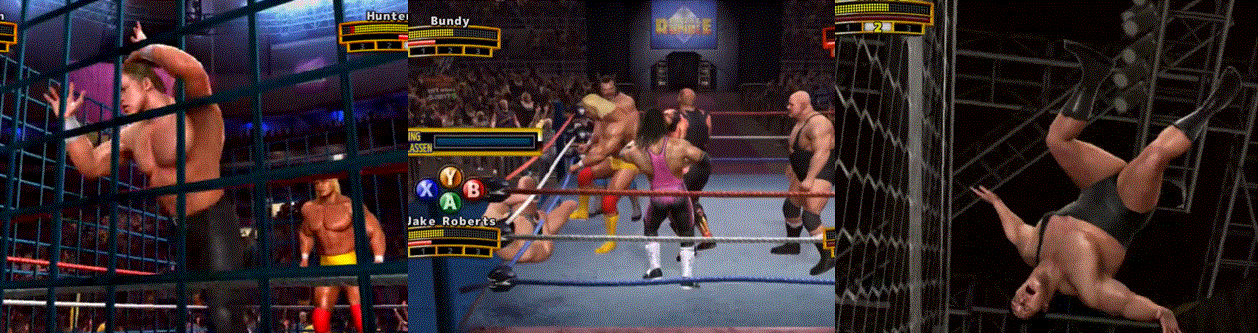
Gameplay: WWE Legends of WrestleMania is a wrestling title that gives players the chance to select from a roster of thirty-eight WWE Legends and pit them against each other in a series of matches, many of which will be immediately familiar to fans of the WWE or anyone who’s played one of Yuke’s WWE videogames before. Unlike many of the SmackDown! videogames, the focus here is much more on fast-paced, arcade-style action rather than simulating a real-life wrestling match, which has both positive and negative impacts on the gameplay. Players can move their Legend using either the left analogue stick or the directional pad (D-pad); having grown up playing the likes of WWF No Mercy (Asmik Ace Entertainment/AKI Corporation, 2000), I generally prefer to use the D-pad for these games (and most fighting games) as it feels more intuitive, but there’s little benefits from favouring one or the other. You can double tap towards or away from your opponent to run, but I had extremely minimal success with this; in most WWE games, running is mapped to one of the shoulder buttons, making it quick and easy to use, but that’s not that case here so the majority of my matches were slower, clunkier affairs as a result.
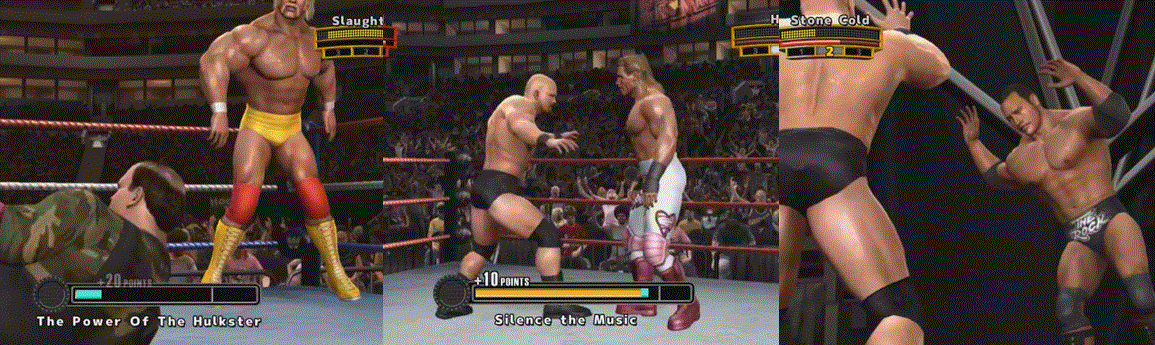
Gameplay is heavily based around QTEs and button mashing.
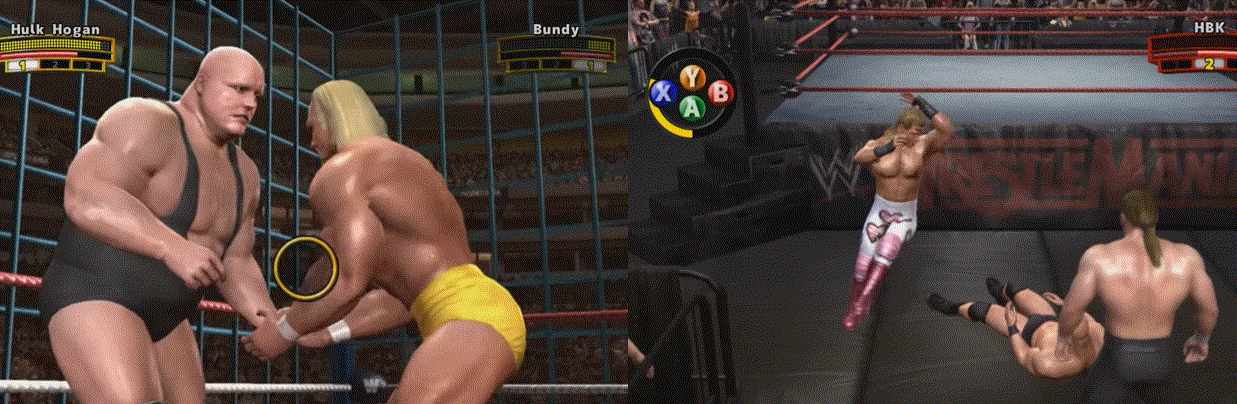
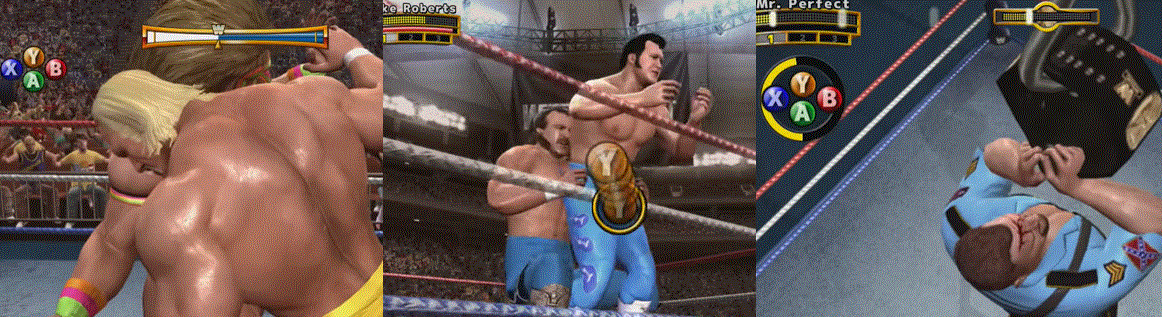
You can throw a strike at your opponent with X; land a few in quick succession to perform a simple combo or hold X to charge up a powerful strike, with both knocking them to the mat and leaving them prone for a leg or elbow drop or other ground-based offense. Grappling is performed with A; again, you can either tap it for a quick, weak grapple, or hold it for a stronger grapple, and use a directional input in conjunction with A to perform different moves (though your move pool is quite limited). As you attack and mix up your offense, you’ll build up a “Chain Meter”; as it reaches three different levels, you’ll gain access to more powerful grapples, with your finisher being unlocked at Level 3 and performed by pressing X and A together. Successfully landing attacks drains your opponent’s health meter and weakens them for either a pin or submission; submission moves are generally locked in when the opponent’s on the mat and see you mashing buttons to wear your opponent down, or you can pin them with B. If either of these things happen to you, you’ll need to mash buttons or full a circular meter to hit a small target in order to stave of the attack or kick out of the pin attempt.
While reversals can be tricky to pull off, finishers are a matter of hitting onscreen button prompts.
You’ll need to mix and match your offense in order to build up your Chain Meter (though simply mashing X can work just as well), and you can sacrifice a chunk of it by taunting with B and Y and gaining temporary buffs. This can all be a little clunky but it generally works quite well; what doesn’t work quite as well is the game’s reversal system. Rather than map counters to a shoulder button, WWE Legends of WrestleMania has them performed by pressing away from your opponent and Y or holding Y to block. I found this to be incredibly unreliable, as my Legend would often just step backwards or even run away, and I really don’t understand why this wasn’t just mapped to the Right Bumper. Unlike the majority of other wrestling games, WWE Legends of WrestleMania heavily relies on button mashing, button inputs, and quick-time events (QTES); you can’t even Irish Whip your opponent without a QTE flashing on the screen and many of the event matches in the WrestleMania Tour mode start, or are punctuated by, QTE sequences that see you mashing or hitting buttons in a test of strength, chain grapple, and other similar sequences. This also extends to the finishers; after pressing X and A, you’ll need to hit the QTE prompts to land your finisher sequence and do the maximum amount of damage, which is certainly unique but it comes at the cost of severely limiting the amount of finishers available in create-a-wrestler mode
There’s not much to differentiate the wrestlers but managers add a little spice to the matches.
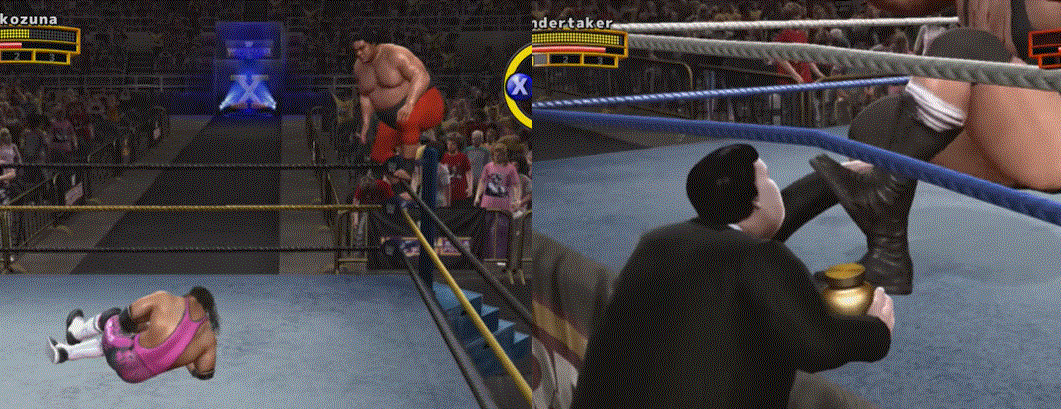
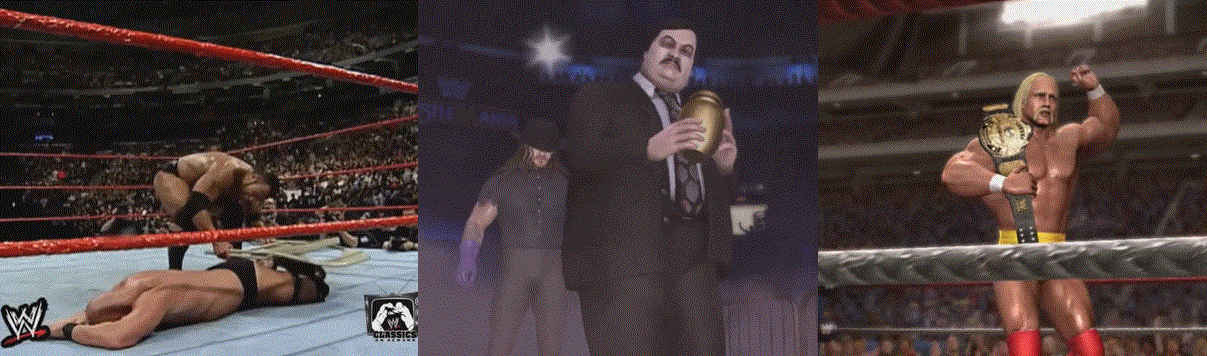
Contrary to other wrestling videogames; there isn’t really a weight class or detection system in WWE Legends of WrestleMania; playing as King Kong Bundy is largely the same as playing as Shawn Michaels, but there are some notable exceptions. For example, while Mr. Perfect can body slam and lift the likes of Yokozuna without issue, some Legends are noticeably more nimble than others and some superheavyweights struggle with climbing cage walls and are limited in their aerial offense. Some wrestling games like to lump their roster into categories and assign them abilities that play to their strengths, but that isn’t the case here so the majority of the roster’s differences are reflected in their move pool: Jimmy “Superfly” Snuka isn’t going to be quite as technically adept as Ric Flair but it’s not as though the Undertaker exhibits any supernatural abilities that other big men, such as the Big Boss Man, have. One major aspect of the game is the presence of managers; the likes of Paul Bearer and “The Mouth of the South” Jimmy Hart can accompany Legends to the ring and can interfere on your behalf at the cost of your current Chain Level, which makes them super useful when they’re in your corner and quite the hindrance when they’re in your opponent’s.
All the standard match types are available, with plenty of button mashing and QTEs sprinkled about.
Wrestling matches have all the standard options you might expect; you can set the difficulty level of the CPU in the options, manipulating the computer’s use of strikes and reversals and such, and customise win conditions (such as turning pin falls and disqualifications on or off and changing the amount of time you can spend outside of the ring). There’s also a number of additional match types on offer that will be recognisable to fans of wrestling games, with most featuring a twist in the game’s new engine and mechanics that mostly boil down to button mashing. You’ll need to mash buttons to either escape from, or prevent your opponent from escaping, a cage or break up a pin fall in a tag team match, for example. Similarly, you’ll find finishers disabled in the Royal Rumble match (there aren’t even special Royal Rumble finishers like in other games) and you’ll instead have to mash buttons to try and force your opponent out of the ring or save yourself from elimination. These components are less prominent in Hell in a Cell and ladder matches, however; you can start Hell in a Cell on top of the structure, which is a nice touch, and can throw your opponent through the cage wall or down to the ring using environmental grapples. Ladder matches are actually much more enjoyable than in other wrestling games I’ve played; you pick up a ladder (or any weapon) by double tapping B and a helpful glowing target shows you where to set it up and climbing and retrieving a championship belt is quite simple compared to other wrestling titles. Retrieving a weapon from under the ring can be a little trickier, though, as can utilising the ringside area or battling into the crowd or up the aisleway, as it requires you to hit A in specific areas around the arena, which can be difficult thanks to the janky controls. You’ll also find such staples as Iron Man matches and Last Man Standing matches on offer here, which are fun ways of mixing up the gameplay, but there’s nothing to really set the game’s matches or gameplay apart from other wrestling titles and very few of these appear in WrestleMania Tour.
WrestleMania Tour sees your reliving, rewriting, and redefining classic matches.
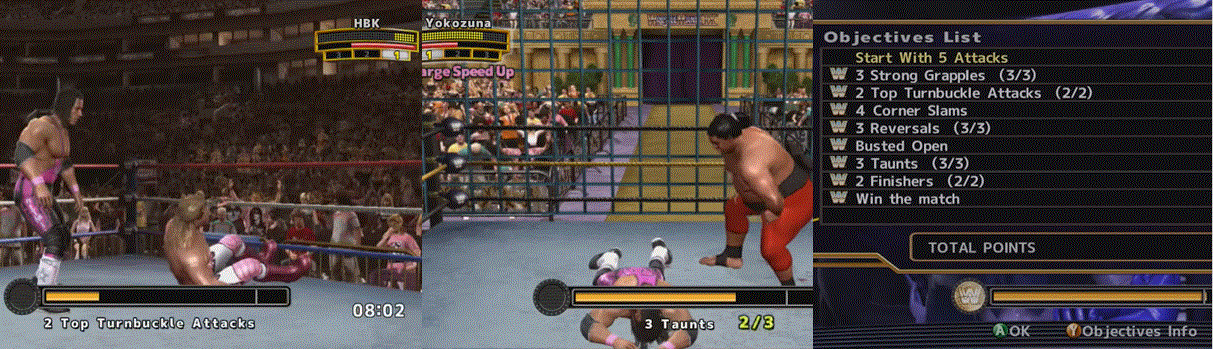
Speaking of which, you’ll be given three single-player options here: “Relive” (where you recreate specific WrestleMania matches), “Rewrite” (where you tackle other WrestleMania matches from the perspective of the historical loser), and “Redefine” (which features unique “dream matches”). Each of these matches is proceeded by a short hype package that features clips from real-life wrestlers and the matches and feud between the competitors, and you’ll be given a series of optional objectives to fulfil in order to earn points. These range from performing a certain number of attacks, grapples, counters, and finishers, winning the match, performing taunts, winning pre-match sequences, and more specific environmental situations (such as winning Chain Grapple sequences, slamming your opponent through an announce table, or grappling up near the entrance). Earning points fills a meter and, once it fills high enough, you’ll earn a medal that will award you with unlockable match types, attires, and more. There’s nothing to gain from playing WrestleMania Tour on anything other than the easiest difficulty, with the computer’s abilities completely neutered in your favour, beyond personal pride so you may as well manipulate the game’s settings to make things easier for you. This mode is also probably the best part of the game as it lets you recreate some iconic WrestleMania moments and matches, and meeting the objectives can be fun, but things quickly get quite frustrating if you’re trying to earn all the medals and monotony sets in quite fast as there’s not much variety in terms of the match types (there are no multi-man matches in this mode, for example) beyond the odd cage or ladder match and you can completely ignore the objectives if you like since winning is all that really matters.
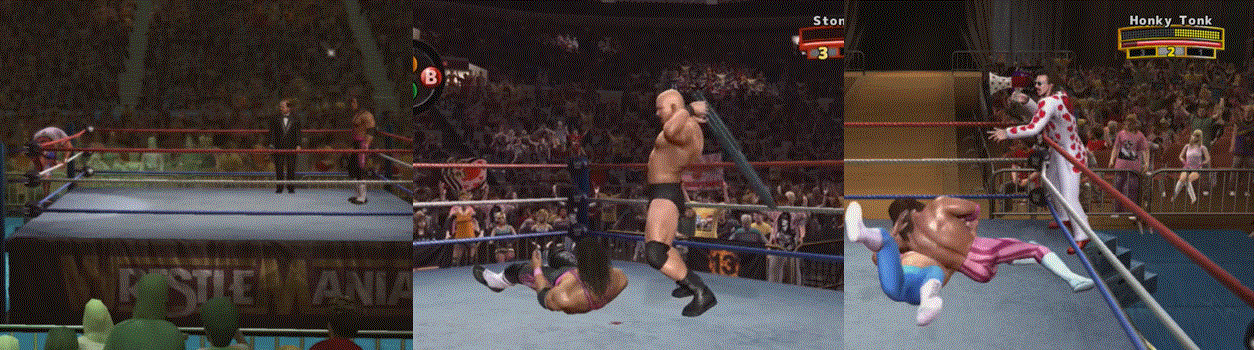
Graphics and Sound: Wrestling games can be a bit hit and miss when it comes to their graphics, especially with their in-game character models. WWE Legends of WrestleMania favours a slightly exaggerated, action figure-like aesthetic for its Legends, which is typically common when bringing the WWE’s old school superstars to life, and for the most part this actually looks a lot better than in some of the SmackDown! titles. This is primarily because WWE Legends of WrestleMania is largely consistent with its presentation, rather than fluctuating wildly between hyper realistic and massively off-model. Notably, however, you won’t find any female Legends or superstars on offer here, and there’s no on-screen referee either, which is a pretty big step back for me.
While character models look pretty good, the camera and arenas leave a lot to be desired.
The number of arenas on offer isn’t exactly much to shout about either. There’s very little variety on offer as you can only fight in WrestleMania arenas; there is a Royal Rumble arena, however, (and ironically you can only ever fight a Royal Rumble match in this arena) but there’s no Raw, SmackDown!, or other pay-per-view arenas on offer. The crowds are as sub-standard as ever, sporting signs and attire tied to their favourite superstars and parting to allow you to fight over the barricade (though essentially acting as barriers to keep you enclosed), but entrances have been a bit neutered. The game does offer the old-school gondola entrances, which is kind of cool, and recreates the old-school name plates and presentation of the pre- and early-“Attitude Era” of the WWE. Unfortunately, however, the presentation does take a bit of getting used to; the camera is very zoomed in, meaning that your Legends take up a lot of screen space and this can make it a little difficult to be fully aware of your surroundings. The camera is prone to wild swings and odd positioning, which is very annoying, and there’s a noticeable delay between button presses and executing grapples, making for a much more deliberate and slower pace to the game. Though I eventually learned to live with these niggling problems, it did take me a while to adjust to the presentation and gameplay style of the game.
Video clips add some historical context but the commentary continues to be mundane and predictable.
The inclusion of video clips and real-world footage adds to the drama and intrigue of the WrestleMania Tour mode, but these are nothing you haven’t really seen before in a wrestling title. The same goes for the entrance videos and music, which is all pretty much as you’d expect (with a few inconsistencies here and there, such as the Big Boss Man utilising his Attitude Era theme), and this extends to the in-game commentary. Provided by the legendary duo of Jim Ross and Jerry “The King” Lawler, the commentary is basically exactly the same as in the SmackDown! series, though there are some specific new sound clips added in to refer to the game’s roster and the rivalries on offer in WrestleMania Tour. I don’t play these games for in-depth commentary or crowd reactions but even I was astounded by how cheap and lazy these aspects were here. The same can be said of the create-a-wrestler options, which offers clothing, body, and hair options all ripped straight from the SmackDown! games but actually have less to offer in some respects: there’s less naming options available, less moves, less finishers, and even less clothing options as everything is geared towards meeting the old-school aesthetic and altered gameplay mechanics of the title.
Enemies and Bosses: Being a wrestling title, every single in-game Legend is potentially your enemy; however, as mentioned, it’s not really necessary to play as or fight against each of the game’s roster in order to learn their strengths and weaknesses. Once you’ve played as and against a couple of the Legends, you’ve pretty much experienced all of the variety the game’s conflicts have to offer; your biggest hurdle will be getting the timing of the weird reversal system down, but you can circumnavigate this by just attacking your opponent head-on with strikes and landing strong grapples as and when they unlock. Guys like Bam Bam Bigelow might look big and intimidating, and the Honky Tonk Man might be the ultimate opportunist, but it’s not like you have to worry about character-specific abilities so what works against one will work against all as long as you can hit the QTE prompts when your opponent does get the drop on you.
Meeting objectives is pretty simple until Steve Austin butts heads with the Rock.
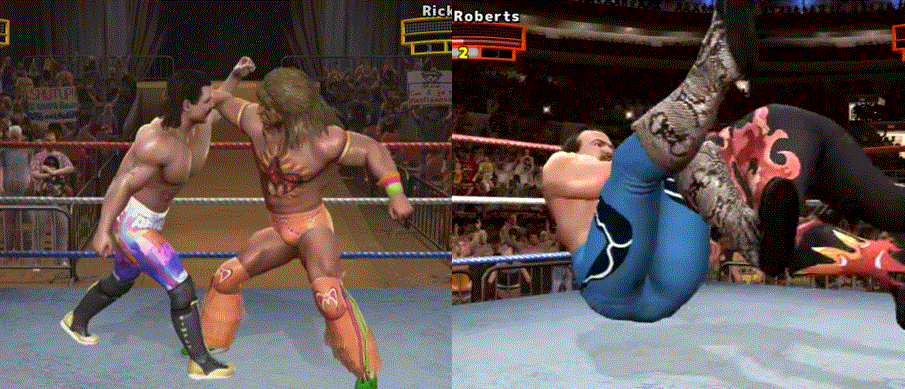
In the Relive portion of WrestleMania Tour, you’ll have to battle against specific opponents in recreations or classic WrestleMania matches; this means you’re forced into assuming the role of the historical victor, or loser, of specific matches. One of the most recurring playable characters in this mode is, of course, Hulk Hogan, who must take on King Kong Bundy in a steel cage, and Andre the Giant and the Ultimate Warrior in recreations of their iconic matches. As long as you win your matches, you’re fine, but you’ll need to meet a certain amount of objectives to earn your medal; this includes stuff like kicking out of a pin attempt, causing the opponent to bleed, or winning with a specific move. As you play through these matches, the amount and difficulty of the objectives will increase; I first noticed them becoming more complex in the classic clash between Steve Austin and Bret Hart, which requires you to attack Austin’s leg five times, fight into the crowd, utilise a steel chair, and win with the Sharpshooter but the difficulty severely ramps up for Relive’s final match. This is a recreation of Austin’s WrestleMania XV bout against the Rock; to achieve this medal, you need to meet every single objective, which can be extremely laborious as one of your objectives is reversing the Rock Bottom, to say nothing of all of the many environmental grapples you need to hit on the outside of the ring. I definitely recommend turning the game’s difficulty level and sliders all the way down in your favour and making liberal use of the health regeneration taunt to increase your chances in this match.
Objectives get even simpler in Rewrite and Redefine, meaning the medals are pretty simple to earn.
In Rewrite, you tackle different WrestleMania matches in the role of the historical loser and must fulfil different objectives in order to change history. Since you’re rewriting the outcome of these matches, these objectives are far less demanding and start off as simple stuff like performing and reversing grapples, taunting, and hitting a finisher and don’t really get more complex than landing more attacks, performing more taunts, maybe making the opponent bleed, and performing multiple finishers and reversals. Honestly, these matches were an absolute breeze, with even Bret and Shawn’s infamous WrestleMania XII Iron Man match providing little challenge beyond a ten-minute time limit. This carries over to Redefine, though the matches and competitors at least have a little more variety; here, you can pick which Legends you want to play as and will witness the likes of Andre and Giant and Big John Studd in a Hell in a Cell match and Mr. Perfect and the Big Boss Man in a ladder match. Redefine culminates with a dead simple no disqualification match between the Undertaker and King Kong Bundy that might have a lot of objectives but they’re nothing compared to the Austin/Rock match (boiling down to stuff like hitting five moves in a row at the start, two top rope moves, three reversals and taunts, and two finishers, which is still laborious but nowhere near as frustrating as in that aforementioned match).
Power-Ups and Bonuses: There are a few options available to you during matches to help turn the tide in your favour; you can toss your opponent to the outside of the ring and interact with the steel steps, announce tables, and barricades to deal more damage to your opponent and, when your opponent is positioned correctly, pull weapons out from under the ring to bust them open or beat them down. When near the aisleway, you can clunkily force them up to the entrance way where there are often other environmental grapple points on offer that let you choke your opponent with wires, toss them into the stage dressing, and even make use of a drum kit but there’s no backstage brawling here. As your Chain Meter builds up, you gain access to taunts that can provide you with temporary buffs; these include regenerating your health, upping your speed and durability, and making reversals easier to pull off for a limited time. Managers can also provide many of the same temporary buffs and also attack or distract your opponent to give you the edge in matches, though utilising these will cost you part of your meter so you’re often asked to pick between receiving a temporary buff or earning your finisher.
Additional Features: There are a mere nineteen Achievements on offer in WWE Legends of WrestleMania, which is astoundingly low for a wrestling title. Achievements are primarily tied to obtaining medals in WrestleMania Tour or making and using a created wrestler but you can also earn them by winning matches using only grapples or with other specific moves. Sadly, in a game featuring so many WWE Legends, there aren’t more fun or notable Achievements; for example, you can use Hogan to slam Andre all you like in the WrestleMania III arena but it won’t pop a “Unstoppable Force” Achievement. As you play, however, your win/loss record and other statistics are recorded in the “Hall of Fame”, which is good for the statisticians out there, but there’s no way to compete for championships outside of the WrestleMania Tour mode, no create-a-pay-per-view mode, general manager mode, or even WWE Universe mode so you’re basically limited to exhibition matches and the WrestleMania Tour. Well, not entirely; there is also the “Legend Killer” mode. Here, you use a created wrestler to take on six tiers, comprised of ten back-to-back singles matches and culminating in a showdown with one of six WrestleMania Legends. You’ll earn experience points (EXP) by winning matches, and even more for mixing and matching your gameplay style as you play, which you can spend upgrading your created wrestler’s attributes and earning more Achievements. The create-a-wrestler mode is basically the same as in the SmackDown! series, including many of the same hair and clothing options as in those games and you can also fully customise their entrance or even create a tag team, though there’s very little incentive without a Universe mode. While there’s no downloadable content on offer here, you can transfer basically the entire male roster of WWE SmackDown vs. Raw 2009 (Yuke’s, 2008) if you have a save file for that game on your system, which greatly expands the amount of moves and finishers available to you. While this is a cool feature, and something I wish WWE games would implement more often, it doesn’t equate to much more than adding modern superstars to the roster (which really doesn’t mean all that much as you can’t play as them in WrestleMania Tour).
The Summary: I do enjoy a bit of a wrestling title, and quickly and easily nabbing a few Achievements, and as a big wrestling fan I enjoy revisiting some of the classic wrestlers of the past but WWE Legends of WrestleMania is a quite a bare-bones title. You can see everything the game has to offer in an hour or so and plough through the main story campaign in an afternoon; the Legend Killer mode might take a little longer but it’s hardly going to take up all your time and attention like a General Manager or Universe mode. The gameplay is a bit jarring at first thanks to the odd camera perspective and the plodding, clunky, QTE-heavy nature of the mechanics, but pretty easy to master and, before long, you’ll be winning matches in no time at all, meaning the game quickly gets boring. Yes, there’s a few other match types on offer but there’s little incentive to play these as you can’t compete for belts and I can’t imagine it’s that much fun to play against other human opponents, either. The create-a-wrestler is more lacklustre than ever and there’s a strange lack of focus on guys like the Undertaker, and some notable omissions from the roster (neither Kane nor Mankind are available, for example), though the ability to transfer the roster from WWE SmackDown vs. Raw 2009 is a neat touch. Ultimately, it’s not bad if you pick it up cheap but probably not really worth keeping in your collection once you’ve mined all of the Achievements. I appreciate the developers trying something a little different but this clearly isn’t a Triple-A title and is really only for fans of the rock ‘n’ wrestling era of the then-WWF. If you’re really in the mood for an arcade style wrestling game from around this time, you’d potentially be better off playing something like WWE All Stars (THQ San Diego, 2011).
My Rating:
⭐⭐
Rating: 2 out of 5.
Could Be Better
Are you a fan of WWE Legends of WrestleMania? Did you like that the developers actually tried to do something a little different with this release or did the dumbed down gameplay put you off? Which of WrestleMania Tour’s matches was your favourite and did you ever achieve Legend Killer status? What did you think to the finisher system and the abundance of QTEs? How did you find the create-a-wrestler mode and were you disappointed by the lack of WWE Universe in this title? Were there any classic WWE superstars you felt were missing from the game and which of the available Legends was your go-to character? How are you celebrating WrestleMania’s anniversary this year and what’s your favourite WrestleMania moment? Drop your thoughts below by signing up or leave a comment on my social media to let me know what you think about WWE Legends of WrestleMania and check back for more wrestling content throughout the year.
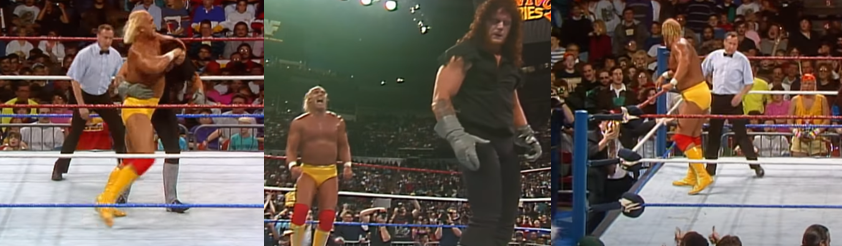
The Date: 27 November 1991 The Venue: Joe Louis Arena; Detroit, Michigan The Commentary: Gorilla Monsoon and Bobby “The Brain” Heenan The Referee: Earl Hebner The Stakes: WWF Championship match
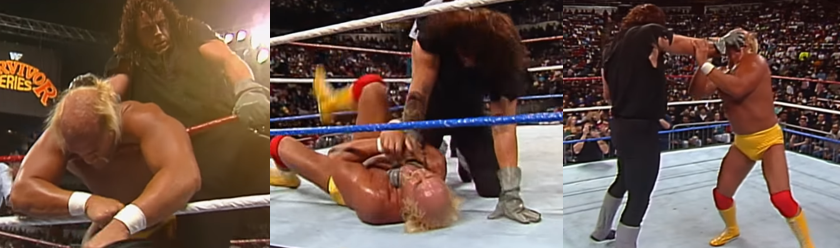
The Build-Up: The Undertaker made his debut on this day at the 1990 at the 1990 Survivor Series as a heel; aligned with Ted DiBiase’s Million Dollar Team and eventually partnered up with the repulsive Paul Bearer, the Undertaker was portrayed as a zombie-like force of nature who was impervious the pain, implacable by nature, and apparently at the whim of a mysterious urn wielded by his manager. Hulk Hogan, meanwhile, was several months into his third run as the World Wrestling Federation (WWF) Champion, having defeated Sergeant Slaughter earlier in the year at WrestleManiaVII. However, thanks to mostly being booked into squash matches, the Undertaker went unpinned (on television, at least) for a year and this impressive statistic was enough to plug him in as Hogan’s next opponent in what was billed as Hogan’s “Gravest Challenge” to date.
The Match: Rather than preceding the match with one of their trademark promo packages, this particular match is preceded by a couple of pre-taped promos from each of the competitors; Hogan, basically, has taken offense to the Undertaker and Paul Bearer’s threat to bury the hopes and dreams of all the Hulkamaniacs but ‘Taker stoically threatens that Hulkamania has had its day and is long overdue for a burial.
Hogan’s bombastic showboating soon gave way to slow, plodding offense.
During his characteristically enthusiastic entrance, Hogan made a point to upturn and demolish the casket that was placed at ringside but the Undertaker maintained his stoic demeanour and remained unimpressed with Hogan’s showboating and simply set out to do what he promised: destroy Hulkamania. Unfortunately, given that it was 1991 and early ‘Taker (as well as Hogan’s limitations), this meant a lot of slow, plodding offense and an abundance of headlocks, face and beck chokes, and slow, measured strikes from the Undertaker.
Bearer’s interference and the Undertaker’s indomitable nature kept Hogan on the back foot.
Hogan, of course, was all about the superhuman energy and resolve; even though he spends the majority of the match on the back foot and seemingly unable to actually hurt the Undertaker, he continually came back time and time again even after having his head slammed off the steel ring steps and being choked by an electrical cord. Of course, Hogan had the crowd firmly in his corner right from the beginning of the match and they exploded into cheers whenever Hogan mounted some offense and showered the arena with boos every time Bearer got involved behind Hebner’s back.
Undertaker’s moveset back then mainly consisted of dull choke and claw holds.
A far cry from the later brawling and high-impact offense of his later years, the Undertaker’s plan of attack mainly consisted of punches, clotheslines, and full-face chokes; his gameplay, apparently, was to wear down Hogan and drain him of his much-vaulted energy and, every time he pressed his advantage with a Claw Hold or similar move, ‘Taker would turn to Bearer to draw power from the mysterious urn, his eyes rolling into the back of his head, and my interest and excitement draining right along with Hogan’s vigour.
Hogan’s comeback meant nothingonce Flair snuck in a steel chair to give ‘Taker the win.
Of course, as relentless and dominating as the Undertaker was, Hogan is still Hogan; jacked up (and blown up) to the nines and full of passion, Hogan completely no-sold the Undertaker’s Tombstone Piledriver to mount his trademark comeback. This onslaught was enough to stagger the Undertaker and drive him to his knees but, right as Hogan looked to be setting up for the finish, Ric Flair sauntered down to ringside to distract Hogan. Flair then slid a steel chair into the ring, which the Undertaker summarily Tombstoned Hogan onto, and the match ended with the Deadman being crowned the new WWF Champion to the chagrin of Monsoon, the delight of Heenan, and a brief cheer from the crowd.
Sadly, it’s every Hogan match ever and even has a screwy finish to keep him looking strong.
It’s not an especially long of exciting match, to be honest; it’s basically every Hulk Hogan match you’ve ever seen as Hogan takes a beating, pulls out sly heel moves and tactics, and spends the majority of the match either on his back or taking a beating because he’s too gassed to work a long, involved match and is simply building up for his characteristic comeback. The story was far more interesting than the actual in-ring content as ‘Taker was more about slow, boring offense and shrugging off attacks and Hogan was only ever really good for pumping up the crowd and hitting his signature moves; the entire match was about a clash of ideals and wills and the potential death of Hulkamania but, whereas Hogan was able to overcome all his previous challenges, he failed to overcome his “Gravest Challenge”. However, he arguably only lost the match due to Flair’s interference and looked set to for a win before Flair distracted him, tainting the Undertaker’s iconic first championship win in true Hogan fashion, which is a shame as the Undertaker looked so dominant throughout the match and this should have been a clean win. Still, at least it’s a short match; the WWF was a very different time back then and, while I respect Hogan and his impact on the industry, I can’t say I’ve ever been a fan of his in-ring work and he didn’t seem to have a lot of chemistry with ‘Taker, who was worked a very premeditated and limited style thanks to his commitment to the zombie aspects of his character.
The Aftermath: Hulk Hogan and the Undertaker faced off in a rematch less than a week later at This Tuesday in Texas, which Hogan, of course, won and, by WrestleMania VIII, both men were embroiled in entirely separate feuds and the Undertaker would not win the WWF Championship again until WrestleMania 13 some six years later. Despite both being in the company at the same time for many years following this match, the two never crossed paths again and would not face off in a championship match until Judgment Day in 2002, when the Undertaker defeated Hogan (then billed as Hollywood Hulk Hogan) for the Undisputed World Wrestling Entertainment (WWE) Championship.
My Rating:
⭐
Rating: 1 out of 5.
Terrible
What did you think to the contest between Hulk Hogan and the Undertaker at the 1991 Survivor Series? How would you rate it compared to their other bouts and which of their feuds, matches, and moments is your favourite? Were you a fan of the Undertaker’s when he debuted and were you hyped for his showdown with the Immortal Hulk Hogan? Which of the two were you rooting for, given Hogan’s incredible popularity and the Undertaker’s dominant first year? How are you celebrating the Undertaker’s debut this year, what are some of your favourite matches and moments from his long and distinguished career, and what dream match would you have liked to see him involved in? Whatever your thoughts, drop a comment below and let me know what you think about the Undertaker.
As may already be evident, I have a long-standing preference for the WCW and WWF videogames released by AKI/THQ back in my youth; however, another WWF videogame series I have been particularly fond of and spent many hours and days of my childhood playing has been the WWF SmackDown! series released by THQ and Yuke’s on Sony’s PlayStation in 2000. Eventually, this series evolved into the WWE SmackDown! Vs. Raw franchise, which was released on multiple consoles between 2004 and 2010. I believe I came into this series with WWE SmackDown! vs. Raw 2008 Featuring ECW (Yuke’s/Amaze Entertainment/THQ, 2007) and bowed out with WWE SmackDown! vs. Raw 2011 (Yuke’s/THQ, 2010) as, by this point, it was pretty clear to me that I was simply purchasing the same videogame every year with additional wrestlers, some new match types, and minor improvements to the graphics and gameplay. As a result, I decided to buy a new title every two years or so and, after enjoying WWE ’13 (ibid, 2012) and deciding that WWE 2K15 (Yuke’s/Visual Concepts/2K Sports, 2014) was far too stripped back on features to justify the price tag, I settled on getting WWE 2K14 (ibid, 2013) and biding my time.
WWE’s videogames eventually aped the yearly formula of the FIFA series.
As a result, I have not bought or played a new videogame in 2K Sports’ WWE 2K series for about four years now, and with good reason; as the series made the jump to the Xbox One and PlayStation 4, reviews and feedback ranged from resoundingly negative to mediocre displeasure as 2K Sports apparently removed many expected gameplay mechanics and features in what was nothing less than a blatant attempt to sell features seen in previous PlayStation 3-era titles as being “new”. Despite the additions of never-before-seen superstars such as Sting, AJ Styles, and Samoa Joe, I decided to wait it out until the release of WWE 2K18 (ibid, 2017) to give the series a chance to iron out these kinks and to create an ironic sense of symmetry given that the last title I played was WWE 2K14. As such, it took me a little while to become accustomed to WWE 2K18’s control scheme; previously, these titles allowed you the option of controlling your wrestler with the directional-pad (or “D-pad”) and taunting with the analogue stick, which is my preferred control scheme given how it mirrors that of the AKI/THQ titles.
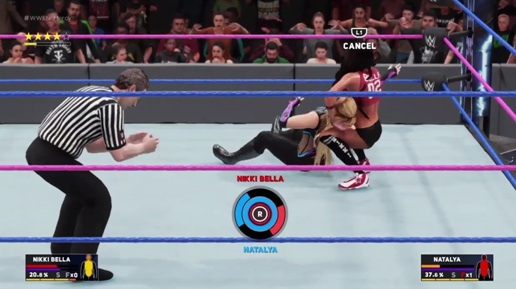
WWE 2K18 loves these little wheels of death!
However, WWE 2K18 does not allow you to change the control scheme, meaning that I was forced to control my wrestler with the left analogue stick and taunt using the D-pad which, for an old school player like myself who dislikes change, took some getting used to. One of the other main reasons I prefer D-pad control is that I find it easier to direct and aim my opponent during running attacks or Irish whips; I find the analogue stick makes such aiming harder as the stick is more sensitive. WWE 2K18 also features some new mini games which replace the ones I had grown accustomed to in WWE 2K14; when being pinned, for example, you now have to press X on a little wheel rather than stopping a little bar that bounces back and forth. This is actually a lot trickier than it sounds as it seems the videogame is set up to make kicking out of pins harder than before to, I guess, allow for more “realistic” matches. Additionally, there is no longer the “Breaking Point” submission system; instead, there’s either a tricky mini game involving the analogue stick or you must mash one of the four action buttons when they appear onscreen. I went with the button mashing option but have found that winning a match by submission is not as easy as it used to be, potentially because you can no longer select a match to be either quicker, normal, or epic; this, and the improved attribute system, means that you are forced to work for your submission victory.
Suffer enough damage and you’ll roll from the ring to take a break.
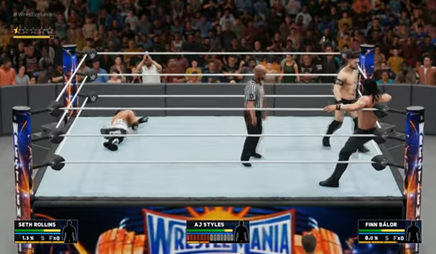
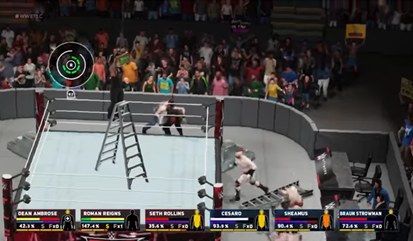
Other gameplay changes can be seen in multi-man match; now, when you or another player receives enough damage, they automatically roll out of the ring and you must mash buttons to fill up a bar and re-enter the match. It sounds good on paper and, again, appears to be tooled towards making matches more “realistic” but I found it more annoying than anything else as you could end up stuck on the outside and lose the match. This mechanic carries over into ladder/TLC matches as well, making them considerably more frustrating than usual as you incur far more damage much faster in these matches so you’ll spend a lot of time mashing buttons to get back into the matches. Also, in ladder/TLC matches, you no longer pull down the belt of briefcase using the right analogue stick; instead, you have to play a little mini game where you must fill up segments of a circle by rotating a ball into a small hole using the right analogue stick. It’s fun but quite distracting; I found myself concentrating more on the mini game than the match and, if you get interrupted with only a couple (or, even worse, one) segments left to fill, you are almost guaranteed to lose the match as the next wrestler to play the mini game will probably complete the circle while you’re busy mashing buttons to get back into the match.
Multi-man TLC matches are still the worst.
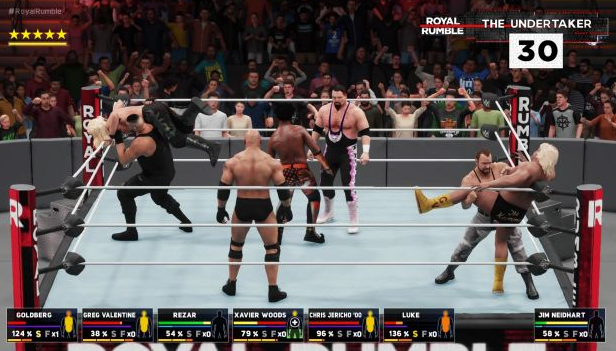
The Royal Rumble match is also noticeably different and, technically, more difficult; rather than hitting buttons in a quick-time event as in WWE 2K14, you now have to mash a button when trying to eliminate an opponent. Honestly, I’ve played a couple of these matches and never once eliminated anyone using the button-mashing mini game no matter what their health and stamina. I found the best way to eliminate wrestlers was the tried-and-true Royal Rumble finisher, clotheslining them out of the ring or countering a run attack, or by exploiting a glitch where, if you whip the opponent onto the apron and quickly punch them repeatedly, they simply fall from the ring.
I struggled to legitimately eliminate anyone in the Royal Rumble…
As I always found ladder, TLC, and Royal Rumble matches tedious any way, these gameplay changes don’t bother me that much; you are not forced to play these matches and, on the whole, I would just avoid them. Some good changes have been made to tables matches, though; every time you hit your opponent with or into a table, it fills up a break meter and, once it’s full, you can smash the opponent through it using some new and expanded options. 2K Sports have also introduced a carry system, similar to the one from WWE SmackDown! vs. Raw 2007 (Yuke’s/THQ, 2006), which allows you to smash your opponent off the ropes, turnbuckles, apron, and other objects. They’ve also brought back in-crowd fighting, to a degree, allowing you to smash your opponent through (or hit them over) the barricade at ringside or toss them from the stage area to fight in little areas near the crowd.
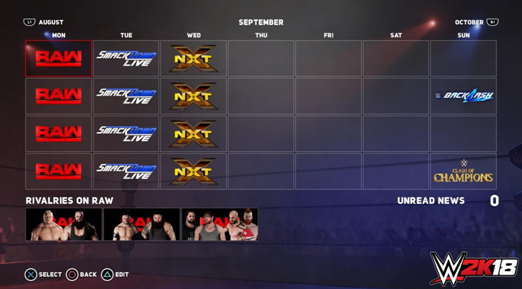
Universe mode is back, bigger and better than ever.
Although create-a-story and create-a-finisher are no longer options, WWE 2K18 is still full to the brim with creation options. I honestly spent maybe five days or so setting everything up the way I wanted it and creating wrestlers, entrances, victories, shows, and teams in the expanded Universe mode. As before, Universe mode allows you to create a show, place wrestlers and championships on the show, and then create monthly pay-per-view events for that show. I like to recreate the product as closely as possible so I created a Raw, SmackDown! Live, and NXT brand (with 205 Live and Main Event as minor shows) and, for all the Legends and duplicate wrestlers, a WCW Monday Nitro brand (with some crossover between them all). You can create more than one Universe at a time but I prefer to have it all in one place rather than jumping backwards and forwards all the time; I then moved every pay-per-view event to their correct calendar month and also created some additional pay-per-vews for my NXT and Nitro brands; this is extremely in-depth, allowing you to choose from a whole bunch of preset or created arenas (with scene transitions, an array of screen filters, a bunch of different referees, and more).
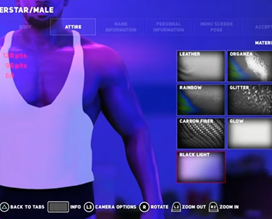
There are loads of colour and customisation options.
You can still create your own championship belts as well, if that’s your thing; given how many old school belts are in the videogame, I don’t tend to do much with this, though. Instead, my focus was on the massively deep create-a-wrestler mode; created wrestlers look more realistic than ever before and you can choose from a whole bunch of options, from wrinkles to scars, facial and body hair, eye colour, veins, muscle definition, and even how much body oil your created wrestler has! There are also a whole load of attire options, including blank attires that you can customise as you desire and also pre-set attires worn by the featured roster; you can change not only the colour of these attires but also the material type, which allows shirts and jeans and the like to be leather, take on a metallic hue, or even glow in the dark! Finally, there are far more options for names for your created wrestler this year and the in-game commentary team will refer to your created wrestler by these throughout their matches.
Apparently you can put a price on greatness.
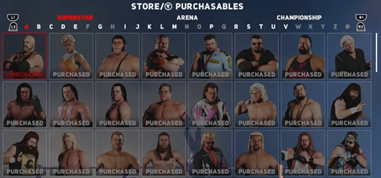
Although there are many WWE and superstar-related images available to you in this mode, there are noticeably less options for body tattoos this years, unfortunately. This is where the Community Creations option will come into play; you are able to upload images to the 2K Sports website and transfer them into the videogame, meaning you can search in the WWE 2K18 for a whole bunch of professionally-designed images, logos, and tattoos to apply to your created wrestler. You can also download created wrestlers created by others to account for those wrestlers omitted from this years roster, though you are limited to twenty downloads a day and cannot download created wrestlers that feature aspects from wrestlers you’ve yet to unlock or purchase. Speaking of which, WWE 2K18 features an in-ring store mode, as is the norm for this series now. As you play matches, you are awarded virtual currency based on how many stars your match scored; the more stars you get through move variety, countering, and such, the more currency you earn. You can then spend this in the store to unlock Legends, and additional arenas and championships and, make no mistake, this is the only way to unlock this extra content. Previously, in WWE 2K14 at least, you could unlock new wrestlers by playing the 30 Years of WrestleMania mode but, here, you can only do this by purchasing them.
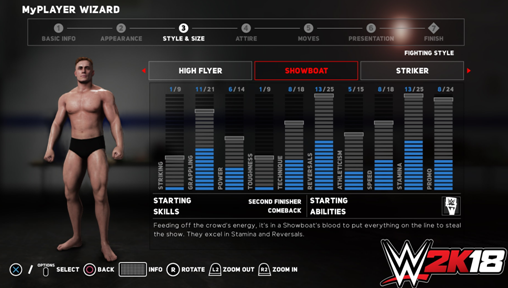
You can do this by playing any match in any mode and, also, through the MyPlayer mode, which is the career mode of the videogame. You have to create a wrestler, using far more limited tools and options, and work your way through training and wrestling on NXT before being called up to the main roster. You can make some limited decisions to decide whether you are a Company Man (a heel) or a Fan Favourite (a face). In my playthrough, I was initially called up to Raw and forced to lose a bunch of matches, so I jumped to SmackDown! Live, where I won the United States Championship, Money in the Bank ladder match, and Royal Rumble match and am currently feuding with Triple H and the Authority on the path towards the WWE Championship. Along the way, you can partake in side quests to earn rewards (new moves, attire, and currency), make a signature t-shirt to earn some extra cash, and perform in-ring promos and run-ins.
You’ll need to pay to get the most out of MyPlayer mode.
Overall, this mode is quite enjoyable but, honestly, it’s a poor substitute for a Road to WrestleMania-type of mode. There are a lot of load times and some noticeable frame drops; you are also forced to walk/run from the garage to the producer and back every single week, which begs the question why they bothered putting in the free-roaming backstage area at all rather than just have a set-up similar to the PlayStation 3-era titles where you had a locker room with a phone and just did everything through text. There are some inconsistencies; I was regularly teaming with Sami Zayn then, randomly and with no explanation, my partner suddenly became Fandango. I was also once asked by Tius O’Neil to attack Primo Colón one week but, when I couldn’t find him, ended up attacking Kassius Ohno. There are also a lot of times when you do more promos than matches, when the match objectives aren’t completely clear (the Money in the Bank match springs to mind), and when your matches end due to interference more often than not but, these issues aside, it’s a pretty decent mode, though I found it more enjoyable and profitable to play Universe mode more than anything.
It’s interesting that the load times for the MyPlayer mode are so atrocious as, normally, they’re not that bad; matches in Universe mode load much faster than in WWE 2K14. I learned from some of my mistakes in WWE 2K14 and don’t have nearly as many custom arenas or created wrestlers, which may help with this, and also towards limiting crashes. WWE 2K14 would crash all the time, usually after a match but sometimes before one, and it was very frustrating. I have had a few crashes in WWE 2K18 but, as the matches and the videogame loads up a lot faster, it’s not as annoying. One bug that is annoying is, when downloading a created wrestler, attached logos and images will sometimes not download, meaning you’re left having to either find them separately or with an incomplete created wrestler/attire.
I haven’t played WWE 2K18 online yet, mainly because I don’t have Xbox Gold or whatever you need to do that but also because online players are trolling, move-spamming sons of bitches; also, the learning curve for timing reversals and having competitive but enjoyable matches that I actually won was quite steep. Sometimes, you’ll have a match and be in complete control and all the opponent has to do is a couple of moves and you can’t recover, then you get hit with one finisher and its over. A good feature, though, is that miss-matched opponents (like Braun Strowman against Kalisto) often trigger a squash match, where you gain full momentum and a finisher after your first hit and win the match in seconds for a decent payday.
All the Sting you could ever want!
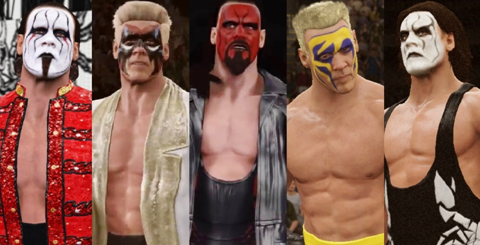
The roster in WWE 2K18 is as deep as you could want; there are some noticeable omissions from NXT but, otherwise, everyone you could want and more is in the videogame alongside some decent and surprising Legends. Hulk Hogan and Yokozuna are gone but Vader and the Big Boss Man are back; there are some crazy instances of numerous duplicates, such as five (five!) versions of Sting and separating Finn Balor and his Demon King attire (though the Demon King does still act as an alternative attire to regular Balor) but, mostly, there’s some good inclusions this year. The soundtrack, apparently “curated” by the Rock, is mostly miss rather than hit, with the only decent track being a radio edit version of Disturbed’s Down With the Sickness, though a similarly-edited version of Limp Bizkit’s Rollin’ is used as the entrance theme for Undertaker ’00 despite this particular version of Undertaker’s biker gimmick actually being more associated with You’re Gonna Pay. The in-game commentary is all-new, at least for me anyway, including the three-man team of Michael Cole, Corey Graves, and Byron Saxton; mostly, it is far better than what I experienced in WWE 2K14 but there still times when they refer to women as “guys”, talk inanely about things not even relevant to the match in progress, or ask each other questions that are never answered.
Graphically, WWE 2K18 is very impressive.
Overall, WWE 2K18 is a challenging and enjoyable affair; Universe mode is bigger and more expansive than ever, with shorter load times and significantly less crashes and glitches (so far), and the star rating system does make it feel as though each match is important and worth something. MyPlayer suffers a bit (though admittedly this may also be because I don’t want to waste my virtual currency upgrading the MyPlayer character unless I absolutely have to as I want to unlock the Legends) but is, otherwise, fun enough for what it is. I would have also liked to have seen, at least, Showcase matches similar to previous titles or themed around a wrestler (this year’s pre-order bonus, Kurt Angle, for example, or Shawn Michaels, or even the cover star, Seth Rollins) to assist with the unlocking of extra content. Creation options are deep and versatile; you can waste hours and even days crafting the perfect created wrestler (I know I did!) or downloading extra attires and wrestlers to fill out the already impressive roster. I am glad that I waited for 2K Sports to add in many of the features they previously omitted and refine their current-generation gameplay engine as it seems to have paid off; matches are far more realistic and challenging than in WWE 2K14, where I could win with a minimum of effort, which is good once you’re used to the control scheme and what is expected of you, if admittedly somewhat detrimental to those who just want to pick it up and play a quick match without any obligation to simulating a real-life WWE match. Based on my experience with this title, I will probably wait until WWE 2K20 for my next entry into the series as I would never recommend anyone buys these titles on a yearly basis but, if like me, you’ve been away from the series for a while, I would definitely recommend picking this one up.












 Dr. K's Waiting Room
You must be logged in to post a comment.