Movie Night: Malignant

Released: 10 September 2021
Director: James Wan
Distributor:
Warner Bros. Pictures
Budget: $40 million
Stars:
Annabelle Wallis, Maddie Hasson, George Young, Michole Briana White, Marina Mazepa/Ray Chase, and Jacqueline McKenzie

The Plot:
After her and her abusive husband are attacked at home, Madison Lake-Mitchell (Wallis) is plagued by terrifying visions of gruesome murders that she soon realises are real. Her plight worsens when the killer reveals a link to her mysterious past and she is forced to confront a horrifying secret about herself that has laid dormant for decades.

The Background:
The gritty, disturbing horror/thriller Saw (Wan, 2004) not only ushered in a new sub-genre of horror and spawned a long-running and influential series of gory films, it also put director James Wan and writer Leigh Whannell on the map. Since then, the duo have seen even more horror success with their Conjuring universe (Various, 2013 to present) that has enabled them to venture into other genres and produce more experimental horror films. An original idea with no connection to Wan’s similarly-titled graphic novel, Malignant was delayed by the COVID-19 pandemic but finally released to mostly mixed reviews and is currently on track to be a box office bomb with its $14.7 million worldwide gross.

The Review:
Malignant opens in the good old days of the early nineties at the Simion Research Hospital, where Doctor Florence Weaver (McKenzie) works to help children with mental and physical reconstruction after severe trauma. One look at the exterior of the hospital, however, should tell you that the facility is hardly the most benign and there’s a strong implication that Weaver and her associates have been experimenting on the children in their care in bizarre ways. The most destructive and promising of their charges is the mysterious and dangerous Gabriel (Mazepa/Chase), a monstrous young boy who is somehow only able to communicate by broadcasting his thoughts through speakers and radios and who can control electricity. One night, he flies into a violent rage, killing several staff, and Weaver has no choice but to “cut out [his] cancer” since he refuses to respond to their treatments.

Though she survives her attack, Madison loses her baby and starts experiencing disturbing visions.

The story then jumps ahead twenty-eight years to find pregnant Madison in an abusive relationship with her husband, Derek (Jake Abel); this is her third pregnancy and she is desperately hoping for the baby to survive this time as she has tragically suffered miscarriages previously. Although it’s said that Derek has beat on her before, this particular incident is caused specifically because of his heartbreak at having to continuously see his children die before they’re born, something he blames Madison for and, during an argument, he violently smashes her head into the bedroom wall and leaves her with a nasty head wound. That night, though, a shadowy supernatural entity toys with Derek before brutally twisting his head around and then attacking Madison; although she survives the assault, her baby doesn’t, and she’s left devastated and paranoid that the entity is still haunting her.

Sydney supports Madison even as she is haunted by visions of gruesome murders that turn out to be real.

On the plus side, this allows her to reconnect with her cute younger sister, Sydney (Hasson); thanks to Derek’s toxic influence, they haven’t been able to see each other for some time but Sydney stays by her sister’s side during her recovery and supports her even after she begins to suffer gruesome visions of murders. While sleeping or performing menial tasks, Madison is seemingly haunted by visions of a gangly, trenchcoat-wearing killer that leave her paralysed with fear and terrified out of her mind; her fear only grows when she realises that the killings are actually taking place and Sydney goes with her to inform the police in the hopes of catching the man responsible. Even when Madison reveals to Sydney that she (as in Madison) was adopted into Sydney’s family at eight years old, Sydney continues to support her and even conducts her own investigation into Madison’s mysterious past after she undergoes hypnotherapy to try and uncover her strange link to the killer.

Madison’s claims to see murders raise the intrigue and suspicion of the cops.

The brutal killings are investigated by Detectives Kekoa Shaw (Young) and Regina Moss (White); while Regina is more of a stern pragmatist, Kekoa is something of a workaholic and is so focused on his cases and crime scenes that he misses obvious flirtatious advances form the likes of Sydney and the equally cute crime scene investigator Winnie (Ingrid Bisu). While investigating Derek’s death, Regina immediately pegs Madison as the prime suspect due to her abusive nature and but Kekoa is more sympathetic to her plight; Regina is equally unconvinced (and even somewhat insulted) at Sydney’s claims that Madison is having visions of the murders but, while chasing up one of Madison’s visions, Kekoa comes face-to-face with their vicious killer, a seemingly supernatural and superhuman man who claims to be Gabriel. When their traditional methods hit a wall, Kekoa and Regina arrange to have Madison sit with a hypnotherapist and soon their investigation leads them down a dark path that forces Madison to go to her mother, Jeanne (Susanna Thompson), for answers to help fill in the gaps in her memory.

The Nitty-Gritty:
If there’s one thing James Wan has become really good at over the years, it’s building a sense of tension and dread; the sporadic and effective use of music definitely helps with this as scenes are either completely silent save for a character’s panicked breathing, punctuated by a chilly melody that rises to a crescendo, or startlingly flip from the mundane to the terrifying with a sharp pull of strings. While such jump scares aren’t for many, I always felt like Wan used them really well in Insidious (Wan, 2010) and his use of them (and music and silence) to help build a foreboding atmosphere is just as good here. it’s a pity, then, that Malignant suffers a bit from uneven pacing; building tension is one thing but the film definitely slows down a bit in the second act and the performances and deliveries don’t exactly make the middle section all that interesting either. The film meanders for some time as though it’s forgotten what it was doing and, when it does get back on track, it does so with a jarringly brutal shift that, while thoroughly bloody and entertaining, end sup feeling a bit rushed.

Horror clichés are given a unique new twist that keeps things interesting.

As a core aspect of Malignant is the question of the killer’s identity, Madison’s mysterious past, and the strange connection they seem to share, it’s difficult to talk about the film without spoiling too much. I will say, though, that anyone who’s had even a passing knowledge of horror films of this kind will probably see the twist coming, however Wan puts an absolutely ghastly spin on this twist that completely turns the film on its head and changes the way you view it. Indeed, much of the film is drawing from horror clichés that have been done before (it’s not the first time a character has had visions of a killer’s actions, for example, or dreamt of/been haunted by a serial killer) but Wan repackages these tropes with his own unique twist and presentation to keep things interesting. Wan further mixes things up with some unique and creative camera angles; when Madison has her visions, her surroundings bleed away into the killer’s location and the camera spins around her dramatically, which is very effective at putting us in her shoes and sharing her dread, and there’s a section where she’s being pursued by an invisible force that’s short entirely from a bird’s-eye view inside her house that is very Sam Raimi.
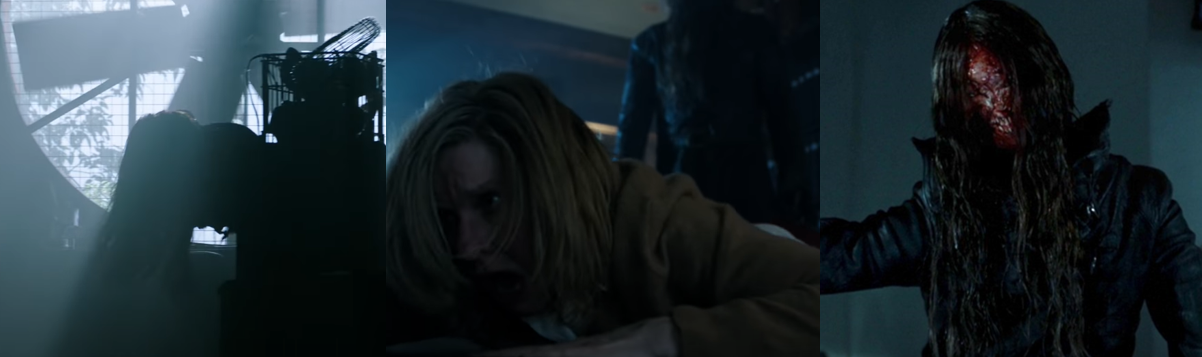
Gabriel ‘s twisted visage and movements make for an unnerving and inhuman killer.

Quite soon into the film, the killer identifies himself as Gabriel; he exhibits the same croaking, cackling voice as Gabriel and also the same control over electricity and lights. The killer is presented as both supernatural and tangible, appearing as an ominous and genuinely frightening black shadow when in Madison’s dreams and visions and as a lanky figure in a trenchcoat with long hair and wielding a trophy fashioned into a deadly knife. His movements are erratic and inhuman and remind me more than a little of the unsettling Onryō from film series like Ringu/The Ring (Various, 1998 to 2017) and Ju-On/The Grudge (Various, 2001 to 2020); the few times we do see his face, he’s a scarred monster of a man and he exhibits an unnatural control over his limbs and incredible superhuman strength, to say nothing of exerting a seemingly supernatural influence upon Madison. His design is extremely effective and makes for some effective scares; scenes are often framed in a way to keep areas of shadow in the background, meaning you’re constantly on edge waiting to catch a glimpse of the killer, and his tendency to bleed out of the darkness or appear out of nowhere makes for some effective jump scares. The film also benefits from his uncanny and superhuman prowess during one particular scene that sees him effortlessly slaughter almost an entire police precinct and the startling reveal of his true nature and connection to Madison completely changes the context of the film and asks for a repeat viewing.

The Summary:
I was intrigued by the trailers for Malignant; obviously, because of the way the world’s been, I wasn’t aware of this film at all until cinema’s opened up again and I found it to be an interesting premise with some creepy visuals. This is reflected in the film; the premise, while nothing groundbreaking, is executed in a unique and interesting way by mixing and matching other horror clichés into a new context and putting a terrifying twist on them. I’ve always said that it’s perfectly fine to go back to the well in movies, especially horror (how many haunted house films have there been, for example?), as long as the filmmakers put an interesting twist on the cliché and Malignant definitely does that. Unfortunately, it’s pretty easy to guess what the main twist is going to be, meaning that you’re just waiting for the film and the characters to catch up. When they do, there’s a horrifying spin on the reveal that helps to get the film back on track but that doesn’t completely make up for a middling middle half of the film and some odd performances and deliveries. Overall, it was an entertaining and chilling horror thriller; I can’t deny that I was expecting a little more from it but I stuck with it and was entertaining by the presentation and the foreboding ambiance being built up throughout the film, though I suspect that it might do better and possibly garner a cult following once it comes to home media.

My Rating:

Rating: 3 out of 5.

Pretty Good

Have you seen Malignant? If so, what did you think to it? Did you see the initial twist coming and what did you think to the twisted follow-up to that? What did you think to the film’s use of horror tropes and jump scares? Did you enjoy the film’s performances and the brutal kills? Would you like to see a follow-up to this concept and are you a fan of James Wan’s horror films? Whatever you thought of Malignant, sign up to leave a comment or leave your thoughts on my social media.

Movie Night: Halloween (2018)

HalloweenLogo

Released: October 2018
Director: David Gordon Green
Distributor: Universal Pictures
Budget: Approximately $10 to $15 million
Stars: Jamie Lee Curtis, Judy Greer, Andi Matichak, Will Patton, Haluk Bilginer, and James Jude Courtney

Plot:
Forty years after surviving an attack by serial killer Michael Myers (Courtney), Laurie Strode (Curtis) has become a recluse, alienating her entire family as she prepares for Michael’s inevitable return. When Michael escapes from captivity, Laurie is forced to confront both her past and her worst fears.

Background:
In 1978, legendary director John Carpenter brought us Halloween for the first time and, with it, effectively gave birth to what became known as the slasher genre of horror movies. Make no mistake, without Halloween we may never have seen the popular portrayal of masked, silent killers stalking suburban teenagers, and the film created and popularised many other troupes of the genre for years to come. Given Halloween’s success, it is perhaps of no surprise that a sequel soon followed. Halloween II (Rosenthal, 1981) continued the story, picking up immediately where the first film left off and introducing the idea that Michael Myers and Laurie Strode were brother and sister. Following this, a whole slew of sequels soon followed, with each one adding new dimensions to Michael’s backstory and diluting his mysterious nature. It soon reached the point where Michael’s backstory was so convoluted and confusing that the only things worth watching about the films were the kills and the Donald Pleasence’s scene-stealing performance. Rob Zombie’s 2007 remake was met with mixed results, though I quite enjoyed how violent and insane this film was. Despite earning a sequel (which was inarguably much, much worse), Zombie’s turn with the franchise effectively left it dead in the water. Now, forty years after the original movie, Carpenter, Curtis, and many of their collaborators have returned to the franchise with a direct sequel to the 1978 original that ignores every other entry in the series. Of course, this isn’t the first time this has happened; before Zombie’s remake, Halloween H20: 20 Years Later (Miner, 1998) ignored every entry after Halloween II and even returned Curtis to her famous role for a final showdown with her brother. As a result, this new sequel feels largely unnecessary, but does it return the franchise back to its genre-defining roots and throw further dirt onto the grave of Michael Myers?

The Review:
As mentioned, Halloween takes place forty years after the end of Halloween (the 1978 one…not the 2007 one…) and slightly alters the ending of Carpenter’s original; Myers was apprehended shortly after his killing spree and has been incarcerated under the care of Dr. Ranbir Sartain (Bilginer). In all that time, Michael has not uttered a single word despite Sartain’s attempts to reach him. Two British podcasters arrive to try to learn more about Michael’s motives but are unsuccessful; they are equally unable to convince Laurie Strode to visit Michael before he is transferred. Traumatised by her experiences decades earlier, Laurie has become a recluse who has shut herself off from the world and her family in preparation for Michael’s return; however, while her relationship with her daughter, Karen (Greer) is strained, she is much closer to the granddaughter, Allyson (Matichak). When news breaks that Michael’s transport bus has crashed and Michael has escaped, Laurie is forced to try and convince her family to return to her fortified house for safety so she, aided by Officer Frank Hawkins (Patten), can hunt Michael down and end him once and for all.

Despite their advanced age, both Michael and Laurie are more capable than ever.

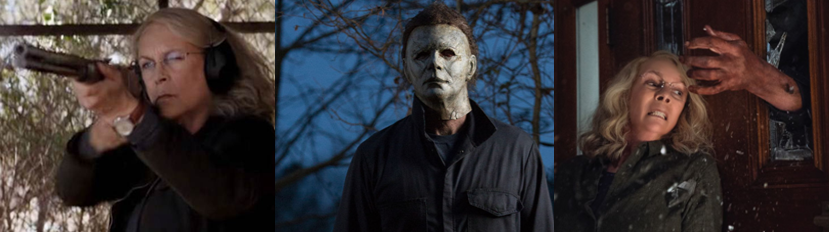
Halloween is a masterful return to form for a franchise that has, to say the least, lost its way through numerous sequels, knock-offs, and convoluted additions to the narrative. Rather than worry about any of that, the film ignores everything after Halloween II, including the Carpenter-crafted idea that Laurie and Michael are related, and returns Michael to a mysterious serial killer. Michael’s face, though clearly scarred from his many battles in 1978, is kept hidden either behind his trademark mask or though clever editing so we never truly see his face and the emphasis on character’s desperately trying to get him to speak and explain his motives keeps Michael as a mysterious, unstoppable force of nature rather than a puppet or spelling out his motivations. Halloween closely apes Carpenter’s original, returning to many of the same themes and even recreating shots from new perspectives to bring perhaps the best and most effective sequel in the franchise, and marries this with some truly violent kills. While nowhere near the level of Zombie’s splatter-gore, this Halloween portrays Michael as being more powerful than ever, capable of twisting heads around backwards and stamping heads into mush. The kills are sudden and violent, with many taking place off screen and most of them being completely random (even more random than the kills in the original movie), which only adds to their horrific nature. This is Laurie’s movie, first and foremost, and she is portrayed as being very damaged from her experiences but also incredibly well prepared. Her house is rigged with flood lights, booby traps, and guns and other weapons to arm herself with against Michael but, at the same time, she’s clearly very vulnerable and afraid. In H20, Laurie was ruled by her fear and desperate to hide away, only becoming a proactive individual once Michael returned and she was forced to face him. Here, though, Laurie has been preparing her entire life to face Michael again and kill him, for better or worse.

While the kids did okay I couldn’t buy into the random knock-off of Dr. Loomis.

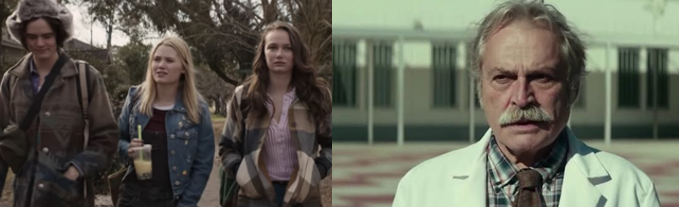
Curtis is joined by a decent supporting cast, who are all written pretty well and naturally and appear believable. More time could perhaps have been devoted to Karen’s equally-traumatic upbringing, as this is only really touched upon, and many of Allyson’s friends are nothing more than disposable filler, but they’re fine for the most part. Sartain, however, is a poor substitute for Loomis (Laurie even outs him as “the new Loomis” at one point, which was a bit too on the nose for my tastes); even Malcolm McDowell’s Loomis wasn’t as obtrusive to the plot as this guy, who gets a whole sideplot that really never goes anywhere. And that’s quite a problem at a few points, really. There are characters who have little impact on the plot, plot threads that are underdeveloped and just dropped or don’t go anywhere, and plot holes that go against what the film has already established (for example, Laurie’s house is all decked out and fortified but she doesn’t flood the inside with lights and instead prefers to sneak around in pitch blackness). It also doesn’t help that we have seen much of this film already from other entries in the franchise, particularly Halloween, Halloween II, and Halloween H20. While it may do a lot of things well, it doesn’t change the fact that this entry is perhaps the least necessary of all the sequels.

The Nitty-Gritty:
It’s Halloween, so there really isn’t too much to spoil; Michael escapes, goes on a killing spree, and evil is vanquished in the end (…or is it?!) The biggest change here is that Michael and Laurie are no longer brother and sister, which is apparently being heralded as a good thing but I kind of disagree. John Carpenter created this as part of his forced involvement in Halloween II and, while he has since lamented this addition and regretted it, it has been a pivotal plot point of the franchise ever since and disregarding it, and outright mocking it as Allyson does at one point, leaves a sour taste in my mouth. Without this motivation, Michael returns to being an emotionless, remorseless killer with no objective other than to kill. However, the 1978 Halloween seemed to suggest that he had a particular fondness for killing babysitters and teenagers, especially girls, but here he just…kills everyone and anyone he comes across. Which is fine but, as I say, seems way more random than originally depicted; I always liked the idea that Michael’s attacks seemed random but were premeditated and methodical in some way, but that no longer seems the case.

HalloweenShape.png
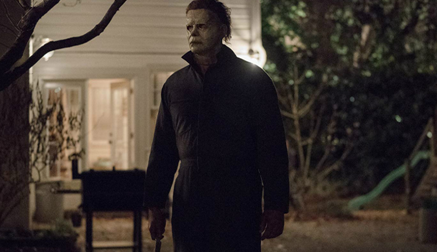
This certainly was the Shape of a decent Halloween film…

The big twist of this movie is that Dr. Sartain actually turns out to be a complete nutjob; he suddenly stabs Hawkins to death in an attempt to “feel” what Michael feels when he kills and even briefly wears Michael’s mask. It was at this point that I was really worried as, for a moment, it seemed as though Sartain was going to take over as the villain of the film. Instead, he is summarily executed by Michael only a short time later; it seemed like they were in cahoots and that Sartain had been aiding Michael but, no…he just went nuts and then got killed and that as it. It was such an out-of-nowhere twist and was dropped so quickly that it really makes you question what the purpose was at all. Sartain should have died in the bus crash as he really wasn’t integral to the plot at all; between both Laurie and Hawkins we had enough of a Loomis type of character without Sartain clogging up screen time. Perhaps if he had died in the crash instead, more time could have been spent on developing Karen’s character, which was sorely lacking; she doesn’t want anything to do with her mother because of a hard upbringing, but it was hardly abusive or traumatic.

The Summary:
Halloween is an entertaining return to form for the series; Michael returns to his murderous ways as an unstoppable force of nature and the franchise appears to be back on track, rather than being bogged down in trying to add new kinks to the narrative. It’s easily the best Halloween sequel we’ve had in a long time but, for me, seems so unnecessary that I can’t, in all honesty, rate it too high. It retreads familiar ground and, while it seems new and fresh since it’s been so long since we saw this from the franchise, it’s still the same ground we have seen before, and better in many ways, so maybe it would be better recommended for those more unfamiliar with the franchise. For me, this movie was already told with Halloween H20, which is one of the stronger entries in the franchise in my view. It really allowed Laurie to gain some closure and put an end to Michael’s threat but, instead, we have to tread the same ground again only this time it’s far more ambiguous. Laurie manages to trap Michael in her basement and sets it, and her whole house, on fire, which appears to have forever killed Michael but, of course, Michael mysteriously vanishes and his body is not seen so the assumption is that he could still return for more kills (though, I still prefer the visual of Laurie lopping his head off with an axe; it was the definitive end we needed).

My Rating:

Rating: 2 out of 5.

Could Be Better