Back Issues [JLA Day]: JLA #43-46


To celebrate the release of Justice League (Snyder/Whedon, 2017), DC Comics named November 18 “Justice League Day”. Setting aside all the drama surrounding that movie, this provides a perfect excuse to spotlight DC’s top superhero team, which set the standard for super teams.

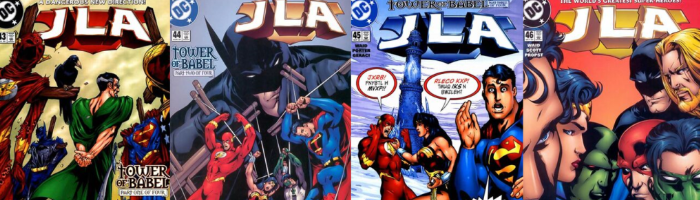
Writer: Mark Waid Artist: Howard Porter

Story Title: “Tower of Babel, Part 1: Survival of the Fittest”
Published: July 2000

Story Title: “Tower of Babel, Part 2: Seven Little Indians”
Published: August 2000

Story Title: “Tower of Babel, Part 3: Protected by the Cold”
Published: September 2000

Story Title: “Tower of Babel, Part 4: Harsh Words”
Published: October 2000

The Background:
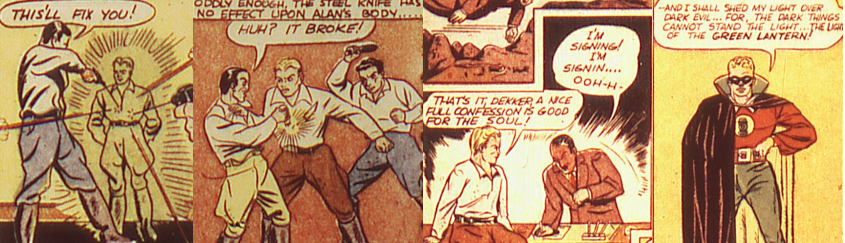
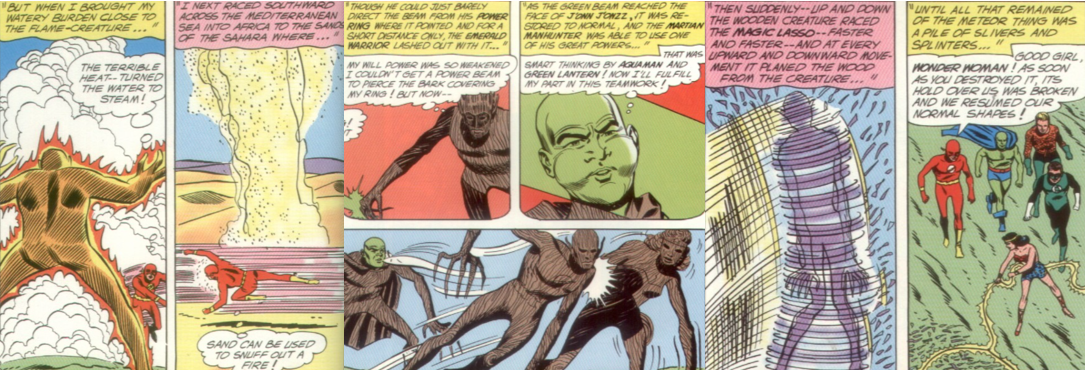
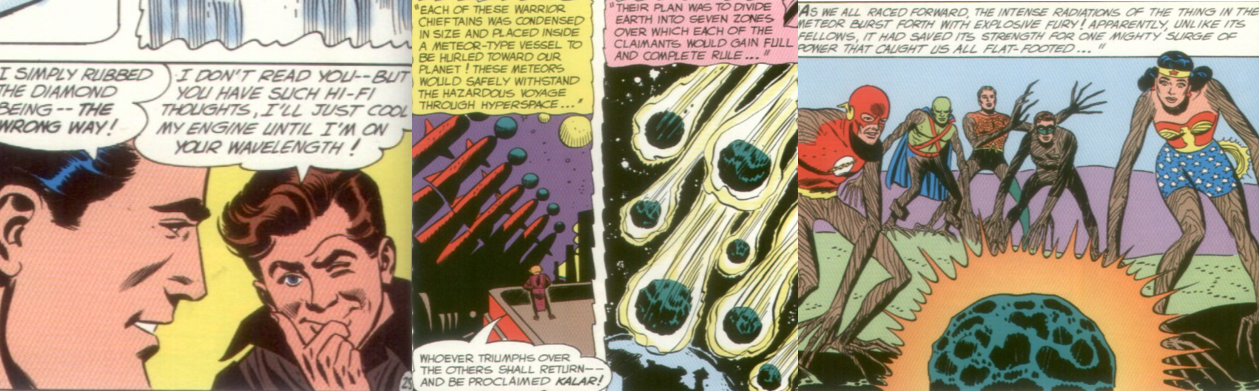
In the 1940s, All Star Comics brought together eight superheroes from different publishers for the first time, birthing not just the Justice Society of America (JSA) but also the first ever superhero team in comics, allowing readers to see their favourite characters interacting for the same price in a single issue. The JSA’s ever-changing roster underwent their most significant change at the late-1950s, when then-editor Julius Schwartz had writer Gardner Fox with reintroduce and rebrand the team as the Justice League of America (JLA) to capitalise on the popularity of the American Football League and Major League Baseball’s National League. Clark Kent/Superman, Bruce Wayne/Batman, Diana Prince/Wonder Woman, Hal Jordan/Green Lantern, Arthur Curry/Aquaman, Barry Allan/The Flash, and J’onn J’onzz (or “John Jones”)/Martian Manhunter debuted as the JLA in The Brave and the Bold #28. Their origin story became a best-seller and the initial line-up of DC’s heavy-hitters is arguably the most iconic, which is exactly why they were at the forefront of the team’s revamp in the 1990s. Spearheaded by Grant Morrison, the new JLA title also became a best-seller and greatly inspired their celebrated animated adventures. This new team battled the likes of White Martians and the adaptable supervillain Prometheus, whose unexpected victory over the JLA laid the foundation for this widely regarded story. Marking the beginning of Mark Waid’s memorable run on the book, “Tower of Babel” had long-term repercussions, was critically acclaimed, and was even loosely adapted into a pretty decent animated feature.

The Review:
Although I grew up reading odd issues and random annuals from the 1970s and 1980s, this is the Justice League I mostly closely associate with. Superman (fresh off his brief stint as an energy being), Batman, Wonder Woman, Wally West/The Flash, Kyle Rayner/Green Lantern, Aquaman (in his best, most intimidating look), and even Patrick O’Brian/Plastic Man being included for some visual variety and laughs made for an impressive and powerful incarnation of the team. “Tower of Babel” pits this team against Rā’s al Ghūl, the “Demon’s Head” who fronts the League of Assassins and believes humanity is a danger. His anger at an aide accidentally dooming the Javan tiger to extinction only precipitates his latest plan to wipe out humankind, which begins with him playing spiteful mind games with his respected adversary, the Batman (whom he reverentially refers to as “The Detective”), by exhuming his parents. Rā’s then dispatches his daughter, Talia, to strike the Martian Manhunter with an explosive shell of strange nanites. Nearby, the Flash and Wonder Woman desperately fight a mysterious and aggressive forest fire, only to be amazed and horrified when the source turns of to be J’onn, his body engulfed in perpetual flames that the Flash extinguishes with his fantastic speed. Aquaman and Plastic Man are then attacked within the United Nations, Aquaman being gassed by a substance that makes him deathly afraid of water and Plastic Man frozen and shattered into a dozen pieces!
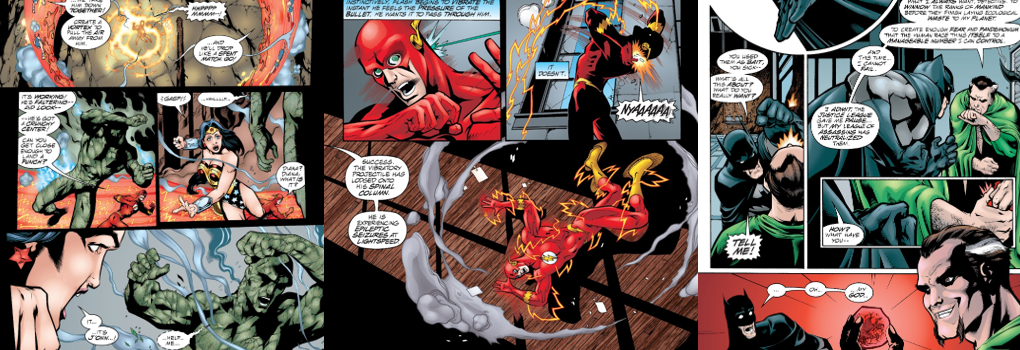
Batman’s horrified when Rā’s targets the JLA using his secret contingency plans!

The injured or affected JLA members are brought to their Watchtower space satellite by their teammates. Superman analyses the nanites infecting the Martian Manhunter and discovers they’ve forced his body to combust in air. Crippled by fear toxin, Aquaman’s condition deteriorates as he rapidly dehydrates and, though the Flash pieces Plastic Man back together, they’re unable to restore him. Realising that the JLA is being targeted, Superman coordinates with John Henry Irons/Steel and Barbara Gordon/Oracle to keep their reserve members are safe but Batman abruptly refuses to help. After switching to Clark Kent to use his sources at the Daily Planet for a possible lead, Superman and the staff are astonished to find that all text has become incomprehensible! Superman races to curb the ensuring madness, learning from Oracle that the aphasia’s caused by ultrasound waves, which he successfully disrupts by retrofitting some Brainiac tech. Finally, Wally and Diana find Kyle woke up suddenly blind, which understandably causes the artist great distress. Although Aquaman figures out that the League of Assassins are tracking their signal devices, his warnings come too late and Diana is trapped within a never-ending battle simulation courtesy of a virtual reality chip. The Flash is also shot with a “vibrational projectile” that induces epileptic seizures at lightspeed and Kyle, directionless and berserk without his eyes, is easily subdued by a begrudging Talia. The world is plunged into chaos as the stock exchange collapses, gang wars break out, planes narrowly avoid collision, military services grind to a halt, and hospitals are rendered useless. The Batman angrily confronts Rā’s in his modern-day Tower of Babel, where Rā’s relishes the chaos and threatens offers to resurrect the Waynes using his rejuvenating Lazarus Pits.
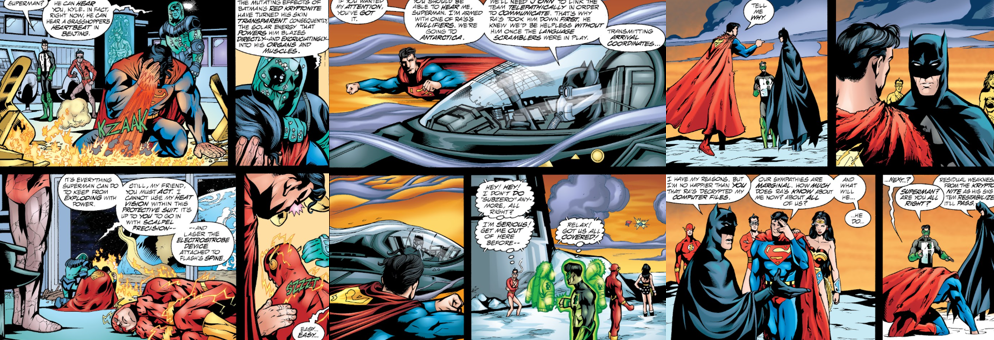
The JLA is left aghast and traumatised by Batman’s betrayal.

Despite clearly being tempted and overwhelmed by the proposition of being reunited with his parents, the Batman attacks in a rage but is horrified when Rā’s brandishes synthetic red kryptonite. Subdued by Rā’s’s troops, Batman fails to warn Superman who is caught completely off-guard when he arrives to help Wally, Diana, and Kyle with Martian Manhunter (wearing a special Atlantean water suit). Although Batman escapes Rā’s and Talia seems displeased at being her father’s lapdog, Superman’s crippled with agony when the rock turns his skin transparent and overloads him with solar energy. Alarmed that Rā’s has stolen his secret contingency files and turned them on his allies, Batman desperately tries to contact Aquaman with a solution, only for Rā’s to further disrupt communications. Luckily, Batman fools his pursuers with a fake death and Plastic Man finally pulls himself back together to teleport the JLA back to the Watchtower. There, Arthur is sustained by a telepathic illusion courtesy of J’onn, Plastic Man removes the chip lodged in Diana’s brain, and Superman focuses long enough to destroy the device tormenting the Flash. Finally, Diana and J’onn work with Kyle to deduce that his ring was slipped on him during sleep and that his blindness was caused by a post-hypnotic suggestion; by focusing, Kyle’s sight returns. The shellshocked JLA discuss Batman’s actions, their faith in their teammate shattered, with Superman feeling especially betrayed. Despite knowing the JLA distrust him, the Batman gathers them in Antarctica to infiltrate Rā’s’s tower, demanding the team work together to end the worldwide disruption. The battle is incredibly brief as Superman simply explodes in a burst of power, bringing the tower down and demanding an explanation from his comrade, only to be stonewalled by Batman’s stubborn nature.
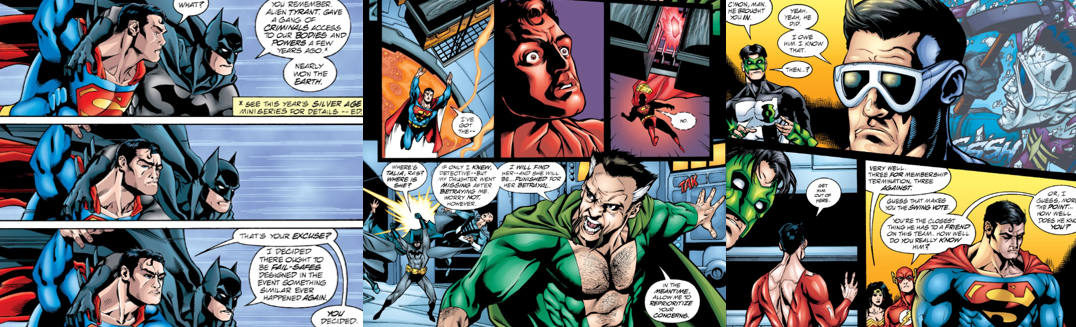
Although Rā’s is stopped, the JLA are fractured by Batman’s questionable actions.

Despite the tower’s destruction, a disgruntled Talia informs the JLA that Rā’s is still a threat, leading Batman to split the fractured team up to handle each crisis. While Green Lantern, Plastic Man, the Flash, and Wonder Woman stop a chemical attack in Rhapastan, Batman explains to Superman that he created fail-safes after the alien tyrant Agameno swapped their consciousnesses with a gang of criminals. Finding little comfort in that explanation, Superman echoes Plastic Man’s uncharacteristically stoic and enraged demeanour by leading Batman through Rā’s’s stronghold. Though Rā’s prepares to retreat in frustration and Superman’s held off by the red Kryptonite, he covers his escape by dropping the Waynes’ coffins! Luckily, the restored Aquaman and Martian Manhunter pull both Superman and Batman’s parents from danger, leaving Batman free to pursue his adversary. While Rā’s escapes, his assistant, Doctor Kant, isn’t so lucky and takes the brunt of Batman and Aquaman’s retaliation, while Wonder Woman convinces Rā’s’s agent out of unleashing his chemical agent. With the danger over and the JLA back to full strength, the team debate what to do about Batman. While the Dark Knight awaits their decision, Superman questions whether they should have safeguards against their powers being manipulated. Aquaman believes the team should be based on trust, the Flash reluctantly thinks Batman has a point, and J’onn somewhat echoes this sentiment. When Arthur challenges J’onn’s loyalty to the Batman, pointing out that he once had similar dossiers, a fight almost breaks out between them, though J’onn ultimately votes in favour of Batman. While Kyle’s also not happy about what happened, he recognises that their powers are potentially dangerous and also votes to keep Batman on the team. However, while Wonder Woman agrees in principle, she refuses to fight alongside someone she can’t trust and Plastic Man coldly agrees. Although the deciding vote comes down to Superman, Batman makes the decision for them and quits the team without a word while they’re debating.

The Summary:
Like I said, this was a great time to be a JLA fan. The artwork was always really good in these comics and the team gelled really well together visually and with their contrasting personalities. It’s a very nineties period for the JLA, of course, with guys like Aquaman and newcomer Kyle Rayner offering very different interpretations of classic characters. I’ve always loved this version of Aquaman, though, with the harpoon hand and dishevelled appearance. Kyle is and will always by my favourite Green Lantern and I enjoyed the dichotomy he brought to the team as he obviously felt a little out of his depth and often deferred to his superiors as a result. These are characteristics reminiscent of Wally’s early days as the Flash, which led them to eventually form a tight friendship, but much of Kyle’s characterisation at this time was proving (or at least realising) that he’s worthy to hang with the big boys. Plastic Man was something of a wild card, for sure, especially due to his goofy nature and bizarre abilities. “Tower of Babel” showed that there was more to him than just being a wise-ass, though, as he’s so traumatised by being frozen and shattered (and by the Batman’s actions) that he drops the jokes and dismissively votes against Batman. Indeed, this story shakes the foundations of the JLA as, up until this point, they’ve all fought together on the understanding that they can trust each other. I’m pretty certain they all know each other’s strengths, weaknesses, and secret identities, for example, and feel they’re more than just colleagues. Thus, when they discover that Rā’s al Ghūl’s plot is due to Batman’s secret contingency plans, the team rightfully feels betrayed and angry, with Superman noticeably upset since he knows Batman the best and has worked with him the longest.
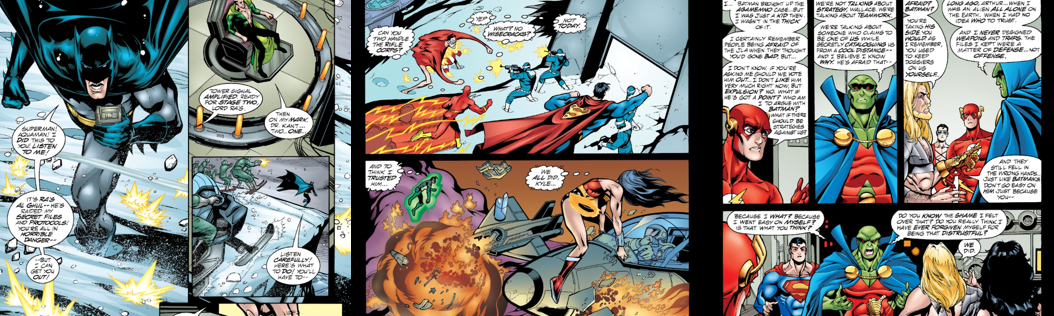
The JLA is divided and rattled by Batman’s betrayal and questions his trustworthiness.

Thus, the main enemy in “Tower of Babel” is essentially Batman, while technically also being the group’s insecurities, and more accurately being the devious Rā’s, who disrupts them to facilitate his latest scheme. The JLA is caught completely off-guard when Talia and her troops ambush them, wielding weapons designed specifically to neutralise their powers or otherwise subdue them. While I believe Batman’s plan was always to non-fatally pacify his teammates if they go rogue or were manipulated, some of his contingencies are very questionable. J’onn, for example, bursts into flame when exposed to air, something that would be both physically and emotionally traumatic for him considering his fear and weakness to fire. Aquaman is almost killed by dehydration when fear toxin variant made him deathly afraid of water, forcing J’onn to put him at ease with a telepathic vision so he could be safely placed in water. The Flash had it pretty bad, too, forced to endure what felt like days of torturous seizures in less than half an hour, while Superman’s powers raged thanks to red kryptonite. Similarly, it seems Wonder Woman would’ve eventually been so lost in her endless combat that she would’ve perished and Kyle was extremely distressed when he was duped into making himself blind. Seems to me that Batman could’ve just as easily used virtual reality environments for all his allies for a similar end, so it’s likely Rā’s al Ghūl perverted his countermeasures. Either way, the JLA are outraged at both the experience and the betrayal, believing Batman misled them and cannot be trusted. Even if he was right, since the JLA are mind controlled every other week and have extremely dangerous powers, the characters are angry at the deception. I doubt their reaction would’ve been much better had they known about Batman’s fail-safes, but it certainly would’ve lessened the sting since they put a lot of trust in him as their strategist and smartest mind.
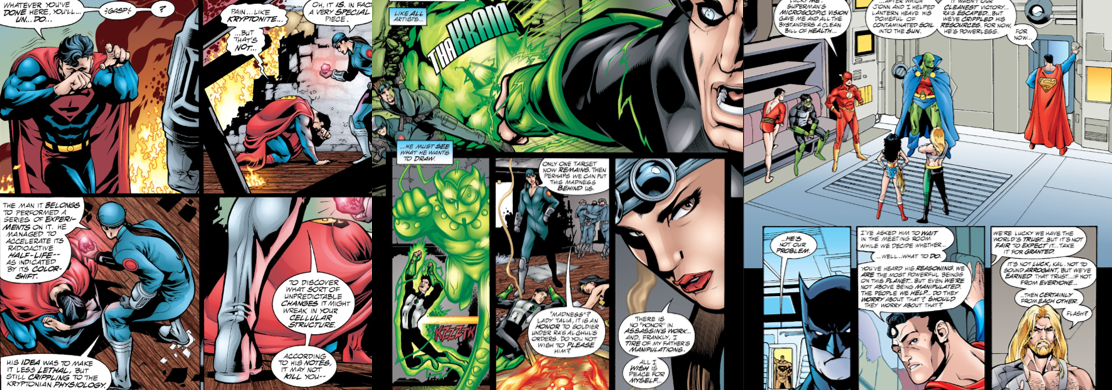
A classic story that deconstructs the JLA and had far-reaching consequences.

This ethical quandary hangs over “Tower of Babel”, creating tension and animosity within the group for the finale, where they can barely function as a cohesive unit and are extremely reluctant to listen to Batman. Though he’s horrified by what Rā’s al Ghūl has done, Batman offers no apology and little explanation. He believes he was right to create contingencies and won’t be swayed from the belief, kick-starting a long-tunning theme of Batman being a stubborn, paranoid, and somewhat unethical character whose efforts to prepare for every scenario alienated his nearest and dearest. Interestingly, “Tower of Babel” doesn’t suggest what Batman’s back-up plan was if he went rogue (though it’s implied to be the remaining JLA) and barely gives him a chance to counteract Rā’s al Ghūl’s actions since the Demon’s Head keeps messing with their communications. I would’ve liked to see more of the world being plunged into chaos but I think “Tower of Babel” wisely focuses on the JLA and how they’re affected by Batman’s actions. The entire point is to fracture DC’s greatest superhero team, which literally happens by the end when the Batman walks away without hearing a verdict, but has knock-on ramifications as tensions are high amongst the others. I enjoyed seeing the team struggle to decide Batman’s future since they were personally disgusted and angered by the betrayal but recognised the need for fail-safes, and also how black-and-white the decision was for Aquaman and Wonder Woman, who felt the betrayal outweighed the risk. “Tower of Babel” easily ranks as one of the top JLA stories for a reason and it’s a great deconstruction of the team and exploration of their powers, weaknesses, and the fragile ethics that hold them together. It had far-reaching consequences for all involved and is well worth a read, especially for fans of this era of DC Comics.

My Rating:

Rating: 3 out of 5.

Pretty Good

What did you think of “Tower of Babel”? Do you consider it a classic JLA story or do you think it’s over-rated? Which of Batman’s contingencies do you think was the worst to suffer through? Did you enjoy this incarnation of the JLA or do you prefer a different line-up? Do you think Batman was right to have contingency plans or do you agree that he crossed a line? How are you celebrating Justice League Day this year? Whatever your thoughts on the JLA, feel free to share them below, check out my other Justice League reviews, and go donate to my Ko-Fi to suggest other JLA stories for me to cover.

Back Issues [Brightest Day]: Green Lantern Vol 2 #7


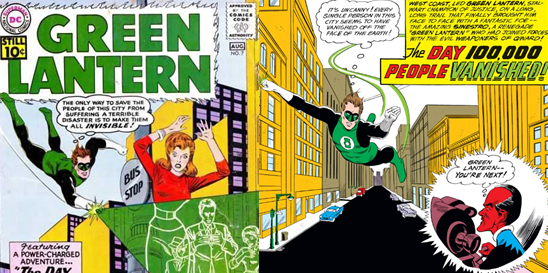
Although February 2014 was dubbed “Green Lantern Day” (because, by the American calendar, the date matched the sector of space assigned to Earth in DC Comics “2814”), the significance of this date has passed as the years have changed. Instead, I celebrate the October 1959 debut of perhaps the most popular Green Lantern, Hal Jordan, who first appeared.


Story Title: “The Day 100,000 People Vanished!”
Published: August 1961
Writer: John Broome
Artist: Gil Kane

The Background:
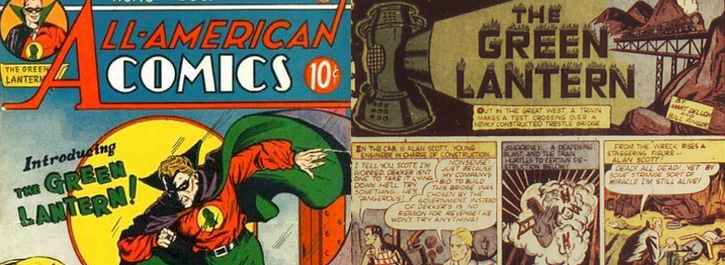
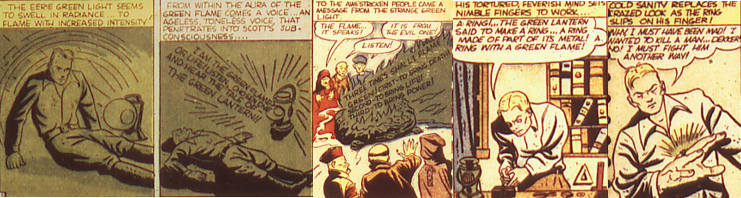
In July 1940, Martin Nodell and Bill Finger debuted Alan Scott, the first Green Lantern, a magically empowered railroad engineer who became a founding member of the Justice Society of America (JSA). However, following the successful reinvention of the Flash in 1956, fighter pilot Harold “Hal” Jordan became the first of a whole corps of Green Lanterns. Widely regarded as the greatest Green Lantern, Hal soon amassed a colourful domestic and intergalactic rogues’ gallery, though none are more prominent than Thaal Sinestro, Created by John Broome and Gil Kane and modelled after British actor David Niven, Sinestro was formally the most celebrated of the corps before it was revealed that he enforced peace through a dictatorship, disgracing him and positioning him as Hal’s mortal enemy since Hal exposed Sinestro’s true nature. A Machiavellian foe, Sinestro joined the villainous Legion of Doom and Injustice League, led his own yellow-hued counterpart to the Green Lantern Corps, and has regularly waged war against not just Hal, but both the Earth and the entire universe! As Hal’s greatest  villain, it should be no surprise that Sinestro has regularly appeared in cartoons and videogames, and was even brought to life by Mark Strong (with scenery-chewing relish) in the much maligned live-action adaptation

The Review:
Hal’s first encounter with the devilishly alluring villain who became his most recurring and dangerous foe begins on the West Coast of the United States, specifically the town of Valdale, where Green Lantern is scheduled to attend the opening ceremony of the new boys’ settlement house. Luckily for him, Hal’s too busy tying up another case so he’s unexpectedly delayed, meaning he’s absent when the bustling metropolis is suddenly enveloped in an ethereal light (not unlike an aurora borealis) and a strange thunderclap sound, which causes all 100,000 residents to disappear! After learning of this phenomenon, Green Lantern investigated and confirmed to his friend, mechanic, and confidant, Tom Kalmaku/Pieface, that Valdale’s inhabitants have vanished. Green Lantern’s doubly concerned as the incident occurred at nine o’clock, exactly when he was scheduled to be in Valdale but, before he can ponder further, Hal’s suddenly sent a bit queasy by a mind blank. It turns out this wasn’t just a bout of nausea and that Hal’s “astral self” was summoned across the galaxy to Oa, the home of the Green Lantern Corps and their enigmatic alien masters, the Guardians of the Universe. Brought before his masters, Green Lantern was told of Thaal Sinestro, the Green Lantern of sector 1417, a fearless native of Korugar who used the awesome, nigh-unlimited power of his power ring to satisfy his vanity with a throne. Sinestro had people line up and plead for his aid, quickly bored by their petty squabbles and requests and desiring more. When one of his people questioned him, chastising his arrogance and accusing Sinestro of being mad with power, Sinestro flew into a rage and shot down the complainant (non-fatally, it turns out).

Hal is dispatched to thwart a renegade Green Lantern’s plot to attack the Guardians.

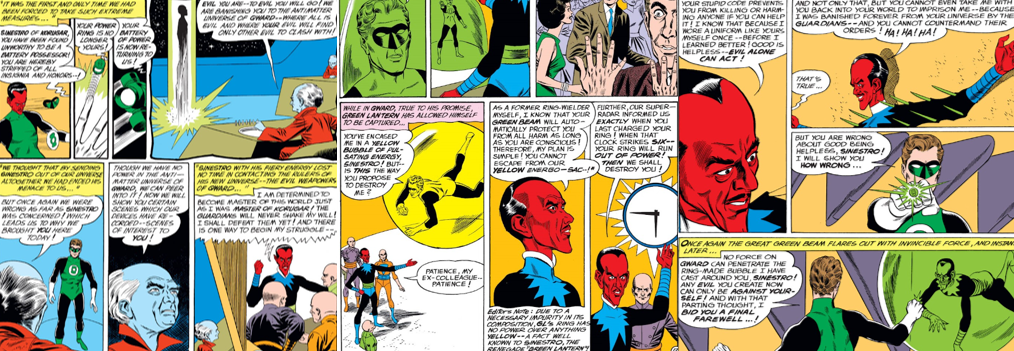
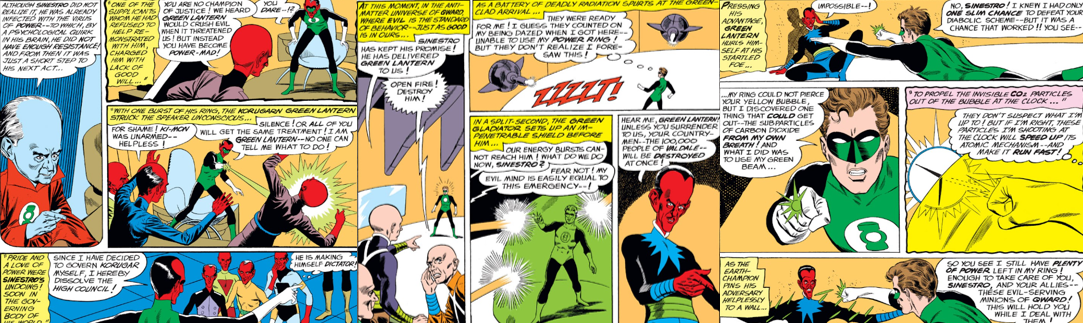
Sinestro then decided to depose the ruling council of Korugar and establish himself as the planet’s dictator who forced his people to live peaceful lives or be mysteriously removed from society. Upon discovering Sinestro’s totalitarian ways, the Guardians admonished him and stripped him of his status as a Green Lantern before banishing him to the antimatter universe of Qward. However, the Guardians later learned that Sinestro rallied the malevolent “Weaponers” of Qward to strike back against his former masters and destroy Green Lantern. Thus, Sinestro developed a “viso-teleporter” to transport Green Lantern to Qward, and the Guardians instruct Hal to journey to the antimatter universe to confront the renegade Green Lantern and save those he’s captured. Since his usual route to the antimatter universe is blocked, Hal reasons that Sinestro will attempt to target him again so he uses himself as bait, turning the residents of Coast City invisible, and is soon forcibly transported to Qward. Although Green Lantern easily shields himself from the Weaponers’ attacks, Sinestro forces him to surrender in exchange for returning his captives home. Sinestro encases Hal in a yellow bubble, rendering him powerless, planning to destroy him once his power ring runs out of charge. Despite his ring being ineffective against yellow, Hal’…somehow…manipulates a clock to trick Sinestro into thinking time has passed faster than it actually has. Once he’s freed from his bubble, Green Lantern zaps Sinestro, washes away his allies, and pins Sinestro to a wall with green needles. Sinestro mocks Hal’s morals and lack of killer instinct and arrogantly reveals that he cannot be punished for his crimes since he’s been banished to Qward. However, Hal gets the last laugh by imprisoning Sinestro in an impenetrable bubble of green willpower before returning home to inspire Valdale’s youngsters with a speech about how good will always triumph over evil.

The Summary:
I’ve always liked Sinestro. I grew up in the 1990s, so I have a bit of a thing for dark doppelgängers of righteous heroes and Sinestro’s one of comic’s most memorable and visually interesting corrupt counterparts to a beloved hero. However, I haven’t read many stories that feature the character and many Green Lantern stories I’ve read either don’t feature him or take place during one of his many real or faked deaths. However, I definitely feel I’ve been spoilt by the likes of Emerald Dawn II (Giffen, et al, 1991), which went into far greater detail about Sinestro’s complex character and his unique relationship with Hal Jordan. Emerald Dawn II set a new standard for their dynamic, casting Sinestro as Hal’s mentor and the greatest of the Green Lantern Corps, only for it to be revealed that he wasn’t just a pompous, arrogant taskmaster with high standards but also a totalitarian dictator who enforced order with an iron fist. You can imagine my surprise, then, to find Sinestro’s first appearance was a twenty-page story based around a bizarre plot to teleport Hal into the antimatter universe. Now, I’m no expert on Qward or the Weaponers; it’s entirely possible Green Lantern had run-ins with them in the past, hence why they’d relish Sinestro’s aid. However, they are the most useless and ineffective people I’ve ever seen. Sinestro doesn’t even utilise their tech, instead creating his own devices, and they blindly follow the charismatic devil as he conjures a clock and boasts about how he’s going to destroy their enemy rather than just doing it. I’d be questioning Sinestro’s effectiveness the moment his viso-teleporter transported a bunch of randomers to my home world, to say nothing of asking why Sinestro doesn’t just pluck the power ring from Hal’s finger or suffocate him to death inside his yellow bubble.

Though visually and thematically interesting, Sinestro is little more than an inconvenience here.

On the plus side, a sizeable portion of the story is spent exploring Sinestro’s backstory, even if it is just the highlights. The idea of a celebrated and formidable Green Lantern falling from grace and abusing his power is a powerful one and perfectly places Sinestro as Hal’s polar opposite, especial as Hal is such a bland do-gooder during these days. He’s the unscrupulous bastion of “right” and “good”, eagerly obeying his masters and opposing Sinestro simply based on the Guardians’ warnings. Sinestro shows a glimpse of how dangerous a Green Lantern can be if they become obsessed with power, first constructing a “sumptuous headquarters”, then forcing people to beg for his help, and finally deposing the ruling government to become absolute authority on Korugar. It’s not stated how long Sinestro ruled his people, but he presumably would’ve continued enslaving his people had the Guardians not stopped by to check on him. His punishment is severe, but strangely humane, with the Guardians simply banishing Sinestro rather than executing him despite it being implied that he executed anyone who spoke out against his rule on Korugar. The Guardians also shoot themselves in the foot since, although they can teleport individuals to Qward and observe the antimatter universe, they “have no power there” and thus cannot intervene when Sinestro plots his revenge. Thanks to a one-way cosmic “back door” of sorts, Hal does return home but cannot truly punish Sinestro because Hal’s too righteous to take a life and Sinestro cannot leave Qward. Thus, Hal leaves Sinestro in what sounds like a fate worse than death but, to me, seems like a prison he’ll easily escape from, making for a pretty lacklustre ending. Everyone starts somewhere, that’s for sure, but Sinestro’s first appearance is an unfortunately forgettable, villain-of-the-month story that really should’ve been given the entire book to be told. Sinestro has a great look, with his devil-red skin, pencil-thin moustache, and striking black-and-blue colour scheme, and his backstory is certainly intriguing. However, it’s undercooked and basically a throwaway story that’s memorable only for introducing one of DC Comic’s best villains, whose future plots definitely extended further than clock-watching!

My Rating:

Rating: 2 out of 5.

Could Be Better

What did you think to Sinestro’s debut story? Do you think the Weaponers of Qward should’ve been portrayed as a greater threat? What did you think to Sinestro, his backstory and characterisation? Were you disappointed by how pedestrian Sinestro’s first appearance was? What are some of your favourite Sinestro stories and moments? Which Green Lanterns your favourite and why? How are you celebrating this pseudo-Green Lantern day today? Whatever you think about Sinestro, or Green Lantern in general, leave your thoughts below, drop me some change on Ko-Fi, and go check out my other Green Lantern content.

Movie Night: Superman

Released: 11 July 2025
Director: James Gunn
Distributor: Warner Bros. Pictures
Budget: $225 million
Stars: David Corenswet, Rachel Brosnahan, Nicholas Hoult, Edi Gathegi, Nathan Fillion, and Gabriela de Faría

The Plot:
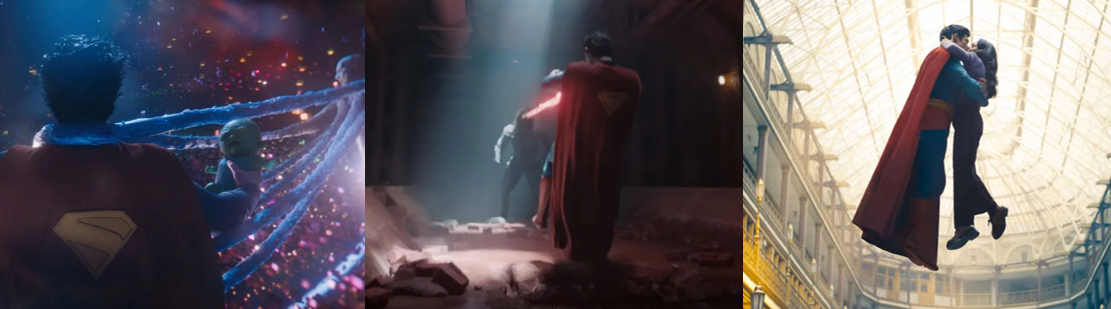
When xenophobic madman Lex Luthor (Hoult) orchestrates a smear campaign against and conspires to murder Clark Kent/Superman (Corenswet), the Man of Steel must prove to the world that he is its protector.

The Background:
When Superman was brought to the big-screen with Superman (Donner, 1978), it resulted in a critical and commercial (if chaotic) success. Although this was echoed with Superman II (Lester, 1980), things quickly took a nose dive, despite Christopher Reeve’s iconic performance. After a nearly twenty year hiatus from cinema screens, Bryan Singer tried to to recapture the magic of Richard Donner’s original film with Superman Returns (Singer, 2006), a critical failure that derailed sequel plans and led to Zack Snyder reinventing the character with Man of Steel (Snyder, 2013). Although a box office hit, Man of Steel divided critics and, while Henry Cavill’s portrayal was widely praised, the subsequent DC Extended Universe (DCEU) struggled to find its footing and, despite long-running plans for a Man of Steel sequel and Cavill (eventually) reprising his role, Warner Bros. opted for a complete reboot of the DCEU with James Gunn at the helm. Initially titled Superman: Legacy, the film was the first live-action chapter in Gunn’s DC Universe (DCU) and was inspired by many of Superman’s most beloved stories. This was reflected in the new Super-Suit; designed by Judianna Makovsky, it combined elements from many different comic book sources. With Cavill out, David Corenswet won the role specifically because he embodied Gunn’s vision of a younger, more optimistic interpretation of the character and it was Corenswet who insisted the costume had the iconic red trunks. After missing out on previous DC roles, Nicholas Hoult was cast as Lex Luthor, shaving his head and studying the work of Grant Morrison and Frank Quitely for the role. Gunn chose to skip the origin story and focus on a Superman in a world where costumed heroes are well established and was compelled to include Krypto the Superdog after connecting with his own adopted pup. Despite childish backlash from misguided die-hard Snyder fans, Superman was met with overwhelmingly positive reviews that praised a return to form for the inspirational hero, the action-packed fun, and the heartfelt narrative. Though some criticised the overreliance on CGI and cluttered runtime, Superman made over $560 million at the box office and paved the way for future DCU projects,

The Review:
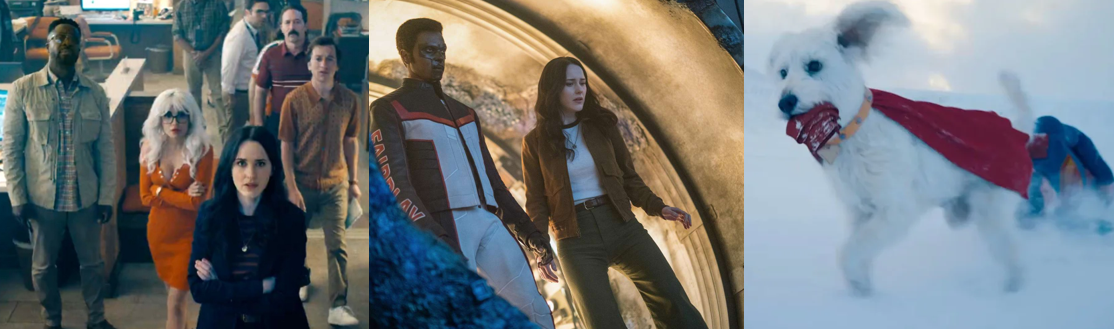
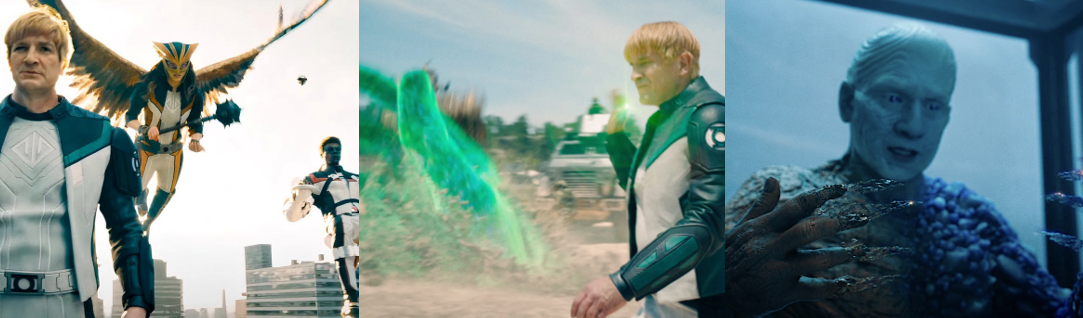
In a fantastic change of pace for DC’s live-action efforts, Superman takes place in a world where superhuman individuals (or “metahumans”) are not only commonplace but accepted. In James Gunn’s DCU, metahumans have been public knowledge for about 300 years and Superman has been active for at least three by the time the movie starts, dropping us in a world where Guy Gardner/Green Lantern (Fillion), Kendra Saunders/Hawkgirl (Isabela Merced), and Michael Holt/Mister Terrific (Gathegi), the corporate sponsored “Justice Gang”, respond to alien, interdimensional, and metahuman threats alongside the world’s most powerful metahuman, Superman. In another change of pace, Superman distills the origin to a simple line of text and dialogue, giving us a Clark who’s already established as a reporter at the Daily Planet (one known for his exclusive interviews with Superman) and already in a relationship with feisty reporter Lois Lane. This also means that the world is well accustomed to Superman and other metahumans, with the Man of Steel celebrated as a symbol of hope and benevolent protector, though Superman is undergoing some scrutiny at the start of the film (and throughout) for taking it upon himself to intervene in a conflict between warring nations Boravia and Jarhanpur. While Boravian president Vasil Ghurkos (Zlatko Burić) launches a public tirade against Superman, the United States government refuses to act against the Man of Steel without proof of malicious intent, with General Rick Flag Sr. (Frank Grillo) being especially supportive of Superman, though even normal citizens question Superman’s unilateral actions when the “Hammer of Boravia” attacks. When grilled by Lois, Clark vehemently defends himself, claiming he did what was right and intervened to save lives. Thus, Superman sees the good in everyone and who has a very black and white view of the world; he knows what’s right and doesn’t hesitate to use his powers to help those in need.

Superman finds his relationships tested by his determination to put his powers to good use.

This desire stems from a damaged message from his long-dead Kryptonian parents, Jor-El (Bradley Cooper) and Lara Lor-Van (Angela Sarafyan) in which they express their love and hopes for him to serve humanity as a protector. Superman takes great comfort in these words, finding solace in the knowledge that he has a higher purpose even if his people are long dead. Additionally, Clark was raised with the standard virtues of right and wrong associated with the character thanks to his adopted parents, Jonathan and Martha Kent (Pruitt Taylor Vince and Neva Howell), who nurtured his kindly nature and contributed greatly to his characterisation as a loveable goof. Despite his amazing powers, Superman struggles as much as any normal man, constantly swooping in to save those in danger and checking to make sure those around him are okay and always pushing to end conflicts with as little violence and death as possible. He’s therefore irritated when the Justice Gang mortally wound a rampaging kaiju and aghast at the idea that he should just stand back and let people die when he could intervene. While Clark and Lois have a very passionate relationship behind closed doors and keep up the pretence of being bickering co-workers, their views on this matter drive a wedge between them early on. While Clark wears his emotions on his sleeve and expects Lois to cut him some slack, Lois is more hesitant about long-term relationships and isn’t afraid to ask the big questions, even of Superman. Though she considers breaking up with him because of her doubts, Lois not only stands by Superman, she comforts him when Lex Luthor launches a smear campaign against him, and teams with Mr. Terrific to rescue him after he willingly surrenders to the authorities. This comes after Luthor raids his Fortress of Solitude and broadcasts the entirety of his parents’ message, which surprisingly reveals that Kal-El was sent to rule a backwoods people, severely shaking Superman’s outlook on himself and his mission to safeguard his adopted world.

While Lois has a lot to do, even teaming with Mr. Terrific, the rambunctious Krypto steals the show!

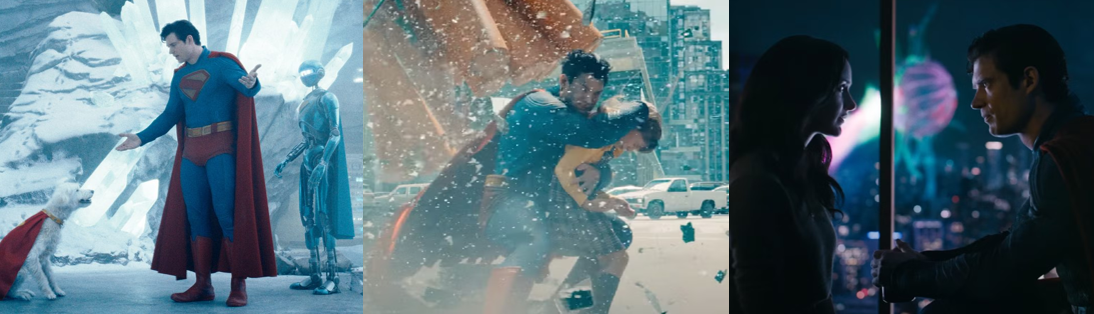
Superman may well give Lois more to do than any previous Superman-centric movie as she gives the Justice gang (particularly the conceited Guy Gardner) a grilling for abandoning their friend, braves Luthor’s unstable “pocket dimension” to locate her lover, and even pilots Mr. Terrific’s T-Craft to ferry him around when he’s injured. While Lois doesn’t hold back when questioning Superman, her deep-rooted desire for the truth sees her digging deeper into Luthor’s malicious vendetta against Superman. She’s aided by peppy photographer Jimmy Olson (Skyler Gisondo), who uses his unexpected way with the ladies to convince Luthor’s current squeeze, Eve Teschmacher (Sara Sampaio), to give them the clues to both locate Superman and reveal that Luthor financed Ghurkos in return for half of Boravia. Lois is depicted as more than Superman’s equal, braving any danger for a scoop and meticulously presenting her evidence to crabby Daily Planet editor Perry White (Wendell Pierce), who supports her efforts to expose Luthor as a liar and a traitor. While his people are long gone, Superman’s aided by a handful of robotic helpers at his crystalline Fortress of Solitude and begrudgingly cares for the energetic and disobedient Krypto, the Kryptonian dog of his unruly cousin, Kara Zor-El/Supergirl (Milly Alcock). While this isn’t Krypto’s first venture outside of the comic books, he steals the show here with his unruly and feisty behaviour, causing chaos due to his super speed and strength much to Superman’s exasperation as he’s struggled to train the pup. An all-CGI creation (though you’d never know it), Krypto’s an adorable superpup who pounds around in a cape, goes for the face when threatened, and nips at Superman’s heels at every opportunity. Though he reluctantly tolerates the dog, Superman is enraged when Luthor pupnaps Krypto, further damaging his reputation by storming into Lex’s office, and endures horrendous torture at the hands of the reluctant Rex Mason/Metamorpho (Anthony Carrigan) when he surrenders to rescue the dog.

While the Justice Gang’s methods clash with Superman’s, it’s nice to see established metahumans.

Although the Justice Gang are clearly the tools of corporate mogul Maxwell “Max” Lord (Sean Gunn), garbed in uncomfortable matching outfits and showing up to avert any crisis and get some much-needed publicity, they are extremely competent superheroes in their own right. While we don’t get any meaningful backstory on any of them, especially the alluring and deliciously battle hungry Hawkgirl, beyond some snarky comments from Guy about how he was chosen to be a Green Lantern, the team is well established and close enough to Superman to know his true identity. Although Mr. Terrific takes centre stage, I enjoyed the abrasive and egotistical Guy Gardner the most and was very pleased to finally see a Green Lantern on the big screen again. Guy is rude, belligerent, and full of himself, believing himself the leader of the Justice Gang and stepping up to anyone who questions his motives, authority, or even the group’s name. Guy is the most vocal of the group in turning on Superman, immediately condemning him as an alien threat, while Hawkgirl is more dismissive and Mr. Terrific is more concerned with the facts. Shown to be a somewhat stoic but unrivalled genius, Mr. Terrific utilises various tech, most notably his T-Spheres, to analyse a threat and determine the best, most efficient course of action, lethal or otherwise. While Superman bemoans their recklessness, the Justice Gang disregard his complaints as they don’t hold themselves accountable for property damage or loss of life, painting them as very rough around the edges. Mr. Terrific is both impressed and horrified to learn the Luthor has harnessed a black hole to create dimensional portals all over the world and kit out a hazardous pocket dimension as his own prison, where the egomaniac throws any dissenters and forces monkeys to slander Superman online. Metamorpho is kept under heel there to save his baby son and forced to transmute his body into Kryptonite to torture Superman. While he initially demands that Superman not try to talk or reason with him, Metamorpho has a change of heart after witnessing how cruel Luthor is and restores Superman to full health, assisting him in fending off Luthor’s goons and even joining the Justice Gang to curb the invasion of Jarhanpur.

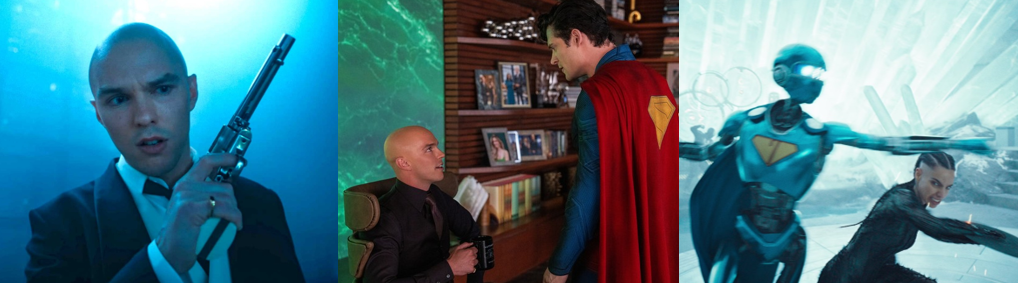
Vindictive Luthor schemes to discredit and destroy Superman with his self-made enforcers.

After years of enduring subpar or wildly eccentric cinematic interpretations of Lex Luthor, Superman finally gives us easily the greatest and most despicable version of the balding madman ever seen on the big screen. Nicholas Hoult excels in the role, effortlessly commanding every scene and bringing a cold, clinical focus to Lex that’s matched only by his ruthlessness and descent into abject tyranny. Already resentful of metahumans, Lex is driven to a self-confessed envious rage by Superman, whom he sees as an alien interloper who is stunting human growth and stealing the spotlight from hard-working, natural geniuses like himself. Committed to first discrediting Superman and then destroying him, Luthor concocts a convoluted scheme to turn the public against the Man of Steel to gain authority to apprehend and destroy him, all while funding the Boravia/Jarhanpur conflict to profit from the war. Constantly in command of every situation, Luthor easily infiltrates the Fortress of Solitude and steals Superman’s personal data, employing his homegrown metahumans – the cybernetic Angela Spica/Engineer (de Faría) and the mysterious Ultraman – to distract Superman while directing a team of all-too-willing underlings to commit horrendous atrocities. Sacrificing her humanity for Luthor’s dream, able to turn her body into any weapon she can imagine, the Engineer attacks with nanotech, easily hacking the Fortress of Solitude and almost suffocating him. Equally, Superman meets a physical match in the ruthless Ultraman, who mirrors his abilities and is directly controlled by Luthor, who’s meticulously studied Superman to counteract and predict his every move. Beneath his silky-smooth facade, however, Luthor is a raving lunatic who condemns anyone who questions him to his pocket dimension, happily tortures and executes those who get in his way or is even remotely tied to Superman, and who relishes the chance to prove his intellectual superiority over the Man of Steel.

The Nitty-Gritty:
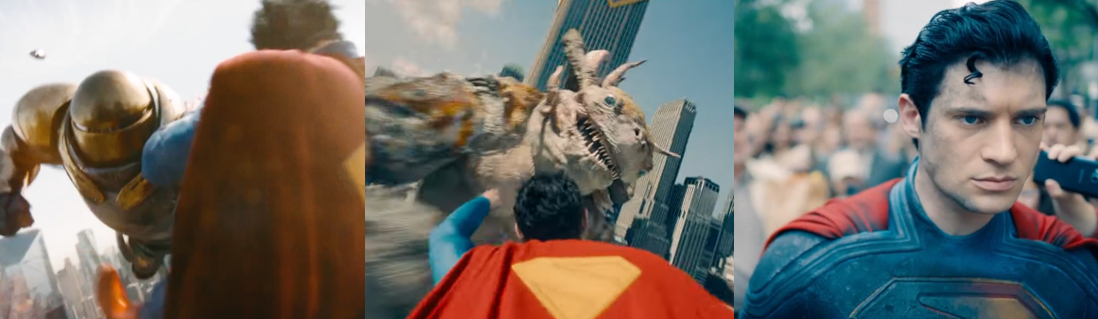
It’s clear that James Gunn is influenced by many different sources for this film. Obviously, the classic Richard Donner films are the most prominent, with composers John Murphy and David Fleming sampling the iconic John Williams theme and giving it a glam-rock edge and the opening and closing titles mirroring Donner’s films. The design of the Fortress of Solitude is also ripped directly from Donner, though Gunn populates it with distinctly “Silver Age” Kryptonian automatons who tend to Superman’s needs. The entire film pops with colour and exciting action, just like a comic book, and Superman is purposely given a corny edge to make him a loveable throwback to a simpler time. Superman also takes place in a world where metahumans, Gods, and monsters have become an accepted part of everyday life. Therefore, while civilians still flee for their lives when the Hammer of Boravia and a fire-breathing kaiju attack, it’s treated as another day in Metropolis, with even Superman and Lois barely acknowledging an interdimensional imp threatening the city during their reconciliation. Superman goes one step further with this, introducing pocket dimensions, establishing the Hall of Justice as the Justice Gang’s headquarters, and hinting at a larger universe beyond our world through a Green Lantern and certain dialogue. Everything feels very “lived in”, like we’ve jumped into the third film in a franchise, without being overwhelming or difficult to follow as the focus is on the characters, their interactions and relationships, and their different dynamics. The world is in awe of Superman but turns on him immediately once Luthor broadcasts his message, with even his allies questioning his true purpose, and this twist is used to push Clark away from being beholden to his lost and unknown people and back towards his true heritage: namely, his Earth parents and their lessons.

Even when Luthor turns people against him, Superman strives to do the right thing.

Although I wasn’t sold on the costume at first, seeing it as a mishmash of different elements from various Super Suits over the years, it looks fantastic on screen. It’s so gratifying to see the trunks and the cape symbol make a return and Corenswet fills the suit out beautifully, appearing as visually iconic as Christopher Reeve did all those years ago. Superman isn’t some invincible demigod here, either. Like in the John Byrne stories I grew up with, Superman is extremely powerful but still physical vulnerable, suffering a brutal defeat by the Hammer of Boravia and enduring incredible agony to return to full strength using a concentrated dose of solar radiation. Superman visibly struggles with his bigger, more impressive feats, increasing the stakes as it’s not always certain that he’ll succeed. Superman also makes a point to rescue civilians wherever possible, something the Justice Gang see as secondary, and even tries reasoning with the Engineer and Ultraman as he always sees the good in people. Superman’s greatest weakness here, however, isn’t just the Kryptonite Metamorpho synthesises to poison him but his own insecurities. Superman believed he was embarking on a sacred mission and is overwhelmed by doubt upon hearing his parents’ full message, but continues to fight anyway, determined to prove that he’s there to help regardless of what people say. The Kents, especially Jonathan, greatly contribute to this, encouraging him to forge his own path based on what he knows is right. To that end, Superman surrenders and allows himself to be imprisoned and tortured, all with the goal of rescuing Krypto and ending Luthor’s schemes, even if it causes him great pain, trusting that his actions will prove that he’s not a threat. Luckily for him, Lois helps turn public opinion back in his favour as Eve’s clandestine selfies reveals Luthor’s plot, though the people of Jarhanpur still believe in Superman since he helped liberate their people from tyranny.

Superman rallies to redefine his mission, battle his crazed clone, and disrupt Luthor’s mad scheme.

Thanks to Lois, Mr. Terrific activates one of Luthor’s interdimensional portals and, after convincing Metamorpho to aid him, Superman escapes from the pocket dimension, recuperating at the Kent farm, reconciling with Lois, and determined to stop Luthor. In his mad ambition to publicly discredit and destroy Superman, Luthor overloads one of his portals and causes a rip in space and time to tear through Metropolis, literally splitting the city in two. Though a mandatory evacuation spares many lives, the entire planet is threatened by this tear, which can only be stopped using Luthor’s access codes. After narrowly escaping being suffocated by the Engineer’s nanites, Superman is horrified to learn that Ultraman is a mindless, brutal clone of his grown by Luthor with the sole purpose of destroying and replacing him. This revelation comes quite late in the film and is easily telegraphed as we never see Ultraman’s face and he’s there when Luthor access the Fortress of Solitude, and I don’t feel it landed all that well. It might’ve been better if Ultraman had been revealed to be a degenerating clone like Bizarro, but I feel the image of Superman battling his mirror image wasn’t as strong as the visual variety offered by the Engineer. It’s moot either way as Ultraman gets tossed into a black hole, leaving Superman free to confront Luthor and engage in a slanging match, one ended when Lois’s story breaks and Krypto manhandles Luthor. His reputation in tatters and his plans undone by Mr. Terrific’s genius, Luthor ends the film disgraced and incarcerated and Metropolis is sewn back together when the rip is shut down. Having declared their love for each other, Superman and Lois rekindle their relationship, the Justice Gang gets a new member in Metamorpho, and the world’s faith in Superman is seemingly restored. Although Superman despairs when his rowdy cousin returns from a bender out in space, he now finds comfort in viewing his memories of his childhood with his Earth parents.

The Summary:
I’ll be the first to admit that I was annoyed that we got another Superman/DC reboot after years of false starts and troubled efforts to get a live-action DC universe off the ground. I was hoping for a course correction with Henry Cavill and slightly sceptical of the new suit, but the colourful atmosphere and light-hearted action of the trailer gave me hope…and James Gunn certainly follows through on that promise. Superman is easily the best big screen adaptation of the Man of Steel perhaps ever, taking inspiration from many different interpretations and comic books and stitching together possibly the most accurate live-action distillation of the character and his chief nemesis. David Corenswet was fantastic in the title role, thankfully spending more time in the suit and just being a good man doing good things, while also not being infallible or so invulnerable that he’s not relatable. Nicholas Hoult was equally captivating as, in my opinion, the best Lex Luthor we’ve ever seen. He brought a malicious spite and smug energy to the role that blew his cinematic predecessors away, appearing as a true threat with an immense hatred for Superman. While I admit some of the supporting characters weren’t as developed as they could be, I’m intimately familiar with all of them so I’ll accept that in favour of a rich, fully realised world where superheroes are the norm. It is a bit odd that Supergirl never told Superman what Kryptonians were really like and somewhat reduces the emotional impact of Superman’s robots being trashed when they’re fully repaired by the end, but the engaging action and thought-provoking character interactions made up for it. I liked that Superman was questioned but not to the point where he was hated and feared, and the painfully relevant metacommentary on the state of politics and social media, and how people rallied behind Superman regardless of his bad press as they could see he was a good person. This was the Superman we should’ve gotten a decade ago, an inspirational hero who can spearhead a colourful and comic accurate live-action universe that finally does justice to these beloved characters while still offering a few fun twists along the way.

My Rating:

Rating: 4 out of 5.

Great Stuff

Did you enjoy Superman? What did you think to David Corenswet’s performance and his suit? Did you enjoy seeing him portrayed as fallible and vulnerable? Were you glad to see metahumans are the accepted norm in his new world? What did you think to Lex Luthor and would you agree this is the best cinematic portrayal of the villain? Were you a fan of Krypto and did you guess Ultraman’s true identity ahead of time? Feel free to share your thoughts on this new version of Superman, even if you’re a hardcore Snyder fan, in the comments, check out my other Superman content, and donate to my Ko-Fi to support more reviews like this.

Back Issues [Crossover Crisis]: Crisis on Infinite Earths


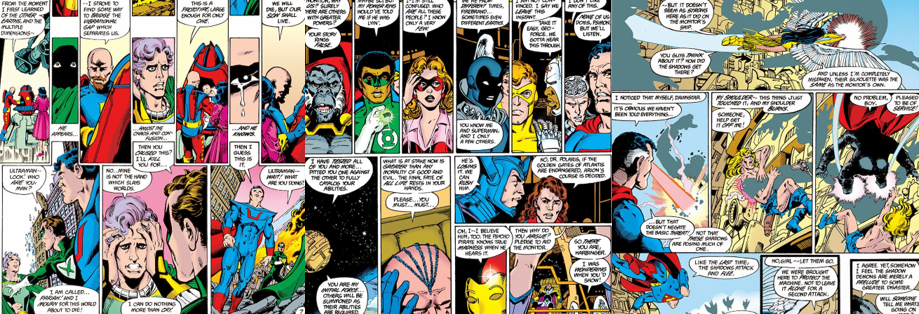
Cover-dated April 1985, the first issue of this ground-breaking event precipitated the destruction of the “Multiverse” in favour of a unified DC canon. Though DC returned to this concept again and again, that doesn’t change how influential this massive crossover was and what better way to celebrate than with a “Crossover Crisis” of my own?


Published: 3 January 1985 (cover-dated: April 1985) to March 1986 (cover date)
Writer: Marv Wolfman
Artist: George Pérez

The Background:
In Showcase #4 (1956), writer Robert Kanigher and artist Carmine Infantino debuted Barry Allen/The Flash, the successor to Jay Garrick, who was established as an alternative version of the Fastest Man Alive. This concept was taken to the next level when Barry and Jay met face-to-face, revealing an infinite number of parallel worlds. Regular crossovers between the likes the Justice Society of America and the Justice League of America soon followed, allowing alternative heroes and various stories to exist simultaneously. Over time, writers like Mark Wolfman became frustrated with this concept, which made keeping track of continuity difficult and it was hard for both writers and readers to connect with the stories. Wolfman initially pitched a reader guide to simplify the DC universe, which then evolved into a sprawling tale of multiversal destruction seen as a risky proposition as it meant erasing all continuity and starting from scratch to attract new readers. Such an event was unprecedented and DC spent two years laying the foundation for this Crisis, hiring researchers to document every character and event in their library and bringing in George Pérez to illustrate, with the artist excited at the idea of illustrating every DC character. Crisis on Infinite Earths became a bestseller for DC Comics and was heralded as a turning point for both the publisher and the industry. The fallout saw every DC character rebooted, with Clark Kent/Superman notably being reimagined as a more grounded character and Wally West taking over as the Flash, though Carter Hall/Hawkman was irrevocably damaged for years as DC struggled to reconcile certain elements of his character. Praised as the greatest comic book crossover in history, the event popularised massive, cosmic crossovers and DC revisited this concept numerous times in subsequent years. The event was even adapted into an ambitious and well received television event and an impressive three-part animated feature.

The Review:
Confused by the concept of the multiverse? Well, Crisis on Infinite Earths has you covered, to a degree, as it opens with (and features throughout) narration and exposition from the tragic Kell Mossa/Pariah. In the beginning, before there was light and life, there was only darkness. Then, from nowhere, came a single light that grew and expanded and finally exploded in “pain [and] relief” as the multiverse was born. The idea is infinite parallel realities all co-exist at once, separated by vibrational planes, though this is noted to not have been the intention when the light burst into being. The story the shifts to one such Earth where the hooded, weeping Pariah witnesses the destruction of not only that world, but the entire reality, at the hands of an all-encompassing white light. As entropy erases everything it touches, Pariah begs to be taken with it, sparing him his grim fate, only to be teleported away as the universe meets its destructive end. We then jump to Earth-3, home of the Crime Syndicate, an evil alternative version of the Justice League. There, Harold Jordan/Power Ring and Clark Kent/Ultraman desperately try to stop the cataclysmic natural disasters springing up across their world as the anti-matter wave approaches. While Thomas Wayne Jr./Owlman and Jonathan Allen/Johnny Quick lament their helplessness against such awesome power, the world’s only superhero, Alexander Luthor, watches helplessly as lifelong enemies like Diana/Superwoman are devoured by the anti-matter wave. With no way to save his world, Alexander rushes to be with his wife, Lois, and baby son, Alexander Luthor, Jr. In a parallel to Superman’s iconic origin, the baby is loaded into a specially prepared rocket and spirited away to Earth-1 as his world dies.

With all universes at risk of annihilation, the Monitor assembles a team of heroes and villains.

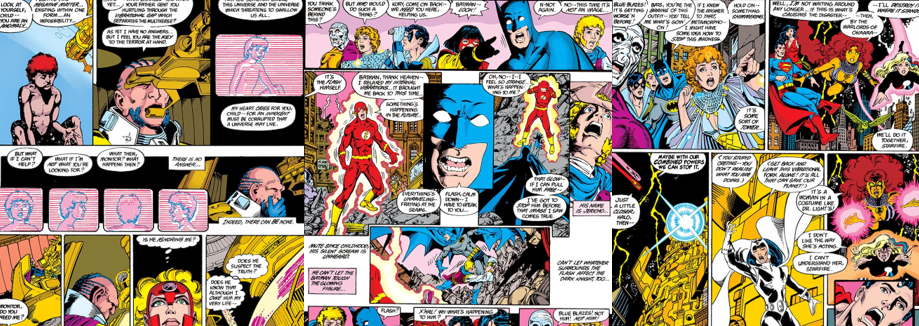
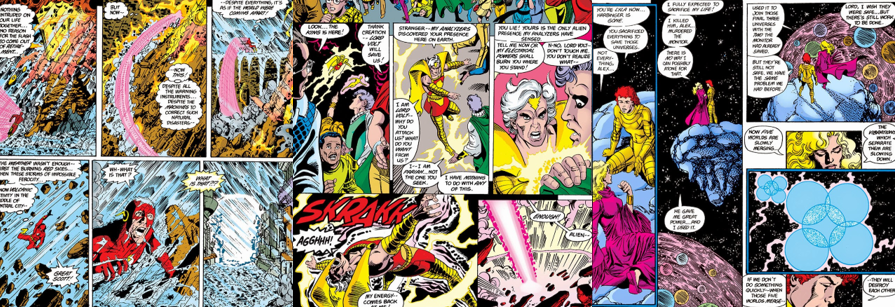
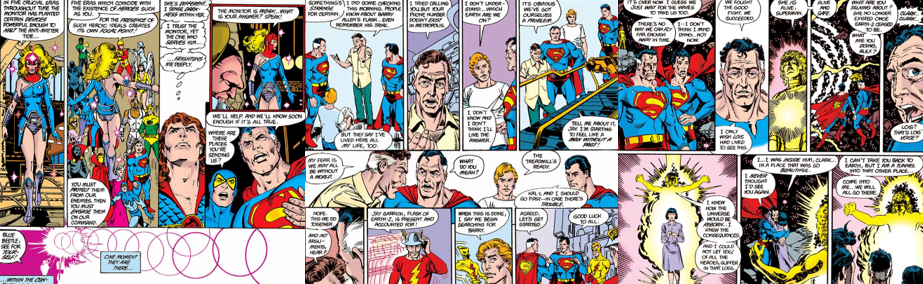
The mysterious Mar Novu/The Monitor observes this from his orbiting, spherical space station alongside Lyla Michaels/Harbinger, whom he sends to recruit Earth’s greatest heroes and villains to stop the pending Crisis. Harbinger recruits King Solovar from Gorilla City, Dawnstar from the 30th century Legion of Super-Heroes, Danette Reilly/Firebrand from Earth-2 1942, Ted Kord/The Blue Beetle from Earth-4, and Roger Hayden/Psycho-Pirate from present-day Earth-2. She returns Psycho-Pirate’s emotion manipulating Medusa Mask and coerces him into quelling Louise Lincoln/Killer Frost’s bloodlust and bringing both her and Ronnie Raymond and Professor Martin Stein/Firestorm to the cause. Though Harbinger is possessed by a Shadow Demon when recruiting Ahri’ahn/Arion the Sorcerer, he joins the other recruits, including Kal-L/Superman, John Stewart/Green Lantern, Neal Emerson/Doctor Polaris, Victor Stone/Cyborg, Simon Jones/Psimon, and Todd Rice/Obsidian. With tensions running high, the group are attacked by Shadow Demons, which seem impervious to physical, mental, and energy-based attacks. While the likes of the Blue Beetle can only run and Firestorm struggles with Killer Frost’s newfound affections, Obsidian and the arrogant Dr. Polaris put their shadow- and magnetism-based powers to good use. The Monitor halts the attack and introduces both himself and the threat to their universes. Weakened by the spread of anti-matter and facing suspicion from his assembled forces, the Monitor reveals that he’s judged them as the best hope of protecting five devices spread across the different eras that he hopes will halt the anti-matter wave. Meanwhile, reality is warped across the multiverse: in prehistoric times, Anthro the Cave-Boy is as astonished to spot a futuristic city amongst the wilds as Querl Dox/Brainiac-5 is to see mammoths stampeding through the 30th century. Half a galaxy away on Oa, the Guardians of the Universe prepare to summon their entire Green Lantern Corps to meet the threat, only for a mysterious voice to corrupt the Central Battery and trap them in a stasis beam. On Earth-1, Bruce Wayne/Batman is busy confronting the Joker during his latest crime spree and is astonished when an emaciated, confused Flash suddenly appears babbling about the end of the world and begging for help before disintegrating before the Dark Knight’s eyes!

As the Crisis worsens, the Monitors prepares Alexander and a new Dr. Light to face the threat.

On the post-apocalyptic Earth-AD, Kal-L, King Solovar, and Dawnstar meet Kamandi, the last boy on Earth, and discover the Monitor’s device, a towering, golden Cosmic Tuning Fork that’s immediately (though only briefly) attacked by Shadow Demons. Arion, Obsidian and the Psycho-Pirate watch over another tower in Atlantis, only for the Psycho-Pirate to be transported to a dark realm and coerced into turning against the Monitor just as Harbinger secretly conspires with that same dark force. Oblivious, the Monitor experiments on the rapidly aging Alexander Luthor, Jr., an impossible merger of matter and anti-matter who potentially holds the key to defeating the anti-matter spread, whom Harbinger’s dark master wants destroyed before he can threaten his schemes. Meanwhile, in the far future of Earth-1, the Flash races to keep his world from being torn apart from natural disasters but is forced to vibrate at super-speed to escape death. This same anti-matter energy arrives on present-day Earth-1, much to the horror of the Teen Titans, who desperately try to both halt the destructive wave and save lives alongside Batman and Superman. As Linda Lee/Kara Zor-El/Supergirl does the same, Barbara Gordon/Batgirl gives in to self-doubt, and John Constantine arrogantly believes it’ll all work out, Vril Dox/Brainiac coldly observes the events concludes that, if he’s to survive, he must team up with Lex Luthor. While defending a Cosmic Tuning Fork from both Nazi forces and Shadow Demons in 1942 Markovia, the Blue Beetle discovers the mysterious Scarab fused to his suit is lethal to the shadowy entities but is wounded before he can put this to good use and returned to his world by the Monitor to spare him. Back on Earth-AD, the skies turn red and King Solovar succumbs to his wounds while Cyborg, Firebrand, John Stewart, and Psimon team up with some local heroes (including Jonah Hex) in 1879 to defend another tower, only to be as overwhelmed by anti-matter as the far-flung future of the Legion of Super-Heroes. Elsewhere, the terrified heroes of Earth-6 blame Pariah for the looming threat, to no avail (though Pariah does save Tashana/Lady Quark to ease his suffering). While the unseen villain forcibly recruits the Red Tornado, the Monitor activates an “ion-based energy ray” to empower Doctor Kimiyo Hoshi, transforming her into the new Doctor Light and sending her to defend his tower on Earth-1.

Following the Monitor’s death, his champions are convinced to unite and save the remaining Earths.

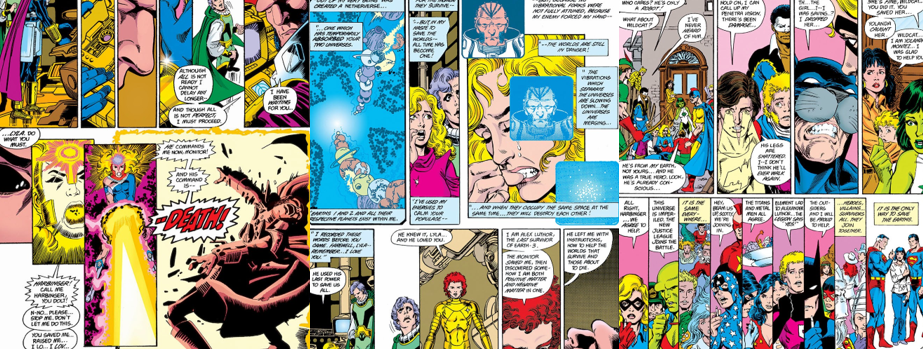
When the heroes attack her, believing she and the tower caused the entropy, Superman quells the fighting, though things take a turn when the Shadow Demons combine into one gigantic, terrifying entity in each era. Even Princess Diana Prince/Wonder Woman’s hopes of recruiting her Amazonian sisters fail. When Pariah berates the Monitor for not doing more to intervene, he reveals just how weak he’s become and then nobly faces his end at Harbinger’s hands. Distraught, Pariah weeps as Earth-1 and Earth-2 are finally consumed; confused to find his strength hasn’t increased as a result, the dark villain delights in having the Psycho-Pirate torture the Flash. Depowered, Lyla is distressed by her actions but a pre-recorded message from the Monitor reveals that his death allowed his essence to empower his Cosmic Tuning Forks and create a “netherverse”, a pocket dimension to keep Earth-1 and Earth-2 safe. After giving the Monitor an appropriate burial, Lyla, Pariah, and the now teenage Alexander Luthor, Jr. gather both world’s champions on the Monitor’s satellite to merge all existing realities into one lest all worlds and realities be lost. Since there are some doubters, Alexander has them witness the Red Tornado be forcibly transformed into a being of pure, primal force, one easily subdued by sorcerers like Kent Nelson/Doctor Fate and Zatanna Zatara (though Ted Grant/Wildcat’s legs are shattered during the fracas). Thus, even the most sceptical agree to defend their worlds, only for the satellite to disintegrate courtesy of the event’s big bad, the Anti-Monitor! Fleeing to the emptiness of limbo, Alexander moves to save Earth-4, -S, and -X, only for Harbinger to subdue him and take his place. While Yolanda Montez continues Wildcat’s legacy on Earth-2, the Freedom Fighters and the Monitor’s agents come to blows on Earth-X when the Psycho-Pirate, his powers augmented by the demonic Anti-Monitor, stirs fear and hatred amongst them. Similarly, on Earth-1, Billy Batson/Captain Marvel and his siblings mindlessly attack Supergirl and Wonder Woman, though the fighting ends when Harbinger forces Earth-4, -S, and -X into the netherverse alongside Earth-1 and Earth-2, exhausting her incredible powers but dooming them to be slowly merged together.

After Lyla relates the Anti-Monitor’s origin, Supergirl sacrifices herself to try and destroy him.

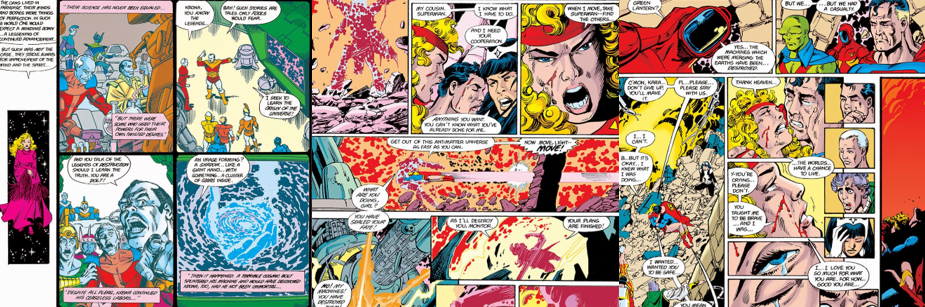
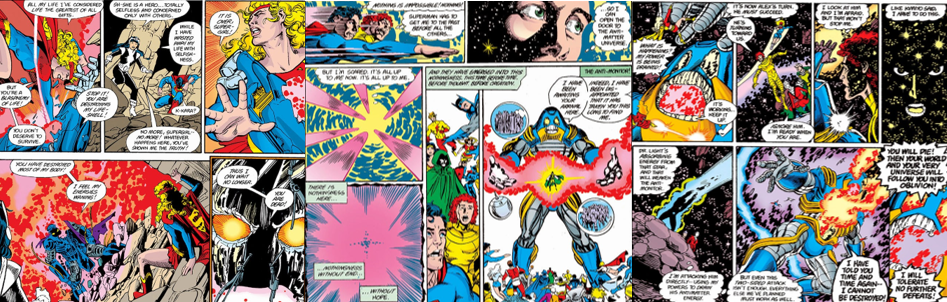
Thus, Lyla, Pariah, and Alexander assemble Earth-1’s Superman, Earth-2’s (Kal-L), Captain Marvel, the Blue Beetle, Lady Quark, and Uncle Sam and reveal that, ten billion years ago, the Oan scientist Krona dared to seek the beginning of the universe, witnessing a giant hand clutching a star cluster. This caused a cosmic fracture, creating not just the multiverse, but an anti-matter universe and a counterpart to Oa, Qward. After banishing Kronoa, the Oans created peacekeeping forces like the defective Manhunters and the Green Lantern Corps but were fractured by a civil war, birthing the Controllers. Amidst the fighting, the Monitor and his evil, anti-matter counterpart came into being. The Anti-Matter conquered Qward and created the Shadow Demons to spread his influence throughout the anti-matter universe before waging war against the Monitor upon sensing his presence. Evenly matched, they were rendered unconscious for nine billion years before being awoken by the misguided Pariah, once a celebrated healer and scientist who also investigated the origin of the universe. Pariah’s world paid the price, and he was damned to live forever and watch all worlds die, though the Monitor also saw him as instrumental in saving all reality. Alexander uses his unique matter/anti-matter powers to create a dimensional tear to the anti-matter universe, which Pariah leads the heroes to the Anti-Monitor’s vast stone fortress. Enraged that the Psycho-Pirate is too drained to corrupt them, the Anti-Monitor has his stronghold attack, injuring the usually invulnerable Kal-L. Dr. Light and Superman discover the Anti-Monitor’s solar collector but are attacked before they can destroy it and halt the merger of the Earths. Hearing her cousin’s agony, Supergirl flies to Superman’s aid, brutally beating the villain in a rage and chastising his disdain for life, tearing through his protective armour. Furious, the Anti-Monitor prepares to explode with all his energy and, in a last-ditch effort to destroy him, his machine, and save everyone, Supergirl tackles him, destroying his machine but being fatally blasted. As the Anti-Monitor’s deteriorating, incorporeal form slinks away, Superman mourns his cousin’s death and vows to kill the Anti-Monitor. Kal-L calms his counterpart and they escape, and a memorial service is held on Earth-2, where Superman pays homage to Supergirl, vowing to remember her and fight in her name. Despite the loss, the five worlds are saved; similarly, the Green Lantern Corps free their masters and almighty Darkseid wisely cloaks Apokalips from the Anti-Monitor’s gaze. However, the Anti-Monitor reconstitutes himself on his ship, where the Flash is imprisoned, and prepares a counterattack from Qward.

Despite the Flash’s noble sacrifice, the Anti-Monitor gains God-like power from his anti-matter universe.

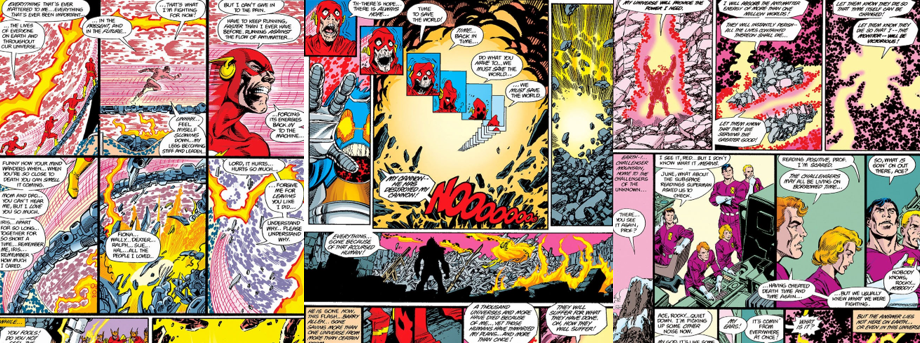
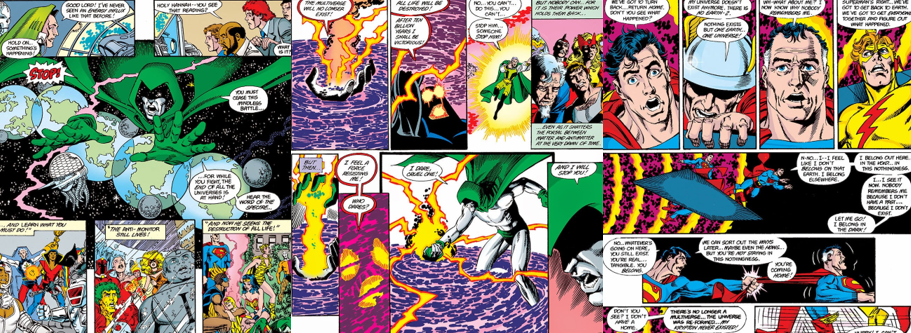
Though saved, the five worlds are still overlapping, causing anomalies and damage to each while  the Anti-Monitor oversees the creation of the anti-matter cannon, which he plans to use to obliterate the worlds. Just as the Psycho-Pirate feels his powers return, the Flash escapes and angrily attacks the sadistic villain, forcing him to turn the Anti-Monitor’s slaves against their master as a distraction. Though stunned to find the anti-matter cannon is powered by concentrated anti-matter and realising that destroying it would kill him, the Flash bravely circles the weapon’s core to turn its destructive energy back on it. Staving off the agony with memories of his loved ones, the Flash runs fast enough to move back in time (explaining his earlier, sudden appearances). Though Barry successfully destroys the weapon, it costs him his life. Enraged, the Anti-Matter absorbs the anti-matter universe, literally sucking the life out of over a million worlds to feed his lust for power and vengeance, an act so awesome that it’s detected by both the Challengers of the Unknown and the embodiment of the Lord’s wrath, Jim Corrigan/The Spectre. In the face of multiversal destruction, the Guardians of the Universe offer Guy Gardner the chance to become a Green Lantern once again and, when all but one of them are all slaughtered by a sudden explosion, Guy vows to avenge them as their champion. The Brainiac/Luthor team then recruit dozens of villains to strike while the remaining Earths are weak and in disarray. As time runs amok on Earth-1 and Alexander, Lyla, and Pariah address the United Nations, the villains make their move, having conquered Earth-4, -S, and -X, encasing them within impenetrable barriers, and threatening to destroy the remaining worlds. Lyla and Jay recruit a reluctant Wally West/Kid Flash to breach the barrier with the cosmic treadmill, though neither Luthor or Brainiac care much about their losses since they still possess the power to destroy everything. However, the Spectre ends the hostilities by revealing that the Anti-Monitor still lives and plans to corrupt the flow of time and formation of life by travelling to the dawn of time.

The Spectre demands co-operation, resulting in a singular world being created.

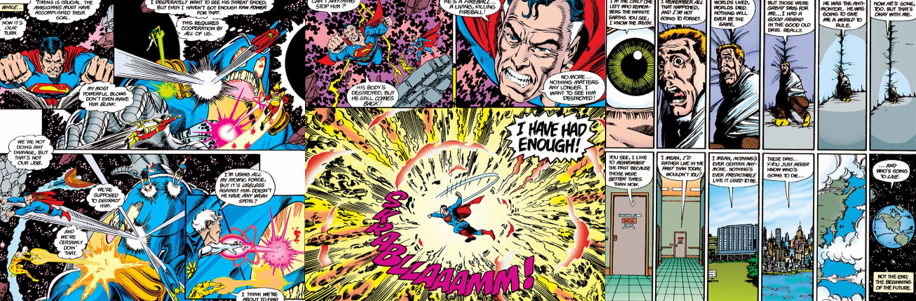
With the villains back on side, Kal-L bids an emotional farewell to his wife, Lois Lane, to join the counterattack, alongside a surprising newcomer: the Superboy from Earth-Prime (a fictional approximation of the real world where he’s the only superhero). After a rousing speech from Uncle Sam, heroes and villains alike pool their technology and powers to travel to the dawn of time and confront the anxious Anti-Monitor. The Anti-Monitor reveals that he, not Pariah, was responsible for the destruction of Pariah’s world after he took advantage of Pariah’s experiments to rebuild his power, absolving the tragic figure of his sins. Now grown to immense proportions, the Anti-Monitor withstands the assault of those assembled (with guys like Batman offering only support), absorbing their life energy to add to his power and allowing his hand to be the one that shapes all reality, as witnessed by Kronoa. His grasp is intercepted by the Spectre and the combined magic of the unified sorcerers, reducing the battle to a literal arm wrestle between the Anti-Monitor and the Spectre. Thanks to their bickering, Luthor’s underlings fail to kill Kronoa before he can cause the creation of the multiverse and the Anti-Monitor, and all seems lost. However, following a blinding light and the literal shattering of all time and space, Kal-L awakens on present-day Earth to find he’s on the same world as his Earth-1 counterpart. Sharing the same fragmented memories, Superman explains that time seems to be healing (albeit wonkily) and that elements of multiple Earths have been merged into one. For example, everyone knows Supergirl died but not how, the Flash is presumed vanished, and Earth-2’s Keystone City and Jay Garrick now live on this Earth. Jay, Wally, and the Supermen use the cosmic treadmill to discover Earth-2 is missing. Realising that the multiverse no longer exists, Superman has to force his older counterpart to return rather than throw himself into the endless void in despair. With the cosmic treadmill irreparably damaged, Wally assembles everyone at Titans Tower, discovering guys like Captain Marvel, Superbody-Prime, Uncle Sam, and the Earth-2 Dick Grayson/Robin also exist on this world, where they’re all shocked to see Harbinger alive and powered back up. The refugees are despondent and horrified to learn their worlds, pasts, and many loved ones are gone thanks to “cosmic irony” as Harbinger explains that there is now one Earth with one coherent timeline that folds their disparate lives into its flow, sending Kal-L into a crazed distress at having lost his wife and home.

A final, all-out assault ends the Anti-Monitor and starts the universe anew, with some casualties.

After questioning the imprisoned Lex Luthor, Batman, Jason Todd/Robin, and Alexander confirm that, while some duplicates remain and some lives were restored, others weren’t and only those who present at the dawn of time remember the multiverse. Just as they’re processing this, the skies turn red and the world suddenly shifts to the anti-matter universe, where the titanic, disembodied Anti-Monitor still lives! Though incensed by their efforts, the Anti-Monitor congratulates them for handing him his first defeat in ten billion years and then decrees that they must all die. Wally’s shock at his mentor’s death is mirrored by the abject panic that sweeps the civilians following the Anti-Monitor’s threat, which doubles when the Shadow Demons kill Don Hall/Dove, Helena Wayne/Huntress, and Tula Marius/Aquagirl. While the sorcerers remove the Shadow Demons, Harbinger assembles one last effort to stop the Anti-Monitor on Qward. Though the Anti-Monitor is too large and powerful to be damaged, Harbinger has Dr. Light absorb the star feeding him power, weakening him enough for Alexander to breach the villain’s armour. With the threat seemingly ended by a combined energy blast, Alexander struggles to return Earth home and the Anti-Monitor absorbs his exiled Shadow Demons to rise again and vaporise Wonder Woman. Rather than see anyone else die, Kal-L tackles the Anti-Monitor, believing he’s got nothing to lose, and Alexander and Superboy-Prime are trapped with him. Though Darkseid, watching from Apokalips, strikes a fatal blow through Alexander’s eyes, the Anti-Monitor refuses to die, so Kal-L delivers a final strike that obliterates the tyrant. Faced with the pending destruction of the anti-matter universe, Kal-L and Superboy-Prime prepare to meet their end only for Alexander to teleport them, alongside Kal-L’s Lois, to a pocket dimension. In the aftermath, Wonder Woman returns to the clay that forms Themyscira, her Earth-2 counterpart is welcomed among the Gods, the dead heroes are memorialised, and Wally assumes the Flash mangle. Confined to Arkham Asylum, the Psycho-Pirate is dubbed a raving lunatic since he’s the only one who remembers the multiverse and the catastrophic events of the Crisis.

The Summary:
Whew, there’s a lot happening in Crisis on Infinite Earths. There’s a reason I’ve put off reviewing it for so long, and why I rarely revisit it. It’s a very dense and complex story, full of exposition and cameos and faces both obscure and iconic. As a celebration of DC’s rich history and characters, it’s hard to find much better than Crisis on Infinite Earths, which stuffs just about every costumed character, hero or villain, into its dense twelve issues! My hat’s off to George Pérez; it must’ve been painstaking to sketch all these group shots, action sequences, montages, and dramatic events. Equal praise to Marv Wolfman as I can’t imagine how difficult it was to make sense of all these different worlds and come up with a cohesive way to explain, link, and destroy them all. In the end, the solution was simple: pure, destructive, unstoppable entropy. It’s fitting that the anti-matter wave is depicted as a blinding white light that erases everything it touches, for it symbolically represents a blank page or an artist’s eraser, indicating that these colourful and convoluted worlds are being literally wiped clean for a new status quo. Our guide through most of this is Pariah, a tragic figure doomed to watch each world die as penance for kick-starting the events that follow. Immortal but seemingly powerless to intervene, all he can do is shout desperate warnings and is powerless to rescue anyone and constantly met with aggression, suspicion, and accusations. He’s merely a pawn in a much larger game, however, much like Harbinger, who acts as an all-powerful emissary of the Monitor and deliver exposition in his stead. A conflicted individual burdened with the knowledge that she will betray and murder the man to whom she owes her life, Harbinger, nevertheless works to uphold the Monitor’s legacy and bring together heroes and villains alike to stand against his dark counterpart.

The Anti-Monitor’s power sends shockwaves through the multiverse and those who’ve witnessed it.

The dreaded inevitability of death is a focal point in Crisis on Infinite Earths. When the anti-matter wave hits, heroes and villains set aside their differences and use all their powers and resources to either stop it or save people from its destructive touch. Even the abhorrent Crime Syndicate find themselves fighting to save their world and Ultraman willingly enters the wave to die on his terms. Even before the wave arrives, the worlds are shaken to their core by natural disasters; volcanoes, tsunamis, and ominous, crackling red skies precipitate the disaster as much as Pariah. Perhaps no character is more synonymous with the coming destruction than the Flash; thanks to his super-speed, he ends up travelling through time, arriving before the likes of Batman and Wally as an omen of what’s to come and taking on an appearance that resembles Death itself. The Anti-Monitor echoes this in his design; though shrouded by his all-powerful armour, he sports a skull-like visage and dark, piercing eyes. Commanding demonic shadows, he’s very much the embodiment of Death and his lust for utter annihilation drives him to snuff out all life and light. Sadistic to the core, he employs the Psycho-Pirate to foster fear and hate, turning his would-be opponents against each other and causing countless more deaths. His ruthlessness seemingly knows no boundaries as he gleefully corrupts Harbinger, relishes the death of his counterpart, and nonchalantly obliterates his rebellious slaves without a second thought. His power and cruelty are so great that even the mighty Darkseid is driven to hide rather than confront him, striking when the villain is at his most vulnerable and largely avoiding the greater conflict. For all his God-like power, the Anti-Monitor still relies on technology; his merger and destruction of worlds can be halted or stopped by Cosmic Tuning Forks or destroying his solar collector. Indeed, it’s only after his massive, world-ending cannon is destroyed that the Anti-Monitor eschews all other methods and absorbs the entire lifeforce of the anti-matter universe into himself to literally take matters into his own hands.

The Supermen anchor the story, leading the assembled champions in battle and saving all reality.

There is no one central character in Crisis on Infinite Earths. Instead, it’s a team-up story through and through, meaning some of your favourites may be sidelined. In some respects, I don’t mind this; Batman outright admits how useless he is against the Anti-Monitor and it’s clear only beings of incredible power can stand against him. Yet, the Blue Beetle is said to be pivotal in opposing the villain, the Red Tornado is briefly said to be incredibly important, and Lex Luthor comes close to co-ruling five entire worlds and even leads the charge to assassinate Kronoa. The Earth-2 Superman, Kal-L, is often at the heart of the conflict, leading the others and inspiring confidence, as is his Earth-1 counterpart. It’s therefore more tragic seeing Superman’s grief-stricken reaction to his cousin’s death; holding Supergirl in his arms, the Man of Steel briefly forgets his morals and vows to kill the Anti-Monitor as recompense. This is but one of the unforgettable deaths featured in Crisis on Infinite Earths as the Flash sacrifices himself to deal a critical blow to the Anti-Monitor, making a martyr of himself for decades before DC made the bone-headed decision to revive him. There’s an odd dichotomy in Crisis on Infinite Earths; these alternative worlds and characters co-exist and are even folded into one by the end. Rather than wiping everything away and starting afresh by the conclusion, the story clunkily has the survivors forget key events and weaves characters like Captain Marvel and the Justice Society into a unified timeline. This works for me as I prefer a coherent narrative, but it essentially means Crisis on Infinite Earth takes place mid-way through the early years of the post-Crisis reboot and reimaginings like John Byrne’s Superman stories happen before and during this event, rather than after it.

Worlds lived, worlds died, and the DC Universe was never the same…for about twenty years…

These days, Crisis on Infinite Earths may be a lot for modern readers to take in. Many of its characters and concepts are either forgotten, wildly different, or have been done to death thanks to the multiple reality-altering events that followed (many specifically to address loose ends from this story). At the time, though, I’d wager many long-term DC readers appreciated the cameos and call-backs weaved into the story. I’m glad DC devoted twelve issues to the story and didn’t rush it, but it does get repetitive and convoluted as it drags on. The secondary threat of Brainiac and Luthor directing a team of villains to conquer the five worlds, for example, could probably be skipped or relegated to a tie-in comic. Similarly, the defending of the Cosmic Tuning Forks isn’t very interesting and doesn’t really add to the story since we barely see any action around this, the Shadow Demons are too powerful to be interesting, and it’s all negated by the Monitor’s death. In this respect, I think the event could’ve been cut down to eight or ten issues and still been just as effective, especially as many Earths and characters feature as quick cameos to be obliterated. The remaining five Earths are said to be the most important, which is a little disrespectful to those that perished by the Anti-Monitor’s hand and a bit of an insult to any fans of those worlds. I liked seeing new heroes rise during the chaos, like a new Dr. Light (who was an aggressive bitch throughout), Wildcat, and Guy being Green Lantern again, though it falls a little flat when you know the canon is going to be altered after this to return the status quo. I liked the Anti-Monitor’s design and his characterisation as a reprehensible being who craved only power and destruction, but it was hard to get a sense of his power and limitations. One minute he’s weakened by giant towers, then his armour is containing his energy, and then he’s being powered by a black sun despite having absorbed the lifeforce of his anti-matter universe. Still, the unification of heroes and villains to oppose him was fun to see, the sacrifices and determination were poignant, and the weaving together of a singular continuity, while flawed, was ambitious and visually engaging to behold.

My Rating:

Rating: 4 out of 5.

Great Stuff

Have you ever read Crisis on Infinite Earths? What did you think of this unprecedented mash-up of DC’s various worlds and characters? Which parallel world was your favourite and were you upset to see destroyed? What did you think to the Anti-Monitor, his vast power and his stubborn refusal to die? Were you shocked to see Supergirl and the Flash die so dramatically? Do you agree that the story dragged on a bit by the end? Which of the subsequent Crisis events was your favourite and what are some of your favourite cosmic events? Drop a comment below to share your thoughts about Crisis on Infinite Earths and feel free to check out my reviews of other notable crossovers.

Screen Time [JLA Day]: Justice League: Secret Origins


To celebrate the release of Justice League (Snyder/Whedon, 2017), DC Comics named November 18 “Justice League Day”. Setting aside all the drama surrounding that movie, this provides a perfect excuse to spotlight DC’s premier superhero team, which set the standard for super teams in comics by bringing together DC’s most powerful heroes.


“Secret Origins”

Air Date: 17 November 2001
Director: Dan Riba and Butch Lukic
Original Network: Cartoon Network
Stars: George Newbern, Kevin Conroy, Susan Eisenberg, Phil LaMarr, Michael Rosenbaum, Maria Canals-Barrera, Carl Lumbly, and Kevin Michael Richardson

The Background:
In 1992, hot off the success of Tim Burton’s gothic Batman movies, Bruce Timm and Paul Dini produced one of the most lauded cartoons of an entire generation with Batman: The Animated Series (1992 to 1995). The award-winning animated series was soon accompanied by one of the greatest adaptations of Clark Kent/Superman’s adventures, and it wasn’t long after that The New Batman Adventures (1997 to 1999) and Superman: The Animated Series (1996 to 2000) were crossing over. Superman also introduced a number of additional superheroes into the celebrated DC Animated Universe (DCAU), colourful faces familiar to comics readers who would be pushed to the forefront when Dini and Timm collaborated on the illustrious Justice League animated series (2001 to 2004). The late, great Kevin Conroy (for many the definitive Bruce Wayne/Batman) returned to voice the Dark Knight, though George Newbern replaced Tim Daly as the Man of Steel, and the show came to define the values and appeal of the titular team. Starting with a bang with a three-episode arc that was later collected as a feature-length presentation, Justice League expanded its lore and roster evermore in its sister-series and has been widely praised for its mature themes, relatable characters, and for setting a new standard for animated adaptations, to the point that DC’s later animated ventures are often directly compared to the DCAU.
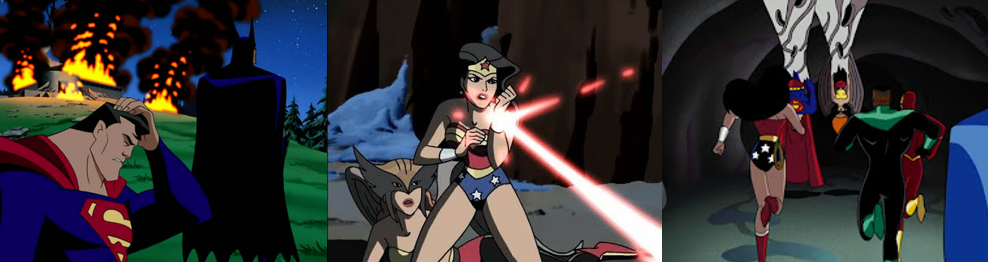
The Plot:
When the alien invaders who decimated Mars attack the Earth, the planet’s greatest superheroes are called together for the first time by Martian survivor J’onn J’onnz (Lumbly) to combat the threat.

The Review:
The DCAU started as a very grounded affair. Batman: The Animated Series largely stuck to street-level or city-wide disturbances, focusing on Batman villains who were crazed, yes, but largely human. There were obviously exceptions, but things rarely got too fantastical. That changed when Superman: The Animated Series was confirmed to take place in the same continuity; suddenly, Batman existed alongside aliens, magic, and other supernatural threats far beyond his mortal limits. Yet, even then, Superman: The Animated Series focused more on the titular Man of Steel and his exploits; when costumed heroes did appear, it was more of a spotlight or a cameo, a glimpse into an even bigger world. I say all this as “Secret Origins” wisely starts off from Batman’s perspective, with him investigating a series security breaches in WayneTech’s global deep space monitoring network and finding the culprits are guilty of more than simple corporate espionage. Confronting the facility staff as they attach an alien device to a satellite dish, Batman is stunned to find the employees not only speaking an alien language but exhibiting superhuman strength and an unnerving ability to reconstitute broken limbs. Stubborn as ever, Batman refuses Superman’s help when he stops by, only to end up aiding the Man of Steel when he’s half-crippled by what appears to be a psychic attack. Though Batman scoffs at the idea of calling for Superman’s help with his signal watch, he pockets the device and continues his investigation over the next six months, undeterred despite his enemy being far outside of his weight class. However, when checking out a Metropolis warehouse, Batman discovers more scientists, this time encased in disgusting, egg-like pods, held in stasis so the alien invaders can better assume their identities. When he’s attacked by an alien guard dog, Batman’s forced to signal Superman for help but even the Man of Steel is seemingly powerless when a series of meteors crash to Earth and birth gigantic, tripod-like alien walkers that decimate the world’s major cities.

When invaders attack, Earth’s heroes are forced to work together (and with J’onn) to fight back.

Despite throwing his best punches, Superman barely slows the destructive walkers, but another psychic barrage clues him in on the key to fending off the invaders. Closely followed by Batman, who’s no match even in his kitted-out Batplane, the World’s Finest find a strange alien humanoid held in captivity in an alien base. Freeing the visitor, they learn that he is J’onn J’onnz, the last survivor of Mars, and that he was attempting to communicate to Superman on a mental level. Though naturally distrustful, even after J’onn assumes a more human guise, Batman listens intently as J’onn relates how the once-peaceful Martian civilization was decimated by the relentless, gloop-like invaders. They destroyed all trace of J’onn’s people, committing mass genocide and even stealing their shape-shifting powers, and were only stopped when J’onn himself led a final, desperate attack on their underground stronghold and paralysed them with a nerve gas. Though he sealed the invaders away and kept watch for 500 years, J’onn was in a hibernation cycle when two astronauts accidentally opened the tomb, reawakening the invaders and turning their aggression towards Earth. Desperate to ensure that another civilisation doesn’t suffer as his did, J’onn escaped and tried to warn the Earth, only to be captured and studied. Luckily, he retained enough of his power to call out not just to Superman, but to Wally West/The Flash (Rosenbaum), John Stewart/Green Lantern (LaMarr), and Shayera Hol/Hawkgirl (Canals-Barrera), who all join the fight and take down a contingent of the alien walkers. Their efforts are further aided by Princess Diana of Themyscira/Wonder Woman (Eisenberg), a “rookie” hero (as John puts it) who abandons her island paradise to aid mankind. Though new to the hero game, Wonder Woman makes an immediate impression, deflecting incoming fire with her wrist guards and showcasing superhuman strength and flight, aiding Hawkgirl and taking down the walkers as forcefully as Superman. Still, distrust is rife amongst the fledgling Justice League; not only are they wary of J’onn but Diana’s expertise is called into question, and the group initially struggles to gel. John immediately takes charge, barking orders and dividing the group into teams to gain intel on the walkers, only to be lumbered with the childish Flash and left chastising Wally for his reckless nature. Such recklessness is echoed in both Hawkgirl and Wonder Woman, whose first instinct is to fight and cause them to blindly charge into ambushes and traps as a result. Superman is constantly trying to help everyone and therefore lets his guard down. Apparently somewhat complacent since he’s largely invulnerable, Superman’s easily subdued by the invaders’ powerful tech.

The fledgling Justice League ultimately triumph over the invaders and become a cohesive unit.

Although they’re unsure about J’onn, he proves to be dependable and is extremely capable in a fight. Boasting psychic powers, he can also fly, turn invisible and intangible, and exhibits superhuman strength on par with his peers. He also holds the key to shutting down one of the invaders’ drilling facility, working alongside Wonder Woman and Batman to steal the ion crystal, only for Batman to be left behind and seemingly gunned down. As the only member of the team without superpowers, Batman is at a physical disadvantage, but he does his best. He has his toys, of course, but his greatest asset is his mind. He colludes with J’onn to fake his death, an act that galvanises the team to work harder in rescuing Superman and Hawkgirl, and which deceives the invaders and their overseer, the Imperium (Richardson), a Lovecraftian, tentacled nightmare that delights in torturing J’onn before his newfound allies. The Imperium realises all-too late that Batman has survived as the Dark Knight sabotages the ion crystal, reversing its polarity and dispelling the polluting cloud that’s blanketed the Earth since the invaders arrived. It’s also Batman who deduces that the invaders are vulnerable to sunlight, a weakness the team quickly takes advantage of by ripping holes in the alien craft, killing the creatures without a second’s hesitation. Though they have no name, the alien invaders are a formidable force; they use shape-shifting abilities stolen from the Martians to impersonate public figures and even the heroes, laying the groundwork for their forces to arrive. They also wield laser blasters and are fully malleable, pulling themselves back together or reforming after taking damage. Most notably, they attack humanity using tripod-like walkers ripped right out of The War of the Worlds (Wells, 1898) just as the Imperium’s arrival is ripped from Independence Day (Emmerich, 1996). Their numbers and advanced alien tech make them more than a match for each of the team individually, even overpowered members like Superman and J’onn, but, once the disparate heroes start working together, the invaders are summarily driven off and Earth gains a powerful group of protectors.

The Summary:
“Secret Origins” has quite a mountain to climb. Sure, while DCAU viewers would’ve been well acquainted with Batman and Superman and have some knowledge of the Flash and the Green Lantern Corps, Wally, John, Shayera, and Diana are essentially brand-new characters in this sprawling continuity. Rather than spending time delving into the background of each of these new heroes, “Secret Origins” spends more time focusing on introducing J’onn and Wonder Woman, assuming the audiences will remember lore about the Flash and the Green Lantern Corps from Superman: The Animated Series and simply dropping Hawkgirl in our laps. I think this was a good approach; I liked that the first part was essentially another Batman/Superman team-up as it showcased neither man could fight off the invaders alone and that the two together wouldn’t be enough, either. This greatly aided in establishing the invaders as a true threat; they easily manhandled Batman, forcing him to ask Superman for aid, and Superman was distracted by J’onn’s attempts to communicate and unprepared to face a physical challenge. J’onn is depicted as a suitably tragic figure, one who’s seen his whole world die at the hands of these invaders and who is determined to prevent it happening again. J’onn even apologises for humanity’s violent nature and defends the very people who treated him so poorly when he arrived. He finds a kindred spirit in Superman and a surrogate family in the Justice League, who eventually accept him as one of them through his courageous actions. This arc is echoed in Wonder Woman, who renounces her place in paradise out of curiosity to explore “Man’s World” and a sense of duty to defend the planet from its aggressors. However, as she’s new to the superhero lark, she’s initially treated with contempt by the strait-laced John Stewart. A gruff military man who focuses solely on the job, John has no time for the Flash’s games and is dismissive of Diana for being a “rookie”. The others are much more accepting and even John is turned around after seeing the fantastic abilities Wonder Woman brings to the table.
Heroes old and new must learn to fight together to defend the Earth.

The dynamic between the fledgling Justice League is at the forefront of “Secret Origins”. J’onn calls them together to defend the planet but none of them have any experience working together. Sure, Batman and Superman have teamed up, but they didn’t exactly like it or make a habit of it. Indeed, the only one with a sense of teamwork is John and even he’s bad at it, ordering the heroes around like he’s king shit and simply expecting them to fall in line or work together without laying the groundwork first. Egos and personalities clash throughout, with Batman being his usual pig-headed self, Hawkgirl charging into conflict, and the Flash toying with his foes, seemingly oblivious to the stakes. Even Superman struggles with the team dynamic, feeling obligated to help everyone and being blindsided as a result, and consequently sees the value in bringing the team together as a permanent fixture. Superman’s focus is on solving all the world’s problems, so much so that he doesn’t even suspect he’s being manipulated by the invaders to weaken Earth’s defences. The invaders are relentless and extremely aggressive, laying waste to cities with little resistance, but are both formidable and extremely vulnerable. Even Batman takes them out with enough effort and their machines are brought down by the heroes, but their sheer numbers and tenacity mean they can easily subdue even the Justice League. It isn’t until they underestimate Batman and their weakness is exposed that they show any signs of fear, with the Imperium desperately fleeing once its exposed to sunlight, only for Wonder Woman and Hawkgirl to violently bring down its escape craft and send the rest of its kind scurrying back to the depths of space. Again, it’s a very War of the Worlds-like ending and perhaps a little too contrived and nonsensical for the invaders to have such a glaring weakness, but it’s used to emphasise the team coming together as a unified force, so I’ll allow it. Ultimately this was a great introduction to the DCAU Justice League. “Secret Origins” established their different and conflicting personalities and how their various powers and abilities will work going forward, emphasising that they all have a part to play, and showed that there are some threats that require a whole group of special heroes to oppose it.
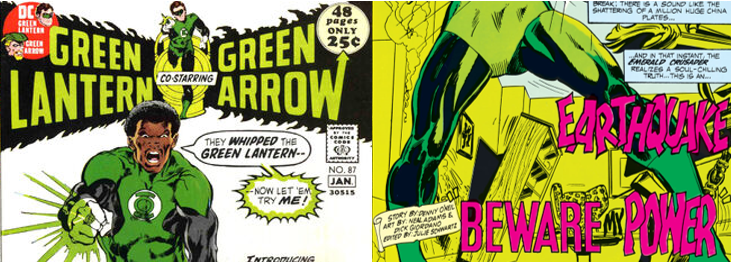
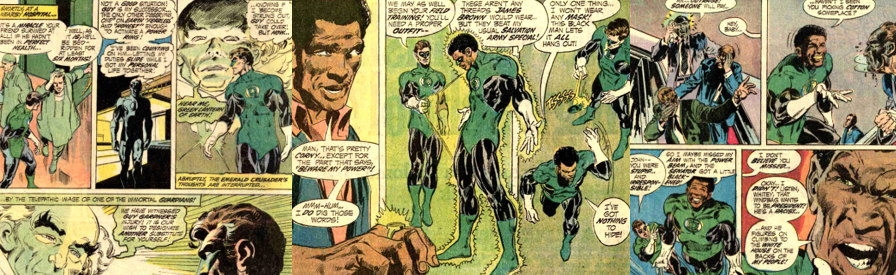
My Rating:

Rating: 4 out of 5.

Great Stuff

What did you think to “Secret Origins”? Did you enjoy seeing these heroes come together? What did you think to threat they faced? Would you have liked to get a little more insight into the Flash and Hawkgirl? Are you a fan of J’onn J’onnz? What are some of your favourite Justice League episodes? Feel free to use the comment section below to share your opinions and be sure to check out my other Justice League content across the site.

Back Issues [Brightest Month]: Green Lantern Co-Starring Green Arrow #87


Although February 2014 was dubbed “Green Lantern Day” (because, by the American calendar, the date read as “2814”, the sector of space assigned to Earth in DC Comics), the significance of this date has passed as the years have changed. Instead, as perhaps the most popular iteration of the character, Hal Jordan, first appeared in October of 1959, I’ve been dedicating every Sunday of October to the Green Lantern Corps!


Story Title: “Beware My Power!”
Published: January 1972
Writer: Dennis O’Neil
Artist: Neal Adams

The Background:
Initially presented as magically empowered railroad engineer Alan Scott, Martin Nodell and Bill Finger’s colourful Green Lantern was significantly reinvented by writer John Broome and artist Gil Kane in 1959, becoming a more science-fiction-oriented superhero. Almost ten years later, Groome and Kane planted the seeds for a diverse peacekeeping force, a Green Lantern Corps, with the introduction of Guy Gardner, a volatile individual who acted as a backup to Harold “Hal” Jordan, popularly known as the greatest Green Lantern of all time. Arguably, however, many fans are more familiar with military-minded John Stewart as Earth’s go-to Green Lantern, particularly after his inclusion in the popular Justice League cartoons (2001 to 2004; 2004 to 2006). Created by Neal Adams, who favoured shelving Guy Gardner for an African-American Green Lantern, John was originally depicted as a belligerent architect whose methods and sensibilities clashed widely with Hal’s, and famously refused to hide his identity. John was later retconned to be a former United States Marine, a change that would come to define his character, and became burdened by guilt after accidentally committing genocide. In addition to serving on the Justice League, John became the first mortal Guardian of the Universe, was one of the rare male members of the Star Sapphires, and has prominently featured in DC adaptations, appearing as a skin for Green Lantern in multiple videogames and very nearly making it to live-action on more than one occasion.

The Review:
Things get off to a dramatic start here as an earthquake rocks Southern California just as Hal Jordan is charging up his ring. Although the tremors are brief and have cause only minor damage, Green Lantern swoops over the city to help out where he can, do-gooder that he is. And he’s not the only one; outside the city, the quake has wrecked a bridge and sees little Suzie teetering over a fatal drop. Luckily, Guy Gardner is on hand to help talk her down, but the poor girl’s so terrified that she’s rooted to the spot. With the remains of the bridge unstable and a plummet into the canyon awaiting them both, Guy makes a desperate run for the girl just as Green Lantern arrives to help. Hal shows up just in time to see Guy get smashed by a bus(!) as the section collapses, rescuing them both from the fall but grieved to see that Guy was critically injured from the impact. When doctors at a local hospital inform Green Lantern that Guy should fully recover in six months’ time, Hal is left dejected. Since Guy has been pegged as his successor, Hal has been relying on him taking over if his personal issues become too overwhelming. Luckily, one of the enigmatic and all-power Guardians of the Universe senses Hal’s anxiety and, aware of the situation, suggests that a new substitute be picked in case the worst should happen. Hal agrees and the Guardian takes him to meet his new replacement in the last place Hal expected to go: an urban ghetto. 

When Guy is injured, Hal begins training socially-minded John to be his backup.

There, we’re introduced to John Stewart in a way that perfectly encapsulates his alternative sensibilities. When a police officer threatens two Black youths with disciplinary action for playing dominoes on the pavement, John intervenes, questioning his authority and calling the cop out on his obvious racism. Hal, however, is unimpressed (though not, as the Guardian suggests, because he’s equally prejudiced) by John’s apparent ego. Though he disagrees with the choice, Hal agrees to approach John as Green Lantern and offer him the position as his backup and John, who’s struggled to find work as an architect because of his race, readily agrees to the opportunity to shake off his reputation as a “square” as a superhero, jokingly suggesting he change his name to “Black Lantern”. Thus, Green Lantern (who doesn’t reveal his true identity to John) begins teaching John about the powers and limitations of the power battery and the ring. Hal teaches John the Green Lantern oath (which he finds “corny”), reminds him to charge his ring every twenty-four hours, and temporarily empowers John with his own Green Lantern uniform so they can begin field training, John, however, refuses to hide his identity behind a mask. He also takes to his training like a natural, mastering the ring easier than avoiding muggers and bigots, and is quickly given the chance to put his skills to the test when they spot an out of control fuel tanker heading towards a crowd at the airport. Although they succeed, Hal is enraged when John purposely causes Senator Jeremiah Clutcher to receive a face full of oil, giving John the chance to insult him with a racist quip. John, however, justifies his actions since Clutcher is a known racist who openly oppresses John’s people in his bid to become President of the United States. 

Despite their clash of personalities, John earns Hal’s resect for his deductive reasoning.

Hal chastises John and, to teach him a lesson, orders him to guard Clutcher from reprisals; he also objects to being called “Whitey”, especially considering John’s so pent-up about racism. Later, Clutcher makes an impassioned speech to his supporters, openly mocking “The Darkies” and accusing them of being of lesser intelligence, which only further raises John’s ire. Although Hal doesn’t approve of Clutcher’s insensitive attitudes, he’s so strait-laced that he believes the senator has the God-given right to free speech, meaning he leaps into action when a Black man suddenly shoots at Clutcher during his tirade while John refuses to get involved. Hal quickly tackles the gunmen, noting that the assassin never tried to put up a fight, while John subdues a White gunman outside the stadium. Hal reprimands John for his prejudice, accusing him of bringing disgrace to his uniform, but John simply shrugs him off and teaches Hal a lesson of his own: he spotted both gunmen at the airport and was suspicious to note that one was shooting and the other was missing. Hal’s stunned to learn that the Black man’s gun was filled with blanks as part of an elaborate frame. The Black man was a patsy, setup to make it look like the “Blacks are on a rampage” and winning Clutcher the Presidency at the cost of an all-out civil war. Hal condemns the senator’s actions and is impressed by John’s deductive reasoning. Hal still has apprehensions about John’s methods and style, but the content architect simply brushes it off and the two seem to finish the story with a mutual respect for each other. 

The Summary:
First and foremost, I have to praise the stunning artwork of the late, great Neal Adams. Adams first came to my attention when I read Batman annuals as a kid and I’ve always loved his bold, kinetic, square-jawed depictions of DC’s superheroes. He brings Hal and John to life in such a dynamic way, depicting them as lean, muscular heroes and giving a fluidity to their actions, and it’s always a joy to see his art on the page. Sadly, the scans I’m reading don’t do the art justice. The colours are muted, messy, and robbed of their “pop”, though this does give “Beware My Power” a bit of a dark edge to it that is reflected in the nature of the plot. Next, I have to comment on Guy Gardner. While he tries to help a girl endangered by the earthquake, he’s unceremoniously taken out when a bus smashes into him, leaving him bedridden like a chump. This element was so random, so unnecessarily over the top, that it may as well have killed Guy (and, realistically, should’ve) since it was a pretty extreme and unintentionally hilarious way to put him on the shelf. It was also weird that Hal’s concern was less for Guy’s welfare and more for his own. His entire concern is on what will happen to him and the Green Lantern mantle if he’s unable to perform his duties and less on how the injuries will impact Guy’s future. It’s pretty selfish, if I’m honest, and does as little to endear me towards the “greatest Green Lantern” as his unwavering commitment to the concepts such as authority and free speech. 

With his outspoken nature and unique appearance, John makes a great first impression.

This means he naturally clashes with John Stewart. While John admittedly has a chip on his shoulder and is overly suspicious of authority figures, he has every right to be since he’s an out of work Black man struggling to make a living in the ghetto and facing unfair persecution wherever he goes simply for the colour of his skin. His attitude might be confrontational, and he might ruffle Hal’s feathers with his cavalier nature, but John’s entirely justified since the story depicts a cop persecuting young Blacks for no justifiable reason and then paints Senator Clutcher as such an exaggerated racist bastard that it’s almost comical. Of course, this is probably truer to reality at the time than we realise. The segregation and public dismissal of Blacks was commonplace and African-Americans had every right to take issue with it. Unlike many of them, John is given the power to affect real change when he agrees to become Hal’s backup Green Lantern. He easily masters the ring (potentially because of his creativity as an architect but also because of the strong sense of injustice he feels) and immediately clashes with Hal in his approach towards using his power. While Hal obviously doesn’t agree with racism, he’s a stickler for the rules and believes everyone should have basic human rights, even dirty scum like Clutcher, so he constantly reprimands John, who frankly doesn’t give a shit about Hal’s opinion. Being a product of the 1970s, the story naturally infuses John’s dialect with a bit too cliché “Jive talk” for my tastes, but it instantly gives him more personality than Guy; as does his refusal to wear a mask, his confrontational behaviour, and his unique look. Consequently, I’d definitely say John makes a better first impression than Guy, Hal, or even Alan. While they were all quite bland and cookie cutter in the debuts, John is bold and outspoken.  He might be a bit of a hypocrite at times (he exhibits the same prejudices towards Whites as he receives from them) and in need of some seasoning, but his introduction was the shake-up the book needed at the time and I’d go as far as to say that both Guy and Hal should’ve been taken out by that bus so the Guardian could’ve empowered John to take over the comic! 

My Rating:

Rating: 3 out of 5.

Pretty Good

Did you enjoy John Stewart’s debut story? What did you think to his characterisation and the personality clash between him and Hal? Were you as unimpressed by Guy’s accident as I was? What did you think to the racism angle threaded throughout this story? Do you think John was justified in his actions or do you think he needed tempering a little to approach things more diplomatically? Where does John rank in the Green Lantern hierarchy for you and what are some of your favourite stories and moments of his? How are you celebrating Green Lantern this month? I’d love to hear your thoughts on John Stewart so leave them below, and go check out my other Green Lantern content across the site! 

Back Issues [Brightest Month]: Green Lantern #59


Although February 2014 was dubbed “Green Lantern Day” (because, by the American calendar, the date read as “2814”, the sector of space assigned to Earth in DC Comics), the significance of this date has passed as the years have changed. Instead, as perhaps the most popular iteration of the character, Hal Jordan, first appeared in October of 1959, I’ve been dedicating every Sunday of October to the Green Lantern Corps!


Story Title: “Earth’s Other Green Lantern!”
Published: March 1968
Writer: John Broome
Artist: Gil Kane

The Background:
Martin Nodell and Bill Finger’s original version of the Green Lantern, Alan Scott, was a magically empowered railroad engineer rather than a space-faring peacekeeper. However, following the successfully reinvention of the Flash in 1956, John Broome and artist Gil Kane changed the Green Lantern mythos forever with the introduction of test pilot Harold “Hal” Jordan, widely regarded as the greatest Green Lantern of all time, in 1959. Nearly ten years later, Groome and Kane revealed that Hal was just one of the potential candidates for Abin Sur’s power ring, the other being volatile Guy Gardner, who first debuted in this issue. Not only was Guy relegated to backup status, he soon found himself gravely injured and briefly trapped in the Phantom Zone. Then, he was replaced by another and developed brain damage, becoming even more hostile and egotistical, especially regarding his status as a Green Lantern. Guy is perhaps best known for his time on Justice League International, where he often clashed with his teammates, as much as his unstable temperament, which saw him kicked out of the Green Lantern Corps and wielding Thaal Sinestro’s yellow power ring. Guy’s backstory was significantly altered in the early-1990s, revealing him to be of Vuldarian heritage, before he returned to the Green Lantern Corps as one of Earth’s many emerald defenders. Whether wielding a green, yellow, or red power ring, though, Guy has maintained a vocal fanbase, despite his flaws. Though allegedly cut from the universally derived live-action film, Guy’s appeared, in some form or another, in various DC adaptations and is due to be portrayed by Nathan Fillion in James Gunn’s reimagined DC Universe movies. 

The Review:
Our story opens with Hal Jordan on Oa, the headquarters of the Green Lantern Corps and home to the enigmatic Guardians of the Universe, for an intensive two-day training course. Yes, it seems even intergalactic space cops have to endure team meetings sometimes, folks! However, rather than learning trust exercises, Hal is shown a gigantic, Jack Kirby-esque telescope that displays current events all across the universe and even keeps a record of a person’s life after they die as a “mental post-mortem”. Hal jumps at the chance to see the last thoughts of his predecessor, Abin Sur, and to learn why he, of all the millions of people on Earth, was chosen to become his successor. As in Hal’s origin story, Abin is fatally injured in a crash and tasks his power battery to find a worthy inheritor of his power ring, but there’s a twist: the battery claims that there are two equally strong candidates! One is, of course, fearless test pilot Hal Jordan and the other is the hitherto-unknown Guy Gardner, a schoolteacher who lost out on becoming Green Lantern simply because Hal was closer. After reliving Abin’s dying soliloquy over the next few panels, Hal is left astonished to learn that there was another potential candidate. Luckily, the Guardians’ incredible machine can also show Hal potential alternative timelines and, at his request, program it to show what would’ve happened if Guy had been selected instead. 

In another life, Guy became Green Lantern and embarked on a very similar superhero career.

In this version of events, gym instructor Guy is whisked away by the green energy and readily accepts the ring. However, since he’s not subjected to the same monologue as Hal, it takes Guy a hot minute to figure out how to use the ring, though he’s no less committed to using its power to battle injustice as Green Lantern. Like Hal, Guy’s first mission was confronting a group of saboteurs. Unlike Hal, who phased through walls and bullets and was dazed by a yellow lamp, Guy crashes through walls and erects an energy shield to block their bullets, hesitating to directly use his ring against them in case he “[crushes] them to a pulp”. Instead, Guy relies on his physical superiority to beat them into submission. Victorious, he also embarked on a fantastical superhero career, tackling colourful supervillains and even defeating renegade Green Lantern Thaal Sinestro. This victory saw Guy finally summoned to Oa and learning the true extent of his powers and responsibilities, but it’s in his return journey home that the biggest deviations occur between Hal and Guy’s lives. Guy was distracted by a series of intergalactic explosions that saw him detour to the planet Ghera to interject in a duel between two alien robots. Their conflict quickly turns against him, though he easily bested the two droids and learned that the planet is populated solely by human children. The robots explain that the Gheran parents created them before being wiped out by a mysterious yellow plague. This same virus kept the children from growing and, in their boredom, they programmed the robots to engage in war games for their amusement, meaning the planet is constantly in a state of conflict between the orange side and the blue side. Amazed, Guy vows to show the children that they’re walking a dark path, confident that he can teach them the benefits of peace, only to suddenly find himself completely paralysed when the children of the blue side not only sense his presence but take control of his body with their mental powers (a feature the robots conveniently neglected to mention earlier).  

Guy eventually breaks free and brokers peace, only to succumb to a fatal disease.

Thinking Guy is an advanced automaton and using their incredible psychic powers to learn his name (but, strangely, not his true purpose), they send him against their enemies. Completely under their sway, Guy has no choice but to obey and is forced to defend them against a mechanical bird the orange’s send to attack the blue’s city. Next, he’s set against the orange’s fish-like submarine, resisting its lightning attacks and scuppering it with a giant green energy hand. Impressed by his abilities, the blue’s send him to wage an all-out attack on the orange’s city. However, after besting their defences, he finds himself caught in a mental tug of war as both sides try to control his mind and body with their mental powers. Desperate to save himself, Guy summons all his willpower to break free and conjure a suit of armour to protect him from further mental attacks. This form is also enough to convince both sides to agree to a parlay; a simple suggestion for “enjoyable sport and exercise” is enough to convince the children to stop their conflict. However, it’s not just Guy’s words that sway the children; he uses his ring to subtly influence them, making them “normal” and unifying them in peace. Pleased, Guy leaves to recharge his ring (uttering an amended version of the classic Green Lantern oath), only to suddenly fall violently ill. Having contracted the yellow plague while on Ghera, Guy quickly finds himself facing certain death and wills his power ring to search out a replacement. The ring brings Hal to him and, just as in the main timeline, the stunned test pilot is gifted the power ring and the Green Lantern mantle, though he “makes up” his own oath since Guy never got to teach him it. Amazed by these visions, Hal returns to Earth to meet Guy in his civilian guise. He joins the same athletic club Guy attends and quickly becomes fast friends with him, eager to keep an eye on him out of respect for his candidacy for the mighty Green Lantern Corps. 

The Summary:
“Earth’s Other Green Lantern!” is one of those classic misleading comic books as the cover advertises the promise of a physical confrontation between Hal and Guy, one that sees the upstart Gardner usurp Hal to become Earth’s only Green Lantern. In truth, this never happens, nor is Guy’s personality anything like the cover depicts. Ironically, the cover paints Guy as an egotistical hothead, which would become his defining personality trait, but the actual story shows him to be as bland and generically heroic as Hal. Indeed, much of the narrative is geared towards showing how similar the two are, which I feel is a massive missed opportunity. Hal is excited by the idea that he wasn’t the only one considered as Abin Sur’s replacement, but Hal and Guy’s superhero careers are functionally identical save for Guy having less initial instruction on the ring and his side quest to Ghera. I have no idea if Hal went to this planet and encountered the strange psychic children, but Guy’s time there isn’t massively significant except that it sees him prematurely killed and handing the mantle to Hal, meaning this alternative timeline really isn’t all that interesting. Now, if Guy had been his later cocky, overconfident self, utilising more direct or brutal methods, maybe things would’ve been more interesting. There are hints that Guy approaches his duties slightly differently, such as being more creative with his energy constructs and being more physically capable than Hal, but there’s not enough deviations between the two to really make me care. 

The differences between Hal and Guy are sparse, and the story’s a fantasy anyway!

The story tries to say that things took a dramatic turn on Ghera but…they don’t, really, except that it sees Guy killed. It seems like it’s going in a different direction, maybe having the kids turn Guy rogue or expanding on him using his power ring to influence their behaviour and having him be reprimanded for that, but that doesn’t happen either. The Ghera sub-plot is actually quite dull. I enjoyed the Jack Kirby influences on the art and visuals of the planet, but the random mental powers came out of nowhere and their control over Guy seemed more like an excuse to show off his control of the power ring than anything else. Indeed, the whole escapade makes Guy seem secondary to Hal since it took him a while to summon the willpower to shake off their influence, and then he just ends their long-running thirst for war with a few words and subtle influences. I’ll admit that I wasn’t expecting Guy to die at the end, though I probably should’ve considering the nature of the yellow plague. Again, it might’ve been more interesting if the virus had been affecting him throughout the story, adding an extra dimension to his plight, but…again, no. In the end, this read like another of those crazy imaginary stories DC liked to publish in the Golden Age where nothing really matters because it’s all a dream or some elaborate fantasy. Sure, it led to Hal seeking Guy out by the end but even that is a bit weird. There’s no suggestion here that he befriends him in case he needs a backup, it’s more out of curiosity and respect, so I can’t help but feel like the whole issue can be skipped as it’s ultimately meaningless in the short term (and even in the long term, as Guy’s personality was eventually completely different). 

My Rating:

Rating: 2 out of 5.

Could Be Better

What did you think to Guy Gardner’s debut story? Were you shocked to learn that Abin Sur had two choices to pick from? What did you think to Guy’s characterisation here and were you disappointed by how bland he was? Would you have liked to see more differences between the two and more from the concept? Where does Guy rank in your Green Lantern hierarchy, and what are some of your favourite stories of his? There’s a comments section below, so share your thoughts there and go check out my other Green Lantern content!  

Back Issues [Brightest Month]: Showcase #22


Although February 2014 was dubbed “Green Lantern Day” (because, by the American calendar, the date read as “2814”, the sector of space assigned to Earth in DC Comics), the significance of this date has passed as the years have changed. Instead, as perhaps the most popular iteration of the character, Hal Jordan, first appeared in October of 1959, I’m choosing to dedicate every Sunday of October to the Green Lantern Corps!


Story Titles: “S.O.S. Green Lantern”, “Secret of the Flaming Spear”, and “Menace of the Runaway Missile”
Published: October 1959
Writer: John Broome
Artist: Gil Kane

The Background:
In July 1940, Martin Nodell and Bill Finger introduced readers of All-American Comics to Alan Scott, the very first Green Lantern. Far from an intergalactic lawman, Alan was a magically empowered railroad engineer who became a regular fixture of the title and DC Comics’ first super team, the Justice Society of America (JSA). However, after Gardner Fox, Harry Lampert, and Julius Schwartz successfully reinvented the Flash in 1956, a new green-hued superhero began operating under the codename Green Lantern in 1956. Re-envisioned as fighter pilot Harold “Hal” Jordan, the Green Lantern concept was drastically reimagined to incorporate a science-fiction slant, and Hal later became he de facto Green Lantern after the universe-shattering Crisis on Infinite Earths (Wolfman, et al, 1985 to 1986) saw Alan Scott and his teammates briefly banished from DC continuity. A hotshot pilot with an eye for the ladies, Hal fully represented the Green Lantern Corps. He opposed tyranny in all its forms, even making an enemy of his tyrannical mentor, Thaal Sinestro, helped found the Justice League of America, and even formed an unlikely partnership with liberal spokesman Oliver Queen/Green Arrow. Widely regarded as the greatest Green Lantern of all time, Hal isn’t without his flaws; his despair at seeing his hometown obliterated by Hank Henshaw/Cyborg-Superman, saw him infested by the malevolent entity Parallax and briefly become a genocidal madman before being redeemed and retaking his place as the premier Green Lantern. This reputation means that Hal is popularly the go-to character whenever Green Lantern appears outside of comics. He’s appeared in numerous videogames and cartoons, even if just to characterise other Green Lanterns, and was the main character of the much maligned live-action adaptation

The Review:
If there’s one thing Hal Jordan is known for in his role as the greatest Green Lantern, it’s his ability to overcome great fear and this is emphasised on the first page of his first-ever story, when we’re introduced to “ace test pilot” Jordan who has a reputation for his “remarkable lack of fear”. It’s this quality that fatally wounded Green Lantern Abin Sur seeks after his spacecraft crash-lands in “Southwest U.S.A.”. Summoning the remains of his strength, the dying alien wills his Battery of Power – the titular green lantern – to seek out a worthy successor, one who is without fear, and sends an emerald-hued energy beam across the globe in search of the perfect candidate. Over at the Ferris Aircraft Company, hotshot test pilot Hal Jordan is tinkering with a “flightless trainer” (presumably some kind of simulator to train space pilots) when he and the craft and bathed in a green glow and, to his astonishment, blasted away at high speed to Abin’s crash site. There, Hal is momentarily stunned to behold the purple-skinned alien, who telepathically welcomes him and begs that he listen to his instructions for the green lantern, which is a weapon against injustice utilised by space-patrolmen across the galaxy. Although Hal is eager to help Abin and save his life, the alien waves off his concerns, accepting the inevitability of his death, and confirms that the lantern chose a worthy successor. 

Hotshot test pilot Hal Jordan is bequeathed a dying alien’s ring and becomes Green Lantern.

Abin then uses what little time he has left to share how his ship was unexpectedly battered by Earth’s radiation bands and he was momentarily blinded and left powerless by the flashing yellow lights. He goes on to relate that, for all the green lantern’s great power, it contains an “impurity” that renders it useless against anything tinted yellow, and that the power ring that channels the green lantern’s awesome might must be charged every twenty-four hours. Abin then hands Hal his ring, begs him to carry on the good fight, and promptly dies, much to Hal’s sorrow. On Abin’s instruction, Hal takes the alien’s slick, form-fitting uniform, tests the ring’s power by wiling a nearby cliff into the air, and vows to oppose evil in all its forms as Green Lantern. The issue’s next story, “Secret of the Flaming Spear”, introduces us to Carol Ferris, daughter of Carl Ferris, and Hal’s boss. Although she doesn’t approve of Hal’s tardiness, she’s more than wiling to go on a date with him, but their intimacy is cut short when pilot Frank Nichols suddenly calls in an S.O.S. when the controls of his experimental plane, the titular Flaming Spear, seize up on him. Feeling partially responsible since Frank’s only up there due to him being unavailable, and realising he has the power to intervene, Hal ditches Carol and utters a sacred oath before the green lantern: “In brightest day, in blackest night, no evil shall escape my sight. Let those who worship evil’s might beware my power… Green Lantern’s light!” Fully empowered, Hal takes to the skies as Green Lantern through sheer fore of will (noting how strange it is to fly without a plane) and easily guides Frank to safety using a burst of energy from his power ring. 

For all his power, Green Lantern can’t affect anything yellow or influence Carol’s heart.

However, on closer inspection of the Flaming Spear, Green Lantern realises that the incident was no accident. Radiation caused the controls to freeze, so Green Lantern uses his ring to follow the lingering radiation to its source, a group of saboteurs holed up in a house not far off. Like his predecessor, Green Lantern phases through the wall of their hideout and confronts them, intercepting their bullets in mid-air but being briefly knocked out when the lead saboteur tosses a yellow lamp at his face. His pride hurt more than his body, Green Lantern recovers and chases after them, only to find they’re making a getaway in a yellow car. Although Green Lantern can’t affect the car directly, he does burst the tyres by conjuring hard-light ice picks with his power ring, wrangling the saboteurs with energy lassos so they can be apprehended by the authorities. When Hal returns to Ferris Aircraft, he finds Carl and Carol delighted at Green Lantern’s actions and that Carl is planning to take a two year leave of absence to go travelling, during which time he officially names Carol as his worthy successor. Carol takes the promotion very seriously, immediately shutting down any romantic involvement with Hal and leaving him to ponder the quandary that his ring can perform any miracle…except win the heart of his love interest. This irony continues in the final story, “Menace of the Runaway Missile”, where Hal wows his colleagues with his fearless testing of a rocket-sled. While Hal has the bravery to endure the intense speed and g-force of the sled, he struggles to find the courage to ask Carol out, especially after she knocked him back. He decides the best way to win her over is to invade her personal space, call her “Honey”, and be overly pushy in asking her out to dinner. Carol maintains her cold demeanour, however, and not only rejects him but also states she has a more pressing appointment at the charity ball, an event with an exclusive guest list that doesn’t include a nobody like Hal. 

Green Lantern captures a wayward scientist, but both his personas end up in Carol’s bad books,

However, Carol lets slip that the mysterious Green Lantern is invited to the ball, so Hal decides that Carol is going to go on a date with him whether she’s aware of it or not. He attends the ball as Green Lantern and spends the whole night dancing with Carol, much to her excitement. Ironically, Carol’s thoughts reveal that she did harbour feelings for Hal and thought they would end up together, but the masked enigma has got her heart skipping a beat and, when Green Lantern leans in for a kiss, she responds eagerly, completely smitten. Unfortunately, at that exact moment, a yellow-hued missile comes baring down on Coast City, catching Green Lantern’s eye and forcing him to abandon Carol mid-kiss, much to her outrage. Upon inspecting the titular runaway missile, Green Lantern discovers it’s armed with an atomic warhead, but he’s unable to stop it because his ring is powerless against yellow. Conveniently, however, the missile’s tip is red, so Green Lantern constructs an elaborate net to catch the missile, which an Army Colonel informs him is not U.S. Army property nor does it contain the deadly payload Hal suspected. The two deduce that the missile’s true target was a hydrogen facility, so Green Lantern questions local aircraft spotters to find the source of the attack, an elaborate facility concealed by a forest. Phasing inside, Green Lantern confronts the man responsible, the maniacal Doctor Parris, who’s amazed when the Ring-slinger turns his high-powered battering ram into water and collars him without breaking a sweat. A lengthy interrogation from the Colonel reveals that Dr. Parris allowed ambition to overpower his reason. Desperate to harness the secret of “H-Power” first, he sought to eliminate his competition, only to now be faced with a lengthy jail sentence. Green Lantern’s victory is short lived, however, as Carol spurns him for not “losing himself” to their kiss, accusing him of not being as into the moment as she was, meaning both Hal’s identities are left in the doghouse by the issue’s end! 

The Summary:
Showcase #22 doesn’t waste any time when it comes to telling Hal’s origin. Alan Scott’s origin story was longer than Hal’s, the bulk of which is taken up by exposition from Abin Sur as he delivers a soliloquy about the green lantern, its limitations, and his expectations for his successor. Unlike later revisions of Hal’s origin, there is no lengthy montage of Hal training with the Green Lantern Corps to be found here. Indeed, there’s barely a mention of the peacekeeping space cops to be found here, and Hal’s place in the grand scheme of the universe is largely cast aside the moment Abin Sur dies as Hal commits to defend Earth from evil, rather than the universe. It’s interesting, then, that John Broome and Gil Kane chose to so radically alter the nature of the Green Lantern for this revision. They lean more towards the science-fiction aspects of the character, but don’t commit to it, meaning we get no space-faring action here and everything is very grounded, which is a shame as I think one of these stories could’ve explored that. Thus, it’s fitting that I compared Hal to Alan in their shared methods of entering buildings with their phasing ability as Showcase #22 is essentially a retelling of Alan’s origin but expanded upon and tweaked here and there. Rather than the Green Flame informing Alan of his abilities, it’s Abin Sur telepathically giving Hal a crash course on the lantern; both channel the lantern’s power through a ring, the lantern comes from space, and the power is fuelled by both willpower and a twenty-four-hour charge limit. Hal also tests the ring’s abilities in similar ways, flying and phasing at will, but expands upon this by conjuring hard-light constructs, immediately demonstrating his greater degree of creativity compared to Alan, though Hal also has an equally arbitrary and ridiculous weakness. At least Showcase #22 makes a partial effort to explain the yellow impurity as an inherent flaw in the power battery. This would, of course, be elaborated upon to a dramatic degree decades later, but it’s just as illogical a weakness as Alan’s vulnerability to wood and leads to absurd scenarios where this all-powerful space cop is felled by a lamp or powerless against anything remotely yellow, which I guess is supposed to say something about the infallibility of even great cosmic power and the ingenuity of the Green Lanterns, but it just looks a bit silly, especially here. 

Hal’s relationship with Carol is uncomfortable and detrimental to both characters.

Although Showcase #22 doesn’t include any supervillains, or even Hal’s mentor-turned-villain Sinestro, and little in the way of a physical challenge for Hal, it does introduce many elements that became synonymous with the character. Chief among these are his reputation for being fearless, his vaulted skill as a test pilot and the arrogance and unreliability that comes with this, and his love interest, Carol Ferris. An independent and strong-willed woman, Carol doesn’t make life easy for Hal. She makes him work for her affections, expecting better from him at work and as a man, but immediately puts an end to any inappropriate flirtations once she’s promoted. Hal’s pursuit of Carol seems a bit undercooked here; his interest in her seems purely based on her looks and appeal as an authority figure since he never mentions anything he likes about her personality. Carol seems equally shallow in her reluctant attraction towards him, basically being interested purely because there’s no one better around, especially at work. Just as I was beginning to admire Carol’s no-nonsense attitude, she does a complete turnaround into full lovelorn Lois Lane the moment she’s face-to-face with Green Lantern. Excited by the masked man’s mystery, she melts into his arms and gives in to the allure, only to turn on him because his eyes weren’t closed during their kiss! The romance between the two, and the shaky attempt at a love triangle, feels tacked on and cheap. I definitely think it would’ve been better if Hal simply admired Carol for her strong will, feistiness, and no-nonsense attitude, with him only developing feelings for her during the ball and Carol’s inner monologue revealing that she secretly does want Hal, but is torn between her duty to her father and her heart, and is feeling conflicted since Green Lantern is so enigmatic. 

There’s a surprising lack of space action here and Hal’s a bit of a creep.

As I mentioned, it’s a bit of a shame that Showcase #22 doesn’t do more with its revised concept for Green Lantern. The origin is different, now firmly rooted in space and including aliens, the costume is way better (even with the useless domino mask), and we of course get the iconic Green Lantern oath and more creativity with the ring’s abilities, but it all feels a bit wasted as the stories are stuck on Earth. Hal isn’t facing anything more challenging than saboteurs and jealous scientists, who only cause him troubles because they just happen to utilise yellow in their schemes. If the lamp, car, and missile had been any other colour, Green Lantern would’ve neutralised these threats even faster, meaning the yellow impurity is simply a contrivance that honestly makes Hal look like an idiot as much as it showcases his adaptability. Hal definitely has to think a little outside the box on two occasions to stop the saboteurs getting away and halt the runaway missile, but apprehending Dr. Parris is a cakewalk for him since there’s no yellow involved, meaning Hal’s greatest obstacles in these stories come from his civilian life and his pursuit of Carol. This could be an intriguing aspect, showing that this all-powerful superhero is powerless in matters of the heart, were it not for how down-right creepy Hal acts towards Carol in “Menace of the Runaway Missile”. He’s a pushy, insistent, misogynist who won’t take “no” for an answer, and even plots to mislead Carol into going on a date with him by wooing her as Green Lantern. The worst part is that this works, completely ruining Carol’s formally forth-right character and turning her into another Lois Lane, and really doesn’t make Hal a very appealing protagonist as he’s just so brash and arrogant whenever he puts the “moves” on Carol. I was very surprised by this, and it did spoil the remainder of the issue, which features some bright, colourful art and makes Green Lantern immediately more visually interesting than his predecessor. I’ve never been a fan of Hal Jordan, though, and his debut issue didn’t do much to change that, casting him as a fearless flyboy whose questionable pursuit of Carol clashes with his righteous battle against evil, which was as disappointing to see as the lack of space-based action. 

My Rating:

Rating: 2 out of 5.

Could Be Better

Have you ever read Hal Jordan’s debut issue? What did you think to the revisions made to the Green Lantern mythos? Were you surprised by how pushy Hal was towards Carol? Would you have liked to see at least one of these stories be set in space? What are some of your favourite Hal Jordan stories and where does he rank for you in the Green Lantern hierarchy? How are you celebrating Green Lantern this month? Whatever you think about Hal Jordan, and the Green Lantern Corps, leave them down below  and be sure to check out my other Green Lantern content. 

Back Issues [Brightest Month]: All-American Comics #16


Although February 2014 was dubbed “Green Lantern Day” (because, by the American calendar, the date read as “2814”, the sector of space assigned to Earth in DC Comics), the significance of this date has passed as the years have changed. Instead, as perhaps the most popular iteration of the character, Hal Jordan, first appeared in October of 1959, I’m choosing to dedicate every Sunday of October to the Green Lantern Corps!


Story Title: “The Origin of Green Lantern” (or simply “The Green Lantern”)
Published: July 1940
Writer: Bill Finger
Artist: Martin Nodell

The Background:
The peacekeepers of the galaxy, the Green Lantern Corps, are popularly known as a space-faring force comprised of various creatures and aliens from across the cosmos, but this depiction of the Emerald Warriors has only been around since 1959. Originally, there was only one colourful superhero known as Green Lantern, Alan Scott. The brainchild of artist Martin Nodell, the Green Lantern was inspired by Richard Wagner’s Der Ring des Nibelungen (The Ring of the Nibelung), the sight of a trainman’s green railway lantern, and elements of Greek mythology. After his pitch for a superhero who wielded a magical ring was approved by DC Comics publisher Max Gaines, Nodell set to work crafting Alan Scott’s first story and soon brought in the legendary (and often forgotten) Bill Finger to help with the project, cementing a partnership that lasted for seven years. After his debut in this issue of All-American Comics, Alan Scott became a regular fixture of both the publication and DC’s first super team, the Justice Society of America (JSA). It’s this association with the JSA that I best know Alan for. As chairman of the group, he fought numerous intergalactic and Lovecraftian threats, gained a degree of eternal youth thanks to various magical enhancements and time dilations, and mentored a new generation of heroes, including his wayward son. Even after he was supplanted by his more sci-fi-orientated successors, Alan Scott remained a prominent figure in DC Comics, gaining additional relevance when he came out as gay in 2020, retroactively establishing him as DC’s first-ever gay superhero. Outside of the comics, however, Alan hasn’t been quite as significant. He missed out on appearing in Justice League (2001 to 2004) and has been largely absent or relegated to brief cameos in other cartoons and live-action shows, potentially due to Warner Bros. often blocking Green Lantern appearances after the critical mauling of Green Lantern (Campbell, 2011). 

The Review:
The story opens “out in the Great West”, where s train is making a test crossing over a new-constructed trestle bridge. Alan Scott, the young engineer who spearheaded the bridge’s construction, is in the cab with a colleague to oversee the test run, which seems to be asking for trouble, in my opinion. Indeed, Alan’s colleague is anxious that Alan’s rival, Alert Dekker, might try to sabotage the operation since Alan’s “company” outbid Dekker’s and cost him a big, fat government contract. Although Alan is confident that Dekker wouldn’t try anything, his optimism is immediately proven wrong as the bridge explodes beneath them, sending the train, its carriages, and all aboard crashing into a ravine. By “some strange miracle”, Alan is the sole survivor, merely being shaken up and coming over all queasy as he holds onto a mysterious green lantern. Suddenly, the artifact bursts to life, emitting an “eerie green light” and, even more incredibly, speaking to him! The lantern tells a tale that begins back in ancient China, where a village’s evening prayers were suddenly interrupted by the arrival of a huge meteor. The meteor cracked open before impact, depositing a pool of flaming emerald liquid before their amazed eyes. This Green Flame spoke to them and delivered a fairly ominous prophecy: “Three times shall I flame green! First – to bring death! Second – to bring life, and third – to bring power!” The villagers were in awe, believing the Green Flame had come from the “Evil One”, a subject about which Chang, the lamp maker, knew a great deal thanks to his studies of the “Old Book”, which had raised some suspicions about his intentions. 

After surviving a train crash, Alan Scott is gifted incredible power by a green lantern.

Chang used the Green Flame to forge a lamp, which the paranoid villagers believed will anger their Gods and bring them only suffering, so they barged in, burned Chang’s books, and attacked him, causing the lamp to burst to life and punish them all, bringing death as it foretold. Over the years, the strange lamp passed between many hands, bringing destruction to the bad and luck and fortune to the good, eventually appearing in the rubbish bin of an insane asylum. The staff decide to give the lamp to Billings, a harmless Chinese patient of theirs known for forging lanterns, and it’s Billings who transfigures the lamp into its more familiar lantern shape. In return, the lantern awakens once more an brings “life” by curing Billings of his insanity, allowing him to leave the asylum as a sane, free man. And, from there, the green lantern eventually made its way onto Alan Scott’s train and into his hand (how isn’t detailed here) to fulfil the final stage of its prophecy, bringing power to the dazed engineer. The lantern tasks Alan with using this great power to seek out and oppose evil, to be a light against the darkness, and that he will retain this power as long as he has “faith in [himself]” for “will power is the flame of the Green Lantern”. After seeking clarification, Alan is instructed to craft a ring for himself from the lantern’s metal so he can always carry its power with him, though he must touch the ring to the lantern every twenty-four hours to recharge it (because…ugh…I guess faith and will power isn’t all that powers the magic?) After gathering his wits, Alan initially believes the whole experience to have been some mad dream but, when he grabs the lantern and feels its power, he knows that it was all true and, angered at the sight of his dead colleagues and Dekker’s amoral actions, he vows to make his rival pay for his murderous ways. To that end, Alan does as the Green Flame instructed and makes himself a ring; but, when he puts it on, he realises that his murderous lust for revenge is wrong and that he must find a more virtuous way to fight Dekker. 

Alan’s magical powers see him confront his rival and begin a career as the Green Lantern.

Alan then spends a few panels testing out his newfound powers; he wishes to fly to Dekker’s house and the ring allows it to be so. His desire to “[go] through the fourth dimension” allows him to easily pass through the walls of Dekker’s place and appear before the callous businessman and his mooks in a puff of green smoke and light. Appearing as a “wraithlike figure”, Alan seems to be a ghost to the astonished goons, but Dekker assumes it’s simply a trick and orders them to shoot the young engineer. Although the bullets just pass through Alan’s body and a knife simply breaks against his chest, a wooden club to the temple surprisingly brings Alan down, so he assumes that wood is his vulnerability. He also notes that he doesn’t possess superhuman strength (though, presumably, he could will himself to if he actually bothered…), but thankfully he’s skilled enough to overpower Dekker’s minions and scare them off. Fearing for his safety, Dekker attempts to barter, offering Alan money and his friendship, so Alan toys with his rival by flying him through the sky and threatening to drop him to his death to force a confession. Terrified, Dekker admits that he caused the explosion and promises to cover the payments and sign a confession. However, right after he does this, the stress of it all causes him o suffer a fatal heart attack. Mourning the waste of life, Alan retires to his unseen “sanctum” and pledges himself to fighting against evil in all its forms, realising that he needs a “bizarre” costume that will ensure evildoers never forget him once they encounter him. To that end, he fashions one of the gaudiest red and green numbers in all of comicdom and vows to “shed [his] light over dark evil” as the Green Lantern. 

The Summary:
I don’t always have the greatest track record when it comes to Golden Age superhero stories; they’re often messy, rushed, and incredibly simplistic, echoing the pulp sensibilities that were so popular at the time. Thus, a degree of leeway must always be shown towards such stories, which are products of their time and restricted by the artistic style and expectations of the period. Having said that, I actually didn’t mind “The Origin of Green Lantern”. We don’t learn a great deal about Alan Scott beyond his profession, optimism, and thirst for justice, making him a bit of a blank slate in many ways, but there’s enough here to make him relatively intriguing. I liked that he was naïve enough to think Dekker would simply take losing out on the contract like a man, and his shock at seeing how far his rival will go to secure that government grant. It was very relatable that Alan’s first thought was to kill Dekker, though it’s not entirely clear why he has a sudden change of heart and opts to force a confession rather than kill his enemy. Alan doesn’t do anything particularly creative once he acquires the green ring, learning as he goes and testing the limits of his power with a whimsical theatricality that shows he’s getting a kick out of spooking Dekker’s men and shrugging off their attacks. Still, his stance towards injustice proves that the Green Flame chose wisely in bestowing him with its seemingly limitless power and thus leaves the door open for future stories to explore Alan’s abilities in more depth. It also allows enough wriggle room for the writers to pull whatever powers or limitations they can think of out of their asses. 

The mysterious green lantern has an ominous aura and some strange limitations.

While Dekker is simply a gangster posing as a businessman, Alan doesn’t don his awful costume until the final panel, and it’s not really clear how Alan survives the crash (though I assume it’s because he was holding onto the green lantern), the titular emerald lamp is the true enigma of the story. A miracle from the stars, the Green Flame is a seemingly menacing sentient element that promise to bring, death, life, and power, apparently at random and not just once since it changes the fortunes of numerous people during a time jump. Those who witness the Green Flame are filled with awe and dread, immediately believing it to be the work of some vague “Evil One” and lashing out in fear, meaning the prediction of “death” becomes a self-fulfilling prophecy. The Green Flame also seemingly supernaturally inspires individuals to forge it into new forms, such as a lamp, lantern, and a ring, so it can pass between new hands over the years. I’ve always found the idea of a magically empowered lantern to be one of the most random concepts in comics. Surely just the magic ring is more sensible, after all, and a superhero taking the name “Green Lantern” not only feels redundant but also announces his source of power to his enemies, not unlike his later JSA colleague, Rex Tyler/Hourman. The Green Flame is also quite vague in its limitations here. It’s said that willpower will allow Alan to wield great power, but he also needs to have a piece of the lantern on him at all times and recharge his ring every twenty-four hours. He’s then strangely injured by wood, of all things, a vulnerability that seems particularly dangerous when you stop and think about it. Still, the ring allows him to fly, pass through walls, and deflect all other attacks, and I have to assume that Alan is still too new to the superhero life to think about increasing his strength or trying anything fancy like creating hard-light constructs and such. In the end, this was a mostly inoffensive tale. It definitely could’ve been better in many ways, but I think it established its bizarre premise just enough to give us a colourful new superhero with a strong sense of justice. The story is worth a read just to see how the sprawling Green Lantern mythos started with one young train engineer and an ominous lantern from the stars. 

My Rating:

Rating: 3 out of 5.

Pretty Good

Have you ever read Alan Scott’s debut story? What did you think to it and how do you think it compares to other superhero origins from the Golden Age? Were you surprised that Alan Scott’s origins are so different from other Green Lanterns? Would you have liked to see more of the Green Flame’s time influencing others? What are some of your favourite Alan Scott stories and where does he rank for you in the Green Lantern hierarchy? How are you celebrating Green Lantern this month? Whatever your thoughts on Alan Scott, and the Green Lantern Corps, leave them down below orand be sure to check out my other Green Lantern content. 

Back Issues [JLA Day]: Justice League of America #9


To celebrate the release of Justice League (Snyder/Whedon, 2017), DC Comics named November 18 “Justice League Day”. Setting aside all the drama surrounding that movie, this provides a perfect excuse to spotlight DC’s premier superhero team, which set the standard for super teams in comics by bringing together DC’s most powerful heroes.


Story Title: “The Origin of the Justice League”
Published: February 1962
Writer: Gardner Fox
Artist: Mike Sekowsky

The Background:
All Star Comics (1940/1941) brought together eight superheroes from different publishers for the first time, birthing not just the Justice Society of America (JSA) but also the first ever superhero team in comics, allowing readers to see their favourite characters interacting all for the same price as any one comic. The JSA’s roster expanded and changed over the years but the team underwent their most significant change in the late-1950s when then-editor Julius Schwartz tasked writer Gardner Fox with reintroducing and rebranding the team as the Justice League of America (JLA) to capitalise on the popularity of the American Football League and Major League Baseball’s National League. The Clark Kent/Superman, Bruce Wayne/Batman, Diana Prince/Wonder Woman, Hal Jordan/Green Lantern, Arthur Curry/Aquaman, Barry Allan/The Flash, and J’onn J’onzz (or “John Jones”)/Martian Manhunter debuted as the JLA in The Brave and the Bold #28, a title famous for featuring superhero team-ups. However, the team’s actual origin wasn’t revealed until this issue of their self-titled series, which became one of DC Comic’s best-selling titles. Over time, the JLA’s roster has also changed and many splinter groups and spin-offs have been introduced, but perhaps there is no more iconic line-up than this original roster of DC’s heavy-hitters.

The Review:
I was going to open this review by saying how odd it was that the Justice League’s debut story wasn’t actually a bumper tale about how these seven characters first came together, but quite a few first appearances of famous comic book teams and characters simply started with them already in their superhero role or somewhat established as a team, so I guess it wasn’t completely against the norm. “The Origin of the Justice League” gets off to a rocky start with perennial hanger-on, Lucas “Snapper” Carr, racing to the Justice League’s cavernous headquarters, the Secret Sanctuary, to celebrate a birthday, though he can only imagine which member of the team is to be honoured. When he gets there, he finds Green Lantern, Wonder Woman, Aquaman, and Oliver Queen/Green Arrow in the midst of getting the place and spik-and-span for the party; there’s something a bit odd about seeing Amazonian warrior and peacekeeper Diana Prince wiping down a table like a scullery maid but it’s great to see them making Snapper do menial chores like mopping the floor and cleaning out their display cabinets since this aggravating hipster youth really isn’t fit for anything else. It doesn’t take Snapper long to get distracted, however, when he spies a display case filled with wooden splinters that is directly tied to the team’s first mission. Wonder Woman has the entire Justice League pitch in getting the Secret Sanctuary ready for their event, which is of course to celebrate the anniversary of the first time they came together, and each of Leaguers take it in turns to share the story with their overexcited mascot.

J’onn and Aquaman are the first to encounter alien beings and to be transformed into trees!

J’onn J’onnz starts things off since it was he who first discovered the threat that would unite the world’s greatest heroes. After hearing a “queer report” about people spontaneously having turned to stone, J’onn investigated and found an entire town full of people turned to stone and confronted the source of the petrification: a massive stone giant that proves impervious physical assault. Using his “Martian vision”, the Martian Manhunter learned that the giant came from the alien world Appellax and was one of seven contenders to the throne who came to Earth in a meteor storm with the goal of conquering the planet to earn the title of Emperor (or “Kalar”) of his home world. Although the giant briefly sapped J’onn’s strength after learning of his weakness to fire, J’onn easily used his “Martian breath” to suck up some water from a fire hydrant to extinguish the flames and then attacked the giant’s weak spot with his great Martian strength. With the giant rendered unconscious, his victims returned to normal and J’onn summoned the police to “take the giant into custody” (apparently leading to them smashing the alien rock monster with sledgehammers!) but was transformed into a tree when he investigated the meteor that brought the being to Earth. While swimming through the Indian ocean, Aquaman learned from a dorado of another meteor, one causing panic in the seas after spawning a strange alien creature made of glass who turned underwater life to glass. Although also turned to glass the moment he investigated, Aquaman was still able to call upon his fishy friends to attack the creature, first attempting to shatter it with brute force and then succeeding in defeating the alien by causing massive sonic vibrations. However, when learned of another meteor and raced to oppose its threat, he too was transformed into a tree.

Wonder Woman and Green Lantern overcome their limitations to defeat their alien threats.

Wonder Woman’s arrival on Themyscira was ruined by the presence of strange glittering globs all over the island that unleashed a living blob of mercury that transformed the Amazons into liquid. Calling upon Hera for strength, Wonder Woman whipped out her magical lasso to ensnare the blob-like alien; although she was unable to simply fling it into space since her strength was divided between fending off the creature’s “queer radiation”, Wonder Woman was, inexplicably, able to swing the creature around so fast that it was destroyed by the resulting friction heat. Although this caused her great strain, Wonder Woman was ultimately successful and returned her sisters to normal, but she too was turned into a twisted tree-like being when she investigated the other meteor. Around the same time, Green Lantern was returning to Earth and was startled by the sudden appearance of one of these meteors, and even more shocked when it spawned a gigantic golden bird that systematically began transforming humans and animals alike into ghastly winged creatures using a “white ray”. Since his Power Ring is useless against anything even remotely yellow, Green Lantern was powerless and being partially transformed into a bird-man himself before luring the creature into a nearby waterfall and using his Power Ring to freeze both solid. With the winged terror effectively subdued, all of its victims returned to normal and Green Lantern got them to safety but found himself becoming a gnarled tree at the same time as Wonder Woman!

The Flash and the others help to free their comrades so Wonder Woman can finish off the wood alien.

While in Europe acting as a representative to an Interpol meeting, the Flash learned of a strange meteor falling near Italy and raced out to investigate, finding a flaming humanoid creature transforming humans into similarly blazing monsters. His attempts to whip up a strong wind, douse the flaming alien with water, and snuff it out with sand were all unsuccessful, however, when the creature proved powerful enough to turn these to steam and glass. The Flash quickly discovered the solution was the same as almost every situation he ever finds himself in and he simply ran around super fast to create a vacuum that extinguished the flaming beast, returning its victims to normal, but he wasn’t fast enough to avoid becoming a tree like his fellow costumed heroes. Their great powers rendered mute and their strength inert by the meteor’s radiation, the fledgling Justice League were powerless to stop a massive wooden alien from emerging from its cocoon and compelling them to follow its bidding. Did I say powerless? Well, not quite as Aquaman (of all people) summoned the strength necessary to chip a small piece of wood from Green Lantern’s hand, exposing his Power Ring and enabling him to free J’onn’s face. J’onn then used his Martian breath to free the Flash, who then helped to free Wonder Woman, thereby allowing her to regain just enough control over themselves to easily destroy the wood-like alien by stripping it to splinters with her magical lasso.  

Superman finishes off the last alien with little to no help from the other heroes.

This wasn’t the end for the colourful heroes, however; one last meteor landed in Greenland but, when they flew over to confront the final claimant to Appellax’s throne, they found Batman and Superman already clashing with the alien, this one a jagged, slender ice being. Although the other heroes were content to leave this last alien to the World’s Finest, Superman ran into a spot of bother when the meteor turned out to be made of Kryptonite, leaving him weak and vulnerable. Although his arms and legs were rapidly turning to diamond as a result of the creature, the Batman was able to use his Batplane to get the meteor away from the Man of Steel, allowing Superman to instantly destroy the creature by using one of his many crazy super powers to turn it into harmless coal. In the aftermath, despite none of the individual heroes even remotely learning anything about working as a team or coming together to destroy a threat greater than any one of them with the exception of Batman and Superman (who had already worked together numerous times by this point), the seven superheroes agree to form a the Justice League to oppose any threats to the sanctity of peace and justice. Back in the Secret Sanctuary, Snapper is blown away by the story, and Superman’s solution to the problem; although awestruck, he wants to know even more of the team’s secrets, like how the Secret Sanctuary was built, but is content to set these questions aside and join his masked friends in celebrating their anniversary.

The Summary:
Have I mentioned how much I detest Snapper-bloody-Carr? Jeez, I mean, of all the jive talkin’, hipster teenage characters in comics from this era, he’s got to be the dirt worst. At least he’s not constantly snapping his fingers like a moron throughout this story, but the way he talks just grates on me. Did the writers really think kids would appreciate seeing a character like this mooching off their favourite superheroes? It really blows my mind to think that this was ever considered a good idea; I mean, if you want to toss in a teenager for the young ‘uns to relate to, just use Dick Grayson/Robin! Anyway, luckily, Snapper is hardly in this story and he doesn’t get to take all the glory for himself like in the Justice League’s first issue, but that doesn’t make this story any better, to be honest. Like in their first issue, the Justice League is painfully divided here, and the focus is more on the less popular superheroes, meaning Batman and Superman don’t show up until the very end. To be fair, though, I don’t actually mind this; especially in today’s world, where Batman is everywhere, on every team, all the time and massively overexposed, it’s nice to see guys like Green Lantern and the Flash get a bit more of the spotlight (Hell, all Batman does is get the Kryptonite away from Superman; he’s probably in the story less than Snapper Carr!)

The combination of Snapper, a weak threat, and lack of teamwork make for a mediocre origin story.

Unfortunately, this isn’t really a compelling origin story. The idea that these seven elemental aliens have landed on Earth and are causing havoc has a lot of potential; seven threats for seven heroes to unite against. Instead though, each threat is dealt with individually; while this does showcase the power of Wonder Woman and the extent of Aquaman’s telepathy, it’s really not a good way to justify them forming a team. The only time they even remotely do anything even slightly team-orientated is when they free each other from the wood-alien’s control; they don’t get overwhelmed and need another hero’s help and they don’t come together to face off a greater threat. They just dispose of their individual menaces, get turned into wood like idiots, and then watch on as Superman finishes off the last alien since he doesn’t need their help. How much better would it’ve been if, say, one alien was boiling or freezing the sea, so the Flash had to use friction to help out Aquaman? Or if Wonder Woman had to bail out Green Lantern after his Power Ring proved useless? Or if J’onn faced the fire alien and Aquaman helped him out with water? The primary appeal of this story is paying the same price you would for a solo book and seeing seven superheroes in action, but the action and narrative really isn’t all the compelling; the aliens have no personalities or characterisations or motivations beyond this throwaway desire to rule the world, and they’re all pretty weak. The wood one is built up as this major threat, but it’s disposed of pretty easily, and the ice/diamond one is similarly undone in the blink of an eye by Superman. Honestly, I feel like Starro the Conqueror was a far more credible and League-worthy threat and, if you recall from my review of that story, he was basically a joke as well, meaning I can’t really take this menace that seriously or find the idea that these heroes would ever want to form a team after this lacklustre experience.

My Rating:

Rating: 2 out of 5.

Could Be Better

What did you think to the JLA’s origin story? Were you satisfied with the explanation of how the seven came together or, like me, did you find the threat and motivation incredibly weak? What did you think to the aliens the heroes faced off with and would you have liked to see the heroes interacting a little more? Are you a fan of Snapper Car and, if so, why? Which era or incarnation of the JLA is your favourite and what are some of your favourite JLA stories? Who would you like to see in the JLA some day? How are you celebrating Justice League Day this year? Whatever your thoughts on the JLA, feel free to share them below or join the discussion on my social media.