
So, for no better reason than “Mar.10” resembling Mario’s name, March 10th is widely regarded as being “Mario Day”, a day to celebrate Nintendo’s portly plumber, an overalls-wearing mascot who literally changed the videogame industry forever and shaped the home console market of the nineties.


Released: 17 November 2023
Originally Released: 9 March 1996
Developer: ArtePiazza
Original Developer: Square
Original Version Also Available For: Nintendo Wii, Nintendo Wii U, Super Nintendo Entertainment System (SNES) Classic Edition, SNES
The Background:
Shigeru Miyamoto’s portly plumber, Super Mario, took the gaming world by storm with Super Mario Bros. (Nintendo R&D4, 1985). All of a sudden, videogames were back in vogue following the infamous industry crash and all-out war was on the horizon as SEGA and Nintendo pitted their colourful characters against each other. If there’s one avenue where Mario always won out, though, it was his versatility. Mario has seen considerable success with even his spin-off games, so it was perhaps only a matter of time before he ventured into the role-playing game (RPG) arena. It was Miyamoto who wished to make a Mario-based RPG and, luckily, his desire coincided with RPG developer Square longing to make a bigger impact outside Japan. Initial meetings saw the developers decide upon an isometric, action-oriented RPG that incorporated 3D models and married Mario’s platforming gameplay with the turn-based gameplay mechanics made famous in Square’s Final Fantasy games (Various, 1987 to present). The result was Super Mario RPG: Legend of the Seven Stars, which became the third highest-selling game in Japan in 1996 and was met with rave reviews that praised the graphics and soundtrack, though the battle system was criticised for being simplistic. Still, the game gained a reputation as one of Mario’s finest adventures and its popularity led not just to spiritual successors and ports, but also to this modern remake. Developers ArtePlaza expanded upon the original game with new battle mechanics and updated visuals, and it was met by equally positive reviews for its faithful, but modernised, reimagining of the SNES classic.
The Plot:
After rescuing Princess “Peach” Toadstool from Bowser, King of the Koopas, Mario reluctantly joins forces with his enemy (and some new allies) when the Smithy Gang makes a play for the legendary Star Pieces.
Gameplay and Power-Ups:
As the title suggests, Super Mario RPG is an RPG in which you control, battle, and interact with various characters from the colourful Super Mario franchise. Primarily, you control Mario and navigate a cutesy isometric reimagining of the Mushroom Kingdom, chatting to various non-playable characters (NPCs) such as the many Toads that make up the kingdom’s citizenship, to sentient frogs, moles, and anthropomorphic weaponry. However, Mario is joined by up to four additional companions who can be freely swapped in and out of your party from either the battle screen or the main menu, accessed with +. Oddly, there are only five characters to pick from; six would’ve made more sense to me, then you’d have two physical specialists, two magic specialists, and two durable tanks. Mario must always be in your party and your party is limited to a maximum of three. Luckily, everyone receives experience points (EXP) from battles whether they’re active or not, and they’ll even be revived with a single health point (HP) upon victory if they’re defeated. The game’s controls are somewhat situational, as you’d expect from an RPG: you press A to interact with NPCs or confirm menu selections, whether in battle or a shop, while B lets Mario jump, either to (amusingly) prove his identity or hop to various platforms, or lets you defend in battle. Y opens the “Special” menu in battle, where you select a Special move to unleash, while X opens the “Item” menu and lets you select an item to use. Similarly, you can press Y or X in the overworld to select from restorative items. You can use the Left or Right triggers to toggle the dash, or set this from the main menu using +. From here, you can shuffle your party, review their Special moves, equip weapons, armour, and accessories, review story progress from the in-game journal, and check out the Monster List (essentially a bestiary). You can also adjust the battle mechanics and the game’s difficulty, an option immediately made available upon starting the game, though I found the game’s “Normal” mode to be pretty easy to plough through.
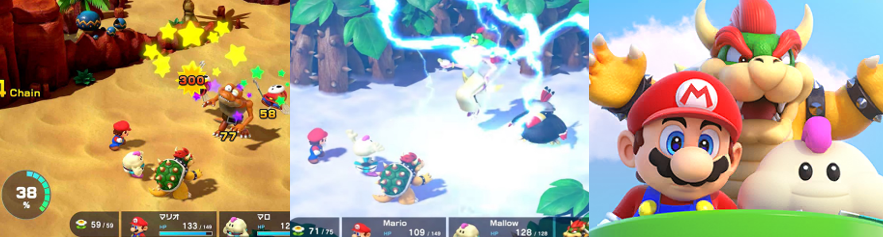
Though triggered by touching onscreen enemies (most of which respawn indefinitely or when you leave the screen), combat is turn-based like in traditional Final Fantasy RPGs. I thought I would gain a turn advantage by preemptively touching enemies but that doesn’t seem to be the case. Your level and “speed” stat seem to determine who strikes first, though I found you usually always get the first hit unless facing a “Special Enemy” or a boss. In battle, you pick a physical attack with A; an onscreen indicator prompts you to hit A again to deal additional damage and the timing is crucial to sweeping enemies as the extra hit can damage every foe. It’s equally important to tap A at the right time when being attacked as this will either reduce the damage dealt or negate it entirely. As mentioned, you can adopt a defensive stance with B; B also gives you the option of running from a battle, something also assisted by certain items (while others allow you to restart the fight if it’s going south). You can also use Special attacks with Y, however these consume Flower Points (FP). Each attack costs a different amount of FP (at least 2 FP and sometimes as much as 16 FP) and FP is shared amongst your entire Party. This means you really have to think about using the more powerful, costly Special attacks as you might run out of FP when you need to be healed or revived. Some enemies are weak to elemental attacks like fire and lightning, which is something to consider when picking Special attacks, and you can restore and even increase your FP with Honey Syrup and various flower-based items. As you deal damage, you’ll build both a combo meter and an “Action Gauge”. When this gauge is full, you can press – to pull off a team-based attack for big damage or call in Toad for helpful buffs. Additionally, as you attack and defeat enemies, you’ll earn similar buffs that up your attack, defence, or “luck” for that battle or restore your HP. However, simultaneously, you must be wary of status effects; enemies can put you to sleep, poison you, weaken your attack or defence while upping theirs, and turn you into mushrooms or scarecrows. While all these ailments are undone upon victory and some are only temporary, you can cure them using items or magic spells, and other items (such as the various bombs and even items that summon Yoshi) will aid you in attacking or neutralising enemies. However, defeat isn’t always a massive issue; checkpoints and manual save points are plentiful and the game’s very generous with its restorative buffs. Your HP and FP is occasionally fully restored after certain battles, too, and you can of course pay to stay at various inns to refill both.
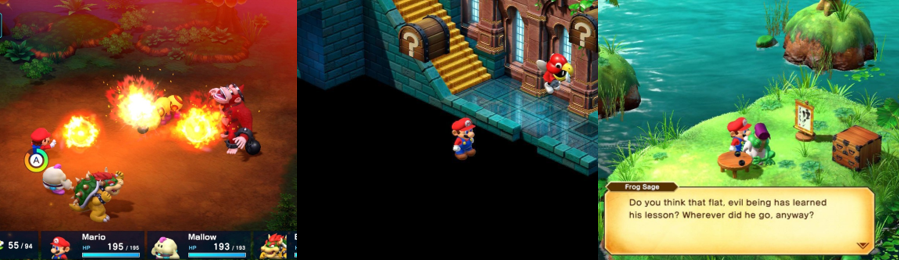
Each character falls into a certain class: Mario is an all-rounder, for example, while Peach favours restorative magic and Bowser is a heavy-hitter. While you’ll mostly be hitting A at the right time to increase your attack power and radius, you’ll sometimes rotate the left stick or rapidly tap or even hold down A to charge a meter. Additionally, different character combinations result in different team-based attacks and it’s important to think about each character’s strengths and weaknesses, especially when levelling-up. After accumulating enough EXP, you’ll gain a level and can pick to buff either physical power and defence, your overall HP, or magic attack and defence. You can also equip weapons, armour, and accessories to boost these stats, and others; Mario gains hammers and Koopa shells, for example, while Mallow uses sticks and cymbals, and the timing of your button presses changes with each. Accessories can also negate status effects, too, protecting you from sleep or poison, or alerting you to hidden blocks in the overworld. While your inventory isn’t unlimited, any additional items you get but cannot carry are automatically transferred to Mario’s house to use later and winning battles also earns you Coins to spend in shops, though you can also get Coins from hitting blocks and items from treasure chests. Sometimes, after winning a fight, you’ll play a game where you must find Yoshi, which doubles (or costs you) the Coins or EXP you earn. Defeating Special Enemies and opening chests also awards Frog Coins to be spent elsewhere, and you can trade Coins for points or rarer items. It pays to chat to every NPC you encounter, too, as some will gift you items, flesh out the lore, offer aid, or point you in the right direction if you somehow get lost. This isn’t easy to do as not only do you have the journal, but the overworld map includes helpful flags to point you in the right direction. Sometimes, you must talk to specific NPCs to get key items, hit switches, or even use whirlpools to walk underwater to progress and you’ll occasionally find hidden paths or doors that lead to goodies, sometimes by entering a pipe like in a traditional Mario game.
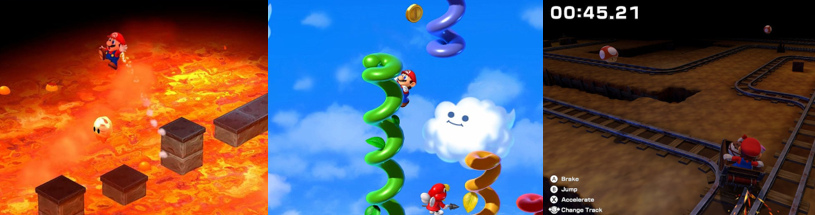
Yes, there are some simple puzzles to solve, such as pressing switches, navigating mazes, crossing invisible platforms, remembering codes, and rearranging paintings. In the platforming sections, you’ll use springs or flowers to jump higher and regularly hop up walls or across gaps or lava pits using moving, collapsing, or temporary platforms (and even Parakoopas). Thanks to the isometric angle and Mario’s slippery feet, this can be a bit tricky but, luckily, you’ll usually land on or in water and simply loop back to try again, and even hitting lava doesn’t doesn’t drain your HP. It can be difficult to judge the distance between gaps, though, and you’re often dodging Thwomps, fireballs, and other enemies while hopping to small square platforms, which can make these sections needlessly annoying. Easily the worst instance of this, for me, was when scaling the vines to reach Nimbus Land. You must angle yourself just right (and know to jump to spawn a hidden platform) to hop to the vines and it was very easy to slip off and have to start over. Similarly, in the end game, you must tackle four out of six obstacle courses to reach Exor, two are simple battle gauntlets, two are tricky platforming sections, and two are timed quizzes! The gameplay loop is further broken up by mini games: you’ll be careening around a minecart track like Indiana Jones, tumbling down a waterfall, racing against Yoshis in the Yoshi Derby, hopping on Goombas, playing tunes on tadpoles, jumping from rolling barrels amidst a raging river, and collecting beetles. Most of these mini games can be repaid (for a price) and will net you extra rewards (as well as the Coins you can grab along the way), and you’ll eventually access a casino and even a secret super boss! Additionally, certain story events and having specific characters in your party rotation will change the overworld and battle system. For example, when in Bowser’s Keep, having Bowser in your Party causes his minions to flee and Mallow’s royal heritage gains access to the hot springs in Nimbus Land.
Presentation:
I’ve only briefly played Super Mario RPG before, but I remember being a little put off by the original’s 3D-to-2D aesthetic, which made everything look a little unsightly and pixelated. That’s definitely not the case here, though! This slick remake has given everything a plasticine, diorama-like makeover that gives the impression of playing with chibi-style toys, not unlike the same aesthetic adopted by The Legend of Zelda: Link’s Awakening (Grezzo, 2019). The pre-rendered cutscenes are gorgeous; every character has a fun victory pose and does a little dance when they level-up and, while you can skip the team attack cutscenes, they look so good that I just let them play. While all the characters are lively, adorable, and animated, Mario naturally stands out from the bunch. Unlike the others, he can’t talk (not even gibberish), so he pantomimes every action, recapping the plot (sometimes too much) with an excitable enthusiasm, vehemently shaking his head at the suggestion that he’s one of Bowser’s minions, and consoling his friends (even Bowser) when they experience hardship. Bowser gets a lot of nuance here, too; he throws himself at obstacles and proudly boasts of his superiority but is humiliated at being kicked out of his keep. Our two original characters, Mallow and Geno, fare pretty well, too. Mallow starts out as clumsy and unsure of himself, but gains confidence thanks to Mario and discovering his true heritage while Geno (a puppet brought to life by a star) fights to repair Star Road with a passion, resulting in a bittersweet ending when the puppet returns to being just a toy. Equally, the game is bolstered by a jovial and familiar soundtrack. This version lets you pick from the classic soundtrack and the modern remix, with both being enjoyable, and I loved hearing familiar Final Fantasy sound effects and seeing fun Easter Eggs like a curtain that turns Mario 8-bit and references to other Nintendo properties.
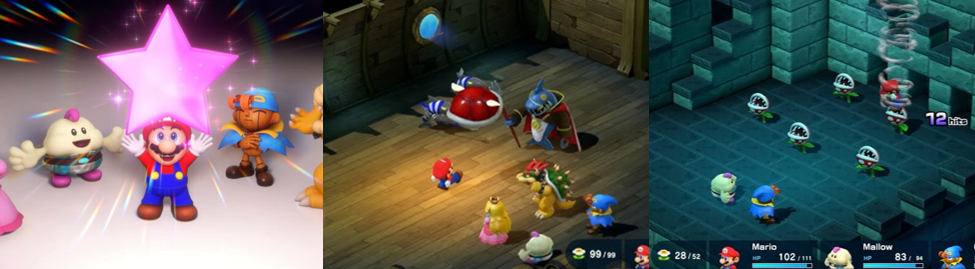
As great as the game looks and sounds, however, I was a bit let down by the environments. While the overworld map is large and varied, the actual locations you explore are a far cry from the fantastical whimsy of other Mario games. You spend a lot of time in grassy areas or underground caves, which is very familiar, or at cliffsides and near lakes, before exploring such exotic locations as…a mountain, a mine, and a haunted pirate ship (actually, that one’s not bad!) You’ll venture into the pyramid-like Belome Temple, the autumnal maze in Bean Valley, and the rocky innards of an active volcano, but it’s not all that memorable and seems incredibly safe. Things get visually interesting in Nimbus Land, Star Hill, and the Weapon’s World, but these are juxtaposed by Bowser’s uninspired keep, the relatively barren Booster Tower, and the dense Forest Maze. Many areas, such as the Kero Sewers, sea, and Pipe Vault are restrictive and linear thanks to the isometric aesthetic, looping or forcing you to solve a maze to progress, while others (Land’s End and Nimbus Castle, for example) are robbed of the scope that makes the various towns so much fun to explore. While Bowser’s Keep is simply the same lava and stone-filled castle you’d expect from the Koopa King, I liked that battles took place on the chandeliers and that there were more branching paths. The Weapon’s World and Factory stood out at the end just for offering some visual variety, with their cogs, conveyor belts, and ominous atmosphere, but I do think Super Mario RPG missed a trick in not making areas more distinct. Sure, some towns have been affected by the Smithy gang and will be restored to life and order by your actions, but why not make Mole Mountains an ice mountain with snow and such? Or do more with the water gimmick at the Seaside, perhaps have parts of Seaside Town underwater or flooded?
Enemies and Bosses:
A slew of Mario’s most recognisable enemies crop up all throughout Super Mario RPG, generally acting as disposable pawns to rack up for EXP: Goombas, Spikeys, Gobys, Shy Guys (and their many variants), Bob-ombs, Piranha Plants, Bloopers, Wigglers, Chain Chomps, Boos, Lakitus and various Koopas (from Sky Troopas to bulbous Heavy Troopas and Dry Bones) and even variants of Donkey Kong show up in some form or another and, generally, aren’t much of a threat. There are exceptions, though: you can encounter numerous enemies in one battle, and mixtures of them, and some (like Dry Bones) can only be defeated by Special attacks or are susceptible to elemental attacks. Other enemies include rats, various insects like stinger-firing Buzzers, tricky Crooks and Ninjas (who can teleport, often flee from battle, and (in the latter case) launch an attack upon defeat), Pandorite (sentient treasure chests that spit up enemies), anthropomorphic vegetables, puppets and jesters, and even giant crustaceans and reanimated mastodon bones. While some enemies (like the Orbisons) can recover their health and that of their allies and others (like Stumpets and Reachers) look intimidating, some (like Geckits) are just as likely to attack themselves and their allies as they are you. Sure, some enemies are larger or inflict status effects, but they’re mostly all a joke; you easily dispatch entire groups with well-timed presses of A and without even using Special attacks. Even larger, more formidable enemies are easily trounced if you keep your level and stats high and time your button presses. Hippopos, Doppels, and Corkpedites can easily have their elemental weaknesses exploited, though you will have to be wary of Special Enemies, variants of almost every enemy who hit harder and can take more damage and should be targeted first. Also, you’ll need to watch for certain powerful or unblockable attacks; kamikaze attacks, unavoidable boulders, large explosions, and gigantic lasers can decimate your party if you’re not careful. Thus, it pays to have plenty of restorative items or keep Peach or Mallow around to restore your life or get rid of annoying status effects.
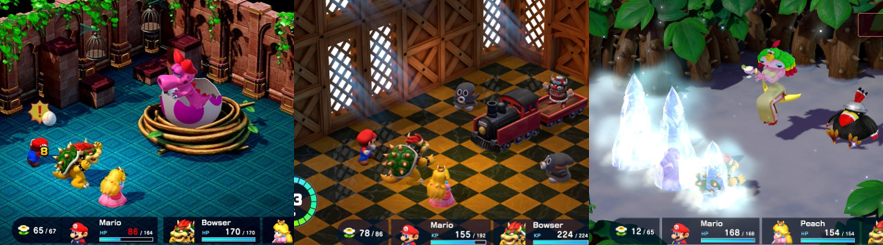
Battles are frequent in Super Mario RPG but ridiculously simple; I trounced most enemies simply by tapping A, meaning combat gets quite tedious at times. Unfortunately, the combat loop isn’t changed much by the game’s bosses, despite how many you’ll encounter. Your first boss battle is, fittingly, against Bowser; taking place up on the chandeliers and with Peach held hostage, you simply target the chain holding Bowser aloft and you’ll come out victorious. Next, you’ll battle the Hammer Bros, who toss hammers and up their valour but aren’t much of a threat, and have your first encounter with Croco. Croco’s a little trickier as you must chase him through a looping maze, battling waves of disposable enemies before getting to him, where he’ll bite and toss explosives and enemies. When on the Sunken Ship, you’ll battle King Calamari, a giant Blooper whose tentacles burst through the floorboards and who spits ink at you. Birdo also makes an appearance, encountered at Nimbus Castle after shattering her egg; as is her nature, Birdo spits eggs but these can be attacked to deal damage to her. Bowser’s magical minion, Wizakoopa, also appears, brainwashed to oppose his master and summoning the powerful fire-breathing dragon Bahamutt, as well as boasting elemental spells. Other bizarre bosses include the multi-headed Pihana Plant Megasmilax, the dog-like Belome (who eats party members and spits up clones), the ambitious Punchinello (who tosses various Bob-ombs), and the deluded Booster, whose circus-themed minions kidnap Peach and force her into a wedding, leading you to defeat them and attack an elaborate wedding cake! You’ll also battle the trident-wielding pirate leader Johnny and the sultry Valentina, who relies on her bird-like minion Dodo in battle, with him pecking at and whisking away party members, while she relies on numerous magical spells.
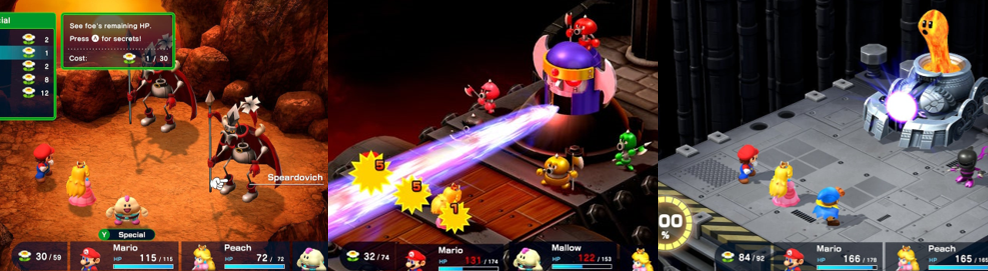
Mario and their friends quest to recover the seven Star Pieces, with most being guarded by the Smithy Gang. This gaggle of anthropomorphic weapons thus represent the primary bosses of the game, with the pogo-sword-riding Mack being the first you encounter (once you dispatch his Bodyguards, of course). Bowyer represents one of the more unique boss battles as he’ll fire arrows that disable A, X, and Y inputs for a few turns, forcing you to utilise different attack strategies or even spend a few turns defending before you can attack again. Speardovich creates a double to aid him in battle while the ridiculous (but strangely familiar) Axem Rangers force you to battle them all at once, eventually bolstered by their airship, The Blade, and its super-powerful Breaker Beam. The opening chandelier battle is revisited in the end game where you battle the katana-wielding Boomer, who switches between blue and red forms, being weak to physical and magical attacks, respectively. In the Weapon’s World, you encounter the giant alarm clock Count Down; you can knock off its Ring-a-Dings and target its sand timer to neutralise it, but it’ll unleash different magical attacks depending what time its hands land on. You’ll also battle Cloaker and Domino, with one favouring physical attacks and the other magical, and both hopping into snake-lime mechs when their partner is defeated. Finally, the Smithy Gang’s factory is home to three armour-clad, axe-swinging administrators and the diminutive Factory Chief and the devastating Gunyolk, a tank-like cannon that also uses the Breaker Beam attack alongside powerful abilities like Electroshock and Fire Saber. The Smithy Gang are usually always accompanied by minions. In the Weapon’s World and Factory, Machine Made duplicates of some bosses appear as regular enemies alongside metallic variants of regular baddies, though it’s usually better to simply focus on the boss as this ends the bout.
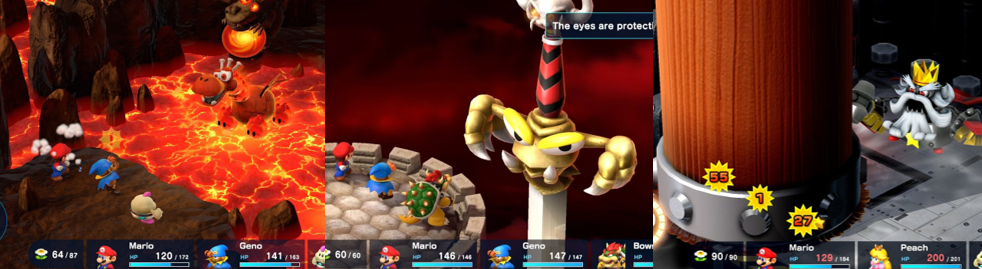
While most bosses don’t pose a problem, four stand out as surprisingly formidable. First is the Czar Dragon, a gigantic (if comical) dragon comprised of Lava Bubbles. The Czar Dragon bites, casts Flame Wall and Water Blast, and fires flaming projectiles, as well as protecting itself with Lava Bubbles. Defeating it sees it rise again as Zombone, which isn’t one-shotted by Pure Water like other undead enemies (though this item does cause it to attack itself) and has even more powerful attacks at the cost of being more vulnerable to Mario’s jump attacks and Mallow’s thunderbolts. Fittingly, given his high rank and him invading Bowser’s Keep, Exor was also a tough encounter. Fought on the keep roof, Exor cannot be harmed until you take out at least one of its eyes and even then it causes trouble with Venom Drool, Aurora Flash, and Lulla-Bye. Defeating him transports you to the Weapon’s World and a final showdown with Smithy, the Smithy Gang leader and the toughest fight yet. Smithy is fought in two phases: in the first phase, Smithy fires bullets, smacks you with his large sledgehammer, and crushes the party with a giant…well, crusher. A smelter also spawns Shypers to whittle your HP down, so it’s a good idea to have Peach on hand as many of Smithy’s attacks damage the entire party. With no weaknesses, Smithy is a tough fight if you’re ill-prepared and it only gets tougher when you drop to the basement and he transforms his head into various forms (a tank, a magician, a treasure chest, and a mask). Each has their own HP and is capable of dishing out status effects, instant-KO blasts, and healing him. You can target his body to help take the pressure off, but I say just go to town on his big stupid head, keep healing and reviving as needed, and use elemental attacks on the right heads to win. But, after all that, there’s an even more powerful optional boss you can take on!
Additional Features:
Considering this is an RPG, there isn’t really much to do in Super Mario RPG beyond the main story. The game is surprisingly linear, guiding you to each location with very few instances of backtracking, side quests, or fetch quests. When you are given a fetch quest, it’s generally something you do naturally. You’re given the item in one town and deliver in the next, rather than going back and forth like in other adventure games. Thus, when you beat the game and start a “Clear Data File”, you’re returned to Mario’s house before the final battle and can revisit every area but there are only a few final tasks to do. First, the Monster List needs to be completed (though this should be mostly full by this point) and you can freely listen to the game’s soundtrack. Next, you can challenge Bowser’s Keep again to acquire any additional weapons you missed when taking on the six obstacle courses. There are also 39 hidden treasure chests to find (greatly aided by equipping the Signal Ring) to snag every item in the game (though, again, this is somewhat pointless once you’ve cleared the main story). You can view the “Play Report” to see how well you did at the mini games and pay to take them on again to improve your score, stay at the luxurious Marrymore Hotel, complete a tedious guessing game to access the casino, and taken on tougher versions of the game’s bosses. Easily the most prominent additional challenge is the secret super boss, Culex. By purchasing expensive fireworks in Moleville and trading them for a special stone in the same town, you open a locked door in Monstro Town and take on the game’s toughest challenge, a 16-bit, cross-dimensional Final Fantasy being that boasts a new 3D form in this version and represents the greatest challenge on offer in the game.
The Summary:
I’ve long wanted to play through Super Mario RPG. Being a SEGA kid, my only avenues for this were emulation but, even when I got the SNES Classic and Nintendo Switch Online, I hesitated to start a game because of the time needed to complete an RPG. When this remake was announced, I knew the time had finally come to change that and I have to say that it was well worth the wait. Super Mario RPG is a gorgeous, fun, surprisingly engaging romp that brings Mario and his friends (and enemies) to life in a unique way. The new battle mechanics and accessibility on offer are fantastic, meaning you’re constantly rewarded during and after battles and there’s always something to see, either in the background or the character animations and interactions. The gameplay was simplicity itself, even by classic Final Fantasy standards. Turn-based RPGs are always my preferred style for the genre, and Super Mario RPG adopts these mechanics beautifully. Unfortunately, the game is extremely easy; I didn’t mind this as I wasn’t looking for an uphill battle, but things did get a bit tedious after a while. The incorporation of “traditional” platforming mechanics was also a bit clunky, as were some of the mini games. The isometric perspective and restrictions of the genre didn’t really lend themselves to these aspects, though I appreciated the attempt to mix up the gameplay loop. While I was disappointed by some of the environment, and that Luigi didn’t appear as a playable character and that more post-game content and side missions weren’t included in this version, I enjoyed my time with Super Mario RPG. Mallow and Geno quickly grew on me, I liked seeing Bowser teaming up with Mario and Peach given more agency, and I was a big fan of the boss designs (despite how easy they were), the graphics, and Mario’s jovial animations. In the end, if you have a kid who you want to introduce to the RPG genre, you could do a lot worse than Super Mario RPG. And, if you played the original as a kid, I’d wager this is just the right hit of nostalgia for you.
My Rating:
Great Stuff
What did you think to the Switch remake of Super Mario RPG? Have you ever played the original and, if so, how does this compare to it? Which characters made it into your team and what did you think to the original characters created for this game? How did you get on with the simplistic battle mechanics and bosses and were you also annoyed by the awkward isometric platforming? Did you ever defeat Culex and complete the Monster List? Would you have liked to see other new features added to the game? Which Super Mario spin-off is your favourite and how are you celebrating Nintendo’s mascot this month? Feel free to share your memories and opinions of Super Mario RPG in the comments and please check out my other Mario content across the site!





















 Dr. K's Waiting Room
You must be logged in to post a comment.