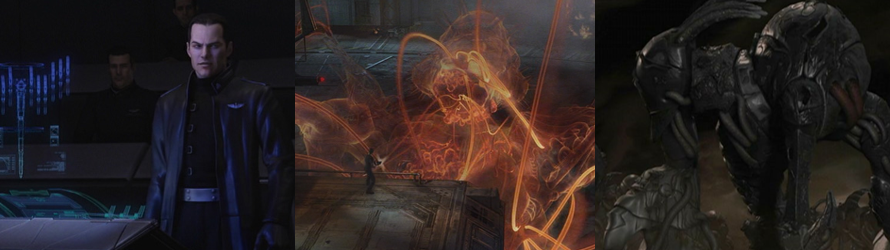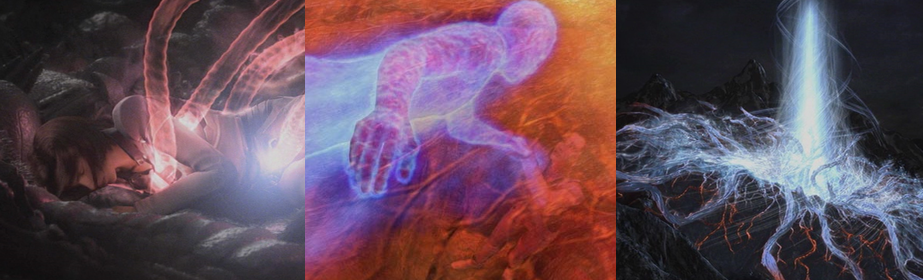
Game Corner: Dirge of Cerberus: Final Fantasy VII (PlayStation 2)

Released: 26 January 2006
Developer: Square Enix

The Background:
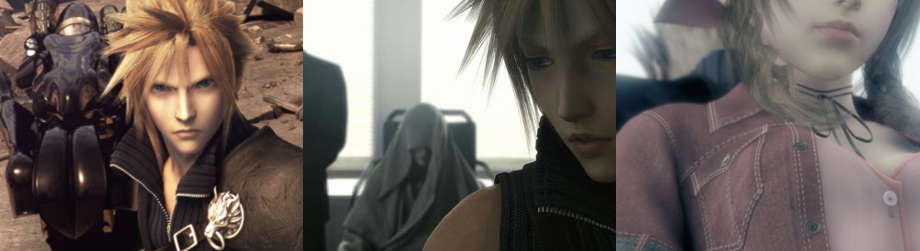
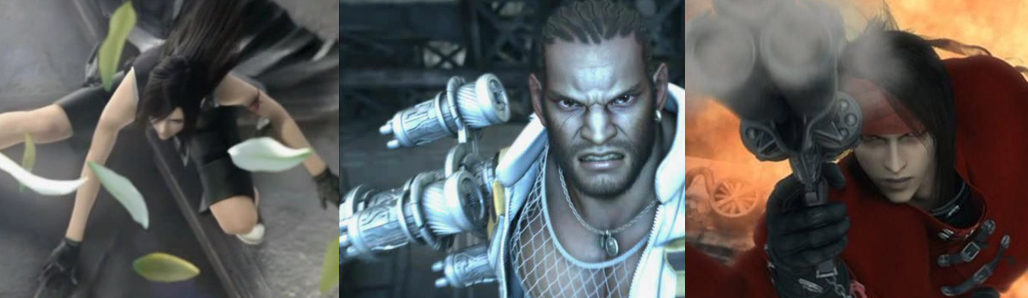
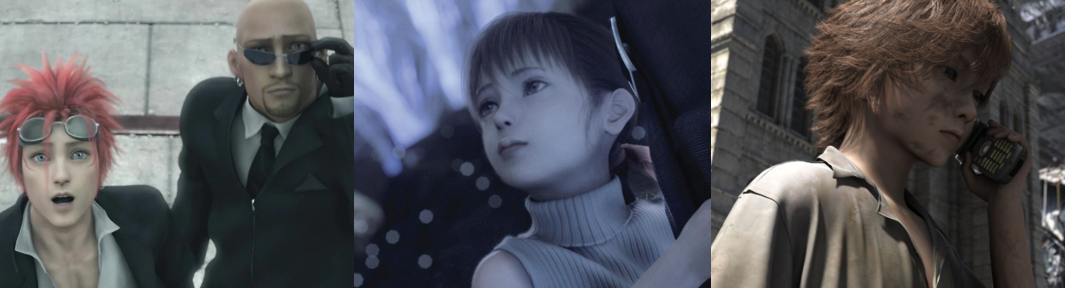
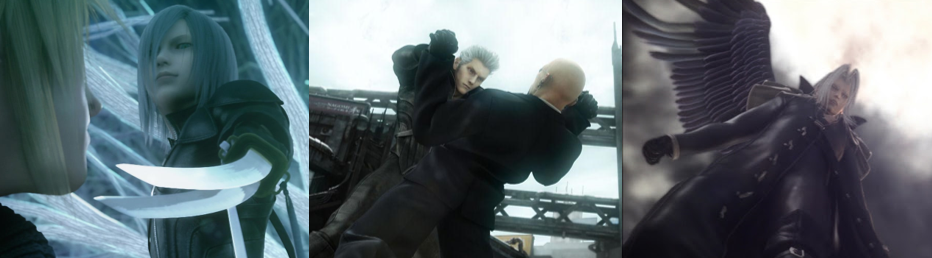
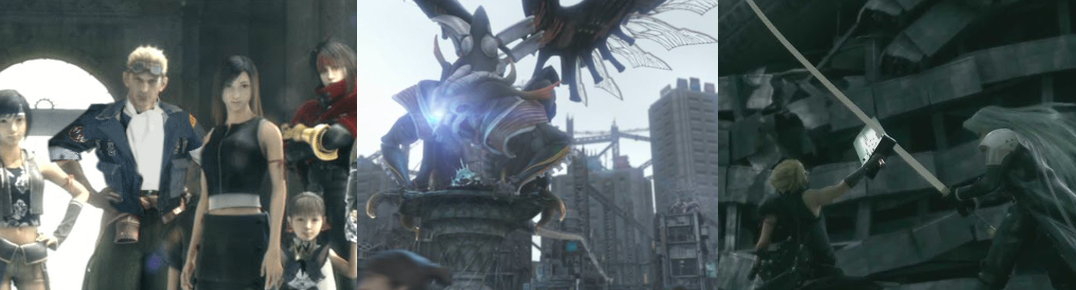
I think it’s fair to say that most gamers are aware of Final Fantasy VII (Square, 1997). The game won numerous awards and sold over ten million copies on the PlayStation, after all. Square Enix expanded upon Final Fantasy VII’s lore in 2003 with Compilation of Final Fantasy VII, a multimedia venture that included Final Fantasy VII: Advent Children (Nomura, 2005), a fantastic computer-generated movie, and multiple spin-off titles. Dirge of Cerberus, a PlayStation 2-exclusive follow-up to Advent Children, was one of these titles. Dirge of Cerberus represented a rare departure from the role-playing mechanics of the franchise, with producer Yoshinori Kitase conceiving an action/shooter revolving around fan favourite optional character, Vincent Valentine. Tetsuya Nomura returned to the franchise to help develop the game’s new villains and characters, with Japanese singer and actor Gackt lending his voice and likeness to the cast. When the game was localised outside of Japan, the developers took the time to address numerous issues with the original release; they focused on the single-player action, removed online functionality, and even omitted the “Easy” mode from the options. Unfortunately, despite selling wellDirge of Cerberus was met with mixed reviews; critics were unimpressed by the gameplaynarrative, and level design and the game was knocked for being a poor imitation of similar hack-and-slash action/shooter hybrids like Devil May Cry (Capcom Production Studio 4, 2001).

The Plot:
After the events of Advent Children, the mysterious Vincent Valentine is drawn into a plot by terrorist organisation Deepground and their leaders, the Tsviets, to summon the most powerful WEAPON of all, Omega, and annihilate all life on the Planet.

Gameplay and Power-Ups:
Dirge of Cerberus: Final Fantasy VII is a third-person, action/adventure game with a heavy emphasis on third-person shooting and which includes some very light role-playing mechanics. The game places you in the role of everyone’s favourite melancholy, wannabe vampire, Vincent Valentine. The story is divided into thirteen chapters that can be played on either “Normal” or “Hard” difficulty, with a third, even harder option unlocked after finishing the game on any difficulty. Unlike Final Fantasy VII, Dirge of Cerberus is much more akin to Devil May Cry than a traditional role-playing game and focuses solely on Vincent save for a brief section where you control Cait Sith. Consequently, Vincent’s abilities are very different from those he had in Final Fantasy VII and have been expanded upon almost as much as his backstory, which was largely marginalised since he was an optional character in his debut. You’ll use X to talk to non-playable characters (NPCs) and interact with the environment for some very light puzzle solving (literally just pressing switches to activate lifts or open doors) and also to jump, pressing it twice for a double jump. Unfortunately, Vincent’s movement is often restricted by the environment; rubble and impassable debris will block your path and platforming is basically non-existent, limiting the jump’s usefulness. Circle is for your melee attacks; Vincent attacks with swipes of his gauntlet and some fancy kicks, but is often left attacking the air since you can’t lock-on to enemies with this attack. Circle also lowers your currently equipped weapon, allowing you to move faster depending on your loadout. Square sees Vincent crouch, which is occasionally useful when taking cover and in the handful of instances where you creep through small gaps or vents, and also performs a near useless dash. Triangle opens the main menu, giving you access to a semi-useful map (a mini map would’ve been better), the item menu (where you manually refill Vincent’s health and magic meters), and customisation options for your guns. If you have one of the three elemental Materia equipped to your weapon, you can fire it with L1, though this depletes Magic Points (MP). You use L2 to toggle between your three weapon loadouts, R1 to shoot, and R2 to reload. Finally, you can press the directional pad up to bring up the map, left or right to use your assigned item, and use the left stick in conjunction with Square to roll out of harm’s way.
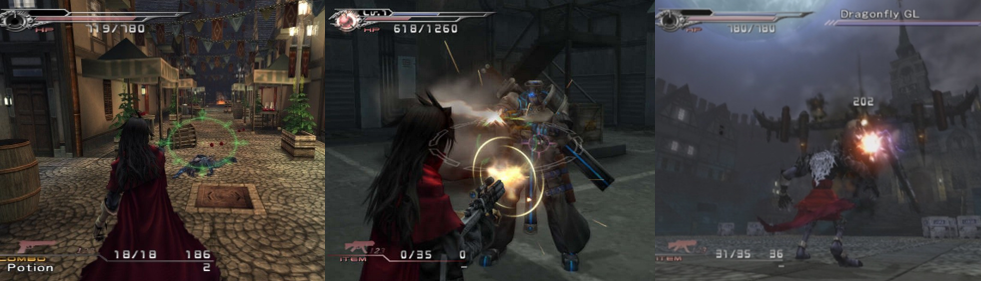
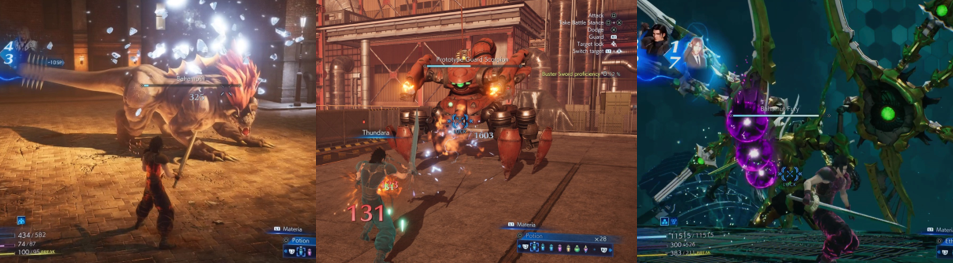
Vincent’s various firearms and monstrous Limit Break are surprisingly dull to utilise.

While the melee attacks are good for close quarters combat and to conserve ammo, your primary attack is Vincent’s various firearms. As you explore, opening chests and picking up attaché cases, you’ll find different barrels and accessories that you can use to create up to three loadouts. Vincent can fire a standard pistol, a sniper rifle, and a machine gun, with different barrels available to strengthen their stats. One stat to keep in mind is the weight of your gun; I built a sniper rifle for Vincent to pick enemies off from afar, but it was heavy and slowed his movement considerably. You can lighten weapons with other attachments, or increase their power and reload speed, but these slots are far more likely to be taken up by one of the three Materia. Fire impacts with an explosive effect to damage multiple enemies, Thunder fires straight ahead, and Blizzard has a homing element. These Materia can be levelled- and powered-up with other accessories and can be very handy against groups of enemies, enemies using Barrier to resist your shots, or bosses, but it’s weird that there’s no Cure Materia to equip. Instead, you’ll rely on the odd Mako Point to refill some MP and restorative items like Potions, Ethers, and Elixirs to fill some or all your MP and Health Points (HP). One item returning Final Fantasy players will recognise is the Phoenix Down, which resurrects Vincent upon defeat (but only if you manually activate it from the menu first). Vincent also has a powered-up form (or “Limit Break”) like in Final Fantasy VII, but this must also be manually activated. When active, Vincent transforms into a monstrous beast for a short time, firing homing fireballs with R1 and battering enemies with claw swipes with X. This is very handy against bigger, armoured enemies and bosses but leaves Vincent a large, cumbersome target (though activating the Limit Break does fully replenish HP). The Limit Break can be manually deactivated with L1 and R1, but it’s not like you get the Limit Breaker item back for doing this so I can’t see the benefit of ending it early. Finally, Vincent can man various turrets with X or while riding in an attack chopper. These sections don’t happen often, which is a shame as it’s fun mowing down waves of enemies and blasting attack planes out of the sky with a powerful mini gun that never overheats or needs to reload.
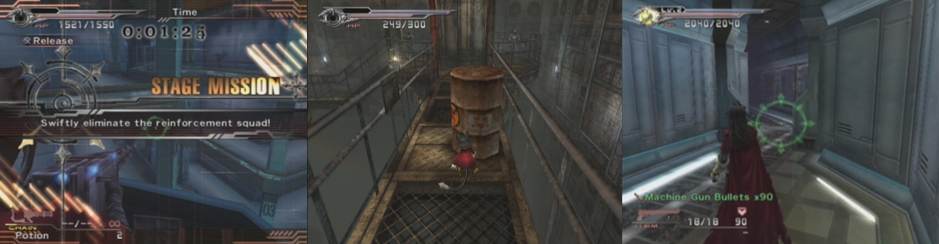
Turret sections, side missions, and stealth gameplay briefly breakup the tedious action.

Defeated enemies drop various items or Gil, the currency of the Final Fantasy franchise. Gil is spent at jukeboxes or at the conclusion of each chapter, allowing you to purchase a limited quantity of items, Materia, ammo, and other resources. Completing each chapter (or being defeated mid-chapter) brings up the ranking screen, where you’re awarded points for your accuracy, kill chains, times defeated, and completing various optional missions. These equate to a letter ranking and award points that can be exchanged for Gil or experience Points (EXP). I chose EXP every time as this is the only way to make Vincent stronger and level him up. Each chapter has a primary goal (essentially to get to end and defeat a boss) but also throws secondary, optional objectives at you. Sometimes these carry a time limit or task you with completing them as quickly as possible; other times you’re searching for items with no idea of how many there are to find. Sometimes you’ll be assisting or escorting Vincent’s World Regenesis Organization (WRO) allies, other times you’ll be destroying certain enemies or deactivating mines. The more you do or complete, the better your ranking and the more Gil/EXP you’ll receive. Alongside one section where you’re blasting Guard Hounds from Reeve Tuesti’s attack chopper, you’ll also pick off pursuers on a high-speed train track and use explosive barrels to thin out enemy hordes. As mentioned, there’s one all-too-brief section where you sneak Cait Sith past enemies since his attack and defence are shit. Sadly, though Vincent’s other AVALANCHE allies show up in cutscenes, you won’t be controlling or fighting alongside any of Final Fantasy VII’s recognisable cast beyond this moment. Although things start out simple enough in Dirge of Cerberus: Final Fantasy VII, the game quickly becomes quite challenging. Environments are painfully linear for the most part, rendering the map almost useless for most of the game, but there are times when you’ll be running around in circles trying to figure out where to go.
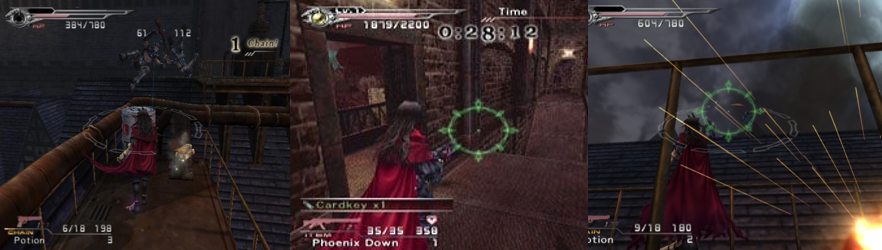
Vincent’s handicapped by clunky gameplay and is surprisingly weak at times.

The Shinra Manor, desolate trainyard, and Shinra headquarters are great examples of this. Since the map only shows where you’ve come from and not your objective, it can be difficult heading in the right direction sometimes. This is compounded by how claustrophobic and restrictive levels are, so you’re not used to exploring all that much. Not that exploration really leads to much; locked doors and dead ends are plentiful and you rarely get rewarded for looking around. Mostly, you’ll be smashing crates, defeating enemies, and searching for key cards to lower energy barriers, which are often guarded by waves of enemies. Sometimes, WRO agents provide support or offer resources; other times, you’ll be rescuing civilians or exploring Mako Reactors to track down Deepground. Although you can temporarily save the game from the pause menu, your game won’t save until you reach specific points in each chapter. These checkpoints are serviceable but you’re sometimes stuck repeating long stretches because you died before a save point so it’s worth using your potions liberally since you should have enough Gil to buy more. While Vincent controls well for the most part, he seems very “heavy” and clunky. He doesn’t have much versatility in the air, has few defence options, and his melee attacks are more like the wild swings of a drunk boxer than the swift attacks of a super soldier. Vincent is also surprisingly weak; snipers and enemy groups quickly sap HP and it’s very frustrating being juggled by rocket-firing brutes since Vincent’s recovery options aren’t very good. This could’ve easily been solved with a proper lock-on feature (something that’d been around since 1997), restorative and defensive Materia like Cure and Barrier, and expanding Vincent’s melee abilities. It’s also far too easy to run out of ammo at times; some of the later bosses require many hits so you can easily end up running out of bullets, with no way to get more, and there’s no way to improve your shot power beyond levelling-up and attaching different barrels.

Presentation:
Dirge of Cerberus: Final Fantasy VII is a bit of a mixed bag in this regard. On the one hand, the pre-rendered, CG sequences look amazing and are largely on par with the visual effects of Advent Children. All returning characters sport the same looks and basically all the cast reprise their roles, with Steve Blum bringing his trademark melancholy gruffness to the perpetually sullen Vincent. While the in-game models and graphics obviously aren’t on par with the CG sequences, they are really good. Vincent, especially, looks amazing; his tattered cloak flows nicely and his gothic visage always stands out against the environments. Enemies are, largely, painfully bland, comprised mostly of Deepground soldiers and a handful of beasts and the WRO, though useful when they appear, are poor substitutes for the more recognisable members of AVALANCHE. Environments, while familiar, are painfully bland, muddy, and indistinct at times. Dirge of Cerberus doesn’t offer any brightness or contrast options, so I was left struggling to see in a lot of dull, murky, and repetitive environments. While some are recognisable, including Mako Reactors, the ruins of Midgar, Edge, and wandering around Cid Highwind’s latest Airship, others are just generic locations that don’t inspire the imagination. This means you’ll be wading through sewers, running around the grey corridors of the Shinra headquarters, and stumbling about in the steampunk blandness of Deepground’s lair. One standout location, however, was the Shinra Manor, which includes Vincent’s coffin room and an extensive cave network. It’s just a shame there are few rewards for exploring all these rooms and little to interact with beyond the usual pick-ups.
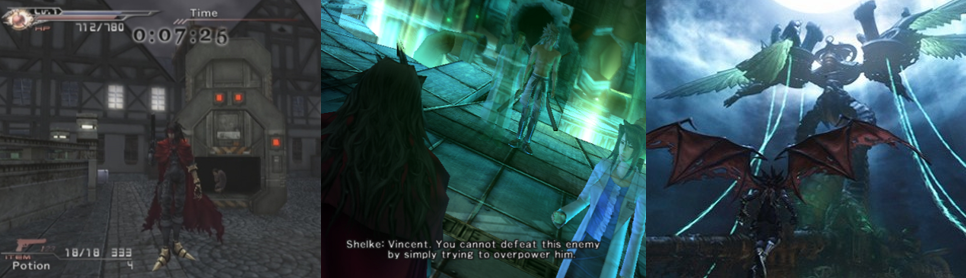
Despite some fun references and great CG scenes, the game is dark and painful to look at.

Although the in-game music is largely forgettable, comprised mostly of generic rock stylings and few remixes of traditional Final Fantasy jingles, Dirge of Cerberus saves its best for the end by bolstering the finale and the end credits with rockin’ efforts from Japanese rock star Gackt. The game does perform very well; I had no instances of glitching or slowdown during my playthrough, and you can even skip cutscenes by pressing Start and X during them. The action is frequently interrupted with numerous cutscenes as Dirge of Cerberus explores Vincent’s troubled past with the Turks, his relationship with Lucrecia Crescent, and the experiments performed on him by Professor Hojo. These are juxtaposed by the present day events, which see the ridiculously overdesigned members of Deepground slaughtering countless lives to summon Omega, the most powerful of the ancient WEAPON, to destroy the Planet. Vincent makes new allies in this quest, such as the disabled but determined Shalua Rui and her brainwashed, socially maladjusted little sister, Shelke, and all his old friends pop up to aid him in the many cutscenes. Honestly, the story sort of lost me mid-way through. I had trouble recognising this as the same world as Final Fantasy VII and the alterations made to the lore seemed forced. Vincent’s Limit Breaks, for example, are now due to the “Protomateria” within him and his final form, Chaos, is an uncontrollable state that acts as a natural counterbalance to Omega WEAPON. Or…something. There are sacrifices and revelations along the way, mostly involving Shelke and Vincent’s past, and it’s interesting to see that these characters continued fighting to save the Planet past Sephiroth’s threat, but it’s a very convoluted and, dare I say it, “Japanese” plot, with lots of existentialism and long winded exposition. As the first high-definition reimagining of Final Fantasy VII (in videogame form, anyway), Dirge of Cerberus does a decent job when it’s using recognisable environments and landmarks but the new elements are largely disconnected from the established world.

Enemies and Bosses:
Considering Final Fantasy VII was stuffed with bizarre and visually distinct enemies, from various monsters to bog-standard soldiers and ancient beasts, Dirge of Cerberus is painfully generic with its enemy selection. Mostly, you mow down Deepground’s soldiers, who fire machine guns from afar and smack you with their weapons up close. The Commander and Sergeant variants are tougher and a bit smarter, taking cover to avoid your shots, and snipers will occasionally appear on rooftops or in windows. Soldiers are often accompanied by Beast Soldiers, bipedal mutants who attack like dogs; these are similar to the Red XIII-like Guard Hounds that charge at you, jaws snapping. Deepground’s forces are bolstered by larger, brutish enemies wielding rocket launchers, Buster Sword-like blades, or manning rapid-fire turrets. You’ll also encounter various mechanical enemies, such as spider-like bots that stun you with electrical blasts and lumbering Sweepers, and a handful of monsters, such as the skittering Bizarre Bugs and the trident-wielding lizard men known as Sahagin. Some of these enemies act as mini bosses, especially the larger ones, while variants act as actual bosses. Deepgrounds troops swarm around you on hoverbikes at one point, for example, bashing into you and forcing you to pick them off one at a time. The Guard Hounds are bolstered by the larger Crimson Hound, jetpack-using Shrikes dart around in the skies and are as difficult to target as the teleporting, winged Gargoyles, and you’ll also battle SOLDIER troopers and elite operatives of Deepground who shield themselves with Barrier. Your tactic against most of these is simply to fire at them until they die, switching to your sniper rifle to pick them off from afar or mowing them down with the machine gun, but the elemental Materia can be very handy at wiping out large groups at once and I often had better luck with the melee attacks (when I had the targets in view, of course).
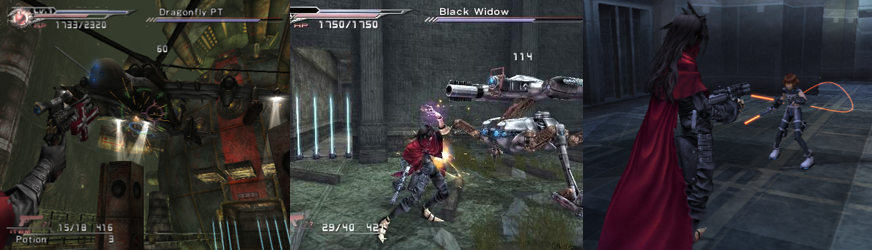
Deepground’s mechs as as much a thorn in your side as their operatives are.

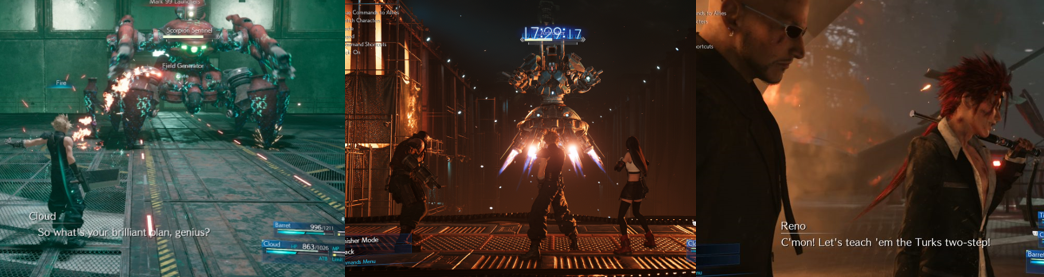
Vincent contends with Deepground’s heavily armoured vehicles at the end of each chapter, with the Dragonfly attack plane and Black Widow mech walker cropping up multiple times throughout the game. When you first face the Dragonfly, it fires with a machine gun and unloads with homing missiles, despotising soldiers into the arena and being felled by Fire without much difficulty. It then reappears as the damaged Dragonfly GL, which also charges at you from the sky, though I made short work of it with the Limit Breaker. It reappears a third and final time in Chapter 11 for the most tedious fight of all. Now joined by Gargoyles and little robots, which must be defeated to farm for resources, the Dragonfly PT constantly stays far out of reach and fires homing shots at you, sweeping around the central building to make for a frustrating target. Unfortunately, I had a lot of trouble dealing decent damage in this fight. Mako Points pop up as the fight goes on and you absolutely need them to pepper it with Fire and do better damage, but this was a slog of a fight made all the more annoying by the Gargoyles diving at me and the robots zapping me. The Black Widow first appears at the end of Chapter 5, bursting into the Shinra Manor and scuttling across the walls and ceilings. It charges at you, spits bombs, and fires a big laser that’s tough to avoid and is heavily armoured so it can take a while to put it down. Its second variant cannot climb walls as the encounter takes place outside the ransacked WRO headquarters, but it’s supported by Deepground’s forces and now fires missiles from a distance. Two Black Widow TWs are fought in the Shinra building, with one on the floor and one and the ceiling, though they lack their dash attack and are noticeably weaker this time around. Deepground’s elite squad, the Tsviets, are also fought numerous times during the game. The first you’ll battle is Shelke the Transparent, a young girl who attacks with lightsaber-like laser batons. She’s a fast, nimble fighter fought in a claustrophobic location, meaning it can be tricky landing hits and the Limit Breaker is of minimal use since Vincent loses a lot of speed in this form.
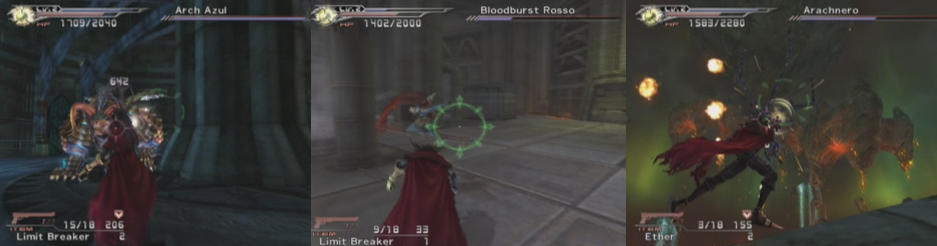
Each of the Tsviets has a secondary, often more monstrous form to contend with.

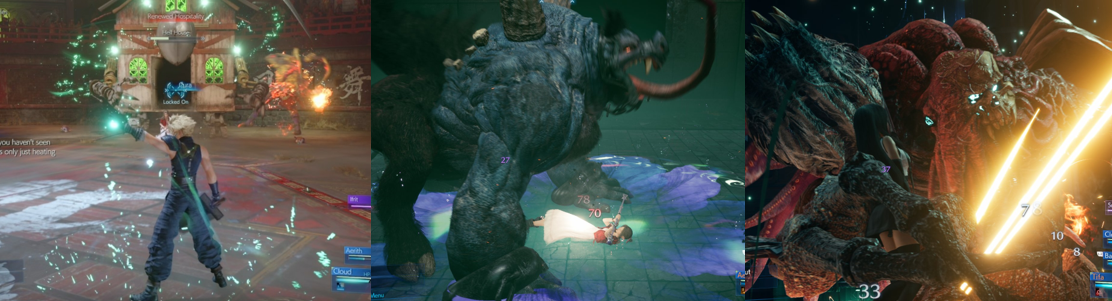
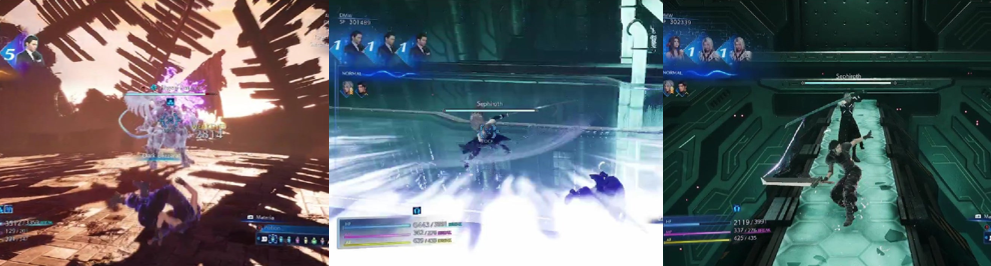
The hulking Azul the Cerulean is fought three times, with the first encounter coming right after your fight with Shelke and being comparatively easy. Though he wields a gigantic cannon, kicks you up close, and causes shockwaves, Azul is painfully slow, a huge target, and the arena is littered with explosive barrels that can whittle his health bar down. When fought in Chapter 9, “Neo Azul” isn’t much different except you’re fighting on an elevator and can use the central pillar for cover. Fire worked well against him here, though you should avoid taking direct hits from his cannon. Defeating him sees him transform into the far more formidable, Behemoth-like “Arch Azul”, a massive beast that charges you, whips with its tail, attacks with its claws, and fires out crystals. Arch Azul is invulnerable to your bullets, meaning you must trick it into smashing pedestals to reveal Mako Points or carry a healthy supply of MP restoring items to stand a chance. Rosso the Crimson is an overall more challenging boss since she’s far faster, the arena you fight her in is much larger, and she can land devastating combos with her lance-like blade. Luckily, a jukebox is on hand for you to replenish your resources and you’ll need them when she gets powered up into “Bloodburst Rosso” and adds a projectile attack to her arsenal, to say nothing of her annoying melee attacks. Though he cuts an intimidating figure, Nero the Sable was actually a bit easier in his first encounter. He flies about using his mechanical wings and fires dual pistols, chopping at your HP with a twirling blade attack and spawning duplicates. Another jukebox turns the tide in your favour and there’s plenty of cover to use to your advantage, and both Fire and the Limit Breaker made this a long but not too difficult fight. The same can’t be said of his horrific transformation into “Arachnero”; in this spider-like form, he’s shielded and fires devastating lasers from four crystals. These must be destroyed to make his shield vulnerable, but you must watch for flaming meteors and a fireball flurry than can basically one-shot you. There’s also no jukebox or resources here so you must stock up on ammo beforehand as you burn through a lot of it just making him vulnerable.
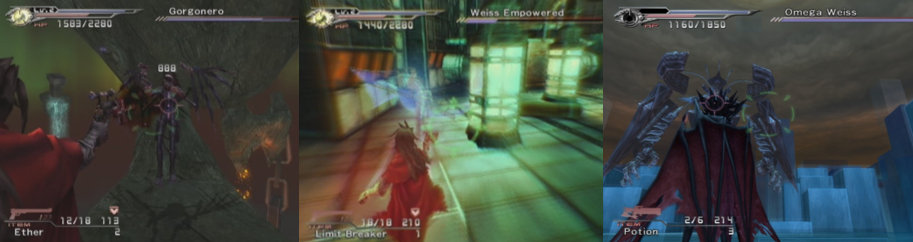
After besting Deepground’s heads, Vincent embraces his darkness and saves the world once more.

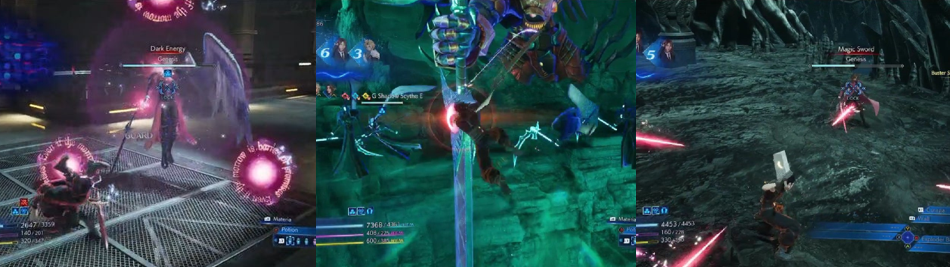
As if that isn’t bad enough, the battles continues right after, with Nero becoming “Gorgonero” and teleporting about the floating rocks of the surreal landscape. You’re stuck in one position, have a small window of opportunity to fire at Nero when he appears, and can only land one hit at a time. Be quick as then you can avoid being shot or being sliced with his spinning blade attack, making for a fight that isn’t as hard as Arachnero but can be troublesome if you’re low on ammo (which you probably will be). Upon reaching the finale, you’ll finally battle Deepground’s head honcho, Weiss the Immaculate (who’s actually Professor Hojo in a super-soldier body…or something…) At first, Weiss is totally invulnerable and the fight must be lost, so don’t bother wasting your resources. In the second, Weiss is fast and sports some powerful sword combos, and he is invulnerable when moving. Luckily, there’s a jukebox nearby and it’s not too hard to avoid him and whittle his health down, just tedious and long-winded. Despite Vincent’s best efforts, Omega WEAPON appears and the Planet is placed in mortal peril, forcing Vincent to combine with Chaos and attack the creature (which fuses with Weiss and Nero) head-on. These final sections see Chaos Vincent floating about a devastated landscape, blasting crystalline drones with his Death Penalty before flying through Omega’s innards, avoiding lasers and taking out more crystals. Eventually, you end up in a serene, surreal, water-like landscape where you must dodge transparent barriers and gun down crystalline drones, attacking the Omega Cocoon, which is simple enough. Finally, you’ll face Omega Weiss, a large, floating mess of stone limbs and appendages. Luckily, this fight is ridiculously easy. Simply fire at Omega Weiss, staying far back and avoiding its fists and gunning down its projectiles. Omega Weiss protects itself with a crystalline barrier that it fires at you, but you can simply dash behind it to continue your assault. Weiss even attacks in a ghostly form, but just ignore him and pour it on. Even Omega’s devastating Omega Meteor can be survived without too much trouble, making this a surprisingly anti-climactic final boss topped only by the abrupt ending.

Additional Features:
There are three “G” reports scattered throughout Dirge of Cerberus’ missions. They’re pretty well hidden, too, as I didn’t find a single one and couldn’t be bothered to follow a guide, mainly because all you get is a slightly extended ending where Genesis Rhapsodos appears for an unresolved cliffhanger. Aside from that, there are additional accessories and barrels for your weapons to be found that can change the way you play, and you’ll also unlock both “Extra Hard” mode after clearing the game and a mission select screen from the main menu. Playing through the game also unlocks the cinematics in the theatre mode, a character viewer, sound test, and art gallery. There’s also a tutorial mode to play through (recommended for first-time players) and additional timed missions to unlock (presumably by getting decent grades in the game’s main missions). These recycle the game’s environments and enemies and stick you with a pre-set loadout, which can make even simple missions tough when you’re used to playing with a more capable Vincent. You also get a final overall grade and the Japanese version includes an online multiplayer component, though I’ve no idea how this worked. Sadly, that’s about it. There aren’t any collectibles to find and there’s little incentive to replay missions unless you want to S-rank everything and earn a grand total of nothing for your efforts.
The Summary:
I’ve played Dirge of Cerberus: Final Fantasy VII before, back when I had a backwards compatible PlayStation 3, and I remember it taking me a long time to get through it and finding it visually engaging but a bit confusing and frustrating at times. These criticisms still ring true today, and it’s a shame as I am a big fan of Vincent Valentine and this genre of videogame. Unfortunately, the third-person elements aren’t implemented very well; the gunplay is weak and unsatisfying and Vincent’s melee attacks are wild and reckless. The game lacks the polish of a Devil May Cry, which was enjoyable to play largely because the combat was so slick and entertaining to engage with. Vincent is surprisingly ungainly, struggling to navigate his environments and handicapped by barriers and obstacles. The gunplay is subpar, for the most part, and made frustrating by the lack of ammo and reliance upon earning Gil to restock. The RPG elements are poorly implemented, too, with Vincent never really feeling that much stronger and the focus on weighing down weapons reducing your options considerably in stressful situations. While it’s great to see the Final Fantasy VII crew back in action, the story is absolutely bonkers. It seems simple enough but then you look at the Tsviets and hear them talk and every cutscene just gets further and further away from what made Final Fantasy VII so memorable. I enjoyed seeing flashbacks to Vincent’s past, though, and wonder if the game might’ve been better if you’d alternated between controlled Turk-Vincent and present day Vincent, scaling back the Tsviets and Deepground guys to focus on battling more familiar Shinra enemies. The game looks great when you can actually see what’s happening (an old school television may help with this) and Gackt’s offerings are great, but I think it was a mistake not to include more sections where you play as Vincent’s friends. Like, why not control Barret Wallace for the gunship section? I really wanted to enjoy Dirge of Cerberus more than I did but it was a bit of a chore to play. The moment-to-moment gameplay gets repetitive, enemies quickly become frustrating, and the manual nature of the mechanics gets tiresome, resulting in an experience that’s confusing, at best, and forgettable at worst.

My Rating:

Rating: 3 out of 5.

Pretty Good

Did you enjoy Dirge of Cerberus: Final Fantasy VII? Is Vincent Valentine one of your favourite Final Fantasy VII characters? How do you think the game compares to the likes of Devil May Cry? Were you able to follow the story and what did you think to the Deepground newcomers? Did you beat the game on Extra Hard mode and unlock all the Extra Missions? Would you have liked to see the other Final Fantasy VII characters be playable here? Which game in the Compilation of Final Fantasy VII was your favourite? Whatever you thought to Dirge of Cerberus and Final Fantasy VII in general, comment below and then check out my other Final Fantasy content.

Mini Game Corner: Dissidia Final Fantasy NT (PlayStation 4)

Released: 11 January 2018
Originally Released: 26 November 2015
Developer: Team Ninja
Also Available For: Arcade, PC, and PlayStation 5

A Brief Background:
With over seventeen mainline games, the Final Fantasy franchise has been a staple of the role-playing genre since its 1987 debut, popularising and largely defining role-playing games (RPGs) for generations of players. Not only has the franchise dabbled in more action/adventure mechanics, the Final Fantasy series has also produced a wide array of spin-off titles, including real-time strategies, mini games, and their characters featured in obscure polygonal fighter Ehrgeiz: God Bless the Ring (DreamFactory, 1998). In 2008, to celebrate the 20th anniversary of the franchise, Square Enix officially brought Final Fantasy into the fighting genre with Dissidia Final Fantasy, an RPG-inspired action fighter that gathered the franchise’s most recognisable heroes and villains and became a critical and commercial success for Sony’s oft-forgotten handheld, the PlayStation Portable (PSP). This release was expanded upon three years later with the release of Dissidia 012 Final Fantasy, a combination prequel, sequel, and enhanced version of the original game. Reviews largely praised the expanded mechanics and additional fan service, and it was later followed by a three-on-three arcade spin-off. Developed by Team Ninja and including characters from the franchise’s latest releases. Dissidia NT’s arcade success led to an enhanced home console port, one that included all previous fighters and was equally praised, despite its chaotic combat.

My Progression:
I had a great time playing the two Dissidia games back when I had a PSP so I jumped at the chance to experience this high-definition version of the game. While far removed from the traditional turn-based gameplay of the series (and even its more modern, action-orientated slant), the Dissidia series has always been a great tribute to the franchise, bringing together some of its more iconic characters and locations in a suitably convoluted battle between the forces of good and evil. Dissidia NT is similar in this respect, featuring champions of light and dark battling for cosmic entities Materia and Spiritus and retaining some of the same gameplay mechanics, but with a very different presentation. The most noticeable difference is that the game is a three-on-three fighter, which immediately brings it down a notch in my eyes. I’ve never liked this sub-genre of fighting games and it really annoys me how many titles have succumbed to this formula. In Dissidia NT, it seems to have been implemented towards online play; you’re supposed to battle online with and against friends, earning clout and points and such and communicating using text/chat features. However, single player components are present, though there’s no way to have a simple one-on-one experience as in the previous games. This impacts the game’s mechanics and difficulty, especially as arenas are large and occasionally troublesome to navigate. You must beat each member of the opposing team (or destroy their “core” in what’s essentially a capture the flag mode) to achieve victory. You do this by targeting either an opponent or their team’s core with L2 or R2, dashing towards them by holding R1 (which lasts as long as your stamina bar), and attacking with either Circle, Square, or Triangle in conjunction with movements of the left stick. Circle unleashes one of three “Bravery” attacks that deplete your foe’s Bravery points and will eventually “break” them, which is your time to strike with Square. Square attacks deplete your opponent’s Health Point (HP) and you can hold Circle or Square to charge these and make your attacks more powerful, but you can only have one HP attack equipped at a time. Triangle gives you access to your two “EX Skills”, which provides buffs to you and your teammates or lays traps for your foes.

Engage in chaotic battles against some of Final Fantasy‘s most iconic characters.

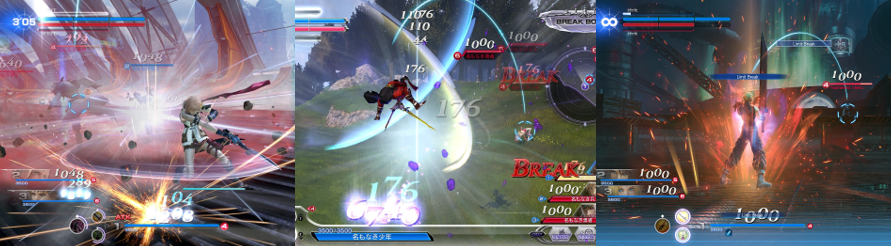
You also have a few defensive options. L1 lets you guard, side step, and parry attacks, you can jump (and double jump) with X, and run up trees and walls. You can use Circle to revive a teammate if you’re fast enough, refill HP and boost Bravery with certain EX Skills, perform “cancels” and air and ground recoveries, and attack “Summon” stones to build a meter. Once full, you’ll unleash a Summon, a powerful creature from Final Fantasy lore that impacts the entire battlefield, unleashing powerful attacks, obscuring the screen, draining Bravery, and applying other buffs. Your enemies can do the same, but it’s often not too difficult to stay out of the Summon’s attack range. What is difficult, though, is chasing down and attacking your foes. The camera swings around wildly, you must often hop up obstacles, and your opponent’s either dash away at high speed, seem to fly or hover above you indefinitely, and you’ll get blasted from behind and all angles without warning. Every battle is contested within a time limit, which adds to the pressure, and carries a difficulty rating ranging from Bronze to Gold and above. Winning harder battles awards more Gil to spend in the shop, more experience points to level-up and become stronger, and other treasures (usually player icons and chat messages but also character skins). Each character has a “type”, such as “Assassin” or “Marksman”, and favours certain attacks. Rinoa Heartilly, for example, attacks with her canine companion, Kefka Palazzo favours ranged magic attacks, and Shantotto is small and agile. Many characters utilise swords or blades, but even then their attacks and styles are vastly different: Cloud Strife, for example, attacks slower than Zidane Tribal, while Squall Leonhart utilises explosive sword swings and the Warrior of Light attacks with a more traditional sword and shield. As you level-up, your characters learn new attacks, adding ranged or close quarters abilities to their repertoire, as well as making them tougher and faster. Unfortunately, battles quickly become a noisy mess of visuals, notifications, and distractions. I found a decent rhythm targeting one enemy, dealing damage, and then switching to another and cycling between them, attacking cores as needed, and even then I’d be battered about like a ragdoll from offscreen attacks and unexpected Summons.

You’ll need to grind for hours in repetitive battles just to unlock the Story Mode’s cutscenes!

Dissidia NT comes with a comprehensive tutorial in which a helpful Moogle walks you through every aspect of the game and you can also review attacks and stats from the pause menu and before each battle. Summons are gifted seemingly at random and can be picked before a battle; you can customise your player card and profile; and you can purchase music, icons, and various bits and pieces from the shop. The game does boast a story mode but it’s sadly a massive step back compared to the last two games, which were very story driven and mixed up different characters in fun ways in seemingly never-ending battles against “puppet” copies of the cast. In Dissidia NT, story mode is handicapped by the “memoria” system. You can only earn memoria by levelling-up, so you must participate in numerous online or offline battles to gain levels and progress in the story mode. Looking at the story map in this mode, there are at least thirty “nodes” to unlock, so you’ll need to level-up at least that much to experience it, and many of these nodes simply unlock nonsensical cutscenes where the characters wander about and ruminate on their cycle of conflict. When you finally unlock a “Battle Trial”, you’ll have to pick from three pre-set characters to fight and will unlock this for the “Gauntlet” mode. This is where you’ll waste spend most of your time winning successive battles to gain levels and treasures, basically meaning you need to grind away for hours just to unlock a cutscene and see the Onion Knight (why he’s not called Luneth is beyond me) striking out with the likes of Y’shtola Rhul. This is extremely tiresome and killed my excitement for the game; I just wanted to blast through the story mode, expecting it to be a chapter-based affair told from the perspective of the heroes and villains. Instead, I was forced to grind away in tiresome battles to level-up, only to limp my way towards two story-based battles where I couldn’t even play as my go-to characters, Cloud and Leon.

Continue?
I was so disappointed to find that Dissidia NT is geared more towards online play and monotonous grinding than providing a compelling fighting experience. It’s doubly disappointing after completing the first two games and expecting more of the same, only to be met by a chaotic three-on-three brawler that restricts you with its arcade sensibilities. The game is a mess of tutorials, messages, mechanics, and instructions, with your allies and Moogle helper constantly banging on. Battlefields become difficult to navigate thanks to obstacles, destructible elements, and being far too big at times. It makes sense given the expanded roster but it makes it very difficult to chase after your target when your stamina drains so quickly and they just stay up in the air for ages. It’s a shame as the game does look great, characters are all represented faithfully, sporting unique EX Skill animations (Zidane and Kuja enter “Trance”, Cloud and Sephiroth have “Limit Breaks”, etc) and skins (Jecht goes shirtless, Cloud sports his Final Fantasy VII: Advent Children (Nomua, 2005) attire, and Cloud of Darkness takes a more monstrous form), and fun characterisations (Shantotto is always rhyming, Kefka is bat-shit crazy, Squall relies on his internal monologue, and Noctis Lucis Caelum is perpetually confused). The game’s arenas and music are pulled from each of the mainline titles but, this time, even Final Fantasy Tactics (Square, 1997) and Final Fantasy Type-O (Square Enix 1st Production Department, 2011) are represented. You’ll battle in the plains of Cornelia, the purple throne room of Pandaemonium, within the crystalline Interdimensional Rift, on the streets of Midgar, and outside the Royal City of Rabanastre, amongst others. Some stages have destructible or interactable elements; others have little Easter Eggs in the background. Each battle is preceded with some banter between the two teams and ends with either a victory pose (and the traditional fanfare) or your crushing defeat. Rewards are bestowed even in defeat and you’ll unlock new characters and Summons as your progress (or part with your hard-earned cash).

Bigger battles and customisation options are available…if you put in the time or money.

Looking ahead, it seems there are fifty-seven panels to unlock in Story Mode, with most of them being cutscenes. Despite Spiritus being prominent to the story, clashing with Materia and desiring the same level of the destruction as the demonic Chaos, he’s not fought in this mode. Instead, your final battle is against the ancient dragon god Shinryu, a gigantic creature that sports two intimidating forms. You’ll also take part in battles against the game’s Summons, meaning your team will go head-to-head with the likes of Bahamut, Ifrit, and Shiva, which all looks thrilling, but I can’t see myself bothering to grind up the nearly sixty levels to unlock all these battles. While some characters are unlockable, Materia and Spiritus aren’t among them and you must part with your real-world money to add to the roster (though, again, there’s little incentive as the game’s so shallow and repetitive). I’m sure the online and multiplayer functions are fun, but I wasn’t impressed enough by the single player modes to test them out. There are also fifty-six Trophies to unlock here, granting you rewards for spending memoria, claiming treasure, completing Story Trials, and winning ranked matches. Unfortunately, as good as the game looks and as smooth as most of the gameplay is, Dissidia NT just doesn’t live up to the standards of its predecessors. There was a real opportunity here to present the gameplay of the portable games in a high-def, arcade-style, all-action brawler. Throw in three-on-three battles as a side mechanic, if you must, but focus on one-on-one gameplay as a priority. Similarly, I get wanting to be an online experience but…is it really too much to ask for a simple ten to twelve-fight tournament mode? Fighting games have been doing that since at least 1991 and I don’t think it’s too much to ask to have that thrown in here. Hell, the developers could’ve made things easier for themselves by just using basic cutscenes for intros and endings rather than the middling, muddled up cinematics you work so hard to unlock here.

But maybe I’m missing the point. Maybe Dissidia NT is a thrilling online experience. Perhaps the battles get easier and more enjoyable once you’re gotten past Level 20. Maybe the Summon battles are worth all that effort. Perhaps you enjoyed the three-on-three experience? If that’s the case, let me know in the comments and go check out my other Final Fantasy content.

Movie Night: Final Fantasy VII: Advent Children Complete

Released: March 2009
Originally Released: 14 September 2005
Director: Tetsuya Nomura
Distributor: Square Enix Holdings
Budget: Unknown (potentially up to $100 million)
Stars: Steve Burton, Rachael Leigh Cook, Steve Staley, Fred Tatasciore, Dave Wittenberg, Wally Wingert, and George Newbern

The Plot:
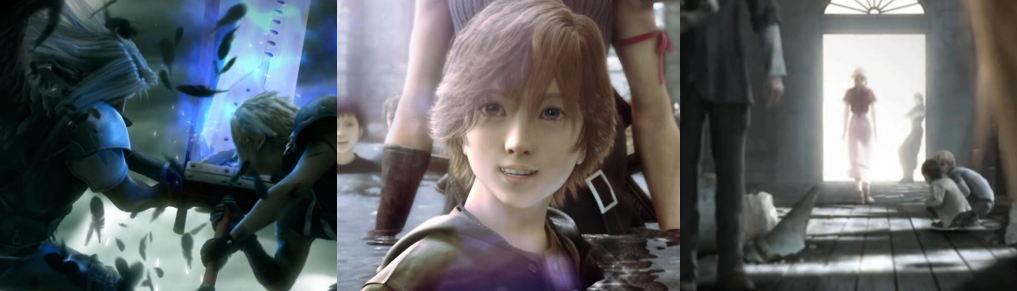
Two years after Final Fantasy VII (Square, 1997), Cloud Strife (Burton) exiles himself to avoid spreading the Geostigma disease he and many children are suffering after Sephiroth (Newburn) contaminated the Planet’s core. However, when three Remnants of Sephiroth – Kadaj (Staley), Loz (Tatasciore), and Yazoo (Wittenberg) – kidnap the diseased children to resurrect Sephiroth, Cloud reunites with his friends to defend the world once more.

The Background:
After decades of being largely exclusive to Nintendo’s 8-bit and 16-bit titles, the genre-defining Final Fantasy franchise was given new life when developer square shifted focus to the PlayStation with the award winning, incredible success that was Final Fantasy VII. This success eventually led to a whole host of spin-off media that didn’t just include new games, but Square’s second crack at a feature-length CGI movie following Final Fantasy: The Spirits Within (Sakaguchi, 2001), a critical and commercial disaster that nearly bankrupted Square. Final Fantasy VII: Advent Children began as a short film by Visual Works, the company behind Square’s CGI cutscenes, designed to pitch a new game. Instead, Final Fantasy VII character designer Tetsuya Nomura joined the team and helped them develop the concept into a feature-length film, one that would focus primarily on Cloud Strife and Tifa Lockhart. While motion capture technology helped map out the character’s movements, the team struggled to bring the more complex action sequences to life and many characters were redesigned to make the animator’s lives easier. Accompanied by an anime tie-in and selling over 700,000 copies in Japan in its first three weeks, Advent Children garnered mixed reviews. While some praised the animation and action scenes, the confusing plot and reliance of audience familiarity with Final Fantasy VII turned many mainstream reviewers off. Regardless, the film was enhanced and extended for its Blu-ray release with this “Complete” edition, which was specially screened in Japan, increased the violence, and was largely received more positively upon release.

The Review:
If you’re a newcomer to Final Fantasy VII or it’s been a while since you played the game, Final Fantasy VII: Advent Children Complete has you covered in more ways than one. If you want a more comprehensive catchup on the events leading up to the film, there’s a “reminiscence” included in the special features that includes key cutscenes from the videogame. This edition also includes an expanded reminiscence for the entire Compilation of Final Fantasy VII which, while lengthy in its own right, is a fun way to relive the videogame without pouring fifty-odd hours of your life into it. Beyond that, the movie includes an opening narration from Marlene Wallace (Grace Rolek) that summarises the videogame from a child’s perspective, greatly truncating events but quickly setting the tone for what’s to come. For the better part of forty years, the Shinra Electric Power Company sucked Mako energy from the lifestream of the Planet, using it to power the vast cities and equip their lite fighting force, SOLDIER, with the best weapons and technology. SOLDIERs were genetically enhanced super soldiers infused with cells from Jenova, an alien lifeform that fell to the Planet on a meteor many years ago. When he found out about his true origin, Sephiroth (Shinra’s elite SOLDIER) went mad and tried to destroy the world, though he was ultimately thwarted by Cloud, a confused Mako-infused mercenary, and AVALANCHE, an anti-Shinra group who regularly destroyed their Mako Reactors. Many lives were lost in the battle, which reduce the Midgar slums to ruins and saw Cloud’s love, Aerith Gainsborough (Grace Rolek) murdered by Sephiroth, but the group eventually stopped him at the Northern Crater, with the very Planet itself helping to repel the massive meteor summoned by Sephiroth. Unfortunately, though his body was destroyed, remnants of Sephiroth’s consciousness and poisonous influence seemed into the lifestream, afflicting many inhabitants of Edge, a city built on the outskirts of Midgar’s ruins and which contains a gigantic monument to the lives lost during “Meteorfall”. Cloud’s ally and love interest, Tifa Lockhart (Cook), owns a bar and delivery service in the city and cares for various orphans, including young Denzel (Benjamin Bryan), as well as looking after Marlene while her father, passionate ecowarrior Barret (Beau Billingslea), travels to find alternatives to Mako energy.

Burdened by guilt, Cloud isolates himself to protect others but is soon dawn back into the fight.

The Geostigma disease afflicts many of Edge’s children, appearing as an unsightly blemish on the skin and causing nausea, vomiting, and a violent death. Since there’s no known cure, those afflicted are shunned and the citizens live in fear of contracting the disease, which has also manifested in Cloud. Accordingly, the troubled mercenary has isolated himself in the wastelands outside Edge and taken shelter in the dilapidated church where Aerith once tended to her flowers. Fearing he’s ad anger to those around him and unfit to help others, Cloud continues to be wracked with guilt for failing to save both Aerith and his best friend, Zack Fair (Rick Gomez), an elite SOLDIER who died saving Cloud and who’s memories and abilities Cloud inherited. Though conflicted and dejected, Cloud continues to carry his cell phone, listening to but ignoring the many calls he receives from the worried Tifa and his former allies, who continue to try and reach him despite his best efforts. It’s while brooding in the wastelands that Cloud is attacked by the three Remnants of Sephiroth and driven to begrudgingly take up Reno’s (Quinton Flynn) offer for work. Since Reno and his hulking partner Rude (Crispin Freeman) are Turks, Shinra’s special forces, Cloud’s naturally wary of him and, when he discovers Shina president Rufus Shinra (Wingert) inexplicably survived being caught in a massive explosion, Cloud’s ready to walk away from Shinra’s representatives. However, intrigued by Kadaj demanding to know the location of his “mother” and bothered by the notion that the Remnants are seeking to resurrect Sephiroth, Cloud reluctantly becomes embroiled in the investigation, though he strictly acts alone. Thanks to Rufus, Cloud heads to the Forgotten City to rescue the infected children, only to find the Remnants have brainwashed the kids into mindless puppets. Saved by his even dark and more stoic gothic ally, Vincent Valentine (Steve Blum), Cloud discusses and ruminates on his disposition. Constantly distracted by memories and messages from Zack and Aerith, who’s face is always hidden from his eyes, Cloud struggles to let go of his guilt and move on from his past. Seeing Vincent as a dark mirror of himself, Cloud resolves to try and atone for his sins, gaining new strength from his friends and his those he cares for. With this, Cloud’s already formidable superhuman abilities only increase, allowing him to defy physics and pull of his more powerful Limit Breaks, all with the aid of his fancy (if impractical) Fusion Sword, which separates into pieces and easily allows him to fend of multiple enemies at once.

With the exception of Tifa and Vincent, Cloud’s other allies are relegated to glorified cameos.

Stubborn, melancholy loner that he is, Cloud leaves the beautiful Tifa behind at Seventh Heaven and shuns his responsibilities as her point man and his relationship with her. Despite this, Tifa continues to care for and pine for him, keeping the businesses ticking over in his absence and promising Marlene that they’ll give him a “lecture” when he inevitably shows up. Realising that Cloud’s sick, Tifa’ hurt that he chose isolation rather than asking for help but gives him a stern talking to once they reunite, chastising him for “dilly-dallying” and outright demanding that he choose between a “memory [and] us”. While she’s no super soldier, Tifa is an incredible formidable fighter; she goes toe-to-toe with Loz, matching his brutish power and augmented speed, and instinctively leaps to Marlene’s defence whenever she’s in danger. Advent Children is largely an exploration of Cloud and Tifa’s relationship, meaning the other members of AVALANCHE are largely sidelined. Barret, Cait Sith (Greg Ellis), Cid Highwind (Chris Edgerly), Yuffie Kisaragi (Christy Carlson Romano), and Red XIII/Nanaki (Liam O’Brien) are all absent the battle with Bahamut SIN, meaning only Vincent gets significant screen time. Sporting supernatural abilities and whisking Cloud to safety with his ragged cloak, Vincent gives Cloud a lot of intel on the Remnants and their plot but initially refuses to get involved since he’s also burdened by his past sins. Unlike Cloud, Vincent doesn’t even have a phone and is a true loner, though he’s inspired by Cloud’s conviction to aid in battling Bahamut SIN. This fight sees Cloud reunite with all his allies and all of them get in on the action, giving him the physical and motivational boost to take down the rampaging Summon and allowing him to draw additional strength from their support. While they’re all ready to help Cloud in his subsequent battle with Kadaj and the reborn Sephiroth, Tifa orders them to stand down so Cloud can literally and figuratively exorcise his demons.

Enemies become allies in the face of a larger threat and help protect Edge’s infected children.

Having nearly caused worldwide destruction, the critically injured Rufus Shinra resolves to make amends for his past misdeeds and the selfish actions of his company. Thus, Rufus dispatches his Turks – Elena (Bettina Bush), Tseng (Ryun Yu), Reno, and Rude – to investigate the Northern Crater, only for them to be attacked by the remnants. Thanks to Vincent’s timely intervention, Elena and Tseng were spared death and, at Rufus’s insistence, Reno and Rude actively aid Cloud and his allies. Naturally suspicious of the three, Cloud initially gives them the brush off but Reno and Rude continue to aid him whether he likes it or not. Though largely portrayed as comic relief, Reno and Rude are determined to atone for their past and even take on the Remnants (despite being severely outmatched) and seemingly ready to sacrifice themselves to both aid Cloud and try to defeat the three Remnants. When faced with Kadaj, who demands to be handed Jenova’s remains, Rufus remains impassive and defiant, using the opportunity to learn more about the Remnants and hiding both the extent of his injuries and the fact that possesses the calamity’s head. Cloud and the others come to respect Reno and Rude and bury the hatchet with their former adversaries, especially after the two both try to help take down Bahamut SIN and actively save lives during the beast’s attack. In the two years since the end of Final Fantasy VII, Cloud has become a reluctant father figure to both Marlene and Denzel and a figure of inspiration to Edge’s orphans. While this makes him uncomfortable since he doesn’t feel he’s strong or capable enough to protect the children, they constantly pine for his return and have an unwavering belief in him. Though a new character whose background is further explored in the On the Way to a Smile – Episode: Denzel short (Ishihara, 2009), we learn that Denzel was orphaned when the Sector 7 plate crushed the Slums and stumped upon Aerith’s church in a bad way. Afflicted with Geostigma and increasing worn down by his condition, Denzel willing goes along with the other children when the Remnants promise to cure them, only to become another mindless puppet thanks to Kadaj’s corrupted water. It’s only when his maternal figure, Tifa, is injured during Bahamut SIN’s attack and Cloud arrives to save the day that Denzel snaps out of his malaise. Reinvigorated by his hero’s return, Denzel takes a page out of Cloud’s book to save others from the Remnant’s Shadow Creepers.

The unstable Remnants desperately seek to resurrect Sephiroth so he can continue his plot.

Birthed at the Northern Crater and appearing as manifestations of Sephiroth’s personality and spirit, the Remnants are like angry, defiant teenagers lashing out at a world they feel has mistreated them. Though similar and largely interchangeable, they are separated by some unique characteristics: Kadaj is the composed eloquent leader and wields a doubled-blade sword, Loz is the child-like brute whose punches and speed are augmented by a wrist gauntlet, and Yazoo…well, Yazoo largely disappears for me since he gets the least screentime and only stands out because he carries a gunblade and regularly mocks Loz for “crying”. While all three are passionate and emotionally unstable individuals, Loz is the most erratic of the three, desperate to be reunited with his mother and descending into anger or tears whenever he feels he’s let her down or been denied her. Seeing Cloud as their older “brother”, the Remnants mindlessly target him, Rufus, and anything remotely related to Shinra in a bid to retrieve Jenova’s head and complete their metamorphosis into Sephiroth. The Remnants summon Shadow Creepers to act as their minions and have no hesitation in using children as human shields to gain leverage. When they steal Cloud’s cache of Materia, Kadaj gleefully Summons Bahamut SIN to ravage the Meteorfall monument and attack the citizens to cause chaos and uncover Jenova’s remains. At times, Kadaj relates his despair at being a mere puppet, one with no true purpose other than to facilitate Sephiroth’s resurrection, yet he remains nonetheless determined to do this, mirroring Sephiroth’s anger at the world and his desire to destroy everything. Though he doesn’t fully appear until the climatic finale, Sephiroth looms over Advent Children Complete like a dark shadow. People are only sick because of him, much of Cloud’s guilt is because of Sephiroth, and the Remnants only exist to bring Sephiroth back. Once he does return, Sephiroth wastes no time in renewing his rivalry with Cloud, relishing the battle and taunting his foe, and using his vast powers to shroud the world in darkness, presumably in preparation for another meteor. Sprouting a single black wing and wielding the lengthy Masamune Blade, Sephiroth is effectively untouchable and attacks with a superhuman vigour, savouring his resurrection and the chance to torture Cloud both physically and mentally.

The Nitty-Gritty:
Guilt is a major theme in Final Fantasy VII: Advent Children Complete. Despite being powerless to help Zack, Cloud carries tremendous guilt about his death and struggles to live up to his promise of being the SOLDIER’s “living legacy”. Despite Zack spirit encouraging him and guiding him (both as a human and as a wolf), Cloud cannot let do of his insecurities, which are only exacerbated by him having indirectly caused Aerith’s death. Similarly, Aerith doesn’t blame or judge Cloud for this and only encourages him to move on and fight harder, but uncertainty weighs heavily on Cloud’s troubled mind and causes him to distance himself from his allies. This is best evidenced in Cloud abandoning Zack’s Buster Sword and leaving it to rust at the spot where his friend died, almost as if the weight of carrying Zack’s legacy was too much for him to carry, and isolating himself from his friends. Eventually, Cloud resolves to at least try and atone for his sins and returns to the fight, emboldening his allies and drawing strength from them in turn. The need to atone is another strong theme here, with Rufus trying to pay penance for Shinra’s part in ravaging the world and Vincent so troubled by his past that he’s even more isolated than Cloud. This need to atone sees Cloud and his friends set aside their differences with Shinra against a common foe and to try and rebuild their world for the better, all of them having been humbled at how close to complete annihilation they came. Unlike Final Fantasy: The Spirits Within, Advent Children is so intrinsically linked to its source material that it may alienate newcomers. Anyone who’s played the game should be delighted to see almost everyone return and many of them pulling off their signature Limit Breaks during the film’s exhilarating fight scenes. It certainly adds to the emotional weight of the film to see Midgar in utter ruins after the events of the game and to see the survivors struggling with the fallout of Sephiroth’s defeat, and I loved seeing AVALANCHE given more personality through voice acting, even if some of my favourites (Barret and Cid) were sidelined. The film’s bolstered by remixes of Nobuo Uematsu’s iconic tunes, with new versions of “Fight On!” and “Jenova” punctuating the action and easily my favourite version of “One-Wing Angel”, a hard rock remix that really adds to the emotional gravitas of the final battle.

The impressive and detailed CGI delivers some brutal and breathtaking action scenes.

As impressive as the photorealistic CGI was in Final Fantasy: The Spirits Within, it’s not only much better here but strengthened since it brings these beloved characters to life. Cloud greatly benefits from this effort, sporting a brooding, dark redesign that mirrors his conflicting demeanour. Riding a bad-ass new motorcycle and wielding an unnecessarily complex sword, Cloud’s insecurities and guilt are as perfectly portrayed as his superhuman abilities. Similarly, Tifa has never looked better than here; not only is she gorgeous, she moves with a fluid, powerful grace that recreates her martial arts skill in stunning detail. Vincent also makes a hell of an impression with his flowing cape, numerous buckles, and gothic demeanour. I loved Barret’s redesigned gun arm  and the detail in Red XII, despite him having the least screen time. The level of detail in the locations is equally stunning, with the game’s pre-rendered backgrounds being brought to life with an impressive attention to detail. We see recognisable locations, such as Aerith’s church and the plate that hung over the Slums, and the finale takes place entirely around and on the remains of a Mako Reactor and the Mako Cannon. The film goes to great lengths to recreate the more bizarre gameplay elements of the Final Fantasy VII in a way that makes some sense. Limit Breaks are largely shown to be physical attributes, though Barret does charge energy through his gun arm and Cloud gains an ethereal aura when he powers up. Everyone defies gravity and endures tremendous punishment, surviving brutal wounds and cutting through the air with ease. This results in some spectacular fights, such as Tifa and Loz beating the hell out of each other in Aerith’s church, a high-speed motorcycle chase down the ruined highways and, of course, the devastating battle against Bahamut SIN. Though more closely resembling the Final Fantasy X’s (Square Product Development Division 1, 2001) version of Bahamut, this creature is an immense, aggressive, biomechanical monstrosity that devours civilians and obliterates everything in sight with Petaflare (100055). Though the team throws everything they have at it, their attacks barely scratch Bahamut SIN’s hide and it takes Cloud’s Climhazzard attack (strengthened by his friend’s support) to finally destroy the creature. While we’re sadly denied seeing the rest of Yuffie’s armful of Materia in action, Kadaj regularly summons Shadow Creepers and the remnants exhibit magical abilities as they fight, with Loz moving at superhuman speed and the characters deflecting bullets with ease.

Cloud defeats Sephiroth, literally and figuratively exorcising his demons and curing Geostigma.

After Bahamut SIN is destroyed, Kadaj retrieves Jenova’s head from Rufus and makes a run for it. Yazoo and Loz are seemingly killed thanks to Reno and Rude and Cloud desperately battles Kadaj on the remains of the Mako Cannon, only for the Remnant to merge with Jenova’s head and Sephiroth to be reborn. Sprouting his black wing and flying through the air, Sephiroth attacks Cloud with a cold, clinical aggression, taunting him at every turn and mocking both his attachments to his friends and his fractured memories. Though he holds his own, Cloud’s noticeably overwhelmed by his rival, who slashes him to ribbons with a version of Octoslash and once again impales Cloud on his impossibly long sword to torture him. Weakened from blood loss and stunned by Sephiroth’s plot to eradicate all life on the Planet and use it as a vessel to travel to a new world, Cloud’s encouraged by Zack’s spirit and flies at his foe, determined to protect the ones he loves at any cost. In this version of the film, that translates into an all-new version of Omnislash, which sees Cloud fly at Sephiroth with each of his blades before delivering the final blow. Though defeated, Sephiroth vows to “never be a memory” and dissipates, leaving only the exhausted Kadaj, who reconciles with Cloud before rejoining the lifestream. Though victorious, Cloud is mortally wounded by the persistent Yazoo and Loz before that also disappear, though thankfully his life is saved when his friends bring him to Aerith’s church. With Sephiroth and the Remnants gone, Aerith’s spirit conjures a healing rain that cures everyone of their Geostigma and restores Cloud to full health. Surrounded by grateful children and his friends, Cloud spots Aerith and Zack’s spirits as they bid him a final farewell and he realises that he’s not alone, seemingly ready to let go of his guilt and embrace the present rather than dwelling on the past. This is further reinforce din a post-credits scene, which shows the restored Buster Sword how sitting in the flower patch in Aerith’s church.

The Summary:
I was really ass-backwards with Final Fantasy VII. I watched this movie first, a year or so before I got to play the game and have to confess that I had a lot of questions as a result. The film does a decent job of getting audiences up to date and is clearly aimed at fans of the videogame, but it can be a bit overwhelming for those who haven’t played Final Fantasy VII (either ever or for a while). Still, Final Fantasy VII: Advent Children is an exhilarating and impressive visual rollercoaster, one that holds up incredibly well today and set a new standard for Final Fantasy’s cutscenes and action-orientated battles. While it can get a bit deep with Cloud’s existential crisis and exploring his feelings of guilt and self-doubt, the film never fails to visually impress, and the battle sequences are a real highlight. I love how it translated the Limit Breaks and physical attributes of its characters to the screen, staying faithful to the source material but still keeping things largely grounded so the more elaborate and supernatural elements (such as the Shadow Creepers and Bahamut SIN) make a greater impact. While it’s disappointing that the supporting characters are relegated to glorified cameos, I liked the development of Cloud’s relationship with Rufus, Reno, and Rudo, the depiction of Cloud drawing strength from his friend’s encouragement was spot on, and the emphasis on Cloud’s relationship with Tifa explored his character in interesting ways. Cloud’s a guy whose entire life turned out to be a lie and he’s been wrestling with his identity for years, so it’s gratifying to see him realise he has so much to fight for and throw his all into opposing Sephiroth. This climactic fight, with its infection hard rock remix of “One-Wing Angel” and brutal, intense action, steals the show even from the battle with Bahamut SIN. It’s amazing seeing these two heated rivals clash with such detail, brutality, and grace and this battle alone clearly informed the more modern, action-orientate gameplay seen in the Final fantasy games (to say nothing of its all-action spin-offs). While every version of Advent Children is a blast, Advent Children Complete is the best way to watch the film with its extended scenes and improved visuals. Overall, Final Fantasy VII: Advent Children Complete is the Final Fantasy movie series fans deserved, being both a loving homage to the source material and a worthy follow-up to perhaps the greatest game in the franchise.

My Rating:

Rating: 5 out of 5.

Fantastic

Did you enjoy Final Fantasy VII: Advent Children Complete? What did you think to the additions made to this version? Were you disappointed that some of the supporting cast got less screentime? What did you think to Cloud’s character arc and the guilt that weighed so heavily on him? Were you impressed by the CGI and the high-octane battles? What did you think to the remnants and the final battle with Sephiroth? Which Final Fantasy game would you like to see get a sequel or adaptation like this? Leave your comments down below, go support me on Ko-Fi, and check out my other Final Fantasy content.
Movie Night: Final Fantasy: The Spirits Within

Released: 11 July 2001
Director: Hironobu Sakaguchi
Distributor: Sony Pictures Releasing
Budget: $137 million
Stars: Ming-Na Wen, Alec Baldwin, James Woods, Ving Rhames, Steve Buscemi, Peri Gilpin, and Donald Sutherland

The Plot:
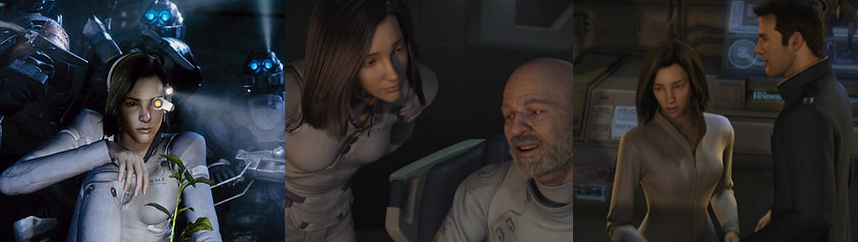
In 2065, alien “Phantoms” have driven humanity behind barricaded cities. When Doctor Aki Ross (Wen) and her mentor, Doctor Sid (Sutherland), discover a way to defeat the Phantoms, she enlists her former flame, Captain Gray Edwards (Baldwin), and his squad to save “Gaia”, the planet’s life force.

The Background:
Back in the mid-1980s, videogame developer Square was primarily known for their simple role-playing games (RPGs), racers, and platformers. Following the success of Dragon Warrior (Chunsoft, 1986), Square allowed Hironobu Sakaguchi and his small team to develop potentially his last chance at success: a complex RPG experience. Luckily for Sakaguchi, Final Fantasy (Square, 1987) was a big hit that popularised the genre and produced loads of sequels and spin-offs in the following the years. In 1994. Square boldly expanded the franchise with Final Fantasy: Legend of the Crystals (Rintaro, Kanda, and Ohkuda), an original video animation notorious for its obscurity. For their next attempt at multimedia expansion, Square partnered with Columbia Pictures, placing series creator Sakaguchi as the director and writer, and invested four years developing the technology to bring the film to life. Powered by numerous state-of-the-art computers and software and incorporating motion capture technology, significant time and painstaking effort was taken to render the film’s character models. Aki Ross was purposely designed to be an intelligent, realistic character whose model could become a recurring “actor” in subsequent CGI films. Seen as a breakthrough in CGI design, Aki even made the front cover of Maxim. This venture didn’t come cheap, however, and the production budget soon ballooned, leave Square on the verge of bankruptcy when the film tanked at the box office. While reviews raved about the film’s technical achievements and realistic animations, the nonsensical plot, uncomfortable realism of the effects, and lack of fidelity to the source material tarnished its appeal. This, it would be some five years before Square attempted another feature-length Final Fantasy venture.

The Review:
In Final Fantasy: The Spirits Within, the Earth is a post-apocalyptic wasteland. About forty years before the start of the movie, the planet was hit by a meteor carrying a highly aggressive, largely invisible alien invasion force that swept across the world. People suddenly dropped dead for no reason and, when the reason was discovered, went to war with these invaders (dubbed “Phantoms” since they’re invisible and can pass through solid objects). Battling the Phantoms was no easy task as physical contact with the creatures sees a person’s spirit removed from their body. However, the United States Military Force (USMF) developed semi-effective means to protect from and combat the creatures thanks to the painstaking research of Dr. Sid. Dr. Sid discovered that the Phantoms were comprised of a bio-electric life force that mirrored our own, a tangible power source that the USMF used to power their barriers, weapons and other assorted, suitably sci-fi technology. Thus, the USMF can seemingly kill or dismember the creatures, though their numbers are seemingly endless so humankind has been forced to shelter in “barrier cities”. Unfortunately, the barriers (effectively a form of electrical shielding) aren’t always reliable and can fail, whether due to the technology developing a fault or the Phantoms’ attack being too relentless, resulting in many lives being lost over the many decades and the planet’s surface left a wasteland of discarded vehicles, corpses, and dilapidated cities. Although a man of science, Dr. Sid is a deeply spiritual person. While his research enabled humanity’s survival, his ideas regarding humans have souls (or “spirits”) and the very planet itself having a tangible life force (dubbed “Gaia”) are seen as unpopular, fairy tale stories that don’t aid with defeating the Phantoms. His theories certainly earn him the ire of the hostile General Douglas Hein (Woods), a military man through and through who has a personal grudge against the Phantoms for killing his family and is literally obsessed (thanks in no small part to James Woods’ suitably grandiose voice work) with obliterating the clear and present danger, rather than indulging fantasies about spirits.

Infected by the Phantoms, Aki’s determined to gather the eight spirits and save her doomed world.

Thus, Dr. Sid has been forced to work covertly to scour the planet for eight spirits; life forms with unique energy patterns that directly feed Gaia and enable her to grow. It’s Dr. Sid’s belief that gathering these eight spirits will produce an energy wave that will dissipate the Phantoms. However, since General Hein would rather fire his massive orbital Zeus Cannon and willingly risk damaging the life force of the world, Dr. Sid works in secret. His first major breakthrough in Gaia research was his protégé, Dr. Aki Ross, who was accidentally “infected” by the Phantoms, something that’s normally a death sentence. However, Dr. Sid’s Gaia research saved her, safely containing the Phantom infestation in her chest, and she’s helped him by gathering six of the spirits through unsanctioned trips to the wastelands. These experiences have taken their toll on Aki as she’s encountered animals driven to the brink of extinction, lone weeds, and even a dying child who all contained the necessary spirits. To make matters worse, the infection is slowly killing her and Aki has regular nightmares of a doomed alien civilisation, one stuck in perpetual war, which she regularly records and studies as she believes it’s the Phantom’s way of communicating with her. All this leads her to distance herself from Captain Gray Edwards, commander of USMF’s “Deep Eyes” squad, since she didn’t want to hurt him with her short lifespan. The two cross paths when Aki secures the sixth spirit and she saves him from a similar infection by utilising focused surgical lasers. Although Gray is a sceptic and a pragmatist, he’s not some deluded warmonger like General Hein and at least entertains Aki and Dr. Sid’s theories, even if he doesn’t believe them. A driven and stubborn individual, Aki’s determined to gather the eight spirits and save her world and fully believes in Dr. Sid’s research, even exposing her infection to prove to the command council that there’s an alternative to the Zeus Cannon and merit to Dr. Sid’s beliefs. Naturally, this causes General Hein to become deeply suspicious of her. Believing she poses a threat and may even be manipulated by the Phantoms, he orders Gray and Deep Eyes to watch her for any abnormal behaviour. However, Gray’s feelings for Aki lead him to save her and them all to be branded as traitors, forcing Deep Eyes to team with the doctors in securing the last spirit before it’s too late.

The loyal Deep Eyes squad give their lives to protect Aki and gather the remaining spirits.

Gray’s a very by-the-book commander. He’s strong and loyal, for sure, and acquits himself well in combat, but he’s a bit of a blank slate. It’s clear that war has taken its toll on him and that he was hurt when Aki pushed him away. When his squad drops off one by one in their mission to save Aki, Gray reacts with anger and grief each time, showing he truly cares for his team. Indeed, Deep Eyes are a very likeable bunch, often bantering and acting like seasoned allies rather than simple grunts who blindly follow orders. Sensing the lingering feelings between Aki and Gray, mechanic and comic relief Neil Fleming (Buscemi) and stoic Corporal Jane Proudfoot (Gilpin) give the two some private time to work through their feelings. It’s abundantly clear that, for all his smart mouth, Neil has a crush on Jane, one he’s too awkward to express out loud and instead resorts to grand gestures to try and win her affections. Unfortunately for him, this results in his death when a gigantic Phantom sneaks up on him during their escape from the barrier city. While she’s largely dismissive of Neil and scolds him like a child at times, Jane’s incensed by Neil’s death and flies into a rage, only to ultimately embrace the same end when it’s clear she can’t defeat the Phantom. They’re joined by surly Master Sergeant Ryan Whittaker (Rhames), a soft-hearted brute who follows his commander out of blind loyalty. After being mortally wounded during the escape from the barrier city, Whittaker demands that they leave him behind with a gun and covers their escape, ultimately dying and leaving Gray fully ready to make his own desperate last stand to cover Aki and Dr. Sid’s journey to the Northern Crater Phantom Crater. Luckily for Gray, Aki won’t let him foolishly throw his life away and Gray joins her in descending into the crater, only finally realising that Dr. Sid’s seemingly mad theories are all-too true and that he, not Aki, holds the key to stabilising the life force of their fractured and doomed world.

General Hein refuses to believe the Phantoms are alien ghosts and is undone by his delusions.

The Phantoms come in all shapes and sizes, from humanoid warriors to gigantic, Lovecraftian creatures that defy description. Largely insectile, sporting tentacles and stingers and carrying weapons they never seem to fire, the Phantoms emerge from the ground and pass through walls with ease. Though they can be cut down and seemingly killed, hundreds more rise in their place and, since they’re largely invisible, they easily get the drop on the unprepared. Even when Aki and the Deep Eyes use technology to detect the Phantoms, fighting even one of them is a lost cause as they kill with a touch and just being near them can be infectious. As if their name (“Phantoms”) wasn’t enough of a clue, the creatures turn out to not be an invasion force, but the tortured spirits of a long-dead world who were carried to Earth via a meteor. Having waged war on their world and ultimately destroyed their planet, the restless alien spirits rise again as dangerous ghosts alongside the other creatures that inhabited their world. Their motivation is revealed to not be conquest, but simply that they cannot rest, though they remain no less dangerous after this revelation. As if an endless swarm of ghostly aliens wasn’t bad enough, Aki’s efforts to recover the eight spirits are undermined by General Hein. A brash, delusional, and paranoid military man, General Hein genuinely believes that the only logical course of action is to slaughter the Phantoms at their source using the Zeus Cannon, an orbital laser powered by the same energy emitted by the creatures. Cold and callous, General Hein relishes publicly humiliating Dr. Sid and throws his authority around with reckless abandon, happily branding even his own troops traitors if they dare question his orders. General Hein is so sure that the Zeus Cannon will work and so desperate to avenge his losses that he orders the city’s barrier to be partially lowered to let in some Phantoms, believing his troops can contain them before realising that he’s doomed the entire city. While this seems to bring him to his senses for a moment, it actually tips him over the edge into full on megalomania. Believing Aki is under the influence of the Phantoms, he refuses to entertain her revelation about them or acknowledge her warnings and orders the Zeus Cannon to be fired, even personally re-routing power and ultimately undoing himself due to his obsession.

The Nitty-Gritty:
My advice to any Final Fantasy fans coming into Final Fantasy: The Spirits Within is not to expect a movie that reflects the source material. You’re much better off watching the film as a sci-fi alien invasion movie than a Final Fantasy adaptation; doing this makes it much more enjoyable, even if it does tend to drag in the middle. However, while the movie has little resemblance to the videogames, there are some loose familiar elements. Dr. Sid is the most obvious example, taking the recurring name from the games (why Biggs and Wedge weren’t also used is beyond me), a Chocobo gets a brief cameo, and you could even argue that the Zeus Cannon is a technological stand-in for the mythical “Summons” usually seen in the games (though calling it the “Odin Cannon” would’ve been a stronger link). While the film isn’t set in a medieval fantasy land, has no magical Crystals, and features no magic, there are some thematic parallels that mirror the games, specifically Final Fantasy VII (Square, 1997). The planet having a life force, for example, is very similar to the “Lifestream” from that game; the steampunk-like technology is also similar, with the barrier city resembling Midgar; Deep Eyes and their uniforms kind of resemble SOLDIER; and the finale at the Phantom Crater reminds me of the descent into the Northern Crater to confront Sephiroth. The idea of the Phantoms spewing from this singular point isn’t a million miles away from the “Lunar Cry” of Final Fantasy VIII (ibid, 1999) and the planet’s sprit is called Gaia, a recurring name for the planet in Final Fantasy games. Yet, the movie features none of the music from the games, no returning characters, and is as far removed from the source material as Final Fantasy VII was from the first Final Fantasy, so I can understand why long-time fans of the games were disappointed by the film, which changes so much of the source material that it’s almost unrecognisable.

As visually impressive as the film is, it suffers from being nothing like the source material.

However, put that aside and watch it as a sci-fi alien invasion movie, and it’s not that bad a watch. Sure, there’s a lot of existential musings on the soul, the nature of the planet, and the difference between logic and reason and abject aggression but there’s a fair amount to like here. The Phantoms are very intriguing; I loved how they all looked so different, from flying snakes to massive Eldritch abominations. I liked the sheer hopelessness that was evoked whenever even a handful of the humanoid Phantoms showed up and how desperate the situation was for all involved since humanity is on the brink of extinction. The performances were all solid throughout as well. Steve Buscemi and James Woods, especially, stole every scene they were in with their comical, over the top delivery that was perfectly mirrored in their character’s performances. And this is, naturally, where Final Fantasy: The Spirits Within shines the brightest. It’s a technical marvel, there’s no doubt about it, showcasing dramatic and cinematic camera angles never seen before in CGI animation and providing the most photorealistic CGI “actors” the world had ever seen. The detail put into Aki, especially, is staggering and you can really feel every emotion, doubt, and strength of conviction through her. Gray doesn’t get quite the same nuance, but General Hein is suitably menacing, Dr. Sid fittingly portrayed as a disheartened but no less enthusiastic grandfather, and the technical achievements of the film can’t be understated. It still holds up really well today, even if technology has advanced so far that most modern videogame cutscenes are now technically superior. Unfortunately, everything does come across as very bland and bleak. This makes sense considering the context, but it’s clear that the darkness and griminess was a conscious choice to hide imperfections in the CGI. The Phantoms are the most colourful thing in The Spirits Within, giving them an ethereal presence that’s bolstered by the fear and desperation of the characters and the creatures’ death touch to make them incredibly ominous. I do wonder what a more traditional, medieval fantasy setting would’ve looked like with this same technology and if it would’ve aged as well, but it is impressive to see CGI characters brought to life so realistically, even if they spend most of the film just standing or sitting and debating beliefs.

Gray’s sacrifice allows Aki to dispel the Phantoms and restore Gaia to full health.

As Aki’s condition worsens, her visions become more intense and detailed, finally allowing her to figure out what anyone with a brain could’ve told her: the Phantoms are alien ghosts, not an invasion force. Unfortunately for her, she and the Deep Eyes must escape the barrier city, which has been compromised thanks to General Hein’s arrogance, resulting in the loss of Gray’s entire squad. Realising the eight spirit is at the Phantom Crater, Aki, Gray, and Dr. Sid head there to retrieve it, finding the infectious spirit of the Phantom’s world threatening Gaia. Unfortunately, General Hein takes his obsession to its logical conclusion and bombards the site with the Zeus Cannon. Although Aki tries to reason with him, General Hein balks at her words and orders the assault to continue, destroying the eighth spirit and, ultimately, himself when he refuses to let go of his vendetta. To make matters worse, the Zeus Cannon also penetrates Gaia, wounding her and leaving her susceptible to the Phantom Gaia’s influence, which seeps in as a tangled mess of red roots. Left defenceless and with the Phantoms closing in on them, Aki has one last vision that makes her realise that the Phantom particles within her have been changed by her spirit and transformed into the eighth spirit. Though sceptical, Gray allows Aki to take the power node from his weapon and broadcast the energy wave, which pushes back the Phantoms. However, when this proves insufficient in restoring Gaia, Gray makes the ultimate sacrifice and acts as a medium between the planet’s corrupted life force and the spirit resting with Aki, dissipating the Phantoms and returning Gaia to normal at the cost of his life. With the Phantoms having finally been laid to rest and Dr. Sid finally seeing his lifelong beliefs with his own eyes, a despondent Aki returns to the surface cradling Gray’s lifeless body and sees a world finally free from the invading spirits.

The Summary:
I was a SEGA kid growing up, so I didn’t get to play the Final Fantasy games (legitimately, anyway) until I was in my twenties and got a PlayStation 3. I knew of the franchise thanks to gaming magazines and such, but I believe my first real experience of it was Final Fantasy: The Spirits Within. I think that ignorance, my personal lack of nostalgia for the traditional videogames, and my love of sci-fi films has always contributed to me having a soft spot for this movie. It’s nothing like any of the games; it has none of the characters you know, none of the tropes, and only surface-level similarities in its themes. As an adaptation, it’s very poor and has little fidelity to the source material. However, that doesn’t mean it’s necessarily bad; it just means you have to view it differently. As a sci-fi alien invasion film, it’s pretty decent. The Phantoms are a really interesting twist on the formula (even if the “twist” can be seen from a mile away) and I loved how they were so dangerous and unstoppable. I like the post-apocalyptic setting and the delusional General Hein, who stole the show for me, and the desperation faced by everyone to combat this threat. The existential themes at work were a bit obnoxious at times, the pacing felt very off and it does drag in the middle, and I would agree with arguments that many of the characters were wooden and underdeveloped. Aki gets the most screen time and the most development, which makes sense, but isn’t always the most interesting character, and the Deep Eyes squad quickly descend into one-dimensional (if enjoyable) characterisations. Of course, the most impressive aspect of Final Fantasy: The Spirits Within is the CGI, which still holds up today. The level of detail in the characters is extraordinary and it’s clear that a lot of time, effort, and money went into the project. Unfortunately, I think it was largely squandered. By being so removed from the source material, the filmmakers alienated their target audience, and bogging the film down with a dull pace didn’t help cover for this decision. I still like it and still defend it, but even I don’t watch it all that much and I can see why both die-hard Final Fantasy fans and even casual audiences would be disappointed as, once you get past the technical achievements of the film, there isn’t much left to sustain your engagement.

My Rating:

Rating: 3 out of 5.

Pretty Good

Did you enjoy Final Fantasy: The Spirits Within? If so, what did you like and, if not, how annoyed were you by the changes made to the source material? What did you think to the premise, Aki’s character arc, and the characterisation of the Deep Eyes squad? Were you also a fan of James Wood’s performance? What did you think to the Phantoms, and did you also guess their true nature ahead of time? Would you like to see another big screen Final Fantasy movie? Which Final Fantasy game is your favourite? I really want to know everyone’s thoughts on this one so leave a comment below, support me on Ko-Fi, and check out my other Final Fantasy content.

Game Corner: Final Fantasy VII Remake (PlayStation 4)

Released: 10 April 2010
Developer: Square Enix Business Division 1
Also Available For: PC and PlayStation 5 (Intergrade Version)

The Background:
Before the PlayStation, Square’s Final Fantasy titles were primarily known as a Nintendo-based franchise. That all changed with Final Fantasy VII (Square, 1997), an award-winning role-playing game (RPG) that sold over ten million copies for the upstart console. Final Fantasy VII was so successful that Square Enix were inspired to expand its lore and characters through numerous spin-off media, including a computer-generated movie, an RPG/action shooter follow-up, and a mission-based prequel initially exclusive to the PlayStation Portable. Development of a remake can be traced back to the early 2000s, though hardware limitations saw the project delayed until late-2015. Rather than simply remaster the original, the team decided to completely rebuild Final Fantasy VII from the ground up, replacing the turn-based mechanics for a more action-orientated gameplay style and creating all-new, photorealistic character models. Soon into development, the team also decided to split the game into three parts, expanding on supporting characters and even adding additional story elements to bolster this first entry. The announcement and first trailer alone did big numbers for Square Enix and the game sold over 3.5 million units worldwide within its first three days and was met with critical acclaim. Reviews praised the expanded characters and lore, the revised combat mechanics, and the deep dive into Midgar society. While some criticised the slower parts of the story and some tedious mechanics, Final Fantasy VII Remake echoed its source material by becoming an award-winning title. In 2021, an enhanced port dubbed Final Fantasy VII Remake Intergrade was released for the PlayStation 5, where the second part of the project released, also to widespread praise.

The Plot:
The Shinra Electric Power Company drains the planet’s “Lifestream” by harvesting its “Mako” energy, making life miserable for the lower classes. Ex-SOLDIER Cloud Strife reluctantly teams with eco-terrorist group Avalanche to oppose Shinra, only to end up defending fate itself when Sephiroth, a celebrated SOLDIER, enacts a mad plot to alter the timeline and become a God.

Gameplay and Power-Ups:
Final Fantasy VII Remake is, as the title suggests, an action-orientated remake of the classic RPG Final Fantasy VII. As in the original game, players assume the role of stoic mercenary Cloud Strike, a troubled young man who wields various swords as tall as he is, and team up with some colourful characters in a bid to first stick it to a corporate conglomerate, then to defend both the world and fate itself. If you’ve never played the original game, this is a great way to experience the story for the first time. However, Remake does dabble in multiple timelines and rely on references near the later stages so some familiarity with the original is required. Those who are well-versed in the original and the series will find new gameplay options available here that mix things up. Obviously, the turn-based mechanics are gone, replaced with the franchise’s more modern third-person, active battle system. You can set up battles to somewhat resemble the original system with “Classic” mode, where attacks are automated and you simply focus on making decisions, though I chose to play on “Easy” mode and have full control over Cloud and his allies. Battles are semi-random; enemies appear and occasionally respawn in specific areas for you to battle for experience points (EXP) and Gil, but you won’t be assaulted every other step like in the original game. When in combat, Square unleashes your standard attack and holding it performs either a multi-hit swing or an automated combo, depending on who you’re controlling. Triangle activates each character’s signature move: Cloud switches between the faster, weaker “Operator” stance and the slower, more powerful “Punisher” stance, while Barret Wallace unleashes a powerful blast from his gun arm that must be recharged, Tifa Lockhart executes a whirlwind uppercut, and Aerith Gainsborough deals magical damage with Tempest. X opens the command menu, slowing the battle to a snail’s pace as you select magic attacks, items, or character abilities. Circle allows you to evade, you can guard by holding R1 to reduce incoming damage, L1 opens your shortcut menu (allowing you to quickly perform preset actions), and you can lock-on to targets by pressing in the right stick. While in the “Commands” menu, L2 or R2 issue commands to your two teammates and you can switch to them with the directional pad, though they’ll battle independently without your input.

Combat is fast and action-packed as you pummel enemies with spectacular special attacks.

Although battles are much more chaotic and action-packed, many of Final Fantasy VII’s mechanics return here. Your health points (HP) are depleted as you take damage, with characters being knocked unconscious after enough hits, and utilising spells such as Fire, Cure, or Barrier drains magic points (MP). Attacking enemies builds up the Active-Time Battle (ATB) gauge and allows you to perform certain actions. You need at least one bar to consume a restorative item, cast a spell, or perform a character’s special abilities, with stronger magic and attacks consuming two bars. These special abilities are dictated by the weapons you hold; each weapon unlocks a new ability once you use it enough, allowing you to use it whenever you like with different weapons, and these abilities essentially replace the multiple “Limit Breaks” of the original game. Limit Breaks are still present, however, and again activated when a small gar fills up during battles. Selecting a special ability or Limit Break can turn the tide of trickier battles as you’ll deal greater damage or inflict wider status effects so they’re worth experimenting with. Victory not only earns you EXP to boost your level and stats (attack, defence, speed, etc) but also nets you Skill Points (SP). These are spent in a surreal menu not unlike Final Fantasy X’s (Square, 2001) Sphere Grid and boost your stats further or grant you additional Materia slots. As you explore and interact with non-playable characters (NPCs), you’ll find Materia that can be equipped to weapons, armour, and accessories. Materia allows you to cast spells in battle, from elemental attacks like Fire, Thunder, and Blizzard, to defensive spells like Barrier and Haste, to boosting your stats and assessing enemy weaknesses. Materia also levels-up through battle and the acquisition of Ability Points (AP), and levelling-up certain Materia lets you cast more powerful spells, though these consume more MP and have a noticeable charge time. Certain weapons add elemental effects to your attacks and most enemies have some kind of elemental weakness, so having a diverse set of Materia is key to mastering the combat system. It also helps to take advantage of buffs and status draining magic, capitalise on “critical hits”, and pummel your target when they’re “staggered”.

Completing side quests and mini games nets you Summons, fast travel, and other rewards.

When facing more powerful enemies, this staggered state is crucial to victory as landing successive hits builds the “Summon” meter. If you have a Summon Materia equipped, you can call forth a powerful beast to fight alongside you. Unlike in the original game, you issue orders to the Summon from the Commands menu and it’ll fight with you until the bar depletes. There are only four Summons available, with three locked behind virtual reality missions where you must defeat them to earn them, but they’re well worth bringing out during tougher boss battles. Victory, chests, and completing side quests also nets you Gil, which you spend on items to restore your HP, MP, or remove status effects like sleep and toad, purchase weapons and accessories, and buy more Materia. You can also use it to rest in inns, but I found little use for this as the game’s littered with helpful benches that restore your party to full health and Cloud even has a free room he can rest in during the first part of the game. This meant I never bought any items and rarely used them in battle and was much more frugal with my MP expenditure than usual, especially as I took the time to complete side quests to gain greater levels and gear. At various points throughout the chapter-based story, you’re encouraged to complete side quests for the destitute inhabitants of the Slums or the boisterous locals at Wall Market. These see you finding and feeding Chocobos to unlock a fast travel system, collecting medicines, defeating enemies that’ve infested the scrapyard and other areas, finding mischievous local kids, and playing songs to cheer people up. You’re usually rewarded with Gil but you’ll also unlock new Materia or be gifted SP or certain gear. Though these side quests did feel like padding at times, it was a great way to flesh out the game’s supporting characters and develop a deeper connection to the Midgar residents, meaning it has more emotional impact when Shinra decimates the area and kills most of them as recompense for your disruptive actions.

Gameplay is mixed up with some racing, interactable, and puzzle solving sections.

While Final Fantasy VII Remake is heavy on combat, you can run from most battles and much of your time between fighting is spent interacting with party members, other members of Avalanche, and the NPCs in the Slums and other Sectors. These interactions also see you participating in various mini games, such as a squat and pull up contest where you rhythmically press buttons in the correct order, culminating in a full-blown rhythm game where a cross-dressing Cloud shows off his dance skills! There are two sections where you race along the Midgar highways on a motorcycle; both see you swinging your sword at Shinra’s soldiers or blasting them with a beam attack, though the second jaunt sees you dodging anaerial bombardment and taking on a massive tank! While most areas are sprawling and daunting in their size, your helpful mini map, onscreen compass, and the larger in-game map steer you in the right direction. Puzzles generally involve squeezing through gaps, pushing things aside, or activating consoles and levers but you’ll also be moving crates (and giving Aerith a ride) using gigantic robotic hands, switching between parties to open doors, asking Red XIII to hop along walls to pull levers, and rescuing terrified children following Shinra’s horrendous counterattack. When bringing down the Mako Reactors, you’re given a time limit to battle to safety; when infiltrating Shinra headquarters, you find and upgrade identification cards and crawl through vents; and you’ll be firing grapnel guns with Triangle to escape the Slums, blasting walls with Barret’s gun arm to find goodies, and draining water to progress in the bug-infested sewers. Shinra-branded crates are scattered everywhere, and you can smash these for items, to restore a little MP with Mako Shards, and to collect Moogle Medals to trade in the slums. You’ll be competing in the colosseum to progress the story and gain levels, searching for cats and allies, following a disconcerting trail of glowing slime, clambering on overheard poles, and shifting disused trains around in your quest. None of it’s too demanding but the game does slow down noticeably during the more padded and tedious moments.

Presentation:
Final Fantasy VII Remake is absolutely gorgeous. The graphical standard is so high that it’s basically like playing through Final Fantasy VII: Advent Children (Nomura, 2005) and a far cry from the chibi-like polygons of the original! However, I did notice some texture warping in the environment now and then and a delay loading the correct, high-quality textures here and there. Still, character models are now expressive and incredibly realistic, with your party’s weapons and gear reflecting what you’ve equipped in every cutscene (so, for example, Cloud doesn’t default to the Buster Sword when you’ve equipped the Nail Bat) and them being more expressive than ever. Cloud, especially, benefits from this as the story revolves around him and him slowly coming out of his shell as he interacts with his unlikely friends and other NPCs. He’s socially awkward at times and hesitant to form deep connections, meaning he’s left quite uncomfortable by Jessie Raspberry’s advances and Aerith’s teasing. He constantly clashes with Barret, who constantly gives Cloud a hard time and it takes a while for him to see Cloud in a different light when he willingly opposes Shinra and defends Midgar. Barret is a standout character for his passionate love for the planet and his little girl, Marlene, but I was surprised to see how big a role supporting characters like Jessie, Biggs, and Wedge have this time around. They desperately try to pierce Cloud’s armour and he begrudgingly comes to care for them, making their injuries and deaths all the more impactful, but it’s obviously his care for Tifa and Aerith that have the most impact on his character. Beset by migraines and assaulted by visions of his past, a distorted version of events, and Sephiroth, Cloud is a deeply troubled young man initially just looking to get a payday who naturally assumes a leadership role and goes out of his way to protect his newfound friends, even accepting Red XII without hesitation.

Midgar has never been so lively and expansive! it’s truly awe-inspiring to behold.

These narrative moments are pivotal to Remake’s story and directly tie into your extended time in Midgar and its various Sectors. While you can argue it unnecessarily drags things out, I did form a deeper bond with the welfare of the NPCs and this area since I interacted with everyone and got a sense of their society. Remake is quite linear and restrictive at times, however; it’s rare that you’ll get lost as your destination is either clearly signposted or you’re barred from going in different directions. You can explore a bit, though, and will find nooks and crannies hiding chests, Materia, health-restoring benches, or other minor goodies. Sometimes you have to go out of your way to find these, like directing moving platforms to an area behind some giant fans that you temporarily disable to snag some Materia. The game often highlights when you might’ve missed something with characters giving you the option to go back, but you can ignore these prompts if you just want to progress. You’ll be exploring Midgar’s Slums often, venturing into the squalor and interacting with the locals at the scrapyard, orphanage, or various shops. Aerith’s church is also here, of course, as is her beautiful house. You’ll also venture deeper into the oppressive and dark, steampunk-styled streets of Midgar to visit Jessie’s family, clamber up a pillar to escape, and toil in the dank sewers beneath Don Corneo’s opulent mansion. Quite often, you’re treated to a sprawling view of Midgar, which looms over the Slums like a dark shadow or stretches to the horizon, either twinkling with lights or left in ruins. The environments all recall the pre-rendered backgrounds of the original game but in a much greater scale. This is best felt when exploring the Mako Reactors, which feel large and lived in and fully operational, and when escaping the wreckage of the Slums and venturing into Shinra headquarters.

Cloud’s emotional journey takes a dramatic twist by the end.

Shinra headquarters is a high-tech skyscraper housing offices, an luxurious library (where the mayor is hidden away like a bad secret), toilets, and a museum dedicated to Shinra’s Mako research. It’s also home to Professor Hojo’s sprawling laboratory, where his Mako experiments created abominations and super-soldiers alike. Although Cloud is beset by fragmented memories, they become much more volatile here as Professor Hojo drops hints regarding his true past and his visions of Sephiroth manifest in physical form. We get brief glimpses of Cloud and Tifa’s childhood and a fiery incident involving Sephiroth, but nothing concrete, of course. Sephiroth’s presence is much more prominent here than during the original game, with his presence altered to potentially be time displaced and often accompanied by ominous, robed spectres known as “Whispers”. These pop up at key moments to keep the timeline intact but rage out of control in the finale, engulfing Shinra headquarters and warping Cloud and his friends to a desolate, whirlwind of a wasteland for the game’s final battle. Final Fantasy VII had one of the best soundtracks in all of videogaming, to say nothing of the franchise, and it’s well represented here. All the memorable themes make a return and can be freely listened to from jukeboxes once you’ve acquired CDs from vendors and side quests, and they even dynamically shift depending on what you’re doing. While your party won’t strike poses after every battle, they do in the combat simulator and Barret likes to hum the “Victory Fanfare” after a win, which is fun. A new remix of “One-Wing Angel” plays during the final battle, which always ups the ante of these situations, and Cloud’s confrontation with Sephiroth echoes their final encounter in Advent Children and recreates the automated showdown from the end of the original game. Finally, Remake ends with a tantalising teaser for what’s to come as we witness an alternative timeline where Zack Fair survived his dramatic last stand and leaves the ultimate fate of these characters up in the air since Sephiroth’s messing with the timeline.

Enemies and Bosses:
It’s been a while since I played Final Fantasy VII so I admit that I didn’t recognise many of the enemies I cut down throughout the remake. Some Final Fantasy staples are recognisable, of course, like the flaming Bombs, frog-like Hedgehog Pies, and the deceptively dangerous Tonberries. Many battles pit you against Shinra’s forces; these militant goons wield machine guns, toss grenades, hide behind riot shields, and even fly using helicopter blades. Shock troopers, faster, more annoying “elite” variants, and even 3rd class SOLDIERS also crop up, alongside turrets, small drones, and cannons. Some of these are placed amidst the environment and can be pre-emptively destroyed by Barret; others come to life from the background or pop up from holes in the ground. Shinra also employs large mechs known as “Sweepers” that boast buzzsaw appendages, flamethrowers, and missile launchers. Their clandestine operatives, Rude and Reno of the Turks, occasionally attack from a chopper and their troops are often accompanied by monstrous guard dogs seemingly bred from Red XIII. Various bizarre monsters, presumably discarded experiments or the result of Shinra’s hazardous actions, are also fought in the Slums and other Sectors. Ravenous rats, crane-like birds, disgusting insects, and weird amphibious creatures are as commonplace as living junk and bandits looking to pick a fight. Ghosts and the ominous Whispers are also encountered numerous times, alongside lizardmen, wolf-like beasts, and the truly peculiar “Unknown Entities” birthed from Professor Hojo’s lab! Many attack in groups and utilise similar magic to you, but you’ll find they invariable have elemental weaknesses, items to be stolen, or are all bark and no bite, especially if your levels and weapons are particularly strong. I’d recommended using Assess to keep a record of their weaknesses, hitting the touch panel on the controller to review each enemy afterwards, and equipping Enemy Skill to learn some of their more troubling abilities for yourself. The game also logs battle intel on each creature for you to review and this ties into the VR side quest to snag new Materia as well.

Shinra’s mechs and agents will hound you throughout the story.

Shinra’s military arm is second to none in the world of Final Fantasy VII and, consequently, you’ll be battling some massive, heavily armed mechs. The Scorpion Sentinel is a significant first boss since you’re also battling a twenty- or thirty-minute timer during the escape portion. The Scorpion Sentinel sets a precedent for the game’s bosses in that they all consist of multiple phases, with the environment changing or the boss altering its appearance and attacks as you deal damage. Able to lock on and bombard you with missiles, leap to the walls, and fire a devastating laser beam from its tail, the Scorpion Sentinel isn’t to be underestimated but, as with every other boss, can be staggered by targeting its appendages and elemental attacks (in this case Thunder) turn the tide. The Crab Warden is somewhat similar, though favouring flame bursts and electrifying the floor and with a central generator and pilot for you to target once you bust through its defences. The Airbuster continues the trend, though the difficulty of the timed fight is set by you since you can sabotage the machine while exploring the Mako Reactor. The Airbuster boasts a large beam cannon, launches its fists, and flies out of reach to pepper you with missiles. In the second phase, it sits at the end of a narrow walkway and will decimate you with its beam unless you take cover, while filling the space with laser beams in the third phase. The Valkyrie flying machine chases you down as you escape the Slums, favouring rapid-fire chainguns and explosive artillery, the tank-like Arsenal must have its wheels cut from under it on the highways, and you must swap between parties to battle the snake-like Swordipede in the depths of Shinra headquarters. This electrified mech flies about, tossing a buzzsaw and blasting you with an electrical field that can make it tough to hit. Alongside these mechs, you’ll battle Shinra’s human forces: Reno and Rude, in particular, are a troublesome duo, attacking with both speed and power. You’ll also match wits with SOLDIER 3rd Class Roche, earning his begrudging respect in a duel, and must target Rufus Shinra’s canine companions to keep him from counterattacking with a shotgun to your face!

Bizarre, monstrous creatures lurk in the shadows and burst free from Professor Hojo’s lab.

You’ll also face some large, generally grotesque monsters. If you want to summon Shiva, Chocobo and Moogle, and the Fat Chocobo, you must first defeat them in VR simulations, which isn’t too difficult given their obvious weaknesses. While competing in the Wall Market colosseum, you’re forced to fight the Hell House, a strange sentient house that’s initially immune to physical attacks, protects itself with Barrier, sends fireworks into the arena, and uses its jet boosters to stay out of reach. While in the sewers, you battle the troll-like Abzu, targeting its horns with Fire magic and avoiding its devastating pounce and poisonous water. A damaged Abzu reappears when you revisit the sewers, now accompanied by its pig-like offspring, retreating to tunnels to flood the room but otherwise retaining the same attacks. Abzu is good practice for the Type-0 Behemoth, a ravenous beast best crippled by attacking its torso and hind legs so you can target its horns, which make it otherwise invulnerable. Similar to the Whispers, who spawn the “Enigmatic Spectre” mini boss, the ghosts that haunt the trainyard are governed by the Ghoul, a poltergeist-like entity that teleports, becomes intangible, and inflicts Silence. This is merely the prelude to the Grim Reaper-like Eligor, who races around in a chariot, sweeps the floor with its eye laser, and can only be attacked from behind (preferably by ice-based magic). Finally, there’s Specimen H0512, a Cthulhu-like chimera with no elemental weaknesses, poisons and who “Slows” you with Noxious Expulsion and Mako Expulsion, slams one of your team around like a ragdoll, and spawns disgusting little minions to distract you.

Sephiroth reaches out from across time to try and undo his defeat and realise his mad goals.

Final Fantasy VII Remake includes an all-new form of Jenova, Jenova Dreamweaver, a malformed, Lovecraftian, tree-like entity fought in Shinra headquarters. This writhing, tentacled thing is rendered vulnerable by attacking its appendages, which spawn throughout the arena, pushes you back with Cast Aside, targets a single character with the hard-hitting Vengeance laser orb, and envelops itself in an impenetrable barrier with Rejection. It’s a fun, three-stage fight that keeps you on your toes, but the tension really ramps up once you enter the “Singularity” and are confronted by the titanic Whisper Harbinger. This towering monstrosity is too big and too far away to hit, but it does create three Whisper-like avatars: Whisper Rubrum, Whisper Viridi, and Whisper Croceo. Though colour-coded, they have no elemental weaknesses and instead absorb elemental attacks; they also constantly teleport and respawn, so it’s better to focus on one at a time. Deal enough damage and they’ll cast Correction, separating your party and forcing you to flee as the Whisper Harbinger wrecks the floating environment and showers the floor with lightning blasts. When Barret and Red XIII leave to attack Whisper Harbinger directly, you’ll face Whisper Bahamut, which throws explosive purple flame balls and the devastating, unavoidable Megaflare. Defeating it, and the other avatars, sees the Whisper Harbinger lose health and eventually crumble but this is a gruelling multi-stage fight that I’m not sure has checkpoints between each phase. Victory sees you confront Sephiroth, first as Cloud alone and then alongside his friends. Sephiroth is fast, casting elemental attacks, attacking with a sword beam, launching a three-swipe attack, and being the most aggressive and damaging enemy you’ll face. His Aeolian Onslaught can be tricky to dodge, his Hell’s Gate creates an explosion of light that hits anyone nearby, his Flamewall restricts your movements, and his Octoslash is effectively a one-hit KO attack. Once you deal enough damage, Sephiroth casts Meteor; you then have until the count of ten to finish him off before your whole party is decimated! This is a tough fight but also incredibly enjoyable. It echoes the Advent Children finale while also bolstering Cloud’s relationships since his friends arrive to help him for each phase of the fight.

Additional Features:
Final Fantasy VII Remake has fifty-four Trophies up for grabs, with one awarded each time you clear a story chapter and when you finish the game. You’ll get additional Trophies for completing side quests, like decorating the orphanage, helping out Johnny, and defeating Summons in VR. Collecting CDs, calling upon a Summon, levelling-up Materia and your characters, and mastering weapons all award Trophies as well. While it’s easy enough to win a battle and stagger an enemy, mastering the darts mini game, receiving praise from Jessie for your motorcycle skills, completing all the squat and pull up challenges, and beating the game on “Hard” mode are a bit more taxing. “Hard” mode is unlocked once you finish the game and disables items and restricts you to healing at benches, making for a far greater challenge. Beating the game also unlocks a chapter select option so you can retry any remaining side quests all while retaining your current level and gear. Your EXP and AP is also doubled at this point, which is helpful, a play log is unlocked, and additional battles are added to the combat simulator. Completing Chadley’s Battle Intel requests lets you battle and add Bahumut and Leviathan to your team, and you’ll need to defeat all these Summons to take on the optional superboss the Pride and Joy Prototype. In addition to a bevy of options, from combat controls to camera positions, you can also upload your save file to the PlayStation 5 to continue your game there. The PlayStation 5 version is the only way to play an interlude mission involving Yuffie Kisaragi, so it’s probably better you upgrade to that version to get the full experience.

The Summary:
Unsurprisingly, I’m a big fan of Final Fantasy VII. I enjoyed playing through it and have been waiting for a remake for a long time, though I never expected Square to go this far with it! I would’ve settled for a graphical overhaul of the original, with additional CGI FMVs tossed in to bolster the experience but, much like Capcom, Square went above and beyond in remaking arguably their most successful RPG and the results are clear to see. Final Fantasy has never looked better; Remake is like playing through a high-budget CGI movie, with an incredible sense of detail and depth to every environment. Making you interact with NPCs and spend more time helping them out fleshed out every character, not just the supporting roles, making them richer and more nuanced than ever. I loved the classic turn-based battle system and was worried I’d struggle here as a result, but combat is fast, fluid, action-packed, and intuitive. It’s fun issuing orders or switching to characters on the fly, taking cover, healing, or dishing out damage across the battlefield, to the point where it would’ve been great if this was a co-op experience! While the playable roster and the available gear is limited and you’re restricted to what amounts to the first disc of the original game, there’s a lot to see and do here and I liked the twist that this is more of a retelling of these events than a complete retread. The bosses were large and engaging and the sense of empowerment and progression was great; I played on “Easy” and didn’t get a single game over but enjoyed the sliding difficulty scale as the stakes increased. My only regrets are that this isn’t available on the Xbox One as of yet and that I don’t have the means to play Intergrade or the next chapter as I’d love to see how the story unfolds following this game. Regardless, Final Fantasy VII Remake is an outstanding visual and gameplay experience, easily accessible to newcomers and packed with fan service for long-time fans, revitalising and expanding upon the original game in bold, new (and, crucially, fun) ways to present a truly amazing feat of videogaming.

My Rating:

Rating: 5 out of 5.

Fantastic

Have you played Final Fantasy VII Remake? If so, what did you think to it and how do you think it holds up against the original? Were you disappointed that the project was split into three parts across two console generations? What did you think to the Whispers and the changes made to the story? Did you enjoy getting to know Midgar more intimately here? Which of the side quests was your favourite? Did you struggle against Whisper Harbinger and Sephiroth? Would you say it’s worth upgrading to the PlayStation 5 to continue the story? Which Final Fantasy game is your favourite? Let me know your thoughts on Final Fantasy VII in the comments and be sure to check out my other Final Fantasy content on the site.

Movie Night [National Anime Day]: Final Fantasy: Legend of the Crystals


15 April has been designated National Anime Day to celebrate the stylistic genre, which achieved mainstream success thanks to animators like Osamu Tezuka.


Released: 21 March 1994 to 21 July 1994
Directors: Rintaro, Naoto Kanda, and Tomohiko Ohkuda
Distributor: Madhouse
Budget: Unknown
Stars: Matt K. Miller, Sherry Lynn, John DeMita, Kate T. Vogt, Michael Sorich, Julia Fletcher, and Barbara Goodson

The Plot:
200 years after Final Fantasy V (Square, 1992), the malevolent Ra Devil (Sorich) arrives from the Black Moon and seeks the four elemental Crystals and only a quartet of unlikely heroes – headstrong Prettz (Miller), timid Linaly (Lynn), bumbling Valkus (DeMita), and mischievous Rouge (Vogt) – can stop him.

The Background:
In the mid-1980s, developer Square entered the Japanese videogame industry with simple role-playing games (RPGs), racers, and platformers for the Nintendo Famicom but, fearing low sales, forbade Hironobu Sakaguchi from developing a more complex RPG. That all changed with the success of Dragon Warrior (Chunsoft, 1986), prompting Square to reconsider their stance. Thus, Sakaguchi formed a small team to develop what he saw as his last chance at success in the industry. Of course, Final Fantasy (Square, 1987) was a huge hit that not only popularised the genre, but led to a slew of sequels and spin-offs over the following years. By 1994. the series spanned five games (with a sixth, arguably one of the greatest entries, due that same year). Final Fantasy V was a big hit upon release, despite not receiving an English translation, and Square sought to capitalise (and expand beyond videogames) by partnering with NTT Publishing on an original video animation (OVA) based on the title. The first direct sequel to a Final Fantasy game, Final Fantasy: Legend of the Crystals was originally released in Japan across four episodes on VHS before being dubbed into English and released in two volumes some three years later. At the time, the OVA was warmly received and praised for its visually engaging mixture of action and adventure. While some have criticised it as a poor adaptation and for its more comedic aspects, Final Fantasy: Legend of the Crystals became notorious for its scarcity. The OVA has never been re-released on any other media and is essentially lost to time, known only to a handful of die hard Final Fantasy and anime fans.

The Review:
200 years ago, the Warriors of Light (or “Valiant Ones”, as they’re referred to here) defeated the mad ambitions of Exdeath (dubbed “Exodus” here) to use the four elemental Crystals of Planet R to plunge all life into an everlasting void of darkness. Since then, Bartz Klauser (here called “Batz”), Lenna Tycoon, Galuf and Krile Baldesion, and Faris Scherwiz have passed into legend, with only Batz leaving behind a legacy in his descendants, the elderly Hassam (John Hostetter) and his brave but timid daughter, Linaly. Hassam operates alongside an unnamed Blue Mage (Unknown) as a spiritual advisor to Queen Lenna (Goodson), monarch of Tycoon, who learn from the wind itself of an oncoming danger. Despite his age, Hassam is adamant about journeying to the Wind Temple to investigate, determined to live up to the standard set by his ancestor. When Linaly offers to go in his place, the two reach a compromise to travel together, but Hassam refuses to allow boisterous Prettz to tag along as Linaly’s “bodyguard”. Believing the hot-headed youth would desecrate the sacred Wind Temple (and suspecting that Prettz just wants to impress Linaly), Hassam refuses to divulge their destination or let him on their boat, despite Linaly having a soft spot for the boy. Undeterred, Prettz follows on his bitchin’, steampunk-esque motorcycle, ultimately saving them from a gigantic, insectile desert monster when his nodachi proves more effective than the gaunt, featherless Chocobo Linaly summons. Despite severing the creature’s head with one dramatic slash, Prettz fails to impress Hassam who, too injured and exhausted to continue, insists that Linaly continue by herself. With Hassam returning to their village to rest and offering spiritual guidance to his granddaughter through a mystical talisman, Prettz continues to follow Linaly, whom he has an obvious crush on. Though she steadfastly refuses his offer for a ride since she wants to honour her grandfather’s wishes to go alone, Linaly soon changes her mind when threatened by a massive airship. Piloted by treasure-hungry pirate Rouge and her all-female crew, the pirates accost them, looking to steal their bike and possessions. Although Prettz manages to elude the pirates using his riding skills and one of his trademark spiked bombs, he makes an enemy of Rouge, who vows to hunt him down and make him pay for the humiliation.

Prettz insists on accompanying Linaly and gets mixed up with a magical Crystal.

While taking refuge in a forest, Linaly reveals the true nature of her quest to Prettz and uses her talisman (and telepathic advice from Hassam) to guide them to the Wind Temple, leading them to a raging sandstorm which Prettz rushes head-first into while Linaly allows her faith to guide her. Upon reaching the Wind Temple, however, they find the shrine out of reach. Hitting upon an idea, Prettz doubles back and forces Rouge and her crew to pilot her airship into the temple valley, threatening to blow them all sky-high unless they agree. Begrudgingly, Rouge agrees and, despite her annoyance and doubts that her ship will even fit through the canyon, successfully brings Prettz to the temple’s entrance…where he finds Linaly waiting! While he was off being a show-off, Linaly investigated the area and solved the puzzle to open the way to the Wind Temple and she ventures inside with Prettz while Rouge is distracted by an incoming airship. Braving the temple’s interior, the duo locate the Crystal, which, upon contact, bombards Linaly with visions of the past and a malevolent figure and the spirits of the long-dead Valiant Ones crying for aid. Overwhelmed by the barrage, both Prettz and Linaly are powerless to keep the Wind Crystal from entering her body, where it glows ominously from her perky little butt (leading to much raunchy leering throughout the OVA). Desperate to help his friend, Prettz races from the Wind Temple, reasoning that the Blue Mage would be able to help her, only to be confronted by Valkus, the heavyset commander of the Iron Wings, the same airship that caught Rouge’s attention. Having learned that the other three elemental Crystals have been stolen and their nations have descended into chaos, Valkus and his crew flew to the Wind Temple to secure and protect the remaining Crystal. Naturally, Valkus believes Prettz and Linaly to be thieves and fires on the two when they not only refuse to return the Crystal but when Prettz also pushes his disrespectful attitude too far. Despite the Iron Wings’ bombardment and Valkus shooting at the two with his pistol, the duo topple Valkus and attempt to escape. After being grazed by one of Valkus’ shots, however, Prettz flies into a rage, only to have his sword blocked by the commander’s bare hands and the hostilities between the group ended when Rouge (who had been eavesdropping the entire time) knocks them all unconscious with gas and kidnaps them, lusting after the mysterious Crystal she heard them talking about.

The lovelorn Valkus is locked up with the duo and learns of the impended threat from Mid.

Elated to have captured not only the kids who humiliated her so badly but also the captain of the Iron Wings, Rouge spirits her quarry to her personal island and threatens them with torture. Defiant to the end, Prettz scoffs at her threats, maintaining his insolent attitude even when Rouge subjects him to a tickle machine. When Rouge threatens to snap Linaly’s neck with her whip, Prettz attacks in a fury, only to receive a beating that renders him unconscious. The three are thrown into a cell while Rouge ponders her next strategy. Though Prettz desperately tries to break out, he receives little help from Valkus, who finds himself confused by his attraction to Rouge. While Valkus’s crew frantically search for their lost commander, following sporadic energy spikes emitted by the Wind Crystal, the prisoners are stunned when the Crystal suddenly emerges from Linaly’s chest, and the spirit of Mid Previa (Fletcher) appears before them. The grandson of Cid, an ally of the Valiant Ones, Mid’s restless spirit ignores Prettz’s insolence and drops a bunch of exposition on the captives. Sometime after defeating Exodus, Mid was heartbroken when his beloved grandfather died, taking all his secrets of the Crystals with him since he’d come to realise it was foolish to meddle with their divine power. While mourning at Cid’s grave, Mid was suddenly attacked by the same dark figure that’s been haunting Linaly’s dreams and barking orders at his robotic subordinate throughout the OVA. This demonic being, later identified as Ra Devil, desecrated Cid’s grave, stealing his brain to absorb the old man’s knowledge, and murdered Mid simply for witnessing the act. Unable to rest, Mid pleads with Linaly to keep the Crystal safe within her and reveals that the three of them (and Rouge) have been chosen by the Wind Crystal to be the new Valiant Ones destined to save Planet R from destruction. Despite Prettz’s scepticism and continued hostility towards Mid because of their shared feelings for Linaly, the group soon set aside their differences when Rouge takes Linaly to forcibly remove the Crystal from her. Thanks to spurring Valkus on with promises that he can see Rouge again if they escape, Prettz finally breaks free from the cell and is forced to follow Mid’s lead.

The rag-tag Valiant Ones must awaken a dragon to confront Ra Devil on the Black Moon.

Although Rouge implied that she would surgically remove the Crystal, Prettz is stunned to find the pirate queen serving his friend laxatives! After fighting past Rouge’s guards, Prettz rescues Linaly and reunites with his bike, thanks to Mid, discovering a massive cavern filled with explosives. When their escape threatens to turn violent, Valkus intervenes to try and make peace, only for Ra Devil’s Deathgyunos forces to attack. Prettz lures the alien creatures away, claiming that he possesses the Wind Crystal and allowing the others to flee to the Iron Wings. Prettz leads the creatures to the cavern of explosives and sets off a massive explosion that leaves Rouge’s island in flames, distraught at the sight, Rouge is offered some comfort by the blushing Valkus and Linaly is overjoyed to see Prettz inexplicably survived the explosion despite being at the heart of it. Reunited on the Iron Wings, Rouge is initially outraged when Valkus is forced to put her in chains to appease his loyal crew. However, she’s soon freed per a decree from Queen Lenna, whom the group meets in person upon reaching Castle Tycoon. Queen Lenna echoes much of Mid’s earlier exposition, explaining that the rag-tag group are the last hope for the world, which will be torn apart if Ra Devil acquires the last Crystal and absorbs their powers. Although Mid confirms the villain’s threat, the group remains sceptical: Linaly doesn’t believe she’s special, Prettz refuses to believe he’s been chosen by an inanimate object, and Rouge scoffs at the idea of a pirate like her being crucial to saving the world. Only Valkus accepts his destiny and the challenge of confronting Ra Devil on his base, the Black Moon, though the others are soon coerced into helping when Queen Lenna promises Rouge a treasure trove of riches and Prettz volunteers to protect Linaly, who quietly accepts her calling to save the world. However, to reach the Black Moon, the group must first venture into the depths of Castle Tycoon to awaken their guardian deity, the flying dragon (or “Hyriuu”). While Valkus and Rouge fend off the attacking Deathgyunos forces, Prettz, Linaly, and Mid head into the catacombs beneath the palace, fending off Ra Devil’s soldiers and taking a plunge through the clouds to a hidden stone shrine to the dragon. Prettz is dismayed to find the creature is represented only by murals and a tiny, flightless lizard (though Linaly is instantly enamoured by the cute little dragon). However, when Ra Devil appears in the chamber and kidnaps Linaly, shrugging off Prettz’s attack and terrifying Mid, Prettz finds himself astride the legendary dragon when it undergoes a dramatic transformation into a titanic winged deity ready to spirit the group to the Black Moon.

The Nitty-Gritty:
Although I haven’t played Final Fantasy V yet, Final Fantasy: Legend of the Crystals is no less enjoyable both as an adaptation/continuation of the game and as an anime. Setting it 200 years after the videogame is a good way to tell a brand-new story with some original characters, though I do wonder if this may alienate or disappoint fans of the game, who only get to see familiar characters returning as spirits. The visual, action, and humour are all far more reminiscent of Dragon Ball (1986 to 1989), focusing more on touches of lewd humour (mainly with everyone staring at Linaly’s glowing butt) and a fantasy land that’s less medieval and more disparate. I’d wager some of the locations will be familiar to fans of the videogame, especially Castle Tycoon and the Black Moon, and the OVA does a decent job of recreating a few of Final Fantasy’s gameplay mechanics. The group engage in random battles, for example; Linaly is a summoner (albeit not a very accomplished one); Queen Lenna is advised by a Blue Mage; and elements of the iconic Final Fantasy theme are sprinkled throughout the soundtrack. Airships are also few prominent and Linaly’s shown to be able to summon Chocobos. They don’t resemble the cute, furry beasts from the games, but this is attributed to Linaly not having fully realised her power. Each of the new Valiant Ones also has a “class” just like in the classic games, with Prettz being a swordsman, Linaly a mage, Valkus a marksman, and Rogue basically being a thief. Finally, there’s the obvious plot point of them safeguarding magical Crystals (specifically the Wind Crystal), which are so powerful and integral to Planet R that their absence causes nations to fall into ruin. Indeed, Queen Leena warns that simply protecting the Wind Crystal isn’t enough and that the world will end if the other three aren’t recovered, much less if their powers and corrupted by Ra Devil.

The OVA is bolstered by some fun action and amusing moments between the heroes.

Ra Devil is an indistinct and vague threat who spends the first three parts of the OVA barking orders from his Black Moon base and resembling little more than a shadowy, vaguely cybernetic/demonic figure. When he appears before Mid and Linaly, he cuts an intimidating if generic and stoic figure, conveying his menace through desecrating Cid’s grave, murdering Mid, and kidnapping Linaly. Rather than being Exdeath Exodus reborn, Ra Devil is a seemingly alien threat who leaves the heavy lifting to his Deathgyunos soldiers, a nigh-endless swarm of demonic creatures who have the numbers advantage but are routinely cut down by Prettz and Valkus. There’s some enjoyable anime action in this OVA, especially when Prettz blasts about on his motorcycle or busts out his sword (something that, sadly, doesn’t happen all that often). The airships are suitably impressive, being immaculately detailed, and I enjoyed the mixture of action and comedy in most action scenes. Rouge’s “torture” turning out to be tickling and prune juice was amusing, as was Mid constantly winding Prettz up by comparing him to a dog and being immune to his physical reprimands. Although the attraction between Prettz and Linaly isn’t dwelled on all that much and is mainly conveyed through his willingness to endure any hardship to protect her, I enjoyed Valkus’ adoration of Rouge, which left the big man a blushing mess whenever the sultry pirate was around. The mismatched Valiant Ones make for quite the odd partnership; they’re often plagued by doubts or bickering between each other rather than battling Ra Devil’s forces. While only Valkus and Mid (and, to a degree, Linaly) understand the true scope of Ra Devil’s threat, even Rouge is convinced to help save the planet when she’s presented with riches. Prettz may be a sceptic and have an unruly demeanour, but he’s loyal to Linaly almost to a fault, volunteering for dangerous missions without truly understanding what he’s up against and taking on foes and even natural disasters with only his moxie and bombs to back him up. Though he knows when to flee a confrontation, Prettz is quick to join a fight if insulted or if Linaly is in danger and impresses with his defiant spirit. This contrasts with Linaly’s more subdued characterisation and leads to some fun interactions between him and his rag-tag cohorts.

Ultimately Linaly bests the God-like Deathgyunos, saves the world, and honours her ancestors.

Despite none of their airships being protected against the vacuum of space, the flying dragon hauls Valkus and Rouge’s crafts into the void, leaving Rouge and her crew stunned to discover Planet R is round rather than flat. Upon spotting the Black Moon, Mid is dismayed to find that Ra Devil’s plot is already underway. After wandering the universe in search of the ultimate power, the half-crippled demonic entity built an ominous base on the Black Moon and hooked the three Crystals up to an elaborate machine. With Linaly in place alongside Cid’s severed brain, Ra Devil begins siphoning the Crystals’ energy to channel the cosmic power of the universe into his very being! While his minions cry out in joy as Ra Devil slowly absorbs the power and knowledge of the universe, a lightning bolt causes our heroes to crash to the Black Moon’s surface, which is both hospitable and strewn with debris. After ordering her crew to repair the damage and nurse the dragon back to health, Rouge joins Prettz, Valkus, and Mid in tracking Linaly using her talisman (which Prettz retrieved in the dragon’s chamber) and Cid’s desperate pleas. When Ra Devil completes his transformation into Deathgyunos, the “God of Oblivion” (a titanic Eldritch abomination of organs and metal), Valkus and Rouge return to their airships to counterattack his forces, leading to Valkus flying into a rage when Rogue is wounded and his ship to be destroyed in an ultimately futile attempt to bring the behemoth down. Although Prettz rescues Linaly, he’s attacked by her thanks to Deathgyunos’ influence and it’s only through Mid’s intervention that the girl is brought to her senses. After Valkus’s men retrieve the other three Crystals and Mid reunites with his grandfather’s brain, Mid stalls Deathgyunos’ advance to allow his newfound friends to escape. Undeterred and seemingly unkillable, Deathgyunos continues, relentless in its desire for complete obliteration and torturing Prettz after the Wind Crystal joins with him. Though Valkus destroys the abomination’s hand, Linaly’s left to confront the creature alone when it subdues her friends with its energy blasts. Summoning a flock of Chocobos, Linaly rips Deathgyunos to shreds, leaving it vulnerable to Prettz’s final sword slash. Victorious, the newly formed Valiant Ones bid a fond farewell to Mid, who crosses over to be with his grandfather and friends, before returning home. Linaly relates their adventure to Hassam, who reacts with awe and pride, and the OVA ends to show Vulkus joining Rouge’s pirates to be with his sultry queen.

The Summary:
It’s a shame that Final Fantasy: Legend of the Crystals isn’t more readily available. The best you can hope for are poor transfers on video streaming sites or maybe a battered VHS copy. It really should be more widely available and I’ve never understood why it isn’t, especially as Final Fantasy and anime fans would probably lap it up. This is a really fun OVA with a lot of amusing moments and memorable characters. I really liked how hot-headed and brazen Prettz was, how he treated everyone except Linaly with such a smart-mouthed disdain and how he impressed with his defiant, never-say-die attitude. He charges into situations without thinking, full of piss and vinegar, and never betrays his friends, no matter the situation. Linaly was probably my least favourite character since she’s so sombre and laid back. Though I enjoyed the relationship between her and Prettz, I would’ve liked to see more of her struggling with her ancestry. Valkus and Rouge were also great; I loved how the big, bossy oaf was left a blushing schoolboy whenever Rouge sauntered about and how mischievous and roguish the pirate queen was. Mid also proved an enjoyable foil for Prettz, even if he’s mostly there for exposition and as a link to Final Fantasy V. Again, I suspect the large gap between the game and the OVA may be disappointing to fans of Final Fantasy V as it may as well have just been a standalone Final Fantasy story since it’s so far removed from Final Fantasy V. I suspect the biggest issue from this is with Ra Devil, a painfully generic threat compared to Exdeath, though he at least visually makes up for it by transforming into a nigh-unstoppable Lovecraftian monstrosity at the end. I would’ve liked to see more from Ra Devil, perhaps have him physically interact with the heroes a bit more, and maybe create a link between him and Exdeath based on their shared desire for destruction. Similarly, while I enjoyed that much of the conflict came from the mismatched Valiant Ones learning to co-operate, it would’ve been nice to see a few more action scenes to show off the gorgeous animation. Otherwise, Final Fantasy: Legend of the Crystals is a lot of fun and has a lot to offer. It’s definitely worth seeking out and petitioning for an official release for, if only to drag it out of obscurity so I can stop thinking of it as a “hidden gem”.

My Rating:

Rating: 4 out of 5.

Great Stuff

Have you ever seen Final Fantasy: Legend of the Crystals? Were you disappointed that it was set 200 years after Final Fantasy V or did you enjoy the new characters? Which of the new Valiant Ones was your favourite and what did you think to their interactions? Did you like Ra Devil and how do you think he compares to Exdeath? Would you like to see the OVA be more widely available or do you think it deserves to be forgotten? What was your introduction to anime and how are you celebrating National Anime Day today? Whatever your thoughts on Final Fantasy: Legend of the Crystals, or anime in general, feel free to share them in the comments, support me on Ko-Fi, and go check out my other anime and Final Fantasy content.

Game Corner: Final Fantasy IX (Xbox Series X)

Released: 13 February 2019
Originally Released: 7 July 2000
Developer: Square
Original Developer: Squaresoft
Also Available For: Android, Nintendo Switch, PC, PlayStation, PlayStation 3, PlayStation 4, Xbox One, Xbox Series S

The Background:
Final Fantasy VII (Square, 1997) is unquestionably one of the definitive role-playing games (RPGs) and probably the most popular Final Fantasy title, selling over twelve million copies worldwide and making its way onto many “top ten” lists. In comparison, Final Fantasy VIII (ibid, 1999), despite being a best-seller, is often the subject of criticism. For the ninth game, Square decided to veer away from the pseudo-futuristic settings of its predecessors and move back towards a medieval fantasy aesthetic like the original games. This fantastical setting would be home to the various anthropomorphic characters who made up the game’s cast, all of whom were designed by Shūkō Murase, Toshiyuki Itahana, and Yoshitaka Amano. Main character Zidane Tribal was purposely designed to be the inverse of his predecessors: young, agile, brash, and outspoken with an eye for the ladies, a philosophy that extended to his supporting cast and the lighter tone of the narrative. Determined to return to the roots of the franchise by reviving narrative concepts such as the Crystals, Fiends, and fantasy elements, the developers tweaked the battle system to be both familiar and slightly different, returning character classes (or “Jobs”) to the franchise to make each character unique both visually and in terms of their abilities. Final Fantasy IX became the second-highest selling game in Japan upon release and was met with critical acclaim. Reviews praised the back-to-basics approach, amusing characters, and detailed environments and character models, though main villain Kuja was seen as inferior to his predecessors In later years, Final Fantasy IX has been recognised as an under-rated entry in the franchise, which perhaps prompted Square to release this enhanced version of the game in 2019. Featuring graphical updates and helpful boosters to speed up the gameplay, Final Fantasy IX found new life and new success on modern consoles and became much more accessible as a result.

The Plot:
In the medieval fantasy world of Gaia, thief Zidane Tribal kidnaps princess Garnet Til Alexandros XVII as part of a ploy by the neighbouring nation of Lindblum. However, he ends up joining forces with Garnet and a diverse cast of characters to take down her mother, Queen Brahne of Alexandria, who has sparked an all-out war between Gaia’s nations.

Gameplay and Power-Ups:
Final Fantasy XI is a traditional turn-based RPG set in a fictional and very fantasy-orientated medieval land. Unlike the previous two Final Fantasy titles, players now form a team (or “party”) of up to four characters, each with their own set of skills, magic, and abilities that are analogous to the classic Final Fantasy Job system. Primarily, players control Zidane, a peppy monkey-boy thief, though you’ll control his teammates at various points and will be encouraged to view their character-building moments and forced to split the playable roster into separate teams. In terms of controls, Final Fantasy XI is nice and simple: use the control stick or directional pad to move your character around the various towns, overworlds, and locations and to select commands in battle, execute those commands. Talk to teammates and non-playable characters (NPCs), activate objects and open chests with A, and back out of menus with B. Open up the main menu with Y, challenge characters to a game of Tetra Master with X, and use Right and the Left Triggers to move the camera on the overworld. RT also enables an “auto battle” function, effectively removing control from the player in battles. In battle, you can press Y to switch characters, hold the Left and Right Bumpers to escape (if possible), and select battle commands (attack, defend, casting spells, using items, and such) from several in-game menus. Pressing the View button opens the map on the overworld (which is eventually enhanced to show location names and allow fast travel) and helpful notes when on menus (a Moogle says what each item or spell does, for example), while pressing Menu pauses the game. From the pause screen, the shoulder triggers and bumpers activate some helpful boosters, such as turning off random battles and setting your maximum attack power to 9999 and speeding up the gameplay, all while still allowing you to obtain Achievements.

Engage in fantasy battles, powering up with Trance and more powerful weapons and gear.

There are some other helpful settings in the main menu, too. You can change the borders and text speed, set your default movement speed to run or walk, turn a helpful cursor on or off so you can always locate your character, and set the battle system to turn-based or “wait”. If you set it to wait, enemies won’t attack while you’re selecting moves, easing the pressure on you. You can also turn certain camera movements on or off to further speed up the gameplay, and certain items also affect this as they increase your chances of attacking first, avoiding damage, and the speed your Active Time Battle (ATB) gauge fills up. When exploring the overworld and the various swamps, forests, caves, and castles, you’re randomly attacked by monsters. Defeating them earns you experience points (EXP), ability points (AP) for your character’s different abilities (as dictated by the gear they have equipped), Gil (Gaia’s currency), and random items (potions, elixirs, and the like). Battling also fills the ATB gauge; once full, you automatically enter a “Trance” state that increases your attack power and speed and allows access to more powerful attacks. Each character carries a weapon to inflict damage on enemies; these are applied manually or you can select “Optimise” to equip the best options. Weapons and gear can be swapped for more powerful options you either steal, find, buy, or “synthesise” in specialist shops to increase their attack power and add various buffs or status effects to your attacks. Different equipment (armour, rings, headbands, and such) do the same, allowing characters to learn abilities that can then be equipped providing you have enough AP. These increase your maximum health and/or magic points (HP/MP, respectively), have you automatically counterattack or take damage for party members, increase you chances of stealing, escaping, or attacking first, negate back attacks, and make you resistant to status effects like poison, petrify, stop, and mini. Each character has different special attacks, too: Zidane steals from enemies, Vivi Ornitier and Eiko Carol cast magic twice in a row, Quina Quen eat enemies to learn their attacks, and Freya Crescent leaps to attack from the air, for example. These abilities are then enhanced through Trance, adding more powerful attacks to your arsenal that will attack or affect multiple enemies, deal greater damage and inflict status effects upon them, or heal or revive your party, though at the cost of MP.

Summon Eidolons, ride Chocobos, and traverse Gaia in various airships.

Characters like Eiko and Garnet (who later takes the name “Dagger”) can also summon “Eidolons”, powerful creatures that deal huge damage. Other beneficial magic includes healing spells, spells that cure status effects, and spells that revive downed players, abilities also accomplished by various items, using a tent at save points, or resting at inns (though this will cost you). Google save points are all around Gaia and you can eventually summon a Moogle on the overworld with X. Moogles also teach you the game’s mechanics, sell items, weapons, and accessories, and have you ferry letters around. Some key items must also be selected from your inventory to be used, such as the Gysahl Greens that summon a rideable Chocobo at specific parts of the map, and orbs or keys to open pathways. Initially, your Chocobo simply travels across the open fields but, as you play the aggravating Hot and Cold mini game to find treasures, it’s enhanced to traverse mountains, water, and even fly. However, you’ll also get access to different ships, ones that traverse water and, eventually, the skies, allowing you to quickly fast travel. When in the castle town of Lindblum, Air Cabs take you to the different districts; Memoria features teleport pads, but mostly you use ropes or ladders to explore. When you’re not battling, you can play Tetra Master, a card game almost every NPC plays. As you explore and battle, you’ll acquire cards; these have different strength ratings that, when placed on a grid, allow you to steal your opponent’s cards. Use the arrows on each card and their strength rating to judge where best to place them and fill the board with your colour to win, though I’d recommend making liberal use of nearby save points as NPCs are unfairly skilled. While it’s largely an optional distraction, you must win a small tournament in Treno to progress the story. Speaking of which, you’re regularly prompted to watch an Active Time Event (ATE). A prompt appears onscreen and, when selected, the game shifts to an NPC or teammate as they contemplate their situation or get into mischief. These are optional, and can arguably distract from the main game, but I liken them to regular cutscenes but with a little more character.

Various mini games and additional mechanics add some (often aggravating) variety.

As is common Final Fantasy games, the difficulty scales in Final Fantasy XI; the further you progress, the more powerful enemies become, even in areas you’ve previously explored. Puzzles are generally quite simple: you’ll be activating switches and consoles, collecting items, pulling levers, and traversing mazes in different areas without too much difficulty. There is a lot of back and forth and repetition involved, though, such as when you explore Fossil Roo and change the track the spider-like gargant takes to reach the exit, or when you wander Pinnacle Rocks looking for Ramuh to piece together his fable and earn him as a summon, or taking the correct path in a looping forest to reach the Black Mage village. You’ll light candles to uncover hidden stairways, explore rooms to find hidden passages, search for your teammates when they’re captured or inevitably wander off or have an identity crisis, mashing A to escape quicksand, and cooking dinner for your party. This, like some other parts of the game, requires you to select the right order from a list to get the best results, with some decisions leading to you battling a swarm of enemies. Final Fantasy XI is full of little mini games, with many being mandatory: you jump rope in Alexandria, take part in a play and sword fight with Zidane’s friend, Blank, and question your life decisions as you swing a cage back and forth to rescue Adelbert Steiner and occasional party member Marcus. Marcus and Beatrix, General of Alexandria’s armies, temporarily join the party at various points, with the latter often teaming with Steiner in side battles. Similarly, there’s a part where you play as Regent Cid Fabool IX (who’s been transformed into frog) and must carefully sneak past a Hedgehog Pie and then balance a set of scales to rescue Zidane’s friends. When exploring Ipsen’s Castle, you can open a secret passageway by picking the correct sequence and then mix ingredients for the Ancient Aroma. In Pandemonium, you get thirty seconds to slip past light plumes and the random battles they contain to cross a temporary bridge, as well as altering some headings to activate platforms. You’ll also power up and activate orbs in Oeilvert to learn valuable lore about Terra and Garland’s plan to fuse it with Gaia.

Presentation:
I loved the chibi character models of Final Fantasy VII and its industrial, futuristic steampunk prerendered backgrounds. Final Fantasy VIII was a huge visual improvement, both in terms of the more detailed character models and environments. Returning to a medieval setting for Final Fantasy IX is a shame for me as I prefer the more futuristic settings, but my God is this game full of charm! Zidane is the polar opposite of the brooding Cloud Strife and the melancholy Squall Leonhart, being peppy, agile, mischievous, and eternally optimistic. Zidane fancies himself a romantic, pirate-like figure; his charms are mostly wasted on Dagger but she warms to his enthusiasm and heart. When he learns his origins from Garland, Zidane becomes morose and lashes out at his friends, who endure tough battles to snap him out of his uncharacteristic mood. While he’s the focus of the story and gets the most character development, Zidane has competition in Vivi, a clumsy, insecure Black Mage who’s constantly feared and hated due to his destructive brethren who embarks on a journey of self-discovery. Zidane clashes with Steiner, the oafish captain of Alexandria’s guards, and Amarant Coral, a brutish thug and loner with a grudge against Zidane. Freya is an old ally of his searching for her lost love, while Eiko is a young girl with a crush on him who’s both envious of Dagger and also tries to get them to admit their feelings. Then there’s the supporting cast, such as Zidane’s roguish crew, the Tantalus Theater Troupe, who initially seek riches but are roped into saving the world, the jester-like Zorn and Thorn who constantly hound and mock the player, and the enigmatic Kuja, a flamboyant villain who lacks the menace of his predecessors but makes up for it in theatricality. It’s a very light-hearted, whimsical adventure for the most part; slapstick comedy and goofy moments pepper the narrative (especially whenever the androgynous and perpetually hungry Quina is around). However, there’s a lot of heart and emotion and high stakes as the story progresses, with characters questioning themselves and being forced to find the courage to fight for something worthwhile.

Medieval fantasy lands soon give way to surreal, alien landscapes.

While the overworld is largely similar to those of the last two games, comprising various land masses (fields, deserts, a snow region), lakes, and a vast ocean, the towns are closer to those seen in pre-Final Fantasy VII, now brought to life in more detail than ever before. The medieval and fantasy theme delivers bustling castle towns, lavish stone palaces, and quaint little villages. Technology is of a similar steampunk style, but far less advanced (airships and complex machinery aside), with towns relying on wind and water power for the most part. While it’s all very beautiful, it’s an aesthetic I find quite samey; Alexandria and Lindblum are quite similar in many ways, for example, though they get more personality after they’re attacked and left in disarray. One aspect I was keenly aware of was that each area is home to a different species, often anthropomorphic ones, and these different species intermingle throughout the game, adding to its distinct visual style and giving it a diverse world. Caverns, ice caves, great trees, murky swamps, and arid deserts filled with abandoned temples and structures are everywhere. Qu Marshes are full of tall crass and frog ponds, the Iifa Tree looms ominously and sports gigantic, twisted branches, and you’ll find isolated settlements in forests and atop mountains. Ruins, great gates, and abandoned towns add a sense of desolation but things really become surreal and visually interesting when you’re transported to Terra, a bizarre alien landscape whose architecture emphasises glaring eyes, spheres, and a quasi-magical awe. Like the chilling Black Mage production line in Dali, the warped, crystalline Terra and its main town, Bran Bal, is where the genomes (Zidane and Kuja’s people) are created as puppets for Garland’s plot. Though you only visit Terra once, its spirit lives on in the desolate landscape of Pandemonium, a ruined dimension of chaos and memory that threatens to eradicate all life.

The game has a strong visual appeal, with fun characters and rising stakes.

Unlike in previous Final Fantasy games, dialogue is delivered through speech bubbles, allowing multiple characters to talk at once and adding a level of personality not seen before. There’s no voice acting beyond a few roars and squeals and such, but each character exudes personality in their body language; Steiner even lives up to his nickname, “Rusty”, since his armour clanks as he walks. Legendary composer Nobuo Uematsu remixes classic Final Fantasy themes for this throwback, infusing every grand town and castle with a regality or sense of adventure, and every warped nightmare realm with a sense of foreboding as this whimsical adventure takes a dark turn. While no tunes were as memorable as “Dancing Mad”, “One Wing Angel”, or “Maybe I’m a Lion”, I enjoyed the fantasy score. Pre-rendered cutscenes and FMV sequences show our heroes comically swinging through the skies, emotionally reunite, and the all-out destruction of castle towns by powerful summons. Many cutscenes are standout moments, such as the characters flying the Invincible through a swarm of Silver Dragons, Dagger and Eiko summoning Alexander to repel Bahamut, and Zidane braving the Iifa Tree to rescue Kuja. Cutscenes are also told using the in-game models, of course, and these are often animated over FMV sequences. The transition is much less jarring than in previous games and, similarly, the distinction between the overworld models and the battle models is basically none this time around. Battles still load up an enclosed arena, characters still pose triumphantly as the victory fanfare plays, and their weapons change appearance as you equip new ones. Unfortunately, I did notice a considerable lag when the game loads battles that I don’t remember from the last two games. Since random encounters happen very frequently, it can get frustrating staring at a black screen and thinking the game’s crashed every other battle.

Enemies and Bosses:
Final Fantasy is known for having some bizarre enemies, but Final Fantasy IX may be some of the weirdest I’ve seen from the series. Sure, you’ve got some returning faces (Bombs, the ever-annoying Cactuars and Tonberries, Goblins, Hedgehog Pies, Malboros, and such) but these are joined by literal zombies, yetis, warrior skeletons, sand golems, lizard men carrying tridents or hatchets, amorphous red blobs with too many eyes for comfort, and a strange living house on spider legs! Giant armoured tortoises, vulture-like birds, oversized beetles, large worms and crabs, ravenous wolves, and sicken toads are commonplace, existing alongside powerful dragons, chimeras, giant trolls, terrifying robe-wearing ogres, and seemingly innocuous treasure chests that turn out to be Mimics. Epitaphs are living stone statues that conjure replicas of your party, Gimme Cats yield barely any rewards upon defeat and simply demand your items, Grand Dragons and Behemoths can KO with one hit even with the boosters activated, Jabberwocks and monstrous Mistodons are the stuff of nightmares, and you’ll be caught completely off-guard by the small, sheep-like Yans and being decimated by their powerful magic. Enemies inflict harmful or aggravating status effects, confusing you, poisoning you, or keeping you from using certain attacks. They heal themselves and their allies, cast elemental magic, and even blow party members away, though many can be stolen from to acquire powerful or rare items. When visiting Treno, you can challenge a powerful monster in the weapon shop if you’re feeling brave, though sadly this is the only opportunity to do this and it’s limited to certain monsters.

Aggressive Black Mages, powerful soldiers, and monstrous plants all stand in your way.

There are many boss battles in Final Fantasy XI, and some enemies must be fought multiple times. Steiner, for example, initially tries to stop you in Alexandria; you’ll battle him three times during your escape, though he’ll either flee or be felled by a Bomb, and he’ll refuse to attack Garnet so you can use this to your advantage. You also have three unwinnable fights with Beatrix where, after you deal enough damage, she uses Stock Break or Climhazzard and flees. You’ll battle Zidane’s boss and father figure, Baku, twice, with the first essentially acting as a battle tutorial, though he’s quite clumsy and often trips. Amarant is also fought before he joins your team; his battle is interesting as he hops all around the arena, making it difficult to target him, though he also casts Death, which can be a problem as you fight him as Zidane alone. Many Black Waltz’s, bloodthirsty Black Mages, attack Gaia’s towns and are thus greatly feared. They use elemental attacks, can freeze your party members, and even utilise dual magic attacks, though the third one you encounter also refuses to attack Dagger. Red Dragons pounce in Mount Gulug (though they’re naturally weak to Blizzard) and two serpentine beasts – Ralvurahva and Ralvuimago – must be fought to pass Gargan Roo. In the early game, Dagger and Vivi are both captured by the appropriately named Prison Cage, a strange plant-like creature from the Evil Forest that sucks HP from its captives. You must be mindful of this and hurting your allies, as it’s game over if their HP drops to zero. The Evil Forest is also home to the Plant Brain, a hideous malicious bud that attacks with lashing tentacles and by casting Thunder or afflicting Darkness through Pollen, though Fire attacks and Blank’s support will win the day (at the cost of the forest).

Bosses become more monstruous and fearsome as you progress.

Your reward for rescuing Lindblum during the Festival of the Hunt is a battle against the boar-like Zaghnol, which enhances its Thunder spells and rams you with Heave. While exploring Gizamaluke’s Grotto, Zorn and Thorn manipulate the cobra-like Gizamaluke into attacking you, though the Bird Killer ability counterbalances its powerful Water spell. While exploring Cleyra and the desert of the Outer Continent, you’ll fight the ravenous Antlion, which reduces your HP to single digits with Sandstorm, counterattacks when attacked physically, and inflicts Trouble (which can only be cured with Annoytment). You’ll finally confront Zorn and Thorn, who fuse into the Lovecraftian entity Meltigemini, which poisons you and stops you earning AP with Virus, though it is weak to Fire magic. Deep in the Iifa Tree, you confront the tree-like demon Soulcage to dispel the Mist spewing from the tree. It can cast LV5 Death and infuriate party members with Mustard Bomb and its attack power is raised if you use Fire spells, but it’s undead so you can use a Phoenix Down to reduce its HP to 1 or use Life or Elixir to instantly kill it. In Fossil Roo, you spring past hazards as the Armodullahan chases them. If hit, you battle it, desperately avoiding its Death spells, until it falls down a hole but you can outrun it if you’re quick. When forced into journeying to Oeilvert to obtain the Gulag Stone, players battle the Ark, and airship-like being that can confuse your team or reduce them to 1 HP but will become a summon upon defeat. Also, when in Ipsen’s Castle, the insectile Taharka attacks when you steal the four elemental mirrors, increasing its defence when it curls into a ball but being notable susceptible to Heat, Silence, and Sleep spells.

Kuja’s threat is usurped by Garland, who’s usurped by Necron!

When the party learns of the four elemental temples, they split up to explore them and are attacked be the four Guardians of Terra, though the player only battles the Earth Guardian, a regal skeleton that attacks with Earth Shake. As you enter Memoria, you’ll battle the Nova Dragon, which tosses you with Psychokinesis, inflicts heavy damage with Twister and Tidal Wave, and counterattacks when physically hit. The four guardians are recreated by Kuja in Memoria and randomly attack as you explore: the four-armed Maliris favours Fire magic, Tiama is a three-headed dragon (almost a Cthulu-type being) that uses Wind magic and can blow you off the battlefield, Kraken is a disgusting octopus-like creature that fires Water or Ink from its tentacles or inflicts Freeze, and Lich is the Earth Guardian reborn, now more likely to cast Death. In Pandemonium, you endure a three-stage gauntlet against the Silver Dragon, Garland, and Kuja with no respite between. While the Silver Dragon favours Wind spells like the Nova Dragon, Garland likes to freeze the party with Stop (causing a game over if all four are afflicted) and obliterate their HP with Flare. In comparison, Kuja casts Demi, Ultima, and Flare Star, the latter of which cannot be protected against with Shell or Reflect. This is an unwinnable battle, as Kuja enters Trance to end the battle, and battle him (as “Trance Kuja”) again after besting the four guardians and Deathguise, another cobra-like dragon capable of annihilating ill-prepared parties with Meteor. Trance Kuja heals with Curaga, casts Flare, Holy, and Flare Star, though these same spells (or similar) can be turned against him. Once again, this is an unwinnable fight but, this time, you’re transported to the Hill of Despair and challenged to assemble a refreshed party to battle Necron, a being from beyond time and space who appears out of nowhere, drawn to Kuja’s despair. This surreal, angelic being is fought in a void and boasts powerful magic spells, including Blue Shockwave (which reduces one character to 1 HP), Grand Cross (which randomly inflicts different status ailments), and Neutron Ring to deal heavy damage. Necron can also attack four times in a row, easily pummelling the unprepared, so it’s best to have abilities like Regen, Auto-Life, and Mighty Guard enabled.

Additional Features:
There are fifty-one Achievements in Final Fantasy XI, with very few obtained through simple gameplay. You’ll get one for finishing the game, sure, and for winning one, ten, and 100 Tetra Master matches, but you’ll be hard-pressed to defeat 10,000 enemies or reach level 99 without grinding endlessly. Similarly, while it is possible to view 79 ATEs in a single playthrough, if you miss even one you can’t go back and view it or tick it off on a second playthrough, same goes for buying every item from Stiltzkin the Moogle (I missed that he was in Bran Bal). While guiding the residents of Cleyra to safety, entering Trance fifty times, causing Moguo to have a tantrum, and having Vivi win the Festival of the Hunt are pretty easy, getting an encore from the nobles, catching ninety-nine frogs, and jumping rope 100 and 1000 times are more than a chore! Similarly, you’ll be playing Hot and Cold a lot to upgrade your Chocobo’s beak and uncover all the hidden treasures across Gaia, though you can obtain most of the Ultimate Weapons if you search around Memoria. Other Achievements are gained from delivering Moogle mail and repairing their Mognet, uncovering the secret of the Eidolon Wall by interacting with the images etched there, obtaining four Moonstones, capturing a golden frog, and trading thirteen rare cards to Queen Stella. If you defeat the Behemoth in the Treno weapon shop with Dagger, you’ll get an Achievement (something easier said than done even with the boosters on!), and you’ll get another for getting a Very Good Omen from the fortune feature in Dali, where you also earn a nifty model airship if you bring an NPC three coffees hidden throughout Gaia.

You’ll have to endure tedious side quests to reap the best rewards and challenge the bizarre Ozma.

Other Achievements are much more time consuming. You can’t acquire Zidane’s Ultimate Weapon unless you upgrade your Chocobo, which must also be done to find hidden treasure chests and reach Chocobo’s Air Garden. This is a hell of an ask and an aggravating task, but your reward is battling the spherical superboss Ozma, an existential cosmic being capable of fully regenerating itself and attacking before you do, decimating the party with powerful spells like LV5 Death, LV4 Holy, Doomsday, and Meteor. Ozma is also practically unreachable unless you befriend all the friendly monsters across Gaia (which also awards another Achievement). These randomly appear (accompanied by a whimsical jingle) asking for ore or diamonds or other items and allow you to attack Ozma unrestricted once appeased. The Ragtime Mouse also randomly appears throughout the overworld, challenging you answer his quiz to earn rewards and another Achievement. All the boosters in the world won’t help too much with these tedious tasks, and be careful what you activate as there are cheat boosters in the main menu that disable Achievements. If you fancy synthesising the best weapons and gear, search around in Memoria to find Hades, an optional superboss that likes to inflict numerous status ailments and reduce you to 1 HP with Judgment Sword but will synthesise the best gear upon defeat. Additionally, you can take on the Tetra Master tournament as often as you like (and challenge numerous NPCs) and pop along to the Trena auction house to win rare items, some of which are needed for Achievements. If you reach Memoria in under twelve hours, you’ll also acquire Steiner’s Ultimate Weapon, Excalibur II, and you’ll even be ranked on your treasure hunting abilities by a mysterious four-armed man. Finally, completing the game unlocks a movie gallery and an additional card game from the main menu, if you fancy checking those out.

The Summary:
I first played Final Fantasy XI on the PlayStation 3 back in the day after years of being a SEGA and Nintendo kid. The darker, more melancholy and futuristic nature of its two predecessors appealed to me a lot more so it was always jarring entering a medieval fantasy world, a trope that had been done to death even back then, but the sheer visual appeal and wacky nature of the game’s characters quickly won me over. I was excited to return to Gaia, especially with the helpful boosters this version offers, and the story and characters are just as appealing as ever. Everyone has such life and personality to them and, while the game is very goofy, there’s an emotional undercurrent through it and it gets pretty dark at times when castles are being destroyed and characters are questioning their origins and morality. While I wasn’t massively blown away by the game’s locations or music, few of which really stood out for me, the diverse cast and bizarre enemies made up for it, as did the bonkers existential narrative that the otherwise simple plot descends into by the end. Gameplay is solid throughout; battles are as easy to navigate as ever, with a few tweaks to the formula to harken back to the old Job system and make characters unique through their abilities. I was a bit disappointed by the Trance state as I missed the big Limit Break attacks of the past games, but they open up new attack options and the summons are as impressive as ever. While it can lag at times and the mini games can be frustrating and the ATEs a little distracting, I think the whole package comes together nicely to pay homage to the franchise’s rich history and deliver a suitable love letter to the games that made Final Fantasy a household name. It may not be as mainstream as Final Fantasy VII or as controversial as Final Fantasy VIII, and I’d agree that it’s unfairly forgotten or overshadowed by its more successful and appealing predecessors and successors, but Final Fantasy XI is everything you could want from an RPG. Strong story, fun and engaging characters, intricate battle system, and a fair amount of replay value if you’re willing to put the time into doing tedious tasks for high rewards.

My Rating:

Rating: 4 out of 5.

Great Stuff

Are you a fan of Final Fantasy IX? Were you pleased to see it return to the medieval roots of the series? Who was in your party in Final Fantasy IX and which character was your favourite? Were you surprised when Necron randomly appeared at the end? Did you ever find all the treasures and defeat Ozma? Whatever your thoughts on Final Fantasy IX, and the Final Fantasy series, drop a comment below and go check out my other Final Fantasy content.

Movie Night: Last Order: Final Fantasy VII

Released: 14 September 2005
Director: Morio Asaka
Distributor: Sony Pictures Home Entertainment
Budget: Unknown
Stars: Christian Sekhanan, Jonathan Waters, Kennedy Spatz, and David J.G. Doyle

The Plot:
Tseng (Waters) of the Turks recaps the catastrophic events of Nibelheim, where super soldier Sephiroth (Sekhanan) learned of his origins and went mad, leading to a violent confrontation with his fellow SOLDIER 1st Class Zack Fair (Sekhanan) and rookie Cloud Strife (ibid).

The Background:
Final Fantasy VII (Square, 1997) needs no introduction. The genre-changing, award-winning game was a best seller on the PlayStation and so popular that Square Enix expanded upon the story with the Compilation of Final Fantasy VII multimedia venture. Produced alongside the computer-generated movie Final Fantasy VII: Advent Children (Nomura, 2005), Last Order: Final Fantasy VII wasn’t the first anime venture for the franchise (Final Fantasy: Unlimited (2001 to 2002) finished only two years previously) or the first to be directly tied to an existing game in the franchise, a task animation studio Madhouse didn’t take lightly. Final Fantasy VII director Tetsuya Nomura was apparently heavily involved in the original video animation (OVA), to the point where development was troubled as a result. Nevertheless, producer Akio Ofuji was allegedly determined to produce a high-quality product that expanded upon Zack’s character and legacy. Although included with some releases of Advent Children outside of Japan, the OVA never received an English dub, though this didn’t stop the anime from being widely praised. Unfortunately, Square were said to be discouraged by negative feedback and subsequently erased Last Order from continuity with Crisis Core: Final Fantasy VII (Square Enix, 2007).

The Review:
Last Order begins right after the sacking of Nibelheim and finds Zack Fair helping his wounded friend, SOLDIER grunt Cloud Strife, to safety in the nearby woods. Unfortunately, the Shinra Electric Power Company sends their troops into the woods to weed the duo out, under the direction of Tseng, leader of Shinra’s clandestine force, the Turks. As he’s essentially a super soldier, Zack easily makes short work of the grunts, though he is massively outmanned and outgunned and burdened by Cloud’s dead weight. The two are branded as “samples” that escaped from Professor Hojo’s (Sekhanan) laboratory in Nibelheim, with both infused with “Mako” energy (the veritable life force of the planet), plus cells from the malevolent alien entity known as Jenovah, and thus branded a threat, especially considering Zack’s vaulted status in SOLDIER. Though Tseng issues the order to recapture the two, he morosely reflects on the events that led to this point, thumbing through his records (and memories) of SOLDIER’s greatest warrior, the super soldier Sephiroth, who turned his wrath on Nibelheim after learning of his true origins as a genetic experiment. Seeing Jenovah as his “mother”, Sephiroth slaughtered most of Nibelheim’s inhabitants and set the town ablaze, leaving young Tifa Lockhart (Spatz) stunned by the legendary hero’s murderous actions. When she learns that her father, Brian (Justin Cabanting), went to the local Mako Reactor to confront Sephiroth, she rushes to help despite the protestations of her martial art instructor, Zangan (Doyle). When she gets there, her father dies in her arms, leaving her further distraught and even more enraged. Determined to get revenge, she enters the Mako Reactor to make Sephiroth (and everything associated with Shinra) pay. Despite her moxie, Tifa is naturally no match for Sephiroth and is left an unconscious, heartbroken heap in the Mako Reactor. Zack was equally horrified by Sephiroth’s sudden turn but was cocksure of his ability to confront the fallen hero, shocked that he could harm innocents, much less their mutual friend, Tifa, who’s left vilifying SOLDIER and all they stand for.

Sephiroth’s psychotic break enrages Zack and compels him to avenge those lost.

Regardless, Zack ploughs into the Mako Reactor to bring the fight to Sephiroth, only to be hopelessly outclassed and left gravely injured. Yet, even in his weakened state, Zack finds the strength to cheer Cloud on when the enraged foot soldier takes Sephiroth by surprise, summoning the will to send the once-lauded hero plummeting to his apparent death, though this also leaves Cloud grievously injured. In their weakened state, the two are easily apprehended by sadistic Shinra scientist Professor Hojo, the man who created Sephiroth, and imprisoned in his laboratory beneath the Shinra Mansion. Even after escaping from Professor Hojo, Zack doesn’t lose his snarky, carefree attitude, despite the odds against him. Cloud might be out cold, but that doesn’t stop Zack reassuring him and making light of the situation, regardless of how grim it appears, and promising him they’ll start a new life once they reach a safe haven. Zack is so athletic that he easily dances rings around the military, dodging their gunfire and decimating them in melee combat and with his gigantic Buster Sword. Although Zack and Cloud represent a real threat, and are valuable assets to Shinra, Tseng orders Rude (Sekhanan) to bring them in alive. As much as others revere Sephiroth, his abilities and his reputation, many also respect Zack’s skill. And with good reason: he’s a one-man army, with determination and charisma that inspires admiration, even from his enemies. This is true of all the Turks (who paradoxically sympathise with Zack and Cloud’s plight while remaining determined to bring them in) and especially their leader. Tseng was already questioning Shinra’s unethical practices; he was outspoken about Professor Hojo’s experiments and the treatment of Nibelheim. However, resentful of the Turks, the military defy their authority (and their direct orders) and use lethal force against Zack and Cloud. When they locate the two hitching a ride on a truck, they’re more than happy to take sniper shots at them and unleash their full might against them.

Tseng reflects on Sephiroth’s downfall and Zack’s persecution.

Unfortunately, we’re denied seeing this as the short cuts to the credits right as Zack’s last stand starts. While this is very dramatic, it denies us the full tragedy of Zack’s last moments; we see him fight for his friends and get a taste of his physical ability, but the feature doesn’t go into much depth with this. It’s a shame as the action sequences bring Zack, Sephiroth, and the game’s turn-based battles to life in a visually striking way thanks to the anime’s slick presentation. The battle between Zack and Sephiroth is as beautiful as it is deadly, with the two trading strikes within the hyper-industrialised Mako Reactor and the fight nicely personifies their different personas. Zack is emotional and hot-headed, full of passion and justified anger, while Sephiroth is a cold, soft-spoken, ominous individual, just as he was in the cutscenes and gameplay moments that this feature recreates. We don’t get a sense of his personality before his psychotic break, but Zack and others express shock at his sickening actions and awe at his abilities. Having learned that he was a genetic monstrosity infused with alien DNA, Sephiroth becomes obsessed with freeing his “mother”, Jenovah, and bringing ruin upon the world, starting with Nibelheim. Even with his new skewed outlook and apparent disregard for his SOLDIER honour and the lives of others, Sephiroth still sees Zack as a “traitor” for opposing him. Unmatched in combat and attacking with a blade that’s twice his size (one-handed, no less!), Sephiroth is a formidable foe; his madness has extended to a full-blown God complex and he easily bests Zack. However, Sephiroth’s obsessions also empower him with a faulty overconfidence; thus, he ignores a cardinal rule of battle and turns his back on his foe and is impaled by Cloud. Despite this fatal injury, Sephiroth’s rage and power are enough for him to return the favour, but he underestimates Cloud’s resolve and ends up careening down the reactor shaft, still clutching at his mother’s severed head!

The Summary:
I fully admit that I came into Final Fantasy VII a bit ass-backwards. Although aware of the game as a kid, I was a SEGA and Nintendo 64 gamer back in the day; I don’t recall any of my PlayStation-owning friends having the game at the time. So, it wasn’t until I was a lot older and got a PlayStation 3 that I really got into it, and the entire Final Fantasy franchise. This means that my first real exposure to the game was Final Fantasy VII: Advent Children and the handy feature-length recap included. I then played the game, then its spin-off sequel and prequel, and here we are with this anime feature, which I believe I first watched between Advent Children and completing Final Fantasy VII, or somewhere around there. However, I didn’t remember it ending so abruptly, or being so shallow. Despite incorporating musical remixes (including a new version of “One-Wing Angel” during Zack’s duel with Sephiroth) and a handful of Limit Breaks, action sequences are incredibly brief and the short focuses more on being a sombre and brief recap of the Nibelheim incident, something the game’s cutscenes convey in far more detail. Sure, Zack showcases more personality, but the feature is so short that even he is painfully one-dimensional (he’s fierce and loyal and carefree, and that’s about it). The same is true of Sephiroth, Cloud, and Tifa, with only Tifa really standing out because you see a lot of emotion in a very short time from her. If it was supposed to be more of a deep dive into Tseng, Last Order also fumbles the ball as he just seems reflective and conflicted over it all and not much else. It’s a shame as the animation is gorgeous, but Last Order is too short to live up to its potential and left me disappointed that we didn’t get to see more of the game’s moments and features recreated with the same level of detail on show here.

My Rating:

Rating: 2 out of 5.

Could Be Better

Did you enjoy Last Order: Final Fantasy VII? Do you agree that it was too short to really impress or were you satisfied with the retelling of the Nibelheim incident? Did you enjoy seeing a little more of Zack’s personality and what did you think to the abrupt ending? Would you like to see more anime adaptations of Final Fantasy? Which adaptation of the franchise is your favourite? Whatever you think about Final Fantasy, drop a comment below and be sure to check out my other Final Fantasy VII content.

Game Corner: Final Fantasy: Pixel Remaster (Xbox Series X)

Released: 26 September 2024
Originally Released: 18 December 1987
Developer: Square Enix / TOSE
Original Developer: Square
Also Available For: Android, Mobile, Nintendo Switch, PC, PlayStation 4, PlayStation 5, Xbox One, Xbox Series S (Pixel Remaster); EZweb, Game Boy Advance, i-mode, J2ME, MSX2, Nintendo 3DS, Nintendo Entertainment System (NES), PlayStation, PlayStation Portable (PSP), WonderSwan Color (Original / Ports)

The Background:
Midway through the 1980s, videogame developer Square first branched into the Japanese videogame industry with simplistic role-playing games (RPGs), racing titles, and platformers for the Nintendo Famicom. Cautious to risk their sales, they initially refused to allow Hironobu Sakaguchi to develop a more complex RPG, however the success of Dragon Warrior (Chunsoft, 1986) saw Square reconsider this decision. Accordingly, Sakaguchi put together a small team to develop what he saw as his last chance to achieve success in the industry. Though Sakaguchi was known as a hard taskmaster, his team worked hard to conceive of the game’s turn-based battle system and lore, inspired by Dungeons & Dragons, and advocating for as much player choice as possible. Yoshitaka Amano joined the project as the character designer while Nobuo Uematsu came on board as the composer, while Nasir Gebelli was brought in to code the game and design an additional sliding puzzle minigame. Against the odds, Final Fantasy proved a critical and commercial success and a game-changing entry in the RPG genre, despite its difficulty and laborious mechanics. This success launched a slew of sequels, spin-off titles, and multimedia ventures, turning Sakaguchi’s last-gasp at success into perhaps the most prolific RPG franchise in all of gaming. Over the years, Final Fantasy has been ported to multiple consoles, adding visual and gameplay upgrades to each new version, such as the quality of life tweaks, a “Bestiary”, and additional dungeons seen in the warmly received Game Boy Advance version that I first played. This rebuilt version of the game was originally exclusive to mobile platforms and Steam, before jumping to home consoles and, eventually, the Xbox series in late-2024. Although this Pixel Remaster removed some features from previous ports, it boasted a much-needed visual upgrade to the classic game and included some modern features to make the experience more accessible, resulting in a largely praised collection of RPG classics.

The Plot:
Upon arriving in the medieval fantasy land of Cornelia, four Warriors of Light are charged with rescuing Princess Sarah from the rogue Cornelian knight, Garland. However, their journey sees them embroiled in a paradoxical plot to upset the four elemental Crystals and spread chaos across the land using four mythical Fiends.

Gameplay and Power-Ups:
Final Fantasy: Pixel Remaster is a spruced-up overhaul of previous 16-bit remakes of the original Final Fantasy. Accordingly, the game is a traditional turn-based RPG title in which players explore a vast overworld and various dungeons from a top-down perspective and engage in regular, random battles while exploring outside towns. As soon as you start the game, you must form a team (or “party”) of four characters, picking from six different character classes (also commonly referred to as “Jobs”). Each has different strengths and weaknesses and can be equipped with different gear, and each class is later upgraded after you acquire a specific key item and talk to the legendary king of dragons, Bahamut, which allows even a Warrior to cast magic. Due to sticking closely to the original NES version, Final Fantasy: Pixel Remaster’s actions are relatively simple, with you using A to talk to non-playable characters (NPCs), open treasure chests, enter your Airship, and to select commands from the various menus. B backs out of these menus and cancels your last order, while “Start” pauses the game. Y brings up a full screen map, which clearly shows towns and things of interest and is a godsend since this was missing in previous versions. A mini map also appears onscreen, which you can toggle with the Right Trigger. X opens the main menu, where you can tinker with either the party or the in-game settings. You can rearrange the order of your party (which changes the overworld sprite), though you won’t be placing characters in front or behind to increase or reduce damage. You can also use various items both in and out of battle, equip various gear (weapons, shields, and clothing, for example), and review or use any spells you’ve acquired from the various magic shops found in each town. When in battle, you can choose to attack, cast magic (which can only be done so many times), use items, or flee. You can still be attacked when fleeing, and you’ll forfeit any experience points (EXP) and Gil (the currency of Final Fantasy) you would’ve earned from a victory. Finally, you can enable the “Auto-Battle” option to have the CPU repeat your last inputs and speed up encounters.

Gear up your party of chosen warriors and prepare for an arduous, fantastical quest.

Battles were frequent in the original Final Fantasy, with anywhere from one to nine enemies randomly attacking after one step or more. These are a bit less annoying in the Pixel Remaster, however, and you can even toggle them off from the “Boost” menu. I’d recommend battling every enemy you encounter, not just to stock up on Gil and randomly dropped items, but also to gain EXP and level-up your party up to stand a better chance against later battles and bosses. The “Boost” menu also allows you to increase the Gil and EXP you receive, meaning you can level-up your characters and increase their stats even faster. This ups their attack power, evasion, and maximum health points (HP), enabling them to take more hits before being knocked out or more easily flee. Each class utilises different weapons and gear and has pros and cons. The Warrior, for example, can wield powerful swords and block damage with shields, but their magic is limited. The Thief attacks with high accuracy, but their gear selection is poor; the Monk can easily flee but cannot use shields and fights best bare-handed. The White and Black Mages specialise in healing and offensive magic, respectively, with the Red Mage being the jack of all trades and probably your best bet for overall coverage. Although you cannot summon powerful monsters to aid you in battle or utilise class-specific moves like stealing items or learning enemy attacks, you can use certain gear in battle to cast magic without cost. You can cast elemental magic against enemies, such as Fire, Blizzard, and Thunder, or restorative spells on your party to cure status effects like Poison or Stone and even return them to life. Magic is a bit weird in this game, with you having to buy it for extortionate prices and characters only able to learn select spells according to different “magic levels”. Better, more useful spells like Flare, Holy, and Warp can all be learned as you progress, allowing you to deal or heal additional damage, escape from dungeons, and up your attack or evasiveness, among other buffs. While some status ailments (like Darkness and Paralysis) disappear after battle, others (Poison and Stone, for example) can only by cured using magic or items; even resting at an inn won’t remove these effects, which can be aggravating.

Some dungeons have hazards to watch out for and you’ll soar through the sky in an Airship.

On the plus side, the Pixel Remaster utilises both autosaves, quick saves, and a manual save anywhere outside of a battle screen, you can find loads of treasure in each area, and you can always backtrack to cheaper inns if you’re low on Gil. Still, Final Fantasy: Pixel Remaster certainly doesn’t hold your hand. While things are pretty linear at the start, you’ll soon be left wandering the overworld with little direction on where to go and what to do. NPCs offer hints and inform you of their current troubles, but it’s mostly up to you to figure out where to go next. It’s not uncommon to stumble upon caves and blocked paths, or NPCs who require items but won’t tell you where to find them. It’s equally easy to miss crucial pick-ups or interactable elements in some dungeons, such as the Cavern of Earth, where you must return with the Earth Staff to proceed further. Most dungeons are simply mazes of tight corridors and stairs, though teleports pop up in the Flying Fortress. Some dungeons contain cracked floor tiles that drop you to lower areas, lava or spiked floors that sap your health, a maze of doors that turn you around, and even areas where random encounters are increased! Unless you battle one of the main bosses, you can’t exit a dungeon until you purchase the Warp spell, so it pays to have a good stock of healing items and to watch your resources so you can stay alive long enough to leave the more labyrinthine areas. You’ll need key items like the nitro powder, oxyale, and the magic key to unlock new areas or progress further and it’s recommended that you spend time grinding as the difficulty can spike at times, especially in the endgame. While you wander about on foot most of the time (and should therefore enable the “run” option in the settings), you soon acquire a pirate ship to cross the sea, a rowboat to travel through shallow streams, and eventually an Airship to fly over the map with no fear of random encounters (though limited places to land).

Presentation:
Final Fantasy has been completely overhauled here, ditching the indistinct and outdated 8-bit graphics and adding an additional graphical flair to the 16-bit paint job seen in the Dawn of Souls (Square Enix/TOSE, 2004) version I first played. This not only brings Final Fantasy more in line with the standard set by Final Fantasy VI (Square, 1994) but also adds some visual effects to compliment the sprite work, such as fog, rushing water, twinkling snow, and more theatrical spells in battle. This also means that sprites are far more detailed and lively, towns and dungeons pop with colour and little details, and a touch of Mode 7 brings an additional gravitas to your flights around the overworld. The graphical overhaul extends to the game’s cutscenes, which introduce the basic story and show new areas unlocking or being altered by your actions. This is all bolstered by a remix of Nobuo Uematsu’s timeless score, which gives each area a distinct identity and makes boss battles more dramatic. However, as slick and detailed as the game looks, there are still some holdovers from the 8-bit days. Sprites constantly run in place, for example, and, though each character in your party can be named, they’ll never speak during the game. Still, your party exudes a decent amount of character at times, splitting out from your lead character during key events, celebrating victories, slumping in defeat, and even keeling over when afflicting with status ailments. Character sprites change when you upgrade their classes (or press the shoulder triggers) to keep things visually interesting and they’ll even whip out different gear when you equip new weapons, which was a nice touch. Battle animations are limited, with basic attacks never connecting with either party, but magic effects are very impressive, with flames bursting from the ground, tidal waves sweeping your party away, and bolts of lightning raining down. There are some nice visual effects are times, too, such as clouds passing by beneath the Flying Fortress, bosses disintegrating upon defeat, harmless bats flittering about in caves, and the Airship and Mirage Tower making their grand entrances.

The graphical overhaul brings a whole new lease of life to this classic RPG title.

Final Fantasy: Pixel Remaster has both feet firmly planted in a medieval fantasy setting. Accordingly, you’ll visit numerous towns in the shadow of large, stone castles and populated by colourful NPCs, from dwarves, to dragons, to mermaids. Some even speak with regional accents not unlike Scottish or Irish, which was a welcome detail, and others change their dialogue after you’ve liberated their towns or defeated whatever evil threatens them. Each town is very distinct, though they share common elements such as stone paths, rural brick buildings, wells, churches, and churchyards. Castle Corneria is an ornate abode of marble statues and beautiful carpets, Pravotia is a town criss-crossed by moats and under siege by Bikke’s pirates, Mount Duergar is a dwarf mine where blacksmiths toil, and Melmond is a town in ruins thanks to a local vampire. While caves and dungeons are primarily differentiated by colour palettes and different layouts, some stood out, such as the volcanic Mount Gulg, the trepidatious Cavern of Ice, and the pyramid-like Mirage Tower. Depending on where you are, the battle backgrounds also change, ranging from a swamp-like marsh to a dark cavern to a cosmic barrage of colours by the end. In-game cutscenes shine with their use of sprite-based assets, such as the king’s men hastily constructing a bridge to speed you on your quest and Bahamut majestically spreading his wings before upgrading your classes, with the game’s ending providing a sneak peek at the peace your actions have brought each location. The game performs exceptionally well, with battles loading and progressing with a slickness the NES could only dream of, though the game can still be tedious due to the constant grinding to survive its progressively more powerful enemies. The methodical nature of its genre means you may get frustrated by the barrage of battles, even with the boosts and Auto-Battle enabled, though things are far less aggravating than in previous versions thanks to the autosaving allowing for quick reloads.

Enemies and Bosses:
There are loads of fantastical, monstrous, and aggravating enemies to contend with in Final Fantasy, with many being recycled as palette swaps but augmented by greater attack power, magic, or coming in larger groups. Various goblins, snakes, tarantulas, and sharks are commonplace enemies, for example, alongside more recognisable enemies such as the Sahagin lizardmen, who naturally make their debut here. Golems, crocodiles, hydras, various dragons, and undead enemies like mummies, vampires, and ghouls all crop up alongside giant worms, bizarre cycloptic creatures, wolves, tigers, and ogres. For the most part, these enemies are relatively unspectacular, lashing out with simple melee attacks and going down in just a few hits. Others, like zombies, Chimera, and the techno-organic Soldiers, both resist and are immune to certain elemental magic. Undead enemies, for example, are particularly weak to Dia spells, the different Elemental enemies will be weak to their corresponding element, and many drop items or gear upon defeat. While enemies can flee from battle, which is to your benefit, some will automatically regenerate health as the battle goes on and many eventually cast magic of their own. While this means they can blast you with Fire or strike you with Icestorm, it’s the status ailments that’ll give you the most trouble. Enemies can “slow” you, paralyse you to keep you from attacking, whittle away your health in and out of battle with poison, and halve your accuracy by inflicting Darkness. Your party can also be subdued by being put to sleep or turned to stone, or even knocked out with one hit if Death is evoked. Luckily, you can equip gear that’ll nullify many of these status effects, and use items and magic to cure them, but they can significantly impact battles even when you’re at a high level, especially when confronted by a swarm of enemies.

While things start simple with an errant knight, you’re soon battling mythological beasts!

While many treasure chests are guarded by specific encounters with the likes of Evil Eyes, Dragon Zombies, and Piscodemons, these are merely tougher enemy variants and don’t really classify as bosses. Your first test comes at the Chaos Shrine when you confront Garland, an armour-clad knight who certainly looks and talks tough and has no elemental weaknesses but is easily put down if you grind to about level twenty since he relies solely on melee attacks. After wiping the floor with Bikke’s pirates and securing a boat, you’ll cross the sea to Elfheim and investigate the Western Keep, tangling with Piscodemons and rescuing the elf-king…who turns out to be the Dark Elf monarch Astos. Like Garland, Astos has no elemental weaknesses but boasts a greater health pool and debilitating spells like Slowra, Dark, and the ever-aggravating Death. You’ll fight many variants of the Vampire boss as regular enemies after encountering him in the Cavern of Earth. Luckily, he’s weak to Fire magic and, naturally, Dia, which can make short work of him and nullify his paralysing Gaze attack. Your primary goal in Final Fantasy is slaying the Four Fiends and restoring the four elemental Crystals, and these mythical creatures represent some of the game’s most impressive and detailed sprites (even if they are mostly static). The Grim Reaper-like Lich is up first, attacking with Fira, Blizzara, and Thundara as well as paralysing you with Hold and putting your entire party to sleep. Weak to Fire, Ice, and Dia magic, Lich is the toughest enemy of the early game but is easily overcome within a few turns if you’ve optimised your equipment, levelled-up, and have the appropriate magic. Marilith is tougher still, resisting or having no discernible elemental weaknesses, roasting you with Fira and handicapping you with Darkness. This was the first real challenge I faced, but a fun one as I was at a high level and could withstand Marilith’s high attack power.

As tough as Chaos is, the game’s optional superbosses will absolutely decimate the unprepared!

Minotaurs, armoured turtles, and oriental-style monsters pepper the convoluted path to Kraken, a Cthulu-like monarch who inflicts Darkness with Ink and decimates your party with Thundara, though it’s naturally weak to Thunder attacks. The final Fiend, Tiamat, is the most horrific; a multi-headed dragon who can poison and chill the entire party with Poison Gas and Blizzard. With a high health pool and no elemental weaknesses, Tiamat can be quite the hurdle for an unprepared or under levelled party. The Four Fiends are fought again, attacking in specific spots as you explore the Chaos Shrine 2,000 years in the past. The battles are mostly the same, bar some new moves to their arsenals, though you should be a lot tougher by this point. They serve as the perfect appetiser to the game’s final boss, who turns out to be Garland, having ensured his survival with a time loop and transformed himself into the demonic Chaos! Chaos is, without a doubt, the toughest of the regular bosses, boasting a whopping 20,000 HP and no discernible weaknesses. Chaos sports some devastating attacks that can wipe out your party with ease, such as a unique version of Flare, a powerful tsunami and cyclone, and the one-hit KO Earthquake, alongside incredibly powerful elemental magic. Your best bet is to get your levels high, equip Ribbons (since Protect Rings won’t help against Earthquake), and cast Haste, Invisira, and Curaga as soon as possible. Holy and Flare are your best bet here, but it’s a gruelling battle, one only surpassed by the death machine, Warmech, a superboss that may surprise you when you approach Tiamat. Unfortunately, this version of the game removes the additional dungeons and optional superbosses from the Dawn of Souls version, meaning you’ll need to shell out a fair bit of money if you want to tackle returning faces like Gilgamesh, Deathgaze, and Shinryu, as well as an even tougher variant of Warmech, Omega, and even the ever-ridiculous Phantom Train!

Additional Features:
There are twenty-three Achievements to earn in this version of Final Fantasy, with six earned from completing story-based objectives like rescuing Princess Sarah and restoring the Crystals, and three more for defeating 100, 300, and 500 enemies. You’ll get additional Achievements for getting your whole party to level 50, obtaining up to 100,000 Gil, playing the hidden slide puzzle game, and finding some and then all of the game’s treasure. There’s loads of treasure to be found in Final Fantasy: Pixel Remaster (more than you can ever carry!), and most of it is guarded by tougher enemies or hidden away in optional rooms and alternative routes in dungeons. If you’re frugal or activate the Gil multiplier boost, like me, you can easily amass enough Gil to buy new gear and spells, but you’ll eventually amass more Gil than you can carry and won’t have to worry about keeping your items fully stocked. You must search around, pay attention, or use a guide to get the best rewards, such as Excalibur and Masamune, the two most powerful swords, though getting the best spells is simply a question of cash and properly thinking about what your characters are capable of learning. Like previous re-releases of Final Fantasy, the Pixel Remaster includes a “Bestiary”, which fills as you encounter new enemies and bosses, cluing you in on their strengths, weaknesses, and the rewards they drop. Unfortunately, defeating the Four Fiends no longer unlocks the four additional areas from the Dawn of Souls remake, so you won’t get to test your mettle against those optional superbosses, though you can still go seek out the elusive Warmech if you want an extra challenge.

The Summary:
I’ve only played a few Final Fantasy titles, so I’ll be the first to admit that I was wary about tackling Final Fantasy: Pixel Remaster, primarily because of the time and energy required to play it. However, I enjoyed my time with the Dawn of Souls version and this version of the game has some benefits over even that version, such the boost features that increase the Gil and EXP you earn and the Auto-Battle mode, which really benefitted my playthrough. It also helped to be able to save at any time and to be frugal with my Gil and spending, and to spend some time between dungeons levelling-up so I was prepared for future challenges. It helps that the game looks awesome; the constantly walking sprites were distracting but, otherwise, Final Fantasy greatly benefits from the graphical tweaks and improvements. This includes adding a visual flair to enhance the redrawn sprites and making battles even more spectacular with some truly impressive sprite art. The story is paper thin for the most part and the main characters largely lifeless, but the world is brought to life through the varied locations and lively NPCs, who are all different races and offer something different to the player. I enjoyed the twist at the end that Garland was creating a self-sustaining paradox and the challenge offered by the Four Fiends, though the difficulty curve was very much like a rollercoaster at times, with some debilitating attacks making even regular enemies an uphill battle if you get unlucky. It would’ve been nice to see a bit more direction about where I needed to go and what I needed to do at times, perhaps by having the priest at the various churches pointing you in the right direction, but it was fun exploring and figuring things out (and online guides are always available). In the end, while it’s obviously dated and lacks many of the more enjoyable features of its previous ports, this much-needed overhaul of Final Fantasy was a lot of fun to play through and I was glad to revisit the game it and see how many of the franchise’s recurring elements got their start, even if it’s obviously been far surpassed.

My Rating:

Rating: 3 out of 5.

Pretty Good

Have you ever played the Pixel Remaster of Final Fantasy? What did you think to the new additions and were you able to figure out the Magic Level system? Which character classes made up your party? What did you think to the difficulty curve and the final battle against Chaos? Did you ever defeat Warmech and complete the Bestiary? Which Final Fantasy game is your favourite? Whatever your thoughts and memories of Final Fantasy, drop a comment below, support me on Ko-Fi, and check out my other Final Fantasy content.

Game Corner: Crisis Core: Final Fantasy VII Reunion (Xbox Series X)

Released: 13 December 2022
Originally Released: 13 September 2007
Developer: Tose
Original Developer: Square Enix
Also Available For: Nintendo Switch, PC, PlayStation 4, PlayStation 5, Xbox One, Xbox Series S (Reunion); PlayStation Portable (Original)

The Background:
You’ve heard of Final Fantasy VII (Square, 1997), right? Of course you have! The game won numerous awards and sold over ten million copies on the PlayStation alone! But the story of Final Fantasy VII doesn’t end there. Seeking to expand their scope beyond just the gaming world, Square Enix announced Compilation of Final Fantasy VII in 2003, a multimedia venture that included the fantastic computer-generated movie Final Fantasy VII: Advent Children (Nomura, 2005) and numerous spin-off titles that expanded the lore and world of Final Fantasy VII. Crisis Core, a prequel story initially exclusive to the divisive PlayStation Portable, was one such title. Director Hajime Tabata wished to exceed fan expectations with the game, which focused on the younger days of popular characters Zack Fair and Sephiroth and built upon story elements that had been laid out for both by Tetsuya Nomura. Envisioned as an action game first and foremost, the team incorporated role-playing elements to craft something of a hybrid and emphasised an element of luck to the combat through the Digital Mind Wave (DMW) system. Upon release, Crisis Core was met with generally positive reviews; while the combat was praised, critics were divided on the DMW system but praised the game’s narrative and graphics. About fifteen years later, to commemorate Final Fantasy VII’s 25th anniversary, Square Enix developed a remake for then-modern consoles alongside Tose, one that completely overhauled the graphics, soundtrack, and voice acting. Although the story remained the same, the game was tweaked to closely align with the much-anticipated Final Fantasy VII remake project. Producer Mariko Sato advocated for numerous improvements to the original game, such as reducing combat interruptions, adjusting the magic speed, and including a “Hard” mode for returning players. Like the original game, Crisis Core Reunion was largely praised; while critics were divided regarding the characterisations and the DMW system, the improved gameplay was praised and it was one of eleven recipients of an “Award for Excellence” at the 2023 Japan Game Awards.

The Plot:
Before Final Fantasy VII, Zack Fair of the paramilitary organisation SOLDIER is assigned to find his mentor, Angeal Hewley, and fellow SOLDIER Genesis Rhapsodos and discovers a revelation that sets him against the malevolent schemes of his former masters.

Gameplay and Power-Ups:
Crisis Core: Final Fantasy VII Reunion is a HD reimagining of the original action/role-playing PSP title. Unlike the original Final Fantasy VII (and most of the Final Fantasy games I’ve played to this point), it’s less of a turn-based RPG and more of a mission-based, action-orientated title in which players control one character (Zack) rather than a party of diverse fighters. Zack is free to roam around various 3D locations (with many being recreations of environments seen in Final Fantasy VII) and automatically engages in random battles when exploring. When in a conflict situation, Zack can attack with X; successive presses of X unleash combination attacks (with some dealing additional damage from “critical hits”), and you can target enemies by pressing in the right stick and switch to different targets by pressing the Left Bumper and the right stick. A lets you dodge incoming attacks, the Right Bumper puts up a guard to reduce damage, and you can flee from most battles by running against the edge of the barrier that pops up in each combat scenario. You use the Left and Right Triggers to cycle through your available items and use them with B, restoring health points (HP), magic points (MP), and providing certain buffs to Zack or debuffs to enemies. The Left Bumper brings up the Materia command window; eventually, you equip different Materia to the four face buttons and RB and RT, allowing you to perform elemental magic attacks, healing spells, reduce damage, apply buffs, eliminate status effects, and more if you have enough MP. Outside of battle, you can dash with RT and hold it to run (a toggle option would’ve been nice), talk to non-playable characters (NPCs), and bring up the map with X. While there’s no mini map (which also would’ve helped), you can toggle on destination markers to help guide you to your objectives from the settings menu, and set the in-game language and toggle the camera tracking.

Equip Materia to boost your attacks and use the DMW to unleash Limit Breaks and Summons.

The game’s big unique feature is the DMW system, a slot-based game of chance that automatically plays in every battle and seems to spin faster and build up the more you attack. Each spin consumes Soldier Points (SP), which are gained from winning battles and fusing Materia, and the strength of each DMW image increases as the game progresses. The game says they’re made stronger by Zack’s emotional tie to the characters represented, but your DMW avatars actually level-up in battle just like him. When three of the same images appear in the slots, press Y to perform a Limit Break or press in both analogue sticks to unleash a powerful Summon. These super powerful attacks, often accompanied by an annoying cutscene that’s thankfully skippable, can lay waste to entire foes, completely heal you and bestow buffs, level-up your Materia, and more. Additionally, during combat, you are often granted limited buffs, such as temporary invincibility or infinite MP or Ability Points (AP, consumed when you dodge, block or use Command Materia like Assault Twister or the elemental blade attacks), which is super useful in a tight pinch. Like other Final Fantasy games, you must be mindful of status effects and elemental attacks; enemies can cast Silence to negate your MP or stun you, and some are weak to certain elemental attacks and resist to others so it’s worth exploiting these weaknesses. Although the game autosaves at various points and gives you the option of retrying a battle upon defeat, there are numerous manual save points in each location. These refill your HP, MP, and AP and offer a selection of Missions to play through alongside the main story. Indeed, while you can level-up and get stronger playing the story, the best way to grind, gain new items and Materia, and improve your combat prowess is through these missions. They all have a level grade so you can judge how difficult they are and are usually quite short, consisting of a handful of battles, though others throw you against seemingly endless waves of enemies, or have you rematching bosses or defeating Summons to add them to the DMW.

Different equipment, Materia, and battling will bestow buffs and additional items.

Although you don’t acquire new weapons or equip armour, Zack does eventually inherit the iconic Buster Sword. Once you have this, you can hit X and A to enter a “Battle Stance”, increasing your attack power and chances for critical hits, and your proficiency increases as you defeat enemies in this stance. Additionally, after Zack is promoted to SOLDIER 1st Class, you gain extra items and buffs (including refilling your gauges) if you win battles in certain ways (with magic attacks, Summons, or without taking damage, for example). You can customise Zack from the main menu, setting up five equipment presets for your convenience, fusing and selling Materia, and eventually purchasing items from various shops. You’ll do this with the Gil you obtain from battle, though I honestly never bought anything as the game is extremely generous with items (which I also rarely used) and restoring your gauges. Materia is fused together to become stronger, and is also be “mastered” over time, increasing its MP cost and its power. This menu also allows you to review the mail and tutorials characters send you, review your DMW progress, and equip various accessories to Zack. These provide passive buffs, such as increasing his stats, providing resistance to elemental attacks and status effects, and more. Items and Materia are also acquired from various treasure chests lying around, completing missions for NPCs, and as required by the story. There’s a part, for example, where Zack searches for various junk to build a flower cart (and impress) Aerith Gainsborough. Other times, you’re climbing ladders, searching for keys to open doors, defeating enemies for different keys, searching for clues to find a pickpocket, activating consoles and turning wheels to open pathways, and searching for additional lore or helpful pickups.

Aggravating mini games and gimmicks compound the strange difficulty curve.

There are numerous mini games and gameplay gimmicks to break up the action, though they’re a bit hit and miss in their execution (despite awarding additional Achievements). Hidden pathways in Wutai lead to enemy troops that must be defeated to impress SOLDIER Director Lazard Deusericus and you can also choose to charge at enemies or take a stealthier approach in this section. Professor Hojo tests your skills in battle and a frustrating squatting challenge, Banora village hides numerous glowing spots that must be interacted with under a time limit, and then the village must be defended from a missile attack using carefully timed strikes. NPCs need rescuing from Shinra headquarters, spies are in Midgar, a Slums vendor challenges you to quickly grab his Materia, perfume can be blended to impress Aerith, and Junon’s perimeter must be defended from incoming enemies. Many side missions are contested under a time limit, which can be a bit stressful, but easily the most aggravating mission with Zack’s infiltration of the Modeoheim Mako Reactor. While you can simply storm in, you get an Achievement for staying out of sight, which is tricky as the guards spot you the moment you pop out from cover and you must rapidly tap Y to keep your body temperature up. There are seven wonders to find in Nibelheim, a mother trapped in a burning building, and keyholes to look through in the Shinra Manor to discover a random safe code. There’s number guessing game to play, fan clubs to join, and an annoying sniper mission where you pick off Shinra forces with an upgradable rifle. While it’s easy to retry the Modeoheim mission thanks to a nearby save point, this sniper mission doesn’t have that so you need to be fast and accurate to get that Achievement. Finally, in the end game, you’ll be battling monstrous monsters from the Lifestream to collect the Goddess Materia and running around a prison, unlocking cages and taking secret tunnels. The game has two difficulty settings, “Normal” and “Hard”. I played on “Normal” and found the difficulty oddly unbalanced. Some bosses were a complete joke, and then other times I’d be one-shotted by a damn Pachyornis! Most enemies are cut down in no time at all, making combat even more tedious and creating a bit of an uphill battle when you randomly face troublesome enemies who’ll decimate you if you don’t break their Boss Ability Gauge.

Presentation:
I briefly played Crisis Core on the PSP many years ago and was mildly impressed with its PlayStation 2-quality graphics on the handheld. Things were a bit clunky and restrictive, particularly Zack’s movement and the mission-based structure of the game, but it seemed decent enough, especially the high quality FMVs. All these visuals have been upgraded here to match the presentation of Final Fantasy VII Remake (Square Enix Business Division 1, 2020). This includes an all-new soundtrack, which features remixes of classic Final Fantasy VII themes to match each location and an awesome new rendition of “One-Winged Angel”, “Vengeance on the World”, and similar rocking riffs like “Black Wing Unfurled”. Zack is given so much more personality here than in his brief, skewed appearances in Final Fantasy VII; we track his entire journey from an enthusiastic protégé to a hero in his own right and watch as he forms relationships with Aerith, Tseng, Cissnei, and his perceptions of Angeal and Sephiroth change as the narrative progresses. There’s little distinction between the FMVs and in-game graphics, though there are few opportunities for Zack’s personality to stand out in battle beyond his quips and voice clips since battles don’t end with a victory pose. Still, battle animations and explosive and varied; the Limit Breaks and Summons, especially, impress, though it can be annoying when the DMW memories interrupt the combat flow. Zack’s character model also changes as the game progresses; he gets a new uniform, takes up Angeal’s Buster Sword, and gains his trademark scar throughout the story, though it’s a shame you can’t alter his appearance further with armour or accessories. The game also includes fun cameos from familiar faces like Yuffie Kisaragi, Vincent Valentine, Cait Sith, Reno, and Rude alongside allusions to Cid Highwind and Red XIII/Nanaki and fully exploring Zack’s friendship with Cloud Strife.

Key Final Fantasy VII locations, characters, and moments are lovingly recreated in impressive detail.

The game’s locations will be immediately familiar to anyone who’s played Final Fantasy VII. Memorable towns like Midgar, Sector 7, and Junon all appear in their steampunk glory, with Zack even naming Seventh Heaven, battling on the highway outside Midgar, and taking the fight to the Wutai. You’ll spend a lot of time exploring Shinra headquarters (home to Hojo’s laboratory, a Materia processing room, and a museum to the company’s achievements) and the bustling town of Midgar, with its iconic train station and desolate Slums, complete with market, playground, and Aerith’s church. You’ll travel to Nibelheim and explore the small town and its peaceful inhabitants, the spooky Shinra Manor and the hideous secrets hidden within, and the looming Mako Reactor that houses Jenova, and then bask in the horror when Sephiroth discovers his true origins and burns the town to the ground! In the endgame, you’ll return to Banora, once Angeal’s peaceful hometown now corrupted by the emerging Lifestream, and descend into the ethereal caverns beneath it where slumbering giants and monstrous enemies await. When tackling missions, you’ll battle in the desert, at the Chocobo Farm, and in steampunk locales that bring the ambitious pre-rendered backgrounds of Final Fantasy VII to life. Things are, however, a bit restricted; you’ll revisit the same caves and enclosed areas again and again, there are few houses to enter, and locations can be surprisingly barren. Handfuls of enemies are encountered at once, with battles against bigger waves restricted to loading each group, and the mission-based structure of the combat betrays the game’s handheld routes. Having said that, though, there’s an emotionally poignant finale where players can control Zack’s last stand against Shinra’s inexhaustible forces, even battling while severely injured and near death.

Enemies and Bosses:
Numerous enemies will dog your progress in Crisis Core Reunion, many of which are returning monsters from Final Fantasy VII. Zack battles various human soldiers, such as Wutai’s forces and even Shinra solders by the end game, each armed with lances, assault rifles, and grenades. More formidable variants also exist, wielding dual blades, casting elemental or restorative spells, and carrying larger weapons, like Wutai’s Crescent Unit. Perhaps the most notable humanoid enemies are the various “G” foes, imperfect and often monstrous copies of main antagonist Genesis who sport their own wings, more powerful magic, and even wield scythes or gunblades. Most of these can be put down without much issue, or by exploiting elemental weaknesses, but the numbers can be overwhelming if you don’t have the right Materia setup or are under-leveled. Naturally, various wild animals and creatures also roam the streets and wilderness of this world. Many have different names and appearances and abilities depending on the region and how far into the game you are. Bat-like Evil Eyes, demonic winged Evilgoyle, and ludicrous Hedgehog Pie are commonplace, as are elemental Bombs, spooky Jack o’ Lanterns, and insectile enemies like the annoying Killer Bees, various worms and beetles, and the lizard-like Sahagin. More bizarre foes like the egg-like Grangalan and spear-beaked Raijincho co-exist with more grotesque creatures, like the demonic Foulanders, strangely deformed Killer Stingers, and hefty Iron Claws. These are joined by mechs and robotic enemies, from disposable pawns like the Bee Saucers and Metal Saucers to more formidable, heavily armed constructs like the various Machines (which come in flying, drill, “death”, and missile variants, among others). While most enemies have an elemental weakness and some cast offensive and healing spells, many are simply there to be cut down by your attacks, meaning it’s easy to underestimate the Machines and G-variant enemies, which can almost act as mini bosses at times and, in some cases, can even be tougher than the likes of Sephiroth!

There’s a strange imbalance in the difficulty of some bosses.

Each of the game’s ten chapters but one (Chapter 7) culminates in a boss fight against at least one enemy, though some are variations of others or have multiple phases. Zack’s first test is against the monstrous Behemoth, a dog-like demon that attacks with a tail and claw swipes and serves as a tutorial for the game’s DMW system. Other variations of this creature appear later in the game, with the Behemoth King proving a steep penultimate challenge that I found more troublesome than the final boss thanks to it casting Regen on itself, having no specific weaknesses, and tanking my hits. Your mission in Wutai culminates in a battle against the duo of Vajradhara Wu and Vajradhara Tai, variants of which also crop up in subsequent missions and who are more deadly when teamed up thanks to their Limit Break, large health pool, and devastating physical attacks. After besting them, you’ll test your skills against the fire demon Ifrit, the first of many Summons who must be defeated to add them to your DMW. Ifrit sports formidable fire-based magic and attacks and you’ll need projectile magic to attack him from afar, but he’s weak to ice attacks like Blizzard. Chapter 2 sees you battling the mechanical Guard Spider, while Chapter 6 sees this improved to the more familiar Guard Scorpion. Both attack with cannons, stomps, and a hail of bullets but the latter mech also sports an EM Field attack that must be avoided. Chapter 2 ends with a battle against the dragon king, Bahamut, who can be annoying with his slam attack and Thunder Strike. In Chapter 4, you’ll battle the larger and more impressive Bahamut Fury, though I found this fight far easier as Bahamut Fury spent a lot of time just standing (or floating) around doing nothing and I easily kept it from attacking with Exaflare despite it having no elemental weaknesses.

Despite their emotional and historical significance, Angeal and Sephiroth are a bit of a let down.

Things continued to be largely manageable in Chapter 3. Here, you fight the G Eraser copy of Genesis, which is noticeably nimbler and more versatile than the three Machines that guard the chapter’s end, which are bested by bringing along thunder, fire, and ice-based Materia. The same is true for the Support Machines and the General’s Tank in Chapter 6. The drama ramps up when Angeal undergoes a horrific transformation, merging with his monstrous copies to form a centaur-like abomination not unlike Ultima Weapon. Angeal Penance is best attacked from behind since its lance has good reach. It can also magically boost its defence, charge, and unleash a bunch of physical and elemental attacks. However, despite its imposing size, this fight was pretty easy; Zack’s very emotional during it so the DMW is often in your favour, meaning this boss is all bark and no bite. Shinra scientist Hollander undergoes a similar transformation after being corrupted by Genesis’s cells. Constantly healing himself, Hollander distracts you with Land Worms and takes away chunks of HP with his Dimension Missile attack or poisons you with his breath. Being a Final Fantasy VII game, you naturally battle Sephiroth as well, most notably after he goes insane in Nibelheim. This is a two-phase battle, with the first seeing Sephiroth attacking with his impossible long sword, teleporting, and unlashing Heartless Angel and his trademark Octaslash. Sephiroth almost always has his guard up, negating many of your attacks, so just dodge, heal, and wait for an opening. Sephiroth spawns four elemental crystals that restore his health and bolster his attacks with fire, thunder, and blizzard spells. These must be destroyed using the opposing element (Fire against Blizzard, for example), and you might want to cast Dispel to remove his buffs. Though challenging, he’s actually easier than some other, less notable bosses and enemies. Once you’ve depleted his health, you then attack him on a narrow walkway. It’s game over if he pushes you back, so  focus on staying alive and pummelling him with everything you have until he takes his dramatic drop into the Lifestream.

Although a formidable combatant, Genesis is sadly lacking compared to other, lesser bosses.

Edgelord antagonist Genesis, a fan of poetry and the flamboyant, is encountered and fought multiple times throughout the story. You first battle him in Chapter 5, prior to the fight with Angeal Penance, and many of the G-variant battles are tests for your one-on-one encounters with Genesis. In the first encounter, Genesis casts Regen on himself and magically increases his defence; he’s fast and tricky, attacking and Cursing you with Black Flurry and draining your MP with Osmose. Yet, I found this battle surprisingly easy; you can negate Genesis’ status effects with magics and items and simply batter him until he flees. In the finale, Genesis summons a gigantic, grotesque creature to fight on his behalf; Genesis Avatar cannot be harmed by physical attacks as it’s out of reach, so you’ll need projectile Materia like Thundaga or Ultima to chip away at it. You also need to keep your distance from his giant sword; it’ll create a shockwave when it hits and spawn G Shadow variants to distract you from attacking the Materia in the hilt. Similar to Bahamut Fury, though, this battle was a joke, especially compared to the Behemoth King and even the G Regicide that preceded it. Simply cast Wall, keep your distance when it unleashes Purgatorial Wave, keep your HP up, and attack the Materia until its defeated. After that, you’ll go toe-to-toe with Genesis once more. Again, he’s fast and can land combos on you. He can cast Apocalypse for big damage and stun-lock you with the Black Feather barrage, but he’s a ridiculously anti-climatic final boss and easily put down despite his agility, making for a dissatisfying final bout.

Additional Features:
Crisis Core Reunion boasts fifty-one Achievements to earn, with one popping after completing every chapter. You’ll also get Achievements for completing some, and all, of the Missions, winning your first battle, dealing 99,999 damage, obtaining and levelling-up all DMW images, unlocking every shop, and receiving mail from everyone possible. As mentioned, every chapter features a mini game or gameplay gimmick that is tied to the Achievements; it’s worthwhile creating a backup save file as you won’t be able to retry if you miss them, fail them, or progress past that chapter. Other Achievements come from collecting equipment, fusing Materia, clearing the “Hard” difficulty, and defeating the powerful superboss Minerva, something you can only do after unlocking and clearing every previous Mission. Missions are unlocked through story progression and talking with NPCs, so be sure to talk to everyone you see. Their difficulty ranges and some are extremely tedious, forcing you to defeat up to 1000 enemies in a row or battle previous bosses and Summons, but you’re rewarded with better Materia and items and such. After you beat the game, you’ll create a clear save file and can start “New Game+”. This carries over your current level, SP, Gil, play time, items, Materia, equipment, DMW progress, Buster Sword proficiency, and mail but not the Missions you’ve completed. You also still need to unlock a lot of this stuff again, such as the additional Materia slots, shops, and Buster Sword, but I imagine it makes a second playthrough – even on “Hard” mode – much easier. Other than that, there’s not much else here; no new costumes or skins, no chapter select, and no gallery or movie theatre, which is a bit of a shame.

The Summary:
As I mentioned, I played Crisis Core: Final Fantasy VII years ago when I first got a PSP. I didn’t get very far, though, mainly because I had a bunch of PSP games to play at the time and was a little put off by the strict mission-based structure of the game. Having finally played through this Reunion version, I can say that this structure is somewhat hampered at times and a little too quaint for a main console release, but it’s not as bad as I first thought. It is tedious having to go into the Mission menu and tackle each one in turn, but it was a fun way to level-up between the main story and combat was usually simple enough that they only took a few minutes to beat. The DMW system was certainly unique; the randomness wasn’t to my liking, but I enjoyed the variety in the attacks and benefits it gave you. This, along with battles constantly rewarding you, means the game can be pretty easy most of the time. Combat thus becomes quite dull very quickly as you just mash away and win, heal at a save point, and repeat until the chapter ends. There is a strange difficulty curve in Crisis Core Reunion, though; it’s really weird that Sephiroth and Genesis were so simple to defeat compared to the Behemoth King, and that enemies like the Pachyornis line could one-shot me yet I could survive Bahamut Fury with barely a scratch. This made combat a little unpredictable and annoying at times, almost as much as some of the mini games and the requirements to earn the Achievements associated with them. I enjoyed the dramatic dive into Zack’s backstory, his relationships with his mentor and peers, and his interactions with Final Fantasy VII icons like Cloud and Aerith. It was very impactful seeing Sephiroth’s downfall first-hand and playing an active role in the sacking of Nibelheim and Zack’s final stand, and the score and 3D recreations of Final Fantasy VII locations were a joy. In the end, it was an enjoyable enough action-orientated RPG but it a little clunky in its execution, with odd difficulty spikes and strange mechanics that make it fall short of its true potential.

My Rating:

Rating: 3 out of 5.

Pretty Good

Have you played Crisis Core: Final Fantasy VII Reunion? If so, did you enjoy it? How do you think it compares to the original PSP release and did you like the new additions made to the game? What did you think to the DMW system and the mission-based structure? Did you enjoy Zack’s narrative and witnessing Sephiroth’s downfall? Did you ever complete all the side missions and defeat Minerva? Which other Final Fantasy VII side character would you like to see take the spotlight and which game in the Compilation of Final Fantasy VII was your favourite? Whatever your thoughts on Crisis Core, or Final Fantasy VII in general, leave a comment below and be sure to check out my other Final Fantasy content across the site.