Movie Night [Day of the Dead]: 28 Days Later


The Day of the Dead (or Dia de los Muertos) is a traditional Latin American holiday celebrated every November 1st. This is the perfect excuse to spotlight the long-running and ever-changing zombie genre, which is often used to parallel society and culture.  


Released: 1 November 2002
Director: Danny Boyle
Distributor: Fox Searchlight Pictures / 20th Century Fox
Budget: $8 million
Stars: Cillian Murphy, Naomie Harris, Megan Burns, Christopher Eccleston, and Brendan Gleeson

The Plot:
Twenty-eight days after rabid chimpanzees infected with a “Rage” virus spread an aggressive plague, bicycle courier Jim (Murphy) awakens to find London in shambles. After encountering other survivors, Jim follows a military broadcast promising sanctuary from the infected…

The Background:
Zombies have featured in movies in some form since the 1930s, initially portrayed as mindless slaves and popularly portrayed as the shambling undead thanks to the legendary George A. Romero. Like many, writer Alex Garland was directly inspired by Romero when dreaming up 28 Days Later, which came when zombies were having one of their many resurgences in horror cinema. Director Danny Boyle joined the project, impressed by Garland’s screenplay, which he saw as more of a post-apocalyptic story than a traditional zombie tale. 28 Days Later reimagined the living dead as voracious, aggressive infected individuals and achieved its iconic shots of deserted London streets by filming in short bursts early in the morning. Funding was a constant headache during production, leading to multiple alternate endings. Things took an eerie turn when filming coincided with the September 11 terrorist attacks, and rights issues have limited the film’s availability on streaming services, though 28 Days Later proved a massive box office success. Although zombie genre purists debated the film, 28 Days Later was universally praised for revitalising the concept, its stirring performances, unsettling atmosphere, and savage, fast-paced editing. The film inspired a wave of violent new takes on the genre and was followed by a similarly regarded sequel in 2007 and (eventually) the first of a proposed follow-up trilogy in 2025.

The Review:
28 Days Later has one of the most startling and dramatic openings in all of cinema. After a brief prelude where animal rights activists break into a secret laboratory to free some chimpanzees, the action picks up literally twenty-eight days later to find Jim alone in a dishevelled hospital. Confused and disorientated, he wanders the deserted hallways and stumbles onto the equally lifeless streets of London, seemingly left behind during the Rapture. For Jim, this is very puzzling as, from his perspective, he was ferrying a package across the city when he was hit by a car, only to wake up apparently the last man alive in the nation’s capital. Loading up on sugary drinks and venturing into the city on a whim, desperately calling out for anyone else, Jim gets his first glimpse of what’s happened when he sees headlines warning of a mass evacuation and military deployment. Bewildered, Jim finds a church full of bodies being feasted on by a handful of the infected, who immediately chase him, roaring and ravenous, into the streets. Malnourished and unprepared, Jim’s completely ill-equipped to escape or fight the infected horde. Indeed, much of Jim’s character arc is transitioning from a near useless, clueless bystander and into a more capable and proactive survivor, one who doesn’t hesitate to kill to defend himself and others and who actively makes plans to outwit the infected and any disreputable survivors. While Jim’s initially in disbelief that the Rage virus effectively wiped out the government and civilised society, the undeniable truth quickly sinks in after repeated attacks from the voracious infected and after he pays a sombre visit to his parents’ (Christopher Dunne and Emma Hitching) home and finds they’ve committed suicide rather than fall victim to the virus.
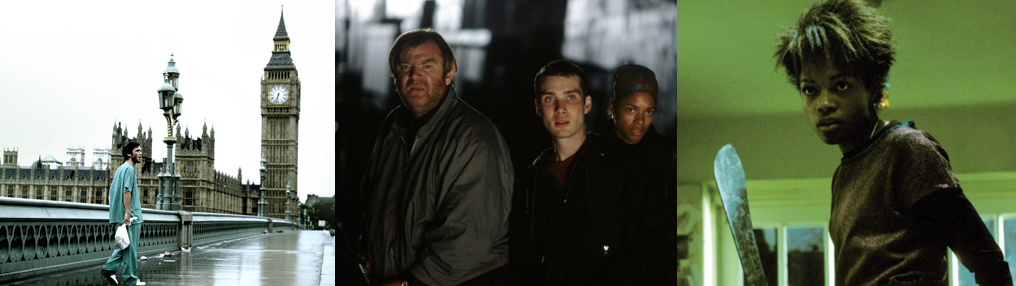
Jim wakes up to find London deserted and society in tatters from the infected.

Yet, despite the United Kingdom being a post-apocalyptic wasteland where bodies, abandoned cars, ransacked shops, and highly aggressive, zombie-like creatures lurk, Jim carries a glimmer of hope that not everything has gone to shit. This largely contrasts with Selena’s (Harris) perspective as she’s so hardened by the sudden destruction of everyday norms that she’s initially cold, pragmatic, and willing to hack apart her allies if there’s even a small chance of infection. Indeed, Mark (Noah Huntley) shares his harrowing escape from the infected, we never learn what Selena went through to go from chemist to cold-blooded survivor and are simply presented with a grim woman who refuses to let anyone slow her down or give in to hope. Despite her best efforts, Selena’s demeanour cools throughout not just Jim’s influence (regardless of her no-nonsense attitude, she fights to save him in the early going) but also spending time with Frank (Gleeson) and Hannah (Burns), a father/daughter duo who shelter them in their tower block flat and beg Jim and Selena to help them reach safe harbour at a military outpost. Moments of levity and normality are fleeting in 28 Days Later, but they flicker to life as the two stay, travel, and bond with Frank and Hannah, with Frank being a father figure to both and caring for Hannah’s welfare melting Selena’s ice-cold heart. The four make a good, fun surrogate family unit, bouncing ideas and opinions off each other and sticking together to gather resources and push through obstacles. While Jim advises against travelling through a tunnel, the four work together to replace a flat tyre and share some carefree moments. Jim’s so relieved to experience a brief flash of normality that he’s understandably horrified when he dreams of waking up alone once more, and noticeably hesitates when Frank is accidentally infected when they reach the military blockade.
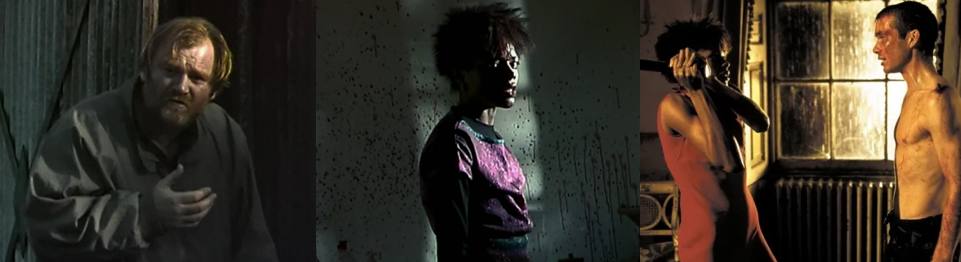
In a world where it’s kill or be killed and a battle for survival, the slither of hope remains.

While Selena initially believes that Frank and Hannah, despite being good people, will inevitably be a burden, she warms to them and, despite her hardened attitude, can’t help but care for and protect others. She easily could’ve left any of them at any time but chooses to stick around and even becomes attracted to Jim, even if she still has walls around her heart. Selena is thus heartbroken for Hannah’s loss, equally distraught at first seeing her grouchy but affable father turn into a mindless monster and then witnessing him being gunned down. Although Selena was sceptical of salvation or a cure, she’s as grateful as Jim is when Major Henry West (Eccleston) rescues them and takes them into his heavily fortified mansion and offers the protection of his renegade soldiers. Like Major West, there’s a sense that all Selena has seen is death and violence, meaning she’s largely numb to it. By contrast, Jim’s noticeably rattled by it all, especially when he’s forced to kill an infected boy (Justin Hackney). Even then, Jim simply reacts to what happens, whereas Selena is always prepared, carrying a backpack of supplies and wielding a machete. By comparison, Hannah isn’t a fighter and even her dad, despite his cool riot gear setup, is more about first hunkering down and then travelling to a safer place where others can do the fighting. While Major West and his soldiers are more than capable of defending their turf, setting up trip wires, landmines, floodlights, and being well armed, their intentions are far from noble. Faced with a squad close to breaking point, Major West ordered them to make preparations and set up a false radio broadcast to bring in women and thus hope for the future, though Sergeant Farrell (Stuart McQuarrie) refuses to participate in sexual slavery and believes his commanding officer has gone mad.
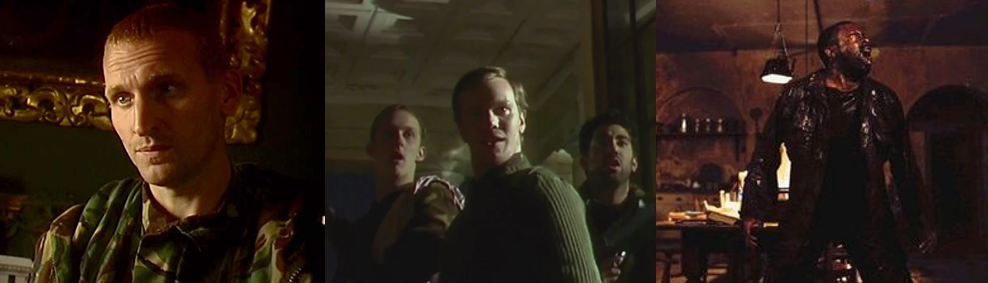
While Major West shines as a reprehensible madman, the soldiers drag the film down for me.

I’ve always felt like 28 Days Later loses its way once Major West and his soldiers appear. The bleak, desolate atmosphere so meticulously established is replaced with a bunch of assholes who just want to muck about and bully struggling chef Private Jones (Leo Bill). To be fair, even douchebags like Corporal Mitchell (Ricci Harnett) and Private Bedford (Ray Panthaki) are quick to defend against the incoming infected. However, even their resources (which, strangely, include piles of electronics) cannot last forever and the restless men soon turn their eyes towards Selena and Hannah. While Major West initially chastises them, preferring a softly-softly approach, he’s quick to reveal his true intentions to Jim, hoping to coerce him to their side, but shows no hesitation in ordering Jim and the rebellious Sergeant Farrell to be killed. Though Private Jones objects to Corporal Mitchell choosing to stab Farrell rather than just shoot him, the others can’t wait to get their hands on Selena and Hannah. Amusingly though, despite all their training and weapons and preparation, the soldiers are easily overwhelmed by Jim and a few infected, showing that they were all bluster and no balls. In a film full of questionable, if relatable, performances (with Megan Burns being the weakest), 28 Days Later is elevated by Christopher Eccleston’s enigmatic presence. Major West exudes authority and initially welcomes the three, offering a sympathetic ear to their plight. However, his charming demeanour falters as the men grow increasingly restless and is soon shown to be a stone-cold pragmatist who sees their current situation as nothing out of the ordinary and has no compunction about chaining up the infected Private Mailer (Marvin Campbell) or letting his men rape women. For Major West, this is what’s necessary to learn more about the infected and rebuild society, but even he and his soldiers barely represent the worst of humanity as some are reluctant to follow his orders. While this shows that human nature is just as implicitly ugly as the infected are explicitly hideous, I do feel the film loses a lot of momentum once it clutters the screen with largely interchangeable soldiers.

The Nitty-Gritty:
For me, 28 Days Later is at its best when it’s showcasing the bleak, empty streets of London and the deserted motorways of the United Kingdom. It’s startling to see the normally busy and bustling city a literal ghost town as Jim wanders through the remnants of a once thriving society. Today, in a post-COVID world, these scenes hit even harder, with Jim discovering numerous posters of lost loved ones and left confused and horrified at the idea of some virus wiping out or driving away the populace. Jim’s initial goal is simply to find people and find out what’s happened, but he must work through the stages of grief before accepting the new status quo, insisting on visiting his parents and struggling to fight the infected. Conversely, Selena attacks with a viciousness that rivals that of the infected and keeps others at arm’s length, whereas Jim is still hopeful that there’s a chance for humanity, especially after seeing Frank and Hannah’s love and a plane flying overhead. Thus, 28 Days Later isn’t just about “survival” but what it means to live, with even Selena finding something more beyond violence thanks to their surrogate family. Still, things are pretty damn hopeless for the UK here as the government’s been wiped out (no big loss, really) and cities are abandoned or in flames. It’s left intentionally vague how many escaped before the UK was locked down, and Mark’s harrowing story of the masses literally trampling over each other again strikes a nerve post-COVID, but there’s also the suggestion that the rest of world is perfectly fine, meaning there’s a vague hope for the future even if the UK has been quarantined. For those left behind, it’s an endless fight for survival and some meaning beyond just living another day, with Major West having high hopes for rebuilding society with his morally skewed soldiers.
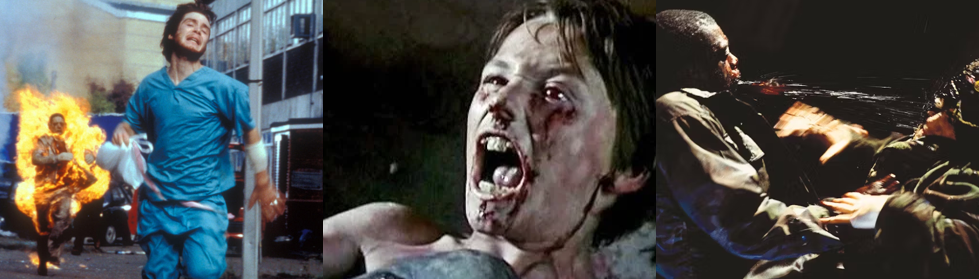
Those infected by Rage are voracious, aggressive, and far more capable than zombies ever were.

Of course, 28 Days Later isn’t a “zombie” film in the strictest sense but it’s clearly inspired by the genre and absolutely reinvigorated it, popularising fast and aggressive undead (or zombie-like creatures) that endure to this day. You know it’s not a typical zombie film right from the start, however, as 28 Days Later provides an explanation for its events with the vaguely defined Rage virus. This appears to be a man-made pathogen (though it can also be implied to have been inherent to the chimps) that drives the infected into a mindless, ravenous aggression where they attack and devour anyone on site. A bite or even a single drop of blood into a wound or orifice is enough for the Rage to near-instantly take hold, with Selena stating that you have between ten and twenty seconds to kill an infected before they fly into a wild rage, and there’s said to be no cure (largely because the chimps were released before the infection could be properly understood). The infected don’t seem to eat their victims, though they are driven by insatiable hunger and violently vomit blood and guts when starved. Major West is particularly curious about how long it takes the infected to starve and the film’s epilogue, which takes twenty-eight days after the initial twenty-eight days, indicates they need flesh to survive. The infected are extremely aggressive, exhibiting superhuman speed and strength and apparently having enhanced senses, particularly smell and hearing. If you see one, others soon swarm in a ravenous horde, crashing through windows and tearing through barricades in a desperate search for sustenance. Still, they’re easily killed (bullets, landmines, blades, baseball bats, and Molotov cocktails all work extremely well) and won’t return once killed, nor do they need their brains destroyed to be put down, but their sheer numbers and aggression make even one a formidable obstacle.
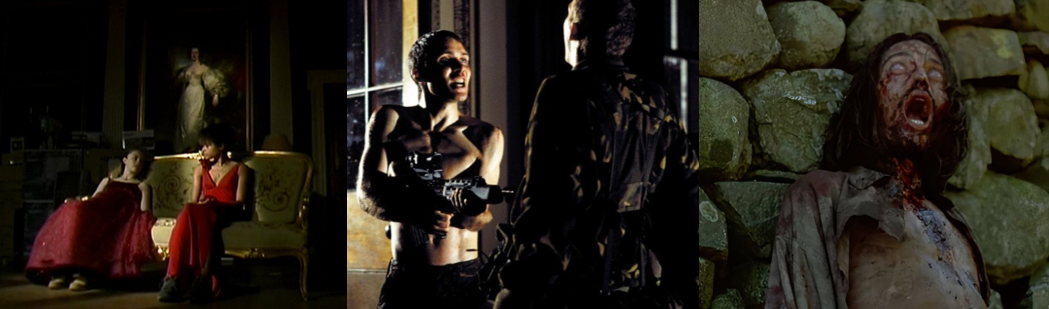
Jim fights back against the disreputable soldiers and miraculously survives a near death experience.

As pressing as the infected are as a threat, they are largely contained to cities and appear only sporadically. Like any good zombie (or zombie-adjacent) film, 28 Days Later is thus more concerned with the threat of human nature than its infected, with Major West and his soldiers posing more of a threat to Jim, Selena, and Hannah than the infected, whom they largely avoid on their road trip. The soldiers easily fend off the external threat but cannot deny their base instincts, relishing the thought of passing around Selena and Hannah and caring more about their sexual lusts than their dwindling numbers. Their overconfidence in their weapons is their greatest weakness as the untrained, scrawny Jim easily picks them off both by himself and by releasing the starving Private Mailer, who easily infects the soldiers and bring down their fort. Though Selena tries to spare Hannah the trauma of being raped by doping her on Valium, her feisty nature is quelled by the lustful Corporal Mitchell, leading Jim to leap to her defence and gouge the soldier’s eyes out in a rage. Selena’s so stunned by Jim’s animalistic behaviour that she almost mistakes him for an infected, yet she hesitates to kill him due to her feelings and is relieved to find he’s simply embraced his killer instinct to save them. As the three escape, however, Major West takes his revenge and shoots Jim, leading Hannah to feed him to his infected soldiers and Selena to desperately save Jim’s life at a nearby hospital. This is also where 28 Days Later falls apart a bit as the ending is so haphazard and nonsensical, with Jim miraculously surviving the gunshot and the three signalling a passing jet for aid. It’s clear that Jim was supposed to die, as in the alternative endings, and this slapdash “happy ending” just doesn’t gel well as a result. It would’ve been far easier to reshoot the scene with Major West to show him missing his shot than pretend like Selena could’ve ever saved Jim from a bullet to the gut.

The Summary:
It’s probably sacrilege to admit this but I’ve never been a fan of 28 Days Later. I find the film quite inconsistent and dull at times, the script is kind of all over the place with inconsistencies and obvious rewrites and changes, and the film loses so much momentum once Major West and his cronies show up. It’s a real shame as it starts so strongly, with Cillian Murphy wandering the eerily deserted streets of London and a palpable sense of dread and confusion presented through the visuals. Murphy does a good job as Jim, starting as a confused and somewhat useless leftover and eventually gaining a killer instinct that almost makes him indistinguishable from the infected. I enjoyed Selena’s no-nonsense portrayal as well, and that we never learn what made her so hardened to the post-apocalypse, and her character arc in learning there’s more to life than just surviving. I liked the surrogate family unit they built with Frank and Hannah, which was obviously doomed to end in tragedy but was far more appealing than having a bunch of dickhead soldiers eat up the screen time. Granted, Christopher Eccleston gave a captivating and chilling performance, standing out as the diamond in the rough, and Major West’s soldiers represented the worst of humanity, but I feel this angle stopped the film dead. There’s something here about the nature of humanity and the juxtaposition of an explicitly monstrous external threat being as dangerous as humanity’s base instincts, but I don’t think it was executed very well. I did like the depiction of the infected as ravenous, hyper aggressive, mindless animals and how quickly they spread the Rage virus. They’re not zombies at all and that’s made very clear, but they’re a significant threat and it’s still chilling seeing the United Kingdom left deserted and in shambles after just a few weeks of exposure. I absolutely consider 28 Days Later an influential film for many reasons and can see why so many like it and so many zombie purists abhorred it, especially back then, but I can’t say that it’s a favourite of mine or a film I’m inspired to watch much. It just feels too haphazard by the end, like there were too many ideas on the table and the simple, startling premise got muddled by rewrites and changes, making it an overall mediocre experience for me to this day.

My Rating:

Rating: 3 out of 5.

Pretty Good

Do you think I was too harsh on 28 Days Later? Were you a fan of the more aggressive and faster infected compared to slower zombies? What did you think to the bleak, empty city streets? Do you agree that the pacing and ending were a bit off? Which character was your favourite and did you like how the genre was changed by this film? What is your favourite zombie film and how are you celebrating the Day of the Dead today? Whatever your thoughts on 28 Days Later, and zombie films in general, feel free to leave a comment below, check out my other zombie content, and donate to my Ko-Fi for more.

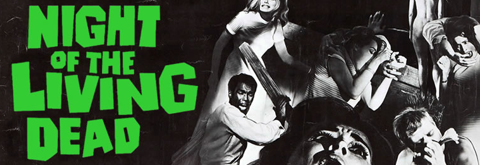
Movie Night [Day of the Dead]: Night of the Living Dead (1968)


The Day of the Dead (or Dia de los Muertos) is a traditional Latin American holiday on which, every November 1st, the lives of deceased loved ones are celebrated with food, drink, parties, and a great deal of masquerade involving the calacas and calaveras (skeletons and skulls). For me, this seems like the perfect excuse to look back on the long-running and ever-changing zombie genre that was largely popularised by director George A. Romero, which I devoted a great deal of my PhD thesis towards and which has often been used as a parallel to various aspects of society and culture.  


Released: 1 October 1968
Director: George A. Romero
Distributor: Continental Distributing
Budget: $114,000 to 125,000
Stars: Duane Jones, Judith O’Dea, Karl Hardman, Marilyn Eastman, and Kyra Schon

The Plot:
When the recently deceased suddenly return to life, traumatised Barbra (O’Dea) takes shelter in a farmhouse alongside pragmatic Ben (Jones) and antagonistic Harry Cooper (Hardman). With tensions rising and the walking dead closing in, the group struggles to survive, co-exist, and make sense of this strange phenomenon.

The Background:
Ever since the 1930s, zombies have appeared in movies in one form or another, either as mindless slaves, voracious cannibals, or in their most famous form: the shambling undead. After growing bored with directing television commercials, George A. Romero and his friends, John Russo and Russell Steiner, decided to capitalise on growing trends for more bizarre content and produce a horror movie. Initially conceived of as a horror comedy about adolescent aliens, it was Russo who decided the creatures being flesh-eating reanimated corpses, which Romero infused with heavy inspiration from the macabre revolutionary themes of I Am Legend (Matheson, 1954) and its first screen adaptation, The Last Man on Earth (Salkow and Ragona, 1964). Although the role of Ben was written as a Caucasian, Duane Jones impressed Romero in his audition and the script was revised based on his input; his casting and portrayal inspired numerous racial readings and made the film surprisingly progressive for the time. The low-budget impacted the options available to the filmmakers; chocolate syrup, entrails from butcher shops, and simple make-up effects brought the gore and ghouls to gruesome life and, while simplistic by today’s standards, proved shocking and outrageous at the time. Despite the controversy it caused, Night of the Living Dead was a massive hit with its box office gross of over $30 million; although critics dismissed it at the time, Night of the Living Dead has since been regarded as a horror classic, one of the best of its era, and it was preserved in the National Film Registry in 1999. The film was not only followed by subsequent sequels (both official and unofficial) and (thanks to an agreement between Romero and Russo) a similarly-named adjacent series) that expanded and refined the zombie concept, but heavily influenced the portrayal of zombies for decades. Remade in 1990 to recoup some profit after legal issues saw the original become public domain, Night of the Living Dead is also the most remade film in history.

The Review:
When I decided to spend a year of my PhD discussing the original Resident Evil movies (Various, 2002 to 2016), I found myself deeply entrenched in the rich and lengthy lore of zombie cinema, tracking their origins as voodoo slaves in White Zombie (Halperin, 1932), their vampire-like depiction in I Am Legend and the first of its many adaptations, The Last Man on Earth, and, of course, charting the history of Romero’s genre-defining depiction of the living dead. I found that zombies are one of the most enduring horror creatures not just in cinema, but in mainstream media; they’ve been as persistent as they appear in movies, changing from shambling ghouls to rage-filled savages, and continue to be popular inclusions in horror media thanks to how versatile they are. Honestly, though, this kind of research and in-depth exposure to zombie cinema kind of ruined my appreciation for zombie movies; many are low-budget, derivative affairs or simply repeat the same lessons established by Romero decades ago, meaning it can be hard to find quality zombie movies. Although well renowned as the grandfather of this sub-genre of horror, Romero’s first effort in bringing zombies to un-life is fraught with issues, ranging from the obvious low budget and stilted performances to inconsistences in the portrayal and behaviour of the titular living dead as these aspects wouldn’t be refined until the far more visually and philosophically interesting (but, blasphemously, still quite tedious, in my opinion) sequel. I also feel compelled to specify here that I’m looking at the black and white original rather than the many different re-releases or the bastardised colour version, simply to give my thoughts on Romero’s original vision as depicted so controversially decades ago.

Unlike Ben, who takes charge as a resourceful leader, Barbra is little more than a traumatised mouse.

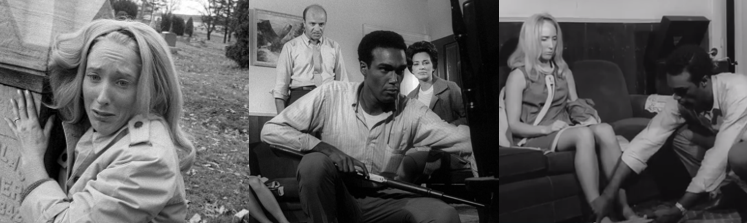
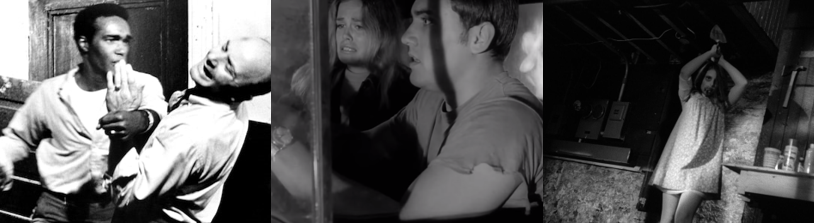
We open with Barbra and her brother, Johnny (Russell Streiner), reaching the end of a regular 200-mile round trip to place a wreath on their father’s grave at the behest of their mother. Johnny, exasperated at regularly having to waste his days commemorating a man he barely even remembers, just wants to get back home and stop throwing away good money for sentiment. While Barbra is happy to make the trip and thinks fondly of her father, Johnny has no time for lingering and amuses himself by teasing Barbra since she’s still scared by cemeteries. Indeed, Barbra’s previous resolve in chastising Johnny’s attitude falters when he starts bullying her, but they’re both horrified when a strange, shambling man (Bill Hinzman) suddenly attacks them. Although Johnny bravely (if awkwardly) tries to fight the man off, he ends up bashed into a gravestone, leaving Barbra fleeing in terror. After…somehow…crashing her car, Barbra is forced to take refuge in a nearby farmhouse; though she arms herself with a knife, she’s unable to call for help due to mysterious interference on the line but, luckily, Ben shows up and immediately takes charge. If you’re hoping for a strong, capable female lead then you’re out of luck, Barbra is so crippled by fear that’s practically catatonic, sleepwalking through the rest of the film and completely giving into despair while Ben is forthright and bravely tackles the ghouls with a tyre iron. Although he’s just as scared as her, his thoughts are on practical matters such as food, lights, and arming himself with a rifle; Barbra’s distressed state aggravates him, but he keeps his cool and puts her to work helping to secure the house against further attacks to await rescue. Eloquent, intelligent, and charismatic, Ben hides his fear and confusion behind productive tasks and narrating his observations and the horrors he’s seen aloud, something he’s forced to do since Barbra too shocked to be much conversation. When Barbra descends into hysteria, so desperate to save Johnny that she almost runs out into further danger, Ben’s forced to physically subdue her to keep her calm, allowing him to finish fortifying the house and glean insight into the crisis from a radio broadcast.

Tensions rise between the survivors, who are faced with a clash of ego and the undead.

Considering it takes Ben some time (presumably a couple of hours) to finish fortifying the house, it comes as a surprise to both them and the audience when other survivors emerge from the cellar. Naturally, Ben is incensed to learn that Harry, his wife and daughter, Helen (Eastman) and Karen (Schon), and lovers Tom (Keith Wayne) and Judy (Judith Ridley), chose to hide rather than investigate the screaming and commotion. Ben’s natural instinct is to help people, no matter the danger, whereas Harry reasoned it wasn’t worth risking their lives and their safety helping others. Having witnessed the strength and tenacity of the ghouls, Harry is adamant that they’re all safer in the cellar, regardless of the fortifications, and both make valid arguments since the cellar allows them to better fend off attacks, but the house gives them a fighting chance and more escape routes. Tom does his best to play peacekeeper, but Harry stubbornly refuses to listen to reason, primarily due to fear, his shame at feeling said fear, and a deep-seated need to protect his family. Although the ghouls briefly breaking through the windows seems to prove Harry’s point, he’s aggrieved when Ben refuses to share any of the upstairs food or resources; it seems Harry wants it both ways, but Ben firmly draws a line and delivers a stern ultimatum: “You can be the boss down there. I’m boss up here”, enraging the overprotective and stubborn father. Taking his chances upstairs, Tom has the anxious and caring Judy join them while Harry barricades himself and his family downstairs out of a pig-headed fixation on being “right”. Weary of his bullish ways, Helen echoes Ben’s remarks about Harry’s shortsightedness, which cuts them and their sick daughter off from information and potential rescue. Like Tom, she emphasises co-operation and compromise, allowing them to trade places with Judy to learn more about the crisis, though he continues to rile Ben up with his antagonistic and cynical attitude. Helen is encouraged by news of rescue centres nearby and Ben devises a plan to hold off the ghouls with flaming torches so they can refuel his truck and get medical help for Karen, but the plan goes horribly awry, resulting in Tom and Judy’s fiery deaths, and Ben unloads his rage onto Harry when he refuses to let him back into the house, leading to the two tussling for the rifle.

Night established and popularised many of the characteristics of zombie media.

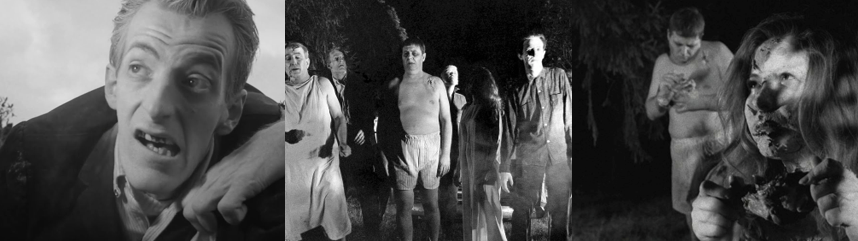
In their first appearance, Romero’s living dead are noticeably different to what we’d see in his sequels and subsequent zombie media. The first thing to note, of course, is that the living dead are never referred to as “zombies”; this term would be as fastidiously avoided and mocked as Romero’s opinions on running zombie variants, meaning the living dead have more in common with Matheson’s interpretation of vampires than the brain-devouring zombie of mainstream imagination. Consequently, the living dead are referred to as anything but zombies; described as “ghouls”, “things”, “them”, and “assassins”, the living dead are also noticeably less gruesome than in later movies, potentially because the zombie outbreak is so recent and the undead so freshly turned. Similarly, Romero avoids explaining the sudden return of the living dead; a news report speculates radiation from an exploding space probe, but divine will is also implied (Johnny mocks Barbra’s prayer and admits to no longer attending church, and is the first to die). The zombie outbreak is treated as a sudden and confusing attack, almost like an epidemic; at first, characters ignore or mock the signs but they’re soon relying on radio broadcasts for scant information and how to combat the voracious ghouls. Night of the Living Dead establishes the basic rules of the undead: for whatever reason, the recently-deceased return in a near-mindless state, driven only by the need to consume human flesh. Rather than infecting people, their bites simply expedite the deaths of their victims; because of radiation from the Venus prove, anyone who dies will then reanimate with a taste for murder and cannibalism. Though slow and shambling and driven back by fire, the ghouls are incredibly persistent and dangerous in large groups; they can only be permanently put down with a blow to the head, destroying their brain, or removing the head entirely, and people are encouraged to forgo proper funeral procedures and immolate the corpses as soon as possible. Unlike most iterations of zombies, however, the ghouls are decidedly less monstrous here; many are more like entranced slaves or crazed maniacs, meaning they can use tools or rocks where brute strength fails and young Karen even uses a trowel to stab her mother to death rather than going for the jugular as you might expect.

The Nitty-Gritty:
There’s a certain classic charm to revisiting the old black and white horrors of yesteryear; everything has a distinctly old-timey and almost gothic atmosphere, which is only extenuated by the greyscale visuals. Yes, it does make some of the night-time action difficult to make out and it’s not for everyone, but I always appreciate this era of cinema as it evokes feelings of nostalgia and appreciation for these filmmakers, who did the best they could on a limited budget and with the technology of the time and, in many cases, pioneered filmmaking effects that we still see in cinema to this day. Even in this first tentative outing for the living dead, Romero positions the ghouls as social commentary; their mindless, savage, almost primal nature explicitly reflects the dichotomy between the survivors, particularly Ben and Harry, who constantly butt heads. There’s a startling message related to this through the simple depiction of the ghouls co-existing and even working together, despite being incapable of communication, to problem solve and better devour their prey; in contrast, the survivors are equally unable to communicate due to fear, tension, and ego and absolutely incapable of working together for these same reasons. It’s these emotional responses that see other survivors uniting against their monstrous foes as a paranoid, trigger-happy mob that’s as inhuman as the ghouls they target, creating a thematic parallel that begs the question who the real monsters are, us or “them”? Naturally, you can read into this even further thanks to Ben being a Black man; though the most level-headed and practical, he’s met with suspicion (even from Barbra, initially) and hostility, which opens itself up to racial prejudice due to his skin colour and Harry’s overly aggressive demeanour, and the ghouls are also framed as being this unknowable threat not unlike  foreign invader that “normal” folk struggle to understand and fight back against with extreme prejudice.

Despite surviving the horrifying night, Ben is callously shot dead as humanity blindly fights back.

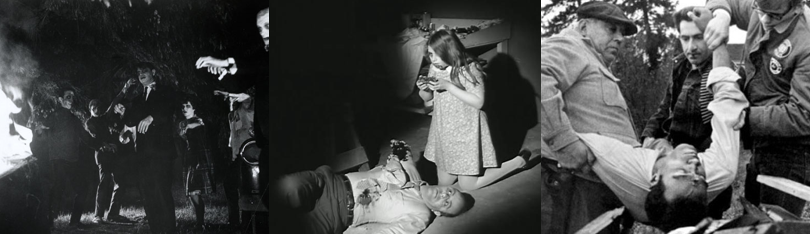
Although Johnny’s death is disappointingly lame and bloodless, the suddenness and brutality of is where the true horror lies; still, Night of the Living Dead contains a fair amount of gore, including a partially mangled (presumably eaten) corpse in the farmhouse, some rudimentary decomposition effects, a surprising amount of flaming bodes, and sickening scenes of ghouls feasting on Tom and Judy’s entrails and chargrilled flesh. Still, Night of the Living Dead focuses more on tension and both internal and external threats. Although Harry covers their exit with Molotov cocktails, he takes advantage of the situation to claim dominion over the entire house. Unsurprisingly, given they’ve been measuring dicks the entire time, Ben fights him for control of the only gun, resulting in Harry being fatally shot due to his hubris. Having succumbed to her injuries, Karen reanimates and feasts on her father’s body before stabbing her mother to death. As she and the other ghouls close in, Barbra finally snaps out of her stupor, only to be dragged into the writhing masses by Johnny, and this irony is quickly followed by Ben, the sole survivor, being forced to take refuge in the cellar when his barricades fail. After putting down the reanimated Harry (which seems as much out of spite as it for survival) and Helen, Ben waits it out and survives the night; since the ghouls go down pretty easily when you have the right weapons, the danger seems to be mostly contained by the authorities and gun-toting locals, who pick the living dead off with ease. When they come to dispatch the ghouls near the farmhouse, Ben emerges from the cellar, attracted to the gunfire, but his caution proves his undoing; since he’s skulking around in the darkness, he’s mistaken for a ghoul and promptly executed on the spot. As the credits play, his body (and those of all the characters, ghouls and human alike) is dispassionately dumped onto a bonfire and burned in one of the bleakest endings in all of horror cinema.

The Summary:
There’s a reason Night of the Living Dead is considered a horror classic and the forefather of zombie media. A low-budget affair that made the most of its resources, the film is a bleak mediation on humanity; simple ideas such as co-operating, coming together in a crisis, and working together to overcome an aggressive foe are present and resonate even to this day, where we’re more likely to turn against each other than set aside our differences. Although not as explicit as in his later movies, the ghouls are clearly utilised as an allegory for these matters, and various others; the fear and inevitability of death, the danger of the unknown, the savage nature of man are all valid readings of Night of the Living Dead.  It’s also incredibly progressive in terms of Black representation; Ben is a keen, intelligent, and proactive survivor haunted by what he’s seen but determined to help others and make a fighting stand until rescue comes. While he can be as abrasive as Harry, his stubborn demeanour comes from a place of logic and reason and he’s constantly trying to increase their chances of survival, only to be met with pig-headed resistance. Harry might be an asshole, but you can see where he’s coming from; he’s scared and wants to protect his family, even if it means sacrificing others. Sadly, Helen (and women in general) don’t fare quite as well; portrayed as meek and generally useless, women just kind of get in the way or are oppressed and bossed about rather than contributing anything meaningful, though this does allow discussions about gender equality and machismo. Night of the Living Dead also established many of the “rules” for zombie cinema; although its ghouls aren’t as monstrous as later zombies and are more like entranced slaves, there’s a mystery and a danger to them when they gather in large numbers against vulnerable victims. However, it’s true that the film hasn’t aged very well; the performances and some themes are questionable, and there have been better zombie movies made since (by Romero himself, no less) that both overshadow this one and expose its flaws, though it remains recommended viewing for any fans of the genre, for sure,

My Rating:

Rating: 3 out of 5.

Pretty Good

Do you consider Night of the Living Dead a classic of the genre? Were you surprised to see a Black man take such a proactive role? What did you think to the tension and rivalry between Ben and Harry? How did you interpret the ghouls and what did you think to their characterisation here? What do you think caused the zombie outbreak and how do you think you would react in such a scenario? What is your favourite zombie film and what do you think of the genre in general? How are you celebrating the Day of the Dead today? Whatever your thoughts on Night of the Living Dead, and zombie films in general, feel free to leave a comment below or leave your thoughts on my social media, and check out my other zombie content across the site.

Game Corner [Day of the Dead]: The House of the Dead: Remake (Xbox Series X)


The Day of the Dead (or Dia de los Muertos) is a traditional Latin American holiday on which, every November 1st, the lives of deceased loved ones are celebrated with food, drink, parties, and a great deal of masquerade involving the calacas and calaveras (skeletons and skulls). For me, this seems like the perfect excuse to look back on the long-running and ever-changing zombie genre that was largely popularised by director George A. Romero, which I devoted a great deal of my PhD thesis towards and which has often been used as a parallel to various aspects of society and culture.  


Released: 27 April 2022
Originally Released: 13 September 1996
Developer: MegaPixel Studio S.A.
Original Developer: SEGA AM1
Also Available For: Google Stadia, Nintendo Switch, PlayStation 4, Xbox Series S, Xbox One (Remake); Arcade, PC, and SEGA Saturn (Original Release)

The Background:
The influence of renowned horror writer and director George A. Romero cannot be understated; not only did he forever change the concept of zombies from their origins as voodoo slaves to the shambling undead we know and love today, but his zombie movies had a profound influence on videogames. The Resident Evil franchise (Various, 1996 to present) was directly inspired by (and constantly paid homage to) Romero’s films, and his influence can be equally felt in the popular light-gun title The House of the Dead. Originally built using the same game engine as Virtua Cop (SEGA AM2, 1994), The House of the Dead was put together over the course of a year and three months by a team that couldn’t speak a word of English. Initially, the developers wanted to include more complex branching paths, but these ideas had to be dropped due to time constraints; to save time, the enemy designs skipped the rough sketch phase and went straight from the initial idea to the design drawing stage, though the developers were able to anticipate the game’s violence would need to be toned down overseas and so included the option to change the blood colour. The initial arcade version of the game was a critical and commercial hit and the SEGA Saturn port was generally well regarded in turn, thus kick-starting a pretty successful series of follow-ups despite two widely derided live-action adaptations. In April 2021, a remake of the original game was announced for the current generation of consoles that included updated visuals and controls, a new “Horde Mode” that increases the number of onscreen enemies, and other additional features. While the Nintendo Switch version received mixed reviews, critical feedback for the Xbox One/Series version of the game was largely positive, with reviews praising the horror presentation and nostalgia offered by the title despite the lack of a physical light-gun accessory.

The Plot:
After renowned biochemist and geneticist Doctor Curien becomes obsessed with discovering the nature of life and death, his experiments at the Curien Mansion take a gruesome turn. After government agent Thomas Rogan receives a distress call from his fiancée, Sophie Richards, from the Curien Mansion, he and his partner, “G”, fly out to investigate only to find the mansion overrun with Curien’s undead creatures!

Gameplay:
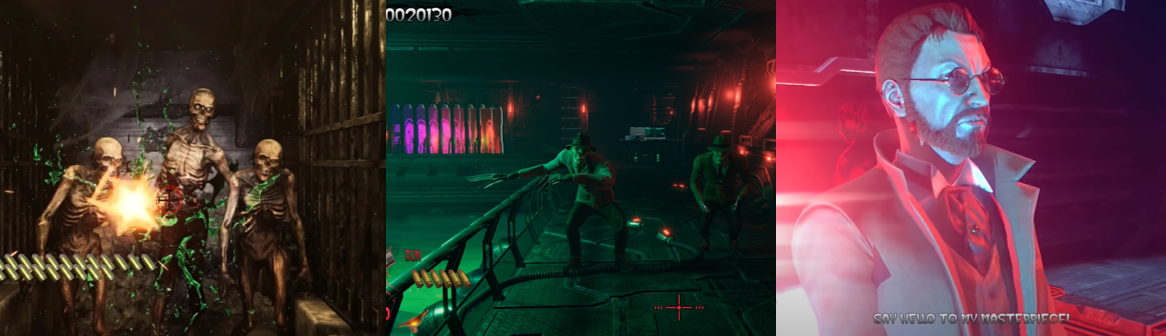
The House of the Dead: Remake is a first-person rail shooter in which players step into the role of two government agents, Thomas Rogan and “G”, and blast their way through hoards of zombies and other demonic creatures across four chapters. While you never have to worry about moving your character, as you traverse a set path at all times with few deviations, you can direct an aiming reticule using the left stick and automatically centre it with the X button. Otherwise, though, your controls are nice and simple: The Right Trigger and A button lets you fire, the Left Trigger and B button lets you reload, Y activates a torch (or “flashlight” for your Americans), and that’s basically it. You can go into the options and set up an auto reload function (though I find manually reloading is far more intuitive) as well as set a variety of other gameplay and aesthetic effects (such as changing the colour of your reticule and the level of aiming assistance you receive). You can also switch between your different weapons using left and right on the directional pad, though you’ll have to go to some effort to actually unlock additional weapons to use; they’re found in weapon crates scattered throughout each chapter, but these are only accessible by saving scientists from zombies and other life-threatening situations, which can be easier said that done when you have a trigger finger as itchy as mine gets in games such as this.

Mow down hoards of the undead but be careful not to kill any innocent scientists!

The game comes with two playable modes: “Original” and “Hoard”, with each one sporting four difficulty levels, the option to switch to a “Classic” and “Modern” scoring system, and allowing solo, co-operative play, or competitive play. The main different between original and Hoard is that there are loads more enemies in Hoard mode, making for a much more frenetic and action-packed experience. While the different difficulty levels make enemies tougher and more resilient, the “Arcade” option imposes health and credit limits; in this mode, you still get three health bars (represented as these glowing jugs) but each hit fully depletes one of them rather than dealing half damage as on the easier difficulties and, when you lose a life, you have a limited number of credits available to continue playing. You can use your points to buy more credits, but these cost about 5000 points a piece so you can easily run out in a playthrough, but the “modern” scoring system earns you extra points for successive kills without missing or being hit. Some enemies can block your shots with their arms or weapons, meaning you either need to time your shot to hit their weak spot or blast away their weapon or limbs to take them out but, while you can shoot their heads off, some will continue to attack regardless. All of them lumber towards you until you put them down but will slash and bite at you up close, and they even throw projectiles, barrels, and bladed weapons from a distance and have a tendency to pop out of nowhere so you need to be quick on the trigger, but not so quick that you shoot the scientists and cost yourself some health and points. At times, levels will split into multiple paths, but it’s not always clear how you take these routes; sometimes you need to shoot a button or blast away a door, debris, or trap door, but other times you need to shoot specific enemies, save certain scientists, or even let yourself get hit to drop down to a new area, which encourages experimentation and multiple playthroughs.

Graphics and Sound:  
Rail shooters don’t tend to be the most graphically intense games, in my experience; generally, the action is far too fast and frenetic to worry about the presentation as you’re constantly on the move and being swung about the place by the auto movement, but The House of the Dead: Remake looks and sounds really, really good. There’s a fantastic B-movie-level menace to everything, from the mansion’s grounds to the gothic interior, the rancid sewers, and Dr. Curien’s high-tech laboratory. The exteriors are bathed in a red glow or the darkness of night, while the interior as full of little touches, from suits or armour to wrecked paintings, and decorations that you can destroy at will. As you explore, you can blast crates and barrels to find the odd health pick-up or score bonus, but you’ll also activate new paths in the same manner, calling elevators, dropping through trap doors, and wading through water depending on your actions, which will then lead you to disgusting sewers, narrow corridors, billiard rooms, and stone hallways not unlike a medieval castle.

Blast your way through a gothic mansion and high-tech lab all while the fantastically cheesy plot unfolds.

Eventually, you’ll reach Dr. Curien’s laboratory, where blast doors block your path and require key cards to open, high-tech computers and monitors are everywhere, and tougher enemies are stored in glass tanks or scrambling about on the ceiling. Enemies can also come crashing through doors and windows, pop out from electrical barriers, and will blast into chunks when you shoot them, losing limbs and heads and having their skeleton and guts exposed as they take damage. The music is all very suitable for the action and the aesthetic, being an adrenaline-pumping mixture of rock and synth, and the satisfaction gained from hearing zombies groan in pain as you put them down or hearing your bullets clang against metal or tear apart a false door or chandelier is pretty fulfilling. The voice acting is hilariously bad, of course, but that’s all part of the charm of the game’s B-movie presentation; both Rogan and “G” have different dialogue and grunts as you play, which is a nice touch, and the line delivery is suitably over the top to immerse you in the atmosphere (there’s even some typos in the subtitles which, intentional or not, I found amusing).  

Enemies and Bosses:
Dr. Curien’s mansion has primarily been overrun by zombies; these shambling, bloody ghouls will stumble towards you, throw knives or axes from a distance, or pop up right in your face to scratch and bite at you, but they can be blasted apart and put down into a rapidly bubbling pool of viscera pretty quickly. Bats, weird winged dogs, vicious worms, spiders, and even mutated monkeys are all commonplace enemies too, but it’s the various zombie variants who’ll give you the most trouble. Larger, more rotund zombies will throw barrels at you or charge at you with a chainsaw in hand, slimy decomposing corpses pop out of the sewers or drop from above, suited zombies scamper about with knives, and hulking brutes wield massive sledgehammers or balls on chains that you need to shoot out of the air. Similarly, the Borg-like cybernetic zombies fire claw projectiles at your face, a pale variant attacks with a laser knife, and you’ll even encounter bigger zombies covered in iron armour that can resist your bullets.

Dr. Curien’s most monstrous creations await you at the end of each chapter.

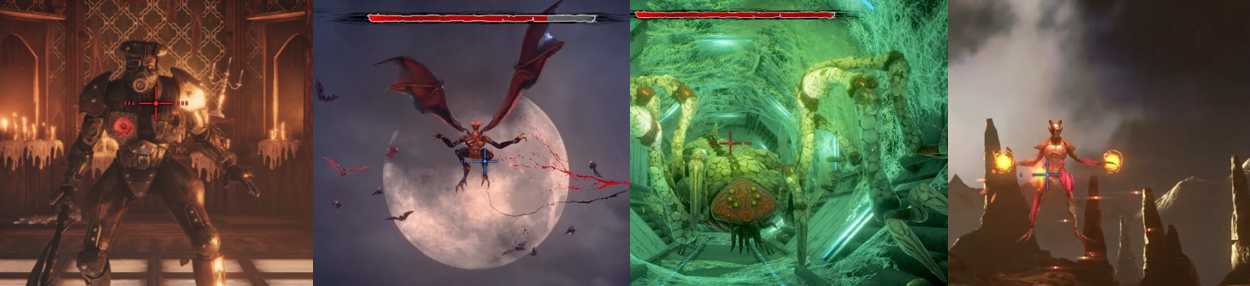
Each chapter ends in a battle against one of Dr. Curien’s more powerful creations, with two of these returning as sub-bosses in the final chapter. The first you’ll battle is Type-27 (or “Chariot”), a large, rotting humanoid garbed in heavy armour and swinging a bardiche. Chariot relentlessly shuffles towards you, looking to maim you with his weapon, but can be forced back by shooting at the weak spot on his breastplate. After enough hits, he’ll burst free of his armour and you can start blasting his decomposing flesh to put him down for good but he can also defend against your shots by covering up with his armour and limbs. Type-041 (or “The Hanged Man”) is much trickier to defeat; this bat-like creature hovers above the rooftops sending bats to attack you, which you must shoot out of the sky and then desperately try and get a good shot at the weak point on his chest as he darts about the night sky and closes in on you for a close range attack. This fight goes on a bit as, when weakened, the Hanged Man will fly away and then force you to a different section of the rooftop, where he repeatedly dives at you to attack, which also leaves him wide open for your shots. Type 6803 (“Hermit”) is a far easier fight; this giant spider-like creature climbs towards you up a cobwebbed tunnel and you must shoot it in the face to force it back. When you follow it, it backs up and fires projectiles from its egg sack and then protects its head as it scurries towards you, but it’s pretty simple to blast it in the face once its exposed. Finally, after dispatching Chariot and the Hanged Man once more, you’ll face Dr. Curien’s greatest creation: Type-0, AKA “Magician”. This synthetic humanoid floats around the arena, quickly darting all over the place and making itself a difficult target, while tossing flaming projectiles at you that can be difficult to shoot down. Covered in an armoured hide, its only weak spots are the exposed flesh dotted around its body, mainly on the legs, and it can summon a rain of projectiles that you need to shoot down and also zoom up close to land a swiping attack, making it easily the toughest boss in the game simply because just landing a hit can be difficult due to its speed and small weak point.

Power-Ups and Bonuses:
As you play through the game’s four chapters, you’ll find scientists being chased, threatened, or otherwise endangered by Dr. Curien’s creatures. Saving them nets you a score bonus and eventually leads to you unlocking new weapons, but they will also often gift you some health, which can either replenish or increase your health, so it’s worth taking the time to save them. Shooting crates and barrels may also reveal health power-ups and other objects, like coins and golden frogs, which add to your score tally. Sadly, the only way to actually access new weapons is to save as many scientists as you can, which will unlock the weapon crates found in each chapter and gift you far better weapons, such as the assault rifle and grenade launcher, as well as a crossbow and the pitter.

Additional Features:
There are forty-one Achievements to earn here, with five being earned simply by beating the game on any difficulty setting. There are three endings to earn as well, with four Achievements tied to them, and these are gained by finishing the game with a certain number of points rather than on different difficulty settings. There is an Achievement for beating the game’s “Arcade” mode, but not the “Hoard” mode, and others for playing with a friend, killing a certain number of enemies, rescuing and killing scientists, and unlocking every weapon. In addition to “busy work” Achievements (like finding every alternative path or picking up every item you see in one playthrough), there are some more obscure and inventive ones, such as blasting enemies over a wall or juggling a zombie with your assault rifle. As you play through the game and encounter enemies, they’ll be added to the creature gallery, which allows you to view their character models, bio, and weak spots. After beating the game for the first time, you can replay any chapter at will (meaning you can just jump to chapter four to beat “Arcade” mode for an easy Achievement), and you can also play alongside a friend, register your high score on the leaderboard, and even input cheat codes on the main menu to unlock infinite ammo, all weapons, one-hit kills, a free-play option and, eventually, invincibility but, while you’ll still be able to get Achievements with these cheats activated, they’ll only take effect once you’ve earned a certain number of Achievements.

The Summary:
The House of the Dead: Remake is a fun, frantic, blood-soaked shoot-‘em-up that’s packed full of gore, action, and fun gameplay. I really enjoyed the presentation, the call-backs to B-movies and zombie classics, and the fast-paced shooting that had me mowing down zombies without a second’s thought and desperately trying not to hit any innocent scientists. Sadly, though, the game is very short; “Hoard” mode really doesn’t add all that much except a whole bunch of additional enemies to fill full of holes and, while it’s fun discovering new paths and burning through the game in repeated playthroughs trying to save everyone you find, it’s not always clear which route you need to take or when these are even available to you. The content is also lacking a bit; it would’ve been nice to have Achievements specifically tied to “Hoard” mode or to have the option to play the original arcade release, or to have included the other arcade titles in with the package as it’s not exactly a lengthy or deeply complex game. Overall, it’s a great way to spend a few hours of your time but the novelty soon wears off; I used to have The House of the Dead: Overkill – Extended Cut (Headstrong Games, 2011) on the PlayStation 3 and I think I remember that having a lot more going for it in terms of length, variety, and unlockable content but if you’re itching for a bit of simple, arcade, zombie-blasting action then The House of the Dead: Remake has you more than covered.

My Rating:

Rating: 3 out of 5.

Pretty Good

Did you enjoy The House of the Dead: Remake? How do you think it compares to the original game, or other titles in the franchise? Did you ever discover al the different paths and save all those scientists? What did you think to the variety and gameplay options, and did you think there was anything lacking in the game? Which of the bosses was your favourite and what did you think to the B-movie presentation of the game? What is your favourite House of the Dead game, or other zombie videogame? How are you celebrating the Day of the Dead today? Whatever your thoughts on The House of the Dead: Remake, and zombies in general, feel free to either sign up and leave a comment below or leave your thoughts on my social media.

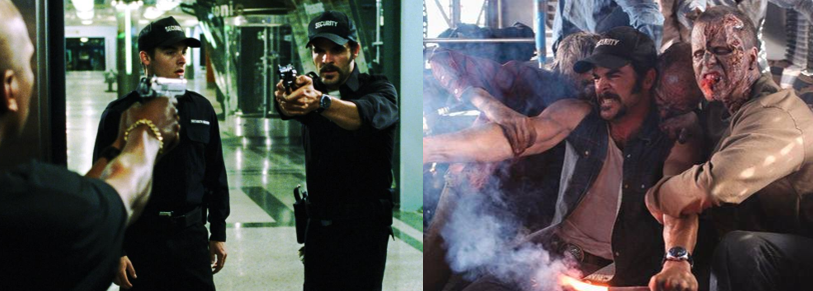
Movie Night [Day of the Dead]: Dawn of the Dead (2004): The Director’s Cut


The Day of the Dead (or Dia de los Muertos) is a traditional Latin American holiday on which, every November 1st, the lives of deceased loved ones are celebrated with food, drink, parties, and a great deal of masquerade involving the calacas and calaveras (skeletons and skulls). For me, this seems like the perfect excuse to look back on the long-running and ever-changing zombie genre that was largely popularised by director George A. Romero, which I devoted a great deal of my PhD thesis towards and which has often been used as a parallel to various aspects of society and culture.  


Released: 25 October 2004
Originally Released: 19 March 2004
Director:
Zack Snyder
Distributor:
Universal Pictures
Budget:
$26 million
Stars:
Sarah Polley, Jake Weber, Ving Rhames, Mekhi Phifer, Ty Burrell, Lindy Booth, and Michael Kelly

The Plot:
When the world inexplicably descends into chaos and bloodshed following a sudden zombie outbreak, a handful of survivors are driven into the local shopping mall.

The Background:
Ever since White Zombie (Halperin, 1932), zombies have long been a staple of horror cinema but their status as reanimated corpses who incessantly feed on the flesh of the living was popularised by director George A. Romero (despite Romero’s films avoiding the term “zombie”) in Night of the Living Dead (Romero, 1968). Not only did Night of the Living Dead inspire a vast sub-genre of horror works, the first of its five sequels, Dawn of the Dead (ibid, 1978), is largely considered one of the best and most influential zombie films of all time. Plans for a remake of Romero’s classic allegory for consumerism began with producer Eric Newman, who acquired the rights to the film and aimed to reimagine it for a younger, modern audience. The remake was written by James Gunn and marked Zack Snyder’s directorial debut, and separated itself from the original by increasing the speed and ferocity of its flesh-eating ghouls. While many often decry remakes, many of the most popular and iconic films are remakes and Dawn of the Dead proved to be a commercial success by grossing over $100 million at the box office. Though some regarded the film unfavourably upon release, an extended director’s cut was released on DVD later that same year and the remake earned some notable cult success and is often regarded as being just as good as the original.

The Review:
Like any good, self-respecting zombie film, Dawn of the Dead offers the merest glimpse of life before the outbreak before everything mysteriously and hideously goes to hell. Ana Clark (Polley) is an underappreciated and overworked nurse who, fatigued by her long hours, is more concerned with going home to her husband, Louis (Louis Ferreira), and her nice, normal suburban life than worrying about bite victims being admitted to the intensive care unit and emergency news bulletins.

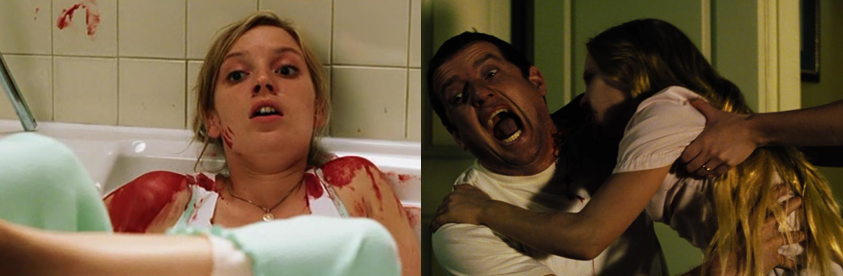
Ana wakes up to find her normal, everyday suburban life has descended into violence and chaos.

As a result, when she awakens the next day, Ana is horrified to find that a local neighbourhood girl, Vivian (Hannah Lochner) has become a rabid, animalistic cannibal; she viciously attacks Louis, taking a chunk out of his neck and, though Ana tries to stop the geyser of blood, she’s unable to get through to the hospital and Louis chokes to death on his own blood…only to immediately return to life and attack her! Distraught and running on pure adrenaline, Ana is able to scramble her way out of the house…only to find her peaceful little neighbourhood has descended into violence and anarchy; fires rage all over the area, car crashes, explosions, and wrecks are everywhere, and the equally desperate and terrified victims of these animalistic zombies pose just as much of a threat as the undead.

Rhames delivers a solid performance as the surprisingly complex Kenneth.

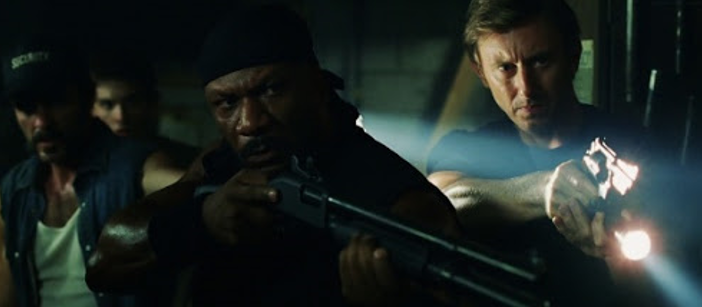
Stunned by a car crash and overwhelmed by shock and fear, Ana is little more than a zombie herself when she comes across the shotgun-toting Kenneth Hall (Rhames); a big, sombre man who is just looking to reunite with his brother. Although he joins up with the main group of survivors, Michael (Weber), Andre (Phifer), and his pregnant wife, Luda (Inna Korobkina), and accompanies them to the nearby mall (which offers a modicum of protection from the rabid undead and a whole host of creature comforts to sustain them), he initially wishes only to check on his brother but quickly realises that no one is coming to help them and that they must work together to survive. Of all the characters in the film, Kenneth is easily my favourite; an intimidating figure with a no-nonsense attitude and a deep, gravelly voice, Rhames is great in the role and is much more than mere muscle as his character has a real depth of emotion and a significant arc where he comes to view his fellow survivors as his surrogate family.

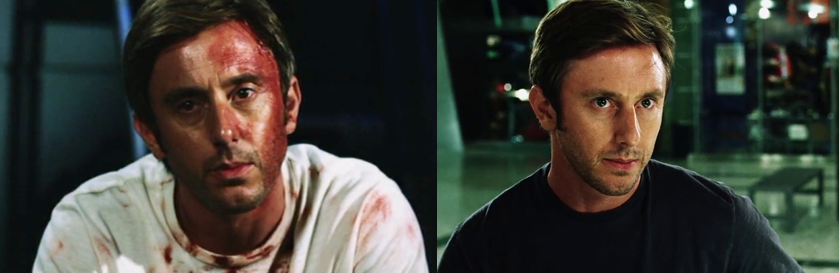
Michael plays peacemaker and offers logical, practical solutions to keep everyone safe.

However, the mall is currently claimed as sanctuary by three security guards – C.J. (Kelly), Bart (Michael Barry), and Terry (Kevin Zegers) – who aggressive oppose the taking in of additional bodies and a reluctant, frosty truce is force between the two groups Michael, a former television salesman, attempts to keep the peace and bring some kind of organisation to the group; he’s not looking to give orders or be a leader but merely comes up with logical suggestions for the others, which are generally adhered to for their practicality. Kenneth, at first, stoically rebukes him and he’s able to appeal to C.J.’s ego and sway him into helping them by coming up with good ideas and attributing them to him, thus positioning him as a paper leader. Constantly adaptable and something of a father figure, Michael becomes close with Ana but their attempts at romance are hampered by the greater problems facing the group. Though lacking in formal training and physical stature, Michael is pretty handy in a tight spot and, thanks to his will to survive and adaptability, is able to kill his fair share of zombies when the moment calls for it and is the first to actively stand up to C.J. during a tense confrontation on the roof.

C.J. goes from a stubborn antagonist to a pivotal ally willing to risk his life to get others to safety.

C.J. is, initially, the film’s secondary antagonist after the zombies; ruled by his fear of the undead and paranoia, he stubbornly holds on to his fragile authority and begrudgingly assists the other survivors on the understanding that they will leave the mall as soon as possible, even locking them up to keep them from stealing stuff. While Bart has a perverse fascination with the undead and follows C.J.’s orders to the letter, Terry is far more reluctant but, while C.J. is a hard-ass when the others first encounter him, he eventually becomes a trusted and valuable ally, covering their escape, putting himself at risk to save others, and even sacrificing himself so that the others can escape. While an obnoxious and detestable character when he’s first introduced, C.J. became another favourite of mine through his redemptive arc; after being decked my Michael and humbled by being locked up with Bart, his attitude shifts noticeably and he becomes a pivotal ally in the film’s chaotic third act. Soon, the group is joined by a number of other survivors: Andy (Bruce Bohne) is trapped on the roof of his gun shop across the road and slowly starving to death and communicates with the main protagonists using writing, leading to a brief bit of entertainment amidst the chaos where he plays chess with Kenneth and they shoot zombies who resemble celebrities. A truckload of other survivors upset C.J. when they crash into the mall, which brings a diverse quasi-society to the mall and, with the zombies kept at bay, the survivors begin to bond, with Terry and Nicole (Booth) sparking up a mutual attraction and Steve Markus (Burrell) acting as a tertiary antagonist with his pessimistic and cynical attitude. The others are little more than shellshocked cannon fodder who exist to share stories of their lives before the world fell apart, stories of their experiences of the outbreak, and fall victim to zombie bites and attacks.

The Nitty-Gritty:
As in Romero’s original films, there is no explanation given for the zombie outbreak and the word “zombie” is never used; newscasters and governmental and scientific minds are baffled by the sudden outbreak and the closest we get to an explanation for the horrific events that unfold is from a televangelist (Ken Foree in a welcome cameo) who believes that “when there is no more room in Hell, the dead shall walk the Earth”. Like most zombie films, the cause and prevention of the outbreak takes a backseat as the survivors concentrate mainly on just that: survival.

Zombies are fast, aggressive, and dangerous monsters driven purely by instinct and hunger.

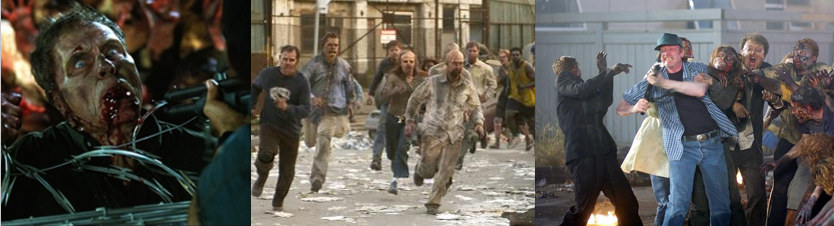
Like the Infected in 28 Days Later (Boyle, 2002), the undead in Dawn of the Dead are fast-moving, aggressive, and animalistic creatures; although the source of the outbreak is unknown, the virus is transmitted through bites: a single bite will kill the victim and then almost immediately reanimate them into a near-mindless cannibals. The only way to stop the zombies is to shoot them in or otherwise destroy their head; anything less results in them relentlessly pursuing their prey or becoming what is known as a “Twitcher” (where they simply thrash around in manic spasms). The zombies work purely on instinct, seeking out warm, fresh meat and guided by vestiges of memory to places they frequented in life, such as the mall, though they show no signs of intelligence or problem solving and simply throw themselves ceaselessly at their victims until they succeed or fall down. Even a single zombie poses a significant threat thanks to their incredible speed, strength, and ferocity but they are even more dangerous in large groups, where they resemble little more than a sea of blood-stained, mangled corpses bent on feasting on living flesh.

The threat of a zombie’s bite is the source of much tragedy and suffering for the few survivors.

The inevitability of death from a zombie bite is a source of great tension and tragedy in the film; when Ana first theorises on the bite being the source of the infection, Michael pragmatically decides that it is best for any amongst them who have been bitten to be immediately executed, which brings him into brief conflict with Ana. Ultimately, he chooses not to kill Frank (Matt Frewer) in cold blood and instead allows him to die peacefully and be put out of his undead misery by Kenneth. Similarly, the revelation and horror of the bite’s potency drives Andre into a deep denial; he starts to brush off offers for help from Ana and the others and his obsessive desire to keep Luda safe, even when she’s succumbed to her infection, leads to his death when he desperately tries to keep his little monster baby from harm. While the original film was largely an allegory for consumerism and greed and held a mirror up to a society that was already a form of brainwashed zombies thanks to advertising and excess, the remake is more concerned with the survivors indulging in excess once they establish a delicate, makeshift society.

The remake is more action-packed and gruesome than the original but no less allegorical.

Tensions, paranoia, and fear are high because of the gruesome events unfolding around them but, with C.J. and Bart locked up and isolated from the group, the remaining survivors quickly bond and share their life stories and experiences. Eventually, C.J. becomes a part of the group when Bart is attacked and helps them to fortify a couple of buses to take them away from the mall when they realise that it’s just a matter of time before more of the zombies breach their defences. This is, primarily, where Dawn of the Dead separates itself from the original (for the better, in my opinion): it’s much more action-packed, the pace is much faster, and the gore is far more ghastly (Bart, for example, is attacked by a zombie that’s missing its legs and scrambles along an overhead pipe!) Nowhere is this seen more in their desperate escape from the mall in their spruced-up vehicles, which, for all their efforts, are nearly toppled over by the zombie hoards and one is easily overturned by the presence of a single zombie. Tension definitely ramps up when the group leaves the safety of the mall as, exposed out in the open, they are constantly at risk even when no zombies are around and, in the film’s last frantic minutes, they lose more of their group in their escape than they arguably would have if they had stayed put and tried to fortify the mall.

The Summary:
I’ve watched a lot of zombie films in my time; I’ve seen all of George A. Romero’s movies and researched the genre, and the concept, extensively for my PhD. However, as much as I respect and admire his influence on the genre, I can’t say that I’m really that big a fan of his films; yet, while I feel that they haven’t really aged all that well, the allegorical messages and subliminal horror of his zombie films remains as relevant as ever (if not more so given the state of the world these days), it’s just let down a bit by the pacing. As a result, I am a big fan of the Dawn of the Dead remake; it’s grittier, much more action-packed, and the effects are far more convincing and horrific. While zombie purists may decry the faster, more aggressive zombies, I actually much prefer it since it makes for a much more frightening and formidable creature; plus, they do shamble and shuffle along when converging on the mall and only explode in a burst of speed and ferocity when flesh is nearby. Best of all, the film retains Romero’s trademark bleak undertones not just in Andre’s macabre fate but also the conclusion of the film, which sees characters both beloved and obnoxious giving their lives so that the few that remain can survive only for them to meet what appears to be a horrific end during the end credits.

My Rating:

Rating: 4 out of 5.

Great Stuff

Are you a fan of Zack Snyder’s Dawn of the Dead? How do you think it compares to the original and other zombie movies? Do you like fast-moving, aggressive zombies or do you prefer the traditional, shambling, more allegorical depiction of the undead? What do you think caused the zombie outbreak and how do you think you would react in such a scenario? Which of the characters was your favourite and which death affected you the most, if any? What is your favourite zombie film and what do you think of the genre in general? How are you celebrating the Day of the Dead today? Whatever your thoughts on Dawn of the Dead, and zombie films in general, feel free to leave a comment down below.