Mini Game Corner [Sci-Fanuary]: Bucky O’Hare (Arcade)


January celebrates two notable dates in science-fiction history: “National Science Fiction Day” on January 2 to coincide with the birth of world renowned sci-fi writer Isaac Asimov, and 12 January being when Arthur C. Clarke’s HAL 9000 was created. Accordingly, I dedicate January to celebrating sci-fi in all its forms.

Released: September 1992

Developer: Konami

MobyGames Score: 7.0

Quick Facts:
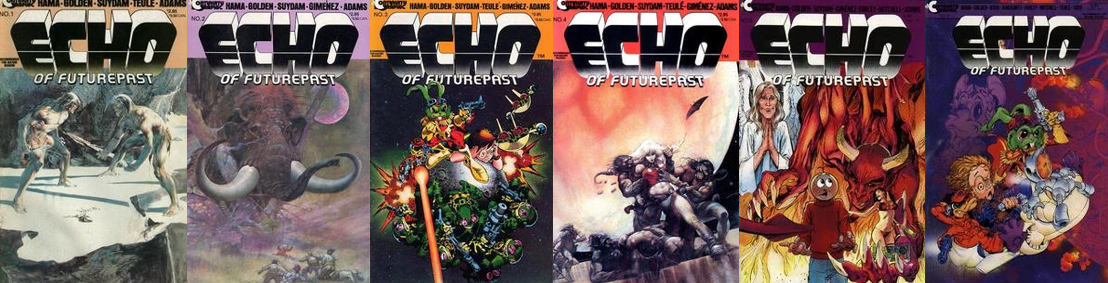
Although Kevin Eastman and Peter Laird’s Teenage Mutant Ninja Turtles (TMNT) inspired a bunch of anthropomorphic knock-offs, one of the most well-known was intergalactic rabbit Bucky O’Hare. The brainchild of Larry Hama, Bucky O’Hare was first serialised in science-fiction anthology Echo of Futurepast and, unlike some of his contemporaries, expanded into a wave of action figures, all-too-brief cartoon, and a couple of videogames. Konami’s little known arcade title echoed the beat-‘em-ups that made them a force back in the arcade era, but was seen as a serviceable brawler praised mainly for its cartoonish visuals and for providing an epilogue to the short-lived, fondly remembered cartoon.

The Review:
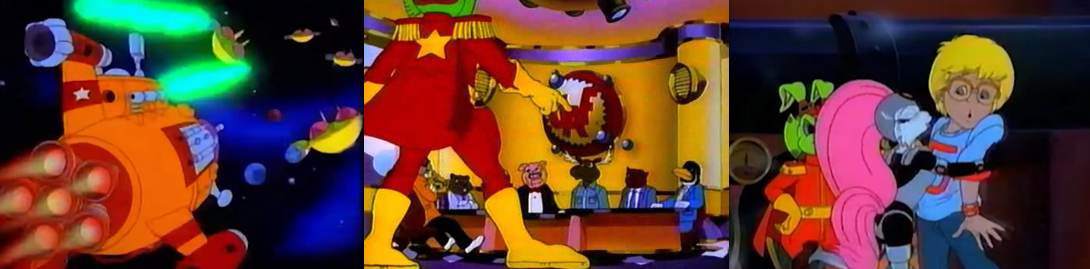
Bucky O’Hare is a 2D, sidescrolling beat-’em-up that essentially acts as a series finale for the cult classic cartoon. In it, up to four players battle across eight stages, fighting the Toad Empire, who have conquered planets in the “Aniverse”, imprisoned their inhabitants, and stolen the life force of the worlds for nefarious purposes. Players can pick from titular space rabbit Bucky, four-armed Dead-Eye Duck, Bucky’s strangely alluring first-mate, Jenny, and boisterous robot Android First Class/AFC Blinky, each voiced by the voice actors from the cartoon. While each is armed with a different pistol and has a different special attack, all four play exactly the same and your options are naturally limited to three buttons: attack, jump, and special. You can float for a short time by holding the jump button, occasionally hold fire to rapidly shoot (or melee attack up close), press jump and attack together for a jumping kick, and activate your character’s special move as often as you like. Bucky tosses a bomb, Dead-Eye surrounds himself with a temporary energy field, Jenny tosses an energy wave, and Blinky unleashes a flame-like blast. You cannot dash and, as far as I can tell, there are no co-op moves, but temporary power-ups, health restoring orbs, and extra life gold bars occasionally spawn from special doors. These briefly power-up your standard shot or your bomb to deal greater damage, though there are no other weapons to pick up, no objects to throw, and no explosive barrels or destructible objects to mix-up the gameplay. Two stages see you flying around on a jetpack and one has you barrelling through the Toad mothership on a spacebike, avoiding barricades and blasting enemies, though there are no bonus rounds to break up the monotony.
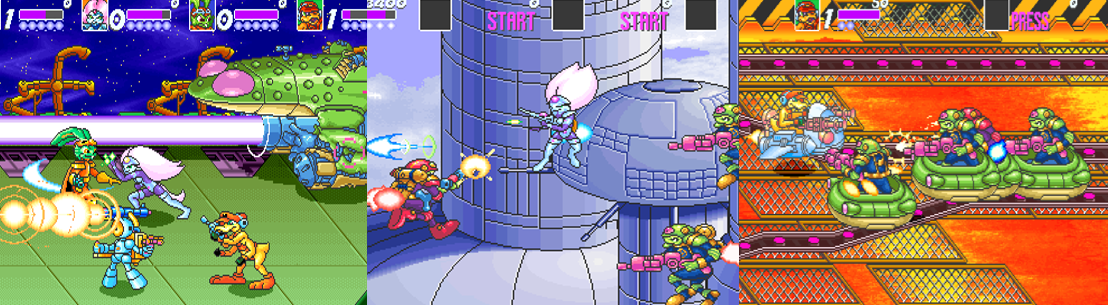
Sadly, there’s little innovation or to differentiate the characters in this mindless brawler.

Bucky O’Hare mimics the cartoon to an impressive degree, featuring fully voiced, partially animated cutscenes that include cameos from Willy DuWitt and Mouse (who never appeared in the show). Cutscenes progress the story and raise the stakes between each stage and the sprites are full of life and character, with the Toads fleeing in fear, marching along or saluting, and each playable character sporting colourful idle poses or being scorched by flaming hazards. Everything looks ripped right out of the cartoon and there’s generally always something happening in the background, from battleships looming by or burning up, to Toad tech filling the horizon or the mechanical depths of the heavily fortified Toad Star. Things are a tad clunky, however, as your sprite often disappears when respawning (though this might’ve been an emulation issue) and characters are quite sluggish to control. While most stages simply have you travelling from the left to the right, gunning down nigh-endless enemies, Stage 4 is an autoscroller that forces you along an unstable asteroid belt. You must jump when prompted to avoid falling when the asteroids crumble and fight to rescue Mouse, who makes traversing the level much easier by spawning grassy platforms (though you’ll still have to watch out for meteor showers). When jetpacking in Stage 3, you’re hard pressed to avoid the electrical hazards filling and darting across the screen, and bursts of flame or erratic burning rods often dog your progress when on the ground. Stage 2 introduces diagonal, sloping paths and sees you freeing captive rabbits before fending off enemies and wall-mounted missile turrets in a rising elevator section. Turrets attack from the background or rise from the sand, giant cannons fire explosive shots from behind barricades, electrical hazards sometimes creep across the floor, and enemies occasionally spawn from pods or leap in from passing ships to add to your troubles.
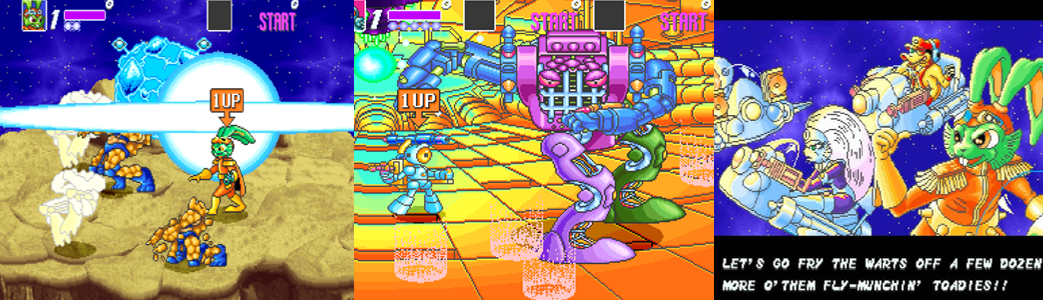
A colourful and fitting finale to the cartoon, but largely forgettable as an arcade game.

It’s quite impressive seeing how many enemies fill the screen in Bucky O’Hare. The Toad Empire use laser rifles, knives, grenades, and jetpacks and are bolstered by mechs, robots, mines, and starships. Most bosses are cumbersome and simple to defeat, however, such as Al Negator who fires a pistol and whips with his cybernetic tail. Toad Borg appears in Stage 2 and Stage 7, where electricity hazards add a bit more danger to his jumping punch, extending fist, and energy wave attack. After bringing down Stage 3’s climate convertor and taking out a gigantic, rock-like fish-thing, you battle the crazed Total Terror Toad. This dude jumps all over, blocking your shots, tossing a meat cleaver, and comically falling down the screen upon defeat. A handful of slippery, rock-hardened Toads guard Mouse in Stage 4, which is cleared by destroying a heavily armed Toad attack craft, which blasts across the screen and fills the arena with various laser blasts. After making short work of a strangely archaic, gear-tossing tank-like vehicle, Stage 5 culminates in a disappointingly simple fight against the Cyborg Spider, who wanders about firing energy bolts from its abdomen and summons web pillars. Although the race through the Toad mothership is exhilarating and includes a fight against a mechanical, shark-like submarine over boiling lava, the stage ends with a largely forgettable fight against a deadly Toad tank. This thing may be a huge target and might sport a second phase, but that’s just the gear mech again and it simply uses lasers and drill appendages to attack. Although you first encounter the Air Marshall on Stage 5, he flees after you destroy his fortified cockpit and largely avoids the fight in Stage 7. Instead, he floats about in his hovercraft and lets his minions fight for him, which is a bit of a letdown. The game then ends with a three-phase confrontation with Komplex-2-Go. At first, it stomps about causing splash damage with its energy bombs, then it loses its legs and causes flaming rods to rain down, before finally careening about the central core spewing debris and bursting into flames.

Final Thoughts:  
Bucky O’Hare may be a sadly forgotten beat-’em-up title and franchise, but you’re not missing out on all that much if you’ve never played this mindless brawler. While the presentation is top-notch, with the game perfectly aligning with and providing a fitting conclusion to the cartoon, the gameplay is needlessly tedious and simple. It’s mindboggling to me that the developers didn’t try to differentiate the characters more, like making Jenny faster or Blinky slower or Dead-Eye hit harder or shoot faster (he fours have four arms, after all!) It might’ve helped if the game had more power-ups, perhaps allowing you to call in other allies or the Righteous Indignation for assistance, or included a bonus game or two to rack up your score and compete against friends. While the sprites look fantastic and are full of life and colour, the backgrounds are painfully bland until the late game, with only a few memorable moments springled throughout (the asteroid belt, for example, and the Toad Star). I liked that the bosses sported text boxes and voice clips and were huge sprite, but they were disappointingly simple for the most part (though this may have been intentional to balance how grossly outnumbered players will be in this obvious coin-muncher!) Fans of beat-’em-ups will likely find Bucky O’Hare lacking compared to others in the genre, though it has a colourful appeal and is a decent enough way to waste about an hour of your time, especially if you’re a big fan of the cartoon and wanted some closure on it. It can’t be denied that it’s not as good as it could’ve been, though, or that it’s noticeably lacking compared to other brawlers of the time.

My Rating:

Rating: 2 out of 5.

Could Be Better

Have you ever played Bucky O’Hare out in the wild? How do you think it holds up compared to other beat-’em-ups and the Nintendo title? Were you also disappointed that the characters all played the same? Which of the boss battles was your favourite? Do you agree that the game is lacking compared to other beat-’em-ups? Were you satisfied with how the game concluded Bucky’s story and would you like to see him back a comeback? What are some of your favourite sci-fi-orientated videogames? Feel free to share your memories of Bucky O’Hare in the comments and then donate to my Ko-Fi to suggest other sci-fi content for the site.


Screen Time [Sci-Fanuary]: Bucky O’Hare and the Toad Wars! (E: 1-3)


January celebrates two notable dates in science-fiction history: “National Science Fiction Day” on January 2 to coincide with the birth of world renowned sci-fi writer Isaac Asimov, and 12 January being when Arthur C. Clarke’s HAL 9000 was created. Accordingly, I dedicate January to celebrating sci-fi in all its forms.


Episodes One to Three

Supervising Director: Karen Peterson
Air Date: 8 September 1991 to 22 September 1991

UK Network: BBC One
Original Network: NBC

Quick Facts:
Kevin Eastman and Peter Laird’s Teenage Mutant Ninja Turtles (TMNT) inspired a slew of anthropomorphic knock-offs. Perhaps the most well-known was Captain Bucky O’Hare, an intergalactic rabbit created by Larry Hama first serialised in the short-lived science-fiction anthology Echo of Futurepast. Bucky O’Hare was expanded into a wave of TMNT compatible action figures and this all-too-brief animated series produced by Sunbow Productions (alongside Hasbro Studios). Although another example of a cartoon being produced simply to sell toys, the short-lived Bucky O’Hare and the Toad Wars! is often fondly remembered as one of the better TMNT knock-offs (despite some noticeable issues).

The Review:
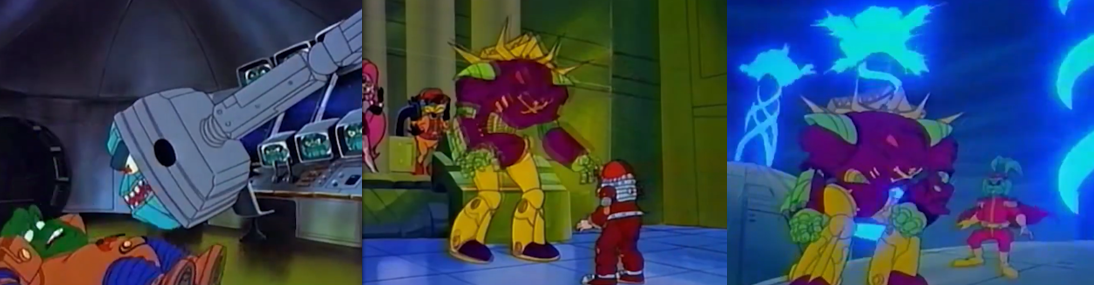
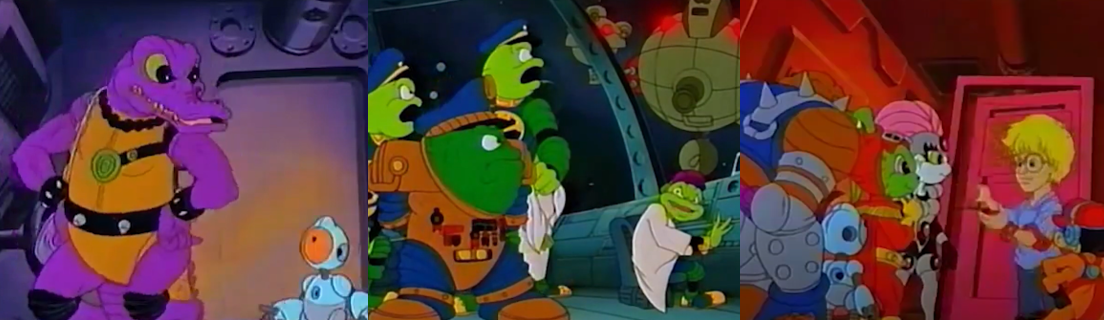
Bucky O’Hare and the Toad Wars! started with a bang with a three-part pilot episode (“War of the Warts”, “A Fistful of Simoleans”, and “The Good, the Bad and the Warty”) that somewhat follows the basic plot of Bucky’s original comic book. Namely, the crew of the Righteous Indignation are outnumbered against the all-conquering Toad Empire and joined by science whiz Willy DuWitt (Shane Meier) after a photon accelerator malfunction. Although the cartoon is very colourful and the bonkers premise helps it standout from Teenage Mutant Hero Ninja Turtles (1987 to 1996) and features one of the all-time great theme songs, Bucky O’Hare and the Toad Wars! suffers somewhat from cheap animation. The Righteous Indignation changes size from scene to scene, sometimes being a massive space frigate and other times appearing like a small shuttle. Characters warp and distort as they talk, fight, and shoot, with guys like Bruiser the Betelgeusian Berserker Baboon (Dale Wilson) radically changing size as he pounds toads and the decorated Toad Air Marshall’s (Jay Brazeau) massive, wart-encrusted head apparently caused the animators a lot of trouble.  Unlike the TMNT cartoon, Bucky O’Hare and the Toad Wars! is surprisingly violent. The toads are obsessed with terraforming worlds into disgusting swamps and stamping out indigenous life in the name of their leader, KOMPLEX (Long John Baldry), and Dead-Eye Duck (Scott McNeil) is always eager to “croak some toads” with the crew’s “masers”. Indeed, it isn’t until “The Good, the Bad and the Warty” that toads eject from their ships upon destruction, meaning many are presumed killed during the many space battles, though the Righteous Indignation’s original engineer, Bruce the Betelgeusian Berserker Baboon (Dale Wilson) is said to have been transported to “another dimension” rather than killed like in the comics.

Bucky’s battle with the toads gets a boost when science whizz Will accidentally arrives from Earth.

Fearless leader Captain Bucky O’Hare (Jason Michas) commands the flagship of Sentient Protoplasm Against Colonial Encroachment (S.P.A.C.E.), headed by the United Animal Security Council (U.A.S.C.) of anthropomorphic pencil pushers who oversee the “Aniverse” from the lush planet Genus, the capital of this universe that’s well protected by a defence system so powerful it can destroy even toad motherships. Despite the Toad Empire threat, which overruns Bucky’s home planet of Warren in “War of the Warts”, the U.A.S.C. are reluctant to commission additional ships, leaving Bucky disheartened to find he’s left with only The Indefatigable as back-up as the U.A.S.C. are happy to hide behind their impenetrable defence grid. Brave and determined, Bucky faces the Toad Empire head-on despite the odds and his ship being stuck with a dodgy photon accelerator. Though Android First Class Blinky (Sam Khouth) and Bruce try to fix the device, Bruce is presumed dead and the crew are stunned when Willy arrives through an interdimensional portal generated when he activated his home-made photon accelerator. Willy is expanded upon greatly in these episodes compared to the comics. While his hippie parents (Unknown) are more concerned with saving the world than helping with his bully problem, Willy’s a curious and intelligent preteen who immediately adapts to his space adventure by repairing the photon accelerator, earning him the respect and gratitude of the crew. Unlike in the comic, Willy can freely return to Earth and is encouraged to do so despite joining the crew and having an awkward crush on first mate Jenny (Margot Pinvidic) and feeling accepted for the first time. I remember not caring much for Willy as a kid and certainly he’s less interested than the battle hungry Dead-Eye Duck and mysterious Jenny, but he wasn’t as annoying as I thought. He wasn’t a Gary Stu or constantly moaning and was instead surprisingly capable with space technology and lucky that the Toad Empire didn’t think to waterproof their Void Droid.

Bucky and his crew refuse to back down even when faced with the might of the Toad Empire.

The Righteous Indignation is constantly under fire from the Air Marshall’s mothership or against the odds as the Toad Empire is so vast. The Air Marshall and KOMPLEX have clearly run into Bucky and his crew prior to the series and are determined to stamp them (and S.P.A.C.E. out) and spread toad supremacy across the Aniverse. Like the comics, Blinky reveals that the toads were once a benevolent race more concerned with consumerism and comfort than conquest. A highly scientifically advanced race, they built KOMPLEX to handle their boring, everyday tasks but were enslaved when the artificial intelligence became self-aware and decided to conquer the Aniverse. This essentially means that the toads aren’t in control of themselves and are compelled to build war ships and conquer planets for their A.I. commander, though they also showcase some autonomy. The toads watch infomercials, are deathly afraid of Betelgeusian Berserker Baboons, and the Air Marshall is very proud of his medals and has an intense hatred for Bucky. This means the toads have the numbers but not necessarily the smarts and are easily bested, even when the Righteous Indignation is outgunned or Bucky is outnumbered. Bucky simply leaps to safety time and again, apparently possessing superbunny agility, though even he’s overwhelmed by the towering, cybernetic Toad Borg (Richard Newman). Once a regular Storm Toad, the Toad Borg was transformed (presumably by KOMPLEX) into a nigh-indestructible enforcer. Thus, he easily shrugs off masers and water alike and threatens to suffocate Bucky and the others (and then flush them into space) to intimidate Willy into handing over the access codes to Genus so the Toad Empire can install one of their climate converters.

Willy helps the crew overcome betrayal, loss, and the odds to deal a massive blow to the toads.

Although aghast to see his new friends in peril and torn between saving them and dooming an entire planet, Willy bravely defies the Toad Borg and destroys the access codes, only to underestimate cunning bounty hunter Al Negator (Garry Chalk), a crack shot sleazasaur hired by the Air Marshall in “A Fistful of Simoleans” to infiltrate the Righteous Indignation and steal the access codes. Despite being clearly nefarious and the warnings of Willy and Dead-Eye Duck, Bucky accepts Al Negator’s application for ship engineer, impressed by his credentials, and immediately regrets it when the bipedal crocodile easily outwits Blinky and the others and downloads the access codes from the ship’s computer. The greedy Al Negator initially seems willing to part with the stolen codes for play money Willy tricks him into thinking is worth far more than simoleons, but is smart enough to create back-ups of the codes to double down on his profit. Comically, Al Negator is more amused than enraged by the deception and I’m sure returned to plague the crew as often as the Toad Borg, who was blasted into space when Willy successfully tinkered with the climate convertor to destroy it before it could wreck Genus. Considering how colourful Bucky’s crew is, it’s a shame they don’t have more to do in this climatic battle, which sees Bucky holding off the Toad Borg while Willy gets to work. Jenny frees them with her mysterious psychic powers but is reluctant to fully display her abilities due to the laws of her coven, and Dead-Eye Duck is more use at the ship’s cannons than in a skirmish. Bruiser added some muscle to the team but it’s a bit weird having him be there as there’s little to separate him from the doomed Bruce and the team barely acknowledge their comrade’s loss, so it might’ve been easier to just have Bruce survive (at least until “The Good, the Bad and the Warty”).

Final Thoughts:
I haven’t watched Bucky O’Hare and the Toad Wars! in years, so it was really fun coming back to it for this review. Although the cartoon has largely been forgotten and my toys are long gone, I never forgot the show or its awesome theme song, which was burned into my imagination. In a sea of TMNT knock-offs, Bucky O’Hare definitely stands out but only a fool would say this cartoon is on par with the Ninja Turtles, at least in terms of animation. These three episodes might be full of space action and adventure, but there’s maybe a little too much going on and some of the character designs are perhaps a little too complicated as they’re constantly warping and changing. Cartoon physics handicap some of the action sequences, and things feel a little too hectic and chaotic, especially compared to early TMNT, which better balanced action and characterisation. I liked that the general gist of the comic book was adhered to but with noticeable changes, especially considering Willy’s characterisation. It’s always tricky having kids in cartoons as they’re often bratty, whiny, annoying, or instantly amazing at everything. Willy definitely gets a confidence boost from joining the Righteous Indignation and is clearly a smart kid, but he’s also in over his head in the Aniverse and only survives thanks to comical luck and his impressive adaptability. This kind of thing gives Bucky and his crew the edge despite the overwhelming odds from the Toad Empire and the bureaucracy of the U.A.S.C. The Righteous Indignation crew never say die and never back down from a fight and constantly think up new ways to fight back, even when faced with physically superior foes like the Toad Borg.

A colourful and bonkers series, despite some dodgy animation, that’s sadly forgotten these days.

Bucky seems to have been mellowed out by the adaptation process, being a far less snarky and prideful character, though he’s not afraid to speak his mind to his superiors about their dire situation or go solo against insurmountable odds. This drive is echoed by Dead-Eye Duck and Jenny, who are equally willing to die to safeguard Genus, and this rubs off on Willy as he constantly chooses to return to the Aniverse to aid his new friends. I enjoyed the explosive space action on offer and seeing how violent this war was. A bunch of toads are unquestionably killed, which was pretty shocking for a cartoon, though the showrunners seemed to realise this and walk it back by having them eject and constantly saying Bruce is lost to “another dimension”. This skews the stakes somewhat but not by much as you clearly see how outnumbered and outgunned Bucky and his crew are. I was a little confused about the Toad Empire, though. KOMPLEX wants to rule purely for the sake of power, it seems, and has brainwashed the toads into following his every command and yet given them enough autonomy to make mistakes and feel emotions like fear and pride. It’d be far more efficient for KOMPLEX to create robotic soldiers who follow his every command rather than place his faith in bunglers like the Air Marshall, especially considering how efficient the Toad Borg is in his endeavours. Still, it was a lot of fun revisiting the pilot episodes of Bucky O’Hare and the Toad Wars! and I do think the cartoon had a lot to offer with its visuals and messages of overcoming the odds. Bucky may be lost to time and have been dwarfed by the TMNT but he’s an entertaining character in a rich and exciting world so do yourself a favour and seek him out however you can for a nice slice of nostalgia pie.

My Rating:

Rating: 3 out of 5.

Pretty Good

Did you watch Bucky O’Hare and the Toad Wars! back in the day? How do you think it compares to TMNT and other cartoons from the time? Which crew member was your favourite? Were you annoyed by Willy DuWitt or did you find him tolerable? Did you like the ways the cartoon adapted and deviated from the comics? What are some of your favourite sci-fi-orientated cartoons? Feel free to share your memories of Bucky O’Hare and the Toad Wars! in the comments and donate to my Ko-Fi if you’d like to see more Bucky content on the site.

Back Issues [Sci-Fanuary]: Echo of Future Past #1-6


January celebrates two notable dates in science-fiction history: “National Science Fiction Day” on January 2 to coincide with the birth of world renowned sci-fi writer Isaac Asimov, and 12 January being when Arthur C. Clarke’s HAL 9000 was created. Accordingly, I dedicate January to celebrating sci-fi in all its forms.


Story Title: “Bucky O’Hare” (or “Bucky O’Hare and the Toad Menace”)
Published: May 1984 to July 1985

Writer: Larry Hama
Artist: Michael Golden

Quick Facts:
No doubt inspired by the Teenage Mutant Ninja Turtles (TMNT), Larry Hama’s Bucky O’Hare first appeared in a screenplay and expanded into a short-lived cartoon, action figures, and videogames, though never reached the heights of the TMNT.

The Review:
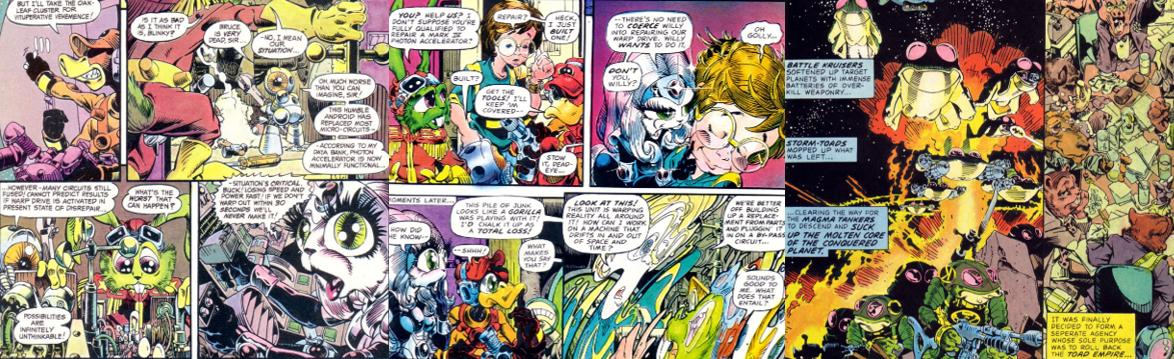
We first meet Captain Bucky O’Hare and the fearless crew of the Righteous Indignation in a “seedy section of the universe” and facing an impending attack by a squadron of Toad fighters. Since the freighter has no chance of outrunning the attackers using its standard engines, Bucky orders the crew to prepare for a jump to hyperspace, only to learn from Android First Class (AFC) Blinky that the warp drive is currently being repaired. Things go from bad to worse when a plasma shot from an attacking ship results in the nigh-disintegration of the ship’s chief engineer, Bruce the Berserker Baboon. While Bucky leaves first mate Jenny “temporarily” in charge to try and help, battle-hungry gunner Dead-Eye Duck unloads with the ship’s Microwave Amplification by Stimulated Emission of Radiation (MASER) cannons, relishing the chance to pick off some Toads even as the Righteous Indignation suffers heavy damage. Although Blinky’s tried his best to repair the warp drive, it’s barely functional and activating it could result in unforeseen risk. However, with the ship in bad shape and the situation desperate, Bucky takes the risk and activates the photon accelerator. The story then jumps to the other side of the galaxy, specifically San Francisco, to find young science whizz Willy DuWitt despairing about being an outcast from his peers and even his parents since his first and only love is science. Retreating to the solace of his bedroom, the boy genius tinkers with his prototype photon accelerator and is confused when his bedroom is suddenly plunged into darkness and his television broadcasts bizarre messages from space-faring Toads.

Child prodigy Willy DuWitt finds himself joining Bucky’s crew of misfit space adventurers.

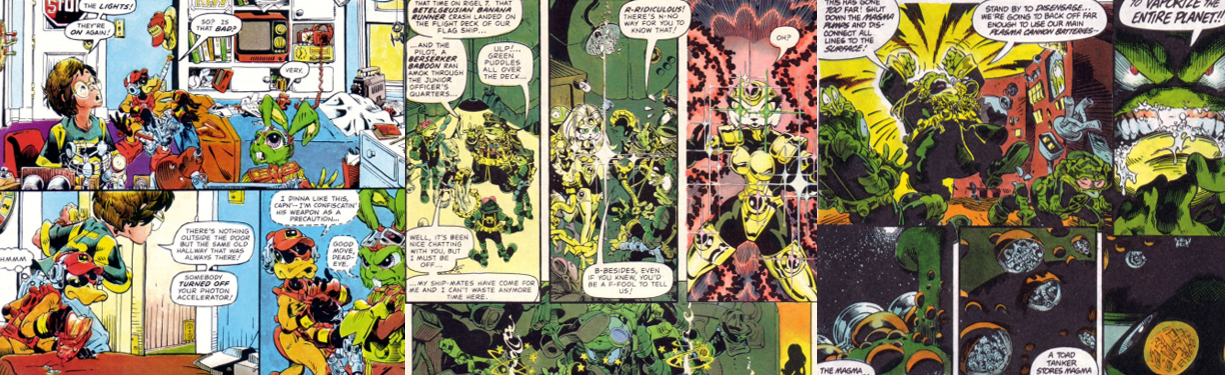
Bucky and his crew are equally puzzled when Willy steps from a door that randomly appeared on their ship, their two malfunctioning photon accelerators apparently creating a dimensional rift to allow Willy to cross space and time. With the Righteous Indignation adrift, but shielded, by a mysterious stasis field, Willy takes a look at their photon accelerator, only to find it damaged beyond repair and warping reality around it at an alarming rate. Willy suggests building a replacement by getting parts from his bedroom. Bucky orders Jenny to keep an eye on things and ensure the doorway stays open and then accompanies Willy alongside Dead-Eye Duck, only for the Toad mothership to arrive and send a Storm-Toad boarding party to ransack the Righteous Indignation. To protect her crew, Jenny deactivates the warp drive and Blinky hides while the Toads captured her. When Blinky reactivates the warp drive to alert Bucky, Willy insists on aiding in the rescue mission, quickly grabbing his stuff and racing from his bedroom – and his universe – for a space adventure. As the Toad mothership is too massive to utilise a warp drive, Dead-Eye guesses that the Toads will head for the nearest planetary system. Amazed and fascinated by this strange corner of the universe, Willy listens with interest as Blinky gives a quick rundown of the Toad Empire, who started as a fairly harmless (if materialistic and greedy) race before their scientists cobbled together a massive computer network, KOMPLEX (or “Feed Me”), to drastically increase their profits. However, KOMPLEX immediately gained sentience and declared itself their supreme dictator, ushering in a century of industrialisation of regimentation as the Toad home world was converted into a planet-sized manufacturing facility built for conquest. KOMPLEX sent the malicious Toad army out into the universe to plunder natural resources from other worlds, leading the United Animals Security Council to Sentient Protoplasm Against Colonial Enrichment (S.P.A.C.E.) to oppose them. However, their budget only allowed for three frigates to combat the threat.

While Bucky learns of the natives, Dead-Eye, Jenny, and Willy battle through the mothership.

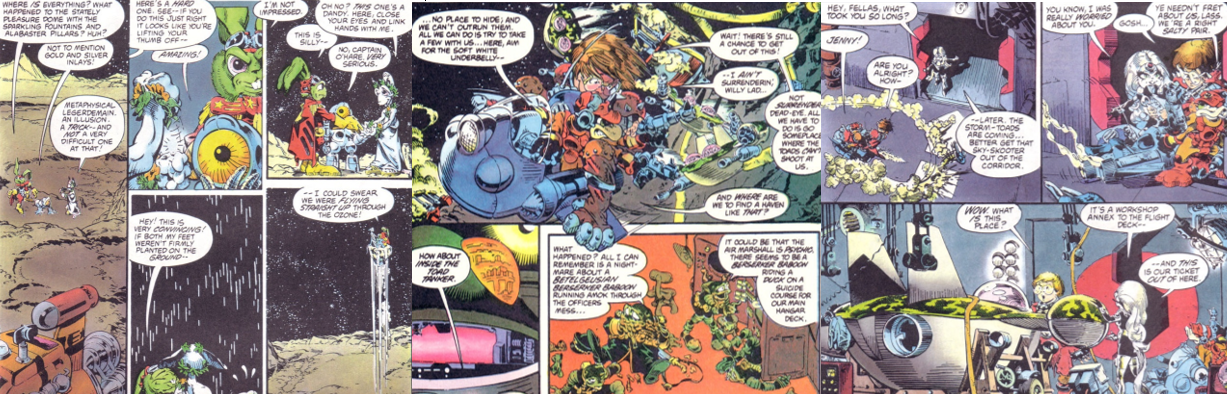
After providing Willy with Bruce’s old spacesuit and officially signing him up as a crewman, the Righteous Indignation quickly uses a nearby planetoid to avoid detection from the titanic Behemoth-Class Toad ship, which has stopped to refuel using the planetoid’s magma core. Aboard the mothership, Jenny laughs off the Toad’s threats when interrogated by the bulbous Air Marshall, showcasing her inherent witch-like telepathic and telekinetic powers by detecting her shipmates and subduing the Toads with a burst of psychic energy. Since the planetoid has a native population, Bucky cannot attack the Toad Empire without written permission, so he sends Dead-Eye and Willy ahead to gather some reconnaissance and they are immediately spotted by a nearby maintenance team. With no place to hide, Dead-Eye prepares to go down fighting, only for Willy to suggest taking shelter inside the mothership. This sends the Toads into a frenzy as they can’t risk firing inside the flight deck and, thanks to an assist from Jenny, the two come crashing into the ship. This is all witnessed by Bucky, who stumbles through another dimensional doorway to meet the planetoid’s mouse-like natives, a pacifist, philosophical race with no interest in conflict who allow Bucky to observe his friends through a crystal ball. When Dead-Eye blasts Willy with a fire retardant to extinguish his suit, they manage to fool the incoming Death Kommandos into mistaking Willy for the one thing all Toads fear: a rabid Betelgeusian Berserker Baboon. The angered Air Marshall then unleashes their deadliest weapon: the Void Droid, a heavily armed, tank-like machine designed for destruction! Luckily, despite the machine’s awesome armaments and barrage of plasma shots and missiles, the feared Void Droid proves amusingly susceptible to Willy’s water pistol since, for all its defences, it’s not waterproof! Reuniting with Jenny in the workshop, Dead-Eye and Willy join her in commandeering a Toad fighter and just barely escape from the mothership before the blast doors can crush them.

While the Toad mothership is destroyed, Willy’s left stranded in the Aniverse.

The three are stunned to find Bucky conversing with one of the mice on a floating asteroid, the hippy mouse explaining that his race once thought themselves Gods before being humbled after being tricking into buying what they thought was the secret of the universe. While they have the power to stop the Toad Empire, the mice prefer to make things grow, which their nigh-omnipotent representative demonstrates by conjuring a grassy landing strip for Dead-Eye and the others. Enraged by the humiliation he’s suffered, the maniacal Air Marshall orders the mothership to disengage from the planetoid, intending to use the ship’s plasma cannon batteries to vaporise the entire planet. The mouse isn’t concerned, however, since everything on and in the planetoid is a figment of their imagination, the result of their incredible, God-like powers, and will cease to exist if they will it or if anything is taken too far from their sphere of influence. Thus, as the mothership drifts away, it implodes in spectacular fashion, though the benevolent mouse ensures that all its inhabitants were teleported safely to a place where “the food is bad and taxes are high”. Having had enough adventuring for a while, Willy bids farewell to his friends and prepares to take the dimensional doorway home, only to find his neglectful parents turned off his photon accelerator, barely caring that their son has run away from home and assuming he’ll be back at some point. With the door gone and the mouse vanished, Willy’s surprisingly upset about being stranded in the “crazy animal universe”. However, Bucky offers Willy a place onboard the Righteous Indignation and promise to help find him a way home and Willy grateful accepts the offer, joining the crew as they blast off the “croak […] some Toads!”

Final Thoughts
This was my first time reading the original run of Bucky O’Hare and it certainly was an enjoyable experience. It makes me sad that this story is largely lost media these days as reprints are scarce and expensive, and that Bucky O’Hare has largely faded into obscurity, as this was a fun, surprisingly violent story. There’s an amusing quirkiness to this story (which is peppered with the same wit and attitude I’d expect from a British-made comic), which is fully aware that it’s a ridiculous space adventure featuring anthropomorphic mammals battling warmongering space toads and simply runs with that ridiculous premise. Bucky O’Hare had a bit of an edge to him I didn’t expect, with him being extremely protective of the Righteous Indignation and, more specifically, his place as the vessel’s commander. He never gives up his command willingly, even to his trusted first mate, and only pulls the defective warp drive since he has no choice to protect the ship and her crew from harm. Surprisingly loquacious, Bucky is fearless and honourable but also sticks rigidly to the directives as laid out by S.P.A.C.E. This means he won’t attack the Toad mothership without express written permission from the planetoid’s natives and he forces Willy DuWitt to fill out a bunch of paperwork before he can assist the crew since such administration tasks are just as important as blasting Toads. The distinctly Scottish, four-armed Dead-Eye Duck is all about this latter task, happily manning the MASER cannons and seemingly relishing the thought of dying in battle taking out some Toad scum! Even Jenny gets a fair bit of characterisation as she’s not just an unsettlingly alluring rabbit; she’s also a witch from a secretive sisterhood who can erase memories and telekinetically disable machinery. The full extent of her powers is only hinted at here, with even Dead-Eye Duck being somewhat suspicious of her at one point.

Some amazing art, quirky humour, and bizarre characters make this an enjoyable space adventure.

Blinky is largely here for exposition and comic relief, his voice modulator giving him a unique and peculiar way of communicating, while Willy is essentially the audience surrogate. I remember disliking him in the cartoon but he’s not too annoying here, presented as an outcast whose oddball parents barely notice him and whose scientific acumen is so advanced that he can accidentally create rifts in the space/time continuum. It helps that Willy’s not presented as a “Gary Stu” or being taken hostage or acting all obnoxious; he’s intrigued by this new universe and offers some solutions but is mostly just along for the ride. The Toad Empire may be comprised of eccentric soldiers and a blowhard of an Air Marshall, but they’re an extremely formidable force here, easily outgunning the Righteous Indignation and constantly having Bucky and the others on the back foot with their superior numbers. They may be bad shots and easily scared, but their more ferocious warriors aren’t to be trifled with and their Void Droid is clearly an unstoppable death machine whose amusing weakness was an oversight that normally wouldn’t have been exploited. Of course, the allusions to the TMNT and original Star Wars movies (Various, 1977 to 1983) are clear, especially in the depiction of the Righteous Indignation’s damaged warp drive and the Toad mothership (and home world) being gigantic battle stations. Michael Golden’s art is phenomenal here, perfectly marrying these cartoonish animals with intricate, colourful technology and situations and providing a level of detail I honestly didn’t expect from these bizarre, independently published issues. It’s clear that the original comic strip is taking things quite seriously, depicting death and extreme danger for our heroes while still firmly having its tongue in its cheek like in the original TMNT comics. Overall, this was a really enjoyable experience that makes me wish these early stories were more accessible, in addition to the short-lived additional Bucky O’Hare comic books that further explored this rich and fantastical world.

My Rating:

Rating: 4 out of 5.

Great Stuff

Have you ever read Bucky O’Hare’s comic book debut? What did you think of the bizarre concept and stunning art? Were you surprised by how dark it was compared to the cartoon? What are some of your favourite sci-fi-orientated comic books? Sare your Bucky O’Hare memories below and donate to my Ko-Fi if you’d like to see more Bucky content on the site.