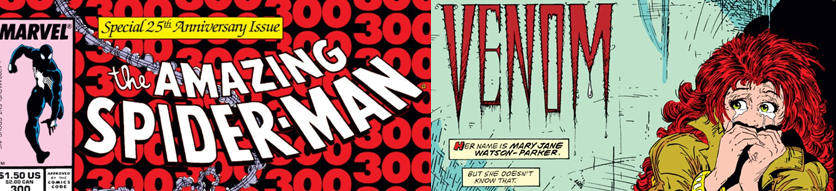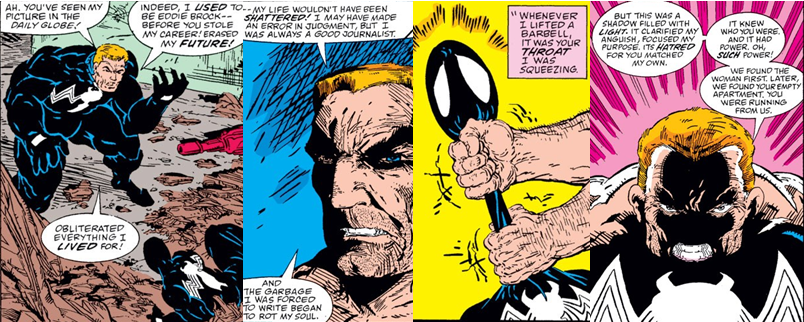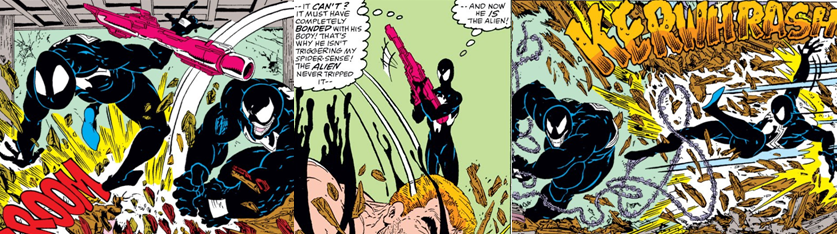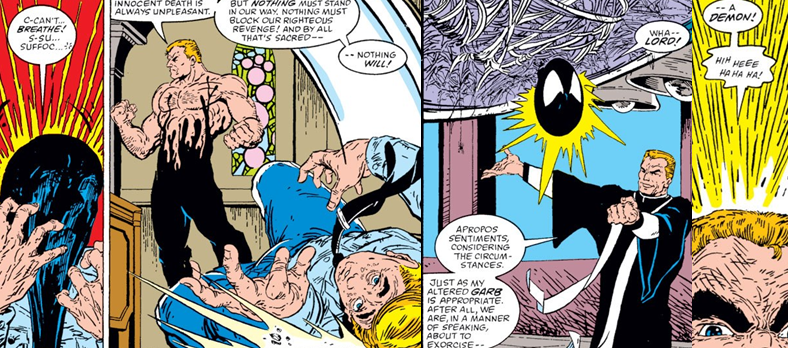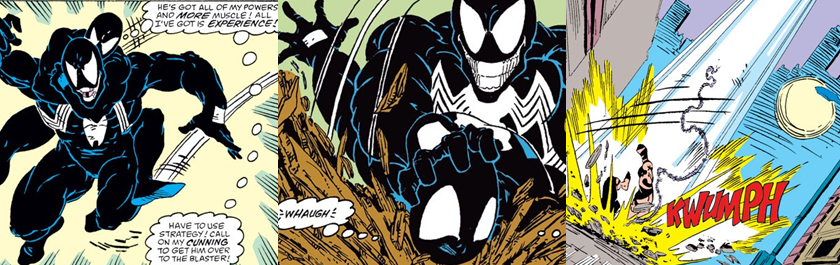
Back Issues [Venom Day]: The Amazing Spider-Man #361-363


To celebrate the release of Venom: Let There Be Carnage (Serkis, 2021), Sony Pictures declared September 27 “Venom Day”, a fitting date to shine the spotlight on one of my favourite anti-heroes, who made their first full debut in May 1988 and have gone on to become one of Marvel’s most iconic characters.

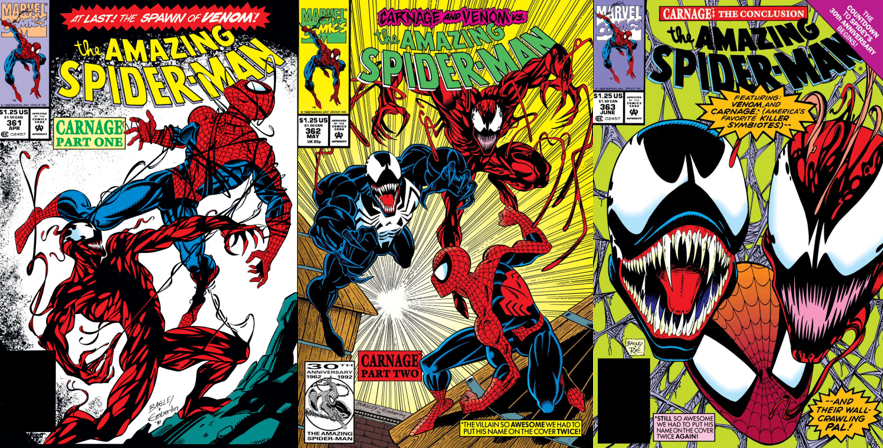
Writer: David Michelinie Artist: Mark Bagley

Story Title: “Carnage – Part One: Savage Genesis”
Published: 13 February 1993 (cover-date: April 1992)

Story Title: “Carnage – Part Two: Savage Alliance”
Published: 10 March 1993 (cover-date: May 1992)

Story Title: “Carnage – Part Three: Savage Grace!”
Published: 14 April 1993 (cover-date: June 1992)

The Background:
In 1982, Marvel Comics editor-in-chief Jim Shooter purchased an illustration of Peter Parker/Spider-Man in a slick black outfit from Randy Schueller for an outrageous $200, a concept that writer Tom DeFalco and artist Ron Frenz interpreted as an alien organism following Marvel Super Heroes Secret Wars #8. After revelling in the costume’s unique ability to form both clothing and organic webbing, Spidey was aghast when Doctor Reed Richards/Mister Fantastic revealed it was a sentient symbiote and quickly rid himself of the parasite using a cacophony of church bells. Throughout 1988, Peter was stalked and attacked by a mysterious assailant who turned out to be disgruntled reporter Eddie Brock, now bonded to the symbiote to form Venom, Spider-Man’s dark doppelgänger. An immediate favourite of mine, Venom has had many hosts over the years and undergone many changes, but took their first step towards becoming a more virtuous (if violent) “lethal protector” when they set aside their vendetta against Spider-Man to battle their more dangerous offspring, Cletus Kasady/Carnage. First teased in The Amazing Spider-Man #345 and allegedly dubbed “Chaos” and “Ravage” before assistant editor Eric Fein suggested “Carnage”, writer David Michelinie and artist Mark Bagley specifically designed Carnage to be a more sadistic counterpart to Venom, one whose symbiosis was so complete that Kasady and the symbiote were in total unity. Heavily influenced by the Joker, Carnage has long been a fan favourite and has repeatedly returned (even from death) to perpetrated some truly deplorable acts, from slaughtering thousands during the sprawling “Maximum Carnage” event (DeFalco, et al, 1993) to becoming a near-literal God! Despite Carnage’s violent nature, the character frequently appears in Spidey/Marvel videogames and, most surprisingly, cartoons, and was played with scenery-chewing relish by Woody Harrelson in Sony’s Spidey-less Venom films (Various, 2018 to 2024).

The Review:
After appearing as Eddie Brock’s psychotic cell mate, Cletus Kasady took a page out of his “old man’s” book by popping up in “asides” in The Amazing Spider-Man #359 and #360. While Spider-Man was busy dealing with Doctor Elias Wirtham/Cardiac, Cletus communed with his “other” to slaughter a guard and escape Ryker’s Island. He then looked up the stupidest name he could find and brutally suffocating Gunther “Gunny” Stein, before finally getting his first full-page reveal murdering a lab technician simply to prove that “law and order” is an illusion. Peter gets a call about this while helping his doting Aunt May, ruminating on how the killing is the latest in a spree of violent murders perpetrated by a psychopath who signs his name (“Carnage”) in blood at each crime scene. While overhearing an eyewitness, Spider-Man is horrified at the implication that Venom is back to their old, murderous ways, despite Eddie living in peace in the mistaken belief that Peter is dead. When he shares these concerns with his highly strung actress wife, Mary Jane Watson-Parker/M.J., she begrudgingly supports him when he voices his responsibility towards subduing the symbiote he enraged. While running some background checks on Eddie, Peter becomes aware of Cletus and is disturbed by his rap sheet: eleven murders, suspected of a dozen more, and potentially burned down the orphanage he was raised in and bashed in an employee’s head in the process. Though alarmed, Peter questions punks, hookers, landladies, and more about Cletus to confirm he’s a twisted sadist who charms with a silver tongue and kills without a thought.
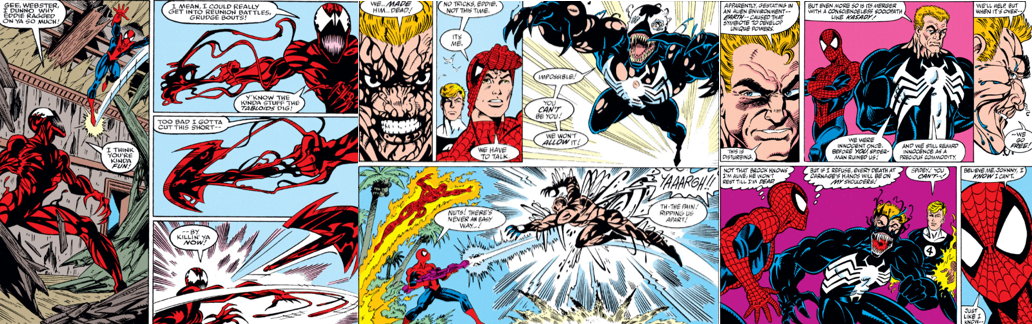
When a violent new symbiote comes to town, Spidey’s forced to team up with Venom!

Theorising that Cletus feels a kinship to the orphanage, Spidey finds Cletus there, naked before a small fire and talking to a stuffed teddy bear! Spider-Man’s unease turns to terror when Cletus transforms into a blood red-and-black symbiotic lifeform and attacks with unexpected speed and strength. Like Venom, Carnage doesn’t set off Spidey’s “spider-sense” but can Carnage uniquely extend and solidify his alien appendages. Overwhelmed by Carnage’s power and confused as to how the symbiote bonded with Cletus, Spidey is stunned when Carnage tosses temporary axe-like projectiles! When two cops investigate, Spider-Man gains a temporary reprieve, only to be incensed when Carnage callously tosses dart-like pieces of himself at a patrolmen, leaving him clinging to life. This distraction allows Carnage to flee, leaving a parting message in his own blood that unnerves the web-slinger. Obsessed with tracking Carnage, Peter decides that the only way to defeat Carnage is to team up with Venom! After catching a lift from Johnny Storm/The Human Torch and retrieving Mr. Fantastic’s sonic gun, Spidey heads to the remote island where he left Eddie, surprising and enraging Venom. Despite the pain caused by the sonic gun and the Human Torch’s flames, Venom almost drowns Johnny before he desperately activates his “nova flame”. Spidey and Venom repeat their earlier fight at the abandoned mining village, with Venom getting the drop on him with their invisibility, before the Human Torch blasts them with the sonic gun. Despite the agony, and his hatred of Spider-Man, Eddie is furious to learn that Carnage is killing innocents. He also reveals that the symbiotes produce asexually and that they have no interest in traditional concepts of “family”, explaining why his “other” didn’t mention that it had reproduced.
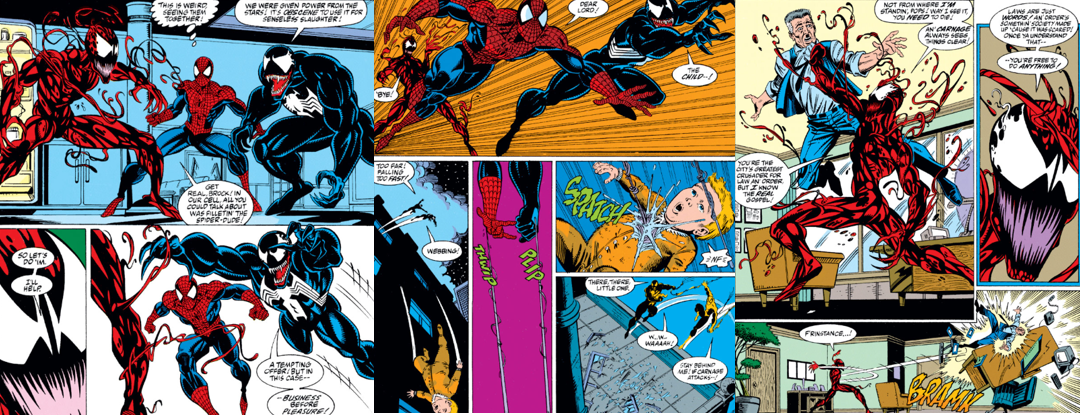
Carnage’s disregard for life sees him target random innocents and those who champion order.

Venom also theorises that Carnage’s lineage and Earth’s environment has altered his symbiote, and that Kasady’s warped personality makes him extremely dangerous. Venom also demands their freedom in return for their help and Spider-Man’s forced to agree. Although Johnny’s unnerved, he flies them back to New York City, where Venom follows their unique connection. Meanwhile, Carnage attacks wealthy Robert Sutcliff, brutalising his guards and tossing his helicopter off the roof (with Sutcliff in it!), simply for jokes. Asserting full control over the union, Cletus eschews logic to return to Sutcliff’s domicile, where he’s confronted by Spidey and Venom. Despite Carnage’s offer to team up and fillet Spider-Man, Venom attacks but, even with Spidey’s added strength, is no match for Carnage. The scuffle sees Carnage endanger a baby and escape while Spidey and Venom rescue the bawling tyke. Though Carnage blocks Venom’s senses, the duo quickly figure out that the killer’s next target is the cantankerous J. Jonah Jameson and, sure enough, Carnage surprises the Daily Bugle’s editor’s latest tirade. Despite him claiming to be “to important to die”, Carnage sees Jonah as the self-appointed bastion of “law an’ order”, the very things he strives to destroy. Thus, it only makes sense in his twisted mind that Jonah should be killed to set an example and show that the only truth is chaos carnage! Despite lashing out when Jonah reaches for a panic button, Carnage decides he’d much rather prove his point before an audience.
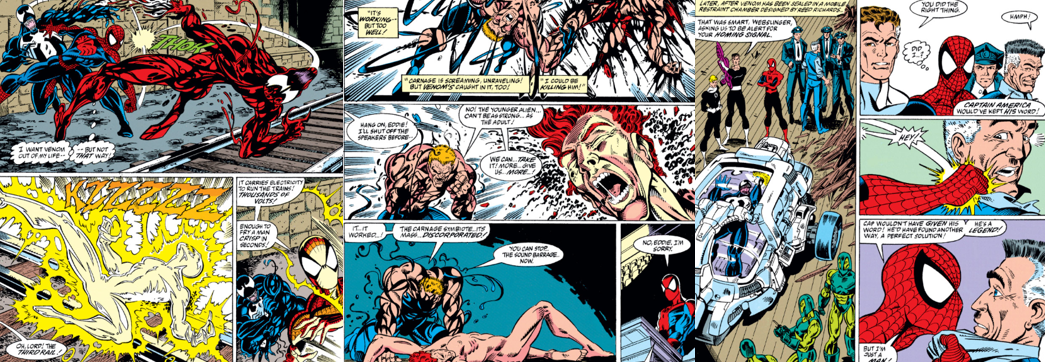
Spidey’s forced to make some tough decisions to end Carnage’s threat, which costs many lives.

Venom shares that Cletus was a natural loner who preferred to listen to heavy metal music than exercise (relatable!) and theorises (correctly) that Carnage has inherited both Peter and Venom’s powers. Though concerned about Venom’s own crazed morality and alarmed by Carnage’s body count, Spidey realises that Kasady plans to murder Jonah at a heavy metal concert at Madison Square Garden. When Carnage rushes the stage and kills a security guard, the braying crowd cheers him, assuming it’s part of the show, and quickly whips them into a violent mob with anti-authority rhetoric. When Spider-Man intervenes, Jonah selfishly tries to turn the situation to his advantage when Venom attacks Carnage. The fight drops into Penn Station, where Carnage slaughters innocent bystanders, keeps Spidey at bay with his darts, disrupts Venom with his stronger, “nastier” symbiote. Sensing the agony may kill Venom, Spider-Man knocks Carnage onto the live rail, but Kasady quickly recovers and targets Jonah again. While Venom tangles with their offspring, Spider-Man commandeers the venue’s sound system, setting the blasting both symbiotes with unbearable levels of sound. Despite the agony, Eddie demands Spidey keep going, correctly surmising that he’s strong enough to resist the pain. However, after Kasady collapses, his symbiote apparently evaporated, Eddie attacks Spider-Man, despite his weakened state, still convinced that Peter is evil. Luckily, Mr. Fantastic and the Human Torch arrive and subdue Venom, proving that Spidey never planned to honour their bargain. Not only does this convince Venom that Spidey’s no hero, Jonah’s also, incredibly, critical of Spider-Man for breaking his word, leading Spidey to lash out at the publisher and leave conflicted.

The Summary:
There’s no doubt that, by this time, Mark Bagley was the quintessential symbiote Spider-Man artist. Few are as synonymous with the flowing, monstrous creatures that Bagley, who gives a fluidity and life to the creatures that makes them both captivating and terrifying. Venom’s abilities were already near limitless, allowing them to reproduce Spider-Man’s webbing and wall climbing, simulate clothing, turn invisible, and circumnavigate Peter’s spider-sense. “Carnage” expands the symbiote lore, revealing they’re largely solitary creatures who don’t care for, nurture, or even consider their offspring. In fact, Venom seems enraged at having a spawn and driven to destroy it out of an inherent sense of superiority. Not only does Carnage have all of Venom and Spider-Man’s abilities, but he’s stronger and faster than both combined and can solidify his “other” in dangerous new ways, launching darts, axes, and forming bladed appendages. He also happily chokes his victims and even endangers babies, all for a sick thrill and to prey upon his enemy’s morals. Venom theorises that Kasady’s warped mindset has infected the symbiote as much as the “alien” environment, and it was interesting to see Kasady admonishing his “other” when it tried to “lecture” him. Most obviously, Carnage refers to himself as “I” and makes all the decisions, driven by a psychotic need to destroy social order, kill at random, and show that all life (and death) is random and chaotic. In this regard, Carnage is far worse than Venom, who has a twisted sense of morality and truly believes they’re saving innocents from evildoers like Spider-Man. While Venom kills to protect others and is clearly nuts, they still strive to save lives, whereas Carnage relishes taking life and happily pushes randomers in front of traffic or thrusts them through walls simply for fun.
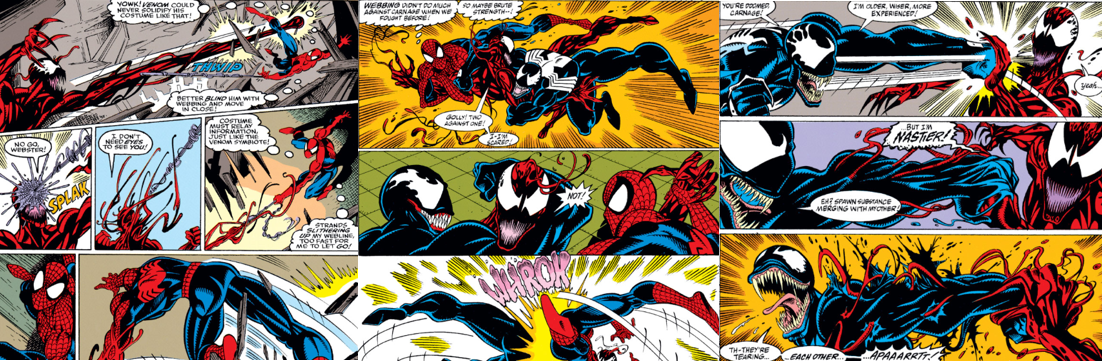
Carnage’s threat is so great that even Spider-Man and Venom combined have trouble defeating him.

This is apparent from Carnage’s appearance, with him seemingly formed from Kasady’s own blood, and Kasady’s decision to write warnings and messages in his blood. Portrayed as a psychotic, crazed serial killer, Kasady is also described as a polite and quiet man who pays his bills and doesn’t cause trouble. This is all a façade, however, as Kasady is deeply disturbed and clearly burned his childhood orphanage down, killing at least one person, and regresses to an unnerving, childish voice when in solitude. Kasady is almost comically without sympathy, painted as a cruel and sadistic killer who delights in causing random mayhem. Carnage is seemingly emblematic of the youth at the time, enjoying horror and heavy metal music and ranting against “the man”, to the point where a bunch of rockers are ready to kill purely on his word! Spider-Man is horrified by Kasady’s crimes, callous disregard for life, and incredible strength, which drives him to disregard M.J. and the Human Torch’s concerns and turn to Venom for help. This partnership is the highlight of the story as Venom continuously unnerves Spidey and makes him question his decision, singing “Strangers in the Night” and seemingly ready to snap at any moment. Spider-Man takes a huge risk partnering with Venom and undoing the ruse he tricked him with, but it turns out to be beneficial as Venom’s more concerned with eliminating his offspring than destroying his hated enemy. Venom proves invaluable, providing additional insight into the symbiotes, sensing Carnage’s presence, and holding the killer off so Spider-Man can think up a more permanent solution. “Carnage” doesn’t outstay its welcome (these days, it would probably be an eight-part story) but could probably have done with an extra issue to further explore Kasady’s backstory, though this would’ve unnecessarily humanised him. It’s not as deep or as impressive as other Venom or Carnage stories, but it’s a notable story for introducing one of Spidey’s most violent foes (and for its beautiful artwork!)

My Rating:

Rating: 4 out of 5.

Great Stuff

What did you think of Carnage’s violent debut? Were you a fan of Cletus Kasady or did you find him too random and crazy? Did you enjoy the team up between Spidey and Venom? Were you impressed by how different and psychotic Carnage was? What are some of your favourite Venom and Carnage stories and how are you celebrating Venom’s debut this month? Whatever your thoughts on Venom and Carnage, share them below, support me on Ko-Fi, and check out my other Venom and Spider-Man content.

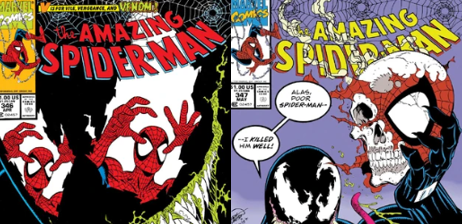
Back Issues [Venom Day]: The Amazing Spider-Man #346/347


To celebrate the release of Venom: Let There Be Carnage (Serkis, 2021), Sony Pictures declared September 27 “Venom Day”, a fitting date to shine the spotlight on one of my favourite anti-heroes, who made their first full debut in May 1988 and have gone on to become one of Marvel’s most iconic characters.


Writer: David Michelinie – Artist: Erik Larsen

Story Title: “Elliptical Pursuit”
Published: 12 February 1991 (cover-date: April 1991)

Story Title: “The Boneyard Hop!”
Published: 12 March 1991 (cover-date: May 1991)

The Background:
Back in 1982, Jim Shooter, then editor-in-chief for Marvel Comics, purchased Randy Schueller’s illustration of Peter Parker/Spider-Man in a slick black outfit for a cool $200. It was writer Tom DeFalco and artist Ron Frenz who made the costume a living organism and Spidey’s new duds appeared without explanation in The Amazing Spider-Man #252, with it later revealed that he picked up the suit in Marvel Super Heroes Secret Wars #8. Over the next year or so, Spidey revelled in the costume’s unique ability to form both clothing and organic webbing but was horrified when Doctor Reed Richards/Mister Fantastic revealed it was a living symbiote. Spidey summarily rid himself of the symbiote using a cacophony of church bells and switched to a cloth version, before eventually returning to his classic outfit. A mysterious assailant attacked and stalking Peter throughout 1988 it was revealed that the symbiote had bonded with disgruntled reporter Eddie Brock. Spider-Man’s dark doppelgänger was an immediate favourite of mine and many readers, eventually jumping to different hosts, with his sadistic, even more dangerous offspring, Cletus Kasady/Carnage, being teased in these issues.

The Review:
Although Venom’s second big appearance occurred in a two-part story in issues 346 and 346 of The Amazing Spider-Man, similar to their original first appearance, the character featured in a cameo in issue 345. Since it’s actually a pretty big cameo, I’ll quickly cover it before delving into the main story. “Gun from the Heart!” (Michelinie, et al, 1991) sees Spider-Man on the trail of noble, but misguided and violent, vigilante Elias Wirtham/Cardiac, with the added bonus of being promised $5000 by Silvija Sablinova/Silver Sable for apprehending him. The main reason this issue is important is two-fold: first, it shows Eddie Brock escaping from Ryker’s Island when his symbiote comes to bond with him once more. Second, it introduces readers to Brock’s cellmate, demented serial killer Cletus Kasady, who is unknowingly bonded with a small drop of the symbiote and would go on to become the sadistic Carnage. While Spider-Man fails to apprehend Cardiac in the main plot, the issue ends with Venom being reborn and swearing to avenge themselves against the wall-crawler. This perfectly sets us up for “Elliptical Pursuit”, which immediately re-establishes Venom’s warped moral code when they chastise fellow former reporter Sly Fenster for selling confidential files on the downlow before expressing regret when their webbing accidentally suffocates the corrupt reporter. The story then jumps over to Grand Central Station, where Peter’s wife, Mary-Jane Watson-Parker/M. J., is unimpressed at being spirited away to her sister’s. Having heard about Brock’s escape and the symbiote’s breakout from the Baxter Building, and fearing for M. J.’s safety, Peter convinces her to leave lest Venom targets the bombshell redhead like last time.

Venom returns with a vengeance, constantly blindsiding Spidey with their superior strength.

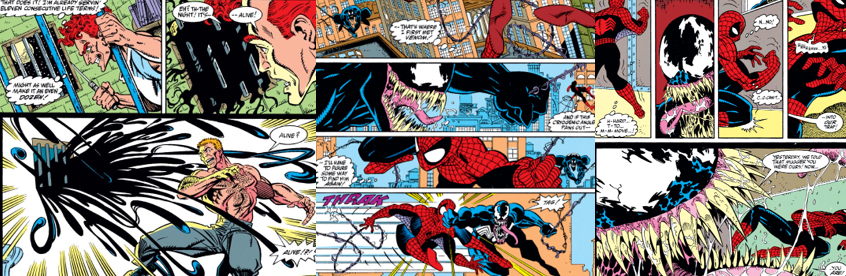
Despite knowing M. J’s safe, Peter’s thoughts dwell on Venom’s threat. Unwilling to put any of his allies in danger, even his former lover and part-time vigilante Felicia Hardy/The Black Cat, Peter resolves to face Venom alone, reasoning that it’s his responsibility since he technically created the creature and their hatred of him. He’s so lost in thought that he forgets that Venom doesn’t trigger his spider-sense and is caught off-guard when Brock accosts him at a coffee shop. Brock calmly convinces Peter to take a walk, expositing how his “other” survived an earlier confrontation with the cancer-inducing Styx and happy to settle their business down a back alley. However, they’re jumped by a mugger, who’s summarily dispatched (non-lethally this time) by Brock, though Peter uses the distraction to flee to a hotel for the night. A seemingly random phone call from Professor Evan Swann inspires Peter to swing on over to Empire State University and check out their cryogenics lab, hoping to find a weapon that can neutralise Venom similar to how extreme heat and sound defeated them before. Once again forgetting his reliance on his spider-sense, Spider-Man is blindsided mid-swing by Venom, who gleefully lays in a beating on the web-slinger. Experience and agility allow Spidey to create some distance, though Venom easily closes it by hurling a girder. With Venom distracted keeping innocent lives safe when their fight causes damage to the Bronx Zoo, Spider-Man goes on the offensive, giving Venom a taste of their own medicine and angering the unstable symbiotic pairing. However, Venom regains the advantage by using their uncanny ability to assume other forms, tricking Spider-Man into entering the cryogenic chamber, where the extreme cold forces the troubled superhero to blackout and be left at Venom’s mercy.

Overpowered, Spidey outwits his foe by faking his death.

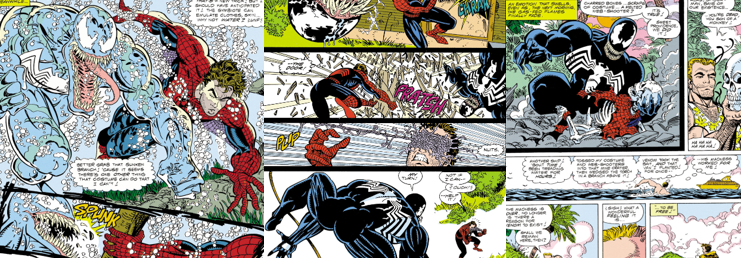
In the next issue, Spider-Man slowly dethaws and awakens on a sweltering beach, confused to find himself trapped on a deserted island with (and courtesy of) his most lethal foe. Not willing to allow for any distractions or let innocent bystanders get in the way of their combat, Venom proposes a fight to the death to settle their grudge and relishes chasing his foe through the dense foliage. Though terrified by the creature’s threat, Peter desperately forces himself to adapt to and out-think his foe but is again blindsided by a clever sneak attack when Venom renders themselves invisible and attacks from a stream, nearly drowning Spidey before he fights his way free using a nearby tree branch. Venom’s abilities constantly give them the edge even when Spidey calls upon the Eagle Scout training his former bully-turned friend Eugene “Flash” Thompson tried to teach him and lay traps for his foe. Venom’s ability to blend into their surroundings forces Spidey to rely on his speed and agility instead. Even when Venom is caught in Spidey’s snare trap, the creature easily overpowers him but, when Venom hurls a truck at his hated enemy, he unwittingly causes Spidey to stumble upon an abandoned mine full of gas. After using the mine to escape Venom, Spidey tries to swim to a boat on the horizon, only to end up tangled in Venom’s living webbing. Tackling his way out of the situation with a desperate lunge, Peter stumbles upon some macabre shallow graves and finally realises that their conflict will only end with his death. Spidey thus lures Venom into the jungle with a flaming torch and goads them into hurling another truck, this time resulting in a spectacular explosion that leaves Spider-Man nothing but a shredded skeleton. Overjoyed at having finally defeated their foe, Venom resolves to live out the rest of their existence in peace on the island, blissfully unaware that they’ve been fooled by an obvious trick. Having dressed a skeleton in his costume, Peter faked his death and swam out another passing boat, breathing a sigh of relief knowing that Venom’s menace has forever been put to bed.

The Summary:
After a dramatic and horrifying first appearance, it was pretty exciting to see Venom return, more unhinged and psychotic than ever. What I love about Eddie Brock is that he’s convinced himself that everyone, especially Spider-Man, is to blame for his lot in life. He takes no personal responsibility for the actions that led to his downfall and has convinced himself that he’s on a righteous, God-given mission to protect the innocent and destroy Spider-Man. This twisted ethical code means he’s vehemently against the killing of innocents and will even be distracted from his vendetta to protect them, but also leads to him both knowingly and unknowingly using lethal force to get what he wants. Similarly, he’s not above threatening Peter’s loved ones, which is exactly why Peter sends M. J. away and refuses Felicia’s help since he doesn’t want to be distracted by protecting them or burdened by putting them in danger. Indeed, Peter acknowledges that others have aided him against Venom before and he’s now put himself in greater danger by going solo. This is exacerbated by just how dependent Spidey is on his spider-sense; normally, he can swing around mulling over his personal dramas and always rely on his spider-sense to warn him of danger. But Venom doesn’t trigger it, so they constantly gets the jump on Spider-Man, almost to the point of parody in just these two issues as Peter seemingly never learns to adapt to this, forgets about it, or cannot find a way to compensate for the loss of his spider-sense.

A brutal conflict ultimately results in Venom finding solace in believing they’ve killed their enemy.

Since Venom is bigger, stronger, and completely out of their mind, Spider-Man is forced to stay on the move and rely on his experience and agility. Time and again, this puts him on the back foot; even when he does reach the university labs, he’s easily fooled by Venom’s camouflage ability and rendered unconscious. I loved the island setting for their final confrontation, which essentially put them on even ground since there were no innocents to worry about or tall structures to swing from, but Venom had the advantage because of their familiarity with the island and their unique abilities. Luckily for Spidey, Venom likes to toy with their prey and relishes the chase, giving Peter multiple opportunities to think up plans to subdue and ultimately trick his psychotic foe. Essentially, these two issues are a prolonged chase and fight sequence; Erik Larsen is one of the quintessential Venom artists, closely emulating Todd McFarlane’s style and giving Venom their gruesome teeth and tongue, so the action is always kinetic and visually striking. It’s not enough to tide over the story, though; the sub-plots regarding Felica and M. J.’s worries about Peter, his beloved Aunt May’s romantic life, and the loose thread regarding Cardiac help break up the pace but distract from the main appeal of the stories. It would’ve been nice to see Venom do more to torment Peter, especially in the first issue. They work great as a creepy stalker and that aspect is only briefly touched upon before the two are trading blows between the city skyscrapers. Similarly, the island battle quickly becomes repetitive as Spidey goes on the run, gets blindsided, and goes on the run…only to be blindsided again. These issues seem to have been produced to put Venom’s threat to bed; they’ are content and happy believing they’ve killed Spider-Man. Michelinie even leaves a tease that a version of the symbiote will live on through Kasady, making me wonder if this was supposed to Venom’s last appearance. As is, it’s a decent enough sequel to Venom’s first appearance, most notable for being the first appearance of Kasady, that indirectly leads to one of Spider-Man’s most violent and tedious crossover events later down the line.

My Rating:

Rating: 3 out of 5.

Pretty Good

What did you think to Venom’s big return? Did you ever think Cletus Kasady would become one of Spider-Man’s most notorious rogues? What did you think to Venom’s characterisation as a self-righteous psychopath? Did you find the conflict tedious in Venom’s repeated blindsiding of Spidey? What is your favourite Venom story and how are you celebrating Venom’s dramatic debut? Whatever your thoughts on Venom, share them down below and be sure to check out my other Venom and Spider-Man content.
Movie Night: Spider-Man: Across the Spider-Verse

This review has been supported by Chiara Cooper.
If you’d like to support the site, you can do so at my Ko-Fi page.

Released: 2 June 2023
Director:
Joaquim Dos Santos, Kemp Powers, and Justin K. Thompson
Distributor:
Sony Pictures Releasing
Budget:
$100 million
Stars:
Shameik Moore, Hailee Steinfeld, Oscar Isaac, Jason Schwartzman, Jake Johnson, Daniel Kaluuya, and Brian Tyree Henry

The Plot:
Miles Morales/Spider-Man (Moore) is at a crossroads in life when his multi-dimensional friend and crush Gwen Stacy/Spider-Woman (Steinfeld) re-appears, now part of a sprawling society of Spider-People led by Miguel O’Hara/Spider-Man 2099 (Isaac). However, Miles is forced to pick between his world and his family when Doctor Jonathan Ohnn/The Spot (Schwartzman) threatens both, bringing him into conflict with the Spider-Society.

The Background:
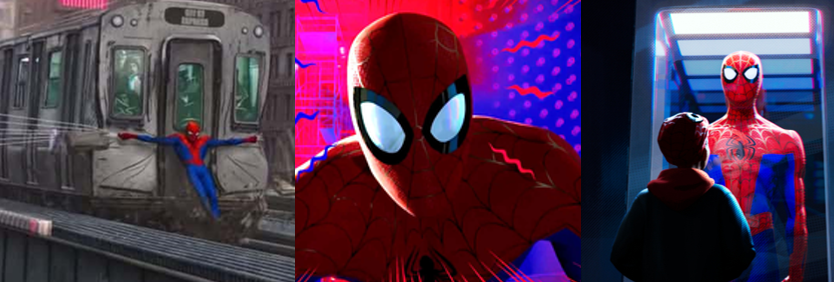
Back in 2011, writer Brian Michael Bendis made the bold decision to kill off Peter Parker/Spider-Man in the pages of Ultimate Spider-Man (2000 to 2011) and replace him with a younger character, Miles Morales, an African American youth of Puerto Rican descent. Though this caused much controversy at the time. Miles quickly became a popular character and branched out into cartoons, videogames, and even the mainstream Marvel continuity (“Earth-616”). After the poor reception of The Amazing Spider-Man 2 (Webb, 2014) saw Spider-Man incorporated into the Marvel Cinematic Universe (MCU), Sony pushed forward with Spider-Man-adacent films separate from the MCU, including the visually spectacular Spider-Man: Into the Spider-Verse (Persichetti, Ramsey, and Rothman, 2018), a Miles-centric story that became a critical and commercial success. Production of a sequel began immedately after the release of the first film and the plan was always to expand upon the multiverse concept in the sequel, which would necessitate splitting the sequel into two parts. The film greatly built upon the concept of multiple Spider-People, writers Phil Lord and Christopher Miller were encouraged by infamous Spider-Man producer Avi Arad to include the Spot as an antagonist, and different art and animation styles were painstakingly incorporated to make each character unique. After being delayed due to the COVID-19 pandemic, Spider-Man: Across the Spider-Verse opened to a massive $563.1 million worldwide gross and universal praise; critics loved the visuals and action-packed adventure and the road seems clear for subsequent sequels and spin-offs.

The Review:
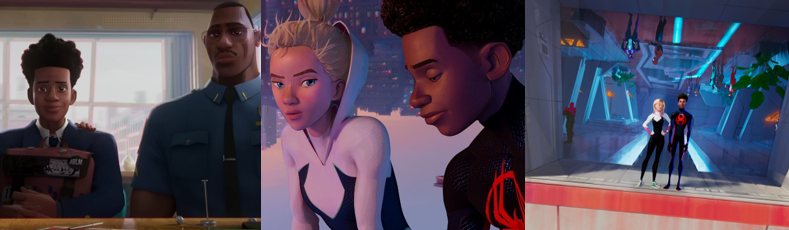
It’s probably not too surprising to say that I really enjoyed Spider-Man: Into the Spider-Verse. While I don’t always agree or like that a street level superhero like Spider-Man is so often at the epicentre of massive multiversal stories, it was a breath of fresh air as both a superhero and animated film. The visual storytelling on offer was nothing short of spectacular and I think it went a long way to cementing in the minds of the mainstream audience that there is more than one Spider-Man out there. That groundwork is taken to the nth dimension in the highly anticipated sequel, which picks up with Miles just over a year after the last movie and finds him a little older, a lot more confident with his spider powers and unique abilities (such as his electrical “venom sting” and camouflage ability), and generally pretty beloved by the citizens of New York City. He has a working relationship with his father, soon-to-be Captain Jefferson Morales (Henry), who remains ignorant of his son’s dual identity, and has made a name for himself as the heroic friendly neighbourhood Spider-Man. Unfortunately, as is often the case for Spider-Man, this success doesn’t translate to every aspect of his life; despite his high grades, his absence from school has been noted and he’s under pressure to take his first tentative steps into adulthood, something made all the more difficult for him not just because of his responsibilities as Spider-Man but his guilt about lying to his parents about his extracurricular activities and the smothering he receives from his doting mother, Rio Morales (Luna Lauren Vélez), who struggles as much as Jefferson with how quickly Miles is growing and the fear of losing him to the wider world.

Miles and Gwen reconnect, only for him to realise the multiverse harbours great hardship.

Because of this, Miles feels very alone; while his roommate (and only friend), Ganke Lee (Peter Sohn) knows his secret identity, he’s mainly just a cameo and refuses to be Miles’ “guy in the chair” and, since Miles doesn’t dare reveal himself to his parents, he’s left pining for Gwen and internalising a lot of his issues, particularly his grief for his beloved uncle, Aaron Davis/The Prowler (Mahershala Ali),. His only true freedoms come from his artwork and his web-slinging; Spider-Man offers Miles a freedom unlike anything else and allows his confident, snarky attitude to rise to the forefront, but this ends up biting him the ass when he treats newly turned supervillain the Spot like an afterthought, causing the former physicist to exponentially increase his power to avenge himself on Spider-Man. Miles initially thinks very little to the Spot, especially when Gwen suddenly reappears in his life; the film’s opening delves much deeper into Gwen’s own tragic backstory, which saw her isolate herself from others after the death of her best friend, Peter Parker (Jack Quaid), after he’d transformed himself into a lizard-man. Since her father, Captain George Stacy (Shea Whigham) blames Spider-Woman for Peter’s death, Gwen is similarly unable to properly open up to her dad and, when he first meets Spider-Man 2099 and the enigmatic Jessica Drew/Spider-Woman (Issa Rae), she’s granted an opportunity to leave her world behind rather than face her pain. Although it’s fairly clear that Gwen has missed Miles as much as he has her, she remains guarded; her duties to the Spider-Society dictate that she has to keep her distance from Miles, but she can’t help reconnecting with him since he’s the only friend she has in the entire multiverse, despite all the new allies she’s made. Her affection for him drives her to hide the Spider-Society’s true purpose from him since he’s destined to rise through horrible tragedy, yet she can’t help but admire his enthusiasm and desire to do the right thing, saving everyone whenever possible, even in the face of overwhelming odds.

Miles’s disregard of the Spot is nothing compared to the wrath of the ruthless Spider-Man 2099.

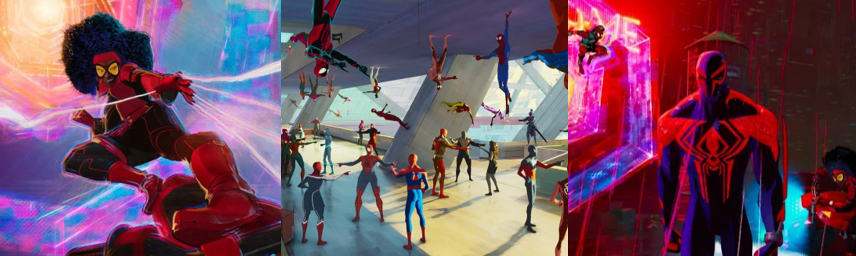
This is just one of many reasons why Miles follows Gwen through an interdimensional portal to Earth-50101, where they encounter the free-spirited and confident Pavitr Prabhakar/Spider-Man India (Karan Soni). Joined by Gwen’s fellow Spider-Society member, the anarchist and anti-authoritarian Hobart “Hobie” Brown/Spider-Punk (Kaluuya), the four team up to tackle the Spot once more after he escapes, realises the vast potential of his organic dimensional portals, and seeks to add to his power by absorbing energy from particle accelerators across the multiverse. While the Spot might be a deranged, deluded villain who struggles with his often-unpredictable powers, his confidence and mania grow alongside his powers, transforming him into a nightmarish creature capable of ripping entire timelines to shreds. A strange bond links him to Miles, allowing the young Spider-Man to see glimpses of the future and act accordingly; however, this is the catalyst that brings him under the scrutiny of Spider-Man 2099 since Miles interfered with a “canon event”, a life-altering moment in Pavitr’s destiny that was fated to make him a greater hero. The consequence of altering this sees Pavitr’s world threatened by a raging black hole, something Spider-Man 2099 has witnessed happen first-hand after he innocently replaced a version of himself and was forced to watch his surrogate family and timelines vaporise before his eyes as a result. Thanks to his connection to the Spot, Miles realises that his father’s death is set to be his canon event and his natural instinct is to save him, only to be imprisoned and threatened by Spider-Man 2099 and the majority of the Spider-Society since they cannot allow one life to threaten the delicate tapestry of the titular Spider-Verse. A stoic, aggressive, and driven individual, Spider-Man 2099 is absolutely relentless in his pursuit of Miles; he has no compunction about ordering the entire Spider-Society to pursue him when he escapes and tries to break him, mentally and physically, rather than allow him to risk his entire world. His ruthless pursuit casts Spider-Man 2099 as much of a villain as the Spot; though he maintains that he’s doing what’s necessary to keep the multiverse stable, his actions have caused great personal tragedy for countless Spider-People, though many of his followers (including Miles’ mentor, Peter B. Parker (Johnson), and Gwen) are strangely onboard with Miguel’s methods since it’s deemed necessary to birth greater heroes.

The Nitty-Gritty:
This questionable morality is as much at the heart of Spider-Man: Across the Spider-Verse as its ruminations of life, responsibility, and adulthood. The film is surprisingly complex in its portrayal of Miles’ relationship to his parents; both feel they’re losing him since he’s becoming a young adult and are frustrated by his obvious lies, and Miles equally is torn between wanting to share himself with them and the fear that they won’t understand. Gwen witnessed this rejection first-hand when her father initially reacted in horror at finding out Spider-Woman was his daughter and was inspired by Miles to return to her father and reconcile with him since she’s tired of running from her path and feeling alone and is struggling with her actions since joining the Spider-Society. Both Miles and Gwen feel alone and like they have no one to confide in, but only Miles feels ostracised from everyone; his friends, family, and even the wider Spider-Verse since Gwen is cagey about their recruitment specifics, and he seems to be the only Spider-Man not part of the team. This is because he hasn’t had his canon event yet, but the film’s a little iffy on that: here, it seems to be the death of a police captain that spurs the Spider-People on, yet Miles lashes out at the various Spider-People for letting down the teachings of their uncles and both Miles and Gwen already suffered tragic losses that you’d think would be catalyst enough for their growth as heroes. I do think that the reveal of the Spider-Society’s true purpose should’ve been handled differently as it’s weird to me that so many Peter Parkers were willing to let even one person die, no matter the stakes, and I wonder if it would’ve been better to reveal that Spider-Man 2099 had been deceiving all of them.

The film’s stunning visuals allow each Spdier-Person to stand out amidst various bizarre universes.

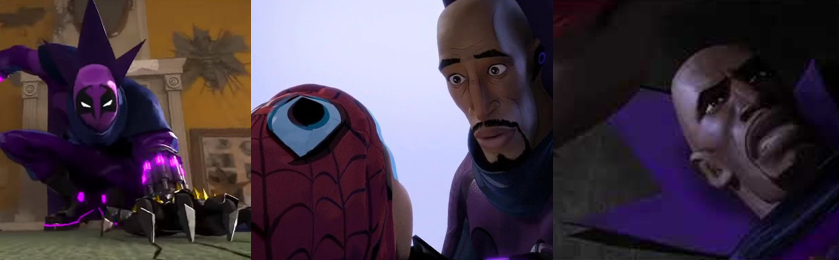
As intense and thought-provoking as the character interactions and themes of the movie are, Spider-Man: Across the Spider-Verse excels in its visuals. The film takes the unique frame rate and cartoonish, comic book-stylings of the first movie and ups the ante to make every Spider-Person feel unique. Gwen’s world is rendered very differently from Miles’s, being mostly pastels and having an almost brushstroke effect; Spider-Punk animates jerkily, like a living piece of Sex Pistols artwork, and the attention to detail in the animation, background details, and little things like thought boxes and sound effects popping up onscreen really add to the exhilarating, pop art appeal of the film. There are some gorgeous shots here, too, such as when Miles and Gwen sit upside down and gaze upon the inverted city, rain and night effects are used for fantastic dramatic detail, and I especially enjoyed how 2099 was brought to life as a sprawling, high-tech utopia above ground and a dark, depressing, neon-spawned underbelly below. This translates into the web-slinging, which is easily the best we’ve ever seen from a Spider-Man movie since the action is only limited to the animator’s imagination. All the Spider-People web-sling and fight differently, with the pregnant Jessica Drew doing her best Akira (Otomo, 1988) on her motorcycle and spewing webs from her fingertips, Spider-Punk leaping into battle with a guitar, and Pavitr incorporating a little wooden accessory into his webbing. For me, the standout in this regard was Spider-Man 2099; as morally reprehensible and ruthless as he appears, his fighting style and web-slinging are a force to be reckoned with. Utilising energy webs and sporting both talons, fangs, and bladed appendages alongside his bad-ass suit, Spider-Man 2099 is more feral than the other Spider-People and carves a swath of destruction in his pursuit of and attack upon Miles. Although clearly outmatched, Miles manages to elude and survive even Spider-Man 2099 thanks to being an “anomaly”; the spider that bit him wasn’t even from his Earth, making him unpredictable (and, for Miguel, potentially dangerous) and accounting for his ability to fend off multiple, more experienced Spider-People and exercise a moral integrity that’s sadly abandoned many of his counterparts.

An exhilarating cliff-hanger sees Miles’ attempts to save his dad, and his world, in jeopardy.

This all comes to a head when Miles frantically uses Spider-Man 2099’s elaborate, spider-based machine to return home, desperate to save his father’s life and keep his world from being consumed by the Spot’s wrath, only to find that he’s been deposited on the wrong Earth. This is quite the twist for both Miles and Gwen, who followed him to try and help, and doubly so since Miles actually found the courage to reveal his dual identity to his mother, only to be stunned to find that his uncle is alive and well in this world, which lacks a Spider-Man since its spider bit him instead. Here, Miles finds himself strung up and held at the mercy of his uncle and his Earth-42 counterpart (Jharrel Jerome), a bad kid who has taken up the mantle of the Prowler. With Spider-Man 2099 and his lieutenants scouring the multiverse to find Miles and keep him from saving his father’s life, Gwen reconciles with her father and recruits her own band of Spider-People to help Miles and end the film on a massive and exhilarating cliff-hanger. I can’t say that I saw this twist ending coming at all; the film is so enjoyable to watch that I would’ve happily sat through another hour of it, and things were really ramping up at the end so it’s exciting to imagine where the next part will go and seeing Miles reunite with his friends from the first movie. The entire film is stuffed with cameos from Spider-People from all across the multiverse, including live-action cameos from the likes of Andrew Garfield and Donald Glover (as an alternative version of the Prowler), persistent voice cameos from J.K. Simmons as J. Jonah Jameson (proving beyond a shadow of a doubt that J.K. just is Jonah in every dimension), and references to both past and current versions of Spider-Man (the recent multiverse shenanigans of the Marvel Cinematic Universe are mentioned at one point). It never feels glorified or out of place, to be fair, and it’s fun spotting and following some of these background Spider-People, though again I do find it odd that so many subscribe to Spider-Man 2099’s logic. There was a point where Miguel is seen injecting himself with something, and Miles points out how he’s more like a vampire than a spider, so I wonder if this’ll factor into the next film, perhaps revealing that Miguel is actually his brother, Gabriel, or someone like Morlun. There’s also the threat of the Spot to wrap up, too; I liked how he was driven to prove himself, just like Mils, but went to destructive extremes and I’m sure that’ll result in a spectacular final showdown involving more than a few Spider-People!

The Summary:
I was blown away by Spider-Man: Across the Spider-Verse. I expected it to be a visual treat but it overdelivered in this regard; I loved how all the Spider-People looked and felt very different, even if just in small ways, to really emphasise that all these different versions are just as valid and “real” as the other. You could spend hours going through every frame looking for cameos and little details, like frames of animation and visual quirks, and still not catalogue everything on offer here; at times it’s almost underwhelming, but it results in easily the best visually impressive Spider-Man action we’ve ever seen in cinema. At then, alongside all that, there’s a really heartfelt and relatable story of a kid trying to find his place in the world, somewhere to belong, and mature into adulthood. I really felt for both Miles and Gwen here and enjoyed how they had such a strong connection together, and it was harrowing seeing him being excluded from even her world because of things he wasn’t yet experienced enough to understand. I loved how Spider-Man 2099 was so tortured by his mistakes that he’s hell-bent on ensuring that no other worlds die because of a Spider-Person’s selfishness; it made his motivations very understandable and contributed to his manic aggression, but also made for a compelling antagonistic character. The Spot may be a joke, but he becomes a force to be reckoned with throughout the movie and I’m excited to see how he’ll be brought down and the further clash of webs and ideals between the various Spider-People. While I took issue with so many Peters and Peter proxies signing up to Miguel’s harsh philosophy, it doesn’t take away from how stunning this movie is as a piece of art. Spider-Man: Across the Spider-Verse has raised the bar not just for Spider-Man movies, but for the animation genre itself and, while I would still like to step away from multiverse shenanigans in Spider-Man movies, it’s hard to deny how incredible impressive and well-executed this film is.

My Rating:

Rating: 5 out of 5.

Fantastic

Did you enjoy Spider-Man: Across the Spider-Verse? What did you think of the different animation styles of the various Spider-People? Which of the alternative Spider-Man was your favourite? What did you think to Miles’ struggles? Do you agree with Spider-Man 2099 or do you think that the other Spider-People are betraying the core concepts of their characters? What other Spider-People would you like to see in the next film? Whatever your opinions on Across the Spider-Verse, go ahead and drop them in the comments and be sure to check out my other Spider-Man content across the site!

Movie Night [Spidey Month]: Spider-Man: Into the Spider-Verse


Easily Marvel Comics’ most recognisable and popular superhero, unsuspecting teenage nerd Peter Parker was first bitten by a radioactive spider and learned the true meaning of power and responsibility in Amazing Fantasy #15, which was first published in August 1962. Since then, the Amazing Spider-Man has featured in numerous cartoons, live-action movies, videogames, action figures, and countless comic book titles and, in celebration of his debut and his very own day of celebration, I’ve been dedicating every Wednesday to talk about everyone’s favourite web-head!


Released: 14 December 2018
Director:
Bob Persichetti, Peter Ramsey, and Rodney Rothman
Distributor:
Sony Pictures Releasing
Budget:
$90 million
Stars:
Shameik Moore, Jake Johnson, Hailee Steinfeld, Mahershala Ali, John Mulaney, Kimiko Glenn, Nicolas Cage, and Liev Schreiber

The Plot:
After being bitten by a radioactive spider and gaining the proportionate strength and agility of the arachnid, Miles Morales (Moore) finds himself caught up in an elaborate plot by Wilson Fisk/The Kingpin (Schreiber) to cross dimensions. In the process, Miles is mentored by, and joins forces with, other incarnations of Spider-Man from across the multiverse while stull struggling to carve out his own identity in the role.

The Background:
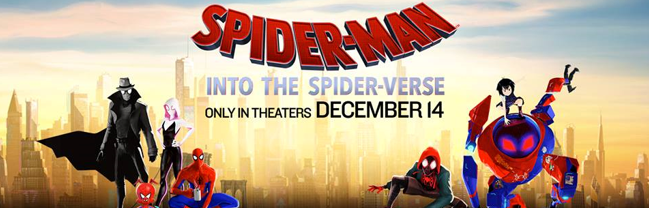
In 2011, writer Brian Michael Bendis decided to kill off Peter Parker/Spider-Man and replace him with a younger character in the pages of Ultimate Spider-Man (2000 to 2011), Miles Morales, an African American youth of Puerto Rican descent, a decision which created much controversy at the time. Miles, however, soon became a popular character and appeared not just in cartoons and other merchandise but also the mainstream Marvel continuity (“Earth-616”). After the poor reception of The Amazing Spider-Man 2 (Webb, 2014) led to Spider-Man finally being incorporated into the Marvel Cinematic Universe (MCU), Sony were determined to continue producing Spider-Man films and spin-offs separate from the MCU. Writers Phil Lord and Rodney Rothman chose to focus their efforts on Miles since he hadn’t yet featured in a film and, to further separate the project, it included not only Spider-People from across the multiverse but also a distinct and intricate animation style that was as vital to the story as the music and dialogue. Spider-Man: Into the Spider-Verse received unanimous praise upon release and made over $375 million at the box office, won numerous awards, and is highly regarded as one of the best and most unique Spider-Man movies ever made. Its massive success meant that both a sequel and a spin-off were soon announced and no doubt contributed heavily to Miles’ continued popularity.

The Review:
First and foremost, Spider-Man: Into the Spider-Verse is Miles Morales’ story, even amidst all the chaos and multiverse madness permeating the plot; unlike the traditional Peter Parker, Miles’ parents are still alive and, while he struggles to adjust to boarding school and to make new friends, he’s nowhere near the social outcast Peter is often portrayed as during his teenage years. A big fan of music (though he is amusingly poor at reciting lyrics) and with an artistic flair, Miles is a slightly rebellious and resentful youth who struggles to live up to the expectations of his father, Jefferson Davis (Brian Tyree Henry), a police officer who regards Spider-Man (Chris Pine) as a menace and delights in embarrassing his son at his new school with typical dad humour. A somewhat streetwise kid who was a popular figure at his old school, Miles is largely an outsider at his more officious and pretentious boarding school; he’s uncomfortable in the mandatory uniform, feels like he doesn’t really fit in, and is intentionally trying to sabotage his future there so he can go back to his old school and his old friends. Believing that his father doesn’t really understand him or his dreams, Miles has a far closer relationship with his uncle, Aaron Davis (Ali), who encourages his penchant for street art and actually takes the time to connect with him on a more peer-to-peer level. To Jefferson’s chagrin, Miles idolises his uncle, who indirectly leads to him gaining his spider powers.

Miles’ struggles with his spider powers are directly paralleled to the onset of puberty.

Already somewhat uncomfortable in his new environment, Miles’ newfound spider powers (which are explicitly compared to the onset of puberty) only increase his agitation; he struggles to adapt to and master his abilities, gaining a far louder and more noticeable internal monologue and accidentally attaching himself to Gwen Stacy’s (Steinfeld) hair in an awkward attempt to flirt with her. Interestingly, Miles’ exploration of his abilities is a source of as much entertainment and amusement as it is an integral part of Miles’ character development; throughout the film, Miles struggles to master his powers, which seem to trigger unconsciously or involuntarily, and a massive part of Into the Spider-Verse revolves around Miles living up to the lofty expectations now placed upon him by his amazing new abilities.

In Miles’ world, Peter is a competent, renowned, and experienced superhero.

Miles lives in an alternative world that isn’t quite Earth-616 or the Ultimate universe; it’s one that draws inspiration from all over Spider-Man’s various adaptations and interpretations but one where Spider-Man is a renowned and experienced superhero. Carrying himself with the confidence of a veteran of many battles, life lessons, successes, and failures, this Spider-Man is, honestly, uncharacteristically competent in a lot of ways (he’s still married to Mary Jane Watson (Zoë Kravitz), has the full support of his beloved Aunt May Parker (Lily Tomlin), and even has a Spider-Cave full of different Spider-Suits, for God’s sake). During an intense battle with the monstrous and demonic Norman Osborn/Green Goblin (Jorma Taccone) and the slick and efficient Prowler, Peter is shocked to meet Miles, someone who shares his abilities, and vows to train him and give him the opportunities he never had when he was first starting out, such is his commitment to using great power with great responsibility.

Kingpin may look ridiculous but he’s a formidable threat who killed Peter with his bare hands!

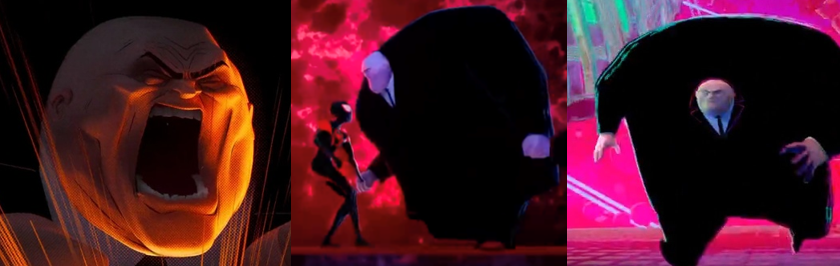
Sadly, and unexpectedly, Peter is killed right before Miles’ eyes by the Kingpin; Fisk, who blames Spider-Man for exposing his criminal deeds to the world and thus driving away his wife and son, has built a gigantic Super-Collider which he plans to use to rip a hole between dimensions and retrieve his family from another time and place. When Peter costs him this opportunity, Fisk beats him to death in a brutal and surprising scene and spends the remainder of the movie desperately trying to track down and reacquire the USB flash drive that allows the collider to work. Like Green Goblin, Fisk is a comically exaggerated version of himself, even compared to the creative flair of some comic book artists, but as preposterously absurd as Kingpin looks, his threat has, arguably, never been more tangible and brutal than in Into the Spider-Verse. Exuding unmatched power, wealth, and authority, he commands some of Spider-Man’s most notorious foes with a cold menace and is more than happy to get his hands dirty in his desperate attempt to be reunited with his family.

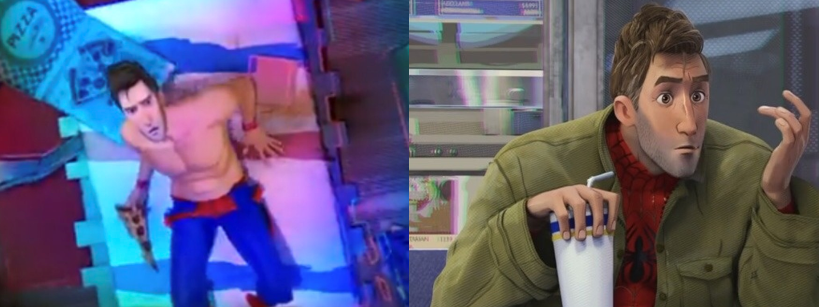
Peter B is an out of shape, world-weary version of Spider-Man who’s far from his prime.

Shaken by Peter’s death, and overwhelmed by the immense responsibility now in his hands, Miles is shocked to meet an alternative version of Peter, Peter B. Parker (Johnson), who arrived during the brief period that the Super-Collider was active. Unlike his counterpart from Miles’ world, Peter B is an out of shape, jaded, wreck of a man who has lost his way, and everything near to him, and yet, despite his crushing losses, obvious depression, and having grown weary of the power and responsibility that comes from being Spider-Man, Peter B still continues to be Spider-Man and does his best to tutor Miles in coming to grips with his powers. He’s obviously not as effective or competent a mentor than his counterpart promised to be but he does what he can regardless and is fully willing to put his life on the line to allow his fellow Spider-People to return home.

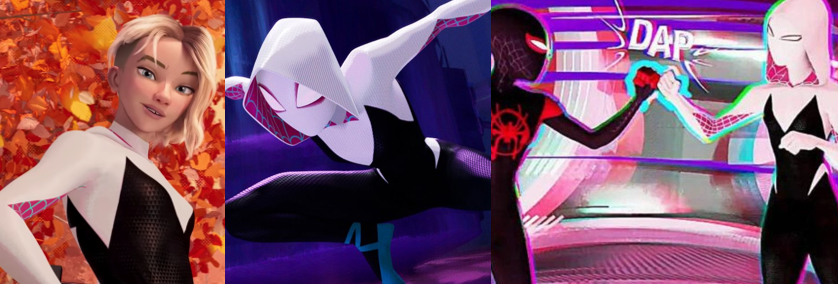
Thanks to her friendship with Miles, Gwen learns to open herself up to others once again.

Speaking of which, Miles is also joined by a whole host of unexpected Spider-People; the first one he meets is Spider-Woman, Gwen Stacy, although he is unaware of her true identity at the time. A vastly different version of the traditional Gwen, Spider-Woman gained her powers in Peter’s place in her world and is a tough, sarcastic character who, while having a soft spot for Miles, is reluctant to open herself up to him, or anyone else, for fear of losing them. In a film arguably crowded by Spider-People, Gwen stands out by being one of the more recognisable and fleshed out characters and is, basically, a tertiary protagonist as her growing friendship with Miles is a major part of her (and his) character development. Sadly, the same can’t really be said about the rest of the Spider-Crew; Peni Parker/SP//dr (Glenn) is perhaps the least developed and expendable of the group. While she is rendered in an outstanding anime aesthetic and has a heart-warming bond with her spider mech, she’s largely inconsequential to the story and could have been spliced out with any other version of Spider-Man. Spider-Noir (Cage) and Peter Porker/Spider-Ham (Mulaney) manage to stand out a little better thanks to being rendered in monochrome and talking like a thirties gangster or being a literal cartoon character, respectively, but we don’t really learn a great deal about them and they’re mainly there to emphasise that every universe has a Spider-Man and that Spidey’s legacy and ideals are carried by a variety of characters all throughout time and space, which all directly ties into Miles’ character arc of growing into, and finally accepting, his role as Spider-Man.
The Nitty-Gritty:
Spider-Man: Into the Spider-Verse immediately sets itself apart from other Spider-Man movies not just by focusing on Miles as its main character and its cross-dimensional subplot but also by virtue of being an animated movie. Truthfully, animation suits Spider-Man down to the ground as, often, some of the more exhilarating sequences in Spider-Man movies are the computer-generated fight scenes and web-slinging moments and Into the Spider-Verse definitely uses its medium to its full advantage, featuring a unique aesthetic, comic book-like sound effects for emphasis, and even varying the frame rate to emphasise the differences between the various Spider-People and Miles’ comparative inexperienced compared to them. Humour is an important element of the film; Into the Spider-Verse is full of amusing lines, sight gags, and comedic moments that come naturally and are incredibly amusing thanks to some effortless and believable line delivery from the likes of Moore, Pine, and Johnson (Spider-Man’s quips during tough situations and battles are a notable highlight). Characters have an easy banter and sass to them that allows even the least developed of them to appear far more nuanced in the short space of time they have to shine and humour is emphasised through Miles’ inexperience with his powers, wry commentary on his increasingly chaotic situation, and the frantic nature of the action scenes and character beats.

Action and fights are colourful and frantic, ensuring no two fights are the same.

Speaking of action, Into the Spider-Verse is crammed full of some of the most impressive, intense, and frenzied action scenes in any Spider-Man movie; the freedom offered by relying on animation allows for some of the most diverse and varied web-slinging as each Spider-Person swings, fights, and moves differently. The use of music and onomatopoeia emphasises the action, which is fast-paced, memorable, and impactful thanks to the film showcasing a wide variety of Spider-Man’s rogues gallery, which includes the likes of the Green Goblin, Lonnie Lincoln/Tombstone (Marvin “Krondon” Jones III), and Mac Gargan/The Scorpion (Joaquín Cosio).

Though a vicious mercenary, Aaron’s hesitation to kill Miles costs him his life.

Apart from Fisk, though, the most prominent villains of the film are Doctor Olivia Octavius/Doctor Octopus (Kathryn Hahn) and the Prowler; while Doc Ock is a sadistic and formidable, half-crazed scientist, it is the Prowler who has the most emotional significance to both the plot and to Miles. Constantly accompanied by an ominous, animalistic theme, the Prowler is portrayed as Fisk’s top mercenary; a brutal and vicious, cat-like fighter in a sophisticated suit of armour, Prowler stops at nothing to hunt down Fisk’s missing USB drive. Miles is absolutely devastated to find that the one person he thought he could rely on in the whole world, his Uncle Aaron, turns out to be the Prowler and even more crushed when, upon discovering Miles’ identity, Aaron chooses to spare his nephew and is executed by the Kingpin as a result and dies in Miles’ arms while urging him to continue on as a hero.

Miles finally embraces his role as Spider-Man, defeats Kingpin, and returns his new friends home.

In the end, against all the odds and his own doubts and inexperience, Miles customises one of Peter’s suits (crafting an absolutely bad-ass variant in the process) and fully embraces his role as Spider-Man to confront the Kingpin and put an end to his destructive scheme. It’s a real coming of age moment for Miles, who previously could only look up in awe at Spider-Man’s legacy, and allows him to not only finally live up to the lofty expectations placed upon him by his father and the various Spider-People but also repair his relationship with his father (and his father’s opinion of Spider-Man) through his actions. With the Spider-People returned home, Miles becomes the one true Spider-Man of his world, gaining lifelong friends and a renewed sense of responsibility, confidence, and identity in the process. It’s a strikingly effective story largely thanks to how relatable and complex Miles is portrayed throughout the film, being a rebellious and well-meaning kid who is simply struggling to find his place in an ever-changing world.

The Summary:
If I’m being completely honest, I’m not really a fan of how often a street-level superhero like Spider-Man gets caught up in multiversal misadventures and meets alternative versions of himself; just like how I’m often a bit perturbed by how often Bruce Wayne/Batman has to put up with the same events, I feel like Spider-Man works better as a more grounded hero who only occasionally dabbles in cosmic-level events. To that end, I feel like Into the Spider-Verse would have been just as appealing to me, if not more so, had the multiverse elements been dropped; Peter B could have just been the version of Spider-Man in Miles’ world, Gwen could have been the same or swapped out with Cindy Moon/Silk, and the other Spider-People could have been replaced by, say, Ben Reilly or Kaine Parker and the idea of a multiverse of Spider-Man could maybe have been saved for the next movie. However, having said that, that doesn’t mean I’m not a huge fan of Into the Spider-Verse as it is; make no mistakes about it, this is a fantastic movie from start to finish, with an extremely appealing aesthetic identity and some absolutely fantastic action. It also carries a very emotional heart to its story, which is one of identity, legacy, and expectation; a coming of age story that follows a young, emotional kid who is struggling to live up to the role his mentors expect of him, Into the Spider-Verse says a lot about not only the nature of Spider-Man but also the struggles of youth and puberty. I’m glad Into the Spider-Verse did so well and I’m genuinely looking forward to the sequel delivering more of the same high-octane action and heartfelt emotion, visual flair, as well as introducing more Spider-People and, hopefully, expanding upon the brief cameo from one of my favourite Spider-Man, Miguel O’Hara/Spider-Man 2099 (Oscar Isaac).

My Rating:

Rating: 5 out of 5.

Fantastic

What are your thoughts on Spider-Man: Into the Spider-Verse? Where does it rank among the various other Spider-Man movies for you and what did you think of the artistic style and focus on Miles Morales and the other Spider-People? Which of the alternative Spider-Man was your favourite? Would you have liked to see one, or more, get a bigger role and if so, which one? What other alterative version of Spider-Man would you like to see show up in the sequel? Are you a fan of Spider-Man always having adventures with alternate versions of himself or would you prefer to see him tackling more street-level threats? Are you a fan of Miles, and what did you think to Peter’s death both in Ultimate Spider-Man and in Into the Spider-Verse? Whatever your opinion on Into the Spider-Verse, go ahead and drop a reply down in the comments and be sure to check back in next Wednesday as Spider-Man Month continues!

Screen Time [Spidey Month]: Spider-Man (1977 Pilot)


Easily Marvel Comics’ most recognisable and popular superhero, unsuspecting teenage nerd Peter Parker was first bitten by a radioactive spider and learned the true meaning of power and responsibility in Amazing Fantasy #15, which was first published in August 1962. Since then, the Amazing Spider-Man has featured in numerous cartoons, live-action movies, videogames, action figures, and countless comic book titles and, in celebration of his debut and his very own day of celebration, I’ve been dedicating every Wednesday to talk about everyone’s favourite web-head!


Air Date: 14 September 1977
Network: CBS
Stars: Nicholas Hammond, Lisa Eilbacher, Thayer David, David White, and Michael Pataki

The Background:
Following his debut in the pages of Amazing Fantasy #5, Spider-Man soon graduated to his own solo comic series and, by the mid-1970s, had become an icon of mainstream pop culture thanks to numerous merchandise and adaptations in other media such as the 1960s cartoon. It was during this time that CBS bought the rights to produce a live-action show for prime-time television; however, rather than debuting as an episodic series, The Amazing Spider-Man first aired as a feature-length episode that served as a back-door pilot. The pilot actually received a theatrical release outside of the United States, though I only remember seeing it on TV here in the United Kingdom once as a kid; regardless, the pilot was a success and led to the commission of a thirteen episode series that aired between 1977 and 1979.
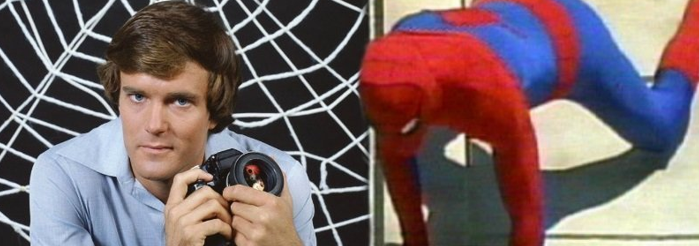
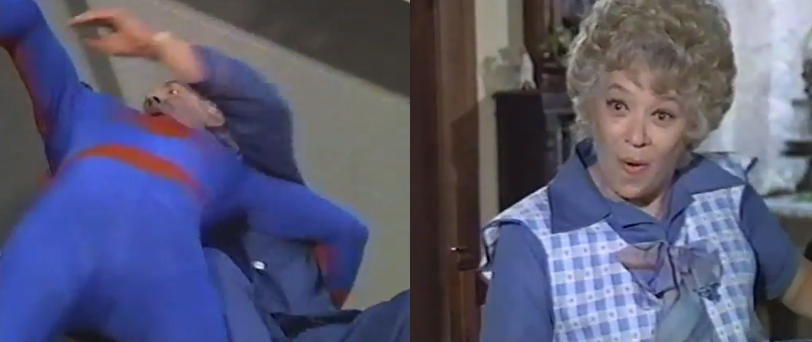
Spider-Man’s feature-length pilot led to a thirteen episode TV series.

Despite drawing favourable ratings during its airing, CBS were reluctant to continue the show as it was expensive to produce and underperformed with older audiences. As a result, the show was eventually cancelled and has never seen a re-release outside of a few VHS tapes back in the day. Although the series was lacking in any of Spider-Man’s recognisable rogues gallery, it’s rumoured that there were tentative plans to produce a crossover with the long-running Incredible Hulk series (1977 to 1982) but these, obviously, never came through. Today, the series is largely forgotten, having been long overshadowed by Spider-Man’s big budget live-action ventures but Peter’s likeness in the 1994 cartoon always reminded me of Hammond’s.

The Plot:
When freelance photographer Peter Parker (Hammond) is bitten by a radioactive spider and gains the proportionate strength, speed, and agility of a spider, he adopts a crime-fighting persona dubbed Spider-Man to oppose the aspirations of the malicious Edward Byron (David), who plans to hold the city to ransom with his mind control technology.

The Review:
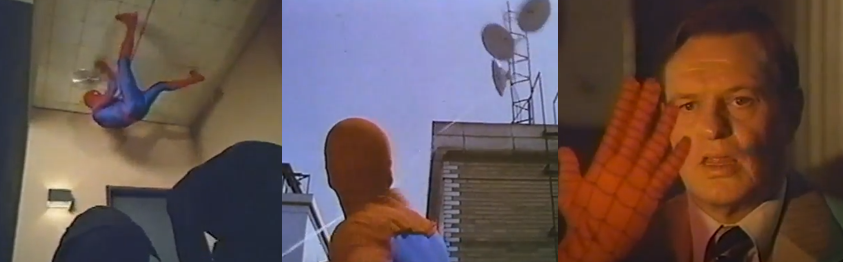
After the introductory titles (which features both a glimpse of the spectacular stunt work that the pilot and series was known for and the show’s super funky seventies theme music), Spider-Man immediately introduces the central antagonistic force of the plot as a doctor and a lawyer are inexplicably compelled to walk out in the middle of their jobs and perform a bank robbery, with the only thing relating the two being mysterious pins attached to their suits.

Peter struggles to sell photos to, or get assignments from, the grouchy Jameson.

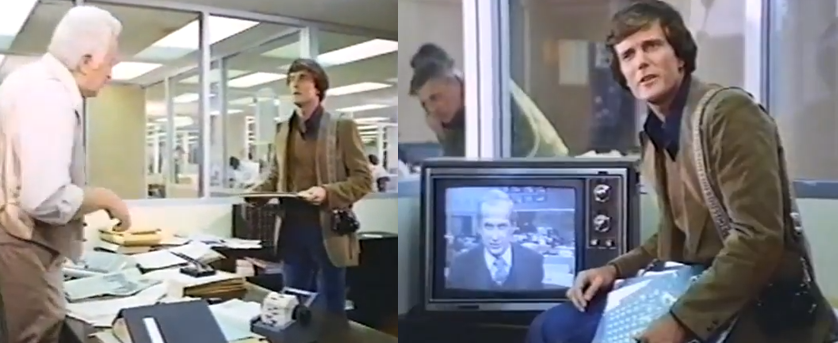
Next, we’re introduced to Peter Parker, a freelance photographer who suffers from allergies and is attempting to work his way through college by selling photographs to J. Jonah Jameson (White), to little avail. While Jameson is far less as explosive and grouchy than his usual iterations, he’s still volatile and a natural cynic at heart, especially when faced with the seeming randomness of the opening crime and the subsequent threat for further crimes to follow.

A lone spider is bathed in radiation during one of Peter’s experiments…

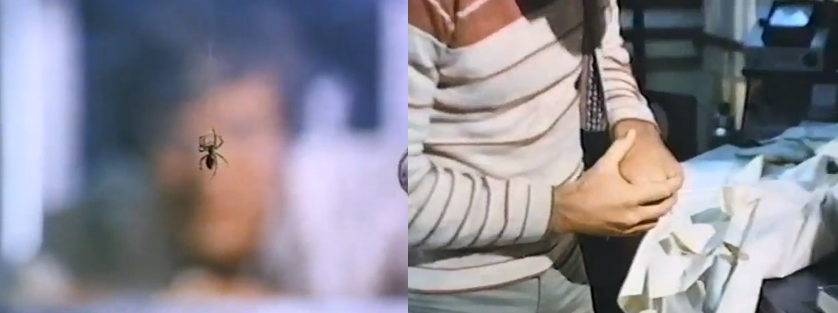
While Peter can’t catch a break with Jameson and is thus constantly low on cash, he’s intrigued by the threat of mass mind control that has been levied against the city and has far more luck in the field of science. Peter works in a laboratory alongside his friend and fellow student Dave (Larry Anderson) and the two of them are conducting experiments on radiation. However, while dealing with some radioactive waste, a lone spider is bathed in over 400 rads’ worth of radiation and, in its last desperate act, bites Peter’s hand.

Peter is exhilarated to find he can cling to walls and surfaces just like a spider!

I’m not entirely certain but I think this is the first time the spider bite was indirectly caused through Peter’s own actions and it’s an interesting change. Rather than going through any kind of adjustment period or troublesome transformation, Peter experiences the effects of the spider bite almost instantaneously, being aware of incoming danger thanks to his spider-sense and racing up a wall with ease and on pure instinct. It’s not until later, after a particularly gruelling night’s sleep, that Peter pieces together the fantastic event and realises that he has been genetically altered; this leads to a montage in which he explores the lengths of his new abilities on the outside of his Aunt May’s (Jeff Donnell) through the use of camera trickery.

After being dubbed “Spider-Man”, Peter throws together a costume to sell pictures to Jameson.

It’s not a great effect, and certainly nothing on the practical wire work seen later in the pilot, but it’s certainly ambitious for the time. Peter first puts his powers to good use while clambering up a wall in the city, which is startling enough to stop a purse snatcher (Barry Cutler) in his tracks. This leads to eyewitnesses dubbing him “Spider-Man”, which piques Jameson’s interest and, in that moment, gives Peter the inspiration to construct a colourful outfit and persona befitting of such a name and to explain Spider-Man’s logistics and capabilities to the pessimistic Jameson (and, in the process, the audience). While Peter acts on instinct to stop a criminal, his primary motivation for becoming Spider-Man is to sell Jameson pictures; there’s no Uncle Ben or lessons about power and responsibility here (which, I’m sure, today’s Spider-Man “fans” would throw a fit over!), just a regular kid trying to do the right thing and make some money out of little more than an ingrained sense of right or wrong.

Captain Barbara’s cantankerous, gruff demeanour was a real highlight for me.

In the course of the pilot, Peter runs afoul of the temperamental Captain Barbara (Pataki), a grouchy, cantankerous, and suspicious police captain who is kind of like the Jack McGee (Jack Colvin) of the show; perhaps because of his jaded nature, he is almost immediately suspicious of Peter and becomes even more so when Peter continues to show up at the scenes of the inexplicable crimes. Barbara is equally unimpressed with Spider-Man’s debut, believing (with little reason) that the wall-crawler is somehow involved in the mysterious events and voicing many of the more aggressive objections to the vigilante that are usually attributed to Jameson, who is skeptical of Spider-Man but never exhibits the hatred normally associated with the character.

Peter and Judy attend one of Byron’s aggressive seminars on the futility of life.

When covering the aftermath of another of the incidents in which Professor Noah Tyler (Ivor Francis) randomly committed a robbery and then crashed head-first into a wall, Peter meets his daughter, Judy (Lisa Eilbacher). Judy confides in Peter that her father has been attending a special group to teach people the “true meaning of themselves” through unusually aggressive lectures. This group, which is more like a cult or twisted church, is led by the pilot’s big bad, Edward Byron; Byron uses specialised radio signals to compel his victims to commit their crimes and is basically able to force anyone wearing one of his pins and subjected to his mind control device to follow his explicit instructions. Specifically, Byron has them commit robberies and then kill themselves and his end goal is extortion, as he threatens to kill several citizens unless he’s paid a ransom of $50 million. Byron exhibits a disdain for those in his group, and humanity in general, and believes himself to be above them both in terms of intelligence and stature; for all his grandiose speeches, though, he’s little more than a madman who wishes to exert and abuse his power and technology purely to satiate his greed.

Peter’s far from the hapless nerd from the comics and his ingenuity is heavily emphasised.

While Peter has some bad luck in the pilot, it’s generally more around trying to make money off the pugnacious Jameson and he’s far from the hapless, down on his luck nerd he is often pigeon-holed as. Instead, he’s a relatively well-adjusted young man who bonds with Judy extremely quickly and a central theme of the pilot is Peter’s intelligence and scientific acumen. Not only does he put together an impressive costume for himself but he quickly cobbles together his patented web-shooters and not only stumbles upon Byron’s hypnotic signal with his microwave emitter but also puts together a gadget to led him to the source of the signal.

Stuntman Fred Waugh took over once Peter donned the suit to perform the pilot’s dangerous stunts.

When in the costume, Spider-Man duties mostly fall to stuntman Fred Waugh, who adopts an agile grace and insectile posture that, possibly, was a conscious decision on Waugh’s part to emphasise the physicality of the character. The pilot features a number of complex and incredibly dangerous stunts achieved through the use of wire work, cables, rigging, and rotating sets; though you can make out some of the wires here and there, that doesn’t take away from the ambition of those involved and it’s because of this practical approach that, for the first time, we get to see a live-action Spider-Man literally climbing up the sides of buildings, leaping to ceilings and walls, and swinging across rooftops (something, even now, which is more likely to be achieved through CGI than traditional filmmaking techniques).

Spidey’s intelligence wins the day as much as his incredible strength and agility.

While these instances showcase Spider-Man’s agility, a protracted fight scene between the web-head and Byron’s three mind-controlled goons does a decent job of showing how formidable Spider-Man is (and, in a follow-up confrontation, his amazing recuperative powers); it’s not an especially thrilling fight scene as it’s a very slow and co-ordinated affair but, nevertheless, he’s easily able to outmanoeuvre and overpower the three. This also gets paid off at the conclusion of the pilot in one of my favourite scenes where Spidey, in the quest to bring Bryon to justice, makes friends with the three. Indeed, in the end, it’s not strength or agility that wins the day but a combination of luck (Peter’s control pin gets dislodged from his jacket) and intelligence as he not only discovers but also decodes Byron’s hypnotic microwave technology. This allows Spider-Man to tear down Byron’s control antenna and turn his technology against him, rendering him little more than a mindless puppet to face Barbara’s not-inconsiderable-wrath.

The Summary:
I’m well aware that I’ve used the word “ambitious” a lot in this write-up but it’s the best word I can think of to describe Spider-Man; it’s impressive how much the filmmakers were able to pull off given the limitations of the seventies and I would argue that, despite a lack of recognisable characters and villains, Spider-Man is actually a far more accurate adaptation of the source material, in many ways, than The Incredible Hulk. They’re both relatively grounded and far more realistic takes on Marvel’s colourful heroes but Spider-Man features far more innovative special effects to bring the character to life.

Despite the lack of Uncle Ben and May’s reduced role, Peter still uses his abilities responsibly.

I have to say, even now, that the Spider-Man costume is pretty impressive; it’s kind of like an all-in-one body suit but the colours are suitably bright and vibrant and I love the simplicity of the design, which includes reflective lenses and, in time, mechanical web-shooters of Peter’s own design that allows him to swing between buildings and stop crooks with a variety of webbing. It’s rarely, if ever, Hammond in the suit but the plus side to that is that Spider-Man is pretty much always wearing his mask and fully capable of performing the pilot’s complex and ambitious stunts and fight scenes. Thanks to the alterations to the character’s origin, Uncle Ben is no longer a factor (he’s not even mentioned or even hinted at) and Aunt May has a much smaller, inconsequential role where she’s a doting matriarch rather than a decrepit, fragile figure (something subsequent live-action movies would emulate). Regardless, Peter is still compelled to use his powers for good (…and to make a little money at the same time) simply because he’s a good kid; he may lack the tragedy and pure motivation often associated with the character but he’s nonetheless as determined to help others.

I’ve got a lot of nostalgia for the pilot and I’ve love to see the show made more accessible.

Neither the Amazing Spider-Man or Incredible Hulk TV shows were on when I was a kid so the only exposure I had to either was in their feature-length spin-offs and, for the longest time, Spider-Man was about as good as you could get for a live-action adaptation of the character. I remember preferring the subsequent features that were produced some time after this and were comprised of combined episodes of the show but, revisiting this pilot episode after a good twenty years was an entertaining experience, to say the least. Sure, many of the effects haven’t aged too well and it’s disappointing that it doesn’t adhere more closely to the source material but I am very forgiving of this pilot and have a real fondness for it, and Hammond’s portrayal of the character, so I can only hope that, one day, the entire series gets a much-needed release on DVD so more people can experience this early and ambitious take on the character.

My Rating:

Rating: 3 out of 5.

Pretty Good

Have you ever seen Spider-Man or the Amazing Spider-Man TV show? What did you think of them at the time and how do you think they hold up today? What did you think to the show’s costume, stunt effects, and Hammond’s performance as Parker? Were you a fan of original characters like Captain Barbara and Edward Byron or would you have preferred to see more comic-accurate characters and villains in the show? Would you like to see a release of the series on home media or Disney+ or do you think it’s best to leave the show to obscurity? Whatever your thoughts on the seventies Spider-Man adaptation, go ahead and leave a comment below and be sure to check in again next Wednesday for more Spider-Man content!

Back Issues: The Amazing Spider-Man #300

Story Title: “Venom”
Published: May 1984
Writer: David Michelinie
Artist: Todd McFarlane

The Background:
In 1982, Marvel Comics’ editor-in-chief Jim Shooter took a liking to an illustration from reader Randy Schueller that depicted Spider-Man in a smooth, black outfit with a large red spider motif across the chest; after purchasing the concept for a mere $200, writer Tom DeFalco and artist Ron Frenz conceived of the costume being a living organism and Spidey’s new black suit debuted without explanation in The Amazing Spider-Man #252 before Marvel Super Heroes Secret Wars #8 revealed that Spidey acquired the suit during the “Secret Wars” event. Over the next year or so, Spidey revelled in the costume’s unique and helpful ability to form both clothing and organic webbing until Doctor Reed Richards/Mister Fantastic revealed its true nature as a symbiotic lifeform. Out of fear, Spidey rejected the symbiote, using the cacophony of church bells to drive it from his body and began wearing a cloth version of his black suit. At the conclusion of Web of Spider-Man #24, though, a mysterious assailant attempted to push Peter in front of an oncoming train and a shadowy figure was clearly stalking him throughout 1988 before the symbiote, now known as Venom, made its full and dramatic reappearance. Since then, Venom has evolved from a gruesome, twisted killer into a violent anti-hero and a more morally righteous hero, with the symbiote jumping from numerous hosts and spawning a number of similarly-powered offspring. Acting as Spider-Man’s dark doppelgänger, Venom was an immediate favourite for me and many readers thanks to their knowledge of Spidey’s true identity, resistance to his spider-sense, and having all of Spidey’s powers (and more) but being far for vindictive, sadistic, and lacking Peter’s strong moral compass.

The Review:
“Venom” opens with the startling image of Mary Jane Watson-Parker, Peter’s former fling turned wife, huddled in the corner of their apartment nearly out of her mind with fear. When Peter returns home, still garbed in his cloth black costume, initially Mary Jane recoils in horror before gratefully embracing Peter. Peter, though disturbed by Mary Jane’s condition and the fact that she was attacked in their apartment, is even more troubled by her description of her attacker and worries that the alien costume might have survived their dramatic break-up. Mary Jane, ever the feisty and capable woman, is largely back to her old self after a good night’s rest in a hotel and immediately makes arrangements for them to move so she can put the whole thing behind her.

The usually strong-willed and brazen Mary Jane is left a trembling wreck by Venom.

However, overcome with his characteristic worrisome nature, Peter retrieves a Sonic Blaster from the Fantastic Four (a formidable weapon against the symbiote, which is highly vulnerable to sonic waves and intense heat), but is too highly strung to notice a mysterious stranger stalking him or to properly socialise with his friends and family, despite Mary Jane’s best efforts to perk him up. It’s an extremely effective way to introduce Venom without even seeing them on-panel; although Venom doesn’t physically hurt or molest Mary Jane, their mere presence and alien nature are enough to reduce her to a shivering wreck. Her condition greatly disturbs Peter, who points out through his internal monologue what a strong, impendent, and capable woman Mary Jane usually is; she’s always been very brazen and outspoken so to see her reduced to little more than a frightened child is a chilling moment for him (and us, the reader). At their house-warming party, Peter suddenly leaves after spotting his alien costume swinging around town and is immediately blind-sided by a muscular doppelgänger of himself baring a horrific grin. Although the reader was introduced to Eddie Brock, a large, stone-faced, muscle-bound man who is in possession of the alien costume, earlier, we don’t actually learn who he is or any of his backstory until this moment. Previously, we saw that he lives in a rundown apartment full of weightlifting equipment and newspaper clippings of Spider-Man, openly converses to the symbiote (though it doesn’t answer him back), and that he religiously pumps iron to increase both his physical strength and the strength of the symbiote.

Brock was driven to the edge before bonding with the symbiote and becoming Venom.

Peter, however, recognises not only the symbiote but also Brock, who is revealed to have been a respected reporter whose reputation was tarnished when he was duped by a compulsive confessor. Because Spider-Man captured Stan Carter/The Sin-Eater, Brock’s big story was discredited and he blamed Spider-Man for the sudden downturn in his fortunes. Brock’s mania was so complete and had blinded him so completely that he was driven first to strenuous exercise and, finally, to suicide; however, right as Eddie was contemplating the worst sin imaginable to his Catholic upbringing, the symbiote found him and, joined in their hatred of Spider-Man, they formed a bond so complete that Venom was born.

Spidey’s mercy proves to be his downfall as Venom are easily able to overpower and defeat him.

Though Spidey tries to use Brock’s monologue to edge his way towards his Sonic Blaster, Venom easily overpowers him with their superior strength. Spidey is, however, able to knock Venom down with a massive girder and blast him with the Sonic Blaster; Spidey hesitates, though, when he realises that the two have formed an unbreakable symbiotic bond and that further exposure to the high-intensity sound waves could kill Brock and decides to regroup and think of a new plan. This is all the hesitation Venom needs to recover, though, and with one massive blow, they knock Spidey out. When he awakens some hours later, Spidey finds that he has been webbed up to a church bell by Venom’s far stronger and much thicker webbing. Brock, now garbed in a priest’s robe, revels in the delicious irony and fitting nature of Spidey’s impending death since Peter tried to use the same massive bells to destroy his “Other”. Like any good, overconfident villain, Venom leaves Spider-Man to his fate and, as such, misses their chance to keep Peter from using his sheer force of will and brute strength to keep himself from being pounded into mush and breaking free of Venom’s webbing.

Spidey outsmarts Venom by forcing them to expend their webbing and tire out.

Unable to match Venom’s strength and at a serious disadvantage since Venom doesn’t set off his spider-sense and appears to have all of his strengths and abilities, Spidey decides to outsmart Venom by forcing them to expend their webbing and tire themselves out, draining the symbiote’s energy and sending Brock crashing to the street below. The story ends with Brock, and the symbiote, being held captive at Four Freedoms Plaza, the high-tech home of the Fantastic Four; there, encased within a cylinder and rendered inert by a constant barrage of sonic waves, Venom’s threat is effectively neutralised. Upon safely returning to Mary Jane, Peter and his wife agree that it is no longer appropriate for him to wear the black costume given Venom’s sadistic nature and he finally returns to the classic red and blue for the first time in about four years.

The Summary:
“Venom” is a really great introduction for one of Spider-Man’s most complex and vicious foes; this story took place during the much lauded Micheline/McFarlane pairing, which results in some absolutely fantastic and detailed artwork. McFarlane always drew a brilliant Spider-Man, emphasising the complexity of his webs, the inhuman positions and poses he would strike while web-slinging, and giving every character an edgy, nineties make-over to help them stand out a little more. Venom, in comparison, is far more subdued, visually, than he would later be, appearing as simply a jet-black, muscular version of Spider-Man with a demonic grin; it wouldn’t be until Mark Bagley came onto the title that Venom would take on some of their more recognisable characteristics, such as the writing tentacles, mass of teeth, and long, drooling tongue.

Brock is a hypocrticial, deluded, sadistic individual in his debut.

Still, Eddie Brock makes for a unique and interesting new addition to Spidey’s rogues gallery; Brock is one of a handful of Spidey’s villains who actually knows his secret identity and the only one (at the time) able to use that information to his full advantage thanks to his ability to circumvent Peter’s spider-sense and the many attributes of his alien costume. Brock is, of course, a complete madman here and in his early appearances; slighted by Spider-Man’s involvement, he blames all of his failings on Spidey rather than admit to being duped by a compulsive confessor. Eddie believes that Spider-Man is an evil and malevolent individual and that it is his sacred duty to put an end to his (Spidey’s) menace; his obsessive mania is so complete that he kills an innocent police officer and then justifies it as being necessary to his “righteous revenge”. He openly admits to being disgusted by innocent death but is all-too-happy to torment Mary Jane, stalk Peter, and attack Spider-Man with a maniacal glee.

Despite all their power, Venom are defeated quite easily through Spidey’s guile and cunning.

If there’s a downside to the story, it’s simply that Venom is defeated rather anti-climatically; the Sonic Blaster proves effective but Peter is too concerned with Brock’s well-being to press his advantage and, unable to match Venom’s brute strength (which is on par with Spidey’s and further augmented thanks to Brock’s intense physical training), Spidey simply has the symbiote exhaust itself and that’s it. However, Venom’s threat wouldn’t end here by a long shot and this is a simple way to leave the door open for their subsequent, far more impressive return and defeats. Furthermore, this tactic shows how blinded by his rage and spite Venom are and how adaptable and intelligent Peter can be; he doesn’t win through sheer mindless brute strength, as Venom are attempting to do, and must instead rely on his wiles and intelligence to overcome Venom’s very real and lethal threat.

My Rating:

Rating: 4 out of 5.

Great Stuff

Have you read “Venom”? Did you purchase a copy of The Amazing Spider-Man’s landmark 300th issue back in the day? What did you think to Venom’s introductory story; were you a fan of the concept and character or do you feel they are a product of a darker time in comics? What did you think to Spider-Man’s black costume and the revelation that it was an alien symbiote? What is your favourite Venom story? How are you celebrating Venom’s dramatic debut today? Whatever your thoughts on Venom, do please leave a comment below.

10 FTW: Things I Hate About Movies

10FTW

So, when it comes to movies, I am surprisingly optimistic. This may be because I would never pay to see a movie if I wasn’t reasonably sure that I was going to enjoy it and because I stick to genres and franchises that I know I like, but I usually go into a film with certain expectations and, as long as those are met, I am generally satisfied. With that said, there are some things about movies that drive me mad…or, at least, annoy me. Tropes that I would like to see less or, if not phased out entirely, and I’m come up with ten of them to rant about right now.

10FTWGuardians
10 Lack of Opening Credits

I’m fairly certain I’m the only person who cares about these days, where everyone is all about cutting right to the action, and I do understand that but there’s something I find innately lazy and annoying about not even seeing the movie’s title appear onscreen at the start of a film. We have to sit through grandiose logo sequences for movie studios, some that last about three minutes and sometimes watching up to five in quick succession, but we can’t just plaster the movie’s title on the screen? I believe the earliest I was exposed to this was in RoboCop 2 (Kershner, 1990) but it’s become especially noticeably in the works of Marvel Studios. I’m not expecting entire cast credits, as these can be admittedly annoying to sit through (though you can just place them over the opening scene, as in Batman v Superman: Dawn of Justice (Snyder, 2016) or the Guardians of the Galaxy (Gunn, 2014 to 2023) films, but just throw the movie’s title up there and help me out a bit!

10FTWSpidey
9 Pointless Post-Credit Scenes

I am a sucker for post-credit scenes; Marvel Studios have popularised this to the point where it’s now expected that every movie has some kind of pre-, mid-, or post-credits scene. Unfortunately, a lot of them aren’t really worth sitting through ten minutes of credits for. Marvel have become especially lazy with this in recent years; no longer to their post-credit scenes set up further events or hints of things to come and, instead, they’re usually just throwaway gags or scenes purposely made to troll us (I’m looking at you, Spider-Man: Homecoming (Watts, 2017)!) These days, it seems like the pivotal, must-see scenes for Marvel movies now come before the credits rather than after them and the worst thing about a lot of these is that they are often used to hint at sequels that either never come or are fundamentally altered between movies; this is especially true of the DC Extended Universe but it also applies to the Dark Universe, which is seemingly dead in the water.

10FTWRaiders
8 Mismatching Title Fonts

Another thing that really bugs me is when movies use a specific title font for the posters, merchandise, and DVD covers but never actually use this font or logo in the film. Take Raiders of the Lost Ark (Spielberg, 1981), which has that awesome orange font for its logo but instead uses a simpler, less grandiose font in the film. What’s worse is that Spielberg used the Indiana Jones logo for Indiana Jones and the Temple of Doom (ibid, 1984) but reverted back to the much less exciting font for the subsequent Indy films. While Christopher Nolan’s Dark Knight trilogy (2005 to 2012) may not have had the most exciting title font ever, at least this was uniform across the film and merchandise. It seemed like Warner Brothers were employing this as the standard font for their DC movies…until Green Lantern (Campbell, 2011) ruined it by using the basic font on the posters and a far more exciting, comic-inspired font in the movie!

7 Prequel Sequels

You know what really gets my arse up? Numbers in movies are sequential; you have the first movie, then the second, then the third and so forth so, when movies use a number in their title, a 2 should mean it’s the second movie and, therefore, a continuation of the first. But, instead, movies like to slap a 2, 3, or even a 4 on there when, in actual fact, it’s a prequel! Tarzan 2 (Smith, 2005) and Insidious: Chapter 3 (Whannell, 2015) are perfect examples of this but, for a better example, take a look at the Scorpion King (2002 to 2018) franchises! The Scorpion King (Russell, 2002) is a spin-off of the Mummy (1999 to 2008) franchise, taking place before The MMovie Night: The Mummy (1999)ummy (Sommers, 1999). Its sequel, The Scorpion King 2: Rise of a Warrior, despite having a 2 in its title, is actually a prequel with the subsequent three sequels all being sequels to The Scorpion King, resulting in the following viewing order:

The Scorpion King 2: Rise of a Warrior
The Scorpion King
The Scorpion King 3: Battle for Redemption
(Reine, 2012)
The Scorpion King 4: Quest for Power (Elliot, 2015)
The Scorpion King: Book of Souls (Paul, 2018)
The Mummy
The Mummy Returns
(Sommers, 2001)
The Mummy: Tomb of the Dragon Emperor (Cohen, 2008)

6 Senseless CGI

I grew up in an age where special effects were constantly evolving, where complex camera techniques and detailed prosthetics were the order of the day. Consider the laborious effort that went into composting all of the matte paintings, models, and sets in Aliens (Cameron, 1986), a film that also employed fantastic suits, miniatures, and puppets that really made it seem as though there were hundreds of Xenomorphs out for Sigourney Weaver’s blood. Nowadays, filmmakers just CGI the hell out of it and be done with it and, while this can result in some breath-taking movies and action scenes, often it’s an egregious use of a tool that should be used to enhance films rather than overwhelm them. Let’s talk, again, about George Lucas, one of the pioneers of practical effects, who used puppets, models, and complex filming techniques to craft his original Star Wars trilogy (1977 to 1983). However, when it came time for him to produce the prequel trilogy (1999 to 2005), he used nothing but green screens, digitally adding almost every element of the films in after this actors stumbled through scenes with no frame of reference. Honestly, just because you can use CGI to create all the Clone Troopers doesn’t mean you should and, to me, it just seems unnecessarily lazy and an arrogant use of your time, budget, and resources.

5 Panic Stations

I’m probably the only person who will admit to liking the Marc Webb/Andrew Garfield Amazing Spider-Man films (2012; 2014). I loved the suit in The Amazing Spider-Man, the slightly different take on Peter Parker’s origin, and that it looked like Sony were finally going to be setting up the Sinister Six…and then The Amazing Spider-Man 2 happened. Despite making $700 million worldwide against a nearly $300 million budget, reception of the film was mixed and, rather than finish the series off with a finale, Sony finally decided to cooperate with Marvel Studios and opted to bring Spider-Man into the MCU. However, rather than integrate the MCU with the Amazing films (as had been previously suggested), Marvel Studios opted to complete recast the character, bringing in Tom Holland. Now, I like Holland as Peter/Spidey, but his introduction in Captain America: Civil War (Russo Brothers, 2016) came just two years after Garfield’s last appearance. Considering The Amazing Spider-Man rebooted the franchise only five years after Spider-Man 3 (Raimi, 2007), that is a lot of reboots and changes to Spider-Man in a very short amount of time. Halloween (Green, 2018), Hellboy (Marshall, 2019), and Terminator: Dark Fate (Miller, 2019) are also guilty of this, falling back on rebooting, retconning, or straight-up ignoring previous movies and returning “to their roots”. The DCEU has also suffered from Warner Brothers panicking to the reactions to their darker, gritty comic book movies, which caused Justice League (Snyder/Whedon, 2017) to suffer from rewrites and drastic changes.

10FTWWilhelm
4 The Wilhelm Scream

The Wilhelm Scream used to be cute, a fun little recurring gag in movies. Like the creator cameos (popularised in recent years by Stan Lee showing up in Marvel movies), this used to be a fun Easter Egg for knowing audiences. Now, though, I have come to really despise this over used sound effect. It has been done to death in the Star Wars and Indiana Jones films alone but seems to crop in every movie you see these days and I am just so sick of hearing it; it really takes me out of the experience and just makes me grimace every time it gets snuck in there.

3 Daft Movie Titles

Movie titles should be simple and striking; they should relate what’s going to happen and give the general gist of the movie. They should not be a chore to read or be indistinguishable from other film titles and, yet, we live in a world with films like The Mummy: Tomb of the Dragon Emperor, Batman v Superman: Dawn of Justice, Fantastic 4: Rise of the Silver Surfer (Story, 2005), and Rise of the Planet of the Apes (Wyatt, 2011). Here’s some alternative titles just for those movies: Tomb of the Mummy, Fantastic 4: Doomsday, Rise of the Apes. As for Batman v Superman, I don’t think it ever should have had a title at all; it literally should have just been the Batman and Superman logos on top of each other, with the film referred to as Batman/Superman. Let’s not forget such lazy titles as Solo: A Star Wars Story (Howard, 2018), The Wolverine (Mangold, 2013), and The Dark Knight Rises, all of which could have easily been called Smuggler’s Run, Wolverine: Ronin, and Knightfall. Don’t even get me started on all the movies we got with Rise of, Age of, and Dawn of in their titles not that long ago!

2 Repeating Past Mistakes

I’m looking at Spider-Man 3 for this one; by the time that movie came out, it was pretty well known that a lot of comic book fans weren’t too happy with the revelation that Jack Napier/the Joker (Jack Nicholson) was the man who gunned down Bruce Wayne’s (Michael Keaton) parents in Batman (Burton, 1989). Yet, Sam Raimi seemingly didn’t hesitate at all to do exactly the same thing when he fingered Flint Marko/Sandman (Thomas Hayden Church) as the gun man in his movie. And why? Just so there would be a “connection” between Peter Parker/Spider-Man (Tobey Maguire) and Sandman…despite the fact we already had a personal connection between Spidey and Harry Osborn/”New Goblin” (James Franco). It wasn’t the only mistake he made in that movie but it was one of the most baffling, especially considering all the controversy surrounding the Joker revelation. We saw a similar situation when Green Lantern decided that Parallax (Clancy Brown) would be much more effective as a big ol’, CGI mess of a space cloud, something that worked out just as well for Galactus in Rise of the Silver Surfer. Similarly, Justice League didn’t earn itself any favours by repeated the same “big fight against a CGI monstrosity” from both Batman v Superman and Suicide Squad (Ayer, 2016), which were its direct predecessors and the subject of a lot of online backlash.

1 Ignoring Continuity

I touched on this earlier but there’s nothing I hate more than a film series or sequels completely ignoring their established continuity. The X-Men (Various, 2000 to present) series is the worst offender of this, throwing continuity out of the window with every entry and thinking it’s cute to poke fun at it in their Deadpool (Various, 2016; 2018) spin-offs. The Terminator series (Various, 1984 to present) is also just as bad with this, mainly because the film rights keep being passed between different studios and bodies, but it seems like every new Terminator movie disregards chunks of, if not the entirety of, their previous entries, making for a disjointed franchise that’s difficult to care about, with Terminator: Dark Fate being a mish-mash of its predecessors rather than something fresh and new. I get that, sometimes, aspects of films or entire movies/sequels aren’t received too well but I would much rather the screenwriters tried to address and move on from any problems rather than simply ignoring them or waving them away. If you’re just going to ignore what’s come before, make a remake or reboot and start completely fresh; otherwise, try something a little lazy than just ignoring entire movies.

How about you? What tropes of movies and cinema do you dislike? Let me know in the comments, or if you think I’m full of shit.

Movie Night: Venom

VenomLogo

Released: October 2018
Director: Ruben Fleischer
Distributor: Sony Pictures Releasing
Budget: $100 million
Stars: Tom Hardy, Michelle Williams, and Riz Ahmed

The Plot:
Disgraced reporter Eddie Brock (Hardy) is bonded with a psychotic symbiotic alien lifeform and becomes a superhuman anti-hero forced to choose between protecting the innocent and enacting revenge.

The Background:
A Venom spin-off had been in the works since Spider-Man 3 (Raimi, 2007), if you can believe that. Sony, once a studio capable of making good decisions and responsible for kicking off the modern superhero crazy with Sami Raimi’s first two Spider-Man movies (2002; 2004), have been determined to produce a Venom movie, even after the character was unceremoniously killed off in Spider-Man 3, and when the Amazing Spider-Man (Webb, 2012; 2014) series was ended prematurely, and now, when the rights to Spider-Man are shared with Marvel Studios. This means that, while Sony can produce spin-offs of Spider-Man characters like Venom, it doesn’t look like they can actually include Tom Holland’s version of the web-head. This has created some confusion, even amongst the two studios, with some at Sony stating that Venom exists adjacent to the Marvel Cinematic Universe and others proclaiming that it is a standalone story, and still others claiming that it’s both! Seemingly inspired by the success of R-rated, violent superheroes like Wade Wilson/Deadpool and Logan/Wolverine, Sony fast-tracked Venom and brought the production back to life, even managing to snag Tom Hardy in the process. Unfortunately, it seems that, at the last minute, someone at Sony lost their balls and, rather than a violent R-rated affair, Venom is more a watered down, studio-friendly version of the character in order to sell more tickets.

The Review:
Venom takes inspiration from three prominent arcs of the character’s self-titled series: Lethal Protector (Michelinie, 1993), Separation Anxiety (Mackie, 1994-1995), and Planet of the Symbiotes (Michelinie, 1995), whilst also taking some inspiration from the character’s origins and portrayal in the Ultimate Spider-Man (Bendis, 2000). This means that Venom is quite a talkative, violent character who isn’t necessarily interested in saving lives but is also driven to punishing only those who do wrong by others, which should result in an interesting and layered character and, instead, produces a fun, if kind of dumb, action movies that could have been really violent but was hampered by studio interference.

VenomDuality
Hardy really captures the duality of Eddie and the symbiote.

Therefore, Venom is an interesting beast; the film lives and dies by the strength and versatility of its star and Tom Hardy is brilliant as a likeable, downtrodden underdog who is trying to do what’s right but is tempted by the power offered by the symbiote to strike back at those who have wronged him. Hardy pulls double duty in this film, playing both Eddie Brock and voicing the alien symbiote, and is portrayed as a loser who screws up his life and blames others for it.

VenomDrake
Here’s an eccentric in a suit. He’s a bad guy.

Unfortunately, the same praise can’t really be said for some of Hardy’s co-stars. Carlton Drake (Ahmed) is every wacky evil corporate villain you’ve seen on film before and, while I didn’t exactly hate him or dislike his performance, I am personally just tired of seeing guys in suits being evil for no real reason. Rounding things out are Anne Weying (Williams), Eddie’s former fiancée who is serviceable enough but sure drops Eddie’s ass pretty quickly after he screws up an important interview. One person who did stand out for me was Dr. Dora Skirth (Jenny Slate), who was super cute and spunky and had a nice little character arc going on. I almost wish that Eddie had started the film with nothing and developed a romance with her rather than trying to find ways to repair his relationship with Anne as Dora had a lot more potential in her.

VenomBond
The symbiote offers Brock the power…but at a price.

Effects wise…well, Venom by its very nature requires substantial special effects and CGI to create the brain-eating anti-hero and it definitely seems like the studio put all of the money into making Venom look as good as possible and, honestly, Venom does look fantastic when he’s on screen. The problem is he’s just not on screen enough; a lot of the runtime is focused more on Eddie as a character and slowly developing his rapport with the symbiote and discovering what it can do, which is great as we really didn’t get to spend enough time with Brock (Topher Grace) in Spider-Man 3 but, as a massive fan of the character, I just wanted to see more Venom in my Venom movie. Other effects, though, are a bit hit and miss; in its non-bonded form, the symbiote is little more than writhing, liquid-like goo that honestly looked a bit dodgy. The effects used in Spider-Man 3 actually looked better and made the symbiote appear more vicious and dangerous; similarly, I wasn’t a fan of how the symbiote formed tentacles and appendages from seemingly nowhere with no ill effect on people’s clothes or skin. In the comics, the symbiote’s mimic clothing and cling and tug at skin like sticky webbing (an effect also nailed in Spider-Man 3) but none of that happens here; it’s seemingly just generated without any noticeable issues. Instead, Venom focuses on the duality between Brock and Venom, with the symbiote constantly talking and expressing itself to Eddie and threatening to devour his organs or takeover his body completely. This is a smart move, as it means we get a much more accurate version of Venom than anything seen before, but the symbiote’s motivations and behaviour is questionable at times, almost as much as those of Drake, and no amount of character work or amazing effects can change that some of those aspects are jarring and glaring flaws.

The Nitty-Gritty:
The Life Foundation obtains the symbiotes and hopes to use them to save humanity from extinction (which is kind of daft but okay, I guess); Eddie stumbles upon their plot and becomes bonded with the symbiote, which helpfully doesn’t kill him in the same way that others were killed from exposure. In an odd addition, the symbiote refers to itself as “Venom” right from the start, which is normally a name the two create to describe their union, and it is driven by hunger for living flesh and the desire to destroy humanity. However, it has a complete change of heart after being bonded to Eddie and decides to protect humankind instead because it randomly decides that it likes life on Earth. Drake, meanwhile, also bonds with another symbiote to become Riot, who wants to bring the rest of their kind to Earth to take the whole show over.

VenomLethalProtector
When he’s actually on screen, Venom looks fantastic!

A lot of fans will probably be annoyed at the decision to include Riot, who is a forgettable footnote in Venom’s character history compared to someone like Carnage, and is simply a return to the tired old formula of a villain who is exactly like the hero but eeeeevil! Riot even looks almost exactly like Venom in the right (or wrong, I guess) lighting, though he is separated by a distinct colour scheme and the ability to form different weapons. Carnage would have been a better choice by far but the neutered rating means that Sony would never have done the character justice. Cletus Kasady (Woody Harrelson) appears in a mid-credits scene, promising to unleash “carnage” when he escapes from prison, which is great as it might mean that the studio finds their balls and does a really violent sequel but it’s weird because the scene is so random and out of nowhere and so obviously put in for fan service. I would have preferred to see Brock chasing Kasady for an interview throughout the movie as his big break and stumble upon the Life Foundation’s plot that way, maybe have Cletus be a captive of theirs. But, still, if they get a sequel and if they go full on with the violence, I look forward to seeing Carnage unleashed in full the next go around.

The Summary:
Venom is loud and fun and full of potential but doesn’t exactly do anything new or even that exciting. Tom Hardy is great and Venom looks amazing, but the rest of the film kind of crumbles around them and the inclusion of Spider-Man would not have helped to stop that from happening, I love Venom and I wanted this movie to be great but, in the end, it only turned out to be just okay. Here’s hoping for an extended, bloodier cut on DVD and a more violent sequel if it makes enough green.

My Rating:

Rating: 3 out of 5.

Pretty Good