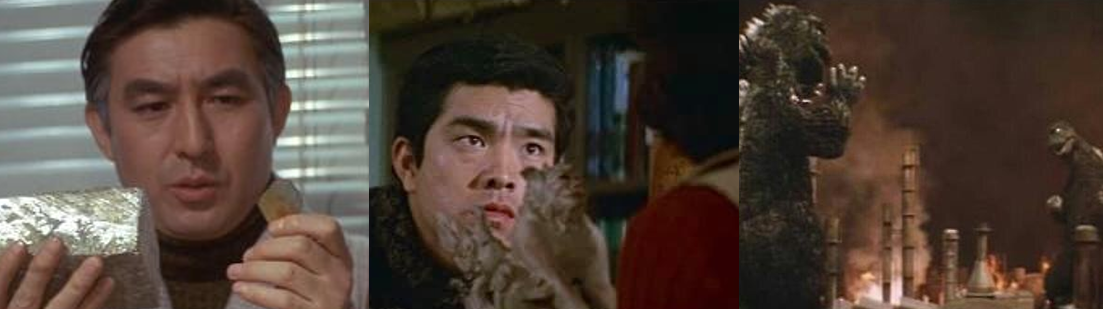
Movie Night [Godzilla Day]: Godzilla vs. Mechagodzilla


Toho’s famous atomic beast first emerged to wreck Tokyo on this day in Godzilla (Honda, 1954), and, in 2016, the day was subsequently declared “Godzilla Day”.


Released: 21 March 1974
Director: Jun Fukuda
Distributor: Toho
Budget: $1.2 million
Stars: Keisuke Shimizu, Isao Zushi, Saeko Kanagusuku, Kazunari Mori, Akihiko Hirata, and Kin’ichi Kusumi

The Plot:
Following the discovery of a doomsday prophecy regarding Godzilla (Zushi), the King of the Monsters seemingly goes on a rampage, only for the true culprit to be a mechanised doppelgänger (Mori) sent by aliens to destroy humanity!

The Background:
On 6 August 1946, and the height of the Second World War, the United States dropped two nuclear weapons on Hiroshima and Nagaski, killing tens of thousands of people and forcing the surrender of the Japanese Imperial Army. The radioactive fallout killed thousands more and left post-war Japan gripped with nuclear fear, a terror that took physical form with Gojira, the living embodiment of nuclear destruction. Although initially framed as Japan’s destructor, the King of the Monsters soon became the country’s reluctant saviour. Following the critical and commercial mauling of Godzilla vs. Megalon (Fukuda, 1973), Toho sought to reverse their fortunes by pitting Godzilla against a mechanical doppelgänger, Mechagodzilla, now one of Godzilla’s most persistent and popular enemies. Apparently the brainchild of producer Tomoyuki Tanaka and inspired by robot-themed anime and a similar metal duplicate of King Kong, Mechagodzilla was designed by Akihiko Iguchi and said to be made from a polyethylene material and fibre-reinforced plastic. While Godzilla vs. Mechagodzilla performed slightly better at the box office compared to its predecessor, the film was ridiculed for its laughable plot, goofy presentation, and continuing the downward spiral of the franchise into childish nonsense. Still, the special effects were praised and Mechagodzilla returned in many forms to hound its organic counterpart, lending some credibility to this film being considered one of the better Godzilla movies of the 1970s.

The Review:
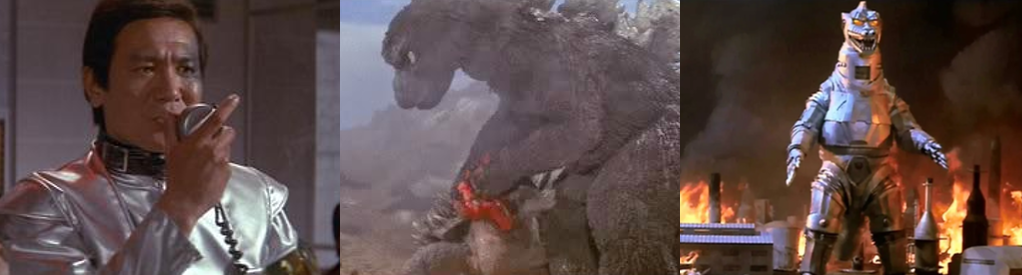
While visiting Okinawa, brothers Keisuke (Daimon) and Masahiko Shimizu (Kazuya Aoyama) witness Princess Nami (Beru-Bera Lin) suddenly collapse from apocalyptic visions of a monster (suspiciously echoing King Ghidorah). While the brothers rush to her side, they largely brush it off as Masahiko is more focused on excavating the Gyokusen Cave. Fortuitously, Masahiko discovers a strange piece of metal just as government archaeologist Saeko Kanagusuku (Reiko Tajima) arrives to document the ominous cave drawings depicting the Azumi’s guardian deity, King Caesar, and artifacts also foretelling a catastrophic monster event. While flying to Tokyo to consult renowned Professor Wakura (Hiroshi Koizumi), who’s also Keisuke’s uncle, Saeko bumps into Keisuke and is accosted by a shady man in dark glasses (Shin Kishida) who claims to be a reporter. Saeko also spots an ominous black cloud that eerily mirrors the prophecy’s “black mountain” that heralds the arrival of a destroyer. While Masahiko brings his discovery to Professor Hideto Miyajima (Hirata) at Mount Fuji (which has been beset by earthquakes), who identifies it as the ridiculously named “Space Titanium”, Wakura’s research is suddenly interrupted by an armed man, Yanagawa (Daigo Kusano), though he’s fended off by Keisuke after a comical scuffle. Mt. Fuji later erupts and what appears to be Godzilla emerges, apparently ready to enact the prophecy. “Luckily” for the locals, one of the lamest kaiju ever, Anguirus (Kusumi), opposes Godzilla, ending up badly beaten, having his jaw broken, and forced to retreat. Still, Anguirus chips Godzilla’s skin and reveals metal underneath, lending credibility to Keisuke’s suspicions that something isn’t right with the King of the Monsters.

While studying space metal and prophecies, our characters are shocked when two Godzillas appear!

Keisuke retrieves a sample from the fight that Professor Miyajima also identifies as Space Titanium, leading the brothers to join the professor and his daughter, Ikuko (Hiromi Matsushita), investigating “Godzilla” as it’s obliterating the local port and confronted by a second, more recognisable Godzilla! The group watches, stunned, as the two fight and the battle is overseen by mysterious, silver clad onlookers in a hockey sci-fi set resembling Star Trek (1966 to 1969). The titular Mechagodzilla initially appears to be the Big G himself, its metallic appearance concealed by flesh so convincing that the nation believes Godzilla has gone mad, just as the prophecy foretold, despite him having a distinctly different roar, very different atomic breath, and even walking different. Their first battle destroys Mechagodzilla’s façade, revealing it as a cyborg controlled by the sneering, malevolent Simeon Supreme Commander Kuronuma (Goro Mutsumi) of “Black Hole Planet 3”. When Mechagodzilla requires extensive repairs, the Simeons force Miyajima to assist in return for Ikuko’s safety. Kuronuma also orders Yanagawa to steal the King Ceasar statue (to keep the deity from threatening their plans), only for Keisuke to again intervene, revealing the Simeons’ grotesque ape-like appearance, and leaving Yanagawa dead when the shady reporter reveals himself to be Interpol agent Nanbara. Revealing that Interpol knows of the bizarre alien plot, Nanbara aids Keisuke in infiltrating the Simeon base to save Professor Miyajima and Ikuko from a laughable death chamber that threatens to boil them alive. While aliens are commonplace in Godzilla movies, the Simeons are some of the most unimpressive, descending into animalistic grunts and snarls when their human façade is lost and memorable only because of their ultimate weapon (and even that’s a rip-off!)

Mechagodzilla impresses by brutalising Anguirus and cutting an intimidating (if clunky) figure.

By this point, Godzilla’s firmly been established as Japan’s protector, so our heroes are stunned when he appears to go on a mindless rampage. Like Anguirus, Godzilla seems enraged by his doppelgänger as much as he is fiercely territorial over his people, leading Godzilla to attack Mechagodzilla with all his might and bathe in a lightning storm to boost his power. Sadly, Godzilla plays second fiddle to a handful of forgettable and interchangeable characters. I’m not sure what the benefit of having two professors was, for example, or why the female characters were so overlooked…or honestly what the point of having the brothers was since Keisuke and Nanbara would’ve made for a more entertaining duo. Most of the runtime focuses on a mad scramble to understand and then protect King Caesar’s artifacts, though I remain underwhelmed by the bizarre beast (Kusumi) and question why this screen time couldn’t have been allotted to Godzilla so he could battle his doppelgänger more. The film seems to depict King Caesar as the new kaiju on the block, but he looks so foolish and lacks the screen presence of Godzilla. Plus, thematically, it makes far more sense of Godzilla to be at the forefront considering Mechagodzilla is modelled after him, even if I’m not sure why the Simeons bothered. They barely managed to frame Godzilla, the prophecy seems to refer to another kaiju, and their motivations for conquest are so ill defined that I still don’t really know what they’re after. Indeed, they only seem to be included because someone behind the scenes was a fan of the then-recent Planet of the Apes films (Various, 1968 to 1973), with their true appearance being cheap, knockoffs of those movies.

The Nitty-Gritty:
So much of Godzilla vs. Mechagodzilla hinges on this bizarre Azumi prophecy, which warns that a monster will appear after a series of warnings and destroy the world. Princess Nami specifically has visions of this, and the characters initially believe the prophecy refers to Godzilla when he goes nuts, but it all leads to a mystical energy beam that reveals King Caesar’s hiding place. King Caesar is a benevolent deity worshipped by the Azumi and, upon being awakened, immediately battles Mechagodzilla alongside Godzilla. So… who is this prophecy referring to? As I said, it paints King Ghidorah as the true threat, though could also refer to Titanosaurus (Tatsumi Fuyamoto), who appears in the next film as another Simeon minion (alongside a repaired Mechagodzilla). However, in the context of this film, the prophecy makes no sense and takes up screen time that could’ve been spent fleshing out the Simeons or giving us more Godzilla vs. Mechagodzilla action. Interpol is depicted as a key organisation in combatting alien and kaiju threats, with Nanbara being a fun and mysterious ally to Keisuke, but very little about Godzilla vs. Mechagodzilla makes sense, even by Godzilla’s standards. All the Simeons want to do is use their ultimate weapon to terrorise the landscape and kill the local kaiju, feats that Mechagodzilla becomes incapable of performing. Sure, it bests Anguirus but he’s like the weakest monster. Once it meets Godzilla, Mechagodzilla is critically damaged, and the aliens are forced to kidnap a human scientist to accelerate its repairs…when you’d think the Simeons would be the best people to fix Mechagodzilla considering they created the damn thing!

Mechagodzilla’s powerful arsenal briefly keeps Godzilla and his derpy ally at bay.

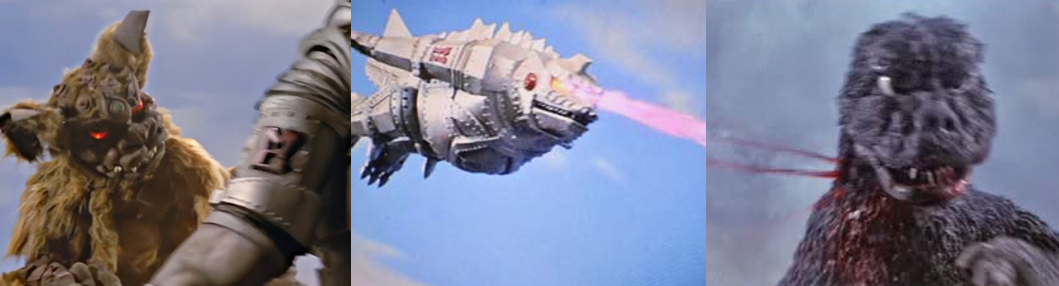
Godzilla’s looking pretty derpy here. His design has been softened and diluted to make him much kinder and more anthropomorphic, with him assuming a boxing stance and showing frustration when his atomic breath misses. Although Mechagodzilla is quite clunky and cumbersome and clearly limits Kazunari Mori’s movements, it’s an extremely striking and ambitious design. Sporting a version of Godzilla’s atomic breath, rainbow eye lasers, missile-like fingers, jet-like feet rockets, and a nigh-indestructible hide made of Space Titanium, Mechagodzilla sports quite the formidable design. However, it’s both directly controlled by the Simeons and prone to mechanical failures, requiring constant repairs and upgrades to enact the aliens’ diabolical plan. Mechagodzilla gets a serious power boost thanks to Professor Miyajima, gaining a cartoonish lightning bolt emitter from its chest and a fun jet form, and even spinning its head around to blast King Caesar and Godzilla at the same time! As ever, however, Anguirus looks absolutely awful. I’ve always hated this creature, with its weird squat legs, goofy face, and rubbery spiked back and tail, and he’s never struck me as a threat to anyone, so seeing him fighting the far superior Mechagodzilla was a joke. Anguirus tries his best, but I’d be lying if I didn’t take a perverse pleasure in seeing him tossed around and left a bloody, broken mess. King Caesar, a bizarre, lion…bear…thing that (a bit like Mothra) is woken from hibernation by a passionate (and super cheesy) song from Princess Nami. King Caesar’s meant to be a feared, all-powered protector but he looks like a raggedy puppet with his floppy, bat-like ears and his frayed hide flapping like a cheap costume. On the plus side, King Caesar is far more mobile than Godzilla and his metal double, moving much faster and hitting rugby tackles, but he just looks ridiculous and pathetic next to Godzilla and especially the impressive (if bulky) Mechagodzilla.

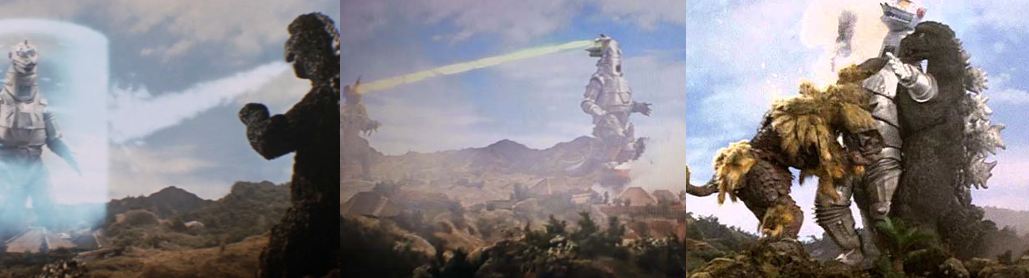
In the end, team work makes the dream work and sees Mechagodzilla reduce to scrap metal.

After Professor Miyajima repairs Mechagodzilla and their agents fail to acquire King Caesar’s statue, Kuronuma sends the supped-up Mechagodzilla against the Azumi deity. Unfortunately, Mechagodzilla’s trademark eye lasers prove ineffectual against King Caesar, who simply reflects them, and it’s so cumbersome that the spritelier King Caesar easily tackles it and tosses it with judo-like throws. Mechagodzilla’s finger missiles and chest bolt bring King Caesar close to suffering the same fate as Anguirus before Godzilla enters the fight. Mechagodzilla proves more formidable in their rematch, erecting an energy shield and fending off both kaiju with laser blasts, lightning bolts, and missiles. Mechagodzilla’s upgraded eye lasers and bolts even cause Godzilla to bleed, with arterial spray bursting from Godzilla’s wounds! However, Godzilla’s inexplicable new lightning powers grant him absurd magnetic abilities that attract his metallic foe and leave Mechagodzilla vulnerable to King Caesar’s tackles, and finally sees Godzilla wrench his metallic doppelgänger’s head off in an explosion of sparks. Aghast that his ultimate creation was defeated, things go from bad to worse for Kuronuma when Nanbara uses Professor Miyajima’s special magnetic pipe to disrupt the Simeon’s computer array, with Nanbara killing Kuronuma and his cohorts with ridiculous ease and he, Keisuke, and Miyajima fleeing from the alien’s base as it conveniently self-destructs. Oddly, the film and Masahiko’s dialogue imply Miyajima didn’t make it out of the base before it exploded, despite us clearly seeing that he did. Regardless, Princess Nami returns King Caesar’s statue and the Azumi deity returns to his slumber, while Godzilla heads back into the ocean for a rest, shards of Space Titanium raining all over for some other fool (benevolent or otherwise) to doubtless utilise in future movies.

The Summary:
It’s hard to expect much from many Godzilla movies. They have a formula and they stick to it, and I commend them for that but it’s clear to see that the formula was becoming very stale by this point. Godzilla lacks all the raw edge and menace he once had, being little more than a cartoon character come to life to fight on our behalf, which is potentially why he’s absent for so much of this movie as you can’t have your hero smashing cities! Indeed, it’s telling that this is exactly what Mechagodzilla does and that’s how we know “Godzilla” isn’t himself, beyond the obviously different roar and atomic breath. There was a lot of potential behind the Simeons using Mechagodzilla to turn the public and the military against Godzilla, but it is quickly squandered when Mechagodzilla’s obvious ruse is discovered and the mech goes in for repairs and Godzilla inexplicably vanishes. We’re then left following a bunch of idiots whose names I barely remember as they scrat about protecting King Caesar from Planet of the Apes and worrying about a prophecy that gets no payoff! The Simeons are some of the most ridiculous aliens I’ve ever seen, even for a Godzilla movie, and King Caesar is easily the worst kaiju design of them all, looking like a demented Muppet or a dog’s used chew toy! The only saving grace is Mechagodzilla, and even that’s a clunky, awkward, obviously plastic suit that looks extremely uncomfortable and cumbersome. Mechagodzilla has a fun array of weapons and could’ve been the catalyst from some really fun, bombastic fights, but again this all plays second fiddle to the Simeons and Godzilla ends up pulling some random lightning powers out of his ass to win (ironic, considering King Caesar could’ve been used as a substitute to tip the balance, but he sucks, so it’s no surprise). I was bitterly disappointed by Godzilla vs. Mechagodzilla, which promised so much and delivered so little, and I would honestly recommend simply watching clips of the titular fight that wasting your time on this mess of a film.

My Rating:

Rating: 2 out of 5.

Could Be Better

Am I being too harsh on Godzilla vs. Mechagodzilla? Maybe you think it’s one of the best Godzilla movies of its era. Perhaps you can explain the Simeon plot and why I should care about an overblown prophecy with no payoff. Maybe you have no taste and you like King Caesar and Anguirus and think Godzilla’s magnetic powers make perfect sense. Perhaps you prefer a different incarnation of Mechagodzilla, or have another favourite Godzilla you want to share? Whatever the case, celebrate Godzilla leaving a comment below, check out my other Godzilla and kaiju reviews, and donate to my Ko-Fi to suggest other Godzilla movies for me to cover!

Movie Night [Day of the Dead]: 28 Days Later


The Day of the Dead (or Dia de los Muertos) is a traditional Latin American holiday celebrated every November 1st. This is the perfect excuse to spotlight the long-running and ever-changing zombie genre, which is often used to parallel society and culture.  


Released: 1 November 2002
Director: Danny Boyle
Distributor: Fox Searchlight Pictures / 20th Century Fox
Budget: $8 million
Stars: Cillian Murphy, Naomie Harris, Megan Burns, Christopher Eccleston, and Brendan Gleeson

The Plot:
Twenty-eight days after rabid chimpanzees infected with a “Rage” virus spread an aggressive plague, bicycle courier Jim (Murphy) awakens to find London in shambles. After encountering other survivors, Jim follows a military broadcast promising sanctuary from the infected…

The Background:
Zombies have featured in movies in some form since the 1930s, initially portrayed as mindless slaves and popularly portrayed as the shambling undead thanks to the legendary George A. Romero. Like many, writer Alex Garland was directly inspired by Romero when dreaming up 28 Days Later, which came when zombies were having one of their many resurgences in horror cinema. Director Danny Boyle joined the project, impressed by Garland’s screenplay, which he saw as more of a post-apocalyptic story than a traditional zombie tale. 28 Days Later reimagined the living dead as voracious, aggressive infected individuals and achieved its iconic shots of deserted London streets by filming in short bursts early in the morning. Funding was a constant headache during production, leading to multiple alternate endings. Things took an eerie turn when filming coincided with the September 11 terrorist attacks, and rights issues have limited the film’s availability on streaming services, though 28 Days Later proved a massive box office success. Although zombie genre purists debated the film, 28 Days Later was universally praised for revitalising the concept, its stirring performances, unsettling atmosphere, and savage, fast-paced editing. The film inspired a wave of violent new takes on the genre and was followed by a similarly regarded sequel in 2007 and (eventually) the first of a proposed follow-up trilogy in 2025.

The Review:
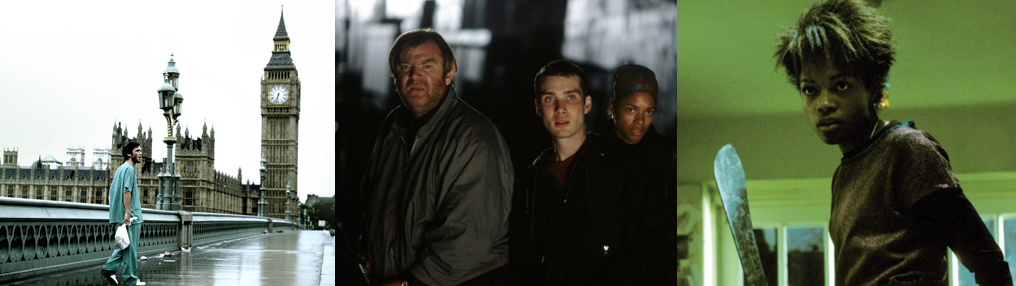
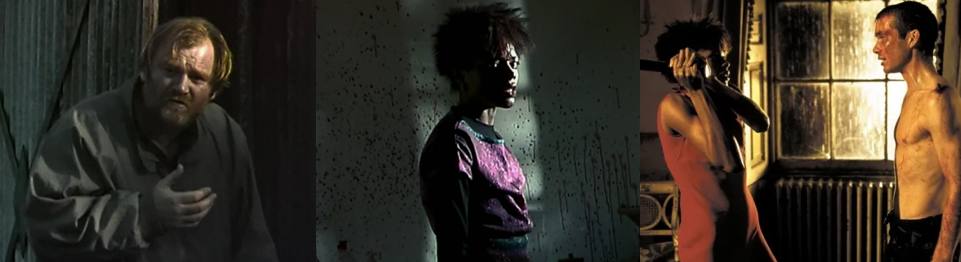
28 Days Later has one of the most startling and dramatic openings in all of cinema. After a brief prelude where animal rights activists break into a secret laboratory to free some chimpanzees, the action picks up literally twenty-eight days later to find Jim alone in a dishevelled hospital. Confused and disorientated, he wanders the deserted hallways and stumbles onto the equally lifeless streets of London, seemingly left behind during the Rapture. For Jim, this is very puzzling as, from his perspective, he was ferrying a package across the city when he was hit by a car, only to wake up apparently the last man alive in the nation’s capital. Loading up on sugary drinks and venturing into the city on a whim, desperately calling out for anyone else, Jim gets his first glimpse of what’s happened when he sees headlines warning of a mass evacuation and military deployment. Bewildered, Jim finds a church full of bodies being feasted on by a handful of the infected, who immediately chase him, roaring and ravenous, into the streets. Malnourished and unprepared, Jim’s completely ill-equipped to escape or fight the infected horde. Indeed, much of Jim’s character arc is transitioning from a near useless, clueless bystander and into a more capable and proactive survivor, one who doesn’t hesitate to kill to defend himself and others and who actively makes plans to outwit the infected and any disreputable survivors. While Jim’s initially in disbelief that the Rage virus effectively wiped out the government and civilised society, the undeniable truth quickly sinks in after repeated attacks from the voracious infected and after he pays a sombre visit to his parents’ (Christopher Dunne and Emma Hitching) home and finds they’ve committed suicide rather than fall victim to the virus.

Jim wakes up to find London deserted and society in tatters from the infected.

Yet, despite the United Kingdom being a post-apocalyptic wasteland where bodies, abandoned cars, ransacked shops, and highly aggressive, zombie-like creatures lurk, Jim carries a glimmer of hope that not everything has gone to shit. This largely contrasts with Selena’s (Harris) perspective as she’s so hardened by the sudden destruction of everyday norms that she’s initially cold, pragmatic, and willing to hack apart her allies if there’s even a small chance of infection. Indeed, Mark (Noah Huntley) shares his harrowing escape from the infected, we never learn what Selena went through to go from chemist to cold-blooded survivor and are simply presented with a grim woman who refuses to let anyone slow her down or give in to hope. Despite her best efforts, Selena’s demeanour cools throughout not just Jim’s influence (regardless of her no-nonsense attitude, she fights to save him in the early going) but also spending time with Frank (Gleeson) and Hannah (Burns), a father/daughter duo who shelter them in their tower block flat and beg Jim and Selena to help them reach safe harbour at a military outpost. Moments of levity and normality are fleeting in 28 Days Later, but they flicker to life as the two stay, travel, and bond with Frank and Hannah, with Frank being a father figure to both and caring for Hannah’s welfare melting Selena’s ice-cold heart. The four make a good, fun surrogate family unit, bouncing ideas and opinions off each other and sticking together to gather resources and push through obstacles. While Jim advises against travelling through a tunnel, the four work together to replace a flat tyre and share some carefree moments. Jim’s so relieved to experience a brief flash of normality that he’s understandably horrified when he dreams of waking up alone once more, and noticeably hesitates when Frank is accidentally infected when they reach the military blockade.

In a world where it’s kill or be killed and a battle for survival, the slither of hope remains.

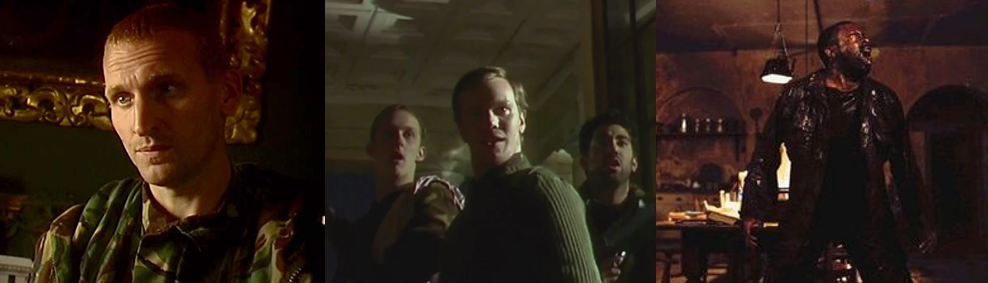
While Selena initially believes that Frank and Hannah, despite being good people, will inevitably be a burden, she warms to them and, despite her hardened attitude, can’t help but care for and protect others. She easily could’ve left any of them at any time but chooses to stick around and even becomes attracted to Jim, even if she still has walls around her heart. Selena is thus heartbroken for Hannah’s loss, equally distraught at first seeing her grouchy but affable father turn into a mindless monster and then witnessing him being gunned down. Although Selena was sceptical of salvation or a cure, she’s as grateful as Jim is when Major Henry West (Eccleston) rescues them and takes them into his heavily fortified mansion and offers the protection of his renegade soldiers. Like Major West, there’s a sense that all Selena has seen is death and violence, meaning she’s largely numb to it. By contrast, Jim’s noticeably rattled by it all, especially when he’s forced to kill an infected boy (Justin Hackney). Even then, Jim simply reacts to what happens, whereas Selena is always prepared, carrying a backpack of supplies and wielding a machete. By comparison, Hannah isn’t a fighter and even her dad, despite his cool riot gear setup, is more about first hunkering down and then travelling to a safer place where others can do the fighting. While Major West and his soldiers are more than capable of defending their turf, setting up trip wires, landmines, floodlights, and being well armed, their intentions are far from noble. Faced with a squad close to breaking point, Major West ordered them to make preparations and set up a false radio broadcast to bring in women and thus hope for the future, though Sergeant Farrell (Stuart McQuarrie) refuses to participate in sexual slavery and believes his commanding officer has gone mad.

While Major West shines as a reprehensible madman, the soldiers drag the film down for me.

I’ve always felt like 28 Days Later loses its way once Major West and his soldiers appear. The bleak, desolate atmosphere so meticulously established is replaced with a bunch of assholes who just want to muck about and bully struggling chef Private Jones (Leo Bill). To be fair, even douchebags like Corporal Mitchell (Ricci Harnett) and Private Bedford (Ray Panthaki) are quick to defend against the incoming infected. However, even their resources (which, strangely, include piles of electronics) cannot last forever and the restless men soon turn their eyes towards Selena and Hannah. While Major West initially chastises them, preferring a softly-softly approach, he’s quick to reveal his true intentions to Jim, hoping to coerce him to their side, but shows no hesitation in ordering Jim and the rebellious Sergeant Farrell to be killed. Though Private Jones objects to Corporal Mitchell choosing to stab Farrell rather than just shoot him, the others can’t wait to get their hands on Selena and Hannah. Amusingly though, despite all their training and weapons and preparation, the soldiers are easily overwhelmed by Jim and a few infected, showing that they were all bluster and no balls. In a film full of questionable, if relatable, performances (with Megan Burns being the weakest), 28 Days Later is elevated by Christopher Eccleston’s enigmatic presence. Major West exudes authority and initially welcomes the three, offering a sympathetic ear to their plight. However, his charming demeanour falters as the men grow increasingly restless and is soon shown to be a stone-cold pragmatist who sees their current situation as nothing out of the ordinary and has no compunction about chaining up the infected Private Mailer (Marvin Campbell) or letting his men rape women. For Major West, this is what’s necessary to learn more about the infected and rebuild society, but even he and his soldiers barely represent the worst of humanity as some are reluctant to follow his orders. While this shows that human nature is just as implicitly ugly as the infected are explicitly hideous, I do feel the film loses a lot of momentum once it clutters the screen with largely interchangeable soldiers.

The Nitty-Gritty:
For me, 28 Days Later is at its best when it’s showcasing the bleak, empty streets of London and the deserted motorways of the United Kingdom. It’s startling to see the normally busy and bustling city a literal ghost town as Jim wanders through the remnants of a once thriving society. Today, in a post-COVID world, these scenes hit even harder, with Jim discovering numerous posters of lost loved ones and left confused and horrified at the idea of some virus wiping out or driving away the populace. Jim’s initial goal is simply to find people and find out what’s happened, but he must work through the stages of grief before accepting the new status quo, insisting on visiting his parents and struggling to fight the infected. Conversely, Selena attacks with a viciousness that rivals that of the infected and keeps others at arm’s length, whereas Jim is still hopeful that there’s a chance for humanity, especially after seeing Frank and Hannah’s love and a plane flying overhead. Thus, 28 Days Later isn’t just about “survival” but what it means to live, with even Selena finding something more beyond violence thanks to their surrogate family. Still, things are pretty damn hopeless for the UK here as the government’s been wiped out (no big loss, really) and cities are abandoned or in flames. It’s left intentionally vague how many escaped before the UK was locked down, and Mark’s harrowing story of the masses literally trampling over each other again strikes a nerve post-COVID, but there’s also the suggestion that the rest of world is perfectly fine, meaning there’s a vague hope for the future even if the UK has been quarantined. For those left behind, it’s an endless fight for survival and some meaning beyond just living another day, with Major West having high hopes for rebuilding society with his morally skewed soldiers.

Those infected by Rage are voracious, aggressive, and far more capable than zombies ever were.

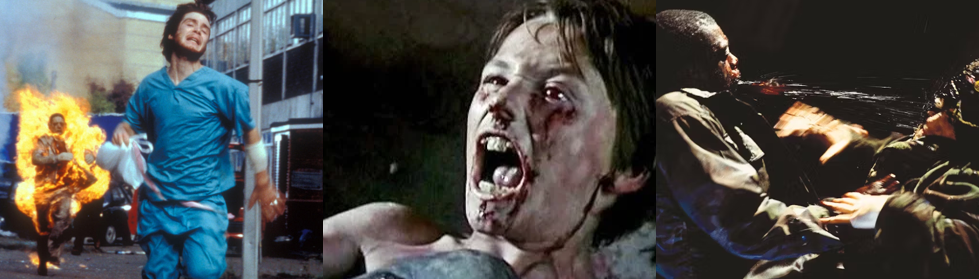
Of course, 28 Days Later isn’t a “zombie” film in the strictest sense but it’s clearly inspired by the genre and absolutely reinvigorated it, popularising fast and aggressive undead (or zombie-like creatures) that endure to this day. You know it’s not a typical zombie film right from the start, however, as 28 Days Later provides an explanation for its events with the vaguely defined Rage virus. This appears to be a man-made pathogen (though it can also be implied to have been inherent to the chimps) that drives the infected into a mindless, ravenous aggression where they attack and devour anyone on site. A bite or even a single drop of blood into a wound or orifice is enough for the Rage to near-instantly take hold, with Selena stating that you have between ten and twenty seconds to kill an infected before they fly into a wild rage, and there’s said to be no cure (largely because the chimps were released before the infection could be properly understood). The infected don’t seem to eat their victims, though they are driven by insatiable hunger and violently vomit blood and guts when starved. Major West is particularly curious about how long it takes the infected to starve and the film’s epilogue, which takes twenty-eight days after the initial twenty-eight days, indicates they need flesh to survive. The infected are extremely aggressive, exhibiting superhuman speed and strength and apparently having enhanced senses, particularly smell and hearing. If you see one, others soon swarm in a ravenous horde, crashing through windows and tearing through barricades in a desperate search for sustenance. Still, they’re easily killed (bullets, landmines, blades, baseball bats, and Molotov cocktails all work extremely well) and won’t return once killed, nor do they need their brains destroyed to be put down, but their sheer numbers and aggression make even one a formidable obstacle.

Jim fights back against the disreputable soldiers and miraculously survives a near death experience.

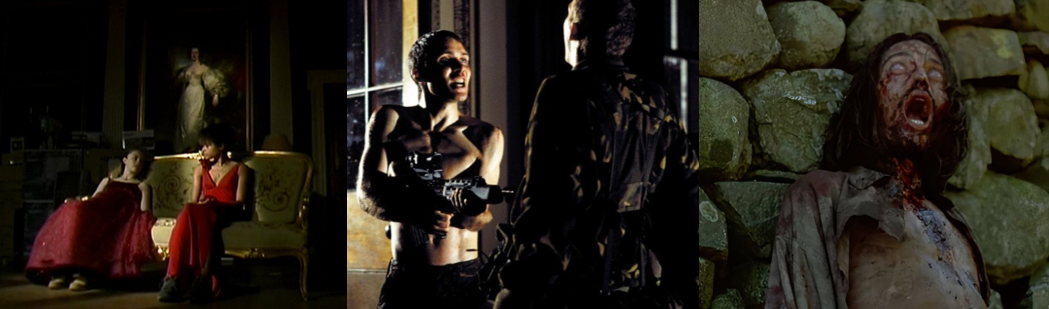
As pressing as the infected are as a threat, they are largely contained to cities and appear only sporadically. Like any good zombie (or zombie-adjacent) film, 28 Days Later is thus more concerned with the threat of human nature than its infected, with Major West and his soldiers posing more of a threat to Jim, Selena, and Hannah than the infected, whom they largely avoid on their road trip. The soldiers easily fend off the external threat but cannot deny their base instincts, relishing the thought of passing around Selena and Hannah and caring more about their sexual lusts than their dwindling numbers. Their overconfidence in their weapons is their greatest weakness as the untrained, scrawny Jim easily picks them off both by himself and by releasing the starving Private Mailer, who easily infects the soldiers and bring down their fort. Though Selena tries to spare Hannah the trauma of being raped by doping her on Valium, her feisty nature is quelled by the lustful Corporal Mitchell, leading Jim to leap to her defence and gouge the soldier’s eyes out in a rage. Selena’s so stunned by Jim’s animalistic behaviour that she almost mistakes him for an infected, yet she hesitates to kill him due to her feelings and is relieved to find he’s simply embraced his killer instinct to save them. As the three escape, however, Major West takes his revenge and shoots Jim, leading Hannah to feed him to his infected soldiers and Selena to desperately save Jim’s life at a nearby hospital. This is also where 28 Days Later falls apart a bit as the ending is so haphazard and nonsensical, with Jim miraculously surviving the gunshot and the three signalling a passing jet for aid. It’s clear that Jim was supposed to die, as in the alternative endings, and this slapdash “happy ending” just doesn’t gel well as a result. It would’ve been far easier to reshoot the scene with Major West to show him missing his shot than pretend like Selena could’ve ever saved Jim from a bullet to the gut.

The Summary:
It’s probably sacrilege to admit this but I’ve never been a fan of 28 Days Later. I find the film quite inconsistent and dull at times, the script is kind of all over the place with inconsistencies and obvious rewrites and changes, and the film loses so much momentum once Major West and his cronies show up. It’s a real shame as it starts so strongly, with Cillian Murphy wandering the eerily deserted streets of London and a palpable sense of dread and confusion presented through the visuals. Murphy does a good job as Jim, starting as a confused and somewhat useless leftover and eventually gaining a killer instinct that almost makes him indistinguishable from the infected. I enjoyed Selena’s no-nonsense portrayal as well, and that we never learn what made her so hardened to the post-apocalypse, and her character arc in learning there’s more to life than just surviving. I liked the surrogate family unit they built with Frank and Hannah, which was obviously doomed to end in tragedy but was far more appealing than having a bunch of dickhead soldiers eat up the screen time. Granted, Christopher Eccleston gave a captivating and chilling performance, standing out as the diamond in the rough, and Major West’s soldiers represented the worst of humanity, but I feel this angle stopped the film dead. There’s something here about the nature of humanity and the juxtaposition of an explicitly monstrous external threat being as dangerous as humanity’s base instincts, but I don’t think it was executed very well. I did like the depiction of the infected as ravenous, hyper aggressive, mindless animals and how quickly they spread the Rage virus. They’re not zombies at all and that’s made very clear, but they’re a significant threat and it’s still chilling seeing the United Kingdom left deserted and in shambles after just a few weeks of exposure. I absolutely consider 28 Days Later an influential film for many reasons and can see why so many like it and so many zombie purists abhorred it, especially back then, but I can’t say that it’s a favourite of mine or a film I’m inspired to watch much. It just feels too haphazard by the end, like there were too many ideas on the table and the simple, startling premise got muddled by rewrites and changes, making it an overall mediocre experience for me to this day.

My Rating:

Rating: 3 out of 5.

Pretty Good

Do you think I was too harsh on 28 Days Later? Were you a fan of the more aggressive and faster infected compared to slower zombies? What did you think to the bleak, empty city streets? Do you agree that the pacing and ending were a bit off? Which character was your favourite and did you like how the genre was changed by this film? What is your favourite zombie film and how are you celebrating the Day of the Dead today? Whatever your thoughts on 28 Days Later, and zombie films in general, feel free to leave a comment below, check out my other zombie content, and donate to my Ko-Fi for more.

Movie Night [Halloween]: Halloween 5: The Revenge of Michael Myers


Starting as the ancient Celtic festival of Samhain, Halloween is largely associated not just with ghosts, ghouls, and confectionery but also a long-running series of horror movies. Beginning with John Carpenter’s Halloween (Carpenter, 1978), largely credited with birthing the “slasher” sub-genre and one of the most influential films in all of horror.


Released: 13 October 1989
Director: Dominique Othenin-Girard
Distributor: Galaxy International Releasing
Budget: $5.5 million
Stars: Donald Pleasence, Danielle Harris, Don Shanks, Wendy Kaplan, Beau Starr, and Ellie Cornell

The Plot:
A year after a lacklustre defeat, serial killer Michael Myers/The Shape (Shanks) returns to Haddonfield to pursue his niece, Jamie Lloyd (Harris), who was left traumatised from their previous encounter and in the care of Michael’s increasingly manic former doctor, Sam Loomis (Pleasence).

The Background:
Widely dismissed upon release, John Carpenter’s Halloween became one of the most successful independent films thanks to its $63 million+ box office. It also heralded the start of a long-running and convoluted horror franchise bolstered by the commercial success of Halloween II (Rosenthal, 1981). After John Carpenter tried to turn Halloween into a horror anthology movie series with the abject failure of Halloween III: Season of the Witch (Wallace, 1982), the studio scrambled to bring Michael back with the aptly-named Halloween 4: The Return of Michael Myers (Little, 1988), a commercial (if not critical) success that saw a fifth entry fast-tracked for the following year. The initial script capitalised on Halloween 4’s dramatic ending by having Jaime Lloyd join Michael Myers in his newest killing spree while another draft sought to humanise Myers, but producer Moustapha Akkad insisted on retaining much of Myers’ established character. A later script introduced the mysterious “Man in Black”, an element eventually downplayed and returned to in the troubled follow-up. Although Donald Pleasence and Danielle Harris returned, Ellie Cornell was disappointed when she was killed early on and Don Shanks took over as the iconic Shape, receiving an accidental broken nose from the deeply committed Pleasence! With a box office of $11.6 millionHalloween 5 was met with mixed reviews criticising Pleasence’s performance and the confusing inclusion of the Man in Black. Its poor reception led to a noticeable gap between the fifth and sixth films as Akkad sought to re-evaluate how to get the series back on track, with disastrous results.

The Review:
Halloween 5 opens with a truncated recap of the ending of Halloween 4, primarily focusing on Michael’s inauspicious end where he fell down a mine shaft. Naturally, the Shape survived and was washed away. Wounded and exhausted, Michael attempts to kill a kindly old hermit (Harper Roisman) but collapses from his injuries and spends the next year in a coma. The film implies that Michael’s running out of juice, as though he only “activates” every Halloween and must kill to keep his energy up, something explored further in the sequel. Jamie Lloyd was last seen attacking her stepmother, Darlene Carruthers (Karen Alston) while dressed in the same clown outfit Michael wore for his first kill but Halloween 5 goes to great lengths to downplay the seriousness of that. It’s not shown in any great detail, Dr. Loomis’s anguished reaction and attempt to kill Jamie is omitted, and it’s casually revealed that Darlene survived the attack. Halloween 5 this clearly walks back this ending, leaving Jamie severely traumatised in a local children’s clinic and rendered mute for the first half of the film. Consequently, Halloween 5 loses me right from the start. The filmmakers had a great opportunity to do something different with the franchise, to show Jamie teetering between following in her uncle’s footsteps and rejecting his murderous ways, to give Dr. Loomis a chance to atone for his failure with Michael, and to perhaps retire the Shape in favour of a new killer who could explore the later shenanigans with the Cult of Thorn without screwing up Michael’s character. Instead, Halloween 5 plays it safe by delivering a by-the-numbers slasher with very few new elements that progress the franchise.

Traumatised by her experiences, Jamie struggles to make sense of her connection to her uncle.

One of these elements is the continued exploration of Jamie’s convenient and chaotic psychic link with her uncle. Presumed to be because she’s his last living relative (that we know of at this point), Jamie senses Michael’s whereabouts and intentions and is haunted by nightmares where he’s either stalking her or she’s seeing through his eyes. These visions, coupled with the trauma she endured, leave Jamie a distressed mute subjected to a battery of tests and whose only links to the real world is her stepsister, Rachel Carruthers (Ellie Cornell), Rachel’s cheerful best friend, Tina Williams (Kaplan), and their dog, Max (Unknown). The three regularly visit, sneaking Max into the clinic and helping her prepare for the Halloween costume contest. Jamie later attends this with her friend, shy stutterer Billy Hill (Jeffrey Landman), and becomes increasingly concerned for their safety when her visions grow stronger on “Halloween Eve”. When Michael awakens, kills the hermit, and reclaims his mask, Jamie suffers seizures, convulsions, and panic attacks, scrawling warnings on her chalkboard and muttering gibberish, which both excites and drives Dr. Loomis frantic since he’s desperate to put an end to Michael for good. Jamie spends most of the first half in bed or in the clinic, routinely being shaken and accosted by the increasingly demented Dr. Loomis, who thinks nothing of yelling at her and badgering her to get a lead on Michael or who the Shape’s next victim is. Scarred, half crippled, and seemingly on the verge of madness from all the death and violence, Dr. Loomis has degenerated into the raving lunatic he was thought to be in the first movie and only receives assistance from Sheriff Ben Meeker (Beau Starr) because of their shared experiences in Halloween 4. Dr. Loomis is livid with Jamie, convinced she’s protecting her uncle (why she would do that isn’t clear) and guilt-tripping her into helping despite her being terrified and confused by her visions. Ultimately, Jamie agrees to help after being chased by Michael and seeing Billy and Tina attacked by her uncle, but by then Dr. Loomis has seemingly lost all reason and regularly uses the petrified child as bait (and even a human shield!)

In a town full of forgettable and oddball characters, it’s easy for rambunctious Tina to stand out.

Although Rachel still offers Jamie comfort, she doesn’t last long. Jamie is assaulted by visions of her stepsister and tries to warn her, but Michael inevitably kills Rachel offscreen. Although Tina goes to check on her friend and finds the house empty, Rachel’s all-but forgotten about until Jamie stumbles upon her lifeless corpse in the dilapidated Myers house. While this sucks for Rachel, Tina is more than a worthy substitute; a bubbly bundle of enthusiasm and energy, Tina is an infectious and adorable personality who treats Jamie like a little sister. Outrageous and outgoing, she regularly teases her boyfriend, Mike (Jonathan Chapin), an angsty greaser who’s obsessed with his car, and encourages their friends, Samantha Thomas (Tamara Glynn) and grocery store clerk “Spitz” (Matthew Walker), to dress up for a Halloween party at a local farm. Thanks to Jamie’s visions, Tina’s rescued after Michael masquerades as Mike but, upon seeing how unstable Jamie is, chastises Dr. Loomis and ignores his warnings. Embracing her nature as a free spirit, Tina goes and has fun, thinking nothing of it when Sam and Spitz sneak off to the barn (after Spitz fakes Sam (and us) out by imitating Myers), but doesn’t hesitate to get Jamie and Billy to safety when they escape the clinic to warn her of the danger. With Michael poised to kill the children, Tina steps in, taking a knife to the shoulder and promptly vanishing on a gurney, her fate unknown, and leaving Jamie forced to rely on Dr. Loomis. Indeed, while Sheriff Meeker tries to hunt Michael down, he and his men are always one step behind. Two of his patrolmen, Nick Ross (Frank Como) and Tom Farrah (David Ursin), are so woefully inept that they not only openly admit to being bad cops but are accompanied by ridiculous clown-like sound effects.

Sporting one of his worst looks, Michael’s shown to be cursed be an insatiable rage.

Now played by Don Shanks, Michael is as determined and unstoppable as ever but moves with a more deliberate, robotic grace. Stalking his prey in broad daylight from behind bushes, commandeering police cars, and driven by an insatiable rage to hunt down and kill his bloodline, Michael is cast as a horrific bogeyman for Jamie and the object of Dr. Loomis’s obsession. Sporting an ill-fitting mask and a mysterious rune tattoo on his wrist, Michael slaughters anyone in his way and seemingly goes out of his way to target Tina’s friends to both quench the rage driving him and, perhaps, sustain him as Halloween drags on. Still sporting severe scars to his hands (at the very least), Michael’s stoic visage contrasts with Dr. Loomis’s increased hysteria. Having similar scars and limping on a cane, Dr. Loomis and Michael are more similar than different by Halloween 5, especially as Dr. Loomis blatantly ignores local authority and hounds Jamie almost as much as Michael, waving her around in front of him like a dog’s chew toy. After luring Michael to the Myers house, Dr. Loomis tries to reason with him by promising to deliver Jamie to him, understanding that Michael believes killing Jamie will end his agonising rage. In these moments, the old Dr. Loomis shines through but his efforts are ultimately useless. Jamie also tries to reach her uncle, even convincing him to remove his mask and revealing that he’s suffering from the curse that drives him, but Michael lashes out both times. Haddonfield is also stalked by a mysterious “Man in Black” (also Shanks), who also has a rune tattoo and lurks around the Myers household, the town streets, and assaults the police station in the finale. This same rune is painted on the wall in Michael’s house, reinforcing a previously teased pagan connection to his rage and killing spree, but these elements are ultimately teasers for the sequel rather than anything significant here.

The Nitty-Gritty:
Halloween 4 teased that Michael’s bloodlust was somehow genetic and that Jamie was destined to follow the same dark path. This is largely downplayed in favour of a more supernatural bent to Michael’s character. The bond between him and Jamie is definitely implied to be supernatural and her visions and nightmares help spare some lives (at least for a while), though they’re forgotten by the third act, which descends into screaming and running and hiding. There’s the suggestion that Dr. Loomis is still trying to atone for failing Michael, but only in his interactions with the Shape, which are framed more as Dr. Loomis trying to subdue Myers so he can be captured or killed. Even Dr. Loomis’s plot to use Jamie as bait is part of this rather than true malicious intent on his part, but the line sure is blurred since Dr. Loomis is more unstable than ever. Dr. Loomis suggests that Michael is driven by rage that can only be quelled by killing and that he believes ending his bloodline will give him peace, something Dr. Loomis strongly suggests is a lie. We see Michael’s rage flare numerous times but, when he unmasks, a single tear runs down his cheek. This, coupled with those strange runes, strongly suggests that Michael’s not in full control of his actions. The film further suggests the Man in Black is part of this but also suggests it’s a supernatural element to Michael’s character. It’s all very vague and thus you can argue it doesn’t dilute the traditionally cryptic Myers, but it’s also explicit and bonkers enough to show that the franchise is on a slippery downhill slope.

Sadly, Halloween 5 is bogged down by toothless kills and half-baked ideas that go nowhere.

Still, one good reason to watch any slasher film is the kills. And the sex, of course. Halloween 5 is very light on the sex and nudity; Tina teases and straddles Mike a few times but is never seen engaging in sexual activity (though it’s heavily implied she has, and is perhaps high most of the time, directly violating the “rules” for a “Final Girl” and perhaps explaining her ambiguous fate). Sam and Spitz get it on in a barn thanks to some suspiciously redubbed moaning, but their sexy time is brutally interrupted when Michael skewers Spitz with a pitchfork. Michael then stalks Sam (who, credit to her, at least attempts to fight back) with a scythe, which makes for an awesome visual and makes me wish Myers had adopted this weapon over his traditional kitchen knife. Sadly, the way Sam’s death is framed implies Michael cuts her throat rather than beheading her and he inexplicably attacks Ross and Farrah with the pitchfork afterwards. If Myers did behead her, it’s not shown on camera; neither are Ross and Farrah’s deaths, just the aftermath, which are just two examples of how toothless Halloween 5 is. Similarly, while we see Rachel get stabbed, the film cuts away before going into detail, robbing her of a dignified death scene and reducing her to a jump scare when Jamie later finds her body. Many of Michael’s victims are strung up in his house in the finale, though none of their deaths are particularly inspiring. Mike’s was good, though. Michael toys with him at first, raising his ire by scratching his beloved car and then impaling him through the head with a garden claw. The editing is particularly disheartening in Halloween 5, robbing the kills of their impact and even making me question Tina’s ultimate fate. There is a cool shot of Michael chasing after Jamie in a car that’s really well lit, though, and I loved the derelict Myers house (even if it’s a recycled location for the finale). Otherwise, Halloween 5 can’t even bolster some goodwill through some decent sex and gore, leaving us to settle for the half-baked mystical connection between him and Jamie and Jamie’s obviously fractured mental state.

Thanks to Dr. Loomis’s bizarre choices, Michael is freed from captivity by a mysterious Man in Black…

To her credit, Danielle Harris does a great job in scenes where she’s suffering from her nightmares and in her interactions with Donald Pleasence. The shared fear and madness between the two is a highlight and certainly more appealing than the uninspired depiction of Myers, who’s mostly going through the motions. After escaping the clinic, Jamie and Billy desperately try to warn Tina, only to witness her being attacked by Myers. Determined to put Michael down, Dr. Loomis challenges the Shape to meet him at the rundown Myers house, where he waits with Jamie as semi-willing bait. After sending away the cops, Dr. Loomis tries to talk Michael down, only to get slashed across the chest and manhandled by the Shape, who then angrily pursues Jamie. Just as he’s poised to kill her, Michael falters and reveals he’s tortured by his nature, only to fly into a renewed rage and fall right into Dr. Loomis’s trap. Weighed down by a chain net, Michael’s an easy target for Dr. Loomis to blow away with a shotgun. Oh no, sorry, that doesn’t happen…instead, Dr. Loomis tranquilises Michael and bashes him over the head with a wooden plank? An odd decision considering Dr. Loomis spends the whole movie heavily implying he wants to kill Michael and even screams at him to “Die!” during the beat down (which also leaves Dr. Loomis collapsed from exhaustion and potential heart attack). Thus, Michael is arrested (!) and chained up in a cell to be transferred to a maximum-security prison. The shellshocked Jamie is taken from the station, only to be drawn inside by the sound of gunfire and screaming courtesy of the enigmatic Man in Black. Venturing into the ransacked station, Jamie finds Michael’s cell blown open and empty and is horrified by the realisation that her murderous uncle is once again on the loose…

The Summary:
I gave Halloween 4: The Return of Michael Myers a bad time for simply being a carbon copy of John Carpenter’s seminal original, and for adding very little to the franchise and effectively keeping it on life support by introducing Jamie Lloyd. However, that film ended with the tease that something new would happen in its sequel and, unfortunately, that wasn’t the case. Just like how the Friday the 13th franchise (Various, 1980 to present) got cold feet about replacing Jason Voorhees (Various), Halloween 5: The Revenge of Michael Myers wimps out on going all-in with Jamie as a replacement for the Shape. This could’ve been an opportunity to explore Jamie’s descent into madness, to show the parallels between her and Michael, to show Dr. Loomis desperately trying to atone for his past and perhaps resolving to kill her by the end. Michael still could’ve gone on a killing spree in the background, perhaps getting slower and more fatigued as he goes, as though his essence were transferring to Jamie, who could’ve killed Dr. Loomis and been spirited away by the Man in Black. But, no. Instead, we get the psychic connection between the two that’s interesting but underdeveloped and forgotten about, another mindless killing spree from Michael, and another half-baked retread of the previous films as Dr. Loomis tries to reason with and destroy Michael. I did enjoy the dark turn Dr. Loomis takes here; seeing the physical and mental toll on his morals was really interesting and I loved that he was willing to put Jamie at risk and even let her die just to get his hands on Michael. Danielle Harris also did a great job, particularly in the first half where she’s mute and traumatised, and I adored Wendy Kaplan’s rambunctious character. However, the bungling cops, bizarre sound cues, and toothless gore all made Halloween 5 a shallow and dull experience, overall. The teases about the Cult of Thorn felt as random as everything else in this movie, as though the screenwriters were just making shit up as they went along and hoping for the best, and this diluted what could’ve been dramatic scenes, such as Dr. Loomis and Jamie trying to reach Michael. In the end, Halloween 5 is just another slasher that fails to capture the magic of the original and simply serves to show that we didn’t need to make a franchise out of this series.

My Rating:

Rating: 2 out of 5.

Could Be Better

Did you enjoy Halloween 5: The Revenge of Michael Myers? Were you also disappointed that Jamie didn’t take over as the killer? Were you annoyed that Rachel was killed off so unceremoniously? What did you think to Dr. Loomis’s fractured mental state and questionable morals? Were you disappointed by the lacklustre kills and cliff-hanger ending? How are you celebrating Halloween this year? Whatever your thoughts on Halloween, and the Halloween franchise, drop a comment below, support me on Ko-Fi, and have a spook-tacular Halloween!

Movie Night: The Crow: Wicked Prayer

Released: 19 July 2005
Director: Lance Mungia
Distributor: Dimension Films
Budget: Unknown
Stars: Edward Furlong, David Boreanaz, Tara Reid, Emmanuelle Chriqui, Danny Trejo, and Dennis Hopper

The Plot:
When Jimmy Cuervo (Furlong) and his girlfriend, Lily (Chriqui), are ritualistic murdered by a Satanic biker gang led by Luc Crash/Death (Boreanaz), Jimmy is resurrected by a supernatural crow to take his revenge.

The Background:
Created by James O’Barr as a way to process losing his fiancée, The Crow began life as a 1989 comic book published by Caliber Comics and soon became an underground success. When dark comic book narratives became popular in Hollywood, the concept was a perfect fit and resulted in a critical and commercially successful adaptation sadly tainted by the accidental death of star Brandon Lee. Though an enduring cult favouriteThe Crow (Proyas, 1994) was followed by a slew of awful sequels: The Crow: City of Angels (Pope, 1996) was rushed out to capitalise on the original’s success. Resulting in a dismal box office and even worse reviews and The Crow: Salvation (Nalluri, 2000) didn’t fare much better with its lukewarm reviews. Despite this, the studio was determined to milk the franchise for all it was worth, initially collaborating with rapper DMX to work on a script revolving around a rapper being resurrected from a drive-by shooting. When this fell apart, the project was re-tooled into Wicked Prayer (with little resemblance to the comic of the same name),which was hoped to revitalise Edward Furlong’s fortunes after years of substance abuse. Director Lance Mungia, a fan of the franchise, eagerly signed on, hoping to tap into real-life tragedies like the Columbine Shootings and 9/11 with a stirring story of revenge. What we got was a film so reviled that the franchise lay dormant for nearly twenty years, a film almost universally lambasted for its laughable presentation, ridiculous effects and make-up, and intolerable performances from its lead actors.

The Review:
We’re out of the big city and stuck in the Mexican wilderness for The Crow: Wicked Prayer, where a racial and class divide exists between Native Americans and then-modern-day settlers. While this bigotry isn’t dwelled upon much, provides a springboard for a few half-hearted characterisations. As the ridiculous onscreen tags inform us, Death’s misfits (styled after the Four Horsemen of the Apocalypse) specifically seek revenge against the Native Americans after their local mine poisoned many of its workers, or robbed them of financial compensation, or some other excuse to attack minorities. When the tribe closes the mine, sparking outrage amongst its workers, for an extravagant casino, Death has his cohorts spread mayhem and death as part of a bizarre ritual to imbue Death with the powers of Satan! The racism goes both ways as Lily “Ignites the Dawn” and Jimmy are urged to stay on the “right side” of the road. Indeed, Jimmy is branded a racist and a killer by the entire town, particularly Lily’s brother, Sheriff Tanner (Dave L. Ortiz), after he killed a Native in his youth. This sees Jimmy ostracised, forced to eke out a living in a squalid trailer park with only Lily standing by him since he saved her from a rapist. However, neither her brother or her preacher father, Padre Harold (Danny Trejo), approve of Jimmy. Thus, when Tanner learns that Jimmy plans to elope with Lily, he’s less than impressed and encourages Jimmy to move on. Despite being an outcast, Jimmy’s devoted to Lily, yet he’s aware of his reputation and encourages her to keep their relationship a low profile. However, she’s far too peppy and trustworthy for that and gladly shouts her love for him, and it’s implied she probably would’ve absconded with Jimmy had Death and his cronies not spoilt their plans.

Troubled Jimmy’s life takes a turn for the worst when he returns from the grave as a lame cosplayer.

Having ridden with Death in his youth, Jimmy doesn’st have a squeaky-clean past but he’s just trying to get on. While I’m sympathetic towards Edward Furlong and everything he’s been through, I’m not sure he’s the best choice for this role as he lacks the charisma and screen presence much like his two predecessors. Jimmy’s certainly a more emotional and aggressive avatar, however, lashing out at his killers with a rage born not just from their atrocious actions, but for turning him into a “monster”. Jimmy’s caught completely off-guard when Death has his minions hang him and Lily and then slice out Lily’s eyes and cut out Jimmy’s heart, leaving Lily’s soul to wander the afterlife directionless. Jimmy returns from the nether near-instantaneously, the confusion, pain, and anger of Lily’s murder still raw, and immediately intuits from the crow that he must take revenge. Unlike his predecessors, who took to this mission with a resigned sense of duty, Jimmy’s reluctant and almost disgusted by killing, even for revenge, and constantly declares his desire to die (he even discovers his powers by trying to kill himself) but soon learns to embrace his rage with a hostility that’s noticeably different from his predecessors. However, being a shorter and far less physically capable individual, Jimmy doesn’t convey the same sense of quiet menace I associate with the character, even when draped in a cool duster jacket or inexplicably teleporting to toy with his victims. Like previous avatars, Jimmy instantly heals from all wounds and exhibits some superhuman strength and agility but, unlike them, his crow is wounded quite early on, leaving Jimmy’s powers in a state of flux. This doesn’t have much of an impact, though, as Jimmy still seemingly heals from his wounds and still performs superhuman (if poorly choreographed) feats, so I’m not sure why they bothered to have this happen when there’s no payoff since Jimmy can’t die until he’s avenged himself and Lily.

Death’s crew of forgettable try-hards are some of the most one-dimensional baddies you’ll ever meet.

Jimmy’s up against a colourful but very confused and one-dimensional bunch. The son of a preacher killed by an “Injun”, Death has a personal vendetta against God and the church, rejecting Christianity and seeking to be the vessel for Lucifer through ritualistic sacrifice. His followers – “Famine” (Tito Ortiz), “Pestilence” (Yuji Okumoto), and “War” (Marcus Chong) – all feel wronged by the mine and the town, taking their perceived hardships and using them as an excuse to be openly racist and cause havoc. Death’s constantly accompanied by Lola Byrne (Reid), a sadistic succubus who longs for the power and infamy offered by the Devil. Having stolen a book of black magic from the head of their order, the strangely theatrical El Niño (Hopper), Lola conjures spells and incantations after gaining a vaguely defined second sight from Lily’s eyes. After tracking down and shooting Moses, the man who killed his father (Richard Cumba), Death encourages his troop to engage in wanton murder, with War gunning down eyewitnesses, all to prepare for an unholy marriage and his own physical sacrifice to be possessed by the Devil. However, as one-dimensional as these “Horsemen” are, they’re all strangely conflicted at times. Death is constantly reminding them of their motivations, calling them out when they hesitate, and even Lola appears visibly uncomfortable at Death’s wholesale slaughter of innocents. Yet, they never once defy Death’s plan, with Lola only descending into penance after her lofty ambitious are ended by the Crow. While Tara Reid continues to be far better on the eyes than the ears, being the weakest link in a chain full of rusted connections, Boreanaz has a great time hamming it up as Death and even more when possessed by Lucifer. He’s a constantly enjoyable presence here, to the point where I wish he’d been cast in the lead role and the producers had piled some more money into Dennis Hopper’s pay cheque to cast him as Death instead.

The Nitty-Gritty:
While the legend of the crow was something of a fairytale in the previous films, a rare mystical occurrence that few understood or knew of, it’s presented as Native American folklore here. Lily speaks openly of the crow, a righteous figure of redemption powered by love, and those returned by the crow’s power are treated with reverence. Indeed, many refer to Jimmy or at least believe him to be an angel, and Lucifer openly makes the Crow as an extension of God’s will, repurposing the concept into a purely religious connotation. Thus, the fight between the Crow and Satan is framed as a battle of wills between Heaven and Hell rather than an emissary from the afterlife being unable to rest due to a devastating loss. It’s an interesting wrinkle in the Crow lore, one that might’ve had more legs if the film had fully committed to it, placing greater emphasis on Padre Harold’s belief in the figure beyond him simply performing a witch doctor dance to revive the bird. Tanner’s vendetta against Jimmy only ends when he realises Jimmy has become the Crow, but the fact Death and his cronies all dabble in black magic takes the spotlight away from Jimmy’s resurrection. While I appreciate the attempt to try something different, The Crow: Wicked Prayer is saddled by some truly awful performances, forgettable moments, and cheap presentation. Shots of the crow flying or glaring into the camera are recycled from previous films, as are some lines, and the special and practical effects are effectively non-existent, with the camera cutting away from any gruesome acts and then showing characters with bloody hands and holding organs or whatever.

Even the interesting changes to the lore are as half-baked as the pathetic fight scenes.

Flashbacks to Jimmy and Lily’s past are similarly limited and presented seemingly at random as a shorthand to make us care about Jimmy’s vengeance, but instead appear as subpar editing. While Emmanuelle Chriqui is certainly cute and it’s nice to spend some time with the Crow’s lover before she’s killed, she has little chemistry with Furlong, who fares far better once he’s painted up. Unfortunately, Jimmy’s Crow looks like bad cosplay, with him moping about rather than exuding the crippling anguish I’d expect from the character. He’s far better when channelling his rage, but even then he’s hampered by some poor fight scenes, with his fist fight with War being a blurry, indistinct mess made more confusing by Padre Harold, Tanner, and a bunch of armed men firing at both men. The film tries to say there are some stakes involved since Jimmy’s powers are weakened for most of its runtime, but it’s hard to believe as he shrugs off bullets and even being physically overpowered by Death, who gradually gains superhuman powers through killing and other strange rituals. Still, none of his minions present a physical challenge to Jimmy, with the terminally ill Pestilence being easily offed via electrocution and the imposing Famine simply being beaten to death with a baseball bat. Jimmy tries to channel Eric Draven’s (Brandon Lee) sombre, caring side when he heals Moses to try and atone for killing his son, but it’s a poor effort. I would’ve liked to see more time spent with Jimmy winning over Padre Harold and Tanner, especially after they save him from his crucifixion, to either better delve into the subtle themes of penance or give him some backup in storming El Niño’s brothel…church…thing. Instead, Jimmy just tells them to get out of his way and heads off alone, with Padre Harold only being convinced to believe in the Crow when Tanner vouches for him.

Even Lucifer’s infernal powers are useless against what this film laughingly sells as “true love”.

All throughout the movie, Death plots to prepare his body and soul to be possessed by the Devil. As ridiculous as that sounds, black magic is not only real in The Crow: Wicked Prayer but ridiculously easy to perform, with even a bimbo like Lola granting herself a degree of clairvoyance and understanding of El Niño’s ancient texts. Murdering Lily and Jimmy was the first step in Death’s plan; he gets his revenge against the man who killed his father, murders some innocent people, and then has a virgin (Daymond John) killed during his marriage to Lola. Surprisingly, Lola stabs Death and kills him to consummate the marriage, a betrayal Death didn’t seem to expect (it’s honestly hard to tell) but which allows Lucifer to posses his body. Now exhibiting incredible superhuman and telekinetic powers, Lucifer easily overpowers the Crow and leaves him for dead and is only stopped from finishing the job (and Padre Harold’s gun-toting mob) by a pressing need to have sex with Lola and thus make his transition official. Unfortunately for Old Scratch, Jimmy pursues them to a dilapidated graveyard and tries to stop him, though he’s no match for the Devil’s superior power and smart mouth. Thanks to Padre Harold leading the mob in a laughable dance, the crow is fully healed and restores Jimmy’s invulnerability and powers, and reminds him why returned to a vengeful unlife. Thus, the two unstoppable powers fight to a standstill until Jimmy sends Lucifer flying, impaling him on a tree branch right as the sun rises. Lola’s incensed at being denied her reward and, in desperation, prays to the Virgin Mary for forgiveness, but is left powerless to resist arrest after Tanner spares her from his father’s wrath. As for Lucifer, he makes sure his final words are suitably self-referential and mocking, leading a spiteful Jimmy to quote some Stephen Crane while slitting his throat. Despite Jimmy not retrieving Lily’s eyes during the fracas, her sight is restored when they reunite in the afterlife (though I guess defeating Lucifer before he could shag Lola undid the black magic she cast over Lily’s eyes? Who knows or even cares?)

The Summary:
And here we are, the lowest point and death knell of the Crow franchise (at least until the remake). This was my first time watching The Crow: Wicked Prayer and I have to say that it wasn’t as bad as I’d been led to believe. Sure, it’s not good and is definitely deserving of a one-star review, but at least I could see what was happening, unlike in the second film, and there was an attempt to do something a little different, veering into more supernatural territory. Unfortunately, The Crow: Wicked Prayer doesn’t commit to this, paying lip service to the Native American slant on the concept (possibly because it has no basis in reality) and skirting around the religious connotations it tries to shoe-horn into the lore. It’s always a tough sell having Satan worshipers as your bad guys and Death’s troop certainly don’t help make that concept any less ridiculous, being cookie-cutter bad guys who I instantly forgot. While David Boreanaz and a surprisingly enthusiastic performance by Dennis Hopper attempt to elevate the material and make things interesting, it’s not enough to carry the film and Edward Furlong just doesn’t have it in him to be a leading man. His involvement reeks of direct-to-video casting and, while he did a decent job with Jimmy’s more aggressive or desperate moments, he just comes across as a weak and watered down version of even his last two predecessors. There’s a good idea or two somewhere in here, but the execution was flawed from the start and The Crow: Wicked Prayer can’t even be said to entertain with some fun fights or bombastic stunts. The budget and the talent just aren’t here and it’s genuinely upsetting seeing the original comic book be diluted and warped into such a shameless cash grab as the concept is so evocative and deserves the same time, energy, and care as in the original film. I avoided The Crow: Wicked Prayer for a reason and you should, too. Just watch the original film four, even five times, and skip everything that came after it, including this debacle.

My Rating:

Rating: 1 out of 5.

Terrible

You didn’t enjoy The Crow: Wicked Prayer but by all means try to tell me you did in the comments. Try to tell me you enjoyed Edward Furlong’ performance, that you believed the chemistry between Jimmy and Lily, and that this is an under-rated gem. Tell me you thought David Boreanaz made for a solid and well-rounded villain, that the changes made to the Crow lore were justified and meaningful, and that the film successfully put a new spin on the franchise. While you’re there, tell me which of The Crow’s sequels was your favourite and how you’re celebrating Devil’s Night this year. Tell me all this, and more, in the comments and then go donate to my Ko-Fi to suggest other Crow content for me to review.

Game Corner [Asterix Anniversary]: Asterix & Obelix: Slap Them All! 2 (Xbox Series X)


Asterix the Gaul first debuted on 29 October 1959 in the French/Belgium magazine Pilote. Since then, Asterix has become a popular and enduring character as his stories have been translated into over a hundred languages across the world.


Released: 17 November 2023
Developer: Mr Nutz Studio
Also Available For: Nintendo Switch, PC, PlayStation 4, PlayStation 5, Xbox One, Xbox Series S

The Background:
Within ten years of his debut in the pages of Pilote, the first Asterix book came to the silver screen as a feature-length animation and, alongside numerous animated and live-action Asterix films, we’ve seen multiple Asterix videogames. His first outing released on the Atari 2600 in 1983, though I’m more familiar with his SEGA-based outings and impressive arcade venture. While this game never received home console port, it eventually gained a spiritual sequel in Asterix & Obelix: Slap Them All! (Mr Nutz Studio, 2021), a visually impressive title that offered action-packed arcade action. Surprisingly, this was followed by a sequel two years later, one that added a few new gameplay mechanics and environments to the existing engine. Unfortunately, while Asterix & Obelix: Slap Them All! 2 was still praised for its visuals, reviews criticised the same tedious beat-‘em-up gameplay and noted that it was barely distinguishable from the first game.

The Plot:
When the Lutetia Eagle, the precious golden emblem of the Roman legions, is stolen and an innocent man is blamed, Asterix and Obelix travel ancient Gaul to discover the true culprit.

Gameplay and Power-Ups:
Like its predecessor, Asterix & Obelix: Slap Them All! 2 is a 2D, sidescrolling arcade-style beat-‘em-up. As before, players can either go it alone as either Asterix or Obelix or team with a friend to fight Romans across over fifteen stages. Sadly, no additional characters were added and Asterix and Obelix are almost unchanged from the previous game. You still jump with A and throw a quick, basic attack with X that can easily be mashed for simple combos. Tapping or holding Y throws your special attack, either a unique charged punch or charged uppercut. Obelix has a unique axehandle smash and slams into the ground with his butt when you press Y while jumping while Asterix spins about and stuns nearby enemies. You’ll see some distinction when using B, too, which sees you pick up sandals for points or food for health or grab enemies. Asterix can only grab smaller enemies and is limited to swinging them over his head or throwing them, while Obelix can also grab larger enemies, slap their faces, and pound them into the ground. Holding the Right Trigger blocks incoming attacks, double tapping left or right sees you dash, and you can now pick up and throw barrels with B. The “Slap” mechanic from the first game is gone and special attacks no longer consume energy. Instead, a new energy meter fills as you attack, and can expend it when it’s partially or completely full.

Aside from two new mediocre combat mechanics, gameplay is the same if not less than before.

When it’s partially full, the Left Bumper engages “Fury” mode. In this state, your character is faster and stronger, and this mode last for as long as you have meter energy. When it’s full, the Right Bumper unleashes your “Ultimate” attack, which sees Asterix dash across the screen at high speed and Obelix cause menhirs to fall, taking out (or severely damaging) all enemies. When playing with a friend, you can revive them with B but, when playing alone, you switch character with the Left Trigger. If one is defeated, you can continue as the other but you’ll have to restart the stage if both are defeated as there are still no checkpoints. Therefore, I still recommend playing as one character until you’re forced to swap, smashing crates and tables to collect Sestertii for points and apples or roast boar for health. As before, there are no weapons to use and some gameplay mechanics are missing (there are no races or timed events this time). Instead, gameplay variety is limited to some branching paths, climbing ladders or cliffs, and some destructible elements, which is a bit of a shame. Sometimes, you’ll be asked to go to the left, which is unusual for a beat-‘em-up; other times, you’ll enter caves and avoid falling boulders and such. Otherwise, it’s the same tedious beat-‘em-up action as before. You can smash tables, spiked barriers, battle across logs and bridges, and smash down doors and rocks, and you’re again forced to constantly pummel large waves of enemies. There are three difficulty settings, with the number and aggression of enemies increasing on harder difficulties, but the points don’t do anything except display your “hiscore” for each stage and there are no collectibles or Easter Eggs beyond various cameos.

Presentation:  
Asterix & Obelix: Slap Them All! 2 retains the gorgeous, hand drawn style of the first game and is again five-star visual experience. Asterix and Obelix mirror their animated ventures and sport a range of animations, from bursting into the scene to celebrating at the end of a stage. They once again offer quips and observations, though they’re largely recycled from the first game; however, there is more voice acting and cutscenes to advance to admittedly weak story. Cutscenes use the in-game graphics and large portrait art, resembling a motion comic and sadly restricting certain actions like platforming and knocking over trees to create bridges to non-playable sequences. While the game’s music is still a letdown, comic book sound effects still punctuate the slapstick action and enemies showcase the same cartoonish animations. Backgrounds are filled with fun visuals, from the bustling Gaulish village and its recognisable characters to obscure cameos from the likes of Codfix. Wild boar, birds, and other animals scatter as you progress, Roman legions and weapons line the backgrounds, and you’ll see the pirates’ wrecked ship and Romans frozen in the frigid wastelands of the Norman region. Dogmatix also accompanies you on your journey, though purely as a cosmetic companion, and you’ll see the Romans’ dirty laundry drying, the streets clogged with carts, the markets of Lutetia bustling with life, and constantly avoid incoming chariots or Romans carrying large battering rams.

Though still a visual treat, the visual variety is lacking and much is recycled from the last game.

Sadly, the environments are largely indistinguishable from the first game. You begin, as always, in the Gauls’ village and spend a lot of time in the surrounding forest and woodlands, fighting through a nearby Roman camp and battling across cliffsides. A few stages are themed around the road to Lutetia, which is mostly cobblestone countryside and docks. The city itself is fun, but painfully restricted and recycles the arena stages from the last game, and I was again left disappointed by how mundane the game’s environments are when Asterix is known for his colourful, globe-trotting adventures. Sure, you’ll tear apart an inn full of reprobates, explore underground caverns, and marvel at the aurora borealis and frozen landscape when battling the Normans, but it’s disappointing that these games have less visual variety than Konami’s arcade title and don’t visit places like Egypt, Spain, or India. You do explore the ruins of the Mansions of the Gods, though this merely amounts to some Graeco-Roman architecture dotted about the environment. Gluteus Maximus returns, in a boxing ring no less, and you’ll battle Redbeard and his pirates on his wrecked ship. You also battle through the marble halls and treasure rooms of the Edifice, but I honestly struggled to tell the game’s environments apart from its predecessor’s. There are some drizzle, rain, snow, and day and night elements and I liked the skulls skewered on sticks in the Viking village, but the game plays things far too safe and appears more like downloadable content than an entirely original adventure.

Enemies and Bosses:
Sadly, this extends to the game’s repertoire of enemies as well, which are largely recycled from the first game. Sure, it appears like there’s more onscreen at once (helped by the many narrow areas) but it’s disappointing there wasn’t more variety. You encounter the same Romans as before, from disposable minions to fatter variants, slender spear tossers, and bigger, tougher ones who block your attacks. Some Romans hide in bushes and tree stumps, chucking poisonous potions to stun you; others carry battering rams or attack with swords; and they’ll even fight with other enemies when the game mixes up the enemy types. These include the usual assortments of pirates and brigands who race at you with their fists flailing, toss daggers, or wield nunchakus and axes. Larger, armoured gladiators also reappear, again armed with tridents and a speedy dash. Lions crop up in the arena and the hulking Normans naturally show up in their homeland. They’re joined by a smaller archer variant, there’s a smaller dual-bladed pirate variant, and Nubian fighters also show up, with some enemies sporting a wake-up attack that can be especially aggravating. The barbarian-like Belgians can be a real pain with their club swings and fast reflexes, horses will kick from stables, and it’s easy to be pummelled if you’re caught in a corner or trapped between large groups of enemies, which can be very frustrating.

Bosses are more disappointing than ever since most are simple gauntlets or returning enemies.

Unfortunately, Asterix & Obelix: Slap Them All! 2 still relies on throwing seemingly endless waves of enemies at you to close most stages. A recurring boss is the returning Centurian variant who charge on horseback and mule kick you before resorting to their swords. Gluteus Maximus challenges you to a rematch in a boxing ring, Redbeard battles you alongside Clovogarlix (the unscrupulous rogue who’s your main target for most of the story), and you also rematch Olaf Timandahaf. While you often battle multiple centurions, larger Romans, Normans, and hulking gladiators alongside these and other bosses, they seem much easier than before, folding like paper on “Easy” mode (though you must defeat all enemies, not just the boss, to win). You’ll encounter Prolix the Soothsayer a few times, with him first eluding you and then conjuring lightning bolts as you battle waves of enemies before he seemingly randomly falls. Similarly, the mysterious thief pops up now and then, evading you throughout the story and then collapsing after one hit and some giant Vikings attack in their village. Although this game doesn’t end with a mind-numbing gauntlet against its toughest enemies, you must still endure a coliseum bout in Lutetia and the final battle isn’t against the game’s main bad guy, Pickinghydrangus, but instead a swarm of enemies, making for an equally lacklustre finale.

Additional Features:
There are thirty-two Achievements in Asterix & Obelix: Slap Them All! 2, with a whopping eighteen awarded for clearing the entire game. You get two Achievements for performing each character’s Ultimate attack, one for entering Fury mode, one for picking up sandals, and one for clearing any stage without switching character. More Achievements are earned for performing every move for each character in a single stage, finishing one without eating food, and for collecting food with your health is full. Despite having three difficulty settings and a co-op mode, there are no Achievements tied to either of these and the game once again lacks any substantial extras. Beating the game unlocks a level select and that’s it; there’s no boss rush, no alternate costumes or skins, and no concept art. It’s as barebones as the first game, which is really disappointing considering there seems to be less in this one that in its predecessor!

The Summary:
When I saw the first trailer for Asterix & Obelix: Slap Them All! 2, I thought it looked incredibly similar to the first game. I could see the animations, enemies, and voice clips were recycled, to say nothing of the environments. Sadly, playing it reveals that this is very much the case. It’s not that it’s bad; like the last game, it’s a perfectly functional arcade-stye beat-‘em-up, but it’s just so barebones! Sure, a lot of the repetitive aspects have been toned down but mechanics like the racing sections and timed challenges have been removed and the bosses feel dumbed down, requiring little strategy beyond relentlessly attacking them and strategic use of the new Fury and Ultimate attacks. These were…okay, but hardly worth a full price game. It’s so weird as Justforkix features in the story, so why not make him a playable character or a skin for Asterix? Why not add menhirs to Obelix’s moveset, or temporary power-ups? Why not add mini games or new elements, like battling across boats on raging waters or through the skies on a magic carpet? Instead, it’s the same trees and forests and repetitive environments with little variation beyond blocking paths with oxen and carts. Asterix & Obelix: Slap Them All! 2 feels like a throwback to when the likes of Capcom would churn out game after game with little changes between them, only it’s worse because so much has been recycled. There is so much variety in the locations, characters, and enemies in the Asterix books and almost none of it is represented here, meaning the best Asterix beat-‘em-up experience is still an arcade game that’s nearly thirty years old and inaccessible beyond emulation! I was tempted to knock off a star since the game doesn’t expand on its predecessor in any meaningful way but, in the end, it’s the same fun but limited experience and that’s sadly all I can say about this otherwise visually impressive title.

My Rating:

Rating: 3 out of 5.

Pretty Good

Have you played Asterix & Obelix: Slap Them All! 2? If so, how do you think it measures up against its predecessor? Did you enjoy the new attack options? Were you disappointed to see so many elements recycled from the last game? What is your favourite Asterix videogame, story, or adaptation? Whatever your thoughts on Asterix & Obelix: Slap Them All! 2, or Asterix in general, feel free to leave a comment below and check out my other Asterix content across the site.

Game Corner: Spawn: Armageddon (PlayStation 2)

Released: 21 November 2003
Developer: Point of View
Also Available For: GameCube and Xbox

The Background:
After making his debut in the comic book industry with his work on Coyoteavid artist Todd McFarlane stood out from his peers by revitalising The Amazing Spider-Man with his signature art style. In time, McFarlane became dissatisfied with his lack of creative control at Marvel and established Image Comics alongside other Marvel creatives in 1992. Image was led by Al Simmons/Spawn, a hellborn anti-hero first dreamed up by McFarlane as a teenagerSpawn #1 was a record-setting hit and became the most successful creator-owned comic of all-time. This led to a widely panned live-action adaptation, a beloved animated series, numerous toys, and a handful of videogames. Spawn’s first videogame outing was Todd McFarlane’s Spawn: The Video Game (Ukiyotei, 1995) which set a precedent for his subsequent outings, which garnered mixed reviews across the board. Developers Point of View sought to deliver the definitive Spawn experience in 2003, though there’s sadly little information available online about the development of this game. I can tell you, however, that Spawn: Armageddon received mixed reviews that criticised the repetitive gameplay, though some have praised it as an enjoyable enough title.

The Plot:
When the demonic forces of Malebolgia invade New York City, signalling the onset of Armageddon, Lieutenant Colonel Al Simmons/Spawn turns his supernatural powers against the hordes of Heaven and Hell to defend humanity.

Gameplay and Power-Ups:
Spawn: Armageddon is a third-person action brawler that focuses on melee, gunplay, and magical attacks courtesy of Spawn’s finite “Necroplasm”. Unfortunately, rather than striking a balance between high intensity, action-packed combat and emphasising stylish combo attacks like the Devil May Cry series (Capcom/Ninja Theory, 2001 to present), Spawn: Armageddon limits the player to a handful of melee attacks, assorted regular and supernatural firearms, lacklustre demon powers, and aggravating platforming sections. Offering three difficulty levels (which alter the strength of your enemies) and favouring a mission-based structure, Spawn: Armageddon sees you cutting down demon entities with Spawn’s “Agony Axe” (formed from his sentient cape) with Circle, jumping, double jumping, and gliding short distances with his tattered cape with X, and awkwardly using his chains (fired from his crotch!) to grapple with L1. Players fire Spawn’s currently equipped firearm with Square and unleash his Hell Powers with Triangle, using the directional pad to switch between them. You can (and should) hold R1 to target enemies, though there doesn’t seem to be a way to cycle your targets and you only target the closest one, can hit an axe slam by pressing Circle in mid-air, and open doors with X. Weapons are found as you explore the restrictive, bland environments and each needs ammo. In lieu of your guns, you can attack with your crotch chains, though defeated enemies and smashed crates will yield ammo to keep you topped up.

Switch your weapons depending on who you’re facing and battle the game’s awful camera.

Enemies and crates also drop coloured “Souls” you must collect. Green Souls replenish your Necroplasm, allowing you to use Spawn’s Hell Powers; Red Souls replenish your health; and you trade Blue Souls for upgrades between missions. From here, you can increase Spawn’s maximum health and ammo and the damage output of your guns, though each upgrade costs progressively more so I’d focus on increasing your health since there are no mid-mission checkpoints. Spawn has a shotgun for close-quarters combat, dual pistols, a sub-machine gun, a mini-gun, the Brimstone Cannon, a missile launcher, and the Inferno Cannon, with the latter requiring a charge and larger weapons (such as the mini-gun) weighing you down. Spawn can toss Necroplasm fireballs, fire an energy beam, erect a shield, and use “bullet time” to pummel enemies for as long as his meter lasts. Some enemies are weaker to certain attacks than others; they’ll shrug off your Necroplasm attacks and your explosives do minimal damage, so you must whittle them down with bullets. Like many elements, this isn’t as deep or as developed as it could be. It would’ve been interesting to see demons weak to bullets and angels weak to your Hell Powers, for example. Spawn’s axe combos aren’t very useful or complex, either, and I often forgot I had it. While you’ll largely be jumping or gliding over gaps or grappling about, Spawn can also wall jump. Unfortunately, the finnicky camera and Spawn’s clunky-ass controls make these platforming tricks frustrating. Spawn cannot block and has few options to avoid damage. He can be easily stun-locked and ragdolled by projectiles, making combat aggravating. It doesn’t help that Spawn: Armageddon throws waves of enemies at you, which just serves to expose how shallow and unfulfilling the combat is.

Tedious combat is awkwardly married with clunky platforming, delivering a lacklustre experience.

Spawn is often confined by Hellfire barriers or mist dispel or destroy skeletal Guardians once all nearby enemies are dispatched. Each mission has a specific objective you can review from the pause menu, but these mainly focus on destroying all enemies, activating switches, or spawning (pun intended) the end goal. In between awkwardly jumping up walls or between moving platforms, you’ll often destroy objects like junction boxes, generators, and power nodes for Heaven’s ominous space station. This opens doors, lowers barriers, or re-routes power to new areas, though it’s often unclear where you need to go or what you need to do as there is no map system and no onscreen indication of your objectives or when you’ve met them (beyond the end goal appearing). This was especially aggravating in the newspaper factory, where I activated a bunch of switches and was left clueless how to reach a higher platform. In the end, getting Spawn on top of a printing press and forcing the double jump and glide to barely get him close enough to ledge grab was the key. I was equally frustrated when disabling auto turrets, attacking gargoyles to raise bridges in Hell, and following blood trails in the subway since some gaps were very difficult to clear thanks to Spawn’s useless glide and grapple. When inside buildings, the game becomes uncomfortably claustrophobic and difficult to navigate as every area looks the same. When outside, the camera gets stuck and blocks your view. Heavenly bolts can rain down upon you, enemies constantly teleport in, you’ll take lifts and portals to new areas. Spawn must also struggle past laser defences and flame bursts, which only adds to the frustration when navigating the floating platforms and narrow stone columns of Hell. While dropping down pits usually resets you on solid ground, it’s an instant game over when descending deeper into the volcanic malebolge and good luck figuring out the looping, maze-like hallways of the Angel Station.

Presentation:
Spawn: Armageddon makes a good first impression. The pre-rendered cinematics bring Todd McFarlane’s distinctive art to life and suggest a game that’s going to at least be visually interesting to look at. You’re only further encouraged when Keith David reprises his celebrated portrayal of the titular anti-hero, but things quickly take a turn with the in-game graphics and painfully generic rock/metal soundtrack. Obviously, you have to give the game some leeway as it is a PlayStation 2 title but…damn, do these character models and environments look ugly and generic. I want to say Spawn fares the best since he closely resembles McFarlane’s artwork but he’s very clunky and struggles to navigate the largely claustrophobic locations. Keith David tries to add some gravitas to the action, punctuation victories with low chuckles and commenting on what’s happening around him, and Spawn’s cape impresses with it unfurls, but it’s odd to me that Spawn looks so low-res when Dante looked sleek and sexy just two years earlier. I liked that demonic creatures like the Violator and Malebolgia communicated through telepathy like in the animated series, though the game is disappointingly light on recognisable characters and villains from the comics. While cutscenes utilise both pre-rendered and in-game graphics, with Spawn being aided/mocked by Mammon throughout, it seems the developers ran out of time or money as major events are often relayed through text prior. This became increasingly noticeable as the game progressed and they were often used to explain a sudden shift in location, but the execution just felt very lazy and cheap to me.

Despite some strong visuals, the game struggles to leave a lasting impression.

You start the game in the heart of the city and return there often, clumsily wall jumping and hopping across rooftops as you defend Spawn’s alley, Rat City. You can destroy fire hydrants, cars, and bins for goodies and may notice the music awkwardly skipping, looping, or cutting out. This quasi-open environment is then replaced with the restrictive newspaper factory, a warehouse-like interior full of large printing presses that are deceptively difficult to climb on. Spawn raids Jason Wynn’s elaborate office building, though the luxurious corridors and offices aren’t much to shout about. However, I liked the wider foyer with its staircases and rooms were often ransacked, splattered with blood and corpses. Things switch back to generic, muddy, and dull as you explore the docks (you might want to adjust your television’s brightness settings for this game, just saying). While things were more visually interesting in the dilapidated subway, it was equally difficult to figure out where to go as everything looks the same. Spawn fends off angels outside city hall and spends a few missions in a twisted, nightmarish bastardisation of Central Park. Though you’re confined to a set path, the gnarled trees, burning Hellfire, and freakish enemies made this an enjoyable section. After battling in a disappointingly bland opera house (save for the giant props), Spawn’s forced to retreat to Hell to subdue his angelic counterpart, Anti-Spawn/The Redeemer. Hell is a volcanic mess of flame bursts, floating rocks, and chains floating around a central tower. After striking a deal with Malebolgia, Spawn fights through the Angel Tower and into the Angel Station, easily the most visually interesting and repetitive areas. While I enjoyed the ethereal lights, marble-like stone, the strange mixture of alien and otherworldly technology, this was a confusing mess of samey corridors that I was glad to see the back of.

Enemies and Bosses:
Spawn’s most recurring enemies here are imps, scrambling little demons who attack in groups, slashing with their claws, leaping at you, or tossing fireballs from afar. Luckily, they’re very weak and easily disposed of, as are the Hell Leeches that often burrow up from the ground and vomit Necroplasm-draining spit. Flying imps can be a bit trickier as they attack from afar while slaughtered corpses rise as flailing Meat Puppets whose torsos claw their way across the floor. While raiding Wynn’s office, you battle both his armed troops and possessed variants, who are noticeably feeble, unlike the twisted Tree demons who haunt Central Park. Often, these demonic forces are bolstered by the unsightly Lamenting Demon, a thrashing monstrosity that spawns floating eyes and is best fought from a distance. The Berserkers were some of the more annoying enemies as they leap at you with blade arms, strike fast, and take a lot of punishment a d made tougher when joined by the durable Whip Demons. Perhaps the most bizarre of Malebolgia’s forces are the Claw Demons, distinctly crab-like demons that scuttle around and lunge with their large front claws. You’ll also battle the formidable forces of Heaven, who teleport about in a blaze of Heavenly light and attack with lances, rain projectiles, and wield Brimstone Cannons. Angels were easily the most tiresome foes, especially in the Angel Station, where they just kept spawning. The space station’s crew also appear here; angels in their purest form, they travel as beams of Heavenly light and share a health bar, though your Necroplasm attacks can whittle them down quite nicely.

The game doesn’t use enough of Spawn’s rogues but, when it does, they’re the best bosses.

Many enemies are recycled as mini boss encounters, like when you battle angels outside City Hall and when the Hellhole opens in Central Park and you’re forced to fend off waves of Newborn demons who pose a significant threat if you’re low on ammo and Necroplasm. You’ll twice battle the Spider Tank, an arachnid mech possessed by demons; once in the docks and then in the more restrictive military warehouse. Either way, it lurches at you firing mini guns and a powerful front cannon, though it’s vulnerable from the rear. While in the docks, you contend with a hellish bulldozer, which tries to run you down and spawns Berserkers. Its weak spot (a disturbing, tentacle-like tongue) is only briefly exposed and is difficult to hit with those nippy bastards distracting you. This battle echoes the one against the brutish Michael Konieczni/Cy-Gor. This cybernetic ape fills a narrow alleyway and forces you to avoid its shockwaves and the debris it hurls, which is difficult as your movements and resources are limited. Spawn’s archenemy, the Violator, is also fought twice but, while he assumes a “frenzied” form in Hell, both battles are functionally the same. You must stay on an upper, circular path avoiding his claw swipes (which destroy your platforms), grappling to safety, and peppering him with attacks until he keels over. You get a prelude of your later battles with the Redeemer when fighting the Reaver, an armoured avenger who wields a titanic sword that covers a wide arc and which he hurls at you, alongside a devastating beam attack. The Redeemer favours floating above you, igniting the floor (forcing you to grapple to nearby spikes), and attacking with his own massive sword. In the finale, the Redeemer transforms into the Metatron for a two-stage final boss. In the first phase, it resembles a scorpion, attacking with its stinger and pincers and shielding itself at times. In the second, it becomes humanoid and leaps across the arena, fires fast projectiles, and unleashes a massive chest cannon. In every encounter, though, the Redeemer is a slow, lethargic enemy who often leaves himself wide open to your heavier attacks.

Additional Features:
After clearing each mission, no matter how short, your progress is tallied up, awarding you unlockables like concept art. Every enemy you encounter is added to the game’s encyclopaedia, providing additional lore and tips on how to defeat them, and numerous comic books can be found in most of the game’s environments, unlocking Todd McFarlane’s beautiful artwork to view. Clearing missions also allows you to freely replay them, challenging different difficulties if you wish, though your upgrading and saving options are limited when you choose this mode. Spawn: Armageddon also has a few cheat codes, inputted from the pause menu, that’ll bestow you with unlimited ammo and Necroplasm, all guns, unlock every comic and enemy entry in the encyclopaedia, and disable the blood. While it’s annoying that there isn’t an infinite health cheat, these codes make blasting the game’s wildly inconsistent missions a breeze.

The Summary:
I was really excited to play Spawn: Armageddon. I’m a huge fan of the character, and brawlers, and had high hopes for the game from what I’d seen, expecting something like a mixture of the Devil May Cry and God of War games (Various, 2005 to present). As I mentioned, my anticipation was high after seeing the decent FMVs and hearing Keith David’s voice, but it was all downhill after a couple of missions. Spawn: Armageddon looks and plays like an ambitious PlayStation title at times; its blocky visuals and clunky controls do little to showcase the power of the PlayStation 2. While the locations are true to the comics, they’re also painfully empty, generic, and bland, bar a few excepts (such as Central Park and Angel Station). Spawn and the demons may look passable enough, but the Violator and Malebolgia look awful and the game’s disappointingly light on recognisable characters. Take away the Spawn title and it’s just another ugly, muddy, clunky action game that needlessly pads out its awkward gun combat with frustrating platforming sections. Spawn’s powers are largely useless here; his cape and glide are stunted, his chains woefully ineffective, and his movement handicapped by his ungainly nature. Missions are all over the place, forcing you to knob about hopping to platforms or trying to get the damn glide and chains to work and then having you quickly destroy a few enemies and supplanting the cutscenes with cheap-ass text. A lack of unlockables (no skins? Really?) and collectibles and some uninspired bosses only compound matters, as do the endless waves of enemies that simply drive home how repetitive and shallow the combat is. It’s such a shame as there’s the ghost of a good game here but it feels as though the developers ran out of time and/or money and simply slapped together a quick, lacklustre brawler that really doesn’t do the character justice and is barely worth the time of even a die-hard Spawn fan such as myself.

My Rating:

Rating: 2 out of 5.

Could Be Better

Did you ever play Spawn: Armageddon? Did you enjoy it or, like me, did you find it a lifeless and disappointing experience? What did you think to Spawn’s firearms and array of powers? Did you also struggle with the gliding, grappling, and camera? Which if the bosses were you most disappointed by? Would you like to see Spawn get another videogame on modern consoles? Which of his videogame outings is your favourite, if any? Whatever you think about Spawn: Armageddon, share your thoughts in the comments, support me on Ko-Fi, and take a look at my other Spawn content.

Movie Night: In a Violent Nature

Released: 31 May 2024
Director: Chris Nash
Distributor: IFC Films
Budget: $3 million
Stars: Ry Barrett, Andrea Pavlovic, Cameron Love, Liam Leone, Charlotte Creaghan, and Reece Presley

The Plot:
When some friends nonchalantly take a locket from the remains of a fire tower, the ranged Johnny (Barrett) resurrects and begins a slow and violent search for it.

The Background:
John Carpenter’s Halloween (Carpenter, 1978) wasn’t the first “slasher” but it absolutely popularised this horror sub-genre and laid the foundation for a slew of copycats, with perhaps none more influential than the Friday the 13th franchise (Various, 1980 to present). These films cemented many horror tropes, such as the hulking, masked, mute killer and the events taking place in dense woodland, and proved incredibly popular arguably because they repeatedly returned to these clichés. After decades of these movies, and others, even the most ardent fans would agree that the formula became stale. Writer/director Chris Nash sought to address this with a low-budget throwback that sought to return to the slower, more methodical roots of the slasher genre and simultaneously subvert it by framing the events from the killer’s perspective and as though the film were a nature documentary. Premiering at the 2024 Sundance Film Festival, In a Violent Nature received a limited cinema release and eventually made $4.5 million at the box office. The film was received very positively, with reviews praising the imaginative spin on the slasher genre and arthouse approach, while also criticising its more predictable elements. Still, many ranked it as the best horror film of 2024 and a sequel was announced at the 2024 San Diego Comic-Con.

The Review:
Unlike any horror movie or slasher film I’ve ever seen, In a Violent Nature follows the killer for most of its runtime or framing shots from his perspective. This unique approach is immediately evident as the camera starts focused on the locket and the scorched fire tower where Johnny’s body is buried rather than on the kids who take his property, and the film rarely deviates from this perspective. Fundamentally, In a Violent Nature like a Friday the 13th slasher, specifically Friday the 13th Part VI: Jason Lives (McLoughlin, 1986) and Friday the 13th (Nispel, 2009), primarily by depicting Johnny as a slow, lumbering, dishevelled, reanimated corpse who trudges through the woods and brutalises his victims. Like Crystal Lake, the Ontario wilderness is effectively haunted by Johnny’s legend, which is told to his unsuspecting victims and the audience (over a campfire, no less) by Ehren (Sam Roulston). “Slow” Johnny was the son of a shopkeeper in a nearby logging community who was regularly targeted by the loggers, who felt slighted by his father’s extortionate prices. One day, they lured him up a fire tower and accidentally caused him to fall to his death. His father then died in a barroom brawl after seeking revenge and Johnny’s restless spirit has been blamed for subsequent murders ever since, with the only things keeping him at bay being his mother’s locket and the grounds of the old fire tower. Of course, Kris (Pavlovic), Colt (Love), and the others laugh this off as a simple ghost story but, for the locals, it’s all-too- true and they’re very guarded about keeping Johnny subdued and hidden away.

Follow Johnny as he rises from the grave to hack and slash his way to his missing locket.

Once he awakens, Johnny begins his search and wanders seemingly aimlessly through the thick, oppressive woods and wilderness. Mute and acting purely on instinct and rage, he plods incessantly through brambles and thickets, shrugging past all obstacles and rarely being distracted. However, it seems he has no true idea of where the culprits are and is acting purely on instinct. He’s driven to head towards the nearest sounds, slaughtering a local and clutching desperately at anything that remotely resembles his lost locket, experiencing memories of his father and his past in the process. Although we follow close behind him, the other characters are not so attentive and Johnny easily slips past them, stalks them, and enters their property, largely because no one expects an undead killer to be wandering the woods and they’re usually distracted by petty disagreements or dope. Vague memories seemingly drive Johnny to seek out the local ranger station, where he acquires an old firefighter mask to hide his gruesome visage, an axe, and a particularly ghastly set of dragging hooks to skewer and mangle his victims. Unlike Jason Voorhees (Various), who exhibited various supernatural abilities thanks to sloppy editing, we always see exactly where Johnny’s going, how he gets there, and what he does with his victims. He tends to drag their bodies away or casually dispose of them and is as captivated by various woodcutting implements as he is by key chains, showcasing a child’s mindset alongside his seething bloodlust. Never moving faster than a brisk stride, Johnny nevertheless exhibits superhuman strength and endurance, easily shrugging off gun shots, breaking bones, and nailing his victims with pinpoint accuracy. Johnny searches each victim for the locket and moves on to the next when he comes up short, though we’re later told by a local ranger (Presley) that simply returning the locket isn’t enough to stop Johnny’s rampage and he instead needs to be subdued and buried under the fire tower, a seemingly impossible feat.

The victims get even less characterisation than normal since the film isn’t about them.

Although we end up with a “Final Girl” in Kris, we don’t learn too much about her or her friends except that they’re comfortable enough to banter about their dicks, tease each other about their lusts, and that there’s some sexual tension here and there. Ehren is the first to die when he goes for a smoke (or a shit, or to go try his luck with some gas station girls) but, beyond his foreknowledge of Johnny’s legend, we mainly learn that he’s potentially horny. Similarly, Aurora (Creaghan) initially stands out since she’s desperate to get a signal and enjoys a good selfie, but she gains a touch more characterisation when she flirts with Brodie (Lea Rose Sebastianis) and practises yoga. Brodie’s “thing” is swimming in the nearby lake (which is naturally a fatal pastime) and flirting with Aurora, while Colt and Troy (Leone) spend most of their time bickering. It’s a little hard to tell and the characters are difficult to distinguish since we mainly hear their conversations offscreen and only get a glimpse of their lives through Johnny’s peripheral senses. By the time the survivors realise their friends are dead, there’s little to no emotional connection to their plight. Colt and Kris plan to lure Johnny into an ambush, one assumed to involve setting him ablaze, but there’s little reason to be invested since we barely know them and Johnny offs them so brutally. In a Violent Nature thus takes the notion of cheering the killer over the hapless victims to the nth level, devoting basically it’s entire runtime to this enraged zombie’s pursuit and making us invest our time and energy into him and his quest rather than his victims. Thus, his victims are depicted similar to how slasher killers are seen in classic horror: on the periphery, with little insight into the character or motivations. It’s an interesting contrast and one that lands fairly well until the finale, where we’re robbed of a climactic showdown and the film is left to fizzle out as we suddenly shift to following the traumatised and wounded Kris as she’s rescued by a passing motorist (Lauren-Marie Taylor).

The Nitty-Gritty:
In a Violent Nature is a very methodical film. Since we’re following Johnny most of the time, the film has a very slow and deliberate pace. Normally, slasher killers stride through the environment to build dramatic tension or magically appear for a jump scare. It’s rare that these films show us what the killer is up to between these moments, but In a Violent Nature depicts it in painstaking detail. Johnny walks. A lot. From the moment he digs himself from his grave, he walks and barely stops except to watch his victims, choose a weapon, or distract himself with a toy. He walks, and walks, and walks some more, covering vast distances with a determined stride, all to ambient noise. There is no soundtrack, no sudden strings or memorable score. There’s a touch of digetic music but otherwise we’re left with the sounds of crickets, Johnny’s heavy footsteps, and general woodland noises. It’s creepy and gritty and grounded in a way most horror audiences probably aren’t used to provides a stark, naked isolation to the events. However, it does get somewhat tedious after a while. Occasionally, jump cuts advance Johnny’s progress across or change day to night, a technique I feel could’ve been employed more to cut down the repetition. After a while of following Johnny, I think we get the point and the over-the-shoulder perspective wears out its welcome, especially as I feel the filmmakers missed the opportunity to do more with Johnny in these moments. Like, maybe he grows dormant and shuts down at times, or maybe he has more memories unlocked during his jaunt, or we could see him stalking his victims more elaborately. Just…something to break things up a bit.

While some kills are brutally memorable, the film doesn’t have enough to balance the slower moments.

Like any decent slasher, In a Violent Nature features a fair few kills ranging from brutally creative to sadly disappointing. Johnny’s first kill is offscreen; all we’re shown is his hand slowly reaching for his victim’s face before it cuts to that same hand dripping in blood, the local’s cap drenched in blood splatter. I didn’t mind this as it’s very creepy to imagine what Johnny did to the guy’s face, but I also think the film would’ve been better served by showing us the true, gory end this guy met if only to counterbalance the slower, more methodical moments. Similarly, Brodie is simply offed by Johnny grabbing her when she’s swimming. We see this entirely from an outsider’s perspective, meaning she disappears into the lake with a yelp, surfaces once, and then floats to the surface, dead. It’s a stark and sudden affair somewhat at odds with the film’s main hook, which is following Johnny’s every action. Compare it to Ehren’s death, where we follow Johnny as he arms himself with a drawknife, stalks him in the dark, and comes up behind him when he’s smoking by a tree. The resultant face-splitting death is made more gruesome by Ehren’s struggles and the sickening depiction of his severed head, and by Johnny dragging his body around and using it to smash his way to his mask and hooks. Johnny uses his hooks for a shocking and delightful kill when he surprises Aurora, shoves his fist through her stomach, and yanks her head through the hole! When he attacks Troy and Trevor, he makes a mockery of their attempt to limp to safety with his precision axe throwing and then delivers a spectacular head smash with a rock. Although the ranger seemingly offers Kris and Colt hope, his past experiences with Johnny mean nothing when he’s easily disarmed and paralysed. Johnny then systematically drags the ranger into a nearby cabin, demonstrates the cutting power of a log splitter, and then severs his would-be-nemesis’s arm (a disappointingly weak effect since it’s obviously a fake limb). He then hauls the ranger’s body into the log splitter’s path to cut his head off, which was a bit disappointing as I was hoping the guy would be split crotch to head and the ranger was paralysed so he’s not even screaming, making for a surprisingly weak kills despite its elaborate nature.

Rather than a climactic showdown, the film ends with a limp allegory on the nature of survival.

Johnny’s search for his stolen locket takes him all over the wilderness. He kills anyone in his way and searches for it each time, only to come up short and move on to the next victim, with the locket eventually making its way around Kris’s neck. We never see this, but the ranger reacts with anger when he spots it when she and Colt go for help upon discovering their friends’ dead bodies and narrowly escaping Johnny’s wrath. The ranger offers a bit more exposition about Johnny and his previous encounter with him but, thanks to Colt being so useless he can’t even chain the temporarily subdued killer’s limbs, the ranger’s left at Johnny’s mercy. After dispatching his foe, Johnny pursues the last two survivors into the dark woods where we hear Kris and Colt whimpering and whispering, desperately trying to come up with a plan. Colt’s plan to distract Johnny so Kris can set up a trap ends horrifically badly when the lad gets his head caved in with an axe. Witnessing Johnny repeatedly bludgeon her lover’s head leaves Kris in a traumatised stupor and she abandons the plan, leaving the locket behind and slipping away. She’s then picked up by a passing motorist and left little more than a vegetable as her saviour bizarrely details her brother’s encounter with a bear in an attempt to calm Kris’s nerves. Injured from her experience, Kris flies into a panic when the driver stops to tend to her wound, anxiously expecting Johnny to burst from the woods. However, in a subversion of the usual jump scare that punctuates such slasher films, this doesn’t happen. Instead, we get one last slow camera shot showing that the locket is gone, presumably retrieved by Johnny, though his fate is left ambiguous. This was such a surreal deconstruction of the slasher’s usual climactic and bloody ending. Instead of a dramatic showdown with the killer, we get a prolonged anecdote about a bear that I guess is supposed to be an allegory for trauma but instead grinds the film to a halt and ends In a Violent Nature on a perplexingly limp note.

The Summary:
I’d seen a lot of hype surrounding In a Violent Nature. Trailers, reviews, and social media posts lauded the film as a brilliant deconstruction of the slasher genre, a unique twist on a tried-and-tested formula that changed how these films are presented. For the most part, that is certainly true. The decision to follow the mute, hulking, zombie-like killer is an inspired one and definitely helps it to stand out against other films of its genre. The nature documentary slant is an intriguing decision and it’s interesting following Johnny as he wanders about, easily slipping past unsuspecting victims and brutalising them with little effort. Unfortunately, the film can be a bit of a slog. Not only is the setting uninspired (the masked killer in the woods has been done to death) but the lack of visual variety may put some horror fans and casual audiences off. It’s fine to show the ludicrousness of these killers just walking everywhere but I would’ve liked to see more insight into Johnny, maybe show him setting traps or doing something more interesting with his victims’ bodies than hauling them around. Similarly, while no one watches these films for the protagonists, In a Violent Nature definitely suffers from not allowing us to emotionally connect with Johnny’s victims. It’s hard to care when he kills them and, indeed, the film seems to suggest that we shouldn’t since it’s turning the tables and painting the victims as unknowable, even evil forces (they did steal from Johnny, after all). If these slower moments had been bolstered by some truly memorable, outrageous, and gruesome kills then I think the pacing would’ve benefitted. Instead, we get a couple of decent kills but that’s all. Johnny has an instantly iconic look, a suitably tragic and relatable backstory, and suitable motivation for his kills but any goodwill is swept away for an overly subversive ending that causes the film to fall flat on its face. I get what In a Violent Nature was going for in subverting expectations and putting a new spin on a clichéd genre and, for the most part, it works but I can see the movie being a hard sell for more casual horror viewers. Hell, even long-time horror fans like myself may find it a bittersweet pill to swallow since it denies a lot of the tried-and true elements of the genre in favour of trying to be cute and artsy with it, resulting in an entertaining but polarising final product.

My Rating:

Rating: 3 out of 5.

Pretty Good

Have you ever seen In a Violent Nature? Did you enjoy the unique perspective on the genre or did all the walking and slow pacing put you off? What did you think to Johnny, his look and backstory? Were you disappoint by the lack of characterisation given to his victims? Which kill was your favourite and would you like to see more from this world? Which slasher film is your favourite? Whatever you think about In a Violent Nature, leave your thoughts below and go check out my other horror content across the site!

Movie Night [00-Heaven]: Casino Royale (2006)


October 5th is officially recognised as “Global James Bond Day” so I’m dedicating some time to revisiting some firsts in the long-running franchise.


Released: 16 November 2006
Director: Martin Campbell
Distributor: Sony Pictures Releasing
Budget: $102 to 150 million
Stars: Daniel Craig, Eva Green, Mads Mikkelsen, Jeffrey Wright, Giancarlo Giannini, and Judi Dench

The Plot:
Newly promoted 00 agent James Bond/007 (Craig) must set his ego aside to play poker against Le Chiffre (Mikkelsen), a terrorist banker desperate to recoup his losses, only to find his loyalties strained when he falls for no-nonsense British Treasury agent Vesper Lynd (Green).

The Background:
Although Sean Connery’s immortal and iconic performance brought the super spy franchise to life, James Bond was the brainchild of writer Ian Fleming and heavily inspired by his years as a Navy intelligence officer. Bond first appeared in the 1953 novel Casino Royale, which was initially adapted into a one-hour CBS television adaptation, a 1958 South African radio drama, a 1957 comic strip, and finally a bizarre 1967 comedy. Fleming selling the rights to all his Bond novels except Casino Royale (and, most infamously, 1961’s Thunderball) led to years of rights disputes, which wouldn’t be resolved until 1999. Writers Neal Purvis and Robert Wade initially hoped to return Bond to his roots through popular Bond actor Pierce Brosnan, feeling the franchise had gotten too fantastical. However, when negotiations broke down, director Martin Campbell returned to helm a reboot, bringing writer Paul Haggis to retool the script accordingly. Clearly inspired by The Bourne Identity (Liman, 2002), the filmmakers sought to make a grounded, gritty spy thriller and considered numerous actors to take over the role before settling on Daniel Craig, which caused some ridiculous controversy at the time and Craig later came to despise the role. Despite being a reboot, Judi Dench returned as “M” to help with the transition and the film purposely subverted many expectations of the franchise. Although some criticised the poker scenes, the opening parkour sequence was widely praised and Casino Royale’s spectacular car crash stunt broke records at the time. Grossing nearly $620 million, Casino Royale was both a massive hit and the highest-grossing Bond film for a time. Critics lauded Bond’s reinvention, Craig’s rugged performance, and the new insights into Bond’s character and background. Widely regarded as one of the best Bond movies, Casino Royale successfully reinvented the character and reinvigorated the franchise, and led to four more, largely praised outings for Craig’s Bond.

The Review:
For the first time in Bond’s mainstream film career, Casino Royale starts the character from the beginning, presenting a black and white pre-title sequence where Bond earns his promotion to 00 status by claiming his necessary first two kills. While the first is an ugly affair that leaves Bond shaken, his execution of corrupt MI6 Section Chief Dryden (Malcolm Sinclair) is a far more dispassionate act, though both set the tone for Craig’s gritty, far less refined version of the character. Bond is noticeably rougher around the edge compared to his veteran predecessors, with even M lamenting his reckless ways and outrageous ego. Bond has little regard for protocol, breaking into M’s private home and even logging into MI6 systems using her credentials, dumbfounding and frustrating M. Seen as a “blunt instrument” who needs to consider the “big picture” rather than executing small-time bombers like nimble Mollaka (Sébastien Foucan), Bond immediately risks punishment for his insolence and struggles to reconcile with M’s orders that he set aside his ego and act for the greater good. Having been raised as an orphan at the grace of someone else’s charity, Bond carries a large chip on his shoulder, giving him an air of conceited arrogance that quickly turns to blind rage when he doesn’t get his way or is outdone at poker or in a fight. Yet, paradoxically, Bond has a rugged charm; he always says, “thank you”, rises when greeting or saying farewell to people, and easily appeals to women with his piercing blue eyes, self-confidence, chiselled physique, and wry smile. Naturally, Bond’s pursuit of women is purely for a sexual thrill or to get intel on his targets, but he also only pursues married women to “keep things simple”, though he also adopts a stoic demeanour concerning their fates.

Young, gritty Bond must set aside his ego to safeguard the greater good through a poker game.

There’s certainly no questioning Bond’s commitment. He leaps into action, literally charging through walls and chasing his targets by any means necessary, though his methods are often questionable. After recovering Mollaka’s cell phone and tracing a mysterious text (“ELLIPSIS”), Bond discovers another would-be terrorist (Claudio Santamaria) targeting a prototype aircraft, working on hunches and intuition to prevent catastrophe and consequently driving Le Chiffre to desperation. Though annoyed when M fits him with a tracking implant, Bond’s sure of his chances at besting the banker at the titular casino. We get a taste of Bond’s card skills early on when he humiliates Alex Dimitrios (Simon Abkarian), winning his Aston Martin and seducing his wife (Caterina Murino), and giving an overview of the game to a sceptical Vesper while travelling to Montenegro. While poker has always been in Bond movies, it’s at the forefront here and shot like a tense game of cat and mouse as Bond tosses his chips, reveals his hand, and glares at Le Chiffre, daring him to test his luck. Admittedly, I have very little understanding of the game, but these scenes have always been a highlight for me. Bond focuses on Le Chiffre, sacrificing his winnings to learn the banker’s “tell” and frustrating Vesper with his arrogance. Bond clearly knows what he’s doing, but he lets his ego to get the better of him and ends up wiped out. When Vesper angrily refuses to stake his buy-in, Bond prepares to go against M’s strict orders to bring Le Chiffre in alive, but is stopped by Felix Leiter (Wright) of the Central Intelligence Agency (CIA). Leiter agrees to fund him in return for Le Chiffre since Felix is struggled to hold his own in the game.

Though sceptical of the plan and clearly hiding something, Vesper soon succumbs to Bond’s allure.

M’s exasperation and scepticism of Bond are echoed by Vesper, a stunning and forthright Treasury Agent who’s unconvinced by the plan to bankrupt Le Chiffre. Bond shares with her some of the analytics and mathematics involved in the game, but primarily emphasises that it’s about reading people, quickly surmising that Vesper’s an orphan with a prickly demeanour who’s struggling to get over a lost love. Unimpressed, Vesper showcases her own insight into Bond’s character, proving herself his intellectual equal and further one-upping him by providing a tailored dinner jacket so he can look like the man he’s only pretending to be. Though Vesper sees Bond’s ego as a liability, she’s instrumental in saving his life after Le Chiffre poisons him and Bond, who enjoys their rapport as much as Vesper is irritated by his arrogance, comforts her after she witnesses him brutally throttle Steven Obanno (Isaach de Bankolé). After Vesper is captured following Le Chiffre’s loss and Bond endures unimaginable torture to protect her, Vesper’s opinion of Bond cools as much as his stoic armour is stripped, leading Bond to resign and pursue a passionate romance with Vesper to save himself from a violent and cruel lifestyle. Despite the horrendous damage to his nether regions, Bond miraculously recovers and whisks Vesper to Venice after being won over by her fortitude and beauty. Unfortunately for Bond, his uncanny ability to read people is blinded by Vesper and he’s caught completely off-guard when she betrays him and takes the money, handing it to one-eyed Adolph Gettler (Richard Sammel) of the mysterious “Organisation” behind Le Chiffre. Indeed, while Bond quickly accuses René Mathis (Giannini), his otherwise indispensable Montenegro contact, of betraying him to Le Chiffre, Bond misinterprets Vesper’s cagey nature as grief or heartbreak and doesn’t realise she’s been compromised until it’s too late.

Cruel banker Le Chiffre desperately puts his poker skills to the test to recoup his losses.

A cold, calculating mathematician, Le Chiffre is a highly skilled poker player who takes funds entrusted to him by unscrupulous individuals like Obanno and “invests” it to fund wars, rebellions, and terrorism for the Organisation. Le Chiffre bets against the stock market and plans to double-down by destroying a prototype aircraft, only to lose everything thanks to Bond’s interference and, in desperation, use the high stakes poker game to recoup his losses. A grim individual who cares little for his lover (Ivana Miličević), uses an inhaler, and occasionally weeps blood from his messed-up eye, Le Chiffre is anxious to play and delights in taunting Bond with bluffs and fake tells and information from Mathis. Despite Le Chiffre’s best efforts, Bond keeps coming back and even Bond killing Obanno only increases Le Chiffre’s desperation, forcing him to kidnap Vesper and lure Bond into a trap. Le Chiffre threatens to kill Vesper and rob Bond of his manhood unless he gets the winnings, fully aware that MI6 will offer him sanctuary since they want what he knows, only to be summarily executed for his failures by the mysterious Mister White (Jesper Christensen). Mr. White’s shady Organisation is merely hinted at in Casino Royale but cast a shadow over the film as Le Chiffre is such an enigmatic and cruel-hearted character that I really feel his loss after he’s killed. From there, though, the film discusses the nature of trust as Bond order Mathis to be interrogated and then reels when Vesper betrays him. However, I think it might’ve been better to keep Le Chiffre alive for the finale and have Bond shoot him through the eye with a nail gun rather than Gettler as it would’ve been equally fitting considering the banker’s dodgy eye.

The Nitty-Gritty:
Casino Royale presents a very different Bond, one far younger and less refined than we’re used to. Said to be ex-Special Air Service (SAS) and orphan, Bond is a somewhat reckless and disobedient recruit for MI6, who barges in with a distinct lack of finesse and delights in rubbing people the wrong way. His charm is based on his rugged good looks and arrogant swagger, which have little affect on M and are largely deflected by Vesper, who both push for him to be more professional and emotionally detached regarding his work. Ironically, Bond is very emotionally detached in his relationships, preferring to use and dispose of people on a whim and even turning on his close allies when he senses they’re not to be trusted. Reboots were seeing a resurgence at this time and I remember people stupidly thinking Casino Royale was a prequel to Dr. No (Young, 1962) despite it clearly being set in the modern day and featuring a very different Bond. Judi Dench’s presence doesn’t help, to be fair, though M is quite different to before, taking a firmer and more demanding approach with Bond, whom she disciplines like an unruly child. Casino Royale also subverts many of the Bond tropes, incorporating the opening gun barrel sequence into the narrative, having him not “give a damn” about his Martini, recontextualising how he acquired his Aston Martin, and saving the “Bond… James Bond” for the final shot. Most crucially, for me, is the inclusion of easily the best Bond theme ever, “You Know My Name”, a rocking earworm from the late, great Chris Cornell that’s sampled throughout the film alongside more traditional Bond motifs as he slowly develops into something more recognisably Bond.

A gritty, realistic makeover results in some of the most brutal and thrilling action sequences of the series.

Considering how over the top Bond’s adventures had become at the time, it was both startling and refreshing to see Casino Royale ape The Bourne Identity and present a grounded, far grittier Bond and his action sequences. Craig’s Bond is a messy brawler who roughly tussles with his foes, landing hard, crippling blows and absorbing more damage than any of his predecessors. Bond is generally battered and bloody after every scrap and both traumatised by the violence and relishes it, assuming a stoic demeanour whenever he kills. As if the opening bathroom brawl wasn’t enough, Casino Royale delivers one of the most memorable sequences of the franchise a Bond relentlessly chases Mollaka through a Madagascan construction site. While Mollaka deftly parkours about, Bond barges through walls, steals vehicles, and takes any shortcuts he can to nail his man, earning M’s ire for his short-sighted, brutish approach. Vesper is left traumatised after witnessing Bond fright machete-wielding Obanno, which sees Bond tumble down stairs and choke the life about of his foe. Of course, we get some high-octane chase sequences too, like Bond’s mad dash through a Miami airport to intercept Le Chiffre’s bomber, which sees cars being blasted away by a passing aircraft, and his desperate pursuit of Vesper, which ends with his car careening over. The finale sees Bond fighting through a sinking building in Venice, gunning down Gettler’s goons and worsening the situation to throw his enemies off-balance. Indeed, while he’s not as suave as his predecessors, Bond is still impressively adaptable and uses his environment wherever possible since his ego won’t allow him to lose. Since “Q” (Ben Whishaw) wouldn’t be introduced for some time and Casino Royale takes a very realistic and back-to-basics approach, Bond doesn’t have many fancy gadgets beyond simple stuff like a defibrillator and earpieces, though he is still packing his signature Walther PPK.

Devastated by Vesper’s betrayal and death, Bond takes solace in his grim-faced demeanour,

Despite almost dying, Bond outplays Le Chiffre and wins the poker game, forcing Le Chiffre to kidnap Vesper and brutally torture Bond, only for Mr. White to execute him for the Organisation. After recovering, Bond tries for a normal life with Vesper and takes a passionate getaway to Venice. However, Bond is disturbed when M asks about the winnings and he finds the funds are being withdrawn from a nearby bank. Realising he’s been duped, Bond tails Vesper to a secret meeting where she hands the cash to Gettler. Blinded by betrayal, Bond is easily spotted and a spectacular firefight ensues that sees an abandoned Venetian building crumble and sink into the Grand Canal during the chaos. Naturally, Bond triumphs in his fight to Vesper, offing Gettler with a nail gun, only to find she’s locked herself in an elevator cage and refuses to be rescued. When she plummets into the water, a desperate Bond follows, hammering and clawing at the door to reach her, only for Vesper to drown before his eyes. Though Bond tries to resuscitate her, it’s a futile effort and he’s left visible distraught by her seemingly senseless death. In the aftermath, Bond rescinds his resignation and dispassionately dismisses Vesper’s death and importance to him, only to learn from M that Vesper was being blackmailed by the Organisation to keep her lover safe and that she made a deal to spare Bond despite knowing it would probably lead to her death. Although his heart is already hardening and his stoic demeanour is already rebuilding, Bond finds Vesper left details of Mr. White’s location and promptly visits to his opulent estate, wounding him with an unnecessarily large rifle and apprehending him…
The Summary:
While I was a huge fan of Pierce Brosnan’s Bond and disappointed to see him replaced at the time, I was beyond excited for Casino Royale and loved it back in the day. The film was a superb shot in the arm for the franchise and finally did away with the cartoonish outlandishness that had dogged much of the series, presenting a gritty, rugged Bond set very much in the present day and a realistic world. Craig’s Bond is also one of the more accurate to the source material, being somewhat cruel and cold-hearted at times and a stone-cold killer when he needs to be while still being polite and enjoying the finer things in life. I loved that Bond was so vulnerable here, emotionally and physically. His reaction to killing, the bloody aftermath of his fights, and the sheer look of confusion, anger, and despair on his face when he loses are all very raw and palpable and go a long way to show why Bond is the way he is in future movies. Casino Royale’s action sequences remain some of the best in the franchise and I really enjoyed seeing Bond barge his way through situations with little to no finesse, saving his more subtle actions for the surprisingly engaging poker sequences. I also liked Le Chiffre, who was motivated by fear and desperation and stole every scene so effectively that I was dismayed when he was killed. The romance between Bond and Vesper is also very engaging as she’s very much his equal and not someone who suffers fools gladly, yet she can’t deny her attraction and admiration for Bond, despite how pig-headed he can be. I do wish the film had committed to the do-over and replaced Judi Dench as this still seems like a strange choice for a reboot, but I did like how this M had no time for Bond’s recklessness and constantly disciplined him. Nostalgia is a beautiful thing but Casino Royale is still one of my favourite Bond movies, and my favourite of Craig’s tenure, for its messy fight sequences, thrilling action set pieces, intense cat-and-mouse poker scenes, and the engaging exploration of how Bond was moulded into MI6’s top field agent through his trauma and experiences.
My Rating:

Rating: 5 out of 5.

Fantastic

Are you a fan of Casino Royale? Were you disappointed to see Pierce Brosnan replaced at the time or were you excited for a back-to-basics approach? Did you enjoy Daniel Craig’s more brutish, rugged portrayal of the character? Were you able to follow the poker scenes and, if so, did you enjoy them? Is Le Chiffre one of your favourite Bond villains and do you agree his death should’ve been moved to the finale? What did you think to the romance and rapport between Bond and Vesper? Which of Ian Fleming’s books would you like to see adapted into a Bond movie? How are you celebrating 007 this month? Share your thoughts on Casino Royale in the comments, check out my other Bond reviews, and donate to my Ko-Fi to help support more 007 content.

Wrestling Recap: Hogan vs. Warrior (Halloween Havoc ’98)

The Date: 25 October 1998
The Venue: MGM Grand Garden Arena; Paradise, Nevada
The Commentary: Tony Schiavone, Bobby “The Brain” Heenan, and Mike Tenay
The Referee: Nick Patrick
The Stakes: Grudge match

The Build-Up:
World Championship Wrestling (WCW) changed the wrestling industry on 4 September 1995 by airing the first episode of WCW Monday Nitro in direct competition to the World Wrestling Federation’s (WWF) Raw is War, kicking off the “Monday Night Wars” that saw WCW dominate for a staggering eighty-four weeks. WCW accomplished this by signing some of wrestling’s biggest names to lucrative contracts. with perhaps their biggest coup being signing the undisputed face of the WWF, “The Immortal” Hulk Hogan, after being wooed by promises of big paydays and future film roles. While his initial run saw Hogan going though the motions of his usual hero shtick, he reinvigorated his career when he turned heel, rechristened himself “Hollywood” Hogan, and ran roughshod throughout WCW alongside the New World Order (nWo). Despite being relieved of the WCW World Heavyweight Championship in controversial fashion, Hogan and the nWo continued to dominate Nitro, leading to his old rival, the Ultimate warrior, to sign with WCW after numerous disagreements with the WWF. The Warrior’s arrival had been previously teased with a lookalike, the Renegade, but the real deal finally debuted in WCW in May 1998, going on a half-crazed rant, forming the “One Warrior Nation” (oWn), and critically injuring Davey Boy Smith with a gimmicked trapdoor. The Warrior would haunt Hogan with ridiculous mind games and tricks, which resulted in a dangerous fireball botch in this match, which is generally considered to be one of the worst matches in WCW history and incomparable to their WrestleMania VI classic.

The Match:
I’m somewhat amazed that Hogan didn’t politic his way into the main event spot of Halloween Havoc, which instead went to Goldberg’s much-celebrated victory over Diamond Dallas Page. While the commentary team big up the Warrior’s “magnificent body”, it’s clear he’s less than “Ultimate” here and much smaller than in his prime. Still, the crowd seemed anxious for the two old rivals to lock horns once more and, after a brief tie-up, Hogan took the early advantage with a knee to the gut and some clubbing blows into the corner. However, while working over the Warrior’s wrist, Hogan was overpowered and trapped in an arm lock then sent to the canvas by a hard shoulder block. After recuperating on the outside and dictating the pace of the early going, Hogan baited the Warrior into a test of strength, muscling the Warrior into another corner and deliver a beatdown. However, when Hogan clasped his hands to the Warrior’s and forced him to his knees, dominating and mocking his opponent, the Warrior powered up and overpowered Hogan, receiving a gut kick for his efforts. Hogan continued to dominate, keeping him on his knees and forcing him to expend precious energy, only for Hogan to keep his grip on the Warrior’s wrist. An Irish whip led to them criss-crossing until Hogan planted the Warrior with a scoop slam. However, as Hogan showboated, the Warrior popped up and hit a scoop slam of his own before awkwardly clotheslined Hogan over the top rope. The Warrior quickly followed, beating and slamming Hogan’s head against the security railing, smashing Hogan’s forehead off the ring post after raking the Warrior’s eyes.

A plodding match with a strange botch and an egotistical win for Hogan.

The match quickly returned to the ring, where Hogan accidentally collided with the referee and then doubled down by dropping a knee on him so the nWo could interfere. However, the Warrior dodged the Giant’s big kick and took both him and Stevie Ray out, only for the referee to miss his cover over Hogan. A back suplex scored Hogan a two count, so he repeatedly rammed his knee into the Warrior’s spine and whipped and choked him with his belt. Though he missed his signature Big Splash, the Warrior avoided Hogan’s elbow drops and returned the favour by whipping Hogan with his own belt. As Nick Patrick reprimanded the Warrior, Hogan struggled with some flash paper, resulting in the flames fizzling out in his hands and completely missing the Warrior’s eyes! Undeterred, the Warrior hit two top rope axehandles, somehow busting Hogan open. Hogan then hit an Atomic Leg Drop, but missed a second, allowing the Warrior to “pump up” and floor Hogan with repeated clotheslines. However, when the Warrior tried to win, Eric Bischoff distracted the referee, and Horace Hogan surprisingly cracked the Warrior over the head with a steel chair. This allowed Hogan to get his win back, though, luckily, WCW officials kept the Hogans from setting the Warrior on fire. I’d heard that this was a stinker, but honestly it wasn’t any better or worse than most Hogan matches. It actually had a bit of energy, with Hogan berating and clawing at the Warrior with an intense hatred, though the story of the Warrior being this resilient, powerful force fell completely flat as he was on the backend for most of it. The fireball botch was embarrassing, for sure, and the interference was annoying, and it’s definitely not on par with their WrestleMania VI match, but I’ve seen far worse efforts from Hogan.

The Aftermath:
Despite WCW going to great lengths to sign the Warrior and get him back in the ring with Hogan, this was Jim Hellwig’s last match in WCW. The last of three, I might add. He showed up on WCW Monday Nitro to rescue the Disciple from the nWo and then left the company, and the wrestling industry, prior to a brief return to the ring for the Nu-Wrestling Federation in 2008. Unfortunately, even the cataclysmic error that saw many viewers miss the Halloween Havoc main event match couldn’t distract wrestling critics from tearing this match apart. It was labelled a disaster only surpassed by the Warrior’s bizarre and lukewarm debut in WCW, with both competitors throwing barbs at each other for years to come regarding their respective attitudes and talents. Still, after years of being estranged from and vilified by World Wrestling Entertainment (WWE), the Ultimate Warrior was inducted into the WWE Hall of Fame, made amends with Hogan, and gave a rousing speech to his fans that became disturbingly prophetic after he was found dead the very next day.

My Rating:

Rating: 2 out of 5.

Could Be Better

What did you think to the long-awaited rematch between Hogan and the Warrior? Were you excited to see the Warrior in WCW? What did you think to his crazed rants and parlour tricks? Were you disappointed when the fireball spot went wrong? Do you think this match is as bad as everyone says? Were you happy to see the Ultimate Warrior honoured by the WWE after so many years of animosity? Which Halloween Havoc match is your favourite? Share your thoughts on this infamous match below, support me on Ko-Fi, and be sure to check out my other wrestling content across the site.

Movie Night: Hollow Man: Director’s Cut

Released: 25 December 2009
Originally Released: 4 August 2000
Director: Paul Verhoeven
Distributor: Sony Pictures Releasing
Budget: $95 million
Stars: Kevin Bacon, Elisabeth Shue, Josh Brolin, Kim Dickens, and William Devane

The Plot:
When ambitious scientist Doctor Sebastian Caine (Bacon) arrogantly subjects himself to his invisibility serum, his team is horrified when he descends into madness after going drunk with power.

The Background:
By 1897, British author Herbert George Wells had established himself as a prolific author in the science-fiction genre. Possibly inspired by W. S. Gilbert, Wells’ 1897 literary classic The Invisible Man captivated readers with its cautionary tale and then impressed audiences when adapted into James Whale’s ambitious and celebrated 1933 classic. Followed by a bunch of pseudo-sequels and spin-offs, The Invisible Man developed an enduring legacy in sci-fi and horror and eventually lived again, in spirit at least, when acclaimed auteur Paul Verhoeven sought to make a more “conventionally commercial” blockbuster. Writer William Goldman disliked the script but attempted to salvage it with rewrites, only for Verhoeven to ignore his input and double-down on the special effects work. Sony Pictures Imageworks and Tippett Studio developed the intricate invisibility effects, which involved compositing scenes with and without star Kevin Bacon and dressing him in a latex body suit to create a digital double. Initially absent once his character became invisible, Bacon was brought back for reshoots to give the characters someone to interact with and the actor detailed a troublesome pre-production period. With a box office gross of $190.2 million, Hollow Man was Verhoeven’s biggest hit since 1992 but was met with largely negative reviews that criticised its formulaic characters and misogynistic undertones, though the visual effects were widely praised. Accompanied by this Director’s Cut, which added about ten minutes of slightly extended scenes, and followed by a critically panned direct-to-DVD standalone sequel in 2006, Hollow Man saw the remorseful Paul Verhoeven retreat from Hollywood, though it’s often regarded as an under-rated gem.

The Review:
Hollow Man follows a team of scientists, technicians, and other assorted specialists developing an invisibility serum. Genius narcissist Sebastian Caine is at the forefront of the project, which was entrusted to him by his old mentor, Doctor Howard Kramer (Devane), and his team includes his ex-girlfriend, Linda McKay (Shue), and his frenemy Doctor Matthew “Matt” Kensington (Brolin). The team has already cracked invisibility, producing a startling neon blue serum that undergoes some vague irradiation process and is injected directly into the blood stream. The team have tested the serum on multiple test animals, cared for by feisty veterinarian Doctor Sarah Kennedy (Dickens), though they cannot reverse the process. While Linda and Matt embark on a love affair, Sebastian works tirelessly on the problem until he suddenly intuits the solution. Giddy with excitement, eager to claim a Noble Prize and etch his name in history, Sebastian insists on testing the formula on Isabelle (Tom Woodruff Jr.). Although the gorilla’s heart rate and blood pressure spikes wildly, the team stabilises her and she becomes visible. Emboldened by their success, Sebastian attempts to rekindle his romance with Linda, only for her to coldly shut him down due to his narcissism (though it’s clear she admires him, as do the rest of the team).

Narcissistic scientist Sebastian loses what little sanity he had to invisibility madness.

However, Linda and Matt are infuriated when Sebastian lies to the Pentagon, arrogantly wishing to be the first person to turn invisible and back. Despite their protests, Linda and Matt agree to Sebastian’s proposal and lie to the others to get them onboard, each eager to be at the forefront of the experiment. Though tense and demanding, Sebastian insists on injecting himself to protect Linda from legal repercussions and endures agonising convulsions as he slowly and painfully dissolves. Though he’s extremely sensitive to lights, Sebastian and the others are elated by the successful trial, and they endure his playful invisible antics. The first red flags occur when Sarah is unnerved by his presence, believing he sexually assaulted her, and technician Janice Walton (Mary Randle) refuses to go anywhere without her infrared goggles. Thus, they’re horrified when he reacts violently to the reversion serum before fading away again (potentially because they didn’t use the defibrillator). Sebastian’s initial excitement about being invisible quickly turns to anger and resentment as he endures days of testing, with no solution in sight, angrily lashing out at Linda and Matt when they try to help him and struggling with cabin fever. On the plus side, the team forge a latex mask to give him a physical presence, but Sebastian still storms out, much to the alarm of friendly but naïve medic Carter Abbey (Greg Grunberg).

Sebastian’s warped mind is further twisted, driving him to paranoia, anger, and murder.

Returning to his apartment, Sebastian tries to talk himself out of messing with his alluring neighbour (Rhona Mitra) before stripping down and raping her. Obviously, he keeps this to himself (though he makes allusions to Carter, who obliviously encourages him), but the team is pissed at him breaking protocol and essentially place him under house lab arrest. However, while Sebastian feigns compliance, he surreptitiously fiddles with the video camera to fool technician Frank Chase (Joey Slotnick) and sneaks out again, discovering Matt and Linda’s romance and finally snapping. His ego wounded and angrily resentful at the team, Sebastian brutally murders one of Sarah’s dogs and talks down to the others, raising their suspicions further. Linda’s sympathy evaporates when Sebastian showcases the extent of his mania, considering his condition as a “gift” that they’re jealous and fearful of. When they discover that Sebastian’s messed with the cameras, Linda and Matt come clean, enraging Sarah and driving them to ask Dr. Kramer for help, even if it means the end of their careers. Unimpressed and incensed, Dr. Kramer dismisses them and prepares to report Sebastian, only for the manic scientist to drown him in his pool. Thus, like basically every invisible man, Sebastian descends into full-blown madness. Sebastian was already an arrogant, self-absorbed asshole before he turned invisible, believing himself “God” but cabin fever and unforeseen side effects of the serum escalated his violent tendencies. Sebastian relishes the power and freedom of invisibility (“It’s amazing what you can do when you don’t have to look at yourself in the mirror”) and is willing to kill anyone who tries to stop him.

The Nitty-Gritty:
Technically speaking, Hollow Man isn’t a remake of The Invisible Man and barely resembles H.G. Well’s classic text beyond surface level similarities. However, a scientist going mad partially from an invisibility serum and going on a killing spree are all reminiscent of The Invisible Man. Like Griffin, Sebastian is wholly unlikeable from the start. Sure, there are moments of humility and humanity, mainly in his interactions with Linda, but it’s clear he only wants her because he can’t have her and wants to be seen as superior to her lover. Sebastian openly mocks Sarah and her love for animals, gets very handsy with his colleagues when invisible, and routinely berates Matt simply to prove his intellectual superiority, completely missing the irony and hypocrisy of him being as unable to crack reversion. Hollow Man is a very different film for director Paul Verhoeven. It has none of his usual satirical or visual signatures, no commentary on the media or government, and everything is presented in such a clinical and by-the-number way that it could’ve been directed by anyone. It doesn’t help that most of the film takes place in a visually boring laboratory or that it feels like Verhoeven was making a cookie-cutter sci-fi/horror simply for a pay cheque, compromising his usual signature style simply to appease studio executives and producers.

The impressive special effects largely carry this otherwise tedious horror/thriller.

Hollow Man makes up for this with its impressive visual effects. The CGI when Isabelle and Sebastian turn invisible or return (briefly, in Sebastian’s case) to visibility is extremely detailed. Sure, it makes no sense how any of the test subjects can see but that’s largely inconsequential when skeletal structures, arteries, muscle, and flesh appear or disappear before your eyes. Sebastian’s experience is noticeably more traumatic since he can articulate the pain of the process but also because it’s like his flesh is dissolving. With Isabelle, it’s the reverse and the filmmakers painstakingly show her organs and body structure reforming. While they’re occasionally cartoony, the CGI still holds up and I also enjoyed the simpler techniques used when Sebastian is invisible, like moving chairs and the others reacting to his unseen presence. Sebastian cuts an unsettling figure in his latex mask, with empty voids for his eyes and mouth, making him a true “Hollow Man” devoid of a body, soul, and eventually conscience. The invisibility effects can be somewhat inconsistent, however. When Sebastian attacks Dr. Kramer, you can clearly see Sebastian’s hair, eyes, and mouth but, other times, he appears to be bald or to have no eyes or mouth depending on what suit Kevin Bacon is wearing. While this can be distracting, the sight of Sebastian cutting through water, covered in blood, or strangling Carter from an overhead pipe is as unnerving as his incredible physical strength, which is apparently augmented by his insanity. Verhoeven’s signature gory style finally appears in the finale, where blood spurts from Carter’s neck wound, Frank takes a pole through the abdomen, and Matt suffers a sickening blow to the gut.

Linda preys upon Sebastian’s ego and lusts to get the better of him and finally end his rampage.

After killing Dr. Kramer, Sebastian prepares to erase all traces of the team and the experiment. Thus, he traps the team in the lab and picks them off one by one. Though armed with their infrared goggles and tranquilizer darts, and utilising a tracking system, the team are essentially powerless against Sebastian, who easily subdues and kills them before grievously wounding Matt and spitefully locking him and Linda in a freezer. Confident of his victory, Sebastian casually applies a semi-convincing false face and rigs a makeshift bomb with some chemicals and a centrifuge. He underestimates Matt’s tenacity (some duct tape takes care of his internal bleeding) and Linda’s adaptability as she cobbles together an electromagnetic to escape the freezer. Moments away from freedom, Sebastian is surprised by Linda, who attacks with a flamethrower, melting his disguise and making him temporarily visible from the burns. Matt makes a miraculous recovery to help in the scuffle, which sees Sebastian being electrocuted and partially restores him. Desperately clambering up the elevator shaft as Sebastian’s bomb explodes, Matt and Linda barely avoid being smushed by the elevator and are attacked by the relentless Sebastian, now reduced to a skinless, raging maniac obsessed with taking them with him. However, Sebastian’s obsession with Linda gets the better of him and he pulls her in for one last kiss, “for old time’s sake”, giving her the perfect opportunity to brace herself and release the elevator’s emergency brake, sending the egomaniacal murderer plummeting to his fiery end. The film then ends rather abruptly with Linda and the injured Matt being met by emergency services, robbing us of any kind of stinger relating to Linda’s trauma following the events.

The Summary:
I’ve always been a fan of Hollow Man, though sometimes I wonder why. The film is quite long, which doesn’t help, and the visually repetitive setting only exacerbates this issue. Perhaps if the lab had been a bit more futuristic, or if different areas had different colour schemes or themes, that might’ve helped but, as is, it gets very tedious looking at the same clinical, drab locations the entire time. The characters aren’t all that great, either. Sebastian’s a narcissistic prick with a superiority complex who elicits little sympathy and who’s already unbearable before he loses himself to invisibility madness. Elizabeth Shue seems to be trying her best but also seems bored, only coming to life when Linda has to be horny, while Josh Brolin seems somewhat miscast, despite my gravitating to his more “Everyman” persona. I liked Sarah’s feistiness and how depraved Carter was, but the team were largely forgettable and boring, meaning I don’t care much when they die. Thankfully, their deaths are quite gory and/or harrowing, but Paul Verhoeven’s signature visual and thematic style is entirely absent here, making for a confusing film that was wasted on his unique talents. The special effects are what carries Hollow Man but, while they do a bulk of the heavy lifting and are impressive, they don’t really make up for the other tiresome aspects. Yet, I find myself drawn to Hollow Man and the impressive visuals of skeletons and circulatory systems fading in and out before our eyes in painstaking detail. The invisibility effects may well be the best I’ve ever seen and they do give Sebastian a horrific aura, especially as he’s so unpredictable and aggressive. Still, I can see why people dislike this film and struggle to recommend it, but Hollow Man remains a somewhat guilty pleasure for me.

My Rating:

Rating: 3 out of 5.

Pretty Good

Are you also a fan of Hollow Man? Did you enjoy its twist on the Invisible Man formula? How impressed were you by the digital effects and the depiction of invisibility? Did you find it hard to sympathise with Sebastian and the other characters? Were you disappointed that Paul Verhoeven’s signature style was entirely absent? Which incarnation of the Invisible Man is your favourite? How are you celebrating Halloween this year? Share your thoughts on Hollow Man in the comments, go read my other horror reviews, and support me on Ko-Fi to suggest other translucent horror content.