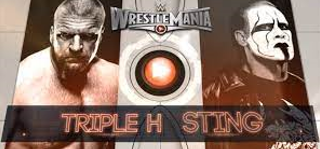
Wrestling Recap: Sting vs. Triple H (WrestleMania ’15)

The Date: 29 March 2015
The Venue: Levi’s Stadium; Santa Clara, California
The Commentary: Michael Cole, Jerry “The King” Lawler, and John “Bradshaw” Layfield/JBL
The Referee: Charles Robinson
The Stakes: No disqualification singles match

The Build-Up:
For an unprecedented eighty-four weeks, World Championship Wrestling (WCW) dominated the “Monday Night Wars” thanks to big-name star power, big-money contracts, and ground-breaking storylines involving the New World Order (nWo). During this time, Hulk Hogan, arguably wrestling’s greatest icon, experienced a career revival as the villainous “Hollywood” Hogan and his clash against WCW stalwart-turned-dark avenger Sting became the stuff of wrestling legend on this day in 1997. On 26 March 2001, the wrestling world changed forever when World Wrestling Entertainment (WWE) bought WCW and claimed ultimate victory. However, while many WCW wrestlers jumped ship to the WWE for an ill-fated “Invasion” angle, Sting repeatedly turned down offers to join the WWE and instead spent nearly ten years signed with Total Nonstop Action (TNA). Over the years, WWE repeatedly tried to negotiate a contract and fans longed to see the Icon clash with the Undertaker in a dream match. However, it wouldn’t be until 2014, when Sting was shockingly announced to be included in WWE 2K15 (Yuke’s), that the WCW Icon finally decided to sign with the company. At the time, the WWE was in one of its worst ruts as weekly television was dominated by the Authority, a stable of wrestlers and corporate figureheads led by Triple H that routinely interrupted matches and quashed fan favourites. It was in the midst of a multi-man match against the Authority’s representatives that Sting finally made his presence felt. He debuted at the 2014 Survivor Series to help Dolph Ziggler fend off Triple H and pin Seth Rollins to remove the Authority from power. Although this only lasted for a few weeks, Triple H was incensed by Sting’s interference and challenged him to a face-to-face confrontation at Fastlane. Sting accepted and the two brawled, with the Icon besting Triple H’s signature sledgehammer. However, the simple story of Sting being a “vigilante” looking to oust Triple H from power was quickly muddled by the ridiculous decision to reframe the feud into a battle for the honour of the long-dead WCW.

The Match:
As a massive Sting fan, I was super pumped about him finally signing with WWE in 2014. Sure, he was getting on a bit but there were still so many opportunities for dream matches there, especially with a light schedule and a bit of smoke and mirrors. Sadly, things were kind of botched right from the start. After Sting helped remove the Authority from power, he really should have been placed as the replacement authority figure, one who favoured putting on interesting matches and seeing things go down in a fair and just way. Also, they never should have replaced his WCW music with that generic, awful quasi-goth metal track. I didn’t expect the WWE to pay for Metallica’s “Seek & Destroy” but they bought WCW, so they owned the rights to his original Crow music that is so iconic to the character, so they really should’ve used that. Finally, as much as I feel like Triple H vs. Sting was definitely a match to do while he was about, this is not the match people wanted to see. People wanted Sting vs. The Undertaker, even back in 2014, and I’ll never understand the decision to veto that in favour of this except to stroke the egos of a bitter Vince McMahon and the vindictive Triple H. Speaking of whom, the Game came to the ring following a pre-taped introduction by Arnold Schwarzenegger, flanked by T-800 endoskeletons, and decked out in Terminator-themed apparel that might’ve looked cool if the match hadn’t taken place in broad daylight! I get that this was a tie-in to the event’s sponsor, Terminator Genysis (Taylor, 2015), but it actually didn’t make much sense since the last time Schwarzenegger and Triple H interacted, the Austrian Oak slapped the shit out of the Game. Oh, and Triple H looked ridiculous in his cheap cosplay outfit, too. The bell hadn’t even rung before Michael Cole was repeating the ludicrous diatribe that Triple H’s goal was to destroy the last remnant of WCW. As if that wasn’t bad enough, JBL constantly kept ragging on Sting throughout the match, questioning his ability to hang in the WWE, and pretending like he’d been absent from the business for the last ten/fifteen years. Just absolutely pathetic stuff all around from the commentary team, really. WCW was dead and buried and Sting had a whole career after it, so all they succeeded at here was sending mixed messages about the legendary figure.

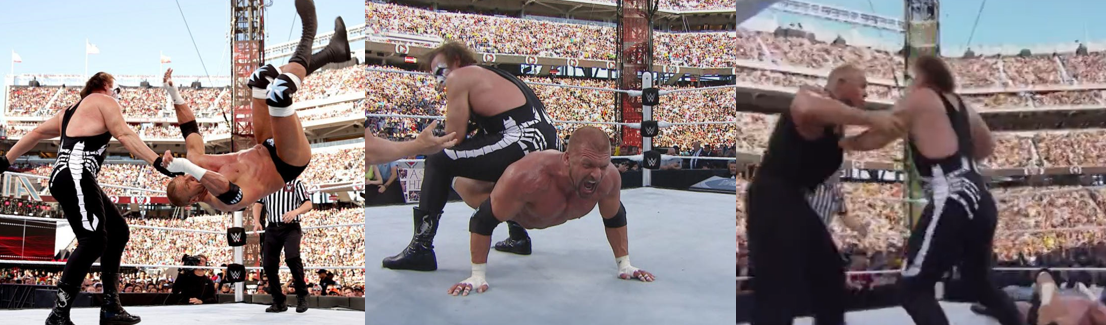
Sting dominated the early stages of the match until D-Generation X rushed the ring!

After milking a brief outburst of “This is awesome!” (which, to be fair, it kind of was because it was Sting at WrestleMania!), the two locked up. Sting knocked Triple H down with a shoulder block so the Game countered with another lock up to show some off his fundamentals and then hit a shoulder block of his own. Sting bounced back with a hip toss and a dropkick that sent Triple H scurrying into the corner as Sting pandered to the crowd to chants of “You still got it!” Though hesitant, Triple H engaged in another lockup, but this time he turned the match into a brawl. Sting shrugged off Triple H’s patented knee smash and sent him scrambling to the outside to avoid the Scorpion Death Lock. After clearing his head on the outside, Triple H returned to the ring to slug it out with Sting once more only to end up back outside after taking his little flip over the top rope off an Irish whip. This time, Sting followed but crashed and burned into the barricade when the Game dodged a Stinger Splash. Triple H chucked Sting shoulder-first into the ring steps and hefting him back into the ring with a suplex off the apron for a two count. Triple H maintained his dominance with some mounted punches, a whip into the corner, and relished in seeing Sting fall to his knees at his feet. After another near fall, Triple H slapped on a rest hold as, apparently, all this action was just two much for the competitors. When Sting tried to mount a comeback, the Game shut him down with his signature spinebuster for another two count before returning to his rest hold. This time, Sting fought out with the Scorpion Death Lock after countering a top rope attack. However, Triple H’s old D-Generation X buddies, “Bad Ass” Billy Gunn, “Road Dogg” Jesse James, and X-Pac, rushed the ring, forcing Sting to break the hold to fight them off. Sting even countered the Pedigree and launched Triple H from the ring, and then took all of D-X out with a top rope dive! Unfortunately, a momentary distraction from Billy Gunn was all the opportunity Triple H needed to plant Sting with the Pedigree but, incredibly, Sting got the shoulder up before the three count.

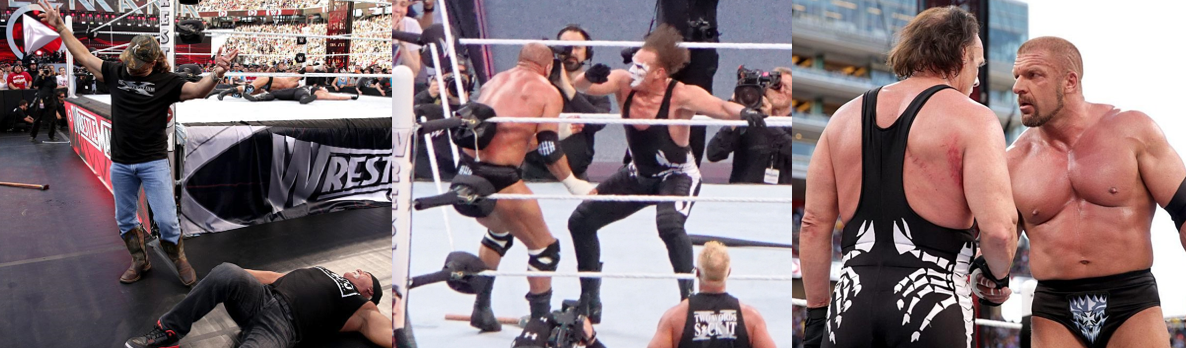
While faction warfare broke out at ringside, it was Triple H’s sledgehammer that made a chump of Sting.

Stunned, Triple H retrieved his sledgehammer from under the ring but he was interrupted by, of all people, “Hollywood” Hulk Hogan, Kevin Nash, and Scott Hall of the nWo! Yes, Sting’s long-time enemies, who he vehemently opposed during arguably the most memorable moments of his entire career, actually helped him! This led to an admittedly awesome moment as the nWo finally got into it with D-X, it just had no place being in this match as it made no sense for them to defend either him or the “honour” of the long-dead company. Regardless, in the chaos, Sting dropped Triple H with the Scorpion Death Drop for a two count. Sting then reapplied the Scorpion Death Lock and Hogan moved the sledgehammer out of Triple H’s reach, which really should’ve been the finish to the match. Instead, Triple H grabbed the ropes (which shouldn’t have counted as it was a no disqualification match…) and Sting was blasted by a Sweet Chin Music from the ”Heartbreak Kid” Shawn Michaels! Since Triple H was slow to cover, Sting kicked out, so D-X slid Triple H his sledgehammer and Sting’s hated enemy, Scott Hall, passed him his trusty baseball bat. Sting not only nailed Triple H with the bat, he also comically snapped his sledgehammer in two before unleashing a flurry of strikes in the corner. A Stinger Splash followed but, rather than hitting a second and bringing the match to a close in a feel-good moment, Triple H blasted Sting in the head with the tip of his sledgehammer and pinned him for the three count! To make matters worse, the two shook hands in a show of respect after a tense showdown between their factions! This match feels like it was put together by someone who had no idea about anything that happened in WCW and just wanted to see D-X and the nWo have a scuffle while putting the final nail in the coffin of the long-dead company. Sting looked pretty good but it was clear from the rest holds that he was getting a bit gassed by the middle and, honestly, this match should’ve made better use of the no disqualification stipulation to help with this. Instead, it was tonally all over the place, with Sting proving a daunting figure but being buried by JBL, him getting the better of Triple H but being beaten by a sledgehammer to the face, and then him shaking Triple H’s hand afterwards like he was beaten by the better man and not a brute who cheated to win.

The Aftermath:
Since Sting lost this match like a chump, Triple H and the Authority continued to dominate the WWE, especially as their golden boy, Seth Rollins, had captured the WWE World Heavyweight Championship in the main event of WrestleMania ’15. Thanks to having the Authority in his corner, Rollins successfully defended the WWE World Heavyweight Championship throughout the year and even toppled John Cena in the main event of that year’s SummerSlam. To honour him and his accomplishments, the Authority presented Rollins with a commemorative statue, but were stunned to find Sting in its place. Despite the fact that he lost his big match, Sting challenged Rollins for the WWE World Heavyweight Championship at Night of Champions, a decision that would’ve made a lot more sense if Sting had won at WrestleMania ’15 and spent his time afterwards continuously opposing the remnants of the Authority. This also could’ve tied into Rollins’ later rivalry with Triple H as he could’ve claimed to beat the man who beat his mentor. Unfortunately, Night of Champions would spell the end of Sting’s in-ring WWE career as he suffered a debilitating neck injury from Rollin’s trademark Buckle Bomb. Although the remorseful Rollins got some flack for this (and, honestly, he really should’ve stopped using the move from that point), Sting maintained that it was a freak accident. Despite announcing his retirement during his induction to the WWE Hall of Fame, Sting jumped ship to All Elite Wrestling (AEW) in 2020, where he took on a mentor role to youngster Darby Allen and even returned to the ring for a handful of matches.

My Rating:

Rating: 3 out of 5.

Pretty Good

What did you think to Sting’s long-awaited WWE debut? Were you disappointed that he faced Triple H and not the Undertaker? What did you think to the involvement of D-X and the nWo and do you think it made sense for the nWo to help Sting? Were you annoyed by JBL’s commentary during the match and the anti-WCW narrative being told here? Did it annoy you that Sting lost and how do you feel about his time in the WWE? Whatever your thoughts on Sting, and this match in particular, feel free to voice them below and be sure to check out my other wrestling reviews!

Movie Night: Sonic the Hedgehog 3

Released: 20 December 2024
Director: Jeff Fowler
Distributor: Paramount Pictures
Budget: $122 million
Stars: Ben Schwartz, Keanu Reeves, Jim Carrey, Colleen O’Shaughnessey, Idris Elba, and James Marsden

The Plot:
When a mysterious black hedgehog known as Shadow (Reeves) escapes from captivity and goes on a rampage, Sonic the Hedgehog (Schwartz) and his friends – Miles “Tails” Prower (O’Shaughnessey) and Knuckles the Echidna (Elba) – must team up with their old foe, Doctor Ivo Robotnik (Carrey), against a common enemy.

The Background:
As a key player in the aggressive Console War between Nintendo and SEGA, Sonic had quite the life outside of the videogames, starring in many comic books and cartoons. The idea of a Sonic the Hedgehog movie had been doing the rounds since 1993 but, thanks to legal and creative issues, the best we got was the gorgeous original video animation (OVA), Sonic the Hedgehog: The Movie (Ikegami, 1996). That all changed once Paramount Pictures acquired the franchise rights and produced a live-action/CGI hybrid movie that first horrified and then impressed audiences, A critical and commercial success, Sonic the Hedgehog (Fowler, 2020) repeated this feat with a hugely profitable and well-regarded sequel that, surprisingly, saw star Jim Carrey reprise his role and added more elements from the videogames to the formula. This success saw Knuckles branch out into his own solo series (to mixed reviews) alongside development of a third film. Although he teased his retirement from acting, Carrey was convinced to return by a 24-carat script and the chance to play a dual role. Taking inspiration from Sonic Adventure 2 (Sonic Team USA, 2001) and Shadow the Hedgehog (SEGA Studios USA, 2005), the filmmakers cast Keanu Reeves as the popular anti-hero, who was teased at the end of the last film, and worked hard to both capture the spirit of his videogame counterpart and deliver something new to the character. To make up for unfortunate delays, multiple special effects studios worked simultaneously on the film’s effects and Sonic the Hedgehog 3 released to widespread acclaim. Reviews praised both Reeves and Carrey as the standout stars, alongside the humour and surprising gravitas, though the supporting cast were criticised. Still, Sonic the Hedgehog 3 made more than $210 million at the box office and hopes were high for a fourth entry and additional spin-offs.

The Review:
If there are two things I’ve never been shy about, it’s my love for the Sonic the Hedgehog franchise and my dismay that his big-screen adventures haven’t been all-CGI animated affairs. Yet, despite this (and the notorious reputation movie adaptations of videogames have), the live-action/CGI hybrid Sonic adventures have actually been pretty good. Blending elements of Sonic’s long defunct, Western canon with more modern elements of his lore, the films recast Sonic as an adventurous and enthusiastic, high-speed hero from another world. After coming to Earth and living alone, desperate for friends and acceptance, Sonic has found a surrogate family alongside Tails, Knuckles (fresh off his solo series), and their human family, Tom (Marsden) and Maddie Wachowski (Tika Sumpter). On the anniversary of Sonic’s b-Earth-day, Sonic and Tom reflect on the hedgehog’s journey, how he found friends and a place in the world despite experiencing great pain as a child and being separated from his parental figure. Having formed a brotherhood during their last adventure, the trio (colloquially known as “Team Sonic”) perfectly complement each other’s abilities: Sonic’s the leader, Knuckles is the muscle, and Tails is the gadget guy. Though they banter at times and Knuckles is often the butt of many jokes due to his thick-headedness, the three vowed to never again use the Master Emerald lest its power threaten the world and are depicted as a tight-knit group of friends. Team Sonic are also closely affiliated with the Guardian Units of Nations (G.U.N.), a military division established to monitor and respond to alien threats, with the three now regarded as trusted allies of the G.U.N. overseer, Commander Walters (Butler). Unlike in Sonic Adventure 2, where Sonic was targeted by G.U.N. because they ridiculously mistook him for Shadow, G.U.N. Director Rockwell (Krysten Ritter) is dispatched to recruit Team Sonic’s aid, a task she performs reluctantly as she’s suspicious and distrustful of the “aliens”.

Overwhelmed by Shadow’s speed and power, Team Sonic are forced to join forces with Dr. Robotnik.

Though Team Sonic and the Wachowskis enjoy their peaceful downtime, they jump at the chance for some action (Team Sonic at the beginning and the Wachowskis later, when the boys ask for their help infiltrating the G.U.N. headquarters). However, while Knuckles is eager to test his mettle against the new hedgehog, Sonic calls for cooler heads, despite the chaos and destruction Shadow unleashes upon the city. Angered and suspicious of the “colourful bunch” since they arrived in a G.U.N. helicopter and Shadow’s vendetta is primarily against G.U.N., the enraged hedgehog refuses to listen to reason and easily trounces the three with his impressive physical strength and powers of teleportation. As if that wasn’t bad enough, Shadow’s rocket boots and natural Chaos Energy make him more than a match for Sonic, resulting in a resounding defeat for the trio. After learning of Shadow’s tragic origins from Commander Walters, the three are suddenly attacked by Dr. Robotnik’s egg drones, only to learn from the doctor’s long-suffering right-hand man, Agent Stone (Lee Majdoub), that the increasingly manic (and finally overweight) Dr. Robotnik is not only alive but not behind the attack. Incensed to learn that his machines have been hijacked, Dr. Robotnik begrudgingly agrees to a short-lived team up to track down their common foe. Naturally suspicious of the mad scientist, Sonic keeps a close eye on the maniacal doctor and shares his regret for Shadow’s pain. Their conversation leads Dr. Robotnik to “trauma dump” to his foe and reveal that he also had a tragic childhood filled with bad choices and a lack of parental figures, echoing the main theme of the film (essentially, don’t let your past/pain define you). Equally, discussions with Tails regarding the nature of Team Sonic’s relationship leads Agent Stone to question his devotion to Dr. Robotnik, who routinely humiliates and belittles Stone despite his clear awe and loyalty. We don’t get too much additional insight into Knuckles and he remains and arrogant and proud warrior who takes things far too literally. However, Knuckles proves to be an extremely loyal friend; even when an emotional Sonic is ready to go to blows with Knuckles, Rad Red takes the high road and falls back on the trust he placed in his family.

Desperate to connect with the family he never had, Dr. Robotnik teams up with his maniacal grandfather.

The team up between Team Sonic and Dr. Robotnik is tenuous, at best, given the doctor’s past actions and unstable disposition, but it quickly falls apart when they explore the G.U.N. facility where Shadow was once experimented on. There, the bald lunatic is surprised to meet his long-lost grandfather, Professor Gerald Robotnik (Carrey), an equally devious and intelligent scientist who once ran tests on Shadow and who has returned after fifty years in prison to enact revenge through the angst-ridden hedgehog. Playing dual roles really allows Jim Carrey’s natural, madcap comedy stylings to take centre stage here. Both Robotniks are very similar, sharing an eccentric and dark sense of humour and a desire to vent their personal frustrations upon not just their enemies, but the entire world. Elated to finally meet a member of his family, Dr. Robotnik abandons his newfound allies and devotes himself to Gerald’s cause, using the power of virtual reality and amusing montages to bond with his elder and feel a sense of belonging so strong that he angrily rebukes and dismisses Agent Stone when he raises concerns about Gerald’s intentions. While Dr. Robotnik employs a few mechanical aids throughout the film, they’re secondary to the duo’s more threatening objective: the Eclipse Cannon, a world-ending space station Gerald built for G.U.N. back in the day. Perfectly matched in their mania, genius, and physical abilities, the Robotniks are also cunning and spiteful. While infiltrating the G.U.N. headquarters, Dr. Robotnik tests his laser-reflective clothing by threatening his grandfather’s life, much to Gerald’s respect. Though distrustful of Shadow, Dr. Robotnik relishes the chance to have the power to prove his superiority over the world and his fleet-footed foe, a mad desire that sees him finally donning a game accurate outfit and standing beside his grandfather on the Eclipse Cannon. Unfortunately for the pining doctor, Gerald’s ambitions extend far beyond subjugating the world. Intent on eradicating all human life, including his own, Gerald’s mad plans clash with Dr. Robotnik’s desire to rule, turning the crazed scientist into a reluctant ally for the final act.

Consumed by anger, Shadow vents his wrath upon the world to avenge his lost friend.

Of course, the central antagonist the entire film revolves around is Shadow, a dark and brooding hedgehog from beyond the stars who’s focused only on revenge. While the trailers made it seem like Keanu was phoning in his performance, his growling delivery is pitch-perfect for the enraged anti-hero and he perfectly captures Shadow’s pain and rage. Falling to Earth over fifty years ago and subjected to years of experiments to harness his powerful (but unstable) Chaos Energy, Shadow was treated as a mere lab rat and shown none of the warmth and affection that shaped Sonic into a self-serving hero. Shadow’s only friend was Maria (Alyla Browne), Gerald’s well-meaning granddaughter who bonded with Shadow, giving him someone to care about. After realising Shadow’s powers were too dangerous to contain, G.U.N. sought to keep him in stasis and, during an escape attempt, Maria was accidentally killed, fuelling Shadow’s rage. Shadow’s so consumed by his anger and pain that he attacks G.U.N. and anyone who gets in his way on sight. Thus, when he sees Commander Walters, Shadow doesn’t hesitate to strike to retrieve one of the Eclipse Cannon’s keycards. Unfortunately, Shadow actually attacked Tom in disguise, causing him to not only question his vendetta but enrage Sonic, who abandons his family to extract a measure of revenge from his dark doppelgänger. Although you might not be surprised to learn that Tom isn’t killed, it is touch and go for a moment and the risk against him is great considering the destruction Shadow causes when unloading on G.U.N.’s soldiers. Unlike in the videogames, Shadow doesn’t need a Chaos Emerald to teleport or reach blinding speeds; equally, he’s specifically said to be from the stars, rather than a result of Gerald’s experiments. Yet, he’s just as angry and misguided as in the source material, and equally unstoppable. Even Team Sonic’s combined might cannot match with Shadow’s powers, making him an incredible formidable foe.

The Nitty-Gritty:
Sonic the Hedgehog 3 is a story about choices; specifically, the choices we make that shape us. Sonic chose not to let his pain rule his heart and to be a selfless hero, whereas Shadow is consumed by his grief and is turning his rage upon the world he believes wronged him. Similarly, years of rejection and abandonment issues shaped Dr. Robotnik into a spiteful and malicious supervillain, just as decades in prison and the loss of his granddaughter twisted Gerald into a crazed madman ready to destroy himself alongside the world. Sonic, Tails, and Knuckles are depicted as brothers as much as friends and teammates; together, they’re their greatest source of power and inspiration. While this doesn’t give them the edge against Shadow, their combined abilities and resourcefulness see them explore other options to subdue their foe. It’s therefore incredible tense and heartbreaking when Sonic, consumed by anger and a lust for revenge after Shadow hurts Tom, is ready to fight Knuckles to learn the location of the Master Emerald. Tails, in particular, is distraught by Sonic’s emotional state and his refusal to listen to reason, just as Knuckles is angered that his friend would abandon his morals and their vow. Yet, Knuckles refuses to betray their bond, even if Sonic is ready to, and Sonic’s subsequent efforts to beat Shadow into submission as Super Sonic serve as a character test for the misguided hero. Indeed, during their fight, Shadow not only riles Sonic up more and transforms into his own Super form, he also spits Sonic’s rage in his face and draws comparisons between them. Despite Sonic rejecting the notion that he’s anything like his destructive foe, he’s forced to face reality when he remembers Tom’s words and teachings and, thankfully, lets go of his rage to find common ground with Shadow. Similarly, Sonic learns there’s more to Dr. Robotnik than just a crazed supervillain during their short-lived team up. Much of Dr. Robotnik’s lust for power comes from not having strong moral influences and a resentment towards the world though, ultimately, all three learn to set aside their personal grievances to protect the world.

Shadow’s power makes him a formidable threat, even to Super Sonic!

Like its predecessors, Sonic the Hedgehog 3 is full of colourful, fast-paced action and adventure. Sonic, Tails, Knuckles, and Shadow all sport poses, lines, and abilities from the videogames, with Shadow riding through Tokyo on a motorcycle while blasting at Sonic with a laser pistol and many of his dramatic, angst-filled poses being ripped right out of Sonic Adventure 2 and Shadow the Hedgehog. It’s a joy to see and witnessing Shadow’s raw power is endlessly exciting; he zips about, blasting foes with kicks and punches, and laying waste to everyone. Equally, Team Sonic continue to impress: Sonic defies all laws of physics, Spin Dashing and blasting around at incredible speeds, Tails keeps pace with his helicopter blade tails, and Knuckles easily hefts around objects as though they were weightless. Of the three, Sonic has the best chance of fighting Shadow thanks to Knuckles’ hot-headedness and Tails’ comparative fragility. However, it takes all three (and Tom and Maddie utilising holographic disguises) to breach G.U.N.’s headquarters. After Tom is left fighting for his life, we see the triumphant and dramatic return of Super Sonic; however, Shadow’s power is so immense that he blasts the Chaos Emeralds from his foe with one blow and absorbs them in turn. The battle between Super Sonic and Super Shadow sees them literally tear up the landscape, causing volcanoes to erupt and them to battle across the globe and eventual on the surface of the Moon! Setting aside everyone’s ability to breathe in space, these are some of the film’s most exhilarating moments and seeing Super Sonic and Super Shadow team up to stop the Eclipse Cannon was an exciting finale. Although the Biolizard and Finalhazard don’t appear, there was a cute reference to it and other Easter Eggs for eagle-eyed fans. The Eclipse Cannon console is modelled after a Mega Drive, for example, Dr. Robotnik’s ring tone is Paul Shortino’s “E.G.G.M.A.N”, a hard rock cover of “Live and Learn” plays when Super Sonic and Super Shadow team up, and Team Sonic regroup in a super fun Chao Garden restaurant!

Unexpected alliances and sacrifices see Team Sonic save the world from destruction.

One of the best aspects of Sonic the Hedgehog 3 is how it focuses more on the videogame characters and yet still finds a way to keep Tom and Maddie relevant. They’re there to reinforce the familial bond that separates Sonic from Shadow and contrast the Robotniks’ volatile and twisted relationship. While Director Rockwell added little to the plot and could’ve easily been supplanted with Commander Walters and another fight against Shadow, the infiltration of G.U.N. headquarters was a fun sequence that culminated in the Eclipse Cannon dramatically launching from the River Thames! After being reminded of everything he’s lost, the enraged Shadow powers up the cannon and battles with Super Sonic before realising that he’s been walking the wrong path, one that would dishonour Maria’s memory rather than avenge her. Similarly, Dr. Robotnik is aghast to learn of his grandfather’s suicidal plot and battles him aboard the Eclipse Cannon, matching his nanotech against Gerald’s, and only coming out victorious thanks to a last-minute save from Tails and Knuckles. Thus, with the world in peril from the Eclipse Cannon’s devastating death beam, Super Sonic and Super Shadow block its path while Dr. Robotnik, Tails, and Knuckles fight to redirect the space station, saving the world but blasting half of the Moon! The effort drains the Chaos Energy from Sonic and sees him plummet through the atmosphere; bravely, Tails and Knuckles follow and succeed in saving him. Unfortunately, the Eclipse Cannon’s core overloads and the only ones capable of sparing the Earth from a cataclysmic event are Dr. Robotnik and Shadow. While Super Shadow expends the last of his energy pushing the space station as far away from the Earth as possible, Dr. Robotnik fights to stabilise the core. After delivering a heartfelt message to Agent Stone and thanking him for his loyalty and friendship, Dr. Robotnik and Shadow are seemingly vaporised when the Eclipse Cannon explodes. After making amends with his friends, Sonic returns to his family, grateful for their love and friendship, only to be attacked by a robotic doppelgänger (and a hoard – or “brotherhood” – of the machines) on the outskirts of New York City. Thankfully, he’s saved by a mysterious pink hedgehog and the post-credits reveal that Shadow survived the explosion, setting up further adventures.

The Summary:
Sonic the Hedgehog 3 is a rare gem, for sure. Not only is it an enjoyable movie adaptation of a videogame franchise, but it’s also an entertaining third entry in a film series, and the first time Jim Carrey’s ever portrayed a character three times, making it incredibly rare in the grand scheme of Hollywood. Naturally, given the source material, the film is a tad darker than its predecessors; Shadow alone is a grim, edgy figure, to say nothing of his tragic backstory. There’s far more action and peril this time around and the world is not only endangered, but humanity faces global annihilation from Gerald’s insane plot. Still, there’s a lot of fun, colourful action and humour at work here, including Jim Carrey’s physical comedy, references for the fans, and topical gags for mainstream audiences. Jim Carrey steals the show, throwing his all into both Robotniks, devouring the scenery, and commanding the screen whenever he’s present. I loved the energy and enthusiasm he brought to both roles and it was an inspired decision to expand Gerald’s character into an even darker and more insane mirror of his grandson. However, it’s Shadow that’s the star of the show here. Keanu Reeves perfectly captured Shadow’s angst and pain and flawlessly brought the misguided and outraged anti-hero to life. I enjoyed the tweaks to his backstory and the parallels between him, Sonic, and Dr. Robotnik that reinforced the film’s themes of family, choices, and overcoming grief. Add to that some enjoyable references to the videogames, particularly Shadow’s outings, and some fun gags and you have a hugely enjoyable adventure that successfully appeals to kids, adults, game fans, and mainstream audiences.

My Rating:

Rating: 4 out of 5.

Great Stuff

Did you enjoy Sonic the Hedgehog 3? How do you feel it holds up compared to the previous films? Did you enjoy the addition of Shadow and the changes made to his backstory? What did you think of Jim Carrey’s dual performance as Dr. Robotnik and Gerald? Did you enjoy the fight between Super Sonic and Super Shadow and the many references to the videogames? Where do you see the films going from here and are there any Sonic games or characters you’d like to see make an appearance in the future? To share your thoughts on Sonic the Hedgehog 3, leave a comment below and be sure to check out my other Sonic content on the site!

Movie Night [Christmas Day]: Die Hard 2

Released: 4 July 1990
Director: Renny Harlin
Distributor: 20th Century Fox
Budget: $60 to 70 million
Stars: Bruce Willis, William Sadler, Fred Thompson, John Amos, Art Evans, and Bonnie Bedelia

The Plot:
While waiting at Dulles Airport to pick up his wife, Holly Gennero-McClane (Bedelia), Lieutenant John McClane (Willis) is embroiled in a complex cat-and-mouse plot by disgraced Colonel William Stuart (Sadler) to hijack the planes and liberate a corrupt foreign military leader.

The Background
Roderick Thorp published a follow-up to his 1966 thriller, The Detective, in 1979, to decent reviews. Accordingly, an adaptation of Nothing Lasts Forever did the rounds before being retooled by struggling screenwriter Jeb Stuart. Stuart reimagined Thorp’s aging Detective Joe Leland into a flawed everyman, a role so expertly portrayed by Bruce Willis that it changed the perception of action heroes forever. Despite garnering mixed reviews, Die Hard’s (McTiernan, 1988) $140-odd million box office made it a a massive financial success that revitalised 20th Century Fox and redefined the action hero stereotype. For the sequel, the filmmakers turned not to Thorp’s writing but to Walter Wager’s 58 Minutes (1987), a thriller in which a police officer has less than an hour to stop terrorists who have hijacked an airport. Inspired by the Iran/Contra affair, Steven E. de Souza helped rework the concept into a Die Hard sequel, which saw star Bruce Willis return to the tune of $7.5 million and producer Joel Silver removed after his spending ballooned the budget. Also marketed with the subtitle Die Harder, Die Hard 2 was the first film to digitally compose live-action footage with a traditional matte painting, which was used for the final runway scene. With a box office of $240 million, Die Hard 2 exceeded expectations and held the largest pre-opening record for six years, though reviews were mixed. Even positive reviews noted issues with the plot and it was dubbed another disappointing sequel of the era that failed to capture the magic of the first film. Still, there are some who claim it to be an under-rated entry and the box office success alone was enough to justify a third entry some five years later.

The Review:
Die Hard 2 immediately expands the focus of its action by pivoting away from a claustrophobic, confined location and dropping grizzled, promoted cop John McClane into a bustling airport over the holiday season. In Die Hard, McClane was burned out, irritable, and desperately trying to win back his estranged wife. His personal issues were compounded by the terrorists who took over Nakatomi Plaza and he vented his anger and frustration on them with sharp-tongued relish. In Die Hard 2, things are going much better for McClane: he’s looking a little less haggard, he’s been promoted and has transferred to the Los Angeles Police Department, and he and Holly are back together. Unfortunately, while they might be on much better terms, they’re still apart as Holly’s flying in to spend Christmas with him, the kids, and her family. Still, they remain in contact through the miracle of airphones and McClane’s excited to meet her at Dulles Airport. Things get off to a shaky start for McClane, however; bad luck seems to follow him around, even when things are going well, as he’s unceremoniously towed by Sergeant Vito Lorenzo (Robert Costanzo) for illegally parking outside the building. McClane’s appeals fall on deaf ears as, in a taste of the disregard McClane’s later shown, Vito’s unimpressed by his rank and stature. To make matters worse, it was his mother-in-law’s car! Still, a $40 fine is the least of McClane’s worries when he wanders through the airport and not only bumps into a strangely familiar face and spots a handful of guys acting very suspiciously. Attentive and curious, McClane observes as the men covertly talk, sync their watches, and Sergeant Oswald Cochrane (John Costelloe) and Miller (Vondie Curtis-Hall) slip into a restricted baggage sorting area. Interestingly, McClane’s first thought isn’t to investigate himself but to instead alert the airport police. However, when he’s greeted by Vito’s smarmy grin, he realises they’ll never take him seriously and follows the two alone. When confronted by McClane, the two open fire and a brief fracas ensues that leaves Cochrane dead, McClane in custody, and Miller alive to tell the tale to his commander, shamed military veteran Colonel William Stuart (the man McClane had bumped into earlier).

Met with opposition at every turn, McClane faces another Christmas ruined by a new terrorist plot.

After McClane verifies his identity, he’s brought to Captain Carmine Lorenzo (Dennis Franz), who just so happens to be Vito’s brother and who’s not only dismissive of McClane’s reputation, but personally offended by his presence and his attitude. Consequently, Carmine angrily rebukes McClane’s suspicions that the two men were anything more than simple luggage thieves and has him removed from his office. Stubborn and unimpressed by Carmine’s failure to take the situation seriously, McClane takes matters into his own hands and faxes a copy of Cochrane’s fingerprints to his old friend, Sergeant Al Powell (Reginald VelJohnson), who reveals that they’re fake. Based on this, and the men’s weapons, and the impending arrival of the crooked General Ramon Esperanza (Franco Nero), McClane realises that something bad is about to go down and forces his way into the airport control tower to warn Carmine and air traffic controller Ed Trudeau (Thompson) that a group of mercenaries are obviously planning something. While Trudeau seems to take the threat seriously, especially when the tower starts losing power and access to their systems, Carmine refuses to entertain any of McClane’s warnings, believing he’s an overhyped, out of his depth cop trying to steal the spotlight. McClane is unceremoniously booted from the tower and accosted by keen reporter Samantha Coleman (Sheila McCarthy), who name-drops Colonel Stuart and puts the final pieces of the puzzle together for McClane. Unlike in the last film, McClane is surrounded by potential allies but constantly met with antagonism, resentment, and dismissal. No one takes his warnings seriously, causing not only the tower to be compromised when Colonel Stuart hijacks their systems, but also many deaths when Carmine’s crack troops are gunned down by Colonel Stuart’s men (leaving airport chief engineer Leslie Barnes (Evans) wounded) and Stuart brings down an aeroplane in retaliation. Although McClane desperately tries to provide a warning to the doomed aircraft, he ultimately fails and those deaths weigh heavily on his troubled conscience throughout the film. While Trudeau shows some compassion to McClane following this, he continues to be met with hostility from the airport staff and from no-nonsense Major Grant (Amos), who arrives with a bunch of troopers to take control of the situation and, like Carmine, immediately butts heads with McClane, who’s seen as a dangerous loose cannon despite his best efforts to help.

McClane’s reputation and aggressive demeanour mean he’s as short on allies as he is time.

Luckily, McClane does have some allies amongst all these hot-headed egos. While Powell is sadly relegated to a cameo, he does confirm McClane’s suspicions that something’s amiss at Dulles. Barnes proves extremely helpful in offering alternative ways to signal the aircraft, though Colonel Stuart angrily retaliates each time or has set up contingencies for these. Barnes is also the one who clues McClane in that Colonel Stuart’s men are using a coded frequency (though he’s unable to break it) and who re-routes the emergency beacon to covertly communicate with the pilots. While racing to find solutions and workarounds to Colonel Stuart’s plot, McClane ends up in a network of access tunnels beneath the runway and bumps into Marvin (Tom Bower), a quirky janitor with racks upon racks of blueprints who helps McClane get to different areas of the airport, try new ways of signalling the planes, and locate Colonel Stuart’s outpost at a nearby church. Marvin also retrieves the coat and pre-coded walkie-talkie of one of Stuart’s men, allowing McClane to listen in and retort to Stuart directly. This gives McClane the chance to vent his anger on the man responsible for ruining his latest Christmas, though Colonel Stuart isn’t easily baited and out-thinks McClane at every turn. While Major Grant and McClane clash, McClane earns his begrudging respect after he helps storm Colonel Stuart’s church, raiding their operation and driving off Stuart’s men. This resolution is short-lived, however, when McClane realises he and Major Grant’s men were firing blanks the entire time. While Carmine again refuses to believe McClane’s claims, he’s forced to realise they’ve all been duped when McClane dramatically opens fire on Carmine (somehow not being gunned down by the cops present) to demonstrate his point and Carmine finally comes on side, giving McClane clearance to intercept the villains. While McClane treats Coleman with about as much respect as Colonel Stuart and has no time for her sniffing around for a story, she proves somewhat useful first in identifying Stuart and then in joining him in intercepting Stuart’s Boeing 747, giving McClane the chance to dramatically tackle the bad guys and end their plot.

Holly’s safety means McClane has a personal stake in the film’s events.

While Holly returns, she’s far less of a factor and has far less agency this time around. She’s stuck in the air, as far out of McClane’s reach as before, but with even less control over her situation. While she communicates with McClane using an airphone, she has no idea why her landing has been delayed and only becomes concerned about the situation after the returning Dick Thornburg (William Atherton) points out the circling aircraft in the nearby skies. As obnoxious and grating as ever, Thornburg feels slighted and threatened by Holly since a right-hook to his jaw knocked out two of his teeth after he endangered her children in the last movie, leading him to take out a restraining order against her. While this earns Holly the admiration of Connie (Karla Tamburrell), an air hostess equally repulsed by Thornburg, Holly’s forced to endure his presence as the situation worsens. Ever the opportunist, Thornburg patches into the cockpit radio and learns of the situation, then remotely forces his way on-air to report on the situation live, selfishly thinking only of his career and not the panic it causes those waiting at Dulles Airport. As perceptive and feisty as her husband, Holly not only catches on that their situation is going to become a real problem due to lack of fuel but also retaliates against Thornburg once more by subduing him with a fellow passenger’s taser. Still, while Holly doesn’t get much else to do, it’s the drive to save her from plummeting to a fiery death that pushes McClane on downside. His personal stake in the events sees him aggressively interject himself into the situation and causes as much of the animosity he receives as his smart mouth, though McClane excels in a pressure situation and simply forces himself to fight harder or find other ways around problems, even if it means pissing off those in authority. The subtext of Die Hard 2 is lesser than the first, with more generic masculine and pseduo-sexual connotations, but the premise of this stubborn, determined “Everyman” fighting against the odds to save the woman he loves is strong, though I would’ve liked to see Holly have a more active role in the main plot.

Colonel Stuart enacts a diabolical plan to liberate his anti-communist idol.

This time, McClane is up against an opponent just as intelligent, ruthless, and heavily armed as Hans Gruber (Alan Rickman) but one with the added benefit of a lifetime of military service and equally well-trained, incredibly loyal followers. A former Special Forces officer and one time student of Major Grant, the anti-communist Colonel Stuart strongly supported General Esperanza and even funded his operation, being dishonourably discharged and disgraced as a consequence. After fleeing the United States prior to his court martial, Colonel Stuart and the imprisoned General Esperanza plotted an elaborate scheme to hijack Dulles Airport, intercept Esperanza’s plan, and abscond to safety in a Boeing 747. A stoic, calculating martial arts expert, Colonel Stuart plans everything to the smallest detail, easily infiltrating Dulles Airport and hijacking their communications and power array and duplicating much of their control room in a nearby church. From here, Colonel Stuart and his men easily dupe the aircraft into thinking ground control is experiencing nothing more than heavy weather and effectively holds all incoming aircraft hostage, crashing them without a second’s thought whenever and reprisals are attempted. Though he doesn’t hesitate to take lives, even those of his men, Colonel Stuart reprimands Trudeau and McClane for not obeying his instructions and forcing his hand, indicating that he’s trying to rescue his beloved General with as little bloodshed as possible. His patience with McClane quickly wears thin, however, especially when John intercepts Esperanza’s aircraft and nearly brings him into custody. Aggravated that one stubborn cop could cause his meticulous plan so much trouble, Colonel Stuart has his men open fire on the craft and tosses a bunch of grenades in to take out McClane but is forced to flee when McClane miraculously survives thanks to his quick thinking. Colonel Stuart’s men are fiercely loyal; while they briefly hesitate upon being ordered to trick an aircraft into crashing, they obey his every word without question out of fear of his reprisals. Colonel Stuart’s joined by Major Grant, a deceptive and equally ruthless military man who slits newcomer Telford’s (Patrick O’Neal) throat just for not being “one of them” and aids in duping McClane to cover their escape. When push comes to shove, Colonel Stuart finally gets his hands dirty in a one-on-one fight with McClane, being far more physically capable than Gruber. He’s also much more in control of his emotions and motivated not by greed, but by a warped sense of patriotism and pride.

The Nitty-Gritty:
Die Hard is a Christmas movie. I don’t care what you say or think; it just is. Die Hard 2 is also a Christmas movie, but the season is far less of a factor in the plot. Seasonal jingles aren’t as prominent in Michael Kamen’s score and Christmas trappings aren’t as easily noticeable thanks to how bustling Dulles Airport is, but the entire crux of the plot is Holly coming home for Christmas and half the reason the weather is so bad is because we’re deep into the festive season. McClane does note that his bad luck constantly ruins the season for him, but this seems more emblematic of him than of the festive period. Indeed, Major Grant notes that McClane is in the “wrong place at the wrong time” during one of the many tirades launched against him for trying to help, and the situation only escalates as things spiral out of control. McClane is in a slightly better position this time around, though; he’s wearing shoes, for starters, is fully armed, and has more resources at his disposal to try and help. Unfortunately, he’s constantly hampered by those around him. Since Carmine doesn’t take his concerns seriously, Trudeau doesn’t prepare the control tower for a possible hijacking; since doors are constantly shut in his face, McClane can’t share his insight or opinion on the situation; and since Colonel Stuart is so resourceful and intelligent, the odds are stacked against him in a far greater way than before. This time, McClane battles to save not just his and Holly’s lives, but the lives of all the people on the planes unable to land because of Colonel Stuart. McClane might be selfishly driven to intervene to ensure Holly’s safety but he doesn’t just sit back and do nothing when Stuart hijacks a British airliner. He runs out onto the landing strip and desperately tries to do something, though this is of little comfort when his efforts inevitably fail. While Die Hard 2 is therefore more of a typical action/thriller and less of a tale of reclaiming masculinity and enforcing masculine power like the first film, some aspects of this still remain. Half the reason Vito, Carmine, and Major Grant clash with McClane is because they view him as a threat to their authority and masculinity. McClane is a loose cannon who shouts his opinion and acts impulsively, with little respect for local authority and the chain of command, which especially irks Carmine and equally annoys Major Grant, who believes McClane’s interference is doing more harm than good.

Aside from some explosive moments, McClane is largely a gunfighter this time around.

Ironically, even if McClane approached these figures with a more reasonable and respectful tone, it probably wouldn’t have helped since McClane is something of a celebrity now after his actions in Die Hard. This, and departmental xenophobia, are equally strong reasons for them to dislike McClane and dismiss his concerns, only to begrudgingly realise that he’s been the only one making sense the entire time, which is frustrating but still an improvement over the bungling police presence in the last film. While thematically and narratively very similar to Die Hard, Die Hard 2 broadens its scope for action set pieces; there are more characters involved so more opportunities for big shoot outs, with McClane even engaging in a snowmobile chase near the climax. However, I’ve never thought of Die Hard 2 as being “bigger” or “better” than the first one in terms of its action. It’s often far more explosive, that’s for sure; the plane crash is a notable set piece, as is the destruction of General Esperanza’s plane. However, it’s pretty obvious both are model and composite shots, making them ironically less impressive than McClane’s leap from the exploding Nakatomi helipad. McClane doesn’t get as many opportunities to throw hands this time; he always has his pistol and ammo on him, so he’s more apt to just gun down his foes with a wry remark, meaning we see less of McClane’s physical tenacity. However, this is supplanted by his “die hard” nature; he’s a stubborn cockroach of a man who won’t quit and keeps fighting even when met with a hail of gunfire. Ironically, he’s far less banged up and bloody than in the first film despite the greater odds against him and McClane’s resourceful nature comes not from finding innovative ways to kill his enemies but from finding creative ways to save lives, galvanising McClane into a more broadly heroic character. That’s not to say Die Hard 2 is tame, by any means: plenty of guys are executed by gunshot to the head, people are strangled, have their throat cut, and are riddled with bullets or blown to pieces. But it does feel far less personal this time around; before, McClane was desperately picking Gruber’s men off one by one but Colonel Stuart has far more men with far less memorable characteristics, so it just feels more generic when they’re killed rather than a rousing victory for our lone hero like before.

Though he’s no match for Stuart, McClane gets the last laugh and rescues his wife once again.

McClane is against a ticking clock throughout Die Hard 2. He only has ninety minutes before Holly’s plane runs out of fuel so he does everything he can to restore communications with the planes and find a way to negotiate her safety. He experiences ups and downs in this endeavour as Barnes does manage to contact the pilots, but McClane is intercepted by Colonel Stuart and his men before he can barter Esperanza’s life for Holly’s. The wounded General Esperanza escapes but things start to look up with Major Grant comes along and leads an all-out assault on Colonel Stuart’s church base, only to dupe McClane and the others with blanks and betray them to aid Stuart and Esperanza’s escape. With time running out and Holly’s plane preparing for an emergency landing, McClane finally gets the assistance he’s been demanding the entire movie and has Coleman’s pilot chase after the escaping villains. With no way to block the larger aircraft, McClane is forced to make a desperate drop to the wing on their Boeing 747 to try and stop them. Unlike the first movie, which ended with a tense showdown akin to an Old West duel between the exhausted McClane and the smug Gruber, Die Hard 2’s climax centres around bare-knuckle fistfights on the wing of a speeding aircraft trying to take off. Major Grant is the first to head out to put a beating on the outmatched McClane. However, thanks to his tenacity and resourcefulness, McClane manages to trip Major Grant and send him into a jet engine, splattering him across the plane and further screwing up Esperanza’s attempts to get off the ground. Thus, Colonel Stuart takes matters into his own hands and beats the shit out of McClane in a way Gruber could only dream of, finally kicking him to the speeding runway below. Returning inside to celebrate with his men, Colonel Stuart is completely oblivious to the fact that McClane opened the plane’s fuel valve. Bloodied and beaten, McClane delivers his “Yippie-ki-yay, Mister Falcon motherfucker!” catchphrase and tosses his lighter at the fuel trial, which naturally defies all physics and logic to burn into the plane and explode it in mid-air. As an added bonus, the flame trail and burning wreckage act as a marker for the planes to use to make a safe landing, reuniting McClane and Holly once more and bringing their latest Christmas drama to a close.

The Summary:
Die Hard is a Christmas tradition for me. I watch it every year and every year I enjoy it as much as the last time I watched it. Die Hard 2 also makes the Christmas watch list, but I’d be lying if I said I looked forward to it as much as the first movie. It’s not that it’s bad, really, just not as enjoyable or memorable as the first film. The atmosphere is both familiar and yet different, which is what you want from a sequel but something just feels off. Narrative beats, returning characters, and a sense of repetition help thematically link it to the first movie while also expanding upon the characters and setting. John McClane is far less beaten down than before, but no less tenacious; however, his character is noticeably different, largely because of the supporting cast. He’s face-to-face with the same type of bureaucrats who got in his way last time and we live his frustration with their dismissive attitude and his desperate attempts to do something while they sit around, stubbornly refusing to believe him due to their slighted pride. McClane is as resourceful and enjoyable as ever, delivering some wry quips and surviving some unbelievable situations, but he’s recast as a more typical heroic figure this time. Die Hard 2 isn’t just about saving a handful of hostages; it’s about saving thousands of lives from Colonel Stuart’s reprisals. It’s not about reclaiming masculinity; it’s about reinforcing it and a clash of “Alpha Male” figures and egos. Colonel Stuart exemplifies this; unlike Gruber, he’s a physical and intellectual challenge for McClane, after all. Oddly, despite its greater scope, I find Die Hard 2’s action to be lacking compared to the first. Things don’t feel as intimate and personal and a lot of the impact is dulled, as though everyone’s just going through the motions despite some enjoyable performances. In the end, I still watch Die Hard 2 at Christmas and still enjoy it, but I would much rather watch Die Hard twice or skip to one of the other sequels as they delivered a new challenge for McClane in a far more unique way than what we see here.

My Rating:

Rating: 4 out of 5.

Great Stuff

Are you a fan of Die Hard 2? How do you think it compares to the first films? What did you think to Colonel Stuart and his cold-hearted depiction? Did you like seeing McClane face new challenges, especially following his infamy from the first movie? Were you also disappointed by the action sequences? Is Die Hard 2 on your Christmas watch list? What are your plans for Christmas Day today? Whatever your thoughts, feel free to comment down before and have a great Christmas!

Movie Night [Christmas Countdown]: Home Alone 2: Lost in New York

Released: 20 November 1992
Director: Chris Columbus
Distributor: 20th Century Fox
Budget: $28 million
Stars: Macaulay Culkin, Joe Pesci, Daniel Stern, Catherine O’Hara, Tim Curry, and Brenda Fricker

The Plot:
While jetting off to Florida for Christmas, an airport mix up separates young Kevin McCallister (Culkin) from his mother, Kate (O’Hara), and his family, leaving him to deal with vengeful burglars Harry (Pesci) and Marv (Stern) in the Big Apple.

The Background:
Widely considered one of the greatest Christmas movies, Home Alone (Columbus, 1990) was dreamed up by writer and producer John Hughes and brought to life by Chris Columbus. Macaulay Culkin beat over two hundred children for the breakout role in the critical and commercial hit, which became an instant Christmas classic. The first of its many sequels entered development just one year after the first film landed, with Culkin receiving a lucrative payday for returning, alongside a share of the film’s gross. Once again, the shoot was difficult for star Joe Pesci, who suffered serious burns during filming, and the film was a commercial success even if its final gross fell short of the first film. The third highest-grossing film of 1992, Home Alone 2 was nevertheless met by largely negative reviews. The cartoonish violencesentimental hook, and central concept were all noted to be lazy, derivative repeats of the first film, though the performances were praised and it has since been regarded more favourably, especially compared to the later, unrelated sequels.

The Review:
It’s been a year since the McAllisters and their chaotic extended family left Kevin home alone and things are very much the same as before in their opulent and inexplicably luxurious family home. That is to say that the house is full of kids and adults rushing back and forth in a mad panic trying to pack and prepare for another family vacation, this time to Florida and at the expense of the McAllister patriarch, Peter (John Heard). Everyone slips right back into their previous roles exactly as depicted in the last film, with Peter unwittingly causing the family to sleep in by unplugging the alarm clock and Kevin’s uncle, Frank (Gerry Bamman), being as aggressive and dismissive towards Kevin as ever. Some things have changed, however; Kevin isn’t as bratty as before and his relationship with his mother is much improved. Kate makes more of an effort to listen to and include him and goes out of her way to ensure that Kevin makes it to the airport this time, acutely aware of her previous mistake and desperate to keep it from happening again. Despite reaching a mutual respect at the end of the first film, Kevin is still at odds with his older brother, Buzz (Devin Ratray). Still resentful towards his little brother and happy to demean him at every turn, Buzz delights in humiliating Kevin in front of the entire school, including the parents and staff, by pulling a mean-spirited prank during his choir solo, one that’s entirely unfunny but which has everyone in the audience in stitches. Kevin naturally lashes out, causing a ruckus, and the two are taken to “family court” to discuss the issue. While, on the surface, this seems more productive and fairer than what we saw in the last film, where Kevin’s family condemned him without giving him a chance to defend himself, it’s a kangaroo court, at best, and Buzz easily sways the family into believing he regrets his prank. Naturally frustrated that his family expects him to apologise, Kevin once again bemoans his unfair treatment and chastises his family’s ignorance. Still, he successfully makes it to the airport this time, despite not wishing to spend his Christmas in Florida due to his sudden love of Christmas trees.

Lost in New York, mischievous Kevin touches hearts and raises suspicions as he indulges himself.

Unfortunately for Kevin, things go awry at the airport. Thanks to Peter, the family’s again in a mad rush to reach their flight and, thanks to messing about putting batteries in his Talkboy tape recorder and lackadaisical airport security, Kevin accidentally boards the wrong flight and ends up in New York City. After quickly overcoming his surprise and a brief flash of fear, Kevin takes in the sights of the city and heads to the luxurious Plaza Hotel. Posing as “the father” and using his dad’s credit card and cash, Kevin secures a swanky room and all the treats he could want. Kevin’s arc in this movie is, like much of Home Alone 2, copy and pasted wholesale from Home Alone except he’s now in the city. Given complete freedom to do whatever he wants, Kevin indulges in sweets, bad movies, and a trip to Duncan’s Toy Chest, where he chats with the proprietor, Mr. Duncan (Eddie Bracken), and showcases an empathy beyond his years. Kevin even repeats that same routine of fear, misunderstanding, and befriending of a misjudged local, in this case an unnamed vagrant (Fricker) with a love of pigeons. Unlike the last film, though, Kevin’s not just relishing the chance to do whatever he wants without consequence; he’s living the Christmas vacation he feels he desires, one that caters to his every whim. However, the presence of a lone child in the Plaza Hotel foyer raises the suspicions of the hotel concierge, Mr. Hector (Curry), who immediately tries to confirm that Kevin’s….well, it’s not entirely clear what Mr. Hector is trying to discover, actually. He exhibits the same strangely confused reaction at seeing a kid by himself, but it’s not entirely clear why he’s so sceptical. Thanks to Kevin’s quick thinking, the youngster throws Mr. Hector off his scent with a blow-up doll and a convenient recording of Uncle Frank yelling at him, securing Kevin the hotel’s co-operation for a short time out of fear of reprisals from his unseen father. However, thanks to Kate and Peter reporting Kevin’s absence to the police, Peter’s credit card comes up as stolen, verifying Mr. Hector’s suspicions and leading him to more aggressively confront the mischievous youth. Though Kevin again holds them at bay with a convenient ruse, he’s forced to flee the hotel, believing he faces criminal charges for credit card fraud, and wanders the dangerous streets of New York, the fun suddenly sucked out of his impromptu vacation.

Harry and Marv get distracted from their big payday with thoughts of revenge.

In a film (and franchise) full of coincidences, Kevin’s old enemies, Harry and Marv (now calling themselves the “Sticky Bandits”) also end up in New York following a jail break. Fugitives and desperate for a quick, big score to abscond to safer shores, the two rule out petty theft or any big-time jobs and instead target Duncan’s Toy Chest, believing that it’ll be an easy score since no one would be stupid enough to rob a toy store on Christmas Eve. Ever year, Mr. Duncan donates the store’s profits to a local children’s hospital, in cash and in person, meaning all the crooks have to do is hide out in the store until it closes and rob the place. Unfortunately, there’s a glaring plot hole with this plan: Mr. Duncan tells Kevin he plans to donate the money at midnight but the money’s still there when the Sticky Bandits come out of hiding. Anyway, it’s a moot point as Kevin shows up to interfere with their plot. Earlier in the film, the three just happened to cross paths despite the vastness of the city and Kevin was horrified to find his enemies out and about and hungry for revenge. Thanks to the busy city streets and some quick thinking, Kevin evaded the Sticky Bandits and got to safety, but not before learning of their appalling plan to screw over sick children. Harry and Marv are exactly the same as before: malicious and bumbling. Harry may be the smarter of the two, chastising Marv’s foolishness and loose tongue, but he’s hardly the sharpest tool in the drawer. Like Kevin, Harry and Marv have learned from their previous experiences, however. Not only do the crooks have no desire to go back to prison but they’re acutely aware of how adept Kevin is at setting up traps, meaning they’re far more likely to be cautious when chasing him rather than simply barging in head-first. This doesn’t help them in the slightest when it comes to chasing Kevin as they still fall afoul to his many traps and tricks, but there are fleeting moments when it seems like the two might pose a significant threat this time around. While they’re happy to simply steal some cash and get out of the country, they can’t pass up the chance to get a measure of revenge on the kid who sent them to jail and they become fixated on this. This leads to their inevitable torture and downfall when they could’ve simply targeted a different toy shop or schemed up a slightly different plan and potentially have avoided being scarred for life.

Kate and the family are side-lined for a greater focus on Kevin and his new friends.

Unlike Home Alone, Kate doesn’t get a big side plot this time around. She, Peter, and the kids are stuck in Florida, their vacation ruined not just by Kevin’s absence but the inclement weather. Since they have no idea of where Kevin is until Peter’s credit card gets flagged, they can’t do anything but wait at their surprisingly lowkey hotel, though they immediately get the next flight to New York once the Plaza Hotel alerts the police. We don’t get to see this flight and we also get far fewer reactions from Kate and the others at Kevin’s plight; she simply expresses concern for his safety and that it. That is, of course, until she meets Mr. Hector and finds out what a botched job he and his long-suffering bellhop, Cedric (Rob Schneider), did at keeping Kevin safe and secure at the hotel. Flustered and desperate to appease the enraged Kate, Mr. Hector’s forced to shut his yap and acquiesce to the McAllister’s every whim to avoid any reprisals more severe than a slap to the face and Kate braves the cold, dangerous streets to try and find Kevin. This is a far cry from her cross-country travels and the guilt-ridden reflections of the first film, meaning the bulk of Home Alone 2 is spent following Kevin and drinking in the awe of the hustle, bustle, and sights of New York City. At first, this is portrayed as a beautiful and awe-inspiring location and Kevin is amazed at everything he sees, but his wonder turns to fear when he’s left wandering the streets and Central Park at night, surrounded by surly vagrants and dark shadows. He reacts with fear whenever he sees the Pigeon Lady, creeped out by her grim façade, ragged clothes, and the pigeons clinging to her, but quickly comes to realise that she’s not bothering anyone and was trying to help him. He bonds with her in the same way he bonded with Old Man Marley (Roberts Blossom) in the last film, learning there’s a deeply emotional and tortured soul beneath the repulsive visage and again learning that he’s been unfair to his family and shouldn’t have taken them for granted. It is, as I said, essentially the same character arc he underwent in the first film. Even the musical cues, much of the dialogue, and a lot of the trap sequences are mirrors of Home Alone’s and I don’t think Home Alone 2 does enough with its new setting to differentiate itself from the original as a consequence.

The Nitty-Gritty:
Similarly, every theme and character arc seen in Home Alone 2 is a repeat of what we saw in Home Alone. Kevin’s siblings and family may not be as explicitly aggressive or dismissive towards him (except for Buzz), but they still all laugh at Buzz’s prank and take the older boy’s side after the fact. Kate is far more protective and aware of Kevin this time, but only when it comes to planning their trip and ensuring Kevin isn’t left behind. When she and Peter begrudgingly report Kevin’s disappearance to the cops, there’s a sense that Kate’s despondent not just because of the same emotional turmoil she faced in the last film (namely, questioning her ability as a mother) but also at the idea of her being judged for letting this happen two years in a row. Kate’s concern is definitely framed as being for Kevin’s welfare (this is clear when she desperately hits the streets trying to find him) but it also seems much more rooted in her desire to not be seen as a bad mother. As before, Peter doesn’t seem all that bothered until they reach the hotel and Mr. Hector proves to be less than useless, and even then he’s more worried about losing Kate or her getting hurt searching for Kevin. All the other McAllister’s return and have even less personality or impact than before. They’re there simply to enforce that this family is way too big and it’s easy for Kevin to be lost in the shuffle. Instead of focusing on Kate’s turmoil, Home Alone 2 follows Cedric’s struggles to find out more about Kevin for his boss and his inability to secure a decent tip from the youngster, and Mr. Hector’s problematic pursuit of investigating his young guest. Again, I’m not sure why Mr. Hector is so suspicious of Kevin; he’s right to be, but I just don’t get what raised that flag for him, especially considering how many guests (including kids) are milling about in the bustling hotel.

Kevin’s hazardous traps once again scupper the crooks and he’s rewarded with a merry Christmas.

As fun as it is living vicariously through Kevin as he explores the city, treats himself to all sorts using his dad’s mysterious wealth, and messes about with his Talkboy, the main appeal of any Home Alone film is the traps and tricks the kids use against the bumbling burglars. Although Harry and Marv are initially confident of their chances at nabbing Kevin and tossing him in the river since he doesn’t have a kitted-out funhouse to torture them in, they run right into an all-new booby-trapped domicile after Kevin photographs them robbing the toy shop and alerts the police. Desperate to retrieve the evidence and get their revenge, they follow Kevin to his uncle’s place, already a death trap thanks to hefty renovations, and endure incredible punishment that surely would’ve killed them a dozen times over. Though wise to some of Kevin’s tricks and testing doorknobs and light switches and even avoiding swinging paint cans, the Sticky Bandits are nevertheless hit in the face by bricks, dropped down several storeys, and set ablaze by Kevin’s malicious traps. Marv absorbs the brunt of the punishment, I’d say, taking a nasty tumble, being crushed by shelves, being electrocuted, and having a bag of plaster land right on his head. Not to be outdone, Harry gets set on fire and partially exploded and the two are crushed by a giant iron bar and a tool chest, their cautious nature giving way to their anger and frustration. Unfortunately, it’s all very much the same as in the last film, just dialled up to be more comical and ridiculous. Harry’s sent flying into the air and crashing onto a car and they two are forced to take what’s clearly a life-ending plummet from a rope to avoid being set on fire! Even Harry packing heat doesn’t help them since his gun gets jammed and the two are ultimately undone simply because they spend too much time growling threats at Kevin, allowing the Pigeon Lady to intervene and subdue the crooks for the cops. Kevin’s relief at seeing his foes be apprehended is doubled after his wish upon a gigantic Christmas tree at Rockefeller Center coincides with Kate remembering that Kevin loves Christmas trees (all of a sudden…) and finally tracking him down. Thanks to Kevin’s note, Mr. Duncan rewards him and his family with a bunch of presents and all seems well…until Peter is handed the bill Kevin ran up during his stay!
The Summary:
Home Alone is far from my favourite Christmas movie. It is, however, a staple of the season for me and I have a lot of nostalgia for it, despite its flaws. As a kid, I always wanted to watch Home Alone 2 but it never seemed to be on and I didn’t watch it until I was in my mid-twenties. Consequently, I have far less nostalgia for the film and find it to be much weaker than the first. This isn’t helped by the fact that Home Alone 2 is essentially exactly the same movie as the first one, just set in New York City. The core concept is the same, many of the characters are unchanged, and the lessons and pratfalls are either copied wholesale or drawing heavily from what we saw before. Just because it worked once doesn’t mean it’ll work again, and I think Home Alone 2 plays things way too safe and relies far too much on slapstick violence, diluting the charm of the original into a poor imitation. The film just doesn’t do enough with its new setting; Kevin has all of New York to play with, but the finale is once again him being chased through a boobytrapped house by the same bungling crooks. The film also suffers from an increased emphasis on Macaulay Culkin; we follow Kevin’s indulgences and exploits far more that in the last film, and it gets a bit dull after a while since he’s literally pulling the same shtick as before. Tim Curry tries to salvage these scenes with his flamboyant performance but it’s both weird and not enough to make the film as enjoyable as the first. It’s a shame as the concept had a lot of potential and seeing what Kevin could get up to in the big city with near-unlimited funds could’ve been fun, but instead it’s just a rehash of the first film with in a slightly expanded environment and far less entertainment value. Honestly, just watch the first film twice and you get the same experience.

My Rating:

Rating: 2 out of 5.

Could Be Better

What do you think to Home Alone 2: Lost in New York? How do you think it compares to the first film and is it a Christmas tradition for you to watch this movie? What did you think to the increased screen time for Macaulay Culkin? Do you agree that the film squandered the potential of its larger setting? Were you also disappointed that it copied so much from the first film? What did you think to the new traps and the punishment endured by the Sticky Bandits? What did you think to the other sequels in the franchise? Whatever your thoughts, leave a comment below and be sure to check out my other Christmas movie reviews!

Movie Night [Christmas Countdown]: Dr. Seuss’ How the Grinch Stole Christmas

Released: 17 November 2000
Director: Ron Howard
Distributor: Universal Pictures
Budget: $123 million
Stars: Jim Carrey, Taylor Momsen, Christine Baranski, Bill Irwin, and Jeffrey Tambor

The Plot:
The monstrous Grinch (Carrey) hates Christmas with a passion. When the joyful holiday cheer of Whoville becomes too much for him, the Grinch disguises himself as Santa Claus and sets out to ruin Christmas by stealing the town’s presents! 

The Background: 
In 1955, poet and children’s author Theodor Seuss Geisel (better known by his pen name, “Dr. Seuss”) wrote and illustrated “The Hoobub and the Grinch”, the precursor to a more expansive work focusing on the mean-spirited Grinch. Inspired by his personal life and the rampant commercialisation of the season, Dr. Seuss quickly completed the story, which reportedly received critical acclaim and saw the titular character become an instant and surprisingly complex Christmas icon. Following previous collaborations, Dr. Seuss teamed with legendary cartoon director Chuck Jones to adapt the story into a television special that became a universally loved Christmas classic. Although he refused to sell the film rights to his works before his death, his widow, Audrey Geisel, successfully negotiated a lucrative merchandising deal that gave her a high percentage of any profits and creative control over any projects. Many filmmakers and names vied to produce a Grinch adaptation but Geisel rejected them all until a reluctant Ron Howard impressed with a pitch to flesh out the story and add a backstory to the Grinch. Jim Carrey signed on to portray the title character and endured a torturous experience, courtesy of renowned make-up artist Rick Baker, that saw him irritable and moody due to the uncomfortable suit and make-up before eventually learning to endure the process. With a worldwide box office gross of nearly $350 million, Dr. Seuss’ How the Grinch Stole Christmas was a commercial hit, though reviews were mixed. While Carrey’s performance was universally praised, it was seen as both the sole saving grace of an otherwise uninspired film and awkwardly gratuitous at times. The film was followed by an equally successful CGI reboot in 2018, Carrey’s appearance was evoked for bizarre slasher film in 2022, and Carry later said he’d reprise the role if he could use motion capture rather than a practical suit.

The Review:
Just as in the original children’s story and the classic animated special, the film is set in Whoville, a wonderous, magical land populated by enthusiastic and joyous beings known as Whos. As related by our narrator (Anthony Hopkins), the entirety of Whoville and its surrounding lands, including the ominous Mount Crumpit, is contained within a single snowflake and, while the Whos celebrate every season and holiday with gusto, their most favourite holiday is, of course, Christmas time. The Whos really get into it, decorating the entire town and swarming the shops to buy gifts upon gifts for their nearest and dearest (and, seemingly, everyone in town). While all Whoville revels in the season and is united in jubilation, some competitiveness does exist within the town: Betty Lou Who (Molly Shannon) strips her entire house of every lightbulb she can find in a bid to outdo her neighbour, Martha May Whovier (Baranski), who always has the best lights in Whoville. The pompous mayor, Augustus May Who (Tambor), is positively giddy during the festive season, especially as he manipulates the town’s goodwill into regularly voting him as the “Holiday Cheermeister” so he can bask in their adulation and generosity. Interestingly, this is a world where everyone is eager to buy and exchange presents but also one in which Santa Claus exists, indicating that they also receive additional presents from the Big Round Guy. It’s no surprise, then, that the Grinch later lays into the Whos regarding their avarice and their hypocrisy for, while all the Whos delight in the season and pile gifts under the tree, almost all their presents get “dumped” to Mount Crumpit via a lengthy disposal tube, causing a mountain of disregarded Christmas gifts to pile up near the Grinch’s snow swept home. Indeed, Christmas is depicted as a chaotic time in Whoville, especially for postmaster Lou Lou Who (Irwin), who has the unenviable task of sorting and delivering everyone’s Christmas cards and gifts. You’d think a small town like Whoville wouldn’t need such a large and hectic mailing system but, as I said, the Whos are nothing if not enthusiastic and generous and it’s heavily implied that other, similar towns also exist on the same snowflake.

Disillusioned with Whoville’s Christmas obsession, Cindy Lou investigates the mysterious Grinch.

Yet, despite the chaos, Lou remains captivated by what all Whos see as the Christmas spirit. Whoville is a town committed to the idea of spending their cash on gifts and going all-in with the season and see all the excess and frivolity as being part and parcel of getting into the spirit of things. Even the youngsters are encouraged to make gifts for their friends (“Christmas of Love”) and it seems Whoville celebrates Christmas all year round in at least some capacity. Hell, the town clock even counts down to the minute as they approach the big day! However, there’s one Who who’s not feeling the Christmas spirit this year: little Cindy Lou Who (Momsen). This year, Cindy Lou is perplexed by the excess and greed, sad to learn from her father and all those around her that there isn’t more to Christmas than just presents (“Where Are You, Christmas?”) Disillusioned with the town’s obsession, Cindy Lou desperately searches for some deeper meaning to the holiday and, eager to please her father, Cindy Lou tries to help out in the mailing room only to come face-to-face with the Grinch, an ostracised figure known throughout the town as a miserly spoilsport who hates Christmas. Shocked by the monster’s appearance, Cindy Lou almost falls victim to the post office’s gigantic and ludicrous sorting machine but, annoyed by her screams for help, she’s saved by the Grinch. From that moment, Cindy Lou becomes fascinated by the creature and goes out of her way to find out everything she can about him. While this annoys Mayor May Who and causes some concern throughout the town, she learns that the Grinch came to Whoville many years ago on a strange wind and was conditioned to hate Christmas from an early age. Left out in the cold while the Whos celebrated the season and bombarded by obnoxious Christmas spirit, the young Grinch (Josh Ryan Evans) was the antithesis of his joyous Who peers: furry, mean spirited, and with a vile disgust towards all things Christmas. Despite everyone in town preferring to act like the Grinch doesn’t exist, Cindy Lou actively campaigns to both talk about and involve him in the festive season, believing that the true spirit of Christmas is offering holiday cheer to all, regardless of their appearance or demeanour. This sets her at odds with Mayor May Who, who harbours a deep-rooted jealousy and dislike towards the Grinch that stems back to their childhood, where they both vied for the attention of the young Martha May (Landry Allbright).

The Grinch’s spiteful mischief escalates into a full-on rampage against the Whos and Christmas.

Indeed, Martha was one of the few Whos who showed any affection for the young Grinch and, even in adulthood, is still awestruck by the monster’s rugged charisma and inexplicable superhuman strength. Described as more of a “What” than a Who, the Grinch’s animosity towards Christmas was only exacerbated when the young May Who (Ben Bookbinder) mocked and bullied him, leading to an anti-Christmas outburst and the Grinch exiling himself to the frigid wastes of Mount Crumpit. There, he lives alongside his dog, Max (Kelley/Various/Frank Welker) and amuses himself by scaring away any Whos daring enough to climb his mountain. Incensed by Whoville’s Christmas cheer, the Grinch throws on a simple disguise and heads into town to cause them mischief, sabotaging bikes, encouraging kids to run with a hacksaw, making prank phone calls, and messing up Lou’s mailing system. Satisfied with his malice, the Grinch returns home and is seen to be an extremely lonely individual, one who consoles himself with feelings of animosity and spite but who secretly yearns for affection and to be accepted. Disgusted by these feelings and caught in a perpetual cycle of self-loathing, the Grinch actively pushes away any who attempt to reach him, including both Max and Cindy Lou, and wrestles with his insecurities and anxiety when Cindy Lou invites him to accept the title of Holiday Cheermeister. After debating with himself, the Grinch finally decides to accept Cindy Lou’s offer and cautiously arrives at the ceremony. Despite his mean-spirited demeanour and disgust of the Whos, the Grinch genuinely seems to enjoy participating in the holiday games and being celebrated by the town, but his brief flash of happiness turns to rage when Mayor May Who humiliates him in front of everyone with a shaving razor. Seething, all his childhood memories of being bullied overwhelming him, the Grinch launches into another tirade, berating the Whos and going on a rampage, incinerating the town tree and reaffirming the town’s wariness of him. Retreating to Mount Crumpit, sure that his actions will have crippled the town’s Christmas spirit, the Grinch is further incensed to find the town “relentless” in their celebration and quickly returning to their holiday cheer. This causes the vile Grinch to hatch a devious plot to ruin their Christmas once and for all just as he does in the source material (“You’re a Mean One, Mr. Grinch”).

The Nitty-Gritty:
It’s actually quite amazing how Dr. Seuss’ How the Grinch Stole Christmas manages to take the story, and the original animated feature, and make it so spectacularly dull. Obviously, the source material isn’t long enough to sustain a full-length feature film and I understand wanting to expand upon the concept and the Grinch’s character, but this is honestly one of the Christmas movies I dread watching every year. The pacing is really off and the film feels way too long, spending far too much time in Whoville and needlessly complicating the Grinch with a backstory that really isn’t all that interesting. It would’ve been so much easier and saved so much time to simply say that a town of Whats lived over the mountains or beyond the sea or whatever and one of them randomly landed on Mount Crumpit one Christmas and was ostracised by the Whos because of his startling and terrifying appearance, leading to him resenting them and Christmas. That would’ve spared us the time spent exploring the Grinch’s childhood (as much as I like the “You’re eight years old and you have a beard!” line) and the strange love triangle between the Grinch, Martha May, and May Who that could easily be cut from the film. Martha May’s shown to be fascinated by and attracted to the Grinch, yet does nothing to defend him and is just as horrified by his rampage; the Grinch doesn’t even spare her when he steals the Whos’ Christmas! Additionally, I love Jim Carrey as much as the next guy and he’s the best part of this film, but so much of the runtime is spent just watching him riff and mess about in the Grinch’s lair. It’s funny seeing him eat glass, argue with his echo, and thumb through his depressing diary, but it also feels like needless padding since the film knows it doesn’t have enough steam to justify being nearly two hours long and must rely on Carrey’s comedic antics. Honestly, this would’ve been perfectly fine as a 90-minute feature, or they could’ve worked in some more musical numbers to stave off the utter boredom I always feel around the second act.

While the Whos look monstrous, Carry steals the show as the theatrical Grinch.

Dr. Seuss’ How the Grinch Stole Christmas is like a feature-length stage show, in many ways. Whoville never feels like anything other than a sound stage and the film seems to be embracing its whimsical roots in its aesthetic. Everything is bright and over the top, accentuating Whoville’s obsession with Christmas and compounding the Grinch’s sour nature since he’s literally and figuratively bombarded by this holiday cheer, which only shrinks his already small heart. The Whos honestly look horrific, even more so than the Grinch! Rick Baker’s prosthetics and make-up perfectly capture Dr. Seuss’ artwork but looks extremely uncomfortable for the actors, whose facial features are distorted to make them appear comical and exaggerated. The Grinch, meanwhile, looks superb. Garbed head to toe in yak fur, with oversized fingers and a cat-like visage, Jim Carrey disappears into the role, embodying the Grinch through and through, yet retains full body and facial movement, allowing his rubber-faced antics to shine and his over-the-top performance to steal every scene. The Grinch is another of Carrey’s famous live-action cartoons; every movement is exaggerated, even subtle ones, and he’s clearly throwing everything he has into bringing the cartoon character to life. The Grinch provides many of the film’s most amusing lines and scenes: I love his interactions with the Whos, many of which feel improvised by Carrey, and his utter revulsion towards them (and, depressingly, himself). His only companion is Max, a doggy who secretly loves Christmas but goes along with the Grinch’s plans out of sheer loyalty. The Grinch is shown to be an alluring, terrifying figure, exhibiting superhuman strength and durability as well as a mischievous nature and aptitude for invention. He has many large contraptions and machines in his lair and easily cobbles together a fully functioning, flying sleigh out of the Who’s discarded gifts and trash. The Grinch is both vain, conceited, and incredibly insecure; he just wanted to be accepted for who he was and was faced with mockery at every turn. He embodies Cindy Lou’s disillusionment, representing both the lack of Christmas spirit and the true meaning of the season since he doesn’t want presents: he just wants to be accepted without judgement. Of course, he doesn’t do himself any favours: he causes havoc in town and wrecks the Who’s decorations with his outbursts, reinforcing the belief that he’s nothing more than a mean-spirited monster, much to the delight of Mayor May Who.

A remorseful Grinch returns the stolen gifts and discovers his Christmas spirit.

Enraged at the Who’s relentless Christmas spirit, the Grinch fashions himself a Santa suit, builds a flying sleigh, and forces Max to act as his Rudolph as he sneaks into town on Christmas Eve to steal everyone’s Christmas presents (and all their Christmas paraphernalia) in scenes that directly adapt the animated feature. Swiping every gift using a giant hose and stuffing them into a magical, oversized bag, the Grinch leaves no stone unturned: he forces Mayor May Who to kiss Max’s butt and even steals from Martha May. However, while ransacking the Lou Who’s house, the Grinch is once again met by Cindy Lou. Naturally, she doesn’t recognise him due to his “convincing” disguise and is disappointed when “Santa” reinforces the belief that Christmas is all about presents. The Grinch keeps up the charade to avoid being discovered, sending Cindy Lou to bed and swiping her tree before hefting his haul back to Mount Crumpit to toss it all over the edge. While Mayor May Who is enraged to discover what’s happened and blames Cindy Lou for inviting the Grinch into town, he’s shut down by Lou, who finally finds his backbone, sticks up for his daughter, and relates the true meaning of Christmas: family. Galvanised by his words, the Whos join hands and sing (“Welcome Christmas”) and even the Grinch is touched by their spirit, finally understanding the true meaning of Christmas and finding his heart enlarged by their cheer. Immediately remorseful, he attempts to save the town’s gifts but is only able to summon the strength when Cindy Lou appears on the sleigh and is endangered. With the gifts secure and Cindy Lou safe, the Grinch speeds down the mountain to return what he stole and admits his wrongdoings, prepared to be punished for his crimes. While Mayor May Who encourages Officer Lihan Who (Jim Meskimen) to arrest the Grinch, the cop and the town are only too happy to forgive and forget since the Grinch not only apologised but returned everything he stole. To make matters worse for the greedy mayor, Martha May rejects his engagement in favour of the Grinch and the once monstrous figure enjoys his first Christmas with the Whos, hosting the season at his cave and carving the Roast Beast alongside Cindy Lou, his heart having finally grown large enough to allow love and warmth into his life.

The Summary:
There’s no doubt that Dr. Seuss’ How the Grinch Stole Christmas is a Christmas classic. It has a lot of fans and I can understand its appeal, but I just find it to be far too long. The movie loses a lot of momentum after the first hour and it becomes painfully obvious that the movie is struggling to expand the source material into a feature-length production. I’m honestly surprised it didn’t lean more into being a colourful, Christmas musical; at least some more musical numbers would’ve kept the energy up. Instead, it relies entirely on Jim Carrey’s madcap, comedic antics to sustain it and, while these are amazing and the best parts of the film, it’s not enough to keep me from descending into boredom as the film limps along to the finale, the only part that’s even remotely like the source material. Thankfully, Jim Carrey gives a magnetic and inspired performance here; despite being completely unrecognisable under the make-up, his personality and energy shine through and it’s clear he put everything he had into bringing the miserable monster to life. Everything from his theatrical delivery, his over-the-top performance, and his exaggerated motions make the Grinch an amusing and instantly memorable character and he’s responsible for the best lines and moments in the film. I loved seeing him stewing on Mount Crumpit, him arguing with his insecurities and causing mischief in town, and his fully justified rampages when he’s humiliated by May Who. Everyone seems to be channelling that stage show energy, to be fair, leaning into the ridiculousness and embracing the quirky nature of their appearances and rhyming patterns. The whole film has a colourful, unique visual appeal that make it almost dream-like and I enjoyed those aspects, even if the environment did feel a bit cheap at times. However, because of the sheer amount of needless padding, you can easily just watch a montage of Carrey’s performance and skip to the final act, where the film finally adapts the source material and the Grinch steals Christmas. Everything else feels bogs down the runtime and really makes Dr. Seuss’ How the Grinch Stole Christmas a chore to watch, at least for me, meaning it’s not one of my favourite Christmas movies.

My Rating:

Rating: 3 out of 5.

Pretty Good

Are you mad that I’m so critical of Dr. Seuss’ How the Grinch Stole Christmas? Do you regularly watch it for the Christmas season? How do you think it compares to the book and other adaptations? Did you enjoy the additional lore added to the Grinch or did you also find it unnecessary? What did you think to Jim Carrey’s performance? Are you a bit of a Grinch around this time of year? What Christmas movies and specials are you watching this year? Whatever your thoughts on Dr. Seuss’ How the Grinch Stole Christmas, leave them in the comments and go check out my other Christmas content across the site.  

Movie Night: Kraven the Hunter

Released: 13 December 2024
Director: J. C. Chandor
Distributor: Sony Pictures Releasing
Budget: $110 to 130 million
Stars: Aaron Taylor-Johnson, Ariana DeBose, Alessandro Nivola, Fred Hechinger, and Russell Crowe

The Plot:
Saved from death as a boy by a voodoo serum, Sergei Kravinoff (Taylor-Johnson) hunts wrongdoers as “Kraven the Hunter”. However, when his past comes back to haunt him, Kraven must fight to rescue his cowardly younger brother, Dmitri (Hechinger), from a maniacal, half-human, wannabe mobster.

The Background:
Following the phenomenal success of Sam Raimi’s Spider-Man trilogy (2000 to 2007) and the sadly mediocre reception of Marc Webb’s reboot films, Marvel Studios finally achieved the impossible by striking a deal to include the iconic wall-crawler in their Marvel Cinematic Universe (MCU). After seeing the incredible success of Spider-Man: Homecoming (Watts, 2017), Sony were excited enough to greenlight a bunch of spin-offs that would focus on Spidey’s villains and side characters. After Venom (Fleischer, 2018) made bank, Sony not only signed off on a very profitable (if critically maligned) sequel, but also, inexplicably, solo projects for Roy Thomas and Gil Kane’sLiving Vampire”, Doctor Michael Morbius, Denny O’Neil John Romita Jr.’s, Cassandra Webb/Madame Web, and Stan Lee and Steve Ditko’s Sergei Kravinoff/Kraven the Hunter, a character best known for his memorable (if temporary) death in the celebrated “Kraven’s Last Hunt” (DeMatteis, et al, 1987) arc. Although a prominent villain in videogames and the 1990’s Spider-Man cartoon, Kraven’s journey to the silver screen was fraught with years of stop/start efforts. After committing to the idea of their own adjacent series of interconnected Spider-Man movies, production of a solo Kraven film began in earnest in August 2018. Screenwriter Richard Wenk shared that his screenplay was heavily influenced by “Kraven’s Last Hunt” and that he was experimenting with different directions for the character depending on Peter Parker/Spider-Man’s inclusion, all while MCU creators pitched including Kraven in their films. Aaron Taylor-Johnson joined the project and underwent an intense training regime to prepare for the title role, attracted to the film for its deeply interpersonal story. After a number of delays, Kraven the Hunter finally released to universally negative reviews and, as of this writing, the film hasn’t even made $30 million at the box office. Critics tore apart the obvious dubbing of scenes, the disastrous execution, and the tiresome concept of a Spider-Man-less Spider-Man movie. Though director J. C. Chandor was hopeful of a sequel and Taylor-Johnson was contracted for additional appearances, those hopes seem dashed not only by the film’s poor reception but Sony’s announcement that they’ll be refocusing their Spider-Man efforts.

The Review:
It’s baffling to me that Sony just forgot how to make decent Spider-Man movies. Apart from their animated ventures, all their Spider-Man spin-offs have been mediocre to terrible and completely directionless. I can almost understand making standalone Venom movies and it was surprising how well they worked without Spider-Man, but was anyone asking for solo movies for Spidey’s low tier villains and supporting characters? Maybe if there had some kind of plan, like linking all these spin-offs into a coherent, adjacent universe or bringing back Andrew Garfield for a series of showdowns with these characters then maybe, maybe, things would’ve been different. Instead, we live in a world where Sony legitimately thought people would pay to see Kraven the Hunter, of all people. To be fair, Aaron Taylor-Johnson certainly looks the part. He’s ripped and exudes a rugged charisma that certainly catches the eye and his Russian accent and dialect is commendable. He’s easily the best part of this film but that’s a bittersweet compliment as he’s completely wasted here instead of being put to better use in a film that’s not completely forgettable ten minutes in, let alone by the end. Kraven the Hunter opens with Kraven a fully-fledged manhunter; he infiltrates a Russian prison to assassinate crime lord and poacher Seymon Chorney (Yuri Kolokolnikov), an act that kicks off the central conflict of the movie. The film then jumps back in time sixteen years to introduce us to a young Sergei (Levi Miller) and Dmitri (Billy Barratt) and set up their shared and individual issues with their father, kingpin and avid game hunter Nikolai Kravinoff (Crowe).

Following a vicious attack and mystical serum, Kraven becomes a renowned manhunter.

This extended flashback establishes that the Kravinoff boys fear and loathe their authoritarian father, who believes in survival of the fittest and refuses to show or tolerate any weakness in either himself, his vaguely defined criminal organisation, and his two boys. Resentful towards Nikolai for his treatment of their mother (Masha Vasyukova), who was mentally unwell and took her own life, the young Kravinoffs are nevertheless powerless to defy their father’s will and forced to accompany him to Tanzania for a hunting trip. While Nikolai favours Sergei, he’s critical and dismissive towards his bastard child, Dmitri, whom Sergei tries to defend at all costs. This drive sees Sergei leap to Dmitri’s defence when a gigantic lion approaches them in the wilds. Hesitating to shoot, Sergei is mauled and hauled away by the beast, leaving Dmitri in hysterics and Sergei close to death. Luckily for him, young Calypso Ezili (Diaana Babnicova) just happened to be vacationing in the area, coincidentally learned from her grandmother’s (Susan Aderin) tarot cards about Sergei’s fate, and carries a helpful voodoo serum which, coupled with the lion’s blood, not only saves Sergei’s life but bestows him with vaguely mystical animal powers. After fully recovering and lashing out at his father’s abhorrent ways, Sergei packs up and leaves, strangely leaving Dmitri behind, fleeing to his mother’s sanctuary (essentially a spherical greenhouse) in the far reaches of Russia. There, Sergei learns the extent of his new abilities: he’s fast like a cheetah, climbs skyscrapers and trees like an ape, is soft footed like a deer (to the extent that he apparently negates people’s peripheral vision), has eyes like a hawk, and superhuman hearing and durability. These gifts allow him to build a reputation as the world’s greatest hunter and he carves a name for himself as “Kraven”, hunting down crime lords like his father (but, oddly, not his father) and local poachers. In all that time, no one has ever pieced together that Kraven is Sergei Kravinoff and his name has become legend. He travels the world with his unseen pilot (whose scenes were clearly left on the cutting room floor) ticking names off his list. However, he riles up the criminal underworld when he kills Chorney as it leaves a power vacuum that both Nikolai and would-be kingpin Aleksei Sytsevich/The Rhino (Nivola) are eager to fill.

Kraven’s family issues see him make unlikely and underutilised allies.

As mentioned, I don’t get why Sergei left Dmitri behind. The boy lived in constant fear of his father and was desperate to earn his approval and respect, an uphill battle he was seemingly doomed to never win, even with his “chameleon” like talent to mimic voices and lovely singing voice. It seems like it would’ve made more sense for Sergei to take Dmitri and for him to be his pilot but, instead, Dmitri ends up kidnapped by the Rhino and held to ransom, forcing Sergei to reunite with Nikolai and begrudgingly work alongside his estranged father to rescue his troublesome little brother. Despite being renowned as the greatest hunter in the world, it takes Kraven sixteen years to track down the now adult Calypso (DeBose), now a lawyer living in London and jaded by the bureaucratic justice system. Though initially hesitant because of Kraven’s violent lifestyle, Calypso reluctantly agrees to help him track down the Rhino and warns him against pursuing dangerous crime lords, a caution that comes true when Dmitri is kidnapped and Calypso is also targeted by the Rhino in a bid to flush Kraven out. If there’s supposed to be a romantic subplot between Kraven and Calypso, this also seems to have been cut from the film. Calypso certainly looks the part and there are glimpses of chemistry between her and Kraven, but so much of her dialogue is clearly redubbed through ADR and it’s not only jarring but leaves much of her performance flat as a result. She just about manages to prove her worth, however, and she’s never held hostage like Dmitri. She also has contacts who provide Kraven with leads (even if they’re false ones courtesy of the Rhino’s slick henchman, “The Foreigner” (Christopher Abbott), a superhuman mercenary with unexplained hypnotic powers), and even saves Kraven’s life when he’s drugged and brought to the brink of death once more.

Aside form Nikolai, the film’s villains are bizarre and dull, poorly characterisaed antagonists.

Despite years of mistreatment, resentment, and hatred towards his father, Kraven purposely leaves Nikolai off his list because, for all his flaws, the crime lord is still the hunter’s father. Kraven reunites with his father and brother once a year for Dmitri’s birthday, growing more and more troubled by his brother’s obsession with pleasing the old man, and rebukes Nikolai when he refuses to pay Dmitri’s ransom to avoid showing weakness. Taking matters into his own hands, Kraven tracks down the Rhino and runs into the Foreigner, a mysterious assassin who, honestly, could’ve easily been cut from the film or supplanted with someone else. While we learn of his personal grudge against Kraven, we never learn the Foreigner’s real name, how he got his strange powers, or even what the extent of them are. He easily subdues and murders anyone in his path until he reaches Kraven, who he decides to drug, cripple, and beat up rather than go for a quick kill, which costs the Foreigner his life. Compounding matters is the use of the Rhino, of all people, as the film’s main antagonist. Reimagined as a neurotic, semi-maniacal would-be crime lord who craves attention and a “partner” to elevate him up the ranks, the Rhino is a strange, cartoonish villain just as apt to make bizarre noises as he is to monologue about his aspirations. After being disregarded by Nikolai for his physical weaknesses and needy demeanour, the Rhino turned to Doctor Miles Warren for both a cure for his condition and a means to become stronger. The result was some unexplained genetic tampering that turned Sytsevich’s skin into an impenetrable hide and bestowed him with incredible strength, much like his namesake, but also causes him such agony that he medically keeps the transformation at bay. Instead, he orchestrates a convoluted plot involving kidnapping and murder to try and fill the void left by Chorney and make a name for himself as the man who killed Kraven, or coerce the Kravinoffs into joining forces. This latter scheme is mirrored by Nikolai, who desires to rule the criminal underworld with his sons, leading to what’s essentially a war between rival mob gangs in a bid for greater glory. However, if you ask me, reimagining the Rhino into this role is a poor fit. I would’ve preferred to see Alonzo Lincoln/Tombstone in this role, with the Rhino replacing the Foreigner as his muscle/henchman, and possible have rewritten the script to weave Dr. Warren into the narrative more explicitly, but what do I know?

The Nitty-Gritty:
Kraven the Hunter is, fundamentally (somewhere beneath all the mess), a story about a son escaping the shadow of his abusive and totalitarian father. While part of young Sergei enjoyed his father’s approval, he was nevertheless disgusted by Nikolai’s treatment of Dmitri and his penchant for big game hunting. Having grown up emotionally and physically abused by his father, and having witnessed his brother get the same treatment or worse, Kraven is determined to not become the same kind of man as his father. To a degree, he accomplishes this (he becomes a morally grey vigilante, of sorts, rather than a ruthless crime boss) but his affinity for violence and desire to be seen as the Alpha Male among his peers echoes his father’s teachings. Naturally, Kraven rejects these comparisons and believes he’s doing good by taking out poachers and mob bosses, but his path inevitably intersects with Nikolai once more and he’s clearly disturbed by his similarities to his father. Dmitri couldn’t be more different from both men; he craves the approval Nikali shows Sergei and does everything he can to appease his father. Dmitri’s talents are in entertaining and mimicry rather than physical feats, wowing the patrons of his club with his pitch-perfect vocal talents and even earning a modicum of respect from his father, who appreciates Nikolai’s Tony Bennett impersonation. Despite a lifetime of abuse and mistreatment, and being beaten and having a finger cut off, Dmitri refuses to succumb to the Rhino’s torture or sell out his family to the irrational wannabe, though he’s stunned to learn that his brother is the fabled Hunter, which only adds to his insecurities and desire to carve his own legacy by the film’s end. Despite featuring many names associated with Spider-Man, Kraven the Hunter is very light on Spider-Man elements: the Daily Bugle appears a couple of times, Dr. Warren is name dropped, and it’s revealed that Kraven has an inexplicable and convenient and never explained fear of spiders. However, there’s no indication that a Spider-Man exists in this world or if it’s even connected to Sony’s other spin-off films.

Sadly, all the bloody violence and delicious abs in the world can’t excuse the poor CGI and editing.

While Kraven the Hunter is often a mess of clunky, clearly rerecorded dialogue and overdone clichés, the action on display is pretty good at times. The film is, sadly, populated with some of the worst CGI animals I’ve ever seen; the gigantic lion and the leopard that attack Kraven at different points are the worst offenders by far. When Kraven leaps into action, the violence is fast, bloody, and brutal, with him stabbing foes, slicing their throats open, and clamping bear traps to their heads! At one point, he sets traps for his pursuers that sees one guy get ripped in half crotch first, another take a machete to the head, and blood splattering across a bleak Russian forest. Kraven beats guys to death with his bare hands, easily breaks bones and manhandles multiple, even armed foes, and his skilled with knives, blades, and spears is readily apparent. Believing it dishonourable to use firearms and any weapons not made of the land or meticulously crafted, Kraven keeps a cache of blades and weapons at his sanctuary and on his person, subduing targets with blow darts and poisons and easily clambering up sheer surfaces with an animal grace. I’m not the biggest fan of or expert on Kraven but I do believe he’s often imbued with animal senses, spirits, and ferocity and that’s on full display here. Kraven often gallops about on all fours, tackles jeeps like a rhino, clings to purchases like a monkey, and has senses so keen that he can hear, smell, and see things no normal human could. This all adds to his abilities as a manhunter and in a fight, with him being swift enough to avoid gun fire and carpet bombs, durable enough to take a beating, and apparently strong enough to survive being buried under a bunch of stones and debris. Somehow, he’s so fleet footed that he can remain completely undetected even when standing right behind his foes and his eyes often glow an ethereal orange to show he can see in the dark or across vast distances. He’s not completely invulnerable, however. He succumbs to the Foreigner’s poison like any other man and is beaten close to death by the malicious mercenary, his life only spared by the timely intervention of Calypso. Dmitri also proves to be a vulnerability, one the Rhino doesn’t hesitate to exploit, and Kraven’s emotions often get the better of him where his brother and family are concerned.

A lacklustre showdown with a ridiculous villain leaves Kraven set for a sequel that’ll never happen.

Despite Kraven’s lauded and feared reputation, he struggles to piece together the paper-thin plot taking place around him and needs Calypso and the intel offered by his dying targets to figure out what the hell’s going on. Already angered that security footage that identifies him is doing the rounds, Kraven’s desire to shut down those actively seeking him out is exacerbated when Nikolai’s life of crime seemingly causes Dmitri’s kidnapping by would-be rival kingpin, the Rhino. When Dmitri and Kraven shoot down the Rhino’s offer to join forces, the Rhino organises a strike against Kraven on his home turf, a ridiculously poorly thought-out operation that leaves all his ill-equipped troops dead and Sytsevic forced to allow his transformation to take full effect. Transforming into a hulking man-rhino that, despite being comic accurate, looks laughably cartoonish, the Rhino fights Kraven amidst a buffalo stampede. Thanks to his impenetrable skin and augmented strength, the Rhino easily shrugs off Kraven’s blows and knives and pummels the Hunter, beating the piss out of him and looking to throttle him to death. However, Kraven spots the medicine line on the Rhino’s thick hide and rams a role into his stomach, then has the stampede trample the weak-ass villain to death. Although Kraven talks Dmitri out of executing the Rhino, Kraven has not hesitation about confronting his father, who released the video footage to coerce his estranged son into eliminating his competition, a revelation that leaves Nikolai being mauled by a wild bear courtesy of Kraven. The film then ends with Kraven being aghast to learn Dmitri has taken control of their father’s operation and undergone some “unorthodox” surgery of his own to assume the face of anyone he wishes at will. How Dr. Warren did this isn’t explained and quite how the Chameleon thinks he’ll fool anyone with his short stature is beyond me. I think a better reveal would’ve been that Dmitri was posing as Nikolai and was a bad guy all along, manipulating events to seize power and using fake masks and practical augmentations rather than what I assume is either a nanotech or some vague bioengineered tampering to steal people’s identities. Oh, and Kraven gets his signature jacket, made out of the hide of the lion he failed to kill, as a parting gift from his father.

The Summary:
I wasn’t expecting much, if anything, from Kraven the Hunter. I’m really not a fan of the character and would have little interest if he showed up in a Spider-Man movie, so giving him a solo film seems moronic and pointless to me. Luckily, I can say that I enjoyed Kraven the Hunter more than Morbius or Madame Web, but not by much and that’s hardly a high bar to clear and the film’s flaws mean it’s still not getting higher than a generous two-star rating. This rating is based purely on Aaron Taylor-Johnson’s performance, which I did enjoy, and the brutal, bloody action sequences, which give the film an edge sadly not afforded to the Venom movies as swearing and strong, bloody violence would tip them into 18-rated affairs. Aaron Taylor-Johnson does look great in the role, and I did enjoy the depiction of Kraven’s powers; it seemed a lot of his actions and stunts were practical, too, which was appreciated. However, it made the poor CGI stand out even more. I obviously don’t expect the actors to be wrestling with real lions and such but surely CGI has progressed to the point where they can be rendered more convincingly? The Rhino suffers greatly from this, too. Clearly a rushed, last-minute inclusion, the Rhino is so awful here and looks so janky that I honestly prefer the mech-suit version we got previously; at least that’s somewhat believable! Add in pointless characters like the Foreigner, a strange and ill-fitting interpretation of the Rhino, and some horrendous and distracting ADR, and you have a film that feels like it was butchered by the budget and the editing process. It feels like many scenes were left on the cutting room floor, especially those featuring Calypso and Kraven’s life between hunts, making for an awkwardly paced and disjointed affair. It’s also disappointing that it’s not made clear where Kraven the Hunter fits in Sony’s spin-off films, if anywhere. However, even if the film had been better in these regards, I would still be unimpressed and annoyed at the idea of giving Kraven a solo movie. And, if it had been a Spider-Man film featuring Kraven, I would’ve been equally disappointed as I just don’t care about the character. Thus, Kraven the Hunter was doomed to fail for me and I cannot understand, for the life of me, who this mess was made for.

My Rating:

Rating: 2 out of 5.

Could Be Better

Did you enjoy Kraven the Hunter? If so…what’s the matter with you? What did you think to Aaron Taylor-Johnson’s performance and the depiction of Kraven’s powers? Do you agree that the film felt rush, especially regarding Dmitri’s story arc? What did you think to the Rhino and his eventual full reveal? Did you also think that the film felt butchered in the editing room? Are you a fan of the character in general (and, if so, again…why?) and would you like to see Kraven return in some capacity? What Spider-Man villain would you like to see get a standalone movie? I’d love to know your opinions of Kraven the Hunter, so leave them below and be sure to check out my other Spider-Man and Marvel content.

Movie Night [Doomsday]: Deep Impact


Over the years, there have been many theories about when the world will end but one of the more prevalent was the mistaken belief that doomsday would befall us on December 21st 2012 based on the Mayan calendar ending on this day. Of course, not only did this not happen but it wasn’t even based on any actual fact to begin with. Nevertheless, I figured today was a good day to celebrate this popular concept.


Released: 8 May 1998
Director: Mimi Leder
Distributor: Paramount Pictures / DreamWorks Pictures
Budget: $80 million
Stars: Elijah Wood, Téa Leoni, Robert Duvall, Morgan Freeman, Ron Eldard, Leelee Sobieski, and Vanessa Redgrave

The Plot:
When journalist Jenny Lerner (Leoni) badgers United States President Tom Beck (Freeman) about a White House scandal, the world discovers that teenager Leo Beiderman (Wood) spotted a world-ending comet heading for Earth and veteran astronaut Captain Spurgeon “Fish” Tanner’s (Duvall) leads a mission to destroy it.

The Background:
The origins of Deep Impact can apparently be traced back to the late-seventies, when producers Richard D. Zanuck and David Brown proposed remaking When Worlds Collide (Maté, 1951) to Paramount Pictures, a project which stalled for many years. Things took a turn when they tried to get Steven Spielberg involved and he combined the idea with his hopes of adapting The Hammer of God (Clarke, 1993), though he was unable to direct due to his commitments to Amistad (Spielberg, 1997). By the time Mimi Leder took over as director, the film’s production and release coincided with that of Armageddon (Bay, 1998), a similarly-themed disaster movie that was directly compared to Deep Impact by the press. Author Arthur C. Clarke was left disgruntled when he was omitted from the film’s credits after influencing the concept, CNN apparently refused to be involved, leading to MSNBC lending their name to the narrative, and Leder claimed on the DVD commentary that the budget didn’t allow for the production to show perspectives from outside the United States. Real world scientists and astronauts were reportedly brought onboard as consultants and the film’s harrowing scenes of destruction were handled by legendary effects studio Industrial Light & Magic, who used both traditional miniatures and model work alongside cutting edge CGI water rendering to depict the comet’s disastrous impact. Deep Impact proved a commercial success with its near $350 million box office and held the record for the biggest opening weekend for a female-directed film for some ten years. Reviews, however, were mixed, with some praising the brooding tone and others criticising the wooden performances. Still, Deep Impact is generally regarded as being more scientifically accurate than Armageddon and has been considered to be the more nuanced and mature of the two productions.

The Review:
If I had £1 for every time Hollywood released a world-ending asteroid movie in 1998…I’d have £2. Which isn’t a lot, but it’s weird that it happened twice, right? On paper, Deep Impact and Armageddon have the same premise (the Earth is threatened by an extinction-level event) and a group of astronauts try to save it with nuclear weapons, but their presentation couldn’t be more different. For me, I’ve always preferred Armageddon and have always seen Deep Impact as a bit of a cheap knock-off so, spoilers, I don’t rate this one too highly. Unlike Armageddon, which largely takes place on the surface of its ridiculously oversized, planet-killing asteroid and in the control centre of the National Aeronautics and Space Administration (NASA), Deep Impact follows a handful of characters from different walks of life and showcases the comet’s threat from different perspectives. The first of these we’re introduced to is aspiring young astronomer Leo Beiderman, the first to spot the comet when it’s about a year away from reaching our solar system. Although his girlfriend, Sarah Hotchner (Sobieski), teases him that he’s simply misidentified an existing star, his discovery is verified as not only true but a significant threat by professional astronomer Doctor Marcus Wolf (Charles Martin Smith), who then promptly dies racing to alert the authorities to the danger. Quite how anyone learns of the comet in the year gap that then passes isn’t explained. It’s hinted that documents were recovered from the crash, though Dr. Wolf’s car went up in a massive ball of flames so I’m not sure how the government learned of the comet or came to the erroneous conclusion that Leo also died in the same accident. Still, the United States government spends the next year covertly preparing for the comet’s arrival, secretly colluding with the Russians to construct a space craft and nuclear bombs capable of deflecting it and also digging out caves in case the worst should happen. These contingency plans don’t bring much comfort to Secretary of the Treasury Alan Rittenhouse (James Cromwell), who resigns to be with his family and make his own preparations for what could potentially be the end of all life on Earth.

Ambitious and obnoxious reporter Jenny discovers the Earth is facing impending doom.

Rittenhouse’s resignation raises questions over at MSNBC, where ambitious journalist Jenny Lerner investigates the story, believing it to first be a dead-end gig compared to landing the coveted anchor chair and then a convoluted cover-up for an illicit scandal in the White House. However, after questioning Rittenhouse, Jenny’s puzzled to find him stockpiling food and referring to his assumed mistress, Ellie, as “E.L.E”. Though frustrated at being lumbered with the boring story and amazed at Rittenhouse’s ego, Jenny’s terrified when she’s suddenly accosted by the Secret Service and brought to the President himself, Tom Beck, a stern man who remains tight-lipped about what, exactly, the E.L.E. is but offers to advance her career by giving her a prime spot at the press conference where he reveals the truth. Desperate to be taken seriously, Jenny jumps at the chance, ignoring minor concerns like national security and public panic, but even she is left speechless at the announcement of an Extinction-Level Event (hence “E.L.E.”) and the plan to defend the planet. From there, Jenny earns herself the anchor spot and becomes the face of the Messiah’s mission, delivering bland, robotic addresses to the public as only the dull and lifeless Téa Leoni can. Jenny’s given some edge in her dramatic relationship with her parents. Her mother, Robin (Redgrave) later takes her own life after learning she’s ineligible for the cave sanctuary and donating all her worldly goods to the preservation project. Jenny’s estranged father, Jason (Maximilian Schell), starts the film elated to have just married Chloe (Rya Kihlstedt), a woman only two years Jenny’s senior, and desperate to reconnect with his daughter, only to then be accused of being a neglectful father and finally make peace with Jenny as she does something selfless for a change and gives up her spot in the cave to be comforted by her dad. As this comes in the face of the best moment of the film (the city destroyed tsunami), it’s a very emotional moment but I just don’t care for Téa Leoni. Jenny’s an insufferable character, focused only on her career and constantly lashing out like a child, which to be fair ties into her eventual growth when she realises the end is nigh, but her delivery is so wooden and she looks so bored all the time that I have a hard time buying her as this charismatic and developed news anchor.

While Leo’s a bit of a dud, President Beck is a commanding and surprisingly vulnerable presence.

Sadly, Elijah Wood isn’t much better as Leo and seems out of his depth here. Leo is basically a blank slate, walking around in perpetual bewilderment at having a world-ending comet named after him and being celebrated as a hero at his high school. He doesn’t really do all that much until the third act, when he and his family are inexplicably selected to be taken to safety and he coerces Sarah into marrying him so her and her family can be saved, too. However, an administrative cock up sees the Hotchner’s names missing from the list, forcing Leo to journey all the way back to his hometown to rescue Sarah. As the smaller half of the comet, Beiderman, streams overhead and then crashes into the sea, Leo finds Sarah and her family and her parents, Vicky (Denise Crosby) and Chuck (Gary Werntz), force them to get their baby to higher ground. Leo provides more of a grounded perspective on the incoming comet, but the film doesn’t really follow him beyond the start and the third act, meaning he’s stuck with one-dimensional characterisation as a good kid who’s a little overwhelmed and desperate to get Sarah to safety. Instead, the Beidermans and the Hotchners are just another set of characters who spend their time anxiously watching Jenny’s news reports on the comet’s trajectory and the Messiah’s mission to intercept it. Indeed, much of Deep Impact focuses on people just staring at the television, which I guess speaks to the passive helplessness of the masses against this incredible external threat but doesn’t make for thrilling viewing. President Beck makes several addresses ensuring his citizens that “life will go on” and, thanks to Morgan Freeman’s peerless gravitas and delivery, comes across as a strong and trustworthy leader. He’s tough but fair, considers all viewpoints, and plans for both the best- and worst-case scenarios. At the same time, he has a vulnerability to him, one that becomes more evident as each mission meets failure. His attire becomes more formal, changing from a dress suit to a simple rolled up shirt, and his cadence becomes more severe as he prepares the nation for calamity. It’s a stirring performance that really belongs in a better film, and yet the cynic in me wonders what world leader would ever dare be so honest to his constituents!

The Messiah crew are the planet’s last hope to destroy the lacklustre comet.

Like Armageddon, Deep Impact also follows a group of astronauts in a specially built “rocket”. The mission is crewed not by hard and hardy oil drillers but by fully certified astronauts: Commander Oren Monash (Eldard) leads the mission, Andrea “Andy” Baker (Mary McCormack) is the pilot, Doctor Gus Partenza (Jon Favreau) is the chatterbox medical officer, and Mark Simo (Blair Underwood) is the navigator. They even have a token Russian cosmonaut, Colonel Mikhail “Mick” Tulchinsky (Aleksandr Baluev), who’s in charge of the explosives, and are joined by veteran astronaut Captain Spurgeon “Fish” Tanner. While the youngsters respect Fish, they see his appointment as a publicity stunt as he hasn’t been properly trained for the mission. However, Fish soon shuts them down since he’s the only one to log actual space flight time (he even walked on the Moon back in the day) as opposed to training on “videogame” flight simulators. While most of the crew are painfully one-note, they set aside their personal differences once the mission’s underway and perform their duties to a high standard. It’s just not particularly interesting and certainly nowhere near as dramatic as in Armageddon. The Messiah might appear more realistic and the space scenes are far less exaggerated, but it’s weird seeing the crew spend all their time in casual clothing rather than jump suits and their initial tactic is no less questionable than in Armageddon. Instead of one big bomb, the Messiah drills a series of nuclear warheads into Wolf- Beiderman but, as many have suggested, all this does is split the comet into two parts. They also take so long to set their explosives that they’re exposed to the Sun, blinding Oren, sending Gus flying into space courtesy of an explosive release of gas, and leaving the Messiah dangerously low on fuel. The crew are then largely forgotten until the final act, where they seek to outdo Bruce Willis and concoct a suicidal plan to vaporise the larger half of the comet which, again, is a surprisingly emotional scene but just lands flatter than Armageddon because the presentation is so tedious. Even the comet, Wolf-Beiderman, isn’t as visually impressive as Dottie. Sure, it’s more realistic (both visually and in terms of size) and looms in the background, getting closer and more dangerous as time passes, but it just looks like a big ball of ice and lacks any menacing character in its design.

The Nitty-Gritty:
Deep Impact approaches the end of the world as a story of hope and humanity. The aware of the comet, President Beck makes plans to knock it off course or destroy it as a priority and to prepare for the preservation of human life as a secondary (but equally important) objective. While Rittenhouse doubts the Messiah’s success, President Beck is confident in the mission succeeding. He’s equally confident that his strike missiles will deter the comet; and, finally, he’s even more confident that the million people he randomly selects to be brought to safety will rebuild human society. As pragmatic as President Beck is, his faith in these contingencies is flawed. The Messiah was never going to succeed by drilling so shallowly into the asteroid and his projections about how long it’ll take for the comet’s devastation to recede seem woefully optimistic. He (or rather, presumably, his advisors) estimate it’ll take just two years for the dust to settle and for the survivors to rebuild. For comparison, it took something like 300,000 years for the Earth to recover from the asteroid that wiped out the dinosaurs! He doesn’t seem to have factored in potential fallout, the shifting of landmasses, or the widespread destruction of resources. Instead, he’s literally built an underground Noah’s Ark and placed his faith in a higher power to guide them, which exposes chinks in his leadership armour. MSNBC present the mission from a purely factual approach, bringing in experts to talk with Jenny about specific aspects of the mission and what it means if it succeeds or fails. As the situation grows more dire, Jenny’s stoic mask finally slips when she reads Gus’s obituary and delivers the specifics on the lottery, which excludes older citizens like her mother. Rather than descending into abject fear and panic, everyone we see continues their lives as normal. MSNBC and the White House staff work right up into zero hour and only start evacuating just before Beiderman hits! While we see a mass exodus in the face of this danger, it’s obvious that most of these people are doomed. Jenny and Vicky react to this selflessly, giving up their safety and their child to ensure young life has a chance to survive, and President Beck’s first address after “the water’s [recede]” is one of hope and renewed appreciation for the planet.

The devastating destruction is the film’s biggest selling point and most impressive moment.

Like any good disaster movie, the main selling point of Deep Impact is the devastation caused by Beiderman’s impact. Unfortunately, whereas Armageddon opened with a meteor shower and destroyed both Paris and Shanghai, there is no Earthly destruction until the film’s final act. Before then, it’s all character drama and staring at television screens but we do get some tension when the Messiah crew touchdown on Wolf-Beiderman. Though the comet isn’t as hostile as Dottie, the crew only have a few hours to set their explosives before the Sun rises and combusts the comet’s surface. This leads to a distressing scene where Oren is blinded, Mark is injured, and Gus is blasted into space. While Mick pleads with Fish to go after their colleague, it’s ruled out since they don’t have the fuel for a rescue operation and Gus is left to suffer one of the worst fates imaginable. To make matters worse, the bombs don’t even work and instead cause a smaller section of the comet to split off. When the President’s missile strike fails to have any impact on the approaching threat, our Earth-bound protagonists can only watch in horror as Beiderman splashes down and kicks up a tidal wave large enough to suck the water from land masses and engulf entire cities. After finally reconciling with her father, Jenny faces this destructive torrent head on, comforted by Jason’s embrace, and the waters wash over the world. We only see the destruction of New York City, unfortunately, but man is it worth it. The wave ploughs through skyscrapers and national landmarks like the Twin Towers and the Statue of Liberty, obliterating anyone unfortunate enough to still be on the streets and wiping away forests, homes, and entire towns. Leo and Sarah are left running from the incoming waters, which wash away the gridlock of traffic (that includes Sarah’s parents) and drive them, exhausted and devastated, to higher ground. In the finale, President Beck gives an overview of the impact’s devastation, which also tore through the United States Capitol, but we sadly don’t see any other countries or cities affected by the wave. Still, the visual rendition of the impact and the destruction is distressing and easily the best part of the movie.

The Messiah‘s heroic sacrifice spares the world from total destruction…and the water’s receded.

After failing to destroy Wolf-Beiderman, the Messiah is left with two choices: risk suffocation or irradiation either coasting or rushing back to Earth. At Oren’s suggestion, they accelerate back home, only to find that they’re far from a high priority in the face of Beiderman’s arrival. Still, Fish runs some calculations and suggests detonating the remainder of their payload into the large chasm left behind when Beiderman separated from Wolf (something I feel they could’ve done a lot sooner, like when they were right by the comet!) Unfortunately, this is a one-way trip as they don’t have the time, fuel, or resources to land and deposit the bombs, and they all remorsefully agree to sacrifice themselves to give the world a chance. Luckily, they’re close to home so they successfully contact NASA flight director Otis “Mitch” Hefter (Kurtwood Smith), who’s also inexplicably still at his station, and arrange to say their goodbyes to their loved ones. Again, the similarities to Armageddon as astounding; instead of one heroic figure saying farewell to his daughter, we have a handful of them tearing up to their wives and newborns and Fish delivering a poignant goodbye to his late wife. The crew then strap in, acknowledge their appreciation for each other, and meet their end in the most anti-climatic way possible as Wolf simply shatters into tiny fragments upon impact. These then harmlessly burn up in the atmosphere and end the comet’s threat, though again I’m left disappointed by how visually unfulfilling this depiction is. Wolf also appeared a lot closer to Earth than Dottie, meaning a fair amount of nuclear fallout probably swept over the shattered remains of our world but it’s okay…the water’s receded! Lives and homes and entire nations were swept away but it’s okay…the water’s receded! The Earth suffers the greatest calamity in thousands of years and humanity is seemingly united in their efforts to rebuild, never mind how many resources were lost to the waters or how low a priority building the White House has to be. But it’s okay…the water’s receded.

The Summary:
I feel like I’m being way too harsh on Deep Impact. It’s not that I don’t enjoy the film…I just prefer Armageddon. Sure, Deep Impact is more realistic and the sets, the science, and the presentation are far more true to life than Michael Bay’s style over substance approach. However, while I’m not much of a Bay fan, at least his effort was visually engaging, and I never felt bored watching Armageddon. Deep Impact drags along at a snail’s pace, building tension and anticipation for its show stealing scenes of destruction but populating its runtime with dull, obnoxious, and forgettable characters. Téa Leoni is the worst of the bunch; I’ll give her props for making Jenny such an aggravating character, but watching Leoni is like watching grass grow. She’s so wooden and seems bored the entire time, meaning I just don’t care about anything she says or her character arc. Elijah Wood isn’t much better, unfortunately, relying on his doe-eyed charm to carry him through the film’s dramatic moments and failing to deliver a compelling character. Unsurprisingly, Morgan Freeman and Robert Duvall carry this film. President Beck may be the best example of a United States President we’ve ever gotten, being confidant and authoritative but also humane and vulnerable, while Fish brings vigour and expertise to his otherwise mediocre crewmates. Of course, the big wave is the main reason to watch Deep Impact and it really is worth it; splice this scene into Armageddon and you’d have the best of both worlds! I also enjoyed the more emotional moments and the poignant message off hope the film ends on, but Deep Impact is quite a chore for me and lacks the visual and dramatic punch of its bigger, louder, and ultimately more enjoyable counterpart.

My Rating:

Rating: 3 out of 5.

Pretty Good

Are you a fan of Deep Impact? How do you feel it compares to Armageddon and other disaster films? Did you prefer the film’s more realistic approach? Which of the characters was your favourite and what did you think to Téa Leoni and Elijah Wood’s performances? Were you impressed by the massive tidal wave? How important is scientific accuracy and realism to you in disaster films like this? How are you celebrating the end of the world today? Whatever you think about Deep Impact, disaster films, and overblown predictions of the end of the world, go ahead and drop a comment down below.

Movie Night [Friday the 13th]: Friday the 13th Part VI: Jason Lives


Long considered to be an unlucky day due to superstitions involving the number thirteen and religious connotations, Friday the 13th is perhaps equally as well-known as being the title for a long-running series of slasher movies. As a result, this is clearly the best opportunity to take a look at the Friday the 13th (Various, 1980 to 2009) horror series and to commemorate this unlucky and dreaded date.


Released: 1 August 1986
Director: Tom McLoughlin
Distributor: Paramount Pictures
Budget: $3 million
Stars: Thom Mathews, C.J. Graham, Jennifer Cooke, Renée Jones, Kerry Noonan, and David Kagen

The Plot:
After being released from a sanatorium, grown-up Tommy Jarvis (Matthews) attempts to cremate the body of deceased serial killer Jason Voorhees (Graham). However, an errant lightning bolt resurrects Jason and only Tommy holds the key to stopping him.

The Background:
After the success of John Carpenter’s Halloween(Carpenter, 1978), which basically gave birth to horror’s “slasher” sub-genre, Friday the 13th (Cunningham, 1980) proved a surprising box office success. Although producer/director Sean S. Cunningham distanced himself from the franchise, which was plagued by negative reviews, Friday the 13thPart 2 (Miner, 1981) and Friday the 13thPart 3 (ibid, 1982) were financial successes. Yet, Paramount executives were embarrassed by their association with the franchise and planned to close the book on Jason with Friday the 13th: The Final Chapter (Zito, 1984). A box office gross of $33 million made The Final Chapter a commercial success, meaning this “Final Chapter” was nothing of the sort. Although Friday the 13th: A New Beginning (Steinmann, 1985) seemed to be setting up a new killer, its disastrous critical reception and audience backlash convinced the producers to bring Jason back the following year. Director Tom McLoughlin was given free rein to accomplish this and took inspiration from the classic Universal Monster movies to reimagine Jason as an undead monster. He also consciously shied away from nudity, anticipated censorship struggles, and adopted more comedic slant. Despite this new direction, star John Shepard was approached to return as Tommy but turned it down, allowing horror alumni Thom Mathews to step into (and take over) the role. Initially, stuntman Dan Bradley was cast as Jason but he was replaced by former soldier C.J. Graham after the producers were dissatisfied with his performance. Ironically, despite returning Jason to the franchise, Jason Lives actually made less than A New Beginning, totalling $19.4 million worldwide, leading producers to consider a horror crossover for their next instalment. Incidentally, Jason Lives was also met with mixed reviews; while some labelled it as predictable and nonsensical, others have called it one of the best in the entire franchise.

The Review:
I’ve mentioned it before, but I was not a fan of horror movies as a child. I would hide behind my comics and often had nightmares after catching even a glimpse of the genre’s most iconic killers. Because of this, I was a late bloomer when it came to the Friday the 13th franchise and the first entry that I ever saw was Jason Lives, though I was acutely aware of Jason’s status as a mainstream horror icon. Jason Lives actually went a long way to helping desensitise me to horror, with its tongue-in-cheek presentation and over the top aesthetic that made it more entertaining than terrifying. However, I remember watching it with only the vaguest knowledge of the franchise and being a little confused by the opening sequence. At the time, I genuinely thought Tommy was remembering Jason murdering his family and that the echoing cries of “Die! Die! Die!” were from Jason rather than the young Tommy! Obviously, I now know better but I think that’s a fun anecdote, almost as much fun as the film’s opening sequence, which mirrors the opening of A New Beginning but expands upon it. It now takes place in canon, for one thing, against the background of a stormy night. For another, it has Tommy (now recast and reimagined to be far less volatile) be the one who digs up Jason’s grave. Like his predecessor (the canonicity of which is up for debate), Tommy is traumatised by his encounter with Jason but, while one could argue he’s a bit dull compared to John Shepard’s unstable ass-kicker, he exhibits an intense drive to not only confirm for himself that Jason is dead, but to destroy his body forever. To that end, he risks reincarceration to return to Crystal Lake (now rechristened Forest Green) alongside his reluctant and anxious friend, Allen Hawes (Ron Palillo), with Jason’s mask in his possession in order to cremate his remains and set his demons to rest once and for all.

Tommy desperately tries to make amends after accidentally resurrecting Jason.

Although it’s said that Tommy suffers from hallucinations of Jason, this isn’t an aspect we see here. Instead, Tommy hopes that destroying Jason’s body will stop the visions and his recurring nightmares, but he’s driven into rage upon the sight of Jason’s rotting corpse and reliving his childhood and stabs the worm-infested remains repeatedly with a metal fence pole. Unfortunately, Tommy accidentally provides Jason with the means to return to life (something he could’ve never predicted) and is thus responsible for the mayhem and murder Jason causes throughout the film. Although Tommy tries to get ahead of this by warning the local sheriff, Mike Garris (Kagen), he is met with hostility and scepticism because of his maniacal behaviour and background. Frustrated and branded a nut-job, Tommy can only sit in his cell and wait to be transferred back to his psychiatric hospital since Sheriff Garris is determined to help Forest Green move on from Jason, Crystal Lake, and the horrors associated with both. In a desperate attempt to prove his story, Tommy escapes custody when being escorted out of town, only to find the cemetery groundskeeper, Martin (Bob Larkin), has covered Jason’s body up. Tommy is even implicated in the murders that follow since Sheriff Garris refuses to believe that Jason has returned and finds it far more likely that Tommy is going on a killing spree. Burdened by guilt and desperate to atone for his actions, Tommy is frustrated at the lack of support he receives, especially considering his unique insight into Jason. Where John Shepard would attack anyone who provoked him with an explosive violence and was sullen and withdrawn, Thom Matthews presents Tommy as intelligent, flirtatious, and determined to put Jason down for good, by any means necessary, even if it means employing quasi-supernatural means to counter Jason’s otherworldly force. Although it’s disappointing that we didn’t see Tommy take over as the new killer, Jason Lives does play with this a little bit. Sheriff Garris is convinced that Tommy is behind the recent killings and even refers to him as Jason at one point, though Tommy remains the pure-hearted, if flawed, hero of the piece.

Ballsy Megan and some colourful supporting characters actually make me care about Jason’s victims.

While locked up, Tommy catches the eye of Sheriff Garris’s playful, rebellious, and provocative daughter, Megan (Cooke). One of the new breed of camp counsellors, Megan and her friends – responsible Paula Mott (Noonan), cackling Alice Cooper aficionado Carter “Cort” Andrews (Tom Fridley), and prankster Elizabeth “Sissy” Baker (Jones) – are left to look after the young kids who’ve arrived for summer camp. However, they have no clue what they’re supposed to do since head counsellors Darren Robinson (Tony Goldwyn) and Paula’s sister, Lizbeth (Nancy McLoughlin), fail to show up due to a slight case of death. Sheriff Garris isn’t immediately bothered by Megan’s plight and is more concerned with keeping her away from Tommy, who warns of Jason at every opportunity. Since she apparently likes a bad boy, Megan openly flirts with Tommy right in front of her father and willingly goes out of her way to assist him, even briefly hiding him for her dad by thrusting his head between her legs in her prized convertible. Megan was raised believing Jason was nothing but a legend but, while she and Sissy are intrigued by Tommy’s wild claims about Jason’s return, they find the idea of caring for the crop of screaming, cynical kids a far more pressing and terrifying threat. The teens try their best to entertain the kids but they struggle to impress or interest the pessimistic youngsters. It doesn’t help that they’re distracted by Darren and Lizbeth’s absence or that Cort takes off with the rambunctious Nicola “Nikki” Parsley (Darcy DeMoss). Still, while the wannabe counsellors are as painfully cliché as ever, I found them enjoyable. With the exception of Paula, they all exhibit a fair amount of personality, meaning it was genuinely distressing when Jason tore through them. I also enjoyed the cantankerous Sheriff Garris, who’s just trying to protect his daughter and maintain peace after years of bloodshed. His aggravation and aggression towards Tommy is perfectly reasonable, but I liked how he protected Megan from Jason in the finale, even though it meant his death. Finally, Jason Lives impresses by including a bunch of enjoyable (if disposable) tertiary characters to up the body count. The company executives paintballing in the woods are surprisingly entertaining with their banter and annoyance, Darren and Lizbeth exhibit an awareness of the genre and situation (though it does little to save them), and even Martin makes an impression by being a bitter, paranoid drunk.

Undead and more powerful than ever, Jason make a dramatic and entertaining return to form.

Although A New Beginning stated that Jason had been cremated, this is ignored (and the explanation was sadly excised) and Jason begins the film as a festering, ghastly corpse. While Jason exhibited superhuman strength, stamina, and dexterity in the previous films, to the point where he was an almost supernatural force, Jason Lives explicitly reimagines him as an undead and nigh-unstoppable killing machine. Resurrected by lightning, Jason immediately showcases his newfound, unnatural strength by ripping Hawes’ heart out and stalking the surrounding woodland with almost a brazen arrogance. In previous films, Jason’s appearance was often hidden or accomplished through first-person perspectives that built up to his eventual full reveal and dominance of the final act. While some aspects of this remain in Jason Lives, Jason gets far more screen time than ever before and is unquestionably positioned as the star. Jason Lives adds a surprising humanity to Jason, especially considering he’s a mindless, rage-filled zombie now. For the first time, the local summer camp is populated by little children but Jason never attempts to harm them. Young Nancy (Courtney Vickery) is terrified when she sees him, and Jason comes dangerously close to her, but he seems more curious and perhaps sympathetic towards them. Indeed, the only reason he even comes near them is when he’s pursuing his more traditional quarry and I liked the implication that he feels a kinship towards children, even though he was clearly trying to kill young Tommy in The Final Chapter. Although we never get a good look at his mangled, rotting visage, this is one of my favourite looks for Jason. He dons his iconic hockey mask and sports dirty, dishevelled attire that he progressively adds to throughout the film as he takes Tommy’s gloves and a tool belt from the ill-fated paintballers. I also appreciated that Jason used a variety of means to dispatch his quarry, including the metal pole Tommy stuck him with and his immense undead strength rather than relying solely on his trademark machete.

The Nitty-Gritty:
While I fully admit to being biased towards Jason Lives and consider it one of the best in the franchise, the film boasts perhaps the best score of all the Friday the 13th films. Harry Manfredini returns as the composer, delivering the classic “Ki-ki-ki-ma-ma-ma!” theme and bolstering it was a truly haunting, almost sing-song melody that creates a haunting atmosphere and some solid, impactful orchestral whenever Jason appears on screen to really give him a bombastic presentation. Jason Lives is full of cheeky nods to horror cinema: Jason’s resurrection evokes Frankenstein (Whale, 1931), as does “Karloff’s General Store”; there’s name-drops to Friday the 13th creator Sean S. Cunningham and the great John Carpenter, and little Nancy and her terrified prayer surely reference A Nightmare on Elm Street (Craven, 1984). Oddly, horror isn’t the only genre referenced in Jason Lives as the opening titles include a parody of the James Bond gun barrel sequence. Indeed, parody (or, at least, comedic metacommentary) is a prominent aspect of the film: Martin addresses the camera and comments on the youth of the day, the immortal Alice Cooper’s music features prominently throughout the film; and we get such amusing scenes as Jason slamming a victim into a tree and leaving a bloody smiley face in the bark and a desperate woman offering Jason cash and her American Express card floating uselessly in a puddle next to her body. There’s just a sense of playful self-awareness throughout the film that really leans into the idea of Jason being a mainstream icon. While you could argue that this diminishes Jason’s terrifying aura, there are plenty of shots and moments that frame him as a horrifying threat and it’s fun actually rooting for him rather than against him. He’s like the straight man to a handful of more ludicrous characters, which actually allows him to be more dangerous and unhinged than ever.

Jason’s newfound power results in some fun, unique, and brutal kills.

If there’s one downside to Jason Lives, it’s that it’s very light on sex and nudity. We get one scene where Cort is getting it on with Nikki but it’s extremely tame and Nikki doesn’t even take her shirt off. Luckily, the film makes up for it was some fun and surprisingly gory kills. Jason wastes no time asserting himself and making the most of his ridiculous new strength. He rips Hawes’ heart out within the first ten minutes and takes to the forest, metal pole in hand, encountering the lost counsellors, whom he first intimidates and then impales with his pole. Jason (played by Dan Bradley for this one scene) increases his body count considerably when he encounters five corporate executives paintballing the forest (with three of them already helpfully wearing bandanas that read “DEAD”). He rips angry sexist Burt Dennenbrough’s (Wallace Merck) arm off, acquiring his machete, scores three kills in one when he beheads Katie Rice (Ann Ryerson) and siblings Stan (Matthew Faison) and Larry Irving (Alan Blumenfeld) with one swipe. Of course, not every kill is as memorable as I’d like thanks, as always, to censorship. Sissy’s head twist and decapitation is sadly tame, and Martin and lovers Steven Halavex (Roger Rose) and Annette Edwards (Cynthia Kania) are offed in disappointingly lame fashion. Yet, on the plus side, bland Paula ends up splattered all over in the inside of a cabin. Cort and Nikki’s ends are equally impressive, with Nikki having her face rammed through the RV wall and Cort being stabbed right through the head, leading to a fantastic shot of Jason standing triumphantly atop the flaming wreckage. Easily the best kills come in the film’s final act where Jason crushes Officer Pappas’ (Michael Swan) head (thankfully with no lame-ass 3D eye popping effect) and then folds Sheriff Garris top to tail, snapping his spine and leaving him a mangled mess right before her daughter’s eyes.

With a great effort, Tommy and Megan manage to trap Jason beneath the lake and end his threat…

Since Jason has literally returned from the dead and is a walking zombie this time around, he’s even more impervious to physical harm than ever. He shrugs off a shovel to the back of the head, rips limbs from bodies, barely registers gunshots and easily pops right back up after being blasted by a shotgun. Thus, stopping Jason this time requires a far more unique approach than just hacking his head in, so Tommy researches the occult to figure out how to dispose of his nightmarish enemy. Despite constant opposition from Sheriff Garris, and being labelled as a psychotic murderer, Tommy receives help from horny, rebellious Megan and acquires the supplies he needs to enact his plan. Unfortunately, a large part of this plan involves luring Jason into the open, which puts both him and Megan in considerable danger. With all her friends dead, her father and his deputies dead, and the little kids terrified out of their minds, Megan almost meets her own end when Jason tries to crush her head with his bare hands. However, he quickly forgets about her when challenged by Tommy. Clearly recognising his enemy’s voice, Jason willing pursues him into the lake, where Tommy waits with a chain attached to a boulder and surrounded by a ring of fire. While this seems like an oddly practical and far less supernatural solution than Tommy’s reading implied, Tommy wraps the chain around Jason’s neck but not before the undead killer trashes the boat. Although weighed down by the rock, Jason drags Tommy under and throttles him, seemingly killing him, so Megan swims out to rescue him. Although she almost suffers the same fate, she gets the boat’s outboard motor running and (despite the inconsistencies between shots and the distance between Jason and the blade) slices the propeller into Jason’s neck, apparently killing him once more. Once back on shore, Megan desperately and haphazardly manages to revive Tommy (conveniently Jason didn’t crush his neck) and he breathes a sigh of relief knowing Jason is finally in Hell once more…unaware that the monster still lives, trapped beneath the lake, burning with hatred and waiting to rise once more!

The Summary:
As I said, I’m biased but Friday the 13th Part VI: Jason Lives is still one of my favourites in the franchise, alongside The Final Chapter and the surprisingly brutal remake. I love how meta the film is, how tongue-in-cheek it approaches the material, and how it unapologetically knows exactly what it is: mindless shlock horror made to appeal to the masses. Jason Lives really has fun with the traditional slasher formula, commenting and playing with it and never taking itself too seriously, which was the shot in the arm the series needed after not just the last film but also falling victim to repetition. It’s outrageous to think that this once grounded, semi-realistic horror series now features a full-blown zombie killer, but it really works. Jason’s new undead abilities allow him to take centre stage and be the horror icon everyone wanted to see, and the film is a celebration of his iconography after trying to kill and replace him in the last two films. While it’s still clearly been censored, Jason Lives features some fun and unique kills with a fair amount of blood and Jason is continually framed as both a feature and a terrifying villain, especially in the enraged brutality and renewed aggression of his actions and stature. While Thom Mathews is admittedly quite dull and Tommy loses much of the edge he had in the last film, I think he did a good job as Jason’s more pure-hearted opposite, and I liked how he was treated as a pariah and a poison rather than the only one capable of stopping further bloodshed. Add to that a rocking soundtrack courtesy of Alice Cooper, some surprisingly memorable supporting characters, fun parodies and Easter Eggs to horror cinema and other genres, and you have a bombastic return to form for cinema’s most notorious masked madman! Entertaining from start to finish, Jason Lives is the perfect horror to slap on with some mates, a few drinks and snacks, and just have fun celebrating this long-running franchise. It set a new standard for Friday the 13th movies, one that not many after were able to live up to, and remains an absolute favourite of mine to this day.

My Rating:

Rating: 4 out of 5.

Great Stuff

Are you a fan of Friday the 13thVI: Jason Lives? Do you consider it one of the stronger entries or were you put off by the change in direction? What did you think to Thom Matthews’ portrayal of Tommy and the way Jason returned? Which of the new characters was your favourite and which death scene entertained you the most? Do you think the series should’ve tried using Tommy as the killer or do you think it was the right decision to bring Jason back? Which Friday the 13th movie is your favourite? Do you consider Friday the 13th to be unlucky? Are you watching a Friday the 13th movie today? Whatever your thoughts on Friday the 13th (the movie, franchise, and day), go ahead and leave them down below.

Back Issues: The Amazing Spider-Man #15

Story Title: “Kraven the Hunter!”
Published: 12 May 1964 (cover-dated: August 1964)
Writer: Stan Lee
Artist: Steve Ditko

The Background:
After his success with the Fantastic Four, Marvel editor and head writer Stan Lee created teenage superhero Peter Parker/Spider-Man, whose debut issue became one of Marvel’s best selling publications. Spider-Man’s popularity grew to the point that he headlined other comics, including being partnered up with other, less mainstream superheroes in the pages of Marvel Team-Up, and amassed one of the most colourful and memorable rogues galleries in all of comics. Sergei Kravinoff (better known as Kraven the Hunter) was created by Spider-Man co-creators Stan Lee and Steve Ditko and made his debut in this story, though he’s perhaps best known for his epic (if temporary) death in the celebrated story arc “Kraven’s Last Hunt” (DeMatteis, et al, 1987). Kraven has long hounded the web-slinger as part of the Sinister Six and across a variety of media, featuring in videogames and the 1990’s Spider-Man cartoon. Finally, after years of stop/start efforts to make it onto the silver screen, Kraven inexplicably made his live-action debut in 2024.

The Review:
Our story begins in classic sixties Spider-Man fare, with Spidey dropping in on a bunch of crooks and breaking up their party. In a change of pace, though, Spider-Man doesn’t just beat them up with ease and grace while expositing how his super strength gives him the edge of New York City’s normal, everyday mooks. Instead, he shoots out a web to trap three of the would-be bank robbers but the fourth, who he presumes is their leader, makes a hasty exit out the window. The leader manages to give Spider-Man the slip by activating a special gas from the inside of his suit that instantly changes his appearance into a harmless old man and, when he gets back to his apartment, reveals his true identity as Dmitri Smerdyakov/The Chameleon, the man of many faces who was the very first supervillain Spider-Man ever encountered. Realising the threat Spider-Man poses, and bitter about being deported and exiled after their last encounter, the Chameleon decides to hire an “old friend”, Kraven the Hunter, to destroy the web-spinner once and for all! It turns out that Kraven has amassed a hell of a reputation as the world’s most accomplished hunter. His achievement of having trapped and defeated every type of animal with his bare hands is so impressive that even cantankerous Daily Bugle editor J. Jonah Jameson is in awe of the hunter’s prowess.

Kraven’s world-famous prowess initially sees him get the upper hand on Spider-Man.

Seeing Kraven’s arrival in the United States as a big scoop, Jameson orders his secretary, Betty Brant, and his long-suffering freelance photographer, Peter Parker, to accompany him to the pier to get an exclusive. There, Betty is unreasonably salty when Peter arrives at the same time as Liz Allen and Eugene “Flash” Thompson but Kraven’s mere presence and physical stature are enough to turn their heads and put a stop to the relationship drama. Kraven turns down Jameson’s request for an exclusive with a dismissive bark, so determined is he to “hunt the most dangerous game of all”, and then gives Peter the shock of his life when he single-handedly rounds up the ship’s animal cargo with speed, strength, and wiles so honed that all Spidey can do is watch in amazement. So fantastic is Kraven’s display of power that Spidey completely forgets to take any pictures, angering Jameson. The newspaper editor’s vexation is replaced with intrigue, however, when Kraven lets slip that he’s there to hunt Spider-Man. Peter’s so stunned by this revelation that he’s speechless when Betty gives him the cold shoulder after Liz showers him with attention, which also riles up her muscle-bound flame, Flash. After all that drama, Kraven meets with the Chameleon to read up on his prey using the research and first-hand experience he has acquired, confidentially assuring his ally that the superhuman strength and reflexes he has been afforded by a witch-doctor’s secret potion will enable him to succeed where others have failed. To allow Kraven to stalk Spider-Man more effectively, the Chameleon hires some goons to cause a ruckus, which naturally attracts Spider-Man. Kraven watches with a begrudging respect for his foe’s power, agility, and cunning, impressed with how easily he fights, evades, and subdues multiple crooks, and then catches the web-spinner by surprise by waiting for him on a nearby rooftop.

Kraven’s potion and confidence cause undue stress to the troubled teenage superhero.

Kraven rushes his quarry, explaining that he’s motivated only by the hunt and the personal triumph that defeating Spider-Man will bring him. He immediately puts his enhanced abilities and research to good use by snatching Spidey out of mid-air and tossing him to the ground. Relentless, Kraven presses his attack with a “nerve punch” that Kraven boasts can “down a full-grown charging rhino”. Spidey takes the shot on the arm, which goes completely numb, and surprises Kraven by fending him off with just one arm. In desperation, the hunter resorts to pricking Spidey with one of his special potions, a concoction designed to sap his spider-strength. Kraven then makes a tactical retreat to allow the drug to do its work and Peter returns home, woozy and suffering from tremors as a result, while Kraven astonishes the Chameleon by revelling in the thrill of the encounter and the battle yet to come. Although Peter awakens back at full strength, he’s alarmed to find his hands are still twitching uncontrollably. He desperately tries to hide his condition from his doting Aunt May, who has arranged a blind date with him the niece of their neighbour, Anna Watson, and is relieved when the twitching dies down by the time he gets to the Daily Bugle. There, his exasperation with Betty’s unprovoked jealousy is quickly replaced by astonishment when Kraven comes barging out of Jameson’s office. Although Jameson hates Spider-Man with a vengeance, he refuses to endorse Kraven’s methods since there are laws against hunting human beings. Kraven’s confidence shakes Peter so badly that his hand tremors make a dramatic and embarrassing return while he’s in Science class, much to the amusement of his peers and the annoyance of his professor, Miles Warren. Peter’s condition is so bad that he can’t aim his webs straight and he’s forced to resort to leaping from building to building as Spider-Man as he aimlessly searches for any sign of his would-be hunter.

Kraven’s cunning and prowess ultimately fail to match with Spidey’s spider-sense.

Fully aware that his prey would seek him out, Kraven arranges for the Chameleon to brazenly walk around town in disguise as the world-famous hunter and lure Spider-Man into Central Park to renew the hunt. Despite his suspicions and his blaring spider-sense, Spidey follows the fake and ends up briefly trapped beneath one of Kraven’s nets. Thankfully, exerting the full limits of his spider strength is enough to snap one of the connecting chains, but he’s so disorientated by one of the Kraven’s loudly beating a drum that he’s unable to stop the other Kraven from slapping metal braces to his right forearm and calf. Designed to “hold a hunger-mad tiger”, the manacles have a magnetic attraction so strong that it takes all Spidey’s incredible strength to keep them apart. They also jingle every time he moves to instantly alert Kraven to his presence, however. Relying on his superhuman reflexes and spider-sense, Spidey stays one step ahead of his hunter and buys enough time to spray the manacles with “liquid web fluid”, which successfully negates their properties. His uncanny sixth sense alerts him to someone hiding in the nearby bushes and Spidey is stunned to unmask the Chameleon as the fake Kraven. This victory reinvigorates the web-head, however, and he quickly turns the hunt against his foe, chasing Kraven deep into the woods using his spider signal. No matter where or how he tries to run and hide, Kraven is continually spotted by his foe and resorts to trying to sneak attack him with his nerve punch, only for Spidey’s spider sense and unmatched agility to keep him off-guard. Angered by Spider-Man’s mocking taunts and realising that he’s lost every advantage, Kraven again tries to make a tactical retreat, but this time runs head-first into one of Spider-Man’s webs. Spidey thus leaves him and the Chameleon there, beaten and humiliated, to be deported by the authorities (though, naturally, they both swear revenge). In the aftermath, Jameson is so elated by Peter’s photographs of the action that he allows Peter to have one of his secret stash of chocolate bars. However, the youngster’s relationship dramas continue to mount even after Mrs. Watson’s niece cancels their blind that as Betty gives him the brush-off and Liz goes out dancing with the hunky Flash.

The Summary:
Considering I don’t think much of Kraven and consider both him and the Chameleon to be two of Spider-Man’s bottom-tier foes, I actually enjoyed “Kraven the Hunter!” quite a bit. Steve Ditko continues to set the standard for how Spider-Man should move and fight in his comics and the action is fast and packs a hell of a punch whenever the two are trading blows or showing off their superhuman skills. I always enjoy the visual difference between Peter and Spider-Man, how being in the costume is such an exhilarating and freeing experience for the socially-inept photographer, and it was a neat twist to see him go toe-to-toe with someone not just seemingly as strong and agile as he, but also far more cunning and ruthless. As ever, Peter’s relationship and personal drama is a constant distraction from his current predicament. While I’m always glad when stories from this era don’t reduce females to babbling bimbos, Betty’s raging jealousy was a serious pain in the ass here. She gets mad at Peter simply because he arrives at the same time as Liz and Flash, assuming he “[came] with her” even though they’re not even near each other in the panel, and acting like a clingy, co-dependent brat just because Liz fixes his tie and calls him “Petey”. While it’s true that Betty probably should be worried about Liz, especially as she’s one of the few to admonish Flash for his attitude towards Peter, all she ends up doing is pushing him towards Liz, with comical results. This may very well have been the first of many hints towards Peter’s most famous love interest, Mary Jane Watson, though Peter’s actually relieved when she cancels their blind date as he already has enough troubles on his plate and isn’t optimistic about the state of Mrs. Watson’s mysterious niece.

Despite the relationship drama and the Chameleon’s presence, Kraven gets a good showing.

Although this issue features the return of the Chameleon, his presence is thankfully downplayed in favour of the far more visually and physically interesting Kraven. The two are depicted as close friends, which is a nice change as it’s not every day you see supervillains palling about so amicably. Naturally, the story goes out of its way to show that Kraven more than meets expectations. The ship’s animal cargo spontaneously getting loose is the perfect excuse to show how fast, smart, and strong he is and prove that he’s more than capable of subduing even the most dangerous of animals with his bare hands. Living for and relishing the thrill of the hunt, Kraven sees Spider-Man as the ultimate prey and goes to some lengths to get a sense of his prowess. I say “some” as Kraven only spends a few panels observing Spider-Man rather than days, which may have contributed to his downfall as he underestimated Spider-Man’s strength and tenacity and was forced to resort to one of his potions and a hasty retreat. Although Kraven’s potion causes Spider-Man some troubles, all it really does is take away his ability to shoot webs straight and in the end all Spider-Man needed to win was his extraordinary spider-sense and superhuman reflexes. Still, Kraven does match blows with Spider-Man and even briefly cripples one of his arms and is proven to be just as agile and physically strong as the web-spinner but, ultimately, he’s undone, in part, by his own hubris. This all made for a surprisingly enjoyable first appearance of Kraven the Hunter. I can’t say it’s changed my opinion of him, or his lame outfit, but it definitely made for a pretty entertaining villain-of-the month Spider-Man story.

My Rating:

Rating: 4 out of 5.

Great Stuff

What are your thoughts on Kraven’s debut? Are you a fan of the character and, if so, what are some of your favourite Kraven tales? Were you annoyed by the relationship drama in Peter’s life, or did you enjoy it as a character-building tool? What did you think to Kraven’s depiction, powers, and personality? Are you a fan of the Chameleon or, like me, do you find him disappointing? How excited were you for Kraven’s live-action debut? Feel free to leave your thoughts on Kraven below and be sure to check out my other Spider-Man content.

Wrestling Recap [Undervember]: Undertaker vs. Batista (WrestleMania 23)


After debuting as part of the “Million Dollar Man” Ted DiBiase’s Million Dollar Team at the 1990 Survivor Series, the Undertaker became a force of nature within World Wrestling Entertainment (WWE). To celebrate the Deadman’s illustrious career, I’m looking back at his WrestleMania matches against the future members of the super-stable Evolution.


The Date: 1 April 2007
The Venue: Ford Field; Detroit, Michigan
The Commentary: Michael Cole and John “Bradshaw” Layfield/JBL
The Referee: Charles Robinson
The Stakes: No disqualification singles match for the World Heavyweight Championship

The Build-Up:
Over his many years as a WWE Superstar, the Undertaker went on to become a true phenom within the promotion, facing off against a who’s-who of wrestling’s biggest names and amassing the greatest winning streak in wrestling history with 21 WrestleMania wins between 1991 and 2013. By WrestleMania 23, Evolution had long since split up, legal issues had caused a company-wide rebrand, and the WWE had split their roster into three distinct brands, Raw, SmackDown!, and the ill-fated Extreme Championship Wrestling (ECW) revival, each with their own distinct competitors and championships. After defeating his mentor for the World Heavyweight Championship at WrestleMania 21, Batista impressed in the Raw main event before being drafted to SmackDown! in 2005, where he reigned as a popular babyface champion until being forced to relinquish the belt due to an injury. Upon his return in 2006, the “Animal” regained the World Heavyweight Championship from King Booker and ended up signing a contract to defend the belt against the Undertaker, who had shockingly won the annual Royal Rumble match and then formally chose to challenge Batista on an episode of Raw. Although Batista initially claimed to have great respect for the Undertaker, his patience was tested by the Deadman’s spooky mind games and aggressive stance, which led to many awkward tag team bouts where the two struggled to get along and often left each other to the mercy of their opponents.

The Match:
During the first brand split, I was a SmackDown! guy. This was by necessity rather than choice, since it was available on Sky One for “free” in the United Kingdom at the time, but luckily it meant I was treated to some of the best wrestling available courtesy of the fabled “SmackDown! Six”. There were some strange decisions in that brand split, though, such as splitting apart established tag teams like the Acolytes Protection Agency (APA) and the Dudley Boyz; D-Von Dudley underwent a dramatic repackaging on SmackDown! as “Reverend D-Von” and was accompanied by a monster of a man, Deacon Batista. Looking back now, there’s no way that I (much less anyone else) could’ve predicted that this huge, tattooed, grim-faced heavy would become one of the most popular main eventers of the “Ruthless Aggression” era. Even I didn’t really take notice of Big Dave until he jumped over to Raw and started running with Evolution, but he improved week by week and had such a great look and explosive moveset that I quickly became a fan of his. He was one of those one-of-a-kind guys who just naturally clicked with the audience and his ascension to the top felt natural and earned since the fans latched onto him over Randy Orton and wanted to see him succeed, even if his in-ring skills weren’t perhaps as refined as some other competitors. This wasn’t an issue by 2007; by then, Batista had fully established himself as a big-time player in the WWE and had honed his craft to the point where he was pretty reliable on the mic and in the ring. I think there was a lot of anticipation heading into this match as Batista was still a rising star but he was facing the Undertaker, a guy who had never lost at WrestleMania, with the World Heavyweight Championship on the line. To his credit, Batista showed absolutely no intimidation when the Undertaker stalked his way to the ring through smoke and flanked by fire. If anything, Batista appeared determined and a little pissed off as he dashed at his opponent with a quick tackle and started beating on him in the corner.

The Undertaker was forced to bust out his best moves to counter Batista’s power game.

The Undertaker soon returned the favour, throwing hands in the corner, so Batista countered with some shoulder blocks and sent the Deadman over the ropes to a chorus of boos. The mixed reaction to Batista continued as the two brawled around the ringside area. The Undertaker mostly shrugged off Batista’s shots and the slams into the barricade and ring apron but took a hell of a bump when the champion whipped him knee-first into the steel steps. After rolling the groggy Undertaker into the ring, Batista uncharacteristically climbed to the top rope and hit a diving shoulder block for the first near fall of the match. He then no-sold a big boot and downed the Undertaker with a big clothesline for another near fall and continued to dominate the Deadman with his power game. This quickly turned into a fun spot where the two exchange big right hands, with the fans loudly cheering every punch the Undertaker threw and booing Batista’s. The Undertaker eventually won this exchange and got himself back in the match with a few splashes in the corner and his Snake Eyes/big boot/leg drop combo for a two count. Although the Undertaker hit his “Old School” rope walk strike, Batista powered out of a Chokeslam attempt but the Undertaker shut down the champion’s attempts to regain the momentum by hitting a clunky diving clothesline off the ropes for another two count. The action went outside again where the Undertaker got a measure of revenge by bouncing Batista’s head off the ring steps, running his elbow into the Animal’s jaw, and hitting his apron leg drop to topple Batista to the floor. The Undertaker then returned to the ring and more than made up for his earlier diving clothesline by launching himself over the ropes and taking Batista down with a hell of a suicide dive that left both men down!

Although Batista have his all, the Undertaker emerged victorious and as champion again.

Once they got to their feet, the two continued to brawl at ringside. This time, the Undertaker got whipped into the timekeeper’s table, but Batista made a conscious decision to continuously return to the ring to break the referee’s ten count since he had guaranteed that he would pin the Undertaker for the victory. Thus, Batista beat on the helpless Phenom on the outside before powerslamming him off one announce table and through another! Batista tossed the exhausted challenger into the ring but was left frustrated when the Deadman kicked out no matter how much he pummelled him. This frustration almost cost him as the Undertaker forced his way out of a Batista Bomb attempt, but Batista shut that down with a beautiful belly-to-belly slam for a two count. Batista then let his emotions get the better of him as he lashed out with the ten punches in the corner and left himself wide open for a Last Ride and the crowd was stunned when the Animal managed to kick out at two. Batista answered back with his big spinebuster, but his momentum was again thwarted first by the Undertaker’s zombie sit up and then by a Chokeslam, but again the champion was able to kick out before the three. The closing stretch saw Batista slip out of a Tombstone Piledriver and drill the Undertaker with a Spear before finally hitting the Batista Bomb…for a two count! Aghast, Batista tried to hit it again but the Undertaker powered out. The Phenom then reversed Batista’s attempt at a Tombstone, bounced him out of the corner, and nailed the Animal with the legendary Tombstone Piledriver to score the victory, earning himself his fifth World Championship and bringing the Streak to 15-0. This one was actually really good; the Undertaker seemed hungry and ready to fight and the match made good use of Batista’s power game. I liked the story of Batista being determined to get a legitimate, uncontested pin fall victory and trying to hit the Batista Bomb and being exasperated when it failed to get the job done. The Undertaker also did a hell of a job making Batista look good by throwing his body at the Animal at every opportunity. It lacked a little edge at times and JBL’s obnoxious commentary was, as ever, quite the distraction but this could’ve been a great place to end the Streak. Yhe Undertaker didn’t need the World Championship to be popular, especially at this time, but if he had gone into the event with the belt instead of challenging for it, I think that outcome could’ve been a little different for Big Dave.

The Aftermath:
Since this match was heralded as one of the best matches the two ever had, it’s perhaps no surprise that the Undertaker and Batista were far from done following this exchange. Batista himself felt slighted that the two didn’t get the main event spot at WrestleMania 23, which may have contributed to the two clashing twice more in the following months. Batista challenged the Undertaker at Backlash in a Last Man Standing match and in a steel cage match on SmackDown!, but both matches ended in controversial draws. Unfortunately, their rivalry was cut short when the Undertaker suffered an injury. The WWE had Edge cash-in his Money in the Bank contract to steal the belt so Batista transitioned into challenging Edge for the title, though he was unsuccessful each time. It wasn’t until he got into it with the Great Khali that Batista regained the World Championship and, once the Undertaker returned from his injury later in 2007, the two continued to face off for the belt. Interference from Edge meant Batista finally emerged victorious and the three men faced off at Armageddon at the end of the year, with Edge regaining the belt in a triple threat match. By WrestleMania XXIV, the Undertaker was challenging Edge in the main event while Batista had to settle for representing SmackDown! in a “Battle for Brand Supremacy” against Raw’s Umaga, though the Animal and the Deadman would cross paths again three more times between 2008 and 2009, with the Undertaker being victorious in each instance.

My Rating:

Rating: 4 out of 5.

Great Stuff

What did you think to the Undertaker’s battle against Batista at WrestleMania 23? How would you rate it against the Undertaker’s other WrestleMania matches? Do you think the Undertaker needed the World Championship at this point in his career? Were you a fan of Batista’s and would you have liked to see the Streak end at his hands? Do you think this match should’ve been the main event of the evening? How are you celebrating the Undertaker’s debut this year, what are some of your favourite matches and moments from his long and distinguished career, and what dream match would you have liked to see him involved in? Whatever your thoughts, drop a comment below and go check out my reviews of other Undertaker matches across the site!