
The Day of the Dead (or Dia de los Muertos) is a traditional Latin American holiday on which, every November 1st, deceased loved ones are celebrated. This is also the perfect excuse to spotlight the long-running and ever-changing zombie genre largely popularised by director George A. Romero, which has often paralleled various aspects of society and which I devoted a great deal of my PhD thesis towards.

Released: 16 August 1985
Director: Dan O’Bannon
Distributor: Orion Pictures
Budget: $3 to 4 million
Box Office: $14.2 million
Rotten Tomatoes Scores: 71% / 80%
Quick Facts:
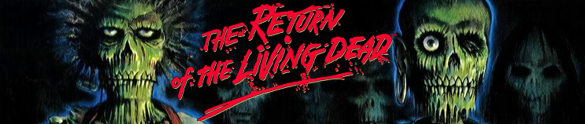
Though dismissed at the time, Night of the Living Dead (Romero, 1968) was a surprise hit and is now regarded as a horror classic. Though it spawned equally regarded sequels, the initial follow-up was a novel co-scripted by Romero and his writer friend, John Russo. When Romero and Russo parted ways, Russo took the “Living Dead” title with him, resulting in this radically different take on the zombie sub-genre. Though widely regarded as a cult classic, The Return of the Living Dead spawned its own questionable sequels,
The Review:
You’d be forgiven for thinking The Return of the Living Dead is a sequel to Night of the Living Dead, judging by its title. In a way, it kind of is but only in a metatextual sense. The Return of the Living Dead takes place in a world where Romero’s zombie classic is a movie, just like ours, a dramatisation of a bizarre incident involving Trioxin. At the Uneeda medical supply warehouse in Louisville, Kentucky, veteran foreman Frank Johnson (James Karen) shows young newcomer Freddy Hanscom (Thom Mathews) the ropes and, seeing how impressed the youth is by the various skeletons and bodies stored there, tells the true tale that inspired Romero’s movie. Developed by the United States military, Trioxin had the unique an unexpected side effect of partially reanimated corpses. The bodies sprung to life and were shipped off to be destroyed, but a mix up saw some delivered to Uneeda, where they’ve been stored in the basement for years. Frank says that Romero got wind of this and wanted to tell the story, but was coerced into exaggerating the facts, creating flesh eating zombies. To impress Freddy, Frank shows him the rusted canisters that contain the corpses, arrogantly delivering a swift kick to one to prove its sturdiness and accidentally flooding the warehouse with Trioxin gas. The two collapse, choking, as the corpse (later dubbed the “Tarman” (Allan Trautman)) seemingly melts in its canister. When they awaken, sickened by the stench and panicked by the incident, they’re horrified when the various cadavers (even those split in half!) shudder to life and one (Terrence Houlihan) desperately tries to break out of the meat locker. Horrified and aghast, Frank and Freddy desperately try to think of a solution: Frank doesn’t want to call the cops and risk the company’s (and his) reputation, so he calls his boss, Burt Wilson (Clu Gulager), instead to think of a plan.
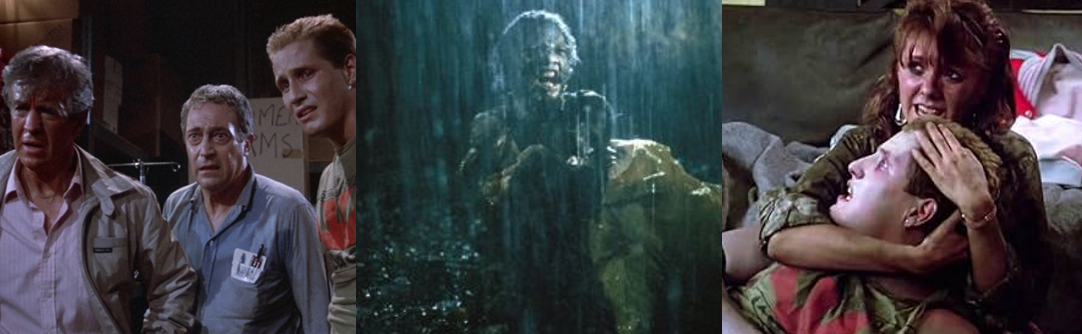
Initially incensed that the two messed with the canisters, Burt is just as clueless as to how to deal with the incident as they are. However, he cuts through Frank’s abject fear to recall that the zombies in Night of the Living Dead were put down by destroying the brain. Although he’s nearly throttled by the yellow-tinted zombie, Burt and the others overpower it and drive a pickaxe through its head, only for it to continue thrashing. Even sawing its head off doesn’t do the trick as the headless body goes on a rampage before they manage to tie it down and dismember it. Realising that the movie lied to them, Burt quickly hits upon the idea of taking the still moving body parts to Ernie Kaltenbrunner’s (Don Calfa) crematorium to incinerate all traces of their blunder. When Ernie finds Burt’s cockamamie story about rabid pests unconvincing, Burt shows him the body parts to earn his trust and assistance and is relieved when they reduce the zombie to ash. Unfortunately, unbeknownst to them, this spews toxic gas into the night sky that triggers semi-caustic rain, which reanimates the corpses in a nearby cemetery! Burt and the others are ignorant of this for a time as their elation soon turns to concern when Frank and Freddy become violently sick. Ernie calls for some paramedics (Drew Deighan and James Dalesandro) to come check them out as they are too sick to be driven to the hospital, and they’re alarmed to find their vital signs are so low that they’re essentially dead. This only exacerbates Frank’s despair and, upon seeing how voracious and monstrous the living dead are, he ultimately climbs into the incinerator and end things before he loses himself completely to the undead’s insatiable hunger for “Braiins!”
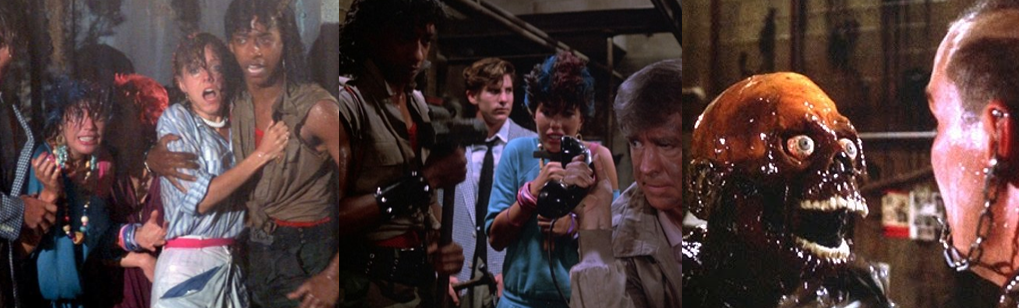
Freddy eventually gets some support from his girlfriend, Tina (Beverly Randolph), who rushes over to find him when he’s late meeting her and their punk-rock friends – Casey (Jewel Shepard), Chuck (John Philbin), “Scuz” (Brian Peck), “Spider” (Miguel A. Núñez Jr), “Suicide” (Mark Venturini), and “Trash” (Linnea Quigley) – in the cemetery. This is a colourful and eclectic bunch of misfits who I struggle to believe would ever hang out together! Chuck stands out from the other alternative punkers with his floppy hair and pressed suit, while Suicide is trying a little too hard to be a bad ass with his leather jacket and chains. The promiscuous Trash sure makes an impression, swooning over Spider and Suicide alike and entertaining her friends with a striptease, though the entire group is caught completely off-guard when the toxic rain causes the dead to burst from their graves. All of them are killed except Tina and Spider, who safely get into the mortuary and help barricade it against the undead, alarmed and confused, Casey and Chuck who shelter in the warehouse. This causes some tension between Spider and Burt, who suggests they flee in an abandoned police car to call for help. This separates them from Tina and Ernie, who are forced to hide in the attic when Freddy inevitably turns and attacks them, leading to them blinding him with sulphuric acid. The punkers are an unusual bunch of delinquents who are sadly underutilised here. Their outrageous lifestyles and belligerent attitudes could’ve made a nice contrast between the older, wiser Burt and Ernie and offered a commentary of the punk-rock youth of the time. Instead, they’re presented as loud but largely harmless twenty-somethings teenagers whose anarchist beliefs are as inconsequential to the living dead as older, more traditional values. Unlike in Night of the Living Dead, there’s no class, social, or racial conflict here even when there should be. Spider could’ve made more rash, impulsive decisions, for example, and challenged Burt’s authority more directly. Instead, the survivors largely work together to find a solution to their problem.
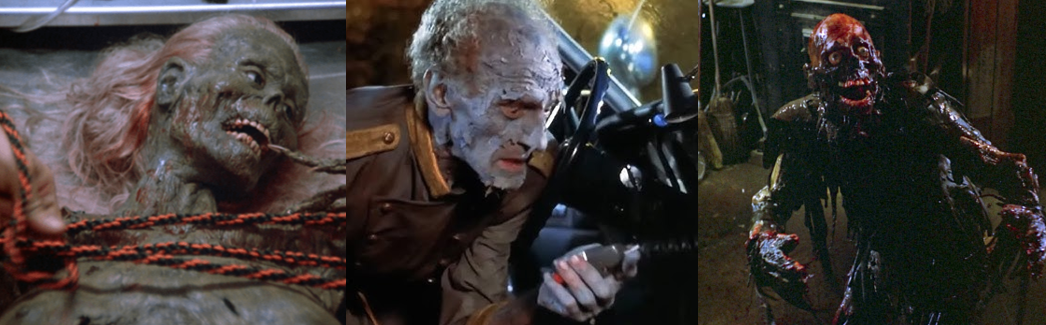
Unlike in Romero’s films, the living dead are given a definitive origin in The Return of the Living Dead, directly attributing their creation to man, the military, and, by extension, warfare. Trioxin instantly reanimates any dead body, no matter what state its in, and slowly poisons and turns anyone who breathes it. Even the mud, showered by the toxic rain, is enough to turn an individual, though bites don’t appear to transmit the disease. It’s difficult to tell, to be honest, as these zombies don’t bite in the same way as Romero’s. Instead, they overwhelm their prey and feast upon their brains. These zombies also retain a modicum of intelligence; they can talk and co-ordinate far better than traditional zombies. Even when reduced to a rotting torso (Cherry Davis), the zombies articulate their voracious hunger for brains, the only thing that eases the agony of being dead (“I can feel myself rot!”) These zombies are also far more durable, shrugging off blows and bullets and continuing to attack even with their heads and limbs cut off. They swarm in a ravenous hoard and then impersonate their prey to lure in additional victims for them to feast upon, which was incredibly amusing. While The Return of the Living Dead is surprisingly light on gore, the Tarman (courtesy of Kenny Myers) cuts a memorable and disturbing figure. Little more than a shambling skeleton oozing in black oil, his eyes bugging out as he cries for “Braaains!”, the Tarman is a triumph of practical effects that’s sadly not seen enough as it would’ve made for a great recurring central antagonist or figurehead for the undead. The visual depiction and behaviour of these zombies would be just as influential as Romero’s efforts, with the two often being mixed up in popular media, and gives the living dead an extra edge, in my opinion, as they’re practically unstoppable here. Even when you immolate their bodies, you risk further infection by producing toxic, Trioxin-laced gas, which only reinforces the zombies as a metaphor for the inevitability of death.
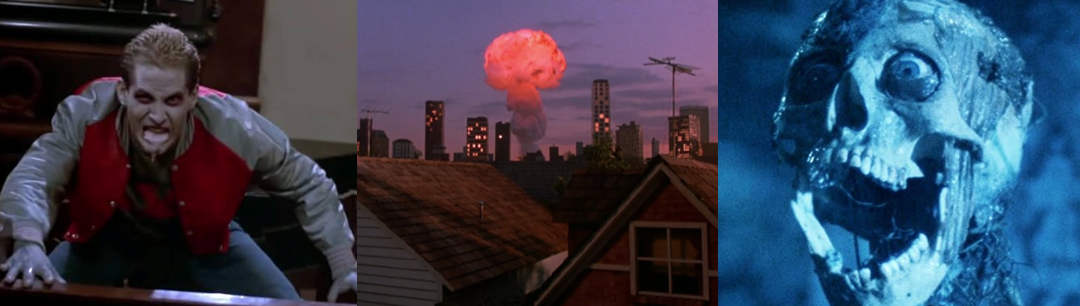
The locals are completely unprepared for the voracious zombies and are easily swarmed, their heads split open and their brains devoured. Freddy’s condition worsens at an alarming rate, with the only cure being total immolation, and the others are forced to isolate him before he becomes a threat. While Tina is vehemently against this, she’s horrified when he finally turns and starts lurching around the mortuary looking to eat her brains, leaving Tina huddled helplessly in Ernie’s arms in the attic. Burt and Spider meet Casey and Chuck at the warehouse and incapacitate the Tarman, lopping off his head and finally calling the emergency number on the Trioxin canisters as the zombies have devoured all the paramedics and cops! This eventually puts Burt through to the exasperated Colonel Horace Glover (Jonathan Terry), who’s been searching for the missing Trioxin containers for about twenty years and been frustrated by failure. Eager to finally tie up this annoying loose end, Colonel Glover diligently takes down all the information Burt has on the outbreak and promises to extract them as soon as possible. Amusingly, this turns out to be a blatant lie as Colonel Glover immediately orders Gunnery Sergeant Jefferson (Derrick Brice) to fire a nuclear missile at the town, using the July 4th celebrations as cover, and obliterates all the survivors alongside the infected area. This by itself would’ve made for a fantastically bleak ending, one made darkly amusing by Burt and the others hearing the incoming missile and Freddy inches away from Tina, but the film then doubles down with a brief coda before the end credits. Here, Colonel Glover is pleased with the results and satisfied that their efforts have eradicated the zombie outbreak. However, unbeknownst to him, the raging fires and spewed more Trioxin gas into the air and caused heavier rainfall, reanimating more corpses and promising a far greater outbreak of ravenous corpses.
Final Thoughts:
It’s been about fifteen years since I last saw The Return of the Living Dead, and this is only my second time watching it. I’ve always found its visual style very appealing. The Tarman, especially, and the punk-rock cast really capture the imagination, and Matt Clifford’s synth-rock score (alongside the punk-rock soundtrack) elevates the film into cult classic territory. The Return of the Living Dead is also as influential on the zombie genre as Romero’s movies, with many depictions of zombies in pop culture having them yearning for “Braaiins!” or utilising chemical agents for their origins. The film also has its tongue firmly planted in its cheek. It’s not a comedy by any means, but it’s certainly more outrageous than Romero’s films, using zombies for distinctive dark comedy rather than social commentary. Unfortunately, something about this one just doesn’t stick with me as much as I’d like. The performances are decent enough, but I don’t think the film did enough with the rebellious youths who made up a sizeable portion of the cast. There was no class or social tension between the survivors, and no commentary on the anarchistic kids paralleling the zombies or the zombies tearing down traditional values. The zombies were simply a common enemy for these disparate groups to unite against, only to be betrayed by their government in the end. Perhaps that’s the point, that all our differences are nothing compared to the unbearable weight of government and military oppression, but this wasn’t as explicit as it could’ve been. This could’ve been a great excuse for some fun social satire; instead, it’s just a pretty enjoyable zombie romp. There’s not much variety to it considering its scope (we’re stuck in the mortuary or the cemetery for most of the film) and the gore was depressingly absent, meaning the film only remains memorable because of the zombies’ gruesome designs and quirky lines. Ultimately, while I think The Return of the Living Dead is an influential classic and a must-see for zombie fans, I remain disappointed in it for not truly living up to its full potential as a splatterific, bonkers dark comedy horror counterpart to Romero’s more cerebral offerings.
My Rating:
Pretty Good
Do you consider The Return of the Living Dead a zombie classic? Were you also disappointed by the lack of gore? Did you like that the zombies had a definitive origin and that they could talk? Were you impressed by the Tarman and the other practical effects? Do you also think there should’ve been a bigger emphasis on the punk-rock youths? Which of the film’s sequels is your favourite? How are you celebrating the Day of the Dead today? Whatever your thoughts on The Return of the Living Dead, and zombie films in general, leave a comment below and donate to my Ko-Fi if you’d like to see me cover the sequels.


One thought on “Movie Night [Day of the Dead]: The Return of the Living Dead”