
January celebrates two notable dates in science-fiction history: “National Science Fiction Day” on January 2 to coincide with the birth of world renowned sci-fi writer Isaac Asimov, and 12 January being when Arthur C. Clarke’s HAL 9000 was created. Accordingly, I dedicate January to celebrating sci-fi in all its forms.


Released: 26 October 2021
Originally Released: January 1995
Developer: SEGA
MobyGames Score: 8.2
Also Available For: GameCube, Game Gear, Mega Drive, Mobile, Nintendo Switch, Nintendo Wii, PC, PlayStation 2, PlayStation 3, PlayStation 4, PlayStation 5, PlayStation Portable (PSP), SEGA Mega Drive Mini 2, Xbox, Xbox 360, Xbox One, Xbox Series S/X
Quick Facts:
Back in the 16-bit era, mascot platformers were king thanks, largely, to the phenomenal success of Sonic the Hedgehog (Sonic Team, 1991). During Sonic’s long and complicated development, a character who could grab objects was pitched but discarded for being too complex. Years later, SEGA revisited the concept, producing a prototype titled Feel, which went through many redesigns and focused more on platforming than Sonic’s fast-paced action. Though the upcoming SEGA Saturn hurt Ristar’s sales, it was praised for its colourful visuals and unique gameplay mechanics and criticised for its lack of innovation and unfair comparisons to Sonic. Despite plans for a sequel and being included in multiple SEGA collections, Ristar has been all-but forgotten, though he did get an unofficial comic strip in Sonic the Comic Online and there have been calls for a revival over the years.
Gameplay and Power-Ups:
Rister is a surreal and vibrant 2D, sidescrolling platformer that, despite some visual similarities to Sonic, emphasises slow, deliberate platforming. Players control the titular Ristar, a cock-sure shooting star who travels across six worlds (called “Rounds”) to rescue his father from evil space pirate Kaiser Greedy. Each Round has three levels (two platforming challenges and a boss battle) and hidden Bonus Rounds. There’s no timer, no high score table (despite players earning points for defeating enemies and collecting gems), and players can only skip to later Rounds with special trophies that reveal passwords. There are two control schemes available so I mapped jump to the A and Y buttons and grab to the B button. Unlike some mascot platformers, Rister doesn’t defeat enemies by jumping on them or using weapons. Instead, he grabs them with his stretchy arms (extending his reach further the longer you hold the button) and rams into them with a headbutt. While this is effective, it can be quite slow and clunky. Players can grab in different directions, and even diagonally, but you may find you miss your target and take a hit. Ristar’s health is measured, fittingly enough, by stars. You can partially replenish it by smashing treasure chests and collecting either a gold or a blue star, which also gift 1-ups. Other treasure chests contain gems for points and Ristar occasionally grabs items, such as a miniature statue of himself or a gemstone, to bypass traps or activate teleporters. Sadly, the combat isn’t very deep; you just grab and smash everything. Sure, you can cling onto enemies to avoid being sucked into a black hole or to resist the flow of water, but you can slam or throw enemies, which severely hampers Ristar’s abilities. He can also swim and, though he’s a bit slippery underwater, he’ll never have to worry about drowning, so that’s a tick in the plus column.
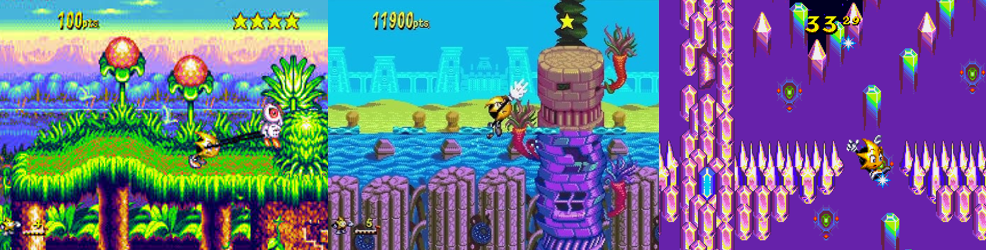
Ristar’s grab can also snag ladders, poles, overhead rails, and various other handholds to allow you to climb, clamber across gaps, and even wall climb…to a degree. This mechanic is very finicky and seems contrary to what the game wants you to do, so it’s good that it isn’t mandatory until Round 6. This Round also sees Ristar use anti-gravity sneakers to clunkily swim/fly about, though this is so limited that it’s more of a handicap. Round 5 sees him slide and ski down a snowy mountain, though this is a glorified cutscene, and ends with him tossing snowballs he builds with his idle pose at the boss, while Round 3 sees him pulling levers to activate or turn off furnaces. Each Round features a special Star Handle that spins Ristar around at high speeds. This ricochets him about to bounce up even spike shafts and clear vast distances, though you must angle him just right to get a “height bonus” and clear the level. Other Star Handles transport you to Bonus Rounds, where you have a strict time limit to navigate a brutal obstacle course and retrieve special treasure. You won’t lose health or lives in these stages, but it can be difficult finding and clearing them. Ristar can also smash certain walls or objects to either break them or topple them, create new paths and bridges, and must bash heavy moving platforms in Round 6 that’ll crush him with their massive hit boxes if he’s not careful. This Round also features multiple teleporters that transport Ristar to hazardous corridors where he either battles a mini boss, tosses missiles at cannons, or rips open the background to uncover gems. Very rarely, players red star power-ups make you temporarily invincible. Ristar also smashes enemy-spawning targets in Round 2, which largely takes place underwater and sees players grabbing bubbles to get higher, dealing with rising and falling tides, and fighting to avoid being blasted into a spike wall by the water current. Sadly, there are no autoscrolling sections where Ristar blasts through space to take out enemies like in its visual counterpart, Rocket Knight Adventures (Konami, 1993) and, while you get score bonuses and congratulatory text after each Round, you don’t appear to earn extra lives or continues and, with no high score table, the points are essentially meaningless.

Ristar is a very slow game. Ristar plods about very lazily and only gets his ass moving when flying at enemies or bouncing around off a Star Handle. The bulk of the game involves jumping across gaps, spike pits, lava, or other hazards, hopping to platforms and using Ristar’s grab to scramble about. Some jumps can be very tricky since Ristar’s reach will just miss, forcing you to take longer or more dangerous paths or to struggle with his wall climb. In Round 1, you grab floating fluff or passing birds to get higher, reach into tree holes for goodies, and smash trees to light up the woods, though spores stick to you and, like the starfish in Round 2, slow you and then explode if you don’t shake them off. Round 3 sees you tossing Ristar statues into glowing spots to avoid being hurt and trapped by cages, and outrunning rising flames to test your platforming and grabbing skills, and you’ll also hold B to raise a pulley and reach higher ground in the factory section. Round 4 has an odd carry mechanic where you grab metronomes and deliver them to singing birds to open new paths, utilising fans and pincers and conveyer belts and defeating enemies before the can steal your item. This Round features a musical theme, with you being bounced about by drums and timing your grabs just right to navigate narrow spiked chasms, as well as flying along on zip wires and hopping past dancing guitars. Round 5 introduces a slipping gimmick where you must time your jumps off icy platforms to keep from looping around, destroy rocks in the underwater cavern, and again deal with Round 2’s rushing water gimmick. Round 6 is, fittingly, the most dangerous, featuring spiked mincers, the slipping gimmick, poles and handholds that switch positions every time you grab them, and an overhead ray that zaps you to the background and forces you to defeat enemies and grab handholds while obscured. Things get quite challenging quite quickly; Ristar has a big hit box and spikes and other hazards are everywhere, meaning things can get frustrating in later Rounds.
Presentation:
Visually, Ristar is one of the most impressive Mega Drive games. The colourful graphics, deep and detailed backgrounds, and vibrant presentation remind me of Knuckles’ Chaotix (SEGA, 1995), as do the wacky Round intro cards, story text, and sprites. Though one of gaming’s oddest characters, Ristar is full of life, sporting a determined frown, gleefully smashing enemies, yelping when hit, and blasting about when launched. Ristar sports a few idle poses that change in Round 4 and Round 5 to show him bopping along to the beat and struggling with the heat, respectively. The game’s story is very simple (and changes depending on your region) but is beautifully brought to life by both text and large, partially animated sprite art. Despite the title screen drawing immediate comparisons to Sonic the Hedgehog, Ristar is like a mish-mash of Sonic, Rocket Knight, Gunstar Heroes (Treasure, 1993), and Disney’s various 16-bit titles with both its gameplay and visuals, though oddly promoting precision platforming rather than fast-paced combat, perhaps to better showcase the stunning, cartoonish visuals and bizarre environments. While there’s no ending cutscene, stills showcase the ending and key moments during the credits and Ristar busts out a fitting victory pose upon defeating each boss and clearing the game. It’s a shame that his enemies aren’t as interesting, with players mostly smashing boring coloured Orblets, Unfortunately, Ristar can’t duck or look up, has no other combat options, forms, or power-ups, and his hit box is quite large. This is compounded by the odd decision the delay between grabbing health-restoring stars and Ristar’s health being restored, meaning you can grab a star and die before it’s added to your tally! As visually impressive as the game is, though, I was disappointed by the less than memorable soundtrack that cheaply recycles sound effects from Sonic 3 & Knuckles (SEGA Technical Institute, 1993/1994) during the final boss battle.
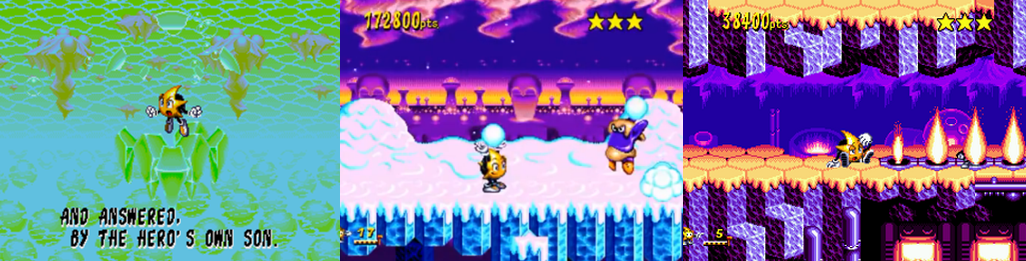
Though Ristar plays things safe regarding its level themes, each Round is a kaleidoscope of colours and visuals and often depicted as obstacle courses that test your jumping and grabbing, so combat is often secondary. Planet Flora is your typical, grass-themed intro stage, featuring a sprawling valley in the background, bushes you can pass through (and which enemies pop out of), vine-themed handholds, birds flocking by, and Venus fly trap platforms that snap your heels! You venture into the roots of the forest and through a dark wood, with some impressive lighting effects in the boss arena, before heading to the decidedly Atlantis-themed Planet Undertow. You explore (and destroy) ancient ruins and swim through a coral cave (with no fear of falling debris), trashing machines to stop the current. Planet Scorch features a flashing hexagonal floor, an active volcano in the background that rains explosives, and furnaces that you (and enemies) can toggle on. After bypassing the rising flames and outrunning the screen-filling fire wall, you venture into the sweltering furnace and hop across lava pits formed when Orblets activate special bombs. Planet Sonata starts with a fantastic retro sci-fi aesthetic, with Jetsons (1962 to 1963;1985 to 1987)-style futuristic buildings and flying cars, before transforming into a musical-themed stage, featuring flutes, drums, musical sheets, and even a theatre stage for the boss battle. Planet Freon opts for a snow theme, sporting a glowing aurora borealis in the background, sliding Ristar about, and dropping you into a crystal cavern full of waterfalls and frozen frog statues, Planet Automaton is a hazardous robot factory full of spikes, grinders, and teleporters, with robotic nasties being built or guarding each corridor. Finally, Castle Greedy is a surreal alien landscape full of bonkers alien tech where a little spy camera follows you about at the start and you confront the suitable theatrical Kaiser Greedy in his fantastical throne room. There’s a lot to look at in Ristar’s worlds and the colours certainly pop, but I felt a strange absence of gimmicks for each area as the developers relied more on traditional platforming rather than innovative mechanics, best seen when Ristar’s skiing section is relegated to a cutscene rather than being playable.
Enemies and Bosses:
There are a handful of oddball enemies to smash your starry head against in Ristar, with the most common being the various coloured Orblets. While many of these are harmless unless you bump into them, floating about and generally acting as a nuisance or a handhold, others hang from branches in cocoons, endlessly spawn from metallic pots, briefly electrify themselves, or are surrounded by spikes or flames. Each Round also features unique enemies; though most simply hop or jump about, like Planet Flora’s weird rabbits and lizards, the chunky birds swoop at you and perform a torpedo attack. Planet Undertow is patrolled by fish, frogs, electric eels, and seahorse that’ll endlessly attack until you destroy the spawn point. Large, squid-like crustaceans also appear, taking a few hits to put down, and the first projectile-firing enemies appear in the form of that large enemy and the aggressive lobsters that pop up. Planet Scorch features a nasty vulture who grabs you and a slug-like enemy that emits flame bursts, while Planet Sonata is populated by robotic enemies themed around birds and musical instruments. There are purple pipes that must be destroyed to stop them spitting projectiles, dancing robot birds that toss minions, and large robotic woodpeckers that peck you with their beaks. Planet Freon sees spiked fish in the waters, strange, bulbous aliens floating about in water rings, and mechanical baddies that drop icicles. Planet Automaton sees these weird, Slinky-like robots on the walls that spit projectiles and duplicate when hit, UFO-like robots that float by and fire a laser spread, and weird robot poles with two large, spiked fists, alongside missile-firing cannons and the biggest assortment of coloured Orblets yet! Sometimes, you’ll battle a mini boss or a wave of enemies to finish the first level of a Round, such as Planet Flora’s giant snake that popes from holes in the background and the literal waves of Orblets that rain down in Round 2. Planet Sonata sees you battling three robot woodpeckers controlled by a bird maestro, Planet Freon pits you in a snowball fight against a strange, rotund little alien, and Planet Automaton forces you to run a gauntlet of robotic bosses, smashing a bouncy trashcan-like mech and forcing a large battle robot back against the wall with precision hits.
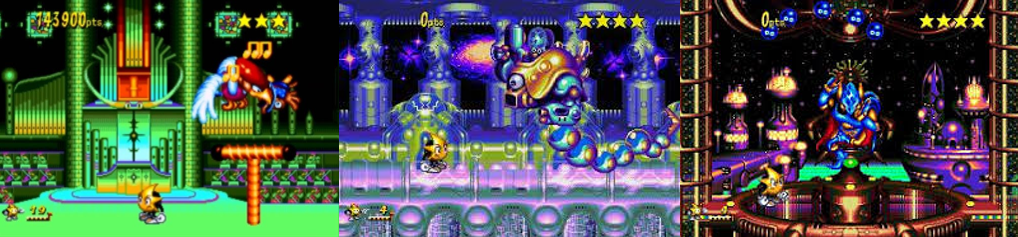
Naturally, each Round ends in a boss battle, with bosses changing colour as you deal damage and often spawning Orblets as projectiles or distractions. The mischievous imp Rhio possesses Planet Flora’s elder and compels him to float around conjuring snowflake-like projectiles. You must dodge these and smack him to knock Rhio loose and attack, watching for the miniature tornados he conjures. The aggressive hammerhead shark Ohsat darts in from either side of the screen in Round 2, causing rocks to fall and eventually left floundering when each hit you land drains the arena’s water. The mole-like Adahan attacks in Planet Scorch’s volcanic depths, popping from the ground claws first and kicking up dirt. After a few hits, the fight switches to a freefall section where you must hit him as he bounces off the walls, which can be tricky due to Ristar’s janky grab mechanics. Awaueck rains musical notes that are hard to dodge and is only vulnerable when you knock him from his perch. The strange ice monster Itamor tosses bouncing balls and emits a freezing breath, but the mini boss appears to help you by providing hot soup to toss into Itamor’s maw and melt him from the inside out. The battle robot Uranim tosses junk from offscreen before battling you in an enclosed arena. You must smack him a few times to knock him over and then lure the pincer-like tentacle to hit him to cause damage, watching for his jump and ricocheting projectiles. Kaiser Greedy’s right-hand, Ionis, pilots Eyebar -555, a mechanical snake in Round 6 that boasts a boomerang projectile, machine gun and blaster arm, and ricochet bolts. Dodge all this and hit his shield a few times to dislodge Ionis and deal some real damage. Kaiser Greedy then trumps this by floating and teleporting around his throne room, tossing Orblets, firing a lightning bolt, and conjuring an insta-kill black hole! You must anticipate where he’ll be to grab and attack in a very small window, and hold onto any Orblets to avoid a sudden end, in this ridiculously tough finale.
Additional Features:
Ristar offers two difficulty settings, “Normal” and “Hard”, with “Hard” mode reducing your total health to just two stars and “Normal” gifting you four. Beyond that, there isn’t much else on offer here unless you’re playing the Japanese version, which features a different story and some passwords that enable a stage select, time attack, invincibility, and other effects. If you play the Game Gear version, you’ll have a slightly different experience, both graphically and in terms of the bosses and mechanics, while this version allows you to rewind the action and create save states. If you’re playing the version included in the SEGA Mega Drive Ultimate Collection (Backbone Entertainment, 2009), you’ll get an Achievement if you collect five yellow stars, though there are oddly no Achievement specific to Ristar in the SEGA Mega Drive Classics (SEGA/D3T, 2018) collection.
Final Thoughts:
I’ve been enamoured by Ristar for years. As a kid, I was always intrigued by screenshots in gaming magazines and I always wanted to own it based on my love of 2D mascot platformers but never saw a copy in the wild and a decent copy can be quite pricey. Thanks to modern re-releases, Ristar is more accessible than ever…but, sadly, that doesn’t mean it’s really worth your time. The game looks absolutely gorgeous and goes a long way to show what the Mega Drive was capable of with cartoonish, vibrant 2D sprites. Ristar looks fantastic and his worlds are unique and colourful, though sadly lacks memorable gimmicks as the developers prioritised platforming and Ristar’s unique grab mechanic. This is an interesting gimmick, but one that doesn’t live up to its potential. I just wanted Ristar to do more, perhaps throw or slam enemies or something a bit more dynamic than just grabbing handholds and bashing enemies. The gimmick is sadly underutilised and Ristar lacks the speed and action to complete with, much less usurp, Sonic, with Ristar being slow, far too big a target, and far more limited compared to his peers. Ristar is also incredibly challenging, with numerous spikes and hazards sapping your health and continues and so much trial and error that I’ve no idea how people beat it without rewinds and save states. It’s only a short game, but later Rounds are almost unforgiving with their obstacles and tough mini bosses, and it’s not like the ending is worth your time. The bosses were a highlight, for sure, being big and well animated and making you use Ristar’s grab in different ways. It’s just a shame this innovation didn’t translate to the core gameplay to let Ristar chain together grabs, swings, and attacks, which we’d see SEGA arguably do better in Sonic Unleashed (Sonic Team, 2008). In the end, while Ristar impresses with its visuals and beautiful stages, there’s just not enough meat on the bones for it to stand alongside other mascot platformers. I’m glad I finally saw it through, but I’d much rather playthrough Rocket Knight Adventures or Sonic 3 & Knuckles than this one, which is a shame as it had so much potential.
My Rating:
Pretty Good
Do you think I’m being too hard on Ristar? How do you think it compares to other action platformers? What did you think to the grab mechanic and Ristar’s visuals? Did you also struggle with the late game difficulty curve? Which of the bosses was your favourite and would you like to see Ristar make a comeback? What are some of your favourite sci-fi-orientated videogames? Feel free to share any memories you have of Ristar in the comments, support me on Ko-Fi, and then check out my other sci-fi content.

 Dr. K's Waiting Room
One thought on “Game Corner [Sci-Fanuary]: Ristar (Nintendo Switch)”