


Released: 11 October 1974
Director: Bob Clark
Distributor: Ambassador Film Distributors
Budget: $686,000
Stars: Olivia Hussey, Keir Dullea, Margot Kidder, James Edmond, John Saxon, and Nick Mancuso/Bob Clark/Albert J. Dunk
The Plot:
Jess Bradford (Hussey) and her Sorority Sisters are tormented by obscene phone calls from “The Moaner” (Mancuso/Clark) that soon turn violent when the bodies pile up over Christmas.
The Background:
While John Carpenter’s Halloween (Carpenter, 1978) can be said to have popularised the “slasher” sub-genre, and copycats like the equally iconic Friday the 13th franchise (Various, 1980 to present) established its enduring tropes, slasher films can more accurately be traced back to this seminal, Christmas-themed horror. Initially developed by Canadian screenwriter Roy Moore and inspired by both urban legends and a gruesome string of murders, Black Christmas aimed to present realistic protagonists and challenge perceived notions of female leads with a socially relevant character arc. The late Olivia Hussey took the lead on the advice of a psychic, while Margot Kidder was allegedly attracted to how wild her character was and director Bob Clark was said to have meticulously storyboarded the entire film. Clark employed first-person shots to portray the mysterious killer and his techniques genuinely shocked both cast and crew. Briefly retitled Silent Night, Deadly Night upon release, Black Christmas was an unexpected box office hit that initially garnered mixed reviews. Over time, the film was heralded as a classic of the genre that was especially celebrated for its feminist subtext and subverting expectations of the festive holiday. While it massively influenced subsequent slashers, Black Christmas never spawned a sequel, though it was eventually remade over the years and fan film continuations later emerged,
The Review:
Black Christmas is set almost entirely within a sorority house around the Christmas season. This provides a good sense of space and the rooms in the house, but it does get a touch repetitive being stuck in the same location 90% of the film. Interestingly, despite there only being a handful of residents cared for by alcoholic and incorrigible housemother Barbara MacHenry/Mrs. Mac (Marian Waldman), the house seems to shrink as the film goes on, becoming more claustrophobic and ominous, especially as many scenes are shot from the perspective of the killer hiding in their attic. This largely unseen, mysterious figure approaches the house in the dead of night at the start of the film and easily clambers to the attic, watching the sorority sisters muddle about with their various dramas. Chief among them is the repeated obscene phone calls they receive from a raspy, vulgar voice they’ve dubbed the Moaner. At least once a day, the Moaner calls and growls aggressively sexual threats and comments to the girls, who are disgusted and amazed by this. While Jess is appalled and quiet newcomer Clare Harrison (Lynne Griffin) is disturbed, headstrong, domineering Barbara “Barb” Coard (Kidder) fearlessly challenges the voice and barks equally obscene insults. Barb’s efforts only exacerbate the deranged Moaner, leading to the voice screaming, arguing with itself, and threatening to kill her. Already upset by the calls and Barb’s snide comments, Clare prepares to spend Christmas with her father (Edmond) only to be surprised and suffocated by their unwanted house guest. Her corpse is toyed with by the killer (let’s call him “Billy”) and undiscovered for the entire film but driving much of what follows.
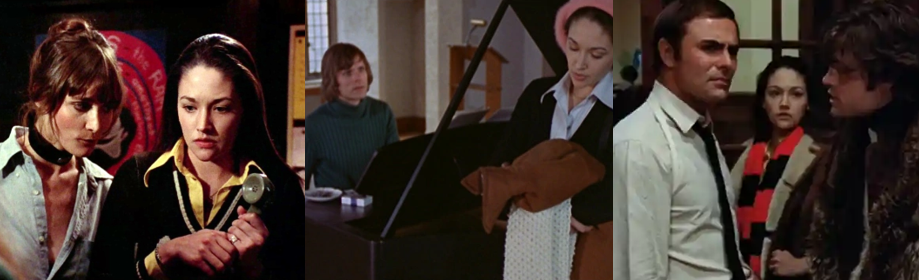
A big and very unusual sub-plot of Black Christmas revolves around beautiful and determined Jess, who ironically usurps many of the tropes of a “Final Girl” as she’s in a sexual relationship with Peter Symthe (Dullea) and it can be inferred she enjoys drinking with her sisters. Jess discovers she’s pregnant early on, leading to disagreements between her and her piano playing “artist” boyfriend about what to do. Jess decides it would be unfair to have an abortion without telling Peter first, but he’s stunned by her decision and comes across as very condescending and neurotic when she tells him. Any time Peter questions her, Jess stands her ground, determined to decide what to do with her body and only informing him as a courtesy. It’s telling that Jess only replies with “I know you do” when Peter says he loves her, especially as she later shoots down his marriage proposal and insists that she doesn’t want to give up her dreams (whatever they are) just because he’s decided to drop out. Although they initially seem to have a very loving relationship, the baby revelation rocks Peter to the point where he messes up his piano playing and takes a very draconian view on the matter. While I agree that Peter is allowed to be upset and deserves to know that she’s pregnant, Jess makes very valid points about not being ready or willing to be a mother or throwing her youth away on a marriage that likely won’t last. It’s a very mature and pragmatic attitude and it’s clear she’s thought it all through, just as it’s clear she’s disappointed not to have his support but not very bothered since she knows she’s better off without him. When the Moaner’s calls emulate a baby’s screams and seemingly mock her, Jess finally reports the calls and concerned Lieutenant Kenneth Fuller (Saxon) immediately suspects Peter after seeing and hearing of his attitude about the abortion.
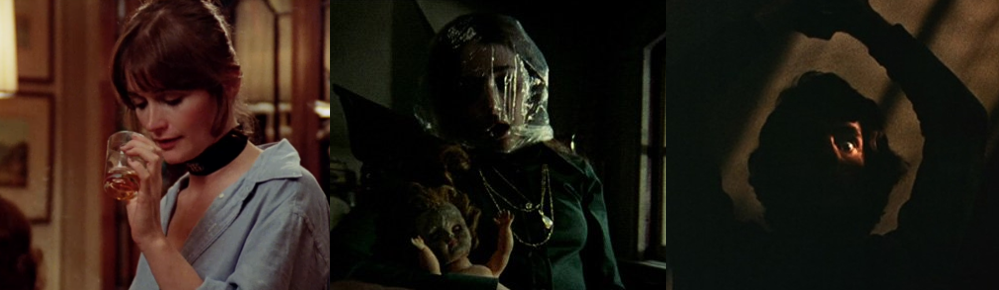
This relationship drama is as much a focal point of Black Christmas as the mystery of the calls and the stranger in the sorority house, though it’s married with Mr. Harrison’s concerns for his daughter. When she no-shows their rendezvous, he visits the sorority house to look for her, dismayed at the idea of his daughter picking up boys and partying rather than studying. While Mrs. Mac tries to alleviate his concerns, he remains unimpressed by Barb’s outspoken demeanour and taste for the booze. Regularly swigging back shots and even encouraging minors to drink, Barb drowns her sorrows, clearly upset that her mother would rather go off with her new fancy man than spend Christmas with her. Though her sisters rally around her, Barb is a prickly and difficult person to love and her drinking only makes her worse as she humiliates herself before the worried Mr. Harrison and alienates the others with her selfish and confrontational attitude. This is only worsened by growing concerns about Clare and a local teenager being killed in the park, with most of our main characters helping to search for the girl. Lieutenant Fuller leads this effort, immediately taking Mrs. Quaife’s (Martha Gibson) concerns for her daughter to heart and organising a search party. Lieutenant Fuller equally takes the report of Clare’s disappearance very seriously, and the obscene calls reported by Jess, chastising inept Sergeant Nash (Douglas McGrath) for dismissing them and withholding what he sees as irrelevant information. Determined to help, Lieutenant Fuller taps the sorority house phone and encourages Jess to keep the Moaner on the line to trace the source, only to grow increasingly suspicious of Peter when he overhears them arguing about the abortion.
The Nitty-Gritty:
This was my first time watching Black Christmas, which I can immediately tell inspired John Carpenter. The shots from Billy’s perspective, the disconcerting breathing, the sense of dread surrounding the sorority sisters as we know there’s someone in the house but they don’t is all mirrored in Halloween. In some ways, however, it might’ve been better to not show Billy entering the house or any shots from his perspective except when he’s killing as it makes the iconic reveal that “The calls are coming from inside the house” less impactful since we know Billy is behind the calls. Still, it is disturbing knowing Billy is rattling around upstairs and could strike at any moment, and seeing the characters be so oblivious to this. And, honestly, why wouldn’t they be? Jess is notably very distracted by her unwanted pregnancy and her issues with Peter, delivering an extremely progressive (and no doubt controversial, then and now) sub-plot regarding a woman’s decision to do what she wants with her body and how insensitive and entitled men can be about that. Personally, I think she’s right to have an abortion if she’s not ready. She never says she wouldn’t want children some day; she just wants a chance to live her life first rather than being trapped with an asshole and his baby, resenting both. The search for Mrs. Quaife’s daughter was an odd sub-plot, however. It might’ve been better if Lieutenant Fuller and the others were searching for Clare instead, though it was odd that the police never thought to search the sorority house or Clare’s room, where her lifeless corpse is left rocking in a chair for Billy’s amusement. While Barb is clearly the loudest and most obnoxious, she’s clearly upset about her mother and people judging her. Phyllis “Phyl” Carlson (Andrea Martin) is easily the weakest of the sisters in terms of screen time and characterisation, portrayed as the voice of reason when Barb gets drunk, but Mrs. Mac was a delight every time she was on the screen sneaking booze, searching for her cat, or coyly apologising for the sisters’ behaviour.
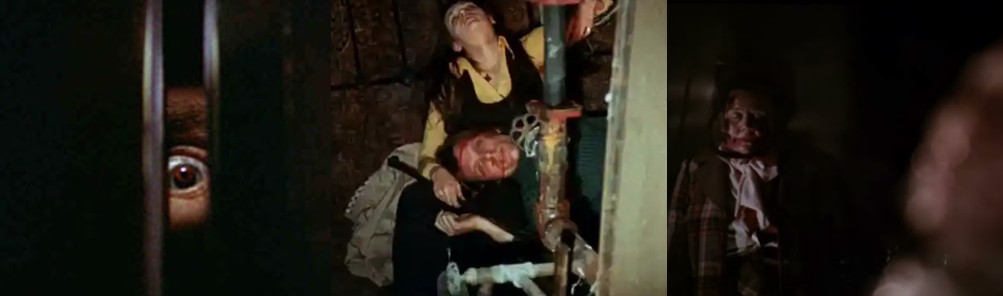
Although Black Christmas is more of a suspenseful thriller than a stab-happy slasher and the body count is very low, the deaths are pretty decent and harrowing. Clare is asphyxiated with cling film and her corpse is left rocking in a chair, eyes bulging and mouth silently screaming, for Billy to toy with. Although Mrs. Mac gets a roped hook to the neck offscreen, we do hear her strangled cries and see her hanging there, blood dripping down her body, as undiscovered as Clare. Mrs. Quaife’s little girl is killed offscreen and we never see her body or how Phyl and Officer Jennings (Julian Reed) die (though we do see their bodies and that Jennings has had his throat slit). Barb’s death is thus the showcase of the film. Sent to bed by Phyl after making a fool of herself, Barb is brutally stabbed by Billy with a glass unicorn, giving a rare glimpse of the killer (his bulging eye against his darkened silhouette), though the kill is mostly from his perspective. Billy is a demented and disturbing figure who seems to have multiple personalities, mood swings, and to despise women, hinting at an abusive childhood and a deranged psyche. Delighting in tormenting the sisters, he strikes from the shadows and goes largely unnoticed as they’re more concerned with his phone calls. After Sergeant Nash urges Jess to leave the house immediately as the killer’s in there, she naturally disregards his warnings and investigates, discovering her dead friends and being forced into the basement by the crazed stranger. When Peter breaks into the basement to help her, the panicked Jess reacts without thinking (or possibly assuming Lieutenant Fuller’s suspicions were correct) and beats Peter to death with a fire poker. In the aftermath, Lieutenant Fuller wraps the case up, believing Peter went nuts after being spurned by Jess, completely oblivious that Billy is still hiding in the attic.
The Summary:
As I said, this was my first time seeing Black Christmas, much to my shame. I was well aware of its place in horror history, and its twist ending, and somewhat familiar with the plot since I’ve seen the 2006 remake a few times but never found time to watch the original. Consequently, much of my opinion comes from love of Halloween, which clearly borrowed many elements from this film, especially regarding the mysterious and stalkerish nature of its disturbed killer. It was interesting seeing how much focus was placed on the sorority sisters and how relatable they were, Jess especially. She’s making difficult decisions at a difficult time of her life and dealing with a difficult boyfriend, all while being increasingly unnerved by the Moaner’s ghastly phone calls. Barb might’ve been an obnoxious and rowdy character, but I appreciated her subtle layers and the insecurities she was dealing with. Mrs. Mac was a fantastic addition and John Saxon brought a lot of authority to his role, especially in how he chastised dismissive Sergeant Nash, whose ineptitude cost lives and time. Billy’s obscene language and deranged behaviour becomes increasingly harrowing and malicious as he specifically targets each girl, and I loved the mystery surrounding him as we never learn anything about him or even see what he looks like. My only complaint is that we’re fully aware that Billy is in the sorority house and that Peter is innocent, meaning there’s little suspense around who’s behind it all, but it was still thrilling knowing Billy was always lurking and watching and could strike at any moment. Ultimately, I feel this is a fair rating as Black Christmas laid the foundation for the slasher sub-genre but many of its most distinguishable features were done far better in subsequent films, though I did enjoy the character drama and the sense of dread that built throughout the film.
My Rating:
Pretty Good
Is Black Christmas a Christmas tradition for you? Which of the sorority sisters was your favourite? Were you shocked to see the film tackling abortions? Do you think it detracted from the horror to know that Billy was in the house? Which of the kills was your favourite? What’s your favourite Christmas-themed scary movie? Use the comments below to discuss Black Christmas, check out my other horror content, and donate to my Ko-Fi if you’d like to see me review the other Black Christmas movies.

 Dr. K's Waiting Room
I need to rewatch this one. I’ve only seen it once.
LikeLiked by 1 person
This was my first time
LikeLike