

Released: 14 March 2018
Originally Released: 23 July 1993
Developer: SEGA
Also Available For: Mega Drive, Nintendo 3DS, Nintendo Wii, PC, PlayStation 2, PlayStation 3, PlayStation 4, PlayStation 5, PlayStation Portable (PSP), Xbox 360, Xbox One, Xbox Series S/X
The Background:
Ninjas were a big deal back in the day, whether they were mutated turtles, rainbow-coloured fighters, or mysterious assassins. Ninjas and videogames went hand in hand, resulting in titles so challenging that they defined a generation of players. Eager to have a piece of that pie, SEGA saw notable success with Shinobi (SEGA, 1987), a difficult but enjoyable arcade title later refined for home consoles. Director Noriyoshi Ohba aimed to make the sequel a technical showcase for the then-new Mega Drive hardware, one purpose-built for home consoles and which became notorious for including unlicensed appearances by pop culture icons. A widely praised release, The Revenge of Shinobi (SEGA, 1989) is now regarded as a classic of its generation and inspired not just a semi-recurring comic strip in the United Kingdom, but also a third game. Originally scheduled for release in 1992, Shinobi III: Return of the Ninja Master was vastly overhauled when the developers were dissatisfied with the original version, leading to a lot of content being cut and replaced with new mechanics. Though largely seen as being much easier than its predecessor, Shinobi III impressed with its refined gameplay mechanics and visual presentation, with many seeing it as the best of the classic Shinobi titles. This positive reception (and the lack of copyright issues compared to its predecessor) no doubt contributed to Shinobi III having a lucrative lifespan beyond the Mega Drive as the game was included in numerous SEGA collections, converted to 3D, and added to the Nintendo Switch’s online service in 2018, which eased the pain of how expensive an original copy can be.
The Plot:
When Neo Zeed returns under the command of the mysterious Shadow Master, the legendary Shinobi, Joe Musashi, fights to end their sinister bio- and cybernetic research.
Gameplay and Power-Ups:
Shinobi III: Return of the Ninja Master is the last of the Shinobi titles released for the Mega Drive and, like its predecessor, is an action/platformer with a strong emphasis on projectile-based combat. Like in the last game, players take Joe Musashi through multiple levels (or “Rounds”), each with at least three stages, though this time there are only seven Rounds. As before, there are four difficulty settings to choose from, with the harder settings dramatically reducing your total life count, and players can continue their game a handful of times if they exhaust all their lives. Unlike in The Revenge of Shinobi, however, Shinobi III’s control scheme is locked to a preset that maps your jump to A, tosses shuriken with B, and activates your “ninjitsu” magic with Y. You can still set how many shuriken you start with, however, and you can still pull off a somersault by pressing A at the height of your jump. Press B when somersaulting to unleash a shuriken spread to take out multiple enemies or press down on the directional pad to pull off a flying kick. As before, Musashi can assume a “defensive pose” to deflect incoming projectiles, but this is now done manually by holding B and you can even do it while crouching and crouch-walking. Shinobi can also dash by quickly tapping left and right, dramatically speeding up the action, wall jump by…jumping off walls…and cross gaps and hazards or navigate stages while clinging to ceilings, pipes, and such by holding B. Various goodies are found by smashing crates, ranging from health-restoring hearts, rare extra lives and ninjitsu replenishments, to additional shuriken and the ever-annoying time bomb. Musashi is far faster and more versatile this time around, moving at a swifter pace and boasting a few additional tricks to make combat and gameplay smoother. It’s still tricky pulling off his somersault and the wall jump can be finicky, but I found Shinobi III far more forgiving than its predecessor and focusing more on action than platforming.
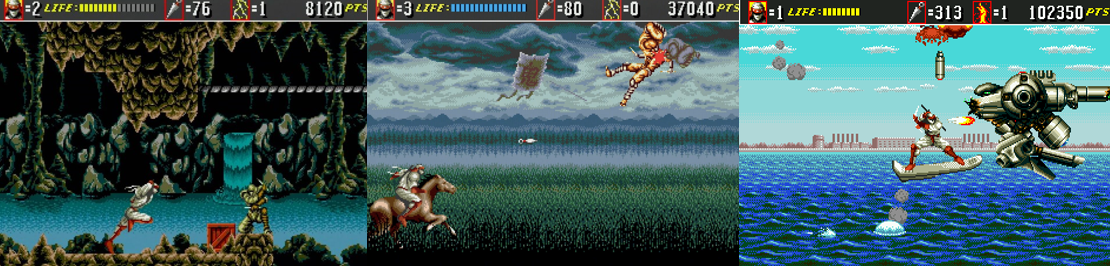
Players can once again collect “Power-Ups” to boost Shinobi’s attacks, adding his deadly sword to his melee attack and block and transforming his shuriken into flaming projectiles. Players also gain points for every enemy defeated and item collected, and the end of Round score tally also adds points depending on if you used your ninjutsu magic or your remaining health. By pausing the game, players select which ninjitsu technique to use with Y, with each functioning exactly like The Revenge of Shinobi: Jutsu of Ikazuchi temporarily protects Shinobi with an electrical shield, Jutsu of Kariu summons flaming pillars to damage all enemies, Jutsu of Fushin enhances your jumping speed and height, and Jutsu of Mijin has Shinobi self-destruct (costing him a life) to destroy enemies. Only one of these can be used per life but you gain additional uses by finding items, though I found less use for them this time around as Shinobi is largely grounded and the game encourages you to wall jump and spider-walk to clear gaps. Musashi gains two additional abilities, the first being a horse and the second some bitchin’ surfin’ skills! Round 2 sees you racing across a marsh-like field on horseback, jumping obstacles and taking out enemies with your shuriken or ninjutsu. Round 4 has you surging across the water, jumping off ramps to collect items and avoid mines while defeating waves of enemies, with both instances functioning like autoscrolling shooter. Round 6 also sees you in freefall down a canyon, forcing you to hop to falling boulders to keep from dropping to your doom, while many stages force you to clamber to higher levels by finding surfaces to cling to (which isn’t always obvious).
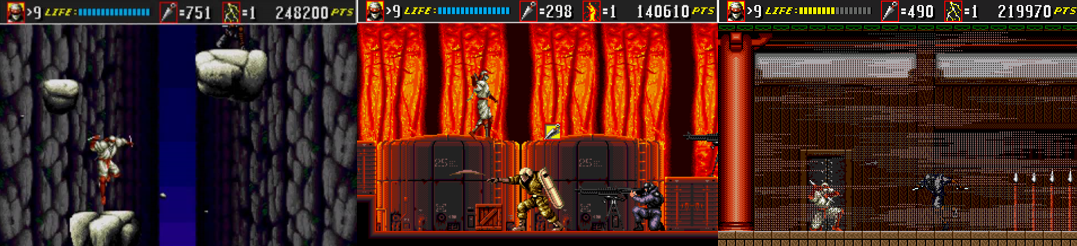
Shinobi III is much more challenging, overall, than its predecessor, throwing far more enemies and hazards at you but with the caveat that most stages keep you quite grounded and I found extra lives a touch more plentiful. Bottomless pits are commonplace, of course, and many times platforms will either be temporary or will require time bombs to destroy so you can progress, but insta-kill hazards are limited to crushing spikes rather than lava pits. Sometimes, you must time your wall jumps and spider-walk to avoid electrified walls and ceilings; others, you cling to or run across conveyers to progress. There are instances where you ride platforms either across a zig-zag-like track or directly upwards, with Round 2 featuring a vertical autoscroller that’ll see you crushed or left behind if you don’t pay attention. Round 3 dumps you in a disgusting, bio-organic nest where the sticky ground slows your movement and Round 4 sees you hopping to sinking barrels around an oil rig, leaping to firmer ground before you drown. Round 5 mimics a similar stage from The Revenge of Shinobi in that you can somersault over chain-link fences but, this time, you must also avoid hidden mines that eventually explode under your feet! Toxic goop, electrical sparks, and support beams hanging under Neo Zeed’s fancy blimp all make traversal an issue in their own way. Round 7 takes you inside the blimp, where drones attack as you ride a precarious moving platform, while the final area of this stage features platforming and skill-based challenges so troublesome that no enemies are required! As if tricky jumps weren’t bad enough, Round 6 puts you in a mist-filled pagoda where spikes jut from the ground and another damn door maze awaits! This was much simpler to figure out compared to the one in The Revenge of Shinobi (I simply guessed the route by taking the high ground), though made more challenging since enemies respawn each time you looped around!
Presentation:
Although Shinobi III is visually very similar to its predecessor, there have been a few improvements between the games. Musashi still doesn’t have an idle pose, but his sprite is much bigger, more detailed, and versatile thanks to his expanded move set. He now grabs the hilt of his sword when powered-up, cuts a mean pose when surfing, and blood splatters whenever he or his enemies take damage! While many sound effects are unchanged from The Revenge of Shinobi and enemies still explode in spectacular fashion, the soundtrack is overall inferior to the last game. Obviously, I have more nostalgia for The Revenge of Shinobi so I’m naturally biased towards that game, but Shinobi III really disappointed in its tracks, and in the less visually interesting enemies (especially compared to the beta version). However, larger enemies (such as samurai and various mechs) do appear more often, almost as mini bosses, and you’ll face far greater numbers and waves of enemies, with no visible slowdown or performance issues. I liked that the bombs now had a visual timer, the additional weather effects (such as rain, wind, and parts of the environment reacting to these elements), and the greater depth added to the backgrounds. Stages are far more detailed, lively, and have many more instances of parallax scrolling, making for a technically more impressive title. This is best felt in the expanded introduction (featuring a larger, more impressive, animated interpretation of Musashi), the new map screen, and the detailed artwork that pops up after you clear a Round. The game also features more story text at the start and end, and even end credits this time around (though there’s only one ending in Shinobi III).
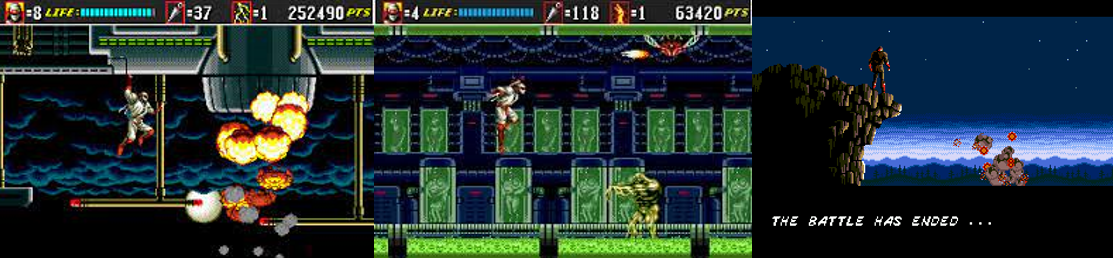
Things start with a visual bang in Round 1’s dense forest, with grass and leaves rustling in the wind, which leads into a dank, dark cave filled with waterfalls and rippling water. I loved the marsh lands and docks that rush past in Round 2 and 4, respectively, which see clouds, kites, and tanks in the distance. The cyberpunk-like city of Round 2, the industrial factory/oil rig of Round 4, and the cybernetic research area seen in Round 5 were all worlds above the visuals offered in the last game, with foreground elements (mostly trees, pipes, and other machinery) bringing each area alive and never being too intimidating in how cluttered they were. While Round 6 was mostly relegated to a grey canyon, I loved the sense of speed as you fall to certain doom, though the night sky and full Moon are done far better in Round 7, where thick clouds rush past. Rounds 3 and 5 impressed me the most, however. Round 3 takes place in an ominous, high-tech bio-weapon facility where Neo Zeed’s bizarre abominations and brain-like experiments slumber or burst free from captivity. This leads to a revolting sewer where Neo Zeed dispose of their toxic waste and experiments, meaning the surfaces are teeming with sticky, biological sludges and malformed monsters lurk. Round 5 takes the military base from the last game and sets it against a raging inferno and explosive oil drums, then sees you slashing through another high-tech factory, this one with molten metal bubbling in the background and ominous, vaguely familiar mechanical dinosaurs waiting to be activated. The final battle occurs in a bizarre, cyberspace-like environment that really messes with your mind, while additional lighting effects and environmental details add a level of polish to the Shinobi formula that keeps it both traditional and bizarre and better showcases the Mega Drive’s power.
Enemies and Bosses:
Neo Zeed’s forces are once again primarily comprised of ninjas and soldiers, though these are noticeably cybernetically enhanced. Ninjas drop from trees, somersault over you, toss shuriken, and fly about on bat-like wings, as before, and come in different colours to indicate when you’re getting closer to the big bad. Larger samurai guard the tunnels in Round 1, slashing an energy wave and cutting with their large katana, though these are defeated as easily as the regular ninjas. The soldiers still fire machine guns, but now use mortals rather than grenades and there are no Marines bolstering their ranks, though red-clad female assassins still pop up. Ninjas now ride futuristic hoverbikes, pilot mechs, and are joined by odd, blowpipe-firing figures and floating kabuki-style warriors who emit flame bursts. Crawling brains and sludge monsters attack in the depths of Neo Zeed’s laboratory, soldiers wield laser rifles, shields, and boomerang-like projectiles, and mutated bugs, laser turrets, and persistent drones also await your presence. Steam bursts from vents, enemies crawl on ceilings like spiders, and more mini bosses appear during your playthrough. These include the return of the agile and Shadow Dancer (who now rains spears while jumping around), a gauntlet against an army of mutated brains as toxic goop bubbles nearby, large mechs that dash and attack with rapid-fire pulse cannons, and Karura, a lance-carrying bird man who attacks as you plummet in Round 6 and becomes invulnerable when seen as a whirring blur of feathers. You’ll also take on another supercomputer, though this one zaps you with an electrical field and fires explosive shells into the arena. Round 4 ends with a two-phase battle against an intimidating mech boss that begins as little more than a giant cannon in the water and soon takes to the air and requires you to blast away its cannon and shield before attacking its main body.
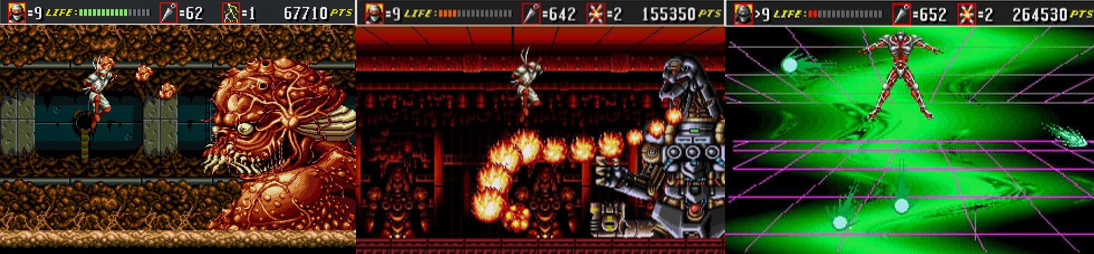
The first boss you face is another giant samurai, one mutated to sport four arms (two holding katana and two wielding a spear). Though you can’t hop to the high ground and this guy can dash, it’s easy enough to jump over him, use your somersault attack, or roast him with Jutsu of Kariu. Shinobi III takes a turn into the bizarre and macabre in Round 3, which sees Musashi targeted by a gigantic, malformed blob of mewling flesh while navigating the sewers and then facing off with the ghastly abomination. It lumbers in from the right or emerges from the disgusting ground, tossing chunks of flesh or swiping with its deformed hand, and noticeably degrades as you deal damage to its drooping eyes. While Shinobi III opts not to tow the line between parody and copyright infringement with its enemies and bosses, the developers couldn’t help but include an appearance from Mechagodzilla in Round 5. This gigantic, impressively detailed sprite emerges from the darkness and plods about in the background, breathing fire and raining debris. After destroying its head, it’ll unleash a barrage of projectiles from its chest, making this a tricky encounter even though touching it doesn’t hurt you. Round 6 ends with a rematch against Neo Zeed’s big boss, a squat, masked, demonic figure who whips his hair. This time, the fight occurs in a dark room full of doors that the masked fiend emerges from, tricking you with a duplicate. Though the fight is noticeably easier, it can be tough picking the right one and he becomes more aggressive, flinging a spread of darts after enough hits. This time, the final battle is against the Shadow Master, which is a two-phase affair fought in a psychedelic environment. The Shadow Master is super-fast and aggressive, leaping about, tossing kunai, teleporting, rushing at you with a sword, and delivering an explosive hit. After enough damage, he powers up and tosses energy projectiles, a flurry of blasts, and a charged shot from his arm.
Additional Features:
While Shinobi III is quite a challenge even on “Easy”, you can make things even more difficult by selecting harder difficulties, thus limiting your lives and continues. While you can accumulate points, there’s still no high score table to put your name on, though the “Options” menu has been expanded to include sound effects and voices. As in The Revenge of Shinobi, you can grant yourself unlimited shuriken with a simple trick but, even better, Shinobi III features an invincibility cheat activated by playing certain songs in the right order. Not that you really need that when playing this version of the game as the Nintendo Switch offers rewind and save state features to cut the challenge off at the knees. Finally, if you’re playing the version included in the SEGA Mega Drive Ultimate Collection (Backbone Entertainment, 2009), you get an Achievement for finishing the first stage without a continue and, in the SEGA Mega Drive Classics collection (SEGA/D3T, 2018), you get an Achievement if you beat any level without tossing a shuriken.
The Summary:
I never grew up playing Shinobi III: Return of the Ninja Master, so I don’t have the same level of nostalgia for it as for The Revenge of Shinobi. However, this did everything I’d expect from a sequel: it took what worked in the last game and expanded upon it. The visuals are greatly improved, with Joe Musashi being much faster and tighter to control. His additional moves and abilities were a welcome inclusion, mitigating my difficulties at mastering his somersault and adding an extra layer to the platforming and jumping challenges. I appreciated the added emphasis on fast-paced, hack-and-slash combat and the autoscrolling sections, which nicely broke up the gameplay and served as fun distractions. While the soundtrack was disappointing and I wasn’t blown away by the enemies, the bosses were a big step up from the last game. There are more of them, for starters, and the developers shied away from ripping off pop culture characters for some gruesome, intimidating, and fun affairs that better test your skills as a player. I did find the ninjitsu a bit wasted here, however, and it was a shame Musashi didn’t gain new magic or power-ups to use, but the visual variety offered by the stage design more than made up for it. I appreciated that the game veered more towards the surreal and science-fiction to try and mix things up, and that you were rewarded for playing well in stages. There are few cheap deaths and hazards here, and the game does get very challenging when you’re presented with small platforms, temporary ground, and tricky jumps. I can see this being aggravating on original hardware, but this version of the game makes it a breeze even without the invincibility code. Ultimately, while I would probably still choose to play The Revenge of Shinobi due to my nostalgia for that title, Shinobi III was a worthy follow-up that vastly improved almost every aspect of its sequel, making it equally good in my eyes.
My Rating:
Great Stuff
What did you think to Shinobi III: Return of the Ninja Master? How do you think it compares to The Revenge of Shinobi and what did you think to Musashi’s new abilities? Were you also disappointed by the soundtrack and the lack of new ninjutsu magic? What did you think to the new bosses and how bizarre some of them were? Did you enjoy the autoscrolling sections and manage to beat the game on original hardware? Which Shinobi game is your favourite? Let me know your thoughts and memories of Shinobi III: Return of the Ninja Master in the comments, support me on Ko-Fi, and check out my other Shinobi reviews.

 Dr. K's Waiting Room
2 thoughts on “Game Corner: Shinobi III: Return of the Ninja Master (Nintendo Switch)”