
Released: 16 November 1987
Developer: SEGA AM1
Also Available For: Amiga, Amstrad CPC, Atari ST, Commodore 64, IBM PC, Master System, MSX, Nintendo Entertainment System (NES), Nintendo Wii, PC Engine, PlayStation 3, Xbox 360, Xbox One, Xbox Series S/X, ZX Spectrum
A Brief Background:
For quite a while, between the seventies and mid-nineties, ninjas were all the rage. Sneaky, costumed martial artists wielded katana and tossed shuriken and appeared in numerous cartoons, comic books, movies and videogames. Games were treated to everything from ninja turtles, rainbow-coloured warriors, and games so challenging that they defined a generation. Since ninjas were so prevalent in the gaming industry, it wasn’t that surprising that SEGA built an arcade game around a skilled ninja warrior. Although vastly surpassed by its Mega Drive sequel, the original Shinobi was a commercial success whose demanding gameplay proved extremely popular. When Shinobi came to the Master System, it received a noticeable downgrade in graphics yet some welcome quality of life features, such as a health bar and the elimination of one-hit deaths, which led to it being equally lauded. Shinobi kicked off a successful side franchise for SEGA, one sadly left to the wayside for many years, and saw numerous ports to other consoles, though many were since delisted.
The Review:
Joe Musashi’s debut as the shuriken-throwing Shinobi is a 2D, sidescrolling affair that’s essentially a ninja themed run-and gun. Players can either go it alone or play alongside a friend to fight their way through five stages (known as “Missions”), with three to four rounds per Mission (with the final round being a boss battle). While you’re playing against a three-minute time limit on the arcade version, I never experienced any time outs and you’re given plenty of time to play as each round is quite short. The Master System version lacks the timer but is noticeably harder, even though Musashi can take multiple hits before dying, since the controls are much clunkier and players have no continues. On the arcade version, your game lasts as long as you have pocket change, though there are no checkpoints mid-round. However, the game throws you a bone by not requiring you to rescue hostages each time you lose a life. Yes, Musashi’s goal is to rescue a handful of hostages in each area, with the captives generally guarded by street thugs, ninjas, Mongolian swordsmen, and bazooka-wielding goons. Rescuing hostages awards points, with players earning extra lives with enough points and landing their initials on the high score table at the end of the game, and upgrades Musashi’s attacks. Rescuing them is mandatory on the arcade version, with the exit only accessible once they’re rescued, but is optional on the Master System version, where they also refill your health. By default, Musashi tosses shuriken with one button, though he’s limited to tossing them in the direction he’s facing or while crouching rather than in any direction or off a somersault. When enemies get close, Musashi kicks or punches them (providing he doesn’t take a hit and die), but this is upgraded to a sword slash (and a nunchaku and a ball and chain on the Master System version). Shinobi’s shuriken are swapped out for a missile-firing pistol (very discreet!) and even grenades on the Master System.
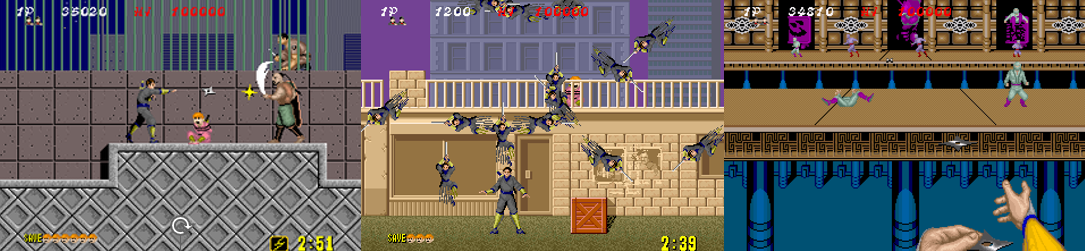
Shinobi’s big gimmick is Musashi’s ability to leap onto walls and into the background by holding up and pressing the jump button. These inputs also allow him to drop back down as well, and players must switch back and forth between the foreground and background to rescue hostages, take out or avoid enemies, and progress across stages. It can be clunky at times, and difficult to see where you’re supposed to jump, and some enemies are obnoxiously placed to sap your lives and pocket money. Musashi can duck or jump over crates to avoid incoming fire or progress further, and utilise “ninjitsu” magic at the press of a button. Unlike in later games, this magic is severely limited and changes depending on which Mission and version you’re playing. I saw Musashi duplicate himself and dart around the screen with flying kicks, summon a lightning storm, and conjure tornados, though I couldn’t figure out how to do the magic on the Master System version. After clearing a Mission, players are awarded point bonuses to add to their high score and must take on a first-person bonus round (accessibly by rescuing hostages on the Master System). Here, you frantically toss shuriken at ninjas as they hop from the background, with the round ending in failure if they reach you. While most of Shinobi is geared towards simple run-and-gun action, you’re often tasking with hopping to pillars, wading in water, clambering up and down pipes, or clearing gaps to progress. This can be a tricky prospect as Musashi is incredibly sluggish, has a large hit box, and jumps like he has lead in his shoes, meaning you’re far more likely to plummet down a pit than reach your intended destination. Unlike in later games, though, there are no additional hazards or gimmicks to worry about here, though the sheer number of enemies and projectiles means Shinobi is an incredibly challenging title regardless.
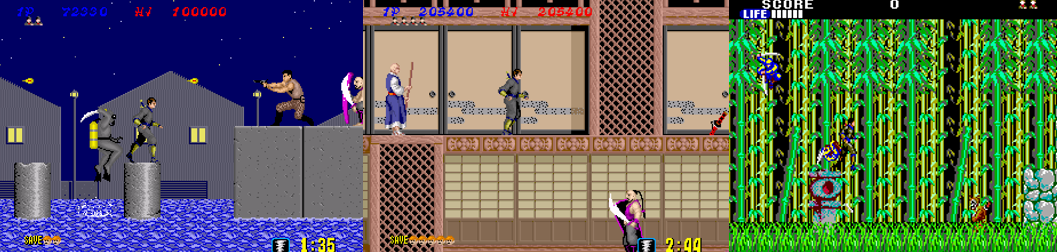
Despite being a SEGA kid, and owning a Master System, I never played Shinobi growing up. I played The Cyber Shinobi (SEGA, 1991) and The Revenge of Shinobi (ibid, 1989), but never this one. Consequently, I can’t help but be disappointed with how the game looks. Sure, there are some fun voice samples and grunts, the distinctly Oriental music was certainly fitting, and the title screen showcasing Musashi’s animated head was somewhat impressive, but the game is very basic compared to its sequels. On the arcade, Musashi and his enemies are large, colourful sprites with limited animations and annoyingly big hit boxes. Musashi is garbed in black and has his face exposed here, and lacks some of his later abilities, but still strikes a dramatic pose when using magic, which fills the screen with fun, varied effects. Each Mission begins with a briefing document showing the boss and your place on a crude map, and the locations are somewhat varied. You’ll battle on the city streets, against a background of Marylin Monroe posters and simplistic skyscrapers, across the docks and inside a large ship, hop across a rocky mountainside, most likely get a headache from the dense and mangled bamboo forest, and finally battle inside a pagoda full of ninjas. I did like the water effects when you’re outside the docks, with enemies casting a shadow so you can anticipate their appearance, and the large structures at the end of most stages, such as caves and Oriental buildings. Bosses are fought in enclosed arenas that are given some visual flair, taking place on a balcony looking out on treetops or against a dragon mural, and the large sprite art and sprite manipulation in the bonus stages was certainly impressive. While your only reward for beating the game is some text regarding the ending and your place on the high score table, that’s more than Master System players get, as the game abruptly ends on home consoles! The Master System version is also far uglier, with loads of sprite flickering, clunkier controls, and a truly awful visual downgrade from the arcade that’s only echoed in other inferior ports.
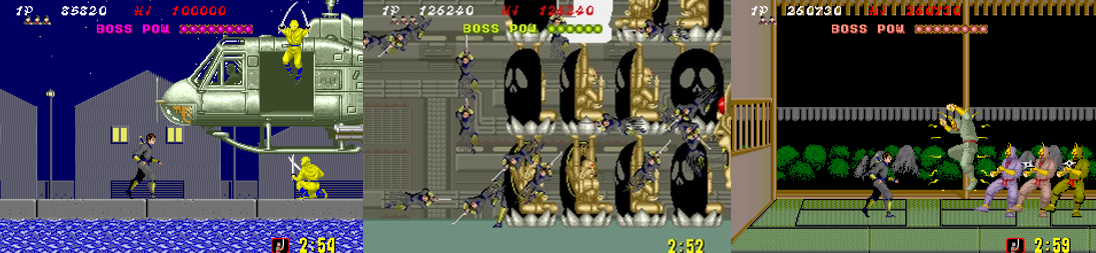
Musashi is attacked by knife- and gun-wielding street punks, bazooka-firing troopers, and a slew of colourful ninjas. Some resemble Peter Parker/Spider-Man and pop from water, fly from the thick bamboo forest, or appear in a puff of smoke to flip about with katana. Kabuki-masked enemies toss bones, Mongolian warriors swing or throw their blades, weird little hunchbacks leap about, and bo-swinging monks hop between the foreground and background. Most are defeated in one hit, but their projectiles fire high and low, enemies are often perched right where you need to jump, and some deflect your shuriken. Ken-Oh, a hulking ninja garbed in black armour, is the first boss you face. He launches fires fireballs that can be extremely difficult to avoid as they fill the screen and easily sap your lives as you frantically try to jump and toss your shuriken at his helmet. The Black Turtle attack helicopter was much easier, despite its gatling gun and the ninjas it spawns. You can deal a lot of damage with your ninjutsu magic, and the helicopter even displays battle damage and goes down in an impressive explosion. The Mandara was a crippling step up in difficulty, however, being a two-stage boss battle that features an insta-kill wall of electricity and starts with an advancing troop of boddhisatvas that must be destroyed before they reach you. You must then avoid the Mandara Master’s bouncing projectiles and hit the jewel on its forehead to win. The Lobster, a massive, armoured samurai, was the easiest boss, providing you get your timing down. All this guy does is slowly advance and swing his sword, but he’ll stun-lock you if you’re not careful. To defeat him, you must time your jumps to hit his head, forcing him back and easily besting him if you’re quick enough. Finally, Musashi faces Nakahara, the “Masked Ninja”, in a four-phase challenge. First, the Masked Ninja jumps at you, leaping off the walls, and you must time your shots to land when his shield is briefly gone. Then, he turns into a tornado and flings blades at you, before hopping about while shadowed by duplicates, and finally rushing in to land melee attacks, all of which can be tough to avoid and it’s even hard to know if you’re done damage!

The Summary:
Despite my love and nostalgia for The Revenge of Shinobi, and my appreciation for the Master System, I’ve never been that enthused by the original Shinobi. I could tell just from screenshots and a bit of gameplay that it was a clunky and demanding experience, and my opinion has only been cemented after this playthrough. I played through both the arcade and the Master System version and, while there are subtle differences and some tweaks for the home console version, both were unforgiving at times and a chore to get through. Joe Musashi is ridiculously difficult to control, awkwardly leaping to and from the background and being far too big a target for this mission. Enemies are relentless, constantly spawning and tossing projectiles and causing cheap deaths thanks to the outrageous one-hit-kill system. This is mitigated on the Master System, but the game’s still an uphill battle thanks to the awful visuals and problematic controls. Musashi isn’t as spry as I’d like and drops like a stone when trying to clear gaps, and isn’t acrobatic enough to avoid the simplistic bosses’ attacks. His ninjutsu magic, while impressive, is incredibly limited and almost useless against bosses, and you’re barely given a chance to learn enemy patterns or level layouts before you’re pumping in more coins and replaying the same sections over and over. I liked the variety and aesthetic of the game, and the first-person bonus rounds, and that you have to rescue hostages, though these were better implemented in the home console ports. It’s amazing to me that Shinobi was as popular as it was at the time as I find it very difficult to believe anyone got very far in this unforgiving piece of jank, which punishes you at almost every turn, even when playing on the Master System (where some cheat codes ease the pain). I’m honestly glad I started with its superior 16-bit sequel, which outclasses this offering in every way.
My Rating:
Could Be Better
Did you ever play Shinobi in the arcade, or own it on home console? Were you impressed with the game and its unique jumping mechanic? Did you also struggle with the one-hit kills and Musashi’s large hit box? Which of the bosses was the most troublesome for you and did you ever clear all the bonus rounds? Did you prefer the changes made for the home console release? Would you like to see a new Shinobi collection? Whatever your memories and experiences of Shinobi, share them in the comments, support me on Ko-Fi, and check out my other Shinobi reviews.

 Dr. K's Waiting Room
4 thoughts on “Mini Game Corner: Shinobi (Arcade)”