

Released: 11 June 2024
Originally Released: 23 September 1994
Developer: Konami
Also Available For: Mega Drive, PC, PlayStation 4, PlayStation 5
The Background:
The success of Sonic the Hedgehog (Sonic Team, 1991) saw anthropomorphic mascot platformers become a popular trope throughout the nineties, with a superpowered earthworm, an intergalactic adventurer, and a gun-toting jackrabbit making a rocket pack-wearing possum seem normal! The brainchild of Nobuya Nakazato, the man behind many Contra titles (Konami, 1987 to present), Rocket Knight Adventures (Konami, 1993) was one of the most popular and celebrated Mega Drive titles. Despite a port for the Super Nintendo being allegedly cancelled, Rocket Knight Adventures was followed by two sequels the very next year: one exclusive to the Super Nintendo and the other this notoriously expensive Mega Drive-exclusive title. Although not as well-regarded as its predecessor and seen as inferior to its Super Nintendo counterpart, Sparkster: Rocket Knight Adventures 2 was praised for its colourful gameplay and tweaked rocket pack mechanics. Sparkster: Rocket Knight Adventures 2 inspired a six-part story in Sonic the Comic (1993 to 2002) but the franchise was dead in the water until Climax Studios attempted a revival in 2010, to mixed reviews. However, the game, the other 16-bit Rocket Knight titles, finally received a modern re-release with this Re-Sparked! collection, a widely praised release that came with some fun bonus materials and quality of life features.
The Plot:
When King Gedol’s lizard forces invade the kingdom of Zephyrus and rogue Rocket Knight Axel Gear kidnaps Princess Cherry, Sparkster searches for seven magical swords to oppose the Gedol Empire and best his rival.
Gameplay and Power-Ups:
Just like the other 16-bit Rocket Knight games, Sparkster: Rocket Knight Adventures 2 is a 2D, sidescrolling action platformer. However, unlike the original game and its similarly titled Super Nintendo cousin, there are no run-and-gun elements to Rocket Knight Adventures 2 as Sparkster’s sword has been robbed of its sword beam. This significantly impacts the primary gameplay as you now rely on Sparkster’s bog-standard sword swings, which can fall a little short at times. You attack with Y and jump with B, executing a jump sword swing and clinging to poles using Sparkster’s paws and tail when you jump to them. Unlike in the other games, Sparkster’s rocket pack charges automatically and has different levels of effectiveness depending on how full the meter is. As long as the meter’s at least partially full, you can press A to rocket dash in the direction you’re facing, diagonally to take out turrets, and upwards to get higher. If you press A without a direction, Sparkster spins on the spot to attack enemies and, when the rocket pack is fully charged, Sparkster spirals in a “Screw Attack” (no relation), travels further, and bashes through destructible blocks and walls. While waiting for the meter to charge does take a lot of agency away from the player, it charges pretty quickly and you have far more control over Sparkster off a upwards boost, which greatly aids with reaching platforms. Sparkster can still ricochet off walls to get higher, though this is still underutilised, in my opinion, with Rocket Knight Adventures 2 focusing more on traditional platforming. Players still collect gems for points, though this time there are two types: regular blue ones and red ones that kick-start a slot machine for additional gems, health (now apples and chunks of meat), extra lives, or a rocket pack that instantly sends you flying in a Screw Attack. Naturally, these can all be found in the game’s stages, too, and you receive a score tally after clearing each stage for bonus points.
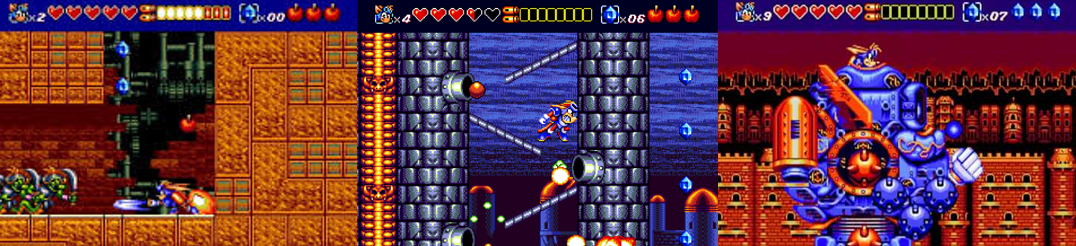
Sparkster can also grab the new power-up icon that gifts him a flaming sword to increase your attack power, though you’ll lose this when hit or advance to the next stage and I can’t say I noticed a significant difference, especially as many enemies die in one hit. Rocket Knight Adventures 2 has seven stages and four difficulty settings, with players only seeing the true ending by beating the game’s harder difficulties. Sadly, the shoot-‘em-up stages from the other two games are gone, replaced by three sections where you control Sparkster’s giant mech, the SparkRobo. Two of these are Rock ’Em Sock ’Em Robot battles with Axel Gear that are similar to that one boss from the first game, and the other is a sidescrolling autorunner where you blast enemies from the sky using the SparkRobo’s rocket punch (Y, which can also be charged) and jump over bombs tossed by enemies on the ground (also with Y). Sparkster doesn’t ride any minecarts or miniature mechs here and only has to deal with one autoscrolling section, where players dispatch enemies, destroy or jump to crates, and hop between train carriages to avoid a nasty spill. Spikes, flame plumes and lava, and insta-death traps are still present, however, with quicksand swallowing you, moving platforms ridden past spikes, and even a sand twister tossing you about atop a pyramid in Stage 2. This stage has a higher and lower path, which you may wish to switch between for different rewards and dangers, while Stage 5 features many switches to open doors, doors guarded by projectile-firing gargoyles, and conveyer belts. Stage 2’s pyramid gimmick differs from the Super Nintendo version, featuring a race from rolling balls and false doors that loop you back to the outside until you find the correct path. You’ll also cross lava on moving platforms and by clinging to overhead pipes, which gain destructible spiked hazards and even Gedol henchmen by Stage 5. Stage 3 sees Paeli, leader of Gedol’s lizard ninjas, bombard Sparkster and the blocks of the stage from his airship. This destroys the ground and forces you to take high-speed tubes up to the top of the ship to destroy barriers and drop the ship from the sky.
Presentation:
Sparkster: Rocket Knight Adventures 2 is a bit of a mixed bag, visually, something immediately evident from the lacklustre title screen (simply the game title against a moving sky background). This does pan down into the opening cinematic and mech battle against Axel Gear, however, a fight you can skip if you wish, which causes you to miss a collectible and displays an absolutely garish secondary title screen. Unlike in the Super Nintendo game, stage intros are back but they’re far less visually interesting than in the first game, and every sprite has been redesigned to give it a more anime flair. Although I miss the cute, squat Sparkster of Rocket Knight Adventures, he looks pretty good here and is far more animated. He bops about as if itching to get going, his rocket pack is almost constantly aflame, and he stands heroically when left idle. Sparkster also squeals when hit, reacts when piloting the SparkRobo, has more animation frames, and displays more personality than on the Super Nintendo thanks to Rocket Knight Adventures 2 including more pantomime-like, sprite-based cutscenes. These are similar to those of the first game, seeing Sparkster leap into action when Axel Gear kidnaps Princess Cherry and advance between stages, with elements from previous stages (such as Stage 1’s train) appearing in others. Unfortunately, like the Super Nintendo title, Rocket Knight Adventures 2 cannot live up to or surpass the original’s soundtrack. Things are jaunty enough, for sure, but nothing stuck in my head like the main from the first game. Interestingly, Rocket Knight Adventures 2 does replicate the slowdown from the first game, with the frame rate noticeably dipping when Gedol’s forces drive vehicles or too many sprites and explosion effects appear at once.
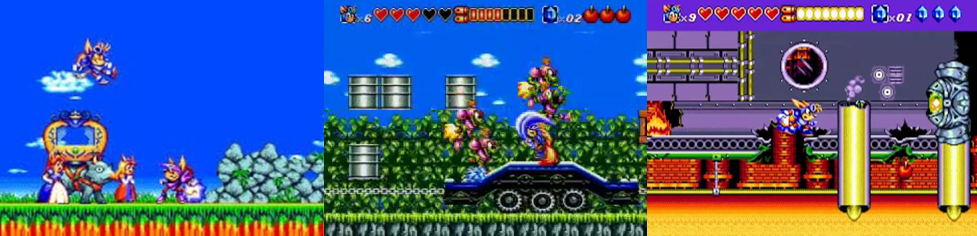
Perhaps most unforgivably, Rocket Knight Adventures 2 appears far blander than the first game and its Super Nintendo counterpart. Stage 1’s forest section is disappointingly subpar compared to the first game, with the ground being a far more basic block of sprites and the background having little to distract you, even when the overgrown ruins creep into play. The train section adds some spice and variety, for sure, but it paled in comparison to the Super Nintendo title. Similarly, while both games include a desert, they’re rendered very differently. Stage 2 has a neat shifting sand and heat shimmer effect in the background, but its pyramid is blockier and more akin to ruins, making it far less visually engaging than SEGA’s competition. Stage 3 took place atop the pyramid’s ruins and in an airship, which was, again, a far cry from the steampunk-style battle craft from the first game, even with its fake doppelgängers of Princess Cherry and larger, blade-like propellers. Stage 4 was like a poor imitation of a similar city stage from Rocket Knight Adventures; sure, the SparkRobo looks cool (if a tad goofy), but the city lacks the detail and appeal of the first game. Things pick up in Stage 5, which takes place outside and inside King Gedol’s heavily fortified castle-cum-weapons factory. The background is a bit busy at times, but I liked all the moving parts, alternate routes, and the danger brought on by the turrets. While the mech battles against Axel Gear are in bland, dark caverns, you battle him in a traditional swordfight against a grandiose background and confront King Gedol in his opulent throne room. If you find all seven “Keys to the Seal” swords, you’re also treated to a great sprite-based cutscene of Sparkster becoming “Gold Sparkster”, a form he retains for the end credits and loses when he returns the combined magical sword in the game’s ending.
Enemies and Bosses:
Instead of fighting pigs or wolves, Sparkster tackles the lizard forces of the Gedol Empire, whose infantry leaves a lot to be desired. Sure, armoured lizard-men spontaneously appear from boulders or even gems, but it takes a long time before they attack with swords. In Stage 1, for example, they might get the drop on you, but they just charge at you while unarmed; they don’t even lose their armour when defeated, making them far less satisfying to kill. By Stage 5, they’re hiding in large, snake-themed turrets and you’ll battle more formidable forces, such as gun-toting lizards (who oddly explode when defeated) and sword-wielding snakes whose body parts can hit you. Gedol’s forces drive steampunk-style vehicles in Stage 1, flailing their buzzsaw-like arms and forcing you to strike and rocket to safety, and pilot chicken-like mech walkers and float on balloons in Stage 4. Their forces are bolstered by some robotic enemies, such as annoying spiked balls that home in on you in Stage 3 and the returning robotic owls who can screw up your jumps. Interestingly, not only are bosses far weaker when playing on the easier difficulties, but you’ll miss some additional screens and mini bosses if you play on “Easy”. Stage 1 sees you battle a disturbing living plant that can only be damaged by rocketing into its face, which it protects with its extendable arms. You’ll also get an assist from some possum helpers when facing an ugly-ass lizard, with the two of you bouncing about an enclosed arena and the boss tossing bombs or rolling into you. A sentient plume of lava awaits in Stage 2, one that spews a flamethrower and controls the lava and forces you to the rail above to rocket into is face. Finally, there’s a large, robotic lizard face that hounds you throughout Stage 5, dropping spiked enemies, summoning lightning walls and lizard minions, and screwing up your traction with a conveyor belt.
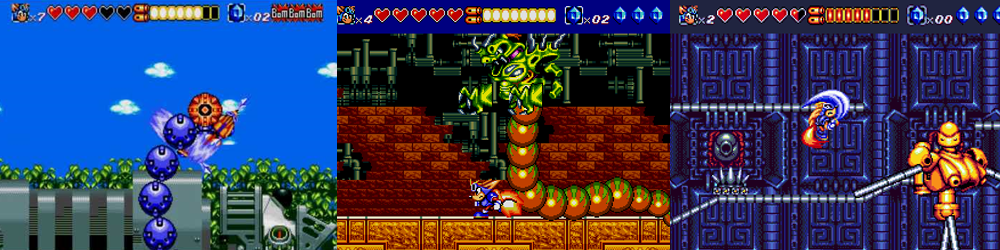
The first true boss is a variation of the Raccoon Robot enemy from the first game, this time integrated into a train. You must rocket away from its wide-reaching ball arm and avoid its projectiles, quickly striking the weak spot on the front of the train and dashing to safety as the arm flails wildly, which is quite taxing as the arm covers almost the entire screen and the projectiles can catch you off guard. Stage 2 ends with a gigantic, armoured snake whose only weak spot is its torso. You must dodge its claw arm, which it’ll fire out to reel you in and vigorously shake you, then chase it to the background. While hiding back there, it bursts its long, extendable tail, bursting from the ground and swishes it about, though you’ll also have to watch when it leaps across the tomb. King Gedol’s second-in-command, Paeli, is fought on the roof of his airship and seems to be a sorcerer or genie or something. He fires a flaming shot that both hurts and shrinks you, transforms into a genie-like form, then bursts into harmless miniatures that rain down as bombs and apples. One of these miniatures sparkles, so that’s your target; hit him and Paeli runs around in a panic like Captain Fleagle for you to deal real damage to him. Near the end of Stage 5, tall, spindly robots stomp about, spinning their long, stick-like arms, tossing bombs, and firing lasers. They’re easy enough to take down, even with the rails, conveyers, and enemies nearby, but you’ll then fall into a small arena and battle two of them. One fires pellets, lasers, and spins its arms but, upon defeat, is replaced by its green brethren, who leaps to the ceiling dropping bombs and drops to the floor to be finished off.
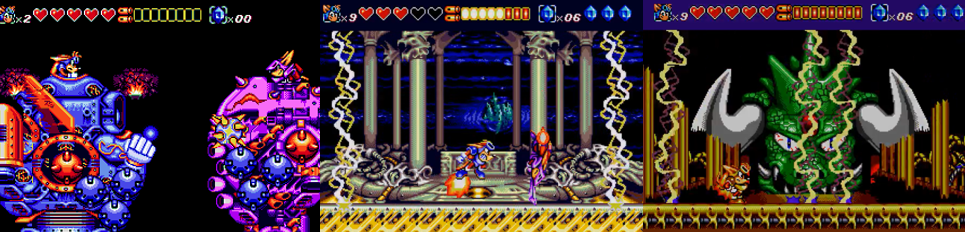
As in the other Rocket Knight titles, your most persistent foe is the rival Rocket Knight Axel Gear, who you fight in a mech battle at the start. Though this is optional, you’ll miss a Key to the Seal sword and learning the SparkRobo’s controls for later on. You must avoid Axel’s punches and hold A to block when he throws a shot or a projectile. Though you don’t get a projectile attack, you can throw uppercuts with B or Y or hold one of these to charge a straight punch. While this battle is much easier than the top-down mech fight from the Super Nintendo game, it’s no less tedious. Axel constantly guards and backs away and there’s a noticeable delay between button presses that can catch you out. While you don’t necessarily have to win this first mech fight, you will have to in Stage 4. However, to get to this rematch you must race through the streets and avoid Axel’s missiles, hitting them back at him to cause him to flee to his mech. Best his mech (with patience and persistence) and you battle Axel in a sword fight. Axel summons lightning walls that you can ricochet off otherwise they’ll hurt you and Axel again sports the same attacks as you, rocketing about, spinning as a flaming dervish, and swinging his sword. He does tend to hover about doing nothing, leaving himself open, and drops the final Key to the Seal upon defeat. With all seven, Gold Sparkster gets a permanent rocket charge and is much faster, which is very useful in the final fight with King Gedol. This is a two-stage affair, with the lizard king blinding you with a flash and charging lightning bolts from above or spawning a meteor shower. You can only attack him during this charge animation and, after enough hits, he transforms into a gigantic form that takes up the entire background! In this phase, King Gedol fires eye lasers that travel across the floor, walls, and ceilings, ricochet about, or randomly fire in all directions. You must dodge these and rocket into the gemstone that appears on his forehead to finally put him down for good.
Additional Features:
Sparkster: Rocket Knight Adventures 2 has four difficulty settings that fundamentally change the nature of the game, altering the length and challenge of the stages and changing the ending depending on how hard a challenge you set for yourself. You can further adjust the game’s difficulty from the main “Options” menu, changing how many lives and continues you play with. The game also includes a password feature, allowing you to skip to later stages and easily acquire all seven Keys to the Seal. These magical blades are hidden in each stage, sometimes in plain sight and sometimes requiring a bit of exploration to find. You’ll need all seven to play as Gold Sparkster and get the best ending, encouraging a replay or two (though be sure to take out Axel’s mech at the start for the first sword!) This Re-Sparked version also comes with the American and Japanese versions of the game, boasts an awesome anime opening, allows you to apply filters and borders, and negates even the hardest difficulty with a rewind and save state feature. The collection also comes with a boss rush, advertisements and concept art, the box art and manual, and the entire soundtrack for all three games. Those playing the PlayStation 4/5 version can also earn nine Trophies, one for clearing the first five stages, one for beating the game on any difficulty, one for unlocking Gold Sparkster, one for achieving the true ending, and one for beating the boss rush.
The Summary:
I’ve played Sparkster: Rocket Knight Adventures 2 before thanks to the magic of emulation, but never got past the first stage because, as a big fan of the original and an avid Mega Drive collector, I always wanted to own a physical copy of the game. It took a while, but the Re-Sparked collection finally made that a reality, only to present me with a game that’s visually inferior to its predecessor and Super Nintendo cousin in many ways. While Sparkster looks great and there are some interesting effects in some stages, the environments just seem far blander and far less engaging compared to the other 16-bit titles. Honestly, the game made a bad impression from the start and never really recovered; the rocket gameplay is much improved, but the main enemies lack animation frames and personality. The locations lack the steampunk trappings of the other titles and are far more generic which, coupled with the bizarre downplaying of the rocket pack and ricochet gimmick and removing Sparkster’s sword beam, means Rocket Knight Adventures 2 is just another colourful platformer. It’s fun enough, for sure, and some stages have interesting gimmicks, such as zipping through the airship and piloting the SparkRobo, but where are the flying sections? Where’s the quirky humour? Where’s the memorable music? The bosses were decent enough and I liked that you face more of them on harder difficulties. The one-on-one with Axel Gear is probably the best version of that fight, it’s just a shame you have to sit through another tedious mech battle to get to it. Rocket Knight Adventures 2 is also far too linear at times and felt the easiest of the three 16-bit titles, with King Gedol being the simplest of the final bosses and the hardest part being tracking down those hidden swords. In the end, I enjoyed Sparkster: Rocket Knight Adventures 2 but nowhere near as much as I wanted to. It fails to live up to its predecessor, lacks the visual punch of the Super Nintendo title, and was a disappointing experience after years of pining for it.
My Rating:
Pretty Good
Do you think I’m being too harsh on Sparkster: Rocket Knight Adventures 2? How did you think it compared to the first game and the Super Nintendo sequel? What did you think to the new rocket pack mechanics and the lack of sword beam? Were you disappointed to see the flying sections removed? Did you ever find all the Keys to the Seal and unlock Gold Sparkster? Would you like to see a new entry in the Rocket Knight series? Tell me what you thought to Sparkster: Rocket Knight Adventures 2 in the comments, support me on Ko-Fi, and go read my other Rocket Knight reviews.

 Dr. K's Waiting Room
3 thoughts on “Game Corner: Sparkster: Rocket Knight Adventures 2 (Nintendo Switch)”