
Sonic the Hedgehog was first introduced to gamers worldwide on June 23 1991 and, since then, has become not only SEGA’s most enduring and popular character but also a beloved videogame icon. Thus, in keeping with tradition, I’m dedicating some time to celebrate SEGA’s supersonic mascot.


Released: 13 September 2007
Developer: Dimps / Sonic Team
The Background:
SEGA’s desperate desire to create a mascot to rival Super Mario paid off when Sonic the Hedgehog became a mainstream icon with Sonic the Hedgehog 2 (SEGA Technical Institute, 1992). Despite subsequent success with both 2D and 3D titles, costly business decisions forced SEGA to withdraw from console manufacture, bringing the original “Console War” to an anti-climatic end. Now focused on software development, the unthinkable happened when Sonic and SEGA-branded videogames appeared on Nintendo’s GameCube and Game Boy Advance. Alongside Dimps, Sonic Team created a trilogy of largely lauded 2D throwbacks for the handheld and this partnership extended to the more powerful, dual screen Nintendo DS with the widely praised Sonic Rush (Dimps/Sonic Team, 2005). Introducing series staple Blaze the Cat and pioneering the hotly-debated Boost gameplay, Sonic Rush impressed enough to warrant a sequel. Inspired by adventure narratives, director Sakae Osumi decided the sequel should be set on the high seas, with pirate antagonists, and the developers expanded on the Sonic Rush’s game engine to incorporate more 3D elements and more use of the touchscreen. Released after the universally panned Sonic the Hedgehog (Sonic Team, 2006), critics noted that Sonic Rush Adventure proved the brand was still viable and praised the eye-catching visuals, upbeat soundtrack, and touchscreen functionality for the boat racing sections. While the plot and material collecting were criticised and we never got a third game in this sub-series, its influence was felt in Dimps’ subsequent 3DS port of Sonic Colours (Sonic Team, 2010).
The Plot:
Stranded in Blaze’s world following a mysterious storm, Sonic and Tails team with Blaze and an energetic, wannabe sailor to explore the neighbouring islands and keep the lost Jeweled Scepter away from Captain Whisker and his robo-pirates.
Gameplay and Power-Ups:
Like its predecessor, Sonic Rush Adventure is primarily a 2.5D action platformer focusing on high-speed platforming and Boost-based tricks. Initially, only Sonic is playable but, after clearing the third stage (known as a “Zone”), Blaze will be unlocked once again. While the game takes place on various islands, each Zone contains two stages (or “Acts”) and a third, dedicated boss battle against one of Doctor Eggman and Eggman Nega’s robotic giants (known as “Ghosts”). The game includes an “Options” menu where you can set the game to “Easy” or “Normal” mode to tweak the difficulty of bosses, toggle the ten-minute time limit on or off, and manually save your progress. Sonic Rush Adventure expands on the world map of its predecessor, allowing you to not only draw paths to other islands on the bottom screen but also enter buildings and talk with non-playable characters (NPCs). These allies give you hints, allow you to listen to the game’s soundtrack, offer additional missions to complete, and allow a stage and boss select so you can quickly retry completed Zones. Although Sonic and Blaze are still contrasting personalities, their controls and gameplay and essentially the same and as in Sonic Rush. Both jump with A or B, charge up a dash with down and A/B, and perform various mid-air tricks with A, B, and the Right trigger. You can use the directional pad in conjunction with these buttons to reach higher or further platforms, as well, though Blaze has the added benefit of her Burst Hover, which grants her a limited mid-air glide.
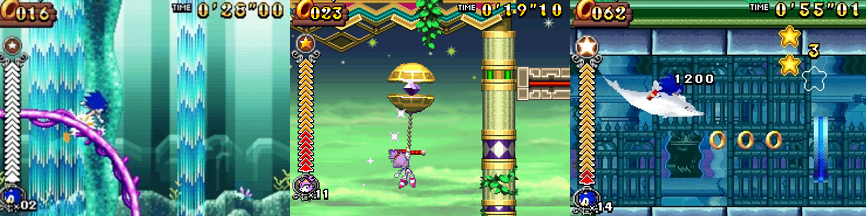
In contrast, Sonic can home in on nearby targets and is much faster by default, though Blaze is also immune to fire. Both characters can grind on various rails, tapping B to pull off additional tricks. These tricks and smashing robots fill your “Tension Gauge” which, when partially or completely full, blasts you ahead with the Super Boost or Fire Boost when you hold down X or Y. This allows you to plough through Badniks and breakable walls and across gaps at high speed, completely invulnerable, though you need to be careful as it makes it much easier to miss ramps and other interactable objects that spring you across the environment. Golden Rings act as your life blood, protecting you from attacks and awarding you extra lives when you collect increments of 100, and you can snag all the usual power-ups (extra Rings, a barrier and magnetic shield, and a brief invincibility) alongside boosts to your Tension Gauge and top speed. Your Tension Gauge also gets a boost when you pass a checkpoint, and you’ll use loops, springs, and ramps to blast between both screens across the game’s colourful and distinct Zones. Similar to the last game, there are instances where you get additional gimmicks: Blizzard Peaks starts you on a snowboard for some high-octane grinding, Coral Cave sees you push and jump into large minecarts, and Pirates’ Island sees you riding a dolphin through rings in underwater tunnels. The hang glider reappears in Machine Labyrinth, now steam-powered and letting you Boost along, while catapults, cannons, and giant hooks and anchors carry you to higher platforms. Pirates’ Island includes a water cannon gimmick where you aim, fire, and grind along water streams, crystals allow you to float across deadly gaps in Sky Babylon, and the Haunted Ship’s cannons blast you through the sky, allowing you to press buttons to score points off rings. Occasionally, the game switches perspective, shrinking you to the background, bringing you to the foreground, and putting you in a third-person view as you switch tracks in a mine cart or grind across spiked vines.
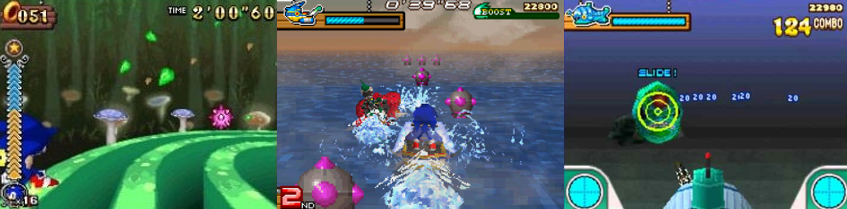
The “adventure” aspect of the game comes into play in the overworld. You’ll travel across the sea to reach each island and challenge the game’s Zones, which you can only do with Tails’ various sea craft. After plotting a path, you’re placed on the bottom screen and use the stylus to control Sonic as he grabs Rings, performs tricks off ramps, and avoids enemies. In these sections, tricks and other actions are performed by swiping or tapping the screen, which builds your “Boost Gauge” and allows you to rocket ahead by double-tapping the screen or pressing the Left or Right triggers. Clearing Acts awards various materials and a letter grade; the higher your grade, the more materials you acquire. These can be brought to Tails to create newer, more diverse sea craft, such as a submarine and a hovercraft. As each craft needs specific materials to be built and further upgraded, you’ll be revisiting Zones again and again to “farm” for these materials. These can also be located on the sixteen Hidden Islands, which act as brief obstacle courses designed to test your skills and award materials, and you must do this to progress though the story. Sonic starts with the Wave Cyclone, a simple hoverbike, before Tails builds the Ocean Tornado, a sailboat you control and fire the weapons of (comprised of a gun turret, cannon, and flamethrower). The Aqua Blast hovercraft is similar to the Wave Cyclone but players must move it side to side to avoid rocks and other hazards and fire its laser cannon in either short or charged bursts. The last craft you get direct control of is the Deep Typhoon, a heavily armed submarine that sees you exploring the ocean’s depths, tapping commands similar to a quick-time event to lock-on to and destroy enemies and hazards, as indicated by a radar. Additional power-ups are also found in these stages to repair your craft or fill your Boost Gauge, and they certainly offer a fair bit of variety, though the grinding for materials can get tedious at times.
Presentation:
Like Sonic Rush, Sonic Rush Adventure utilises traditional sprite art for its backgrounds alongside polygonal assets. These are primarily seen in the character and enemy models but various interactive elements (such as drums and bouncy ropes and the end goal treasure chests) are 3D models as well. Sonic and Blaze’s models seem to be copied wholesale from the last game, sporting the same animations, playstyles, and voice clips as before and therefore being just as blocky and clunky. Again, I wonder if it might’ve been better to swap things around and have fully polygonal environments and sprites for the characters, though these models do look a lot better when the action switches to the touchscreen for the sea sections or brief third-person sequences. As you might expect from the title, Sonic Rush Adventure places more emphasis on the story, meaning more cutscenes using both 3D models and still images and more interactions with NPCs. The standout of these is the now sadly forgotten Marine, a plucky raccoon girl with a love for the sea and its craft and who hides incredible power behind her boisterous personality. Sporting a quirky Australian dialect, she furthers Blaze’s development from a stoic princess into a more laidback defender of her world and is a joy to talk with, as are the various amusing koalas who help you. Sonic Rush Adventure incorporates a more sea-faring flair to its soundtrack, peppering every stage with upbeat tunes that match the fast-paced gameplay. The opening theme, “A New Venture”, is infectious in its whimsy though it was surprising and a little disappointing to find the game didn’t include voice acting to go with its cutscenes and still relied on simple text. For most of its length, Sonic Rush Adventure focuses on two new antagonists, Captain Whisker and Johnny, and doesn’t reveal Dr, Eggman and Eggman Nega’s involvement until later, though I genuinely think it would’ve worked just as well, if not better, to omit the Eggmen entirely and focus on his pirate-theme doppelgänger and Sonic’s latest rival, just to mix things up a bit.
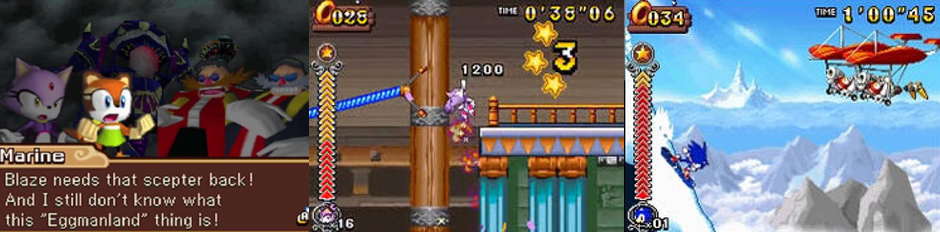
Sonic Rush Adventure is one of the more visually unique Sonic games, especially in its environments. While Zones blast along a mile-a-minute and it’s easy to overshoot ramps or plummet down the many bottomless pits, the new, sea- and pirate-themed aesthetic really benefits the visuals. This is immediately apparent in the heads-up display, whose font is a far cry from the usual, generic lettering in other Sonic titles and more akin to the short-lived “Storybook” games on the Nintendo Wii. Things start pretty standard in Plant Kingdom (which features vines to swing from and grind on, bouncy mushrooms, and robotic dinosaurs) before delving into steampunk in Machine Labyrinth. Similar to Metropolis Zone, Machine Labyrinth features steam-based springs and winding tubes alongside the hang glider, pinwheels, and massive drums that pinball you about. Coral Cave is a coral spin on a mine, featuring crystalline coral, coral bridges, and a partially flooded grotto alongside abandoned mine carts and tracks and waterfalls. Similar to Pirates’ Island, you must pay attention to the top screen or you’ll get crushed by falling hazards that are used as platforms to higher areas, and giant anchors will swing you about, too. The Haunted Ship was probably my favourite Zone. Featuring a misty graveyard of wrecked ships in the background and seeing you dash up ropes and mainsails, you’ll explore the dishevelled interiors, bash robotic pirate ghosts, and blast between ships using massive cannons. You’ll also bounce up to higher areas using special ropes or be forcibly dragged up by barrels. Sky Babylon was also visually very interesting, sporting a green night-time sky and strange, neon-glowing ruins in a mish-mash of Marble Garden, Sky Sanctuary, Altitude Limit, and the Babylon Garden. Strange floating orbs drag you higher, destructible platforms drop you past flaming hazards and to the ever-present electrical bolt lurking below, and you explore both the background and foreground. Blizzard Peaks started strong with its snowboarding section, which allowed some fun grinding, and with its snowy slides and giant icicles that you must jump between. Pirates’ Island is, essentially, Sonic’s version of Venice, featuring stone buildings, flooded ruins, spring-loaded fountains, and helpful dolphins to navigate its waters. These environments and their gimmicks are all recycled for the Hidden Islands, and there’s even a degree of choice in which locations you visit depending on which ships you have.
Enemies and Bosses:
Sonic Rush Adventure bolsters its unique environments with a slew of all-new Badniks, each one the creation of the Dr. Eggman/Eggman Nega duo and in keeping with the nautical/pirate aesthetic of the game. The most persistent of these are the various “Kaizoku” Badniks that toss explosive barrels, glide around on hang gliders, fire small, shoulder-mounted cannons, hide in snowballs, or attack with a cutlass. The Kaizoku Hogan variant is a touch tougher than the usual Badniks, swinging a ball and chain and sporting a health bar. The Hover and Gunner variants fly about using jetpacks, and the Skeleton versions float around like wandering spirits and toss bone sat the player. These Badniks are bolstered by the “Shisaku-gata” series of mechanical miscreants who chuck spanners, hover using steam-powered jetpacks, and push you back with jets of steam. More traditionally designed Badniks also appear, such as the Barrier Angler (a robotic angler fish, which also has an electrical variant), the Jaws-like Nibbles, the Dive Bat (another of Dr. Eggman’s many bat-themed Badniks), and the Rabid Crab (which focus more on melee attacks than Crabmeat’s projectiles). The Triceratank charges you with its horn similar to the Rhinobot, Ptera swoop from the skies, Sky Moons fire projectiles while hovering in the path of your jumps, and steam-powered Bomb Ghosts wander the Haunted Ship ready to explode in your face! Each Zone ends in a boss battle against one of Dr. Eggman and Eggman Nega’s gigantic robot creations. Unlike in the last game, where you were restricted to either a platform or a ring, Sonic Rush Adventure features more variety to its boss battles. You’re still restricted to a set area, but the arena and boss strategies alter as the fight progresses, switching between the screens. Each also possesses a health bar, though you no longer have your allies cheering you on, and ends with a dramatic, slow-motion final blow against the mech.
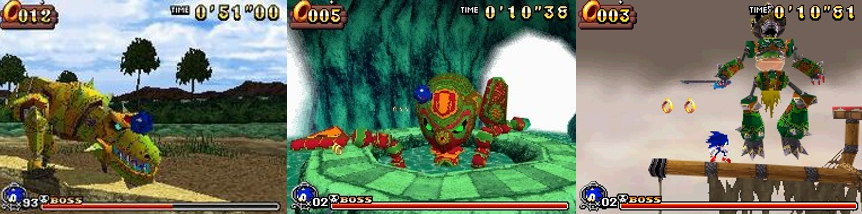
The first boss you encounter is the Ghost Rex, a gigantic, robot Tyrannosaurus rex that stomps around in the background, stalks around your small stone platform, and tries to munch you with its powerful jaws. Dodge this attack to attack its head and repeatedly strike it when it tries to charge from either side of the platform and you’ll eventually fall to a cavern, where the Ghost Rex elongates its neck to try and crush you and cause shockwaves. The Ghost Pendulum is fought on a ring and stays out of reach and you must run around in a circle, striking its low-hanging fruit to smack them into it. As the fight progresses, more balls appear, with some sporting spikes and electrical barriers and the boss dropping to create shockwaves, which can all be tricky to avoid. The Ghost Kraken is also fought on a ring; it spins its tentacles to attack you, but you can smack these (especially the jewelled one) to damage it. It also tries to grab and slam you into the ground, forces you underwater, and spits ink to either stick you in place or obscure the screen. The Ghost Pirate awaits on the Haunted Ship, spewing fireballs and flaming vortexes and attacking with kicks and its cutlass. You must target the glowing red core, which eventually detaches and must be chased around to deal more damage, which can be tricky, especially if the ship’s swaying. The Ghost Whale is one of the most unique bosses as it’s fought on a rapidly deteriorating ice float. You must smack it when it charges to jump inside, where you have thirty seconds to battle to its inner core, destroying pods for more time and avoiding freezing hazards and ridable missiles.
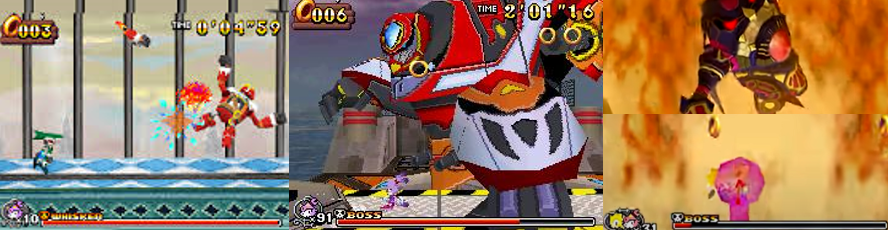
The Ghost Condor was probably the toughest of the regular bosses for me. You’re running on a never-ending path on the bottom screen, avoiding mines, spiked platforms, and the boss’s charge. You must hit the green mines to fly up and smack the boss’s weak spot, landing on the platforms to deal additional damage, though the hazards, speed, and aggressiveness ramp up over time. Captain Whisker and Johnny first attack as a duo on a stage full of buzzsaw-spewing platforms. Captain Whisker fires his rocket arms and performs a ground pound to produce a shockwave and Johnny torpedoes at the player, and they have a team attack that must be repelled. Both must be defeated but this looks more intimidating than it is and it’s pretty easy to pepper them with hits. Captain Whisker then jumps into the Ghost Titan for a penultimate showdown not unlike the battleship bosses from the last game. You must hit its missiles to lower the shields on the cannons, then line up the aiming reticle to attack. The Ghost Titan also delivers a big punch, fires laser-guided flame blasts, litters your platform with bullets from its crotch, and spreads flames across the ground. Though there’s a lot happening at times this was a big, fun, boss made even more intimidating by it boxing you in with insta-kill lasers at the end. After collecting the seven Chaos and Sol Emeralds, you’ll battle the true final boss, the Egg Wizard, a super-powerful mech piloted by Dr. Eggman and Eggman Nega and wielding the fabled Jeweled Scepter. This is a three-phase battle that takes place from a top-down perspective in the molten core of Blaze’s world. You control Super Sonic and Burning Blaze, collecting Rings to sustain your transformation and switching between the two with R. In the first phase, you reflect boulders using Super Sonic’s A attack. You must then reflect the Egg Wizard’s fireballs and three flaming dragons to deal damage or switch to Burning Blaze and fire single or charged fireballs with A. Deal enough damage and the Egg Wizard regains some health and adds a targeted meteor, a flamethrower, and gigantic missiles that must be avoided or reflected to deliver the final blow. It’s not the hardest final boss but, with no checkpoints, few Rings, and many of the attacks stunning you, it can be a trifle aggravating to contend with.
Additional Features:
When exploring the seas of Blaze’s world, you’ll inevitable cross paths with Sonic’s latest rival, the arrogant robotic shark, Johnny. When you do, Johnny challenges you to the race, with the prize being a legendary Chaos Emeralds. These races take place on the Wave Cyclone and are thus performed using the touchscreen and stylus. Players can follow Johnny’s trail for a boost and must dodge his mines or they’ll suffer irreparable damage and lose. To stay ahead, you collect Rings and perform tricks off ramps to build and maintain your Boost Gauge, though you can replay each race as often as needed to score the Chaos Emeralds. Like before, Blaze doesn’t get Sol Emeralds from Special Stages like these. Instead, you talk to NPCs to take on various missions, with seven of the 100 available missions specifically relating to the Sol Emeralds. These are acquired by finding Hidden Islands or beating certain bosses again, and only by getting all seven of both will you unlock the game’s true ending. Other missions also challenge you to reach the goal within a certain time limit or while holding a set amount of Rings. You can also explore to find the sixteen Hidden Islands and replay previous Acts to get materials to build and upgrade your craft and score better rankings, and take on a time attack mode. Sonic Rush Adventure also includes a multiplayer component where players race against each other to finish Zones and defeat bosses the fastest, though I’ve never played this mode. Finally, there’s a sound test and movie viewer mode available and you can take on the bosses and Johnny’s race at any time by chatting to NPCs.
The Summary:
Sonic Rush was a fun, if barebones, return to form for Sonic, a natural progression of the Game Boy Advance titles and a nice taster of what the Nintendo DS could do with the franchise. Sonic Rish Adventure takes everything that worked and adds a bit more to it, expanding the narrative and the scope of both Sonic and Blaze’s world and delivering a fresh take on the usual, formulaic events by assuming a pirate aesthetic. I really enjoyed the sea-based sections, exploring the map and playing about with each craft. It was a fun use of the touchscreen that never outstayed its welcome, though it does get a touch tedious having to grind for materials. It might’ve been better if Tails built the ships as the story progressed and the materials were purely to upgrade each one to give you an edge in combat or against Johnny. The Zones were some of the most unique and visually interesting the series has ever seen, finally moving away from tried-and-tested tropes and embracing new aesthetics. The gameplay is fast-paced and fun, with lots happening at once and really gave me a sense of empowerment, though it’s still dogged by bottomless spits, insta-kill hazards, and unavoidable traps. Captain Whisker, Johnny, and Marine are some of the best new additions to the franchise and I’m honestly annoyed that they’ve never been seen again. I’ll reiterate that neither Eggman was necessary for this game, and it might’ve been better without them as Captain Whisker was a familiar enough threat given a quirky edge by being a pirate. It’s a shame that Sonic and Blaze’s gameplay was basically unchanged from Sonic Rush, with no new moves or abilities or playable characters added to the mix, but the 2.5D Boost gameplay was arguably better than it’s ever been here. It really feels like Sonic Rush Adventure filled in some of the blanks of the last game, adding more diversity and complexity to the boss battles, switching up the stage aesthetics, and placing more emphasis on the story. Add to that the fun sea mini games and races and opportunities for exploration and you have a really solid title that definitely deserves more love than it gets as I never see anyone talking about this one, and that’s a real shame.
My Rating:
Great Stuff
Did you play Sonic Rush Adventure back in the day? What did you think to the new setting and the quirky new characters? Did you enjoy the pirate aesthetic to the stages and trying out new sea-based craft? What did you think to the grinding mechanic and the changes made to the boss battles? Did you ever defeat the Egg Wizard, and do you agree that Captain Whisker and Johnny were strong enough antagonists by themselves? Which of Sonic’s handheld adventures is your favourite and how are you celebrating him this month? I’d love to know what you think about Sonic Rush Adventure so leave a comment and be sure to check out my other Sonic content.

 Dr. K's Waiting Room
One thought on “Game Corner [Sonic Month]: Sonic Rush Adventure (Nintendo DS)”