
Sonic the Hedgehog was first introduced to gamers worldwide on June 23 1991 and, since then, has become not only SEGA’s most enduring and popular character but also a beloved videogame icon. Thus, in keeping with tradition, I’m dedicating some time to celebrate SEGA’s supersonic mascot.


Story Title: “Enter: Sonic”
Published: 29 May 1993
Writer: Alan McKenzie
Artist: Anthony Williams
Story Title: “Robofox”
Published: 12 June 1993
Writer: Mark Millar
Artist: Woodrow Phoenix
Story Title: “The Origin of Sonic”
Published: 4 September 1993
Writer: Nigel Kitching
Artist: Richard Elson
Story Title: “Prologue: Once Upon a Planet…”
Published: 30 April 1994 (cover-dated: 13 May 1994)
Writer: Nigel Kitching
Artists: Mike Hadley and John M. Burns
Story Title: “Kintobor Spelled Backwards Is…”
Published: 14 May 1994 (cover-dated: 27 May 1994)
Writer: Nigel Kitching
Artists: Mike Hadley and John M. Burns
Story Title: “A Tale of Tails”
Published: 28 May 1994 (cover-dated: 10 June 1994)
Writer: Nigel Kitching
Artists: Mike Hadley and John M. Burns
The Background:
Sonic the Hedgehog was a huge success for SEGA. Thanks to an aggressive marketing campaign and being bundled with the all-powerful 16-bit Mega Drive, over 15 million copies were sold and SEGA briefly usurped Nintendo as the big dog of the videogame industry. Eager to capitalise on Sonic’s mainstream popularity, SEGA shamelessly licensed their mascot anywhere they could, leading to two concurrent cartoons and multiple comics books published across the world, with each taking vastly different approaches to the source material. While the Japanese manga was far more faithful to the videogames, Archie Comics awkwardly mashed together the contrasting tones of Sonic’s cartoons into what would become the longest-running comic series based on a videogame, and the United Kingdom was treated to Sonic the Comic (StC). Published fortnightly, StC took much of its lore from the now defunct Mobius storyline created specifically for Western audiences and made the bold decision to portray Sonic as an egotistical narcissist who treated his friends poorly while fighting for freedom and justice. Eventually folding more elements and characters from the videogames into its narrative, StC was a highlight of my youth for many years. Although it soon devolved into reprints before being cancelled, its spirit lived on through an online continuation.
The Review:
I’m doing things a little different for this review. StC’s early days were a bit sporadic, which isn’t surprising considering each issue featured a handful of stories based on different SEGA properties alongside letters, artwork, reviews, and cheats for SEGA titles. While Sonic the Hedgehog stories were always at the forefront, the lore was anything but sequential. Issue one, for example, drops us right in the middle of the action and appears to take place shortly before the events of the first videogame. By issue six, it’s clear that StC takes place sometime after Sonic the Hedgehog 2 (SEGA Technical Institute, 1992) and StC rarely produced direct adaptations of the source material, especially the first two games. It also didn’t waste much time in bogging down its stories with exposition; the comics were aimed at a pre-made audience of SEGA gaming fans so this wasn’t necessary. Thus, it took some time for later issues and backup stories to flesh out Sonic’s characters and world. Fittingly, this was initially related through supplementary stories titled Sonic’s World, in which key events from Mobius’s history, the videogames, and StC’s unique canon were revealed to the reader. Thus, rather than going through each issue in turn for this review, I’ll instead be tackling them in as close to chronological order as possible to give a taste of the world StC crafted and the way it reinterpreted the source material. Accordingly, we must start not with issue one but with issue twenty-five, which included the first appearance of the Sonic’s World stories and gave us our first real overview of how Fleetway were interpreting the videogames. Like all Sonic media outside of Japan in the 1990s, Fleetway takes place not on Earth, but on Mobius, a planet said to be both 117,63222 light years from Earth and in “a parallel dimension” and divided into areas known as “Zones”. “Prologue: Once Upon a Planet…” gives a brief overview of how Sonic the Hedgehog fought the evil Doctor Ivo Robotnik, forcing him to retreat to a secret based in the “Special Zone”, and how Dr. Robotnik has both biological and mechanical minions station around the planet and rules with an iron fist. This story, like the others in these Sonic’s World features, is narrated by the Kintobor Computer, an artificial intelligence that assists Sonic and his friends from their underground base and is the digital backup of Sonic’s old friend, the kindly Doctor Ovi Kintobor.
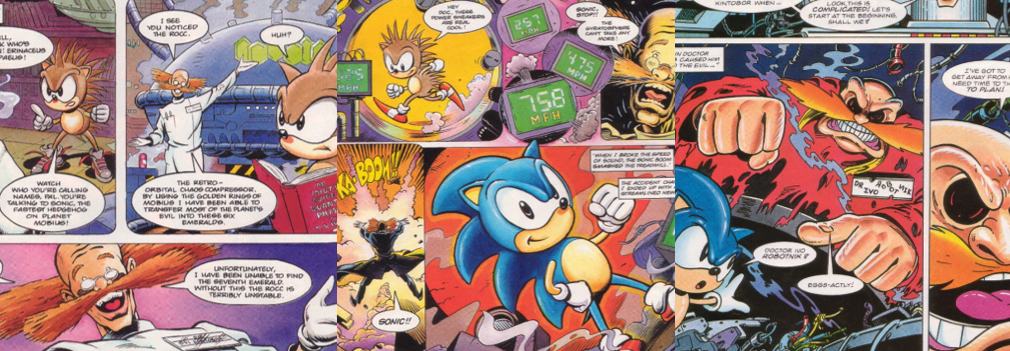
Who is Dr. Kintobor, you ask? Well, to answer that we need to jump to issue eight’s “The Origin of Sonic”. This story (set before Dr. Robotnik conquered Mobius) saw Sonic charge up a Star Post with his superfast speed and transport his friends (long-suffered sidekick Miles “Tails” Prower, brave Johnny Lightfoot, and cowardly Porker Lewis) to the Special Zone. Modelled after the iconic half-pipe Special Stages seen in Sonic 2, StC’s Special Zone the a chaotic and dangerous home of Sonic’s friend, the Omni-Viewer, a gigantic sentient television screen. Capable of transporting and transmitting people and events across time and space, the Omni-Viewer shows Sonic’s friends the origin of both Sonic and Dr. Robotnik through his view screen. Some time ago, Sonic was just a normal, brown hedgehog (albeit one with incredible speed). While exploring Mobius, Sonic stumbled upon Dr. Kintobor’s secret laboratory and met the kindly Doctor, one of the few humans living on Mobius. Enamoured by the beauty of the world, Dr. Kintobor created the Retro-Orbital Chaos Compressor (ROCC), a massive machine designed to transfer the planet’s “evil” into six gems using special Golden Rings. Unfortunately, without the legendary seventh emerald, the process is incomplete and the ROCC is unstable. Sonic agrees to search the planet for the elusive seventh emerald and, in return, Dr. Kintobor develops his natural speed. Thanks to a snazzy pair of “friction reducing […] power sneakers” and a “kinetic gyratoscope”, Sonic breaks the sound barrier, streamlining his body to his iconic blue look. One day, Dr. Kintobor took a lunch break and, while carrying a rotten egg, tripped and collided with the ROCC. The explosion scattering the Golden Rings across Mobius and warped the six Chaos Emeralds to the Special Zone and, like Sonic’s accident, forever changing the friendly Doctor. Where he was once tall, slender, and pleasant, he was now squat, bulbous, malicious, and rotten. Even his name was reversed (hence “Doctor Ivo Robotnik”) and he became obsessed with recovering the Chaos Emeralds to conquer the world. “The Origin of Sonic” concludes with the Omni-Viewer returning Sonic and his friends to Mobius, forced to drop them six months into the future and thus allowing Dr. Robotnik to take over the planet.
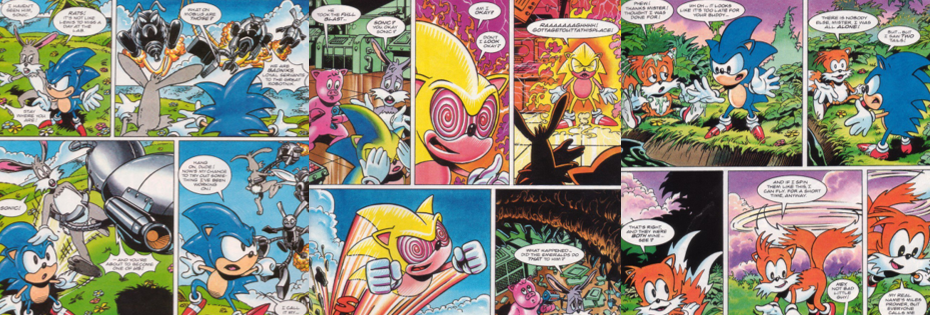
“Kintobor Spelled Backwards Is…” reveals that Sonic and Porker discovered one of the Golden Rings could talk after Dr. Kintobor’s brain patterns somehow transferred to it during the explosion. Using comic book logic, the tech-savvy Porker downloads Dr. Kintobor’s consciousness onto a computer, birthing the Kintobor Computer and allowing the kindly Doctor to live on. Following Dr. Robotnik’s transformation, Sonic and his friends scoured the world for the Golden Rings and the Chaos Emeralds to try and reverse the process until, one day, they were attacked by the first generation of Dr. Robotnik’s Badniks. Using his Sonic Spin Attack, Sonic trashed the Badniks and discovered, to his horror, that Dr. Robotnik was capturing his friends and using them to power his machines. There’s some crossover between these panels and issue one’s “Enter: Sonic” and even America’s promotional comic book, namely that Sonic trashed Badniks in Green Hill Zone and rescued Porker Lewis. A montage briefly recaps the first Sonic videogame, how Sonic travelled and successfully recovered the six Chaos Emeralds before Dr. Robotnik. However, when Sonic and his friends tried to analyse them, the Chaos Emeralds disappeared in a burst of radiation since, without the seventh to balance them, they couldn’t be safely kept together. Absorbing the full brunt of the blast, Sonic was transformed into a maniacal, golden-hued form that blasted from the base in a desperate desire for freedom. Crashlanding in the Swampland Zone, Sonic returned to normal with no memory of his transformation; his confusion gave way to concern when he heard cries for help. Rushing to assist, Sonic pulled a fox boy from the swamp and was amazed to find the cub, named Miles, not only had two tails but could fly by spinning them like a propeller, earning him the nickname “Tails”. Tails joined Sonic for another montage, this time recapping Sonic 2, which sees Sonic take down Dr. Robotnik’s greatest creation, the Death Egg, and safely hide the six Chaos Emeralds in the frozen North Cave.
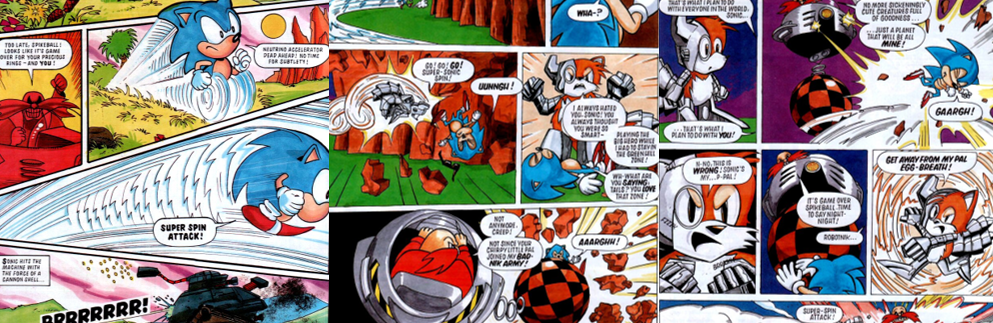
This brings us to “Enter: Sonic”, where Dr. Robotnik unleashes a fresh hoard of Badniks throughout Green Hill Zone to keep Sonic from meddling in the evil genius’s newest creation, the Engine of Destruction. Fuelled by the Golden Rings and literally sucking them out of the air, the machine promises to “crush Sonic into a million bitty hedgehog nuggets” and “pollute the atmosphere […] for a thousand years”! After rescuing his friends from their Badnik prisons, Sonic learns of the Engine of Destruction and races off to stop it, encountering some of the same hazards players must overcome in the first game (loops, crumbling platforms, and spike pits). Despite its vast size and ominous appearance, the Engine of Destruction is easily destroyed by Sonic, who simply rams into it at full speed. Sonic’s victory is soured by the realisation that he hasn’t heard from Tails for some time. Between issue one and two, Sonic goes on an unrelated adventure and returns to find Green Hill Zone deserted after Dr. Robotnik raided it overnight. Donning his new “power-grip trainers” and a pair of shades, Sonic liberates his friends, only to find Dr. Robotnik has transformed the foxboy into the semi-cybernetic “Robofox”. His personality warped by Dr. Robotnik’s programming, Robofox both physically and mentally attacks Sonic. However, when he witnesses his friend and hero being pummelled to death by Dr. Robotnik’s wrecking ball, Tails regains his senses and charges the villain, destroying both his exoskeleton and trashing the Egg-O-Matic. Relieved to have his friend back, Sonic teases Tails for his actions and sadly takes him back home, though his fancy new sneakers were wrecked from the adventure and Dr. Robotnik lived to fight another day.
The Summary:
It’s interesting reading these stories in this order, which can loosely bee described as sequential, rather than in publication order. There were a few other stories that flesh out some other elements of these events, such as a glimpse into Tails’ past before he came to Green Hill Zone and a time travel story that showed Sonic was responsible for the accident that birthed Dr. Robotnik. This Mobius/Dr. Kintobor canon was very popular outside of Japan at the time and all the books and comics published in the United Kingdom used a variation of it, while the United States made up their own backstories. It’s certainly an interesting and “comic book” take on the premise but it amuses me that the localisation team went to so much effort to expand the lore when the original story is so simple: anthropomorphic characters battle an evil despot to defend the world from pollution. It’s certainly interesting to see Sonic’s origin depicted this way and, now, many decades later, rather quaint. For a generation of readers, this was Sonic’s canon origin. People really thought he lived on Mobius and was once a regular brown hedgehog, transformed by breaking the sound barrier. It’s a very “superhero” origin, fitting considering Sonic was often billed as such in publications at that time. I think my biggest issue with the Dr. Kintobor thing is how little emotional connection I have to that character. We don’t spend much time with him and his personality is erased by Dr. Robotnik. Even the Kintobor Computer became superfluous once Porker became even more of a tech genius, and it just raised more questions than it was worth sometimes. The whole ROCC thing is an interesting way of explaining why Golden Rings are scattered everywhere in the games and another early story even explained the item monitors, but Rings rarely appeared in StC after this or in the same way as the games so it’s a bit convoluted. I did like that the writers were laying the groundwork for a seventh “Control Emerald” even this early on. This would turn out to be the legendary Grey Emerald rather than the Master Emerald, but it’s a fun way to explain why the Chaos Emeralds constantly need to be collected in each game.
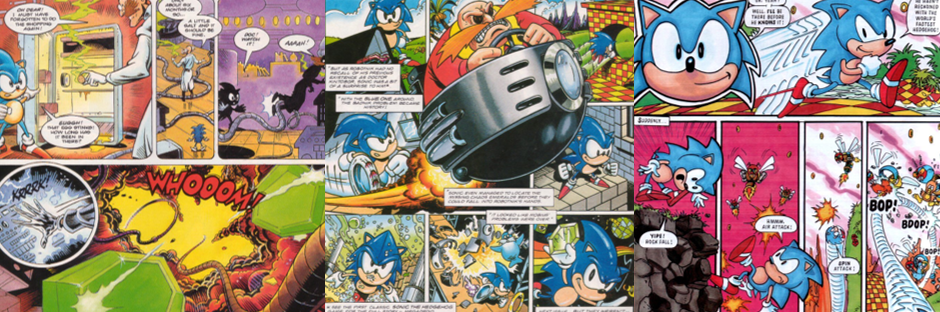
StC also had a unique spin on Super Sonic, making him Sonic’s demonic alter ego and creating deeper parallels between him and Dr. Robotnik, elements sadly never really expanded upon in future stories. The artwork of these stories is decent, if a bit inconsistent. Richard Elson was busy on the main Sonic stories in issues twenty-five to twenty-seven, though we get a taste of his work in issue eight. It’s not quite as refined as later but a lot better than issue one and two, where Sonic’s poses (especially in “Enter: Sonic”) are lazily ripped from official SEGA artwork. I did enjoy how these stories adapted elements from the videogames; we honestly didn’t see this that much in StC, potentially because multiple stories of Sonic simply running around, bashing Badniks, and avoiding traps isn’t very interesting or dramatic. It’s fun seeing Green Hill Zone come to life in “Enter: Sonic” and seeing Sonic’s friends be jostled about by the Special Zone’s bombs in “The Origin of Sonic”. Both locations would be expanded into more grounded, bustling locations within just a few issues as StC settled into a more relatable adaptation of the game’s fantastical elements, but I liked the simplicity and fidelity of everything here. There’s just enough to make it unique, like the Engine of Destruction and the Omni-Viewer. A major plus in these issues is that Dr. Robotnik sports his videogame appearance; he’d later transform into his cartoon counterpart, but I find this rendition far more menacing, especially during his first appearance following his accident. These Sonic’s World stories also deliver the first direct adaptation of the videogames, albeit in an extremely truncated form. We’d see elements included in other stories, sure, but these montages recreate and canonise the videogames, making it clear that issue one occurs after Sonic 2 and that Sonic’s had multiple adventures even before StC began. The stories are also laced with some quirky humour; everything feels very “British”, from the dialogue and the characterisations. Sonic isn’t quite the obnoxious asshole we’d see in other stories, but he lives up to his reputation as a “Hedgehog with Attitude”, giving off an arrogant and cocksure bravado that perfectly contrasts with Dr. Robotnik’s spiteful and egg-centric personality.
My Rating:
Pretty Good
Did you read Sonic the Comic as a kid? If so, what did you think to its unique interpretation on Sonic, his friends, and his lore? Were you a fan of the Mobius/Dr. Kintobor origin or are you glad that it’s been forgotten in modern times? What did you think to Sonic’s original look and his first meeting with Tails? What are some of your favourite StC stories and characters? How are you celebrating Sonic the Hedgehog this year? Whatever your thoughts on Sonic the Comic, or Sonic in general, drop a comment below.

 Dr. K's Waiting Room
9 thoughts on “Back Issues [Sonic Month]: Sonic the Comic: Origins”