
Sonic the Hedgehog was first introduced to gamers worldwide on June 23 1991 and, since then, has become not only SEGA’s most enduring and popular character but also a beloved videogame icon. Thus, in keeping with tradition, I’m dedicating some time to celebrate SEGA’s supersonic mascot.

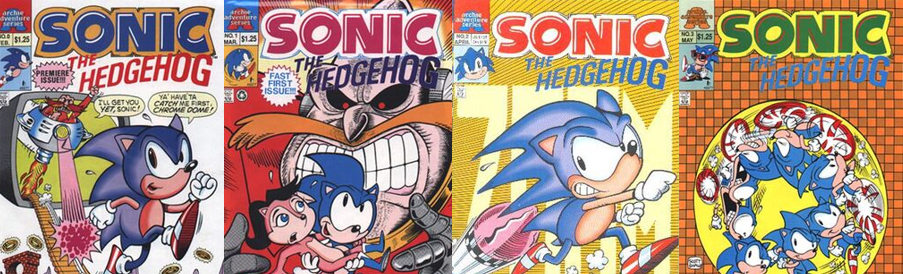
Story Titles: “Don’t Cry for Me, Mobius!” and “Oh No–Robo! No-Mo’ Mobo!”
Published: 24 November 1992
Story Titles: “Run, Sally, Run!” and “Something Fishy”
Published: March 1993
Story Title: “A Crowning Achievement”
Published: April 1993
Story Titles: “Sonic Flashback!” and “Why Ask Spy?”
Published: May 1993
The Background:
SEGA wasted little time capitalising on Sonic’s massive popularity once he became a mainstream success and single-handedly caused them to usurp Nintendo’s position at the top of the videogame industry. Following in the footsteps of Nintendo’s success with DiC, SEGA’s mascot soon debuted on the small screen with two concurrent cartoons, the most popular of which was the simply-titled Sonic the Hedgehog (1993 to 1994), also known as “SatAM”. SatAM recast Sonic as the point man for the Knothole Freedom Fighters, a team based on his Animal Friends from the source material, and Doctor Robotnik as a terrifying, semi-cybernetic dictator. SatAM’s darker tone clashed with the slapstick approach of its sister-series, but Archie Comics awkwardly mashed both together for this four-part miniseries, the genesis of what would become the longest-running comic series based on a videogame. In the years since, Archie Comics would expand on their convoluted lore, shoe-horning in more and more videogame characters, until a ridiculous lawsuit spelled the beginning of the end for the comics, with the license then taken up by IDW and an all-new, game-adjacent continuity.
The Review:
When I was a kid growing up in the UK, Archie’s Sonic the Hedgehog comics were a complete oddity. I never even heard of them until I picked up a trade paperback collection of this original miniseries. Though they offered little in the way of a resolution to SatAM’s unresolved cliff-hanger, they were the closest thing to an official follow-up. While they had many flaws and became ridiculously convoluted, things started relatively simply with this oddball miniseries, which has the overall look and cast of SatAM but strangely incorporates some elements (particularly the cartoonish slapstick) of Adventures of Sonic the Hedgehog (1993). Sonic, Miles “Tails” Prower, Princess Sally Acorn, and their colourful friends and enemies live on Mobius, a world whose natural beauty has been tainted and corrupted by the maniacal Dr. Robotnik. “Don’t Cry for Me, Mobius!” begins with the mad doctor chasing Sonic throughout the countryside and trying to splatter him with his super sticky “mega-muck”. While Sonic easily outruns Dr. Robotnik’s Egg-O-Matic, he appears to be trapped by, of all things, a simple Caterkiller. This is a ruse to lure Dr. Robotnik closer as Sonic avoids a splatter of mega-muck, destroying the Caterkiller and leaving Dr. Robotnik covered in his own goop. Sonic then breaks the fourth wall and invites the reader to follow him to Knothole Village, the hidden refuge of the Freedom Fighters, where he meets with Tails (Sonic’s biggest fan and budding sidekick), Boomer the Walrus (the mechanic and tech support who wasn’t quite yet known as Rotor), and Princess Sally (the team’s leader who sports a decidedly different colour scheme and is exasperated by Sonic’s brazen attitude). Sonic and Sally’s awkward mutual attraction is interrupted by fusspot Antoine D’Coolette, who alerts them to a leak that could potentially reveal their location.
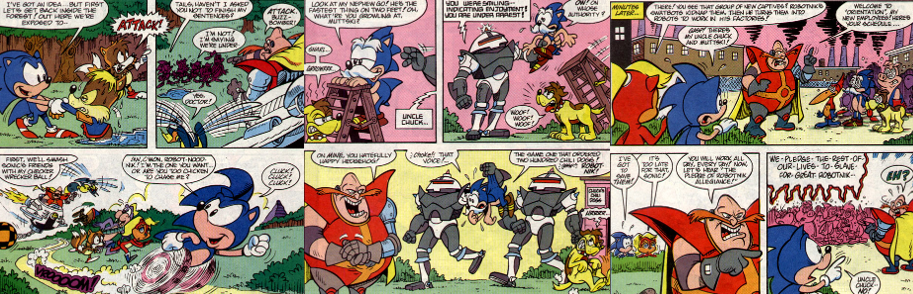
The Freedom Fighters head topside to investigate, exposing themselves to Dr. Robotnik’s spy satellites, and discover the cause is a growth of literal weeping willows driven to tears by Dr. Robotnik’s destructive actions. Eager to crush his hated enemy, Dr. Robotnik leaps into his wrecking ball machine and attacks alongside his Buzzbomber. Sonic leads them to a nearby well but briefly panics when he can’t immediately grab a power boost from the Power Rings within. Once he grabs one, he uses its strange magical powers to flip Dr. Robotnik’s wrecking ball, smashing his ship and forcing him to flee back to Robotropolis, his heavily industrial cityscape. We then get our first taste of how things got to be this way in “Oh No–Robo! No-Mo’ Mobo!”, a flashback story which shows that Sonic was once the delivery boy for his Uncle Chuck’s chili dog stand. The two literally jump for joy when a call comes in for two hundred chili dogs and Sonic gleefully speeds away to deliver the order, leaving Chuck and their beloved pet, Muttski, to be apprehended by Dr. Robotnik and his SWATbots, who’ve covertly conquered the land without the hedgehogs realising it. Sonic’s delivery brings him to Robotropolis and sees him almost crushed by a wrecking ball courtesy of Cluck, Dr. Robotnik’s robotic bird. Realising he’s been duped, Sonic races back to his family and finds SWATbots destroying the chili dog stand. After trashing the robots, Sonic heads back to Robotropolis to save his family and bumps into Princess Sally, an idealistic squirrel girl who’s also trying to rescue her family. Thanks to Sally’s insight, Sonic soon finds Uncle Chuck and Muttski but is dismayed to see they’ve been turned into robots (strangely drawn as though they’re merely hypnotised) and forced to work as Dr. Robotnik’s slaves. When Sonic angrily confronts Dr. Robotnik and futily tries to reason with his uncle, he’s attacked by more SWATbots and forced to flee with Sally to the “Great Forrest” and readily accepts her offer to join her band of rebels.
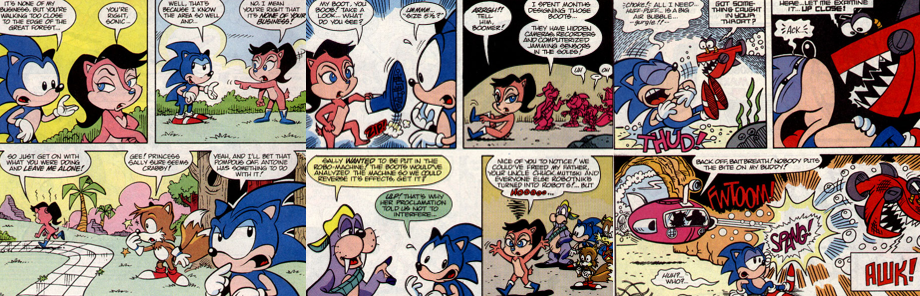
“Run, Sally, Run!” sees Sonic perturbed when he passes by Princess Sally as she’s wandering dangerously close to the edge of the forest and is angrily told to stay out of her business. Believing Antoine is behind her foul mood, Sonic races to Knothole and discovers that Sally has arranged to meet with Dr. Robotnik to negotiate the return of her father, King Maximillian Acorn, and that no one is to interfere. Naturally, Sonic (joined by Antoine and Tails) races to intervene but Sally chastises them and demands that they not follow her. Though they again plan to disregard this, the three are suddenly trapped within a cage and, while Sally is confident that the meeting is legitimate, she’s aghast when Buzzbomber drops her right in Dr. Robotnik’s lap and she’s hauled away to the “Robo-Machine”. Naturally, Sonic burrows out and into Dr. Robotnik’s lair, rescuing her, smashing the Robo-Machine, and dashing Sally back to Knothole. Unfortunately, Sally’s unimpressed by the “mucho-macho-squad”, whose reckless actions meant she couldn’t use Boomer’s special boots to analyse and reverse the Robo-Machine’s effects, leaving Sally enraged and Sonic embarrassed all because she couldn’t just explain the situation to them. Whilst relaxing with a spot of fishing in “Something Fishy”, Sonic accidentally hooks a Jaws Badnik and narrowly avoids being chomped to pieces like the dock he’s standing on. Diving into the lake (with no fear of the water), Sonic discovers not just Dr. Robotnik’s polluting pipes but also his waterproof robot maker. Though Sonic avoids being fed into the machine, he almost drowns and is only saved by the timely intervention of Boomer and Tails, who arrive in Boomer’s bathysphere craft. While the damaged Jaws limps off to report to its master, Sonic smashes the robot maker and returns to dry land with his friends, his appetite for seafood now lost.
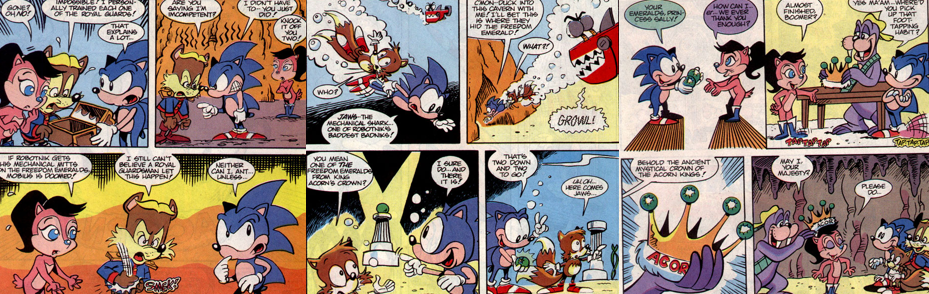
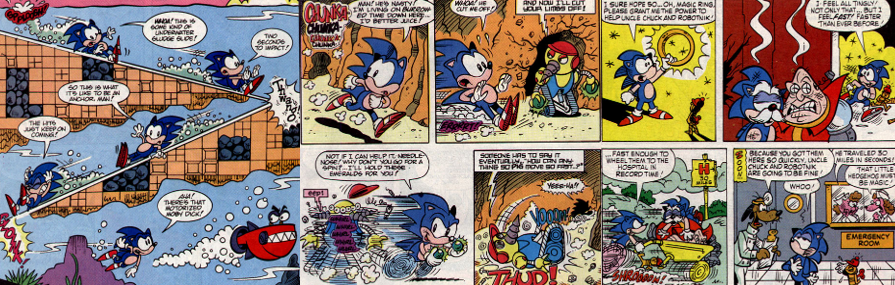
By “A Crowning Achievement”, Sally has switched to a brunette (a look Sonic secretly likes and which Sally secretly hopes he likes) and presents Sonic with her father’s jewellery box, which contains the legendary “Freedom Emeralds”. Despite their name, the jewels are actually pearl-like spheres set onto an elaborate crown, King Acorn’s family heirloom that Sally hopes will bestow her with magical powers. In preparation for her coronation, Sally has Antoine and his Royal Guard guard the box, but they’re all stunned to find it empty and the crown missing. After almost coming to blows over the incident, Sonic and Antoine suspect one of the guardsmen to be a robot spy. Using his super speed, Sonic sets off the sprinkler system and exposes the spy, who reveals he delivered the crown (and Knothole’s location) to his master before promptly self-destructing. Thanks to Sonic’s “Warp Sonic Speed”, Knothole (and our heroic hedgehog) are spared a gruesome fate, and Sally orders him and Antoine to retrieve the crown. Begrudgingly, the two pursue Dr. Robotnik’s blimp using a hot air balloon. Though Antoine’s forced to bail when they’re attacked by Bat Brains, Sonic bounces across the Badniks and pops the blimp with his patented Sonic Spin Attack, retrieving a Freedom Emerald in the process. Learning from a busted SWATbot that Dr. Robotnik plans to hide the Freedom Emeralds across Mobius, Sonic races underwater (with Tails accidentally in tow) and finds another Freedom Emerald at the same cavern from “Something Fishy”, easily defeating Jaws once more. While Sonic easily snags a third gem from a passing SWATbot, he’s dropped into a confrontation with Burrobot. Despite the robot’s terrifying burrowing power, it’s still no match for Sonic’s speed and is relieved of its Freedom Emeralds. Trapped in an underground maze, Sonic runs himself to exhaustion searching for the exit before having the genius idea to burrow upwards. Naturally, he conveniently pops out in Boomer’s workshop, finally restoring the crown and bolstering the Freedom Fighters’ morale, though Dr. Robotnik, angered at being absent for the story, vows to have his revenge.
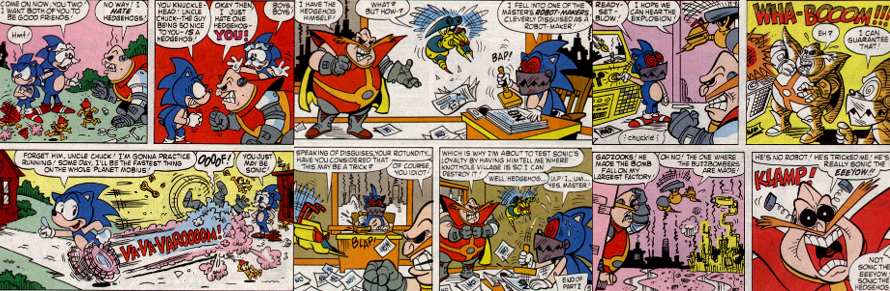
“Sonic Flashback!” sees Sonic forced off a cliff by a two-pronged attack of Crabmeats and the tried-and-tested wrecking ball. Knocked loopy, Sonic has a weird dream where he and Dr. Robotnik grew up together, revealing that Uncle Chuck created the magical rings to boost Sonic’s speed. Chuck despairs of his nephew’s disdain for “Little Robotnik”, an orphan boy who tinkers with mechanical toys and aspires to take over Chuck’s farm. Unwilling to entertain “Robbie’s” attitude, Sonic speeds off and Chuck ends up crashing his tractor into the barnyard (and Robbie) thanks to Robbie sabotaging the vehicle to make his toys. Boosted by the magical ring, Sonic gets them to a hospital in record time but Robbie, incensed at Chuck’s reckless driving, builds an even bigger robot out of Chuck’s appliances and attacks the hedgehogs. Luckily, Sonic easily rescues his uncle and reduces the robot to scrap with a hose pipe, then he wakes up and gets back to fighting Dr. Robotnik for real. In “Why Ask Spy?”, Princess Sally has Sonic slap on a mechanical jaw and some scary contact lenses to masquerade as a robot. After convincing Tails that Sonic is a threat, Sonic successfully infiltrates Dr. Robotnik’s lair, convincing the dictator that he stumbled into one of his devious traps and was transformed into a mindless slave. Disregarding Buzzbomber’s concerns, the gleeful doctor orders Sonic to lead him to Knothole and is thankfully saved from betraying his friends when he instead volunteers to investigate a disturbance at the Crab Factory. There, Sonic reconvenes with Sally and Antoine and also discovers Uncle Chuck diligently assembling Crabmeats. After a run-in with the robotic Muttski fires Sonic up, he gets a measure of payback by tricking Dr. Robotnik with his disguise once more and dropping a bomb on the Buzzbomber factory to deliver a significant blow to the dictator’s operation. Interestingly, Sonic justifies this by saying he doesn’t want to bomb his uncle’s factory and possibly kill him but seems to have no consideration for the slaves working in the other factory.
The Summary:
Issues 0 to 3 of this miniseries also devote a few pages to some shorter stories, pin-ups, and gags to bolster the narrative. Issue 0 sees Princess Sally lament to loss of her literal family tree, gives a rundown of Sonic’s different levels of speed (categorising three as “Ultra-Sonic”, “Super-Sonic”, and “Hyper-Sonic”, with no relation to Sonic’s similarly named forms), introduces readers to Dr. Robotnik’s other Badnik minions, and gives a quick explanation of Sonic’s iconic sneakers (which were created for him by Uncle Chuck in this continuity). Issue 1 showcases Sonic’s speed by having him blow Boomer’s mind with a game of baseball, play tennis with himself, and go through his family album (with him being too fast for the camera each time), offers a two-page pin-up of the heroes and villains, and sees Boomer give examples of slower creatures to have a pop at politicians. Issue 2 sees the writers poke fun at other comics by offering ten reasons why readers should pick Sonic the Hedgehog over the likes of DC and Marvel (ironically, guest stars, fancy covers, a motion picture, and character deaths would all come to pass). It also includes two one-page stories, one detailing the versatility of his spines and one demonstrating that Sonic’s faster than the speed of sound (something amusingly noted in issue 0 where the editor points out that the “Zoom” sound effect will arrive “later this week”). Gags and skits such as these tie into the miniseries’ slapstick nature; signs, sight gags, and puns are plentiful in these four issues, placing Sonic the Hedgehog firmly as a book for little kids. There are some more mature themes behind all the cartoonish action, such as a strong anti-pollution message, negative portrayals of bullying and xenophobia, and a strong sense of justice, but it’s all very light-hearted and carefree, with the characters rarely in peril since Sonic can just magically solve every issue with his Spin Attack, magic ring, or by easily fooling his enemies.
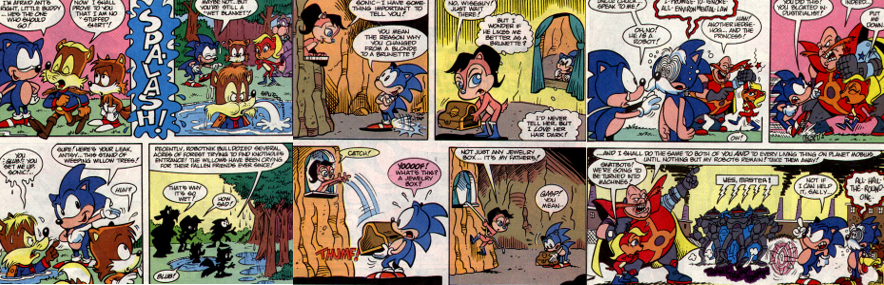
Fans of SatAM will probably be disappointed to find that the miniseries merely takes visual cues from that series. We have the same cast of characters in similar situations, but it’s far goofier than in SatAM. The tone is far closer to Adventures of Sonic the Hedgehog, with Dr. Robotnik more a bumbling blowhard than a menacing tyrant, his minions being snarky and foolish robots easily fooled by drawings, and Sonic performing nonsensical feats like magically turning Dr. Robotnik’s machine against him or setting off sprinklers by literally burning rubber. Sonic’s characterisation is a weird mish-mash of Adventures and SatAM, showcasing his arrogance and smart mouth but also seeing him be awkward around Sally, whom he has an obvious crush on. Sally is far more annoying here than in SatAM, barking orders and deliberately misleading her allies only to berate them for acting in her best interests. She’s a strong-willed leader who isn’t afraid to join the fight and is far from a damsel in distress, but her polarising personality make her more of a hinderance than an asset. Boomer and Antoine aren’t featured much, but we do see that Sonic respects Boomer and detests Antoine, seeing him as a “sap” who lacks the fortitude and ability to fight Dr. Robotnik. Tails is very much like his Adventures counterpart, depicted as Sonic’s biggest fan and excitedly following him into danger, but, like in SatAM, Sonic isn’t handcuffed to him and Tails is depicted more like the team’s mascot than a capable Freedom Fighter. Characters like Snively and Bunnie Rabbot are strangely absent, meaning Dr. Robotnik is more reliant upon his blundering SWATbots and Badniks. Like in Adventures, the game-accurate Badniks are given bizarre personalities and depicted as fiercely loyal, but ultimately stupid minions who may briefly get the upper hand against Sonic but are always sent packing by the story’s end.
Interestingly, the miniseries attempts to delve into the backstory of Mobius and what life was like before Dr. Robotnik took over. It’s obviously very different from what SatAM and later comics would depict and is thus very rushed and disappointing. It’s fun seeing Sonic interact with Uncle Chuck and Muttski, but Dr. Robotnik’s takeover is completely glossed over and Sonic’s past with Sally is reduced to simply bumping into each other while searching for their families. Most egregiously, the miniseries takes a literal, outdated definition of the term “robot” and depicts Dr. Robotnik’s slaves more like hypnotised slaves than mechanical automatons. Despite being bolstered by clearly robotic SWATbots and Badniks, the Mobians Dr. Robotnik enslaves have no robotic appendages (except, bizarrely, for Muttski) and the roboticization process is as far removed from SatAM as everything else beyond a surface level similarity. The miniseries also ham-fistedly includes game-accurate elements, such as Dr. Robotnik’s wrecking machine and his Badniks, though the writers seem to have no idea how the Golden Rings (or SatAM’s Power Rings) work. It’s as though the writers were shown the pilot episodes of Adventures and SatAM and given a brief description and some visual cues of the games, then told to just do whatever they like. Consequently, while the miniseries is fun at times and probably very appealing to younger readers, it doesn’t exactly capture the spirit of either cartoon or the source material. Instead, it’s a weird amalgamation of different elements and half-baked interpretations of already drastically different adaptations. While the artwork is serviceable, mirroring early episodes of SatAM, it’s not enough to bolster the appeal of this miniseries. It’s amazing to me how complicated and dramatic Archie’s Sonic comics became in the years following this publication; compare these issues with ones from just a few years later and it’s like night and day! Ultimately, it’s fun to revisit these early days but I think Archie’s Sonic comics benefitted by abandoning their ties to the 90’s cartoons and creating their own narrative, making these a fun, if childish, curio more than anything.
My Rating:
Could Be Better
Have you ever read the original Archie Sonic the Hedgehog miniseries? What did you think the way it mashed together elements from the cartoons and videogames? Were you disappointed that it took a more slapstick approach or did you enjoy these early issues as a kid? Which of Archie’s original characters was your favourite and what did you think to their award-winning run? How are you celebrating Sonic the Hedgehog this year? Whatever your thoughts on Archie’s Sonic comics, or Sonic in general, feel free to leave a comment below.

 Dr. K's Waiting Room
14 thoughts on “Back Issues [Sonic Month]: Sonic the Hedgehog #0-3”