
On 21 February 1986, The Legend of Zelda (Nintendo EAD, 1986) was first released in Japan. The creation of legendary game designer Shigeru Miyamoto and Takashi Tezuka, The Legend of Zelda launched one of Nintendo’s most popular franchises. This year, I’m dedicating every Friday to Nintendo’s most famous silent protagonist, Link and his vast and enduring fantasy world of sword and sorcery.

Released: 9 February 2023
Originally Released: 4 November 2004
Developer: Capcom / Flagship
Also Available For: Game Boy Advance and Nintendo Wii U
The Background:
After making an immediate impact upon its release, The Legend of Zelda franchise was further refined and expanded throughout Nintendo’s handheld ventures and 16-bit era, but changed forever after a successful jump to 3D with The Legend of Zelda: Ocarina of Time (Nintendo EAD, 1998). After further 3D success with the bleak follow-up, The Legend of Zelda: Majora’s Mask (ibid, 2000), Nintendo surprised everyone by adopting a cartoony, cel-shaded aesthetic for Link’s GameCube debut, The Legend of Zelda: The Wind Waker (ibid, 2002). The visuals were as widely praised as the gameplay and The Wind Waker enjoyed rave reviews, prompting Nintendo to adopt the style for further adjacent, handheld adventures. After a successful collaboration with Capcom and Flagship on The Legend of Zelda: Oracle of Ages and Oracle of Seasons (Flagship, 2001), the teams returned to develop a new Zelda title for the Game Boy Advance, a spiritual successor to The Wind Waker and The Legend of Zelda: A Link to the Past (Nintendo EAD, 1991) whose story and aesthetic mirrored a whimsical fairy tale. Development specifically focused on Link’s new ability to shrink in size, thereby opening new avenues for exploration and puzzle solving, and providing some unique new items for players. The Legend of Zelda: The Minish Cap was a best-selling title for the Game Boy Advance and was met with critical acclaim. Reviews gushed over the cartoony art style, innovative dungeon designs and puzzles, and the new shrinking mechanic, though its short length and repetitive elements were criticised. Despite winning a Game of the Year award, The Minish Cap was stuck as a ridiculously expensive Game Boy Advance exclusive for many years until finally being made available on Nintendo’s online stores.
The Plot:
Apprentice blacksmith Link accompanies his childhood friend, Princess Zelda, to the Picori Festival, where monsters are unleashed by the evil wizard Vaati. With Zelda petrified, Link teams with wise-cracking magical hat Ezlo and assists the pixie-like Minish people in restoring the legendary Picori Blade to confront the threat.
Gameplay and Power-Ups:
The Legend of Zelda: The Minish Cap is a traditional, 2D, top-down action/adventure game in which players take control of Link (or whatever they choose to name him), in the “toon” style of his Wind Waker counterpart, and embark on a quest to save Hyrule, and the Princess Zelda, from new sorcerer on the block, Vaati. As a Game Boy Advance title, the controls are as basic as it gets and akin to the previous handheld Zelda titles. You equip any of Link’s weapons and items to either A or B and then use that button to attack, defend, hit switches, solve puzzles, and whatever else your items are capable of. The Right Trigger performs a roll, speeding up your travel time, and also performs similar actions to A (like speaking to non-playable characters (NPCs) and opening chests). R is also the only way to open locked doors, which can be clunky as it would’ve been easier for Link to simply manually use any keys he possesses. The Left Trigger also performs a dedicated function, fusing “Kinstones” with NPCs, which I’ll detail in a bit. The + button pauses the game and brings up your inventory screen, the pretty basic map (which uncovers the more you explore and highlights notable areas), a subscreen showing how close you are to extending your health bar, total Mysterious Seashells and Tiger Scrolls, and allows you to save the game or enter “sleep” mode. As I’ll also get into in a bit, Link is joined by a hat-shaped companion, the insolent Ezlo, who constantly interrupts your gameplay to offer blindingly obvious advice that would make Navi blush. Also like Navi, you can choose to ask him for a tip by pressing -, though I’d just as soon never speak to him again. As you’d expect, Link acquires his standard sword and shield but the enigmatic Grimblade Brothers will teach additional sword techniques, such as a rolling attack, the aerial downthrust, and patented moves like the Sword Beam and Spin Attack. Some of these are more like padding, though, such as Link having to learn to attack with his sword when running with the Pegasus Boots.
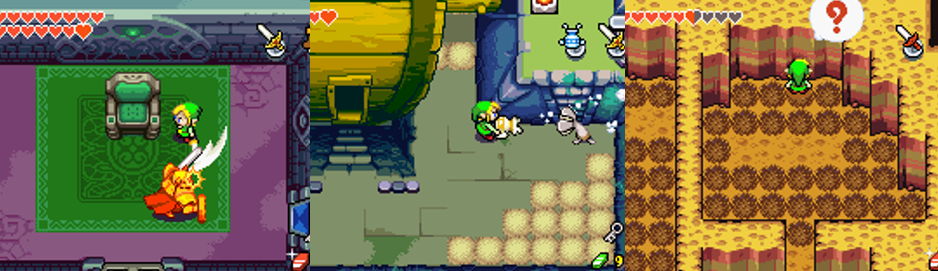
Many of Link’s recognisable weapons return here and function exactly as you’d expect. The bow and arrow lets you to hit eye switches and take out Eyegore statues, bombs blow up walls and discover new areas, and you can purchase a boomerang to stun targets or hit switches. This can be further upgraded into the Magical Boomerang, allowing you to manually direct it. Eventually, you can swap out the regular bombs for remotely detonated ones (though there are few benefits to this) and obtain the optional (and missable) Light Arrows for extra arrow damage. The Flame Lantern lights up dark areas, ignites torches, and burns certain enemies and spider webs. The Roc’s Cape lets you jump and glide short distances, the aforementioned Pegasus Boots let you run really fast, and the Ocarina of Wind warps you to any Wind Crests you’ve uncovered. The Minish Cap debuts three new items: the Cane of Pacci (which flips certain enemies and objects and creates temporary boosters in holes to launch you higher), the Gust Jar (which sucks up enemies, propels you across gaps when used on spring mushrooms, and turns lily pads into rafts), and the Mole Mitts (which dig through dirt). The Flippers, Grip Ring, and Power Bracelet are all passive items that don’t need to be equipped to use and let you swim and dive, climb certain walls, and pick up and toss jars and such, respectively. Link can capture life-restoring Fairies or store potions in bottles, increase his total bomb and arrow inventory with bigger bags and quivers, and also carry more Rupees by finding bigger wallets. Link’s sword is progressively empowered as you acquire the four Elements, duplicating Link into as many as four copies to push bigger blocks, step on or slash switches, and attack enemies, as well as fire a special beam that restores petrified NPCS. Finally, you can upgrade the shield into the reflective Mirror Shield, though this requires awakening a sleeping Biggoron and waiting for him to finish chewing on it.
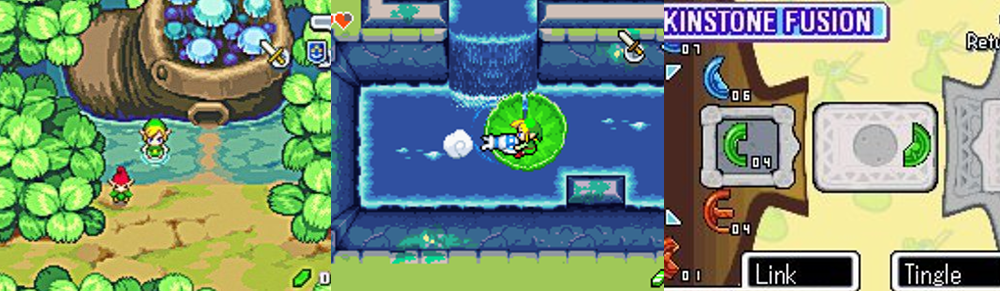
Link’s newest gimmick in The Minish Cap is the ability to shrink to microscopic size, courtesy of Ezlo’s magic. This is performed primarily at magical tree stumps and allows you to enter small holes, climb small steps and vines, and access out of the way places. When shrunk, you’ll interact with the pixie-like Picori tribe (or “Minish”) scattered throughout Hyrule (once you’ve consumed a Jammer Nut, that is) and be given additional side quests and assistance from them. In this form, Link takes more damage and his weapon usage is limited, but he can talk to animals and cross small lily pads. Occasionally, Minish Link enters Armos statues to activate or deactivate them and the action frequently zooms in to follow him up rafters, into the Minish towns, and through enlarged (from your perspective) areas, like in Honey, I Shrunk the Kids (Johnston, 1989). Apart from this, Ezlo is more a hinderance than anything; he’s obnoxious and rude and demanding and pops up to point out the obvious, severely dumbing down puzzles and interrupting the gameplay. The other big mechanic here is Kinstones; as you slash bushes, defeat enemies, and open chests, you’ll find several coloured Kinstone pieces. These are fused with certain NPCs to alter the overworld in different ways. This may involve spawning a treasure chest containing another Kinstone, or Magical Seashells, or a Big Rupee, or even a much tougher gold enemy for an additional challenge. Fusing removes vines to open new areas, parts waterfalls, drains ponds, and even spawns in NPCs for you to trade and train with. You can buy Kinstones, but they cost a lot and it’s not really worth it as you’ll inevitably find them on your travels, and none of the main variants are necessary to complete the story, though the benefits (extra hearts, Rupees, and training with the uncovered Grimblades) can be worthwhile. Specifically, fusing with Din, Farore, and Nayru spawns Lucky Butterflies which, when touched, increase your digging, shooting, and swimming speed. The only time you’re required to fuse Kinstones is when you find golden ones, such as in Cloud Tops, where you navigate a maze of clouds, floating about to find different halves of golden Kinstones to activate five propellers and be blasted up to the Palace of Winds.
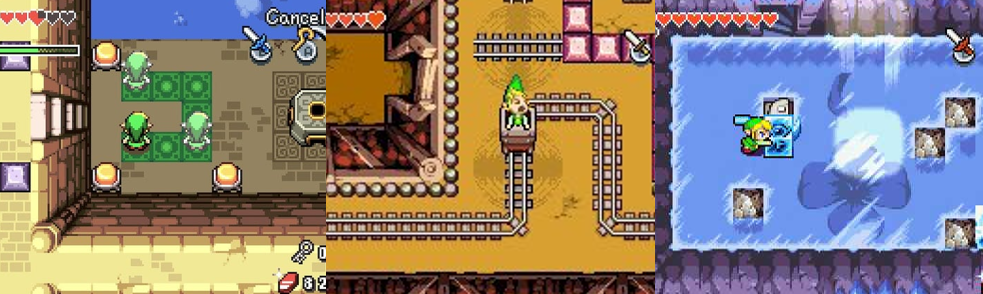
Link’s shrinking ability isn’t just used on the overworld; you’ll frequently shrink in Dungeons to reach new areas and progress. As ever, Dungeons contain a map, compass, and new weapon to aid your journey, as well as secret areas, switches, and stairways to other floors. Sometimes, you’ll drop or push blocks to lower levels; others, you’ll push levers to let in sunlight to melt blocks. Frequently, you must eliminate all enemies to open doors, or push jars or statues onto switches for the same effect, though it’s much more likely you’ll be duplicating Link to solve these puzzles. Tornados carry you across bottomless pits, moving platforms carry you across gaps, and floors are often covered in collapsing tiles, spikes, or rolling spiked logs that must be avoided. You’ll jump up to mesh bridges (and down through certain holes), hop up and across cloud platforms, push ice blocks into place, cross gaps using powerful wind blasts from propellers (in conjunction with the Roc’s Cape), and spring across chasms with the Gust Jar. There’s a giant rotating barrel in the Deepwood Shrine which must be rotated to progress, high-speed mine carts in the Cave of Flames that you redirect with switches, the Fortress of Winds is a veritable labyrinth of floors and dirt, the Temple of Droplets is a largely pitch-black mixture of ice and water, and the Palace of Winds offers the constant threat of falling to your doom. For the game’s final Dungeon, Vaati corrupts Hyrule Castle, transforming it into a monster-infested Hell filled with recycled enemies and hazards from previous Dungeons. While largely inspired by A Link to the Past and Link’s previous handheld entries, it’s in Dark Hyrule Castle where I saw some of the strongest parallels as exploring the Dungeons, battling Darknuts, and restoring the petrified NPCs was very similar to Link’s celebrated 16-bit adventure. Sadly, only two of the Dungeons are Minish-sized (the Deepwood Shrine and Palace of Droplets). Though you don’t really notice as you’re exploring these Dungeons, the developers did include larger variants of common enemies as boss battles. Still, I feel they didn’t take full advantage of Link’s new miniature perspective in these (or other) areas as the shrinking mechanic was more of a gimmick or hinderance a lot of the time.
Presentation:
I’ll be the first to admit that I never really cared for The Wind Waker’s cartoony aesthetic. It’s grown on me over time, but I much prefer the more realistic, fantasy-orientated style of Link’s other 3D adventures. However, it works really well here; probably better than in 3D. Link is super expressive; from his grunts and yells (carried over from this 3D titles) to his messy bed hair, his look of sheer panic on a runaway minecart, and the way he races around when on fire. He’s a jaunty little cartoon sprite, bobbing along and reacting to everything around him. Ezlo is very animated as well, popping up on Link’s head to react to and comment on their surroundings or the plot, and all the NPCs are similarly cartoony and fun to behold. Many will be familiar to long-time Zelda players, such as Malon (with her milk cart and nearby farm), Dampé the grave keeper, Ingo (now a real estate developer), and Gorons intent on ploughing through a rocky underpass. Many characters fuse Kinstones with you to solve a personal crisis, such as the overworked mailman, the librarian searching for lost books, and a poor man haunted by a restless spirit. The Minish Cap is a little light on new races but there are anthropomorphic characters to find, animals to chat to (as a Minish), and, of course, the gnome-like Picori tribe. These peaceful little sprites have a main village and live in little mushroom houses or up in the rafters, their homes made out of barrels, walls made of books, and heating provided by flickering candles. When Link is turned microscopic on the overworld, a helpful bubble indicates where he is. Though his actions are limited, he has full access to his arsenal when the game zooms in, casting dirt paths with the shadows of grass and blocking his path with chestnuts and such. Minish-Link must avoid cats looking to swipe him and relies on lily pads to cross water until he gets the Flippers, and you must be on the lookout for small holes, paths of flowers, and flappable objects to progress and shrink or return to full size.
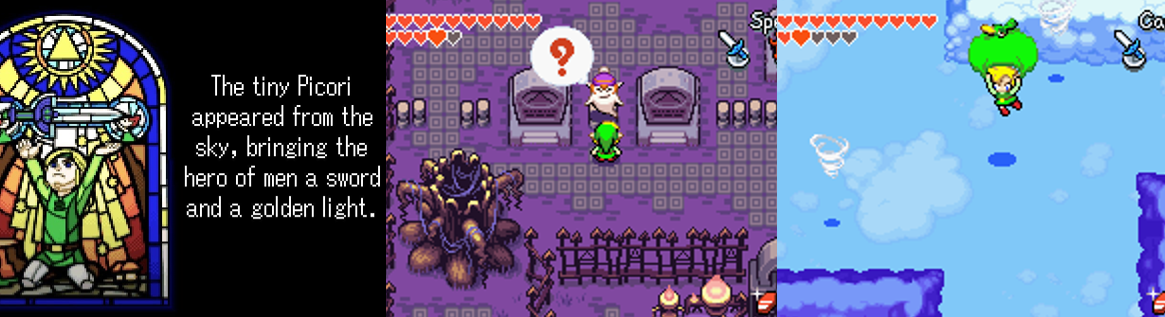
The Minish Cap’s overworld and Dungeons are heavily reminiscent of A Link to the Past, mixing locations such as ruins, a swamp, and Hyrule Castle itself with areas I’m more familiar with from the 3D games, like Lake Hylia and Lon Lon Ranch. Mt. Crenel acts as a Death Mountain substitute, featuring falling boulders, climbable walls, tornados to fly you about, and a Minish mine where Melari repairs the broken Picori Sword. Like the Swamp of Evil, Castor Wilds is a murky swamp full of thorns; you’ll need the Pegasus Boots to navigate this area, and shrink to clamber inside Armos Statues within the maze-like ruins. Finally, the Flame Lantern lights your way in the desolate Royal Valley, which contains a looping maze in its haunted forest. Aside from the Minish Village, Cloud Tops and the Palace of Winds and the Temple of Droplets impressed me the most, visually. The other Dungeons are very formulaic, despite some fun perspective and depth effects, but these three have you up in the clouds or high in the sky or navigating a frozen labyrinth, respectively, which really mixes up the formula. Dark Hyrule Castle is similar, putting an ominous spin on the palace’s ornate rooms and recycling all previous hazards, but I was disappointed that the Dungeons didn’t utilise Link’s new miniature perspective to make their visuals and layouts standout more from the likes of A Link to the Past. Instead, The Minish Cap often resembles a toon-ified version of that game, doing little to stray from the usual stone trappings of those Dungeons and being a little too familiar at times. Still, there are fun touches, like the Biggoron atop Veil Falls, the big bell in the bustling Hyrule Town, guards to sneak past, and occasional weather effects. The game’s story is all relayed though text boxes, as usual, but key events are told using stained glass murals, Wind Waker-style art is showcased in the end credits, and the sprite-based cutscenes are full of cartoony life. The music is as infectious as ever, with familiar and slightly tweaked classic Zelda tracks at the forefront (many I mostly recognised from A Link to the Past and Ocarina of Time), though new areas and Minish locations have a spirited flavour that adds to the game’s whimsical, fairytale-like charm.
Enemies and Bosses:
All of Zelda’s most recognisable enemies make a return in The Minish Cap, though redesigned to evoke the toon style of The Wind Waker. This is most evident in the Moblins, who charge with spears or fire arrows and have much more life and detail compared to past 2D Zelda titles In some cases. This ups the challenge represented by some enemies, such as the various Dark Knights you’ll encounter. These are essentially mini bosses and swarm Dark Hyrule Castle, defending against your attacks and landing powerful sword swipes and even boasting a charged thrust. Your best bet against these enemies is to hop over them with the Pegasus Boots and attack from behind, a tactic mirrored when facing the Ball and Chain Soldiers. Other enemies require strategic use of your other items, such as using the Gust Jar to suck up and fire out the annoying Peahats or pull the masks off Helmasaurs, tossing your boomerang at Sparks, or using the Cane of Pacci to flip Spiked Beetles and attack their vulnerable underbelly. Like Likes masquerade as Rupees and steal your items, Keatons and Takkuris make you drop Rupees on contact, Madderpillars (also a kind of mini boss) fly into a rage with you bop their noses and attack their tails, and you’ll even encounter Bob-ombs and Lakitus. ChuChus fry you, Floor and Wall Masters return you to the Dungeon entrance, and Octorocks and Deku Scrubs are subdued by deflecting their projectiles. Cloud Piranhas snap at you from the clouds, fake doors crush you, and Acro-Bandits leap from the ground in a swaying tower. You’ll also battle elemental Wizzrobes, who teleport about shooting ice, fire, or lightning; Stalfos leap and toss their bones at you; and Slugglas drop from above. By the time you reach Dark Hyrule Castle, rooms are filled with an assortment of these enemies. Though you can often simply bypass them, you’ll need to defeat a gauntlet of them before Vaati completes his macabre ritual to reach the petrified Princess Zelda in the finale.
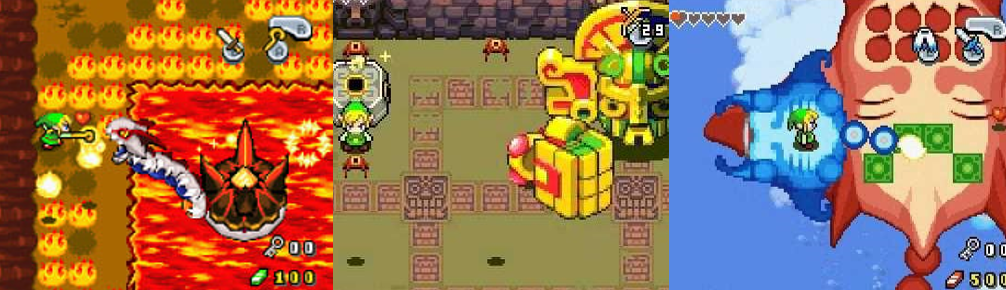
The Minish Cap is surprisingly light on bosses; four of its five main bosses guard an Element, which empowers your sword and duplicates Link, relinquishing a Heart Piece to extend your life bar. The first boss you battle is a gigantic green ChuChu; well, it’s actually a regularly sized one but you’re in Minish form, so it appears huge. A blue variant appears later in the game too, now sporting electrified skin, but the tactic of sucking at its “feet” with the Gust Jar and whacking it with your sword when it’s stunned remains the same. Next, you face the turtle-like lava dinosaur Gleek, which sits in a pool of lava and spits fireballs in a circular motion. You must run behind it and flip its shell with the Cane of Pacci to race up its neck and attack the crystal on its back. In retaliation, it rains rocks and breathes fire, making the fight more difficult as it progresses. Mazaal is the only one of the main bosses to incorporate the shrinking mechanic in. A strange, disembodied Aztec head and fists, he is stunned by shooting and slashing the jewels on his hands (which try to crush and hit you). You then shrink, enter his head, and attack the glowing pillar to deal damage. As the fight progresses, you use the Mole Mitts in his head and dodge a Shrink Ray attack from his eyes. The Big Octorok is fought in a shallow pool that it freezes, reducing your traction and making avoiding its pellets much harder. Well, I say “avoid” but you actually smack these back with your sword to stun it, allowing you to set fire to the petal on its back. This causes rocks to rain down and the Big Octorok to freak out; it also charges, spins around, and creates a smokescreen to limit visibility. Finally, the Gyorg Pair are easily the most unique boss in the game. This fight takes place in the skies of Hyrule on the back of two manta ray-like creatures. When riding the red one, you must dodge the smaller blue one and its fireballs and duplicate Link to attack the red one’s eyeballs. You then hop to the blue one, slashing its eyeballs, and repeat, watching for smaller green variants that fly past.
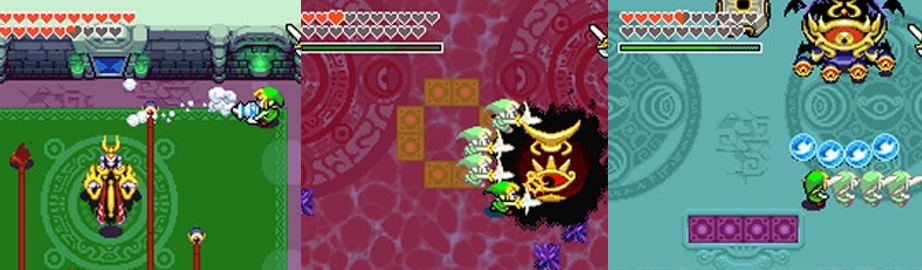
After battling past the many Darknuts that haunt Dark Hyrule Castle, you’ll finally confront the master swordsman and corrupted sorcerer, Vaati. Vaati takes many forms, one similar to Agahnim, one like Arrghus or Vitreous, and one like Nightmare’s final form, Dethl. The first form, “Vaati Reborn”, morphs him into a dangerous sorcerer protected by many small, spinning eyes. These encircle him, distracting you as he shoots fireballs, and must be destroyed to expose his big, eyeball-like weak spot. After enough hits, he encases the eyes in protective shields that must be sucked off with the Gust Jar. The eyes also fire vertical laser beams (just stand between them) and Vaati erratically teleports, making him a harder target to hit. For his second form, “Vaati Transfigured”, fought immediately after in a psychedelic landscape, Vaati takes his obsession with eyes to the next level. In this fight, you shoot arrows at the small sphere surrounding the central body to uncover four red eyeballs. You must then duplicate Link into the same formation and attack, continuing your assault when he’s stunned. However, Vaati spews destructible spiked balls and a spread of electrifying balls, which can be tricky to dodge especially considering his large hit box. After he’s defeated and Princess Zelda is revived, Dark Hyrule Castle collapses and Vaati’s true, final form, “Vaati’s Wrath” emerges. In this form, he pursues you, again firing balls of electricity, and sends his extendable claw arms under the ground to attack. When one pops up, stun it with the Cane of Pacci, shrink down, and venture inside to destroy the one real bladed eyeball amongst the fakes to literally disarm him. Repeat for the other arm and Vaati sends four electrical orbs your way from the small eyes in front of him, as well as a spread of larger orbs. To win, simply avoid the spread and duplicate Link in a line to deflect his smaller shots with your sword (the timing can be tricky), which will stun him and soon end his dreams of conquest.
Additional Features:
As you’d expect, there are forty-four Pieces of Heart to find all around Hyrule. Collecting four will extend your life bar, so they’re worth seeking out. While some are just lying in the open, others require your items to reach or are gifted by fusing Kinstones. Opening chests, defeating enemies, and cutting grass also sees you collect Magical Seashells. Unlike the similar items from Link’s Awakening, these are essentially infinite in number (though your inventory maxes out at 999) and are traded for figurines in Hyrule Town, similar to the Pictobox side quest in The Wind Waker. This is quite a time-consuming task, however, as you must speak to the proprietor, set how many Magical Seashells you wish to trade (with the percentage of a new figurine increasing the more you wager), and then pull a lever to get an egg-like capsule containing the figure. The more places you explore and the more NPCs you meet, the more figurines you can get, with your Magical Seashells being replaced by the Carlov Medal once you obtain all 136 figurines. This, in turn, opens Baris’s house, gitfting you another Piece of Heart and the Phonograph, which acts as a sound test for the game. Similar to the Magical Seashells, there are a near-infinite number of coloured Kinstones to find. Fusing with NPCs unlocks new areas and gifts rewards that aid your quest, and completing all fusions awards you with a Tingle Trophy. Clearing the game earns you a Triforce stamp on your save game file; you can have up to three of these and also change the language to suit you. Finally, the Nintendo Switch version lets you play the European and North American releases (with subtle differences between them), rewind should you make a mistake, and create save states at will, dramatically reducing the game’s already low difficulty.
The Summary:
I’ve wanted to play The Legend of Zelda: The Minish Cap for the longest time. Finding a physical copy was expensive, even unboxed, so I consoled myself with the knowledge that it would be another Zelda game that passed me by…until I upgraded my Nintendo Switch subscription and finally dug into it. Visually, the game is very impressive; colourful and lively, The Minish Cap is like playing a cartoon and I really enjoyed how it translated a Wind Waker aesthetic onto a traditional Link to the Past formula. The core gameplay is as reliable as ever; Link has some fun new toys to play with that mix things up, like the Gust Jar and Mole Mitts, though I do feel these could’ve been emphasised more. Similarly, the shrinking mechanic became tedious after a while. Generally, it’s simply anther way to get from one place to another and fuse with different NPCs rather than changing the puzzles in a meaningful way. Likewise, while the graphics represented these sections well, I think the developers could’ve done more with it, such as more bigger enemies and obstacles that meant using the duplication feature in interesting ways, rather than just hitting switches. Ezlo was also a pain in the ass, thankfully rectified in the post-game, and the Kinstone fusing got old quickly, too. This mechanic replaces traditional fetch and trading quests and is used as a shorthand for everything, limiting your exploration options and adding an element of grinding. The bosses were fun, if too few in number, but Vaati wasn’t the most enigmatic or threatening villain and the story felt uncharacteristically low stakes for a Zelda game. As a spiritual successor to A Link to the Past and the handheld games, The Minish Cap does well and the core Zelda gameplay is always enjoyable, but I don’t think this one lived up to its full potential and it ended up being more of a chore at times.
My Rating:
Great Stuff
Was The Legend of Zelda: The Minish Cap a staple of your Game Boy Advance library back in the day? Were you a fan of the Wind Waker art style and, if so, what did you think to the way it was implemented here? Did you enjoy the shrinking mechanic and the Kinstone fusions or did they become tedious for you, too? Did you ever fuse every Kinstone and collected every figurine? What did you think to Vaati as a villain? Would you like to see the Minish return? Which Zelda game is your favourite and how are you celebrating the franchise this month? Whatever your thoughts, share them below and be sure to check out my other Zelda content on the site.

 Dr. K's Waiting Room