
January celebrates two notable dates in science-fiction history, “National Science Fiction Day” on January 2 and Arthur C. Clarke’s HAL 9000’s birthday on January 12. Accordingly, I’m dedicating January to celebrating sci-fi with an event I call “Sci-Fanuary”.

Released: 8 March 2023
Originally Released: 18 November 2002
Developer: Nintendo R&D1
Also Available For: Game Boy Advance (Original); Nintendo 3DS, and Nintendo Wii (Virtual Console)
The Background:
Nintendo introduced gamers to Samus Aran in August 1986. Her debut title was celebrated for its challenging gameplay, is now regarded as one of the greatest games ever, and helped popularise the action/exploration “Metroidvania” subgenre. Nintendo followed Metroid with the Game Boy-exclusive Metroid II: Return of Samus (Nintendo R&D1, 1994), a contentious and divisive title whose narrative nevertheless directly influenced Samus’s jump to Nintendo’s ground-breaking 16-bit console. After two years in development, Super Metroid (Nintendo R&D1/Intelligent Systems, 1994) was universally praised for its impressive visuals and tight gameplay, becoming a must-have title for any Super Nintendo owner. Despite this, it would take over ten years for Samus to receive another solo title, with the first footage of “Metroid IV” being shown at the 2001 E3 convention. The team behind Super Metroid returned for Metroid Fusion, introducing a mission-based structure to the gameplay to guide players towards objectives rather than them having to figure things out blindly as before. The developers also took the opportunity to revamp Samus’s appearance and the way she replenished her health and missiles, as well as simplify the controls compared to Super Metroid. Like Super Metroid, Metroid Fusion received critical acclaim; the gameplay, graphics, and mechanics were praised, though many were disappointed by its short length. While Metroid ventured into the 3D arena after Fusion, a sequel came less than ten years later, and the game eventually became available outside the Game Boy Advance (albeit digitally) as Nintendo branched out into virtual consoles.
The Plot:
While exploring planet SR388, bounty hunter Samus Aran is attacked by the parasitic “X” organisms. Though saved by a Metroid-based vaccine, Samus is physically altered. Despite this, she investigates a Biologic Space Laboratories (BSL) space station overrun by the X, now led by “SA-X”, an X parasite mimicking Samus at full power!
Gameplay and Power-Ups:
Metroid Fusion is a 2D, action-orientated exploration title that takes a lot of inspiration from Super Metroid. As in that game, you (as Samus Aran) will be exploring a vast space station home to numerous elevators and hidden tunnels to various high-tech laboratories, caverns, flooded and lava-filled areas, and other regions, all infested by the X parasite. This time around, Samus’s abilities are restricted by her superiors, represented by a station computer that gives the player objectives, points you in the right direction, and offers advice about how to tackle each area. In this regard, Metroid Fusion is the most linear Metroid game so far; the station computer warns you of nearby hazards, says what weapon or upgrade you need to overcome them, and highlights your objective on the game’s map screen. That’s not to say you won’t be backtracking and searching high and low for secret passages and hidden power-ups, but it definitely helps to have an in-game system guiding you along. This, in conjunction with the helpful mini map and the larger full map (accessed with the + button), means it’s easier than ever to navigate the station’s different environments, at least at the start of the game. The + menu also allows you to review Samus’s current suit, abilities, and weapons, refresh yourself on your current objective, and enter sleep mode if you ever need a break. As always, Samus can only save at designated Save Stations (though you can make liberal use of the Switch’s save state and rewind feature to compensate for this) and she can replenish her health, and missile and bomb ammo, at various Recharge Stations. Defeated enemies will also replenish these, but things are a little different this time around. When defeated, enemies release an X parasite that must be collected to refill your health or ammo. If you linger too long, it’ll spawn another enemy, or a tougher variant, adding a level of anxiety that was missing from the previous games.
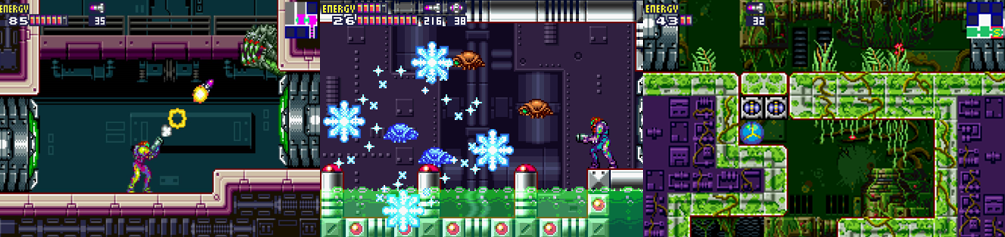
Samus’s abilities are limited at the start of the game, narratively explained by her being fragile following her encounter with the X. To begin with, you can fire her trademark arm cannon with B or Y, holding the button to charge it and aiming in all directions. A allows her to jump, and she’ll jump higher the longer you hold the button, and you can enable precision aiming while holding down the Left trigger. As you explore the game’s locations and defeat bosses, you’ll gradually regain all her signature abilities. Samus will gain missile upgrades that deal additional damage, open different doors, and even freeze enemies, eventually allowing you to charge up a wider shot by holding the R trigger. She can also morph into a spherical ball to pass through vents and narrow tunnels, eventually dropping bombs and hopping to higher tunnels. Her arm cannon can be upgraded to increase her rate of fire and pass through enemies and walls, shredding enemies who normally take multiple shots to defeat. Her jumping ability can also be enhanced, allowing her to jump higher and continuously and adding her signature “Screw Attack”, though abilities like the Space Jump can be difficult to master due to the finnicky timing required to sustain her jumps. This is equally true of Samus’s aggravating wall jump, which is just as frustrating as in Super Metroid, though thankfully I found it wasn’t necessary to clear the game. Samus’s suit can also be upgraded to withstand extreme temperatures, allowing her to enter frozen areas, freely move through water, and even endure lava. While Samus’s suit will change with each upgrade, she doesn’t showcase anything new her with two exceptions: Samus can grab ledges, making platforming and entering tunnels much easier, and absorbs the different coloured X parasites to refill health and ammo. However, her maximum health, missile, and bomb count can still be expanded by searching around. While you’re told how to use all these abilities and the map even highlights when there’s something in each area, you’ll get no direction on how to use her wall jump or her “Shinespark” ability. The Speed Boster lets Samus crash through certain blocks, but you can press down when she’s at full speed to store that energy and then direct her to smash through higher blocks, which I found extremely aggravating and difficult. I still don’t know why simply jumping while running and pressing A at a wall isn’t enough to pull off these manoeuvres.
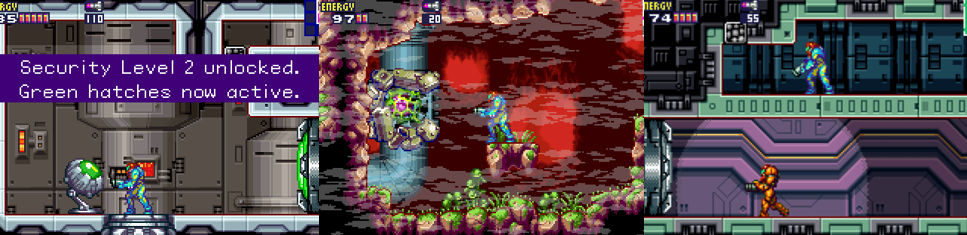
The level layout of Metroid Fusion again owes a lot to Super Metroid, with long vertical shafts, bio-organic areas, and ominous facilities being the order of the day. Puzzles are generally solved using Samus’s abilities; you can uncover destructible blocks by blasting the environment or laying a Power Bomb, though sometimes you need to find an alternative route to access them. Lifts, doors and tunnels will take you to new areas, with the game’s bosses often wrecking the environment and forcing you to take a longer path around blockades or hazards. Samus will be constantly searching for Data Rooms, Navigation Rooms, security consoles, and the like to discover her objective, restore power to an area, or unlock coloured doors. Sometimes, these will remove obstacles such as water or encroaching darkness from an area, though her suit upgrades often circumvent these. Sometimes, you’ll need to drop Power Bombs to break open tubes; often, you’ll be climbing ladders or clinging to overhead rails; occasionally you have to race against a timer to solve overloads or escape areas; and you can again freeze enemies to make temporary platforms. Enemies respawn after you leave a screen, as ever, but the unique X parasites revive corpses or spawn new enemies while you’re on the screen. Some doors are barricaded by disgusting, energy-shooting eye growths that need to be destroyed, some blocks and platforms crumble under your feet, and some areas are veritable mazes that have their pathways hidden within the foreground. Easily the biggest edition to the game is the nigh-unstoppable SA-X, a twisted doppelgänger of Samus that occasionally stalks the corridors or wrecks the background. When the SA-X appears, take the computer’s advice and stay out of sight or run as it can drain your health in seconds with its advanced abilities. On the few occasions when you’re chased by the SA-X, you can use your Ice Missiles to (very) briefly freeze it, adding a great deal of tension to the game in these instances.
Presentation:
Visually, the game also owes a lot to Super Metroid and its Aliens (Cameron, 1986) inspirations. The BSL space station is ominously empty, often devoid of music, and home to a huge docking bay (where Samus’s ship is parked), a series of large ventilation shafts, and elevators that take you to the station’s other areas. As you progress, you’ll return here a few times and explore new areas, such as the Sub-Zero Containment area that houses Ridley’s frozen husk, a teeming Habitation Deck (where Samus frees the friendly Dachoras and Etecoons from confinement), and the sprawling Reactor Silo, with Samus exploring each to tackle various issues with the space station. There are six “Sectors” to explore, all accessed by a main elevator system (though you can take alternative paths when this system fails or is inaccessible) and each with new areas to uncover as you expand Samus’s repertoire. You won’t explore these in numerical order, and you’ll also have to backtrack to them both as part of the story and to find all of Samus’s upgrades and power-ups. Sector 1 is a cavernous area, featuring rocky platforms spotted with vegetation, not unlike SR388, where Samus initially has to find and destroy atmospheric stabilisers to dispel the mist filling the area. Later, she ventures into mechanical hallways similar to Tourian, discovers Metroid husks in lava-filled caves, and battles Neo-Ripley in a large, cargo hold-like room. Sector 2 is like a Mayan temple, full of ancient ruins completely overtaken by foliage. Plants, vines, and flowers swarm the environment, creating a jungle-like feel and masking pathways, and these are married with a coral reef-like subsection. Sector 3 is both a sweltering laboratory and an arid desert, featuring a desolate, muddy aesthetic and a baking boiler room that threatens to destroy the entire station.
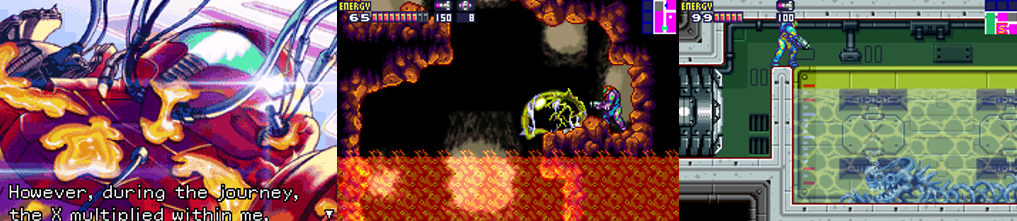
Sector 4 is basically an aquarium; it features a blue theme, lots of water, exposed power nodes that’ll sap your health, and beautifully detailed underwater sections full of anemones and a tranquil water effect. Sector 5 is a frozen laboratory filled with glass panels in the background and that’s eventually wrecked when an X-infused creature, the Nightmare, escapes captivity. Sector 6 is another cavern, but this time dank and dark, save for areas sporting vivid mushrooms. It’s also home to a restricted laboratory; Samus needs a beam upgrade to enter, where she’ll find various Metroids held captive. These are then unleashed when the SA-X arrives and blasts the environment, forcing Samus to make a desperate escape up a shaft while avoiding the panicked jellyfish. The SA-X and other bosses are prone to affecting the game’s environments; they’ll crash through walls, block off doors, and seal off some areas, forcing you to either escape, find alternative paths, or battle them in enclosed areas. Metroid Fusion focuses on story more than any previous game, featuring lovely cutscenes at the start and at various points throughout the story that showcase the SA-X’s power and Samus’s reaction to the events happening around her. This is further reinforced through various cutaways that detail Samus’s inner thoughts as she thinks of her former commander and ponders her newfound physiology. The game’s soundtrack is a further extension of Super Metroid; remixes of classic Metroid themes are featured, as are ambient sounds and suitably ominous tracks, but nothing really stood out to me as particularly new or memorable. Everything looks and sounds and plays really well, but the game owes so much to Super Metroid that it almost feels like a remake at times. I would’ve liked to see more variety in the locations and more effort put into the soundtrack, rather than playing it so safe.
Enemies and Bosses:
The BSL space station and its six Sectors and various areas are teeming with all kinds of alien lifeforms that are all hostile to some degree thanks to the X. The theme here is bugs and vegetation, as every enemy is some kind of insect or mollusc or plant-life turned monstrous, with only a few exceptions. We’ve got scuttling bug-like Gemmers, slug-like Choots that spring up from the ground and lazily float down, crab-like Dessgeegas that jump at you sideways, weird coloured balls floating around pumping out toxic gas, the Xenomorph-like Genesis creatures pouncing from above and below, and the armoured Gerubus crabs that need missiles to be dispatched. Piranha-like fish, tiny snails, and even zombified corpses are all infected by the X and, occasionally, stronger versions will be spawned upon defeat or you’ll need to defeat enemies a certain way to open up doors. Some enemies will be more than familiar to players of Super Metroid: the crustacean-like Evirs swim about firing projectiles from their tails, worm-like Funes snap at you from walls, and the Space Pirates even make an appearance. Kind of. The Zebesians are functionally the same, clambering up walls, firing shots from their claws, and even resisting your shots unless you charge up a beam or blast them from behind with missiles. Each defeated enemy releases an X parasite that must be collected, but you’ll also encounter blue X parasites that damage you until you upgrade your suit. Metroids also make a brief appearance, though they’re more of an annoyance than a threat as they simply knock you back rather than causing damage.
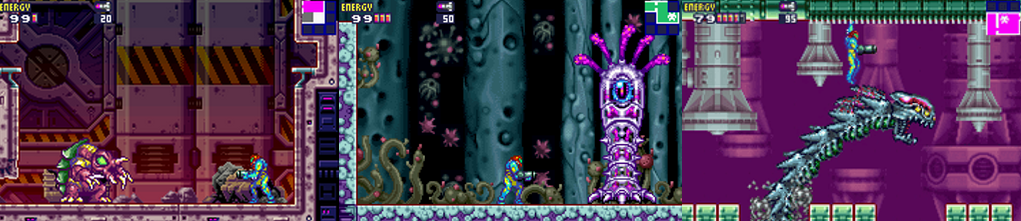
There are twelve bosses to battle in Metroid Fusion, though one is encountered twice. Many of the bosses will not only be familiar to Super Metroid players but are simply super-powered X parasites. Defeating them reveals their true form, the eye-like Core X, which floats around firing lasers or protecting itself with spikes or electricity. Defeating this restores your health and ammo and bestows a new ability, but their inclusion essentially means every boss fight is a two-stage affair. The first you encounter, the Arachnus X, is an armadillo-like creature that stomps around, rolls at you, slashes with its pinchers, or unleashes an energy wave attack. Luckily, there are small tunnels you can retreat into to avoid these, though you’ll need to be wary of its widespread fireball attack, and it’s only vulnerable from the front and to your missiles. Next, you’ll battle the weird, plant-like Zazabi X, a strange jellyfish-like tentacle that hops around and tries to squash you. While it’s overhead, you can shoot up to bombard it with missiles but be sure to move as it saps your energy if it envelops you. Serris X presents quite the challenge. This serpentine beast bursts from the ground and circles the screen, taking up a lot of real estate and getting faster the more damage you deal to its head. You’ll then have your first encounter with the Security Robot B.O.X., a crab-like walker that charges you and spits bombs that spew fire plumes. Luckily, there’s a rail overhead you can grab to fire missiles into its opening from above, which eventually causes it to flee. When you battle it again later, these overhead rails are essential to avoid the electrified water in the arena, and it now sports a missile barrage in its arsenal!
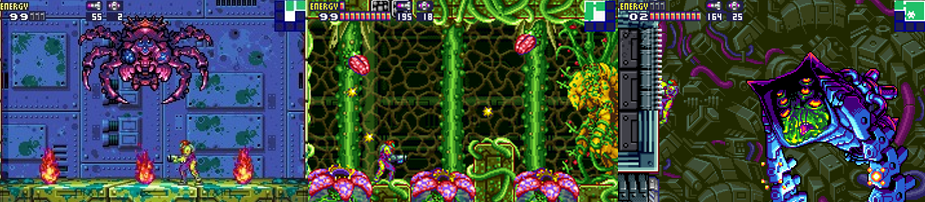
Since you get a lot of experience battling Core X’s, targeting their eyes and dodging them as they float about, the Barrier Core X doesn’t pose much of a problem beyond being bigger, surrounded by smaller variants, and retreating to the water. The giant spider, Gedo X, is much more formidable; if this thing gets you in its mandibles, you’re in for a bad time! Luckily, you can retreat to the corners of the cargo bay in your Morph Ball to leave it bouncing around aimlessly. Gedo X also spits a spew of fireballs you’ll need to avoid and eventually starts dropping garbage on you, so you’ll need to dodge this as well as you frantically target its head with Super Missiles. Plant Core X reminded me of the Mother Brain battles from the first two games. This tangled mess of vines and thorns has infested a Chozo Statue and is protected by spore-spitting flowers and carnivorous plants. Pieces of the boss fall off and become hazards as you pepper it with Super Missiles and, while the spores eventually stop, the creature rears to life and blasts you with Plasma Beams! Like SA-X, Nightmare X’s threat is foreshadowed as soon as you venture into Sector 5 and see its shadow flying about it. Later, it wrecks the area and you’re forced to confront it, where it’s revealed to be this gigantic, bio-mechanical…thing that takes up most of the screen! Nightmare X hovers around erratically, fires a barrage of lasers from its arm/wing/things, and is only vulnerable to Super Missiles and the Charge Beam, and only in its mewling face. You must lure it to one side of the room and clamber up the ladders to attack it, marvelling as its face bleeds and degenerates as it takes damage, but your missiles will be useless when it engages it gravity-warping abilities so make sure to switch to the Charge Beam.
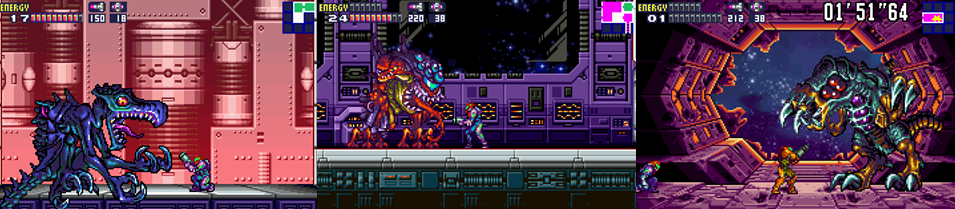
After a tense, manic escape from the Restricted Zone that sees you blast the SA-X into space, you’ll come face-to-face with an X masquerading as Samus’s archenemy, Ridley. Another gigantic sprite, Ridley flies about the place and charges at you, testing your reaction time and agility. It also breathes fire and tries to grab you. While this drains your energy, you can pummel it with Super Missiles to deal big damage, though it’s also recommended to use the Charge Beam. Eventually, the shrieking creature crumbles and you defeat one more Core X before finally facing SA-X. This X is a perfect copy of Samus in her classic suit and with all her abilities; it pops up throughout the game searching for you or chasing you down, decimating you with its Screw Attack and Ice Beam. You can finally settle the score in this fight but the SA-X is fast and powerful and you can only damage it with a fully charged Plasma Beam. Your Ice Missiles briefly freeze it but the window of opportunity is very small so be ready to Screw Attack to safety. After enough hits, it mutates into a monstrous form, one much easier as it simply tries to crush you, but it surprisingly saves you in the final fight when it sacrifices itself to empower you in the battle against the Omega Metroid. This gargantuan, insectile, alien monstrosity rips through the docking bay and is fought against a time limit. Initially, it’s invulnerable, but the SA-X’s Ice Beam lets you to damage it. However, you need to hit hard and fast and escape to safety. If its slashes land, you’ll be stun locked and killed in seconds or waste valuable time, so rush in, blast its head, and quickly retreat to end it. With the timer ticking down and the Omega Metroid’s huge hit box, this can be a frustrating test of patience and sadly lacks much strategy beyond shooting and retreating.
Additional Features:
Scattered all around the space station and its Sectors are numerous power-ups that will increase your maximum health and the number of missiles and Power Bombs you can carry. These are invaluable as the game progresses and tougher enemies and specialised hidden blocks become more prominent. You’ll gain all of Samus’s weapon and suit upgrades by defeating bosses, Core Xs, or from the odd Chozo Statue, so you don’t have to worry about missing anything. Maps are automatically provided when you interact with the Navigation Room or activate consoles as well, and as ever you can utilise the Nintendo Switch’s save state and rewind feature to drastically reduce the game’s difficulty. You get three save slots with Metroid Fusion and each one tracks your completion percentage, which is tied to how many power-ups you’ve found as well as how quickly you’ve played through the game. These factors also impact the ending you get upon finishing the game, with five on offer in the North American and European versions and eleven in the Japanese version, ranging from seeing Samus pose in her suit to showing off her form-fitting blue suit. If this is incentive enough for you to challenge the game again and finish it faster, then by all means go ahead, but there is nothing else on offer here, which is a bit of a shame as it would’ve been nice to see an SA-X skin or Samus’s blue suit form unlocked.
The Summary:
Although I’ve played a few Metroid games now, I still feel unaccustomed to the franchise. Nostalgia and a longing for Super Nintendo games means Super Metroid is probably my favourite of the series, so I was naturally very pleased with Metroid Fusion. As mentioned, the game has so much in common with Super Metroid that it’s basically a remake, with Samus’s abilities copied wholesale alongside many familiar locations and bosses. I didn’t expect the call-backs to Metroid II though, that was pretty neat, and I enjoyed seeing the game’s environments change as you explore the space station. There’s always something happening, be it an overload or a power drain or an escaped monster, and it’s a fun reason to backtrack and try out Samus’s new abilities. Pitting you against a ticking clock was a great way to break up the action, and adding an element of danger to defeating enemies with the X parasites was a neat touch, too. I also enjoyed the threat of the SA-X; this formidable double increases the tension and causes nothing but trouble throughout your adventure. Unfortunately, I don’t think it was utilised enough. There were some areas where the SA-X was entirely absent, and I think running from it, sneaking around it, or engaging with it multiple times would’ve helped the game stand out more from Super Metroid. Like, one of Samus’s power-ups could’ve been left lying in the open and be stolen by the SA-X and maybe you have to sneak around to retrieve it. Or you’d see it in the background or something. I would’ve liked to see more done to each area, too, to properly embrace each theme. All of them share similar high-tech features, just with different colours, which was a bit disappointing. Still, I imagine this was a great Metroid experience upon release as Super Metroid wasn’t available on the go like it is now and it still holds up really well as a companion piece to Super Metroid that does just enough to make it unique.
My Rating:
Great Stuff
Did you enjoy Metroid Fusion? Did you like how similar it was to Super Metroid or would you have liked to see it stand out a bit more? What did you think to the SA-X and do you think more could have been done with the concept? Which of the areas was your favourite? Did you ever achieve 100% completion and Samus’s true form? Which Metroid game is your favourite? Whatever your thoughts, feel free to leave a comment below, and be sure to check out my other Metroid reviews across the site.

 Dr. K's Waiting Room
Great review..
LikeLike