

Released: 7 October 2022
Director: David Bruckner
Distributor: Hulu / Paramount+
Budget: $14 million
Stars: Odessa A’zion, Brandon Flynn, Drew Starkey, Adam Faison, Goran Višnjić, and Jamie Clayton
The Plot:
Recovering drug addict Riley McKendry (A’zion) steals a mysterious puzzle box that summons the Cenobites, who demand six sacrifices. When her brother, Matt (Flynn), is taken by the Cenobites, Riley attempts to uncover the truth behind the box and avoid her fate.
The Background:
In 1986, British novelist, playwright, and filmmaker Clive Barker published volume three of his Night Visions anthology series, which included the novella The Hellbound Heart, a horror story heavily influenced by his time as a hustler and experiences in S&M clubs. Just as Barker was being heralded by iconic horror author Stephen King as “the future of horror”, The Hellbound Heart caught the attention of Hollywood and, unsatisfied by previous adaptations of his writings, Barker insisted on writing and directing the adaptation himself despite his lack of experience. Thanks to the macabre Cenobites and the alluring presence of actor Doug Bradley, Hellraiser proved to be a critical and commercial hit, kick-starting a horror franchise that, unfortunately, failed to live up to the original and quickly descended into direct-to-video releases that removed all subtlety and nuance from the concept. For years, Barker distanced himself from later entries, particularly the rushed “ashcan” sequel/remake that was so awful that slasher icon Bradley refused to participate for the first time. The series finally got a shot in the arm with the generally well-received Hellraiser: Judgment (Tunnicliff, 2018) and, after years of fighting to regain the rights to produce a much-needed reboot, Barker finally got his wish to revitalise and return to the franchise when this remake was announced in 2019. Although Bradley turned down a chance at a cameo to preserve his legacy, the real story here was the announcement that his iconic role as “Pinhead” would be played by a woman, a decision that caused a ridiculous amount of backlash that even Bradley admonished. Specifically said to be drawing more from Barker’s original novella and film and with make-up effects by Josh and Sierra Russell, this new Hellraiser made its debut exclusively on streaming platforms like Hulu and Disney+. Hellraiser made a modest $12,640 and garnered mostly positive reviews. Critics lauded the return to form for the redesigned Cenobites and praised it as the best entry in years, despite criticisms of the characterisations. The film’s success was enough to warrant the production of a sequel, though development of an unrelated television series continued to tread water.
The Review:
At first glance, Hellraiser has much in common with another horror remake, Evil Dead (Álvarez, 2013). Not only is it more of a “re-imagining” of the source material, but the main plot revolves around a damaged, recovered addict. Riley McKendry has wasted most of her life to drink and drugs but, after putting her brother, Matt, his boyfriend, Colin (Faison), and their friendly roommate, Nora (Aoife Hinds), through hell with her mood swings and antics, she’s finally on the right path towards sobriety. However, for the long-suffering Matt, there’s still a problem: Riley’s boyfriend, Trevor (Starkey), who she met while going to group therapy and following the “12 Step” program. Not only is Matt immediately suspicious of Trevor because of this and because he so obvious looks like a drug dealer and user, he’s also worried that Riley mixing with a recovering addict will only drag her down when Trevor inevitably relapses. Riley naturally lashes out against Matt’s judgements; whatever trauma drove her to addiction is clearly deep-rooted within her and she latches onto Trevor as a source of escape and sexual comfort. Indeed, when Matt suddenly vanishes after being cut by the mysterious puzzle box, the first thing Riley does is find comfort in Trevor’s arms and it’s in him, not her friends, that she confides in and turns to to help her figure out what the deal is with the box. Speaking of which, it’s Trevor’s fault the puzzle box even ends up in Riley’s hands in the first place. When she mentions that she needs to find a “better job” to start paying her share of the rent and get Matt off her back, Trevor encourages her to help him break into an abandoned warehouse and swipe whatever’s inside, said to belong to some rich asshole, and split the profits. Unfortunately for her, and all of them, what they find is a strange, gold-and-brass puzzle box that immediately enthrals Riley. However, when she returns home drunk and gets into a blazing row with Matt, her brother finally snaps and throws her out, leaving her wandering the city streets late at night in an alcohol and pill-fuelled daze.
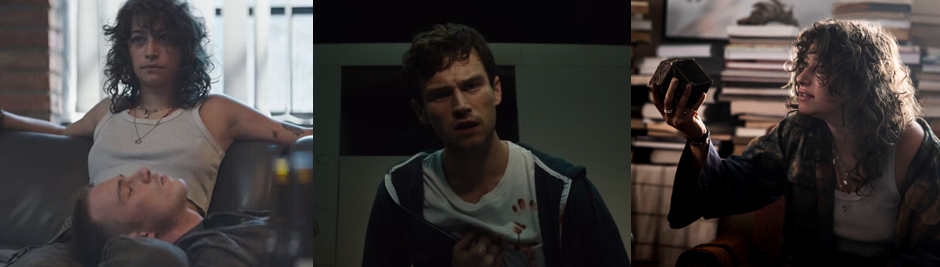
Riley finds solace in a playground. There, her head spinning from the drugs, she tinkers with the puzzle box and is amazed when it starts to move and shift, changing form in her hands. Unlike hapless stooge Joey Coscuna (Kit Clarke) in the film’s prelude, Riley avoids a nasty cut from the box’s blade but is suddenly overwhelmed by a bout of nausea and the distant tolling of bells. As she drifts in and out of consciousness, Riley spies a horrific, scarified creature –The Gasp (Selina Lo) – who demands that Riley offer a blood sacrifice since she missed being sliced. Riley’s thoughts turn to Matt who, either sensing his sister’s plight or enchanted by the Cenobites’ power, heads out to find her, suddenly convinced she’s in danger. Though Matt finds her half out of it in the playground, he accidentally stabs himself on the box and, when he goes to clean up, the Cenobites hungrily abduct him. When Colin and Nora accompany the ambulance crew in finding Riley, they’re all driven out of their minds with worry by Matt’s disappearance. None of them believe Riley’s claims that it’s tied to the box, believing she was off her head at the time. Frustrated, terrified, and burdened by guilt (to say nothing of being haunted by visions of the Cenobites), Riley turns to Trevor to get answers. Though he claims to believe her and shelters her, Trevor’s clearly disturbed by the box. When he tries to dispose of it, Riley launches into a tirade, obsessed with understanding its secrets so she can find her brother and atone for her awful behaviour. Reluctantly, Trevor accompanies Riley to an assisted living facility, where they question former lawyer Serena Menaker (Hiam Abbass), who’s listed as the owner of the warehouse they found the box in. She reveals that box belongs to disgraced corporate mogul Roland Voight (Višnjić). She also exposits some titbits about the box, freaking Riley out as she describes a lot of the same stuff she’s been seeing, and then forcibly tries to take it for herself, ending up cut in the process and being claimed by the Cenobites. Riley then uses the power of the internet to read up on Voight, a hedonistic millionaire who disappeared and was presumed dead, and fixates on breaking into his fortress-like mansion, no matter how hard Trevor tries to dissuade her.
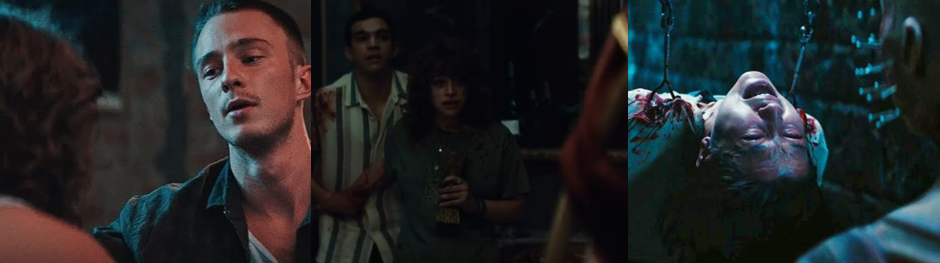
While Matt takes an instant dislike to Trevor, primarily out of concern for Riley’s wellbeing, his assumptions are a little off the mark, at least initially. Trevor’s a surprisingly attentive miscreant; he genuinely seems to care for Riley, even accidentally letting slip that he loves her during sex, and enables her wild claims at every turn. He does, however, try to inject some logic into her increasing mania, which she doesn’t appreciate. No matter how often he tries to dissuade her from investigating the box and Voight, Riley persists like a rebellious child and Trevor’s forced to tag along to keep her safe, seemingly presenting himself as the opposite of the bad influence Matt believes him to be (even if Trevor does encourage her to steal the box in the first place). Matt doesn’t get much screentime but he’s a pivotal plot point since Riley’s entire journey is first about finding and making amends with him, and then about saving and resurrecting him. It’s clear he loves his sister and desperately wants her to turn her life around, but he’s grown tired of her reckless and self-destructive ways and can’t help but lose his patience when she repeatedly throws her life away with Trevor, drink and drugs. Matt’s spectre haunts Riley as much as the Cenobites; she dreams of him, hears him calling for help, and is even confronted by his presence in Voight’s mansion. This is potentially a Cenobite trick since he asks, “Do you want me to be?” when she asks if it’s really him. Embracing him and tearfully apologising for her actions, Riley’s horrified when she catches a glimpse of Matt’s true, skinless form. Reading Voight’s notes teaches Riley about the “gifts” offered by the Cenobites’ “God” and she becomes obsessed with solving the box and bringing Matt back using the box’s dark magic. Matt’s disappearance devastates Colin, who struggles to wrap his head around what’s happened and understand Riley’s babbling about the box and its demons. Then there’s Nora. Nora’s kinda just…there. She’s friendly enough and clearly has Riley’s best interests at heart, but she’s mainly there to add to the body count once they all end up trapped in Voight’s mansion.
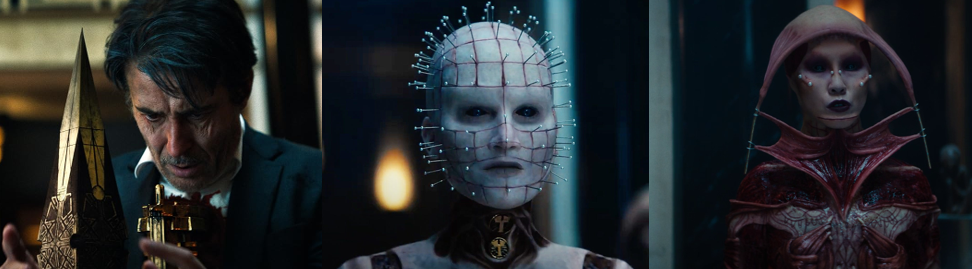
The Cenobites are very different to what we’ve seen before. Gone is the bondage leather and dark robed façade, replaced with rendered, pinky-white flesh. It’s a startlingly alternative look, making them more like mutilated angels than gothic demons. They walk around completely naked, exposed muscles and weeping genitals on full display, unashamed of what they perceive as their “beauty” and “perfection”. While I’m not against a drastic redesign for the Cenobites and they each have enough similarity to their predecessors to be identified as suitably Clive Barker-esque, I do think a slightly more traditional look should’ve been used for the pin-headed Hell Priest (Clayton). As is, the Priest is easily mistakable for the Gasp from a distance, and I just feel a being of their stature and authority would’ve benefited from some slick, gory black leather robes. Still, Clayton exudes a cold menace akin to that of the legendary Doug Bradley in bringing this androgynous creature to life. The Hell Priest is ruthlessly stoic, demanding Riley make blood sacrifices – or sacrifice herself – to appease their carnal desires. The Hell Priest may speak in riddles but they’re brutally honest, promising gifts like “power”, “sensation”, and “resurrection” to those who complete ethe puzzle box. Voight, however, learned too late that the Cenobites’ idea of “pleasure” is twisted and sadistic, offering only exquisite suffering, relishing in the agony of their victims. A decadent, self-serving millionaire who thinks nothing of sacrificing others to the Cenobites’ lusts, Voight relished an audience with their God, Leviathan, desiring to experience true sensation. He was rewarded with a horrendous device lodged in his chest that continuously twisted his nerve endings, keeping him in perpetual agony and unable to die. Desperate for relief, Voight spent the next six years trying to summon the Cenobites once more, finally manipulating and bribing Trevor into bringing him a suitable patsy while he lurked in the hidden passageways of his mansion. The box is also very different, sporting six “configurations”, each with a different solution and thankfully being more taxing to solve than just…rubbing it like in previous Hellraiser films. Interestingly, neither the box or the Cenobites care who is sacrificed to its power, allowing Riley to stab and summarily tear apart the gruesome Chatterer (Jason Liles) and concoct a scheme to use Voight’s specially prepared mansion to do the same to the remaining Cenobites and escape her predicament.
The Nitty-Gritty:
It’s inaccurate to describe Hellraiser as a “remake”. It’s more akin to a re-imagining or an all-out reboot since its ties to The Hellbound Heart and Barker’s original adaptation are tenuous, at best. Indeed, this isn’t a suburban tale of hedonistic sex, violence, and lust; instead, it’s a rumination on an addict’s guilt and torment. The characters are all original to the series, with only Voight being analogous to one of Barker’s characters, and the situation is very different. Thanks to the changes made to the Cenobites and the puzzle box, there’s a persistent sense of dread hanging over Riley. She’s not braining unsuspecting bankers to sacrifice them to her lover, or even her brother. Matt may be trapped in what we’ll call “Hell” for simplicity’s sake and sport a skinned form, but he doesn’t escape the Cenobites nor does he truly appear after being taken. Instead, Riley has a ticking clock hanging over her head as she desperately tries to figure out what the box is and how it works to find a way around the Hell Priest’s demands for a sacrifice. The box has a mesmerising power, seemingly calling to any who see it and compelling them to mess with it. Once cut, its victims become dazed and confused and reality shifts, allowing the Cenobites to arrive and claim their victim. When Riley drags her feet appeasing the Hell Priest, the mutilated cleric forcibly cuts her, delivering a final ultimatum and spurring Riley to venture to Voight’s ominous mansion. Although Voight claims that the box is one of a kind, I feel there’s enough leeway here to imagine this is one of many puzzle boxes (we’ve seen copies before, after all) and you could easily think of Hellraiser as a re-quel without too much effort (the Hell Priest has changed forms before, as well). Still, the links to the original are strong, both visually and thematically. The Cenobites favour barbed chains, we see their spinning column of human flesh, Hell is represented as a cold, stone maze, Leviathan (a welcome and unexpected return) is visually similar to what we’ve seen before, the Hell Priest grimly and expertly delivers some of Doug Bradley’s most famous threats and, above all, Ben Lovett’s haunting score draws upon Christopher Young’s previous work, the music now diegetically linked to the puzzle box and the coming of the Cenobites.
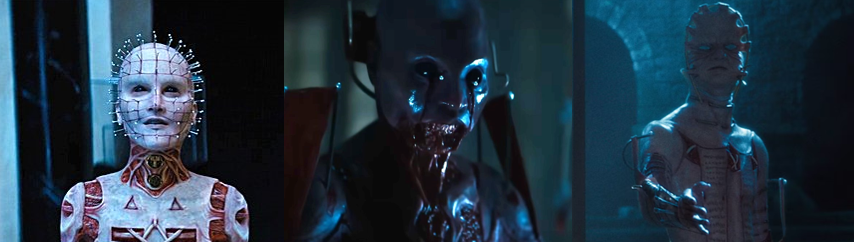
Of course, it wouldn’t be a Hellraiser film without some sex and gore, and there’s plenty of that here. Riley throws herself at Trevor whenever she’s stressed to try and block out her pain and guilt, only to be tormented by visions of the Cenobites or face the judgemental looks of her friends and family. Voight has a fully stocked sex dungeon and is said to be a sadistic hedonist, though it’s very much a case of “tell, don’t show” when it comes to exploring the depraved things he got up to before solving the puzzle box. Hellraiser wisely takes its time building up to the reveal of the Cenobites and their power; Joey’s torn apart in the background and Matt vanishes offscreen with a scream. When the Cenobites appear, they’re initially visions that bombard the drug-addled Riley. However, they soon appear in all their scarified glory, callously observing and patiently stalking their prey, savouring every moment. Of course, we have the familiar Hell Priest with their signature pins, and the ghastly Chatterer, but the Gasp is somewhat analogous to the Female Cenobite (Grace Kirby) as well. Like the Hell Priest, the Gasp is eloquent and vindictive, taking a perverse pleasure in Serena’s pleas for forgiveness just as the Priest delights in tormenting the strung-up Nora. There’s also the strangely fish-like Weeper (Yinka Olorunnife), the Asphyx (Zachary Hing) which wanders around blindly, its vision obscured by its own taught flesh, a disturbing pregnant Cenobite (Gorica Regodić), and, briefly in the finale, the Masque (Vukašin Jovanović), a Cenobite whose face has been removed from its skull! While their primary method of subduing and torturing their victims is their hooked chains, the Cenobites also employ metal wire, pins, and sheer brute force when necessary. Flesh tears and wounds spurt with gore as the Cenobites impale and torment their victims, stringing them up like puppets, drinking their blood as they bask in their agony, and finally tearing them apart. Perhaps the most memorable is poor Nora, who’s stabbed by Voight and drawn into Hell while in the back of a van. It’s a disturbing visual, seeing the back of the van extend into the Labyrinth’s stone corridors. While Riley catches a glimpse of Nora’s predicament, she’s too late to help her and all that’s left is a splatter of blood.
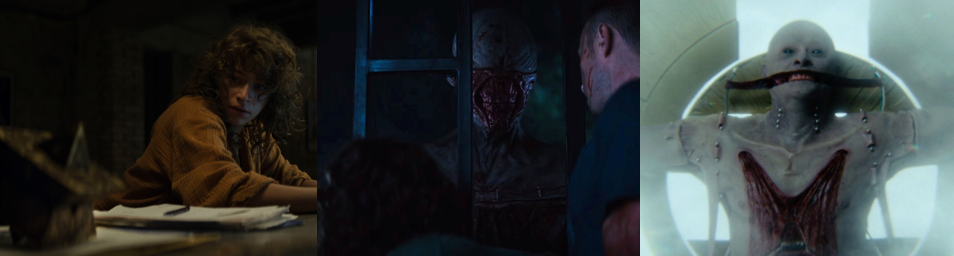
Riley pours through Voight’s diaries and learns of the different gifts offered by the puzzle box, believing that she can bring Matt back by asking for his resurrection. When she learns that that the Cenobites are happy to slaughter one of their own as a sacrifice, Riley desperately plots to use Voight’s mansion to lure in the remaining demons and stab them with the box, sparing herself and her friends. While Voight has transformed his mansion into the perfect trap for the Cenobites, keeping them and their chains at bay with a series of gates and doors, Riley’s horrified when Voight, half-mad from his constant torment, lurches from the shadows and stabs Colin to solve the box. She’s even more enraged to learn that Trevor was working for Voight all along, though is numb to his claims that he tried to warn her off and blind to the fact that he did everything he could to keep Riley and her friends from being harmed. When Colin gets tied up in the Cenobites’ metal wire and prepared for a filleted, Riley first begs the Gasp to spare him then offers Trevor as a substitute, stabbing him in the gut when he tries to retrieve the box from her and sparing Colin from a gruesome fate. Meanwhile, Voight finally gets the audience with God he so longed for when Leviathan descends from the tumultuous skies. Confronted by the Hell Priest, Voight demands to be relieved of his pain so he can finally die and is distraught to learn that his gift cannot be taken away, merely exchanged. Impassively stunned that Voight is displeased by his agony, the Hell Priest offers to grant him that which he has truly coveted his entire life: power. Voight readily accepts and is giddy with euphoria when the archaic device falls from his chest and his wounds heal, restoring him and freeing him from his pain. His elation is short-lived, however, as he’s summarily impaled by Leviathan’s gigantic chain and dragged into the heavens to be granted the Cenobites’ greatest gift. With Voight taken away to be brutally transformed into a new Cenobite, a process that sees his flesh peeled back and his body and mind horrifically altered by Leviathan’s unknowable lights, Riley has her own confrontation with the Priest. Although she’s offered her brother, Riley realises that Matt is gone and that the Cenobites gifts are twisted promises and choses to live with her guilt. The Hell Priest is pleased since choosing a life of regret with bitter and brief suffering is almost as torturous as their barbed chains. The Cenobites then vanish and Riley leaves the puzzle box behind, her and Colin wondering if they made the right choice in the end.

The Summary:
Despite my childhood trauma watching Kirsty Cotton (Laurence) unwittingly summon the Cenobites, I’ve become quite accustomed to the Hellraiser franchise. I consider the first the best, have a soft spot for the fourth, and have long hoped for a dark, gritty, atmospheric remake that returns to the ambiguous and intriguing notions raised in the first film rather than muddying the concept with overtly religious nuances that don’t really fit with the franchise since the “Hell” depicted isn’t the Judeo-Christian version. It took a while but, thankfully, we finally got there! Hellraiser may be as far removed from the source material as the other sequels, but it captures its spirit far better than any previous entry. The Cenobites are once again unknowable, strangely alluring creatures that callously mix pain and pleasure into a cacophony of vindictive torture and, while they appear as twisted angels and are referred to as demons, they’re not tied down to religious constructs. I love their redesign, and the changes made to the box; the torment Riley feels trying to figure it out before they take her and her friends is palpable and presented the narrative in a fresh, new way. Riley was a compelling protagonist; damaged and flawed, she’s ripe for the Cenobites’ manipulations, but she’s constantly trying to find ways to outsmart them. Her desire to be reunited with Matt drives her forward and her arc is learning to let him go, to live with what she’s done and, hopefully, grow from it. While Nora and even Colin weren’t much to shout about and Goran Višnjić was hamming it up a bit as Voight, the characters were decent enough and it was a blast seeing them be so cruelly tormented by the Cenobites. Hellraiser has a lull in the middle and a few performance flaws but, overall, is a fantastic reimagining of the concept. It mixes and matches elements from the book and the various films into a bold new presentation that finally makes the Cenobites scary again and leaves an indelible impression that’s on par with the original movie, finally delivering a Hellraiser worthy of the name.
My Rating:
Great Stuff
Did you enjoy this reimagining of Hellraiser? How did you think it compares to The Hellbound Heart, the original adaptation, and the other sequels? What did you think to the redesign of the Cenobites and Jamie Clayton’s performance as the Hell Priest? Did you like the changes made to the puzzle box and Cenobite lore, and the influences from the other films? What did you think to Riley, her issues, and her desire to resurrect Matt? Which of the Hellraiser sequels was your favourite, if any, and would you like to see a sequel to this movie? Whatever your thoughts on Hellraiser, feel free to share them below and go check out my other horror content on the site!

 Dr. K's Waiting Room
One thought on “Movie Night: Hellraiser (2022)”