
To celebrate the release of Dr. No (Young, 1962), the first of the James Bond movies (Various, 1962 to present), October 5th is known as “Global James Bond Day”. This year, I’m spending every Saturday commemorating cinema’s longest-running franchise, and one of the most recognised and popular movie icons.


Released: 31 July 1987
Director: John Glen
Distributor: United Artists
Budget: $40 million
Stars: Timothy Dalton, Maryam d’Abo, Jeroen Krabbé, Joe Don Baker, Art Malik, and John Rhys-Davies
The Plot:
British secret agent James Bond/007 (Dalton) helps KGB officer Georgi Koskov (Krabbé) defect and learns that a policy of assassinating defectors has been instated by new KGB head Leonid Pushkin (Rhys-Davies). After being betrayed by Koskov, Bond’s only lead to him – and a greater plot involving shady American arms dealer Brad Whitaker (Baker) – is naïve cellist Kara Milovy (d’Abo), whom he must coerce into helping him track Koskov down before it’s too late.
The Background:
MI6 super spy James Bond was created by writer Ian Fleming in 1953 based on his time as a Navy intelligence officer. The character was most famously brought to life by Sean Connery, kicking off an unparalleled cinematic franchise. When Connery tired of the role, Roger Moore stepped in and made it his own as a softer, gentler Bond. Though Moore was beloved in the role, his movies took a critical and financial downturn after twelve years and seven films. Moore stated he left the franchise due to aging out of the role, and the search was on for the new James Bond. Although San Neill was initially considered, it was actually Pierce Brosnan who was first cast based on his work on the television series Remington Steele (1982 to 1987). However, the announcement caused renewed interest in the show, meaning contractual obligations would keep Brosnan from the role until 1995 and Timothy Dalton (eventually) agreed to sign on in his place, eager to separate himself from Moore’s portrayal with one more in line with the source material. Although the film’s title was taken from Octopussy and The Living Daylights (Fleming, 1966), very little material was taken from the book beyond the opening sequence, with the film initially planned to include recurring KGB General Anatol Gogol (Walter Gotell) in Pushkin’s role, but Gotell was too sick to handle such a large part. The film saw the return of Bond’s iconic Aston Martin, and complex (and dangerous) mid-air stunts made more troublesome by unfavourable weather. Perhaps due to Bond’s nearly-five-year absence, The Living Daylights outperformed Moore’s last film with its $191.2 million box office (actually making it more profitable than five of Moore’s movies), but was met with mixed reviews. Many both praised and criticised Dalton’s more gruff and serious Bond; while the stunts impressed, the middling plot and unappealing villains drew criticism and, while some have argued that it is an under-rated entry, others maintain Dalton’s second attempt was more fitting for his version of Bond.
The Review:
Everyone has their favourite Bond, and everyone has the Bond of their generation; sometimes they don’t align, and sometimes people prefer aspects of one Bond to another. For me, Pierce Brosnan was both my Bond and the Bond of my generation thanks to 007’s lengthy absence from cinema screens during my childhood. Yet, when I first started getting into the Bond franchise, I had an affinity for the suave, light-hearted take offered by Roger Moore. It might be surprising to learn, then, that I’ve always been a fan of Timothy Dalton’s edgier, more serious take on the character. While this was influenced by his short time in the role and thus often being underappreciated, when I later researched Bond for my Master’s degree, I developed a greater appreciation for his surprisingly faithful portrayal of the character, who’s often a pretty dark character. The differences between Dalton and Moore are apparent right from the start: he takes the deaths of his fellow agents very seriously (almost personally), and throughout the film he’s shown to have more of an edge than his predecessor. He is visibly frustrated with Kara throughout the film and barking his displeasure and just exuding a feeling of exasperation at having to hold himself back because of etiquette or duty. At the same time, Dalton shows a softer, caring side; he begrudgingly goes out of his way to retrieve Kara’s cello and enjoys wooing her while on the move. Yet, he has a ruthless, biting delivery and always seems to be on the verge of snapping into a violent rage, which makes him seem volatile and unpredictable, qualities that I find really enjoyable after the previous flawless, almost superhuman incarnations of the character.
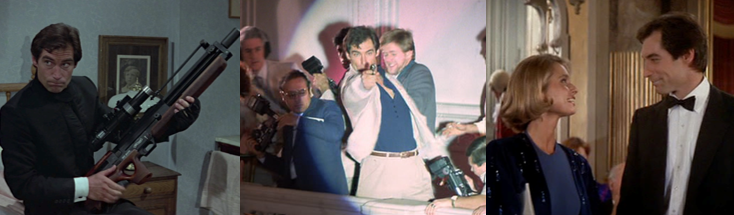
The Living Daylights coyly toys with the audience in its opening sequence by masking Dalton’s appearance, making the unveiling of the new Bond a dramatic reveal that’s designed to explicitly say, “This is the new guy!” To me, this is plainly establishing that The Living Daylights is supposed to be a soft reboot of the franchise, but this does get decidedly muddled. “M” is still portrayed by Robert Brown, who previously portrayed Admiral Hargreaves but was presumably promoted during Moore’s era, and “Q” is still portrayed by Desmond Llewelyn, suggesting Dalton’s Bond is the same character as the previous iterations. Yet the sudden youthful appearance of both M’s secretary, Miss Moneypenny (Caroline Bliss), and Bond himself lends credence to this being a soft reboot, one that retains many of the previous actors and in which it can be implied that Bond went on similar missions to his predecessors. I think this is probably what The Living Daylights is going for but it’s understandably a little muddled since reboots ad re-quels weren’t part of the mainstream cinema lexicon at this time. This is a Bond with very little time for quips and glib remarks; sure, he does make them but they’re drier than the desert sand. He also tends to be late, flippant, and easily distracted especially by his vices, (booze and women, for example). This, as much as Bond’s arrogance and his standoffish, “lone wolf” persona irks the likes of Saunders (Thomas Wheatley), who prefers to go by the book rather than improvise like 007. Yet, Bond’s reputation as “the best” precedes him; Koskov only agrees to defect if Bond personally protects him, yet Bond has little regard for his orders. Indeed, he seems to welcome the idea of being fired for his insubordination and is portrayed more as a man living on the edge, facing the threat of death every day, and preferring to take the most direct course of action to achieve his objectives. Bond’s instincts do earn him the disapproval of M, meaning he’s reprimanded for sparing Kara, and his disbelief at Koskov’s claims about Pushkin, a man Bond knows quite well, is dismissed after the General is spirited away by KGB enforcer Necros (Andreas Wisniewski). Although Bond refuses to hunt down and kill Pushkin, despite his name being on his Smiert Spionam, he agrees to take the assignment only so he can more efficiently circumvent M’s orders and follow his gut, which tells him to investigate the sniper he wounded.
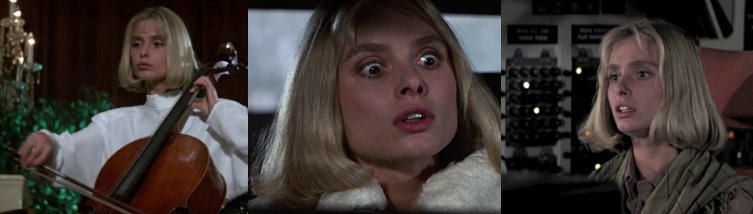
Kara catches Bond’s ear (and eye) almost immediately; he picks her out of her entire choir and admires his beauty and talent, but even he is stunned when she pulls out a sniper rifle. Recognising that the girl has been setup as a decoy, Bond purposely shifts his aim to only graze her since he “only kills professionals”, angering Saunders but showing that Bond has the wherewithal to spot a patsy. Intrigued by her, Bond follows her to discover her exact involvement in the narrative, only to find she’s simply a naïve girl blinded by love and loyalty. Of course, Bond’s instincts are dead right and it turns out Koskov manipulated her to make his defection appear genuine, but Kara’s so infatuated with Koskov that she defends him, even when interrogated by Pushkin and the KGB, and is visibly excited at the knowledge that his “friend”, Bond, has been sent to take her to him as promised. Naturally, Bond is perfectly happy to manipulate her feelings by assuming the role of a concerned mutual friend and keeping her on the move, placated with false promises, half-truths, and sightseeing, in the hopes of luring Koskov out. Bond assumes an almost paternal relationship with her, even requesting two bedrooms and treating her to lavish gifts and experiences, all under the guise of looking after her in Koskov’s absence. Despite her love and devotion to Koskov, Kara is smitten by Bond, whose mask slips the more he gets close to her, but Koskov’s influence runs deep. All it takes is one phone call and a few kind words and Kara is convinced to drug Bond, believing him to be a KGB agent. However, even as he’s crippled by the poison, Bond reveals Koskov’s true nature and that he spared her life while Koskov wanted her dead. Kara realises she’s been taken for a fool when Koskov hands her over to Colonel Feyador (John Bowe) as Bond’s accomplice and, while she shows some fighting spirit in the action-packed finale, remains little more than a wide-eyed, cheerfully enthusiastic (and, ultimately, extremely forgettable) hinderance.
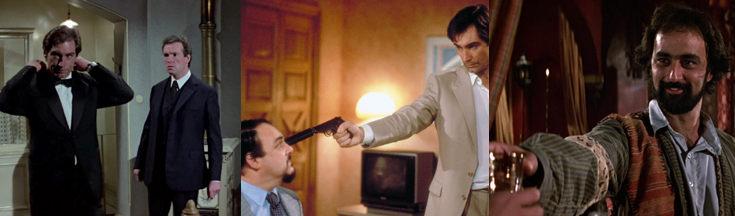
At the start of the film, Bond is paired with Saunders and immediately gets on his bad side by being late, distracted, and overly critical of Saunders’ carefully planned out extraction plan for Koskov. Saunders goes by the book and thinks very little of Bond’s cavalier attitude; his anger at Bond deliberately missing Kara turns to humiliation when Bond usurps his operation, showcasing a field awareness and experience that paints Saunders as ineffectual and bumbling, but is convinced by Bond to investigate Koskov. While Saunders comes through and reveals Koskov’s partnership with American arms dealer Brad Whitaker (Baker), and he and Bond find a mutual respect, it indirectly leads to his death as Necros murders him before Bond’s eyes, enraging the already uptight 007. Although he’s a new character to the franchise, Pushkin is said to be a former acquaintance of Bond’s. Bond, ever the remarkable judge of character, smells a rat when Koskov claims that Pushkin has designs on being the next Joseph Stalin but is driven to confront him after Saunders’ death. Holding Pushkin at gunpoint and callously using his mistress, Rubavitch (Virginia Hey), as a distraction to subdue his guard, Bond demands answers and prepares to execute Pushkin as per his orders. However, Bond is convinced to stage an elaborate public execution of Pushkin to try and draw Koskov out, which attracts the local authorities and Bond’s his old ally, Felix Leiter (John Terry), who’s also been monitoring Whitaker’s operation and later helps him breach the arms dealer’s fortified base in the finale. While escaping from his cell in Afghanistan, Bond casually frees Kamran Shah (Malik), who turns out to be the leader of the rag-tag Mujahideen rebels and helps them flee the Soviet air base. Though he shelters them and is grateful for their assistance, Kamran initially refuses to help Bond due to the insurmountable odds and finds his resolve amusing but is convinced to provide him with what little arms and aid they can offer when he learns of the greater threat posed by Koskov’s plot.
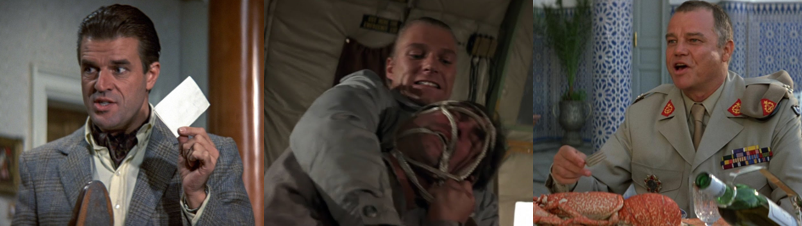
Koskov is initially portrayed as a willing defector to the British government; a terrified, almost bumbling Soviet General who greatly admires Bond, much to 007’s chagrin (though they do share an affinity for fine foods and wines). In exchange for amnesty, he offers information on Pushkin that paints the General as a threat not just to the free world but to Western spies through his Smiert Spionam initiative. Koskov claims Pushkin is targeting spies as part of a diabolical scheme to create political unrest due to a mad lust for power, but it’s simply a ruse conjured by Koskov to coerce Bond into eliminating his chief rival. Of course, this deception isn’t uncovered until later in the film, meaning Bond plays right into Koskov’s hands in his frantic search for the turncoat General, which leads him into conflict with Pushkin and the revelation that they’ve all been fooled by the same man. Koskov. Koskov’s primary enforcer is Necros, a psychopathic KGB assassin who stands out like a sore thumb with his large physique and yet fools everyone with his disguises and accents, Necros makes an immediate impression by infiltrating the highly secure MI6 state house, garrotting victims and tossing explosive milk bottles, and applying a brutality and surprising theatricality to his methods, fully capable of holding his own when his cover’s blown and killing without remorse. Instantly recognisable by his headphones and that annoying song that plays through them, Necros acts as Bond’s physical threat. Easily able to take and dish out punishment, Necros embodies the callous ruthlessness of the “Red Menace” yet takes pride in his methods and is also said to be part of a revolutionary operation. Koskov’s backed by would-be conqueror Brad Whitaker, whose military credentials and credibility are questioned by Pushkin, who terminates their arrangement after learning of his disrepute. An aggressively patriotic nutjob with a fascination for warfare and military tactics, Whitaker has his own private war museum all setup with model recreations of history’s most infamous battles for him to study and even life-like mannequins of him dressed as infamous military leaders (or “surgeons”, as he views them), much to Pushkin’s disgust. Although a blowhard who’s more talk than action, despite his short temper, Whitaker proves a surprisingly threatening opponent for Bond thanks to his proficiency with cutting edge weaponry, his use of theatrics to disorientate 007, and being garbed in “the latest body armour” to essentially resemble a futuristic riot cop.
The Nitty-Gritty:
We might have a spirited, aggressive new Bond but, sadly, the trademark title sequence is still as lacklustre as ever. I know it’s kind of blasphemous to say but very few of the early title sequences wowed me thanks to featuring bland font and surreal, often nonsensical visuals of women and guns, and The Living Daylights is no exception. Sure, the song by a-Ha is a banger but I’m not sure what all the sultry women holding guns and projected 007 logos is supposed to be suggesting, or their relevance to the film’s plot. Still, it’s as traditional as the opening gun barrel sequence and many of the usual Bond cliches are here, too, including a mission debriefing from M, overt flirtation with Miss Moneypenny, and Q’s continued exacerbation with Bond’s childish antics. Indeed, Dalton’s Bond may have more of an edge to him, but he still relishes in winding Q up with his antics, though I’d say that the age gap has slightly altered their relationship into something more akin to a rebellious son acting out against a father figure. Tonally, The Living Daylights can be a little jarring. For all Dalton’s grouchy edge, there are strange moments of levity (no doubt holdovers from Moore’s era), such as his ally, Rosika Miklos (Julie T. Wallace), using her curvaceous girth to distract from Koskov’s escape, the escape itself (which sees the General blasted through a gas pipeline), and the usual shenanigans at Q branch with “ghetto blasters” and trap sofas. While I’m not against comedy in Bond films, and it’s nowhere near as bizarre as that seen in Moore’s outings, it does noticeably clash with the more serious focus on Smiert Spionam. Indeed, “Cold War” tensions are perhaps more rampant than ever here as the lines between ally and enemy are blurred through deception and subterfuge.
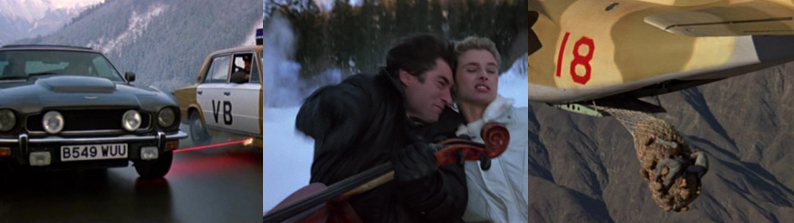
Dalton certainly looks the part in sharp suits and Bond’s trademark tuxedo, and wielding 007’s trademark Walther PPK, but his entire demeanour is one of disinterest, frustration, or childish banter, especially on the job (he brazenly smokes in the MI6 offices, appears visibly frustrated with the daily red tape, and takes pleasure whenever he can since his job is so dangerous). Despite Q branch being as wacky as ever, Bond’s field gadgets are noticeably toned down in The Living Daylights to keep things more grounded. He has a fancy looking but otherwise entirely unremarkable pair of binoculars (especially compared to Saunders’ night vision goggles), a practical tuxedo jacket that turns into a stealth suit with a simple strip of Velcro, yet Q’s built a firing ghetto blaster, Bond lugs around a massive sniper rifle at the start, and Q provides him with a whistle-operated explosive device (with built-in skeleton key) that seems more impractical than a simple grenade. The Living Daylights sees Bond back behind the wheel of an Aston Martin, this time the sleek, sexy V8. Yet, in another example of the film’s inconsistent tone, Bond’s car is outfitted with a bevvy of gadgets that include a laser that severs a pursuing police car from the rims, hidden missile launchers in the front bumper, bulletproof glass, and even ski attachments and a self-destruct! Amusingly, Bond not only ends up escaping the Czech police by driving across a frozen lake and blasting over their blockade with a rocket boost (the naïve and awestruck Kara too exhilarated by all the gunfire and explosions to question his implausibly explanations) but also evades his pursuers and crosses into Austria by using Kara’s cello case as a makeshift sledge! After “assassinating” Pushkin, Bond makes a dramatic escape across the rooftops of Tangier, and the third act culminates in a massive shootout between the Mujahideen and the Soviets and Bond fighting with Necros while dangling precariously out the back of a cargo plane in mid-flight!
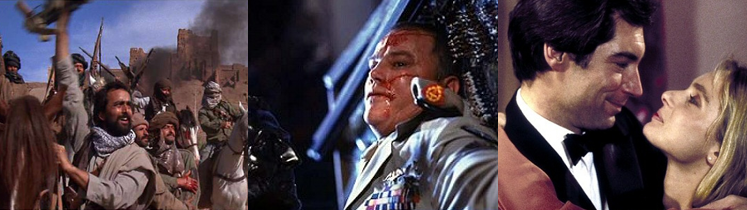
As you expect from a Bond movie, The Living Daylights is quite the globe-trotting adventure. Thanks to Bond bouncing Kara all over the place to rendezvous with Koskov, the film journeys to Vienna, Austria, Whitaker’s personal museum in Tangier, and ends in a Soviet air base in Afghanistan. Bond is taken there by Koskov, who plans to turn him in for Pushkin’s “murder” and be heralded a hero, installing him and Whitaker into a position of wealth and power. While travelling with Mujahideen, Bond also learns that Koskov and Whitaker have been buying opium from them to sell for a profit to fund their arms dealings with the Russians, thus putting the Mujahideen and many others at considerable risk. With Kamran’s help, Bond smuggles some C4 into the bags of opium, ending up trapped in the cargo plane when his flimsy disguise fails him. While the Mujahideen provide a distraction, Bond commandeers the plane and takes off with Kara onboard, only for Necros to leap on at the last second and attack Bond in mid-flight. Massively outmatched by the larger foe and facing a ticking clock thanks to the C4, Bond’s forced to improvise and send the cruel assassin plummeting to his death, disposing of the bomb (and saving the Mujahideen from the Soviet forces in the process), and inexplicably escaping the crashing plane in a jeep when it runs out of fuel. With Felix guiding him, Bond then confronts Whitaker at his museum who surprises Bond with his tenacity, tricks, and advanced weaponry; pinned down and outgunned, Bond gets the upper hand with Q’s quirky explosive gadget, felling Whitaker with one of his own statues. Having narrowly escaped a fiery death at the air base, Koskov swoops in and tries one last deception, but Pushkin doesn’t buy it and has Koskov arrested (and, presumably, sentenced to death). In the aftermath, back in Vienna, Kara receives a standing ovation for her solo performance, which M, General Gogol, and Kamran and his soldiers also attend to offer their congratulations. Although upset by Bond’s absence due to a mission, Kara is overjoyed to find him waiting in her dressing room, with a veritable forest of flowers, for a more personal celebration.

The Summary:
I definitely feel like Timothy Dalton is perhaps the most under-rated James Bond. It’s certainly jarring going from the charming, whimsical Roger Moore to the more gruff and serious Dalton, but, though he really does capture the edge of the character as conceived in the books (at least the ones I’ve read), it’s difficult for Dalton to really impress here. Not only is The Living Daylights bogged down by a pretty middling and confusing plot, but it also still contains a lot of the same over the top elements that made Moore’s run paradoxically so enjoyable and so fantastical. Just as it didn’t suit Moore to be channelling Sean Connery’s meaner spirit, so too does it not suit Dalton’s strengths to be in some of these ridiculous situations, turning a witty quip into a spiteful bark and clashing with the more grounded nature of the film. Still, he is one of my favourite Bond’s; I love how he seems so tense and ready to snap at any moment, his disregard for the rules, and this sense that he does what he does because it’s his job, but that he also takes it very personally. Sadly, Kara didn’t really impress me as a Bond Girl; she’s just kind of there and this naïve, lovesick girl who I have a hard time believing Bond would fall for beyond a passing fancy. Koskov and Whitaker were more enjoyable with their bombastic, almost cartoonish personalities, but Necros really stood out for me. Barring that annoying song that’s always accompanying him, I think he was a really good physical foil for Bond, and I would’ve liked to see more of him. There are some decent stunts and set pieces here, but I find The Living Daylights quite tedious. The tone is all over the place, the plot isn’t that engaging, and I always find myself tuning out near the third act. Dalton was capable of more, and his next film leaned into his strengths a bit more, but this was a pretty disappointing first outing for him and probably doesn’t help bolster his reputation as a Bond actor.
My Rating:
Could Be Better
Are you a fan of The Living Daylights? Where does it rank against the other James Bond films for you? What did you think to Timothy Dalton’s edgier take on James Bond? Did you find the tone jarring and the plot a bit dull? What did you think to the collusion between Koskov, Whitaker, and Necros? Were you impressed by the film’s stunts, or did they clash with the more serious atmosphere? Which Bond actor, film, story, villain, or moment is your favourite? How are you celebrating Global James Bond Day today? Whatever you think about The Living Daylights, or James Bond in general, feel free to leave a comment on my social media or drop your thoughts down below.

 Dr. K's Waiting Room
One thought on “Movie Night [00-Heaven]: The Living Daylights”