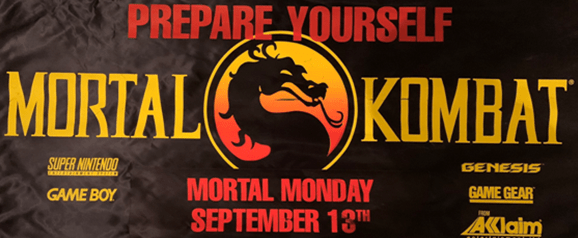
To celebrate the simultaneous worldwide release of Mortal Kombat (Midway, 1992) on home consoles, 13 September 1993 was dubbed “Mortal Monday”. Mortal Kombat’s move to home consoles impacted not only the ongoing “Console War” between SEGA and Nintendo but also videogames forever thanks to its controversial violence. Thus, it’s only fitting that we continue celebrating this influential fighting series every September 13th…except this year that clashes with Friday the 13th so…


Released: 23 April 2021
Director: Simon McQuoid
Distributor: Warner Bros. Pictures
Budget: $55 million
Stars: Lewis Tan, Jessica McNamee, Josh Lawson, Joe Taslim, Mehcad Brooks, Tadanobu Asano, and Chin Han
The Plot:
Struggling fighter Cole Young (Tan) is targeted by the relentless Bi-Han/Sub-Zero (Taslim), an assassin working under orders by the malevolent sorcerer Shang Tsung (Han) to kill Earthrealm’s chosen warriors before they can compete in the ages-old martial arts tournament known as Mortal Kombat.
The Background:
Inspired by the success of Street Fighter II: The World Warrior (Capcom, 1991), developers Ed Boon and John Tobias used innovative digitised sprites to unleash Mortal Kombat upon impressionable gamers. Attracting both popularity and controversy for its bloody content and gruesome “Fatalities”, Mortal Kombat soon expanded its scope not just with additional videogames but also into mainstream media thanks, largely, to catching the eye of producer Lawrence Kasanoff. Kasanoff envisioned a multimedia venture for the franchise and initially got off to a great start with the first live-action adaptation. Mortal Kombat (Anderson, 1995) became a cult hit that’s still one of the most highly regarded videogame adaptations ever made. Unfortunately, this success didn’t pan out quite as Kasanoff originally planned. A universally panned sequel was followed by lukewarm television ventures and talks of a third film evaporated into Development Hell. After the series made a dramatic comeback following Midway’s bankruptcy, hopes for a new Mortal Kombat movie were raised through the web series helmed by Kevin Tancharoen. Although he never got to direct a big screen adaptation, Tancharoen’s efforts were picked up by producer James Wan, writer Greg Russo, and director Simon McQuoid, with the trio determined to bring the franchise’s gory violence to life in all its glory. Despite long-running rumours of the original movie’s cast returning for another film, this new Mortal Kombat featured an all-new cast and attracted early controversy for creating a new audience surrogate and its poor use of Goro, now a disappointing CGI creature rather than a traditional effect. While the film’s $84.4 million box office made it a mild success, reviews were somewhat mixed. The fights and gore were praised but the characters, acting, and plot all drew criticism. Yet, despite it not living up to the standards set by the 1995 film, Mortal Kombat delivered some stellar fight scenes between the franchise’s most popular characters and was successful enough to warrant a 2025 sequel.
The Review:
I’ve always enjoyed the original Mortal Kombat movie. Even now, it’s still my favourite live-action adaptation of a videogame, to the point where I wrote an entire chapter of my PhD thesis about the film and its infamous legacy! I waited eagerly for the follow-up, only to be met with a surreal, nonsensical bombardment of noise and mess that basically killed the franchise dead. Even the relatively enjoyable television ventures couldn’t undo the damage, and Mortal Kombat was left to fester for years as fans waited for news of a third film or an all-out reboot. Those dreams were almost answered by Kevin Tancharoen, whose online videos showed a certain promise, but Warner Bros. randomly decided to go in a different direction and sign-off on this reboot instead. From the first trailers, things looked somewhat promising by focusing on bloody combat, the franchise’s trademark Fatalities, and with much of the marketing revolving around fan favourite ninjas Hanzo Hasashi/Scorpion (Sanada) and Sub-Zero. Indeed, Mortal Kombat immediately makes up for the character assassination these icons received under the direction of Paul W.S. Anderson by opening in 17th century Japan and depicting the wholesale slaughter of Hasahi’s ninja clan, the Shirai Ryu, at the hands of Bi-Han and his own ninja assassins, the Lin Kuei. Hasashi, an honourable family man who lives a relatively peaceful life tending to the land with his wife, Harumi (Yukiko Shinohara), and young son, Satoshi “Jubei” Hasashi (Ren Miyagawa), and infant daughter (Mia Hall). However, when his family and clan are threatened, Hasashi becomes a force to be reckoned with, making use of a digging trowel as a makeshift kunai to oppose the assassins, only to realise all-too-late that the attack was merely a distraction so the sadistic Bi-Han could leave Harumi and Jubei little more than ice sculptures for the grief-stricken Hasashi to find.

Naturally, a fierce battle ensues between the two rivals that sees Bi-Han’s face permanently scarred and Hasashi stabbed and killed by his own weapon, condemning his soul of the hellish Netherrealm, ending his bloodline, and leaving the Lin Kuei victorious. Well…not quite, for Hasashi’s baby survived and was recovered by Raiden (Asano), God of Thunder and protector of Earthrealm, since it was foretold that the “blood of a Hasashi” would unite Earth’s champions against the realm-conquering Outworld. Honestly, Mortal Kombat might’ve fared better if the entirety of its runtime was built around the Hasashi/Bi-Han rivalry, taking place in the past and including select appearances from other prominent franchise characters. Instead, the story jumps ahead to 2021, a time when Outworld has won nine out of ten Mortal Kombat tournaments and needs just one more victory to legally invade our world. They have succeeded in this endeavour thanks to the unmatched sorcery and deceitful nature of Outworld representative Shang Tsung, an enigmatic man who uses any means at his disposal (including bending the sacred rules of the tournament) to preemptively target those destined to fight against Outworld. Thus, any Earthrealmer bearing a dragon-shaped birthmark is targeted by Shang Tsung’s lead assassin, Bi-Han, now clad in armour and taking the name Sub-Zero, who presumably retains his youth and vigour thanks to the sorcerer’s influence. Sub-Zero’s latest target is Cole Young, a down-on-his luck mixed martial artist who’s struggling with self-doubt and to make a career out of his skills to provide for his family, wife Allison (Laura Brent) and daughter Emily (Matilda Kimber). Once a champion fighter, Cole has been reduced to taking $200 fights to put food on the table and is thus incredulous when Jax shows up inquiring about his unique dragon mark.
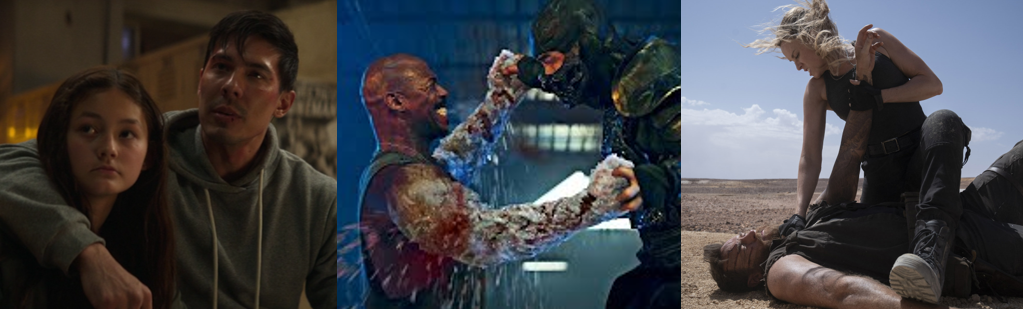
Cole is drawing into the crazy world of Mortal Kombat when Sub-Zero attacks him and his family at dinner, and it’s only the intervention of Jax that allows the Asano to escape. While Cole follows Jax’s instructions to meet with his partner, Sonya Blade (McNamee), Jax ends up mutilated when he battles Sub-Zero to cover Cole’s escape. Hopelessly outmatched despite his size and power, Jax has his arms frozen and shattered by the cruel cyromancer. Unlike Cole, and the other chosen warriors, Sonya does not carry a dragon mark, which is a source of great distress for her and something adversarial mercenary Kano (Lawson) and even Raiden mock her for. However, Sonya is acutely aware of Mortal Kombat, the threat against Earth, and the bizarre individuals associated with it. While Cole is sceptical, despite witnessing Sub-Zero’s abilities, his cynicism is quashed when another of Shang Tsung’s assassins, the voracious Syzoth/Reptile, who viciously attacks Sonya’s hideout. Since he’s her only chance to track down Raiden’s hidden temple, Sonya is forced to free Kano to assist in the fight. Although his face is mauled by the beast, Kano circumnavigates Reptile’s camouflage by stabbing him with a flare and proves his viciousness by tearing the Saurian’s heart out. While he’s a crude, crass, antagonistic criminal who can’t be trusted, Sonya is forced to bribe Kano with money she doesn’t have and he reluctantly joins the group, and the allies they find there, delighting in lording his superiority, verbally tearing them down, and excited at the prospect of gaining superpowers under Liu Kang’s (Lin) tutelage. Similar to Tancharoen’s previous adaptation, Mortal Kombat explains the videogames’ special moves not just in explicitly bestowing them to Shang Tsung’s demonic forces but in the concept of “Arcana”, abilities unique to those with the dragon mark. Since she doesn’t have a mark, Sonya can’t unlock her power but is permitted to stay and help train the others, giving Kano ample opportunity to rile her up, though Cole also struggles to unlock his Arcana despite his efforts.

Protected from Shang Tsung’s assassins by Raiden’s mystical barrier, Cole, Sonya, and Kano train alongside warrior monks Liu Kang and Kung Lao (Max Huang), who also tend to Jax’s wounds and furnish him with a rudimentary set of cybernetic arms. Like Cole, Jax is frustrated by his newfound handicap, but Liu Kang and Kung Lao strive to push them all to unlock their true potential to defend Earthrealm. Staunch believers in Raiden’s cause, Liu Kang and Kung Lao have already unlocked their Arcanas, demonstrating incredible abilities such as fireballs and teleportation, and Kung Lao also utilises his iconic razor-sharp hat. Although Liu Kang is sympathetic to their confusion, time is against the would-be champions and he and his fellow Shaolin repeatedly subject the group to intense sparring sessions to push their bodies and minds to the absolute limit. Unfortunately for them, the only one who achieves this is Kano who, angered by “Kung Pow’s” dismissive attitude towards him, suddenly fires lasers from his injured eye. Far from the wise, playful mentor of previous adaptations, this version of Raiden is a blunt deity. Indeed, he’s so disappointed by the fighters and Cole’s progress that he regularly runs them down and even out-right dismissing Cole when, after revealing his lineage as Hasashi’s ancestor, he expresses displeasure that the struggling fighter didn’t live up to the expectations set by his forefather. When returned to his family, however, Cole finally unlocks his Arcana to defend them from Prince Goro (Angus Sampson), a four-armed Shokan who attempts to kill them and is instead torn to pieces when Cole spontaneously grows organic armour that allows him to absorb any attack, grow tonfas to attack with, and grants him superhuman strength.
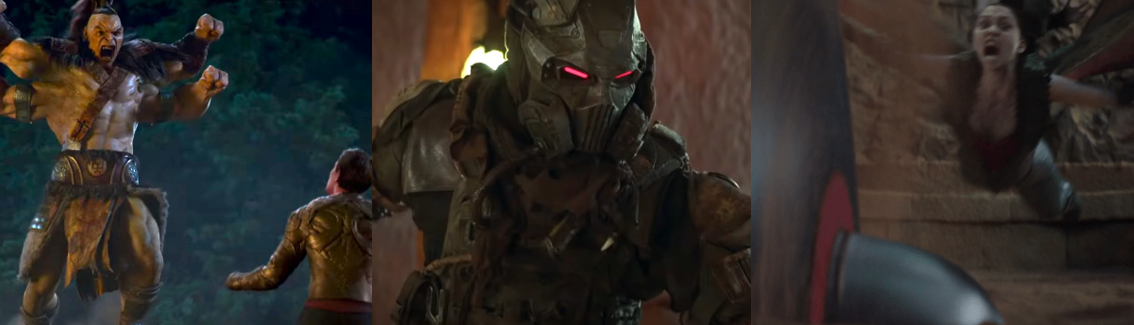
Galvanised by his awakened abilities and his victory over Goro, Cole reunites with his allies, now shaken following Kano’s betrayal. After a discussion with former ally Kabal (Daniel Nelson/Damon Herriman), Kano is convinced to betray Raiden, lowering the shield and allowing Shang Tsung’s assassins to attack. In the fracas, Jax unlocks his Arcana to save Sonya, upgrading his gaunt metal arms to more formidable appendages, but Kung Lao is lost when Shang Tsung steals his soul. Retreating to a void between realms to regroup, Cole shares a plan to target Shang Tsung’s warriors individually before teaming up to tackle Sub-Zero, their greatest threat, together. Like the original movie, Shang Tsung’s minions are given very little characterisation outside of two exceptions, Sub-Zero and Kabal. It’s genuinely upsetting seeing Goro reduced to an easily-dispatched underling and that more time wasn’t spent making Nitara (Mel Jarnson), Mileena (Sisi Stringer), and Reiko (Nathan Jones) more than lifeless minions for the good guys to fight. It seems the filmmakers were banking on Nitara’s and Mileena’s sex appeal (and the former’s unique, if poorly realised, vampiric abilities) and Reiko’s gargantuan stature to make up for this, but it doesn’t really work and it’s hard to care when they’re defeated, however gory it is, making me wish that Goro had taken Reiko’s place. Thankfully, Kabal somewhat makes up for this. He and Kano have the same snarky demeanour and Kabal has an awesome look, but we learn very little about their time together in the Black Dragon Clan and it’s weird that Liu Kang believed killing Kabal avenged Kung Lao’s death when Shang Tsung dealt the finishing blow. Similarly, Chin Han is as miscast as the sorcerer as Tadanobu Asano is as Raiden; neither can hold a candle to their predecessors or even their television counterparts and, while Han tries to exude an authoritative menace, both are very weak and forgettable in their roles.
The Nitty-Gritty:
Similar to the much-maligned Mortal Kombat: Annihilation, faith in yourself and teamwork are core themes of this new Mortal Kombat. Much of Cole’s characterisation comes from his declining martial arts career; he went from a champion to a chump and he struggles with feelings of inadequacy and self-doubt, despite having a caring and supportive family behind him. It’s this, as much as his scepticism, that holds him back while training, and these issues are only compounded when Raiden literally tells him he was destined for more and has failed to accomplish even half of his potential. It’s thus telling that Cole’s Arcana awakens when he’s defending his loved ones, but it’s hard to deny that Cole’s bland and completely unnecessary character. The Mortal Kombat franchise has one of the biggest and most diverse rosters in all its genre but the filmmakers created a brand-new audience surrogate when Johnny Cage would’ve fulfilled this role just as well. Hell, it would only have taken a couple of slight tweaks to have Cage assume Cole’s role, and all the hints towards Cage’s future involvement can’t make up for his absence here. Cole’s struggles are echoed in both Jax and Sonya, who both face an uphill battle to overcome either their physical limitations or their lack of an official brand to contribute to Earthrealm’s defence, something they ultimately accomplish when forced to go beyond their limits to save their friends or avenge their losses.

While the first Mortal Kombat unquestionably captured the spirit of the source material, smartly drawing from martial arts cinema to focus more on memorable characters and fights than the trademark gore, this Mortal Kombat clearly draws from NetherRealm’s modern titles and even explicitly recreates Kung Lao’s infamous “Razor’s Edge” Fatality by having him slice Nitara in two with his hat! Similarly, Jax crushes Reiko’s head and Liu Kang conjures a flaming dragon to take out Kabal, just like in the videogames, and of course there’s Kano’s classic heart rip Fatality, which are all suitably gruesome and give the film an entertaining edge since it’s the first time we’ve seen such explicit gore in an official live-action adaptation of the famous franchise. Similarly, the film is full of cursing, with Kano clearly channelling the late Trevor Goddard into his performance as the bombastic and outrageous Kano to steal the show like his predecessor did with his rude quips and abrasive attitude. I do enjoy these more adult aspects of the film and, in many ways, they make it a superior and more faithful adaptation than the original film, but all the blood and swearing in the world can’t make up for bland characters and uninspiring acting. Say what you will about the original’s tame content but at least the main cast was charismatic and embodied their roles. I like the performances from Liu Kang and Kung Lao here but they show up so late into the story and we learn so little about them that it’s difficult to be too attached to them. Raiden is an unlikeable jackass, most of Shang Tsung’s underlings are disposable baddies to be offed, and once again Sonya fails to impress as a bad-ass female protagonist, coming across more like a spare part since she isn’t even a chosen warrior. It’s as though the filmmakers did the opposite of the original film, focusing on gore and spectacle over character and heart, meaning it also falls short of being a definitive adaptation and can’t even rely on a memorable soundtrack to get by since the remix of “Techno Syndrome” isn’t used as prominently as in the original film.

Mortal Kombat tries to claw back some credibility in the finale when, after dispatching Shang Tsung’s dull minions and finally granting Sonya an Arcana and a dragon mark when she kills Kano, Cole is drawn into a confrontation with Sub-Zero after he kidnaps Allison and Emily. Unfortunately, even with his organic armour, Cole is no match for the cold-blooded assassin. Luckily, however, Raiden gifted Cole his ancestor’s kunai, which returns Hasashi from the Netherrealm as the vengeful Scorpion. Thus, the film comes full circle as the two most popular characters battle once more, completely stealing the thunder from Cole and making all the time spent with the other characters largely superfluous. If Johnny Cage wasn’t going to be used in Cole’s place, Cole could’ve at least been a reincarnation of Hasashi or have been transformed into Scorpion by the Arcana or the kunai. Instead, Cole’s left freeing his family and watching from the sidelines as his ancestor avenges himself on his killer in a bloody battle that’s easily the best of the film. Again, this is why these two should’ve been the primary focus. If you’re not going to do the tournament anyway, you may as well focus on the two most interesting characters in the franchise, and Taslim and Sanada excel in their kinetic, brutal fight scenes. In this rematch, the two are far more equally matched and Scorpion takes his revenge, immolating the injured assassin alive. Strangely there’s a moment of sympathy for Sub-Zero that, like Shang Tsung’s throwaway line regarding the resurrection of his fallen forces, is potentially a hint at his return in the next instalment, possibly as Noob Saibot. In the aftermath, Hasashi charges Cole with protecting their bloodline and returns to the Netherrealm. As Shang Tsung threatened to bring an entire army to their door, the galvanised Cole readily accepts Raiden’s offer to find and train new warriors and heads out to recruit movie star Johnny Cage (Unseen) to the cause.
The Summary:
I was pretty excited about Mortal Kombat at the time. I’d wanted to see a new adaptation for years and truly believed the original movie could be outdone if the filmmakers drew inspiration from it as much as the modern videogames. Obviously, nostalgia is a huge factor in the original’s appeal. Truthfully, it has many flaws that go beyond its tame nature, but it’s still an enjoyable action film, primarily because of the cast and execution. This Mortal Kombat stumbles somewhat in this aspect, predominantly because of its bland and unnecessary main character. Lewis Tan may have a good look and fight well, but he’s not much of an actor and it’s hard to be invested in Cole since I spent the entire time wondering why he’s even there. His Arcana wasn’t that great, either, and I’m not sure I liked this concept, while I’m on the subject. It worked as a goal for the characters to strive towards, but I honestly think it’s better to have the mortal warriors have to overcome fantastic abilities rather than giving everyone superpowers. The gore and Fatalities were great, as were many of the fight scenes and action sequences, and I enjoyed how closely these aspects mirrored the videogames. Sadly, this is juxtaposed with lacklustre version of Shang Tsung (because it’s hard to improve upon Cary-Hiroyuki Tagawa), an unlikeable rendition of Raiden, and a bizarrely unimpressive Goro who not only goes out like an idiot but is an awful CGI monstrosity. Indeed, for every aspect that works here, there’s two or three things that don’t, making this enjoyable enough but far from an improvement over the original film. It’s a shame as there’s a lot of potential here, and I’m sure viewers unfamiliar with the original movie will find a lot to like in this version. However, it missed the mark in a lot of ways for me, primarily in overcomplicating and overstuffing the narrative, making it a bit of a mess at times.
My Rating:
Pretty Good
Did you enjoy Mortal Kombat? What did you think to Cole Young; was he an interesting enough protagonist for you or did you find him a bit bland? Would you have preferred to see Johnny Cage in his role? What did you think to the blood, Fatalities, and fights? Were you also disappointed by the depiction of Raiden, Shang Tsung, and the underling villains? Would you have preferred to see Scorpion and Sub-Zero be the primary focus? Which Mortal Kombat characters would you like to see featured in a future film? How are you celebrating Mortal Kombat today? Whatever your thoughts, leave a comment below or on my social media and be sure to check out my other Mortal Kombat content across the site.

 Dr. K's Waiting Room
One thought on “Movie Night [MK Day]: Mortal Kombat (2021)”