
Sonic the Hedgehog was first introduced to gamers worldwide on this day back in 1991 and, since then, has become not only SEGA’s most enduring and popular character but also a beloved videogame icon and, in keeping with tradition, I have been dedicating the entire month to celebrating SEGA’s supersonic mascot.

Released: 7 October 2010; 15 May 2012
Developer: Dimps / Sonic Team
Also Available For: Mobile, Nintendo Wii, Ouya, PC, PlayStation 3, PlayStation 4, PlayStation 5, Shield, Xbox One, Xbox Series S, Xbox Series X
The Background:
In 1991, after much development and strategic planning to create a mascot iconic enough to rival Super Mario, SEGA introduced gamers to Sonic the Hedgehog. Sonic’s initial success (thanks, largely, his debut game being bundled with the Mega Drive) exploded into mainstream popularity with Sonic the Hedgehog 2 (SEGA Technical Institute, 1992) and, from there, the sky seemed to be the limit. So big was Sonic’s blockbuster third outing that it was split into two parts to save costs and meet deadlines; nevertheless, Sonic 3 & Knuckles (ibid, 1994) is widely regarded as one of the best of the classic 2D Sonic games, though SEGA strangely followed this success with several lacklustre spin-offs before transitioning to 3D in 1999. By 2010, Sonic had appeared in around sixty titles, with SEGA outsourcing their supersonic mascot to Dimps for the Sonic Advance series (2001 to 2004), which seemed to be the closest fans could hope for a Sonic 4. Conscious of the demand for a classic Sonic experience, SEGA again teamed with Dimps for a secret project originally codenamed “Project Needlemouse” in a nod to Sonic’s origins. Sonic 4 was conceived of as a throwback title, one that would mix modern elements with the classic formula, and incorporate gyroscope functions for mobile players. Episode I released to mixed reviews; despite criticisms of the poor physics, the game was a commercial success and development began on Episode II, with the specific intention to introduce new elements. With the digital re-release of the celebrated Sonic the Hedgehog CD (SEGA, 1993) looming, Episode II was developed to tie up loose threads from that game, as well as introducing team-based mechanics by including Sonic’s sidekick, Miles “Tails” Prower. Episode II was also met with mixed reviews; while largely seen as an improvement over Episode I, the boss battles and level designs drew criticism. Although players could access a side story with both titles, Episode Metal, plans for a third entry were mysteriously abandoned and the game has largely been discarded by all, especially after more fitting throwbacks to the classic era were later released.
The Plot:
Doctor Eggman is back, having refined some of his past creations and seeking to conquer new lands with the Chaos Emeralds. When Sonic inevitably arrives to stop him, Dr. Eggman calls in Metal Sonic to hold off his foe while he again works to harness the power of Little Planet.
Gameplay:
In the tradition of the classic Sonic titles, Sonic the Hedgehog 4 is a 2.5D, sidescrolling action platformer in which players blast through ten levels (known as “Zones”), with most having three stages (or “Acts”) each, culminating in a boss battle against Dr. Eggman or Metal Sonic. Fundamentally, the basic controls are as familiar as ever; players can pick up speed to blast through Acts, spinning to crash through Badniks, walls, and acquire power-ups with the A or B button, or charge up a Spin Dash by pressing down and either A or B. Oddly, the Spin Dash is actually quite nerfed and doesn’t give you the usual speed boost you’d expect compared to simply running, and Sonic uncurls when flying off curves and springs, leaving him vulnerable to attack. However, this is somewhat explained by the incorporation of the Homing Attack; by pressing A or B after a jump, Sonic will fly towards the nearest target (“helpfully” indicated by an onscreen reticule and targeting sound), which is all-but required as you chain together Homing Attacks to cross gaps. In Episode II, the controls are slightly expanded; here, Tails constantly follows you around, snagging Golden Rings and bopping Badniks, and can be called to your side at any time by pressing the Right Trigger or performing one of the three new Tag Actions with X. Sonic and Tails can either curl up into a massive ball to break through walls with the Rolling Combo or Tails can indefinitely swim Sonic around underwater with the Submarine Combo or briefly carry him with his helicopter tails with the Copter Combo. Each has different strengths and weaknesses; the Rolling Combo is quite fast and unwieldy, the Submarine Combo can be a bit slippery to control, and the Copter Combo only allows for a short burst of flight, though it’s very handy to use to save you from one of Episode II’s many bottomless pits.
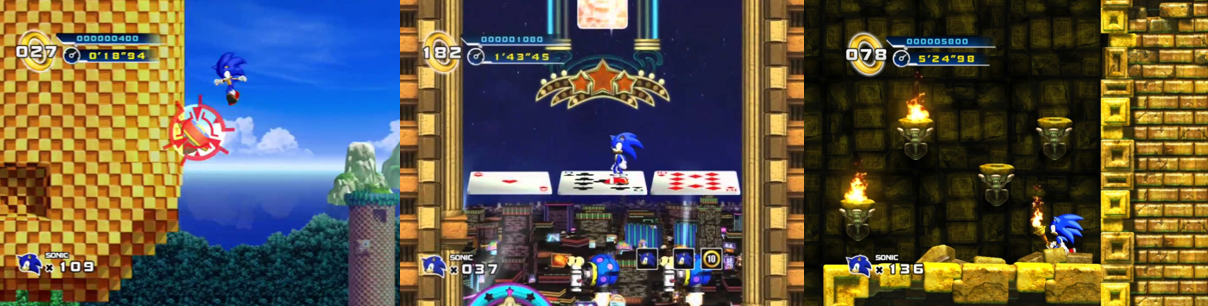
The basic gameplay mechanics are also very familiar; players must collect Golden Rings to stave off death, with the Rings scattering when you’re hit so you can snag them to protect yourself, in addition to swallowing air bubbles to keep from drowning. Acts are played against a ten minute time limit, after which players will lose a life, though you can earn extra lives by racking up points, collecting 100 Rings, or breaking open 1-up monitors. The more points you acquire, and the faster you finish Acts, the more likely it is you’ll earn continues to carry on playing after you’ve exhausted your lives, and you can respawn from checkpoints by running past Star Posts. Zones are filled with robotic enemies and cheap obstacles to sap your Rings and lives, however, from spikes jutting out of floors, walls, and ceilings, to bottomless pits, crushing hazards, and a massive wall-like drill machine that relentlessly chases you down. In Episode I, you’ll play through Zones heavily inspired by the classic Sonic games, meaning you’ll run through loops, mobius strips, jump to moving or temporary platforms, press switches to open doors, and ricochet all over the place on bumpers, springs, bouncers, and steam vents. A few new gimmicks are also present, though; Sonic can swing from vines and zip lines in Splash Hill Zone, ride playing card bridges and cross flipping cards in Casino Street Zone, awkwardly run on giant cogs in Mad Gear Zone to cross tracks, and light dynamite and ride mine carts in Lost Labyrinth Zone. It’s this latter Zone that has some of the most frustrating elements of Episode I, however; not only is it full of water that threatens your life and slows you down and all the same gimmicks as Labyrinth Zone, but you must also run across giant balls in Act 1, carry a flaming torch to light the way in Act 2 (including an annoying light puzzle that can easily cause you to time out if you don’t light the torches in the right order), and struggle with an underwater maze and some bizarre tilting mechanics in Act 3. Indeed, Episode I suffers greatly by its reliance on the original games, especially the first two, and its obnoxious use of Homing Attack chains; every Zone is simply a remix of those seen in Sonic 1 and 2, with a few things shuffled about and some sluggish, clunky physics thrown in to sour the experience.
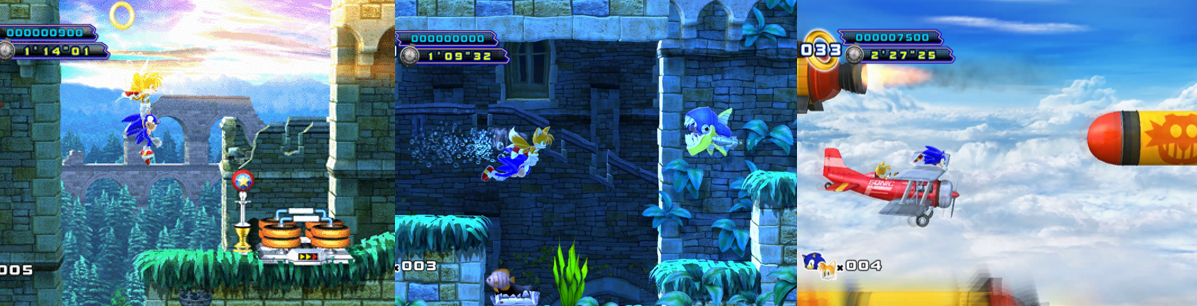
Episode II addresses many of the issues with Episode I, providing more unique gimmicks and reimagining of old gameplay mechanics along with new elements that can be both enjoyable and frustrating. The Spin Dash pads from Marble Garden Zone are back, for example, and there are now warning signs alerting you to bottomless pits; tilt mechanics are gone, replaced by platforms you can hit with the Homing Attack to make horizontal or springs, and there’s less reliance on Homing Attack chains and more emphasis placed on the Tag Actions. This is especially true in White Park Zone, where you’ll need to make ample use of the Submarine Combo to navigate the ice-cold waters, and Sky Fortress Zone, where you’ll have to expertly use both the Homing Attack and carefully-planned execution of the Copter Combo to cross gaps and avoid spiked ceilings. This Zone also sees the return of the Tornado in a very Sky Chase-inspired sequence; Sonic can now perform the Homing Attack from the Tornado’s wings and you can barrel through obstacles with X, though this’ll leave Tails dizzy for a few seconds. This was a fun autoscrolling section that focused more on avoiding Metal Sonic’s attacks and minions and trying to not get crushed by hazards but, like much of Episode II, it does go on for some time. Zones are much bigger with more varied paths, which is a good thing, and give you lots of options to use the Tag Combo or roll snowballs or take oil slides to different areas, but things can get quite aggravating due to their length and the eventual number of cheap instant deaths. Some Zones uses their gimmicks in interesting ways; Oil Desert Zone, for example, mixes together elements of Oil Ocean and Sandopolis Zone, including quicksand, rising sand you must outrun, and the aforementioned oil slicks but you’ll also lose traction on oily surfaces and these can even briefly be set alight! Sky Fortress Zone makes liberal use of propellers and wind to blow you about, rocket boosters to fry you, and chain-link fences littered with explosives for you to run across. White Park doesn’t just see you swimming through icy water, ploughing through snowdrifts, or snowboarding on avalanches but also includes a rollercoaster aesthetic, which sees you racing along at high speeds and springing to the foreground and background in a fun (if, at times, disorientating) mechanic, while Sylvania Castle Zone makes use of destructible ruins, water, springs, rotating platforms, and shortcuts across the water’s surface like in Hydrocity Zone.
Graphics and Sound:
Sonic the Hedgehog 4 opts to ditch the classic sprite art (except, bizarrely, for loading screens and certain icons) and go for a sleek, plasticine aesthetic that seems to be trying to bridge the gap between the classics and the then-modern games but ultimately ends up being quite an unsightly, unnecessarily shiny, and cluttered mess of colours, especially in Episode I. Sonic takes far too long to get to top speed here and looks daft when he does; every movement feels like you’re underwater and the screen is zoomed in a little too close, making it difficult to see what’s ahead of you. Sonic has his usual idle poses and looks up cheerfully enough, but this is also slow and doesn’t even scroll the screen; the sound effect of his Spin Dash is also wrong, with the “release” sound used for the ”wind up” and vice versa, and all of the game’s story is told through the in-game manual and a couple of simple, pantomime-like cutscenes that are just ripped off from the first game. Although many of the same sound effects are recycled for the in-game action and menus, the soundtrack is actually pretty good; it’s stronger in Episode II, but even Episode I has some catchy tunes going on, especially the boss theme. Each Act also has slightly different gimmicks and colour palettes to mix things up, and there’s even a world map where you can freely choose which Zone and Act to play, though I disliked that the game automatically returns you to this screen after you clear an Act unless you press Y to play the next Act.
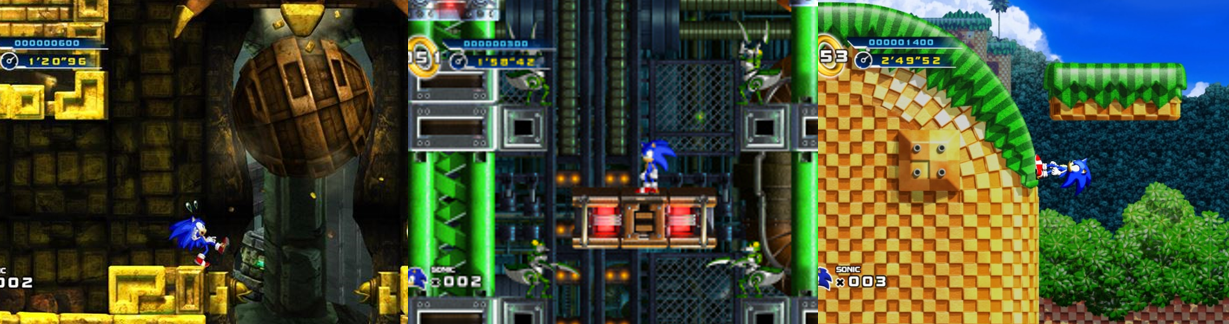
Episode I is, however, an unsightly mishmash of conflicting effects and colours. There is a lot going on in the foregrounds and backgrounds, especially in Mad Gear Zone, which takes Metropolis Zone and ups the ante to eleven, with pistons and gears and steam vents and moving parts cluttering up the screen and making it difficult to see enemies, hazards, and even the way forward. It’s a shame as I quite like the redesign given to classic Zones like Green Hill and Labyrinth Zone, with a greater level of detail and lighting applied to make them pop and feel “busier” than before with the inclusion of waterfalls and crumbling effects. However, that doesn’t change the fact that it looks and feels like you’re playing with toys or plasticine; everything is unnecessarily busy and lacks the charm of traditional sprite art, meaning there’s no “weight” to anything. This isn’t helped by the dreadful physics; Sonic is constantly struggling against gravity, loses all momentum when hitting the ground after flying through the air, and can easily walk up slopes and loops without fear of falling. If you play fast and hard, you can avoid much of this, but Zones like Lost Labyrinth force you to slow down, and Casino Street Zone’s curved surfaces lose all their appeal when you can just trot up them without curling into a ball or using the Spin Dash. The Homing Attack is also finicky, stuttering when multiple targets are onscreen and sometimes causing you to drop to your death with it fails to lock-on. Finally, Episode I just feels like a cheap and thrown together knockoff; five Zones and one playable character, with no two-player options and very few new gameplay options, make it feel less like a continuation of the classics and more like a reimagining for the mobile generation (indeed, I argued at the time – and even now – that the game might’ve been better served being titled Sonic the Hedgehog HD).
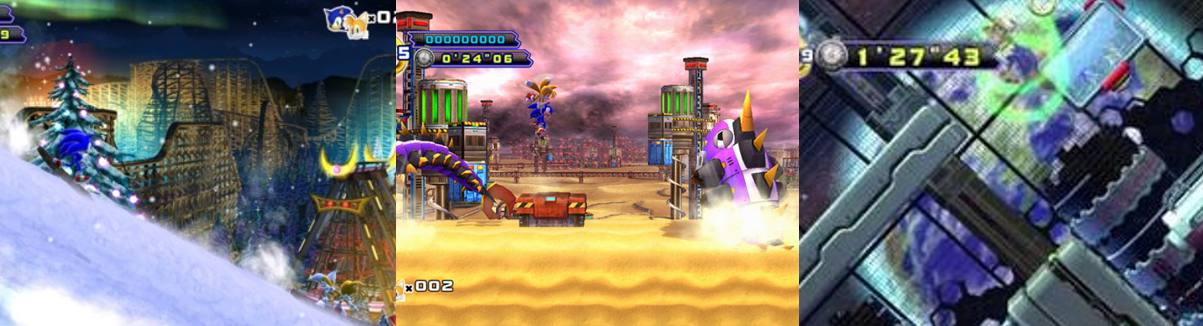
Episode II is, technically, a vast improvement over its predecessor; the menu screens are more detailed and lively, the physics are far more polished (Sonic doesn’t always uncurl off a ramp and no longer feels floaty and heavy), and the soundtrack is even better, boasting catchy tunes and a remixed boss theme that kept me invested even at the game’s most frustrating sections. The world map has been cleverly expanded, Sonic’s running animation is far better, and the addition of Tails really adds to the gameplay. Unfortunately, Zones are still quite cluttered; White Park Zone, especially, can be very busy with all the foreground and background elements overlapping, but I enjoyed how they retained different times of day and the looming presence of the mechanised Little Planet or Metal Sonic in the background of many Acts. In fact, every Act has something interesting happening in the background; you can see the rollercoaster and theme park in the background of White Park Zone: Act 1, drilling platforms and machinery at work in the background of Oil Desert Zone, and holographic screens and foreboding machinery all over the gravity-skewing Death Egg mk. II Zone. Episode II incorporates far more cutscenes, with them being similar to those of Sonic 3 & Knuckles, but to the game’s detriment; you’ll have to sit through numerous unskippable scenes of Sonic and Tails being taunted by Metal Sonic or Dr. Eggman getting his newest mech ready to battle you, which can make replaying these sections after failing a real chore. However, I really liked the way Episode II presented far more unique Zones; yes, there are influences and borrowings from previous mechanics here, but it feels like some actual effort went into giving the new Zones distinct identities rather than being rip-offs of previous efforts, and the gameplay experience was far more enjoyable here, even if the difficulty has spiked somewhat as a payoff. Indeed, hazard and enemy placement and Zone construction seems to take a leaf out of Sonic CD’s playbook, with many high-speed paths running you head-first into danger and awkward platforms, though it’s nowhere near as slapdash as in Sonic CD and seems like a balanced marriage of all five of the classic 2D Sonic titles.
Power-Ups and Bonuses:
If you’ve ever played a Sonic game before, you’ll know exactly what’s on offer here. In addition to the life-preserving (and granting) Golden Rings, you can break open monitors to earn an extra ten Rings, grab a bubble that will protect you from one hit, a temporary speed up, and a briefly period of invincibility, as well as the odd extra life monitor. Sadly, none of the elemental shields appear here, neither does Sonic’s insta-shield, and there are no new or returning additional power-ups with the exception of Episode II’s “Special Combination” item box. These are pretty rare (I only found two throughout my entire playthrough) but see Sonic and Tails bounce across the screen, racking up points and destroying all onscreen enemies as you tap A and being showered with Rings, not unlike the “Team Blast” function of Sonic Heroes (Sonic Team USA, 2003). Episode II’s Special Stages also include the new “Combination Dash” pickup, which tethers Sonic and Tails together to allow them to pickup more Rings, a clunky mechanic that relies on momentum as much as your current speed.
Enemies and Bosses:
When playing Episode I, you may be equal parts excited and disappointed, depending on your nostalgia for the classics and desire for fresh Sonic content, by the enemy selection on offer. Every Badnik encountered is ripped straight from Sonic 1 and 2, with only the Batbot and Bubbles returning from Sonic 3 & Knuckles. This means you’ll be bopping Motobugs, smashing Buzzers, dodging spiked balls thrown by Orbinauts, and cursing with frustration when you run head-first into Shellcracker’s clawed fist or Slicer’s annoying bladed projectiles. Episode II continues this recycling of classic Badniks, primarily focusing on enemies encountered in the old Wing Fortress Zone, but also includes a bunch of brand-new Badniks for you to go up against. Some of these are intimidating in their size; Snowy the massive mechanical polar bear is almost akin to a mini boss as it takes a couple of hits to destroy while giant robotic Sandworms will burst from the sand in a surprise attack. Others, however, are more aggravating: Flamers can set fire to Oil Desert Zone’s oil slicks, the dung-beetle-like Scarabesque always seem to sap your Rings with their explosive balls, and the seal-like Steelions will be the bane of your life in White Park Zone’s waters as they flash-freeze the nearby area and cause you to drown. Each Badnik you destroy releases a furry woodland critter, with a whole bunch being freed after boss encounters, nets you some points, and can be used to cross gaps with your Homing Attack but don’t get too cocky as some will sprout spikes to ruin your chain and send you plummeting to your death.
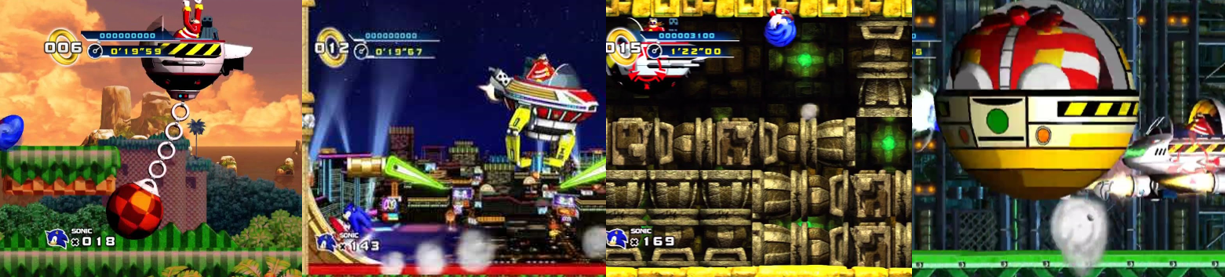
After clearing each Act of every Zone, you’ll have to do battle with Dr. Eggman (and/or, in Episode II, Metal Sonic). In Episode I, there are five boss encounters, with all of them being recycled battles from Sonic 1 and 2 but with a new coat of paint and an extra “pinch” mode after you deal enough damage. First up, you’ll once again battle Dr. Eggman in his classic (and overused) Egg Wrecker; as before, you need to attack Dr. Eggman’s craft while avoiding his massive wrecking ball, which is a lot easier now that you have the Homing Attack and a higher rebound after landing a hit, meaning it’s simple to put him down even when he spins around and tries to crush you with the ball. Casino Street Zone revisits the Egg Claw boss; again, you need to run up the pinball table-like arena or use the bouncers to attack Dr. Eggman, this time while avoiding a claw-like appendage and an electrical shield that will damage you on contact. In Lost Labyrinth, you’ll again have to chase after Dr. Eggman’s Eggmobile, avoiding spikes and drowning, until he locks you in an enclosed arena. Here, he summons a series of horizontal and vertical columns that will crush you if you’re not careful, forcing you to quickly hop up and target him as he hides in a safe corner for easily the most aggravating boss of the game. Finally, in Mad Gear Zone, Dr. Eggman busts out a new version of the Egg Bouncer; as in Sonic 2, you’ll need to watch out for the mini Dr. Eggman bubbles that detach from his craft, which become a deadly hazard in the second phase. In this section. The game takes a page out of the Sonic Advance 2 (Dimps/Sonic Team, 2002) bosses and forces you to run at Dr. Eggman, avoiding spiked balls and his erratic duplicates to land hits. As if that isn’t bad enough, you’ll have to battle all four bosses in their “pinch” phases again in the secret final Zone, E.G.G. Station, in a boss rush. Luckily, there are Rings and checkpoints between each bout, though they’ve also got added hazards thrown in, such as moving platforms in the Egg Wrecker section and additional projectiles in the Egg Bouncer section.
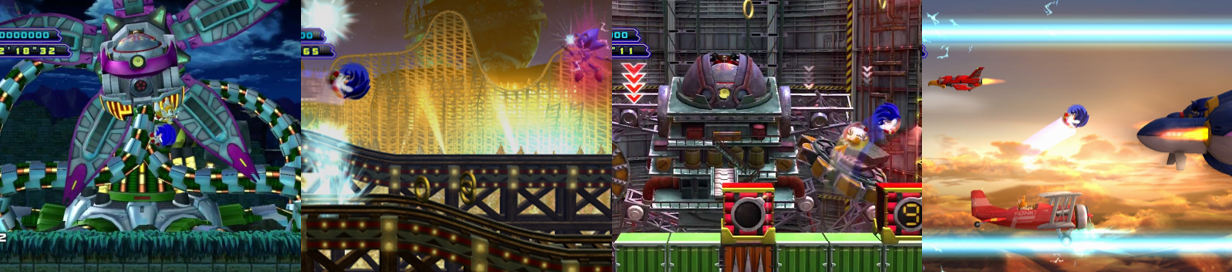
Episode II is once again a double-edged sword when it comes to bosses; while they’re largely far more unique and offer more of a challenge, they’re long, tedious, and involve a lot of waiting around. Episode II takes inspiration from Sonic CD for its bosses, giving them complex attack patterns and more visually interesting and tricky pinch phases, which is either a good or a bad thing depending on how patient you are. In Episode II, you’ll battle Dr. Eggman twice; in Sylvania Castle Zone, he pilots the Egg Serpentleaf, a massive plant-like mech that tries to swat you with its many tentacles and shields him behind a spiked bud. You’ll need to use the Copter Combo to avoid being smacked and land a few hits on Dr. Eggman, which will eventually cause more tentacles to appear and the mad scientist to blast the arena with a massive cannon. You’ll next encounter him in Oil Desert Zone in an even more irritating boss battle; Dr. Eggman assembles a massive mech out of scrap metal and you must pursue him up a garbage disposal, dodging his buzzsaws and the crates he drops (which thankfully aren’t instant-kill hazards but can contain spikes or bombs) and smacking his cockpit when he appears. When you reach the surface, the Egg Scrap Mech rapidly jumps between the foreground and background before trying to crush you; you’ll need to hit its feet with the Rolling Combo to stun it and finish off this pain in the ass boss. The other two boss battles are against Metal Sonic; like Sonic CD and Sonic Advance 2, these are auto-runners and autoscrollers. In White Park Zone, you must race towards Metal Sonic and attack him, then dodge his charge attack (either by jumping or springing to the foreground or background) and hop over the electrical traps he lays for you. After a few hits, he’ll start destroying the rollercoaster track so you’ll have to take care not to fall when attacking him. In Sky Fortress Zone, Metal Sonic pesters you in his Metal Carrier and then battles you directly, blasting electrical bolts that you need to dodge to smack his cockpit. He’ll then face you head-on, firing energy beams that you need to avoid and then jettisoning booster rockets that can crush you if you’re not careful. This can be a very annoying boss battle if you fail as there’s a lot of downtime at the start and between phases; while you can easily amass 100 Rings for an extra life, it doesn’t help with the frustration that can build in this encounter.
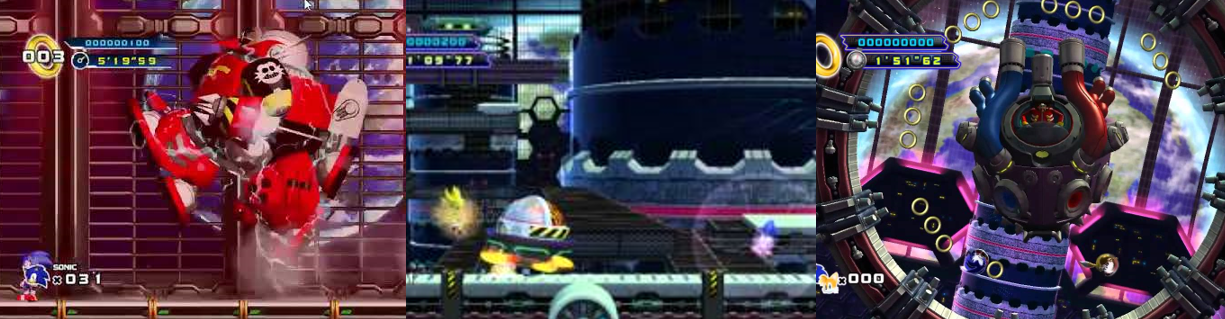
Once you’ve cleared every Zone and bested Dr. Eggman’s boss rush in Episode I, you’ll face a final confrontation with the mad scientist in a refurbished Death Egg Robot. This is easily the most tedious and frustrating boss battle of Episode I as the Death Egg Robot takes nearly thirty hits to destroy and the battle involves a lot of waiting around. To start with, it’s exactly the same as in Sonic 2 but easier thanks to you having Rings and the Homing Attack; simply stay away from the mech, attacking its torso and avoiding its rocket arms, until it starts to malfunction. In this phase, the Death Egg Robot cannot be directly attacked; you need to quickly dash under it as it hops about and then use the Homing Attack to blast one of its rocket arms back at it, avoiding the sporadic laser blasts as you go, to land a few precious hits. Once you’ve done this enough, Dr. Eggman will try one last attack, forcing you to quickly dodge out of the way and land the finishing blow before you’re dropped to your death. In Episode II, you’ll rush at Dr. Eggman and Metal Sonic aboard the Death Egg mk. II; you need to get past the invulnerable Dr. Eggman and ram Metal Sonic a few times, avoiding the giant energy balls unleashed, before racing against your robotic doppelgänger like in Stardust Speedway, only this time with more doors to bash through. Finally, you’ll battle Dr. Eggman’s Egg Heart at the heart of the mechanised Little Planet; this battle is fought on constantly rotating mechanical rings that will burst with electricity, forcing you to quickly hop between them and ram Dr. Eggman’s cockpit. The more damage you do, the more erratic the rings move and the more dangerous the hazards become; Dr. Eggman even erects an energy shield that you’ll need to break with a Rolling Combo, making for a far more unique but equally frustrating final boss encounter.
Additional Features:
There are twenty-four Achievements to earn in Sonic 4, twelve for each Episode, and they’re pretty basic, for the most part. You’ll get an Achievement for clearing the first Act of each game’s first Zone, one for clearing each game, one for completing first Act of each game’s first Zone in a strict time limit, and one for collecting first one and then all the Chaos Emeralds. In Episode I, you’ll get an Achievement for defeating 1000 enemies and accumulating 99 extra lives, while in Episode II you’ll add to your Gamer Score by playing as Tails fifty times and performing the Rolling Combo. Each Act in Episode II also hides a Red Star Ring; collect them all and finish the game for another Achievement, and upload your best scores in each Episode for another. I mentioned Chaos Emeralds just now and, as you’d expect, the seven gems are collectible in each Episode. You’ll earn them by beating Special Stages, which are accessed by finishing Act 1 to 3 with fifty Rings and entering a Big Ring, but the Special Stages vary drastically between each Episode. In Episode 1, they’re based on Sonic 1’s Special Stages, featuring a floating maze filled with Rings, bumpers, and exit pads; you need to collect Rings to lower barriers and reach the Chaos Emerald before the time runs out, collecting time bonuses and making use of the ‘Retry’ option in the pause menu if you’re sensing failure. As bad as Sonic 1’s Special Stages were, these are far worse; you rotate the maze here, not Sonic, which is extremely awkward and disorientating. Sonic can also jump but all this does is shake the screen in a nauseating way and, while you can replay the Special Stages from the world map, you can only retry those you’ve beaten and you must enter a Special Stage from a different Act to get a different Chaos Emerald.
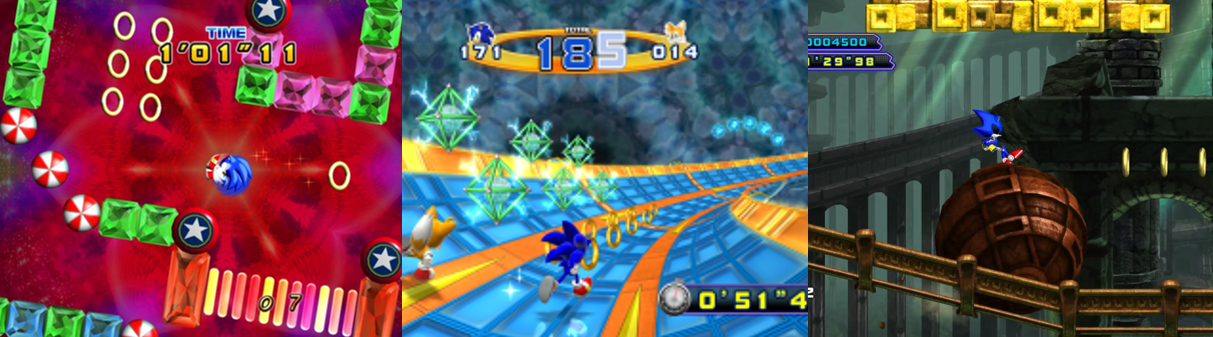
In Episode II, the Special Stages are redesigned and now influenced by the half-pipe stages from Sonic 2. Here, Sonic and Tails must collect a set number of Rings to progress, dodging bombs and electrical hazards and making use of the awkward tether mechanic in the final two Special Stages. While these are a lot more enjoyable and it’s much easier to retry if you’re struggling, they can get really annoying as the difficulty increases; you’ll need pixel-perfect timing and to make good use of the boost and momentum to snag all the Rings and the Chaos Emeralds here. In both Episodes, collecting the seven Chaos Emeralds allows you to transform into Super Sonic once you collect fifty Rings and double press A or B. this makes you super fast and completely invincible unless you’re crushed or drop down a pit, though it only lasts for as long as you hold Rings. Unlike Episode I, Episode II also features a multiplayer component; you and a friend can play the game in co-op like in Sonic 2, either locally or online, though this is strangely the only way you can play as Tails alone. Finally, completing Episode II unlocks Episode Metal, a side story in which you play as Metal Sonic and work your way backwards through remixed versions of Episode I’s Zones with all new cutscenes setting the stage for Metal Sonic’s return. Despite some new animations and sound effects, Metal Sonic is simply a reskin of Sonic and doesn’t have any new attacks; he also has to smash Badniks as well, which is a bit odd but I guess speaks to his superiority complex. There are no Achievements tied to Episode Metal, which is significantly harder then either Episode I or II; enemies, hazards, instant-death traps, and Act layouts have all be increased, altered, and made far more challenging, though there are sadly no bosses to contend with here, meaning this is more of a distraction for players who have mastered the base games.

The Summary:
Honestly, calling any title Sonic the Hedgehog 4 was going to be asking for trouble; Sonic the Hedgehog HD or Sonic Returns or Sonic Redux would’ve been far more appropriate titles and would’ve tempered expectations for these sadly unfinished titles. It just baffles me how SEGA thought it was acceptable to go from the sprawling, multi-character epic that was Sonic 3 & Knuckles to this tame, cheap, stripped down bastardisation of the first two games. Playing Episode I alone is a joke; the game is functionally playable but visually a mess, with wonky physics, a lack of replay value, and too many recycled gimmicks and elements from Sonic 1 and 2. Thank God for Episode II, which fixes many of these issues; Sonic controls a lot better, the Zones are far more visually interesting and unique, and the bosses have more effort put into them. The team-based mechanics were fun; they could’ve easily been overused but they were enjoyable when you weren’t being asked to fly over bottomless pits, though I’m confused as to why there’s no option to play as Tails in the lead. The inclusion of Episode Metal was also a nice touch, though I think more could’ve been done with this. At least give Metal Sonic his electrical boost or some new gameplay mechanic, or have him face off against Sonic, rather than just being relegated to a hard mode add-on. Truthfully, I am sad we never got the planned Episode III as it’s possible that more unique elements would’ve been added in, including a playable Knuckles the Echidna and other more engaging elements, but sadly we’ll never know. As a complete package, Sonic the Hedgehog 4 is widely inconsistent; in addressing errors from Episode I, the game just feels like a disjointed mess, even when it’s doing something new and enjoyable. It’s obvious the developers tried to address these issues in Episode II, providing a more challenging and versatile gameplay experience, but at the cost of upping the difficulty in some areas and making it equally as frustrating as Episode I but in different ways. Ultimately, Sonic the Hedgehog 4 is a disappointment; it not only fails to live up to its title, but also fails to match the quality of Sonic’s Game Boy Advance titles. I can understand why SEGA distanced themselves from it (though not its hefty price tag), though luckily these mistakes were atoned for in the years to come with better, more enjoyable throwbacks to Sonic’s heyday being released.
My Rating:
Could Be Better
Are you a fan of Sonic the Hedgehog 4? Which Episode did you prefer and what did you think to the presentation and stripped down mechanics? Were you disappointed by how much Episode I drew from the original games and the poor selection of Zones and modes? What did you think to the team up moves in Episode II and the return of Metal Sonic? Which of the game’s bosses and Zones was your favourite, and would you have liked to see an Episode III tie everything up? How are you celebrating Sonic’s anniversary this year, and what are some of your favourite Sonic games? Whatever you think, leave a comment below or on my social media and go check out my other Sonic content across the site!

 Dr. K's Waiting Room
3 thoughts on “Game Corner [Sonic Month]: Sonic the Hedgehog 4 (Xbox 360)”