


Released: 15 July 1988
Director: John McTiernan
Distributor: 20th Century Fox
Budget: $25 to 35 million
Stars: Bruce Willis, Alan Rickman, Bonnie Bedelia, Reginald VelJohnson, Paul Gleason, and William Atherton
The Plot:
New York City police detective John McClane (Willis) arrives at the Nakatomi Plaza in Los Angeles to reconcile with his estranged wife, Holly Gennero-McClane (Bedelia). Things quickly turn south when Hans Gruber (Rickman) and his gang of terrorists take the building hostage, leaving McClane to wage a one-man war.
The Background
In 1979, writer Roderick Thorp published a sequel to his 1966 thriller, The Detective; inspired by The Towering Inferno (Guillermin, 1974), Nothing Lasts Forever was well-received and soon shopped around Hollywood, with Thorp hoping Frank Sinatra would reprise his role from the adaptation of The Detective (Douglas, 1968). Instead, the concept ended up in the hands of struggling screenwriter Jeb Stuart, who was given free reign as long as he retained the Christmas-in-Los-Angeles setting. Drawing from personal experiences with married life, Stuart reimagined Thorp’s aging detective, Joe Leland, into a flawed everyman, though remained largely faithful to the spirit of the source material. After Sinatra turned down the lead role, the project was offered to some of Hollywood’s biggest action stars, including Arnold Schwarzenegger and Sylvester Stallone, before Bruce Willis (then known more for his comedic efforts) was cast as the wisecracking John McClane and subsequently redefined not only his career, but the portrayal of action heroes in general. Die Hard was the silver screen debut for the late, great Alan Rickman, who was won over by the wit and intelligence of the script and even had some creative input on his character thanks to his theatre background. Screenwriter Steven E. de Souza came onboard for a rewrite, which framed the narrative as though Hans Gruber were the protagonist, though director John McTiernan allowed Willis and the other actors room to improvise during the shoot, which was based almost entirely in and around the Fox Plaza in Central City. Willis performed many of his own stunts, suffering partial hearing loss as a result; the stunts were dangerous and complex for cast and crew alike, though McTiernan couldn’t resist dropping Rickman early to produce a genuine look of fear for Gruber’s fall. In defiance of low expectations, Die Hard was a massive financial success, making around $140 million at the box office, revitalising both 20th Century Fox and the action genre. Although initial reviews were mixed, praising the direction and stunts but questioning Willis’s performance, the film was seen as a breakout role for the actor, one that redefined the action hero stereotype into a more vulnerable and snarky tough guy. After proving to be equally popular on home video, this success naturally translated into a sequel two years later, a venture that proved even more profitable and led to an entire franchise of additional sequels, videogames, and ancillary media of varying quality that nonetheless cemented Willis’s status as a smart-mouthed action hero.
The Review:
Believe it or not, but there was a time when I wasn’t much of a Die Hard fan. Despite growing up on action movies, specifically those starring Arnold Schwarzenegger, kid me always found Die Hard to be a little too slow and “grown up” compared to the Austrian Oak’s films. Eventually, however, I grew up a bit and did a binge watch of the then-trilogy of Die Hard films and realised what I’d been missing out on. Specifically, Bruce Willis establishing himself as a mainstream action icon with these films, in particular this first Die Hard movie, which is still the undeniable best of a surprisingly strong action franchise. McClane separates himself from his action movie counterparts by being the quintessential “Everyman”; he’s physically fit, yes, but not some musclebound brute and he’s far from invincible, gradually becoming more injured and fatigued as the movie goes on. He’s easy to relate to because he’s a very flawed character; his marriage is on the rocks, he’s seen as insubordinate and a liability by his peers, he makes mistakes, and he’s forced to adapt, always one wrong move away from certain death. This is in stark contrast to the likes of Schwarzenegger and Stallone; while they have certainly portrayed more grounded, vulnerable, and human characters, they’re best known for being virtually unstoppable and overcoming the odds through sheer brute force, whereas McClane has to use his wits, cunning, and sheer force of will to triumph.
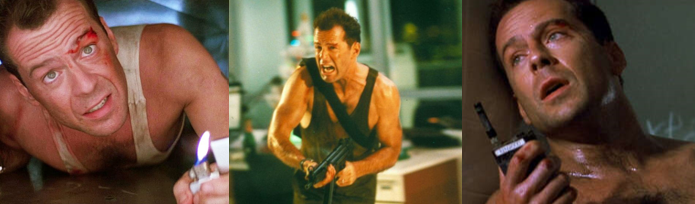
John McClane is portrayed very much as a fish out of water since he is both a New York City cop in the unfamiliar surroundings of Los Angeles and a rugged working man amidst a skyscraper full of well-heeled business types. Although rough around the edges, he’s treated warmly and with respect by Joseph Takagi (James Shigeta) and invited to join the Nakatomi Christmas party, but he’s focused solely on reconnecting with Holly, who has managed to build a successful career for herself without McClane, much to his chagrin. While he’s clearly still in love with her and wants to build bridges, if only for the sake of their young children, McClane is handicapped by a natural immaturity that causes only further arguments rather than him simply admitting to his mistakes. A career cop, McClane is always taking in his surroundings and has a suspicious nature that allows him to separate bullshitters like Harry Ellis (Hart Bochner) from the honest, like Argyle (De’voreaux White), his overly chatting limo driver. This talent goes hand in hand with his adaptability and stubborn nature, from which the film takes its title; though outnumbered and outgunned and definitely in way over his head, McClane keeps his wits about him and is always trying to find some way to get help or pick off his assailants and is intuitive enough to assess the threat posed by the terrorists based on their accents, firearms, and tactics. Basically caught with his pants down, McClane finds himself the only one capable of raising the alarm when Hans Gruber and his goons take over the tower, executing Takagi and taking his employees hostage while they work on breaking into the vault. Outnumbered, outgunned, and without even his shoes, McClane’s first instinct is to call for help, only to be repeatedly met with scepticism, endangering himself and forcing him to flee or fight, with tenacity in equal measure. Though armed only with his service pistol, McClane soon acquires a machine gun (“Ho-ho-ho”), but it’s not enough to tackle Gruber head-on. Instead, McClane fights with a brutal and rabid animal spirit; often physically outmatched by his foes, he takes quite a beating in every encounter and only emerges victorious due to his stubborn nature or taking risks that further damage his body, slicing his feet on glass shards, tumbling down stairs, getting shot, crawling through ventilation ducts, and defying physics and death alike with a desperate leap from the rooftop with only a firehose as a lifeline!
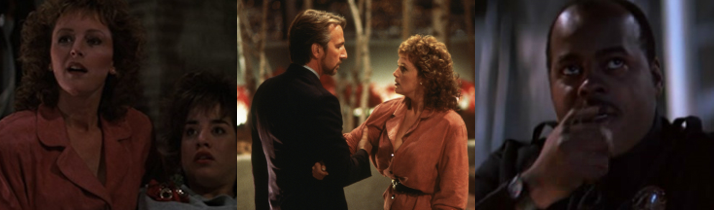
If anyone knows about McClane’s stubborn nature, it’s his wife, Holly. A driven and determined career woman, Holly moved to Los Angeles with their kids to make a go out of it in the corporate world and, despite McClane’s doubts (and hopes), actually succeeded in her new role. Though warm, kind, and friendly, Holly is sick of McClane’s thick-headed ways and bullish nature; she has no problem calling him out or standing up to him and just wants to be treated with some respect. Although he knows what he needs to do to repair their relationship, McClane struggles to express himself and often falls back on accusations and jealousy, widening the gap between them. When she’s taken hostage, Holly remains calm and composed but brings the same fiery energy when she’s forced to speak up for her fellow colleagues in place of Takagi; even Gruber comments on her dependable and forthright nature, which helps her act as a mediator between the groups in a far more effective way than her coked-up colleague, Ellis. When she learns that McClane is at large in the building and causing Gruber trouble, Holly begins to hope; despite their differences, she knows that McClane will fight to the bitter end to get the job done, but even she is shocked by the state he’s in by the end. While Los Angeles’ finest are often more of a hinderance than help to the fatigued and aggravated McClane, his most vocal supporter outside of the tower is Sergeant Al Powell (VelJohnson), a Twinkie-loving father to be who’s struggling with guilt after accidentally shooting a kid. Alerted to gunfire and a disturbance at Nakatomi Plaza, Powell is horrified by what’s happening inside. Going with his gut, Powell becomes McClane’s primary contact, much to the ire of Deputy Chief Dwayne T. Robinson (Gleason). While Robinson believes McClane is as much of a problem as the terrorists, if not one of them, and prefers to go by the book and suck up to Agent Johnson and Johnson (Robert Davi and Grand L. Bush) of the Federal Bureau of Investigation (FBI), Powell is much more “boots on the ground” and helps McClane stay sane and motivated and to stop and think about the big picture regarding the takeover.
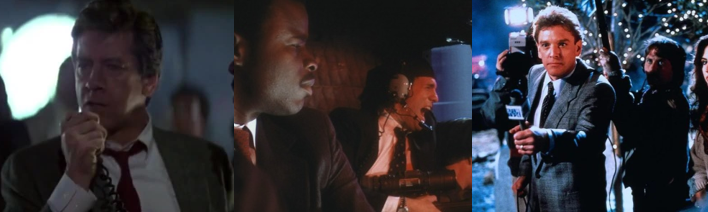
Although he means well, Robinson is clearly not used to being in the field; he refuses to listen to McClane’s warnings and outright criticises his attempts to help and desperately tries to negotiate with Gruber, completely oblivious to the fact that he’s being played for a fool. When the LAPD’s Special Weapons and Tactics (SWAT) team try to storm the tower by force, he witnesses a taste of Gruber’s firepower when Gruber’s men shoot out their spotlights and destroy the armoured transport vehicle (APV) with a rocket launcher. Rather than thank McClane for his assistance, which sees him kill several of Gruber’s men with a hastily-constructed bomb, Robinson chastises him for damaging the building, but even his ineffectual nature pales in comparison to the arrogant and self-righteous FBI agents. Even Powell can see that the FBI are just like Robinson, working from a checklist and foolishly believing that they’re in charge of the situation without realising that they’re just expediating Gruber’s plan and causing unnecessary danger. Indeed, the agents are so arrogant that they personally accompany the helicopters to retrieve the hostages, relishing the chance to kick some ass and paying the ultimate price for it when they’re caught in an explosion, despite McClane’s best efforts to ward them off (which almost get him killed!) As if that wasn’t bad enough, snivelling reporter Richard Thornburg (Atherton) learns of the commotion and forces himself into the investigation, doing a deep dive on McClane and his family in order to advance his career. This directly impacts the finale when Gruber learns of Holly’s connection to McClane from Thornburg’s invasive and wholly inappropriate report, which see her kids and family plastered all over the media. This is enough to earn him her undying wrath and she gives him a good sock to the jaw after finally being rescued, proving that her drive to protect her family is just as strong as her husband’s.
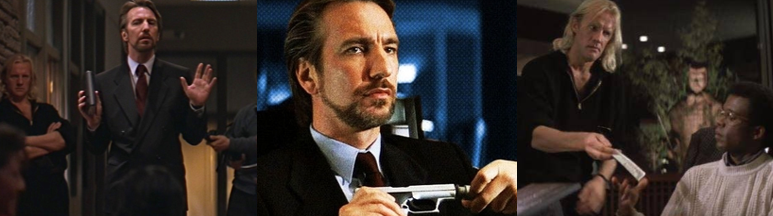
So, to say McClane is against the odds is putting it mildly. With only a single security guard on duty, he has no backup inside the building against Gruber’s heavily armed and physically imposing forces. McClane immediately antagonises Gruber’s most brutish henchman, Karl Vreski (Alexander Godunov), after he kills Karl’s brother, Tony (Andreas Wisniewski), in a brutal scuffle. A cold-blooded and merciless killer, Karl swears revenge and his burning need to kill McClane sees him disregard Gruber’s orders, warn his allies not to rob him of his quarry, and ends with him hanging from a chain, seemingly dead because of his vendetta. Gruber’s other most notable ally is Theo (Clarence Gilyard), the group’s wisecracking and enthusiastic tech specialist who happily applies his skills to cracking Takgaki’s safe, seeing it as a personal challenge, and directs his allies in fending off the SWAT team, laughing with glee at how outmatched the LAPD are against their firepower and his intellect. And then there’s Hans himself, a smooth talking, eloquent, unnervingly polite terrorist who commands not just the respect and loyalty of his crew but the attention of every room and scene he’s in. While he’s a reasonable man, Gruber is as psychotic as his underlings when pushed; he thinks nothing of executing Takagi and Ellis and is fully prepared to kill everyone in the building to pull off his heist, despite agreeing to Holly’s terms to treat the hostages humanely. Although positioned and selling himself as a revolutionary terrorist fighting against oppression, he’s actually little more than a common thief as his goal is to steal $640 million in untraceable bearer bonds from Takagi’s vault and abscond to a faraway beach, free from persecution thanks to his elaborate and well-executed plan. While he’s largely the commanding voice of reason and directs his men to focus on the big picture, such as retrieving his C4 explosives rather than wasting time and energy hunting McClane, he didn’t factor a lone New York cop into his schemes and his demeanour noticeably becomes more frustrated the more his operation is scuppered by this smart-mouthed “cowboy”. Gruber even comes face to face with McClane at one point when looking for his detonators and gains a deeper understanding about his foe; though Gruber’s accent and charade are good, McClane shows he’s more than a meathead by seeing through the act, but Gruber matches him at every turn, ordering Karl to “shoot the glass” when he notices McClane’s bare feet and even taking Holly hostage to ensure their escape in the finale.
The Nitty-Gritty:
I’ve never understood the debate regarding Die Hard’s status as a Christmas movie. Every year, memes and posts and arguments rage about whether it “counts” as a Christmas movie when the evidence is pretty clear that it absolutely is a festive film. For starters, it takes place on Christmas Eve and at the Nakatomi Christmas party; that alone is enough to qualify in my book, but we’ve also got an abundance of Christmas decorations (including trees and presents), a hip Christmas song, and a Christmassy jingle laced into the film’s score. For me, all it takes is for a film to be set during the Christmas season for it to be considered a Christmas movie, making the entire debate redundant from my perspective; plus, it’s a great excuse to watch Die Hard while the turkey’s roasting. The Christmas setting is a great excuse to have Nakatomi Plaza be empty save for its partying employees; it also helps set up some great puns and aggrieved commentary from McClane, who regularly laments about how unfair the situation is. Thanks to a combination of fear, adrenaline, anxiety, and his own juvenile nature, McClane provides a running commentary throughout the film to himself, Powell, and his foes. It’s clear he does this to cope with the extreme danger of his situation, but it also showcases his investigative mind as he ponders the accents and gear of Gruber’s gang, chastises his own reckless behaviour and bad ideas at every opportunity, and assaults his enemies with colourful insults as much as bullets and body blows.
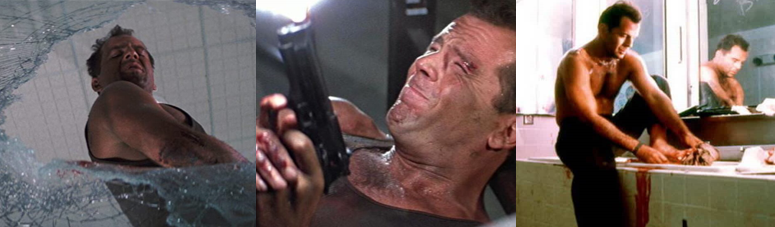
Whilst studying for my PhD thesis, I did a lot of background research into action cinema and, unsurprisingly, Die Hard came up quite a bit, especially regarding discussions of masculinity in Hollywood (and, specifically, this genre). For decades, action cinema and gender roles were defined by physicality; masculinity, especially, was embodied by hyper-masculine heroes like Schwarzenegger and Stallone, but this perception was challenged by the AIDS crisis and smaller, less troublesome statures and heroes became more prominent. Thus, not only did Stallone dramatically reconfigure his persona at this time, but McClane represented something very different to his peers; defined “through the voice, more wise-guy than tough-guy” (Tasker, 1993: 239), McClane was a “perpetual adolescent [who seemed] to be playing games”, cracking jokes and carrying “a sense of surprise and confusion that [the] explosive events are happening to him”. He thus personified the more relatable, rugged “Everyman” action hero; proactive individuals who faced danger not just with a fist or a gun but a smirk and a hefty amount of icy dialogue (ibid). However, McClane remains a figure of masculine power like his peers; Barry Grant (2007) noted that McClane survives multiple milestones throughout and ultimately triumphs, believing McClane’s heroics were linked to masculinity, patriarchy and their mythic representations since he conquers a clearly phallic structure, overcomes numerous male henchmen who challenge his masculinity, and ultimately defeats these villains to reclaim both his masculine potency and his wife. Indeed, Die Hard was noted by Steve Neale (2001) to be progressive in these gender codings as “fantasies of class- and gender-based resistance to the advent of a post-feminist/post-Fordist world [and] all the old lines of force and division between races, classes and genders are both transgressed and redrawn”. While you can read gender and political messages into almost any narrative, there’s some really interesting reading on the subject out there, especially in relation to Die Hard. I think what impresses me the most about this is how it allows the film, and this largely dismissed genre, to gain a bit more legitimacy in the eyes of academics; sure, it’s a bombastic action flick filled with blood squibs, wise cracks, and elaborate stunts but that doesn’t stop it from having intriguing academic appeal and opening discussions regarding gender roles.
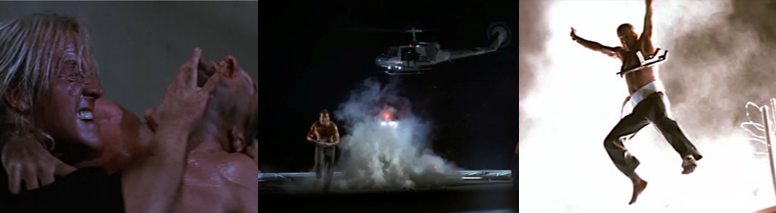
Indeed, while Die Hard is easily the most grounded and subdued of the franchise, which upped the ante to almost ridiculous (but no less entertaining) degrees, it still has some impressive set pieces, especially for a film set largely in one location. There’s the aforementioned APV assault, which sees the foyer rocked by explosions and ends with an impressive (if slightly dodgy) composite shot of McClane chucking C4 down an elevator shaft. And before this we have fun stuff like McClane blasting Marco (Lorenzo Caccialanza) through a table and then tossing him out a window, where he crashes onto Powell’s car and finally gets the LAPD out in full force. McClane’s fist fights with Tony and Karl are very brutal affairs; McClane takes quite a beating in each case and survives only by the skin of his teeth and is left sweaty and bloodied as a result. The damage he accumulates racks up to the point where he starts to consider that the odds aren’t looking too good in his favour; as he gingerly pulls glass shards from his feet, he tries to confide in Powell, who remains the steadfast voice of encouragement and hope. Things continue to escalate when Theo finally cracks the vault and Gruber enacts his final deception; he agrees to let the hostages go in exchange for safe passage on a helicopter, knowing full well that the FBI will double-cross him and rigging the rooftop landing pad to blow. Thanks to McClane, the hostages get to safety but Johnson and Johnson aren’t so lucky as their chopper is engulfed by the explosion. McClane, however, proves as resourceful as ever, leaping from the roof with a firehose as a makeshift safety line and smashing his way back into the building, narrowly avoiding a fatal fall in the process. Indeed, the film’s title is certainly apt as McClane continually avoids death even when he should probably have died several times over, though this takes a visual toll on his body and his mind as the film progresses, with him becoming noticeably bloodier and more desperate as things escalate.
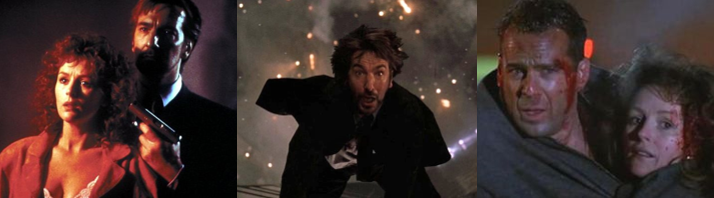
Thankfully, Powell in on hand to keep him together; their many radio exchanges see Powell shamefully admit to his mistake, which saw him transfer to a desk job and holster his revolver, an emotional arc that reaches a crescendo in the film’s final moments when Powell is forced to shoot Karl dead when he suddenly springs to life, thus allowing Powell to regain his confidence (and, if you want to read it that way, his own sense of masculinity; guns are a very phallic object, after all). After spending the whole movie pretending to be this cultured, intellectual terrorist revolutionary, Holly is disgusted and stunned to learn that Gruber’s simply in it for the money. Although many of his men have been killed by McClane, Gruber finally gets into Takagi’s safe and prepares to make his getaway, taking Holly as his hostage for collateral. However, McClane stumbles out from the embers, exhausted and bloody, to confront Gruber once more; as ever, though, he’s outnumbered and outgunned and dare not make a move since Gruber has Holly at gunpoint. With no other choice, McClane drops his gun and surrenders to Gruber, who prepares to shoot him and mockingly repeats a taunt McClane had flippantly thrown his way earlier, “Yippee-ki-yay, motherfuker”, causing them both to break out in laughter. This is all the distraction McClane needs to enact his final, desperate gambit; with his hands behind his head in a submissive gesture, he retrieves a pistol he taped to his back, guns down Eddie (Dennis Haden), and incapacitates Gruber with a shot, despite taking another bullet in the process. This sees the mortally wounded Gruber topple out the window, but he proves as persistent as his nemesis; caught up on Holly’s wristwatch (a gift from Takagi for her hard work), he prepares to shoot McClane only to be sent suddenly plunging to his death when McClane rips the watch from his wife’s wrist, symbolically shedding Holly from her career and returning her into the arms of her grateful and remorseful husband, their relationship having been galvanised by the whole traumatic ordeal.

The Summary:
Christmas is a great time of year. The food, the atmosphere, the presents…and the movies! Every year, I get to re-watch some of my favourite Christmas-themed films and Die Hard absolutely makes that list. Yes, you can (and should) watch it any time of the year but why not at Christmas, when the movie is set? Honestly, this is one of the all-time greats of the genre; more of an action/thriller, the film is a hugely entertaining depiction of one tenacious man’s fight against overwhelming odds and, while it can sometimes feel a little lengthy, it’s very fun and always enjoyable to watch every time. John McClane is a very different type of action hero; he’s vulnerable and flawed and has a smart mouth and a never-say-die attitude. He’s the perfect monkey wrench in Hans Gruber’s meticulous plot to get rich quick and the dichotomy between the two is half the fun of the movie. Even though they share very little screen time together, you can see them both growing more desperate and riled up and eager to take the other out as the film progresses, and this rising tension is both palpable and reflected in the escalating violence and destruction. I loved McClane’s snarky attitude, his quips and one-liners, and the humanising relationship between him and Al Powell, which really helps you remember that these action heroes are just normal people, deep down beneath the machismo. Another thing I love is how raw Die Hard is; it’s grounded and dirty and gritty and it really makes you feel it every time McClane takes a shot or a beating or a fall. Although it’s easy to just turn your brain off and enjoy a good time, I do like how the film invites deeper readings and academic discussion with its depiction of gender, masculinity, and violence. For me, Die Hard has endured the test of time; it reinvigorated the action genre and created one of the best protagonists of action cinema and it’s one of those films I both genuinely look forward to watching time and time again and which just gets better the more you watch it.
My Rating:
Fantastic
Are you a fan of Die Hard? Did you like how it reinvigorated the action genre with a snarky everyman hero or are you a fan of the more over-the-top protagonists? What did you think to Hans Gruber’s plan, his portrayal, and his crew? Did you enjoy McClane’s tenacity and snarky attitude? What did you think to the set pieces? Do you consider Die Hard to be a Christmas movie? What are your plans for Christmas Day today? Whatever your thoughts, feel free to comment down before and have a great Christmas!

 Dr. K's Waiting Room
Great review. No argument from me; this is one of my favorite Christmas movies.
LikeLike
Thank you 👍
LikeLiked by 1 person