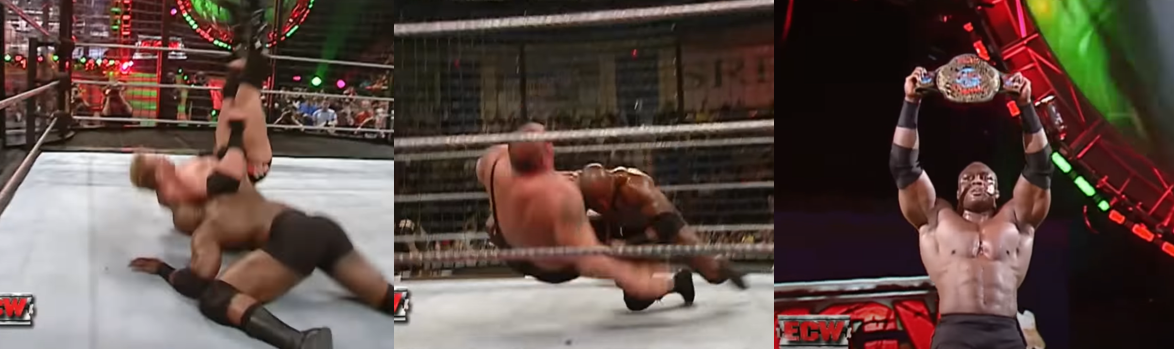
Wrestling Recap: Kurt Angle vs. Sting (Bound for Glory ’07)

The Date: 14 October 2007
The Venue: Arena at Gwinnett; Duluth, Georgia
The Commentary: Mike Tenay and Don West
The Referee: Rudy Charles and Andrew Thomas
The Stakes: Main event singles match for the TNA World Heavyweight Championship

The Build-Up:
On the 27 May 1996 edition of WCW Monday Nitro, Scott Hall declared war on World Championship Wrestling (WCW). He, Kevin Nash, and their “third man”, Hulk Hogan, hijacked WCW programming as the New World Order (nWo) and WCW dominated the “Monday Night Wars”. WCW’s saviour in this period was Sting, who disappeared into the rafters for almost a year before returning in a persona heavily inspired by The Crow (O’Barr, 1989; Proyas, 1994) to defeat “Hollywood” Hulk Hogan for the WCW Championship in an infamous match on this day in 1997. By 2007, however, the wrestling landscape had vastly changed; the unthinkable happened on 26 March 2001 when Vince McMahon, chairman of World Wrestling Entertainment (WWE), appeared on Monday Nitro to officially announce his purchase of WCW, thus ending the Monday Night Wars. While a handful of WCW wrestlers jumped to the WWE for an ill-fated “Invasion” angle, many chose to sit out their big-money contracts, and one WCW star who repeatedly turned down WWE was “The Icon”, Sting. Instead, Sting signed on with upcoming promotion Total Nonstop Action (TNA), an alternate to mainstream WWE founded by Jeff and Jerry Jarrett and initially part of the National Wrestling Alliance (NWA). Initially, Sting’s time in TNA was focused on opposing Jeff Jarrett, who held a stranglehold over the NWA World Heavyweight Championship, and in various feuds with Christian Cage and Abyss. When the NWA stripped TNA’s champions of their belts, Sting briefly captured the newly-christened TNA World Heavyweight Championship in a match mired in controversy. While Sting was undoubtedly one of TNA’s biggest signings, so too was former Olympic champion Kurt Angle, who made a shocking debut on October 6, 2006 and captured TNA’s top belt by making Sting tap out earlier in the year. After a short run with the TNA World Tag Team Championships, Sting earned himself another shot at the big belt and these two wrestling legends met once more in this one-on-one contest.

The Match:
As much of a wrestling fan as I am, it’s always been difficult for me to watch WWE on a consistent basis; over here in the United Kingdom, we usually have to pay extra for sports channels to watch the weekly shows, which is something I’ve never been interested in, so it was rare and exciting to have wrestling programming available on channels I was already paying for as part of my television package. TNA was one of those shows, and I dipped in and out of the product for quite some time; I watched some of the early years in the Asylum, where many of the low-tier WCW and WWE guys would battle it out over that piece of scrap tin the NWA called a championship and got my first taste of future stars such as AJ Styles, Abyss, and Samoa Joe as well as seeing personal favourites like Raven return to the ring. My peak for the company was when it transitioned to Impact Wrestling, a move I still disagree with, but I remember them signing big names like Sting and Kurt Angle and it really making me sit up and take notice. Sadly, a series of blunders meant that TNA/Impact never quite managed to reach the same level as the WWE but, for a while there, it was easily the number two wrestling promotion in the United States and things were legitimately very exciting in this much-needed alternative to the WWE mainstream. Where else, after all, would you get to see Sting and Kurt Angle battle for a World Heavyweight Championship? All this context is to say that, while TNA wasn’t quite as polished as the WWE powerhouse, they did the best they could to provide a different brand of wrestling and put on some truly exciting matches, and their hype package for this main event was emblematic of that as the video, while not to the standards of WWE’s production, set the stage for these two wrestling icons clashing in Georgia, the birthplace of WCW and Sting’s most memorable moments and of Angle’s Olympic gold medal victory.

A lengthy feeling out process soon saw Kurt Angle take control.

A couple of things I really enjoyed about TNA, especially during this time, was that they used a six-sided ring instead of the traditional four; while I’m sure this was difficult for many performers to adjust to, I always thought this helped the promotion stand out from the competition and thought it was a dumb move to remove that feature when Hulk Hogan and Eric Bischoff came along. Mike Tenay and Don West also liked to breakdown the match and its performers in a “Tale of the Tape” segment, which always lends an air of legitimacy to the contest in my eyes and essentially paints both competitors as being on somewhat even ground, although Angle was benefiting from a recent edge to his character and an association with Kevin Nash. Sting came out first to the unanimous support of the admittedly small audience and his absolutely dreadful TNA theme (nothing beats Metallica’s “Seek and Destroy”, in my opinion) and carrying his trusty baseball bat; Kurt Angle followed and man, it is weird not hearing the crowd chant “You suck!” at him and to see his vices still taking their toll. Once the bell rang, the two seemed a little cautious; they exchanged collar and elbow tie-ups and go-behinds at the start as part of a feeling out process, with Sting backing away whenever Angle grabbed the ropes to break his holds, but Angle’s wrestling prowess saw him get the upper hand in the early going with a takedown and a wrist lock. Sting showed he wasn’t just some showboat, however, by giving as good as he got; both men targeted the wrist and arm (a strange strategy considering both favour a leg-based submission hold…) and tried to out-wrestle each other with headlock takedowns. Things finally started to speed up once Sting whipped Angle off the ropes; Angle scored with a shoulder block, but Sting landed a beautiful hip toss that was enough for Angle to flee to the outside. Angle took his time getting back into the ring and switched from indulging him with tie-ups and went on the offensive with a gut kick, a European uppercut, and some knife-edge chops against the ropes.

Sting’s tenacity took a beating thanks to Angle’s resourcefulness and Nash’s interference.

A burst of adrenaline saw Sting shrug these off, however; he landed some chops of his own followed by the ten punches in the corner. An awkward reversal exchange saw Angle block Sting’s next attempt to whip him into the ropes, but he ate a dropkick and took a clothesline to the outside after Sting frantically kicked him off a potential Ankle Lock attempt. Sting eventually followed and rammed Angle into the guard rail and onto the announcer’s table before tossing him back into the ring. Angle’s attempt to regain some momentum saw him fly shoulder-first into one of the ring posts but a rake to the eyes allowed him to escape the Scorpion Death Drop. Suddenly, the match turned in Angle’s favour; he planted Sting with a snap German Suplex, followed up with a backbreaker and a couple of unsuccessful pin attempts, before once again beating on Sting and choking him in the corner. A vertical suplex scored a two count, then Angle locked in a body scissors around Sting’s ribs, which he transitioned into a headlock and ended with a belly-to-belly suplex that tossed Sting across the ring. Angle continued the pressure with a chin lock to keep Sting grounded, allowing both men to catch their breath and building tension as Sting rallied for support to power back to his feet. A double clothesline saw led to a dramatic ten count and another chance to the clearly winded competitors to recuperate; a slugfest followed, which saw Sting repeatedly plant Angle with a series of clotheslines and a big spinebuster. Sting’s first cover of the match resulted in a two count and directly led to him hitting his patented Stinger Splash on an absolutely drenched Angle, and then another to the champion’s back followed by a running faceplant. Oddly, Sting then went to the top rope; not sure why or what the hell he was thinking but it was a moot point as Angle leapt up and tossed him down with a big suplex for another near fall. Sting slipped out of an Olympic Slam and tried a roll-up for another close two count, then Angle got pissed and started pounding the life out of Sting with not one, not two, but three successive German Suplexes. Feeling the intensity raging through him, Angle dropped the straps and slapped on the Ankle Lock, but Sting was able to roll over and, inexplicably, reverse it into the Scorpion Deathlock! Unfortunately for the Icon, Angle’s wife, Karen, rushed to the ring the distract him and the referee, which allowed Kevin Nash to plant him with a clothesline.

In the end, Sting’s trusty bat and finishing move secured him his first, if brief, TNA Championship.

Angle then scored with the Olympic Slam but the referee was busy dealing with Karen so he was a little too late for the count, meaning Sting kicked out. Angle then sat Sting on the top rope but, while Sting was able to fight out of a belly-to-belly suplex, his attempt at a diving splash saw him eat nothing but knees, though he still kicked out of the pin. Angle then planted Sting and hit this trippy somersaulting knee drop, like a version of the 450 Splash, but it still only got a two count. Frustrated by Sting’s tenacity, Angle went for the Ankle Lock again, this time right in the middle of the ring; Stin rolled out and sent Angle flying into Nash. However, when Sting ducked Angle’s wild clothesline, referee Rudy Charles got taken out and thus Sting was left frantically motioning for a new referee after planting Angle with the Scorpion Death Drop. Referee Andrew Thomas tried to make the three count but Nash yanked him out of the ring and punched him out before putting a beating on Sting in the corner. Sting took both Nash and Angle down with a double clothesline, however, but got a good ol’ shot to the nuts from Angle for his efforts. Tenay tried to say that Sting managed to block a shot from Angle with his own baseball bat but he clearly wasn’t fast enough as you can see the bat hit him and he ends up bleeding as a result. Still, Sting snatched the bat away and busted Angle open before finally taking Nash out of the equation. Sting then hit another Scorpion Death Drop and Rudy Charles came around long enough to make the final three count, thus awarding Sting another World Heavyweight Championship, much to the delight of the crowd, the announcers, and Sting himself. Sadly, though, this was quite the lethargic affair; considering the two had a bit of a grudge heading into the match, the energy was lacking and it was a very slow and by-the-numbers affair, possibly to cover for Sting’s limitations and Angle’s physical issues. Both guys seemed to get winded very quickly and the referee bumps and interference weren’t really necessary, and the whole contest felt like it was on the verge of kicking into a higher gear but just never got around to it.

The Aftermath:
Sting’s first of four reigns as the TNA World Heavyweight Champion wouldn’t last long; he dropped the belt back to Kurt Angle two days later on an episode of TNA Impact! after interference by Kevin Nash. The two then faced off again the following month at Genesis in a tag team match; Sting and the recently-debuted Booker T took on Angle and Nash, with Angle again emerging victorious. Sting then took a bit of time away from TNA and even teased his retirement, before returning in 2008 and joining forces with Angle, Nash, and Booker T and Scott Steiner as the Main Event Mafia to battle TNA’s younger stars in a turf war. This not only saw Sting reclaim the top belt but reignited his feud with Angle, which eventually led to the stable turning on the Icon, and he and Angle continued to trade wins, losses, and the championship belt even as Sting’s sanity began to slip. Sting and Angle last shared a TNA ring together in 2013 when they reformed the Main Event Mafia to oppose the Aces & Eights stable; both men were inducted into the TNA Hall of Fame (with Sting being the very first inductee) and the WWE Hall of Fame and even showed up on WWE programming later down the line. However, while Angle officially retired from in-ring competition in April 2019, Sting bounced back from what seemed like a career-ending injury to become an active mentor and competitor in All Elite Wrestling (AEW).

My Rating:

Rating: 2 out of 5.

Could Be Better

What did you think to the contest between Sting and Kurt Angle at Bound for Glory 2007? Were you excited to see Sting and Angle be a part of the TNA roster at the time? Did the pacing and interference bother you? What did you think to Sting and Angle’s time in TNA and what are some of your favourite matches and moments from their time there? Were you a fan of TNA? Which of Sting’s “Crow” eras, personas, and matches are your favourite? Whatever your thoughts on Sting, and this match in particular, feel free to voice them below or leave a comment on my social media.

Movie Night: Aquaman and the Lost Kingdom

Released: 17 March 2023
Director: James Wan
Distributor: Warner Brothers
Budget: $205 million
Stars: Jason Momoa, Patrick Wilson, Yahya Abdul-Mateen II, Randall Park, Temuera Morrison, and Amber Heard

The Plot:
Desperate to find the means to avenge himself against Arthur Curry/Aquaman (Momoa), pirate David Kane/Black Manta (Abdul-Mateen II) stumbles upon the mythical Black Trident, which possesses him and compels him to unleash an ancient threat so powerful Aruthur is forced to join forces with his deposed brother, Orm Marius (Wilson).

The Background:
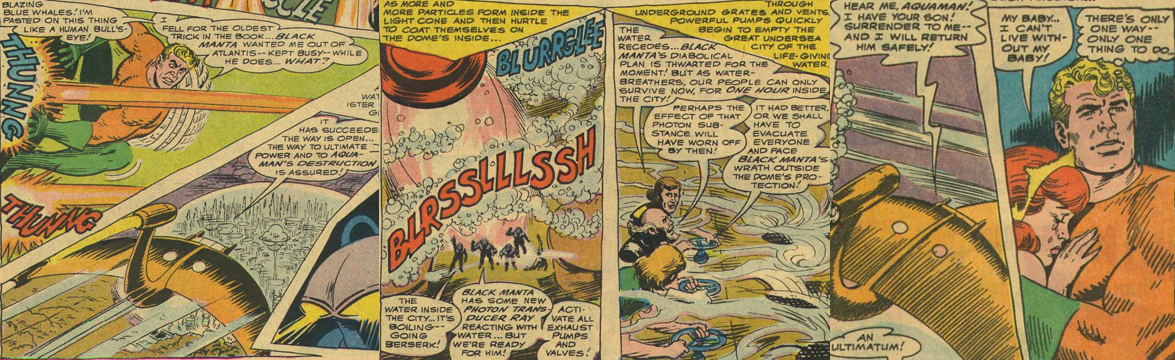
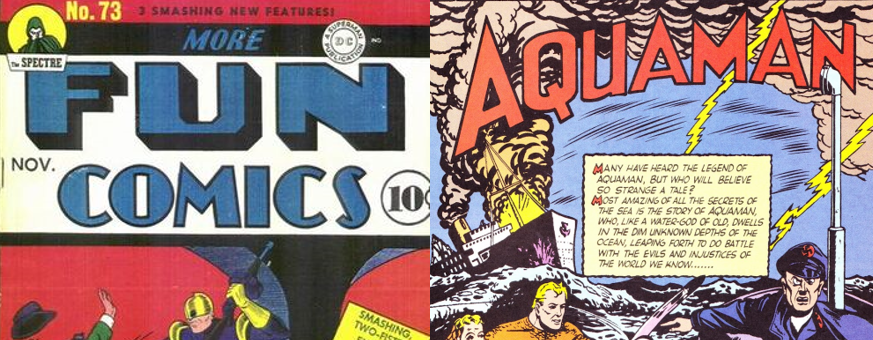
Back in 1941, Mort Weisinger and Paul Norris created the character of Arthur Curry as part of DC Comics’ (then known as National Comics) desire to capitalise on the success of Clark Kent/Superman and Bruce Wayne/Batman. Although subject to unfair ridicule over the years, Aquaman ultimately had the last laugh when, after years of Development Hell and aborted projects, his live-action debut was met with critical and financial success. Following a short-lived animated spin-off on HBO Max, a planned horror-themed spin-off was thankfully cancelled and a sequel was quickly greenlit; both Momoa and director James Wan were enthusiastic to explore other kingdoms and regions of Atlantis and the vast underwater realm, though the film attracted unwanted media attention when star Amber Heard was accused of abusing her husband, Johnny Depp. Many called for her to be recast and, while Warner Brothers initially shot this request down, it was reported that her role had been significantly reduced as a result of the circus of a trial that followed. The production also stalled due to the COVID-19 pandemic, which changed the release date numerous times but did give the visual effects team more time to work on the film. This apparently also involved excising cameo appearance from one or more Bruce Wayne/Batman actors as James Gunn geared up towards completely restarting the DCEU, with Gunn apparently providing some notes to the filmmakers. After much drama and delays, Aquaman and the Lost Kingdom finally released to largely negative reviews; critics attacked the brainless plot and clunky pacing, though Wan’s direction and Momoa’s enthusiastic performance were praised. As of this writing, the film has currently grossed $340.6 million at the box office but it’s largely academic; Momoa isn’t expected to reprise the role in Gunn’s new DC Universe and no new Aquaman projects have been announced yet, leaving the character essentially dead in the water no matter how much money the sequel makes,

The Review:
I was pleasantly surprised by Aquaman; it was big, colourful, mindless fun in an era when the DCEU was unnecessarily dark and bleak, and it altered Aquaman’s characterisation in a way that made him so much more entertaining and relatable. Jason Momoa attacks the role with such relish and natural charisma that it’s easy to overlook flaws in logic or pacing, and that same charm returns in this sequel. Of course, it helps that he’s disgustingly good looking and absolutely shredded, but Momoa’s Aquaman has the kind of Dude/Bro mentality and whimsical childishness that really brings a smile to my face. In this film, a lot has changed for the slovenly brute who once shunned humanity and responsibility; he’s now the King of Atlantis, doting father to Arthur Junior (Various), and loving husband to Y’Mera Xebella Challa (Heard). First, let’s address the elephant in the room: yes, Mera is in this movie but no, she does not have much of a role. In fact, given all the controversy surrounding Amber Heard, I was expecting Mera to be killed off and it does seem like that almost happened; instead, she’s merely severely wounded by Black Manta and taken out of the second act of the movie, only to make a minor reappearance at the end to help Arthur and Orm and get the baby to safety. I can fully understand this, and it’s not like her presence is really missed; she still impresses in her skin-tight outfit and gets to show off her hydrokinetic powers, but the plot doesn’t require her presence and it’s better she was given less prominence considering everything that happened. Interestingly, much of her character development from the first film is repeated with Orm; he’s prejudiced against the surface world like Mera was, confused by their words and ways, and slowly comes to enjoy some of our customs by the movie’s end, though these lessons are reframed in the context of Arthur encouraging a stronger bond between them and him pulling pranks on his relatively naïve younger brother by tricking him into thinking cockroaches are a delicacy!

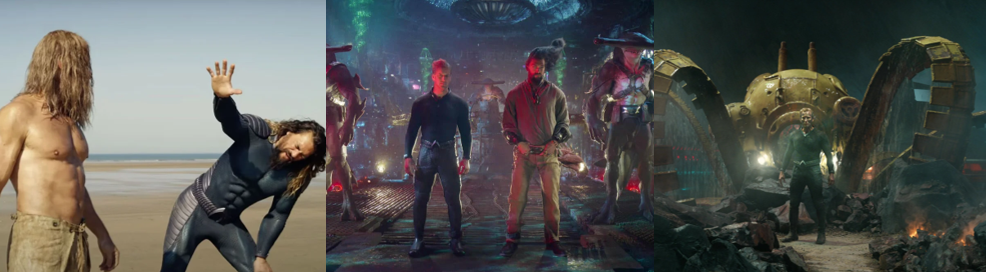
Now a father dissatisfied with the crown, Arthur teams up with his brother to face a powerful threat.

So, there’s not much focus on the romance here; even Arthur’s father, lighthouse keeper Tom (Morrison) and Queen Atlanna (Nicole Kidman) don’t share a scene together until the start of the third act, and Arthur’s initial conversations with his father even somewhat imply that Atlanna is dead. She’s not, but her role here is equally minimal and simply the catalyst to unite her two estranged sons into joining forces. Instead, we’re left with Arthur, but that’s more than enough! Despite his big victory in the first film, Arthur is bored by the crown, his duties, and the endless politics of the Atlantean council, which handicap him with bureaucracy. A child of both worlds, he spends as much time out of the sea as he does in it to care for his son, something with many of his kingdom resent, and his desire to reveal Atlantis to the surface world and work with them to reduce pollution and climate change are continuously shot down. Frustrated by self-doubt about his role as a leader, Arthur is almost giddy when David Kane returns armed with a powerful trident of his own and wielding forgotten Atlantean technology. Kane’s plot to steal Atlantis’s highly volatile stockpiles of Orichalcum and exacerbate the heating of the world (which also causes a deadly plague to kill many Atlanteans, including Arthur’s mentor, Nuidis Vulko (Willem Dafoe), between movies) causes Arthur great distress. With no way of tracking Black Manta, Arthur enlists the help of King Nereus (Dolph Lundgren) and Topo the octopus to sneak into the desert prion where Orm is held captive and enlist his help since he’s the only one who may be able to lead them to Kane. Arthur jumps at the chance for some action, even if it risks all-out war breaking out, as he’s desperate to get into the thick of it again, to say nothing of trying to connect with his brother and settle the score with his old rival.

Orm is disgusted by his brother’s childishness but proves surprisingly trustworthy.

This dysfunctional dynamic is where the heart of Aquaman and the Lost Kingdom lies, and where much of its entertainment value comes from. Emaciated from his time in prison and embittered by his brutish brother’s lack of decorum when it comes to the throne, Orm is depicted as a conniving, untrustworthy bigot who lusts for power. Yet he agrees to help Arthur, and even stats he will willingly return to custody afterwards, out of loyalty to Atlantis, and never misses an opportunity to chastise his brother’s buffoonery and overreliance on his muscles. Orm emits a more stately persona, attempting to use diplomacy rather than brute force; he’s able to lead them to an underwater den of debauchery and an aquatic crime boss, the appropriately named Kingfish (Martin Short), to get information on Black Manta’s location and even drops condescending advice to Arthur about what it means to be a king. The banter and bickering between Arthur and Orm is great; Orm is visibly disgusted by his older brother, and the humiliation he felt at his hands, while Arthur tries to win him over with his boisterous personality and surface world benefits such as beer and cheeseburgers. Although King Nereus cautions about trusting Orm, the former Ocean Master proves surprisingly reliable; he never runs from a fight, doesn’t attempt to kill or sell out Arthur, and doesn’t even show envy at learned Arthur married Mera. Although it seems like Orm is happy to leave King Nereus to die, he saves the king and earns his respect in the process, and even readily joins Arthur in battling Black Manta when he could easily slip away and let them kill each other. Orm proves equally invaluable in delivering exposition about the Black Trident and the titular lost kingdom of Necrus, though the two brothers are briefly set against each other in the finale when Orm claims the Black Trident and briefly falls under its malicious sway.

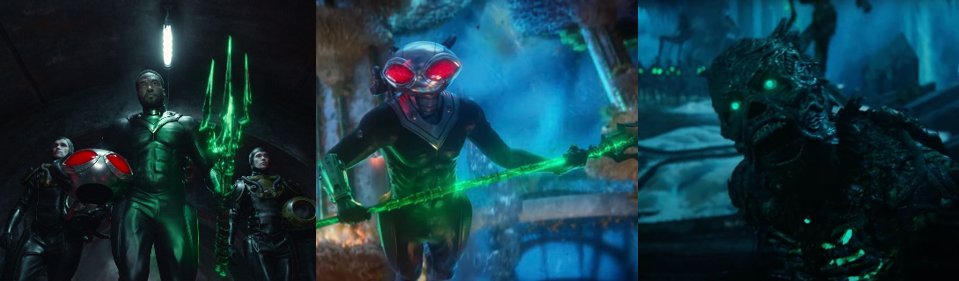
Possessed and empowered by the Black Trident, Black Manta’s threat is significantly increased,

Established in the first film as a vengeful, sadistic mercenary, David Kane has become obsessed with discovering the secrets of Atlantis so he can repair his Black Manta suit and avenge himself on Aquaman. Kane’s fascination with Atlantis is shared by his reluctant scientific advisor, Doctor Stephen Shin (Park), who’s longing to see Atlantis is manipulated by Kane into helping him figure out Necrus’s ancient weapons. Once he finds the Black Trident, Kane is bombarded with visions, promises of power, and a superhuman lust to free the imprisoned King Kordax (Pilou Asbæk), who’s dark magic slowly infests Black Manta and drives him to the brink of insanity. Even Orm is stunned to learn of Black Manta’s newfound viciousness, which sees him threaten the entire world with climate instability simply for the sake of it rather than for any kind of ransom, and Kordax’s influence means Black Manta can now go toe-to-toe with both Aquaman and Orm without his power suit. However, he still utilises his technology, blasting his enemies with beams of intense energy and combines both science and magic (and a massive disrupter cannon on a repurposed Necrus ship) to showcase his new might. Black Manta’s need to awaken King Kordax and his list for revenge are so powerful that he targets Arthur’s family, critically wounding Mera and Tom and even kidnapping his son with the intention of using his blood to destroy the magic seal imprisoning the undead king. As for King Kordax, he’s more of an ethereal spirit, a ghastly skeletal wraith who whispers in Kane’s ear, possesses any who touch the Black Trident, and formally commanded a legion of undead warriors in battle against his brother, King Atlan (Vincent Regan). Desperate to return to unlife once more, he feeds the ego of whoever wields the Black Trident, compelling them to spill the blood of Atlan’s bloodline so that he and his army can ransack the entire globe!

The Nitty-Gritty:
Aquaman and the Lost Kingdom charts the natural next chapter in Arthur’s story; this loveable manchild feels increasing pressure on all sides to grow up and be more responsible as a husband, father, and leader, roles that he attacks with his usual juvenile vigour but which he finds himself questioning at times. Though devoted to his family, he finds the politics of the crown tedious and expresses dissatisfaction with the role, which he only fulfils out of obligation to his mother and his people. There’s no question that he’s a good father (indeed, Tom encourages Arthur to have more children!) or that he wants what’s best for Atlantis, but he desires a worldwide unity that the council aren’t willing to risk and struggles to balance both sides of his life. These issues are explored through his tumultuous relationship with Orm; both were denied a childhood together and are wary, if not frustrated, by each other, with only their love for Atlanna and Atlantis keeping their fragile alliance alive throughout most of the film. They’re two halves of the same coin, though, and both learn a lot from the other; Arthur learns more about what it takes to be a king and Orm learns to not be such a dick and enjoy other cultures. However, while they’re one of the best parts of the film, I would’ve liked to see a little more of this; perhaps a scene or two where Orm does abandon Arthur, or one where Arthur’s knowledge of the surface world helps Orm, or seeing Orm’s stoic disdain crack upon learning that he’s an uncle. The galvanising love show to them both by Atlan helps fill these gaps, as does the presence of King Nereus and the Brine King (John Rhys-Davies), who have their own issues with Orm, but it does feel like some scenes were left on the cutting room floor to keep the pace up.

The visuals and costumes continue to impress, and the fight are more personal this time.

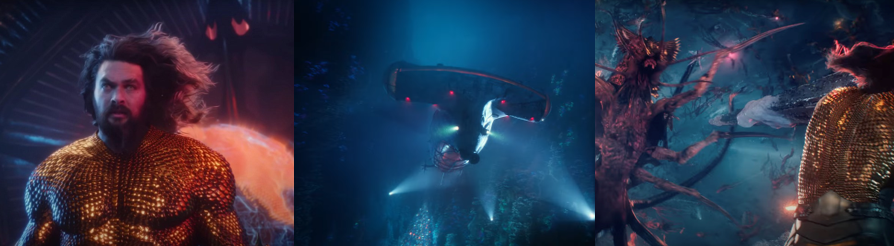
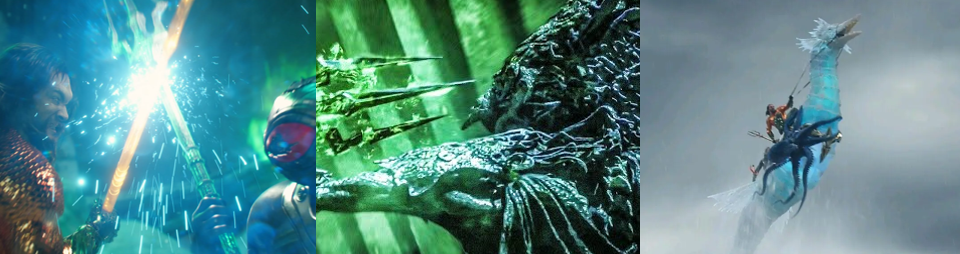
Not that that’s a bad thing; Aquaman and the Lost Kingdom has a very brisk pace that doesn’t waste too much time, but it’s also learned to not interrupt every character moment with a dramatic explosion (there’s even a tongue-in-cheek reference to that at one point. The underwater realms are as captivating as ever, being a neon-drenched wonderland of strange, almost monstrous undersea races and futuristic technology alongside rusted apparatus and long forgotten ancient ruins. Aquaman’s ridiculously good orange/gold armour returns, looking better than ever, and he even gets a sleek, form-fitting black/blue suit and makes him invisible for a few moments at a time, perfect for sneaking into the arid desert prion and battling the dried-out, horrifying guards who dwell there. Although Orm is shafted in the costume department this time around, Mera still catches the eye in her tight little number and Black Manta steals every scene in his ludicrous saucer-like helmet. The fight sequences are much more intense this time, too; moving away from full-scale undersea battles to focus on gritty melee combat, the fights between Aquaman and Black Manta are great now that Kane has received a power boost and is a significant threat able to hideously burn even Atlantean flesh. There are a fair few visually interesting locations on offer as well, from the throne room and market square of Atlantis to the scorching desert and the overgrown, hazardous forest on Black Manta’s island (complete with volcano lair) thanks to the presence of polluting Orichalcum. A fair bit of the film involves ice and frozen locations, too, with Necrus and his army encased in an icy tomb, but overall I found the CGI and action sequences to be really well done; perhaps a bit less bombastic at times, but the focus on crafting meaningful fight scenes benefitted the plot greatly, I feel.

Arthur and Orm come together to defeat Black Manta and repair their relationship.

Despite working surprisingly well as a team, Arthur and Orm are unable to defeat Black Manta; they disrupt his operation, with the help of the remorseful Dr. Shin, but find Kane is willing to sacrifice Arthur Junior to set King Kordax free, leading to a more concentrated assault against Black Manta and the quickly rising undead army of the entrapped king. Determined to save his son, Aquaman battles Black Manta once more, only to find Kane has been fully overtaken by the malicious Kordax. Luckily, Mera and Orm are both on hand to get the baby to safety, but Orm falls under Kordax’s spell when saving Mera and his nephew from certain death. Although it seems like the two brothers are about to fight once more, Arthur tries a different approach, one influenced by his time with Orm and his desire to build bridges between them. Instead of fighting, Arthur also grabs the Black Trident and tries to reason with his brother, with both struggling against Kordax’s influence, and successfully talks Orm down. Orm then provides Arthur with the means to destroy the awakened undead king and finally acknowledges him as his brother in the aftermath, where all involved agree to say that Orm perished in the battle as thanks for his help. With Orm out exploring the surface world for the first time, Arthur makes the decision to finally reveal Atlantis to humanity, directly addressing the United Nations and calling for a global effort in reversing the damage done to the environment and thus ending the DCEU on a surprisingly hopeful message. Sure, the climate change aspects of the film are a little ham-fisted, but I think they’re to be expected in an Aquaman story, especially as suspicion of humankind is such a prominent aspect of the mistreated Atlanteans.

The Summary:
I was excited for an Aquaman sequel; I’ve loved Jason Momoa in the role right from the start and really enjoyed the first film, so it bugged me that Aquaman and the Lost Kingdom was delayed and pushed back and mired in controversy and said to be awful. It really isn’t, to be fair; it’s not as good as the first (though repeated viewings may change that opinion) but it’s not an incomprehensible mess, an ugly noise of awful CGI, or a lacklustre bore-fest either. It’s a fun, thrilling, and surprisingly intense adventure; Black Manta’s vendetta against Aquaman is deeply personal, as are the issues between Arthur and Orm, and the performances of those three actors really sell that. Kane is a cold-blooded, merciless pirate who blood on his mind; Orm is a bitter and resentful fallen king; and Arthur is just trying to do the right thing but struggling with his suitability to the throne. While the actors all do a fantastic job of embodying their roles, the visual effects are absolutely top-notch; I love seeing these characters come to life, Atlantis is a gorgeous undersea society, and the various dishevelled ruins and repurposed technology really give a sense of scale and time to this world. The bickering between Arthur and Orm more than makes up for Mera’s dramatically reduced role and makes this more of a dysfunctional buddy comedy at times, but the more personal and fierce fight sequences are just as appealing to me. It’s shame that the DCEU died out so quickly; I don’t relish having to restart Aquaman’s story and find a new actor for the role, but at least we have these two movies to show us what the character is capable of in the right hands. Ultimately, Aquaman and the Lost Kingdom may not be the best DCEU or superhero movie you’ll ever see, but I think it’s definitely high in the ranks and worth your time for the lead actor alone, but there’s plenty to enjoy beyond that if you’re simply looking for a fun and surprisingly intense action film.

My Rating:

Rating: 4 out of 5.

Great Stuff

Did you enjoy Aquaman and the Lost Kingdom? How do you think it compares against the first film and other DCEU movies? Did you enjoy Jason Momoa’s performance and Arthur’s relationship with Orm? Were you glad that Arthur Junior was spared the fate of his comic book counterpart? What did you think to Black Manta and his newfound power boost? Were you annoyed by the climate change plot, or did you find it suitable for the film? Who would you like to see portray Aquaman in James Gunn’s new DC Universe? Whatever your thoughts on Aquaman and the Lost Kingdom, and Aquaman in general, drop a comment below or on my social media.

Movie Night [Christmas Day]: Die Hard

Released: 15 July 1988
Director: John McTiernan
Distributor: 20th Century Fox
Budget: $25 to 35 million
Stars: Bruce Willis, Alan Rickman, Bonnie Bedelia, Reginald VelJohnson, Paul Gleason, and William Atherton

The Plot:
New York City police detective John McClane (Willis) arrives at the Nakatomi Plaza in Los Angeles to reconcile with his estranged wife, Holly Gennero-McClane (Bedelia). Things quickly turn south when Hans Gruber (Rickman) and his gang of terrorists take the building hostage, leaving McClane to wage a one-man war.

The Background
In 1979, writer Roderick Thorp published a sequel to his 1966 thriller, The Detective; inspired by The Towering Inferno (Guillermin, 1974), Nothing Lasts Forever was well-received and soon shopped around Hollywood, with Thorp hoping Frank Sinatra would reprise his role from the adaptation of The Detective (Douglas, 1968). Instead, the concept ended up in the hands of struggling screenwriter Jeb Stuart, who was given free reign as long as he retained the Christmas-in-Los-Angeles setting. Drawing from personal experiences with married life, Stuart reimagined Thorp’s aging detective, Joe Leland, into a flawed everyman, though remained largely faithful to the spirit of the source material. After Sinatra turned down the lead role, the project was offered to some of Hollywood’s biggest action stars, including Arnold Schwarzenegger and Sylvester Stallone, before Bruce Willis (then known more for his comedic efforts) was cast as the wisecracking John McClane and subsequently redefined not only his career, but the portrayal of action heroes in general. Die Hard was the silver screen debut for the late, great Alan Rickman, who was won over by the wit and intelligence of the script and even had some creative input on his character thanks to his theatre background. Screenwriter Steven E. de Souza came onboard for a rewrite, which framed the narrative as though Hans Gruber were the protagonist, though director John McTiernan allowed Willis and the other actors room to improvise during the shoot, which was based almost entirely in and around the Fox Plaza in Central City. Willis performed many of his own stunts, suffering partial hearing loss as a result; the stunts were dangerous and complex for cast and crew alike, though McTiernan couldn’t resist dropping Rickman early to produce a genuine look of fear for Gruber’s fall. In defiance of low expectations, Die Hard was a massive financial success, making around $140 million at the box office, revitalising both 20th Century Fox and the action genre. Although initial reviews were mixed, praising the direction and stunts but questioning Willis’s performance, the film was seen as a breakout role for the actor, one that redefined the action hero stereotype into a more vulnerable and snarky tough guy. After proving to be equally popular on home video, this success naturally translated into a sequel two years later, a venture that proved even more profitable and led to an entire franchise of additional sequels, videogames, and ancillary media of varying quality that nonetheless cemented Willis’s status as a smart-mouthed action hero.

The Review:
Believe it or not, but there was a time when I wasn’t much of a Die Hard fan. Despite growing up on action movies, specifically those starring Arnold Schwarzenegger, kid me always found Die Hard to be a little too slow and “grown up” compared to the Austrian Oak’s films. Eventually, however, I grew up a bit and did a binge watch of the then-trilogy of Die Hard films and realised what I’d been missing out on. Specifically, Bruce Willis establishing himself as a mainstream action icon with these films, in particular this first Die Hard movie, which is still the undeniable best of a surprisingly strong action franchise. McClane separates himself from his action movie counterparts by being the quintessential “Everyman”; he’s physically fit, yes, but not some musclebound brute and he’s far from invincible, gradually becoming more injured and fatigued as the movie goes on. He’s easy to relate to because he’s a very flawed character; his marriage is on the rocks, he’s seen as insubordinate and a liability by his peers, he makes mistakes, and he’s forced to adapt, always one wrong move away from certain death. This is in stark contrast to the likes of Schwarzenegger and Stallone; while they have certainly portrayed more grounded, vulnerable, and human characters, they’re best known for being virtually unstoppable and overcoming the odds through sheer brute force, whereas McClane has to use his wits, cunning, and sheer force of will to triumph.

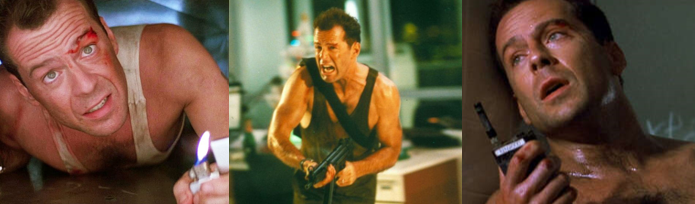
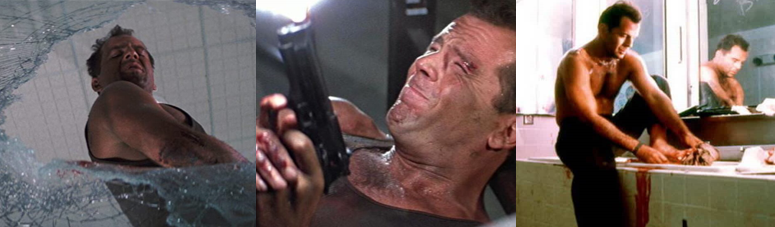
Smart-mouthed John McClane is the only man tenacious enough to rescue the terrified hostages.

John McClane is portrayed very much as a fish out of water since he is both a New York City cop in the unfamiliar surroundings of Los Angeles and a rugged working man amidst a skyscraper full of well-heeled business types. Although rough around the edges, he’s treated warmly and with respect by Joseph Takagi (James Shigeta) and invited to join the Nakatomi Christmas party, but he’s focused solely on reconnecting with Holly, who has managed to build a successful career for herself without McClane, much to his chagrin. While he’s clearly still in love with her and wants to build bridges, if only for the sake of their young children, McClane is handicapped by a natural immaturity that causes only further arguments rather than him simply admitting to his mistakes. A career cop, McClane is always taking in his surroundings and has a suspicious nature that allows him to separate bullshitters like Harry Ellis (Hart Bochner) from the honest, like Argyle (De’voreaux White), his overly chatting limo driver. This talent goes hand in hand with his adaptability and stubborn nature, from which the film takes its title; though outnumbered and outgunned and definitely in way over his head, McClane keeps his wits about him and is always trying to find some way to get help or pick off his assailants and is intuitive enough to assess the threat posed by the terrorists based on their accents, firearms, and tactics. Basically caught with his pants down, McClane finds himself the only one capable of raising the alarm when Hans Gruber and his goons take over the tower, executing Takagi and taking his employees hostage while they work on breaking into the vault. Outnumbered, outgunned, and without even his shoes, McClane’s first instinct is to call for help, only to be repeatedly met with scepticism, endangering himself and forcing him to flee or fight, with tenacity in equal measure. Though armed only with his service pistol, McClane soon acquires a machine gun (“Ho-ho-ho”), but it’s not enough to tackle Gruber head-on. Instead, McClane fights with a brutal and rabid animal spirit; often physically outmatched by his foes, he takes quite a beating in every encounter and only emerges victorious due to his stubborn nature or taking risks that further damage his body, slicing his feet on glass shards, tumbling down stairs, getting shot, crawling through ventilation ducts, and defying physics and death alike with a desperate leap from the rooftop with only a firehose as a lifeline!

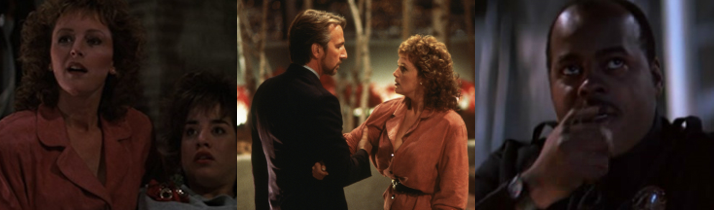
McClane’s only ally and supporter in rescuing his equally spirited estranged wife is Powell.

If anyone knows about McClane’s stubborn nature, it’s his wife, Holly. A driven and determined career woman, Holly moved to Los Angeles with their kids to make a go out of it in the corporate world and, despite McClane’s doubts (and hopes), actually succeeded in her new role. Though warm, kind, and friendly, Holly is sick of McClane’s thick-headed ways and bullish nature; she has no problem calling him out or standing up to him and just wants to be treated with some respect. Although he knows what he needs to do to repair their relationship, McClane struggles to express himself and often falls back on accusations and jealousy, widening the gap between them. When she’s taken hostage, Holly remains calm and composed but brings the same fiery energy when she’s forced to speak up for her fellow colleagues in place of Takagi; even Gruber comments on her dependable and forthright nature, which helps her act as a mediator between the groups in a far more effective way than her coked-up colleague, Ellis. When she learns that McClane is at large in the building and causing Gruber trouble, Holly begins to hope; despite their differences, she knows that McClane will fight to the bitter end to get the job done, but even she is shocked by the state he’s in by the end. While Los Angeles’ finest are often more of a hinderance than help to the fatigued and aggravated McClane, his most vocal supporter outside of the tower is Sergeant Al Powell (VelJohnson), a Twinkie-loving father to be who’s struggling with guilt after accidentally shooting a kid. Alerted to gunfire and a disturbance at Nakatomi Plaza, Powell is horrified by what’s happening inside. Going with his gut, Powell becomes McClane’s primary contact, much to the ire of Deputy Chief Dwayne T. Robinson (Gleason). While Robinson believes McClane is as much of a problem as the terrorists, if not one of them, and prefers to go by the book and suck up to Agent Johnson and Johnson (Robert Davi and Grand L. Bush) of the Federal Bureau of Investigation (FBI), Powell is much more “boots on the ground” and helps McClane stay sane and motivated and to stop and think about the big picture regarding the takeover.

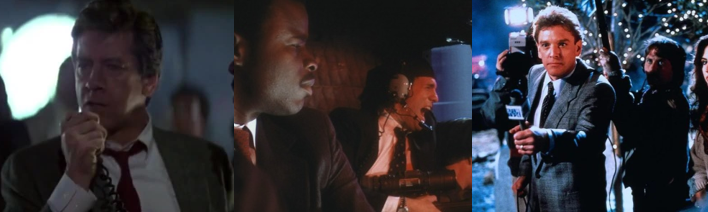
McClane feels very unappreciated by the bureaucratic and arrogant pen-pushers on the outside.

Although he means well, Robinson is clearly not used to being in the field; he refuses to listen to McClane’s warnings and outright criticises his attempts to help and desperately tries to negotiate with Gruber, completely oblivious to the fact that he’s being played for a fool. When the LAPD’s Special Weapons and Tactics (SWAT) team try to storm the tower by force, he witnesses a taste of Gruber’s firepower when Gruber’s men shoot out their spotlights and destroy the armoured transport vehicle (APV) with a rocket launcher. Rather than thank McClane for his assistance, which sees him kill several of Gruber’s men with a hastily-constructed bomb, Robinson chastises him for damaging the building, but even his ineffectual nature pales in comparison to the arrogant and self-righteous FBI agents. Even Powell can see that the FBI are just like Robinson, working from a checklist and foolishly believing that they’re in charge of the situation without realising that they’re just expediating Gruber’s plan and causing unnecessary danger. Indeed, the agents are so arrogant that they personally accompany the helicopters to retrieve the hostages, relishing the chance to kick some ass and paying the ultimate price for it when they’re caught in an explosion, despite McClane’s best efforts to ward them off (which almost get him killed!) As if that wasn’t bad enough, snivelling reporter Richard Thornburg (Atherton) learns of the commotion and forces himself into the investigation, doing a deep dive on McClane and his family in order to advance his career. This directly impacts the finale when Gruber learns of Holly’s connection to McClane from Thornburg’s invasive and wholly inappropriate report, which see her kids and family plastered all over the media. This is enough to earn him her undying wrath and she gives him a good sock to the jaw after finally being rescued, proving that her drive to protect her family is just as strong as her husband’s.

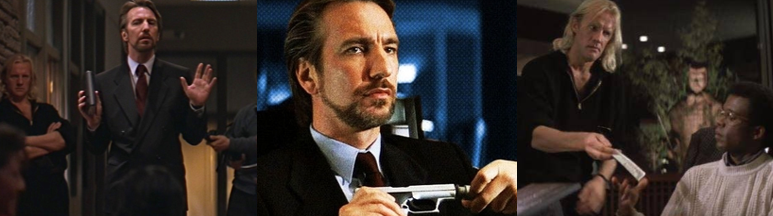
Composed psychopath Hans and his goons are riled up by McClane’s cowboy vendetta.

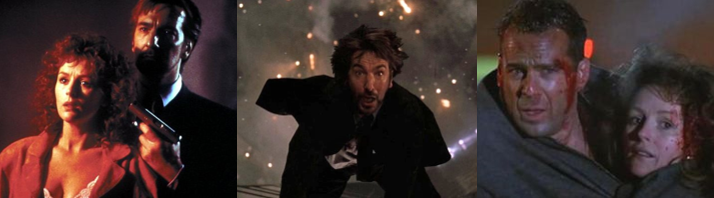
So, to say McClane is against the odds is putting it mildly. With only a single security guard on duty, he has no backup inside the building against Gruber’s heavily armed and physically imposing forces. McClane immediately antagonises Gruber’s most brutish henchman, Karl Vreski (Alexander Godunov), after he kills Karl’s brother, Tony (Andreas Wisniewski), in a brutal scuffle. A cold-blooded and merciless killer, Karl swears revenge and his burning need to kill McClane sees him disregard Gruber’s orders, warn his allies not to rob him of his quarry, and ends with him hanging from a chain, seemingly dead because of his vendetta. Gruber’s other most notable ally is Theo (Clarence Gilyard), the group’s wisecracking and enthusiastic tech specialist who happily applies his skills to cracking Takgaki’s safe, seeing it as a personal challenge, and directs his allies in fending off the SWAT team, laughing with glee at how outmatched the LAPD are against their firepower and his intellect. And then there’s Hans himself, a smooth talking, eloquent, unnervingly polite terrorist who commands not just the respect and loyalty of his crew but the attention of every room and scene he’s in. While he’s a reasonable man, Gruber is as psychotic as his underlings when pushed; he thinks nothing of executing Takagi and Ellis and is fully prepared to kill everyone in the building to pull off his heist, despite agreeing to Holly’s terms to treat the hostages humanely. Although positioned and selling himself as a revolutionary terrorist fighting against oppression, he’s actually little more than a common thief as his goal is to steal $640 million in untraceable bearer bonds from Takagi’s vault and abscond to a faraway beach, free from persecution thanks to his elaborate and well-executed plan. While he’s largely the commanding voice of reason and directs his men to focus on the big picture, such as retrieving his C4 explosives rather than wasting time and energy hunting McClane, he didn’t factor a lone New York cop into his schemes and his demeanour noticeably becomes more frustrated the more his operation is scuppered by this smart-mouthed “cowboy”. Gruber even comes face to face with McClane at one point when looking for his detonators and gains a deeper understanding about his foe; though Gruber’s accent and charade are good, McClane shows he’s more than a meathead by seeing through the act, but Gruber matches him at every turn, ordering Karl to “shoot the glass” when he notices McClane’s bare feet and even taking Holly hostage to ensure their escape in the finale.

The Nitty-Gritty:
I’ve never understood the debate regarding Die Hard’s status as a Christmas movie. Every year, memes and posts and arguments rage about whether it “counts” as a Christmas movie when the evidence is pretty clear that it absolutely is a festive film. For starters, it takes place on Christmas Eve and at the Nakatomi Christmas party; that alone is enough to qualify in my book, but we’ve also got an abundance of Christmas decorations (including trees and presents), a hip Christmas song, and a Christmassy jingle laced into the film’s score. For me, all it takes is for a film to be set during the Christmas season for it to be considered a Christmas movie, making the entire debate redundant from my perspective; plus, it’s a great excuse to watch Die Hard while the turkey’s roasting. The Christmas setting is a great excuse to have Nakatomi Plaza be empty save for its partying employees; it also helps set up some great puns and aggrieved commentary from McClane, who regularly laments about how unfair the situation is. Thanks to a combination of fear, adrenaline, anxiety, and his own juvenile nature, McClane provides a running commentary throughout the film to himself, Powell, and his foes. It’s clear he does this to cope with the extreme danger of his situation, but it also showcases his investigative mind as he ponders the accents and gear of Gruber’s gang, chastises his own reckless behaviour and bad ideas at every opportunity, and assaults his enemies with colourful insults as much as bullets and body blows.

John McClane embodied a different type of action hero, a vulnerable, flawed, smart-ass everyman.

Whilst studying for my PhD thesis, I did a lot of background research into action cinema and, unsurprisingly, Die Hard came up quite a bit, especially regarding discussions of masculinity in Hollywood (and, specifically, this genre). For decades, action cinema and gender roles were defined by physicality; masculinity, especially, was embodied by hyper-masculine heroes like Schwarzenegger and Stallone, but this perception was challenged by the AIDS crisis and smaller, less troublesome statures and heroes became more prominent. Thus, not only did Stallone dramatically reconfigure his persona at this time, but McClane represented something very different to his peers; defined “through the voice, more wise-guy than tough-guy” (Tasker, 1993: 239), McClane was a “perpetual adolescent [who seemed] to be playing games”, cracking jokes and carrying “a sense of surprise and confusion that [the] explosive events are happening to him”. He thus personified the more relatable, rugged “Everyman” action hero; proactive individuals who faced danger not just with a fist or a gun but a smirk and a hefty amount of icy dialogue (ibid). However, McClane remains a figure of masculine power like his peers; Barry Grant (2007) noted that McClane survives multiple milestones throughout and ultimately triumphs, believing McClane’s heroics were linked to masculinity, patriarchy and their mythic representations since he conquers a clearly phallic structure, overcomes numerous male henchmen who challenge his masculinity, and ultimately defeats these villains to reclaim both his masculine potency and his wife. Indeed, Die Hard was noted by Steve Neale (2001) to be progressive in these gender codings as “fantasies of class- and gender-based resistance to the advent of a post-feminist/post-Fordist world [and] all the old lines of force and division between races, classes and genders are both transgressed and redrawn”. While you can read gender and political messages into almost any narrative, there’s some really interesting reading on the subject out there, especially in relation to Die Hard. I think what impresses me the most about this is how it allows the film, and this largely dismissed genre, to gain a bit more legitimacy in the eyes of academics; sure, it’s a bombastic action flick filled with blood squibs, wise cracks, and elaborate stunts but that doesn’t stop it from having intriguing academic appeal and opening discussions regarding gender roles.

Amidst the explosions and gunfights, Die Hard has a raw and brutal edge to its set pieces.

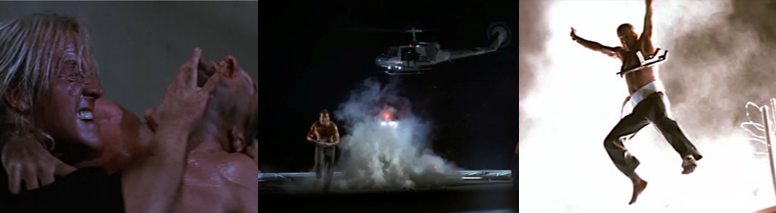
Indeed, while Die Hard is easily the most grounded and subdued of the franchise, which upped the ante to almost ridiculous (but no less entertaining) degrees, it still has some impressive set pieces, especially for a film set largely in one location. There’s the aforementioned APV assault, which sees the foyer rocked by explosions and ends with an impressive (if slightly dodgy) composite shot of McClane chucking C4 down an elevator shaft. And before this we have fun stuff like McClane blasting Marco (Lorenzo Caccialanza) through a table and then tossing him out a window, where he crashes onto Powell’s car and finally gets the LAPD out in full force. McClane’s fist fights with Tony and Karl are very brutal affairs; McClane takes quite a beating in each case and survives only by the skin of his teeth and is left sweaty and bloodied as a result. The damage he accumulates racks up to the point where he starts to consider that the odds aren’t looking too good in his favour; as he gingerly pulls glass shards from his feet, he tries to confide in Powell, who remains the steadfast voice of encouragement and hope. Things continue to escalate when Theo finally cracks the vault and Gruber enacts his final deception; he agrees to let the hostages go in exchange for safe passage on a helicopter, knowing full well that the FBI will double-cross him and rigging the rooftop landing pad to blow. Thanks to McClane, the hostages get to safety but Johnson and Johnson aren’t so lucky as their chopper is engulfed by the explosion. McClane, however, proves as resourceful as ever, leaping from the roof with a firehose as a makeshift safety line and smashing his way back into the building, narrowly avoiding a fatal fall in the process. Indeed, the film’s title is certainly apt as McClane continually avoids death even when he should probably have died several times over, though this takes a visual toll on his body and his mind as the film progresses, with him becoming noticeably bloodier and more desperate as things escalate.

An injured and exhausted McClane ultimately topples Gruber and reunites with his wife.

Thankfully, Powell in on hand to keep him together; their many radio exchanges see Powell shamefully admit to his mistake, which saw him transfer to a desk job and holster his revolver, an emotional arc that reaches a crescendo in the film’s final moments when Powell is forced to shoot Karl dead when he suddenly springs to life, thus allowing Powell to regain his confidence (and, if you want to read it that way, his own sense of masculinity; guns are a very phallic object, after all). After spending the whole movie pretending to be this cultured, intellectual terrorist revolutionary, Holly is disgusted and stunned to learn that Gruber’s simply in it for the money. Although many of his men have been killed by McClane, Gruber finally gets into Takagi’s safe and prepares to make his getaway, taking Holly as his hostage for collateral. However, McClane stumbles out from the embers, exhausted and bloody, to confront Gruber once more; as ever, though, he’s outnumbered and outgunned and dare not make a move since Gruber has Holly at gunpoint. With no other choice, McClane drops his gun and surrenders to Gruber, who prepares to shoot him and mockingly repeats a taunt McClane had flippantly thrown his way earlier, “Yippee-ki-yay, motherfuker”, causing them both to break out in laughter. This is all the distraction McClane needs to enact his final, desperate gambit; with his hands behind his head in a submissive gesture, he retrieves a pistol he taped to his back, guns down Eddie (Dennis Haden), and incapacitates Gruber with a shot, despite taking another bullet in the process. This sees the mortally wounded Gruber topple out the window, but he proves as persistent as his nemesis; caught up on Holly’s wristwatch (a gift from Takagi for her hard work), he prepares to shoot McClane only to be sent suddenly plunging to his death when McClane rips the watch from his wife’s wrist, symbolically shedding Holly from her career and returning her into the arms of her grateful and remorseful husband, their relationship having been galvanised by the whole traumatic ordeal.

The Summary:
Christmas is a great time of year. The food, the atmosphere, the presents…and the movies! Every year, I get to re-watch some of my favourite Christmas-themed films and Die Hard absolutely makes that list. Yes, you can (and should) watch it any time of the year but why not at Christmas, when the movie is set? Honestly, this is one of the all-time greats of the genre; more of an action/thriller, the film is a hugely entertaining depiction of one tenacious man’s fight against overwhelming odds and, while it can sometimes feel a little lengthy, it’s very fun and always enjoyable to watch every time. John McClane is a very different type of action hero; he’s vulnerable and flawed and has a smart mouth and a never-say-die attitude. He’s the perfect monkey wrench in Hans Gruber’s meticulous plot to get rich quick and the dichotomy between the two is half the fun of the movie. Even though they share very little screen time together, you can see them both growing more desperate and riled up and eager to take the other out as the film progresses, and this rising tension is both palpable and reflected in the escalating violence and destruction. I loved McClane’s snarky attitude, his quips and one-liners, and the humanising relationship between him and Al Powell, which really helps you remember that these action heroes are just normal people, deep down beneath the machismo. Another thing I love is how raw Die Hard is; it’s grounded and dirty and gritty and it really makes you feel it every time McClane takes a shot or a beating or a fall. Although it’s easy to just turn your brain off and enjoy a good time, I do like how the film invites deeper readings and academic discussion with its depiction of gender, masculinity, and violence. For me, Die Hard has endured the test of time; it reinvigorated the action genre and created one of the best protagonists of action cinema and it’s one of those films I both genuinely look forward to watching time and time again and which just gets better the more you watch it.

My Rating:

Rating: 5 out of 5.

Fantastic

Are you a fan of Die Hard? Did you like how it reinvigorated the action genre with a snarky everyman hero or are you a fan of the more over-the-top protagonists? What did you think to Hans Gruber’s plan, his portrayal, and his crew? Did you enjoy McClane’s tenacity and snarky attitude? What did you think to the set pieces? Do you consider Die Hard to be a Christmas movie? What are your plans for Christmas Day today? Whatever your thoughts, feel free to comment down before and have a great Christmas!

Movie Night [Doomsday]: Snowpiercer


Over the years, there have been many theories about when the world will end but one of the more prevalent was the mistaken belief that doomsday would befall us on December 21st 2012 based on the Mayan calendar ending on this day. Of course, not only did this not happen but it wasn’t even based on any actual fact to begin with. Still, doomsday scenarios and depictions of the end of the world have been an enduring genre in fiction so I figure today was a good day to dedicate some time to this popular concept.


Released: 29 July 2013
Director: Bong Joon-ho
Distributor: CJ Entertainment/Lionsgate
Budget: $40 million
Stars: Chris Evans, Song Kang-ho, Jamie Bell, Tilda Swinton, John Hurt, and Ed Harris

The Plot:
After an attempt to reverse global warming causes an ice age to render the Earth uninhabitable, the remnants of humanity are crammed into a circumnavigational train, the Snowpiercer, where the elite thrive in the extravagant front cars and the poor struggle in squalid tail-end compartments. With tensions rising, Curtis Everett (Evans) prepares to lead an uprising against the train’s domineering authority, represented by Minister Mason (Swinton).

The Background:
Snowpiercer began life as a French language graphic novel, Le Transperceneige (Lob, et al, 1982); after discovering a copy in a South Korean comic book shop in 2005, director Bong Koon-ho was immediately fascinated by the story’s depiction of social classes desperately vying for survival in a claustrophobic, post-apocalyptic scenario. Despite his fascination with the graphic novel, and having secured the rights to a live-action adaptation thanks to his friendship with fellow director Park Chan-wook, development of the film took a great deal of time to get off the ground. Star Chris Evans came on board (no pun intended) in 2012; although he brought with him a mainstream star power thanks to his prominence in the Marvel Cinematic Universe, Bong had to employ some clever filmmaking techniques to hide the actor’s muscular physique during filming. Featuring some complex practical and computer effects to render the titular train’s numerous cars and the desolate frozen wasteland of the outside world, Snowpiercer had the largest film budget of all time for any film with Korean investors but its theatrical release was limited to South Korea at the time. Still, while Snowpiercer’s box office may not have been the most spectacular, the film received largely positive reviews, was widely regarded as one of the best films of 2014, and eventually led to a television adaptation in 2020.

The Review:
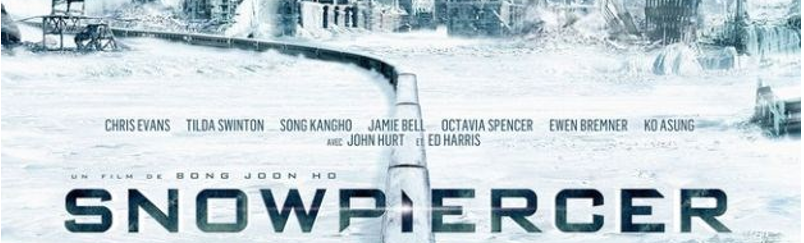
Snowpiercer presents a unique spin on the concept of a global disaster movie; while we’ve seen ice ages and frozen Earth films before, I’m hard pressed to think of one where we were directly, unequivocally responsible for the planet becoming a block of ice and snow much less one where the few remnants of humanity were crammed inside a world-spanning, perpetual motion train.

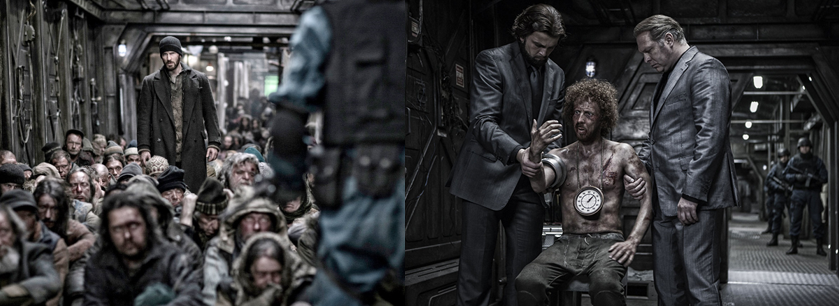
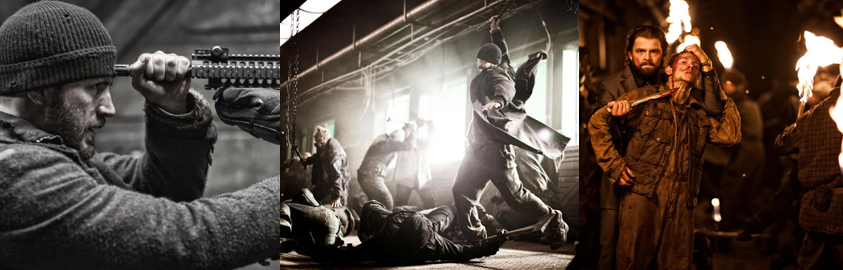
The tail section lives in abject poverty and is routinely abused by the upper classes.

Immediately, the film’s depiction of class and social segregation is made explicitly clear; Curtis, his young friend Edgar (Bell), and his fellow lower classes are forced to live in abject poverty and extremely cramped, disgusting conditions like homeless vagrants. Muddy, dishevelled, and little more than meek, subservient cattle, the lower ends are fed nauseating protein blocks and held at the mercy of the upper classes and the train’s armed guards, who do not hesitate to beat them mercilessly or tear children away from their mothers. Curtis, a principal figurehead amidst the dregs of the train, is very much a reluctant leader and uncomfortable with his position after a traumatic experience in the past. Indebted to Gilliam (Hurt), the aged, half-crippled true leader of the resistance movement, Curtis begrudgingly uses his powers of observation and force of will to help co-operate with prisoner Namgoong “Nam” Minsoo (Kang-ho) in a desperate attempt to storm the train’s length to seize control of the engine (and, thus, the “world”), and kill its operator, Wilford (Harris).

Much to Curtis’s chagrin, Edgar worships and looks up to him as a leader and a brother.

Much to Curtis’s chagrin, Edgar worships him as a hero and leader and sees him as something of an older brother; optimistic and full of fight, Edgar is willing to follow Curtis into the fray, which greatly disturbs Curtis as he believes that Edgar is willing to die for nothing. Their relationship is one based on both necessity and a lifetime of lies as Curtis carries tremendous guilt after he nearly killed and ate Edgar when he was just a baby. Such abject mania and cannibalism was rife in the early days of the train and many of the back-end’s inhabitants, such as Gilliam, are missing limbs after being willingly (or forced) to offer sustenance to their fellow passengers.

Snowpiercer features a diverse cast, making communication another source of contention.

Snowpiercer features an extremely diverse cast, with many of the supporting characters being South Korean actors; the most prominent of which is Curtis’s contact, Nam, and his seventeen-year-old daughter, Yona (Ko Asung). Both are addicted to a coal-like waste by-product, Kronole, which offers abusers a hallucinogenic high, yet Nam is instrumental to their efforts since he designed all the doors and locks on the train and his daughter exhibits some degree of clairvoyance. Since Namgoong mainly communicates in Korean, Curtis and the others are forced to communicate with him through the use of an unreliable mechanical translation device, though there are many instances of subtitles as well.

Mason is an abominable, despicable coward who’s only looking after her own self interests.

The upper classes are condescending, well-kept, and ruthless individuals who regularly lord their position and power over the lower classes; none embody Wilford’s order or the will of the upper class more than the detestable Minister Mason. A comical figure in many ways, sporting a pompous Yorkshire accent, an elaborate sense of style, and a self-righteous attitude, she stresses the importance of social order and subjugation through capital punishment and fully believes that everyone, and everything, must adhere to their pre-ordained place to maintain society and order.

Against overwhelming odds and cruel oppressors, Curtis’s rebellion is a bloody and brutal affair.

Even after decades of suppression and failed revolutions, which have resulted in countless deaths and mutilations, the lower classes maintain a degree of resistance and fighting spirit; thankfully, those same years have taken their toll on the upper classes, who have not only become complacent but have also run out of bullets over the years. As a result, Curtis’s campaign to seize the train takes the guards completely off-guard and is, initially, somewhat successful. Along the way, they discover to repulsive truth behind the protein bars and are enamoured by seeing the sun, the outside world, and the opulence of the upper classes. Much death and violence accompany this push to the front, however, resulting in the sudden death of Edgar and turning Curtis’s mission into one of revenge as much as liberty.

The Nitty-Gritty:
Snowpiercer is an extremely bleak and claustrophobic tale, full of dark, desolate lighting and a surprising variety of environments considering the entire film takes place on overcrowded train carts. The back end is a grim, gloomy area that is little more than a slum but, as Curtis’s revolution proceeds through the train, environments become much more elaborate and ornate as we see the luxury and indulgence that the upper class surround themselves in.

The train’s construction and stability raises some questions but it’s definitely a unique premise.

This includes a fully-functioning school (which teaches the children of the upper class to respect and pay reverence to the train and to Wilford as though they are some kind of religious icon), lavish first-class cabins equipped with lighting, heating, and actual cooked food, and such extravagances as musicians and even a greenhouse, aquarium, and hot tubs. Of course, as with many post-apocalyptic tales, there are some questions raised by Snowpiercer’s concept and left unanswered: the train is, by definition, a perpetual motion engine that circles the world endlessly thanks to being powered by small children but, while we see it precariously clinging to the tracks throughout the film, it’s pretty obvious that the train, its tracks, or the many bridges would surely have degraded or been destroyed by the extreme cold.

It’s a hard life in an even harsher world and revolution carries a heavy cost.

Still, I can forgive a lot of these questions mainly because the film does go to some lengths to address some of the main ones (by explaining that Wilford had the foresight and the capital to prepare his train tracks and engine before the world went to Hell) and the rest are best left to one side as a degree of suspension of disbelief is necessary to allow the film to actually happen. Additionally, the overall concept of the subjugated lower classes rising in a desperate suicide mission to take control of the train is compelling enough to carry the film even through its more preposterous ideas. After a particularly bloody and costly battle through the train, Curtis secures safe passage through the train by taking Mason hostage and is disgusted to see the extent to which the upper classes indulge themselves. At the mercy of the lower classes, Mason’s previously haughty attitude and lofty position is shattered as she is force-fed the protein blocks and sells out her beloved Wilford purely to save her own wretched hide. Thankfully, as satisfying as it is to see her reduced to a blubbering wreck, she gets her ultimate comeuppance when she is duly executed by Curtis not only for the deaths and suffering she has willing taking part in over the years but also for indirectly being responsible for Gilliam’s death.

After Curtis rejects Wilford and derails the train, the two survivors face an uncertain future.

There are a number of dramatic twists that await Curtis at the head of the train; the first is that Gilliam and Wilford conspired to inspire Curtis’s rebellion simply to maintain the train’s delicate and ghastly self-sustaining ecosystem by killing off a large portion of the tail section. The second is that Wilford, seeing the need for a successor, offers Curtis the opportunity to take over as the train’s operator but, while he is tempted, having lost everything and in the face of mass executions, Curtis violently refuses when Yona reveals that the engine is powered by children from the tail section. In that moment, Curtis finally sacrifices not just a limb for his fellow passengers but also himself to derail the train and leave Yuna and the boy, Timmy (Marcanthonee Reis), to an uncertain future in a world that may be slowly thawing.

The Summary:
Snowpiercer is a fantastically dreary and depressing tale about the decaying and desperate remnants of humanity being forced into a claustrophobic space, separated by class and social standing, and forced to either scramble for survival and scraps and eek out a pathetic existence in the tail end or indulge in their every desire and whim at the front end. Trapped under the thumb of their oppressors and driven by hunger and desperation, Curtis is determined to see his mission through simply because of the suffering and death he has witnessed first-hand and his hatred of both himself and Wilford for forcing them to live in such conditions. As far as post-apocalyptic tales go, you could do a lot worse than Snowpiercer, which expertly focuses its narrative on this fragile ecosystem and presents a desolate, desperate tale of survival within a suffocating, oppressive space that separates it from its competition and results in a bleak and intense story of desperation and survival.

My Rating:

Rating: 3 out of 5.

Pretty Good

Are you a fan of Snowpiercer? How do you feel it holds up against other post-apocalyptic tales? Were you a fan of the social and class issues represented in the film and or did its bleak atmosphere put you off? Have you read the original graphic novel and, if so, how do you feel Snowpiercer works as an adaptation? Perhaps you were more a fan of the later television adaptation; if so, why is that and how does it compare to the film? How are you celebrating the end of the world today? Whatever your thoughts on Snowpiercer, feel free to leave a comment down below.

Movie Night [Christmas Countdown]: Home Alone

Released: 16 November 1990
Director: Chris Columbus
Distributor: 20th Century Fox
Budget: $18 million
Stars: Macaulay Culkin, Joe Pesci, Daniel Stern, Catherine O’Hara, John Heard, and Roberts Blossom

The Plot:
When bratty eight-year-old Kevin McCallister (Culkin) acts out the night before a family trip to Paris, his mother, Kate (O’Hara), makes him sleep in the attic. After the McCallisters mistakenly leave without Kevin, he is left to defend his home from career burglars Harry (Pesci) and Marv (Stern).

The Background:
A serious contender for the greatest Christmas movie ever made, Home Alone was the brainchild of writer and producer John Hughes, who conceived of the general premise while on holiday. Hughes parlayed with both Warner Bros. and 20th Century Fox to give himself a safety net should the film go over budget, and turned to Chris Columbus to direct after the latter had a falling out with star Chevy Chase. Although Hughes pushed for Macaulay Culkin to be cast, Columbus auditioned over two hundred children for the lead role before finally agreeing that Culkin was the best fit, and filming of nighttime scenes was restricted to accommodate his age. Co-star Joe Pesci proved more troublesome to the shoot than the child actor, however, as he was angered by the early starts and struggled to keep himself from swearing. The severity of the film’s stunts also caused some tension during filming, which resulted in Culkin being permanently scarred and a real tarantula being placed on co-star Daniel Stern’s face. Home Alone was a ridiculous success at the time, grossing over $475 million at the box office and being met by largely positive reviews. While the plot and its elaborate traps were criticised, the heart-warming comedy, performances, and Culkin gained the most praise. Over the years, it’s been pegged as a Christmas classic, despite sequels diluting the premise with redundant retreads, and is a Christmas tradition more many, including myself, over the festive season.

The Review:
It’s difficult to think of a movie more synonymous with the Christmas season than this one; maybe Miracle on 34th Street (Mayfield, 1984) or Santa Claus: The Movie (Szwarc, 1985), but it’s a tough call. It’s one of those Christmas movies that’s always on every year and has become as much of a tradition as crackers and pigs in blankets. The film is a whimsical family comedy, but you wouldn’t really know that from the opening moments; when we’re introduced to the lavish McCallister family home, it’s the definition of chaotic, with screaming kids running everywhere, arguing, and their parents being just as bad. They’re all in a tizzy because they’re leaving for the airport in the morning for a luxurious Christmas getaway to France, and so preoccupied with their own problems that none of them notice (or question) the uniformed police officer desperately trying to get their attention. Although they don’t suspect a thing since this was a simpler time, the cop is actually Harry in disguise, covertly casing the neighbourhood to get a sense of its security precautions, something that McCallister patriarch Peter (Heard) really doesn’t seem all that bothered about. Peter’s happy to rely on his automatic lights and locks and such, which really goes a long way to show you how much this unexplainably rich family takes their home (and everything, for that matter) for granted. All the stress of packing and organising such a huge trip means that matriarch Kate (O’Hara) has even less patience for her youngest son’s bratty behaviour than usual; the smallest of his siblings, Kevin is ridiculed by brutish older brother Buzz (Devin Ratray) and snobby sister Linnie (Angela Goethals) for his helplessness since he’s so reliant on his mother that he can’t even pack his own suitcase for the trip.

Fed up of his neglectful family, Kevin revels in finally having his freedom.

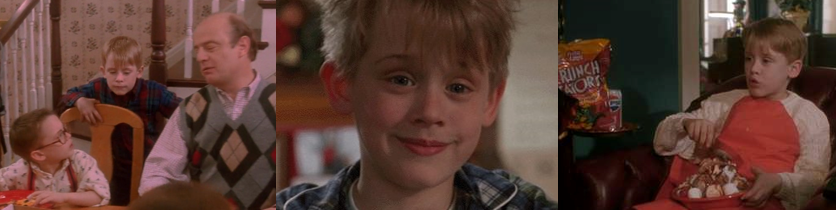
There’s a sense that Kevin is frequently forgotten or dismissed even without his extended family in the house; with them there, he hasn’t a chance of being attended to, loses his room to his tight-fisted and grouchy uncle Frank (Gerry Bamman), and is horrified at the prospect of sharing a bed with his young cousin, Fuller (Kieran Culkin), due to his bedwetting. In a house full of noise, Kevin’s only outlet is to be louder than everyone else; he brazenly backchats his mother, offers false apologies when he’s punished for acting out, and causes the ire of his entire family when he rightly lashes out at Buzz for eating his pizza. Despite there being plenty of blame to go around, it’s easier for Kate to punish Kevin by sending him up to the third floor, and Kevin spitefully protests this injustice by wishing that she (and all of them) would disappear and leave him alone. Of course, he has no idea that fate has conspired to make this wish come true; Kevin’s plane ticket was accidentally thrown away while cleaning up his mess, Peter accidentally unplugs the alarm clock and causes them to oversleep and rush around in a panic in the morning, and an annoying neighbourhood kid (Jeffrey Wiseman) throws off Heather McCallister’s (Kristin Minter) head count, meaning nobody notices that Kevin is missing until they’re halfway to Paris (and even then it’s a strange intuition Kate suddenly has for no real reason other than a mother’s instinct). Thus, Kevin’s stunned when he finds his house empty, but this turns to elation when he remembers all the awful things his family has said and done to him, and he immediately indulges his every whim. He robs Buzz’s “life savings” (accidentally trashing his room and setting his pet tarantula loose in the process), orders himself a cheese pizza, eats copious amounts of ice cream and junk food while watching trash TV, and generally has the time of his life, all while narrating to himself and occasionally calling out to his family to punish his behaviour. Of course, it’s not all fun and games for Kevin; he applies aftershave and ends up screaming in agony and is forced to go shopping for a new toothbrush and groceries, overpacking his bags and inadvertently shoplifting after being spooked by his neighbour, Old Man Marley (Blossom), whom he’s terrified of thanks to Buzz’s wild stories of his bloodlust.

As if scary Old Man Marley wasn’t bad enough, Kevin must protect his home from the Wet Bandits.

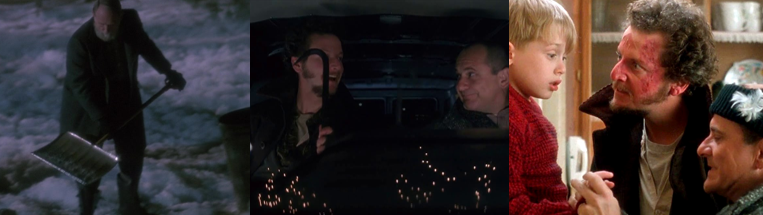
Although continuously terrified by the old man’s grim façade, this fear is just the start of Kevin’s troubles; unbeknownst to him, Harry and Marv have systematically been robbing every house in the neighbourhood since everyone’s gone away for the holidays and left their homes vulnerable. Although far from an intelligent crook, Harry is clearly the brains of the operation; he cases out each house, evaluating their potential and noting when their security measures, and chastises the dim-witted Marv for his perverse fixation on flooding houses to earn them a reputation as the “Wet Bandits”. While Harry is methodical and meticulous, Marv is loud and bumbling, focused more on haphazardly filling his swag bag rather than searching for high value items. Harry pegs the McCallister’s as the “silver tuna” (mainly because they live in a palace!) and is astonished to find the house seemingly occupied when they go to enter it. Night after night they are dissuaded by Kevin’s elaborate deceptions, mannequins and pulleys to trick them into thinking the house is occupied. Obsessed with ransacking the house, Harry follows Kevin and quickly deduces that he’s home alone; confident that the two of them and their crowbars can handle one little boy, Harry resolves to use force but even doesn’t account for how adaptable (and cruel) Kevin is when backed against the wall. What follows is an absolute massacre that sees the two thieves beaten up, knocked about, and brutalised by Kevin’s homemade traps, each one driving Harry further and further over the edge. Pesci shines in his role as the bad-tempered thief, and you can really tell from his indistinct mumbling, garbled curses, and rising frustration that he was really living his character’s aggravation with this obnoxious little foe.

With their trip ruined, a distraught Kate desperately tries to get back home to her son.

As this is going on, the story continuously jumps over to the McCallister’s, whose Christmas vacation is effectively ruined by the realisation that they left Kevin behind; though Buzz and Frank aren’t concerned, the fun and excitement of the trip has been sucked out of everyone else, compounded by them being stuck in an apartment with nothing to do while Peter waits to hear about potential flights. Wracked with guilt and determined to make it back by any means necessary, Kate stays at the airport and wait for a cancellation after every attempt to call their neighbours and elicit the police’s assistance conveniently fails. Although Kate convinces a kindly old couple (Bill Erwin and Billie Bird) to trade some cash and valuables for a plane trip back to the United States, she’s forced to bounce around airports since she can’t get a direct flight back and naturally becomes frustrated from exhaustion and desperation. Luckily for her, friendly polka musician Gus Polinski (John Candy) takes pity on her; after rambling about his band, their success overseas, and their own transportation issues, he offers her a ride in their van, which she gratefully accepts. Although relieved to finally be on her way, and finding kindred spirits in the band since they’ve lost a lot of time with their families while on the road, she’s bombarded by upbeat polka music and endures Gus’s bizarre story of the time he left his own son in a funeral parlour. While this makes for good comedy and helps to humanise Kate after she was such a snappy bitch, I do feel there could’ve been more to this, I assume they were only able to get the late, great John candy for a day or two so he’s just a glorified cameo but I would’ve liked to see Kate spend more time reflecting on her relationship with Kevin with Gus and the band and less time screaming at airport employees. Speaking of humanising, Kevin is surprised to find that Old Man Marley isn’t the grouchy killer he’d been led to believe; while seeking solace in church after regretting taking his family for granted, Kevin speaks with Marley and learns he’s been branded by cruel lies and is actually a kindly old man who’s estranged from his family. The conversation helps Kevin to better understand his own relationship with his family, galvanises his fighting spirit, and sees Marley become an unexpected saviour in the finale, all while reinforcing the true meaning of Christmas: family.

The Nitty-Gritty:
Home Alone is certainly a product of its time and is far from perfect, but it has a quaint charm that only increases with time. Nowadays, this situation would be resolved in a heartbeat as Kevin could easily call or message his family, but that wasn’t really possible in 1990. It also doesn’t help that the power and phone lines are temporarily (and conveniently) knocked out in the opening scene, limiting Kate’s options, or that everyone in their neighbourhood also happens to be out of town at the same time. I can excuse this just by looking at the McCallister’s house and their neighbourhood; this is clearly a wealthy area, populated by the same kind of people as the McCallister’s, so it makes sense that the well-to-do would jet off over Christmas. However, one thing I’ve never been able to believe is that the McCallister’s were able to get up, get changed, load all their shit into the airport buses, get to the airport, and still make their flight in less than an hour! Even if they hadn’t overslept, I find it very difficult to believe that they’d even get to the airport on time; the lack of airport security is somewhat believable as things were different back then but, realistically, they would’ve been stuck in traffic, at the airport waiting for a later flight, or forced to head home anyway since they should’ve gotten there a good two hours early. Does this detract from my enjoyment of the film? Not at all. It’s a fun little eccentricity that, as I say, only gets more amusing the further we get from the antiquated nineties.

Thanks to his traps, Kevin fends off the thieves and gratefully reunites with his family.

Although he’s just a little boy who is apparently incapable of doing anything without parental guidance, Kevin proves to be a capable and adaptable defender thanks to his many toys, his vast imagination, and his devious and sadistic nature. In less than an hour, he draws up a battle plan that sees him planting a nail on the cellar stairs, flash freezing the stone pathways and steps, leaving broken Christmas ornaments by the window, rigging paint cans, irons, and other items to bash the crooks, and even scorches Harry’s head with a blowtorch! Kevin shoots his foes in the face and crotch, sets up Micro Machines to trip them, and even makes use of Buzz’s pet tarantula when in a tight pinch. It’s all very amusing and entertaining stuff but, while Harry and Marv suffer only superficial and comical injuries as the film turns into a live-action cartoon, the implications of these booby traps are staggering as many would surely be fatal in real life! Although Kevin rigs his house with all these traps and pratfalls, he’s smart enough to have a back-up plan that sees him lure the Wet Bandits into a trap after alerting the police, only for the two to intercept him, battered and hungry for revenge. Luckily, Old Man Marley saves Kevin’s bacon and the two are apprehended, easily charged with all their crimes thanks to Marv’s flooding obsession, but Kevin is still left all alone and morose at having apparently wished away his family. Hoping for a Christmas miracle he tidies and decorates the house only to wake up and find it still empty. This is, of course, a fake-out as Kate arrives soon after, mere moments before the rest of the family, and reconciles with Kevin. Even Buzz is impressed that Kevin didn’t burn the house down, briefly showing Him respect before he sees the state of his room, and Kevin has an emotional embrace with his mother that echoes Marley’s own reconciliation with his estranged family, ending the film on a heart-warming note.

The Summary:
Christmas isn’t Christmas without Home Alone, but I do admit that my affection for the film has waned as I’ve gotten older and more cynical. There’s something about live-action, feel-good family movies that just doesn’t age as well as animated films, particularly when it comes to Looney Tunes-style violence that turns what was a grounded (if whimsical) film into a live-action cartoon, somewhat lowering the stakes even when Harry and Marv get their hands on Kevin. It also doesn’t help that I’ve never been a big fan of Macaulay Culkin; sure, he’s just a little boy here and he definitely does well in the role, but his delivery is a bit cringey at times and Kevin is so unlikeable in the opening and obnoxious when left alone that I find it hard to root for him. I enjoy the wish-fulfilment aspects of the film, where Kevin just goes nuts around the house and with food and acting like a grown-up while still being a little kid, and it’s definitely heart-warming seeing both him and Kate (and the rest of the family) realise how much they mean too each other. But, for me, the appeal of the film is the Wet Bandits; Marv might be an idiot, but Harry is so alluring as a cantankerous, scheming thief whose patience is pushed to the limit by Kevin’s traps and antics. Seeing them fall afoul of Kevin’s booby traps is still the best part of the film, even if it does drastically shift the tone, and I enjoyed the imagination and mischievousness behind Kevin’s antics and traps, I just wish that we’d had some inkling of his ability to set these up beforehand. He goes from a bratty, underappreciated kid to a free-spirited child to setting potentially lethal traps pretty quickly, which I guess speaks to how everyone (even he) underestimates him, but I could’ve done with this being fleshed out a little since we were specifically told that he was Les Incompétents. Ultimately, these are minor gripes from a bitter and aging film nerd; kids and youngsters will still find plenty to enjoy here, even if the film is heavily dated in some aspects, and Home Alone is still a staple of the festive season despite its flaws.

My Rating:

Rating: 3 out of 5.

Pretty Good

What do you think to Home Alone? Is it a Christmas tradition of yours or do you prefer another Christmas movie; if so, what is it? What did you think to Macaulay Culkin’s performance? Did you enjoy seeing his bobby traps in action? What did you think to the Wet Bandits and Kate’s desperate attempts to get home to her son? Have you ever been left home alone? What did you think to the film’s sequels? Whatever your thoughts, leave a comment below and be sure to check out my other Christmas movie reviews!

Back Issues: Aquaman #35

Story Title: “Between Two Dooms!”
Published:
August 1967
Writer: Bob Haney
Artists: Nick Cardy

The Background:
In November 1941, readers of More Fun Comics were introduced to Arthur Curry/Aquaman for the first time; while superficially appearing to be a knock-off of writer/artist Bill Everett’s Prince Namor McKenzie/The Sub-Mariner, the two aquatic supermen are actually very different characters. Mort Weisinger and Paul Norris created the character as part of DC Comics’ (then known as National Comics) call for new costumed heroes to captialise on the success of Clark Kent/Superman and Bruce Wayne/Batman, and Aquaman proved popular enough to prominently feature throughout the 1950s and beyond. In addition to seeing his cast of supporting characters expand to include a wife and ill-fated son, Aquaman amassed quite the gallery of nautical rogues; while his half-brother, Orm Marius/Ocean Master, tops most lists as his archnemesis, one of his most persistent antagonists is David Hyde/Black Manta. Initially debuting without a definitive origin, Black Manta was revealed to have a deep-seated hatred for Aquaman (and the sea as a whole) and proved to be a malicious and dangerous adversary;. Utilising a number of weapons and technology built into his distinctive battle suit, Black Manta was responsible for the death of Aquaman’s aforementioned son and frequently clashed with the Atlantean King alongside the Injustice Society. Black Manta has proven persistent enough to appear in DC’s animated ventures and videogames and made his live-action debut in Aquaman (Wan, 2018), where acclaimed actor Yahya Abdul-Mateen II shined in the role of secondary antagonist and promised to further explore the character in the sequel.

The Review:
Our story begins deep beneath the ocean at the long-lost underwater city of Atlantis, now prosperous and protected by an impenetrable dome and home to the Atlantean Royal family: Aquaman, his wife, Mera, their babbling baby, Arthur Curry, Jr./Aquababy, and Aquaman’s teenage sidekick, Garth/Aqualad. Like their fellow citizens, the three are startled when a menacing submarine begins orbiting their city, but both Mera and Aqualad are aghast when Aquaman volenteers to investigate alone; he states, very plainly, that it’s his duty as the Guardian of Atlantis and that he relies on Aqualad to safeguard the city in his absence, and then torpedoes himself towards the sinister-looking craft. Upon latching onto the submarine, a slew of comically expressive mutated Manta-Men burst forth, cluing Aquaman in that it’s the work of his old enemy, Black Manta. Black Manta has come more than prepared, trapping Aquaman to the ship’s hull through “bio-magnetics” and leaving him an open target for the Manta-Men’s deadly stun blasts and unable to intercept the villain’s assault on Atlantis. In an altogether different, far sleeker underwater craft, Black Manta heads towards Atlantis; garbed in an armoured outfit and sporting two enormous, glowing eyes on his helmeted head, Black Manta mocks Aquaman’s foolishness as he attaches a strange tube to the outer dome that protects the city. Within, Atlantis’s leading scientist, Doctor Nuidis Vulko assures Queen Mera and Aqualad that the dome cannot be penetrated, but both of them are horrified to see Aquaman under attack on their “radar-video” and, despite Aquaman’s orders, marshal themselves to go to his aid, with Mera using her command over water to open the heavily-guarded main lock and Aqualad commanding two giant seahorses, Imp and Storm, to carry them to their king.

Black Manta leads a life-changing assault on Atlantis and even kidnaps Aquababy!

They arrive just as Aquaman is heaving the ship into a spin, thereby making himself a more difficult target, and Mera promptly destroys Black Manta’s craft with a massive hammer made from “hard water”. Despite Dr. Vulco’s assurances, Black Manta throws Atlantis into chaos by using a “photon transducer ray” to bombard the dome with concentrated light particles that flash-boil the city’s water, forcing Dr. Vulco to empty Atlantis of the life-giving liquid and dooming its inhabitants to death as they cannot survive outside of water for longer than one hour. Although grateful for the assistance, Aquaman chastises Aqualad for leaving Atlantis undefended and orders the three of them back to the city to intercept Black Manta, where Aquaman is aghast to find the city empty of water. Black Manta’s efforts have succeeded all too well; Dr. Vulco’s attempts to refill Atlantis with water are met with disaster and he’s equally unsuccessful at removing the chemical substance the villain has affixed to the dome, potentially dooming the Atlanteans. With no options left, Aquaman orders Dr. Vulco to employ “Project X”, a radical solution that sees every Atlanetan administered with a serum that enables them to breathe air, with the exception of the Royal Family as they’re needed to protect the waters. The serum has a near-instantaneous effect, thereby nullifying Black Manta’s threat and temporarily causing his tactical retreat. Aquaman takes Aqualad into the ocean to ensure that the threat has finally passed and, mere moments after they’ve gone, Black Manta threatens the city once more, this time by launching a missile at them and kidnapping Aquababy after rendering Mera unconscious with a strange mist emitted from his craft. With the leverage swung back in his favour, Black Manta orders Aquaman to surrender in return for his son’s life and Aquaman has no choice but to give in to the villain’s demands.

Surprisingly, it’s the villainous Ocean Master who comes to the aid of Aquaman and his son.

Although Black Manta goes back on his word and attempts to have both Aquaman and his child as his prize, the villainous Ocean Master just happens to be passing by, himself swearing revenge against Atlantis and his half-brother, and intercepts Aquababy simply to have the pleasure of destroying Aquaman for himself. Helpless within Black Manta’s strange, unbreakable capsule…thing…Aquaman can only watch as his two foes wage war on each other using their crafts, with Aquababy at risk from the devastating missile salvo. Following an underwater dogfight, Ocean Master lands a crippling blow to Black Manta and causes his craft to crash into a coral reef. However, Black Manta scuppers Orm’s ship with one final missile, leaving him unconscious and at the mercy of his monstrous Manta-Men. Thankfully for the would-be despot, Aquababy has taken a shine to him and uses his own command over hard water to fend off the mutated monstrosities, much to Ocean Master’s chagrin as he’s humiliated to owe his life to the son of his worst enemy. Meanwhile, Aquaman asks two whales to free him and he engages Black Manta head on, only to be wounded by the villain’s harpoon gun and left staring death in the face. At the last second, Aquaman’s life is spared by a begrudging Ocean Master, who grapples with Black Manta and the two engage in a brutal fist fight even as they’re being carried away by a powerful (and convenient) current. Black Manta’s fate is left ambiguous, but Ocean Master returns to find Aquababy crawling alone, so he delivers him to his unconscious foe; however, this one act of charity is accompanied by the promise of one day battling and ending Aquaman in the near future. When he comes to, Aquaman is overjoyed to find Aquababy safe and sound; Mera and Aqualad are equally happy to find them both alive, and the threat having been ended, but none of them notice an envious Ocean Master glaring at them from the murky depths and swearing to conquer Atlantis.

The Summary:
A lot has changed between Aquaman’s debut story and this issue; Atlantis is now a thriving underwater community, a city inhabited by sea-breathers and protected by its impenetrable dome. Aquaman also appears to be somewhat revised, now installed as king of Atlantis and having bolstered his social circle with friends and family. His overall demeanour remains unnervingly chirpy; his dialogue is a little too “hip” for my tastes at times and it’s a little cringy to see him refer to Aqualand as “Tadpole”, but this is nothing compared to Aqualad’s excited exclamations. In the style of quintessential boy sidekick Dick Grayson/Robin, Aqualad is not only impulsive and eager to battle at the side of his mentor and king, but also prone to spitting out such cries as “Holy Haddocks!”, “Suffering Swordish!”, and “Wailing Wolf Fish!” While he doesn’t really get much to do in this story, Aquaman clearly trusts Aqualad to safeguard Atlantis in his absence and he appears to share many of the same abilities as his mentor, but he’s not depicted nearly as capable as the water-bending Mera. While Mera is largely defined by her role as a wife and a mother, and thus has some of that air-headed demeanour that was commonplace in female comics characters back in the day, her ability to create hard water constructs and willingness to battle at Aquaman’s side show there’s more to her than just being a bit of arm candy.

A dramatic debut sadly somewhat overshadowed by Aquaman’s extended cast and villains.

Aquaman himself is generally depicted as a proud and dutiful defender of his city and its people; at the first sign of danger, he volunteers to meet it head-on, but his impulsiveness leads to him falling for Black Manta’s trap and almost being blasted to smithereens by his ridiculous Manta-Men. Although this is Black Manta’s first appearance, the dialogue indicates that this isn’t the first time he’s battled Aquaman or Ocean Master; we don’t get any kind flashback hinting at the villain’s origin or true name and appearance and he’s largely absent for most of the story, represented mainly by his various armoured crafts and his monstrous underlings. When he does appear, he’s a pretty intimidating figure with his armoured outfit and distinctive helmet, and he makes quite an impression by constantly fooling Aquaman, boiling Atlantis’s water and forcing them to undergo physiological (and presumably permanent) changes in order to survive, and even stooping so low as to kidnap Aquababy all to get his hands on Aquaman, who he injures and drives to the point of exhaustion. Black Manta also goes toe-to-toe with Aquaman’s half-brother Ocean Master, whose appearance somewhat pads this story be is actually quite beneficial to his character; though he has every reason to hate Atlantis and Aquaman and is as driven to destroy both as Black Manta, Ocean Master actively opposes Black Manta simply to have the honouring of conquering Atlantis and killing Aquaman. Him going out of his way to save Aquababy also shows that Orm has a code of honour unlike most villains and he ends the story being reasonably well-rounded as a character rather than just mercilessly evil for the sake of it like Black Manta. Unfortunately, this means that the story does more for Ocean Master, overall, than its debuting villain but I still think Black Manta came off pretty well here and proved himself to be a cunning and vindictive new foe for Aquaman.

My Rating:

Rating: 4 out of 5.

Great Stuff

What did you think to Black Manta’s debut story? Were you impressed by his cunning and guile or were you put off by his lack of physical presence? What did you think to his attack on Atlantis and the last-second intervention of Ocean Master? Are you a fan of Aquaman’s family and extended cast? What are some of your favourite Black Manta stories and moments and are you excited for his return to the big screen? Whatever you think about Aquaman and Black Manta, feel free to leave a comment below or start the discussion on my social media.

Screen Time [Christmas Countdown]: How the Grinch Stole Christmas! 

Air Date: 18 December 1966
Director: Chuck Jones and Ben Washam
Original Network: CBS
Budget: $315,000
Stars: Boris Karloff, June Foray, Dallas McKennon, Thurl Ravenscroft, and the MGM Studio Chorus 

The Background: 
In 1955, children’s author and poet Theodor Seuss Geisel (known by his pen name as “Dr. Seuss”) wrote and illustrated a 33-line poem titled “The Hoobub and the Grinch”, which was the catalyst for a more expansive piece of work focusing on the mean-spirited Grinch. Inspired by himself, his wife’s ongoing medical problems, and the rampant commercialisation of Christmas, the story was completed within weeks and reportedly received critical acclaim, with the titular character becoming an instant and surprisingly complex Christmas icon. After collaborating on animated ventures during the Second World War, Dr. Seuss and legendary cartoon director Chuck Jones reunited (despite Dr. Seuss’s initial apprehension) to adapt the story into a television special. Jones insisted on complete creative control and expanded on the original story to flesh out characters like Cindy Lou Who (Foray) and Max (McKennon) and inserting musical numbers to pad the runtime. Though released amidst a slew of other animated Christmas specials, How the Grinch Stole Christmas! impressed when first broadcast; over the years, it has become a universally loved Christmas classic, with the cartoon noted as a timeless, heart-warming festive tale. It was so successful that it inspired follow-up cartoons years later, two financially successful cinematic remakes (one a Jim Carrey showcase and the other an all-CGI throwback) and even a bizarre slasher film in 2022, to say nothing of a slew of other Dr. Seuss adaptations over the years. 

The Plot:
The monstrous Grinch (Karloff) hates Christmas with a passion. When the joyful holiday cheer of Whoville (The MGM Studio Chorus) becomes too much for him, the Grinch disguises himself as Santa Claus and sets out to ruin Christmas by stealing the town’s presents! 

The Review: 
The cartoon is set in Who-ville, on Christmas Eve, where the joyful and excited Whos are happily preparing for the big day by decorating the biggest Christmas tree they can find and displaying it proudly in the centre of their village (“Opening”). They’re also hard at work decorating their houses, and the entire village, with tinsel, wreaths, garlands, baubles, and Christmas joy galore (“Trim Up the Tree”) which, in conjunction with the heavy snowfall, quickly turns Who-ville into the most festive place around…maybe ever! However, while all of Who-ville likes Christmas a lot, the sour Grinch, who lives atop the desolate and foreboding Mount Crumpit, does not. Although the narrator (Karloff) informs us that “no one quite knows the reason” why the Grinch hates Christmas so vehemently, it’s speculated to be because his heart is “two sizes too small” and his hatred extends to the entirety of Who-ville. He glares from his cave, joined only by his faithful dog, Max, the only living creature the Grinch shows any remote affection for. The Grinch tells Max that he’s desperate to keep the Whos from making a racket with their Christmas joy and presents, even their sumptuous banquets, where they gorge themselves on a seemingly endless supply of food, and their insistence of gathering in the village to sing and ring bells (“Welcome Christmas”). After fifty-three years of Who nonsense, the Grinch has reached his limit; the Grinch is inspired by a snow-caked Max to assume the guise of jolly ol’ Saint Nic and storms into his cave (dragging Max along) to whip up a suitable outfit (“You’re a Mean One, Mr. Grinch”). Once complete, the Grinch forces Max to act as his reindeer, loads up a “ramshackle sleigh” with some black sacks, and sneaks into Who-ville in the dead of night while all the Whos are tucked up in bed, oblivious, easily clambering into their houses via the chimneys and stealing every present under each tree with glee!  

After stealing Christmas, the miserly Grinch has a change of heart regarding the festive season.

Emboldened by his wickedness, the Grinch does this for every house, wrecking their trees, pinching their Christmas stars, rolling up their gifts in rugs, and even stealing candy canes from sleeping Who children and clearing out their “ice boxes” (“You’re a Mean One, Mr. Grinch (Reprise)”). However, just as he’s stuffing a Christmas tree up a chimney, he’s discovered by sweet, innocent, Cindy Lou Who; to pacify the child, the Grinch quickly thinks up a lie, convincing Cindy Lou that he’s going to fix a fault with the tree’s lights. After placating her with milk and a cookie, the Grinch leaves the house barren and ransacked, with barely a microscopic crumb left behind. Once he’s cleared out all of Who-ville and piled his sleigh high with his stolen wares, including the village tree, he heads back up Mt. Crumpit, with poor Max desperately pulling the overloaded sleigh through the snow while being mercilessly whipped. Once at the top, the Grinch prepares to dump everything over the side (“A Quarter of Dawn”), gleefully anticipating the despair of the Whos once they realise Christmas isn’t coming this year. However, when the Grinch pauses to bask in their anguish, he’s surprised to find the Whos’ spirits remain as high as ever! They gather in the village, joining hands and ringing in the season with their bells and song (“Welcome Christmas (Reprise)”), their hearts as warm and large and full of Christmas cheer even without the presents and decorations. Considering the Grinch believes that Christmas is purely about the gifts and excess, he’s confused by this but, as he puzzles out the quandary, he realises that “Christmas” is about more than just things bought from shops. This revelation drives him to save his plunder from their plummet, empowered by the sudden increase in his heart size and the true spirit of Christmas. Now cheerful and joyous, the Grinch and Max ride into Who-ville and return everything they stole, restoring Christmas to the village and even joining them for Christmas dinner, carving the roast beast and allowing the spirit of the season to fill him from head to toe (“Finale”). 

The Summary:
It might surprise you to know that I’m not really a fan of Dr. Seuss. I didn’t grow up reading his bizarre stories, nor was How the Grinch Stole Christmas! part of my annual Christmas tradition. In fact, I don’t think I’ve ever seen it broadcast on television here in the United Kingdom, so my experience with the good doctor and his colourful characters is limited solely to their later live-action and CGI adaptations. All this is to say that it wasn’t until Christmas 2023 that I randomly decided to finally give this a quick watch and share my thoughts on it since it’s such a well-known and beloved holiday tale and children’s story. Unsurprisingly, given who directed it, How the Grinch Stole Christmas! is suitably Chuck Jones-ian in its animation style; there’s a raw fluidity to the cartoon, meaning you can tell that countless hours of work went into animating every frame, and the characters and their environments are ripped straight from Dr. Seuss’ famous work, literally bringing the static images to life in all their sketchy glory. As you’re probably aware, it’s also a musical, with its songs (particularly Ravenscroft’s rendition of “You’re a Mean One, Mr. Grinch”) becoming as synonymous with the festive season as the titular miserly creature and being revised and covered not just for future adaptations of the story, but to coincide with the season. The story is a whimsical and timeless ditty, full of enjoyable little rhymes and colourful, memorable, oddball characters; the Whos are strange, furry humanoids who embody Christmas cheer and happiness and their town, though small and buried in snow, is a place of light and love where the Whos live peacefully and with lots of food and comfy houses to keep them snug and warm. 

A whimsical fantasy tale with a timeless, heart-warming message.

Naturally, this is juxtaposed by the Grinch; a green-furred, sour-faced gremlin, the Grinch despises the Whos, and Christmas, and has glared at their village with anger, enraged by their noise and excess, every December for the last fifty-five years! Although no definitive reason is given for his dislike for Christmas, it basically comes down to him lacking in Christmas cheer, misunderstanding the meaning of Christmas, and feeling conflicting waves of jealous, disgust, and personal insult since he’s not part of any of the Whos’ celebrations. Believing that the Whos will sing a different tune if all their Christmas possessions are stolen, the Grinch slinks around like a snake, swiping everything he can get his hands on (even lightbulbs and ice cubes!), and easily fooling curious Cindy Lou with his forked tongue. However, the sight and sounds of the Whos retaining their Christmas spirit even without possessions is enough to change the Grinch’s demeanour completely; this is a fundamental lesson of many Christmas tales and it’s shown in beautifully simplistic detail here. The Grinch never considered that Christmas was as much a state of mind as it was about food, decorations, and extravagance, and the love and warmth of this revelation lightens his mood and turns him around on the season completely. It’s simple and much of the depth is buried beneath the whimsical songs and cartoonish fantasy, but it resonates nonetheless and is an important lesson for kids to learn (basically, be grateful for what you have and don’t just think about presents!) While I’m not always Dr. Seuss’ biggest fan, I enjoy the visual and thematic appeal of the Grinch and his heartwarming story, and this fun little animated short is a great addition to your Christmas viewing every December, 

My Rating:

Rating: 3 out of 5.

Pretty Good

Is How the Grinch Stole Christmas! an annual tradition for your Christmas? Have you read the original story and, if so, what do you think to its different adaptations? Are you a fan of the Grinch character and the colourful, bizarre Whos? Why do you think the Grinch hated Christmas so much? Are you a bit of a Grinch around this time of year? What Christmas movies and specials are you watching this year? Whatever your thoughts on How the Grinch Stole Christmas!, leave them in the comments or on my social media and go check out my other Christmas content across the site. 

Back Issues: More Fun Comics #73

Story Title: “The Submarine Strikes”
Published: November 1941
Writer: Mort Weisinger
Artists: Paul Norris

The Background:
In April 1939, writer/artist Bill Everett introduced readers to Marvel Comic’s first Mutant, Prince Namor McKenzie/The Sub-Mariner, the superpowered prince of Atlantis who could live on land and in the sea and was just as likely to wage war against humanity as he was to defend it. While, on the surface, Arthur Curry/Aquaman appears to be another instance of blatant borrowing from their competitor, Mort Weisinger and Paul Norris’s aquatic superman couldn’t be more different. Aquaman was co-created by Weisinger after he moved to National Comics (the precursor to DC Comics) and was charged with coming up with some new costumed heroes to captialise on the success of Clark Kent/Superman and Bruce Wayne/Batman; after More Fun Comics changed its focus from superheroes to humour, Aquaman switched to Adventure Comics and was prominently featured throughout the 1950s. In addition to getting the cover spot on issues of Showcase and backup features in Detective Comics, Aquman had his own self-titled series, which saw him gain a wife, an ill-fated son, and undergo some pretty radical changes (including losing his hand). Often the subject of unfair ridicule for his ability to talk to fish and presumed uselessness, Aquaman has been part of DC’s biggest stories and proved popular enough to feature in numerous DC cartoons, a poorly-received videogame, and very nearly got his own teen drama show before Jason Momoa made a huge impression in his live-action debut as the character, portraying him as a bad-ass king of the deep and helping to change the character’s perception.

The Review:
As the story begins, a helpful text box informs the reader that many, especially those at sea, are well aware of the legend of the Aquaman, a water-dwelling do-gooder who emerges from the dark depths of the sea to battle evil and injustice, though even they consider him to be just that, a legend. While out on a mission of mercy, an unarmed ship is suddenly scuppered by a torpedo fired from an unseen submarine, the U-112; immediately, the captain orders an evacuation and stays behind to ensure that the crew and their consignment of refugees and hospital workers gets safely off the ship before he himself boards a lifeboat. At first, it’s not made clear where the enemy submarine is from or why they targeted the ship but it’s soon revealed that they’re goddamn Nazi sons-of-bitches who are determined to leave no witnesses to their heinous act. Luckily, just as the Nazis open fire upon the lifeboat, the scaled figure of the Aquaman arrives to help; his strength tempered by the crushing ocean depths, it’s no trouble at all for Aquaman to shunt the lifeboat out of the path of the submarine’s torpedo. Aquaman then turns his attention towards the “metal fish” and its maniacal crew.

Aquaman saves a boatload of refugees then delivers a startlingly different take on his origin.

Aquaman leaps aboard, sending one Nazi overboard with a good kick to the chin, but the commander sends the sub into a dive and makes a getaway. Although Aquaman vows to track them down and make them pay, his first priority is the safety of the ship’s compliment; to that end, he commands a pod of dolphins to help push the boat to dry land. The porpoise purpose of this seems to be to demonstrate Aquaman’s ability to clearly and openly communicate with sea life as he could have easily pushed the lifeboat to shore himself, and while that works the cynic in me also views it as him kind of making slaves out of the dolphins. Anyway, once on dry land, the captain begs to know Aquaman’s secret and he freely relates his origin story: his father was a famous undersea explorer who vowed to discover the secrets of the ocean after his wife’s death. This eventually led to him discovering the lost kingdom of Atlantis and constructing a water-tight home within its ruins, where he read up on ancient tomes and learned the secret of living under the ocean from Atlantean science and writing. Somehow, by “drawing oxygen from the water and using all the power of the sea”, the man who would come to be known as Aquaman was able to thrive underwater and continues his father’s work at the bottom of the ocean. So…quite a different Aquaman origin than I am familiar with, and one that’s absolutely full of plot holes and unanswered questions.

After escaping from the Nazi’s death trap, Aquaman puts an end to their threat.

With his story told, Aquaman dives back into the sea to get on the trail of the U-112, determined to do his share of punishing the evil that dwells on the surface world. By this point, the submarine has docked at a small island where the captain tells tales of his success and the strange sea-man who attacked them. Although his commanding officer balks at such an unlikely story, he’s forced to eat crow when Aquaman comes riding in on the back of a dolphin! Aquaman dives under the waters to avoid their bullets and, with a single powerful blow, sinks their submarine before their horrified eyes, trapping the Nazi bastards on their island. When Aquaman confronts them, he effortlessly swats away the commander’s pistol and chastises them for thinking him a “helpless refugee woman” but…somehow…the U-112 captain and his commander escape to their munitions house and then, even more startlingly, knock Aquaman unconscious by dropping a mallet on this head! Patting themselves on the back for their victory, the two tie Aquaman up, clamp weights to him, and toss him into the ocean, where he plummets into the mouth of an extinct sea-volcano. The sheer crushing depths restricting him, Aquaman desperately signals his dolphin friends by rubbing against a bulb-like plant and secreting an inky liquid (why he didn’t just shout for help isn’t clear; I guess he’s too deep?) The dolphins rush to his aid and allow him to easily break his bonds and return to confront the two Nazis. He knocks the submarine captain out with a stiff uppercut but the commander manages to slip back to the munitions room again; this time, he lobs a grenade at Aquaman’s head and, out of sheer instinct, he tosses it right back, blowing up the munitions storehouse and sending the commanding hurtling into the sky with comedic effect (but killing him nonetheless…) The deed done and the wicked punished, Aquaman returns to the sea, ready and willing to fight for justice in all its forms in the future.

The Summary:
So, yeah, Aquaman’s first story is decidedly different from his Marvel Comics counterpart; for one thing, Aquaman isn’t a murderous, ignorant fool ready to wage war against humanity but, and perhaps most strikingly, he’s not a native Atlantean and his powers don’t come from his heritage but are instead mysteriously and vaguely manufactured through a combination of “training” and “science”. It’s left incredibly vague exactly how Aquaman survives and breathes underwater or how he communicates with dolphins “in their own language” and, is so often the case in these early tales, we don’t really learn what his limits are (he can survive underwater but was effectively powerless when dumped in that sea-volcano because it was too deep; he can swim super-fast but is also seen riding dolphins, and he exhibits some superhuman strength but is knocked out by a mallet!) or even what his true name is! Garbed in a striking orange-scale outfit with green, fin-like gloves and a generally jovial personality, Aquaman stands out against his peers for lacking a cape and operating exclusively underwater; depicted as a highly trained and superhuman man, Aquaman is seen as the defender of injustice in all its forms, but especially out at sea, rather than being the Prince (or even King) of Atlantis.

A whimsical tale, despite some holes in the plot and Aquaman’s limits and origins.

Nowhere is this more evident than in the story’s choice of antagonist; no one’s going to mourn the death and destruction of Nazi soldiers and munitions and depicting the Nazis as openly firing upon innocents and mocking their foes is a great way of depicting them as morally reprehensible, if a little cliché (both the captain and the commander wear monocles and snigger about their superiority over others). The action is almost as haphazard as the artwork, however; Paul Norris shines in depicting the Greek-God-like Aquaman, panels at sea, and scenes that take place underwater, but the Nazi island is a bit bland and it’s jarring that the Nazis are able to just run away from Aquaman, especially as he’s right there in front of them! They even get the drop on him, again making me question his powers and durability, but this also seems to just be another excuse to reinforce Aquaman’s knowledge of the sea and command over its denizens. When Aquaman does leap into action, it’s with a cringey pun or taunt and he’s swift and efficient, easily knocking grown men out cold and tossing back grenades even if he doesn’t understand what they are. In the end, I was a bit surprised that Aquaman’s origin didn’t originally tie him as a native of Atlantis; this skewed my perception of the story somewhat as it raises a lot of questions that naturally aren’t answered here, but it was a pretty whimsical and enjoyable little tail tale that stands out against those of other superheroes, if nothing else.

My Rating:

Rating: 3 out of 5.

Pretty Good

What did you think to Aquaman’s debut story? Are you a fan of the character and, if so, what is it about him that you like? Were you also surprised by his differing origin and what do you think about his ability to talk to fish? What are some of your favourite Aquaman characters, stories, and moments and are you excited for his return to the big screen? Whatever you think about Aquaman, feel free to leave a comment below or start the discussion on my social media.

Wrestling Recap: Extreme Elimination Chamber (December to Dismember ’06)

The Date: 3 December 2006
The Venue: James Brown Arena; Augusta, Georgia
The Commentary: Joey Styles and Tazz
The Referee: Mickie Henson
The Stakes: Extreme Elimination Chamber match for the ECW World Championship

The Build-Up:
Back in the days when the then-World Wrestling Federation (WWF) and World Championship Wrestling (WCW) competed in a vicious ratings war, Extreme Championship Wrestling (ECW) offered a different brand of sports entertainment. First founded in 1992 as Eastern Championship Wrestling, the company was re-branded by one of wrestling’s greatest minds, managers, and promoters, Paul Heyman, in 1993 and came to be known for its violent and controversial matches and content, which was instrumental in inspiring the WWF’s “Attitude Era”. Unfortunately, despite ECW’s rabid cult following, the company was unable to sustain itself after losing its television deal; many of ECW’s stars jumped to the WWF and the company officially closed its doors in early-2001. ECW lived on, however, not just in the rise of independent promotions but also in the confines of the rebranded World Wrestling Entertainment (WWE); the success of their Rise and Fall of ECW documentary (Dunn, 2005) saw the WWE host a special throwback event, ECW One Night Stand, in 2005 to celebrate the brand. It was so successful that a second event followed in 2006, one that would see ECW and many of its stars return as a third WWE brand. Unfortunately, despite initially being presented as an alternative product and a showcase for new talent, the WWE ECW was doomed to fail: it lacked the “Extreme” edge fans expected, Heyman’s influence was limited, and its top star and champion, Rob Van Dam, was stripped of his championship belts after being arrested on drug charges! The WWE seemed to lose interest soon after; although they promoted this pay-per-view event, very few matches were announced beforehand and the card was supplemented by Raw and SmackDown! talent. The entire show was built around this Extreme Elimination Chamber match, with former champion RVD being the first announced for the contest. There was also some drama surrounding Hardcore Holly’s involvement; he was initially scheduled to be a part of it before Bobby Lashley attacked him and took his place, failed to gain a spot in a match against RVD, and was finally included after Sabu was mysteriously attacked earlier on the show, a decision that irked the ECW original but would be just the tip of the iceberg when it comes to this universally lambasted event.

The Match:
Considering ECW December to Dismember 2006 was already criticised for its lacklustre card and padding its runtime, it’s perhaps not surprising that this match was preceded by not just a hype video emphasising its violent and brutal nature, but also a lengthy pre-match promo from ECW general manager Paul Heyman. While the crowd, and even the commentary team, have no love for Heyman, who turned heel by ditching the ECW originals for up-and-coming stars like Bobby Lashley and CM Punk (and, naturally, the Big Show) as the future of the company. This promo went on for about three minutes and, afterwards, the show wasted even more time by dwelling on the chamber’s lowering around the ring. What made this match unique, and “Extreme”, compared to previous elimination chamber matches was that each competitor also carried a weapon: CM Punk had a steel chair, Test a crowbar, Lashley a table, and the Big Show had a baseball bat wrapped in barbed wire. Otherwise, the rules were the same; two men (RVD and Hardcore Holly) started the match and, around every five minutes, another competitor was released to join in. As was often the case whenever the Big Show actually got a serious push, much of Heyman, Styles, and Tazz’s commentary emphasised the champion’s size and strength; despite the fact that the Big Show had been beaten like a drum over the years by this point, he was hyped as “unbeatable” simply because he was a huge man with a newfound motivation since capturing the championship. Of all the competitors, rising star CM Punk,the epitome of an indie darling, and the ever-popular RVD made the most waves during their entrances. Even now, as big a fan of Test and even Hardcore Holly I am as a dependable midcarder, it’s hard to deny that these two stick out like a sore thumb; nobody in the audience wanted Holly in this match and their inclusion really speaks to how limited and lacklustre the WWE ECW roster was.

RVD proved the MVP of this thrown-together match, closely followed by crowd favourite CM Punk.

As mentioned, RVD and Hardcore Holly started the match after what felt like an ice age of stalling and entrances and they kicked off what was sold as the most devastating match in the entire WWE by…trading lock ups and punches. A clothesline exchange was enough for Holly to go for the cover, which earned him barely a one count, then Holly gently tossed RVD to the raised steel floor outside the ring. RVD leapt to the cage wall when Holly dodged his dive, which was admittedly pretty impressive; unfortunately, he ended up hitting the ropes when he tried a follow up dive, which was apparently enough to draw an “ECW!” chant from the crowd. Holly pressed his advantage by running RVD into the chain-link wall and slamming him on the steel but crashed and burned when he uncharacteristically went for a dive off the top rope and ate a boot for his troubles. RVD capitalised with his patented Rolling Thunder manoeuvre from the ring, over the ropes, and to Holly’s prone body on the outside, only to find himself deposited back into the ring from a suplex for a two count. Holly and RVD traded blows, with Holly landing his trademark dropkick, before CM Punk joined the action. The crowd exploded when Punk launched his steel chair right at Holly’s face and took out RVD with a springboard clothesline, only to be blasted with that same chair when RVD tossed it at his head! RVD followed up with his rolling monkey flip in the corner, which saw Punk slightly graze the chair with his tail bone, only for Punk to duck RVD’s spin kick and sweep him onto the chair with his speed and martial arts skill. Punk kept Holly out of the game with a springboard dropkick and continued to work over the busted open RVD, thrusting him head-first through the chair as it was wedged in the corner, only to have his momentum cut off when Holly swung him into the chain link wall for a near fall.

The crowd were unimpressed when RVD and Punk were eliminated, and by the botched pin on Holly.

Holly continued his attack with a sidewalk slam to Punk before dumping him on the ropes and booting him right in the head and driving him to the mat with a superplex. Regardless, CM Punk kicked out of two follow-up pin attempts and all three men were fatigued when Test brutally attacked with his crowbar, slamming, clawing, and choking Punk and RVD to give Holly time to recuperate. RVD somehow found a second wind, attacking with the chair then eliminating CM Punk with the Five-Star Frog Splash, which initially caused the audience to pop but their cheers quickly turned to boos when they realised what’d happened. Test then shockingly hit Holly with his Big Boot; however, despite the referee not counting to three and Tazz insisting that Holly kicked out, Hardcore Holly was summarily eliminated in confusing, frustrating, and anti-climactic fashion. RVD then flew in with a side kick off the top rope that downed Test and left him in prime position for a Five-Star Frog Splash off the top of the Big Show’s pod; however, the Big Show grabbed at RVD and interrupted the move, allowing Test to attack with a chair, dump him off the pod, and land a massive elbow drop from the pod to the steel chair, which took RVD out of the match and left the audience incensed as they realised their two favourites were gone.

After some stalling, shenanigans, and mediocre action, Lashley captured the championship.

There was a huge lull in the match where Test was left to awkwardly stumble about the ring as the counter wound down; then, when Heyman’s riot squad refused to let him out, Lashley broke out of his pod by smashing the roof with his table. Although he almost slipped off the top rope, Lashley, hit a diving clothesline, kicking the chair in Test’s face, and smashing him in the gut with the crowbar. The Spear that followed then took Test out of the match, leaving Lashley to stalk around the ring for over a minute as he waited for the Big Show to be released. The Big Show lumbered out with his barbed wire baseball bat and hammered at Lashley, who desperately defended himself with the chair; quickly, Lashley tricked the Big Show into getting the bat caught in the cage wall, allowing the challenger to drive the champion into the steel mesh and right through a pod, busting him open and leaving him prone for a beating. The Big Show rallied, effortlessly tossing Lashley into the ring and flooring him with a clothesline; however, when he went for his trademark Chokeslam, Lashley countered into a huge DDT! The Big Show got pissed when Lashley deftly ducked his haymakers and tried to plant him with a running powerslam, but Lashley easily slipped off, hit the ropes, and collided with a Spear to finish the clearly winded champion and capture the ECW Championship to reluctant applause. I can understand why this match is so poorly regarded; there’s just not enough star power, heat, or intrigue behind it. The weapons added some spice but they were barely used and there was too much waiting around, not to mention the two clear fan favourites being unceremoniously dispatched and that botched pin on Hardcore Holly!

The Aftermath:
This wouldn’t be the last time that the Big Show and Bobby Lashley clashed over the ECW World Heavyweight Championship; on the very next episode of ECW, Lashley defeated the Big Show in a one-on-one match, retaining the belt and temporarily removing the Big Show from WWE programming. Lashley continued to mix it up with his fellow chamber opponents, clashing with RVD on ECW and defending the championship against Test at Royal Rumble, but he ended up embroiled in a “Battle of the Billionaires” at WrestleMania 23 as he represented Donald Trump in a match against WWE chairman Vince McMahon’s proxy, Umaga. This ultimately led to perhaps the most outrageous storyline of the revived ECW as McMahon and Lashley feuded over the championship, with the chairman actually capturing the belt in the process! Although December to Dismember wouldn’t be the end of ECW, it was the end of Paul Heyman’s tenure with the company, and the WWE, for some time; the show’s poor buy rate and attendance figures escalated tensions between Heyman and McMahon, with the former walking away from the company after his booking decisions regarding CM Punk, Rob Van Dam, and Bobby Lashley were ignored. Contrary to popular belief, ECW limped on for about two more years after December to Dismember, but the brand was never again afforded its own pay-per-view and December to Dismember went down in history as one of the worst produced, worst attended, and worst regarded wrestling events of all time.
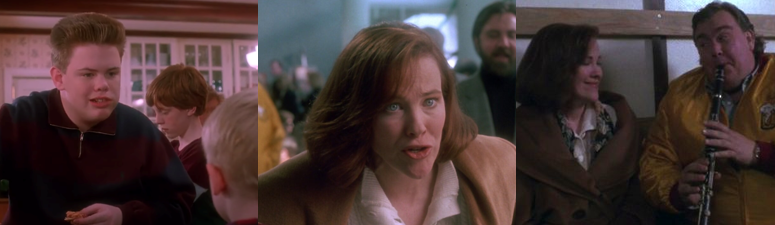
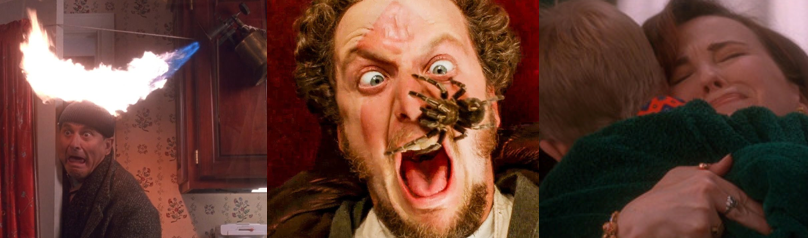
My Rating:

Rating: 1 out of 5.

Terrible

What did you think to the Extreme Elimination Chamber match? Who did you want to see win the match at the time? Were you annoyed that Sabu was swapped out for Hardcore Holly? What did you think to CM Punk being the first person eliminated? Do you think the match should have made better use of its weapons? Were you excited that Bobby Lashley won? What did you think to the WWE’s revival of ECW? Would you like to see the December to Dismember event make a comeback? Whatever your thoughts, feel free to leave them below or drop a comment on my social media.