
After the release of Sonic the Hedgehog (Sonic Team, 1991), Sonic firmly established himself as the hot new gaming icon and catapulted SEGA to the forefront of the “Console Wars”. Anticipation was high for a sequel and, in keeping with their aggressive marketing strategies, SEGA dubbed November 24, 1992 as “Sonic 2sday”, a marketing stunt that not only heralded the worldwide release of the bigger, better sequel but changed the way the videogame industry went about releasing games for years to come.


Story Title: “Attack on the Death Egg”
Published: 7 August 1993
Writer: Nigel Kitching
Artist: Ferran Rodriguez
Story Title: “Super Sonic”
Published: 21 August 1993
Writer: Nigel Kitching
Artist: Richard Elson
Story Title: “Megatox”
Published: 2 October 1993
Writer: Nigel Kitching
Artist: Richard Elson
Story Title: “Casino Night: Part 1/2”
Published: 22 January 1994/5 February 1994
Writer: Nigel Kitching
Artist: Richard Elson
Story Title: “Hill Top Terror”
Published: 19 February 1994
Writer: Nigel Kitching
Artist: Ferran Rodriguez
Story Title: “Pirates of the Mystic Cave”
Published: 2 April 1994
Writer: Nigel Kitching
Artist: Richard Elson
The Background:
Sonic the Hedgehog was a massive success for SEGA; thanks to an aggressive marketing campaign and including it with their 16-bit Mega Drive, SEGA saw sales of over 15 million copies upon its release. However, all was not right at SEGA as Sonic mastermind Yuji Naka quit for the California-based SEGA Technical Institute. After bringing in many of his own Japanese staff, Naka spearheaded the creation of a sequel while an entirely separate, Japan-based team worked on Sonic the Hedgehog CD (SEGA, 1993). Though mired by an influx of ideas, another internal contest decided Sonic’s new sidekick, Miles “Tails” Prower, and improved graphics and gameplay saw Sonic 2 become incredibly successful; 400,000 copies were sold in its first week alone, with over 6 million units during the Mega Drive’s lifespan. SEGA’s control of the home console market shot up by 40% as a result of Sonic 2; the game was widely praised upon its release and is still held in high regard, with many claiming that it is the best in the series. This, more than anything, helped catapult Sonic to mainstream success and saw SEGA briefly usurp Nintendo’s position at the top of the videogame industry and SEGA were quick to capitalise with a slew of merchandise, including cartoons and comic books. About six months after Archie Comics began publishing a weird amalgamation of the Adventures of Sonic the Hedgehog (1993 to 1996) and Sonic the Hedgehog/SatAM (1993 to 1994) cartoons, United Kingdom publisher Fleetway Editions Limited brought us “Britain’s Official SEGA Comic”, Sonic the Comic (StC), a fortnightly publication that I collected diligently until its unfortunate end. Though pulling much of its lore from the now-defunct Mobius and Doctor Ovi Kintobor storyline that was prevalent outside of Japan, StC quickly veered away from the source material to recast Sonic the a mean-spirited leader of a gang of Freedom Fighters made up of both videogame characters and anthropomorphic characters adapted from the videogames. Like the Archie comics, StC often included a few very loose adaptations of the videogames, though these were often heavily truncated and adapted to fit with its noticeably different lore. Sonic 2 was no different, with many elements of its plot and gameplay being loosely peppered throughout the comic’s early issues.
The Review:
So, as I mentioned, StC often included truncated videogame adaptations. Sometimes these stretched over a few parts, or a handful of separate parts; sometimes they carried on through spin-off strips. But, quite often, StC simply adapted the general sense of the source material over various issues and stories, and that’s very much the case with their adaptation of Sonic 2. From issue one, StC quite clearly takes place after the first videogame, with Sonic generally sticking to the Green Hill Zone and other locations from the first game but also visiting or at least referencing events from the second game, if only because Tails was regularly included as Sonic’s sidekick. I suppose you could argue that Sonic 2 takes place between issues, but I always assumed that the first two games happened, and the comic went from there. All this is to say that, initially, I was simply going to review “Attack on the Death Egg” but I decided to make things more difficult for myself and review a bunch of StC stories that are clearly pulling from the second game, while also inserting their own lore. One of the most prominent bits of original lore in StC was their version of the Kintobor origin; in StC, the kindly Doctor Ovi Kintobor was transformed into the evil Doctor Ivo Robotnik after an accident involving a rotten egg and a massive dose of chaos energy from the six unstable Chaos Emeralds. Somehow, Dr. Kintobor’s consciousness was imprinted onto a Golden Ring and then transferred to the computer and acted as a guide, warning system, and information network for Sonic and his gaggle of Freedom Fighters, and an occasional emphasis was placed on Sonic carrying or hiding his guilt for his role in the creation of Mobius’s power-hungry dictator.
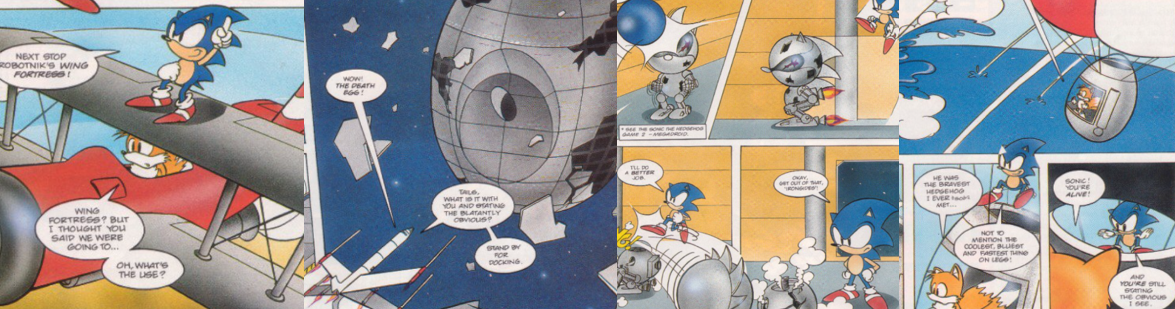
I offer this context because “Attack on the Death Egg” opens with Sonic operating the Kintobor Computer and Tails expressing childish curiosity about the kindly doctor’s holographic face, which acts as an interface to make the machine easier for Sonic to use. The computer reveals that Dr. Robotnik’s all-powerful Death Egg space satellite is not only still in one piece after Sonic 2 but is currently on a collision course with the Emerald Hill Zone, so Sonic has Tails fly them to Dr. Robotnik’s “flying fortress” (obviously the Wing Fortress Zone), though Tails is clueless as to why they’re heading there and not to the Death Egg. While the fortress is largely abandoned, it’s not without some recognisable defences; Sonic dodges a Cluck’s cannonball and ends up battling the laser cannon boss from the videogame (though Sonic’s dialogue and inner monologue implies he’s never encountered this before). Similarly, Tails is completely clueless about the Wing Fortress; he doesn’t even realise it has a spaceship there, which is a bit odd as the Sonic 2 cutscene clearly showed him helping boost Sonic onto the same craft. One quick stomach-churning trip to space later and the two are back onboard the heavily damaged, egg-shaped space station; there, Sonic is…not surprised, more excited and insulted…to see Mecha Sonic is still operational, albeit badly damaged. Sonic makes short work of his chunky robotic doppelgänger, ramming it with a Super Sonic Spin Attack and then kicking its head off, before ordering Tails to take the one and only escape pod while he (as in Sonic) manually redirects the Death Egg to plunge into the ocean rather than destroying the Emerald Hill Zone (which I believe causes a continuity issue for later in StC when Knuckles the Echidna makes his debut). Although Tails weeps for his friend and vows to tell tales of Sonic’s heroics, Sonic obviously escapes certain death and appears to bask in the glory of his bravery.

StC returned to Sonic 2 in the very next issue, which saw Sonic and Tails help with a raging inferno at the Oil Ocean Zone; while original character Red and the other firefighters have battled the blaze for three days with little success, Sonic easily disperses the burst of flaming oil by creating a “Sonic-Cyclone” with his super speed. However, the dangers of the gigantic oil refinery remain and Red implores Sonic to help them clean the place up with his unprecedented knowledge of the many traps placed around the Zone. Naturally, Sonic agrees without hesitation, but is surprisingly caught off-guard by a lone Aquis; this robotic seahorse singes him with its flame shot and forces him into one of those slippery oil slides, apparently incinerating him alive in a pool of oil! Thankfully, Sonic survives but the stress of the anticlimactic near-death experience transforms him into Super Sonic! Now, this is something else StC took major liberties with; in StC, Super Sonic is a mindless, enraged, demonic entity hell-bent on destruction and chaos and much more akin to Doctor Bruce Banner’s green-skinned alter ego than a conscious, Super Saiyan-like power-up. Sonic first transformed into this being after absorbing a massive dose of chaos energy from the volatile Chaos Emeralds, and then again after collecting too many “Mobius Rings”, and he would undergo the transformation whenever pushed too far, such as here. Now faster than light and able to fly, Super Sonic ploughs through the Aquis in a fit of rage but is so consumed by hatred and evil that he then tries to murder the little woodland critter than pops out of the Badnik! Thankfully, Tails talks some sense into the rampaging, invincible hedgehog, calming him down before his temper got the best of him, returning him to normal and allowing him to make good on his promise to clean up the Oil Ocean Zone.
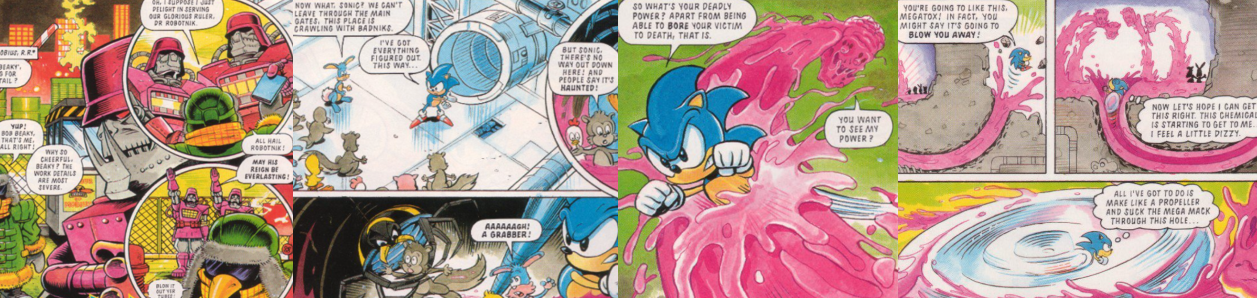
After a two-issue gap, StC tapped into Sonic 2 for inspiration for one of the most memorable stories of the comic for me, “Megatox”. This one has special meaning to me as, when I was a kid, before we could afford to buy StC on the regular, I only had two issues; one was issue two, and one was issue ten, so I read “Megatox” to death back in the day. By this time, Dr. Robotnik has overtaken Mobius thanks to taking advantage of a time dilation a few issues back; his Badniks and military Troopers are everywhere and Sonic and his friends have been forced on the run in disguise as Bob Beaky’s traveling circus. This is why Sonic infiltrates the Chemical Plant Zone dressed in a massive snow suit and hat and pretending to be Bob Beaky, loyal servant of Dr. Robotnik’s; this allows him to get into the toxic facility, where Troopers are working woodland critters to exhaustion and disciplining them with energy whips. Disgusted at the Trooper’s mistreatment of innocent Mobians, Sonic quickly abandons his disguise and trashes Dr. Robotnik’s goons; since they don’t use animals as power sources, Sonic doesn’t have to worry about holding back and literally bursts through them to lead a desperate escape attempt through a tunnel full of a strange, pink, toxic gunk. Although Sonic gets the critters to safety (and even frees another from a Grabber), he’s startled when the toxic gunk (known as “Mega Mack”) suddenly comes to life and attacks him, assuming a sentient, corporeal form called Megatox. Once a scientist charged by Dr. Robotnik to create a poisonous chemical to kill Sonic, he was transformed into living Mega Mack after a freak laboratory accident and wastes no time in fulfilling his objective by choking and poisoning Sonic with its toxic body. Already feeling the effects of the poison, and unable to directly attack Megatox since it is essentially living water and incapable of being destroyed through conventional means, Sonic instead burrows through the ground and disperses Megatox all over the countryside (no doubt indirectly polluting the nearby environment in the process) using a vortex, ending the strange creature’s threat…for a time.

Eight issues later, Sonic 2 was used as the basis for a two-part story; these weren’t uncommon in StC, and a lot of Sonic’s stories were two-part tales. This one takes place in the Casino Night Zone, here realised as a gigantic fun park adorned with Dr. Robotnik’s visage. The Casino Night is also home to a number of…well, casinos. Sonic and his buddy, nervous but tech-savvy Porker Lewis, sneak into the Zone and are disgusted to find the Dr. Robotnik has not only rigged all the games to strip guests of their money and worldly possessions but is turning them into compulsive gamblers using hypnotising beams from a massive, garish statue in his image. Dr. Robotnik (here still sporting his sadly underused videogame design and spitting out egg puns aplenty) has left the Casino Night in the hands of three original characters knock-off villains, the Marxio Brothers – cigar-chomping leader Grouchio, underappreciated stooge Chicio, and the mute trumpet-honker Harpio – thinly-veiled composites of the Marx and Super Mario Brothers from the never-seen (but, assumedly, terrible) Marxio World. When Porker’s specially-created disruptor fails to work from a distance, a frustrated Sonic resolves to get closer so he can put a stop to Dr. Robotnik’s diabolical scheme and, afraid of the hedgehog’s wrath, Grouchio orders Chicio to unleash a swarm of laser-firing Troopers into the Zone. Although Sonic fights them, the sheer numbers cause him some concern and see him fall into a trap; more specifically, a giant pinball machine that batters him about and almost ends with him becoming a hedgehog kebab…until he simply gets out of it with relative ease. Unfortunately, Sonic is forced to surrender when Porker gets captured and tied up by the Marxio’s, ending the first part with him admonishing his nerve-wracked friend even as they await certain death tied to rollercoaster tracks.
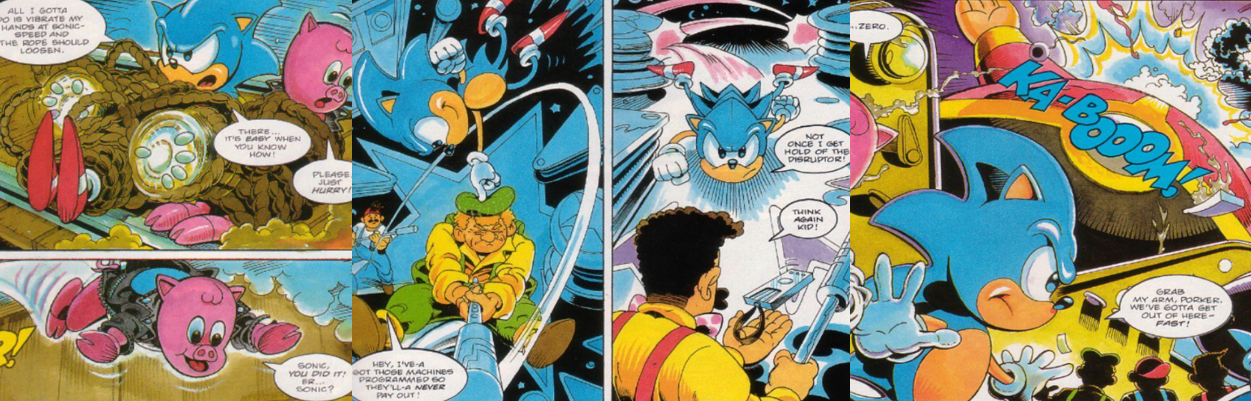
“Casino Night” continues in the next issue, picking up right where the first part left off and, thankfully, sparing us any flashbacks or wasted time recapping the previous events. StC was great like that; they just did the smallest text box or a bit of dialogue and that was it. Another thing it was good at was painting Sonic as an absolute prick; like, he was heroic and brave and all that, but Goddamn was he an abrasive, self-absorbed, egotistical bully sometimes. Mostly, he threw his insults at Tails, but he wasn’t above tormenting Porker either, and he does that in this issue, driving the poor pig into a panic by pretending like they’re doomed to die. After getting his kicks from Porker’s abject terror, Sonic vibrates the ropes that bind them at super speed and breaks them free seconds before their gruesome demise. Spotting the Marxio’s nearby, now in possession of the disruptor device, Sonic pursues them into the nightmarish pinball machine that functions as the heart of the Casino Night Zone and runs rings around them as they try to smash and bash him with their metal pole…things (a weapon Sonic’s ill-fated ally, Johnny Lightfoot, would later take as his own). Although Grouchio smashes the device, Sonic is far from perturbed; in fact, he was simply stalling for time to allow Porker to reprogram the Casino Night’s main computer and cause all of the machines to pay out bucketloads of cash. As an exclamation point, Sonic has Porker destroy the head of Dr. Robotnik’s statue, disrupting his hypnotic rays and delivering a decisive victory in the ongoing war against the egg-shaped tyrant.
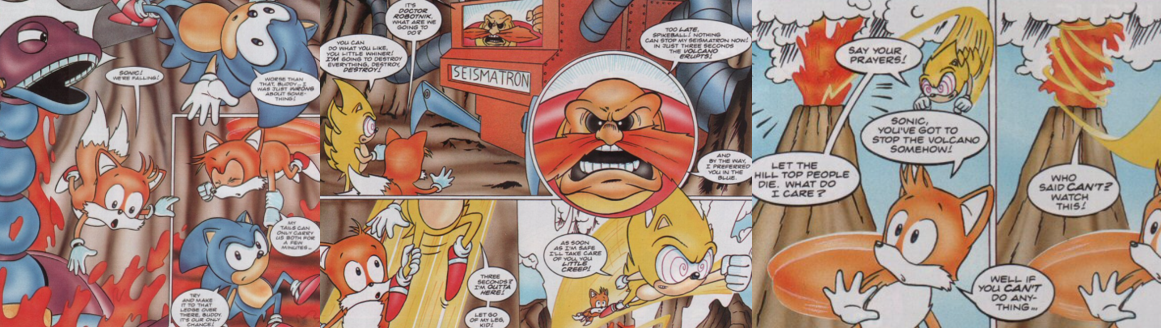
Super Sonic made a return in the very next issue, which took place at one of my favourite Sonic 2 Zones, the Hill Top Zone. “Hill Top Terror” sees Sonic and Tails assist a small village at the base of an active (and very close to erupting) volcano. Before landing, Sonic has to take out a small group of Turtloids, oddly seeming to fly at superspeed and then observing that he can’t actually fly and needs Tails to rescue him with his biplane (which earns the two-tailed fox what can be loosely called a compliment). Sonic and Tails meet the bird-like tribe and their leader, Chief Kordon, who explains that the Mountain of Destiny threatens to wipe them out, claiming it to be the wrath of the Gods, which Sonic dismisses with a casual flippant comment. Racing to investigate, Sonic and Tails are surprised by a Rexxon dwelling in the boiling lava of the mountain; with Tails struggling to keep them from falling to their deaths, the stress of the situation causes Sonic to transform into his demonic other half once more. After taking his anger out on the Badnik, Super Sonic is left hungry for something to destroy and therefore unimpressed by Dr. Robotnik’s seismatron, which causes the volcano to violently explode and spells doom for the village. Thankfully, Tails hitches a ride out of there on Super Sonic’s leg and then manipulates the malevolent creature into stopping the volcano by questioning his power and ability. The effort of creating a “Super Sonic fan to cool the lava” is enough to not only save the villagers from a horrible death but also to return Sonic to normal; though he has no memory of his time, actions, or the threats he made towards Tails as Super Sonic, just enough of his personality remained to carve an effigy of himself on top of the mountain for the villagers to admire.
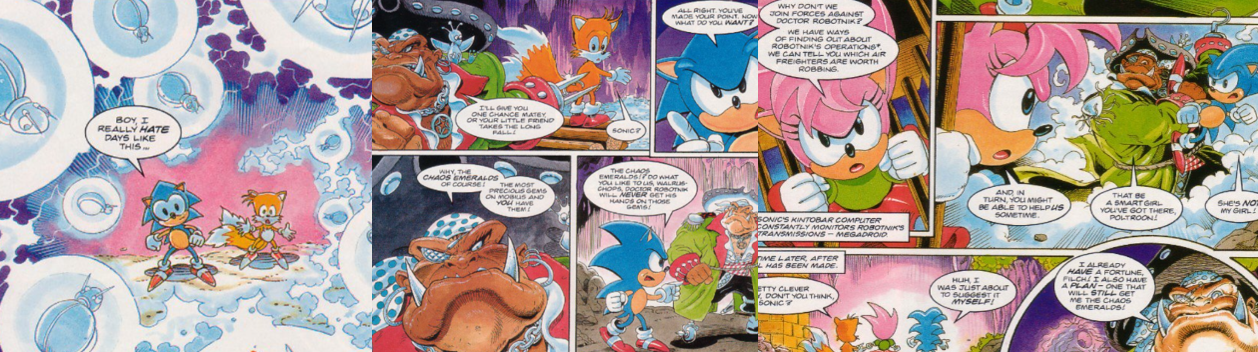
Finally for today, we have “Pirates of the Mystic Cave”; this story is actually something of a prelude to StC’s later adaptation of Sonic CD and introduces readers to one of StC’s more annoying recurring original characters, Captain Plunder and his Sky Pirates. The story sees Sonic, Tails, Porker, and Johnny exploring the Mystic Cave Zone in search of Amy Rose, Sonic’s lovelorn number one fan who joined the Freedom Fighter team some issues prior and had a knack for getting herself in trouble. While there, they’re attacked by the caterpillar-like Crawltons but, unlike usual, these Badniks are empty of helpless woodland critters. Sonic and Tails are soon cut off from Porker and Johnny by a massive steel door and summarily attacked, and knocked out, by electrical bursts courtesy of a gaggle of Flashers. When they awaken, they find themselves in a cove where Amy is held prisoner in a wooden cage by the hulking, warthog-like Captain Plunder. Desiring Sonic’s cache of Chaos Emeralds, Captain Plunder first threatens Tails with walking the plank and then ruthlessly kicks him down a chasm, but Sonic reminds his young friend that he can fly and therefore the attempted murder is easily thwarted. While Sonic is unable to hurt Filch, Captain Plunder’s resident poltergeist (whom the captain himself murdered for being greedy with the biscuits), he is able to fight the hook-handed warthog. However, far from a mere meek damsel in distress, Amy talks sense into the two and convinces them to join forces against Dr. Robotnik; although Sonic can’t surrender the Chaos Emeralds, he can offer information which of Dr. Robotnik’s air freighters are worth robbing and the cutthroat crew offer the Freedom Fighters some much-needed backup in the fight against the dictator. Although Captain Plunder agrees to the deal and the Freedom Fighters are allowed to leave unharmed, he vows to use the situation to his advantage regardless and steal the Chaos Emeralds at the first opportunity.
The Summary:
There’s a real variety in these six (technically seven, I guess) stories; none of them are a direct adaptation of Sonic 2 by any means and, indeed, the comic plays fast and loose with the game’s continuity at the best of times. One thing I enjoy about Sonic’s comics is how the game locations are actually used and expanded upon, becoming intricate cities, populated areas, and really feeling alive and part of this diverse and often wacky fictional world. The cartoons and movies really struggle with this aspect; occasionally, Zone names and locations are referenced, seen, or somewhat evoked, but it’s never as explicit as in the comics, where anthropomorphic characters live and work and struggle like in the real world. Other concepts, like gameplay mechanics such as Golden Rings and such, were never quite as easily translated in the comics; like the cartoons, these were downplayed or ignored, with stories largely focusing on the Chaos Emeralds and using Rings very sparingly, as though this mechanic were something that only existed in the context of the videogames and wasn’t quite the same thing in this new fiction.

Regardless, these stories tell quite a few fun and interesting tales in just a few pages. All but two of these were illustrated by the great Richard Elson, the premier artist of StC who always delivered some of the best, dynamic, and visually interesting sequences and panels. However, this isn’t to discredit Ferran Rodriguez; while his art style is noticeably less detailed than Elson’s and far more simplistic, his characters and locations evoke the anime aesthetic channelled in the manuals and advertisements for the games, especially over in Japan, therefore bringing a more “SEGASonic” version of the character to StC. While some of the writing is a little off (Sonic’s constant heckling of Tails and Porker can make him out to be more of a bully) and it’s a little weak that Super Sonic’s first big appearances were a result of mediocre Badniks like Aquis and Rexxon, the visual representation of the Zones used is absolutely spot on. StC rarely, if ever, took much inspiration from the actual plots of the videogames beyond Dr. Robotnik enslaving animals and polluting the environment, but they always did a bang-up job of bringing the game’s Zones to life in their adaptations, and all of these look great. Sure, Wing Fortress and Death Egg are a little lifeless and dull and Hill Top Zone is less of a lush mountainscape and more of a barren, rocky volcano, but Elson’s depictions of the bustling, pollution-spewing Oil Ocean and Chemical Plant Zones is a joy to behold. There’s so much detail there, with elements from the games (like the oil slides, the toxic gunk, the pinball arena, and the ominous caves) tweaked to become somewhat believable and fully flesh out environments. This is probably best evident in the Casino Night Zone, which takes more from the bustling city you see in the background of the Zone but still includes the bounce springs and bumpers, though Oil Ocean Zone really came off incredibly well, too.

Like basically all external Sonic media, StC was rife with original characters; many, especially those in Sonic’s gang, were adapted from the Mobius lore but others, like Captain Plunder, were a little more surreal and yet fit quite well with this version of Sonic’s world. Few of them make much impression in these stories beyond Captain Plunder and, I guess, the Marxio Brothers for being parodies of SEGA’s rival, Nintendo. One thing you may notice is that Dr. Robotnik doesn’t show up much in these stories and Sonic doesn’t actually fight him directly; this was actually quite common, especially after Dr. Robotnik took over Mobius and became virtually untouchable, and much of the ongoing story was about striking victories and disrupting his operations, not unlike what we saw in SatAM, casting Sonic firmly as the underdog despite him always coming out on top. For those who were hoping to see a traditional Zone-by-Zone adaptation or a bigger, more dramatic showdown on the Death Egg, these stories will probably be a disappointment; indeed, the Death Egg wouldn’t be properly explored or seen as a real threat until later, after Knuckles’ introduction, so I can understand why “Attack on the Death Egg” might fall a little flat in that regard. Still, I think these stories collectively do a decent job of capturing some of the essence of Sonic 2 and recontextualising the Zones and gimmicks into something that would actually work as a living, real place. Many of the elements seen in these stories would return in later issues, with Captain Plunder, Megatox, and the Marxio Brothers becoming recurring villains and anti-heroes, and basically all of Super Sonic’s unique characterisation as this out of control, destructive force was established here. Naturally, there’s a lot of bias on my part; I grew up reading these stories and was an avid collector of StC and really enjoy how they adapted the source material into something recognisable, but still distinctive in its own right, and I definitely think their efforts to incorporate and expand upon Sonic 2 resulted in some fun and visually engaging stories here.
My Rating:
Great Stuff
What did you think to Sonic the Comic’s adaptations of Sonic the Hedgehog 2? Did you read StC as a kid and, if so, what did you think to its unique take on the source material? Which of these stories was your favourite and what did you think to the StC version of Super Sonic? Would you have liked to see a more direct adaptation of the games in the comics and how would you compare with StC did with the American comic books? What are some of your favourite stories, characters, and moments from StC? How are you celebrating “Sonic 2sday” this year? Whatever your thoughts on Sonic 2, and Sonic comics in general, share them below or join the discussion on my social media.

 Dr. K's Waiting Room
I had minor glimpses with the comics at a cousins house growing up, I loved the art style back then, still do.
LikeLike