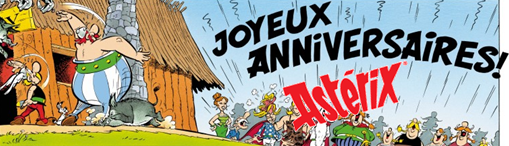
Asterix the Gaul (and his best friend Obelix) first debuted on 29 October 1959 as a serial in the French/Belgium magazine Pilote. Since then, the plucky Gauls have gone on to have many adventures in comic books, videogames, and feature-length productions and Asterix himself has become a popular and enduring character in his native France and beyond as his stories have been translated into over a hundred languages across the world.


Released: November 1993
Developer: Core Design
Also Available For: Game Gear and Master System
The Background:
It didn’t take very long at all for the French comic book series Asterix to make the jump from the comics and into other media; the first Asterix book was adapted into a feature-length animation in 1967 and both animated and live-action Asterix films have been pretty consistent over the years. Similarly, there have been a number of Asterix videogames; the first of these was released for the Atari 2600 in 1983 and one of my absolute favourites was Konami’s arcade game from 1992. Growing up, I had a lot of fun playing Astérix (SEGA, 1991) on the Master System, a colourful and entertaining little platformer that I’ve yet to finish ever thirty years later, and figured that the Mega Drive title would be a good investment. Asterix and the Great Rescue was developed by Core Design, the team behind the classic SEGA title Chuck Rock (Core Design, 1991), and was met with mixed reviews upon release. With today also being the birthday of the SEGA Mega Drive, I figured it was the perfect time to put this game in and see how it holds up compared to its 8-bit counterpart.
The Plot:
The year is 50 BC. Gaul is entirely occupied by the Romans. Well, not entirely… One small village of indomitable Gauls still holds out against the invaders and life is not easy for the Roman legionnaires thanks to the Gauls’ magic potion, which gives them superhuman strength. Like in many Asterix videogames, the Romans kidnap the village druid, Getafix, to stunt the village’s supply of magic potion so their bravest warriors, Asterix and Obelix, set out to rescue Getafix and teach those crazy Romans a lesson.
Gameplay:
Asterix and the Great Rescue is a 2D, sidescrolling action platformer in which one player gets to pick between Asterix and Obelix before each journey across six Levels to rescue the druid Getafix from the Romans. Disappointingly, unlike in the majority of Asterix videogames, there’s very little actual difference between Asterix and Obelix; both characters move at the same plodding speed, have the same amount of health, jump at the same height, and have exactly the same special abilities. Indeed, the only discernable difference I could identify is that Obelix’s hit box is larger (due to his characteristic girth) but it’s not like Asterix’s is that much smaller. You can customise the game’s controls from the main “Options” menu but the default setup is functional as is. Players can jump with A, attack with a punch with B, and use a “Special Weapon” with C. Pressing up on the directional pad (D-pad) in conjunction with C allows you to pick from four different Special Weapons while pressing down on the D-pad allows you to crouch and crawl to avoid incoming projectiles.

Sadly, considering the characters’ and comics’ focus on madcap fighting, combat is extremely disappointing and limited here; there are no jumping attacks, your punches have a pathetically short range, and the only additional combat option available to you is that you can hold down B to perform a series of rapid punches while moving to take out groups of enemies faster. Asterix and the Great Rescue is constructed in a strangely confusing way; there are six Levels, each split into four “Huts” and each Hut has up to three “Rooms”. The wording is very confusing as you’re not necessarily inside of a hut or a room as you might think but what it actually boils down to is six levels, four worlds, and up to four zones in each world and I guess the developers thought it would be “fun” to supplant this usual videogame terminology with terms from the comic book. While six Levels might not seem a lot, the game is actually surprisingly long; the Rooms are generally short sprints asking little more from you than to travel to the right, bashing enemies, and reaching the goal (“magic elixir” for Asterix and a roast boar for Obelix) but you’ll also be tasked with finding keys, performing some tricky jumps, or navigating some confusing areas.

Your greatest enemy in each Room will be the time limit; every Room has a time limit that is anywhere from less than a minute to two minutes of game time and, if you fail to reach the goal before the time runs out, you’ll lose a life and have to restart from the beginning of the Room. There’s very little room for error in some of these Rooms and, if you mess up or take too long, then that’s just too damn bad as there are no checkpoints. Thankfully, you can acquire extra lives by earning enough points or stumbling upon a beating heart pickup. You start each game with three lives and three credits and, when you lose all of your lives, you’ll be given the option to cash in a credit and continue from the start of the last Room you played but, if you use up your credits, it’s game over. After clearing each Level, you get a password to jump to later in the game, which is helpful, but the damage you sustain throughout the game carries over to each Room, which is extremely frustrating, and you’ll find an abundance of bottomless pits as you progress, which mean instant death.
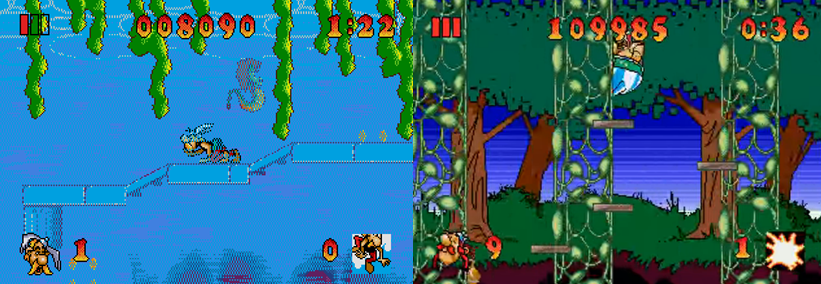
Gameplay in Asterix and the Great Rescue is extremely inconsistent and frustrating; generally you just have to fight your way to the goal but other times you have to dodge bursts of fire, press switches to progress further, dodge falling blocks or incoming boulders, or hop around moving or temporary platforms to get through the Room. This can be extremely frustrating as some enemies are too small to hit, others take multiple hits to defeat, and it’s not always clear what you have to do in order to progress; all too often, platforms will suddenly drop underneath you, animals or bridges will collapse after carrying you across gaps, and you’ll need pixel-perfect timing to reach far away platforms. You’ll also need to hop across lava pits, make a number of blind jumps, contend with murky water that slows you down, teleport across Rooms using special statues, or use a series of bubbles, springs, and catapults to travel higher and further. Spikes, thorns, spiked balls, flames, and rotating platforms all compound matters, making avoiding damage extremely difficult even when playing on “Easy” mode, where enemies are less frequent and aggressive. Thankfully, there’s no knockback from taking damage but my experience was that my character would simply keel over and die more often than not since their hit box is so big that it’s extremely difficult to avoid being hit (especially when you get dropped literally right into the path of oncoming enemies in some Rooms).
Graphics and Sound:
Asterix and the Great Rescue has a lot of promise but doesn’t quite manage to deliver in terms of its graphics. Sprites are colourful and faithful to the comics, for example, but not especially big or full of animation frames; there are no idle animations, for instance, and neither Asterix, Obelix, or their enemies exude the same charming humour as they do in the comics or even the Master System game. Environments can similarly be very hit and miss; the Gaulish village is beautiful to behold but little more than a tutorial to learn the basic controls. Occasionally, you’ll see familiar Asterix characters like Unhygienix in the background but he’s wildly out of proportion compared to the avatar’s sprites. Other times, the background will be quite sparse (a simple night sky) or somewhat detailed but then it’ll also look really crude (especially in the Forest and Rome levels). There are a lot of different environments to explore, however. You’ll travel from the Gauls’ village, cross the dock, enter a Roman camp, explore a dense forest and jump through the treetops and past gigantic spider’s webs, battle through dungeons in Germany, hop across clouds and birds and wander around stages made out of Frankfurters, pass through an ice Room (with some impressive snowflake effects falling over the screen) on the way to a Roman galley, and finally jump and fight through water ruins, an ornate garden, a lavish banquet hall, and the coliseum in Rome.
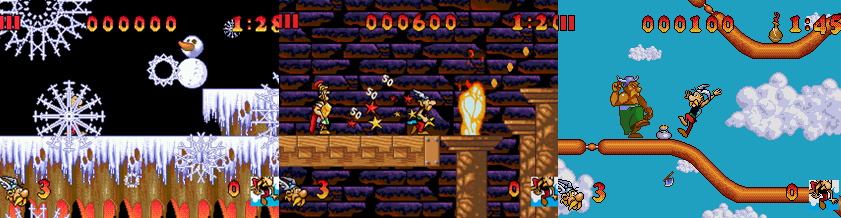
All of these are locations that will be familiar to any Asterix fan but, for most videogame players, will seem very by-the-numbers for the average platformer and full of clichés such as weighted switches, temporary platforms, and rising or moving platforms. A lot of the time it can be difficult to tell where you need to go as you can sometimes pass through certain walls but not others, despite them both looking the same, and you’ll need to experiment with your Special Weapons in order to progress (if you have enough time left to figure that out, of course). I did experience a bit of slow down at times, which is quite ludicrous as there’s rarely a lot happening on screen, and some graphical hiccups here and there. The music is quite jazzy, however; it’s not especially varied but it’s decent enough, and certainly far better than the game’s sound effects. The game’s story is told through text and a recreation of the map of the invaded Gaul, all of which will be more than familiar to any Asterix reader. Though the game’s title screen leaves a lot to be desire, each Level is proceeded by a pretty nice still picture of the famous duo but you’ll have to wait for the final screen on the game for anything resembling any kind of impressive sprite art and even then it’s basically just a partially animated still.
Enemies and Bosses:
As any self-respecting Asterix fan might expect, your primary enemies in this game will be the Romans. Roman soldiers charge at you with spears, march along in groups wielding swords, toss spears at you from above, and gold-armoured Centurions will also show up to try and skewer you as you progress. These are all pulled straight from the comics and even include Roman’s hiding in tree disguises; most of them will go down in just one hit but the more rotund and golden Romans will take two to three hits. You’ll also have to content with woodland critters scurrying and flying your way, axe-throwing Germans, German maidens who explode when you get too near, mermaids and sea creatures, archers whose arrows stay on screen way too long, Romans trying to jab you from beneath with their swords, spiders and other bugs, dogs, and even hatchlings trying to take a bit out of your ass. By far the worst obstacle is the mule-kicking horses who will send you flying clear across the screen; I swear you need as much luck as you do skill to time your jumps past those assholes!

Each Level culminates in a boss battle, the first of which is, oddly, against the village bard Cacofonix (I know he’s an annoyance in the comics but to make him a boss seems a bit extreme). Cacofonix stands in one spot atop his tree hut and spits musical notes at you from his lyre and can only be damaged by hopping on top of one of village chief Vitalstatistix’s shield bearers and tossing rotten fish at him. It takes a lot of hits to finally put the bard down so, again, your biggest enemy here is the time limit as it’s pretty easy to avoid his musical notes by standing in the right spots. The second boss fight sees a Roman encampment firing rocks at you; these must be hit back over and over again until the camp finally surrenders to your might. After this, a Roman soldier awaits you on a log and will instantly force you to your death unless you mash A, B, and right as fast as possible to knock him off instead but, of course, the game never tells you any of this so it is easy to simply fail time and time again.

The final Room of Germany has you desperately outracing a rising sea of red and taking out enemies as you make your way up to a goal which, again, is more a test of your skill and patience with the game’s controls than any sort of actual combat. On the Roman Galley, you’ll be attacked by a gigantic alligator (or is it a crocodile?); simply hop up onto the platforms to avoid the creature’s snapping jaws and then jump down to smack him in the head but watch out for his massive hit box clipping your avatar. The finale sees Julius Caesar set two vicious tigers against you in the Coliseum; these will randomly pop in and out of archways under Caesar’s view box and must be smacked whenever they appear and hopped over to avoid damage. Like all of the game’s bosses, though, this is simply a test of patience and landing hits before you get a time out and the bosses are, by far, the least challenging aspect of the game.
Power-Ups and Bonuses:
There are numerous items to pick up and collect in Asterix and the Great Rescue; you’ll find gold coins, bags of coins, and Roman helmets, all of which will add to your score and bring you one step closer to an extra life. You can also replenish your health either partially or fully by collecting pieces of roast chicken or a chalice, respectively, and you can grab a sickle for a brief period of invincibility or a bomb to enter “Mega Attitude Mode”, which increases your speed and strength so you can blast through enemies and obstacles.

The main thing to keep an eye out for, though, are the gourds that you’ll find scattered throughout each Room. These will give you ammo for your Special Weapons and will respawn when you move the screen a little bit. Your Special Weapons are essential to your progress but it’s not always abundantly clear where or when you have to use them (such as the first screen of Rome where you’re seemingly trapped but actually have to blast a wall that doesn’t appear to be destructible). The Fireball adds a ranged attack to your arsenal and can be used to destroy certain blocks, hit targets, or deactivate certain traps; the Ice Block (which is actually a cloud) creates a temporary platform to allow you to reach higher areas or cross spike or lava pits safely (if you can get the angle of the throw right…); the Disguise covers you in a series of vines and flowers so that enemies will walk right past you; and Levitation allows you to (chunkily) float about using the D-pad to avoid spikes and reach higher or further areas.
Additional Features:
There’s not really much else on offer in Asterix and the Great Rescue beyond the single-player experience; there’s no two-player simultaneous play, meaning that the only way for two players to play is to take it in turns, and no real benefit to playing as either of the two main characters. You can tackle the game on a harder difficulty setting and try to get your name at the top of the high score table but the game is so tough anyway that I wouldn’t recommend it. There aren’t even any decent cheats for the game as the password system is simply for jumping to the game’s levels so you’ll probably be done with this game after one playthrough or session.

The Summary:
Boy, was I disappointed with Asterix and the Great Rescue. Once again, I as met with a 16-bit iteration of a videogame that pales in comparison to its bright, humourous, and fun 8-bit counterpart; you know it’s bad when even the Master System’s game gives Asterix and Obelix different abilities and playstyles and has more gameplay variety. Honestly, I can’t even say that this game looks good as, compared to other games of a similar genre that came out at the same time, Asterix and the Great Rescue looks and sounds like 1989 Mega Drive title rather than a 1993 release. Clunky, awkward controls, a rubbish combat system, confusing and frustrating gameplay, and just a complete lack of entertainment and engagement make Asterix and the Great Rescue an extremely disappointing title that saves itself from a one-star review simply because I am a big fan of the comics and characters but, honestly, I wouldn’t recommend anyone actually bother playing this letdown of a game.
My Rating:
Could Be Better
What did you think to Asterix and the Great Rescue? How do you think it compares to other Asterix videogames and games of its genre? Did you enjoy the title and feel I’m being too harsh on it or do you agree that it was a frustrating and disappointing mess of a game? Which character, book, or movie is your favourite? How are you celebrating Asterix and Obelix’s anniversary, and the release of the Mega Drive, this year? Whatever your thoughts on Asterix, feel free to leave a comment below or on my social media.

 Dr. K's Waiting Room