
Sonic the Hedgehog was first introduced to gamers worldwide on 23 June 1991 and, since then, has become not only SEGA’s most enduring and popular character but also a beloved videogame icon and what better way to honour SEGA’s supersonic mascot than by celebrating his birthday all throughout June.
This review has been supported by Chiara Cooper.
If you’d like to support the site, you can do so at my Ko-Fi page.


Released: 28 November 2012
Originally Released: June 1996
Developer: SEGA
Original Developer: SEGA AM2
Also Available For: Arcade, GameCube, PlayStation 2, PlayStation 3, Xbox 360
The Background:
As you’re probably aware, Sonic the Hedgehog (Sonic Team, 1991) was a massive success for SEGA; it catapulted them ahead of their rivals, Nintendo, and changed the face of the “Console Wars” forever. Sonic the Hedgehog 2 (SEGA Technical Institute, 1992) not only continued that success but also catapulted Sonic into mainstream popularity. SEGA were quick to capitalise on Sonic’s popularity, licensing the character out for comic books, cartoons, and all kinds of merchandise and producing a number of spin-off titles for all kinds of consoles and placing Sonic into many different genres, from racing games to puzzle games and, of course, a fighting game. Sonic the Fighters (also known as Sonic Championship) was developed by SEGA AM2 after the team were spotted dabbling with Sonic character models during the development of Fighting Vipers (SEGA AM2, 1995), whose game engine formed the basis of Sonic the Fighters. I was lucky enough to play Sonic the Fighters at SEGAWorld back in the day but, for many, their first experience with the game was when it was released as part of Sonic Gems Collection (Sonic Team, 2005). Although the game has been criticised for being nothing more than a basic fighting title, Sonic the Fighters was eventually brought to PlayStation 3 and Xbox Live as a digital title that not only gave the game a new coat of paint but also added additional characters and gameplay modes.
The Plot:
Doctor Eggman and his new version of Metal Sonic, Mecha Sonic Model. 29 (or “Rocket Metal”), have constructed a spherical battle station, the Death Egg II in orbit. Sonic, his allies and some disreputable types, are each in possession of one of the eight Chaos Emeralds but Miles “Tails” Prower’s Lunar Fox rocket ship can only seat one so they decide to hold a one-on-one tournament to determine who will fly up to stop Dr. Eggman.
Gameplay:
Sonic the Fighters is a 3D polygonal fighter in which you pick from one of eight playable characters and battle the other remaining fighters on a series of garish 3D planes, including a mirror match against a monochrome double of your character, before blasting up to the Death Egg II and battling Metal Sonic and Dr. Eggman. You can select from series staples Sonic, Tails, Amy Rose, Knuckles the Echidna, and Espio the Chameleon and some of the franchise’s more obscure characters Fang the Sniper (also known as Nack the Weasel), Bark the Polar Bear, and Bean the Dynamite. Whichever character you pick, you’ll be tasked with pulling off a variety of rapid-fire punches, kicks, and special attacks using the Y, B, and A buttons in co-ordination with other buttons and directional inputs. You can throw your opponent, duck and sidestep attacks, and raise a barrier by pressing X to block incoming attacks. If your opponent shatters this barrier, though, and you run out of barrier energy, you’ll be left stunned and vulnerable so it’s best to time the use of your barrier to when it’ll be at its most useful. You can also press back, Y, and B to expend some of your barrier’s energy and enter “Hyper Mode”, which will bestow you with some sparkles and increase your speed and attack stats.

As a 3D polygonal fighter, Sonic the Fighters allows for a series of basic combos and character-specific special attacks that are awkwardly pulled off using directional inputs and button presses or combinations and change depending on where you’re standing and the position of your opponent, meaning that it’s easy to enter a button combination and simply spam the same moves over and over again. Each character controls a little differently and focus on a slightly different method of attack: Sonic is all about his trademark Spin Dash, Tails can charge at opponents head-on using his twin tails like helicopter blades, Knuckles can glide across the screen, Amy wallops her foes with her Piko-Piko Hammer, Bomb tosses a variety of bombs, Fang uses his rapid-fire popgun, Espio tosses opponents around with his tongue, and Bark is all about the grapples and high-impact punches. Each is just different enough to add a bit of variety to the fast-paced and simplistic gameplay, with Amy favouring barriers, Bark being slower but hitting harder, and Espio being notably aggressive in his attack but you can easily just mash at the buttons and come out on top more often than not.
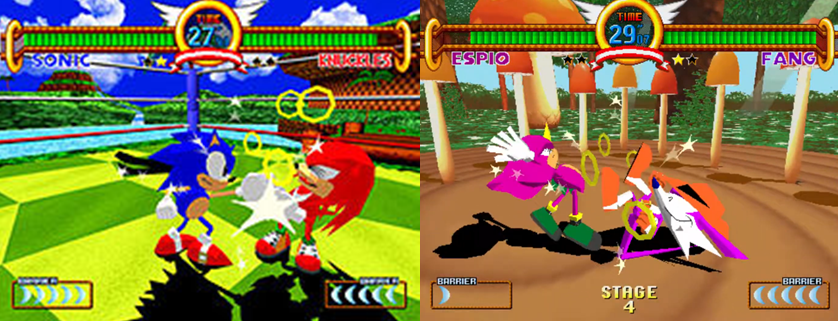
Perhaps fittingly, fights in Sonic the Fighters are extremely quick and frantic; health bars seem to drain extremely quickly, especially when you’re hit with a few frenzied punches or a throw or two, and it won’t take you longer than ten minutes or so to blast through the arcade ladder on the easiest setting. You can customise the difficulty of the single-player arcade mode, the length and number of rounds, and set the strength of attacks and number of barriers characters have from the main options menu, which can make the game easier and harder depending on your setup, but it’s a rapid fighting game that bombards you with colours, cartoony slapstick, and a quick burst of adrenaline rather than being a deep or complex fighter. Unlike a lot of fighters, there’s very little to break up the action in Sonic the Fighters; there’s no bonus stages or mini games to worry about and variety only comes into play in the garish and colourful stages and the brief little cutscenes that play in the game’s final stages. Every time you play the game, you’ll battle the same opponents in the same order in the same stages, which only adds to the game’s repetitive and predictable nature, and the only option you’re really given to try and spice up your fights is that you can press the Start button to switch the perspective to slightly behind your character (though I found this a bit disorienting for a one-on-one fighting game).
Graphics and Sound:
Characters are brought to life in the finest polygonal graphics the arcades had to offer; fighters are large, colourful, and extremely expressive, spewing Golden Rings every time they’re hit, squashing when hit with big moves, and reacting with an over-the-top, cartoonish slapstick that really adds to the game’s charm. And, honestly, it’s a good job that these aspects are present in Sonic the Fighters as these kind of graphics (while impressive and trend-setting at the time when the industry was swamped with traditional 2D fighters) really haven’t aged well at all. Seriously, games like Virtual Fighter (SEGA AM2, 1993), Soul Edge (Project Soul, 1995), and Tekken (Namco, 1995) might have shown what the next generation of home consoles and 3D polygonal graphics were capable of but they look pretty ass these days and Sonic the Fighters is no exception with its harsh edges and blocky textures. Still, the game is very bright and colourful and really pops out at you…well, I say “pops” but really it screams in your face with how vibrant and garish it can be. Every character stands out from even the most colourful backgrounds thanks to their large, blocky size, cartoonish expressions, and vivid, recognisable colour schemes (Sonic is a stunning blue, Fang is a unique purple, and Bark is a big cream-coloured polar bear, for example). The character designs really are spot on, with each character having their own unique little quirks and animations to help them stand out; Fang bounces on his tail like a pogo stick, Tails flails his arms around in a little flurry, and Bean haphazardly tosses his bombs with reckless abandon.

The game’s final bosses only continue this, with Metal Sonic rendered beautifully in 3D (he is probably the most smooth and impressive of all the game’s characters) and even Dr. Eggman’s little mech looking both cute and perfectly in character (if a bit small). Each of the game’s eight characters has their own stage and the majority of these stages are based on recognisable Zones from across the Sonic franchise but, ironically, the four core characters (Sonic, Tails, Knuckles, and Amy) seem to have been slightly misplaced in these stages. You’d think that you’d face Sonic in the Green Hill-inspired South Island and Knuckles in Mushroom Hill but, actually, you face Knuckles in South Island and Espio in Mushroom Hill, which is a bit odd. Fang, Bean, and Bark and all perfectly placed in Casino Night, Dynamite Plant (which seems like an amalgamation of Chemical Plant, Oil Ocean, and Metropolis Zone), and Aurora Icefield, however. Stages are limited to a very small, restrictive 3D plane that, yes, you can freely navigate around using movements and sidesteps but they’re not very big. You won’t have to worry about ring outs, however, which is good, and you can smack your opponent into, and bounce them off of, the walls of each stage, which can produce comical sounds from the Sonic sound effects library. One area where the game really excels in its music; jaunty, upbeat, energetic tunes accompany the start, end, and duration of each round and it (like the game’s general aesthetic) reminds me of the look and sound of Sonic 3D: Flickies’ Island/Sonic 3D Blast (Traveller’s Tales/Sonic Team, 1996) and even the Sonic the Hedgehog original video animation (Ikegami, 1999). When you win a round, you’ll also view an instant replay of the last few moments of the fight, much like in Tekken, and a handful of quick, simple cutscenes (which utilise the in-game graphics) show Dr. Eggman copying your fighter for the mirror match and relay the general plot of the game as well as the dramatic ending that sees you battling against a strict time limit.
Enemies and Bosses:
As a one-on-one fighting game, you’ll be tasked with battling every character in the game in your quest to secure the eight Chaos Emeralds and take on Metal Sonic and Dr. Eggman. No matter who you pick, though, two things are guaranteed: one is that you’ll battle a monochrome double of yourself and the other is that you’ll face the same fighters in the same order every time, meaning you can prepare accordingly for the unique traits of each fighter without being taken by surprise, though it does make the single-player arcade ladder very predictable and repetitive. I played the game on the easiest difficulty and found that the first few fights were pretty much a walk in the park: Knuckles is extremely unaggressive and rarely even tries to launch an attack against you, Amy likes to hide behind her barriers to drag out the battle, and Bark, for all his size and power, is pretty easy to dominate with the faster characters. Things always seem to take a turn for me when I go up against Espio, who appears to be much more aggressive in his approach, and Fang, who is extremely cheap to both play as or fight against since his popgun just blasts projectiles with relentless abandon.

Once you conquer all of the fighters and secure the eight Chaos Emeralds, you’ll rocket up to the Death Egg II and do battle with the game’s toughest opponent yet: Metal Sonic. Metal Sonic is a fast, aggressive move thief, busting out a version of Tails’ helicopter drop and Knuckles’ glide by rocketing across the screen like a torpedo. He can also blast out a large laser from his chest and drain your health bar with just a few combos and is easily the most frustrating opponent in the game made all the more annoying because of the game’s dodgy controls and requirements to properly pull off special moves. Once you finally take out Metal Sonic, though, the Death Egg II’s self-destruction sequence begins and Dr. Eggman comes stomping out in his little pincer mech and tries to keep you from escaping before the space station explodes. For this battle, you’ll automatically be placed into a permanent Hyper Mode but, on the flip side, you’ll also be given fifteen seconds to defeat Dr. Eggman in a single round fight and, if you fail, it’s game over. Thankfully, Dr. Eggman is no real threat (at least on the easiest setting) and you can simply trounce him in no time at all by spamming whatever attacks and combos you know before he even has a chance to unload his best attacks against you.
Power-Ups and Bonuses:
There’s no extraneous power-ups or onscreen collectibles to worry about in Sonic the Fighters; it’s about as bare bones as you can get for a fighting title and the only power-up you have at your disposal is the Hyper Mode, which can be activated for a few seconds at the cost of some barrier energy and can help turn the tide if you’re struggling. If you manage to reach Metal Sonic without losing a single round, and score the win in the first round against him, you can activate your Hyper Mode to transform into Super Sonic for the remainder of the game. Obviously, this only applies when you’re playing as Sonic and no other character gets this buff and, unfortunately, there’s no way to play as Super Sonic outside of this requirement but it’s pretty cool to wreck Metal Sonic and Dr. Eggman as a fully powered up Super Sonic if you’ve got the skills and luck to activate this form.
Additional Features:
There are twelve Achievements for you to earn in Sonic the Fighters and you should probably be able to get them all in one quick playthrough without any real difficulty. Seven of the Achievements are earned simply by completing the arcade mode on any difficulty; you’ll also nab another from playing arcade mode and battling your monochrome doppelgänger and, as long as you press the attack against a defending opponent, you’ll most likely grab another at the same time, too. The only ones that you might have to think a little harder about are ‘A Small Transformation’ (which requires you to get squashed by Amy’s hammer attack), ‘Perfect’ (which requires you to complete one round without being hit), and ‘Honey the Cat’ (which requires you to press Start when selecting Amy).
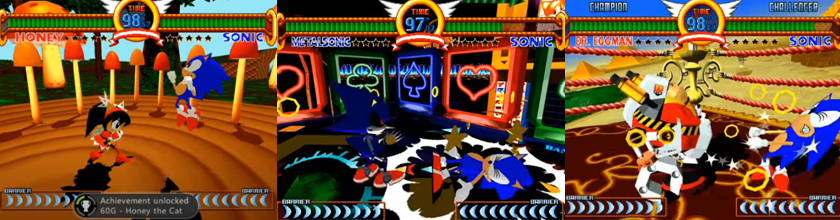
Speaking of Honey, this character was officially added to the game’s playable roster of fighters in this console port, which is very much appreciated. You can also play as Metal Sonic and Dr. Eggman by pressing Start when selecting Sonic or Bean, respectively, but you can only play as these two outside of the arcade mode, which is a bit of a shame. Equally disappointing is that other cut variants of the bosses were still inaccessible even in this game and that there’s no way to play a one-on-one fight against a computer-controlled opponent outside of the arcade mode. You can, however, fight against a friend in both couch co-op and online and compare your scores and winning streaks with others with the online leaderboards but, sadly, that’s it; there’s no gallery or character models or anything, which is a bit of a shame.
The Summary:
Sonic the Fighters is a fairly decent little blast of fun that should keep you satisfied for about, maybe, half an hour at the most. The arcade mode is a breeze to blast through in about ten minutes, depending on your skill level and the difficulty settings you set up, and there’s some fun to be had playing as each character and basking in their vibrant, animated 3D models. As an obscure entry in the Sonic franchise, you could do a lot worse and it’s great seeing Fang, Bean, and Bark brought to life in 3D and given a chance to shine. I’ll never understand why it took SEGA so long to bring these fantastically-designed characters back into the franchise and that, and my brief experience with the game at SEGAWorld, means I have a bit of a soft spot for this mostly forgotten entry in the franchise. However, it can’t be denied that Sonic the Fighters isn’t really that good of a gaming experience or a fighting game; it’s bright and vibrant and full of quirky, cartoonish charm but there are definitely better 3D fighters out there from the same time and the game is just too fast and too frantic for its own good, meaning it’s a disappointingly short and underwhelming experience that is only worth your time because it’s kinda cheap, the Achievements are dead easy to get, and you can breeze through it easily enough even when facing the game’s cheaper, more frustrating opponents.
My Rating:
Could Be Better
Are you a fan of Sonic the Fighters? Which of the game’s roster was your favourite and why? What did you think to the game’s aesthetic and gameplay? Did you struggle with the controls and button inputs or did you discover a depth to the gameplay that I missed while madly mashing buttons? Did you ever play Sonic the Fighters out in the wild or did you first experience it when it was ported to home consoles? Would you like to see SEGA attempt a Sonic fighting game again sometime, maybe in the mould of the Super Smash Bros. series (HAL Laboratory/Various, 1999 to present)? Whatever your thoughts on Sonic the Fighters, leave a comment down below.

 Dr. K's Waiting Room
One thought on “Game Corner [Sonic Month]: Sonic the Fighters (Xbox One)”