This review has been supported by Chiara Cooper.
If you’d like to support the site, you can do so at my Ko-Fi page.


Released: 1991
Developer: Data East
Also Available For: Amiga, Amstrad GX4000, Atari ST, Commodore 64, Game Boy, Nintendo Entertainment System (NES), ZX Spectrum
The Background:
In 1987, director Paul Verhoeven brought us RoboCop, a delightfully over-the-top sci-fi classic punctuated by copious amounts of gore and offering a tongue-in-cheek analysis of corporations and the media. The film was profitable enough to earn a sequel, which faced a tumultuous production, grossed noticeably less at the box office, and was met with mixed reviews. Regardless, RoboCop 2 (Kershner, 1990) remains an under-rated film in my opinion and, like its predecessor, was followed by comic books and a videogame adaptation publisher by Ocean Software, a British company known for making videogame adaptations of numerous film and television franchises, and developed by Data East, a Japanese arcade developer. The game saw the return of numerous gameplay mechanics from its predecessor, and was also released on multiple platforms, with some notable differences being present in the Japanese arcade release. While the Amiga port was praised for its presentation and the ZX Spectrum version was lauded for its replayability, the arcade version was criticised as being unoriginal and graphically inferior to its predecessor.
The Plot:
Detroit is being over-run by gangs, crime, and corruption thanks to the machinations of Omni-Consumer Products (OCP) and only cybernetic police officer RoboCop can hope to maintain law and order on the city streets.
Gameplay:
Like its predecessor, RoboCop 2 is a 2D, sidescrolling action shoot-‘em-up in which players once again assume control of Alex Murphy, cybernetic police officer RoboCop, and are tasked with cleaning up the streets of Detroit. Much like every RoboCop title I’ve ever played, RoboCop remains a sluggish, clunky, and awkward playable character. The controls couldn’t be simpler; you move RoboCop left and right with the joystick and can fire his iconic Auto 9 either directly ahead or directly behind him, allowing you to blast at enemies quickly and efficiently (though I did have some trouble remembering which button corresponded to which direction, and you can’t just hold down the fire button like in other run-and-gun games). RoboCop can’t duck but he can still haul his metal butt into the air to jump; thankfully, you won’t be required to do any kind of platforming and this is purely to allow you to hit certain bosses in their weak point with a “Jumping Shot” since you can’t aim your Auto 9 in any direction but the one you’re facing.

You’ll have to contend with quite a few onscreen enemies at once, as well as a time limit, but each credit you enter will give you two lives and RoboCop is far more durable this time around. When enemies get up close, RoboCop will unleash a few piston-like punches and toss them away, which is super useful not just for clearing enemies off you but also dealing damage as enemies can take quite a few shots before going down but seem weaker to your melee attacks. You won’t really have to worry about anything except battling your way ever onwards, no matter how different the environment around you gets; you’ll occasionally get to fire at barrels or crates for power-ups or smash through pipes and doors, but I found these often just blinked out of existence rather than exploding. Gameplay is mixed up a little bit with a brief instance where you must frantically mash the fire button and waggle the joystick to overpower a car and, more consistently, when the perspective shifts to a vertical shooter and you have to pick off goons when they pop out from behind columns like a shooting range and in first-person bonus stages where you’re riding on a motorcycle or in a car for a bit of rail shooting.
Graphics and Sound:
One area where RoboCop really takes a hit is in the sprite work; sure, RoboCop and the enemies he encounters are much bigger and more detailed than in the last game, but they’re lacking in personality and animations. There might be a few voice samples from the films included but RoboCop doesn’t have an idle animation anymore; he just stands there like a statue until you get him plodding along. He’ll twirl and holster his Auto 9 after clearing a stage, which is all very well and good but, ironically, he only seems at his most alive when he’s being knocked down or killed. He scrambles to his feet and is rendered a smouldering mess of limbs upon death, which is a nice touch, but sadly this kind of detail is missing from his active sprite.
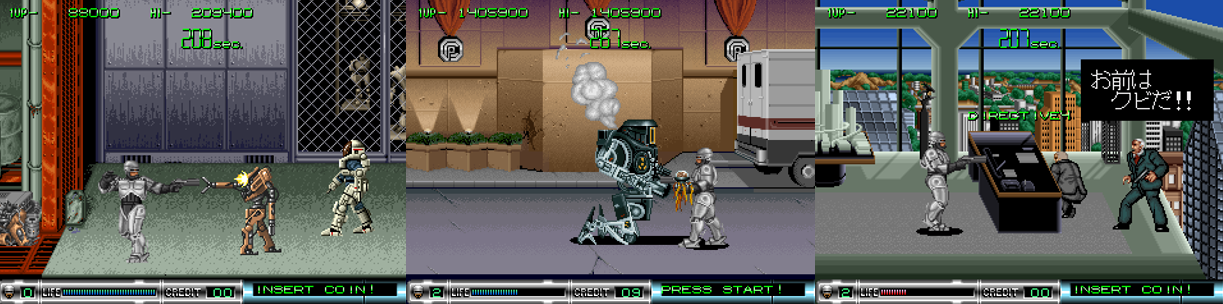
Thankfully, the recognisable bosses and areas from the movies fare much better in this respect; you start off on the graffiti-stained wreckage of the Detroit streets, passing behind wrecked cars and battling through the arcade past arcade machines and an air hockey table and into the Nuke production factory, and eventually end up at the OCP building. Like the gun shop and the Nuke factory, this area is ripped straight from the movie (it even has the little model of Delta City in the background) and you’ll battle through its hallways, up a lift, and fall from the rooftop to the streets below just like in the movie’s finale. Various pixelated shots from the movie are incorporated into the game’s opening sequence and the title screen, though the ending is related using only simple text; however, if you’re playing the Japanese version of the game, you’ll be treated to a pixel-art recreation of the first film that plays before and during a whole new opening stage that recreates RoboCop’s showdown at OCP headquarters from the end of that movie.
Enemies and Bosses:
Detroit’s finest scumbags are out in force in RoboCop 2; these mohawk-wearing punks initially attack with knives and guns but are soon busting out axes and large mallets to pummel you with. They’ll also race around on motorcycles, sport some nifty karate moves, and whip out heavier ordinance when you reach the gun shop. Soon, you’ll match wits with OCPs security droids, have arcade machines tossed at you, and be shot at by laser rifles and rocket launchers. Punks will also take shots at you from the backs of vans and from helicopters in the rail shooter sections, and you’ll find the enemies get mixed and matched as you reach the end of the game.

Each stage ends in a boss battle that’s made all the more tedious by the fact that each once can absorb a great deal of damage before being put down. Even the first stage boss, which is just a frog-footed motorcycle thug swinging a chainsaw around, doesn’t go down easy, and things quickly escalate when you come across a goon in a mechanised suit. This bugger flies around dropping mines everywhere and blasting at you with a machine gun and missile launcher, and even crops up again later in the game for a rematch; be sure to shoot at the pilot when he ejects, if only for a bit of catharsis. In the Nuke factory, you’ll encounter some mutated enemies clearly inspired by the first film’s “Melting Man” effect, and even battle a monstrous version of Catzo after dunking him in a vat of the stuff. You’ll also have to contend with a massive hopping cannon than leaps about the place blasting at you with its main weapon, tosses grenades at your head, and fires a machine gun at you. While you won’t take damage if you touch it and the main cannon can be put out of commission, it’ll become more erratic and aggressive when near defeat.
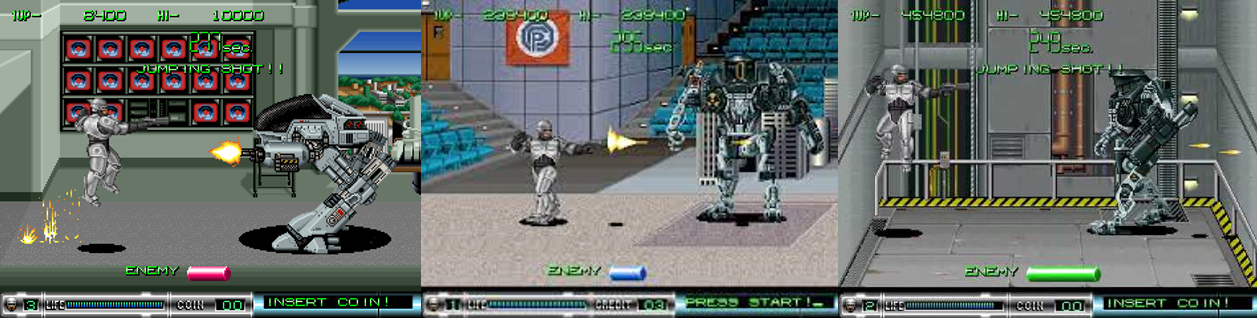
When you get to the OCP building, you’ll finally face off against one of the franchise’s most memorable foes, the Enforcement Droid 209/ED-209. Of course, you initially battle against this in the prelude in the Japanese version, but both battles are the same; you must avoid ED-209’s machine gun fire and missiles and shoot at its big domed head with your jumping shot. This is all you really need to worry about as ED-209 doesn’t really move that much or have other attacks but, while you’ll employ the same strategy against RoboCain, you’ll find this final boss much more formidable and mobile. First, the battle against RoboCain takes place over three phases; in each phase, RoboCain gains more health and adds additional attacks to its arsenal. At first, RoboCain plods about blasting at you with its machine gun arm and swiping at you with its metallic talon, then it gains its extending arm attack and flails its arms around like a whirlwind, and then it attacks with its electrical claw up close and fries homing missiles at you. When you crash to the ground outside the OCP building, RoboCain will lose some of its armaments the more your pour on the attacks, eventually crumbling to its knees and leaving itself wide open for RoboCop to rip its brain out and end its threat once and for all.
Power-Ups and Bonuses:
Health is extremely scarce in RoboCop 2, but you can occasionally grab pills to refill your health bar. Your main in-game upgrade, however, will be the additional, extremely temporary weapons you can grab here and there as you battle through each stage. You can grab such state-of-the-art bang-bangs as the Cobra Assault Cannon, a mini gun, and a bazooka, all of which deal heavy damage but are only good for a few shots before you lose them, which is extremely disappointing.
Additional Features:
Your main reason to replay RoboCop 2 will, of course, be to beat your high score. However, the game can be played in two-player co-operative mode, with player two taking control of a blue chromed RoboCop for twice the action. As mentioned, the Japanese version also features an additional opening stage so it’s probably best to play that version of the game so you can wring a little more game time out of it.
The Summary:
RoboCop 2 is very similar to its predecessor in a lot of ways; it remains a simplistic, action-packing shoot-‘em-up with a little variety thanks to the first-person and vertical shooter sections. While RoboCop is far more durable this time around, so are his enemies and, although there’s far less onscreen hazards to have to worry about, RoboCop remains as unwieldy as ever. The game features some nice big, detailed sprites and environments that are ripped straight from the movie, but the lack of personality and animation frames makes it all the clunkier to play. It’s a decent enough way to spend about forty minutes of your life, but it really doesn’t bring anything new to the table and is, in a way, a little less appealing than the first game due to the lack of enemy variety and entertaining action sequences. RoboCop 2 just about saves itself with an impressive amount of attention to detail, especially in recreating the brawl between RoboCop and RoboCain, and the additions found in the Japanese version absolutely make that the definitive version of this game, but you’re not really missing out on much if you skip this one or only play about ten minutes of it.
My Rating:
Pretty Good
Did you ever play RoboCop 2 in an arcade? Which RoboCop videogame is your favourite? Would you like to see a new RoboCop game; if so, what genre do you think would best fit the source material? Which RoboCop movie is your favourite? Either way, leave your thoughts about RoboCop 2 below, or drop a comment on my social media.

 Dr. K's Waiting Room
2 thoughts on “Game Corner: RoboCop 2 (Arcade)”