Screen Time [National Anime Day]: Attack on Titan (Season One)


15 April has been designated National Anime Day to celebrate the stylistic genre, which achieved mainstream success thanks to animators like Osamu Tezuka.


Season One

Air Date: 7 April 2013 to present
UK Distributor: Netflix, et al
Original Network: MBS/NHK General TV
Stars: Bryce Papenbrook, Josh Grelle, Trina Nishimura, Jessica Calvello, Lauren Landa, Matthew Mercer, and R Bruce Elliott

The Background:
Attack on Titan began life as a Japanese manga written and illustrated by Hajime Isayama and has been published in Bessatsu Shōnen Magazine since September 2009. Drawing from personal experiences regarding the fear of strangers you cannot communicate with, the isolated and enclosed nature of Japanese culture, and the Muv-Luv visual novel series (âge/5pb, 2003 to 2016), Attack on Titan was very well received, selling over 100 million copies by the end of 2019 and quickly etching itself into worldwide popular culture. As a result of the manga’s popularity, Attack on Titan has been adapted into videogames, live-action movies, and an ongoing anime. The anime was produced by Wit Studio and Production I.G, directed by Tetsurō Araki, and dubbed into English by FUNimation Entertainment. Like the manga, the anime was received generally positively, with critics praising the storyline, animation, and music but criticising the crudeness or the titular Titans and the bleakness of the story’s tone.

The Plot:
For a hundred years, the last vestiges of humanity has lived in cities surrounded by enormous walls that protect them from gigantic man-eating humanoids referred to as Titans. After his mother is devoured by a Titan before his eyes, Eren Yeager (Papenbrook) vows to join the Titan-hunting Scout Regiment alongside his friends Mikasa Ackerman (Nishimura) and Armin Arlert (Grelle) and rid the world of the Titans once and for all.

The Review:
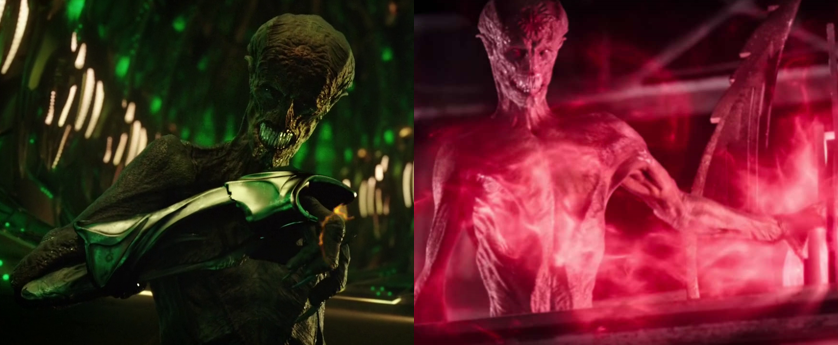
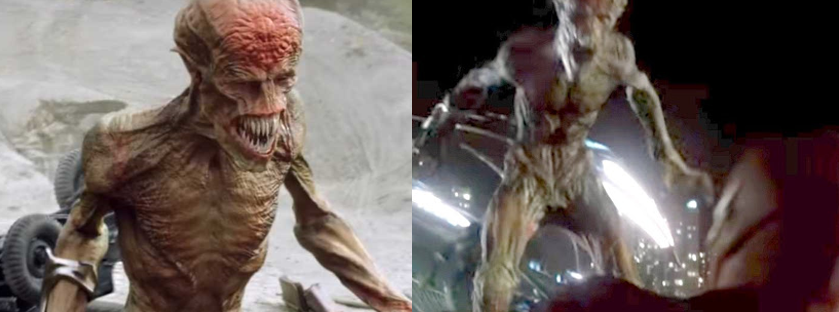
In a world where we are literally swamped with all kinds of bat-shit crazy ideas for manga, anime, and videogames, Attack on Titan offers what can only be described as a “unique” premise: one day, about a hundred years ago, the gigantic cannibalistic Titans simply showed up and started eating humans left, right, and centre. They appeared seemingly out of nowhere and decimated humanity, driving them behind fifty-foot high walls and to the point of near extinction. Since then, humanity has lived in relative peace, training generations of soldiers to battle the nigh-indestructible Titans and scout out new areas for expansion and the acquisition of resources. The titular Titans are gruesome, disturbing creatures; ranging in height from around three to fifteen meters tall, they vary in appearance from constantly-grinning or alarmingly stoic-faced naked humanoids, to twisted, frenetic freaks and skinless, steam-emitting monstrosities. Deceptively fast and light despite their enormous size, the Titans are superhumanly strong and constantly regenerate from any injury unless attacked at their one weak point at the base of the neck. The Titans generally attack without reason or mercy, devouring humans not for sustenance but, apparently, simply out of some kind of base instinct (though more intelligent Titans do exist).

Horrific, intelligent Titan variants pose a real threat to humanity’s survival.

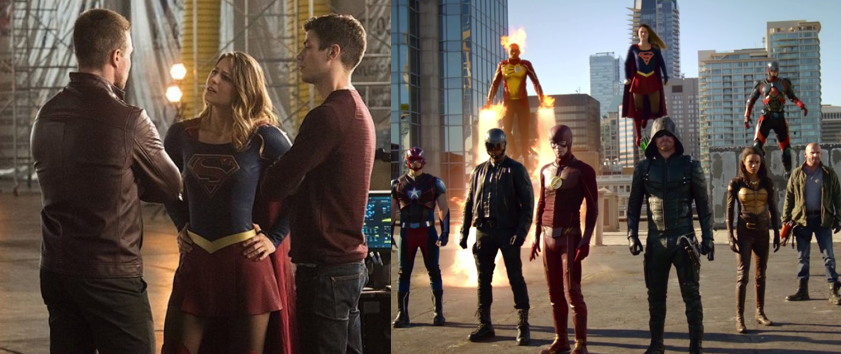
The Colossal Titan (which is so huge that it can peer over the walls that keep humanity safe from the Titans) systematically destroys the weakest part of Wall Maria to allow its brethren to enter the outer area of the city. This act alone earns the Colossal Titan (and the Titans in general) Eren’s hatred as it directly leads to the death of his mother and kick-starts his entire crusade to hunt down and destroy all of the Titans. Later in the season, Eren and Squad Levi encounter a skinless Female Titan that specifically targets Eren and is capable of hardening its skin at will and is smart enough to cover its neck when under attack. Similarly, the Armoured Titan is not only highly resistant to the army’s anti-Titan cannons but methodically picks and choose its targets, unlike the horrific Abnormals, which run and skitter around in an unhinged frenzy.

The Titans are practically unstoppable and have driven humanity to near extinction.

Honestly, one of the best parts of Attack on Titan is the Titans themselves; they are horrific creatures that are cold, unmoved, and seemingly unstoppable. Just one Titan is capable of swatting attackers right out of the air, stomping on them, or chomping down on them in the apparent blink of an eye. Often, two or three Titans are seen as a significant threat to the populace and those trained to protect them but, other times, soldiers (specifically the army’s more highly-skilled individuals) will be able to cut Titans down almost effortlessly and, yet, the Titans continue on regardless and it is stated at one point that humanity has never, in a hundred years, scored anything close to a significant victory until the episode “Primal Desire: The Struggle for Trost, Part 9” (Koizuka, 2013).

The O.D.M. allows the characters to perform superhuman feats.

Opposing the Titans are the city’s military; trained in the use of Omni-Directional Mobility Gear (O.D.M.), these guys are able to fly all over the place thanks to the O.D.M.’s gas-powered grapple hooks. Once mastered, the O.D.M. pretty much turns every character into Peter Parker/Spider-Man as they swing, fly, and rappel all over the place with superhuman skill and ease, attacking Titans with their swords and yet, despite all their skill and extraordinary physical prowess, they are still splattered into mush or devoured by the hundreds in seemingly every campaign, willingly throwing their lives away even when escape would be a far better proposition. Attack on Titan centres around three human characters: Eren (the hot-headed, idealistic protagonist), Mikasa (Eren’s stoic, but highly skilled adopted sister and self-appointed bodyguard), and Armin (their childhood friend who is more of an academic than a fighter). Of the three, Eren is easily the most relatable and interesting; wracked with guilt after never appreciating his mother and haunted by fragmented memories of his father, he is driven by an unrelenting desire to succeed in the military, join the Scout Regiment, and experience life beyond the walls of the city to hunt down and destroy every Titan he finds. Eren is quite the flawed character; despite his bravado and commitment to his mission, he struggles to master the O.D.M. gear, is far less capable at battling the Titans than Mikasa or Captain Levi (Mercer), the military’s most decorated and powerful soldier, and isn’t as well-read as Armin.

Somehow, Eren is able to transform into the Attack Titan to take the fight to the Titans.

However, his heart cannot be denied; in the face of a Titan assault in “First Battle: The Struggle for Trost, Part 1” (Ezaki, 2013), Eren immediately takes command and leads the charge against the Titans. Briefly paralyzed with fear in the face of the Titans’ awesome power, he barely hesitates to sacrifice himself to save Armin from being swallowed by the Bearded Titan, apparently dying in the process. Luckily, however, Eren later resurfaces in his own Titan form, the Attack Titan, apparently mysteriously having the innate ability to transform into a Titan when injured and with a clear, defined goal. At first, and sporadically throughout the season, Eren cannot fully control this transformation and struggles to understand it; understandably, it causes a lot of fear and mistrust amongst his fellow soldiers, who constantly treat him either with respect and awe or terror and hatred, and his superiors constantly flip-flop on whether to use his powers to aid them or simply execute him.

Levi is the army’s most formidable soldier and a decorated Titan killer.

Eventually, Eren is assigned to Squad Levi and the direct scrutiny of Captain Levi, a stoic but superhumanly capable soldier who is equal to the strength of a hundred fully-trained soldiers. Levi is the anime’s standard detached, bad-ass character, slicing up even the near-unstoppable Female Titan in a whirlwind of blades and fully prepared to sacrifice his entire regiment (comprised of the army’s best and longest-living Titan hunters, it must be said) to protect Eren.

Though stoic, Mikasa has a natural aptitude for combat.

Levi’s demeanour is largely mirrored by Mikasa, a damaged young girl whose entire family was slaughtered before her eyes until she was saved by Eren, the two of them killing her attackers in a mindless fury. Since then, Mikasa has attached herself to Eren, following him everywhere, even to military school and out into the 104th Regiment. Though not quite as stoic as Levi, Mikasa is nevertheless capable of killing entire swarms of Titans all by herself through some innate physical prowess that is never really explained. It’s hinted numerous times throughout the season that Mikasa’s feelings towards Eren border on something more than friends and family but both are quick to either brush off this suggestion or are far too focused on the far more prominent threat of destroying the Titans.
Armin is the weakest and most annoying of the three protagonists.

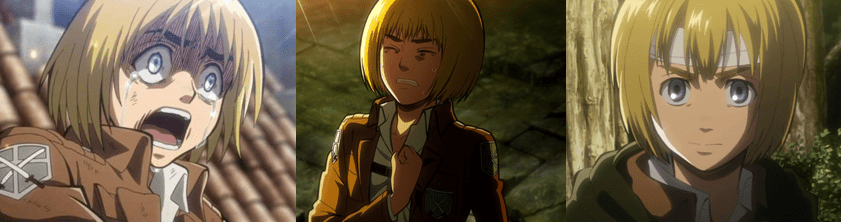
Finally, there’s Armin, easily the weakest and most annoying character of the three. Many episodes either grind to a halt or entirely focus on one of the three debating the merits of teamwork, humanity, or reliving their memories and feelings through long-winded internal (or external) monologues or flashbacks but never is this more annoying when the focus is placed on Armin. The weakest link of his regiment, Armin’s prowess lies more in academics, strategy, philosophy, and introspective analysis; he’s quick to give in to despair (though, to be fair, so are a large number of the anime’s soldiers and characters in the face of the Titans’ inexorable threat) and to stand useless and in fearful awe in the midst of a heated battle where untold numbers of his friends and peers are decimated by the Titans to incessantly monologue about his shortcomings or the bravery of others.
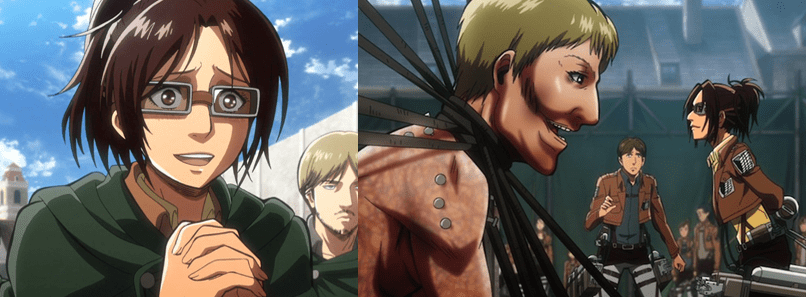
Hange Zoë is easily the worst and most annoying character of the season.

Still, as annoying as Armin is, he’s got nothing on Hange Zoë (Calvello), a military scientist who is so incredibly obsessed with the Titans that she has been driven to what appears to be near insanity. Loud, obnoxious, and exploding into a crazed frenzy at the drop of a hat, Zoë wants nothing more than to study and investigate the Titans, growing uncomfortably close to captive Titans and disconcertingly obsessed with Eren and his unique physiology. Though her experiments and studies have uncovered numerous helpful insights into the Titan’s composition and nature (and has led to the creation of numerous weapons to bring them down or kill them), her character is largely both uncomfortable and annoying at the same time as she often cares more for the well-being of the Titans than her fellow humans.
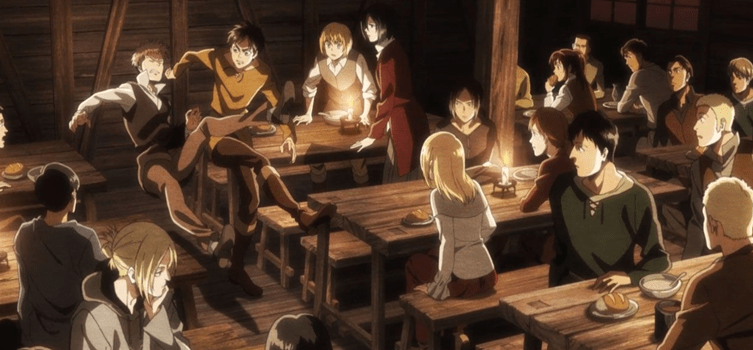
Many of the supporting characters are easily forgotten until they suddenly die.

Rounding out the cast are a number of expendable soldiers and civilians; sure, most of them have names and character traits but it’s largely pointless to remember them or grow too attached as they are liable to either get splattered into a bloody mess, eaten alive, horribly dismembered, or found as little more than a bloodied and mutilated corpse. Often, another character would lament their comrade’s fate and I would find myself struggling to remember who they were, what they did, or when they last appeared. Interestingly, the city is made up of varying classes, each of which experience life within the walls differently and views the military, and the Titans, in different ways: many criticise the need for expensive military ventures and pursuits, others are living comfortably deep within Wall Sina, while those in the outer areas live relatively underprivileged lives. Like a lot of post-apocalyptic narratives, I have many questions regarding the world of Attack on Titan; I’ve looked into the series and researched it a little bit to get some answers regarding the history of this world and how the walls and city were erected but, in the context of season one, we get very little information regarding how the city was built and how they survive.
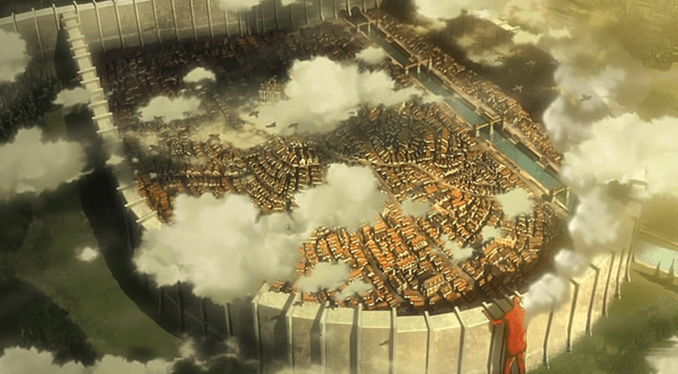
I have many questions about the city, its society, and the lore of this world.

For some reason, currency and wealth is still a thing within the city; many of the wealthier citizens are frustrated at their “taxes” paying for what amount to little more than suicide missions against the Titans and the Royal Family live in opulence within Wall Sina. Equally, there is a lot of mention of rations and finite resources; every time Titans breach the walls and cause a mass evacuation, food and supplies are strained so badly that it is often seen as a good thing when hundreds of soldiers are killed by Titans so that the city’s resources can last a bit longer. I have many questions regarding this: shouldn’t the city just be entirely focused on training soldiers, fortifying their defences, and building a military society rather than giving people the option of living passive lives? Why is money and wealth a thing? How can money really mean anything in this type of world? Where do the resources come from? How were all these houses built, to say nothing of the walls that protect the city? How do the citizens even have the means to build anything with such finite resources? Why aren’t the soldiers, especially the veterans, better at killing Titans when the creatures are largely predictable, have a well-known weak spot, and seem so cumbersome and slow despite their surprising speed and daunting strength?

Eren isn’t the only one who can transform into a Titan, raising many questions for season two.

These questions are generally disregarded in season one and, for the most part, it works; despite characters knowing a lot about the Titans’ physiology, the creatures and their origins are a complete mystery to the characters and they are constantly forced to learn as they go and endure horrific losses to gain slivers of new information about them. How Eren, and others, are able to spontaneously produce Titan bodies is left obscure and the motivations of the Titans’ cannibalistic ways are up for debate at this point. The season ends, however, not only with the knowledge that Eren is not unique as Annie Leonhart (Landa) is revealed to not only be a traitor to the humans but also capable of transforming into a Titan herself, but also that gigantic Titans are encased within the walls of the city, ending the season on a massive cliff-hanger as we’re faced with the knowledge that human-to-Titan individuals are more commonplace than first thought and that there is more to the history of this world than we, and the characters, are aware.
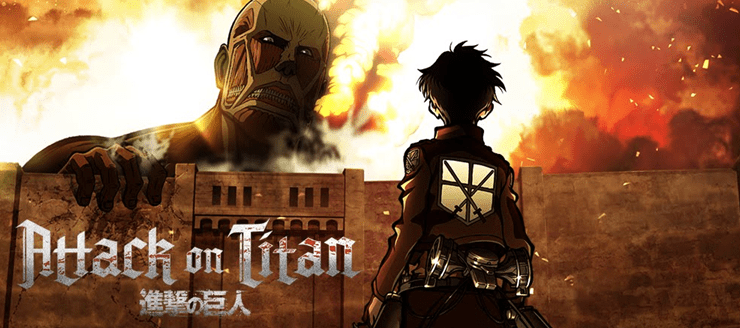
The Summary:
I had heard a lot about Attack on Titan for quite some time; I am not, by my own admission, the most well-read anime fan as I find a lot of the most popular anime films and series to be dense almost to the point of being impenetrable and with so many episodes (most of them being filler or padding) that I just don’t have the time or patience to fully invest my energy and effort.

There are so many monologues! It really grinds the pace and action to a halt.

However, when I saw Attack on Titan was on Netflix, I figured I’d watch a few episodes and see if it hooked me. Within three episodes, I was interested enough to carry on but, by around episode fifteen, the series had started to lose me. I quite liked Eren’s flawed character and the constant life and war lessons he was forced to learn through numerous encounters with the Titans and characters like Mikasa and Levi helped make the anime exciting and engaging when it was actually focused on action rather than constantly slowing the plot down with endless monologues and prattling on and on (often, inexplicably, when characters are moving at high speeds) about teamwork, friendship, and the futility (or glory) of war.

Attack on Titan excels whenever Titans are onscreen or the action picks up.

Attack on Titan excels when it focuses on the Titans and the action-packed assaults against them; seeing Eren and his fellow soldiers swing and fly all over the place, either being crushed, devoured, or successfully cutting down the creatures is exciting and gorgeous to behold and really showcases the detail and intricacies of the anime’s smooth and slick animation. Sadly, though, entire episodes can go by without the merest hint of action or appearances by the titular Titans; while this can lead to some interesting character development, more often than not episodes drag their runtime out focusing on characters who quickly die, strategies that immediately fail, or retreading the same ground about Eren, Mikasa, and Armin’s characters and backstory.

Some flashbacks and slower moments help flesh out the main characters.

Occasionally, our protagonists will learn and grow as characters, which is nice to see, but often they’ll learn a lesson or some self-confidence in one episode only to immediately have to relearn this again in the next (or subsequent) episode. It makes for a disjointed pace and gives me far too much time to think about the rules of this world and questioning how their society even works much less proves so unreliably effective against the Titans even with years of experience in fighting them. As a result, despite the massive cliff-hanger at the end of the season and what I’ve read of how the plot develops later on, I can’t see myself coming back to Attack on Titan again. At least, not the anime, anyway.

My Rating:

Rating: 2 out of 5.

Could Be Better

What are your thoughts on Attack on Titan? Did you enjoy the series or, like me, did you have issues with its plot, pacing, and content despite its interesting premise, creatures, and characters? Did you ever read the manga; if so, do you prefer it to the anime? Perhaps you prefer the live-action films, or the Attack on Titan videogames; if so, which is your favourite and why? Which character, or Titan, is your favourite? Do you also find Zoë and Armin annoying characters? How are you celebrating National Anime Day today? Whatever you think about Attack on Titan, or anime in general, please do leave a comment below.


Game Corner: Taz-Mania (Mega Drive)

Released: July 1992
Developer: Recreational Brainware
Also Available For: Game Boy, Game Gear, Master System, Super Nintendo Entertainment System (SNES)

The Background:
My absolute favourite Looney Tunes (1930 to present) character, the Tasmanian Devil (or simply “Taz”) first debuted in “Devil May Hare” (McKimson, 1954) as a dim-witted and voracious foil to Bugs Bunny (Mel Blanc). In the early- to mid-nineties, the Warner Bros. cartoons were undergoing something of a renaissance thanks to shows like Tiny Toon Adventures (1990 to 1992) and Animaniacs (1995 to 1998) and Taz became part of this resurgence in popularity when he graduated to his very own cartoon, Taz-Mania (1991 to 1995). To tie into this, several videogame adaptations of the show were produced; while the SNES version, which was more of a pseudo-3D endless runner, was unfavourably received, the Mega Drive title (which, like the others, was a traditional 2D sidescroller) was received very well. Since the Master System version (Technical Wave, 1992) was one of the first videogame cartridges I ever owned and one of my favourite action/platformers, I decided to pick up the Mega Drive version and see how the technically superior title holds up against others of its genre.

The Plot:
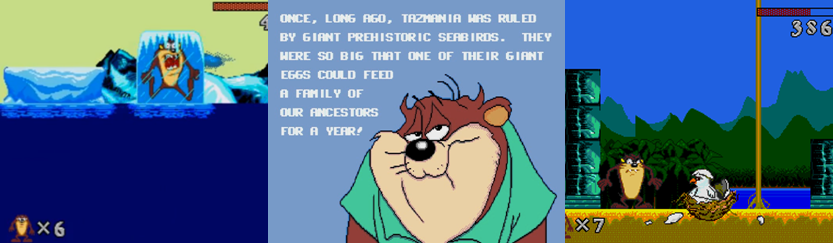
After being told a tale of a giant seabird that laid massive eggs capable of feeding an entire family for over a year, the ravenous and greedy Taz sets out in search of the Lost Valley and its legendary giant bird in hopes of satisfying his endless appetite.

Gameplay:
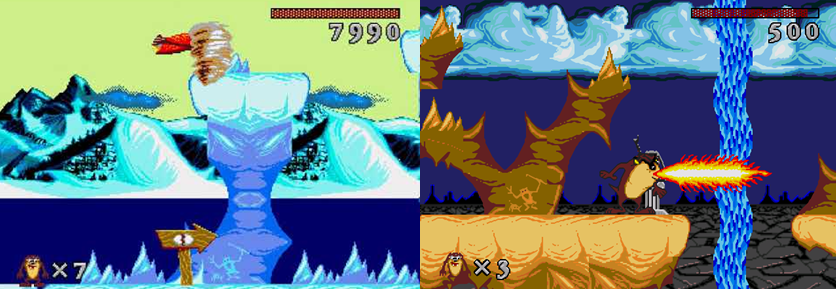
Taz-Mania is a 2D, sidescrolling action/platformer which has you guiding Taz across a number of locations (though, primarily, through jungles and Aztec ruins). While a variety of enemies populate Taz-Mania’s levels, your biggest enemies will be the controls and the numerous bottomless pits and instant death traps. Taz, though big and colourful and occasionally full of life, is a slow and clumsy character to play as; his jump is awkward, he can’t crouch or look up or down, and his hit box is ridiculously large at times.

Taz spins like a tornado and spits fire but has a large hit box and tends to destroy his own power-ups.

Thankfully, you can get Taz to move his big, useless butt by sending him into his trademark tornado spin; however, while this is great for blasting away most enemies, it also knocks away health and other power-ups when they’re onscreen. You can use the spin in mid-air for a boost but it’s a bit finicky and the game is structured less around letting you blast ahead at full speed and more around awkwardly jumping to platforms, working your way up or across, and making blind jumps across bottomless pits. Taz also has an “Action” button that will let you carry certain items to reach higher areas, activate switches, and breathe fire after eating chilli pepeprs, and can also defeat some enemies and damage bosses by jumping on their heads. Unfortunately, you’ll be spending most of your time struggling with the game’s sluggish controls and annoying platforming elements; in the Badlands, for example, you have to jump from jets of water to reach the exit but, if your jump is a little off (which happens more often than not thanks to Taz’s jumping being a bit stilted and floaty), you’ll get damaged by the water and the knockback will most likely send you falling to your death. Similarly, when you reach the Jungle, you’ll have to make blind jumps to platforms you can’t even see in order to progress and either fall to your death or jump right onto an enemy for your trouble.

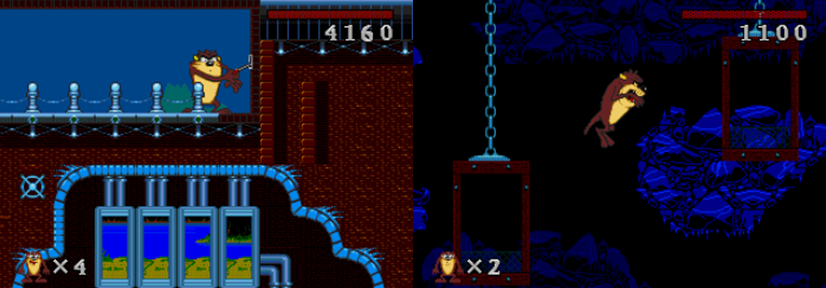
Gameplay is slowed to a crawl as you pull levers and try to figure out annoying lift puzzles.

Taz-Mania is much more of a thinking game than the Master System version, which I remember being more of a standard, cutesy platformer; in the Acme Factory, you have to jump up conveyor belts and dodge lasers to pull a series of switches and keep a deadly robot from being assembled. Pull the wrong switches, though, and you’ll be chargrilled as punishment, which is a pretty fast way to burn through your lives. Later, in the Mines, you’ll need to use similar levers to activate lifts to reach new areas; unfortunately, some of these are booby trapped and will send you falling to your death while others are suspended precariously over a bed of instant death spikes or missing entirely (which will also cause you to die immediately). In the Ruins level, you’ll have to make some very tricky and awkward jumps between platforms and if you’re not absolutely pixel-perfect, you’ll simply pass right through your intended target as though it were intangible!

While hopping from logs isn’t too bad, the mine cart section is an absolute nightmare!

More than once, you’ll be tasked with jumping from log to log to cross some rapids; thankfully, you won’t instantly die if you fall or land in the water but you will be bounced out at the cost of some health. These aren’t particularly difficult sections but they become more troublesome when you have to move Taz up and down to the foreground and background, which makes positioning his exact landing point difficult to judge, and when you have to struggle upstream and avoid flying over the edge of a waterfall. By far the most frustrating and unfair section of the game, though, is when you must jump into a runaway mine cart; you can speed up and slow down by pressing left or right and press A to raise the cart up and avoid crashing headfirst into a bumper, but you also have to be careful not to collide with the ceiling, enemies, or to fall off the broken tracks. One mistake and you instantly lose a life, which is ridiculously unreasonable and makes the presence of a life bar almost completely redundant.

Graphics and Sound:
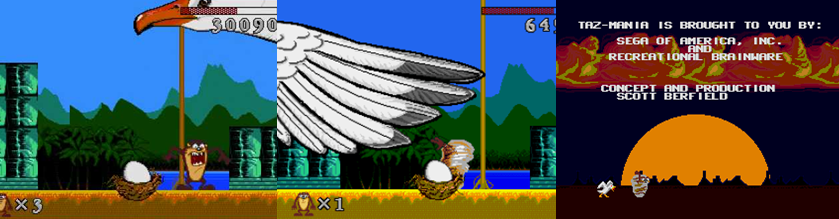
If there’s one thing Taz-Mania has going for it, it’s the graphics; sprites are big, cartoony, and colourful and the entire game evokes the look and feel of the cartoon. While the music and sound effects are extremely grating and poorly realised, it’s fun seeing Taz fly into an impatient rage when left idle and the little quirks he has here and there, such as eating the “S” in the opening SEGA logo.

Levels are colourful but not very varied and lacking in depth and complexity.

Sadly, this doesn’t really shine through all of the time and, for the most part, Taz is a very static and awkward character sprite. Similarly, the game’s backgrounds and levels aren’t all that interesting to look at; this game released almost a year after Sonic the Hedgehog (Sonic Team, 1991) and in the same year as Sonic the Hedgehog 2 (SEGA Technical Institute, 1992) so there’s really no excuse for the environments being so bland and basic. Occasionally, you’ll see some foreground effects and have to pass through certain walls to reach new or secret areas but, for the most part, there’s not really a lot on offer in terms of variety as the game spends way too much time in barren wastelands and jungles.

Taz-Mania really should have relied on in-game sprites for its story and cutscenes.

By far the most visually interesting levels are the Acme Warehouse and the Iceland, a stage you only visit once yet you’re forced to endure the drab, dark mine and confusing mess of the Jungle for what feels like an eternity. Taz-Mania employs some very simple motion comic-like cutscenes and text to tell its story that, while featuring bigger sprites and including a handful of cameos from the show, featured extremely limited animation and it feels like they could have been swapped out for in-game graphics and sprites like the game’s ending.

Enemies and Bosses:
Taz’s journey is obstructed by a handful of enemies, such as bats, frogs, crabs, and anthropomorphic stone heads and man-eating plants that try to take a bite out of you. Your most persistent and annoying obstacle (apart from the controls) will be the abundance of instant death traps and hazards such as pistols, fans, jets of flame, and bombs that dog you at every turn. In Iceland, you’ll also want to avoid landing in the freezing water as you’ll be frozen into a block of ice that will slowly drain your health unless you mash buttons to escape.

A couple of Taz’s adversaries from the cartoon show up as bosses, which is nice to see.

Fans of the cartoon may be slightly disappointed by how few characters carry over into the videogame and, yet, a handful of them do appear. In many levels, you’ll encounter a number of spear-wielding Bushrats, for example, and the first boss you battle is against Bull Gator and Axl in their trademark jeep. If you’ve played Sonic 2, it’s basically the same thing as the Emerald Hill Zone boss; simply hop over it to avoid being crushed and bounce or spin into the truck a few times and they’ll be done. Similarly, at the end of the Jungle level, you’ll encounter Francis X. Bushlad, a red-headed archer who simply shoots arrows at you in a predictable pattern and is easily bested by hopping on his head or spinning into him after jumping over his projectiles.

Taz also battles a giant plant and a stone version of himself.

You’ll also battle against a giant, man-eating plant that the instruction manual encourages you to throw a bag of “No Weed” at but I’m pretty certain I defeated it by simply spinning into it without much trouble at all. In the Ruins stage, one of the many Taz statues will come to life and you’ll have to fight a stone doppelgänger of Taz, who has all the same moves and abilities as you and is thus ridiculously easy to take out by jumping over his spin attacks and hitting him with your own when he’s standing still.

A giant seabird fiercely protects her egg in the finale but a few smacks to the head will dissuade her.

The finale of the game sees you navigating through a stone maze of sorts and then walking, almost completely unopposed, to the giant egg that is Taz’s goal. The egg is, of course, guarded by a giant seabird that attacks you with its humongous wings and talons, both of which are surprisingly easy to avoid. When the bird’s head pops into frame, simply spin into it a few times and you’ll win the day…only to be denied your dinner as the egg hatches and the hatchling mistakes Taz for its mother and amusingly chases him back home.

Power-Ups and Bonuses:
One thing Taz is known for is his insatiable appetite and, as a result, he’ll automatically pick up and eat objects and enemies that he comes across. This, however, can be detrimental to your health as Taz will swallow bombs if you’re not careful and get blown up in classic Looney Tunes fashion.

Aside from the bombs, you should eat everything you come across for health, points, and power-ups.

However, the rest of the time, Taz will eat all kinds of food, such as roast chicken, fruit, and water bottles but he’ll also eat smaller enemies to refill his health; you can also eat Taz icons for an extra life and a Star for a brief period of invincibility, though I found very few of these in my playthrough. Furthermore, as mentioned, you can eat chilli peppers to spit fire by pressing A for a short time.

Additional Features:
Taz-Mania comes with three different difficulty settings, Practice, Easy, and Hard but you won’t get to experience the full game on Practice and will receive the greatest challenge on Hard. If the game is too easy for you (which, honestly, it probably won’t be given how frustrating and unfair some parts of the game are), you can activate a number of…somewhat useful cheats by holding A, B, and C on both controllers on the title screen and pressing Start. After that, you can pause the game at any time and press A to refill your health, B to become permanently invincible, and A, B, and C to skip to the next level. The invincibility isn’t actually that helpful, though, as you need to activate it every time you die or start a new level and certain hazards (such as ingesting bombs and landing in water) will still damage you and all the invincibility in the world won’t protect you from an instant death trap.

The Summary:
I really enjoyed the Master System version of Taz-Mania; it was bright, simple fun and I was excited to finally get my hands on the Mega Drive version after being won over by screenshots of the game for most of my life. Unfortunately, Taz-Mania definitely looks a lot better than it plays and shines much more in still shots than it does in motion. The sprites, especially Taz, are great, very fitting, and cartoony but are noticeably lacking in animation frames and just a sense of character. Taz is one of animation, and Looney Tunes’, most expressive and bombastic characters but he’s depressingly pedestrian here. The emphasis on platforming, blind jumps, and unfair deaths instead of fast-paced action and adventure in the style of Sonic also seems to have been a mistake and, for all its colourful, cartoony appeal, Taz-Mania was an underwhelming and disappointing experience for me, especially compared to the technically inferior Master System version.

My Rating:

Rating: 2 out of 5.

Could Be Better

Were you a fan of Taz-Mania? How do you think it holds up today? Did the game’s controls, difficulty, and more finicky moments turn you off or is it one of your favourite 16-bit titles? Are you a fan of Taz and his cartoon? If not, which Looney Tunes character is your favourite and, by the same token, which Looney Tunes videogame is your favourite? Whatever your thoughts on Taz-Mania, feel free to leave a comment down below and be sure to check out my review of the follow-up!

Movie Night [Robin Month]: Batman Forever


In April of 1940, about a year after the debut of arguably their most popular character, Bruce Wayne/Batman, DC Comics debuted “the sensational find of [that year]”, Dick Grayson/Robin. Since then, Batman’s pixie-boots-wearing partner has changed outfits and a number of different characters have assumed the mantle as the Dynamic Duo of Batman and Robin have become an iconic staple of DC Comics. Considering my fondness for the character and those who assumed the mantle over the years, what better way to celebrate this dynamic debut than to dedicate an entire month to celebrating the character?


Released: 9 June 1995
Director: Joel Schumacher
Distributor: Warner Bros. Pictures
Budget: $100 million
Stars: Val Kilmer, Tommy Lee Jones, Jim Carrey, Nicole Kidman, Chris O’Donnell, Michael Gough, and Pat Hingle

The Plot:
As Gotham City is terrorised by former district attorney turned acid-scarred supervillain Harvey Dent/Two-Face (Lee Jones) and Edward Nygma/The Riddler (Carrey), Bruce Wayne/Batman (Kilmer) struggles with his life’s mission and to discourage Dick Grayson (O’Donnell) from following the same dark path.

The Background:
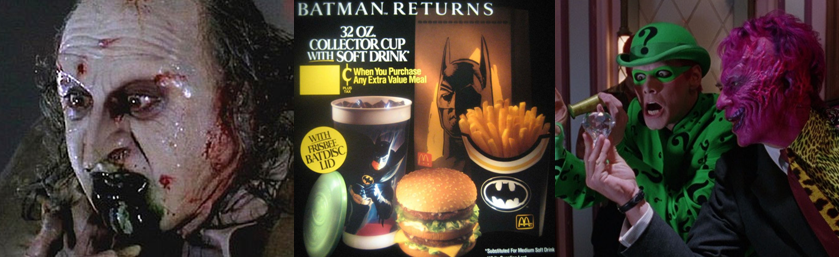
Batman (Burton, 1989) was a massively successful adaptation of the DC Comics character, whose popularity had been somewhat waning and was in the midst of a dark, gritty reinvention. Although director Tim Burton was initially not interested (to say the least) in returning for a sequel, he was persuaded when Warner Bros. afforded him substantial creative control over the film’s production. However, while Batman Returns (ibid, 1992) brought in over $280 million in worldwide revenue against a $65 to 80 million budget, the film was criticised for its far darker presentation. While the film enjoyed mostly positive reviews, Warner Bros. were dissatisfied with its box office compared to the first film, parents were outraged by the film’s dark, macabre content, and McDonald’s were equally upset at being associated with such a gruesome movie. In response to this, Warner Bros. made the decision to replace Burton with a new director, eventually settling on the late Joel Schumacher, while keeping Burton on in a token producer role.

Returns‘ more ghastly aspects frightened investors, leading to a more light-hearted Bat-romp.

Although Schumacher initially wanted to produce an adaptation of Batman: Year One (Miller, et al, 1987), Warner Bros’ weren’t too keen on this idea and pushed, instead, for a more light-hearted affair that would sell toys and be more akin to the popular Batman television show of the sixties. This approach held little appeal for Michael Keaton, the star of the previous two Batman movies, and the role was recast with the notoriously-difficult, but far more physically-imposing, Val Kilmer assuming the mantle. Despite the wildly different tone of the film, Batman Forever contained a number of allusions, call-backs, and references to the previous films to set it in roughly the same continuity (save for recasting Harvey Dent from smooth-talking Billy Dee Williams to the maniacal Tommy Lee Jones). Warner Bros’ new approach appeared to be successful, with the film making over $330 million at the box office and pleasing parents and corporate sponsors, though the film garnered a somewhat divided critical reception. Much has been made of Schumacher’s aesthetic choices and direction, though the film but has earned a cult following compared to its grandiose sequel, with many calling for the release of an extended version to restore many of the excised scenes that added a darker subtext and scenes to the film.

The Review:
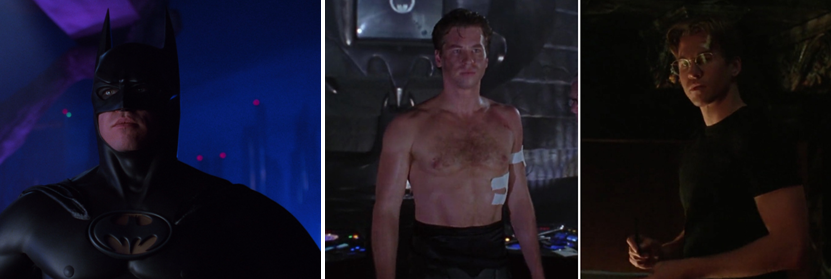
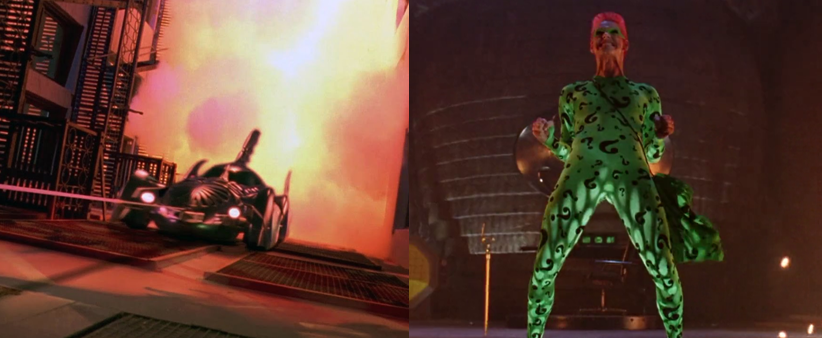
Right from the moment Batman Forever begins, you can tell it’s a very different film to its predecessors; gone is Danny Elfman’s iconic theme, the Gothic, enclosed sets, and the vast majority of the cast, replaced by an admittedly heroic and boisterous (if a bit over-played) score, a vast, near-incomprehensible Gotham City filled with neon, towering skyscrapers, and impractical architecture, a host of new faces, and, of course, a whole load of new toys. First, there’s the new Batsuit; though no longer as armour-plated as the Burton-era suits, this suit seems much more form-fitting and famously included nipples to give it a more anatomically-correct look. Unlike in the previous films, where Keaton was forced to be very stiff and was heavily restricted by this suit, Kilmer (and his stunt and fight double) move much more freely. He’s still not able to move his head, sure, but he’s far more agile and capable in his fight scenes, delivering easily the best live-action Batman fights at that point in time. With a new suit comes new gadgets, a new Batcave, and a new Batmobile, all of which are far more stylised and elaborate than in Burton’s movies and are introduced in a pretty cool “suiting up” scene during the opening credits. However, as much as I defend this movie, I do feel this scene is tarnished a bit by that cringey “I’ll get drive thru” line which, while amusing and I’m sure made McDonald’s happy, is a bit out of place. A simple “Don’t wait up” would have sufficed.

Kilmer was a pretty decent, physically imposing Batman and haunted Bruce Wayne.

I haven’t had much exposure to Val Kilmer in my life but, as much as I love Keaton’s intensity and the dark edge he brought to the role, Kilmer is actually pretty good as Batman. In Batman Returns, we saw that Gotham City was starting to become acclimatised to Batman but, in Forever, he’s very much in the public spotlight as a widely celebrated “superhero”. To clarify, I feel there’s a difference between a superpowered superhero like Clark Kent/Superman and a street level vigilante like Batman or Oliver Queen/Green Arrow. They are, technically, superheroes but I feel they shouldn’t be publically celebrated or acknowledged in-world like a Superman; in these Batman movies, though, Batman is pretty much the only masked crimefighter out there and, here, we see that he openly works with Commissioner Jim Gordon (Hingle) and appears in public, when necessary. Like Keaton, Kilmer assumes a deeper, gravelly “Bat Voice” for the role that is somewhere between a growl and a whisper. He tries to emulate Keaton’s intense glare but, where he fails in that regard, he succeeds in his imposing physical stature, appearing far more physically fit for the role than the slighter, shorter Keaton. Kilmer’s Batman is also much chattier than his predecessor, sporting a dry wit and a pragmatic drollness that would be amusing if not for the film’s excessive, over-the-top and cartoonish humour elsewhere. Kilmer is also pretty decent as Bruce Wayne; he doesn’t betray much emotion but he’s both awkward and charming when interacting with Doctor Chase Meridian (Kidman), arranges for full benefits for Fred Stickley (Ed Begley Jr) and his family after his apparent suicide, and is very patient with the fanatical Nygma when they first meet.
Carrey channels Gorshin’s spirit for his zany turn as the Riddler.

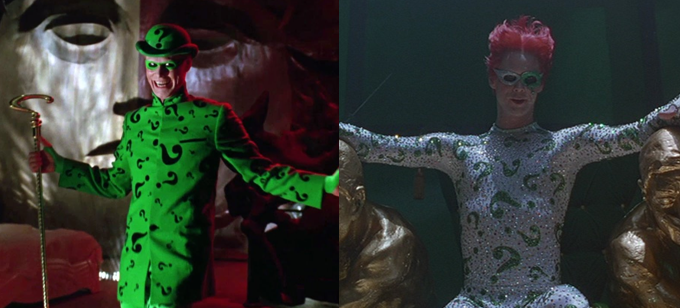
Speaking of Nygma, if you’re not a fan of Jim Carrey than a) What’s wrong with you? and b) This really isn’t the film for you. This was peak Carrey, with the actor riding a wave of well-received comedies, and he really gives it his all here, stealing every scene he’s in with a madcap, zany performance that is part Frank Gorshin and part classic Carrey. As Nygma, Carrey is a hyperactive and overly-enthusiastic employee who is completely obsessed with Bruce Wayne. Carrey brings a natural manic energy to the role, hogging the spotlight and stealing every scene he’s in with his rubber-faced antics and you really get that this guy is a fanatical individual who is infatuated with Bruce Wayne and desperate to showcase his mind-manipulating invention. This proves to be his downfall, however, as Bruce cannot in good conscience approve Nygma’s brain-altering invention, which crushes Nygma’s spirit and turns his heroic worship of Bruce into a sadistic mania. Nygma takes to sending Bruce threatening riddles (though Bruce is able to solve each one almost immediately, he spends the majority of the film completely stumped as to who sent them and what they really mean) but doesn’t descend into full-blown supervillain territory until seeing Two-Face in action. As the Riddler, Nygma is a completely unhinged maniac, teaming up with Two-Face to put his 3D “Box” in every house in the city to increase his intelligence and wealth. Amusingly, as Nygma transforms into a successful businessman and bachelor, he begins to borrow Bruce’s look and mannerisms but becomes increasingly unhinged as the Riddler, eventually setting himself up on a ridiculously elaborate island and freely partaking of the knowledge of all those connect to his Box.

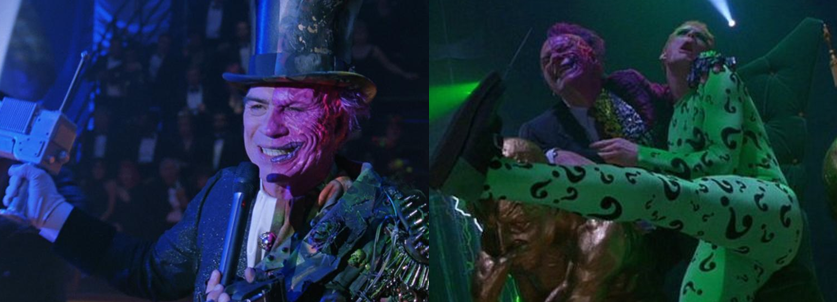
For a guy who “couldn’t sanction” Carrey’s buffoonery, Jones sure does ham it up!

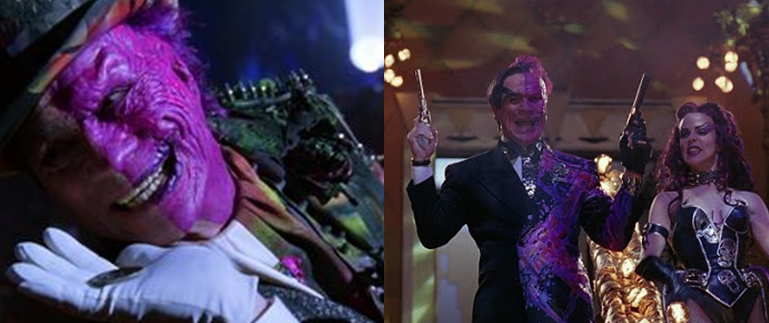
While the Riddler gets much of the film’s focus, Two-Face’s tragic origins and complex relationship with Bruce and Batman is almost completely glossed over; we’re introduced to Two-Face (annoyingly and constantly referred to as “Harvey Two-Face” for no discernable reason) after he’s already suffered his horrific scarring (here rendered in a far less disturbing manner, with a ridiculous straight line literally splitting Harvey’s face in two) and there’s only ever the briefest hint towards the character’s nuance and fall from grace. Instead, we’re left with a frenzied clown, a character far removed from the dark, tragic supervillain of the source material and more akin to the Joker, for lack of a better comparison. Ruled by his obsession with duality, his double-headed coin (which he is perfectly happy to flip over and over again until he gets the result he wants), and killing Batman (since he blames Batman for his condition), Two-Face is a ludicrous, flamboyant carton of a villain who would make Cesar Romero blush. I can only assume that it was Schumacher’s decision to make Two-Face this overexcited buffoon since Tommy Lee Jones, apparently, detested Carrey’s ostentatious antics and yet seems to be going out of his way to try and match Carrey’s far more amusing and far less grating physical humour.

Dick grows from an angry bad boy with an attitude to a selfless costumed hero.

Two-Face’s inclusion, though, allows Batman Forever to do something I will forever hold it in high regard for and that is introducing Dick Grayson/Robin. As a kid, I grew up watching the sixties Batman TV show and reading a number of different Batman comics, many of which included Robin in various forms and I remember being super excited about Robin’s inclusion here. In a fantastic example of adaptation, Robin is a combination of Dick (name/origin), Jason Todd (bad boy attitude), and Tim Drake (costume); garbed in motorcycle gear, with a piercing in his ear, he’s clearly an angst-ridden rogue who has no time for the luxury of Bruce’s lifestyle and wishes only to avenge the death of his family. Even better, the film does a great job of retelling Batman’s origin through the parallel of the deaths of Grayson’s family, which triggers Bruce’s flashbacks of his own parents’ deaths and delivers a haunting scene where, in relating the parallels between the two events to Alfred Pennyworth (Gough), Bruce slips on his wording and mutters “I killed them”, providing a glimpse into the survivor’s guilt and responsibility he feels. Bruce sympathises with Dick and takes him in; though he is angry and hungry for revenge, Dick is convinced to stay through a combination of Bruce appealing to Dick’s love for motorcycles and Alfred guilt-tripping the troubled acrobat with hospitality. Alfred plays quite the sly role this time around, offering Dick understanding and comfort but also subtly influencing his discovery of the Batcave and transformation into his own masked persona. Dick’s first instinct, though, is obviously to steal the Batmobile and take it on a joy ride; after taking his anger and pain out on some colourful street thugs, Dick directs these same emotions towards Batman when he arrives to confront him, blaming him for his family’s murder but, having vented his emotions, becomes insistent on Bruce training him to be his partner to give him the means to bring Two-Face to justice. Bruce is angered at the very idea and discourages him at every turn, not wishing Dick to go down the same path as he, much less commit murder.

Chase is the horniest psychologist you’ll ever meet. It’s fantastic!

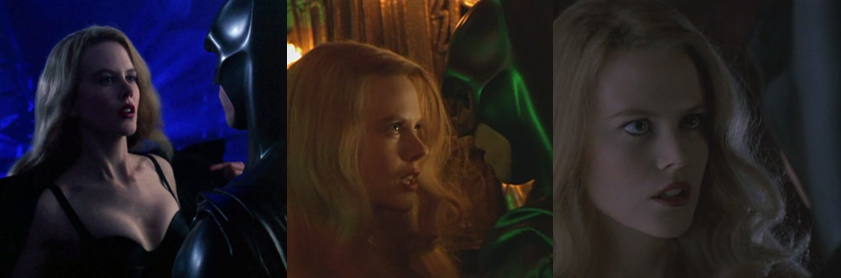
Finally, there’s Chase Meridian; Kidman is absolutely gorgeous, of course, but man is her character one horny bitch! Chase is immediately fascinated, sexually and psychological, by Batman; she, like pretty much all of the public, isn’t deterred by Batman’s appearance and is, instead, in awe of his presence and attracted to his mystery and physique and even goes so far as to use the Bat-Signal as a “beeper” to tell him things about Two-Face that he already knows and are painfully obvious and to explicitly voice her interest in Batman in her attempt to seduce him right there on the rooftop! She is overwhelmed by the sexual magnetism and allure of Batman as the “wrong kind of man” and the mystery about what drives him to do what he does but is just a enamoured by Bruce, seeing him as something of an enigma who is haunted and hiding more than he lets on. It’s not the same as her attraction to Batman, which is very primal and sexual, but it eventually grows into the more “grown up” choice on her part and she is clearly elated to find that the two are one and the same.

The Nitty-Gritty:
Batman Forever is a loud, bombastic action film; essentially, it’s a live-action cartoon, with every set and action sequence having a garish, over-the-top presentation. The film starts off, as Two-Face says, with a bang; the sequence of Batman hanging from Two-Face’s helicopter looks pretty shit but I can appreciate the blending of practical stunts, early-CGI, miniature sets, and the age of the film, to let it go and the entire set piece of Batman’s chase after him is explosive and frantic and really helps open the film with a huge amount of energy, albeit energy that screams “live-action cartoon featuring a lauded superhero” rather than a dark, broody piece about an urban vigilante. Also, people think that Schumacher’s Batman films were all light-hearted and campy and, yes, they are but while Batman isn’t as vicious or brutal as before and is much more of a “superhero” than a brooding vigilante, he still directly and indirectly causes a lot of death and destruction, including the death of Two-Face (something he specifically ordered Dick not to pursue).

There’s maybe a little too much bombastic slapstick and cartoony elements, to be sure.

Easily the star of the show, for me, is Jim Carrey as the Riddler. While I think Batman Forever would have benefitted all the more if Nygma had been the only elaborate comedic element in a film full of straight men, I am a massive fan of Carrey and his work in the nineties and the way he hogs every scene is just fabulous to me. I just love his many garish costumes, his elaborate movements, the way he emulates Bruce Wayne, and how he switches between manic energy and a sinister glee on a dime. Ultimately, neither Riddler or Two-Face are much of a physical threat to Batman and, far from the master of puzzles and conundrums of his comic counterpart, Riddler opts to force batman into making the now-cliché “choice” between the love of Bruce’s life and his crimefighting partner. Having faced his demons throughout the film and been reminded of why he became Batman, Bruce chooses to save both, reducing Nygma to a gibbering, crazed wreck in the process and finally putting to rest the demons that have haunted him all his life. Of course, it’s naïve to pretend like Batman Forever is perfect; it’s mindless entertainment for kids, to be sure, but is maybe a little too loud, bombastic, and slapstick for parents or hardcore Batman fans. There are a few narrative inconsistencies as well, such as Bruce inexplicably deciding to retire Batman and settle down with Chase. I never quite got the logic here; Bruce seems to think Batman is no longer needed but it also seems like he’s willing to give up his crusade to be with Chase since he can’t justify being Batman anymore (despite the fact that, as Dick says, “there’s monsters out there” like Two-Face and the Riddler). Then there’s the ridiculously cartoony security guard from the start of the film, the garish new Batmobile, the way in which the Batcave opens up and comes alive every time there’s an intruder, the ludicrous moment where the Batmobile drives up a wall to safety (how the hell did it get down from there?), the sheer ineffectiveness of Gotham’s police department (seriously, the cops are completely useless and call for Batman at the first sign of any trouble), and the overly cartoony sound effects that punctuate a lot of Carrey’s scenes and the fight sequences.

Two-Face is easily the weakest and most annoying part of the film.

For me, though, the weakest part of Batman Forever is clearly Two-Face; he’s just a grating, annoying villain who goes way, way over the top at every moment. He’s also an absolute idiot; he holds the circus hostage under the belief that Batman is present or that someone there knows who Batman is, which is a bit of a reach, constantly goes against his modus operandi, and ends up being tricked to his death in the simplest way possible. The only positive to his inclusion is that it fuels Dick’s need for vengeance; Bruce lectures Dick about how killing Two-Face won’t take away his pain, how he’ll end up becoming an obsessed vigilante taking his anger and pain out on countless others if he kills Two-Face, but Dick’s only wish is to kill Two-Face for what he did and it’s only in sparing Two-Face’s life that he (Dick) comes to evolve into the same selfless hero we saw him to be when he risked his life to save the circus from Two-Face’s bomb.

It’s fantastic to see Robin done in live-action and used as a thematic parallel to Batman.

Make no mistake about it, this is a great film if you’re a fan of Robin and Stephen Amell O’Donnell perfectly encapsulates the “mad, broody youth” vibe they were going for. After Dick forces himself into Batman’s business, Bruce is livid at Dick’s recklessness and continually attempts to talk him out of pursing the same life as him. In the end, though, with Chase in need of rescue and his motivations resolved (Bruce remembered that he promised his parents that no one would ever have to suffer like he would, that he would take his revenge upon all criminals to safeguard others no matter the cost), Batman throws on his “sonar” suit and is in the middle of choosing between his Batwing and Batboat (all new toys for kids to buy/pine for) when Dick, now Robin, arrives and the two reconcile. Personally, I love this moment; the two basically acknowledge that each other were right, that each of them has their own path, and that they have converged into one destiny. Robin even admits that he can’t promise he won’t kill Harvey but Batman accepts this, and that Dick must walk his own path, and they solidify their partnership with a firm handshake…only to immediately be separated upon reaching Nygma’s island. Regardless, I’m continually entertaining by film’s smart use of Robin as a thematic parallel to Bruce. I’d love to see this concept revisited in a new Batman movie one day; skip retelling Batman’s origin again and, instead, have a darker, more jaded Batman begin to stray from his path but be brought back from the brink by adopting Dick, whose origin can be used as a direct analogy for Batman’s. Sadly, it doesn’t look like we’ll be seeing that in a film any time soon but Titans (2018 to present) has done a really good job, in my opinion, of exploring similar ground with an even better version of Dick/Robin and taking that to its logical conclusion (the debut of Nightwing).

The Summary:
Batman Forever is a hugely entertaining kids’ movie which has a lot of potential that is sadly squandered by its execution. A lot of time is spent exploring Bruce’s psyche and motivations; not as much as was originally intended but far more than we had seen in live-action up until that point. The film suggests that Bruce has become so lost, so blinded by his pain, anger, and guilt, that he’s forgotten why he became Batman in the first place (to protect the innocent) and is, instead, lashing out at criminals out of habit. Dick is expertly used as a parallel to Bruce’s life and background; his anger is raw and in need of guidance. Bruce was guided by the bat he encountered as a child but Dick simply wants to kill Two-Face and has no clear focus beyond that. Bruce knows first-hand that killing the man responsible won’t bring Dick the peace or closure he so desperately seeks and that he’ll end up exactly like him, “Running out into the night to find another face. And another. And another!” It’s not massively dwelled upon but the film suggests that Bruce can use his experience to guide Dick in such a way to focus his rage and pain in a more productive way, one that sees him walk the same path but not so tainted by darkness and heartache. This turns out to be the case as Dick refuses to kill Two-Face, turning away from becoming a mindless killer and towards being an agent of true justice, which is something Bruce also learns to do through his relationship with Dick and Chase, which finally sets him towards a more productive path. Sadly, though, the film’s themes and explorations are hampered somewhat by the madcap nature of Schumacher’s world; thanks to several subtle references, this is clearly the same world as Burton’s Batman movies but much bigger, grander, and more…operatic. Gotham City is awash in garish neon and giant, impractical statues and skyscrapers and the film has a manic energy thanks not only to Carrey’s scene-stealing antics but the infantile characterisation of Two-Face and his goons. Cartoonish sound effects permeate many of the film’s action sequences and I can’t help but think the film would have been more appealing if everyone played it entirely straight except for Carrey. Clearly, Schumacher is leaning heavily towards the sixties television show, which is fine since that is a classic in every way and a guilty pleasure, but what made that show work was that everyone played it straight, which only served to make the ridiculousness more entertaining. Here, it’s ridiculous for the sake of being ridiculous so when there are moments or genuine humour (mainly from Batman and Alfred and Carrey’s less zany moments) they get drowned out by the overabundance of cartoonyness and Tommy Lee Jones’ grating performance as Two-Face.

My Rating:

Rating: 4 out of 5.

Great Stuff

What are your thoughts on Batman Forever? Where does it rank against the other Batman movies of its era, or even now? What did you think of the cast, particularly Kilmer, Carrey, and Jones? Were you excited to see Robin brought into the franchise or do you prefer Batman to “work alone”? What did you think of Schumacher’s version of Batman, his world, and his rogues? Would you like to see an extended cut of the film or do you think it’s best left as it is? Whatever your thoughts, go ahead and drop a comment below and be sure to come back next Tuesday for my review of the much-maligned sequel!

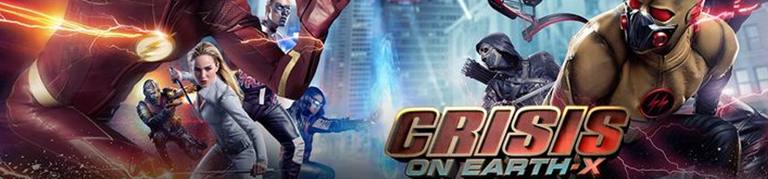
Screen Time [Crossover Crisis]: Crisis on Earth-X


In April 1985, the first issue of the ground-breaking Crisis on Infinite Earths (Wolfman, et al, 1986) released and saw the temporary destruction of the “Multiverse”. To celebrate this momentous event, I’m discussing multiversal crossovers all throughout April in an event I dubbed “Crossover Crisis”.


Air Date: 27 November 2017 to 28 November 2017
UK Network: Sky One
Original Network: The CW
Stars: Stephen Amell, Grant Gustin, Melissa Benoist, Caity Lotz, Carlos Valdes, Dominic Purcell, Chyler Leigh, Brandon Routh, Franz Drameh, Victor Garber, and Tom Cavanagh

The Background:
After the success of Invasion! (Various, 2016), the scope and interconnectivity of the “Arrowverse” began to steadily grow; The Flash (2014 to present), in particular, began to explore more and more of the multiverse while DC’s Legends of Tomorrow (2016 to present) exclusively dealt with concepts of time travel and alternate timelines. Invasion! ended up being the first of many annual crossovers between the CW shows and, accordingly, development of the next big crossover began in 2016. This time around, the showrunners were able to better plan and prepare for the crossover; however, while this allowed for Supergirl (2015 to present) to be included in the line-up, Black Lightning (2018 to present) was notably absent from the event, which drew inspiration from the annual crossovers between the Justice Society and Justice League of America in the Silver Age of DC Comics.

The Plot:
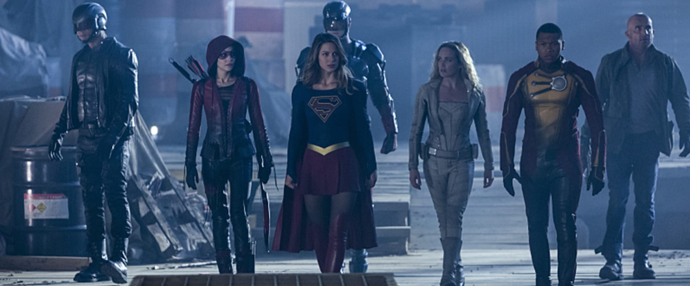
When the long-awaited wedding between Barry Allen/The Flash (Gustin) and Iris West (Candice Patton) is interrupted by evil doppelgängers from Earth-X, a dystopian world populated by Nazi versions of the Arrowverse heroes, they must call upon Oliver Queen/Green Arrow (Amell), Kara Danvers/Supergirl (Benoist), and the time-travelling Legends in a desperate battle to save their world from becoming over-run by their totalitarian doubles.

The Review:
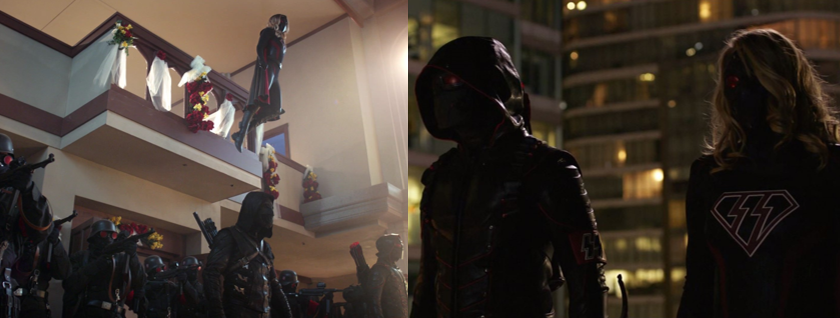
Crisis on Earth-X begins, appropriately enough, in “Part 1” (Teng, 2017), which was the eighth episode of the third season of Supergirl and introduces us to Earth-X, a parallel world that is under the iron grip of a Nazi regime. Oliver Queen/Dark Arrow (Amell) is the Führer and leader of the ruling cabal, the New Reichsmen, who use brute force and murderous tactics to spread fear amongst the populace and rule largely unopposed except for a band of plucky Freedom Fighters who are hopelessly outmatched. Hungry for new worlds to spread their regime to, they seize a temporal gateway and travel to Earth-1 in search of further conquests.

The large majority of the Arrowverse gathers together for Barry and Iris’s long-awaited wedding.

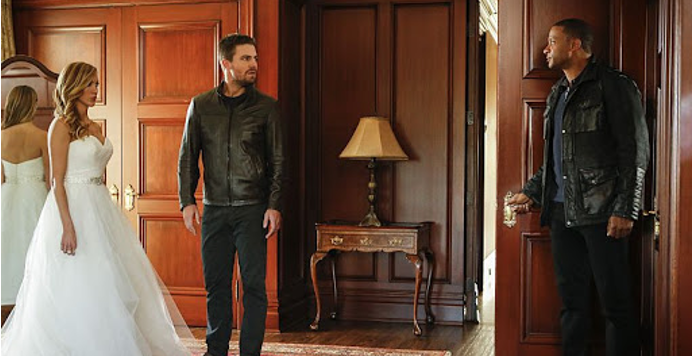
Most of our heroes from Earth-1 are concerned primarily with the impending marriage of Barry and Iris; the daily routine of our multiversal time travelling heroes is given a comedic background as Green Arrow, the Legends (Sara Lance/White Canary (Lotz), Mick Rory/Heat Wave (Purcell), Jefferson Jackson (Drameh) and Doctor Martin Stein (Garber)/Firestorm, Ray Palmer/The Atom (Routh), Nate Heywood/Steel (Nick Zano), Zari Tomaz (Tala Ashe), and Amaya Jiwe/Vixen (Maisie Richardson-Sellers)), and Supergirl (Benoist) put their individual issues and missions on hold to travel to present day Earth-1 for the wedding, bringing these characters together for a happier, more social event rather than an impending crisis. Amidst this, Kara is still reeling from the return of Mike Matthews/Mon-El (Chris Wood) and her sister, Alex (Leigh), is struggling with a recent breakup. The revelation that Mon-El is not only alive but also already married has shaken Kara’s usually positive outlook; like any good CW/TV lesbian, Alex decides to throw herself at the nearest bisexual character (Sara); and Oliver is motivated by Barry’s plunge into marriage to (unsuccessfully) re-propose to long-term love interest Felicity Smoak (Emily Bett Rickards). Additionally, Stein and Jackson are facing the sudden realisation that their time as Firestorm may be coming to an end thanks to a cure developed by Cisco Ramon/Vibe (Valdes) and the Earth-2 Harrison Wells (Cavanagh).

Evil Nazi doppelgängers interrupt the wedding and plot to attack Earth-1.

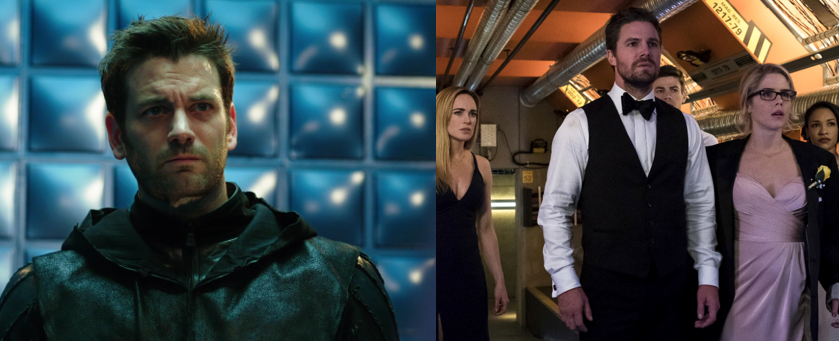
Although Stein is overjoyed at the prospect of returning to his family and a normal life, Jefferson is struggling with the idea of losing their partnership, friendship, and the bond that Firestorm brings the two. Characteristically, Stein misinterprets Jefferson’s feelings regarding the situation and attempts to fashion a way for Jax to continue being a super-powered Legend without him or Firestorm. With all this drama hanging in the air, tensions are a little highly strung on the morning of the wedding and it’s something of a relief (for everyone but Barry and Iris, that is) when Kara Zor-El/Overgirl (Benoist), Dark Arrow, and Tommy Merlyn/Prometheus (Colin Donnell) gate crash the ceremony with their troops. Of course, a massive fight scene breaks out (it’s super lucky and convenient that guys like Oliver and Mick brought their weapons to the church…), the main focus of which pits Overgirl against Supergirl, Oliver against Dark Arrow, and Sara and Alex against Prometheus in a bit of a mirror match, of sorts. Of course, it isn’t until the fight is concluded and Prometheus is captured that the true identities of their opponents are revealed since all the Earth-Xers are sporting bad-ass masks.

Oliver is shaken when the Earth-X Prometheus turns out to be an evil version of his dead best friend.

“Part 2” (Bamford, 2017), which took place in season six, episode eight of Arrow, delves into the consequences of this; as always when he comes face to face with Tommy Merlyn, Oliver is shaken by the appearance of his long dead best friend. Harry also offers a quick bit of exposition into the background of Earth-X, a 53rd Earth that is so horrific that it lacks the usual numerical designation; unlike in Invasion!, Oliver is now far more adjusted to the concept of the multiverse and metahumans but his emotional attachment to Tommy (which is fuelled by his own feelings of grief and guilt at his Tommy’s death) blind him to Prometheus’s uncompromisingly cruel nature. Oliver’s already dramatic and brooding life is further complicated by Felicity’s unexpected rejection of his proposal, which kind of just exists simply to add to the character’s aggro; it’s a common thing in Arrow that seemingly every time Oliver tries to grow as a character and a person, normally dependable people suddenly let him down and then he’s the one who has to learn a lesson to adjust to this before things just work out anyway, which is kind of how the Arrowverse likes to handle its dramatic moments: needless conflict amidst actual, tangible conflict.

In a crossover full of cameos, Wally and Diggle are unfortunately given the shaft.

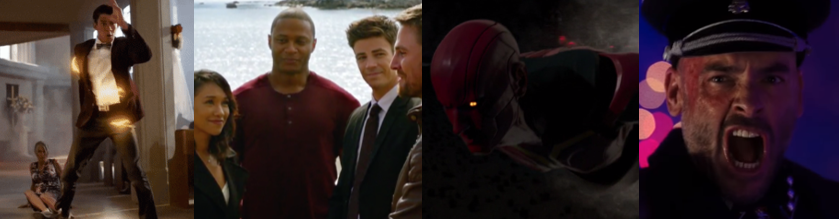
Crisis on Earth-X also features an appearance by Jessica Parker Kennedy, who would later be revealed to be Barry and Iris’ time-travelling daughter, Nora; once again, though, in a crossover featuring a slew of cameos and characters, Wally West/Kid Flash (Keiynan Lonsdale), John Diggle/Spartan (David Ramsey), J’onn J’onnz/Martian Manhunter (David Harewood), and Mon-El are completely side-lined but the event has time for appearances by Ray Terrill/The Ray (Russell Tovey), the Earth-X Leonard Snart/Citizen Cold (Wentworth Miller), Metallo (Frederick Schmidt), Red Tornado, and even a much welcome appearance by Paul Blackthorne as SS Sturmbannführer Quentin Lance. Perhaps the best thing about Crisis on Earth-X’s large cast of characters is the return of Cavanagh as the Reverse-Flash, still the most charismatic and memorable of all the Flash’s villains. Thawne is, it turns out, the actual Thawne from Earth-1, having cheated death thanks to complex (and convenient) time travel shenanigans. While Green Arrow and Supergirl are naturally disturbed and disgusted with their evil counterparts, Barry’s fight against Thawne is far rawer and emotionally charged given their history and Thawne’s sadistic vendetta against him.

Good or evil, Oliver finds a way to be relevant and keep up with his superpowered allies.

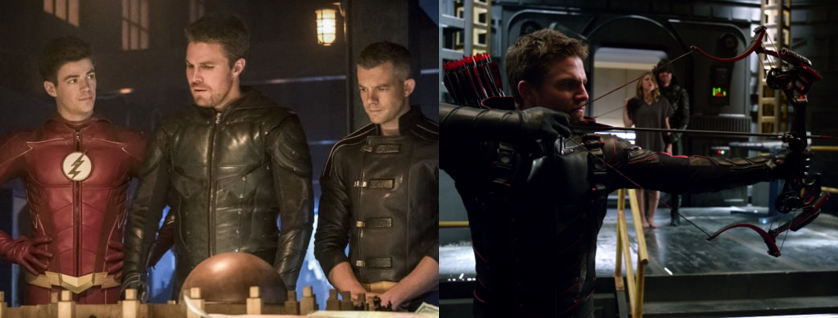
Once again, despite neither him or his Earth-X doppelgänger sporting superpowers, Oliver manages to find a way to make himself relevant and useful in the explosive conflict; his Kryptonite arrow, however, is far less useful than one might expect but Dark Arrow ends up being skilled and competent enough to take on Heat Wave, Doctor Caitlin Snow/Killer Frost (Danielle Panabaker), Curtis Holt/Mister Terrific (Echo Kellum), Rene Ramirez/Wild Dog (Rick Gonzalez), and Dinah Drake/Black Canary (Juliana Harkavy) all at the same time. This is especially evident in “Part 3” (Helbing, 2017), which aired as the eight episode of the fourth season of The Flash), when, trapped on Earth-X alongside Barry, Sara, Alex, Stein, and Jefferson, Oliver is the only one able to break free of their power-dampening restraints thanks to his ability to freely dislocate his thumb. While this quickly becomes a moot point as they are soon rescued by the Earth-X Snart, who introduces them to the pitiful Earth-X resistance movement, Oliver is able to (briefly) successfully impersonate his doppelgänger to infiltrate a convenient, if well-guarded, facility that offers their only chance of returning home. Concurrently, their Earth-1 allies are trapped in the anti-metahuman cells at Scientific and Technological Advanced Research Laboratories (S.T.A.R. Labs) and Kara is held captive under power-dampening red sunlight. For all the power, greed, and conviction of the Earth-Xers, their motivations come down to a desperate need to save Overgirl from dying through a heart transplant with Supergirl with only Felicity and Iris left behind to help her. It’s interesting, and surprising, for a crossover between the Arrowverse’s greatest heroes that two non-powered supporting characters end up being the key to turning the tide against the Earth-Xers as they rescue Kara using little more than their grit and ingenuity and the foresight to summon the remaining Legends.

With the defeat and death of their generals, the Earth-X invasion is averted.

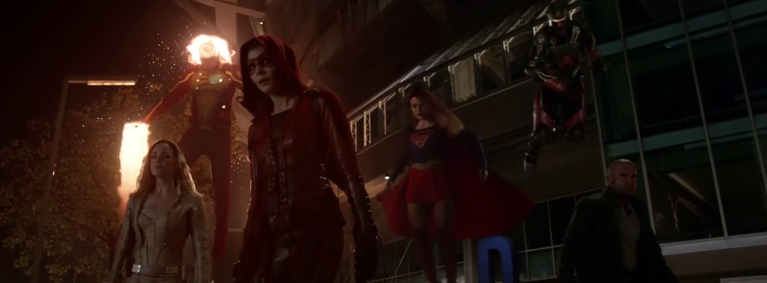
The finale, “Part 4” (Smith, 2017), was the eighth episode of the third season of DC’s Legends of Tomorrow; similar to the final episode of Invasion!, saving the Legends episode to last causes a sudden and noticeable flood of characters to join the already inflated cast. The timely intervention of the Atom saves Kara but, unfortunately, even Gideon (Amy Louise Pemberton) is not capable of saving Stein’s life from a fatal bullet and he dies having sacrificed himself to return everyone to Earth-1 and to keep Jefferson alive. It’s an emotional and dramatic moment for the entire team but, especially, for those two, whose relationship has developed into a fantastic father/son dynamic amidst the dysfunctional family of the Waverider and would forever change the Legends dynamic going forward. Though hurt and grieving following Stein’s death, Oliver and Sara’s pragmatic attitude galvanises the heroes into uniting against the Earth-Xers and their own version of the Waverider, the Wellenreiter, which they use to launch a devastating attack on Earth-1 unless Kara turns herself over to them. Rather than go gallivanting off through time and space, the Legends join their fellow heroes for an all-out counterattack against the Earth-Xers, resulting in a massive brawl in the streets. In the end, the day is won through a combination of teamwork and co-ordination to disable the Wellenreiter and Overgirl succumbing to her solar poisoning. Her explosive death directly leads to Oliver executing his counterpart and, thanks to Barry suitably scaring off Thawne, the crisis is averted, and Barry and Iris are finally married. Invasion! was a very rushed and lacklustre excuse to bring together the Arrowverse against a simple extra-terrestrial threat; while the spirit of each show was evoked as best as possible and each episode did its best to focus on a core group of characters amidst a bloated cast, the crossover was let down by a frantic pace and some dodgy CGI. Crisis on Earth-X, in comparison, is a far more well balanced affair and, in many ways, seems like a much easier and more simpler concept to bring together the CW shows as it doesn’t require fully CGI characters or entirely new ideas; it’s simply a fight between the heroes of the Arrowverse and their violent and sadistic doppelgängers. Of course, it’s not the first time many of these heroes (especially Green Arrow and the Flash) have fought against dark versions of themselves but it’s a pretty simple and effective narrative device; plus, not only does it allow characters to literally fight against their own dark nature, it’s fun to see the actors portraying such radically different versions of themselves. While Dark Arrow isn’t that much different from Green Arrow, Overgirl is the exact opposite of Kara’s normally optimistic and enthusiastic nature, allowing Benoist to flex her range into sadistic bitch territory.

The Summary:
There’s a definite sense in Crisis on Earth-X that the Arrowverse was really beginning to hit is stride and becoming much more ambitious with its characters, concepts, and crossovers; the shows have come a long way from the relatively grounded Arrow (2012 to 2020), almost being unrecognisable with their fragrant and frequent use of obscure and complex sci-fi concepts such as time travel, aliens, and the multiverse. Thanks to having the time to properly focus on these concepts in shows like The Flash and Legends of Tomorrow, crossovers such as these were not only able to occur in the first place but actually felt like a natural and inevitable inclusion rather than being a rushed and desperate attempt to catch up to the competition like in the movies. Of course, dodgy CGI does raise its head once again in Crisis on Earth-X, particularly in the scene where Green Arrow helps Flash and Supergirl reinforce a collapsing superstructure by firing a load of CGI arrows and lines across the girders and whenever the Ray’s powers are on show. Still, these moments are far less intrusive and noticeable than in Invasion!, which is surprising considering Crisis on Earth-X features far more super-powered individuals and a much bigger scope. Once again, the costume design is absolutely spot on; the Earth-X Schutzstaffel-inspired uniforms give the normally bright and colourful heroes a dark and menacing look that is only exacerbated when the narrative switches to Earth-X and we see just how different the totalitarian parallel world is to Earth-1 and the rest of the multiverse.

Crisis on Earth-X certainly outdid its predecessor in terms of stakes, standards, and scope.

Something I really enjoyed about this second crossover was that there was a lot more for everyone to do this time around and far more dynamic and varied character interactions, largely thanks to the fact that the pacing and focus of the crossover is much better this time around; each episode feels like a part of a larger, unified narrative that is the geared towards serving the purpose of the crossover rather than being a regular episode of its main show with the crossover plot shoe-horned in. The ramifications of the crossover had lasting effects on the Arrowverse as a whole as well; not only did it end with the long-awaited marriage of Barry and Iris, and open the doors for bigger and better multiversal events in the future, but it forever changed the dynamic of Legends of Tomorrow, and Jefferson’s character, through the sudden and dramatic death of Stein. Invasion! had the suggestion of high stakes but the plot was so concerned with focusing on the interpersonal drama rather than actually depicting the Dominators as a meaningful threat that there was never really the suggestion that the heroes could fail or lose in any way. This time around, the loss of Stein and the depiction of a dystopian alternative world where many have either died or are pure evil raised the stakes for future crossovers, allowing for a degree of unpredictability to permeate subsequent events.

My Rating:

Rating: 4 out of 5.

Great Stuff

How did you find Crisis on Earth-X? Did you prefer it to Invasion! and where would you rank it compared to the other Arrowverse crossovers? What did you think to the concept of evil, Nazi versions of the Arrowverse heroes? Were there any characters you would have liked to see have more focus in the crossover or were you, like me, far more impressed with the pacing and balance this time around? How did you feel about Stein’s death and which of the four shows is your favourite? Whatever your thoughts on Crisis on Earth-X, be sure to leave a comment below and check back in next Sunday as Crossover Crisis continues!

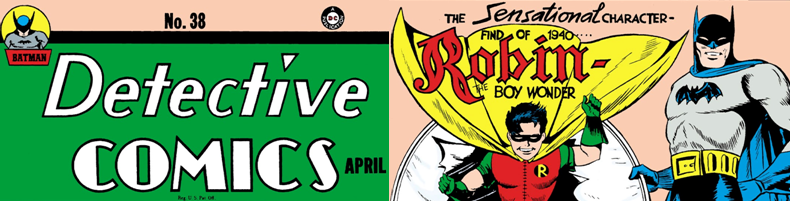
Back Issues [Robin Month]: Detective Comics #38


In April of 1940, about a year after the debut of arguably their most popular character, Bruce Wayne/Batman, DC Comics debuted “the sensational find of [that year]”, Dick Grayson/Robin. Since then, Batman’s pixie-boots-wearing partner has changed outfits and a number of different characters have assumed the mantle as the Dynamic Duo of Batman and Robin have become an iconic staple of DC Comics. Considering my fondness for the character and those who assumed the mantle over the years, what better way to celebrate this dynamic debut than to dedicate an entire month to celebrating the character?


Story Title: Technically untitled but presented as: “The Batman Presents The Sensational Character Find of 1940…. Robin – The Boy Wonder”
Published: April 1940
Writer: Bill Finger
Artists: Bob Kane and Jerry Robinson

The Background:
Since his debut in Detective Comics #27 in 1939, Batman had become a popular staple of DC Comics; the masked crimefighter began as a mysterious individual and, over time, acquired many of the supporting characters and gadgets that would become synonymous with the character thanks, largely, to the understated influence of writer Bill Finger, who greatly expanded upon many of the ideas of artist Bob Kane. However, to make Batman more accessible to younger readers and to give him someone to talk to rather than simply relying on monologues or thought balloons, Kane, Finger, and fellow creator Jerry Robinson came up with the concept of introducing a kid sidekick for Batman. With the character’s look inspired by illustrations of Robin Hood, the appropriately-named Robin not only significantly altered Batman’s dynamic and portrayal, casting him as a less darker and violent vigilante and more as a Sherlock Holmes-type father figure, but also dramatically increased sales and interest in the character upon his debut.

The Review:
The issue kicks off right away by introducing us to the Flying Graysons, John, Mary, and their young son Richard (or “Dick” as he prefers…feel free to make jokes in the comments), a family of trapeze artists for Haly’s Circus who regularly wow the crowd with their high-flying antics, particularly their “death-defying […] triple spin”. One night, whilst backstage, Dick overhears a couple of criminals threatening the owner of the circus, Mr. Haly, who balks at their attempts to force him to pay them protection money, though they promise him that “accidents will happen”. The next night, right as John and Mary are performing their headline act, their trapeze ropes snap in mid-air and they plummet to their deaths off panel but right before Dick’s very eyes!

The Batman finds a kindred spirit in Dick, who is only too eager to join his crimefighting cause.

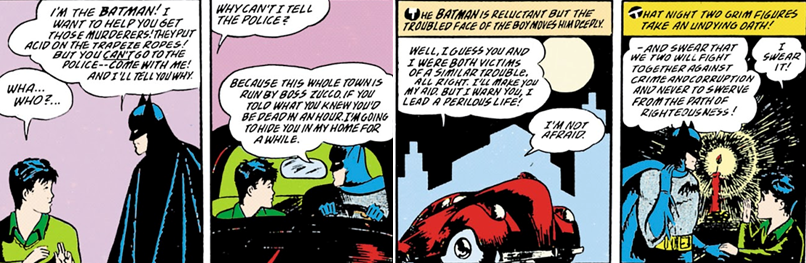
After being briefly comforted by Bruce Wayne, who was in attendance that same night, Dick overhears the gangsters confess to causing the accident, which is enough to both scare Haly into paying them protection money and to convince Dick to go to the police. However, he is stopped by the timely arrival of the Batman, Gotham’s legendary vigilante, who takes Robin with him in order to spare him from reprisals since the entire town is run by mob boss Tony Zucco and ratting out Zucco’s men would surely mean death for Dick. Batman shares with Dick a truncated version of his own childhood trauma and Dick immediately volunteers to join his cause. Though Batman warns him of the dangers of his vigilante life, Dick is unafraid and, with what now appears to be very little convincing, Batman swears Dick to an undying oath to dedicate himself to the fight against crime and corruption.

Dick excels at his training and is soon out on the streets gathering information on Zucco.

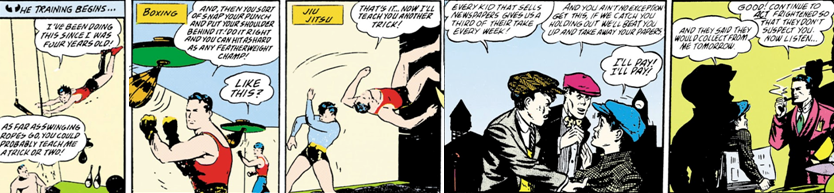
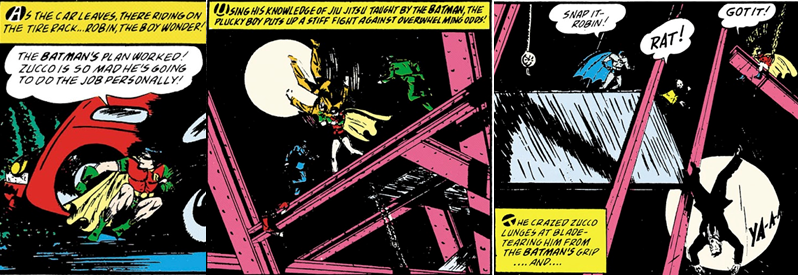
Having revealed his true identity to Dick (off panel, of course), Bruce begins training the boy for his new life; thanks to his circus background, Dick excels at rope swinging and takes to his training in the likes of boxing and “jiu jitsu” with an eagerness and talent over a period of many months. Finally, Dick is ready to play a part in Bruce’s crusade and, for his first assignment, Bruce has Dick impersonate a grubby-faced newsboy in order to attract the attention of Zucco’s thugs and track them back to their lair. With the information provided to him by Dick, Batman is able to intercept and disrupt Zucco’s operation, taking out his thugs across town and smashing up the mob boss’s gambling house. Each time, he tells his prey to give Zucco one simple message (“The Batman”) and dispatches Zucco’s cohorts with both ease and a snappy wit. Batman then delivers a threatening note to Zucco, who is so wound up by Batman’s antics that he falls completely for Batman’s bait and heads to the Canin Building (along with a number of his goons) to personally put an end to the Batman’s interference. However, instead of the Batman, Zucco and his minions are targeted by Dick in his new costumed guise of Robin.

Overexuberance puts Robin in danger but it’s nothing a little murder can’t solve…

Striking fast and hard, Robin tackles one of Zucco’s men, causes another to (apparently) fall to his death by throwing a stone at his head, and handily takes out the rest using his speed, acrobatics, and the element of both surprise and misdirection. However, perhaps because of his youthful exuberance (Dick is clearly relishing the chance to beat up some thugs), Robin slips on a girder and is left dangling hundreds of feet in the air at the mercy of one of Zucco’s men. Fortunately, Dick’s circus training pays off and he is able to twist himself around to send the gunman falling to his death and Batman arrives to take out Zucco before he can get a shot at the Boy Wonder. Batman than threatens Zucco’s remaining henchman, Blade, into signing a confession (…he just happened to have this on him, presumably in his utility belt) about their involvement the deaths of the Graysons and willingly allows Zucco to send Blade falling to his death in order to capture evidence of Zucco killing a man. Batman then assures Zucco that both the confession and the picture will be enough to see him tried and sentenced to summary execution and, having orchestrated events so that Dick could avenge the deaths of his parents, returns to Wayne Manor with Dick to await their next “corker” of an adventure.

The Summary:
Okay, so, maybe Batman didn’t immediately turn into a child-friendly character all at once. Indeed, if you judge this story by most modern metrics of the character and his much-lauded “no kill rule”, you might be surprised to see Batman being so complicit and stoic about things such as mobsters being tossed off a building by a young boy. Of course, you can make the argument that Batman technically doesn’t murder anyone in this story; instead, he orchestrates events so that others do the dirty work for him but it’s quite astounding to see Dick go from a fun-loving, carefree young circus acrobat to a masked killer in just a few months.

Robin revels in the opportunity to fight at Batman’s side.

Of course, the entire point of this story is to introduce and sell us on the idea of Batman adopting (in the literal sense rather than the legal one) a young sidekick; Robin’s origin is a thematic parallel to Batman’s, having witnessed his parents’ deaths at the hands of criminals, but he’s a much different character to Bruce. He’s younger, obviously, faster and far more agile and, thanks to his circus background, takes to his new vocation with vigour and enthusiasm. Though he takes a vow to commit himself to justice, for Dick, being a crimefighter is a thrill and a privilege and, clearly, the entire point of the character is to exist as a form of wish fulfilment for all youngsters out there who wish they could swing through the city and fight thugs alongside the Caped Crusader.

My Rating:

Rating: 4 out of 5.

Great Stuff

What did you think about Robin’s sensational debut? What do you think about the idea of Batman having a kid sidekick? Do you prefer Batman to work alone or do you like the dynamic he has with his colourful partners? What are your thoughts on comics characters brazenly killing or willingly allowing children to be involved in such a violent life? Which of the Robins is your favourite, or least favourite, and why? How are you celebrating the debut of Robin this year? Whatever you think, feel free to leave a comment about Robin below and pop back next week for the next instalment of Robin Month.

Movie Night: Star Trek: First Contact

Released: 22 November 1996
Director: Jonathan Frakes
Distributor: Paramount Pictures
Budget: $45 million
Stars: Patrick Stewart, Jonathan Frakes, Brent Spiner, Alfre Woodard, James Cromwell, and Alice Krige

The Plot:
After intercepting an attempted invasion of Federation space by the Borg, Captain Jean-Luc Picard (Stewart) and the crew of the U.S.S. Enterprise-E pursue their foes back in time to the mid-21st century where the Borg, represented by their alluring Queen (Krige), intend to use their nanotechnology to assimilate the Earth and change the course of not just human history, but the history of the entire known galaxy by disrupting the fated first contact between humans and extraterrestrials on this day, 5 April, in 2063.

The Background:
It’s the age old question, isn’t? Which do you prefer; Star Trek (1966 to 1969) or Star Trek: The Next Generation (1987 to 1994)? Captain James T. Kirk (William Shatner) or Captain Picard? Personally, since I grew up with the original series movies rather than the television show, I’ve always been more of a Next Generation and beyond kinda guy. Regardless, after Star Trek wrapped up, the original cast reunited for a series of movie spin-offs and executive and producers were able to coerce creator Gene Roddenberry to spearhead an all-new Star Trek television show to breathe new life into the franchise. Star Trek: The Next Generation became so popular that it too branched out into feature films, with the first being the appropriately-titled Star Trek Generations (Carson, 1994), which brought Kirk and Picard together but failed to impress critics despite performing relatively well at the box office. For the next film in the franchise, writers Brannon Braga and Ronald D. Moore decided to merge together their two most popular ideas for the franchise’s thirtieth anniversary: time travel and the Borg, with the two kicking around different ideas for the time period the movie would be set in and many different drafts of what would become the film’s final incarnation. Long-time cast member Jonathan Frakes, who had directed a number of episodes of the show, was chosen to helm the film, which delved into the Borg hierarchy, expanded upon their memorable appearance in the “Best of Both Worlds” (Bole, 1990) two-parter, and allowed the usually diplomatic and authoritarian Picard to become more of an action hero archetype. Star Trek: First Contact received widespread acclaim, particularly directed towards its gruesome special effects, and, filmed on what now seems like a paltry budget of $45 million (for comparison’s sake, Star Trek (Abrams, 2009) boasted a hefty $150 million budget), the film did very well at the box office, beating its predecessor by some $30 million.

The Review:
One of the things I’ve always respected about the Star Trek movies is how they don’t really waste a lot of time pandering to audiences who are unfamiliar with the concept or the television series; this generally allows the films to, largely, stand alone and work as products attached to, but also independent from, the show. Star Trek: First Contact differs from this formula in that it directly references, and is built off of, one of the most celebrated Next Generation episodes ever. Accordingly, the film opens with a brief revisitation of Picard trapped on the Borg Cube; if you didn’t know that he was transformed by the Borg, this is a quick and effective way to show that he is still haunted by memories of those experiences. Of course, if you’re not a fan of eye horror, this isn’t a scene for you but it also shows off the amazing updates to Borg technology and how their implants work going forward.

Star Trek: First Contact showcases a number of new sides of Picard’s character.

Of course, this opening sequence is just one of what is implied to be many recurring nightmares on Picard’s behalf and it is interrupted by the report of the Borg’s impending invasion. Despite the all-new, all-powerful Enterprise-E being the “most advanced ship in the fleet”, Picard is annoyed to inform his crew that they’re being kept out of the battle against the Borg; I love how the Romulan threat is so neutered by this point that even Counsellor Deanna Troi (Marina Sirtis) is incredulous as to their assignment to patrol the Neutral Zone and that the Borg are considered such a threat that all it takes is one of their ships to be classified as an “invasion of the Federation”. This all sets up Picard’s tone, character arc, and conflict as Starfleet believes (rightly so, as it turns out) that he shouldn’t face the Borg again given the trauma he faced at their hands. While Commander William Riker (Frakes) disagrees, who gives a shit what he thinks? That guy couldn’t make a decision to save his life! Still, he’s right to an extent as Picard disobeys their orders and is then able to turn the tide against the Borg Cube using his knowledge of their defences and technology; however, as the film progresses and Picard launches guerrilla tactics against the Borg, it’s clear that he is driven by his rage, vengeance, and hatred of the cyborgs rather than his usual calm, measured demeanour.

The Borg Queen brings Data closer to humanity than he ever thought possible.

Just as the Original Series was often framed around Kirk, Commander Spock (Leonard Nimoy), and Doctor Leonard “Bones” McCoy (DeForest Kelley), the Next Generation movies primarily revolved around Picard and Lieutenant Commander Data (Spiner), who, as an android struggling to understand and become more human, was very much The Next Generation’s version of Spock. Data still has his emotion chip installed, which was his big plot point in Star Trek Generations, and is manipulated here by the Borg Queen, who plays upon Data’s wish to be more human by appealing to his emotions, stimulating his sensations, and even grafting organic skin onto his outer shell. This forms Data’s character arc as he appears to give in to the Borg Queen’s temptation and allows them to turn him into something more akin to a cyborg. It is, of course, all a ruse on Data’s part to allow him the perfect opportunity to scupper the Borg Queen’s plans but, given what we saw of him in the “Descent” (Singer, 1993) two-parter, the way the film is framed, and that this is the closest to Data’s dream of becoming human, it’s very easy to believe that he has turned against his friends and crewmates.

Cochrane is a far cry from the near-mythical figure of Starfleet teachings.

Far from the legendary, near-mythical figure of Starfleet teachings, Zefram Cochrane (Cromwell) is a disillusioned, selfish, greedy drunkard; he plays along with the crew’s predictions of the future and assists them in completing the Phoenix but is scared of the fate they readily inform him off and angered that he becomes such an influential figure when his intentions were less than noble. He tries to literally run away from this fate and is convinced to see it all through but not by lectures about how the Phoenix ushers in this new, golden age for humanity, and, instead, partially off-screen and partially through the “don’t be a man” quote from Riker. Either way, in the end, he accepts his role as the figurehead for inter-species relationships.

Lily acts as the audience surrogate and Picard’s conscience.

Cochrane’s assistant, Lily Sloane (Woodard), starts out as an angry, confrontational revolutionary who initially believes she has been kidnapped by opposing forces but is quickly convinced of the Borg’s threat by Picard. For me, she’s probably the weakest part of the film; it’s not enough to drag it down in my estimation but I’ve never been a fan of the actress or her portrayal of the character, who comes across as annoying and a liability at some points. Still, she acts as both an audience surrogate through which the uninitiated are taught about the Borg, the ship, and the future world Picard is from. If there’s one downside to the film, it’s that the remainder of the crew don’t really get a lot to do since so much of the plot revolves around Picard overcoming his trauma and Data’s temptation by the Borg Queen. Beyond her amusing drunk scene, there’s not a lot for Deanna to do here, unfortunately; similarly, Doctor Beverly Crusher (Gates McFadden) exhausts most of her importance after fleeing the Borg attack, though she does later personify the crew’s general blind obedience to Picard’s orders. Riker, also, is largely inconsequential to the away team mission, with Lieutenant Commander Geordi La Forge (LeVar Burton) getting most of the focus, though this is most likely because of Frakes pulling double duty behind the scenes as well. It’s therefore all the more obvious that the never-before-seen Lieutenant Hawk (Neal McDonough) is going to suffer the fate of most Star Trekredshirts” since he gets a lot of screen time and focus for a guy who isn’t a part of the main cast so you know he’s doomed even without a deep knowledge of Star Trek. Similarly, Geordi leaves Porter (Eric Steinberg) in charge of Engineering and he and his female co-worker are summarily assimilated but cameos by the Doctor (Robert Picardo) and Lieutenant Reginald Barclay (Dwight Schultz) help to add to the film’s charm and expand the Star Trek world.

The Borg are treated as a gruesome, terrifying, and formidable force.

The film only has one space battle, which is disappointing, but it’s a fantastic way to showcase the slaughter that the Borg, even a single Cube, is capable of inflicting. The Borg are, apparently, now so advanced that they can just casually manifest a “temporal vortex” through unknown means to travel through time; it’s very convenient and not really explained much but it gets the plot moving quickly and is a much faster way to get everyone back to past. When the Borg are attacking and assimilating the crew, the film resembles a horror movie; the Borg are kept in shadows, attacking off-screen, and are not seen in full view until Picard leads a team to try and stop them before they can spread beyond Deck 16. It’s a very effective way to introduce some tension and horror and the stakes of the film since Picard emphatically orders his team to fire at will rather than leave any assimilated crew members alive despite the fact that de-assimilation is a thing and he knows that. The Borg are treated as a zombie-like, relentless force, one that will not attack unless provoked or they perceive a threat; once they do attack, there are slow and persistent, stoically allowing their numbers to fall until they learn to adapt and continuing their assault regardless, assimilating crew members without conscience or mercy.

The Borg Queen was an alluring, ghastly presence that altered the Borg dynamic.

The Borg Queen introduced a dynamic to the Borg “collective”; until this moment, the Borg were a unified voice, with no hierarchy or individuals. The closest they came to having such a central voice was Locutus and when Lore (Spiner) manipulated that rogue contingent in the aforementioned “Descent” episodes. Here, though, the exact nature of the Queen’s relationship is left somewhat vague; it appears as though she is merely a physical manifestation of the collective but she also orders the drones about and they adhere to her commands (and she refers to herself as “I”, indicating that she is their “leader”, as Data suggests). It’s clearly a filmmaking technique to allow audiences to have a clear antagonistic figurehead to focus on and, while it does work since it expands the nature of the Borg society, it does somewhat diminish the horror of their collective consciousness. Regardless, the Borg Queen is a charismatic, seductive, and manipulative presence; oozing confidence, sex appeal, and a gruesome body horror, she represents Data’s desires for humanity and Picard’s fears of the Borg since it is heavily implied that the Borg Queen personally supervised his assimilation, perhaps even sexually abused him, and that the Borg Queen has assumed numerous physical forms over the years. Her introduction is also one of the most horrific and impressive special effects shots in all of Star Trek and her make-up design looks both incredibly uncomfortable for the actress and ghastly in its execution.

The Nitty-Gritty:
There are a few conveniences, instances of hand-waving, and missed opportunities in the film, if I’m being brutally honest: there’s the aforementioned ease of time travel, the massively convenient explanation for getting Lieutenant Commander Worf (Dorn) back on the Enterprise, and I would have liked to see a little more exposition about how, why, and when Geordi decided to swap out his trademark visor. Still, one of the (many) things I enjoy about Star Trek: First Contact is the vastly improved uniforms for the cast and crew, despite how hot and uncomfortable they appear regardless of their high quality. Everything about the film is so much more cinematic and of a much higher quality than all of those that came before it; the Enterprise-E bridge is massive and far more detailed and the ship itself is much more like the traditional Enterprise but meaner and more capable of combat. Like the Klingons before them, the Borg benefitted greatly from the cinematic redesign; no longer appearing like pale men in black leotards with plastic attachments and hands in clear prosthetics, they appear as disgusting zombies with their cybernetic implants crafted into, or entirely replacing, their limbs in sequences that are extremely horrific for a 12-rated film and easily the most gruesome of any Star Trek production.

Picard’s obsession threatens to destroy him, his ship, and his crew and causes much conflict.

The film mainly switches between the away team, led by Riker (who must work with Cochrane and convince him to help them and where the bulk of the film’s humour and levity is seen), and the main ship where Data is tempted by the Borg Queen and Picard becomes a far more pro-active and action-orientated individual in this film. Picard adopts a sleeveless variant of his uniform, showing off his physique for the first real time, and he is portrayed as an almost John McClane (Bruce Willis) type of action hero, hiding in engineering vents and striking against overwhelming odds. One of the film’s most engaging sequences is the space walk Picard, Hawk, and Worf are forced to take to keep the Borg from calling for reinforcements; it’s a rare instance of weakness for Worf, who dislikes the disorientation caused by zero-g environments, and unique in that the whole scene technically takes place upside down on the underside of the ship. Another memorable scene is, of course, the blazing confrontations between first Picard and Worf and then Lily and Picard. While the rest of the crew may disagree with Picard’s unwavering belief that they must fight the Borg no matter the cost, Worf is the only member of the crew to object to Picard’s orders, believing (rightly so) that Picard is letting his personal feelings influence his judgement. It’s an extremely tense moment as the two close allies and comrades almost come to blows, it seems, and leads to an awkward moment of reconciliation between the two after Picard reluctantly agrees to set the Enterprise-E to self-destruct.

Picard not only ensures the future of humanity but also confronts and overcomes his demons.

Lily (who acts as Picard’s conscience throughout the film, questioning his motivations and notes, with dry criticism, how aggressive and uncompromising his actions have become) also unashamedly criticises Picard’s decision and confronts him, leading to a dramatic and heated exchange between the two in which the extent of Picard’s obsession and pain is revealed. It’s a very humanising moment for Picard, usually so authoritarian and composed, and here stripped down to a tormented victim of unspeakable abuse. In the end, Picard mounts a solo effort to rescue Data and is willing to sacrifice himself, his ship, and Data to distract the Borg Queen and end her threat. Paralysed with fear and confusion regarding the Queen’s appearance, Picard is only able to win the day thanks to Data’s deception and subsequent release of plasma coolant to liquefy the Queen’s organic components and end her threat. Picard finds some closure in snapping the Queen’s neck and the two of them actually mourn her for her force of will and uniqueness amongst the generally zombie-like Borg. It’s a cathartic end to the trauma that has haunted Picard since his assimilation and allows him the chance to step away from the brink of self destruction and take proactive, measured action against one of the franchise’s most formidable foes.

The Summary:
Star Trek: First Contacts a fantastic Star Trek film (and a great science-fiction movie in general) that showcases a completely different side to Star Trek and, especially, Picard; ever since “The Best of Both Worlds”, Picard has been haunted by his experiences with the Borg but, while some episodes of The Next Generation dabbled in how his assimilation affected him, it was never explored as deeply as it is here. Picard is literally haunted by the Borg, able to sense their presence and hear the mutterings of the collective and is driven to animalistic rage whenever he battles them head-to-head. It drives him to an obsession that blinds him to the losses he is suffering; all he cares about is opposing the Borg rather than compromising as they have on so many other occasions. He wants them dead, to make them pay, and to take his revenge upon them no matter if it costs him his ship, his crew, or his life. It’s a powerful character arc, and series of scenes and moments, that humanises Picard and makes him a far more relatable character and a stronger man for it after he realises what his fixation with the Borg has turned him in to. In many ways, it’s a very small-scale film, much more concerned with such interpersonal deconstructions; the away team are simply constructing a warp-capable ship, Data faces temptation from the Borg Queen, and Picard is engaged in guerrilla warfare with the Borg. There’s only one space battle and no real star trekking, with even less diplomacy, making the film both grounded but also outlandish thanks to its time travel plot and the use of one of the franchise’s most horrific and persistent antagonists. It remains easily my favourite of the Next Generation films and, potentially, my favourite Star Trek movie because of its themes, presentation, and intensity of the plot.

My Rating:

Rating: 5 out of 5.

Fantastic

Are you a fan of Star Trek: First Contact? Where does it rank for you compared to the other Star Trek movies? What did you think to the film’s time travel plot or the use of the Borg? What about Picard’s characterisation and Data’s character arc? Are you a fan of the Borg? If so, what are some of your favourite episodes and, if not, why is that and which enemy would you have preferred to see in the film? Where do you stand on the Kirk vs. Picard, Original Series vs. Next Generation debate? Whatever your thoughts on Star Trek: First Contact, or Star Trek in general, feel free to leave a comment below and be sure to check out my other Star Trek content.

Screen Time [Crossover Crisis]: Invasion!


In April 1985, the first issue of the ground-breaking Crisis on Infinite Earths (Wolfman, et al, 1986) released and saw the temporary destruction of the “Multiverse”. To celebrate this momentous event, I’m discussing multiversal crossovers all throughout April in an event I dubbed “Crossover Crisis”.


Air Date: 29 November 2016 to 1 December 2016
UK Network: Sky One
Original Network: The CW
Stars: Stephen Amell, Grant Gustin, Melissa Benoist, Caity Lotz, Carlos Valdes, Dominic Purcell, David Ramsey, Brandon Routh, Willa Holland, and Victor Garber

The Background:
In October 2012, Arrow (2012 to 2020) premiered on the CW; a successful first season saw the show not only continued for another eight years but also herald the start of the “Arrowverse”, a series of interconnected superhero shows that kicked off with The Flash (2014 to present), explored time and space in DC’s Legends of Tomorrow (2016 to present), and delved into the multiverse with the advent of Supergirl (2015 to present). Characters and concepts from each show would often cross over and, in time, the Arrowverse became a surprisingly complex continuity that, inevitably, led to a massive three-episode crossover. The event, titled Invasion!, was heavily inspired by a DC Comics event of the same name from the late-eighties, united the Arrowverse heroes against an external, extra-terrestrial threat. The three episodes were shot concurrently and gave the CW its most-watched week in six years. Invasion! was met with largely favourably reviews, with each series’ episodes ranked amongst the highest for their respective seasons. The success of Invasion! led to further, increasingly elaborate crossovers between the CW shows, all of which I’ll be covering throughout April.

The Plot:
When an aggressive extra-terrestrial race known as the Dominators (Micah Fitzgerald) arrive on Earth looking to conquer the planet, Barry Allen/The Flash (Gustin) and his team at Scientific and Technological Advanced Research Laboratories (S.T.A.R. Labs) team up with Oliver Queen/Green Arrow and his allies, Kara Danvers/Supergirl (Benoist), and the Legends, led by Sara Lance/White Canary (Lotz), to combat the threat of invasion!

The Review:
Each of the three parts of Invasion! are, quite helpfully and naturally, titled “Invasion!”. The crossover begins in media res with season three, episode eight of The Flash (Downs, 2016) before flashing back to ten hours earlier, where Team Flash are in the middle of testing out Wally West’s (Keiynan Lonsdale) recently acquired super speed. Though he shows a great deal of potential and promise, his sister, Iris (Candice Patton), urges the team not to encourage his dreams of following in Barry’s footsteps out of worry for his safety. The team is in a bit of a fractured state as Cisco/Vibe (Valdes) is having trust issues with Barry after his time travel shenanigans in the “Flashpoint” episode (Warn, 2016); Barry’s main arc in the crossover was trying to live with the ramifications of his selfish actions, which caused numerous alterations to the timeline and affected his confidence and relationships. In the midst of this, the Dominators suddenly arrive on Earth, which surprises even Barry, who by this point has already travelled to other parallel worlds. Thanks to information provided by Advanced Research Group United Support (A.R.G.U.S.) director Lyla Michaels (Audrey Marie Anderson), the team learns that the Dominators have been arriving on Earth since the 1950s, attacking and abducting humans and then disappearing seemingly at random. Lyla asks the team to stand down, believing they would be no match for the Dominators so, obviously, Barry immediately ignores that decision and goes to Oliver for help.

Invasion! balances its large cast by focusing each episode of a certain number of characters.

Against Oliver’s wishes and Felicity Smoak’s (Emily Bett Rickards) objections, his sister, Thea/Speedy (Holland), and John Diggle/Spartan (Ramsey) agree to help rendezvous with the Legends at an abandon S.T.A.R.S. warehouse. Barry then immediately jumps over to Earth-38 to recruit Supergirl and the first tentative meeting of the Arrowverse super friends takes place. Thanks to the inclusion of the Legends, Invasion! immediately becomes compounded by an influx of characters: there’s team leader Sara, Mick Rory/Heat Wave (Dominic Purcell), Doctor Martin Stein (Garber) and Jefferson Jackson/Firestorm (Franz Drameh), and Ray Palmer/The Atom (Routh), amidst all the supporting characters from both The Flash and Arrow. While this threatens to bog the narrative down a bit and can be overwhelming for newcomers, each episode smartly places much of its focus on the main cast of their main series. Accordingly, much of the Flash part of the crossover focuses on Wally’s resentment of the team’s distrust in his abilities, Cisco’s issues with Barry, and Doctor Caitlin Snow’s (Danielle Panabaker) struggles with adjusting to her newly discovered ice powers, which Stein helps her reconcile.

Despite her power and optimism, Kara is met with some scepticism for being an alien visitor.

Supergirl brings a modicum of background knowledge of the Dominators from her Earth but, by virtue of Oliver’s suggestion, Barry is named the team leader; Oliver, however, is largely distrustful of Kara upon first meeting and, as the more serious and grim of the entire group, pushes her, and the entire team, not to hold back in order to fight with peak efficiency in the coming battle. Because of her unmatched superpowers, she is made the guinea pig for the team to test their skills and teamwork out on and this (and the frosty reception she later receives in crossover) causes some notable friction between her and Oliver since she isn’t impressed at being treated like an alien. A cautious, distrustful character by nature, Oliver characteristically take some time to warm to others as it is but his relationship with Kara is particularly unique as, just as he was forced to adapt to and accept “metahumans” (DC’s name for superpowered individuals), he initially struggles to trust and accept aliens and the idea of a multiverse. Because of this, and her status as an outsider to the remainder of the cast, Supergirl’s optimism and enthusiasm is tested during Invasion! as she must work to prove herself in the eyes of her new team mates but, thankfully, her drive and abilities are enough to win over even her most ardent doubters.

Barry and Ollie must subdue their friends when they fall under the Dominators’ control.

The tension is only exacerbated when Cisco pressures Barry to reveal the implications of Flashpoint to the team, which drives a wedge between them; while Kara still trusts Barry regardless, it’s only through a tough love pep talk from Oliver that Barry snaps out of his self-doubt and realises that he can still make a positive difference despite the mistakes of the past. Ultimately, these plot points converge somewhat when the Dominators force Oliver and Barry to fight their mind-controlled friends, wherein the unique and surprisingly effective teamwork of the two is enough to free them from the control of the Dominators. The second part of the crossover, which takes part in season five, episode eight of Arrow (Bamford, 2016), is probably the weakest of the three since it doubles as an anniversary episode of Arrow; with Oliver trapped in a virtual reality dreamland, Team Arrow (Curtis Holt/Mister Terrific (Echo Kellum), Rene Ramirez/Wild Dog (Rick Gonzalez), and Rory Regan/Ragman (Joe Dinicol)) work with Cisco and Felicity to figure out how to locate and free Oliver from his prison. Fittingly, given the largely more grounded and practical nature of Arrow, Rene echoes Oliver’s scepticism and distrust of metahumans but, nevertheless, agrees to pool their resources for the greater good just like Oliver.

Oliver is trapped in, and tempted by, the Dominators’ dream world.

Normally a grim, pragmatic, and focused individual, Oliver is overwhelmed by the fantasy world the Dominators have placed him into but, because of the horrors of his past and the trauma he has lived through, is quickly able to sense and recognise that he is living in a dream world. Despite being reunited with his mother (Susanna Thompson), father (Jamey Sheridan), and deceased former love, Laurel Lance (Katie Cassidy), Oliver ultimately chooses to reject the promise of a peaceful, “normal” life in favour of returning to his never-ending fight because he is driven to atone for both his sins and those of his father through his work as Green Arrow. Sadly, as heart-breaking as the Arrow-centric episode is (and as fun as it is to get cameos from Malcolm Merlyn (John Barrowman) and Damien Darhk (Neal McDonough)), the focus on this dream world is a jarring left turn for Invasion! and seems more like a regular, standalone episode of Arrow rather than a continuation of a big crossover event. As a result, the Dominators and the larger plot basically disappear from the crossover until the very end of the episode in favour of focusing on reliving all of Arrow’s greatest moments and characters in celebration of the show’s 100th episode. While I’ve never been the biggest fan of Legends of Tomorrow, the final episode of Invasion! (Smith, 2016), which takes part in the seventh episode of Legends’ second series, at least gets the crossover back on track towards the larger Dominator plot.

Each character brings a different approach and skillset to the fight.

After regrouping with the rest of the super friends, and returning to Lyla’s intel from the first episode, the team splits into groups, with one group travelling back to 1951 in the Waverider to interrogate a Dominator and another group staying behind to work on a way to defeat the Dominators with the resources they have. Interestingly, none of the primary superheroes travel with the Legends; this allows Heat Wave, Nate Heywood/Steel (Nick Zano), and Amaya Jiwe/Vixen (Maisie Richardson-Sellers) a chance to shine in battle with the Dominators while Cisco works through his aggro with Felicity and, back in the present, Stein attempts to adjust to the sudden appearance of a daughter (Christina Brucato) in his life after the events of “Pilot: Part 2” (Winter, 2016). This time-travel jaunt, and these concurrent plot threads, converge in the revelation of the Dominators’ physiology, capabilities, and true mission: the destruction of all metahuman life because the aliens have deemed them a threat. A couple of things that are generally quite consistent about the Arrowverse are the interactions between characters (which usually strikes just the right balance between humour and drama but, quite often, steps a bit far into one side or the other as the narrative demands) and the action and fight scenes. Each character fights and approaches battles in a different way, with the Flash being very innovative, Green Arrow utilising his hard-hitting and efficient martial arts, Supergirl ploughing ahead with her peerless strength, and each of the Legends showcasing equally unique strategies in battle (Atom uses his robotic suit, Canary her weapons and martial arts, Firestorm their nuclear powers, and so on). The result is a wide variety of individual personalities and abilities who, while often clashing, work really well together; the actors have a great rapport with one another (some more than others, like Barry, Oliver, and Kara, for example), which allows for some great moments of levity and drama, and it’s a thrill to see these colourful and distinct superheroes all coming together in the face of a greater threat.

The Dominators are a formidable, if questionably rendered, force to be reckoned with.

I also really like that the conflicting dichotomies of each show is held intact; accordingly, Arrow’s Star City is ominous, dangerous, and constantly shown at night-time and characters like Oliver and Rene are stoic and distrustful, especially of metahumans since they (as in Team Arrow) are comprised, largely, of normal, non-powered individuals and somewhat resent the abilities of those with superpowers. Although none of Supergirl’s supporting cast make an appearance in this particular crossover, she brings an almost naïve and near-boundless enthusiasm and positivity despite the rough welcome she receives from some members of the cast. This is echoed in Barry and the more vibrant, colourful world of Central City, all of which are presented as a thematic parallel to Arrow throughout the Arrowverse. The controlled chaos of Legends of Tomorrow is similarly evoked; Legends has always focused more on the dysfunctional family dichotomy that the crew of the Waverider share as, while they’re all very distinct and opposing personalities, they are able to function as a time-travelling team and take their mission to police and protect time very seriously (even if they don’t necessarily act serious 100% of the time). However, one of the main things holding back Invasion!, much like many of the CW’s shows, are the special effects; for a television budget, the shows have always been ambitious and done pretty well, especially when it comes to costume design. Unfortunately, Invasion! decides to use CGI to render the Dominators rather than practical or more traditional effects, which does knock the quality of the crossover down quite a bit since they don’t hold up too well. The Dominators, for all their obscurity, make for a relatively formidable threat to bring the Arrowverse together; sporting advanced technology, mental capabilities, super strength, and a vicious, bloodthirsty nature, they are as cruel as they are fearsome, the Dominators are able to turn friends and allies against each other and place their victims into a virtual reality dream world in order to manipulate their thoughts and steal their knowledge.

The Summary:
For the first proper crossover between the Arrowverse shows, Invasion! is decent enough but a far cry from the crossover events that would follow; I think the main issue with the crossover is that it feels very rushed and clearly takes place in the middle of a number of unrelated and conflicting storylines for each character and show in the Arrowverse. As if the Arrow-centric episode wasn’t proof enough of this, the fact that Supergirl isn’t included with the crossover is and it all comes down to the simple problem of time. Later crossovers handled the placement and build-up of their crossovers a lot better, either purposely writing them to be standalone events or spending a great deal of time building up to them; Invasion!, though, is tonally all over the place, moving at a near breakneck pace and yet also being jarringly slow when it should be far more action-packed.

There’s not much to the Dominators but it’s a good enough excuse to unite the Arrowverse.

Still, it’s not bad for a first attempt; the Dominators may not be a particularly well-known threat in the DC universe but they serve their purpose here. Their design, while suffering from dodgy CGI, is ambitious, impressive, and suitably horrific and they are depicted as a significant threat. While we never really get a sense of their actual limits or power, they are certainly perceived as a force formidable enough to bring all these heroes together and even have Barry volunteer to sacrifice himself to end their threat. Their danger comes, mainly, from their intricate and advanced technology, their unique approach to warfare, and their sheer numbers, all of which hang over the crossover like an ominous cloud, making the Dominators as much an existential threat as an extra-terrestrial one. Essentially, they exist as the perfect excuse to bring together the Arrowverse super friends, so they’re mainly there just to be defeated (with an anti-climactic amount of ease, it has to be said) but at least they don’t operate on a hive mind, which is a refreshing change of pace.

Invasion! brought together the Arrowverse and cemented its version of the DC Trinity.

I’ve complained a bit about Invasion!’s conflicting focus and pace and, while that is an issue, it does allow the crossover to focus on something that is a big part of the Arrowverse: interpersonal drama. Despite the powers, abilities, and experience of each hero, these are all flawed and vulnerable characters and, if there’s one thing regular watching of the Arrowverse will teach you, it’s that our protagonists must learn new lessons about themselves, the world, and their team as much as they must battle against more tangible, often overwhelming, odds. The best thing about the crossover, beyond seeing all of these superheroes coming together for the first time, is the development of the Arrowverse Trinity (Kara, Barry, and Oliver), which would be the tentpole of further Arrowverse crossovers going forward and opened the door for so many new stories, characters, and possibilities which, as we’ll see in the coming weeks, the Arrowverse explored far deeper than I ever expected at the time.

My Rating:

Rating: 3 out of 5.

Pretty Good

How did you find Invasion!? Which character, cameo, and part was your favourite? Which of the CW Arrowverse shows was your favourite and why? What did you think to the Dominators as a threat? Are there any DC characters you’d like to see used in the Arrowverse or, perhaps, get their own show? Did you ever read the comic book Invasion! is based upon and, if so, how do you feel the crossover handled the story? Which of the Arrowverse crossovers was your favourite? Whatever your thoughts on Invasion!, and the Arrowverse in general, feel free to leave a comment below and check in again next Sunday as Crossover Crisis continues!