

Released: 16 June 2011
Originally Released: 21 November 1998
Developer: Grezzo
Original Developer: Nintendo EAD
Original Version Also Available For: GameCube, Nintendo 64, Nintendo Switch, Nintendo Wii, Nintendo Wii U
The Background:
I’ve talked before about how my first introduction to the Legend of Zelda series (Nintendo EAD/Various, 1986) was with The Legend of Zelda: Link’s Awakening (ibid, 1993) on the original Game Boy, but even that brief experience was enough to suck me into the hype that surrounded Zelda’s highly anticipated jump to 3D. Development of Ocarina of Time began alongside other Nintendo 64 launch titles like Super Mario 64 (Nintendo EAD, 1996) and was originally planned for the ill-fated 64DD add-on and was originally conceived to use a similar painting-based world progression as Super Mario 64. While series co-creator Shigeru Miyamoto spearheaded the development of an expansive world and versatile combat, it was director Yoshiaki Koizumi who championed the use of the Z trigger to target enemies and Takumi Kawagoe who crafted the cinematic cutscenes to convey the game’s epic narrative. Initially released alongside some limited edition gold cartridges, Ocarina of Time was a phenomenal success, regularly amassing perfect review scores. Reviews were unanimous in their praise and the game became an instant classic that has stood the test of time. Ocarina of Time was ported numerous times over the years but development of a remake for the Nintendo 3DS was first hinted at in 2010, with the team taking the time to meticulous recraft the game for a new generation of players. The project was undertaken by Grezzo, who purposely left some of the original bugs in the game as fan service and not only included but reworked the rarely-seen “Master Quest” mode to be more challenging for even seasoned players. Like the original, Ocarina of Time 3D was met with universal critical acclaim; reviews praised the graphical overhaul and timeless gameplay, and the sales and perfect scores were more than enough to justify Nintendo and Grezzo collaborating to remake its sequel.
The Plot:
Kokiri boy Link is ecstatic to finally be assigned a fairy companion. However, Navi’s presence begins a sprawling adventure that sees Link realise his destiny to oppose the evil Gerudo King, Ganondorf. To do this, Link journeys through time to collect the mystical artifacts needed to rescue Princess Zelda and confront the King of Evil in his foreboding lair.
Gameplay:
The Legend of Zelda: Ocarina of Time 3D is a remastered version of the classic Nintendo 64 action/adventure game. Players assume the role of Link, a young elvish child in a green tunic whose name they can customise when starting a new save file, of which there are three. Link’s journey takes him all across the land of Hyrule, and through time itself, and the Nintendo 3DS version of the game makes this quest more accessible than ever thanks to some much-needed improvements to the control scheme. Although Young Link starts out with only the ability to automatically jump from ledges, crawl through gaps, lift and toss puts with A, and roll along to smash crates with the same button, he soon acquires his first sword, which is mapped to the B button. The jump to 3D vastly improves Link’s combat prowess; not only can you hold B down or rotate the control stick to unleash a Spin Attack, but Link will also swipe with a series of slashes and can even duck and jab at foes. To make combat even easier, Link is joined by a fairy companion, Navi, who will target any enemies, non-playable characters (NPCs), or points of interest with a press (or hold) of the Left bumper. You can consult Navi for advice on an enemy’s weakness, chat to NPCs from long distance, or use the control stick, B, and A to hop, back flip, and leap at enemies to deal additional damage. Once you acquire a shield, this is mapped to the Right bumper, allowing you to press and hold R to block incoming attacks (and, later reflect certain elemental beams). In place of the Nintendo 64’s C-buttons, players can now map items to the X and Y buttons or to two additional item slots on the touch screen. Similarly, Link’s ocarinas, camera controls, and inventory and map options are also displayed on the touch screen, giving you greater ease of access to everything you need.
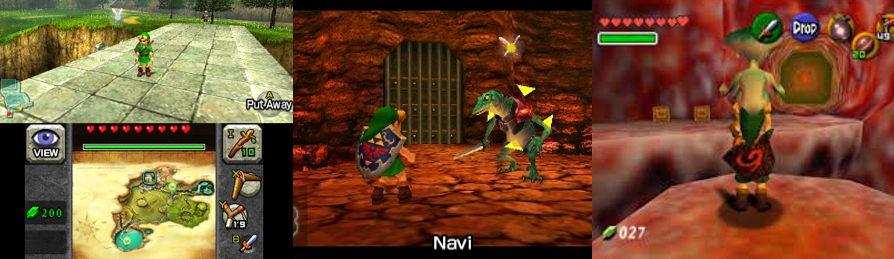
The touchscreen also displays a map of the current area, a miniature version of which also appears on the main heads-up display (HUD), though you can toggle this on and off with the directional pad; his health (represented by hearts), magic meter, and current Rupees (the currency of Hyrule) are also displayed on the touchscreen, significantly decluttering the HUD. Key items you collect to advance the narrative will appear in your ‘Gear’ menu, while equippable items appear in the ‘Items’ menu, which you can customise to suit your preference. In addition to acting as your companion and aiding you in combat, Navi will frequently chime in to remind you of the plot of where you need to head next, ask if you need to take a break, or offer other hints. This can be annoying, especially for seasoned players, as are the constant interruptions from the mysterious owl Kaepora Gaebora, who pops up throughout Young Link’s journey to offer encouragement and advice. Thankfully, you can skip through their dialogue (or ignore Navi entirely, shutting her calls down by entering new areas) with the B button, though this version of the game also includes the ability to receive “visions” from special, obnoxious Sheikah Stones if you ever find yourself stuck. Thankfully, despite this handholding, the game remains as enjoyable as ever; now a fully realised 3D world, Hyrule is large and expansive and you’re free to explore as much as possible depending on what equipment you have. Link can enter water to swim along, for example, but won’t be able to dive until he acquires the Zora Scales, Zora’s Tunic, and Iron Boots. Similarly, destructible blocks, high temperatures, and impassable bridges will block your way until you find specific items or travel through time, though you can still explore much of the overworld field and surrounding areas right from the start.
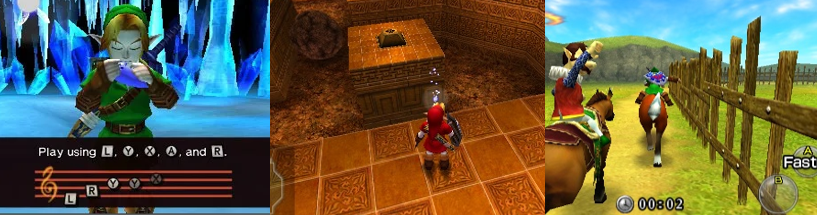
One of the game’s biggest gimmicks is the titular ocarina; by touching the bottom screen, players can play magical tunes to talk to Link’s childhood friend, Saria, for more tips, warp across Hyrule, open new paths, or even make blocks appear or disappear. As you explore and talk to NPCs, such as the mysterious Shiek, you’ll learn more songs that allow you to change the environment, such as turning day to night or causing rain. Link’s quest is split into two distinct parts: first, as a child, he needs to locate the three Spiritual Stones. Then, after awakening as an adult, he can explore new regions of Hyrule in search of five Sage Medallions, all of which are necessary to first access the Temple of Time and then confront Ganon in the desolate future. Link will need to both fight, sneak, and talk his way to these goals; one of your first objectives when you leave Kokiri Forest is to sneak into Zelda’s Castle, a task accomplished only by staying out of sight of her inept guards. When in Kokiri Forest, Link will have to bypass a rolling boulder to get the Kokiri Sword and slap down some Rupees for his first rudimentary shield, before putting these weapons to the test to try and save the Great Deku Tree. Indeed, the first three dungeons lay the ground work for the puzzles and actions you will need to overcome throughout the game; you’ll be lighting Deku Sticks on fire to burn away cob webs, climbing walls and plunging to new levels, hopping to moving platforms, hitting, standing on, or weighing down switches, and defeating all enemies to acquire keys, maps, and compasses all with the goal of acquiring the dungeon’s weapon and defeating its boss. Young Link is eased into all this quite well; the challenge increases with each dungeon he enters, putting new obstacles such as a raging volcano, destructible walls, a hungry fish deity, and a stubborn Zora princess in his path. Although his options are limited as a child, Young Link is key to forging relationships in the future; you’ll only tame the wild Epona by visiting Lon Lon Ranch as a child, for example, navigating the confusing maze of the Lost Woods is far easier as a child, and it’s only by returning to the past that Link can complete a brain-melting paradox, venture into a spooky well, and acquire the Lens of Truth.
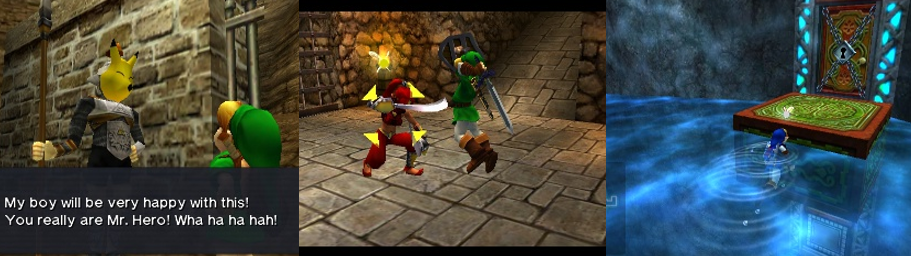
After acquiring the three Spiritual Stones, Link is sealed within the Light Temple until he’s old enough to wield the legendary Master Sword. Upon waking, he’s now older and tougher, but unable to use some of his childish items like the slingshot or boomerang. Adult Link, however, has access to a far greater arsenal of weapons, in addition to NPCs taking him seriously as a hero, though this is countered by the Temples he must conquering being longer and far tougher. Adult Link will explore strange winding corridors, rescue imprisoned Gorons, continuously alter water levels, hop to invisible platforms, and redirect sunlight in his quest for the Sage Medallions, frequently having to travel back to the past to help solve specific puzzles. He’ll also need to collect Silver Rupees to open gates, dissolve red ice, pound rusted switches, lift gigantic blocks and columns, and dodge spinning blades to progress. Adult Link also has the benefit of being big enough to ride Epona, who greatly speeds up foot travel; you can call Epona at any time when in Hyrule Field and mount her with A, speeding her up with taps of A for as long as you have carrots available and clearing fences with ease. If you ever need a break from all the adventuring, there’s a fishing hole available, shooting galleries to earn Rupees and weapon upgrades, a fun (if erratic) variation on bowling, and numerous side quests to complete to keep you playing.
Graphics and Sound:
When it first released on the Nintendo 64, Ocarina of Time was the pinnacle of what the console could achieve; a large open(-ish) world with many varied locations, a sprawling narrative, and numerous NPCs and enemies to interact with. It had a day and night cycle, with skeletal enemies and ghosts spawning at night, areas changed as you journeyed through time, and Link was at his most expressive yet, swinging his sword, shivering and sneezing, or gasping when low on health. Unfortunately, the Nintendo 64 version hasn’t aged all that well; the graphics were quickly surpassed by its successor, which fixed multiple issues with Link’s model and other textures, and the presentation was soon noticeably lacking against subsequent games, though the performance and sheer impressiveness of the original still holds up overall. This version of the game gives Ocarina of Time a much-needed graphical overhaul; not only are the menus made far more intuitive, allowing you to quickly apply tunics and boots to Link, but all the character models (especially Link’s) have been given an upgrade to be more expressive and detailed, even on the Nintendo 3DS’s smaller screen. Speaking of which, there’s obviously the option to enable the 3D features of the system, though I’d recommend leaving it off as it can really make your eyes hurt after a while and it distracts from all the funky new textures and colourful revamp given to Hyrule, the text, and basically every aspect of the game.
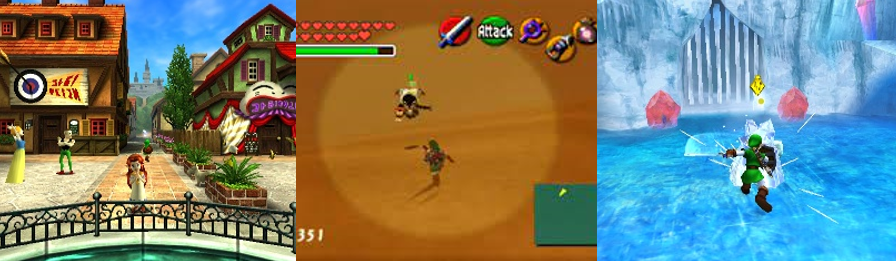
Unfortunately, this hasn’t extended to expanding upon the admittedly barren Hyrule Field; while an impressive overworld, bolstered by a triumph theme song, Hyrule Field quickly becomes annoying to cross through even with the benefit of Epona and there’s not much happening there even in the grim future. Thankfully, the game’s towns and regions make up for this, Hyrule Market, Kakariko Village, and Goron City are all bustling urban environments with lots of back alleys, houses, and nooks and crannies to explore and you’ll marvel at the beauty of Zora’s Domain and the magical wonder of Kokiri Forest. Even better, every area always has ore toit; each opens up when you acquire new equipment or return as an adult, allowing you to brave the intense heat of Death Mountain, dive to the bottom of Lake Hylia, and tackle to hazardous Gerudo Desert. Each area is full of lively NPCs, from condescending guards to overbearing monarchs and mischievous forest imps. Each will flesh out the world and offer clues, both vague and explicit, on how to progress, with some even tasking you with fetching or delivering an item for them and others, like Mido, showing outright aggression towards you. Over the course of your adventure, the lives of Hyrule’s inhabitants and the nature of the world will noticeably change; in the seven-year time jump, the grotesque Dampé will die, Hyrule Market will fall into desolate ruin, construction work will be completed, Lake Hylia will dry up, and Zora’s Domain will be irreversibly frozen. Sometimes, you can impact these events, such as restoring the waters to Lake Hylia, reducing the windmill operator to tears, and restoring the family in the House of Skulltula, and other times monuments to Ganon’s evil will remain in the world, like the deceased Great Deku Tree and boiling lava pit where Zelda’s Castle once stood.
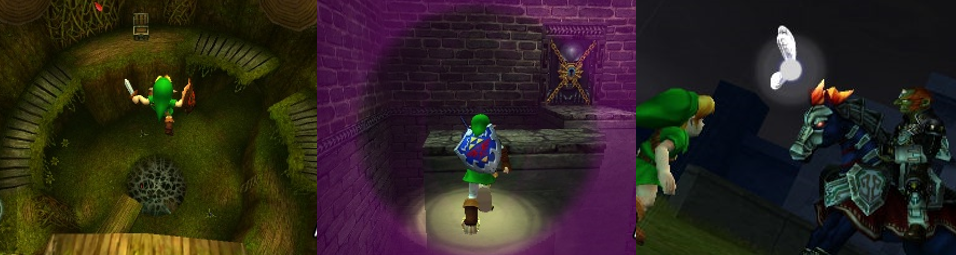
Link’s journey also takes him into a variety of dungeons; the first three are visually very distinct, with you exploring the cobweb-infesting insides of the aforementioned tree, venturing into a dangerous rocky cavern, and trudging through the insides of Lord Jabu-Jabu while carrying (and tossing) the self-entitled Princess Ruto. Puzzle elements such as switches, platforms, and gated areas are personalised in these dungeons and noticeably more uniform when tackling the elemental Temples as Adult Link, though these make up for this by being bigger, more challenging, and no less visually distinct. Each dungeon has a memorable theme assigned to it, whether strangely upbeat or darkly ominous, and Link must utilise all his arsenal to best them, including returning as a child to solve puzzles or acquire new items. No two Temples are the same here; you’ll be tracking down naughty Poes and pushing puzzle blocks together in the Forest Temple, hopping over lava and vertically traversing the Fire Temple to free Gorons, desperately sinking, swimming, and altering the water level in the Water Temple (something made much easier by this version’s colour-coded areas), crossing an eery river on a large barge and uncovering invisible hazards in the Shadow Temple, and using sunlight and time travel to overcome the Spirit Temple. In addition, there are many smaller challenges to overcome; you can uncover fairy fountains to gain helpful buffs, endure the frigid dangers of the Ice Cavern, sneak around Gerudo’s Fortress sniping the all-female guards from afar to rescue the construction workers, and push gravestones to uncover secrets. While characters (and especially Link) will grunt, laugh, and make rudimentary sounds, all of the game’s dialogue and story is told through text, though it’s no less engaging, and each cutscene grabs your attention, with the tale of the three Goddesses, Link’s triumphant rescue of Epona, and the emotional reunion between him and Zelda being just three standout moments.
Enemies and Bosses:
Almost all of the franchise’s classic enemies make their 3D debut here, with Link slashing at bat-like Keese, dropping bombs to destroy crazed Armos statues, reflecting projectiles back at Octoroks, avoiding the squeeze of Wallmasters, frantically chasing down Leevers, and cutting Tekties in two. Many of Link’s enemies are memorable for their disturbing nature; Gibdos and ReDeads, for example, will shamble and crush you with their embrace, screaming to freeze you in place, while disgusting Like Likes will shallow you (and your shield and optional tunic) whole, and Cuccos will take a spiteful revenge if attacked. Many enemies are specifically designed to take advantage of Link’s new combat abilities; you’ll engage the formidable Stalfos, Lizalfos, and Dinolfos in sword combat, striking when their guard is down and defending against their sword swings, and similarly only be able to attack the Wolfos when they’re not defending against your sword strikes. Likewise, you must wait for the Skulltula’s to show their bellies to destroy them, Poes will only be vulnerable for a short time, club- and lance-wielding Mobiles cannot be attacked directly and require the use of stealth and your ranged weapons, which will also keep you from getting shocked by Biris, and be temporarily unable to use your weapons upon touching bubbles. Other enemies, such as Fire Keeze and Dodongos, can set you on fire, burning any wooden equipment you have attached, freeze you in place, or are disguised as regular objects like doors to keep you on your toes.
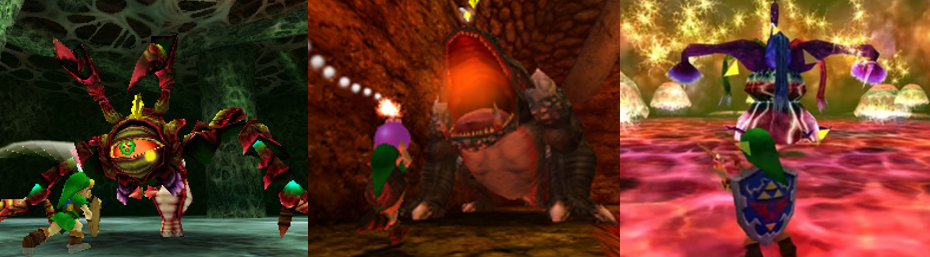
Young Link will have to defeat three bosses to obtain the Spiritual Stones which, like the dungeons themselves, set a precedent for the game as they are best fought with the weapons you obtain in their lair. First up is Queen Gohma, a massive, slobbering spider-like creature that scuttles about on the ceiling, drops Gohma Larva to attack you, and lurches or drops on you. Fortunately, you can shoot a Deku Seed at her big, glaring eye to stun her, easily allowing you to destroy her with a few sword swings. King Dodongo is a little tougher as he’s much bigger and rolls around an arena with lava in the middle. When he pauses to breath fire at you, you need to toss a bomb in his mouth to stun him for an attack, with the biggest issue here being avoiding his cannonball-like rolling. After chasing a Big Octo around a rotating spiked platform and slashing at its ass, you’ll battle Barinade within Lord Jabu-Jabu. This pulsating, electrical monstrosity protects itself with Giant Biri, which must be destroyed to expose its core, and blast of electricity from its artery-like appendages. Your best bet is to hang back with your guard up and continuously toss your boomerang to take care of Barinade’s defences, then leap in sword attacks when its stunned. Later, Young Link will need to venture to the Bottom of the Well to retrieve the Lens of Truth, which is guarded by the unsettling Dead Hand, which teleports in a burst of dust and holds you in place with a field of disembodied hands while it closes in to take a bite. Similarly, Young Link will battle an Iron Knuckle in the Spirit Temple, though this fight is both slightly easier and slightly harder than battling them as an adult. It’s easier because Young Link can completely hide under his Hylian Shield, but harder because his Kokiri Sword does way less damage; you also can’t get too close as the Iron Knuckles deals massive damage with its axe, though it can be tricked into destroying nearby columns to restore your health.
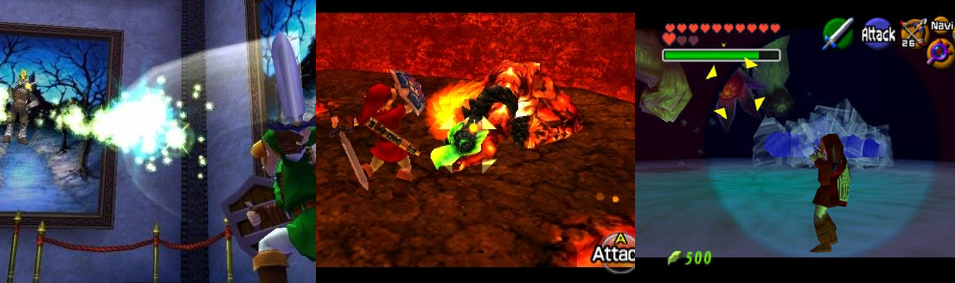
Adult Link has a far greater challenge ahead of him as he must battle five monstrous bosses to acquire the Sage Medallions, with each Temple also sheltering at least one mini boss. The four Poe Sisters will give you the runaround in the Forest Temple before leading the way to Phantom Ganon, an apparition of the King of Evil who randomly appears from paintings strewn around the arena. Pick the right painting and fire an arrow at him until he ditches his steed and then engage in a game of dead man’s volley, smashing his magical projectiles back at him to bring him to his knees, but make sure you keep your distance as these exchanges intensify very quickly. After chucking bombs at the Flare Dancer and avoiding its explosive demise in the Fire Temple, you’ll take on the fire-spewing dragon Volvagia. Volvagia will fly around the small island, diving into and bursting from pools of magma strewn about; when it does, you’ll need to avoid its flame-like whips and smash it with the Megaton Hammer, then take shelter on the climbable walls of the island as Volvagia causes rocks to rain down. In the Water Temple, you’ll have a surreal encounter with Dark Link that’s easily won with the Megaton Hammer or Biggoron’s Sword before taking on the most annoying boss of the game, Morpha. Morpha is a sentient nucleus that brings the arena water to life, sprouting tentacles that will grab and throw you into the spiked walls that line the room, and which can only be damaged by snagging to with the Longshot and pummelling it before it can hop away. After besting another Dead Hand in the Shadow Temple, you’ll battle perhaps the strangest boss of the game, Bongo Bongo, a grotesque beast that can only be seen with the Lens of Truth. This battle is made tricky by the arena floor, which will vibrate as Bongo Bongo hits it, ruining your aim as you shoot arrows at its hands to stun them or its eye to open it to a more meaningful counterattack,
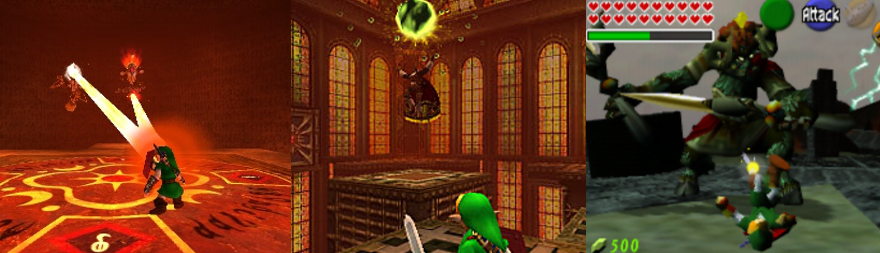
After overcoming another Iron Knuckles as Adult Link (revealed to be Nabooru in disguise), Link will battle Ganon’s surrogate witch-mothers, Kotake (who controls ice) and Koume (who controls fire). As they fly well out of range, you’ll need to use the Mirror Shield to reflect one element back at the other to bring them down; after enough hits, they’ll fuse together into the strangely alluring Twinrova and wield both elements. This time, you need to absorb three consecutive hits of each element on your Mirror Shield to blast them with a flame or ice burst, all while avoiding being charbroiled or frozen solid. Once you have all the Sage Medallions, the Six Sages will create a magical bridge for you to enter Ganon’s Castle, which contains mini challenges themed around each Temple, more Iron Knuckles, and a two-stage showdown with the King of Evil himself. In the first phase, you need to hang right back and avoid falling down to the lower levels as it’s a long journey back up to his throne room; Navi is useless here but you can still L-Target Ganondorf, reflecting his bolts back at him in another game of dead man’s volley that’s actually easier than when fighting Phantom Ganon as Ganondorf is largely stationary (though he does have a more powerful multi-blast attack). Damage Ganondorf enough and he’ll bring the whole castle down, forcing Link to run for safety as Princess Zelda magically opens gates, before transforming into the gargantuan, rampaging pig-beast, Ganon. This fight is ridiculously easy, though, even with the scripted loss of the Master Sword; simply roll between Ganon’s legs when he swipes at you and attack his tail with either the Megaton Hamme or the Biggoron’s Sword until you can retrieve the Master Sword. Eventually, Zelda will hold him in place with her magic, meaning all you have to do is land the final blow with the Master Sword to banish Ganondorf and restore peace to Hyrule.
Power-Ups and Bonuses:
As ever, you can replenish Link’s health using hearts, fairies, or potions; enemies, crates, and bushes will drop hearts to restore your health bit by bit or you can assemble four Heart Containers by searching about, or gain an extra heart with each boss you defeat. Fairies and their larger variants will also restore your health and you can even capture them in one (or all, as I do) of the game’s bottles to restore some health when you’re defeated; similarly, potions will also replenish your health in the same way. You’ll also find Magic Jars to refill your magic meter, which drains as you cast spells, and Great Fairies will increase your meter just as they teach you these spells. These power-up your Spin Attack, allow you to cast a blaming attack, let you setup a mid-dungeon teleport that’s super useful in the Water Temple, and surround you with a temporary protective shield. Some weapons, like the elemental arrows, and items like the Lens of Truth also drain your magic, so use them sparingly to avoid being caught short.
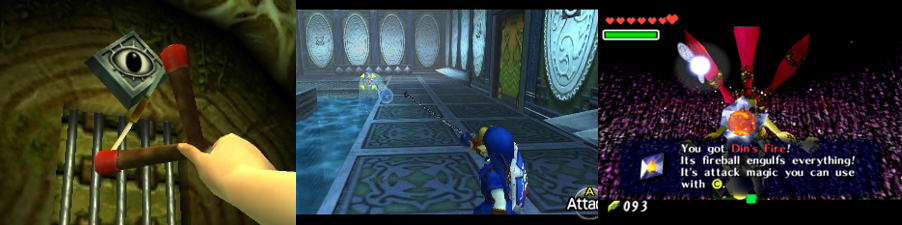
Many of Link’s trademark items and weapons are featured here, either in chests, gifted to you by NPCs, or bought from shops. You can fire Deku Nuts and arrows with the slingshot and Fairy Bow, respectively, with the latter also able to fire flaming, freezing, and light arrows for additional damage, retrieve items, hit switches, and stun or damage enemies with the boomerang, and cross distances by latching onto special surfaces with the handy-dandy Hookshot. The Megaton Hammer will activate rusted switches, the iron Boots let you sink to and walk on the bottom of lakes, the Hover Boots let you briefly run on thin air at the cost of your traction, and you can toss bombs, let loose Bombchus, or stun enemies with a blinding Deku Nut. Link can also earn (or buy) coloured tunics to withstand extreme heat and breath underwater, dive deeper with Zora Scales, and acquire swords so powerful they need to be held with both hands. Additionally, Link can acquire three different shields and upgrade his wallet, ammo, and the range of the Hookshot by completing mini games and exploring dungeons, as well as use bracelets and gauntlets to heave large objects with ease. Secret grottos and areas can be sought out once you earn the Shard of Agony by destroying Gold Skulltulas, Link can rescue Epona from the greedy Ingo by outracing him as an adult, and Young Link can buy and plant Magic Beans that will sprout into floating leaf platforms in the future to find yet more goodies.
Additional Features:
There are thirty-six Heart Containers to find here, which will increase your health to twenty hearts. This can then be doubled by visiting a Great Fairy outside Ganon’s Castle, who will effectively half the damage you take from enemies. There are also 100 Gold Skulltula’s hidden all over the game and they’re well worth seeking out, at least to start with, as destroying increments of ten will restore the family in the House of Skulltula and award helpful gear like a bigger wallet, the Shard of Agony, and a Heart Piece, though the final reward of a Huge Rupee is very disappointing. Both Young and Adult Link can choose to complete trading quests; Young Link’s is based around trading masks with various NPCs, sometimes being stiffed on the sale, all to acquire the Mask of Truth so he can talk to Gossip Stone, while Adult Link’s trading sequence is tougher, but yields a far better reward; by racing across Hyrule without warping, often against a tight time limit, and trading items back and forth, you can eventually acquire the unbreakable, super powerful Biggoron’s Sword that makes mincemeat of enemies and bosses. If you can’t be bothered and don’t mind wasting your Rupees, you can buy the destructible, nigh-useless Giant’s Knife instead, but this is a complete waste of time. It’s also worth completing the shooting galleries, even though the Gerudo one can be tricky due to being an auto-shooter and the tight window for landing bullseyes, as these will increase the ammo for your ranged weapons. Similarly, you can take on the Gerudo Training Ground, solving puzzles and besting enemies for keys to grab the Ice Arrows, but this is entirely optional and mainly for completion’s sake.
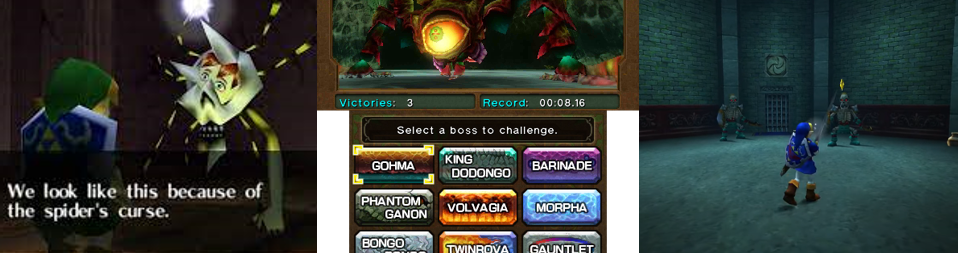
This version of the game comes with some lucrative additional features; while it unfortunately doesn’t add back in the Sword Beam or Unicorn Fountain, Ocarina of Time 3D includes a “Boss Challenge”, accessible from Link’s house after clearing the Forest Temple, which is essentially a boss rush against all the game’s bosses against a time limit and with limited health and items. However, a far more substantial inclusion is “Master Quest”, which is unlocked upon first beating them game. Although previously included in the “limited edition” releases of The Legend of Zelda: The Wind Waker (Nintendo EAD, 2002), this much tougher version of the game has been tweaked here to mirror the entire game. “Master Quest” also noticeably mixes up the puzzles and enemy placements, offering a substantial challenge even for seasoned players as tougher enemies and more difficult puzzles appear as early as Kokiri Forest; even the Gold Skulltula locations have changed, and you can also test yourself against the “Boss Challenge” for this mode, too, which stands as a much appreciated inclusion for long-time players of Ocarina of Time. Finally, you can still teach a friendly scarecrow a custom song, win yourself a cow by racing Ingo, hunt down the Big Poes haunting Hyrule Field, try and snag the elusive Hylian Loach, and this version of the game gives the option of using the Nintendo 3DS’s gyroscopic controls (which, again, I wouldn’t recommend), and removes and changes some of the blood effects.
The Summary:
When I was a kid, there were a handful of games everyone owned for the Nintendo 64 and Ocarina of Time was one of time. Although I’d only had a brief flirtation with the franchise when Ocarina of Time released, I knew it was a big deal as all the gaming magazines hyped it up and it was exciting to delve into this sprawling, action-packed, nuanced adventure. I replayed Ocarina of Time over and over, finding every secret and obtainable item possible, even exploring it with an Action Replay to wring more out of it. It was a seminal title, one that hooked me on the franchise forever more, and this 3DS revamp is everything the original was plus more. The graphical overhaul is very much appreciated, to the point where I’m sad that this port is stuck on the 3DS’s small screen because Ocarina of Time has never looked better. The quality-of-life features offered by the touchscreen and the additional hints are great, addressing every issue gamers had with the original version and offering even more content, including the fabled “master Quest” challenge. While I would’ve liked to see the game tweaked and expanded like its successor, Ocarina of Time 3D is still the definitive version of this classic game in my eyes. Being able to play on the go, reliving those memories and conquering those challenges and losing myself in this immersive fantasy adventure is a thrill that’s only gotten better with age. Everything from the memorable NPCs, the fun side quests, then intuitive and surprisingly deep combat, to the massive bosses, the quirky humour, and the entertaining time travel mechanics keep me as hooked now as they did as a teenager, and I still regularly plug this cartridge in to relive those memories. Honestly, you don’t need me to say it; Ocarina of Time has more than earned its flowers and all I’ll say here is that I highly recommend you add this version to your library as soon as possible, or dust off your Nintendo 64 and start a new playthrough today!
My Rating:
Fantastic
Have you ever played the Nintendo 3DS remaster of Ocarina of Time? If so, what did you think to the graphical overhaul and additional features included? Would you like to see this version ported to the Nintendo Switch to make it more accessible? Did you own Ocarina of Time back in the day? If so, which of the game’s bosses and dungeons was your most or least favourite? What did you think to “Master Quest”; did you manage to beat it? Which Zelda titles would you like to see remade in the future? I’d love to hear your memories of Ocarina of Time so leave a comment below or on my social media, and be sure to check out my other Zelda content across the site!

 Dr. K's Waiting Room
I抎 should verify with you here. Which isn’t something I normally do! I enjoy studying a post that will make individuals think. Also, thanks for allowing me to comment!
LikeLike