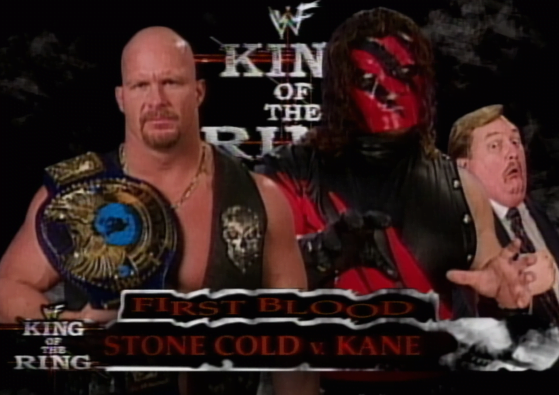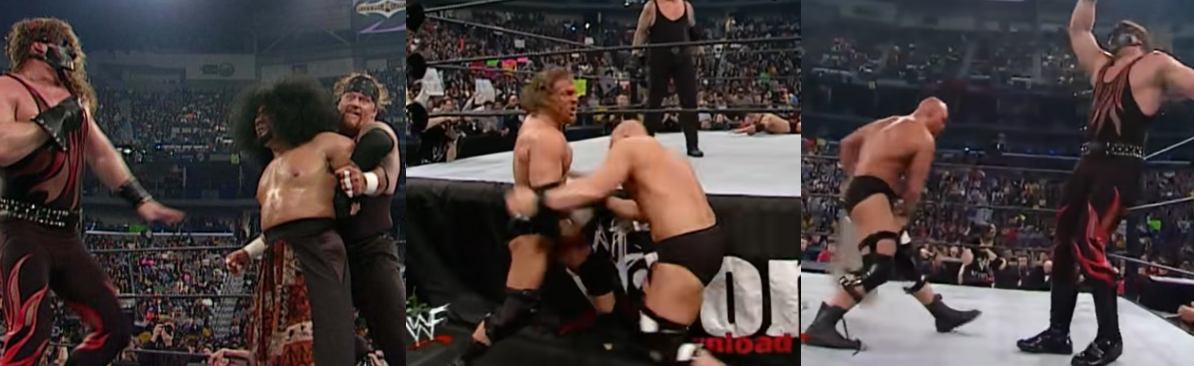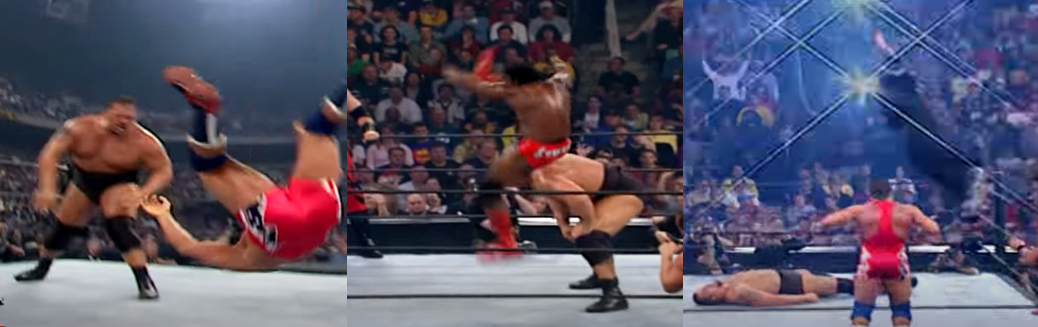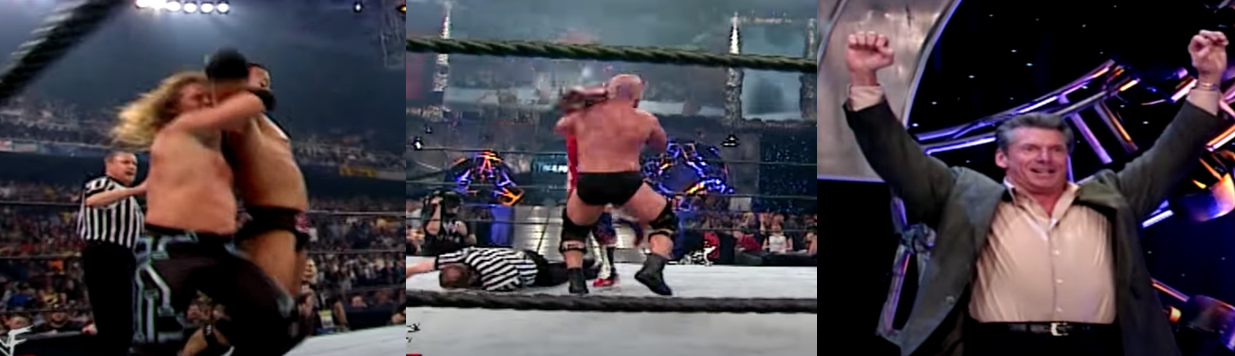
The Date: 28 June 1998 The Venue: Civic Arena; Pittsburgh, Pennsylvania The Commentary: Jim “J.R.” Ross and Jerry “The King” Lawler The Referee: Earl Hebner The Stakes: First blood match for the WWF Championship and Kane’s life!
The Build-Up: The day after my twelfth birthday (and clashing with Global James Bond Day), on October 5th 1997, Glenn Jacobs made a dramatic debut as Kane, the scarred, monstrous younger half-brother of the Undertaker. Following this, Kane ran wild throughout the then-World Wrestling Federation (WWF), attacking everyone in a bid to force his reluctant brother to face him in the ring. Eventually, the Undertaker acquiesced, leading to two defeats for the Big Red Machine. However, on 1 June 1998, Kane defeated the Undertaker on Raw is War to become the number one contender to the WWF Championship, the company’s top prize, which was held by the phenomenonal“Stone Cold” Steve Austin. At the time, Austin was embroiled with an industry-defining feud with WWF Chairman Vince McMahon, refusing to confirm to Vince’s demands and openly defying the chairman’s authority with a brazen attitude. After repeatedly fending off Vince’s misguided stooge, Dude Love, Austin faced a physical threat like no other when Kane challenged him to this “First Blood” match. Speaking for the first time via a voice modulator, Kane drenched Austin with a blood bath and raised the stakes of the match by promising to immolate himself if he didn’t win the title!
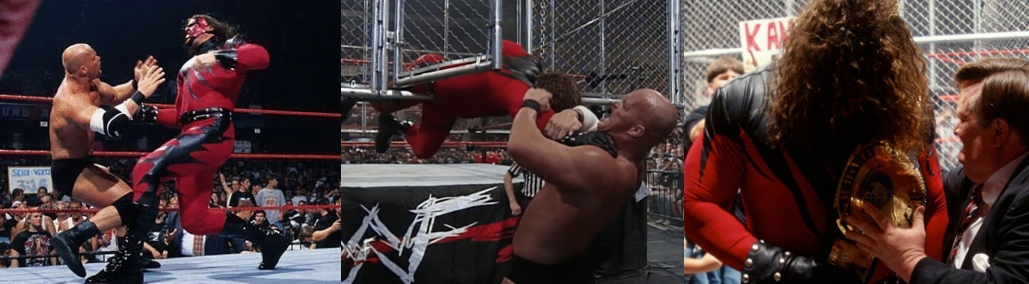
The Match: I think Kane said it best when he once stated that few people remember him winning the WWF Championship on this night thanks to the absolute war the Undertaker and Mankind enacted in the previous match! They didn’t even put a match between the Hell in a Cell and the main event to cool the audience down! I always remember it, though, since I was such a huge Kane fan back in the day and it saw him capture the WWF’s biggest prize from their most successful superstar, and all so soon after his initial debut. Proving that he isn’t some muscle-bound meathead, Kane sported a new attire for this match that completely covered every part of his body, making it seem all-but impossible that any trace of blood could be detected by the referee. Austin fearlessly stormed to the ring, his right arm heavily bandaged following a staph infection, and immediately hit his signature Lou Thesz Press and running elbow drop. Austin then clobbered Kane with the championship belt and removed a turnbuckle pad, though neither man could take advantage of the exposed bolt. Kane quickly ended Austin’s onslaught with some powerful strikes and chokes, shrugging off Austin’s blows but failing to hit the Tombstone Piledriver and being pushed outside. As they brawled around the ring, Austin bounced Kane’s face off the ring steps and the Hell in a Cell started to lower, much to J.R.’s anger. After whipping Austin into the steel steps, Kane ran him into the lowering cage and tried to crush Austin under the cell as it locked into position. Austin’s face bounced off the cage once more and J.R. quickly explained that the minor scratch on the Rattlesnake’s back wouldn’t count towards the match stipulation, allowing Kane’s decimation of the champion to continue. Austin began a comeback by ramming Kane’s head into the cell door, leading to Kane being lifted off the ground when the cage inexplicably rose! After a nasty tumble, Kane was repeatedly rammed into the security guardrail and walked up the entrance ramp, only for Austin to take an ugly back body drop to the concrete and a suplex on the rampway.
Despite a dominating performance, Kane didn’t look like a winner by the end of this mediocre match.
Kane smashed Austin’s head off a light and tossed a security railing at his head as McMahon watched anxiously from his luxury skybox. Austin brought the action back to the ring and finally bashed Kane’s head off that exposed ring bolt, choking him on the ropes and then taking him back outside to smash him over the head with an electrical fan. A touch more brawling led to Earl Hebner being taken out when Kane choke-tossed Austin at the railing. Kane then nailed his Diving Clothesline, though Austin countered a second attempt and stomped on Kane in the corner. This led to Mankind (somehow still not dead) inexplicably running in with a steel chair, though he never got a chance to use it as Austin quickly fought him off and planted him with a Stone Cold Stunner. This distraction allowed Kane to recover, though Austin booted Kane in the balls when he went for a Chokeslam and blasted him with a Stone Cold Stunner as well. J.R. just about had a coronary when the Undertaker came limping out to swing a steel chair at Mankind, but blasted Austin when Foley dodged the shot. The Undertaker clobbered Kane and Mankind and manhandled the referee back into the ring, reviving him with one of the gasoline cans, only to be smacked from behind by Kane. Austin frantically fought Kane off and damn near took his head off with a chair shot, but it was ultimately academic as Austin was bleeding profusely from the Undertaker’s chair shot! Thus, the unconscious Kane was declared the winner and a stunned, bloody Austin was left arguing with the referee. It would’ve been tough for any match to top the Hell in a Cell that preceded this one, but this match lacked a lot of energy. It told a good story of Austin being physically dominated by Kane, who clearly had the upper hand and allowed Austin to be a scrappy underdog, but there wasn’t much to this one. The ending has always irked me as it seemed like the Undertaker didn’t mean to hit Austin, yet he revived the referee to help Kane win, despite the two still attacking each other. Kane also looked pretty weak in the end as he was flat on his back when he was announced as the winner.
The Aftermath: While many people might remember King of the Ring 1998 more for the brutal Hell in a Cell match, a greater and far less impressive footnote came out of the match as Austin confronted Kane over his tainted victory the very next night on Raw is War, challenging him to be a man and grant him a rematch. Austin won the match, regaining the championship and ending Kane’s title reign at around twenty-four hours, and all because the WWF had booked themselves into a corner with the ludicrous immolation stipulation! Still, Kane and Austin continued to feud into July, where the Undertaker and Austin defeated Kane and Mankind to become WWF Tag Team Champions. After defeating the Undertaker at SummerSlam, Austin was pinned by both Brothers of Destruction at Breakdown: In Your House, leading to the title being vacated and Austin being fired at Judgment Day: In Your House when he referred a match between the two and it ended in a no contest. This led to the infamous “Deadly Game” tournament at Survivor Series, where the Rock captured his first WWF Championship and the escalation of Austin’s war with the McMahons. As for Kane, it would take ten years for him to win another World Championship when he captured the revived Extreme Championship Wrestling (ECW) title at WrestleMania XXIV, and twelve years before he became a WWE Champion again, with him finally besting his brother in a heated rivalry over the World Heavyweight Championship at the 2010 Bragging Rights event.
My Rating:
⭐⭐
Rating: 2 out of 5.
Could Be Better
What did you think to Kane’s anti-climactic title win at King of the Ring 1998? Were you surprised when Kane won or did you really think he was going to set himself on fire? Do you think it was a mistake to air this match after the Hell in the Cell match? What did you think to Kane dropping the title the very next night? How are you celebrating Kane’s debut this year? What are some of your favourite matches and moments from Kane’s long and complex career? Whatever your thoughts, drop a comment below to let me know what you think about Kane, and go support me on Ko-Fi.
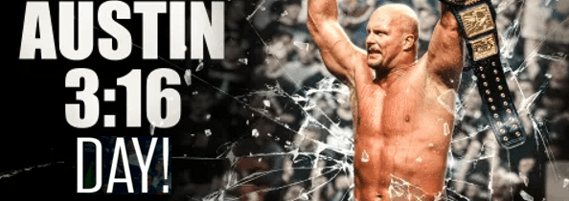
“Talk about your psalms, talk about “John 3:16”…Austin 3:16 says I just whupped your ass!”
With those immortal words, spoken by the legendary pro wrestler “Stone Cold” Steve Austin after winning the King of the Ring tournament on 23 June 1996, a momentous wrestling career was about to unfold before our eyes that would see everyone’s favourite beer-swigging, finger-gesturing anti-hero become not just an industry icon but a mainstream icon as well. Here’s to yah, Steve!
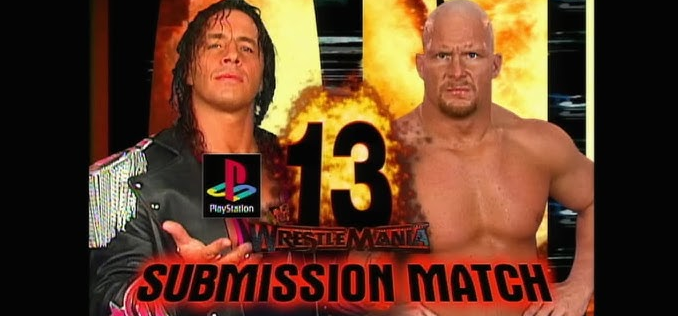
The Date: 23 March 1997 The Venue: Rosemont Horizon; Rosemont, Illinois The Commentary: Jim “J.R.” Ross, Jerry “The King” Lawler, and Vince McMahon The Referee: “The World’s Most Dangerous Man” Ken Shamrock (guest) The Stakes: No disqualification submission match
The Build-Up: Contrary to popular relief, “Stone Cold” Steve Austin’s rise to the top of what was then known as the World Wrestling Federation (WWF) didn’t happen with his infamous “Austin 3:16” promo. After shedding his awful “Ringmaster” persona and winning the 1996 King of the Ring tournament, Austin made a name for himself as a no-nonsense badass during his controversial feud with former tag team partner “The Loose Cannon” Brian Pillman before punching his ticket to a WWF Championship match at WrestleMania 13 by winning the 1997 Royal Rumble. However, this victory was tainted as Austin had already been eliminated by Bret “The Hitman” Hart, leading to Austin’s first-ever main event match at In Your House 13: Final Four for the vacant championship. Since a knee injury saw Austin eliminated in the early-going, the Texas Rattlesnake bit back by costing Bret the WWF Championship, kick-started a prolonged feud between the two that would drastically alter their careers. The son of wrestling legend and hard-nosed trainer Stu Hart, Bret Hart first made his mark in the WWF as part of the Hart Foundation before graduating to notable singles success with his award-winning Intercontinental Championship run. Regarded as the “Excellence of Execution”, Bret eventually became WWF Champion following a shift in direction after a steroid scandal before clashing with brother Owen and pushing himself to the limit in a heated rivalry with the “Heartbreak Kid” Shawn Michaels. Following his WrestleMania XII loss, Bret took a hiatus and, upon declining a big payday from rival company World Championship Wrestling (WCW), returned to answer cocksure Austin’s challenge following his King of the Ring win. Frustrated at being overlooked and the fickle fans cheering such an uncouth anti-hero, Bret began one of the greatest turns towards the dark side in wrestling history and was set on a collision course with Austin, who was on the precipice of greatness.
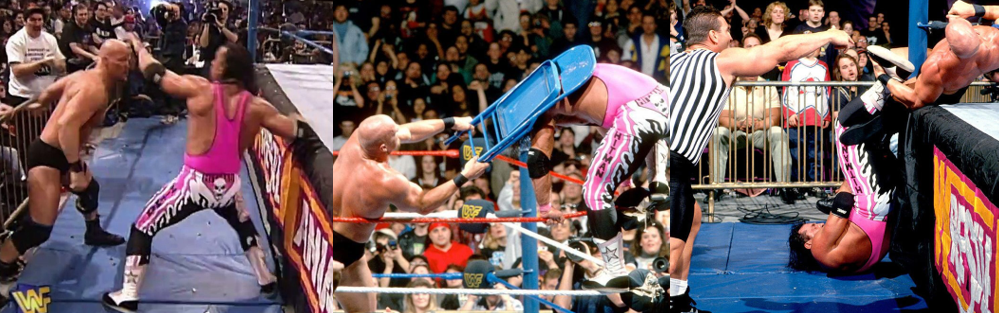
The Match: The introductory package for this classic, career-making match is heavily focused on Bret Hart’s displeasure with the direction the WWF was taking at the time and the lack of respect he felt he deserved for his in-ring ability. While Bret was absolutely justified in questioning this treatment, and Steve Austin’s rude, foul-mouthed attitude, the crowd knew who they wanted to cheer and Bret was largely seen as a “cry-baby”, leading to Bret lashing out at everyone and anyone, including WWF Chairman Vince McMahon, to get his respect. This pivotal match in Austin’s career stood out not just for the storyline surrounding it and the memorable ending, or for introducing Ken Shamrock to WWF audiences, but also for Austin’s iconic glass breaking entrance, which perfectly summed up his no-nonsense persona. Indeed, while he was universally cheered at this time, Austin was no baby kissing, hand shaking babyface and instead treated them with the same disdain and hostility as he did special guest referee Ken Shamrock. This was in contrast to Bret, who still had his fans on this night and who still gifted his sunglasses to a kid in the front row, but I find it incredibly ironic that McMahon called out Bret’s abusive behaviour and volatile attitude when many of this mannerisms and aspects (especially Bret’s contempt for McMahon) would be so integral to Austin’s developing, anti-authoritarian character. As if getting in Shamrock’s face wasn’t enough, the Rattlesnake demonstrated that he had no fear and far less respect for Bret by pouncing on the Hitman and pummelling him with punches the moment he got into the ring. For his part, Bret answered back with shots of his own, leading to the two rolling around like crocodiles wrestling for territory and spilling to the outside to exchange blows. Although Bret sent Austin flying into a ring post, Austin answered back by dumping him crotch-first on the security railing and then clotheslining him into the crowd. The camera struggled to follow the brawl, which saw Bret drenched in beer, Austin back body dropped onto the steps following a piledriver attempt, and Bret land a flimsy-looking fist drop off a guard rail jump.
Some ringside brawling, chair shots, and innovative offense saw Austin on the backfoot at the start.
Once back at ringside, Austin whipped Bret knee-first into the ring steps, though Bret saved himself from further harm by kicking Austin’s knee out from under him. Once the two returned to the ring, Bret nailed a neckbreaker and an elbow drop from the second rope, before focusing his attack on Austin’s knee and leg in preparation for his patented Sharpshooter. With Austin grounded, Hart pounded, wrenched, and “dissected” Austin’s knee, causing the Rattlesnake to stumble and be spitefully kicked to the canvas whenever he fought to his feet. Even when Stone Cold hit a desperation Stone Cold Stunner to create some distance, it didn’t matter as Bret was right back up and soon had Austin’s legs tied around a ring post with a modified Figure Four Leglock! Despite the agony and the additional leverage afforded by the move, Austin refused to tap out to the hold, so the Hitman tossed his opponent into the ring and brought a steel chair and the ring bell into the match. Bret looped Austin’s bad leg into the chair and teased leaping off the top rope, looking to break Austin’s limb, only for Stone Cold to scramble to his feet and send Bret tumbling from the top rope with a chair shot to the head! Austin then continued the assault, whacking the chair over Bret’s spine and assaulting his foe with slams, whips, and suplexes, firmly targeting the Hitman’s back and landing a sneaky stomp to Bret’s balls to add insult to injury. Despite attacking Bret’s spine, Austin locked in a modified arm lock and seemingly forgot his leg, landing an elbow drop off the second rope and applying a Boston Crab. Despite the pressure, Bret hauled himself to the bottom rope to break the hold (something that shouldn’t have counted as this was a no disqualification match), so Austin tried to slap on the Sharpshooter. However, a thumb to the eye put a stop to that and, though Bret was soon launched to the outside, the Hitman continued his comeback by tossing Austin into the timekeeper’s table and busting him open with closed fists to the forehead.
Austin’s sheer tenacity saw fans turn on Bret and applaud and Stone Cold’s defiant attitude.
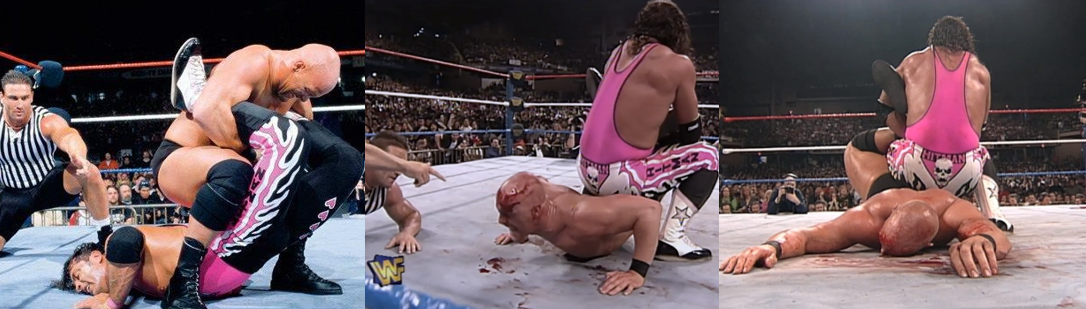
Bret maliciously targeted the wound, causing blood to gush from Austin’s forehead, while being sure to work over Austin’s whole body with a backbreaker, another second rope elbow drop, and repeated strikes to Austin’s injured knee with the steel chair. However, Austin frantically fought Bret off when he tried to apply the Sharpshooter and the match descended into a brawl in the corner once again, which ended with a swift kick to the Hitman’s balls! Groggy and suffering, Stone Cold whipped Bret sternum-first into the corner and then stomped a mudhole in the Hitman’s ass (and walked it dry!) in the opposite corner before hitting a top-rope suplex. His face the literal crimson mask, Austin choked Bret with an electrical cord and received a shot to the head with the ring bell in recompense! The Hitman wasted no time in applying the Sharpshooter right in the centre of the ring, locking it in tight and giving Austin nowhere to go. Shamrock dropped to the mat and frantically asked Austin if he wanted to submit, but the Rattlesnake stubbornly refused and desperately tried to ease the pressure, almost powering his way out of it to chants of “Austin! Austin!” and delivering one of the most iconic WrestleMania visuals ever: his screaming, bloody face. In the end, Austin patently refused to tap out or submit and, as a result, eventually blacked out to the pain, losing the match but leaving Bret visibly frustrated since he couldn’t secure the tap out. Bret then took his frustrations out on Austin’s leg, forcing Shamrock to take him down and solidifying perhaps the greatest double turn in the history of wrestling as the crowd unanimously booed Bret and applauded Austin’s resolve! I’m gonna be honest and say that, as much as I like Austin, a lot of his matches can be very formulaic as he primarily relied on brawling and ringside shenanigans. However, this really showcased how his more in-your-face style can nicely compliment a more technical mat wrestler. The story of Austin not knowing any submission holds meant it made perfect sense for him to rely on weapons and underhanded tactics, while Bret’s clinical targeting of his foe’s limbs showed just how methodical the Hitman was and how resilient the Rattlesnake was!
The Aftermath: This wouldn’t be the end of the rivalry between Stone Cold and Bret Hart, but it did signal a change in their dynamic since Bret was now a dastardly, besmirched heel and Austin was a tenacious babyface. Bret brought in his friends and family to re-form the Hart Foundation to escalate the feud, resulting in another inconclusive finish when the British Bulldog attacked Austin with a steel chair at In Your House 14: Revenge of the ’Taker. However, Austin got the last laugh when he fought off the Hart Foundation and even locked Bret into the Sharpshooter, resulting in ten-man tag team match at In Your House 16: Canadian Stampede. Airing in Calgary, Alberta, Canada, the Hart Foundation were cheered as national heroes and ultimately defeated Steve Austin’s team and had the Rattlesnake arrested after he attacked them at the end of the match. The matches between Austin, his allies, and the Hart Foundation earned them the Wrestling Observer Newsletter’s “Feud of the Year” award and Bret Pro Wrestling Illustrated’s “Most Hated Wrestler of the Year” award, though it’s surprising to see that Austin was on the losing end of the feud. Austin and Bret’s issues fizzled out by the 1997 SummerSlam, which kick-started Bret’s long and troubled road back into the fan’s hearts, towards the WWF Championship and, ultimately out of the company. Austin pivoted into feuding with Bret’s brother, Owen Hart, for the Intercontinental Championship, resulting in a sickening injury that shaved years off his career. Thanks to this incident putting Austin on the shelf for some time, and the cataclysmic fallout of the “Montreal Screwjob”, Austin and Bret never wrestled each other again, though both men looked back on this match fondly and regarded it as one of the best matches of their respective careers.
My Rating:
⭐⭐⭐⭐
Rating: 4 out of 5.
Great Stuff
What did you think to the Submission Match between Steve Austin and Bret Hart at WrestleMania 13? Which man were you rooting for at the time, and did your perception of one or both change after the match? What did you think to Austin’s crowd brawling and Bret’s more systematic attack? Can you name another double turn like this, or a similar bloody visual as Austin’s face? How are you celebrating 3:16 Day this year, what are some of your favourite matches and moments from Austin’s illustrious career? What dream match would you have liked to see him involved in? Let me know what you think about “Stone Cold” Steve Austin down in the comments, send me £3.16 on Ko-Fi, and go check out my other wrestling content across the site!
After debuting as part of the “Million Dollar Man” Ted DiBiase’s Million Dollar Team at the 1990 Survivor Series, the Undertaker became a force of nature within World Wrestling Entertainment (WWE). To celebrate the Deadman’s illustrious career, I’m looking back at his WrestleMania matches against the future members of the super-stable Evolution.
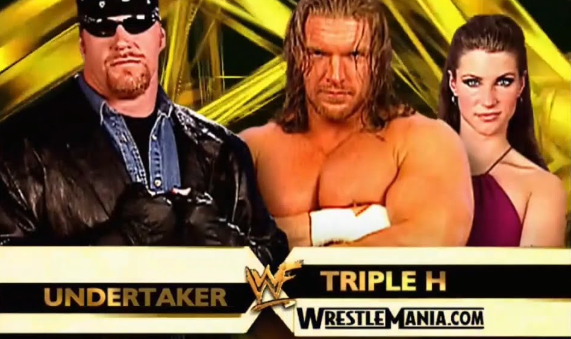
The Date: 1 April 2001 The Venue: Reliant Astrodome; Houston, Texas The Commentary: Jim “J.R.” Ross and Paul Heyman The Referee: Mike Chioda The Stakes: Singles grudge match
The Build-Up: After his 1990 Survivor Series debut, the Undertaker amassed an impressive list of rivalries with some of wrestling’s most talented, and notorious, names in his near-mythical wrestling career. If that wasn’t enough, the Undertaker amassed the greatest winning streak in wrestling history with 21 WrestleManiawins between 1991 and 2013. By WrestleMania X-Seven, one of the most celebratedWrestleMania events of all time, the Undertaker was in the middle of one of his biggest reinventions as the leather-clad motorcyclist “American Bad Ass”. He became embroiled in the battle against Triple H and the McMahon-Helmsley Regime, who had run roughshod over the WWF using their political power. After Triple H finished up is most recent feud with “Stone Cold” Steve Austin, “The Game” touted his superiority and dominance and raised the ire of the Undertaker, whom Triple H had never faced in a pay-per-view singles match before. Immediately, tensions escalated to the point where they were interfering in each other’s matches, using proxies (such as the Undertaker’s brother, Kane, and the Big Show) to attack each other, and Triple H even had the Undertaker arrested after he tried to force his way into his limousine. In retaliation, the Undertaker had Kane hold Triple H’s wife, Stephanie McMahon-Helmsley, hostage to force WWF Commissioner William Regal into sanctioning this one-on-one match on the grandest stage of them all!
The Match: Although many have criticised the Undertaker’s American Bad Ass (or “BikerTaker”) phase, I always enjoyed it. Of course, it helped that I started watching wrestling around the time of the 1999 Royal Rumble, so this was the only version of the Undertaker I knew outside of the videogames, and that I was into heavy metal music and the whole leather aesthetic that was popular at the time. Regardless, I always felt like it was a fantastic reinvention of the character. It allowed the Undertaker to stay relevant in the far more grounded landscape of 2000’s WWF, gave him the chance to showcase more personality and vulnerability, and saw him destroying foes with an absolutely devastating lifting powerbomb known as the Last Ride. At the time, there was no greater, more hated heel than Triple H (well… maybe WWF Chairman Vince McMahon…). He’d not only dominated the main event as the WWF Champion but also been revealed as the mastermind behind Steve Austin’s run-in with a car, though he had definitely been taken down a notch by both Austin and the Rock earlier in the year. The best thing about these two WWF stalwarts was that it made perfect sense to have them face off, even if it was pretty clear that they were playing second fiddle to the more dramatic story revolving around Austin, Rock, and the WWF Championship. The match was bolstered somewhat, however, as Triple H was played to the ring by the legendary Motörhead in a rousing mini rock concert that ensured the Game got his fair share of cheers despite his heinous actions throughout the year. Not to be outdone, the hometown hero, the Undertaker, blasted to the ring on his bike to Limp Bizkit’s “Rollin’”, which, while a good song, still pales in comparison to his original Kid Rock theme. They brawled around at ringside, with Triple H collapsing through a makeshift announcer’s table before being rolled into the ring and J.R. pointing out (maybe for the first time?) that the Undertaker had never lost a WrestleMania match and had amassed an 8-0 winning streak at the show of shows.
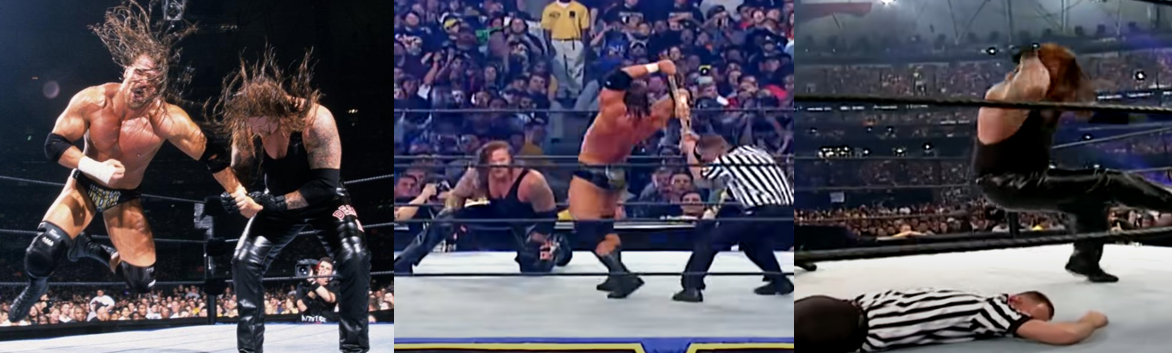
The Undertaker dominated the early and took things to the outside after attacking the referee.
Triple H’s attempt to trade punches with the Undertaker in the ring might have gone badly, but the Game scored a knockdown with his Harley Race-style jumping knee…only for the Undertaker to shrug it off, manhandle Triple H into the corner, and toss him overhead with a back body drop. The Undertaker continued to press his advantage, beating Triple H silly from corner to corner and planting him with a powerslam. Even when he missed an elbow drop, the American Bad Ass came right back with his signature flying clothesline but found himself launched from the top rope when Triple H countered the former Deadman’s “Old School” rope walk strike. Triple H capitalised with a neckbreaker for the first near fall of the match before working over the Undertaker’s forehead (which he had split open with a sledgehammer in the build up to this match) on the ring apron. Frustrated after another slick neckbreaker resulted in a two count, Triple H went for multiple covers and the Undertaker kept kicking out, so the Game started arguing with referee Mike Chioda and then hit his trademark knee smash to shut down the Undertaker’s attempt to fight his way back into the match. Exasperated and sadistic, Triple H harassed the timekeeper and retrieved his trusty sledgehammer, but Chioda snatched it away before he could do any damage with it, only to get sandwiched in the corner when the Undertaker catapulted Triple H out of a Pedigree attempt. This meant that the referee was a little too slow in making the count when ‘Taker covered Triple H off a Chokeslam, so the Undertaker also attacked Chioda and took him out of the match for a ridiculously long time, effectively turning this into a no holds barred brawl for a bit. The Undertaker thus launched Triple H to the outside and tossed him over the barricade and into the crowd for a slugfest through the audience without fear of a count out or a disqualification.
Despite some fun spots, this otherwise standard brawl that was overshadowed by later matches.
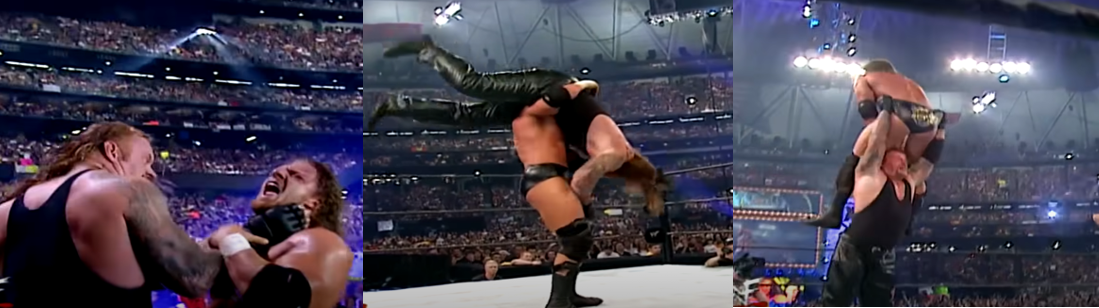
The two battled up to a production area full of monitors and machinery. Here, the Undertaker beat the hell out of Triple H and the Game repeatedly bashed Undertaker’s head and legs with a steel chair. However, the Undertaker dramatically Chokeslammed Triple H over the railing to the concrete below and followed up with a diving elbow drop, an effect sadly ruined by an unfortunate camera angle that clearly showed the crashmat the two guys landed on (still a hell of a bump, though). The Undertaker fended off the doctors and beat Triple H through the raucous Houston crowd before tossing him unceremoniously back into the ring. With Triple H battered and helpless at his feet, the Undertaker grabbed the sledgehammer and prepared to get himself a little payback but got kicked right in the dick instead! Still, the Undertaker avoided taking a shot from the hammer by booting Triple H in the face and the two just exchanged haymakers instead. To try and one-up his opponent, Triple H tried to hit the Tombstone Piledriver, but the Undertaker impressively pivoted out and reversed it into a Tombstone of his own, but Mike Chioda was still out like a light, so it was all for nought. Although Triple H countered the Last Ride with a sledgehammer shot to the Undertaker’s head, it still wasn’t enough to keep the American Bad Ass down for the three count. Incensed, Triple H furiously attacked the Undertaker’s bleeding forehead. He was so desperate to bust ‘Taker open further that he clambered up the ropes for the ol’ ten punches and left himself in prime position for an absolutely devastating Last Ride right out of the corner! The Undertaker dropped to the mat, the referee made the count, and the match ended with another victory for the legendary icon, bringing his winning streak to 9-0. This was an okay match, but nothing really special apart from the brief detour out of the ring and even that was sullied by one of the longest ref bumps I’ve ever seen. Most of the match was a slugfest, which is always a little disappointing as both men are capable of so much more, but it definitely had a big-match feel and spectacle to it. I think it might’ve helped to have the sledgehammer come into play a little more and to have Triple H properly target a body part rather than just getting dominated and begging off, but the biased crowd was super into the whole thing and it was fun enough, though it’s obviously overshadowed by their later WrestleMania bouts.
The Aftermath: So no, this wasn’t the last time that the Undertaker and Triple H battled at the Showcase of the Immortals. This match also didn’t put an end to the rivalry between the two men. The main event of WrestleMania X-Seven saw Steve Austin shock the world by joining forces with Vince McMahon and, the next night on Raw, Triple H shockingly formed the “Two-Man Power Trip” with his hated rival. Triple H captured the Intercontinental Championship and the heinous heel tandem delighted in tormented Matt and Jeff, the Hardy Boyz, and their companion, Lita. Since the Two-Man Power Trip boasted about being the most dominating duo in the WWF, the Undertaker and Kane quickly stepped up to oppose them. However, although the Brothers of Destruction captured the WWF Tag Team Championships, Kane got his arm broken by the Two-Man Power Trip, which was a deciding factor in the brothers losing the belts to Austin and Triple H at Backlash the month after WrestleMania X-Seven. Unfortunately, Austin and Triple H’s run with all the gold and all the power was cut short when Triple H tore his quadricep muscle in a tag team match, a horrific injury that side-lined him for most of 2001. When Triple H returned, it was to triumphant cheers; for the first time in years, Triple H was lauded as a hero while the Undertaker was in the midst of a heel run beating the respect out of people. It wouldn’t be long before the two clashed again as the Undertaker defeated Triple H for the Undisputed Championship at the 2002 King of the Ring, though their in-ring encounters did noticeably lessen for a few years after this thanks to the first brand extension.
My Rating:
⭐⭐⭐
Rating: 3 out of 5.
Pretty Good
What did you think to the Undertaker and Triple H’s first WrestleMania match? How would you rate it against their other WrestleMania matches? Were you a fan of the American Bad Ass gimmick or did you think it was unsuitable for the Undertaker? What did you think to the Chokeslam off the equipment area and did the referee bump also confuse you? How are you celebrating the Undertaker’s debut this year, what are some of your favourite matches and moments from his long and distinguished career, and what dream match would you have liked to see him involved in? Whatever your thoughts, drop a comment below and be sure to check out my reviews of other Undertaker matches across the site!
The Date: 21 January 2001 The Venue: New Orleans Arena; New Orleans, Louisiana The Commentary: Jim “J.R.” Ross and Jerry “The King” Lawler The Stipulation: Thirty man over the top rope battle royale for a WWF Championship opportunity at WrestleMania Notable Competitors: “Stone Cold” Steve Austin (Winner), Jeff Hardy (#1), Rikishi (#30), Kane (Most Eliminations), and Drew Carey (Celebrity Competitor)
The Build-Up: Since 1988, World Wrestling Entertainment (WWE) has brought fans Royal Rumble. The brainchild of the legendary Pat Patterson soon evolved into one of the most exciting events of the year as the winner of the titular over-the-top-rope battle royale would go on to challenge for the World Heavyweight Championship at WrestleMania. Following arguably their best ever year of business in 2000, which had seen the rise of new stars like “Y2J” Chris Jericho and Kurt Angle, the coronation of The Rock as then-World Wrestling Federation (WWF) Champion, and the return of white-hot competitors like Steve Austin and the Undertaker, the WWF took a commanding lead in the ratings war that would see them dominate the industry and anticipation was high for upcoming WrestleMania X-Seven. Heading into the event, five competitors were spotlighted as the odds-on favourites to win: the aforementioned Steve Austin (who had made a dramatic return after being away from the ring for over a year), The Rock (who had recently lost the WWF Championship to Kurt Angle), the Undertaker (simply because of his legendary status), Kane (primarily because of his recent momentum), and the newly-evil Rikishi, who had adopted a mean streak and be propelled into a questionable main event run after it was revealed he helped injure Austin and who had earned the right to enter the match last. The big question heading into the event was whether Kane and the Undertaker were in cahoots; although they’d fought earlier in the year, they had seemingly reforged their alliance in the weeks leading up to the Royal Rumble, and whether WWF Chairman Vince McMahon was seriously going to let comedian Drew Carey put his life on the line by competing in the match!
The Match: This was peak WWF for me; I was finally able to watch WWF programming thanks to a deal they struck with Channel 4, meaning I was actually able to tape and watch this Royal Rumble event on Sunday night. I was really into everything that was happening at the time, especially the on-again, off-again issues between Kane and the Undertaker, Austins big return, and The Rock’s toppling of Triple H and the McMahon-Helmsley regime. It seemed as though everything the WWF produced was a guaranteed win at the time, with new stars, blockbuster main events, and stellar in-ring action and drama captivating audiences, especially me, and it’s largely because of this time (and this, my first real Royal Rumble match) that I became a life-long fan of wrestling. The match began with Jeff Hardy, one half of the high-flying Hardy Boyz who had electrified audiences with their death-defying antics, taking on Bull Buchanan, the stern-faced muscle of the infamous Right to Censor group, who were universally hated for their grating siren music and for opposing violent and risqué content. Although Jeff valiantly tried to topple and outpace the bruiser, Buchanan’s power and surprising agility saw Jeff taking quite a beating until, conveniently, he was joined in the ring by his brother, Matt. The two immediately teamed up to dump Buchanan over the top rope and then, after a respectful fist bump, began going at it (though, as The King rightly pointed out, it would’ve made more sense for them to work together until the end of the match). After a short exhibition between the two, they paused their fight to intercept Faarooq, one half of the Acolytes Protection Agency (APA), who picked up where Buchanan left off with the power game and very nearly tossed out Jeff before falling victim to a Twist of Fate/Swanton Bomb combination and being thrown out of the ring. The Hardyz celebrated by stripping off their shirts (much to the delight of the audience) and going at it again until the fastest two minutes went by and Drew Carey sauntered out, tracksuit and all, slapping hands with the fans as Matt and Jeff took each other out of the match.
Kane was the undeniable highlight, featuring in comedy spots and dominating the in-ring action.
Basking in the adulation of the crowd, Drew’s jovial demeanour was immediately quashed when Kane came to the ring; barely able to continue his excitement, Drew hilariously tried to buy Kane off but promptly eliminated himself from the match after Raven rushed the ring and attacked Kane, sparing the comedian from taking a Chokeslam. Raven came equipped with a kendo stick, kicking off an entertaining impromptu hardcore match as the competitors started bashing each other with plunder and weapons in keeping with the madcap hardcore division. Raven quickly realised he needed these weapons to withstand Kane’s power, blasting him in the face with a fire extinguisher before being attacked by Al Snow, who jumped to gun to extract a measure of revenge against Raven for taking him out of action a few weeks previous. Al Snow went to town, smashing both men with a bin lid and rolling a bowling ball right into Raven’s crotch! Al Snow and Raven soon set aside their differences to keep Kane at bay with metal bins Perry Saturn joined the fight, targeting Kane’s leg, and the competitors ganged up on the Big Red Machine to beat him to the canvas. The hardcore fun continued as the “Lethal Weapon” Steve Blackman rushed the ring with his escrima sticks, attacking everyone in sight, and Grand Master Sexay danced his way into the match. However, Kane got so pissed off with everyone going after him that he went on a rampage and smashed everyone with a bin, clearing the ring in seconds in impressive fashion, only to be met by the Honky Tonk Man! The self-proclaimed greatest Intercontinental Champion of all time cut a promo in the ring and started signing his song, but Kane was having none of it; he bludgeoned the Honkey Tonk Man with his own guitar and tossed him from the ring with a shake of his head for another memorable comedy spot. Things really started to get serious when The Rock rushed the ring and went right for Kane; however, despite the unanimous crowd support and a flurry of strikes, The Rock was quickly overpowered by Kane, who pressed his advantage after taking a quick breather while The Rock made short work of Buchanan’s Right to Censor teammate, the Goodfather. Every time The Rock tried to build some momentum, Kane shut him down; even Tazz racing to the ring was of little consequence as Kane unceremoniously eliminated him within seconds!
Things slowed in the middle until the Big Show and the Undertaker spiced things up with their power.
Kane’s attempt to eliminate The Rock saw the People’s Champion finally start to mount a comeback, but both men were down when Bradshaw (also of the APA) entered the match, allowing the brawler to take immediate advantage. The Rock joined Bradshaw in working over Kane, but Bradshaw ended the alliance in emphatic fashion almost as quickly, flooring The Rock with a clothesline, which in turn earned him a Spinebuster in retaliation which allowed Kane to return to a dominating position. Albert, formally of the tag team T&A, then joined the fight, adding more meat to the match; Kane and Bradshaw briefly teamed up to know the big man down as the match slowed down a little for some brief elimination spots and clubbing offense. Hardcore Holly was out next and joined the lower-carders in trying to eliminate their main event competition; The Rock was able to hold on to the bottom rope but Kane was downed by Albert’s impressive bicycle kick, which very nearly was enough to see him eliminated. K-Kwik was out next and immediately got on the wrong side of Albert; the Right to Censor’s Val Venis hit the ring, followed by the European Champion, William Regal, and Albert’s former tag team partner, Test, to really pad out the middle portion of the match with a lot of rope-hugging, stomping, and miscellaneous grappling in the corners. Test tossed out Regal before going after Albert and then targeting Kane and The Rock continued to find himself absorbing punishment or in a precarious situation despite all his pre-match talk of dominating the match. Things finally got interesting when the Big Show made a dramatic return to th company after an extended absence; the Big Show made his presence known by wrecking everyone with huge Chokeslams before tumbling out of the match courtesy of The Rock. Enraged, the Big Show pulled The Rock under the ropes and sent him crashing through the announce table, effectively eliminating The Rock from the match for some time. Crash Holly entered the ring and the remaining competitors ganged up on Kane once more but he was saved by his brother, the Undertaker, who rode down on his motorcycle and officially solidified his rekindled alliance with Kane by fending off his attackers. The reunited Brothers of Destruction then launched every competitor from the ring and teased a fight before being interrupted by poor Scott 2 Hotty! Despite the horror of the fate that awaited him in the ring, Scotty bravely slid through the ropes and was manhandled, planted with a double Chokeslam, and tossed from the ring like he was a piece of trash.
Neither Haku’s return, Triple H’s attack, or Kane’s impressive performance could keep Austin from victory.
The Brothers of Destruction were then denied the chance to put their newfound partnership to the test against Steve Austin as Triple H attacked Austin during his entrance; earlier in the night, Austin had cost Triple H the WWF Championship in his match with Kurt Angle as part of their ongoing rivalry so the slighted Triple H assaulted the Texas Rattlesnake, busting him open and battering him around the aisleway as The Rock returned to the ring to take a beating from Kane and the Undertaker. As referees desperately forced Triple H off Steve Austin’s bloody, battered body, “The One” Billy Gunn hit the ring and the Brothers of Destruction were momentarily scuppered by the returning Haku, who entered to near silence as many (including myself) didn’t know the notorious former Meng. The final entrant, the sour-faced Rikishi, was attacked by Steve Austin, who then stormed the ring and assaulted everyone before Rikishi sent the Deadman tumbling out with his impressive side kick. Rikishi then tried to crush his cousin with his immense ass, but The Rock countered with a low blow and sent the big man out of the match, leaving the final four as The Rock, a bloodied Steve Austin, a heavily fatigued Kane, and, oddly, Billy Gunn. Why Gunn was chosen over the Undertaker or even Rikishi I don’t know but it was a moot point as he was launched from the ring by Austin within seconds so he could have an electric stare down with The Rock. Although The Rock came out on top when they traded blows, he couldn’t hit the Rock Bottom and ate a Stone Cold Stunner, but the People’s Champion was able to recover when Austin got distracted kicking Kane in the balls. A Rock Bottom shut Austin down but, when The Rock tried to heave Austin out, Kane came up from behind and shoved both men from the wring. While it seemed like the Big Red Machine had won, Austin had managed to hold on; although a Chokeslam seemed to do in Austin, Kane got distracted going for the Tombstone Piledriver and got another kick to the balls as a result. Austin then hit the Stunner and absolutely decimated Kane with repeated chair shots to the head, staggering the Big Red Machine and ultimately forcing him from the ring to award Austin his third Royal Rumble win and a first-class ticket to the main event of WrestleMania X-Seven!
The Aftermath: Although the match meandered in the middle, with the ring filling up with disposable bodies, the 2001 Royal Rumble is largely regarded as one of the best of its kind; Kane’s mammoth stint and dominating performance wouldn’t be toppled for some thirteen years and his reward was a fun match at WrestleMania X-Seven that saw him capture the Hardcore Championship and an extended push alongside his brother throughout 2001. Rather than facing Rikishi and Haku at WrestleMania X-Seven alongside his brother, the Undertaker fought and defeated Triple H and went on to become a primary figure in the resulting “Invasion” storyline. Although he didn’t win the Royal Rumble, The Rock found himself in the main event of WrestleMania X-Seven when he recaptured the WWF Championship the following month at No Way Out. In the weeks leading up to their epic second WrestleMania clash, tensions would rise between Austin and The Rock, especially after WWF Chairman made Austin’s wife, Debra, The Rock’s manager. However, no one could have foreseen that Austin would brutalise The Rock and forge an unholy alliance with McMahon at WrestleMania X-Seven to regain the WWF Championship, kickstarting an ill-advised but somewhat entertaining heel turn for the Texas Rattlesnake that saw him become an unhinged egomaniac who turned his back on friend and foe alike during the Invasion storyline.
My Rating:
⭐⭐⭐⭐
Rating: 4 out of 5.
Great Stuff
Did you enjoy the 2001 Royal Rumble match? Do you think it deserves the praise it gets or do you find it a bit dull in the middle portion? Who was your pick to win and what did you think to Kane’s phenomenal performance? Which of the returns did you think was best and did you know who Haku was? What did you think to the hardcore brawl? Were you excited for WrestleMania X-Seven at the time? Who’s your pick to win this year’s Royal Rumble? Whatever you think about the 2001 Royal Rumble, and thematch in general, drop a comment below or on my social media and check out my other wrestling content across the site.
The Date: 26 November 1987 The Venue: Richfield Coliseum; Richfield Township, Ohio The Commentary: Jim “J.R.” Ross and Paul Heyman The Referee: Earl Hebner The Stipulation: Ten-man elimination tag team match to decide the fate of both organisations The Competitors: Team WWF (WCW Champion The Rock, Chris Jericho, The Undertaker, Kane, and The Big Show) and Team Alliance (WWF Champion “Stone Cold” Steve Austin, WWF Hardcore Champion Rob Van Dam, Kurt Angle, Booker T, and WCW Owner Shane McMahon)
The Build-Up: During its many decades as the dominating force in sports entertainment, World Wrestling Entertainment (WWE) has created some of the industry’s most successful competitors, changed the face of pay-per-view entertainment, and delivered genre-defining match types and wrestling cards. In 1987, the then-World Wrestling Federation (WWF) successfully gambled on WrestleMania then, as the National Wrestling Alliance (NWA) was due to broadcast Starrcade over the 1987 Thanksgiving weekend, WWF chairman Vince McMahon strong-armed many cable companies into airing his showcase of ten-man elimination tag team matches, the Survivor Series, or risk losing out on WrestleMania IV. By 2001, some of the WWE’s biggest events had taken place at the event and, this year, it was chosen as the final battle between the WWF and the alliance of World Championship Wrestling (WCW) and Extreme Championship Wrestling (ECW). The WWF and WCW had gone head-to-head in a ratings war since 1996 but, by 2001, WCW faced bankruptcy and, in a shocking moment, the McMahon purchased WCW and the “Monday Night Wars” came to a surprising end. After attempts to keep WCW alive on WWF television fell through, the WWF began a storyline where WCW joined forces with ECW (also now owned by McMahon) and attempted to “invade” the WWF as the “Alliance”. Unfortunately, as many of WCW’s top names sat out their high-paying contracts, the WWF was forced to rely on lesser names and, all too soon, the angle was more about McMahon feuding with his kids, Shane and Stephanie, and the increasingly paranoid Steve Austin holding onto his WWF Championship. More and more WWF guys joined the Alliance, including one-time saviour Kurt Angle, Chris Jericho slowly turned heel in his quest for gold, and even Austin seemed to consider jumping ship as the angle wore on. Eventually, with viewers and audiences turning away from the product, the decision was made to ditch the entire thing with this “Winner Take All” elimination match that would decide which organisation would prevail. Initially, Vince himself was scheduled to compete on Team WWF but he named the Big Show as his replacement and went about sowing the seeds of dissension throughout the Alliance in the lead up to this premature end to what should have been one of the biggest and longest angles in wrestling history.
The Match: Considering I wasn’t really able to watch much wrestling as a kid, let alone truly be a part of the Monday Night Wars, I was deeply invested in the Invasion storyline at the time. I was pissed when Austin turned heel at Invasion and became a paranoid, self-deluded, cowardly asshole who was obsessed with the WWF Championship. Although the Alliance was missing key figures like the New World Order (nWo), Goldberg, and Sting and had dramatically repackaged top WCW stars like Diamond Dallas Page and Booker T into heels, I was well into their attempts to tear down the WWF. Unfortunately, far too many WWF guys jumped ship for no reason, but I’m not here to re-book this angle, I just wanted to say I was into it, delighted to see these fabled WCW and ECW stars on television, and extremely invested for this match. The build-up was quite good; things weren’t all hunky-dory on Team WWF as Jericho had been feuding with the Rock over the WCW World Heavyweight Championship and, to make matters worse, the Alliance won all but two matches on this Survivor Series card, meaning the stakes were further escalated heading in, something Vince was sure to emphasise backstage when he riled up his competitors with a stirring speech. The match kicked off with its two biggest stars, Austin and the Rock, trading blows; the two went at it in the corner but Austin gained the upper hand with a Lou Thesz Press and an elbow drop for the first near fall. Austin pressed his advantage using his knee braces, but the Rock ducked under a clothesline and hit a Lou Thesz Press and a taunting elbow of his own to rapturous applause and a pin attempt that was broken up by Shane. Thanks to Shane’s interference, the Rock was helpless as Austin tagged in Booker T, who had ridiculously been painted as a poor copy of the Rock during the Invasion storyline when, realistically, the two had barely anything in common!
Things got off to a heated start and only escalated as Shane constantly interrupted pin falls!
Booker laid in some chops but got quickly taken down with a big clothesline for a near fall that was again interrupted by Shane, but the Rock was still easily able to tag in Jericho, who lit up Booker with some chops and planted him with a flapjack. Jericho didn’t press his advantage, however, meaning RVD was able to tag in; of all the new faces from this time, RVD was clearly the most dynamic and popular, so much so that even J.R. had to mention it. RVD showcased his athleticism by nipping up, leapfrogging the charging Jericho, and rolling across his back in a beautiful sequence but, not to be outdone, Y2J answered with a lovely spinning heel kick. RVD showed his cunning by holding the ropes and avoiding a dropkick; he followed up with a slick cartwheel moonsault for a two count. However, when RVD backflipped out the corner and went for a hurricanrana, Jericho countered and locked on the Walls of Jericho; once again, Shane put a stop to this, which also allowed Booker T to tag in. However, Booker got cold feet when Kane (sporting a weird alternative version of his bad-ass vest attire) also tagged in and gladly allowed Kurt Angle to take his place. Angle (who had recently made Kane tap out) tried using his speed to avoid Kane’s power but ended up launched into the corner and assaulted by a flurry of strikes; Kane then whipped him to the opposite corner and crashed in with a clothesline and simply sat up after eating a big German Suplex. Stunned, Angle went for the strikes and ended up taking a sidewalk slam and Kane’s huge flying clothesline off the top. Shane again broke up the pin, so Kane tagged in his big brother, the Undertaker, who also manhandled Angle and then switched his attack to Booker when Kurt made a desperate tag.
The Big Show’s brief rampage was shut down by a finish-fest and, naturally, Shane scoring the pin!
The Undertaker easily knocked Booker down with a big boot and scored a big leg drop for another pin attempt that was again interrupted by Shane; J.R. was getting as annoyed as the WWF competitors, the crowd, and me by Shane’s constant meddling. The Undertaker worked over Booker T’s arm and hit his trademark “Old School” rope walk strike and an arm take down that ended in an armlock on the mat. Shane’s interference allowed Booker to not only kick out of a pin but also tag Austin back in; Austin went right at his old foe, stomping a mudhole in the corner as the crowd sang “What? What? What?” over and over in what is still one of the most annoying chants in wrestling. The Undertaker avoided Austin’s running rope attack and then hit another Old School, only for Shane to break up the pin once more; Team WWF was so riled up that the referee had to hold them back, allowing Team Alliance to work the Undertaker over in their corner and bringing Kurt Angle back into the ring. Angle weathered the Undertaker’s assault and hit a neckbreaker for a near fall but fell to a DDT after missing out on a German Suplex. The Undertaker then made the hot tag to the Big Show, who went on a rampage somewhat neutered by J.R.’s observation that the Big Show often makes big dumb mistakes! RVD illegally charged the ring and ate a clothesline and a standing military press for his efforts; the Big Show then smacked up Team Alliance and went for the Chokeslam but Angle was able to fight out and hit the Angle Slam! Booker T followed up with the Scissors Kick and the Spin-A-Roonie before tagging in RVD, who came crashing down with a Five-Star Frog Splash. Shane then tagged in to hit his big top-rope elbow drop and, naturally, got the pin fall to eliminate the biggest man from the match.
Some eliminations were quite lacklustre as it came down to a four-on-two disadvantage for the WWF.
Thankfully, Shane immediately got his comeuppance as the Rock beat the hell out of him and then tagged Kane back in so he could drill Shane with his trademark One-Arm Chokeslam. The Undertaker followed up with a Tombstone Piledriver, and then Jericho finished Shane off with a Lionsault to finally get him out of the match. Jericho and Angle then went at it; although Y2J won the early advantage with a sick butterfly backbreaker, Austin broke up his pin attempt, allowing Angle to take him down and bring Booker T back into the fold. However, after three consecutive scoop slams and an elaborate knee drop, Booker switched with RVD; RVD landed a kicking combination but his corner shoulder thrusts were countered into a near fall off a roll up. Jericho tagged Kane back in; Kane brought the power and even caught RVD’s fist mid-swing and planted him with a powerslam, fought off Booker T’s interference, and shrugged off the Five-Star Frog Splash. However, as Kane readied a One-Arm Chokeslam, Booker T nailed a Harlem Sidekick; as a brawl broke out, RVD caught Kane with a sidekick off the top rope that was somehow enough to score him the three count. This pissed the Undertaker off so much that he beat up the opposition single-handedly; Snake Eyes and the big boot left Angle primed for the Last Ride but a distraction from Booker T allowed Austin to plant the Undertaker with a Stone Cold Stunner and drape Angle’s lifeless form over him for another elimination! Bolstered by their four-on-two advantage, Booker T attacked the Rock once more, scoring with another Harlem Sidekick but almost being pinned off a desperation DDT and a Samoan Drop, with both pin attempts broken up by Austin. Out of nowhere, the Rock then whipped Booker into Angle and anti-climactically eliminated Booker T with a simple roll-up (your five-time WCW Champion, everybody!) RVD took his place and worked the Rock over with some kicks, before a top rope slam bought the Rock the time to tag in Jericho. A flying forearm, shoulder tackle, and a running neckbreaker scored Y2J a near fall; however, although he managed to land on his feet when RVD countered the Lionsault, Jericho couldn’t avoid a spinning kick. RVD then glanced Jericho with the split-legged moonsault (J.R. postulates that Jericho “got a knee up”) and then ate a pin from the God-awful full-nelson faceplant Jericho was trying to get over as a finisher at this time (I believe it was called the Breakdown…) to even the odds. Things broke down into a brawl again but Angle and Jericho soon paired off in the ring while Austin assaulted the Rock on the outside; after wearing Jericho down with a chin lock and some stomps, Angle tagged in Austin, who planted Y2J with a superplex for a two count.
Despite Jericho’s actions, the WWF (and Vince) came out on top thanks to Angle’s last-second assistance.
An awkward miscommunication off an Irish whip eventually saw Austin switch with Angle. However, when Angle went for a German Suplex, Jericho rolled through and briefly applied the Ankle Lock to a massive ovation; although Angle escaped, he was visibly limping when he tagged out. Austin and Angle continuously tagged in and out but Jericho eventually made the hot tag and the match picked up again as the Rock tied Angle in the Sharpshooter; this surprisingly caused an immediate tap out and an aghast Paul Heyman to almost have a coronary! Austin, the last man standing for his team, Austin countered a diving crossbody and traded Walls of Jericho attempts with Y2J. Although he got his knees up to counter a Lionsault, Austin’s top-rope double axehandle didn’t hit and he barely kicked out after Jericho landed a missile dropkick. However, another awkward exchange saw Austin take Jericho out; although Austin and the Rock immediately rekindled their rivalry, Jericho spitefully planted the Rock with the Breakdown, completing his heel turn and earning him the admonishment of the Undertaker. Thankfully, the Rock was still able to kick out; when the Rock tried a comeback, he was launched outside and smashed off the ring post and the steel steps. Back in the ring, Austin’s spinebuster led to the Rock being trapped in a Sharpshooter that had Paul Heyman screaming for a repeat of the Montreal Screwjob; when the Rock reached the ropes, Austin tried to nail him with the WWF Championship and ended up in the Sharpshooter as well! The Rock countered a Stunner with one of his own, but couldn’t capitalise thanks to a low blow and interference from Alliance referee Nick Patrick. Austin took advantage to nail a Rock Bottom and was so incensed when the Rock kicked out that he took it out on Nick Patrick and forced Earl Hebner back into the ring. After the Rock ate a Stone Cold Stunner, the match seemed to be over; however, Kurt Angle suddenly nailed Austin with the WWF Championship! The Rock then hit the Rock Bottom and finally pinned Austin to eliminate him, win the match, and put the Alliance out of business. As the Alliance reacted in anguish and shock, Vince sauntered out to bask in his victory to really hammer home his superiority.
The Aftermath: Considering how overbooked and chaotic this match was, it’s weird that Angle’s last-minute turn always comes across a little flat to me. Vince had hinted that he had tipped the odds in his favour prior to the match but I always felt like the execution was lacking. The next night on Raw, Vince rechristened the WCW Championship the “World Championship” and prepared to reward Angle by stripping Austin of the WWF Championship and giving it to his mole; however, the status quo of the WWF finally returned to normal by the decree of “The Nature Boy” Ric Flair, who returned to the WWF as a part owner after buying Shane and Stephanie’s shares in the company, turning Austin face again and Angle heel. The World Championship situation culminated in a tournament at the next month’s event, Vengeance, which saw Chris Jericho defeat both the Rock and Austin to become the first-ever Undisputed Championship and go on a disastrous main event run that ended with him dethroned by a returning Triple H. Every member of the Alliance eventually became part of regular WWF programming; some won their jobs at Survivor Series, others were quietly repackaged, and some were forced to kiss Vince’s ass on national television. Other WCW names, such as Eric Bischoff, the nWo, and Rey Mysterio, soon joined the company and the bloated roster eventually led to a brand split that also saw the WCW Cruiserweight Championship and United States Championship adopted by the company. Despite his emphatic victory, Vince never passed up an opportunity to reshape history in his favour or bury WCW; while ECW had an anniversary show and even a short-lived and catastrophic revival, WCW was rarely given its due unless it suited Vince’s purposes and has mainly been evoked to maintain the trademark on their pay-per-views and unique match types.
My Rating:
⭐⭐⭐⭐
Rating: 4 out of 5.
Great Stuff
What did you think to this “Winner Take All” elimination match? Did you ever doubt that the WWF would come out on top? Who would you have preferred to see on Team Alliance? Were you annoyed at Jericho’s actions and how easily some guys were eliminated? Did you see Angle’s turn coming or were you expecting a different end to the match? What did you think to the Invasion storyline and how would you have improved it? Would you like to see WCW get more credibility or do you think it’s better off dead? Who were some of your favourite WCW competitors and what would your dream WWF vs. WCW team be? What are some of your favourite Survivor Series matches and moments? Whatever you think about the Survivor Series 2001 main event, feel free to share your thoughts below or leave a comment on my social media.
The Date: 28 June 1998 The Venue: Civic Arena; Pittsburgh, Pennsylvania The Commentary: Jim “J.R.” Ross and Jerry “The King” Lawler The Referee: Tim White The Stakes: Hell in a Cell match between heated rivals
The Build-Up: The Undertaker had been a force of nature within the World Wrestling Federation (WWF) ever since debuting as part of the “Million Dollar Man” Ted DiBiase’s Million Dollar Team on this day at the 1990 Survivor Series. Over the years, the Deadman built up an impressive list of rivalries with some of wrestling’s most talented, and notorious, names, and one of his strangest and most bloodthirsty foes was Mick Foley. Foley, who had made a name for himself as the “King of the Deathmatch” and putting his body on the line in hardcore matches in Extreme Championship Wrestling (ECW) and World Championship Wrestling (WCW) as Cactus Jack, debuted as Mankind on 1 April 1996 and one of his first feuds was against the Undertaker. The two battled in the first-ever Boiler Room Brawl and the Undertaker’s long-time manager, Paul Bearer, even allied with Mankind back in the day, a partnership which was reignited after Kane made his dramatic debut and began targeting his older brother. Mankind became embroiled in the ongoing feud between the Undertaker and Kane, which included an on-again/off-again partnership between the Brothers of Destruction but, with Kane booked to challenge for “Stone Cold” Steve Austin’s WWF Championship at this same event, the Undertaker looked to end to his rivalry with Mankind in the second-ever Hell in a Cell match. The Undertaker had, of course, been involved in the first Hell in a Cell match the previous year; the structure, a wire-mesh cage with a roof and a locked door, was, at the time, regarded as the WWF’s most dangerous match ever and this match went a long way to not only cementing Foley as an absolute madman (whose career was noticeably shortened by this match) but evoking an unrivalled sense of danger surrounding the Hell in a Cell thanks to both men, but particularly Foley, putting their bodies on the line for the sake of our entertainment.
The Match: It has to be said that there wasn’t a massive amount of build-up towards this match; instead, it was more like the WWF had pressed “Play” after pausing the Undertaker/Mankind rivalry for a while, and the main reasoning behind Foley wanting to put the Undertaker through hell was because the Deadman had attacked Paul Bearer, who was managing Kane at the time, who Mankind referred to as “Uncle Paul”. Indeed, even Foley later admitted that a big part of the reason for his ridiculous stunts in this match came because the feud didn’t have much momentum behind it and the Undertaker was currently dealing with a broken foot, so Foley was worried that the match would suffer as a result. This (and the anticipation for the main event) may explain why Mankind entered to next to no reaction from the crowd, but they soon perked up when Foley tossed a steel chair up to the roof and then clambered up the chain link wall to await the arrival of the Undertaker, which perfectly played into the mental instability of the Mankind persona as hyped up by J.R. and The King on commentary. The Undertaker received a far more rapturous response from the crowd upon the sound of his gong alone and, despite his broken foot, followed his rival up to the cell roof.
While the match started on top of the cell, it wasn’t long before Foley was crashing off (and through) the structure!
With the chain link roof buckling under their combined weight, the two exchanged blows and Mankind immediately landed chair shots to the Undertaker’s back. Looking to end his undead opponent early, Mankind prepared to deliver a suplex to the Deadman but the Undertaker fought back with his patented strikes, which knocked Foley loopy, then sent Mankind right off the roof and crashing through the announce table below! J.R.’s response summed up this heinous, absolutely insane spot perfectly: “Good God almighty! Good God almighty! They’ve killed him!” and one look at Foley’s prone body amidst the table debris makes it hard to argue with this statement! The crowd went absolutely bonkers, electrified by the unforeseen moment, and even the Undertaker later admitted that he was certain Foley was dead. If this were to happen in today’s climate, J.R. and The King’s declaration that the match was over would probably be true and this basically stopped the proceedings for about ten minutes as referees, doctors, Vince McMahon, and even hardcore legend (and Foley’s friend and mentor) Terry Funk rushed out to tend to Foley. No matter how many times you watch the replay (and it’s shown again and again to buy the guys time), it never fails to make an impact (literally and figuratively) as Foley’s body plummets right off the top and absolutely decimates the announce table. However, halfway up the entrance ramp, Mankind clambered to his feet, shoved aside the WWF personnel, and scrambled back up to the top of the cell for more! The Undertaker obliged by Chokeslamming Foley through the cell roof! Mankind landed with an almighty thud and had his face smashed by the errant steel chair, which caused a tooth to come out of his nose! This second fall was completely unexpected for everyone involved and, for the second time in the match, Foley was legitimately believed to be dead by everyone present. Terry Funk, Sergeant Slaughter, and WWF referees desperately tried to revive Foley and buy the two time to recuperate; Funk even took a Chokeslam from the Deadman that literally slammed him right out of his shoes(!) to give Foley a couple more seconds to get back in the game and, beyond all expectations, the match continued for about another ten minutes despite Mankind continually crumbling like a sack of potatoes from the Undertaker’s lightest touch. Again, this would never happen today; the match basically gets back on track, with the cage door being locked and the two continuing to fight, despite the fact that Foley is severely concussed and probably has some internal injuries.
The brutality of the match was unlike anything anyone had seen in the WWF before and cemented Foley’s legacy.
J.R. and The King continued to express shock and awe at just how physically tough and reliant Mankind was, and Foley proved to have a little fight left in him as he interrupted the Undertaker’s signature rope walk to send the Deadman crashing crotch-first to the ring ropes and then made himself a meme with his bloodied smile. Staggered, limping, and favouring his ribs, Mankind knocked the Undertaker to the outside but was in too much pain to lift the steel steps. The Undertaker, however, had no such qualms and repeatedly rammed the steel steps into Foley’s arms and headat ringside! Somehow, Mankind dodged the Undertaker’s torpedo dive through the ropes, causing the Deadman to crash head-first into the cell, and then grated the Undertaker’s already lacerated forehead against the chain link wall to really get the crimson flowing. Mankind then hit the Undertaker with a Pulling Piledriver onto the steel chair, but ‘Taker kicked out at two so Mankind delivered a leg drop onto the steel chair after laying it across the Undertaker’s bloodied face, but was again frustrated by a two count. The Undertaker then got dropped by Mankind’s signature Double-Arm DDT and Foley pulled out a bag of thumb tacks(!) and sprinkled them everywhere, much to the commentators’ shock and the crowd’s delight! Mankind delivered shots to the Undertaker’s head, sending the Deadman teetering, only to be shut down by the last reserves of the Undertaker’s strength. Mankind resorted to applying the Mandible Claw to try and cause the Undertaker to black out, which resulted in Foley clambering behind the Deadman and ultimately sealing his fate as the Undertaker staggered to his feet and dropped Mankind, back-first, right onto the thumb tacks! With dozens of the sharp pins sticking into this flesh and tattered clothes, Mankind walked right into a Chokeslam onto the tacks and, finally, mercifully, was put down with a Tombstone Piledriver. For their efforts, the crowd gave both men (but particularly Mick Foley) a standing ovation and filled the area with applause as doctors and WWF officials were finally able to attend to Foley’s battered, bloody body but, in a final show of guts and perseverance, Foley refused to be stretchered out and was instead assisted to the back by Funk and Slaughter to a standing ovation.
The Aftermath: As impossible as it may be to believe considering the horrific abuse they suffered in this match, neither Mankind nor the Undertaker were done on this night; both men ended up interfering in the main event, which saw Kane emerge as the WWF Champion after Steve Austin got busted open, and two months later Mankind was back in a Hell in a Cell match as he faced his former partner one-on-one on an episode of Raw is War. Foley’s injuries in this match were substantial and greatly contributed to the softening of his Mankind character, who eventually became a loveable goofball and enjoyed a successful tag team run alongside The Rock before Foley was given the company’s biggest prize and, eventually, made plans for his in-ring retirement. As for the Undertaker, he shifted into the main event picture soon after, forming an alliance with Kane and targeting Steve Austin and the WWF Championship before eventually getting back into it with his brother. This wouldn’t be the last time the Undertaker and Mankind met in the ring, either; they fought on Raw is War two nights later, battled over the WWF Tag Team Championships, and were included in multi-man championship (or contender) matches throughout 1998 and 1999. While Foley would later end his lengthy and storied career in another Hell in a Cell match, this particular contest would be one of the defining moments of his career; while the actual in-ring work was somewhat pedestrian, the match impressed on sheer spectacle alone and has been evoked (for better or worse) in video packages, hype for the brutality of the match concept, and in subsequent Hell in a Cell matches.
My Rating:
⭐⭐⭐⭐
Rating: 4 out of 5.
Great Stuff
What did you think to the battle between Mankind and the Undertaker in Hell in a Cell? How would you rate it against their othermatches and against Hell in a Cell contests? What was your reaction when Mankind went sailing off the top of the cage? Do you think the match should have ended right there, or after Foley’s second fall? How are you celebrating the Undertaker’s debut this year, what are some of your favourite matches and moments from his long and distinguished career, and what dream match would you have liked to see him involved in? Whatever your thoughts, drop a comment below and or let me know what you think about the Undertaker on my social media.
The Date: 24 January 1988 The Venue: Copps Coliseum; Hamilton, Ontario, Canada The Commentary: Vince McMahon and Jesse “The Body” Ventura The Stipulation: Twenty man over the top rope battle royale Notable Competitors: “Hacksaw” Jim Duggan (Winner), Bret “Hitman” Hart (#1), The Junkyard Dog (#20), and The One Man Gang (Most Eliminations)
The Build-Up: Considering how dominating the World Wrestling Entertainment (WWE) has been in the industry, it should be no surprise that the company has been at the forefront of creativity; from their celebrated Superstars, impact on pay-per-view entertainment, to the creation of genre-defining match types. By 1988, the World Wrestling Federation (WWF, as it was known then) had already stepped into the mainstream after taking a massive gamble with their inaugural WrestleMania event and added the annual Survivor Seriesevent to their calendar. To see in the new year, WWF chairman Vince McMahon produced the first edition of another annual event, the Royal Rumble, which was headlined by the titular over-the-top-rope battle royale. The match concept was the creation of the legendary Pat Patterson and has since become a trademark event of the organisation, with winners now going on to challenge for the World Heavyweight Championship at WrestleMania, though this aspect wouldn’t be introduced until the 1993 event. After trialling the concept at an untelevised house show, which was won by the Junkyard Dog, there was little rhyme or reason for the match’s debut beyond producing another pay-per-view and showcasing a bunch of WWF’s superstars in one big brawl and, as such, no real storylines leading into the titular match.
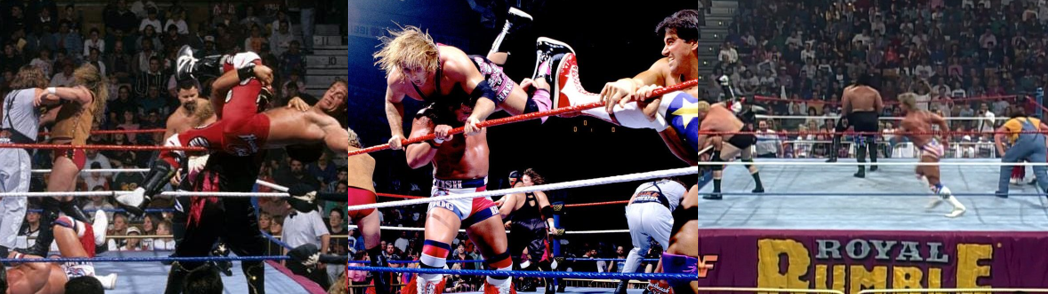
The Match: Generally speaking, I quite enjoy a good Royal Rumble match; it’s a great excuse to debut or bring back wrestlers and can be a lot of fun with the right people in there. They can be difficult to book, however, and often the middle part can get bogged down with tag teams of B- or even C-list lower-card wrestlers who no one’s ever going to believe will win the match. For me, winning the Royal Rumble should be an accolade reserved for the company’s biggest star, preferably their biggest fan favourite; the event itself marks the first step on the Road to WrestleMania and should therefore represent a significant step up in quality. That’s not always the case, of course, and sometimes it feels like the event just takes place because it’s January and that’s what’s supposed to happen. Consequently, I was intrigued to go back to the Rock ‘n’ Wrestling era and see what the inaugural Royal Rumble was like considering this period of wrestling can be a bit hit and miss in terms of match and wrestler quality and that the event didn’t have the WrestleMania stipulation tied to it. Legendary ring announcer Howard Finkel ran down the rules of the match (competitors enter the ring in two minute intervals, are eliminated after being thrown over the top rope, and the last man standing is the winner) while Bret Hart and Tito Santana were in the ring, who were introduced as though it was a one-on-one match rather than simply running to the ring and getting into it like these days.
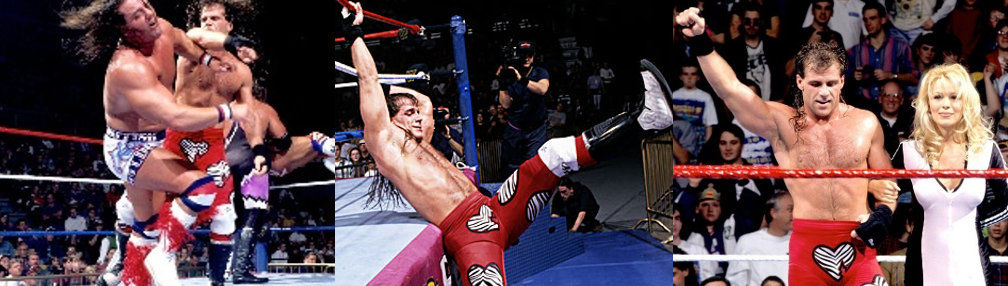
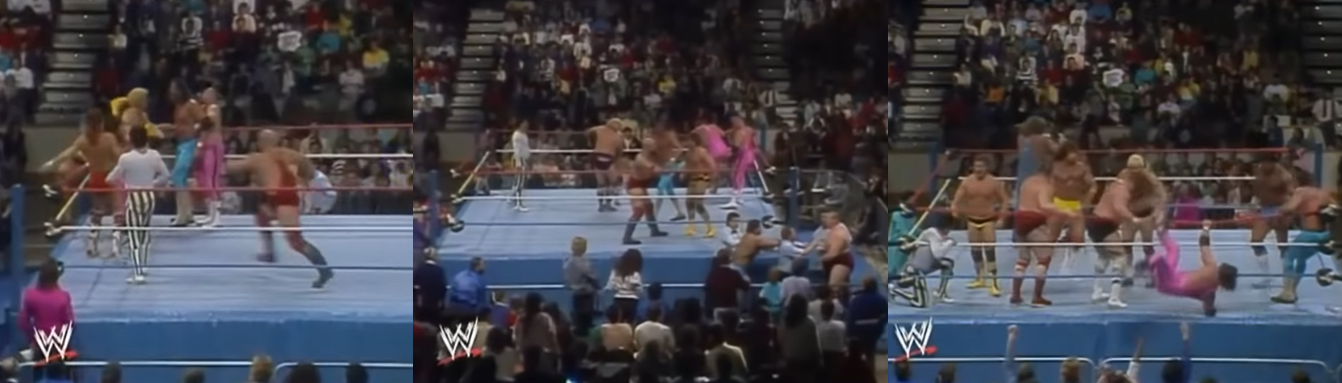
Bret, Neidhart, Santana, and the Snake all got the match off to a pretty hot start.
Additionally, when the bell rang, the two went at it like it was a single match, pulling off actual wrestling moves as though wearing each other down for the pin fall rather than trying to heave each other over the ropes. Butch Reed came in at number three and initially targeted Bret before teaming up with him to put a beating on Santana; at least, until Butch accidentally nailed Bret. Luckily for him, fellow Hart Foundation member Jim “The Anvil” Neidhart came in next and the three of them desperately tried to force Santana out of the ring but he maintained a death grip on the ropes and refused to go over. Thankfully, Jake “The Snake” Roberts came out at number five to even the odds, dumping Butch for the first elimination of the match and attacking both Bret and Neidhart with a flurry of punches to the absolute delight of the crowd. Neidhart was able to interrupt a double DDT attempt on Bret by Jake and Santana and the former took the brunt of the Hart Foundation’s retribution thanks to a jumping piledriver from Bret. Harley Race was in next and also got in on the action against Jake, dropping a couple of elbows while Neidhart held the Snake helpless on the mat. Jim Brunzell was out next as Neidhart sold a beard pull from Jake (!); things slowed down a little as the guys tried to heff their opponents out of the ring but picked up considerably when Sam Houston sprinted to the ring and went right for the Hart Foundation but, unfortunately, Santana’s time in the match came to an end with the boys in pink tossing him out.
Things slowed and became less exciting as the ring filled up, despite Bret’s stand-out performance.
The ring really started to fill up as Danny Davis and Boris Zhukov came to the ring; slow, plodding, confused offense was the order of the day here as guys half-heartedly went at it in the corner, against the ropes, or wandered around aimlessly trying to catch their breath. There was a bit of excitement as Don “The Rock” Muraco and Nikolai Volkoff argued at ringside over the number eleven spot; Muraco simply nailed Volkoff and took to the ring to attack the Hart Foundation and, by the time Volkoff was allowed into the ring, his tag team partner, Zhukov, had been muscled out by Jake and Brunzell. Harley Race was next to be dumped and, as he was leaving and the others paired off again, the crowd exploded to life when “Hacksaw” Jim Duggan came to the ring (carrying his trademark 2×4) at number thirteen, having a brief altercation with Race along the way. More miscellaneous brawling, striking, and grappling in the corners and against the ropes followed, however, and the excitement took a nosedive as Ron Bass lumbered to the ring. Brunzell was thrown out shortly after thanks to Volkoff. B. Brian Blair, Hillbilly Jim, and Dino Bravo all joined the fray and, in the process, both Neidhart and Houston were sent packing, with the latter being muscled out by Ron Bass. The Ultimate Warrior raced to the ring and immediately started throwing chops and, in the chaos, Muraco was able to toss Bret from the ring, ending his run at almost twenty-six minutes.
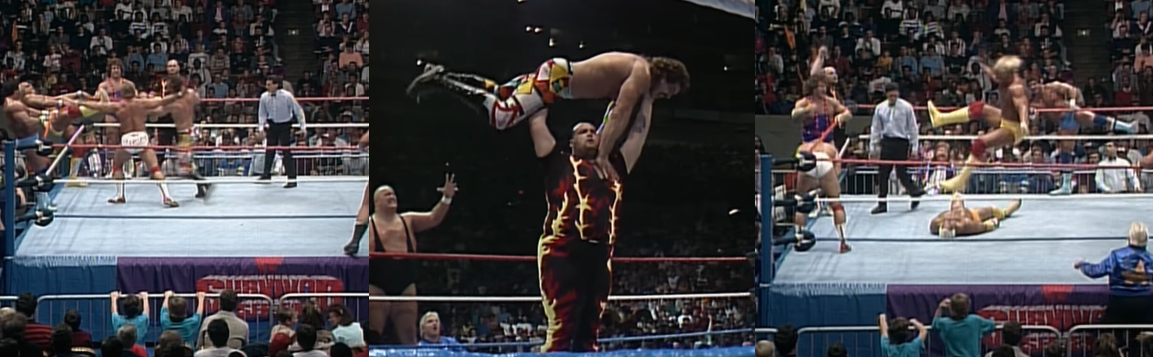
In the end, Duggan outsmarted the One Man Gang to win the first ever Royal Rumble.
Again, the action slowed down and only got slowed as the One Man Gang plodded his way to the ring; the big man made an immediate impression, however, by tossing out not just Blair but also Jake Roberts with a surprising and disappointing amount of ease. The final entrant in his twenty man version of the match was the Junkyard Dog; shortly after he got into the ring, Volkoff was tossed and then the One Man Gang struck again by getting rid of Hillbilly Jim while Bravo took out the Ultimate Warrior with no fuss or fanfare. The Junkyard Dog didn’t last too long either before he was taken out by Bass, who was himself eliminated by Muraco, meaning the final four were Muraco, Duggan, Bravo, and the One Man Gang, an odd selection considering the likes of Bret Hart, Jake Roberts, and the Ultimate Warrior had been in the match. The Rock and the Gang squared off while Bravo and Duggan fought on the other side of the ring; Brave and the One Man Gang worked together to attack both men, with Muraco desperately using his speed to hold them off but a distraction from Frenchy Martin saw him on the back foot and then nudged over the top rope from a weak-ass One Man Gang clothesline that looked as though it would miss and/or take Bravo out as well, but it didn’t. Left alone in a two-on-one situation, Duggan fought back valiantly but looked to be overwhelmed following a double clothesline; however, as he was held helplessly by Brave, he managed to slip away and cause the One Man Gang to accidentally take out Bravo at the last second. Duggan and the One Man Gang brawled for a bit, with Duggan taking a beating against the ropes but, in the end, brains got the better of brawn as Duggan ducked and yanked on the ring ropes as One Man Gang charged him, sending the big man spilled to the outside and becoming the first-ever Royal Rumble winner to an explosive reaction. It may seem like an odd choice to have Hacksaw win the Royal Rumble considering some of the star power featured in the match, but the crowd were absolutely into his win and it’s not like he ended up headlining WrestleMania for winning so it was just a nice feather in the enthusiastic big man’s cap.
The Aftermath: The main story heading into The Main Event that came out of this event was the WWF Championship rematch between Hulk Hogan and André the Giant but there was some fallout for Duggan following his big win. He and the One Man Gang went at it in a singles match at the same event, with Duggan coming out on top, though he ended up battling Bad News Brown to a double disqualification by the time WrestleMania V rolled around later that year. The Royal Rumble event ended up setting a record as the highest-viewed wrestling program on cable television and would go on to become a yearly event for the company; by the next year, the match was expanded to include the now traditional thirty men and, by 1993, the WrestleMania championship shot had been added and the match has since become one of the WWE’s most anticipated annual events.
My Rating:
⭐⭐
Rating: 2 out of 5.
Could Be Better
What did you think to the inaugural Royal Rumble match? Did you like that Hacksaw Jim Duggan won the match or would you have liked to see someone else take the win? Which of the competitors was your favourite? Were there any competitors you would’ve liked to see included? What’s your favourite Royal Rumble match? Whatever your thoughts on the Royal Rumble, share them below or leave a comment on my social media.
The Date: 18 November 2001 The Venue: Greensboro Coliseum Complex; Greensboro, North Carolina The Commentary: Gorilla Monsoon and Jesse “The Body” Ventura The Referee: Joey Marella The Stipulation: Ten-man elimination tag team match The Competitors: Team Hogan (WWF Champion Hulk Hogan, Bam Bam Bigelow, Don “The Rock” Muraco, Ken Patera, and “Mr. Wonderful” Paul Orndorff), Team André (André the Giant, “The Natural” Butch Reed, King Kong Bundy, One Man Gang, and “Ravishing” Rick Rude)
The Build-Up: Over its many decades as the dominating force in sports entertainment, World Wrestling Entertainment (WWE) has been known for creating some of the industry’s most successful competitors, changing the face of pay-per-view entertainment, and delivering genre-defining match types and wrestling cards. In 1987, the World Wrestling Federation (WWF, as it was known then) had taken their first step towards global domination with the successful gamble that was WrestleMania, a pay-per-view showcase of their greatest talent that brought the organisation into the mainstream with celebrity cameos. With the National Wrestling Alliance (NWA) due to broadcast their Starrcade event over the Thanksgiving weekend, WWF chairman Vince McMahon add the Survivor Series event to the WWF’s calendar and strong-armed many cable companies into showing his event instead of Starrcade or risk losing out on WrestleMania IV. The entire event was comprised of four ten-man elimination tag team matches, with the main event pitting WWF Champion Hulk Hogan and his team against bitter rival André the Giant and his team of bad guys (or “heels”). The motivation behind the two forming teams and squaring off came from André’s heel turn earlier that year, which saw him memorably challenge the Hulkster at WrestleMania III only to be planted with an iconic body slam. Since André was managed by one of wrestling’s greatest heel managers, Bobby “The Brain” Heenan, it made sense for him to ally with Heenan’s smorgasbord of man-mountain wrestlers, though Hogan wasn’t short on allies either, with the recently debuting Bam Bam Bigelow and the now-righteous (or “babyface”) Ken Patera joining Hogan’s team to get some payback against Heenan and his goons.
The Match: Honestly, I’ve had an on-again, off-again relationship with the Survivor Series over my many years as a wrestling fan. When there’s an actual storyline behind it and the teams make sense, it can be a fun concept but, often, the WWE cobble together teams just because the event is coming up and they even stupidly diluted the concept by having a separate Bragging Rights event that really should’ve just been merged with the traditional Survivor Series card. The WWE fluctuates its focus on tag teams at the best of times and large teams (or “stables”) of wrestlers are difficult to come by in the modern WWE landscape, which can make justifying a ten-man elimination match difficult. However, when it works and is used sparingly, it can be a unique concept and, from what I can tell from my research, it made sense to form these two massive teams and extend the Hogan/André rivalry in a way that both protected the latter, whose health was deteriorating rapidly at this point, and build anticipation for their inevitable rematch for the WWF Championship. The match began with Heenan in the ring giving a special introduction to the “Eighth Wonder of the World”, who lumbered to the ring and greeted his teammates. Jesse Venture raised the question of whether Hulk Hogan could truly trust Paul Orndorff who, until recently had been more of a heel, teasing the potential for dissention within Hogan’s team but, when interviewed by “Mean” Gene Okerlund backstage, Team Hogan seemed incredibly fired up for the match. Each man made his way to the ring to an ever-increasing rapture from the crowd, which exploded into a crescendo as the Hulkster came down the aisle way carrying Ol’ Glory, his focus squarely on André (and playing to the audience).
Although Rick Rude took the brunt of the early assault, it was Butch Reed who was the first to be eliminated.
Don Muraco and Rick Rude started the match for their respective teams, with the two exchanging blows in the corner before Rude took advantage with an eye rake. A boot to the gut cut off Rude’s attack, however, and Rude tagged in Paul Orndorff, who came off the top rope with an elbow strike. A shot to the gut and a knee strike saw Rude on the receiving end of more offense before Orndorff rammed him head-first into Hogan’s boot and tagged in the champion. Hogan planted Rude with a clothesline and then dropped three elbows in quick succession before tagging in Bam Bam Bigelow, slamming Rude and setting him up for a big body splash from Bigelow, which he followed with a military press before tagging in Ken Patera. Although Patera attacked right away, Rude was able to collapse in his corner, finally allowing another heel, Butch Reed, to get in the ring. Reed didn’t fare too well, however, easily being taken down and rolled up into the first pin attempt of the match and falling afoul of a dropkick courtesy of Don Muraco. Orndorff then showed up his teammate by tagging in and delivering two dropkicks of his own and even getting a cheap shot in on King Kong Bundy before dodging a Reed elbow shot in the corner and bringing the Hulkster back into the match for a double clothesline. Hogan then hit the Atomic Leg Drop and Reed was eliminated without even throwing a single punch; Hogan was spared from tangling with André after tagging in Patera during his celebration. Since André only wanted Hogan, though, he immediately tagged in Bundy to face the Olympian.
Thanks to eye rakes and cheap tactics, the heels scored two eliminations in quick succession.
Patera went on the attack right away, even downing Bundy with a clothesline, but he was too slow to keep the One Man Gang from tagging in to lock up with Orndorff. One Man Gang initially, very briefly, actually got to show some offense but Orndorff fired back with a slew of punches that rocked the big man; a counter in the corner shut Orndorff down, however, and allowed Rude to come back in and start working him over…until Orndorff scored with a clothesline, a body slam, and an elbow drop for a two count. Muraco came back in to hit a stiff clothesline but a thumb to the eye allowed Rude to create some separation and tag in the One Many Gang but Muraco was able to avoid a corner charge, roll over to his corner, and tag in Patera, who survived another eye rake to hit an awkward running crossbody for another near fall. Although Patera hit a running knee to the corner, another thumb to the eye allowed the One Man Gang to put a beating on the Olympian in the heel corner with the assistance of his teammates. A standing front facelock slowed the match to a crawl and then the One Man Gang managed to pin Patera for the three count following an awkward “double clothesline” for an anti-climactic elimination. Hogan immediately went after the One Man Gang, throwing hands, rushing him into a corner, and then bringing in Bam Bam Bigelow for a double Big Boot. Whatever momentum Bam Bam had built up went right out the window, however, when the two big men clumsily bumped heads off a double shoulder block, which saw Rude and Orndorff go at it again. Orndorff panted Rude with a suplex, another elbow drop, and a flapjack before Bundy ran in to interrupt a piledriver attempt; this was enough for Rude to score a roll up with a handful of tights to eliminate Mr. Wonderful from the match.
After twenty-five minutes of plodding action, Hogan and André finally squared off once more.
Rude made the mistake of flexing to rile up the crowd, meaning Muraco planted him with an atomic drop and a clothesline before bringing in Bam Bam to deliver a big side kick. A big suplex set Rude up for a rare running knee strike from Hogan, who then brought Muraco in for a powerslam and that was enough to take Rude out of the match and even the odds at three-on-three. Bundy came in and started beating on Muraco, downing him with a back elbow smash, but he missed a running knee strike; Muraco targeted Bundy’s leg with a series of attacks but Bundy was able to fight him off and bring the One Man Gang back in. The Rock’s attempts to fight off the One Man Gang saw him crushed under the big man’s weight; he was able to kick out at two, however, so the One Man Gang threw him into an inelegant headbutt from André which, when coupled with a body splash, was enough to eliminate the Rock. The One Man Gang switched his focus to Bam Bam Bigelow, crushing his chest when he went for a sunset flip pin and bringing in Bundy to hit a powerful clothesline that turned Bam Bam inside out. Hogan broke up the pin attempt but Bundy stayed in control and brought the One Man Gang back in, who shut down Bam Bam’s counterattack with, what else, but a thumb to the eye before choking him on the ring ropes. Bundy came back in for a knee to the gut and a double axehandle smash before quickly tagging the One Man Gang back in. A back elbow caught Bam Bam right in the eye and Hogan, and the crowd, were absolutely desperate for the big man to make the tag as Bundy came back for some more punishment. Bam Bam managed to avoid the elbow drop, and kick out of a pin attempt, and finally made the tag after rolling to the corner and avoiding a big chop from André. Hogan attacked his rival with a flurry of punches; they exchanged strikes and chops in the corner before Hogan slamming André’s face into the top turnbuckle, but his offense was interrupted when Bundy pulled him from the ring.
Bam Bam fought valiantly but ultimately fell, leading to Hogan to attack André after the match.
The two brawled at ringside, with Hogan slamming both Bundy and the One Man Gang on the outside, but he took so long messing about with the two that he got counted out! The crowd was incensed as Hogan was forced from the ring, leaving Bam Bam all alone in a three-on-one situation, much to Hogan’s disgust. Showing no fear, Bam Bam went right for Bundy, planting him with a clothesline and scoring a two count off an elbow drop and a falling headbutt. After dodging a Bundy charge in the corner, Bam Bam finally eliminated the big man with an impressive slingshot splash from the ring apron but he was too fatigued to fend off the One Man Gang, who immediately choked and beat him on the ropes. Still, Bam Bam easily kicked out of a clothesline (that looked to give the One Man Gang a heart attack) and had the wherewithal to dodge a splash off the top rope. This one mistake cost the One Man Gang and meant the match boiled down to Bam Bam and the lumbering André, who wasted no time smacking Bam Bam around with big chops and headbutts. Bam Bam used the ropes and his comparative quickness to avoid André’s plodding attacks but a missed splash in the corner saw him taking some shoulder blocks to the spine and being easily pinned following a half-underhook, facelock slam…suplex…thing. As André was announced the winner, Hogan stormed the ring and attacked the Giant with the WWF Championship, stealing the spotlight and entertaining the raucous crowd with his trademark flexing while André seethed on the outside. I don’t really like to rag on this era of wrestling too much; things were obviously very different back then, but this was a bit of a let-down considering some of the star power and storylines featured in it. Obviously, André couldn’t really do a lot and needed to be protected but we barely got to see him and Hogan go at it again, much less really see the Giant in any kind of action. It works on the one hand to show him as this unbeatable “final boss” but…we know he can be beaten as we saw Hogan pin him at WrestleMania III so I think I would’ve preferred to see him and Hogan as the final two and them brawl to a double count out. Interestingly, this ended up primarily being a showcase for Bam Bam; he was the last man on Team Hogan and impressed the most with his athleticism for such a big man but, on the flip side, there was way too much boring, plodding offense from the One Man Gang and King Kong Bundy was barely a factor in it as well. As a first go-around for the concept, the WWF definitely put some of their biggest names into it but it’s clear a lot of them were limited in their mobility and having Hogan get counted out only to run in for the cheap heat at the end made this a pretty mediocre affair.
The Aftermath: Naturally, the issues between Hulk Hogan and André the Giant continued to be a focal point of the WWF’s programming; André joined forces with “The Million Dollar Man” Ted DiBiase and the two continued to harass Hogan until he agreed to another championship match at The Main Event. This time, André came out on top, though he immediately sold the belt to DiBiase at it was subsequently held up for grabs in a tournament at WrestleMania IV. Don Muraco, Butch Reed, the One Man Gang, Bam Bam Bigelow, and Rick Rude all made it onto the WrestleMania IV card as well, participating in the same tournament, but they would all fall short. Even Hogan and André lost the chance to regain the belt thanks to a double disqualification, so the vacant belt went to “Macho Man” Randy Savage for the first time after he defeated DiBiase in the main event. As for the Survivor Series, the event continued to be an annual part of the WWF/WWE calendar, with multi-man and woman matches taking place regularly every year. The event would be shaken up somewhat by being used as the staging ground for the final clash between the WWF and the alliance of World Championship Wrestling (WCW) and Extreme Championship Wrestling (ECW) and also saw the first appearance of the Elimination Chamber match and clashes between the WWE’s flagship shows, Raw and SmackDown!
My Rating:
⭐⭐
Rating: 2 out of 5.
Could Be Better
What did you think to the inaugural Survivor Series match? Were you excited to see Hulk Hogan and André the Giant across the ring from each other and thus disappointed that they barely interacted in the match? Who was the stand-out performer for you in this clash? Do you think André winning was the right decision? Were you also annoyed that Hogan got counted out? Which Survivor Series match or event is your favourite? How was your Thanksgiving this year? Whatever your thoughts on Survivor Series, feel free to leave them below or drop a comment on my social media.
With WWE 2K18(Yuke’s/Visual Concepts/2K Sports, 2017) due to be released in a couple of weeks, I thought I’d take the time to revisit some classic wrestling titles on everyone’s favourite polygonal home console, the Nintendo 64. Inevitably, with every new WWE videogame released, debates reignite, resurface, and rage on about why (oh, why, just…why?) can we not get a new videogame in the style of WWF No Mercy (Asmik Ace Entertainment/AKI Corporation/THQ, 2000)? Granted, these debates usually occur on extremely adolescent and unruly forums, such as those on GameFAQs, but there is, nevertheless, a good reason for this. Well, actually, there’s two: nostalgia and the fact that AKI and THQ produced some simplistic and yet incredibly deep and addictive wrestling videogames back in the day. The partnership between Asmik Ace Entertainment and the AKI Corporation began way back in 1996, with Virtual Pro-Wrestling on Sony’s PlayStation, which was later published in North America by THQ as WCW vs. The World in 1997. Following this, AKI and THQ’s wrestling titles would be exclusive to the Nintendo 64 for the foreseeable future and the first instance of this collaboration came with the Japan-exclusive Nintendo 64 title Virtual Pro 64.
Virtual Pro-Wrestling was the precursor to greatness.
I’m not going to delve too deep into the Virtual Pro series as I never played these videogames; instead, with my young mind only grasping the simplest concepts of the pro wrestling world, my first exposure to the series came with the release of WCW vs. nWo: World Tour (Asmik Ace Entertainment/AKI Corporation/THQ, 1997). When I was a kid, this was the wrestling videogame everyone had and everyone played, to the point where I vividly remember finally getting a copy and playing it all through the night during a sleepover with some friends of mine and driving them to near boredom as I worked to unlock and complete everything as they had done weeks and months before. WCW vs. nWo: World Tour’s roster is split into various factions including the titular WCW and nWo but also some fictional wrestling promotions featuring renamed Japanese wrestlers to dance around tricky copyright issues. Each wrestler has four different attires, allowing you to play as Sting in his surfer persona and Hollywood Hogan in the good old fashioned red and yellow. An interesting twist of irony here is that, these days, people will lose their shit about 2K including five separate versions of Sting, yet players of World Tour should be more than used to this given that you can play as Sting and the imposter Sting recruited by the nWo back in the day.
TWO Stings!? Blasphemy!!
World Tour introduced many of the gameplay mechanics that would become staples of this videogame series over the coming years; up to four players can play at once in a variety of matches, though only a single player can take on the league challenge to win championship belts and unlock hidden wrestlers. The core gameplay is built around a simple and yet intricately challenging grapple, strike, and reversal system: players perform a light grapple by tapping the A button and a strong grapple by holding the same button. Pressing a direction on the D-pad in conjunction with either the A or B button will see their wrestler perform one of ten different grappling moves, while light or strong presses of the B button alone (or A and B together) will strike the opponent with a kick or a punch. Players can block incoming strikes with the R trigger and counter grapples with the L trigger. Players can also perform submission holds on a downed opponent, dash at their opponents to land running attacks or dodge around them, drag their prone opponent’s body around the ring, climb the corner turnbuckles, exit the ring and grab weapons from the crowd, or taunt by wiggling the analogue stick. Taunting, and successfully countering and landing moves, raises your wrestler’s Spirit meter; once it is full and flashes “SPECIAL!”, players can perform a strong grapple and wiggle the analogue stick to perform their wrestler’s finishing move and attempt a pin fall.
Nearly every wrestler has a Powerbomb as a Special move.
And good luck with that; World Tour has a steep difficulty curve, even on the easier settings, that can make some matches last nearly ten minutes at a time as you trade counters and moves with your opponent, constantly egged on by the rising and falling cheers and jeers of the crowd and the thumping bass of the in-game music. However, playing through each challenge and winning championships allows you to fight against, and unlock, a number of hidden characters to add to the already-substantial rosters (even Muhammad Ali shows up…as “Joe Bruiser”, whose entire moveset consists of punches!) Sporting a distinct cel-shaded appearance, WCW vs. nWo: World Tour is easily the simplest and least technically-impressive of the AKI/THQ wrestling videogames; there is no create-a-wrestler function (though you can alter the colours of the wrestlers’ attires) and very little options outside of the single and multi-player aspects. However, AKI/THQ took a significant step in the right direction with the subsequent release of WCW/nWo Revenge in 1998.
Some wrestlers came out with valets or managers.
Revenge took every aspect of its predecessor and improved upon it vastly; wrestlers now have individual entrances (sometimes including a valet or holding a weapon, though their individual theme music is unfortunately absent), there are more animations and variety for reversals, a cartoon referee appears onscreen to visualise pin falls and submission holds, an instant replay triggers whenever a wrestler hits their Special move or a signature attack, and arenas are modelled after those seen regularly on television and pay-per-view events. Players can now also steal their opponent’s taunt by rotating the analogue stick in a clockwise direction and a combo system, of sorts, allows certain wrestlers to string together strong striking attacks at the cost of some of their grapple moves. Wrestlers also enter the ring wearing their championship belt and sport more true-to-life finishers and signature manoeuvres thanks to the addition of multiple new animations and moves.
Customisation has always been an option.
However, there were some drawbacks; losing the cel-shaded appearance, characters now appear far more polygonal than before. The difficulty curve remained relatively consistent, meaning that even a dominating performance from a player and the successful delivery of a Special move would not guarantee victory in the majority of matches. Instead, players had to earn their victory, wearing their opponent down with counters, strikes, and grapples in order to win a championship belt and, again, unlock hidden wrestlers. Create-a-wrestler was still absent but the editing options for existing wrestlers was greatly expanded, allowing players to play about with existing attires in interesting and fun ways. WCW/nWo Revenge was the last of AKI and THQ’s titles with the WCW license; from here on out, they would take their revolutionary videogame engine and ideas and apply them to the WWF brands. WWF WrestleMania 2000 (Asmik Ace Entertainment/AKI Corporation/THQ, 1999) was the first of these endeavours and, as before, AKI and THQ took everything that worked in their previous videogames and expanded and improved upon them further still.
Just another chair shot for poor old Mick…
The improvements can be seen immediately; just as Revenge opened with a introduction sequence showcasing its roster and gameplay elements, WrestleMania 2000 begins by showcasing the best of the best of the WWF’s acclaimed Attitude Era. Following this, players are taken to a comprehensive menu screen where they can elect to play a single or multi-man match with the title’s exhaustive roster; while the roster is still arranged in groups, they are no longer organised into factions and the roster is comprised entirely of those seen on a weekly basis back in 1999. Whereas AKI’s WCW titles featured a rather simplistic series of one-on-one matches in the pursuit of individual championships, WrestleMania 2000 includes a lengthy career mode called the Road to WrestleMania. Players select a wrestler and a tag team partner and play a series of matches through one year, facing lower-card wrestlers, taking part in tag team matches, and winning championships in the pursuit of the WrestleMania main event.
After facing Foley’s personas numerous times, you’ll welcome this fight!
Winning multiple championships may mean that the player has multiple matches on one card and the better your progress, the more hidden wrestlers you will unlock; only a 100% success rate will reap the best rewards, which is a pretty tall order considering the mode’s difficulty spikes and drops depending on your success rate and the opponent you are facing. There will even be a few cutscenes in this mode where hidden wrestlers (usually one of the three faces of Foley) will challenge you to defend you championship.
WrestleMania 2000 introduced a proper create-a-wrestler mode.
Perhaps the most significant addition was the comprehensive create-a-wrestler mode, which also allowed players to freely customise their name, music, video, and appearance. Using the create-a-wrestler mode, however, players could piece together close approximations of wrestlers not included in the videogame, such as Kurt Angle or Tazz, in addition to those who hadn’t appeared in a WWF ring at the time, such as Diamond Dallas Page and Goldberg, or entirely original characters. Players could choose from an exhaustive list of moves, many of which are carried over from the previous titles, to pretty much create anyone they could envision.
Only a 100% win streak will reap the best rewards.
In addition, players could create a custom championship belt to defend or entire pay-per-view events; wrestlers all have their own individual entrance themes and tag teams even came to the ring with their team name displayed. The only real downsides were the increased polygonal look of the videogame and the sharp difficulty spike in Road to WrestleMania mode, which could result in players struggling to put away the Godfather but dominating Chris Jericho within two minutes. Finally, the pièce de résistance, the crown jewel in the AKI/THQ partnership, WWF No Mercy. It’s strange to me that the follow-up to WrestleMania 2000 would take its name from a strictly B-level pay-per-view event but there was nothing B-level about this videogame. WWF No Mercy was the culmination of nearly six years of development, refining, and improvement, featuring the biggest and deepest roster yet, the most striking graphics available, the most intricate story mode of all of AKI’s wrestling titles, and the deepest create-a-wrestler you could ask for. There’s a good reason this videogame has been heralded as one of, if not the, best wrestling videogames ever made; more than nostalgia, it’s depth and replayability.
No Mercy believed in gender equality, if nothing else.
After the suitably over-the-top opening sequence, players could enter the Championship mode to compete in a series of matches and win a championship belt. Unlike WrestleMania 2000, players competed for each belt individually (or alongside a friend if they chose to go for the Tag Team Championships) and this mode featured multiple branching paths and cutscenes based on a variety of WWF storylines; for example, players could play through the entire WWF Championship storyline and fight against Triple H in exactly the same manner as Mankind did, even transforming into Cactus Jack for their street fight at Royal Rumble, or they may lose a match and branch off into a storyline mirroring Chris Jericho’s issues with Triple H from 2000. Once the player won a belt, they could play the mode again in order to defend it. With its multiple paths, no longer forcing players to win 100% of their matches, and far more manageable difficulty curve, No Mercy’s Championship mode was light years ahead of anything seen in AKI’s previous videogames and it’s a lot of fun to play differently each time to 100% each path.
Purchase new content in the SmackDown Mall.
New additions to the gameplay in this title included not only a graphical overhaul that makes wrestlers far lass polygonal but also the inclusion of running grapples, both from the front and behind, the return of blood (though early editions of the videogame would randomly wipe themselves due to some glitch involving the blood), guest referee and ladder matches, a breakable announce table at ringside, multiple backstage areas to fight in, a new version of the cage match to better display the in-ring action, the Survival mode (where players faced an endless Royal Rumble against every single wrestler in the title and in which you could unlock hidden wrestlers), and the SmackDown Mall. In the Mall, you could use the money you earn in Championship and Survival mode to unlock loads of extra content, from new moves and gear to use in create-a-wrestler to hidden characters and weapons.
You could create almost anyone in No Mercy.
Speaking of create-a-wrestler, this mode returned better than ever; the moves and attire options made available were more than extensive, allowing you to not only create WCW, ECW, and Japanese wresters not included but also modern day wrestlers to keep the videogame as up-to-date as you desire. The inclusion of wrestler faces (both as avatars and to use on your created wrestler) and certain attires also allowed you to create omitted wrestlers like Gangrel and the Mean Street Posse. Each attire slot could now be assigned entirely unique attributes, meaning you could use one slot to create four separate wrestlers and all that they are forced to share is a moveset. The developers even utilised this to put TAKA Michinoku and Funaki in the same slot, something 2K are seemingly reluctant to do in this day and age (despite proving they are capable of doing so in the past). There were, however, some drawbacks; wrestlers no longer had their entire entrances and tag teams no longer entered as a duo, multi-man matches suffered from slowdown that was not present in previous titles, there were no good mask options to create luchadors like Rey Mysterio, the Big Show was entirely absent from the videogame and (hilariously) replaced in Championship mode with Steven Richards (as opposed to, say, Chris Benoit or even the Big Bossman), and, as mentioned, early copies of the videogame featured a game-breaking glitch that would cause the data to be randomly lost.
Still the best multi-player wrestling videogame, for my money.
This was a major downside to the videogame at the time, as many players had corrupted copies, and even reissued copies of the videogame would often be prone to this glitch. Unfortunately, WWF No Mercy was the last videogame produced by AKI and THQ; despite apparently planning a third title, WWF Backlash, THQ and AKI parted ways, meaning the WWF videogames would follow the model set by the equally-enjoyable WWF SmackDown! (Yuke’s/THQ, 2000) up until the modern era. Since then, the standard set by AKI has not even attempted to be emulated much less imitated by THQ in their subsequent titles. Moving away from the simple, but in-depth grappling system developed on the Nintendo 64, WWE videogames now seek to closely emulate the televised product through simulated gameplay rather than arcade-style action. Although, graphically, AKI’s titles have not aged terribly well, nothing can take away that rush of nostalgia when starting up a new session on WWF No Mercy; instantly, I am transported back to a simpler time when me and as many as three other friends would spend all day and night playing match after match and pushing the cartridge to its very limits. No WWE videogame since has received that kind of constant love and attention from me, as online gaming and the realities of everyday life intervene with the simple pleasure of gathering around a television and throwing Spears at each other endlessly with the very best polygons money can buy.