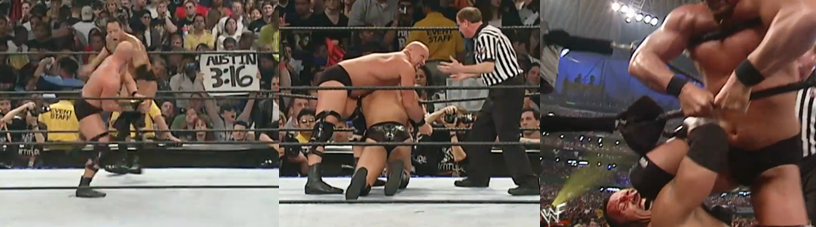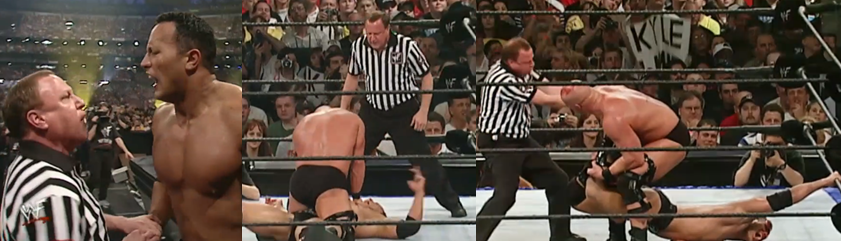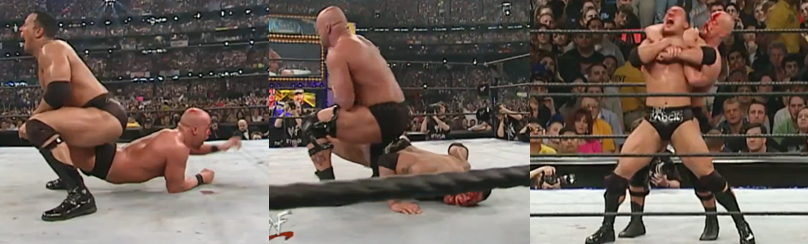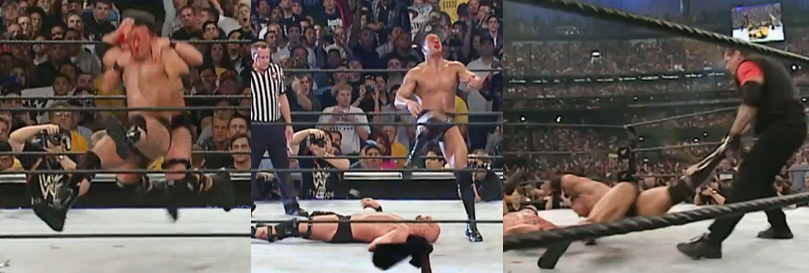
Wrestling Recap [3:16 Day]: HBK vs. Austin (WrestleMania XIV)


“Talk about your psalms, talk about “John 3:16”…Austin 3:16 says I just whupped your ass!”

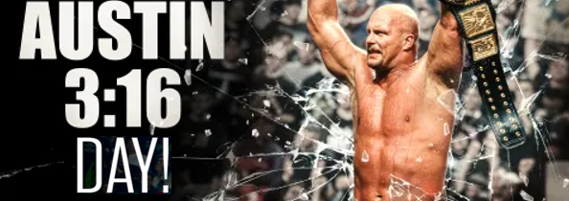
With those immortal words, spoken by the legendary pro wrestler “Stone Cold” Steve Austin after winning the King of the Ring tournament on 23 June 1996, a momentous wrestling career was about to unfold before our eyes that would see everyone’s favourite beer-swigging, finger-gesturing anti-hero become not just an industry icon but a mainstream icon as well. Here’s to yah, Steve!

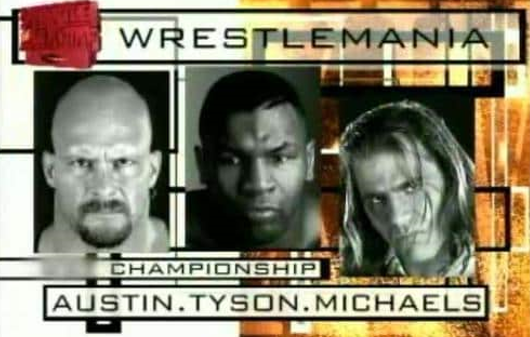
The Date: 29 March 1998
The Venue: FleetCenter; Boston, Massachusetts
The Commentary: Jim “J.R.” Ross and Jerry “The King” Lawler
The Referee: Mike Chioda, with “Iron” Mike Tyson as the special enforcer
The Stakes: Main event singles match for the WWF Championship

The Build-Up:
As any self-respecting wrestling fan will tell you, the World Wrestling Federation (WWF) was clawing back to prominence in 1999. After being beaten in the weekly ratings by World Championship Wrestling’s (WCW) Monday Nitro in the weekly television ratings for nearly two years, the WWF’s “Attitude Era” kept fans glued to the product, many of whom were deeply invested in the rivalry between the loud-mouthed, anti-authority “Stone Cold” Steve Austin and WWF Chairman Vince McMahon. Another crucial factor in getting eyes back on McMahon’s product was the outrageous antics of D-Generation X, a group of wrestlers led by then-current champion, the “Heartbreak Kid” Shawn Michaels, who wielded incredible backstage influence and whose members were often involved in some of the WWF’s most controversial storylines. After the infamous “Montreal Screwjob” saw Bret “The Hitman” Hart part ways with the WWF, McMahon appeared on television more frequently as the evil “Mr. McMahon” and frequently clashed with Austin’s rebellious ways. Hot off a feud with The Rock over the Intercontinental Championship, and despite McMahon’s efforts, Austin won a shot at the big belt, and a slot in the main event of WrestleMania XIV (also billed as WrestleMania X-raided) by winning the Royal Rumble event. He further raised the ire of the chairman when he publicly insulted legendary boxer Mike Tyson on an episode of Raw Is War, though the deck appeared to be stacked against Austin as Tyson revealed himself to be in league with D-Generation X. There was also a great deal of behind the scenes drama surrounding this match as, at the time, Shawn had a bit of a reputation for being unprofessional and, despite nursing a legitimate back injury that would scupper his career for some time, there was some doubt as to whether he would actually lay down for Austin as planned, to the point where the Undertaker was prepared to take matters into his own hands if necessary.

The Match:
Fans today would probably hate the promo package for this match as the majority of it was focused entirely on “The Baddest Man on the Planet” but Mike Tyson was a massive get back then and really helped to put more eyes on the product. The package emphasises not only that Tyson is an absolute bad-ass but that he is D-X through-and-through and Austin barely features at all in it which, considering he was white-hot at this time, I can only assume is all part of the larger story of McMahon not wanting to put any spotlight on Austin and his rebellious ways. Tyson, garbed in a D-X shirt, is the first out and clearly seems to be enjoying his involvement with the product, which is always good. The crowd is, however, largely apathetic towards Tyson, especially once they catch a glimpse of Austin prowling around backstage, to say nothing of when his iconic glass shatters and he enters. After performing his signature rope taunt, Austin immediately gets all up in Tyson’s face, establishing right away that he isn’t afraid of or intimidated by Iron Mike. Shawn Michaels, “the greatest champion of all time” according to J.R., then makes a grandiose entrance; accompanied by some chump named Triple H (who was the WWF European Champion at the time) and Chyna and played to the ring by the Chris Warren D-X band, he expertly played the role of the cocky, arrogant heel by dancing about and wearing the smuggest grin on his face. And why not? Not only did he have the muscle in his corner, Tyson was also in his pocket so he had every advantage in the world except for the unanimous crowd support that Austin received. Tyson makes his presence known from the moment the bell rings by nonchalantly swiping at Austin’s ankles as he (as in Austin) is pacing the ring. When HBK hops about and taunts Austin, Austin gives him the traditional two-finger salute but HBK’s game plan, early on, is to wind Austin up into a frenzy by ducking and jiving away from him.
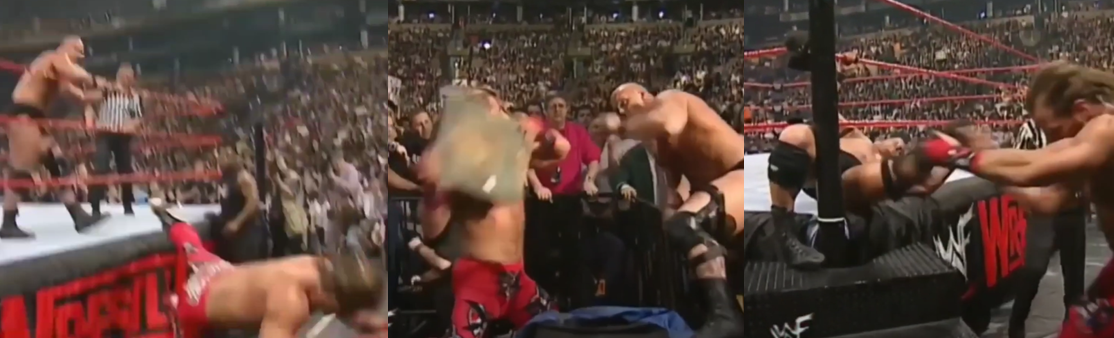
A great deal of the match involves the two brawling on the outside.

Austin, however, puts a stop to that by throwing some punches in the corner, yanking down Shawn’s tights to expose his ass (much to the delight of the crowd), and finally tossing him out of the ring and into his D-X buddies. When Austin follows to press his attack, he is assaulted by Triple H and tossed into the metal barricade. For his efforts, referee Mike Chioda has Shawn’s running buddies ejected from ringside. All of this was still enough for HBK to gain the advantage and a ringside brawl ensues that sees Shawn slam Austin with the band’s equipment and toss him into a dumpster but, the moment they get back into the ring, Austin regains control by countering HBK’s driving axe-handle and whipping the WWF Champion into a corner for Shawn’s signature flip spot. Austin starts to work on Shawn’s arm with a series of stomps; he shuts down Shawn’s speedy offense by dumping him into the ropes but, though he takes a dive to the outside and onto the table, HBK is still wily enough to avoid being hit with the Stone Cold Stunner. Austin presses his advantage, putting a beating on Shawn and going for a series of pins before wearing Shawn down with a headlock. Seems a bit early into the match for a rest hold but, considering Shawn’s injury and the bumps he’s already taken, it’s perhaps not surprising. HBK counters out of the hold and is finally able to gain some momentum by enduring a beating and walloping Austin in the face with the ring bell, which the referee conveniently misses.
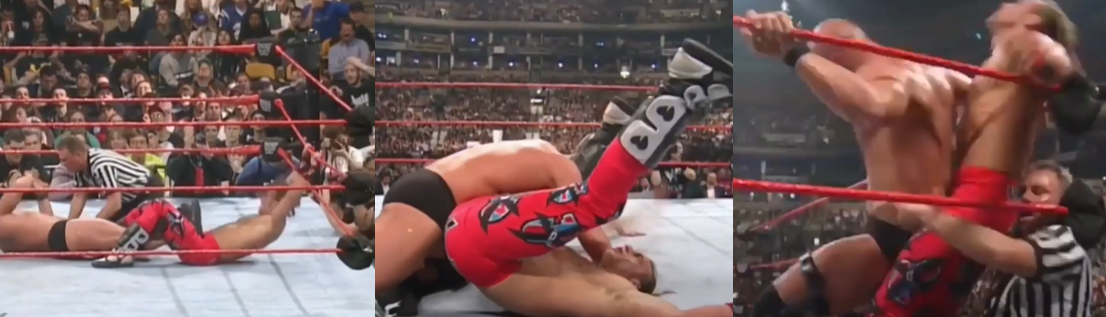
The pace is a bit all over the place, possibly because of Shawn’s injury, making for quite a dull match.

Back in the ring, HBK starts working over Austin’s head despite clearing struggling with the pain of his back injury; more uninspired and slow-paced holds and moves follow before Austin springs back to life, tackles HBK, and tosses him outside again! HBK recovers and starts smacking Austin’s left leg and knee off the ring post and the steel steps, as though the match needs to slow down any more, and continues the assault when he gets back in the ring to put Austin’s leg through the wringer for a bit. Austin surprises HBK with a kick up the ass and a roll-up but this isn’t modern-day WWE so Shawn easily kicks out and continues to wear down Austin’s leg using stomps and the ring ropes. When Austin rolls to the outside for a reprieve, Shawn hits him with a baseball slide and Tyson hefts Austin back into the ring so that HBK can lock in the Figure Four Leglock. Despite HBK grabbing the ropes for additional leverage, Austin refuses to tap out and successfully reverses the hold and buy himself some breathing time. Austin almost catches HBK with a pin off a catapult into the corner and then Shawn transitions into a sleeper hold; in his desperation to get out of the hold, Mike Chioda gets squashed in the corner and taken out of the match.
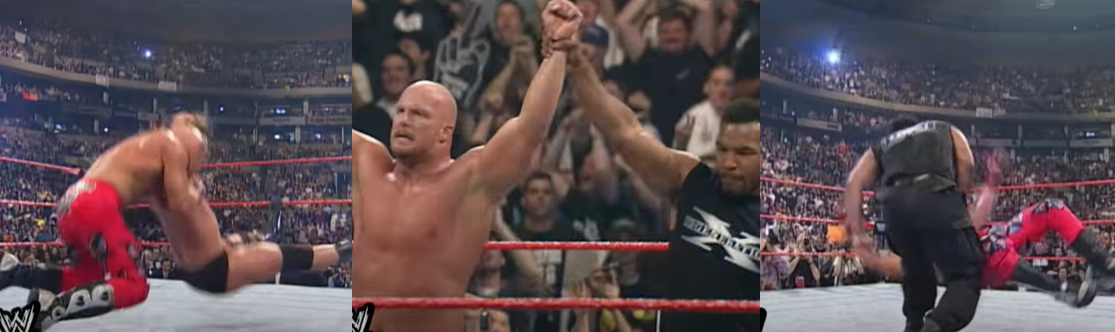
Austin captures his first World Championship thanks to Tyson revealing his true colours.

The match’s pace finally picks up a bit as Austin hammers on HBK, does his Mudhole Stomp in the corner, and fires back with a flurry of offense. Shawn desperately knocks Austin down with his flying forearm/kip up spot and then clambers up to the top rope for his big elbow drop. After landing the move, Shawn begins tuning up the band for the knockout shot but, when he flies in with Sweet Chin Music, Austin ducks it, and goes for the Stunner! Shawn counters out of it, goes for the Superkick again but Austin catches his foot, spins him around, and hits the Stunner! Tyson then slides into the ring and counts a quick three count to give Austin the WWF Championship in a very sudden end to a fairly lacklustre match. Afterwards, Tyson reveals that he was an Austin 3:16 fan all along, a point he emphasises by laying HBK out with a big right hand and then leaving the ring with the new champion.

The Aftermath:
WrestleMania XIV was a monumental night in WWF history; not only was this the first of six WWF Championship runs for Austin, it was also the night that the WWF “scratch logo” became the new logo of the company; the “winged eagle” world championship belt was also replaced with a new design the following night, and Shawn Michaels took a four-year hiatus to recover from his injuries and get his shit together (which, in turn, saw Triple H succeed him as the leader of D-Generation X and truly begin his own ascent to the main event scene). Of course, the most prominent thing to come out of this event was Austin/McMahon feud; for the next five months or so, McMahon did everything he could to try and get the belt off Austin by either screwing him out of it or throwing challengers and obstacles his way. This led to the creation of the Corporation stable, Mankind’s transformation into Dude Love, the debut of Kane, and a series of successful title defences on Austin’s behalf before he was finally forced to vacate the belt when he was pinned by both the Undertaker and Kane. Austin and McMahon also got into a series of verbal and physical altercations, including a steel cage match at St. Valentine’s Day Massacre and the war between the two helped the WWF to overtake the competition and establish themselves as the hottest game in town. Sadly, Austin’s white-hot run came to a premature end when he was written off television to get neck surgery and, while he did reappear in the company some time later, it was clear that his career was winding down thanks to fatigue and mounting injuries.

My Rating:

Rating: 3 out of 5.

Pretty Good

What did you think to the contest between Shawn Michaels and Steve Austin at WrestleMania XIV? How would you rate it compared to their other bouts and which of their feuds, matches, and moments is your favourite? Were you a fan of HBK, D-X, and Tyson? How are you celebrating 3:16 Day this year, what are some of your favourite matches and moments from Austin’s illustrious career, and what dream match would you have liked to see him involved in? Whatever your thoughts, drop a comment below and let me know what you think about “Stone Cold” Steve Austin.

Wrestling Recap: Hogan vs. Undertaker (Survivor Series ’91)

The Date: 27 November 1991
The Venue: Joe Louis Arena; Detroit, Michigan
The Commentary: Gorilla Monsoon and Bobby “The Brain” Heenan
The Referee: Earl Hebner
The Stakes: WWF Championship match

The Build-Up:
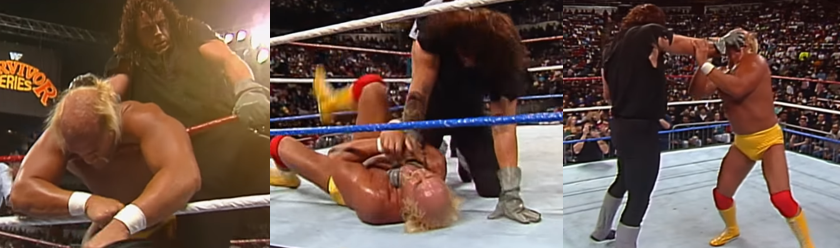
The Undertaker made his debut on this day at the 1990 at the 1990 Survivor Series as a heel; aligned with Ted DiBiase’s Million Dollar Team and eventually partnered up with the repulsive Paul Bearer, the Undertaker was portrayed as a zombie-like force of nature who was impervious the pain, implacable by nature, and apparently at the whim of a mysterious urn wielded by his manager. Hulk Hogan, meanwhile, was several months into his third run as the World Wrestling Federation (WWF) Champion, having defeated Sergeant Slaughter earlier in the year at WrestleManiaVII. However, thanks to mostly being booked into squash matches, the Undertaker went unpinned (on television, at least) for a year and this impressive statistic was enough to plug him in as Hogan’s next opponent in what was billed as Hogan’s “Gravest Challenge” to date.

The Match:
Rather than preceding the match with one of their trademark promo packages, this particular match is preceded by a couple of pre-taped promos from each of the competitors; Hogan, basically, has taken offense to the Undertaker and Paul Bearer’s threat to bury the hopes and dreams of all the Hulkamaniacs but ‘Taker stoically threatens that Hulkamania has had its day and is long overdue for a burial.

Hogan’s bombastic showboating soon gave way to slow, plodding offense.

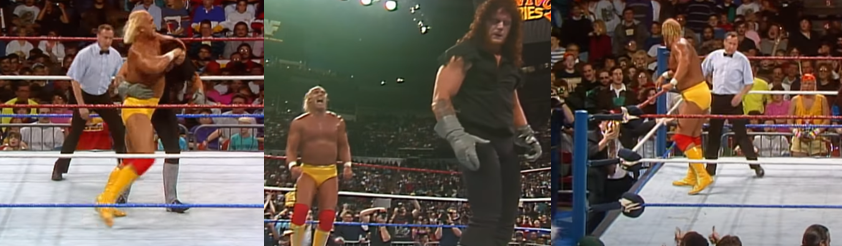
During his characteristically enthusiastic entrance, Hogan made a point to upturn and demolish the casket that was placed at ringside but the Undertaker maintained his stoic demeanour and remained unimpressed with Hogan’s showboating and simply set out to do what he promised: destroy Hulkamania. Unfortunately, given that it was 1991 and early ‘Taker (as well as Hogan’s limitations), this meant a lot of slow, plodding offense and an abundance of headlocks, face and beck chokes, and slow, measured strikes from the Undertaker.

Bearer’s interference and the Undertaker’s indomitable nature kept Hogan on the back foot.

Hogan, of course, was all about the superhuman energy and resolve; even though he spends the majority of the match on the back foot and seemingly unable to actually hurt the Undertaker, he continually came back time and time again even after having his head slammed off the steel ring steps and being choked by an electrical cord. Of course, Hogan had the crowd firmly in his corner right from the beginning of the match and they exploded into cheers whenever Hogan mounted some offense and showered the arena with boos every time Bearer got involved behind Hebner’s back.

Undertaker’s moveset back then mainly consisted of dull choke and claw holds.

A far cry from the later brawling and high-impact offense of his later years, the Undertaker’s plan of attack mainly consisted of punches, clotheslines, and full-face chokes; his gameplay, apparently, was to wear down Hogan and drain him of his much-vaulted energy and, every time he pressed his advantage with a Claw Hold or similar move, ‘Taker would turn to Bearer to draw power from the mysterious urn, his eyes rolling into the back of his head, and my interest and excitement draining right along with Hogan’s vigour.

Hogan’s comeback meant nothing once Flair snuck in a steel chair to give ‘Taker the win.

Of course, as relentless and dominating as the Undertaker was, Hogan is still Hogan; jacked up (and blown up) to the nines and full of passion, Hogan completely no-sold the Undertaker’s Tombstone Piledriver to mount his trademark comeback. This onslaught was enough to stagger the Undertaker and drive him to his knees but, right as Hogan looked to be setting up for the finish, Ric Flair sauntered down to ringside to distract Hogan. Flair then slid a steel chair into the ring, which the Undertaker summarily Tombstoned Hogan onto, and the match ended with the Deadman being crowned the new WWF Champion to the chagrin of Monsoon, the delight of Heenan, and a brief cheer from the crowd.

Sadly, it’s every Hogan match ever and even has a screwy finish to keep him looking strong.

It’s not an especially long of exciting match, to be honest; it’s basically every Hulk Hogan match you’ve ever seen as Hogan takes a beating, pulls out sly heel moves and tactics, and spends the majority of the match either on his back or taking a beating because he’s too gassed to work a long, involved match and is simply building up for his characteristic comeback. The story was far more interesting than the actual in-ring content as ‘Taker was more about slow, boring offense and shrugging off attacks and Hogan was only ever really good for pumping up the crowd and hitting his signature moves; the entire match was about a clash of ideals and wills and the potential death of Hulkamania but, whereas Hogan was able to overcome all his previous challenges, he failed to overcome his “Gravest Challenge”. However, he arguably only lost the match due to Flair’s interference and looked set to for a win before Flair distracted him, tainting the Undertaker’s iconic first championship win in true Hogan fashion, which is a shame as the Undertaker looked so dominant throughout the match and this should have been a clean win. Still, at least it’s a short match; the WWF was a very different time back then and, while I respect Hogan and his impact on the industry, I can’t say I’ve ever been a fan of his in-ring work and he didn’t seem to have a lot of chemistry with ‘Taker, who was worked a very premeditated and limited style thanks to his commitment to the zombie aspects of his character.

The Aftermath:
Hulk Hogan and the Undertaker faced off in a rematch less than a week later at This Tuesday in Texas, which Hogan, of course, won and, by WrestleMania VIII, both men were embroiled in entirely separate feuds and the Undertaker would not win the WWF Championship again until WrestleMania 13 some six years later. Despite both being in the company at the same time for many years following this match, the two never crossed paths again and would not face off in a championship match until Judgment Day in 2002, when the Undertaker defeated Hogan (then billed as Hollywood Hulk Hogan) for the Undisputed World Wrestling Entertainment (WWE) Championship.

My Rating:

Rating: 1 out of 5.

Terrible

What did you think to the contest between Hulk Hogan and the Undertaker at the 1991 Survivor Series? How would you rate it compared to their other bouts and which of their feuds, matches, and moments is your favourite? Were you a fan of the Undertaker’s when he debuted and were you hyped for his showdown with the Immortal Hulk Hogan? Which of the two were you rooting for, given Hogan’s incredible popularity and the Undertaker’s dominant first year? How are you celebrating the Undertaker’s debut this year, what are some of your favourite matches and moments from his long and distinguished career, and what dream match would you have liked to see him involved in? Whatever your thoughts, drop a comment below and let me know what you think about the Undertaker.

Wrestling Recap: Kane vs. Undertaker (WrestleMania XIV)

The Date: 29 March 1998
The Venue:  FleetCenter; Boston, Massachusetts
The Commentary: Jim “J.R.” Ross and Jerry “The King” Lawler
The Referee: Jack Doan
The Stakes: Semi-main event, personal rivalry between siblings

The Build-Up:
In the entire history of the World Wrestling Federation (WWF), and perhaps all of wrestling, there is, arguably, no greater and more tumultuous story than the history between Kane and the Undertaker. The Deadman had embarked on a reign of terror ever since his debut at the 1990 Survivor Series event, seemingly under the control or influence of a mysterious urn wielded by his revolting manager, Paul Bearer. However, the Undertaker’s relationship with Bearer soured after Bearer turned his back on the Deadman in favour of Mankind. In retribution, the Undertaker used his supernatural powers to blast Bearer in the face with a fireball at In Your House 14: Revenge of the ‘Taker but was tormented by Bearer’s subsequent claims that the Undertaker’s younger brother, Kane, had actually survived the fire that claimed the lives of their parents and was looking for revenge. These claims turned out to be all-too-true when, right as the Undertaker was about to defeat his long-time rival in the first-ever Hell in a Cell match on October 5th, 1997 (the day after my twelfth birthday, which sadly clashes with Global James Bond Day) at Badd Blood: In Your House, the lights went out, ominous organ music played, and a gigantic man garbed in red and black stormed the ring, literally tearing the cell’s door off, ignited the ring posts, and planted the stunned Undertaker with his own finishing manoeuvre, the Tombstone Piledriver as Kane made his shocking debut. Mute, superhumanly strong, and seemingly impervious to pain, Kane immediately embarked on a path of destruction in a bid to goad his brother into a match; the Undertaker, however, constantly refused to fight his brother but was finally pushed too far after Kane and Bearer attacked him at the 1998 Royal Rumble event. The two placed him inside a casket and setting it ablaze, seemingly killing the Undertaker, but the Deadman made another of his trademark dramatic returns and, now, was begrudgingly ready to face his brother, one-on-one, at WrestleMania XIV.

The Match:
As you might expect, given the dramatic and destructive conflict between the Undertaker and Kane and the convoluted backstory between the two, the match is preceded by another of the WWF’s fantastic video packages highlighting Bearer’s claims that “Kane is alive!” and Kane’s breath-taking debut at Badd Blood .The emphasis of the hype package is primarily on Bearer’s obsession with using Kane to extract revenge against the Undertaker and the Deadman’s refusal to fight his own flesh and blood; one thing that’s actually very interesting about this feud, even here in its early days, is that both men are kind of portrayed as tweeners. Neither man is really a face or a heel as ‘Taker is clearly being targeted, so the fans are reluctant to boo him even though he inadvertently killed his parents, and Kane was just too bad-ass, too alluring, and too impressive for people to truly boo him. Instead, it seems tensions were palpable for their inevitable conflict and everyone totally bought into the ridiculous story, suspending disbelief to simply enjoy the supernatural elements of their story and watch two massive guys go at each other after weeks and weeks of build-up. Nowhere is this unusual face/dichotomy more evident than during Kane’s entrance, where he famously stalked to the ring surrounded by flames and red lighting and delivered a Tombstone to Pete Rose, who had spent a couple of minutes insulting the crowd, their city, state, and baseball team. This, seemingly, signalled that Kane was actually a babyface despite everything that he had done leading up to this match, but then he switches right back into being more of a heel in his assault of the Undertaker. Like I say, Kane and the Undertaker was basically beyond the usual clichés of “good” and “evil”; they simply were and did whatever they wanted, whenever they wanted to, to whomever they felt like and people cheered regardless because it was always entertaining to see what these two big, beefy, semi-supernatural men would get up to next.

Kane’s power and strength impressed, especially in the early going.

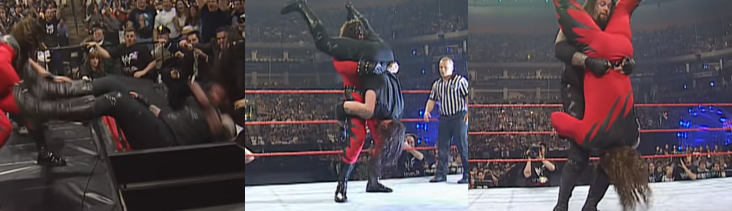
Of course, the Undertaker made a suitable dramatic and ominous entrance; flanked by several torch-carrying druids, the Deadman slowly stalked to the ring following a bolt of lightning and garbed in a gothic, almost vampire-like caped outfit and sporting a temporary black teardrop tattoo on his face. Kane, however, showed no signs of intimidation (or any emotion at all, considering his face was entirely obscured by his iconic mask, but you can feel his boiling, brewing anger thanks to Jacobs’ fantastic body language and subtle gestures) leading to an iconic face-to-face stare down between the two before the Undertaker broke the tension with a big right hand and a furious assault in the ring corner. However, a common theme throughout the match, especially in the early going, is Kane’s indomitable power and ability to answer, and counter, the Undertaker’s offense at every turn; he manhandles the Undertaker on numerous occasions, overpowering him, reversing his attempts to whip Kane into the ropes and the corners, and quickly takes control of the early stages of the match by brutalising the Undertaker with his superior physical power. Kane even showed off his impressive agility by springboarding off the ring ropes to knock the Undertaker to the outside at one point, though the Undertaker was no slouch in this department either as he uncharacteristically hopped up onto Kane’s shoulders form an awkward-looking Facebuster-type move and, later, dove right over the top rope and crashing through the Spanish announce table in what looked like one hell of a crash landing!

After a nasty dive through the announce table, the Undertaker and Kane traded Tombstones!

All throughout the match, Paul Bearer is a constant presence; standing at ringside, he continuously shouts encouragement and directions to Kane and taunts to the Undertaker. As the fight inevitably tumbled to the ringside area, Bearer distracted the referee so that Kane could bring the steel steps crashing down across the Undertaker’s spine. This, and similar assaults, allowed the Undertaker to truly take control of the match as he slowly, methodically, beat the Undertaker into submission, with Bearer getting a few shots in on the Deadman at every opportunity. Kane, however, allowed hubris and his emotion and obsession with hurting the Undertaker potentially keep him from winning the match as he pulled the Undertaker up from a potential three count following a Chokeslam. Kane, however, presses his advantage after ‘Taker crashes through the announce table and was prepared to finish his brother off with his patented Diving Clothesline but was enraged when the Deadman kicked out of the pin and the two ended up trading punches before Kane overpowered the Undertaker and reversed his Tombstone attempt into a Tombstone of his own! ‘Taker, however, kicked out to a surprisingly mild reaction from the crowd (the silence that followed suggests a degree of shock at this event since Tombstone kickouts weren’t as overplayed and highly anticipated as they would become in later years). Undertaker got his second wind following this and, with Kane finally showing signs of fatigue, was able to plant his brother with a Chokeslam and then returned the favour with a Tombstone…only for Kane to kick out!

It took three Tombstones to put Kane away and ‘Taker didn’t look like a winner after the match!

Despite being on the defensive for the majority of the match, J.R. constantly points out that the Deadman is making every effort to cover up from Kane’s punches and suggests that he may be playing a long game and banking on Kane tiring himself out with his furious and relentless assault. While this means that he has to endure what J.R. claims is the most brutal and physically dominating attack than he has ever experienced, this turns out to be the case and the result is a fantastic showcase for Glenn Jacobs’ popular masked character as Kane looks like an instant superstar thanks to all of the offense he gets in and the dominating position he is in throughout the entirety of the match. Nowhere is Kane’s tenacity emphasised more than in the closing minutes of the match; having kicked out of the first Tombstone, Kane continued to sit up, to get to his feet, and to stalk his brother and, despite eating another Tombstone, simply would not stay down until ‘Taker hit a third and final Tombstone to finally put his brother away. However, Kane and Paul Bearer ended up standing tall as Bearer put the boots to ‘Taker after the bell rang and Kane delivered a massive Tombstone Piledriver to his brother onto a steel chair to emphatically send the message that the Undertaker may have won the battle…but the war was far from over!

The Aftermath:
The feud between the Undertaker and Kane was far from over following this match; the two would clash again the very next month at Unforgiven: In Your House in the first-ever Inferno Match, which Kane, again, would lose. The two would eventually go their separate ways and even formed a tentative alliance that saw the Undertaker help Kane to defeat Stone Cold Steve Austin for the WWF Championship at the 1998 King of the Ring event and become embroiled in Vince McMahon’s ongoing feud with Austin over the championship throughout the summer. The two continually crossed paths as both reluctant allies and bitter rivals throughout 1998, with Kane slowly turning babyface and Undertaker turning heel in the process thanks to numerous twists and turns in their storied relationship. Such drama would follow both men throughout their subsequent careers as they continually switched allegiances and alternated between being one of the most dominant duos in the entire industry and being two of the bitterest rivals but, no matter what form their appearance or relationship took, you could always be assured of an absolute spectacle whenever Kane and the Undertaker share the ring together.

My Rating:

Rating: 4 out of 5.

Great Stuff

What did you think to the contest between Kane and the Undertaker at WrestleMania XIV? How would you rate it compared to their other bouts and which of their feuds, matches, and moments is your favourite? Were you a fan of Kane’s when he debuted and were you hyped for his first match against his brother? Which of the two were you rooting for, given the tumultuous nature of the storyline? How are you celebrating Kane’s debut this year, what are some of your favourite matches and moments from Kane’s long and complex career, and what dream match would you have liked to see him involved in? Whatever your thoughts, drop a comment below and let me know what you think about Kane.

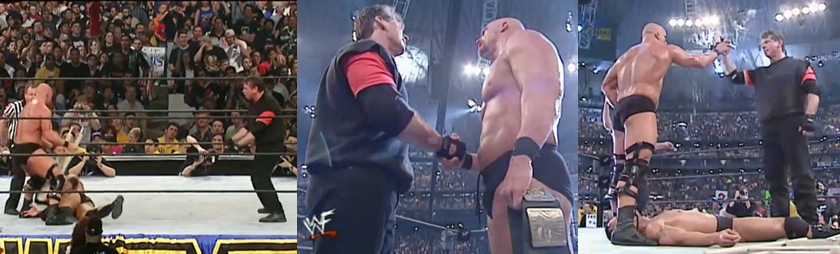
Wrestling Recap [3:16 Day]: Rock vs. Austin (WrestleMania X-Seven)


“Talk about your psalms, talk about “John 3:16”…Austin 3:16 says I just whupped your ass!”

With those immortal words, spoken by the legendary pro wrestler “Stone Cold” Steve Austin after winning the King of the Ring tournament on 23 June 1996, a momentous wrestling career was about to unfold before our eyes that would see everyone’s favourite beer-swigging, finger-gesturing anti-hero become not just an industry icon but a mainstream icon as well. Here’s to yah, Steve!


The Date: 1 April 2001
The Venue: Reliant Astrodome; Houston, Texas
The Commentary: Jim “J.R.” Ross and Paul Heyman
The Referee: Earl Hebner
The Stakes: Main event, no disqualification match for the WWF Championship

The Build-Up:
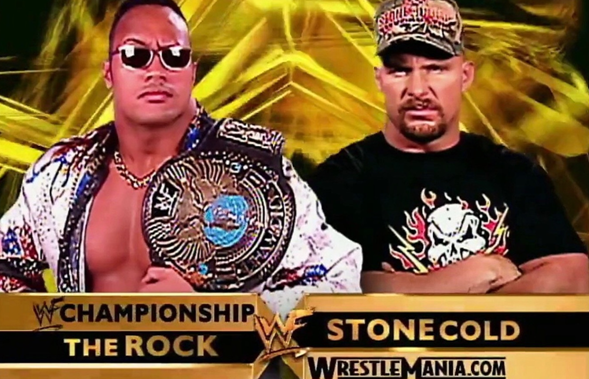
Man, I tell you what, if you were a wrestling fan between 1998 and 2001 you were living the high life! After losing to World Championship Wrestling’s (WCW) Monday Nitro in the weekly television ratings for nearly two years, the World Wrestling Federation (WWF) finally began to turn a corner by ushering their “Attitude Era”, a central focus of which was the rivalry between the loud-mouthed, anti-authority “Stone Cold” Steve Austin and WWF Chairman Vince McMahon. One key aspect of this feud also involved Austin’s various run-ins with the Rock; the two had previously clashed over the WWF Championship at WrestleMania XV: The Ragin’ Climax, where the Rock (then endorsed as McMahon’s “Corporate Champion”) dropped the belt to Austin but the two had plenty of history prior to that as they had feuded over the Intercontinental Championship some years prior. After Austin won the Royal Rumble and the Rock recaptured the belt from Kurt Angle at No Way Out just a few months prior, tensions began to boil between the two now-friendly rivals; Austin’s wife Debra was forced to be Rock’s manager for a while, the two frequently brawled or left each other at the mercy of other wrestlers, and Austin, still on his big comeback from a career-threatening neck injury, famously warned the Rock: “I need to beat you, Rock. I need it more than anything you could ever imagine”.

The Match:
Of course, it’s hard to talk about this match without mentioning the excellent video package that told the story of the tumultuous build-up towards it by charting Austin’s big comeback, Rock’s WWF Championship win, and the rising tensions between the two following Austin’s Royal Rumble win. Originally set to Limp Bizkit’s “My Way”, even without this music this is one of the best hype packages the WWE has ever put together and really sold the intensity of this confrontation. Emotions were high going into this match thanks not just to the clearly partisan crowd but also J.R.’s rousing commentary and personal investment in the match; J.R. was widely recognised as Austin’s best friend and, as such, he spends the majority of the match selling the story of Austin’s big comeback and that this match is this the culmination of Austin’s journey through spinal surgeries, injuries, and adversity. Accordingly, he was outraged by the unexplained, last-second announcement that the match had been made a no disqualification contest, believing that there is some kind of conspiracy behind that decision despite the fact that both he and Heyman mention more than once that a no disqualification stipulation actually gives Austin, known for his wild brawling, the advantage.

Austin was noticably more aggressive, utilising many underhanded tactics throughout the match.

Austin came to the ring first to a raucous reception; this was during the time when Austin was coming out to Disturbed’s “Glass Shatters”, a rockin’ version of his iconic theme, though the massive ovation he received largely crowned out any music and even the commentary at times. Given that Austin was the home state hero, and that audiences were still high on rediscovering their love for him after all of his time out with injuries, this isn’t all that surprising and meant that the Rock, arguably the most popular wrestler in the WWF at that time, received a showering of boos not only during his entrance but also throughout the match. Honestly, this match was loud and boisterous right from the word “Go!” thanks to the crowd, who are a sea of cheers, reluctant boos towards the Rock, and a cacophony of emotion all throughout. You could feel the tension and anticipation in the air from the moment the match begins and it stayed at a constant level throughout, rising to a crescendo whenever Austin is on the attack. Accordingly, there was no standing on ceremony here and the match began with a full-on slugfest between the two. Austin even went for a belt shot in the early going, which might seem surprising but, watching the match in hindsight, you can see how Austin is pulling out all kinds of heel tactics throughout (shots with the ring bell, using his knee braces to attack the Rock’s forehead, undoing the corner turnbuckle pad, choking Rock with the ropes, among other notable moments). Though J.R. largely glossed over a lot of these elements, Heyman sold it well to remind audiences that Austin is driven, obsessed, with becoming the WWF Champion and willing to do anything and everything to emerge the victor.

Despite the no DQ stipulation, Hebner tried to appeal to each man’s reason and maintain order.

Austin dominated the match in the early going thanks to hitting a Lou Thesz Press, escaping the Rock Bottom, and taking the fight to the outside after Rock avoided being hit with a Stone Cold Stunner. The two brawled by the announce table for a bit before heading over the barricade and into the crowd; this wouldn’t be the first time the action spilled to the outside and, if anything, that tactic is a little over-used in this match but it plays to Austin’s strengths since he was largely a brawler by this point and his matches were more about high intensity, a series of punches, stomps, and recognisable spots, and, of course, the Stunner. The emotion of the contest wasn’t lost on the Rock, either, though, and this cost him during their ringside scrap as he allowed himself to get distracted by Hebner, giving Austin the chance to bash him in the head with the ring bell and bust him open. Hebner, easily my favourite referee and, arguably, the WWF’s most recognisable official, could always be counted on to be a big part of every match he was in but in a way that remained professional and subtle. Here, he spends the majority of the match appealing to each man’s reason; it was no disqualification but he still admonished the two for fighting at ringside, using weapons, and forced them to break submission holds when their opponent was in the ropes. However, because of how high the stakes and the personal animosity between the two rivals were, he often found himself being accosted or threatened by both men.

The two men traded Sharpshooters and Austin even busted out the Million Dollar Dream!

As Heyman was fond of saying during this time, Austin was “like a shark that smells blood” the moment the blood began flowing and began to relentlessly target the Rock’s lacerated forehead with a barrage of fists, shutting down a potential comeback with a Neckbreaker, and stomping away on the Rock in the corner of the ring. It was only when Austin found himself distracted by Hebner’s interference that the Rock was able to finally make a proper comeback by launching Austin into the exposed turnbuckle and gaining a little retribution by bashing Austin in the head with the ring bell, busting him open before Austin was able to regain control of the match with a wicked catapult into the ring post. Rock sold the hell out of that move, snapping his head back at the very last second to really sell the idea that he had collided with the post in a sickening way, which more than made up for the announce table simply collapsing under his weight and, potentially, ruining a planned table spot. Austin continued his assault by bashing Rock in the head with a monitor but Rock managed to finally turn the tide by locking Austin into the Sharpshooter; the crowd was thrust into a tumultuous sea of conflict as Austin screamed in agony, refused to quit, and desperately reached for the ropes but Rock shifted him back to the middle of the ring! Austin, though, was able to reach the ropes and then put the Rock into a Sharpshooter, with the crowd being far less divided about this and even less impressed when the Rock powered out of the move. Annoyed, and growing increasingly frustrated, Austin followed up with the Million Dollar Dream!

McMahon cost the Rock his best opportunity to win the match.

J.R. was as surprised as anyone else about Austin dusting off this long-forgotten piece of his arsenal but it was enough to drive the Rock to his knees and set up for the old “three arm” spot. The Rock, of course, kept his arm up at the last second (has this spot ever gone any other way?) and uniquely kicked himself off the corner of the ring to first counter into close two count and then hit a Stunner out of nowhere! Unfortunately, the Rock was too fatigued and hurt to cover quickly enough so Austin kicked out at two and it was at this point that Vince McMahon wandered down to ringside, much to the anger of both J.R. and the crowd. In the ring, Rock and Austin went back to exchanging blows and trading their signature Spinebusters; Rock, of course, followed his Spinebuster up with the People’s Elbow but McMahon broke up the pin. Incensed, the Rock chased McMahon around the ring and ran right into a Rock Bottom from Austin, though he managed to kick out at two for a dramatic near fall.

Austin sold his soul to the Devil himself to once again become the WWF Champion.

After the Rock countered out of a Stunner attempt, Hebner got knocked out of the ring and, in the carnage, Austin ordered McMahon to bring a steel chair into the ring. In a sickening moment, Austin held the Rock in place so that McMahon could deliver a vicious chair shot right to his head. It still wasn’t enough to keep the Rock down, though, and Austin was so infuriated that he got caught with a Rock Bottom. Luckily for Austin, though, McMahon distracted Hebner, and the Rock, long enough for Austin to recover and hit the Rock with a massive Stunner (which, of course, the Rock sold with a theatrical panache). Driven to the limit by the Rock’s tenacity, Austin began assaulting him with McMahon’s steel chair; he then delivered another sick shot to the head before driving it into the Rock’s chest and bashing him over the spine with it over and over and over, beating him to a pulp, and finally scoring the three count! The crowd erupted into thunderous applause but they, and J.R,, soon reacted in shock and anger as Austin and McMahon shook hands and shared a beer over the Rock’s bloodied and prone body. When the Rock stumbled to his feet, Austin put him down with one last belt shot to emphasise his sudden and unexpected change of character. J.R. was disgusted, appalled, and betrayed by the alliance between Austin and McMahon but Heyman, though shocked, believed that this was totally in character since Austin had promised to do anything to win and was always fond of the mantra: “DTA – Don’t Trust Anybody!”

The Aftermath:
The very next night on Raw is War, Austin and the Rock faced off in a rematch inside of a steel cage. It was during this match that Triple H forged an alliance with his much-hated rival and he and Austin came to be known as the “Two-Man Power Trip”. The Rock was subsequently assaulted by the two and suspended by McMahon to allow him the time off required to film The Scorpion King (Russell, 2002). After Triple H won the Intercontinental Championship, the Two-Man Power Trip went on a…well, a power trip, dominating the WWF and coming into contact with the only team big, mean, and powerful enough to oppose them: the WWF Tag Team Champions, Kane and the Undertaker, the Brothers of Destruction. Austin and Triple H were able to best the Brothers, though, but their reign of terror was cut short when Triple H suffered a horrific quadriceps tear. Austin continued on as a heel regardless, however, changing his music and becoming a more paranoid, unpredictable, and cowardly bad guy who turned his back on both the fans and his friends (resulting in a vicious beat down of J.R.). Although he briefly seemed to be returning back to the “old Stone Cold” in the face of the invasion from WCW and Extreme Championship Wrestling (ECW), Austin ultimately joined forces with the WCW/ECW alliance and became this erratic, overbearing, narcissistic heel obsessed with the belt and being treated like the star of the show. Eventually, after the collapse of the WCW/ECW alliance, Austin would return to his roots as a babyface and begin the final stage of his career. Mounting injuries began to take their toll and Austin began to lose his passion for the sport, culminating in one last match against the Rock at WrestleMania XIX but that is a story for another day.

My Rating:

Rating: 5 out of 5.

Fantastic

What did you think to the contest between the Rock and Steve Austin at WrestleMania X-Seven? How would you rate it compared to their other bouts and which of their feuds, matches, and moments is your favourite? Were you a fan of Austin’s unexpected heel turn or do you think he should have called an audible and remained as a tweener? How are you celebrating 3:16 Day this year, what are some of your favourite matches and moments from Austin’s illustrious career, and what dream match would you have liked to see him involved in? Whatever your thoughts, drop a comment below and let me know what you think about “Stone Cold” Steve Austin.

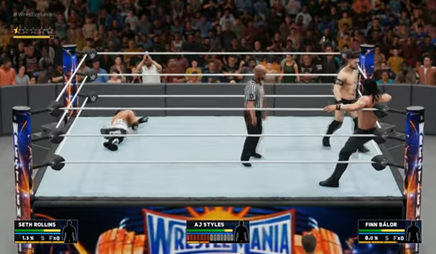
Game Corner: WWE 2K18 (Xbox One)

GameCorner
WWE2K18Logo

As may already be evident, I have a long-standing preference for the WCW and WWF videogames released by AKI/THQ back in my youth; however, another WWF videogame series I have been particularly fond of and spent many hours and days of my childhood playing has been the WWF SmackDown! series released by THQ and Yuke’s on Sony’s PlayStation in 2000. Eventually, this series evolved into the WWE SmackDown! Vs. Raw franchise, which was released on multiple consoles between 2004 and 2010. I believe I came into this series with WWE SmackDown! vs. Raw 2008 Featuring ECW (Yuke’s/Amaze Entertainment/THQ, 2007) and bowed out with WWE SmackDown! vs. Raw 2011 (Yuke’s/THQ, 2010) as, by this point, it was pretty clear to me that I was simply purchasing the same videogame every year with additional wrestlers, some new match types, and minor improvements to the graphics and gameplay. As a result, I decided to buy a new title every two years or so and, after enjoying WWE ’13 (ibid, 2012) and deciding that WWE 2K15 (Yuke’s/Visual Concepts/2K Sports, 2014) was far too stripped back on features to justify the price tag, I settled on getting WWE 2K14 (ibid, 2013) and biding my time.

WWE’s videogames eventually aped the yearly formula of the FIFA series.

As a result, I have not bought or played a new videogame in 2K Sports’ WWE 2K series for about four years now, and with good reason; as the series made the jump to the Xbox One and PlayStation 4, reviews and feedback ranged from resoundingly negative to mediocre displeasure as 2K Sports apparently removed many expected gameplay mechanics and features in what was nothing less than a blatant attempt to sell features seen in previous PlayStation 3-era titles as being “new”. Despite the additions of never-before-seen superstars such as Sting, AJ Styles, and Samoa Joe, I decided to wait it out until the release of WWE 2K18 (ibid, 2017) to give the series a chance to iron out these kinks and to create an ironic sense of symmetry given that the last title I played was WWE 2K14. As such, it took me a little while to become accustomed to WWE 2K18’s control scheme; previously, these titles allowed you the option of controlling your wrestler with the directional-pad (or “D-pad”) and taunting with the analogue stick, which is my preferred control scheme given how it mirrors that of the AKI/THQ titles.

WWE2K18Submission
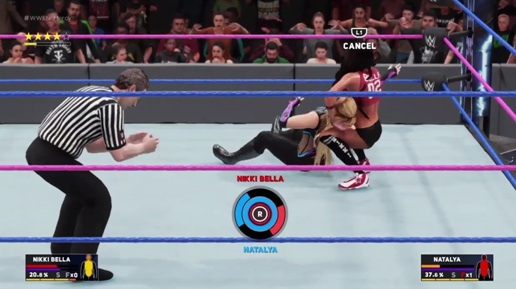
WWE 2K18 loves these little wheels of death!

However, WWE 2K18 does not allow you to change the control scheme, meaning that I was forced to control my wrestler with the left analogue stick and taunt using the D-pad which, for an old school player like myself who dislikes change, took some getting used to. One of the other main reasons I prefer D-pad control is that I find it easier to direct and aim my opponent during running attacks or Irish whips; I find the analogue stick makes such aiming harder as the stick is more sensitive. WWE 2K18 also features some new mini games which replace the ones I had grown accustomed to in WWE 2K14; when being pinned, for example, you now have to press X on a little wheel rather than stopping a little bar that bounces back and forth. This is actually a lot trickier than it sounds as it seems the videogame is set up to make kicking out of pins harder than before to, I guess, allow for more “realistic” matches. Additionally, there is no longer the “Breaking Point” submission system; instead, there’s either a tricky mini game involving the analogue stick or you must mash one of the four action buttons when they appear onscreen. I went with the button mashing option but have found that winning a match by submission is not as easy as it used to be, potentially because you can no longer select a match to be either quicker, normal, or epic; this, and the improved attribute system, means that you are forced to work for your submission victory.

WWE2K18Triple
Suffer enough damage and you’ll roll from the ring to take a break.

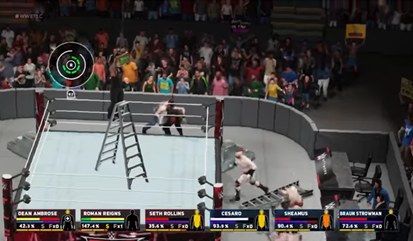
Other gameplay changes can be seen in multi-man match; now, when you or another player receives enough damage, they automatically roll out of the ring and you must mash buttons to fill up a bar and re-enter the match. It sounds good on paper and, again, appears to be tooled towards making matches more “realistic” but I found it more annoying than anything else as you could end up stuck on the outside and lose the match. This mechanic carries over into ladder/TLC matches as well, making them considerably more frustrating than usual as you incur far more damage much faster in these matches so you’ll spend a lot of time mashing buttons to get back into the matches. Also, in ladder/TLC matches, you no longer pull down the belt of briefcase using the right analogue stick; instead, you have to play a little mini game where you must fill up segments of a circle by rotating a ball into a small hole using the right analogue stick. It’s fun but quite distracting; I found myself concentrating more on the mini game than the match and, if you get interrupted with only a couple (or, even worse, one) segments left to fill, you are almost guaranteed to lose the match as the next wrestler to play the mini game will probably complete the circle while you’re busy mashing buttons to get back into the match.

WWE2K18TLC
Multi-man TLC matches are still the worst.

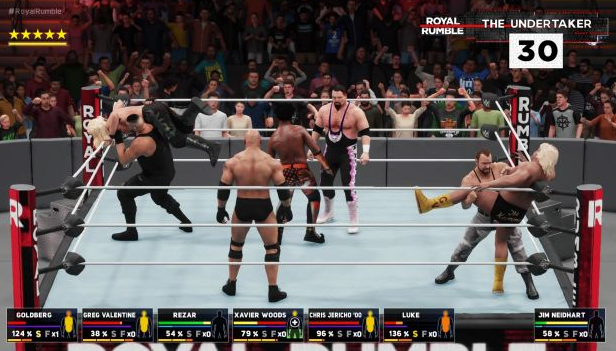
The Royal Rumble match is also noticeably different and, technically, more difficult; rather than hitting buttons in a quick-time event as in WWE 2K14, you now have to mash a button when trying to eliminate an opponent. Honestly, I’ve played a couple of these matches and never once eliminated anyone using the button-mashing mini game no matter what their health and stamina. I found the best way to eliminate wrestlers was the tried-and-true Royal Rumble finisher, clotheslining them out of the ring or countering a run attack, or by exploiting a glitch where, if you whip the opponent onto the apron and quickly punch them repeatedly, they simply fall from the ring.

WWE2K18Rumble
I struggled to legitimately eliminate anyone in the Royal Rumble…

As I always found ladder, TLC, and Royal Rumble matches tedious any way, these gameplay changes don’t bother me that much; you are not forced to play these matches and, on the whole, I would just avoid them. Some good changes have been made to tables matches, though; every time you hit your opponent with or into a table, it fills up a break meter and, once it’s full, you can smash the opponent through it using some new and expanded options. 2K Sports have also introduced a carry system, similar to the one from WWE SmackDown! vs. Raw 2007 (Yuke’s/THQ, 2006), which allows you to smash your opponent off the ropes, turnbuckles, apron, and other objects. They’ve also brought back in-crowd fighting, to a degree, allowing you to smash your opponent through (or hit them over) the barricade at ringside or toss them from the stage area to fight in little areas near the crowd.

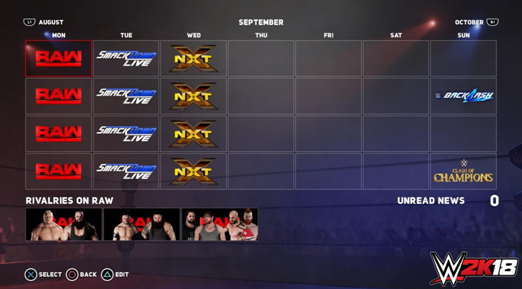
WWE2K18Universe
Universe mode is back, bigger and better than ever.

Although create-a-story and create-a-finisher are no longer options, WWE 2K18 is still full to the brim with creation options. I honestly spent maybe five days or so setting everything up the way I wanted it and creating wrestlers, entrances, victories, shows, and teams in the expanded Universe mode. As before, Universe mode allows you to create a show, place wrestlers and championships on the show, and then create monthly pay-per-view events for that show. I like to recreate the product as closely as possible so I created a Raw, SmackDown! Live, and NXT brand (with 205 Live and Main Event as minor shows) and, for all the Legends and duplicate wrestlers, a WCW Monday Nitro brand (with some crossover between them all). You can create more than one Universe at a time but I prefer to have it all in one place rather than jumping backwards and forwards all the time; I then moved every pay-per-view event to their correct calendar month and also created some additional pay-per-vews for my NXT and Nitro brands; this is extremely in-depth, allowing you to choose from a whole bunch of preset or created arenas (with scene transitions, an array of screen filters, a bunch of different referees, and more).

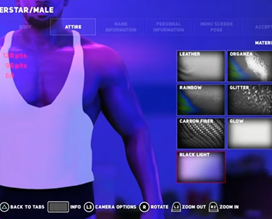
WWE2K18Materials
There are loads of colour and customisation options.

You can still create your own championship belts as well, if that’s your thing; given how many old school belts are in the videogame, I don’t tend to do much with this, though. Instead, my focus was on the massively deep create-a-wrestler mode; created wrestlers look more realistic than ever before and you can choose from a whole bunch of options, from wrinkles to scars, facial and body hair, eye colour, veins, muscle definition, and even how much body oil your created wrestler has! There are also a whole load of attire options, including blank attires that you can customise as you desire and also pre-set attires worn by the featured roster; you can change not only the colour of these attires but also the material type, which allows shirts and jeans and the like to be leather, take on a metallic hue, or even glow in the dark! Finally, there are far more options for names for your created wrestler this year and the in-game commentary team will refer to your created wrestler by these throughout their matches.

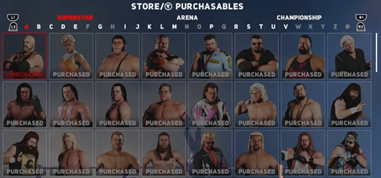
WWE2K18Store
Apparently you can put a price on greatness.

Although there are many WWE and superstar-related images available to you in this mode, there are noticeably less options for body tattoos this years, unfortunately. This is where the Community Creations option will come into play; you are able to upload images to the 2K Sports website and transfer them into the videogame, meaning you can search in the WWE 2K18 for a whole bunch of professionally-designed images, logos, and tattoos to apply to your created wrestler. You can also download created wrestlers created by others to account for those wrestlers omitted from this years roster, though you are limited to twenty downloads a day and cannot download created wrestlers that feature aspects from wrestlers you’ve yet to unlock or purchase. Speaking of which, WWE 2K18 features an in-ring store mode, as is the norm for this series now. As you play matches, you are awarded virtual currency based on how many stars your match scored; the more stars you get through move variety, countering, and such, the more currency you earn. You can then spend this in the store to unlock Legends, and additional arenas and championships and, make no mistake, this is the only way to unlock this extra content. Previously, in WWE 2K14 at least, you could unlock new wrestlers by playing the 30 Years of WrestleMania mode but, here, you can only do this by purchasing them.

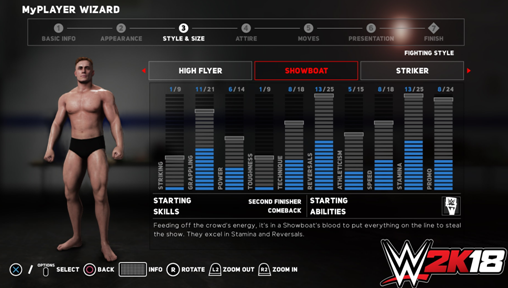
You can do this by playing any match in any mode and, also, through the MyPlayer mode, which is the career mode of the videogame. You have to create a wrestler, using far more limited tools and options, and work your way through training and wrestling on NXT before being called up to the main roster. You can make some limited decisions to decide whether you are a Company Man (a heel) or a Fan Favourite (a face). In my playthrough, I was initially called up to Raw and forced to lose a bunch of matches, so I jumped to SmackDown! Live, where I won the United States Championship, Money in the Bank ladder match, and Royal Rumble match and am currently feuding with Triple H and the Authority on the path towards the WWE Championship. Along the way, you can partake in side quests to earn rewards (new moves, attire, and currency), make a signature t-shirt to earn some extra cash, and perform in-ring promos and run-ins.

WWE2K18MyPlayer
You’ll need to pay to get the most out of MyPlayer mode.

Overall, this mode is quite enjoyable but, honestly, it’s a poor substitute for a Road to WrestleMania-type of mode. There are a lot of load times and some noticeable frame drops; you are also forced to walk/run from the garage to the producer and back every single week, which begs the question why they bothered putting in the free-roaming backstage area at all rather than just have a set-up similar to the PlayStation 3-era titles where you had a locker room with a phone and just did everything through text. There are some inconsistencies; I was regularly teaming with Sami Zayn then, randomly and with no explanation, my partner suddenly became Fandango. I was also once asked by Tius O’Neil to attack Primo Colón one week but, when I couldn’t find him, ended up attacking Kassius Ohno. There are also a lot of times when you do more promos than matches, when the match objectives aren’t completely clear (the Money in the Bank match springs to mind), and when your matches end due to interference more often than not but, these issues aside, it’s a pretty decent mode, though I found it more enjoyable and profitable to play Universe mode more than anything.

It’s interesting that the load times for the MyPlayer mode are so atrocious as, normally, they’re not that bad; matches in Universe mode load much faster than in WWE 2K14. I learned from some of my mistakes in WWE 2K14 and don’t have nearly as many custom arenas or created wrestlers, which may help with this, and also towards limiting crashes. WWE 2K14 would crash all the time, usually after a match but sometimes before one, and it was very frustrating. I have had a few crashes in WWE 2K18 but, as the matches and the videogame loads up a lot faster, it’s not as annoying. One bug that is annoying is, when downloading a created wrestler, attached logos and images will sometimes not download, meaning you’re left having to either find them separately or with an incomplete created wrestler/attire.

I haven’t played WWE 2K18 online yet, mainly because I don’t have Xbox Gold or whatever you need to do that but also because online players are trolling, move-spamming sons of bitches; also, the learning curve for timing reversals and having competitive but enjoyable matches that I actually won was quite steep. Sometimes, you’ll have a match and be in complete control and all the opponent has to do is a couple of moves and you can’t recover, then you get hit with one finisher and its over. A good feature, though, is that miss-matched opponents (like Braun Strowman against Kalisto) often trigger a squash match, where you gain full momentum and a finisher after your first hit and win the match in seconds for a decent payday.

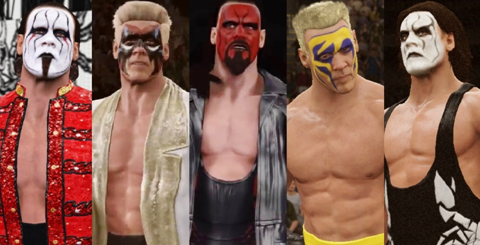
WWE2K18STINGS
All the Sting you could ever want!

The roster in WWE 2K18 is as deep as you could want; there are some noticeable omissions from NXT but, otherwise, everyone you could want and more is in the videogame alongside some decent and surprising Legends. Hulk Hogan and Yokozuna are gone but Vader and the Big Boss Man are back; there are some crazy instances of numerous duplicates, such as five (five!) versions of Sting and separating Finn Balor and his Demon King attire (though the Demon King does still act as an alternative attire to regular Balor) but, mostly, there’s some good inclusions this year. The soundtrack, apparently “curated” by the Rock, is mostly miss rather than hit, with the only decent track being a radio edit version of Disturbed’s Down With the Sickness, though a similarly-edited version of Limp Bizkit’s Rollin’ is used as the entrance theme for Undertaker ’00 despite this particular version of Undertaker’s biker gimmick actually being more associated with You’re Gonna Pay. The in-game commentary is all-new, at least for me anyway, including the three-man team of Michael Cole, Corey Graves, and Byron Saxton; mostly, it is far better than what I experienced in WWE 2K14 but there still times when they refer to women as “guys”, talk inanely about things not even relevant to the match in progress, or ask each other questions that are never answered.

WWE2K18Balor
Graphically, WWE 2K18 is very impressive.

Overall, WWE 2K18 is a challenging and enjoyable affair; Universe mode is bigger and more expansive than ever, with shorter load times and significantly less crashes and glitches (so far), and the star rating system does make it feel as though each match is important and worth something. MyPlayer suffers a bit (though admittedly this may also be because I don’t want to waste my virtual currency upgrading the MyPlayer character unless I absolutely have to as I want to unlock the Legends) but is, otherwise, fun enough for what it is. I would have also liked to have seen, at least, Showcase matches similar to previous titles or themed around a wrestler (this year’s pre-order bonus, Kurt Angle, for example, or Shawn Michaels, or even the cover star, Seth Rollins) to assist with the unlocking of extra content. Creation options are deep and versatile; you can waste hours and even days crafting the perfect created wrestler (I know I did!) or downloading extra attires and wrestlers to fill out the already impressive roster. I am glad that I waited for 2K Sports to add in many of the features they previously omitted and refine their current-generation gameplay engine as it seems to have paid off; matches are far more realistic and challenging than in WWE 2K14, where I could win with a minimum of effort, which is good once you’re used to the control scheme and what is expected of you, if admittedly somewhat detrimental to those who just want to pick it up and play a quick match without any obligation to simulating a real-life WWE match. Based on my experience with this title, I will probably wait until WWE 2K20 for my next entry into the series as I would never recommend anyone buys these titles on a yearly basis but, if like me, you’ve been away from the series for a while, I would definitely recommend picking this one up.

My Rating:

Rating: 4 out of 5.

Great Stuff

Game Corner: THQ/AKI Wrestling Retrospective

GameCorner
THQAKITitle

With WWE 2K18 (Yuke’s/Visual Concepts/2K Sports, 2017) due to be released in a couple of weeks, I thought I’d take the time to revisit some classic wrestling titles on everyone’s favourite polygonal home console, the Nintendo 64. Inevitably, with every new WWE videogame released, debates reignite, resurface, and rage on about why (oh, why, just…why?) can we not get a new videogame in the style of WWF No Mercy (Asmik Ace Entertainment/AKI Corporation/THQ, 2000)? Granted, these debates usually occur on extremely adolescent and unruly forums, such as those on GameFAQs, but there is, nevertheless, a good reason for this. Well, actually, there’s two: nostalgia and the fact that AKI and THQ produced some simplistic and yet incredibly deep and addictive wrestling videogames back in the day. The partnership between Asmik Ace Entertainment and the AKI Corporation began way back in 1996, with Virtual Pro-Wrestling on Sony’s PlayStation, which was later published in North America by THQ as WCW vs. The World in 1997. Following this, AKI and THQ’s wrestling titles would be exclusive to the Nintendo 64 for the foreseeable future and the first instance of this collaboration came with the Japan-exclusive Nintendo 64 title Virtual Pro 64.

THQAKIVirtualPro
Virtual Pro-Wrestling was the precursor to greatness.

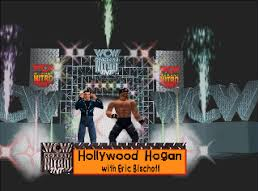
I’m not going to delve too deep into the Virtual Pro series as I never played these videogames; instead, with my young mind only grasping the simplest concepts of the pro wrestling world, my first exposure to the series came with the release of WCW vs. nWo: World Tour (Asmik Ace Entertainment/AKI Corporation/THQ, 1997). When I was a kid, this was the wrestling videogame everyone had and everyone played, to the point where I vividly remember finally getting a copy and playing it all through the night during a sleepover with some friends of mine and driving them to near boredom as I worked to unlock and complete everything as they had done weeks and months before. WCW vs. nWo: World Tour’s roster is split into various factions including the titular WCW and nWo but also some fictional wrestling promotions featuring renamed Japanese wrestlers to dance around tricky copyright issues. Each wrestler has four different attires, allowing you to play as Sting in his surfer persona and Hollywood Hogan in the good old fashioned red and yellow. An interesting twist of irony here is that, these days, people will lose their shit about 2K including five separate versions of Sting, yet players of World Tour should be more than used to this given that you can play as Sting and the imposter Sting recruited by the nWo back in the day.

THQAKIStings
TWO Stings!? Blasphemy!!

World Tour introduced many of the gameplay mechanics that would become staples of this videogame series over the coming years; up to four players can play at once in a variety of matches, though only a single player can take on the league challenge to win championship belts and unlock hidden wrestlers. The core gameplay is built around a simple and yet intricately challenging grapple, strike, and reversal system: players perform a light grapple by tapping the A button and a strong grapple by holding the same button. Pressing a direction on the D-pad in conjunction with either the A or B button will see their wrestler perform one of ten different grappling moves, while light or strong presses of the B button alone (or A and B together) will strike the opponent with a kick or a punch. Players can block incoming strikes with the R trigger and counter grapples with the L trigger. Players can also perform submission holds on a downed opponent, dash at their opponents to land running attacks or dodge around them, drag their prone opponent’s body around the ring, climb the corner turnbuckles, exit the ring and grab weapons from the crowd, or taunt by wiggling the analogue stick. Taunting, and successfully countering and landing moves, raises your wrestler’s Spirit meter; once it is full and flashes “SPECIAL!”, players can perform a strong grapple and wiggle the analogue stick to perform their wrestler’s finishing move and attempt a pin fall.

THQAKIPowerbomb
Nearly every wrestler has a Powerbomb as a Special move.

And good luck with that; World Tour has a steep difficulty curve, even on the easier settings, that can make some matches last nearly ten minutes at a time as you trade counters and moves with your opponent, constantly egged on by the rising and falling cheers and jeers of the crowd and the thumping bass of the in-game music. However, playing through each challenge and winning championships allows you to fight against, and unlock, a number of hidden characters to add to the already-substantial rosters (even Muhammad Ali shows up…as “Joe Bruiser”, whose entire moveset consists of punches!) Sporting a distinct cel-shaded appearance, WCW vs. nWo: World Tour is easily the simplest and least technically-impressive of the AKI/THQ wrestling videogames; there is no create-a-wrestler function (though you can alter the colours of the wrestlers’ attires) and very little options outside of the single and multi-player aspects. However, AKI/THQ took a significant step in the right direction with the subsequent release of WCW/nWo Revenge in 1998.

THQAKIValet
Some wrestlers came out with valets or managers.

Revenge took every aspect of its predecessor and improved upon it vastly; wrestlers now have individual entrances (sometimes including a valet or holding a weapon, though their individual theme music is unfortunately absent), there are more animations and variety for reversals, a cartoon referee appears onscreen to visualise pin falls and submission holds, an instant replay triggers whenever a wrestler hits their Special move or a signature attack, and arenas are modelled after those seen regularly on television and pay-per-view events. Players can now also steal their opponent’s taunt by rotating the analogue stick in a clockwise direction and a combo system, of sorts, allows certain wrestlers to string together strong striking attacks at the cost of some of their grapple moves. Wrestlers also enter the ring wearing their championship belt and sport more true-to-life finishers and signature manoeuvres thanks to the addition of multiple new animations and moves.

THQAKIEdit
Customisation has always been an option.

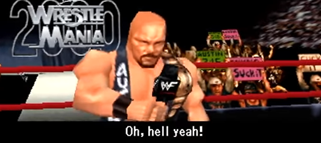
However, there were some drawbacks; losing the cel-shaded appearance, characters now appear far more polygonal than before. The difficulty curve remained relatively consistent, meaning that even a dominating performance from a player and the successful delivery of a Special move would not guarantee victory in the majority of matches. Instead, players had to earn their victory, wearing their opponent down with counters, strikes, and grapples in order to win a championship belt and, again, unlock hidden wrestlers. Create-a-wrestler was still absent but the editing options for existing wrestlers was greatly expanded, allowing players to play about with existing attires in interesting and fun ways. WCW/nWo Revenge was the last of AKI and THQ’s titles with the WCW license; from here on out, they would take their revolutionary videogame engine and ideas and apply them to the WWF brands. WWF WrestleMania 2000 (Asmik Ace Entertainment/AKI Corporation/THQ, 1999) was the first of these endeavours and, as before, AKI and THQ took everything that worked in their previous videogames and expanded and improved upon them further still.

THQAKIWrestlemaniaIntro
Just another chair shot for poor old Mick…

The improvements can be seen immediately; just as Revenge opened with a introduction sequence showcasing its roster and gameplay elements, WrestleMania 2000 begins by showcasing the best of the best of the WWF’s acclaimed Attitude Era. Following this, players are taken to a comprehensive menu screen where they can elect to play a single or multi-man match with the title’s exhaustive roster; while the roster is still arranged in groups, they are no longer organised into factions and the roster is comprised entirely of those seen on a weekly basis back in 1999. Whereas AKI’s WCW titles featured a rather simplistic series of one-on-one matches in the pursuit of individual championships, WrestleMania 2000 includes a lengthy career mode called the Road to WrestleMania. Players select a wrestler and a tag team partner and play a series of matches through one year, facing lower-card wrestlers, taking part in tag team matches, and winning championships in the pursuit of the WrestleMania main event.

THQAKIWrestlemaniaCutscenes
After facing Foley’s personas numerous times, you’ll welcome this fight!

Winning multiple championships may mean that the player has multiple matches on one card and the better your progress, the more hidden wrestlers you will unlock; only a 100% success rate will reap the best rewards, which is a pretty tall order considering the mode’s difficulty spikes and drops depending on your success rate and the opponent you are facing. There will even be a few cutscenes in this mode where hidden wrestlers (usually one of the three faces of Foley) will challenge you to defend you championship.

THQAKICreate
WrestleMania 2000 introduced a proper create-a-wrestler mode.

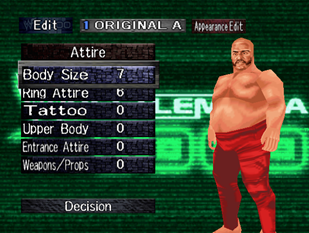
Perhaps the most significant addition was the comprehensive create-a-wrestler mode, which also allowed players to freely customise their name, music, video, and appearance. Using the create-a-wrestler mode, however, players could piece together close approximations of wrestlers not included in the videogame, such as Kurt Angle or Tazz, in addition to those who hadn’t appeared in a WWF ring at the time, such as Diamond Dallas Page and Goldberg, or entirely original characters. Players could choose from an exhaustive list of moves, many of which are carried over from the previous titles, to pretty much create anyone they could envision.

THQAKIWrestlemaniaHBK
Only a 100% win streak will reap the best rewards.

In addition, players could create a custom championship belt to defend or entire pay-per-view events; wrestlers all have their own individual entrance themes and tag teams even came to the ring with their team name displayed. The only real downsides were the increased polygonal look of the videogame and the sharp difficulty spike in Road to WrestleMania mode, which could result in players struggling to put away the Godfather but dominating Chris Jericho within two minutes. Finally, the pièce de résistance, the crown jewel in the AKI/THQ partnership, WWF No Mercy. It’s strange to me that the follow-up to WrestleMania 2000 would take its name from a strictly B-level pay-per-view event but there was nothing B-level about this videogame. WWF No Mercy was the culmination of nearly six years of development, refining, and improvement, featuring the biggest and deepest roster yet, the most striking graphics available, the most intricate story mode of all of AKI’s wrestling titles, and the deepest create-a-wrestler you could ask for. There’s a good reason this videogame has been heralded as one of, if not the, best wrestling videogames ever made; more than nostalgia, it’s depth and replayability.

THQAKINoMercyChampionship
No Mercy believed in gender equality, if nothing else.

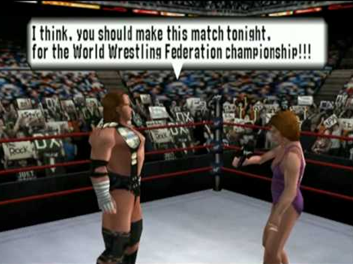
After the suitably over-the-top opening sequence, players could enter the Championship mode to compete in a series of matches and win a championship belt. Unlike WrestleMania 2000, players competed for each belt individually (or alongside a friend if they chose to go for the Tag Team Championships) and this mode featured multiple branching paths and cutscenes based on a variety of WWF storylines; for example, players could play through the entire WWF Championship storyline and fight against Triple H in exactly the same manner as Mankind did, even transforming into Cactus Jack for their street fight at Royal Rumble, or they may lose a match and branch off into a storyline mirroring Chris Jericho’s issues with Triple H from 2000. Once the player won a belt, they could play the mode again in order to defend it. With its multiple paths, no longer forcing players to win 100% of their matches, and far more manageable difficulty curve, No Mercy’s Championship mode was light years ahead of anything seen in AKI’s previous videogames and it’s a lot of fun to play differently each time to 100% each path.

THQAKINoMercyShop
Purchase new content in the SmackDown Mall.

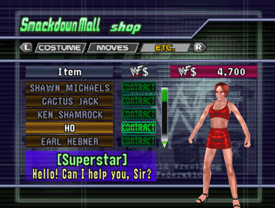
New additions to the gameplay in this title included not only a graphical overhaul that makes wrestlers far lass polygonal but also the inclusion of running grapples, both from the front and behind, the return of blood (though early editions of the videogame would randomly wipe themselves due to some glitch involving the blood), guest referee and ladder matches, a breakable announce table at ringside, multiple backstage areas to fight in, a new version of the cage match to better display the in-ring action, the Survival mode (where players faced an endless Royal Rumble against every single wrestler in the title and in which you could unlock hidden wrestlers), and the SmackDown Mall. In the Mall, you could use the money you earn in Championship and Survival mode to unlock loads of extra content, from new moves and gear to use in create-a-wrestler to hidden characters and weapons.

THQAKINoMercyCAWs
You could create almost anyone in No Mercy.

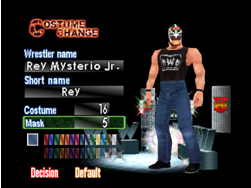
Speaking of create-a-wrestler, this mode returned better than ever; the moves and attire options made available were more than extensive, allowing you to not only create WCW, ECW, and Japanese wresters not included but also modern day wrestlers to keep the videogame as up-to-date as you desire. The inclusion of wrestler faces (both as avatars and to use on your created wrestler) and certain attires also allowed you to create omitted wrestlers like Gangrel and the Mean Street Posse. Each attire slot could now be assigned entirely unique attributes, meaning you could use one slot to create four separate wrestlers and all that they are forced to share is a moveset. The developers even utilised this to put TAKA Michinoku and Funaki in the same slot, something 2K are seemingly reluctant to do in this day and age (despite proving they are capable of doing so in the past). There were, however, some drawbacks; wrestlers no longer had their entire entrances and tag teams no longer entered as a duo, multi-man matches suffered from slowdown that was not present in previous titles, there were no good mask options to create luchadors like Rey Mysterio, the Big Show was entirely absent from the videogame and (hilariously) replaced in Championship mode with Steven Richards (as opposed to, say, Chris Benoit or even the Big Bossman), and, as mentioned, early copies of the videogame featured a game-breaking glitch that would cause the data to be randomly lost.

THQAKINoMercySurvival
Still the best multi-player wrestling videogame, for my money.

This was a major downside to the videogame at the time, as many players had corrupted copies, and even reissued copies of the videogame would often be prone to this glitch. Unfortunately, WWF No Mercy was the last videogame produced by AKI and THQ; despite apparently planning a third title, WWF Backlash, THQ and AKI parted ways, meaning the WWF videogames would follow the model set by the equally-enjoyable WWF SmackDown! (Yuke’s/THQ, 2000) up until the modern era. Since then, the standard set by AKI has not even attempted to be emulated much less imitated by THQ in their subsequent titles. Moving away from the simple, but in-depth grappling system developed on the Nintendo 64, WWE videogames now seek to closely emulate the televised product through simulated gameplay rather than arcade-style action. Although, graphically, AKI’s titles have not aged terribly well, nothing can take away that rush of nostalgia when starting up a new session on WWF No Mercy; instantly, I am transported back to a simpler time when me and as many as three other friends would spend all day and night playing match after match and pushing the cartridge to its very limits. No WWE videogame since has received that kind of constant love and attention from me, as online gaming and the realities of everyday life intervene with the simple pleasure of gathering around a television and throwing Spears at each other endlessly with the very best polygons money can buy.