Back Issues [A-Day]: The Avengers #54-55 / The Mighty Avengers #66-68


In September 1963 the legendary duo of Stan Lee and Jack Kirby assembled Earth’s mightiest heroes, the Avengers, who became the premier team of Marvel Comics, formed the backbone of the Marvel Cinematic Universe, and become an unbelievably popular and successful franchise.

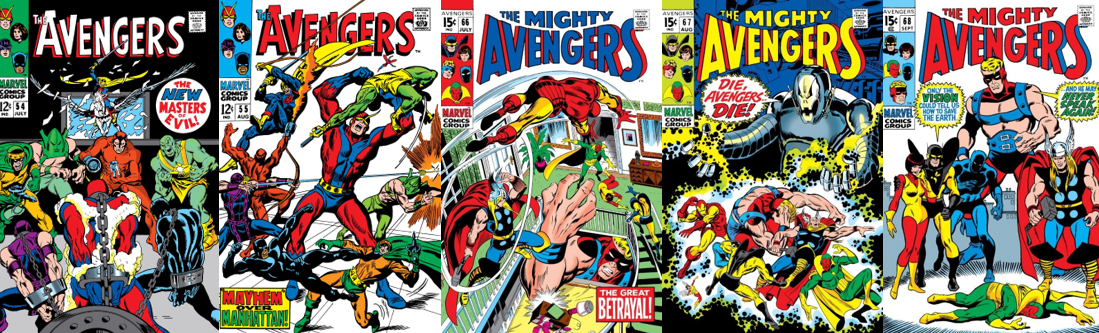
Story Title: “…And Deliver Us From–The Masters of Evil!”
Published: 9 May 1968 (cover-dated: July 1968)
Writer: Roy Thomas
Artist: John Buscema

Story Title: “Mayhem Over Manhattan!”
Published: 11 July 1968 (cover-dated: August 1968)
Writer: Roy Thomas
Artist: John Buscema

Story Title: “Betrayal!”
Published: 13 May 1969 (cover-dated: July 1969)
Writer: Roy Thomas
Artist: Barry Windsor-Smith

Story Title: “We Stand at Armageddon!”
Published: 10 June 1969 (cover-dated: August 1969)
Writer: Roy Thomas
Artist: Barry Windsor-Smith

Story Title: “…And We Battle for the Earth!”
Published: 8 July 1969 (cover-dated: September 1969)
Writer: Roy Thomas
Artist: Barry Windsor-Smith

The Background:
After DC Comics brought together their most popular and powerful superheroes to form the Justice League of America in 1960, Marvel Comics head honcho Martin Goodman tasked Stan Lee with creating a similar team following his success with the Fantastic Four and the X-Men. Luckily, Lee and his most famous collaborators had already introduced numerous colourful characters and, thus, Anthony “Tony” Stark/Iron Man, Doctor Robert Bruce Banner/The Hulk, Doctor Donald Blake/Thor Odinson, and Doctor Hank Pym/Ant-Man and Janet Van Dyne/The Wasp became the first Avengers. Since the debut issue, the Avengers have been a consistent and influential presence in Marvel Comics and their roster has constantly shifted and changed, with the long-retired Captain Steve Rogers/Captain America joining their ranks in issue four. The Avengers splinter groups, been disassembled and reassembled, aided in massive cosmic events, and battled some of Marvel’s most powerful supervillains. Perhaps one of their greatest recurring enemies is the psychotic cyborg Ultron, who was first revealed under the guise of the Crimson Cowl in The Avengers #55. Created by Roy Thomas and John Buscema, and built in-universe by Hank Pym, Ultron is a sentient android who developed a murderous obsession with destroying the Avengers and conquering the world. Capable of changing his form, improving and becoming more powerful over the years, Ultron inadvertently created one of the Avengers’ most powerful allies, the Vision, expanded his schemes to include both the galaxy and altering the timeline, and even merged with his creator at one point. Ultron has made regular appearances in videogames as a powerful, penultimate, or final boss, is often portrayed as a formidable villain in Marvel cartoons, and was masterfully brought to life by James Spader in Avengers: Age of Ultron (Whedon, 2015).

The Review:
The Avengers’ first encounter with the killer automaton Ultron began with T’Challa/The Black Panther testing Dr. Hank Pym/Goliath’s new defensive protocols at the Avengers Mansion. Satisfied that the booby traps are fully functional, Giant-Man alerts the Avengers’ butler, faithful Edwin Jarvis, who’s shocked at the subtle insinuation that he would ever betray his team’s secrets. However, Jarvis then slinks away to make a clandestine phone call and then slips out to visit his mother, only to venture to a secret base beneath a condemned building to meet the villainous Masters of Evil! Rather than being brainwashed or some elaborate decoy, Jarvis has truly betrayed the Avengers for a hefty cash sum and, while Chen Lu/Radioactive Man is suspicious of their enemy’s butler working with them, the team’s newest leader – the elusive and secretive Crimson Cowl – vouches for Jarvis. Still, Ulysses Klaw is anxious to have his revenge against Earth’s Mightiest Heroes, specifically the Black Panther, and is tempted to kill Jarvis as a substitute. Thanks to Dane Whitman/The Black Knight and Bruno Horgan/The Melter, the enraged villains cool off enough to let Jarvis speak. However, after Jarvis delivers the floorplan for Pym’s new defences, the Crimson Cowl double-crosses him with a puff of knockout gas and sends the Masters of Evil on their way. While flying about on his winded horse, Aragorn, the Black Knight recalls how he joined the new Masters of Evil to betray them to the Avengers. However, the Crimson Cowl anticipates this and sends the others to intercept Whitman at the Avengers Mansion. Though overwhelmed, the Black Knight orders Aragorn away but, while Clint Barton/Hawkeye spots the horse, the abrasive Avenger is attacked by the Melter before he can alert the team.
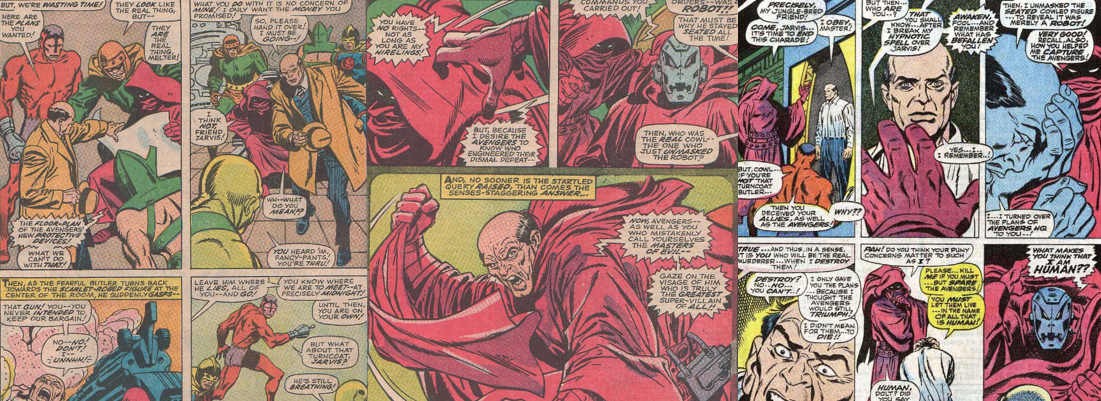
The Avengers and their foes are stunned when their newest adversary turns out to be more than he seems.

Though he fires off a few arrows, Hawkeye’s downed when the Melter buries him under some debris. Simultaneously, David Cannon/Whirlwind attacks the Black Panther, sending him flying with a whirling cyclone, and the Wasp is accosted by Klaw. Despite showing no fear and her super shrinking ability, the Wasp is easily defeated when she flies head-first into a door! Similarly, Radioactive Man surprises Goliath and Doctor William “Bill” Foster in the Avenger’s lab, subduing Foster with a super adhesive and luring Goliath into a trap where he’s ensnared by his own devices! With all the Avengers captured, the gloating Masters of Evil introduce their master, who’s first revealed to be a distinctly Ultron-looking robot decoy and then unmasked to be Jarvis! The Masters of Evil load their prisoners into a futuristic craft and head back to their master, relishing their victory, though the villains are as unnerved by Jarvis’s turn as the Avengers, if not more since Jarvis demonstrates an uncanny ability to be fully aware of everything, no matter how trivial. Although Goliath escapes his restraints, Klaw’s saved by the Crimson Cowl, who admonishes his carelessness. When Klaw turns his incredible Sonic Claw on his master, he’s amazed when it has no effect and is left grovelling at the hooded figure’s feet, suitably humbled. The Crimson Cowl then reveals his plan to drop the Avengers into the ocean and blackmail New York City with a hydrogen bomb. However, the Crimson Cowl purposely drops the Avengers in a craft so they can slowly suffocate after learning that Jarvis was hypnotically duped into betraying them by none other than Ultron-5!
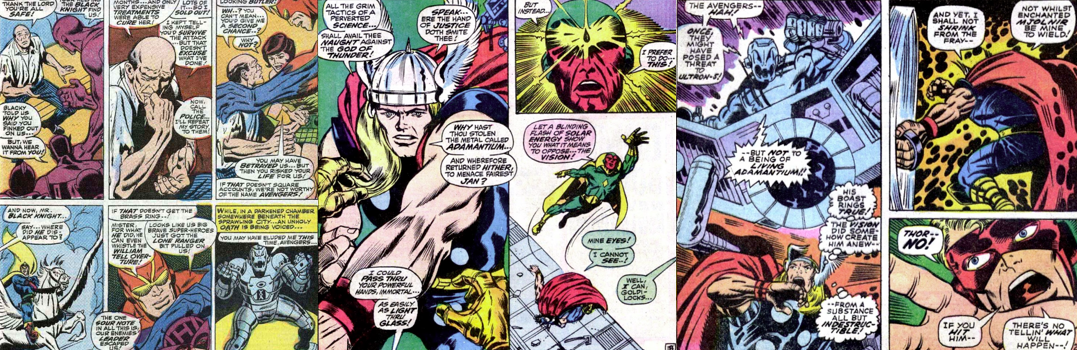
After freeing Jarvis from Ultron, the Avengers are later betrayed by the Vision!

Though it seems like the Melter crushes Jarvis under some rubble during his desperate escape, the remorseful butler survives and wanders the streets, succumbing to exhaustion just as he’s found by the Black Knight. Thanks to Jarvis’s tipoff, the Black Knight intercepts Ultron-5’s craft and frees the Avengers. The team quickly avenge themselves against the Masters of Evil, causing Whirlwind to flee but apprehending the others and easily dismantling the hydrogen bomb. When the Avengers confront their regretful butler, Jarvis reveals he sold out to pay for his mother’s treatments, and they quickly forgive him and part with the Black Knight on good terms, though Ultron-5 is left vowing revenge. Some time later, aboard a Supreme Headquarters, International Espionage and Law-Enforcement Division (S.H.I.E.L.D.) Helicarrier, a new version of the Avengers tests the durability of the mysterious Adamantium, a substance powerful enough to tank blows from Thor Odinson’s hammer and Iron Man’s Repulsor Rays. This proves that, as the team feared, the mineral has been altered by a “molecular rearranger” and presents a serious threat. As Goliath (now Barton garbed in a garish costume) tries to prove he can succeed where they failed, the strangely silent synthezoid, the Vision, is suddenly assaulted by an unseen force and compelled to brood over the grave of Simon Williams/Wonder Man, whose brain patterns formed his personality. Though he first suspects Simon’s spirit is calling him, the Vision suddenly has a revelation and flies off, leaving Pym (now known as Yellowjacket) to ponder his ally’s fate. While Iron Man tests himself in the mansion’s combat simulator, the Vision returns to the team’s Helicarrier, subdues a guard, and steals the Adamantium before lowering the ship’s air pressure to leave none alive. When the team finds out and find Janet attacked, they angrily confront the Vision, who coldly rejects his humanity, easily shrugs off their attacks, and heralds the rebirth of his creator, now in the jet-powered form of Ultron-6!
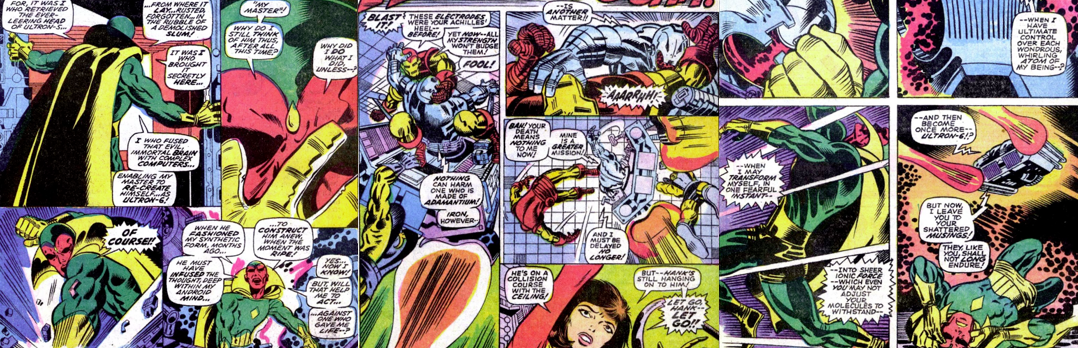
The remorseful Vision tries to atone for his mistakes by battling his creator to the death.

Now made of the indestructible Adamantium, the vengeful Ultron-6 attacks without mercy, easily defeating Thor and Goliath when the battle hungry Thor strikes the android’s body with his enchanted hammer, Mjölnir, and causes a massive shockwave. Though Yellowjacket gets the drop on his creation, Ultron-6 easily throws him off and then targets Pym over Iron Man and the Wasp, hell-bent on killing his “father”, though he proves too powerful for Iron Man to affix some electrodes to stop him. Bored of the conflict, Ultron-6 flees, unknowingly pursued by the repentant Vision, realising his creator programmed a failsafe to ensure his servitude. After regrouping, the Avengers set out to stop Ultron-6, who returns to his stronghold and prepares to launch a cache of nuclear weapons, determined to wipe out the human race! When confronted by his melancholic, wayward “son”, Ultron-6 flies into a rage, desperate to prove himself superior to his creation, though the Vision’s incredible matter-altering powers make him more than a match for his “father”. Ever the stubborn android, Ultron-6 escapes the Vision’s wrath by transforming into “sheer ionic force” and leaves the Vision to be attacked by S.H.I.E.L.D. soldiers for stealing their Adamantium. When the Avengers arrive, they discover Ultron-6 is one lever pull away from causing nuclear destruction, though the murder machine is left incensed that lever is mysteriously inoperable. Regardless, Ultron-6 is still powerful enough to endure Yellowjacket’s electrical blasts and throw the team around like ragdolls with a burst of explosive ionic power. Yet, despite apparently being strong enough to kill the Avengers and then enact his diabolical plot, Ultron-6 simply vanishes and the team is left to witness the Vision’s theatrical sorrow for being controlled by his creator. Before collapsing from his efforts to defeat Ultron-6, the Vision also reveals that he caused Ultron-6’s plan to go awry by trashing his apparatus.
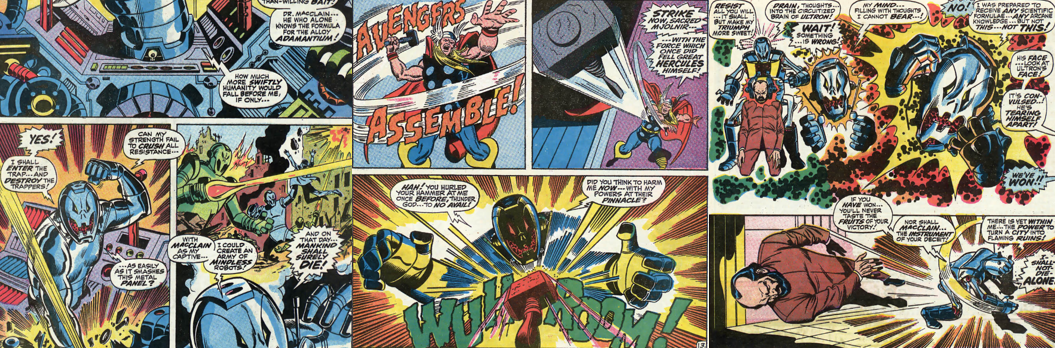
Despite his all-powerful new form, Ultron is undone by some Pym trickery.

After convincing S.H.I.E.L.D. to relinquish custody of the Vision, the Avengers fail to rouse him with a concentrated dose of solar energy and thus turn to Yellowjacket’s “rudimentary mind-probe” to learn that the molecular rearranger is the key to stopping Ultron-6 since the only thing that can rearrange Adamantium. Although the device was also stolen alongside the Adamantium, Yellowjacket contacts the Black Panther while he’s fending off an invasion of Wakanda and requests a chunk of his nation’s Vibranium. Upon learning that the Avengers plan to publicly reveal his threat, Ultron-6 decides to enter their obvious trap and slaughter them, intent on kidnapping Adamantium expert Doctor Myron McLain and forcing him to build an army of Ultron duplicates so he can conquer the world. Despite being a capable and adaptable fighter, the Wasp is more concerned with dressing well for the team’s arrival at the United Nations building, where Dr. McLain is attacked by Ultron’s newest shell, a towering humanoid construct claiming to be the “ultimate” Ultron. Easily dispatching the nearby S.H.I.E.L.D. agents, Ultron calls out the Avengers and renews their battle, barely flinching when struck by Mjölnir and shrugging off the clumsy Goliath’s gigantic fist before briefly putting both Avengers down with lasers. Ultron then forces the Avengers to back off lest he murder Dr. McLain, leaving them powerless to stop him from affixing a “mind-draining device” to the doctor’s head to absorb his immense knowledge and secrets. However, Ultron’s forced to break the connection when he struggles to contain Dr. McLain’s vast intellect, leaving him on the brink of a complete meltdown. Thankfully, Thor averts this by containing Ultron within a special expanding chamber…thing…made of Vibranium, seemingly destroying Ultron in the process. In the aftermath, it’s revealed that “Dr. McLain” was really super genius Hank Pym in disguise and that he forced Ultron to absorb a phrase so alien to him that it led to his destruction: “Thou shalt not kill.”

The Summary:
While I’ve always been a fan of Ultron, his first encounters with the Avengers felt a bit lacking to me. The first two issues, especially, are a bit of a mess, overloaded with characters and painting Jarvis, of all people, as a deceiver and a villain! I understand the idea of behind bringing together a new Masters of Evil, especially as the villains nicely counter each hero’s abilities, but their victory felt forced here. Ultron-5 goes to the effort to brainwash Jarvis (despite him later admitting that he “sold out” for money for his sick mother) to acquire Pym’s floorplan, only for Whirlwind to just enter through a window and the Melter to…well, melt…a hole in the wall. There was barely a co-ordinated attack on the Avengers Mansion, the villains just caught them by surprise with such sophisticated tricks as fancy glue and slamming a door. I would’ve much preferred it if Ultron-5 had used Jarvis’s knowledge to reprogram or take control of Pym’s machinery, turning them against the Avengers as he turns training room against Iron Man and overwhelming them with a real show of power. Instead, the first two issues try to sell Jarvis as a traitor, with no one (not even Pym) recognising Ultron-5 until he reveals himself and the Masters of Evil happily following Jarvis’s commands. Ultron-5 is also depicted as a grandiose fool, more focused on gloating and humbling his enemies than finishing the job, and ends up undone by the Black Knight, of all people, and a comparatively weak incarnation of the Avengers. For me, this makes the “Crimson Cowl” part of Ultron’s history an odd and forgettable side note in the killer robot’s lineage, one perhaps only good for a pub quiz.
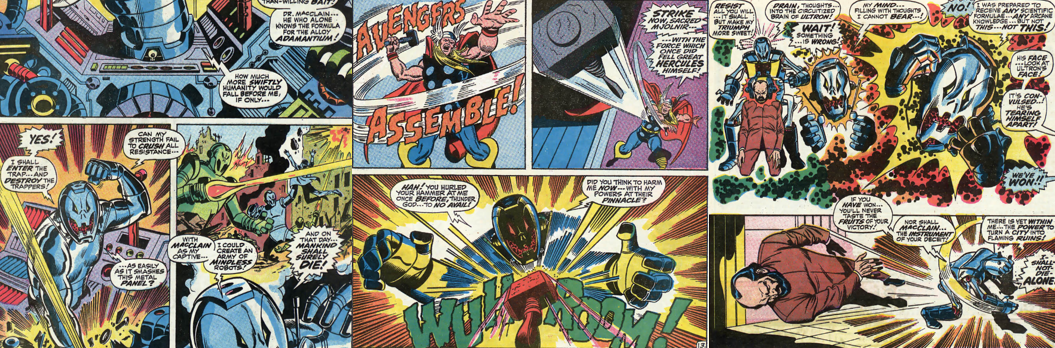
Despite his menacing appearance, Ultron is a boasting, psychotic braggart whose plans go awry.

Ultron makes a better impression in the second story, even if Hawkeye is parading around in a gimp outfit as Goliath and Pym is making a fool of himself as Yellowjacket. One thing I’ve always loved about Ultron’s design is his permanently screaming face, with the flaming energy bursting from his mouth, which is surprisingly expressive and matches his chaotic mood swings. These three issues are also noteworthy for introducing Adamantium and depicting it as the strongest and perhaps most dangerous substance on Earth. Its nigh-indestructible properties make it the perfect target for Ultron-6, who compels his “son”, the Vision, to steal it and fortify his otherwise laughable half-torso, half-rocket jet form. This also seems to facilitate an evolution in Ultron’s physical self, allowing him to project and even transform into ionic energy, easily making him a physical match for Thor and making fools of Goliath and the Wasp. By this point, Ultron-6’s plan has changed from blackmail to worldwide destruction and there’s a real sense of tension as the team desperately pursues him, especially as Ultron-6 is depicted as psychotic in his desire to eradicate human life. Yet, Ultron-6 apparently cannot construct new bodies for himself or robotic minions, which leads to his undoing when he targets Dr. McLain and is easily fooled by Yellowjacket. Still, despite “ultimate” Ultron failing to impress, Ultron is depicted as a significant threat as he outmatches, outwits, and outpowers a far stronger team of Avengers and comes dangerously close to enacting his plan. While he meets his end in dubious fashion, seemingly destroyed by the thought Pym plants in his head and the laughable Vibranium bell-thing Thor encases him in, I enjoyed seeing Ultron throw the Avengers around and be publicly revealed as a very real threat to the world.
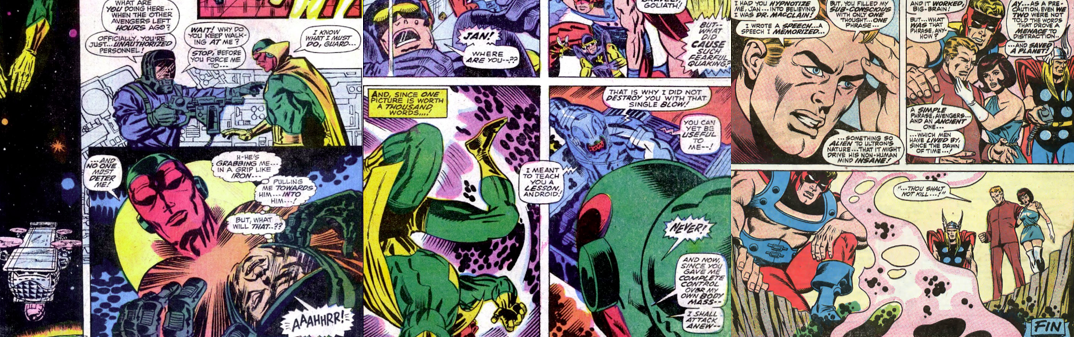
Melancholy Vision proves ineffectual against Ultron compared to Pym’s elaborate scheme.

These three issues also largely focus onto the Vision, a melancholy, brooding figure who’s treated with some distrust by Barton, apprehension by Pym, and naturally seen as a tortured soul by the flakily Janet. Prone to breaking into gloomy soliloquies, the Vision is constantly questioning his purpose and humanity and is torn between his loyalties to his teammates and the programming forced upon him by Ultron-6. Having created the synthezoid some time ago, Ultron-6 compels his “son” to subdue any in his way using his bizarre powers, phase through walls, and betray his allies by stealing the Adamantium. Conveniently, Ultron-6’s control over the Vision isn’t permanent and he soon comes to his senses, only to be set upon by S.H.I.E.L.D. soldiers and put his relationship with the Avengers in doubt. This, as well as the desire to stop his creator, drives the Vision to confront Ultron-6 in a battle to the death. Thanks to the Vision being effectively all-powerful, their fights are brutal and merciless, though Ultron-6 maintains the advantage with his ionic powers and the Vision is left seemingly comatose after exerting himself. I’m not a big fan of the Vision’s dramatic ways but it is fun seeing him go toe-to-toe with Ultron-6 and getting a sense of how powerful Ultron can be since he holds his own against powerhouses like the Vision and Thor. Still, the Avengers’ first counters with Ultron were surprisingly low-key, despite Ultron wishing to wipe the human race off the Earth. Ultron’s shown to be incapable of making good on this threat after the Vision wrecks his equipment, ironically needing the knowledge of a human to prove his mechanical superiority, and spends more time boasting and plotting than actually seeing things through. It definitely makes him a megalomaniacal villain and I really dig his creepy aesthetic, but I don’t think it did him any favours to go up against such mismatched Avengers teams, who handily defeated him despite not being as powerful as they could be.

My Rating:

Rating: 3 out of 5.

Pretty Good

What did you think to Ultron’s first encounters with the Avengers? Where does Ultron rank in your hierarchy of Marvel villains? Did you believe that Jarvis had turned traitor? Were you surprised when the Vision betrayed his team? Which incarnation of Ultron is your favourite or who would you like to see on the Avengers roster one day? What are some of your favourite Ultron stories or moments? How are you celebrating the debut of the Avengers today? Share your thoughts on Ultron, and the Avengers below and, if you’d like to see more Ultron reviews, go support me on Ko-Fi.


Back Issues: The Sentry #1-5 / The Sentry vs. The Void #1

Writer: Paul Jenkins Artist: Jae Lee

Story Title: “Act 1: The Suit”
Published: 19 July 2000 (cover-dated: September 2000)

Story Title: “Act 2: The Unicorn”
Published: 16 August 2000 (cover-dated: October 2000)

Story Title: “Act 3: The Photograph”
Published: 20 September 2000 (cover-dated: November 2000)

Story Title: “Act 4: The Conspiracy”
Published: 18 October 2000 (cover-dated: December 2000)

Story Title: “Act 5: The Betrayal”
Published: 15 November 2000 (cover-dated: January 2001)

Story Title: “The Truth”
Published: 31 January 2001 (cover-dated: February 2001)

The Background:
Debuting in 1938, Clark Kent/Kal-El/Superman wasn’t just an immediate hit with readers, he was also the first-ever costumed superhero, inspiring every single colourful crimefighter that came after him. Oddly, despite co-creating and bringing to life some of the industry’s most recognisable and beloved characters, Marvel Comics legend Stan Lee struggled to emulate the success of the Man of Steel. Over the years, many Marvel characters have been positioned as the company’s parallel to Superman, with none really making much of an impact. Robert “Bob” Reynolds/The Sentry, however, is perhaps the closest Marvel came to this endeavour. First conceived of by Paul Jenkins and Rick Veitch back in the late-1990s, the Sentry was pitched as an over-the-hill superhero struggling with addiction and was cleverly positioned as a “forgotten” hero from Marvel history. Easily one of Marvel’s most overpowered heroes, the Sentry was also a figurehead for mental illness thanks to his drug addiction and psychotic split personality, though this often led to him being seen an aggravating and inconsistent character. Despite some bad-ass moments and turning the tide in many conflicts due to his awesome power and unpredictable nature, Marvel’s insistence of reverting to the status quo meant the character has had more downs than ups over the years, to the point of fading from the spotlight. Indeed, as of this writing the Sentry has only ever appeared in supporting roles in Marvel videogames, with no animated appearances to his name, though the character did make the jump to the Marvel Cinematic Universe, courtesy of Lewis Pullman, in 2025.

The Review:
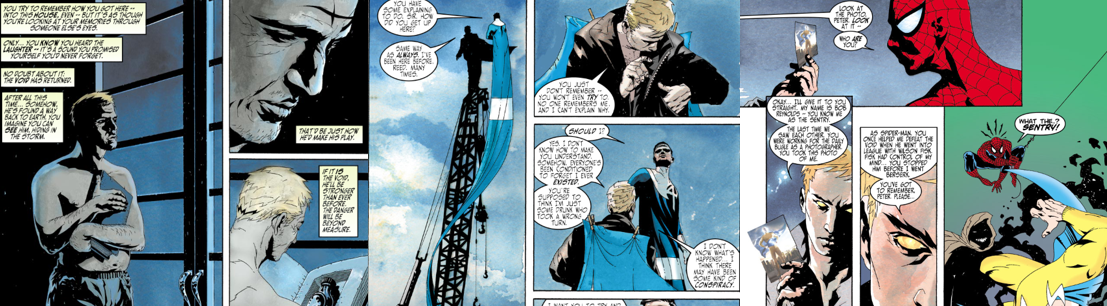
We first meet Bob Reynolds when he’s awoken by a lightning storm that triggers memories of an aggressive alien menace known as “The Void”. After reassuring his wife, Lindy Lee-Reynolds, Bob retrieves a bottle of liquid and is haunted by scattered memories that emulate the art style of the legendary Jack Kirby. Through them, we learn that a young, naïve Bob stumbled upon the mysterious “Professor’s” secret serum and drank it, fashioning a golden costume and blue cape and fighting both crime and supervillains as “The Sentry”. As Bob struggles to reconcile these memories, torn between them being fanciful delusions made from a comic book and real-life recollections of his battles against the Void alongside the Avengers, he remembers dispelling the Void with “the power of a million exploding suns” and the shadowy villain’s vow to return one day. Plagued by self-doubt, Bob’s memories shift to a decidedly darker, more Frank Miller-esque style as the Professor runs down his strengths and weaknesses. The serum supercharged his molecules, causing each atom to be slightly out of shift with time, granting him a “hyperstate of consciousness” and rendering him functionally immortal thanks to the power of the Sun. His only weakness was that his powers were tied to the serum, though the Sentry ignored the Professor’s warnings of him becoming addicted to the drug in favour of saving the galaxy from the Void. Desperate to regain a more coherent sense of himself and to be “vigilant” once more, Bob swigs from the serum and is immediately wracked by pain and spasms. Visions of the Void see Bob branded a common junkie and lectured about the emptiness of life so, when Lindy discovers him delirious and with an empty botte nearby, she naturally assumes he’s fallen off the wagon. Refusing to see her lover destroy himself before her eyes, Lindy walks out, leaving Bob to fool himself into thinking he’s slipping back into his costume and answering “the Sentry Signal” when, in reality, he’s simply put on a jacket with a crude cape pegged to the back! Still, he can fly, at the very least, so he heads to New York City (vaguely remembering when the Void reduced Manhattan to a smouldering crater) and is confronted by Doctor Reed Richards/Mister Fantastic. Though Bob speaks to Mr. Fantastic as an old friend, Reed has no idea who he is, though the word “unicorn” triggers something in the curious adventurer.

Triggered by cloudy memories, Bob tries to reconnect with a world that’s forgotten his heroics.

While Bob remembers Lindy accepting his superhero life right before their wedding, Mr. Fantastic talks the incident over with his family, perturbed by the sudden appearance of a golden unicorn that Bob gifted to Reed, who was his best friend. Disturbed and curious, Reed discovers a VHS tape in the unicorn that contains a warning from himself about the Void, but the tape explodes before the Fantastic Four learn anything tangible. Meanwhile, Bob (who “becomes” the Sentry the more he recalls his fragmented past, with his rudimentary costume even being revitalised) visits Doctor Robert Bruce Banner/The Hulk. Unlike the others, the Hulk remembers “Golden Man” as his “best amigo”, though Bob is disturbed to find the Green Goliath hasn’t evolved past his savage, childlike demeanour. Bob shares his concerns regarding a conspiracy surrounding him and convinces the Hulk to stand by him when the Void returns. Bob then meets Peter Parker/Spider-Man, who doesn’t remember Bob, sees only a blank piece of paper when Bob shows him a photograph he once took of the Sentry, and brands Bob a “fruitcake”. However, as he goes to leave, Bob begs Spidey to investigate further. As the world is thrown into turmoil, Peter’s memory is jogged after he confirms that multiple publications have been excised from public record. Additionally, Doctor Stephen Strange confirms the Void’s threat to Reed and, though he refuses to elaborate, he does magically conjure a memory of the Fantastic Four and Dr. Strange erasing everyone’s memories of the Sentry and Reed forcing Dr. Strange to keep that information hidden. Bob has a psychic parlay with Professor Charles Xavier/Professor X, causing Professor X’s memories resurface, and the X-Men to be put on alert. Similarly, Anthony “Tony” Stark/Iron Man remembers the Sentry, leading Bob to fly into a tirade about how he inspired all the world’s superheroes and was simply forgotten. Bob remembers that the Avengers staged an intervention regarding his overreliance on the serum and the lingering threat of the Void, with all begrudgingly agreeing that the Sentry, despite his many good deeds, should disappear. Since Tony stood up for him, Bob begs him to get the others onboard before flying to a desolate area of the city, his impressive super suit finally reformed. He returns to his long-forgotten fortress, the Watchtower, while his scarred and disabled former sidekick, Billy Turner/Scout, awakens from a disturbing nightmare.

Despite fragmented memories of betrayal, the Sentry rallies to oppose the Void’s return.

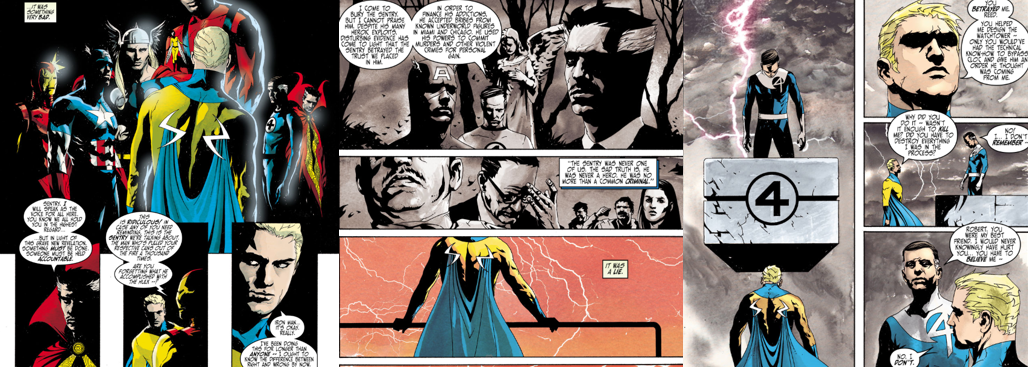
Inside the Watchtower, the Sentry reunites with its Centrally Located Organic Computer/C.L.O.C. to investigate a subliminal message being transmitted around the world by a small, bug-like transmitter that’s powered by the same serum that gives the Sentry his incredible abilities. Thanks to a “self-modifying loop virus”, C.L.O.C. cannot directly aid the Sentry without being destroyed, so the Sentry disables the crude device himself. This leads to a brief and near imperceptible shift in the fabric of reality and, suddenly, kids discover their Sentry memorabilia, Billy finds his old costume, and people are filled first with relief at remembering their hero…and then horror as they also remember the Void. They also remember the Sentry dying in battle (at least, as far as the public were concerned), marking the end of a “Golden Age” of heroes. This event also sees the Sentry remembering Reed condemn him as a traitor and a criminal, claiming that Bob accepted bribes from the criminal underworld to fund his addictions and then mislead the public into thinking he was a hero while also profiting from his violent impulses. Angered at this betrayal and slander, the Sentry reconciles with a remorseful Lindy, only for her to be attacked and threatened by the Void. Gleefully, the Void spitefully monologues about his scheme to bathe the world in darkness and devour every living soul in the universe, saving his hated foe until last just to make him suffer. With that, the Void tosses Lindy aside and conjures an alarming and devastating hurricane out at sea that threatens the mainland. The Sentry makes a quick public address to announce his return, protest his innocence, and warn that the storm signals the return of the Void. After calling for a mass evacuation, the Sentry pleads with his superpowered cohorts to stand by his side once more against the threat on Liberty Island. Though he’s uncharacteristically afraid, the Hulk is the first to arrive out of gratitude for all the support the Sentry once showed him. Spider-Man, the X-Men, the Avengers, and all the city’s costumed protectors then arrive soon after, alongside Billy Turner. When Mr. Fantastic arrives, the Sentry berates him for his betrayal, though Reed’s still got some gaps in his memory and is adamant that he’d never betray his best friend like that.

A remorseful Bob is forced to sacrifice his reputation to keep the Sentry, and the Void, forgotten.

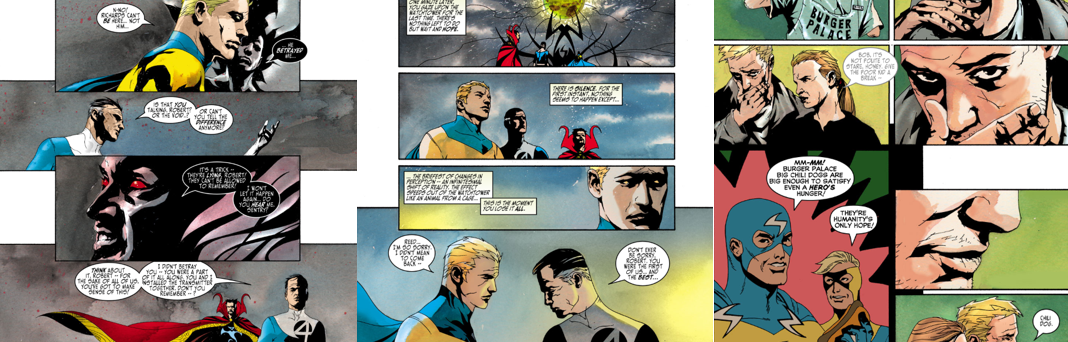
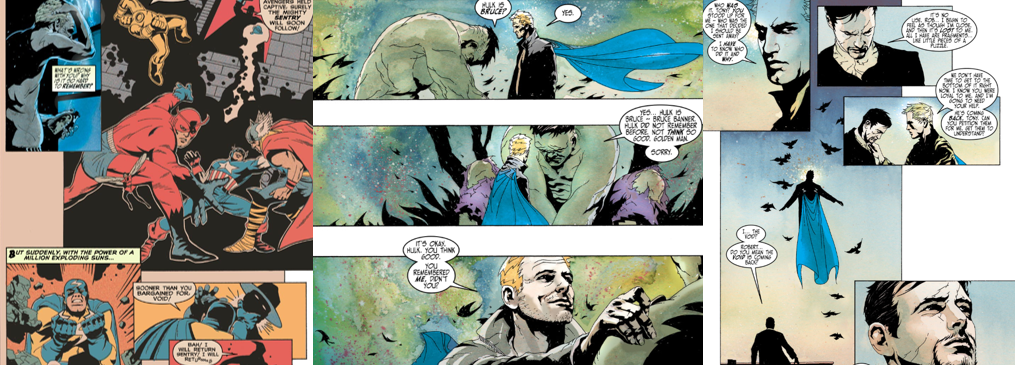
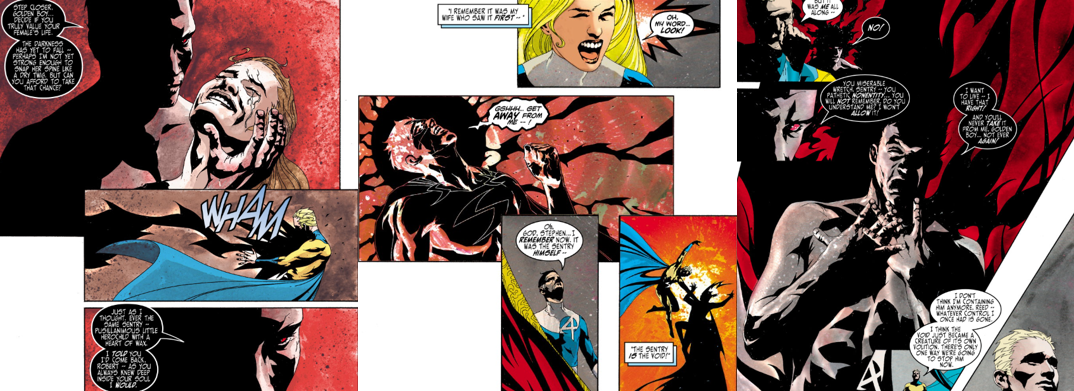
Faced with the Void’s pending arrival and the potential end of the world, the Sentry steels himself, with friends and foes at his back, for the assault. The Void attacks with “infinitendrils” that sap even the Sentry’s abilities and confidence. The trinkets the Sentry gifted to his allies barely keep them from succumbing to the Void’s influence and unnamed heroes and untold civilians die as the Void’s attack decimates the city. During the chaos. Dr. Strange prompts Reed to remember when the Void attacked Manhattan in the past, causing catastrophic damage and leaving a pile of slaughtered bodies in his wake, only for Susan Storm/The Invisible Woman to discover the Void and the Sentry were one and the same! In the face of the Void’s destructive power, which left a million people dead, and faced with a man they’d known and respected and could clearly see was suffering a psychotic episode that manifested in a separate personality, Reed and Bob came up with a plan. After Bob shared his concerns about himself and admitted to his addiction, the two constructed the hypnotic transmitters to ensure that no one, not even Bob, would remember the Sentry, thus keeping the Void at bay.  Thus, at Bob’s insistence, the Sentry’s death was faked, his funeral staged, and his reputation tarnished to ensure that the people who loved and admired him so much would submit to the hypnosis. In the present, the physical and existential battle between the Sentry and the Void rages, breaking even the Hulk’s super-tough body, until Reed intervenes. Although the Void whispers poison in Bob’s ear, fuelling his confusion and anger, Reed triggers Bob’s memories, much to the Void’s anger. Desperate to live and to wreak havoc, the Void threatens to take full control of Bob’s body, so the Sentry rushes back to C.LO.C. alongside his allies. After a moment’s hesitation, the Sentry orders C.L.O.C to reactivate the transmitter and Bob gets a brief moment to reconcile with his best friend before their memories are wiped. In the aftermath, the devastation is blamed on a “temporal anomaly” and Bob returns to his mundane life with Lindy. However, when they stop for a bite and are served by Billy, a flash of a memory suggests the Sentry may not be completely forgotten…

The Summary:
This was my first time reading the Sentry’s debut story arc and I was quite excited to get into it. I don’t know much about the Sentry, but I remember his debut being quite a big deal and have seen it being talked about, and seen him pop up in a few crossover events and such, so I was eager to get into this and see if it lived up to the hype. Unfortunately, I really don’t think it did and I was left a bit disappointed. For starters, it bugged me that the story wasn’t contained in a five or six-issue arc. Instead, we have five issues laying the foundation for the Sentry and the Void, a couple of team-up stories that take between #5 and The Sentry vs. The Void #1, and that standalone resolution to the arc. This was a story clearly written for trade collections, which is fine on paper as that’s my preferred way to read comics, but it’s pretty damn arrogant of Marvel Comics to assume that people are going to be this heavily invested in their brand-new superhero right off the bat. Luckily, the central concept has a lot of legs to it, and I did enjoy the story as a very different, more cerebral superhero tale. It’s always engaging and interesting when comic books are more than just big superhero fights or cosmic events, and the Sentry’s debut definitely delves more into the psychological thriller genre as Bob, Reed, and the reader try to piece together the truth about this strange and apparently forgotten character. The mystery of the Void was equally well done and I liked that he was perceived as a world (well, universe) ending threat and the sense of desperation behind him. The idea that someone or something was so dangerous to all life that even the Avengers and the Fantastic Four blurred their morals to erase the minds of everyone in the world is very powerful and still holds up now, even knowing the truth about the two.

The Sentry is a bit of a Gary Stu and changes long-running aspects of Marvel continuity.

I liked that Bob is presented as an out of shape everyman. He’s a nobody whose wife barely seems to tolerate him and who’s haunted by nightmares and faded memories that could just as easily be comic books he read as a kid. When something (it’s not clear what) triggers the revival of the Void, Bob’s ordinary life is turned upside down and his body undergoes a slow and dramatic change upon drinking the mysterious serum that makes him an all-powerful demigod. I’m not sure how this transforms his costume or why a simple potion can give him such incredible power, but Bob’s memories, personality, and sense of self worth return the more he indulges in the serum and the more he meets with his old allies. Even his physical appearance changes, returning him to the superman physique he enjoyed in his prime, and his trip down memory lane changes many preconceptions of existing Marvel heroes. The Sentry is said to be the “first” costumed superhero, the one who inspired all the others, and his deeds were almost incalculable. He tamed the Hulk, was best friends with Reed Richards, scored Peter Parker his first Pulitzer Prize, and saved the world countless times. Indeed, this debut story goes out of its way to really hammer home that the Sentry was the bastion of all that’s good in the world, that no one could compare to him, and that he was the example others lived by. He had an elaborate headquarters in the heart of New York City, a kid sidekick, and all kinds of gadgets, making him very much a child’s perfect amalgamation of what makes a good superhero. It’s a bit grating, to be honest, primarily because we don’t really get to see any of the Sentry’s past deeds. We simply hear people talk about them and how great he is, with little evidence to back it up since even Bob barely remembers fact from fiction. Equally, we never get to see any of the Sentry’s incredible and much-touted powers beyond a few brief glimpses. Sure, he can fly and take a hit, but I’m not sure what “the power of a million exploding suns” means or how it scales with, say, the Hulk or Thor Odinson.

A unique and engaging story, but one that didn’t live up to its full potential for me.

I really enjoyed the panels that reflected other artists and key eras in comic book history. They went a long way to keeping up the ruse that the Sentry was a long-forgotten hero from Marvel’s glory days, dusted off and reinserted into mainstream continuity. In fact, I’d go as far as to say that we should’ve gotten more of these. They could’ve helped flesh out Bob’s backstory and past exploits, his relationship with Billy, and maybe retroactively insert him into key moments in Marvel history. Instead, they’re just fun panels that don’t live up to their potential, which is a shame. While you could argue that the mystery surrounding the Void, how stubbornly cagy Dr. Strange was and how fragmented records were, hinted towards the final reveal as much as Bob’s obvious unstable mental state, I think it landed really well. There’s a degree of responsibility on the reader’s part to understand that things aren’t quite what they seem. When the heroes assemble to help repel the Void in the finale, they’re not necessarily standing with the Sentry against the oncoming storm. Instead, they’re observing him violently lashing out as the Void reasserts control. While I would’ve liked more panels devoted to the destruction, it’s painted as the greatest threat the world has ever seen and one that the heroes are unable to stop through conventional means. It’s only by appealing to the man they once knew that the heroes manage to contain the Void once more, convincing Bob to make the ultimate sacrifice one more time since his powers and mentality are too unstable to be trusted. It’s a very unusual and dramatic end to a superhero story and paints the Sentry as a very fragile and complex character, one who would continue to suffer from his mental health issues and addictions in subsequent appearances. Unfortunately, I do feel the execution was a bit lacking and the story didn’t quite live up to its full potential. This seems par for the course with the Sentry, who doesn’t seem all that relevant these days, which is also a shame as I really think there’s something here and that it’s a very unique way to introduce a new superhero and supervillain.

My Rating:

Rating: 3 out of 5.

Pretty Good

What did you think to the Sentry’s debut story, and the character in general? Were you surprised and excited by the unusual depiction of the character? Did you guess that the Sentry and the Void were the same person or was it a surprise for you? What did you think to the Sentry being retroactively inserted into Marvel continuity? Do you agree that the story fell a little flat in the end or were you intrigued to see more? What are some of your favourite moments involving the Sentry? Which of Marvel’s Superman knock-offs is your favourite? Whatever your thoughts on the Sentry, leave a comment below, support me on Ko-Fi, and check out my other Marvel content on the site.

Back Issues [Independence Day]: The Avengers #4


First appearing in 1941, Marvel Comics’ star-spangled super soldier, Captain Steve Rogers/Captain America, has become one of Marvel’s most recognisable and celebrated characters not just for his super patriotism but also for being a prominent member and leader of Marvel’s premier super team, the Avengers. Having successfully made the jump to live-action, Cap is now a widely celebrated, mainstream superhero and, given that today is Independence Day, this seems like the perfect excuse to pay tribute to the star-spangled man with a plan himself!


Story Title: “Captain America Joins…The Avengers!”
Published: 1 March 1964
Writer: Stan Lee
Artist: Jack Kirby

The Background:
In 1941, the Second World War was well under way; Nazi Germany overtook Denmark and Norway in April 1940 and the United States finally entered the fray in 1941 to oppose the combined “Axis powers” of Germany, Japan, and Italy. Due to the ever-escalating conflict, patriotism and national pride ran rampant in America, leading to Joe Simon and the legendary Jack Kirby debuting Captain America and his kid sidekick, James Buchanan Barnes/Bucky, who took the fight directly to the enemies of America and encouraged readers to support the war effort by any means necessary. However, after the War ended, superheroes saw a decline in popularity and Captain America’s solo title was cancelled in 1954, but the character got a second chance when he was recast as a “man out of time” in this issue of The Avengers. The Avengers came about as a direct response to rival DC Comics’ Justice League of America; Martin Goodman tasked Stan Lee with bringing together Tony Stark/Iron Man, Doctor Bruce Banner/The Hulk, Doctor Donald Blake/Thor Odinson, Doctor Hank Pym/Ant-Man, and Janet van Dyne/The Wasp as Marvel’s premier superhero team. With their ever-changing roster and prominence in some of Marvel’s biggest events and stories, the Avengers became a consistent and influential presence in Marvel Comics, even more so after the Star-Spangled Avenger joined their ranks in this historic issue.

The Review:
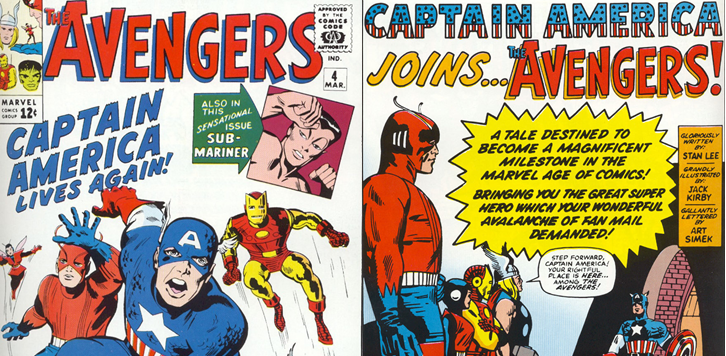
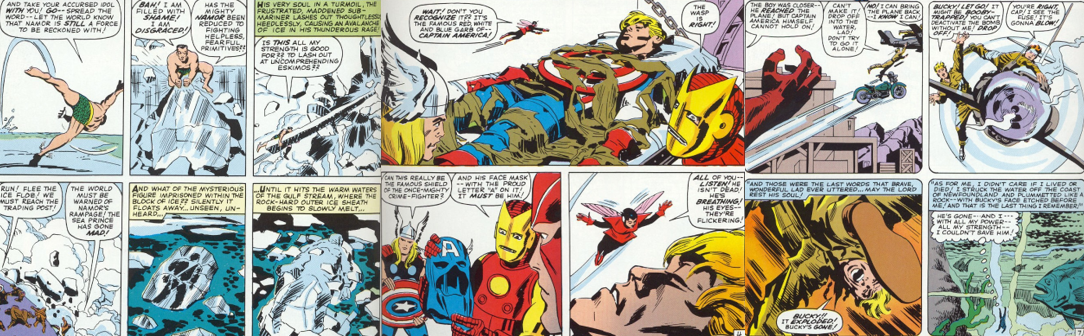
Marvel Comics always liked to hype up their stories and issues back during this time period; front covers would proclaim even the most bizarre-looking characters as being must-see events and issues generally always featured celebratory mentions of the creatives involved, and The Avengers #4 is no different. There are a couple of notable unique features in the full-page title splash for this story, though; first, a big explosive bubble of text directly attributes the return of Captain America to an “avalanche of fan mail” and a dialogue box at the bottom of the page makes sure to mention that “glorious” Stan Lee and “grand” Jack Kirby both collaborated on Captain America’s debut story, thereby lending further prestige to his return to the then-modern era of Marvel Comics. The story itself takes a little while to get started as the first page of panels is dedicated to recapping the Avengers’ battle against Prince Namor McKenzie/The Sub-Mariner and the Hulk in the previous issue; after the Hulk disappeared, Namor was forced to flee from the overwhelming odds and returned to the depths of the ocean. The sting of defeat is great for the proud Mutant but pales in comparison to the frustration he feels at being abandoned by his people after the inhabitants of Atlantis questioned his loyalty. Vowing to never stop searching for his lost people, Namor finds himself lost amidst the frozen wastes of the North Sea, where he comes across a tribe of Eskimos who worship a mysterious figure frozen in a block of ice. Interestingly, despite the Eskimos being isolated from the rest of the world, they instantly recognise “the dreaded Namor”, who wastes no time in mocking their idol and turning his anger upon them. In his rage, Namor decimates the frozen landscape, terrorises the simple folk, and hurls their frozen idol into the sea.

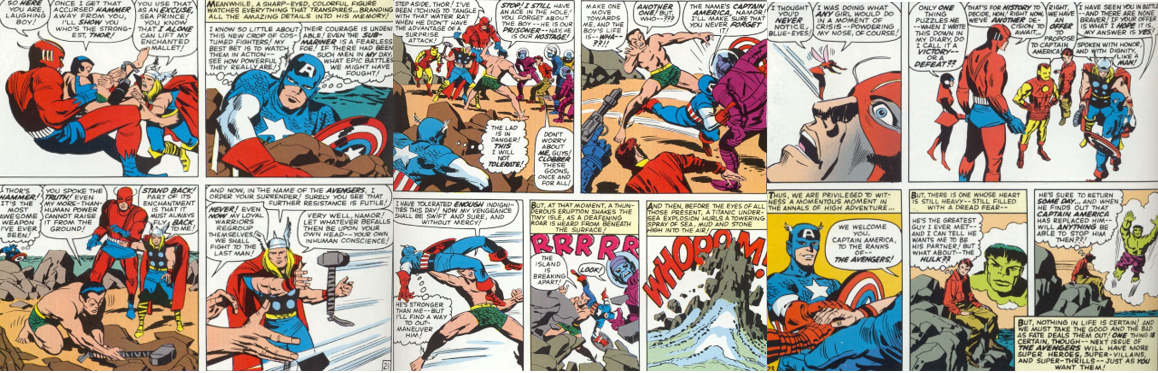
The Avengers are awestruck when they recover the perfectly-preserved body of the legendary Captain America!

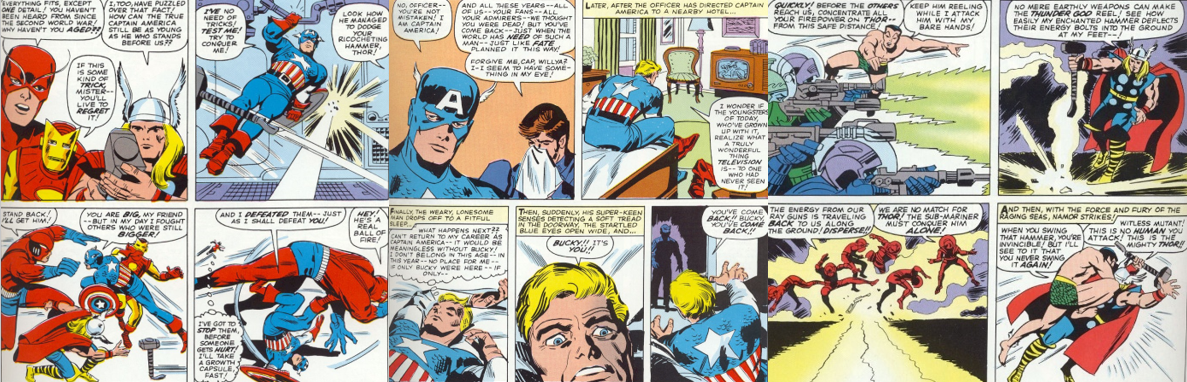
Free from the frigid temperatures of the northern climate, the ice block slowly melts and, by the time the Avengers come across it in their little submarine (I assume they were tracking Namor, that seems to make sense as to why they’d randomly be out there), the ice has completely melted, freeing the unconscious body trapped within. Giant-Man brings the body aboard and the team are stunned to find that it’s none other than the slumbering body of the legendary Captain America, a star-spangled crusader of justice so prolific that even Norse God Thor is aware of his accolades. The team’s shock at this discovery turns to panic when Cap suddenly awakens and lashes out in a confused daze, desperate to keep his kid sidekick, Bucky, from harm. Thor, Iron Man, and Giant-Man leap in to restrain the raging legend, but his madness quickly passes. Within the space of five panels, he resigns himself to the memory that Bucky is dead and reclaims his identity, shield, and mantle of Captain America. Though impressed, the Avengers are so puzzled by Cap’s youth and vigour that they suspect some kind of trick. Thus, Cap invites them to test him, easily dodging Thor’s magical hammer, overpowering even the hulking Giant-Man, and is only kept from embarrassing the group further when Wasp stops him in his tracks by challenging his chivalry. Suitably convinced that Cap is the real deal, tensions calm long enough for Cap to tell the tragic story of how he came to be encased within a block of ice. Back during the Second World War, Cap and Bucky were posing as security guards at an Army base when a mysterious Nazi figure launched an explosive-filled drone in a bid to either kill the two or rob the United States of a powerful weapon. Although Cap failed to reach the plane in time, Bucky leapt onboard and was seemingly vaporised when the plane exploded; the heartbroken Cap was hurtled into the ocean depths off the coast of Newfoundland, where he became encased in ice and effectively held in suspended animation. When the Avengers reach New York City, they’re greeted by the press, hungry for the big scoop on their battle against Namor and the Hulk, but the team are suddenly and inexplicably turned into stone statues by a flash of light! Cap missed the event since he was still inside the craft and, when he emerges topside to find everyone gone, he assumes that the statues are in honour of the colourful heroes and ventures out to explore the strange new world he’s found himself in without a second thought.

Cap tracks down the one responsible for petrifying the Avengers, an alien whom he vows to assist.

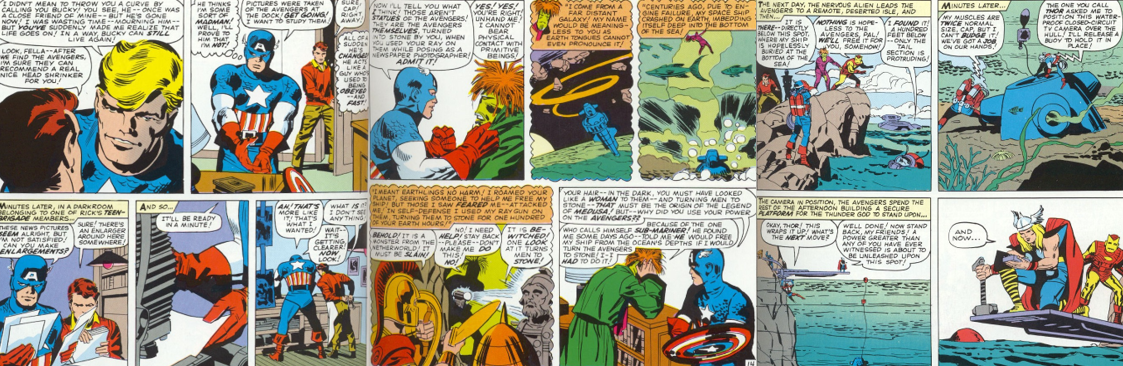
Cap is impressed by how much has changed, from clothing and fashion to the establishment of the United Nations and the upgrades to everyday vehicles, and stuns the public, who instantly recognise him as the legendary hero of World War II. Directed to a hotel by a helpful police officer, Cap briefly marvels at the wonders of television before dozing off in a troubled exhaustion. Already questioning his place in the modern age, Cap is startled to wake up and find Bucky alive and well in his hotel room…only to realise that it’s perennial sidekick and Avengers mascot Rick Jones. Concerned by the Avengers’ disappearance, Rick confronts Cap; since Cap was the last person to see them, Rick basically accuses him of being involved and threatens to set the Hulk on him if he doesn’t help find the team. This threat means little to Cap since he doesn’t know who the Hulk is and he’s still struggling with the uncanny resemblance between Rick and Bucky, but he promises to help find the team despite Rick’s rude demeanour. After reviewing the photos taken of the team by the press, Cap spies a suspicious man holding a camera-like gun and Rick wastes no time in contacting his “teen brigade” to try and find him amongst the teeming masses. Laughably, the teens come up with nothing but dead ends and false leads, but Cap finds the guy seemingly at random just by scouring the city’s rooftops. Once he spots the man he’s looking for, Cap wastes no time in springing into action and confronting him and his armed goons. Even these lowly mobsters recognise Cap and they’re easily overwhelmed by his indomitable shield, uncanny agility, and Herculean strength; while the goons quickly surrender, their leader desperately tries to turn Cap to stone with his ray gun, only to miss and be unmasked as a bizarre extraterrestrial lifeform! Unfazed by this, Cap threatens the alien (who goes unnamed in this issue but is eventually revealed to be named Vuk), who gladly tells his story to avoid being handled by “primitive beings”. Vuk crash-landed on Earth centuries ago and, encountering nothing but fear and hostility, would turn men to stone with his ray gun in self-defence, which Cap realises directly led to the myth of the hydra-haired, stone-eyed Medusa. Vuk relates that the Sub-Mariner promised to help Vuk return to the stars if he turned his weapon against the Avengers and, recognising the Sub-Mariner’s name from the past, Cap vows to help Vuk in return for undoing the damage he’s inflicted upon the Avengers.

As impressed by the team as much as they are with him, Cap helps fight Namor and joins the Avengers.

Namor witnesses these events from his deserted imperial castle using his “undersea scanner” and vows to avenge himself upon his enemies, a promise that suddenly becomes more viable when he conveniently stumbles upon a loyal troop of his elite guard. True to his word, Cap leads the Avengers in finding and freeing Vuk’s ship from the ocean depths, an act that earns them Vuk’s eternal gratitude and Cap’s admiration for the group’s unparalleled teamwork. Their victory is short-lived, however, as Namor and his elite guard suddenly attack the group; Iron Man goes toe-to-toe with Namor but his armour struggles to withstand the sledgehammer-like blows of the Sub-Mariner. In desperation, Iron Man blasts Namor with a “full [intensity] magnetic ray”, but this only grants him a temporary reprieve; with his armoured foe’s “greatest weapon” exhausted, Namor redoubles his attack, smashing a rock over Iron Man’s head and manhandling him to the ground. Momentarily powerless as he waits for his transistors to recharge, Iron Man is saved from certain death by the timely intervention of the Wasp, who Namor easily shrugs off before answering his lieutenant’s plea for help in subduing the rampaging Thor. Thanks to his mighty hammer, Thor easily holds back Namor’s forces by himself and repels the energy bolts fired at him by their ray guns, forcing Namor to leap at the Thunder God to tackle him directly. After slipping free of the Atlantean’s net and saving himself from drowning, Giant-Man returns to the fray to assist Iron Man, hurling the Atlanteans off-panel with his massive strength before rushing to aid Thor in tussling with Namor, who’s become obsessed with wrestling Mjölnir from Thor’s grasp. Watching from the side lines, Cap can’t help but be impressed by the power and courage of the Avengers and in awe of Mjölnir, a weapon so powerful that only the Mighty Thor can lift it. Although the Avengers clearly have Namor beat, the proud prince refuses to surrender and lowers himself to threatening Rick’s life. This irks Cap so much that he finally leaps into action, tackling Namor’s elite guard and briefly being overpowered by the Sub-Mariner before the tiny isle on which they’re all fighting suddenly (and conveniently) breaks apart from an undersea explosion caused by Vuk’s ship. Confident that his enemies will drown beneath the resulting waves, Namor commands his forces to retreat, unaware that the heroes easily survived by clinging to the remains of the island. Impressed by Cap’s prowess in battle, the Avengers ask him to join their little team and he gratefully accepts, but Rick is left pondering the fate of his friend and partner, the Hulk, whose rage at being “replaced” by Captain America is as sure as the inevitability that the Avengers will butt heads with the Sub-Mariner again before long.

The Summary:
I quite enjoyed “Captain America Joins…The Avengers!” I sometimes struggle with Jack Kirby’s more bizarre artwork and designs but there was none of that here (save for the Avengers’ submarine and the brief depictions of Atlantean technology), which really helped these colourful characters to stand out all the more prominently. I especially liked Cap’s brief walk around New York City and him being impressed by the advances in technology and society since his day, and the panels that took place underwater, which evoked a murky, almost alien environment. Unfortunately, paralleling this was the pretty haphazard and confusing flashback to Bucky’s final mission, where it’s a bit difficult to make out where the characters are in relation to the plane, and the depiction of Vuk, who ends up looking more like Beaker than anything remotely impressive. I also really didn’t care for the reveal that an alien was behind the Avengers’ petrification; it was weird that Cap took it in stride and that the story didn’t treat it as a big deal, and it just came out of nowhere. I think it would’ve been far better to have it be an Atlantean in disguise, maybe switch the order of events to show Namor recruiting his elite guard before the Avengers reach New York, and then Cap could just threaten the Atlantean into helping him. It’s a minor thing to complain about but that’s kind of the problem; Vuk doesn’t even get a name and it just seems so random to just insert a Medusa-like alien into the story when the primary focus is the antagonism against Namor. Normally, I’d also complain about the depiction of women and youth during this time but, aside from being a bit too rude and confrontational, I didn’t have much of an issue with Rick Jones here and I was actually very impressed by the restraint show with the Wasp. She doesn’t fawn or coo over Cap upon seeing him and actually proves quite useful in the scuffle with him and Namor…but then all that goodwill gets thrown away on the very last page where it’s revealed that the Wasp disappeared from the battle to powder her nose!

Cap impresses with his abilities and characterisation, as does Namor’s unquenchable pride.

However, I enjoyed the angst of the Sub-Mariner as depicted here; Namor’s anger against he surface world has only exacerbated since his people abandoned him after questioning his loyalty due to his mixed heritage and he’s desperate not only to find his people, but to subjugate humanity to prove his superiority. There’s a tragedy to Namor that’s present even here; he lashes out at everyone and everything because he doesn’t want to be alone and craves power and adulation, but he’s tormented by being a child of both worlds and his status as a Mutant amongst even his bizarre people. Depicted as both an underhanded tactician and a formidable physical force, Namor’s threat is enough to require the attention of all the Avengers even without his elite guard and I liked how he easily overpowered Iron Man and matched even Thor’s God-like power (even if he was unable to lift Mjölnir). Of course, the true star of this story is Captain America; I really enjoyed how the issue went to great lengths to talk up Cap’s status as a legendary figure and that even randomers in the street recognised him as a hero from their youth. The Avengers are awestruck by his presence and seem delighted to not only have him amongst them, but also to test his abilities in battle, and Cap is equally impressed by the team, who he wishes could’ve been by his side during World War II. While it seems like Cap quickly regains his senses and returns to his confident and commanding persona, the story does touch upon the grief and anguish he feels at Bucky’s death and his feelings of belonging in the then-modern world. Though impressed by how far the world has come since his day, Cap briefly feels as though he doesn’t belong there, and it isn’t until he’s back in action, tracking down the Avengers’ mystery attacker and engaging with the Sub-Mariner, that he truly feels himself again. This was the perfect way to sell newcomers and sceptics on Cap’s return and make him relevant amongst his modern contemporaries and I really enjoyed how he meshed with the Avengers and their mutual respect for each other. Take out the Vuk stuff (or replace it with something better) and this would’ve gotten full marks from me, but it’s still a blast to read and one of the quintessential Avengers and Captain America stories.

My Rating:

Rating: 4 out of 5.

Great Stuff

Have you ever read “Captain America Joins…The Avengers!”? If so, what did you think of it and did you enjoy seeing Captain America join the Avengers? Was this your first exposure to Captain America, and if not what was? Were you also disappointed by the inclusion of Vuk? What did you think to the depiction of Namor and Cap’s introduction to the then-modern world? Which of the Avengers is your favourite? How are you celebrating Independence Day today? Whatever your thoughts, drop a comment below or on my social media and be sure to check out my other Captain America content across the site!

Movie Night: Ant-Man and the Wasp: Quantumania

Released: 17 February 2023
Director: Peyton Reed
Distributor:
Walt Disney Studios Motion Pictures
Budget: $200 million
Stars:
Paul Rudd, Evangeline Lilly, Jonathan Majors, Kathryn Newton, Michelle Pfeiffer, and Michael Douglas

The Plot:
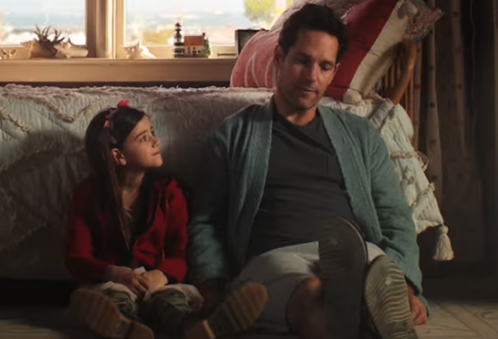
After aiding the Avengers in saving the world, Scott Lang/Ant-Man (Rudd) has become a beloved celebrity now focused on making up for lost time with his daughter, Cassie (Newton). However, when Cassie inadvertently sucks Scott and his family into the mysterious Quantum Realm, Ant-Man faces his greatest challenge when he comes face-to-face with the maniacal Kang the Conqueror (Majors), a tyrannical despot from beyond time!

The Background:
In his first comic book appearance, Doctor Hank Pym/Ant-Man wasn’t the unstable, garishly-costumed hero who would form the Avengers, nor was he the only character to take up the Ant-Man mantle. Perhaps his most notable successor was Scott Lang, a reformed criminal created by David Michelinie, Bob Layton, and John Byrne, who assumed the role in 1979, and both characters eventually featured in the first live-action Ant-Man (Reed, 2015) film. Ant-Man’s impressive $519.3 million gross and largely positive reviews led to a sequel, Ant-Man and the Wasp (ibid, 2018), which outperformed the first at the box office but was met with more mixed reviews. Although the core cast returned to the film, Emma Fuhrmann was disappointed to learn she’d been recast; Kathryn Newton replaced her as Cassie in a decision apparently motivated to better highlight Cassie’s coming-of-age story. Having been established as one a pivotal hero of the Marvel Cinematic Universe (MCU) in Avengers: Endgame (Russo and Russo, 2019), the third film sought to further explore the Quantum Realm and the complexities of time travel through the inclusion of Kang the Conqueror. Returning director Peyton Reed was excited to pit Ant-Man against such a villain as part of his wish to produce a pivotal entry in the MCU rather than a simple palette cleanser, and Majors was equally excited about exploring the multiple facets and iterations of Kang in this film and beyond after previously portraying an alternative version of the character in Loki (Various, 2021 to present). Following numerous delays, Ant-Man and the Wasp: Quantumania finally released to a nearly $450 million worldwide box office and mixed reviews; critics expressed disappointment with the pacing and content of the film, though Jonathan Majors’ performance was met with unanimous praise and that there were some visually impressive sequences to be found amidst the jumbled plot.

The Review:
I was surprised by how much I enjoyed Ant-Man; I’ve never been the biggest fan of the character, especially as his characterisation and relationships can be a bit dated, hokey, and inconsistent, but framing it as a superhero heist film and focusing on Scott Lang as this flawed, but loveable, reluctant hero, a dad just trying to make amends, was a really refreshing idea and helped contrast the MCU’s cosmic scope with a nice grounded adventure. I remember not really being too impressed by Ant-Man and the Wasp; I really should revisit it sometime, especially as it laid a lot of the foundation not just for a major plot point in Avengers: Endgame but also for this film, which takes Ant-Man so far away from a quirky, sci-fi action comedy and into the absolutely batshit realm of other dimensions and timelines. Scott is a great character to thrust into these situations; despite all of the abilities the Pym Particles give him, he’s still just a regular guy, someone who reacts realistically to the crazy events happening around him, so he makes for a charismatic and relatable character to help focus these mind-bending concepts through.

While there’s surprisingly little for Hope to do, Scott and Cassie’s relationship is a focal point of the film.

This is immediately emphasised in the opening scene of Ant-Man and the Wasp: Quantumania; Scott is now a recognised and celebrated personality who remains awestruck at the fantastical things he’s seen in his adventures. However, as much as he enjoys the limelight, the abilities afforded to him by the Pym Particles, and the experiences he’s had alongside his fellow Avengers, Scott is now content to focus on promoting his inspirational memoirs and making up for lost time with his family. Hope van Dyne/The Wasp (Lilly) has now taken control of her father’s company, renaming and restructuring it in her image and to help displaced families following the Blip. She and Scott are seen to have a loving relationship and are no longer at odds with each other like in the previous film, but the two spend a surprising amount of time apart considering both of their names are in the title of the movie, so Quantumania is less a story about these two pint-sized heroes/lovers saving the Quantum Realm and more focused on developing the relationship between Scott and his daughter, Cassie. Cassie is now a somewhat rebellious teenager; she’s getting arresting and causing Scott headaches because she wants to follow in his example, “look out for the little guy”, and help others, and is disappointed in him giving up his superhero duties when there are still people that need help. Her arc throughout the film is both learning the value of patience and how to control her own shrinking/growing abilities, and understanding that the life she is so enamoured by is dangerous. While Scott is proud of her moral compass, her ingenuity, and her moxie, he also wants to protect her first and foremost; thankfully, while this is a point of contention between the two, the film doesn’t portray her as a cliché sulky teenager who acts without thinking or unreasonably lashes out at her father and they still have an adorable bond, she just wants his respect.

Janet’s stubbornness and fear cost the characters valuable time.

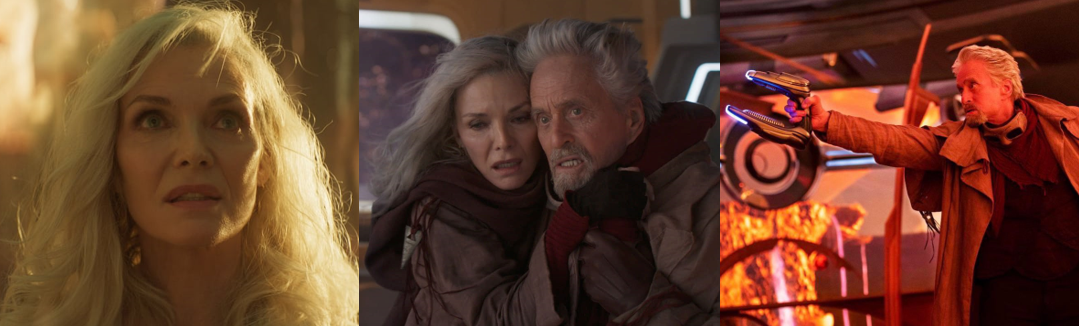
As part of this, Cassie has secretly been spending her time working with Hank (Douglas) to research and map the mysterious Quantum Realm. Despite Hope’s repeated efforts to find out more about the time her mother spent trapped there, Janet (Pfeiffer) remains stubbornly tight-lipped and this was a real issue for me in the early going of the film. Because Janet refused to talk about the Quantum Realm, the characters had no idea of the dangers that lurked there; her warnings came too late to prevent them all being sucked down there and, once they are stranded in the Quantum Realm, she continues to refuse to tell them anything for no real reason at all when that knowledge really would have helped them be better prepared once the source of her fears, Kang, inevitably showed up. Instead, Janet leads Hank and Hope on a merry tour of the Quantum Realm, now expanded into a strange alien environment full of colourful beings and bizarre creatures, most of whom, like the enigmatic Lord Krylar (Bill Murray), know Janet from her time as a freedom fighter. Hank, who has spent his entire life researching the Quantum Realm, is understandably fascinated by the ecosystem and society that dwells there, and equally stunned to get a glimpse of his wife’s tumultuous life amongst these beings. Both characters receive more screen time this time around and are certainly more of a focal point to the plot than Hope, and Hank’s demeanour is now noticeably far more relaxed; he’s lost a lot of his edge and is now portrayed as a quirky scientist with an unhealthy obsession with ants, whereas Janet is shown to be unreasonably cagey and to have fought against the all-powerful Kang during her time trapped in the Quantum Realm

With his nuance performance and incredible power, Kang was the undeniable highlight of the movie.

Although we get a glimpse of his arrival in the Quantum Realm in the film’s opening moments, Kang is a mystery throughout most of the film; he’s talked about with a mixture of awe and fear by the colourful freedom fighters Scott and Cassie hook up with and Janet is so terrified of him that she goes out of her way to keep her family in the dark just to try and avoid catching his attention. This is a shame as, once Kang arrives onscreen, he is unquestionably the most interesting and charismatic character, eclipsing even Scott with his nuanced performance. A cold, calculating, driven individual, Kang is a man from beyond time who was betrayed by his own alternate selves (or “variants”) and banished to the Quantum Realm because of his destructive nature. I know a little bit about Kang from the comics but am by no means a Kang expert, and Quantumania decides to keep his exact backstory and motivations a bit vague, presumably to explain them in further productions. It’s not really explained how or why he has the powers he exhibits or what his limits are; at first, he’s weak and helpless and needs Janet’s help to repair his ship, then he regains his fantastically comic accurate suit and shows an ability to stop characters in their tracks with a thought and swat his pint-sized adversaries out of the air. Yet, though he appears unstoppable and has built an empire comprised of (literal) faceless stormtroopers and advanced technology, Kang can still get down and dirty in a fist fight. Yet, for all his imposing menace and the captivating allure of his unhinged psyche, Kang is very much a desperate man; he’s clearly been broken by some unknown tragedy and is fuelled not just be a need to conquer and avenge himself, but a desperate desire to bring a twisted order to the multiverse, regardless of who he has to torture, enslave, or kill along the way. He’s not just some maniacal villain, though; he seems to genuinely value Janet’s friendship and is driven to violence only as a means to facilitate his escape and seems to regard himself as a necessary evil n the face of some unknown future threat.

The Nitty-Gritty:
There are a few themes at work in Quantumania; you might think that it’s a movie about Scott and Hope as surrogate parents and the dynamic of the Pyms and van Dynes co-existing as this superhero family, but it’s sadly not. You might also think that it’s geared towards showcasing Cassie’s journey into her own superhero persona and, while that certainly is a development in the movie, the focus is more on Scott learning to accept that her daughter wants in the life (which he’s happy to do, he just worries about her) and her learning to walk before she runs (perfectly exampled when Scott has to teach her how to properly make use of the Pym Particles in a fight). The film does shed a bit more light on Janet, a largely mysterious character who clearly has been through some stuff and seen some things down in the Quantum Realm, but it, like her, is unnecessarily coy about the specifics and we’re left with only the briefest, vaguest mentions of her as an inspirational fighter in the war against Kang. Like the other Ant-Man movies, Quantumania leans heavily on the comedy; mostly, this is demonstrated through character’s being awestruck by their surroundings, struggling to adapt to the Quantum Realm’s bizarre society and characters, and riffing off each other. For the most part it works, though the absence of Scott’s more comedic supporting cast is felt in the movie and there’s one scene in particular where the dramatic tension is completely undercut by unnecessary forced comedy.

While the visuals generally impress, others are a bit cartoonish and disappointingly realised.

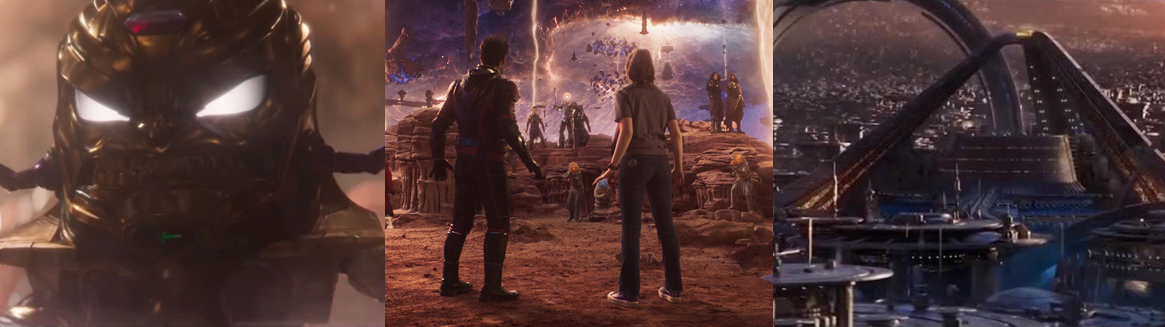
This would be the death of Darren Cross (Corey Stoll), who’s revealed to have survived the ending of Ant-Man but been left a misshapen and embittered troll of a man; rebuilt by Kang’s technology into the ultimate cybernetic killing machine, he chases down Scott and his family with a vengeance as the MCU version of George Tarleton/ Mechanised Organism Designed Only for Killing (M.O.D.O.K.) M.O.D.O.K. is one of the most bizarre villains of Marvel Comics and one I never thought we’d ever see translated to screen, so it’s pretty amazing to see him flying about shooting lasers and missiles and sprouting buzzsaws, but then the face plate lifts up and we’re forced to look at this really unsettling, cheap-looking CGI face and listen to Darren spouting pithy declarations and the character loses a lot of his menace. It’s a shame but, for the most part, Quantumania looks really good; it’s naturally a very CGI-heavy film and as far removed from its more grounded predecessors as you could get and goes to great lengths to expand upon the Quantum realm, while also handwaving a lot of the specifics. Humanoid characters like Jentorra (Katy O’Brian) and telepath Quaz (William Jackson Harper) exist alongside anthropomorphic houses and surreal alien creatures like the protoplasmic Veb (David Dastmalchian) and a robot with a laser for a head! These characters, while visually interesting, aren’t very well developed, though; I barely caught most of their names and their single characteristic is wanting to oppose and dethrone Kang, but they do help to show how versatile the Quantum Realm is. Before, characters couldn’t survive in the Quantum realm without special suits or suffering severe time dilation; that is now no longer a problem as they’ve conveniently travelled to a part of the dimension where they don’t need their helmets to breath and suffer no consequences of lost time once they return. The world is colourful and alive, but also feels strangely restricted; I also can’t help but feel like exploring the Quantum realm should’ve been a sub-plot in Ant-Man and the Wasp and that maybe it would’ve been better if Quantumania had take place entirely in Kang’s city, Chronopolis, to avoid the slow start to this movie. Everything also just feels a bit too cartoonish and intangible, and it’s again far too obvious that many actors aren’t actually in the same shots in some scenes, which really took me out of it.

There’s an intriguing conflict and looming menace lurking amidst the bombardment of spotty CGI.

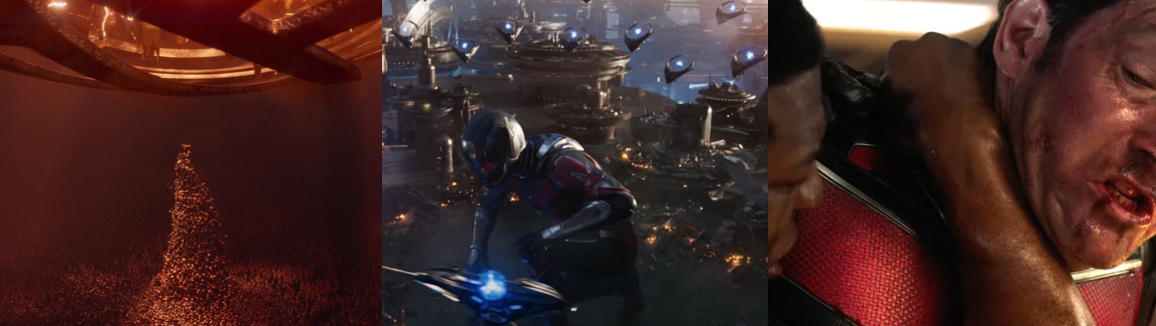
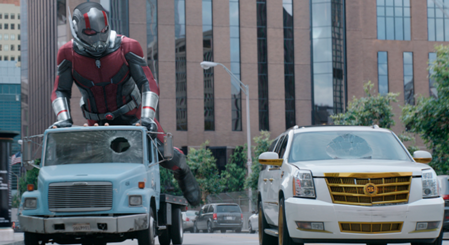
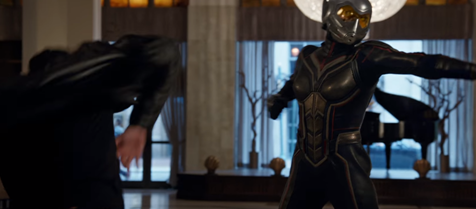
Yet, there are still some exciting and bonkers action scenes on offer here; any time M.O.D.O.K. shows up the screen I filled with explosions and frantic action, and seeing Scott, Hope, and Cassie come together in their small and giant forms for the finale was exhilarating, though it was difficult to appreciate Giant-Man’s scale from the framing. One really inventive scene in the film sees Scott shrink further down to reach the core of Kang’s ship; there, he splits into an infinite number of variants and they must work together to get him closer to the core, literally evoking the image of an ant colony working together. Cassie later has a cool coming-of-age moment where she inspires the people of the Quantum Realm to rise up against Kang, and even Hank gets to have a moment to shine by leading his army of technologically advanced ants into battle, though the same unfortunately can’t be said for Hope, who spends most of the film sporting a ridiculous haircut and being understandably annoyed at her mother’s stubbornness before swooping in to aid Ant-Man in reaching the core and in defeating Kang. After Scott retrieves his ship’s core, Kang sets about escaping his confinement using an elaborate set of spinning rings, which will bring him and his army out of the Quantum Realm and allow him to get back to conquering the multiverse. Giant-Man storms his citadel and, despite all of Kang’s vaulted and incomprehensible time powers, a fist fight breaks out between Scott and the conqueror that sees Ant-Man absolutely decimated. Scott frantically gets his family to safety and chooses to stay behind and sacrifice his freedom to prevent Kang’s escape, only for Hope to show up and help fend Kang off, presumably killing him or banishing him to a further sub-sub-atomic dimension. The film then teases that Scott and Hope will be trapped in the Quantum Realm but the Cassie just immediately saves them and everything’s fine…save for Kang’s troubling warning of an oncoming danger and an entire legion of his variants turning their attentions towards the MCU following Kang’s defeat. Personally, I think it would’ve made more sense for someone in the core cast to die or even have it be Hank and Janet who make the last-minute save and end up trapped in the Quantum Realm. That would’ve been quite fitting given Hank’s obsession with it and small things and Janet’s past there but, instead, things wrap up in a nice little bow despite Kang’s Variants still posing a threat.

The Summary:
I had high expectations for Ant-Man and the Wasp: Quantumania; knowing full well that Kang was set to be an Avengers-level threat in the future and having had some knowledge of the character, I expected this to be a little darker, a little more high stakes, and to have serious repercussions for the MCU going forward. Hell, there was the suggestion that Ant-Man might not live through the tale, let alone be victorious, and it seemed like this could be the shake-up the MCU needed to start seriously working towards their next big team-up movie. Instead, it was just lacking in a lot of ways; I get the idea of exploring and expanding upon the Quantum Realm, but it felt like it took way too much time and I just wasn’t that interested in what was happening there as it felt somewhat inconsequential. It tied in nicely to Cassie’s arc of wanting to help people no matter where or who they are, but a lot of the new characters were forgettable, despite being visually interesting. There was next to no onscreen chemistry or development for Scott and Hope; she could’ve been entirely absent and it wouldn’t have mattered all that much as Cassie could’ve easily done everything she did. Paul Rudd continues to shine as Ant-Man but he’s bogged down by all this CGI mess and protracted world-building, and the environment really didn’t give his unique powers a chance to stand out. The sole saving grace was Kang; Jonathan Majors did an excellent job of portraying a nuanced villain, one who is filled with regret for the evils he must do, and he stole every scene he was in. sadly, though, we really don’t learn anything about him; I have no idea where he’s from or why he’s compelled to be the way he is, meaning a lot of the connection I felt to him came from inference, which is fine but I would’ve liked to see some of the early runtime focused more on him so we get a better sense of his motivations. I think Ant-Man and the Wasp: Quantumania will land better on repeat viewings, especially once Kang returns to the MCU in future productions but, for now, it was a bit of a let-down for me and definitely a case of style over substance.

My Rating:

Rating: 2 out of 5.

Could Be Better

Did you enjoy Ant-Man and the Wasp: Quantumania? How did you think it compared to the other Ant-Man films? What did you think to the exploration and expansion of the Quantum Realm? Did you enjoy seeing Cassie develop into her own heroic role and the relationship between her and Scott? Were you disappointed by M.O.D.O.K.’s portrayal and the effects used to bring him to life? What did you think to Kang and his motivations, and are you excited to see him return in the MCU? Whatever you think about Ant-Man and the Wasp: Quantumania, drop your thoughts below and be sure to check out my other Ant-Man content.

Back Issues: Tales to Astonish #44

Story Title: “The Creature from Kosmos!”
Published:
5 March 1963 (cover-dated June 1963)
Writers: Stan Lee and H. E. Huntley
Artist: Jack Kirby

The Background:
After featuring in the pages of Tales to Astonish #27, the legendary Stan Lee thought it would be fun to revisit the incredible shrinking man, Hank Pym, and recontextualise him as a size-changing superhero eight issues later. Ant-Man soon became the focal point of the Tales to Astonish publication and eventually help to found Marvel’s premiere superhero team, the Avengers, but he wasn’t alone in these endeavors. Created by Lee and H. E. Huntley, Janet van Dyne/The Wasp was only the second of Marvel’s female superheroes; fuelled by a need to avenge her father and a successful fashion designer in her own right (reflected in her many wardrobe changes), Janet became enamoured by Hank Pym (and seemingly every male hero in the Marvel universe) and, after years of will-they-won’t-they and petty spats, the two finally married in 1969. Life as a superhero and with Pym wasn’t easy for Janet; frequently depicted as some scatter-brained bimbo, Janet was forced to watch on helplessly as Pym rapidly switched between identities and created the deadly sentient murder machine Ultron, and was also infamously depicted as suffering physical abuse at Pym’s hands. Still, Janet made a bit of a mark in her own right over the years; she was the leader of the Avengers for a time, was believed dead for a short period, and an alternative version of her gave birth to a daughter, Hope, a supervillain known as the Red Queen. Although the character was unable to appear in the MCU’s first big crossover movie, the Wasp has featured in cameo roles in Marvel videogames and has shown up alongside Ant-Man in Marvel’s animated efforts; a brief cameo in Ant-Man (Reed, 2015) established that Pym (Michael Douglas) was devastated by her loss but he was overjoyed to be reunited with her in the sequel, where she was brought to life by veteran actor Michelle Pfeiffer.

The Review:
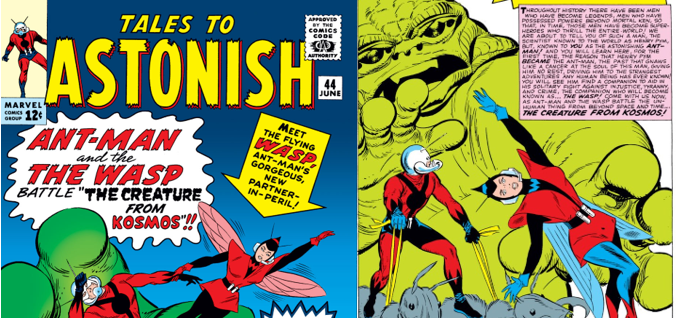
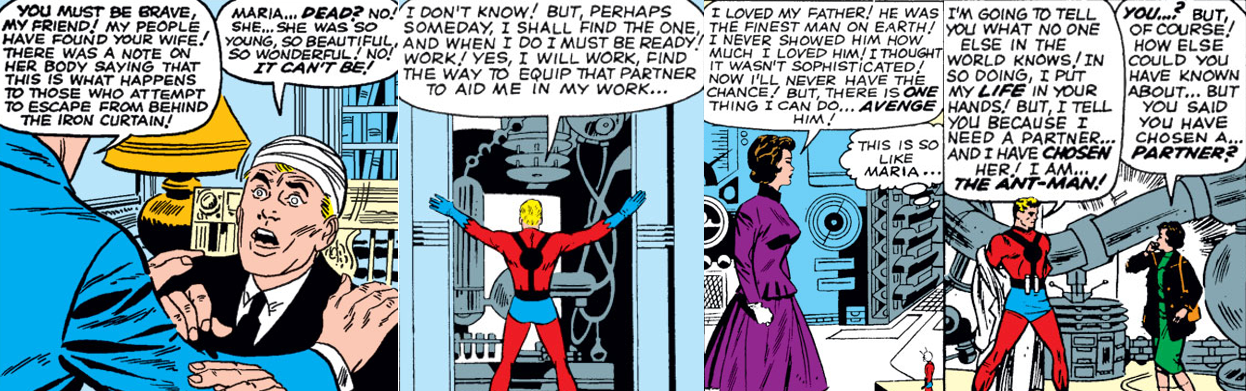
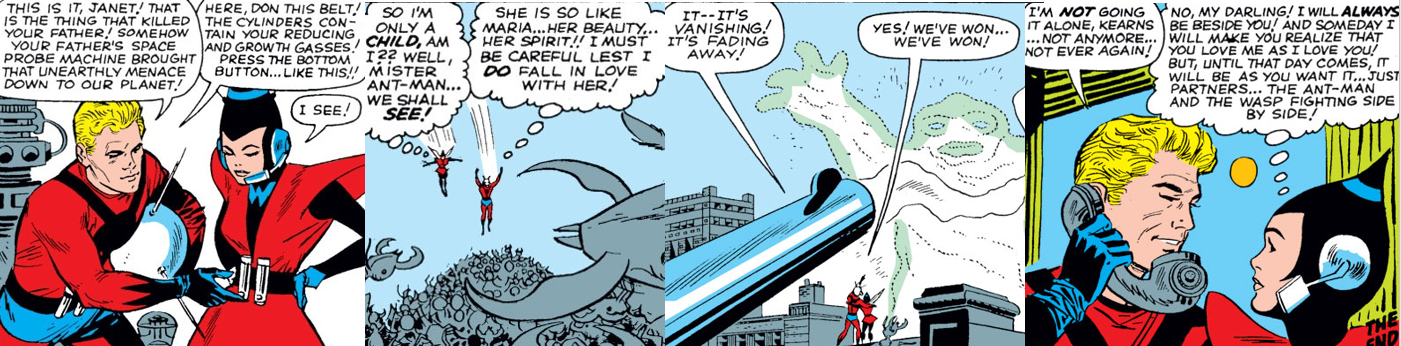
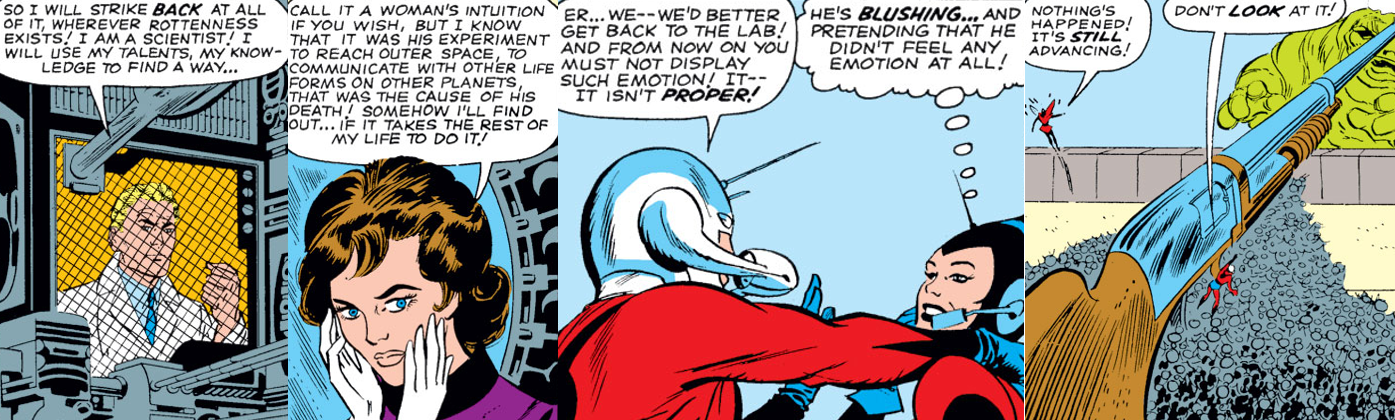
“The Creature from Kosmos!” (or: “Ant-Man and the wasp! Vs. The Creature from Kosmos!”) begins innocently enough in Dr. Hank Pym’s laboratory. By this point, Pym has fully embraced his role as Ant-Man; he’s got a snazzy form-fitting costume, has his Pym Particles (now in the form of gas pellets) built into his belt, and can control ants using a special cybernetic helmet that transmits “electronic-wave commands” to the insects. It’s not made clear exactly what Ant-Man is up to in the lab, and the first few panels seem to be there simply to give us some fun small-scale visuals to open the story. Whatever he was up to, Pym quickly grows to full size and broods over his lost love, Maria; I wasn’t aware of this until now, but Pym was previously married to a Hungarian immigrant and, when returning to Hungary for their honeymoon, Maria was abducted and killed to send a message to “those who attempt to escape from behind the Iron Curtain!” Grief-stricken and enraged, Pym took to the streets in a desperate bid to find those responsible and make them pay, only to end up in jail on the verge of a complete mental and physical breakdown. Filled with a burning desire to stamp out injustice, Pym threw himself into his work and the story retroactively states that his entire reasoning behind his shrinking serum and becoming Ant-Man was to make up for being unable to save Maria all those years ago. However, for all his scientific genius and passion, Pym despairs at how many times he’s cheated death and longs for a partner, someone to carry on his legacy should he fall in battle, and forgoes food and sleep working to equip this partner with the means to do so by studying the biology of wasps.

After losing his wife, Pym finds a kindred spirit (of sorts) in society girl Janet, who’s also suffered a loss.

Pym’s research is interrupted by the arrival of Doctor Vernon van Dyne, a fellow scientist who comes asking for Pym’s help with a Gamma ray beam he hopes to use to detect signs of life on other worlds. Pym, however, is not interested in the project since it’s a little outside of his field of expertise, and van Dyne leaves amicably enough, but Pym is left rattled by the startling resemble of van Dyne’s young daughter, Janet, to his lost Maria. Janet also feels an attraction towards Pym but dismisses him as another scientific bore and longs to connect with a more adventurous type of man. Van Dyne returns to his laboratory to try and boost his ray through his own method, but is stunned when an unspeakable, horrifying, malleable alien lifeform that is so monstrous to behold that van Dyne can scarcely lay his eyes on it. speaking through telepathy, the creature exposits that it is an outlaw from the planet Kosmos who was ostracised for trying to enslave its race. Having escaped along the path of van Dyne’s ray, the creature atomises the hapless scientist, leaving only smouldering remains for the heartbroken Janet, who had popped out for some revelry, to find. With no one else to turn to, Janet calls Pym for help but his dismisses her story as the ravings of a “bored society [playgirl]” and only springs into action as Ant-Man after news of van Dyne’s death reaches him from his network of ants across the city. Ant-Man catapults himself across the city using a pistol-like device that effectively allows him to travel vast distances much like Doctor Bruce Banner/The Hulk’s superhuman leaping, his landing safely cushioned by a gaggle of ants he commands to catch him. Rather than grow to full size to talk with Janet, Ant-Man remains shrunk down while he investigates van Dyne’s body and his wrecked machine, quickly coming to the conclusion (despite such things not being in his wheelhouse) that an alien lifeform was behind the grisly murder. Ant-Man is struck by Janet’s vow to avenge her father’s death, which has changed her demeanour (or, at least, his perception of her) from a “bored, flighty shell” to one of determination that only further reminds him of his beloved wife. After instructing Janet to call the federal Bureau of Investigation (F.B.I.), Ant-Man finds that his insectile companions are afraid of the alien since it secretes a mist containing traces of “formic acid” and is thus, apparently, analogous to an ant. Nevertheless, Ant-Man commands his ants to seek out the monstrous beast responsible for van Dyne’s death and returns to his laboratory to greet Janet in his civilian identity (since he told her to go to Pym after calling the F.B.I.).

Pym recruits Janet to help him defeat a horrifying alien, despite her inappropriate feelings towards him.

When Janet reaffirms that she is determined to hunt down her father’s killer, and to dedicate her life to the pursuit of all criminals, Pym is convinced that he’s finally found the partner he has longed for and reveals his duel identity to her, forcing her to swear to stand by him in the pursuit of justice as the Wasp. Pym radically implants synthetic cells below Janet’s skin tissue that all her to shrink to the size of a wasp and grow tiny wings and antennae to communicate with insects and furnishes her with a belt full of his special gas and a ridiculous costume to wear into battle. Janet is then forced to endure  atrial by fire as the ants report that the alien has been running amok through the city and is currently advancing towards the George Washington Bridge. Janet is so overjoyed by Pym’s generosity and the thrill of her new abilities that she blurts out a confession of love! Thankfully, I’m not the only that finds this incredibly shallow and inappropriate as Pym quickly rebukes her since she’s so much younger than him and he has no desire to fall in love again, but his thought balloons betray his harsh statements and Janet sees his rejection as a challenge to prove herself worthy of him. With the ants too afraid to directly oppose the creature, and the military’s full might useless against it, the Wasp throws herself at the alien in a bid to avenge her father and win Ant-Man’s affection, only to be captivated by the alien’s pheromones. After rescuing (and reprimanding) his headstrong new partner, Ant-Man stumbles upon a way to defeat the alien and rushes them back to his lab, where he whips up a chemical antidote to the monster’s formic acid, which he loads into the shells of a 12-gauge shotgun (!) to fire at the creature. With the alien rampaging through Wall Street, Ant-Man and the Wasp scurry on over with their weapon and give the creature both barrels, dispelling it and ending its threat once and for all. Both are so overjoyed at the result that they embrace and, while Ant-Man insists that such displays of emotion aren’t “proper”, the Wasp can’t help but see that he’s blushing beneath his helmet. The story ends with Pym elated to finally have a partner to fight crime alongside, and with Janet secretly vowing to make Pym realise that they’re meant to be and to fight by his side until they’re together as a loving couple.

The Summary:
Gee…well…where to start…? So, it was great to see a more familiar version of Ant-Man this time around. By this point, he’s firmly established himself as a costumed adventurer; he’s got the snazzy outfit, the fancy gadgets, and even a contact in the F.B.I. whom he liaises with. Ant-Man’s relationship with the ants is also far more amicable now thanks to his special helmet, which instantly translates his thoughts into commands for the ants and their “language” into English so he can easily get a lead on crimes and have a near-limitless communication network all across New York City. While his superhero career might be on the up, however, Hank Pym is given far more emotional depth through the tragic loss of his first great love and his desire to have a protégé to carry on his legacy. Heartbroken by Maria’s death, Pym his not interest in losing anyone ever again and is thus resistant to falling in love again; his only concern is opposing the forces of evil and stamping out criminal scum using his fantastic abilities and he simply wants a partner who will take up that mission should he fall in the line of duty.

I can’t decide which is worse, Pym and Janet’s unhealthy relationship of the forgettable alien villain.

He’s thus completely knocked for a loop when Janet enters his life and he’s instantly torn between her striking physical resemblance to Maria and her youth and perceived shortcomings. It’s only after the violent death of her father than Pym starts to see Janet differently; van Dyne’s death changes her, hardens her edge, and motivates her to not only avenge him but hunt down criminals everywhere much like Maria’s death motivated Pym, which makes it seem like they’re kindred spirits but actually is the beginning of a very toxic and unhealthy partnership. Pym is only interested in giving Janet the means to have her revenge when he sees her suffer a tragic loss; literally nothing else except her determination and likeness to Maria qualifies her to be his partner, yet he kits her out anyway and then admonishes her for flying head-first into battle without considering the consequences. Even worse, his need for a partner is so strong that he continues to let her tag along even after she randomly blurts out that she’s in love with him (despite dismissing him earlier) and continues to sweep her affections (and his own obvious attraction for her) under the rug in the hopes that they can focus on the greater good. It’s all very rushed, is what I’m getting at, and their relationship is off to a pretty bad start as Janet is only sticking around for the thrill of her new abilities and in the desperate hope to force Pym to admit her loves her, rather than actually following through on her promise to prove herself to him. The unnamed alien monster is thus pushed way to the background and sticks out like a sore thumb; it’s interesting that even the ants fear it and that it has all these vague, fear-inducing powers and appearances, but it doesn’t take much to dispatch it and I can’t help but feel like a more grounded threat, like gangsters or something, would’ve been better for the story. It seems like the alien’s simply there to “astonish” readers and be this visually alluring monster for the cover art and splash page as it seems completely out of place and overly fantastical for a story that’s trying to be this drama of love, loss, and legacy and ends up being this weird melting pot of manipulation and denial.

My Rating:

Rating: 2 out of 5.

Could Be Better

What did you think to the Wasp’s debut story? Did knowing Hank Pym suffered such a tragic loss change your perception of his character? What did you think to his motivations in recruiting Janet van Dyne and her characterisation in this story? Do you agree that the strange alien monster was out of place here or did it make the story more appealing for you? What are some of your favourite Wasp stories and moment? Sign up to leave your thoughts on Ant-Man and the Wasp below, or drop a comment on my social media, and be sure to check back next Friday for more Ant-Man content!

Talking Movies: Ant-Man and the Wasp

Talking Movies
Antman&WaspLogo

Marvel Studios took one of their biggest gambles in producing Ant-Man (Reed, 2015), given that the character is far more obscure than his other Marvel counterparts in the Marvel Cinematic Universe. Yet, seemingly against the odds, Ant-Man surprised by momentarily shifting the tone of the MCU away from world- or galaxy-ending threats and back down to Earth for an amusing heist adventure. Now, in the wake of the cataclysmic events of Avengers: Infinity War (The Russo Brothers, 2018), Marvel is at it again. However, while Ant-Man and the Wasp (Reed, 2018) does scale back to stakes and focus of the MCU, it also expands upon the nature and potential of the Quantum Realm, perhaps in service of future films in the franchise.

Antman&WaspCassie
Scott has been under house arrest since Civil War.

Ant-Man and the Wasp takes place about two years after the events of Captain America: Civil War (The Russo Brothers, 2016) and sees Scott Lang (Paul Rudd) three days away from being released from house arrest after violating the Sokovia Accords. While Scott has used the time to set up a security and surveillance company with his friend Luis (Michael Peña) and bond with his daughter Cassie (Abby Ryder Fortson), he has last all contact with Hank Pym (Michael Douglas) and Hope van Dyne (Evangeline Lilly) as they were less-than-impressed with Scott’s actions and have been on the run ever since. However, when Scott has a dream/vision of his time in the Quantum Realm, he reaches out to Hank and is promptly abducted by Hope. Taken to Hank’s laboratory (which he can shrink to the size of a carry-case), Scott learns that he may hold the key to finding and rescuing Hank’s wife, Janet (Michelle Pfeiffer).

Antman&WaspCarChase.png
It’s all about the car chases this time.

Hank is reluctantly forced to coerce Scott into helping Hope acquire a vital component to their Quantum Tunnel from Sonny Burch (Walton Goggins), an act that draws the attention of the mysterious assassin Ghost (Hannah John-Kamen). Very quickly, Hank, Hope, and Scott are in a race against time to evade Burch, the FBI (led by Jimmy Woo (Randall Park)), and Ghost and complete the machine before Janet is forever lost to the Quantum Realm. I went into this thinking we would be getting a much faster paced, more action-packed story now that the origin and exploration of Ant-Man’s powers had been sufficiently delivered in Ant-Man but, surprisingly, Ant-Man and the Wasp is as much about the notion of family as it is its action. While nothing quite tops the small-scale battles on Thomas the Tank Engine railroad tracks or inside purses, there is a decent level of car-based action as Scott and Hope shrink and grow Hot Wheels cars to evade their pursuers and the fight sequences involving Ghost are pretty exciting.

Antman&WaspGhost.png
Ghost continues Marvel’s attempts to have more layered villains.

Speaking of, rather than being a simple dark counterpart to Scott or Hank like Darren Cross (Corey Stoll) was, Ghost is a pretty unique and sympathetic character. Constantly fading in and out of reality thanks to exposure from the Quantum Realm, she blames Hank for her affliction and the death of her parents. It also helps that she’s pretty bad-ass, which helps showcase Hope’s ability to kick ass as the Wasp.

Antman&WaspHope.png
Anything Scott can do, Hope can do better.

In many ways, actually, Ant-Man and the Wasp is more about Hope than any other character; she finally receives her suit, which comes with all sorts of nifty gadgets and tech not included in Scott’s, and is clearly a far better and more effective superhero than Scott. Her passion and desire to be reunited with her mother are evident throughout but she also retains a compassion for others (mainly Scott and her father) that keeps her grounded.

Antman&WaspGiantMan.png
Happy to see Giant-Man make a comeback.

As for Scott, he’s everything he was before, and that’s not a bad thing. Paul Rudd perfectly portrays the everyman who is swept up into things largely beyond him and his ignorance to the technobabble and subpar fighting ability are offset by his charm, wit, and ability to think on his feet. Scott is also all about making up for letting down Hank and Hope by not involving them in the airport skirmish from Civil War and, refreshingly, his daughter and family are all perfectly happy for him to continue to be Ant-Man, rather than giving him shit for his actions.

Antman&WaspFoster.png
Laurence Fishburne jumps to the MCU but is Bill Foster all that he seems?

Rounding out the cast are Michael Douglas and, in a new addition, Laurence Fishburne as Bill Foster. Foster and Pym have a strained relationship after a falling out and Pym’s efforts to discredit Foster’s work, which all helps cast Hank as a man who has some demons in his past. Driven to rescue Janet, Hank will seemingly go to any lengths to atone for what he sees as his greatest failing. Once again, Marvel Studios employ some impressive de-aging effects to Douglas (and Pfeiffer) to shed more light on the Pym’s troubled past as a married couple and part-time spies. In the end, Ant-Man and the Wasp is probably about on-par with its predecessor; it isn’t necessarily worlds better but it’s by no means a step back. As before, it’s a great way to catch your breath after the exhaustive events of Infinity War and, if the mid-credits scene is anything to go by, a vital entry for future films in the MCU.

My Rating:

Rating: 3 out of 5.

Pretty Good

Recommended: Of course, and not just for MCU fans. Rudd’s charisma and the general premise make this a great recommendation for everyone.
Best moment: The triumphant return of Giant-Man and the fight sequences involving Ghost.
Worst moment: The side-plot of Scott’s damaged belt, which causes him to by stuck at different sizes, grew thin very quickly for me. It just seemed weird for Hank to create a new, presumably better suit but have the most vital component be janky.