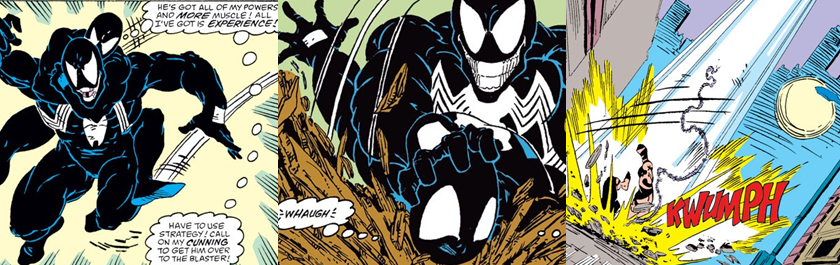
Back Issues [Venom Day]: The Amazing Spider-Man #361-363


To celebrate the release of Venom: Let There Be Carnage (Serkis, 2021), Sony Pictures declared September 27 “Venom Day”, a fitting date to shine the spotlight on one of my favourite anti-heroes, who made their first full debut in May 1988 and have gone on to become one of Marvel’s most iconic characters.

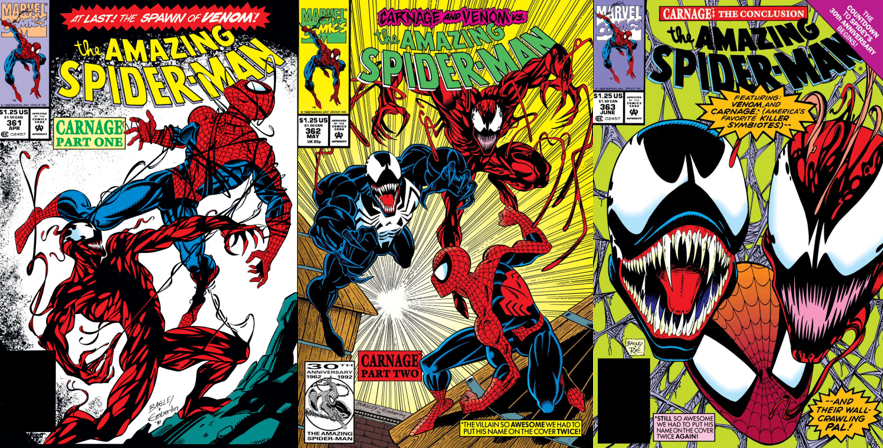
Writer: David Michelinie Artist: Mark Bagley

Story Title: “Carnage – Part One: Savage Genesis”
Published: 13 February 1993 (cover-date: April 1992)

Story Title: “Carnage – Part Two: Savage Alliance”
Published: 10 March 1993 (cover-date: May 1992)

Story Title: “Carnage – Part Three: Savage Grace!”
Published: 14 April 1993 (cover-date: June 1992)

The Background:
In 1982, Marvel Comics editor-in-chief Jim Shooter purchased an illustration of Peter Parker/Spider-Man in a slick black outfit from Randy Schueller for an outrageous $200, a concept that writer Tom DeFalco and artist Ron Frenz interpreted as an alien organism following Marvel Super Heroes Secret Wars #8. After revelling in the costume’s unique ability to form both clothing and organic webbing, Spidey was aghast when Doctor Reed Richards/Mister Fantastic revealed it was a sentient symbiote and quickly rid himself of the parasite using a cacophony of church bells. Throughout 1988, Peter was stalked and attacked by a mysterious assailant who turned out to be disgruntled reporter Eddie Brock, now bonded to the symbiote to form Venom, Spider-Man’s dark doppelgänger. An immediate favourite of mine, Venom has had many hosts over the years and undergone many changes, but took their first step towards becoming a more virtuous (if violent) “lethal protector” when they set aside their vendetta against Spider-Man to battle their more dangerous offspring, Cletus Kasady/Carnage. First teased in The Amazing Spider-Man #345 and allegedly dubbed “Chaos” and “Ravage” before assistant editor Eric Fein suggested “Carnage”, writer David Michelinie and artist Mark Bagley specifically designed Carnage to be a more sadistic counterpart to Venom, one whose symbiosis was so complete that Kasady and the symbiote were in total unity. Heavily influenced by the Joker, Carnage has long been a fan favourite and has repeatedly returned (even from death) to perpetrated some truly deplorable acts, from slaughtering thousands during the sprawling “Maximum Carnage” event (DeFalco, et al, 1993) to becoming a near-literal God! Despite Carnage’s violent nature, the character frequently appears in Spidey/Marvel videogames and, most surprisingly, cartoons, and was played with scenery-chewing relish by Woody Harrelson in Sony’s Spidey-less Venom films (Various, 2018 to 2024).

The Review:
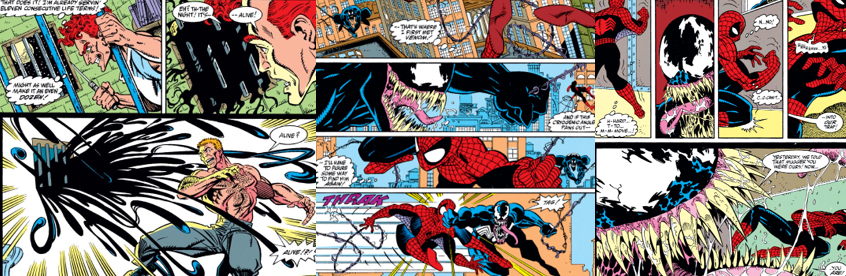
After appearing as Eddie Brock’s psychotic cell mate, Cletus Kasady took a page out of his “old man’s” book by popping up in “asides” in The Amazing Spider-Man #359 and #360. While Spider-Man was busy dealing with Doctor Elias Wirtham/Cardiac, Cletus communed with his “other” to slaughter a guard and escape Ryker’s Island. He then looked up the stupidest name he could find and brutally suffocating Gunther “Gunny” Stein, before finally getting his first full-page reveal murdering a lab technician simply to prove that “law and order” is an illusion. Peter gets a call about this while helping his doting Aunt May, ruminating on how the killing is the latest in a spree of violent murders perpetrated by a psychopath who signs his name (“Carnage”) in blood at each crime scene. While overhearing an eyewitness, Spider-Man is horrified at the implication that Venom is back to their old, murderous ways, despite Eddie living in peace in the mistaken belief that Peter is dead. When he shares these concerns with his highly strung actress wife, Mary Jane Watson-Parker/M.J., she begrudgingly supports him when he voices his responsibility towards subduing the symbiote he enraged. While running some background checks on Eddie, Peter becomes aware of Cletus and is disturbed by his rap sheet: eleven murders, suspected of a dozen more, and potentially burned down the orphanage he was raised in and bashed in an employee’s head in the process. Though alarmed, Peter questions punks, hookers, landladies, and more about Cletus to confirm he’s a twisted sadist who charms with a silver tongue and kills without a thought.
When a violent new symbiote comes to town, Spidey’s forced to team up with Venom!

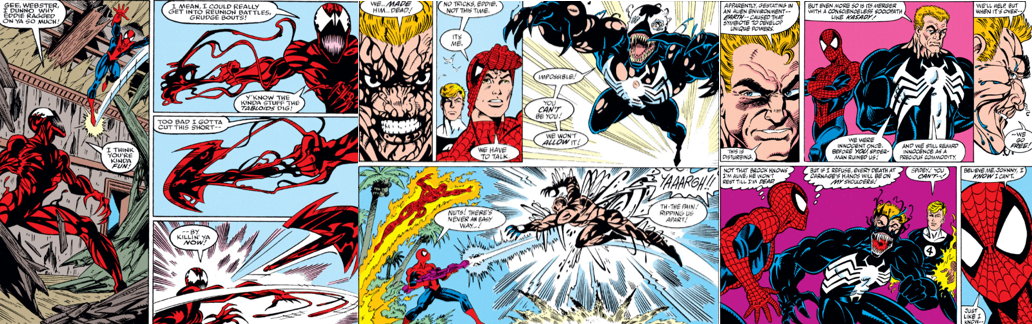
Theorising that Cletus feels a kinship to the orphanage, Spidey finds Cletus there, naked before a small fire and talking to a stuffed teddy bear! Spider-Man’s unease turns to terror when Cletus transforms into a blood red-and-black symbiotic lifeform and attacks with unexpected speed and strength. Like Venom, Carnage doesn’t set off Spidey’s “spider-sense” but can Carnage uniquely extend and solidify his alien appendages. Overwhelmed by Carnage’s power and confused as to how the symbiote bonded with Cletus, Spidey is stunned when Carnage tosses temporary axe-like projectiles! When two cops investigate, Spider-Man gains a temporary reprieve, only to be incensed when Carnage callously tosses dart-like pieces of himself at a patrolmen, leaving him clinging to life. This distraction allows Carnage to flee, leaving a parting message in his own blood that unnerves the web-slinger. Obsessed with tracking Carnage, Peter decides that the only way to defeat Carnage is to team up with Venom! After catching a lift from Johnny Storm/The Human Torch and retrieving Mr. Fantastic’s sonic gun, Spidey heads to the remote island where he left Eddie, surprising and enraging Venom. Despite the pain caused by the sonic gun and the Human Torch’s flames, Venom almost drowns Johnny before he desperately activates his “nova flame”. Spidey and Venom repeat their earlier fight at the abandoned mining village, with Venom getting the drop on him with their invisibility, before the Human Torch blasts them with the sonic gun. Despite the agony, and his hatred of Spider-Man, Eddie is furious to learn that Carnage is killing innocents. He also reveals that the symbiotes produce asexually and that they have no interest in traditional concepts of “family”, explaining why his “other” didn’t mention that it had reproduced.
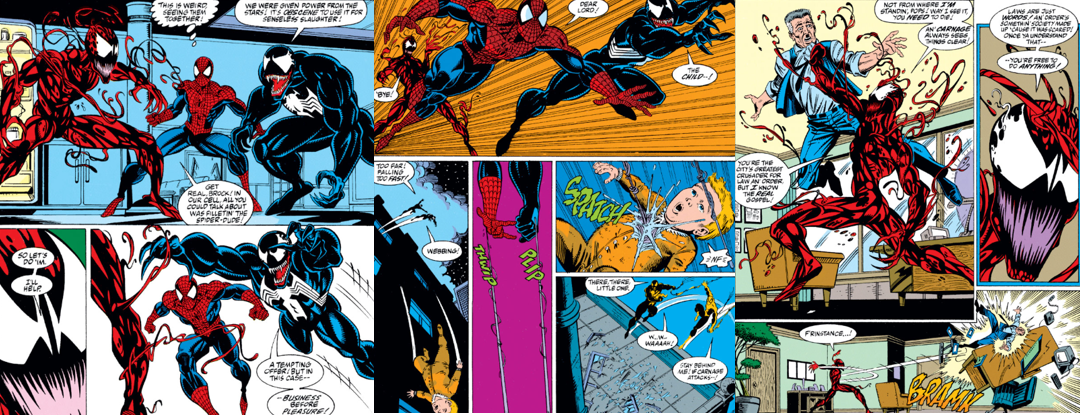
Carnage’s disregard for life sees him target random innocents and those who champion order.

Venom also theorises that Carnage’s lineage and Earth’s environment has altered his symbiote, and that Kasady’s warped personality makes him extremely dangerous. Venom also demands their freedom in return for their help and Spider-Man’s forced to agree. Although Johnny’s unnerved, he flies them back to New York City, where Venom follows their unique connection. Meanwhile, Carnage attacks wealthy Robert Sutcliff, brutalising his guards and tossing his helicopter off the roof (with Sutcliff in it!), simply for jokes. Asserting full control over the union, Cletus eschews logic to return to Sutcliff’s domicile, where he’s confronted by Spidey and Venom. Despite Carnage’s offer to team up and fillet Spider-Man, Venom attacks but, even with Spidey’s added strength, is no match for Carnage. The scuffle sees Carnage endanger a baby and escape while Spidey and Venom rescue the bawling tyke. Though Carnage blocks Venom’s senses, the duo quickly figure out that the killer’s next target is the cantankerous J. Jonah Jameson and, sure enough, Carnage surprises the Daily Bugle’s editor’s latest tirade. Despite him claiming to be “to important to die”, Carnage sees Jonah as the self-appointed bastion of “law an’ order”, the very things he strives to destroy. Thus, it only makes sense in his twisted mind that Jonah should be killed to set an example and show that the only truth is chaos carnage! Despite lashing out when Jonah reaches for a panic button, Carnage decides he’d much rather prove his point before an audience.
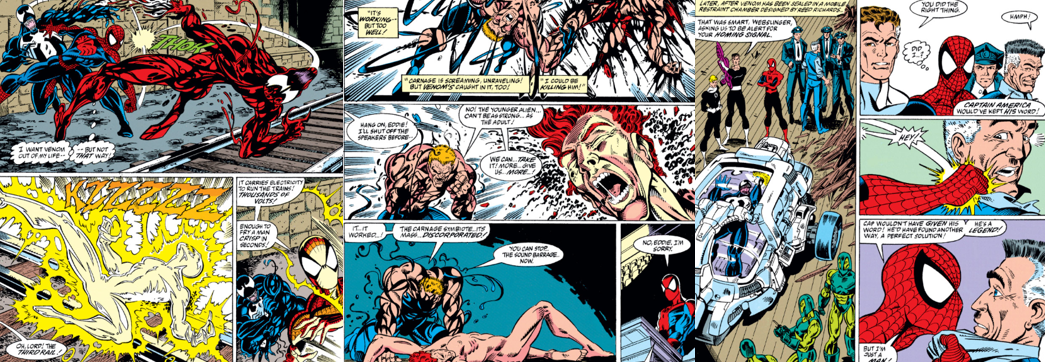
Spidey’s forced to make some tough decisions to end Carnage’s threat, which costs many lives.

Venom shares that Cletus was a natural loner who preferred to listen to heavy metal music than exercise (relatable!) and theorises (correctly) that Carnage has inherited both Peter and Venom’s powers. Though concerned about Venom’s own crazed morality and alarmed by Carnage’s body count, Spidey realises that Kasady plans to murder Jonah at a heavy metal concert at Madison Square Garden. When Carnage rushes the stage and kills a security guard, the braying crowd cheers him, assuming it’s part of the show, and quickly whips them into a violent mob with anti-authority rhetoric. When Spider-Man intervenes, Jonah selfishly tries to turn the situation to his advantage when Venom attacks Carnage. The fight drops into Penn Station, where Carnage slaughters innocent bystanders, keeps Spidey at bay with his darts, disrupts Venom with his stronger, “nastier” symbiote. Sensing the agony may kill Venom, Spider-Man knocks Carnage onto the live rail, but Kasady quickly recovers and targets Jonah again. While Venom tangles with their offspring, Spider-Man commandeers the venue’s sound system, setting the blasting both symbiotes with unbearable levels of sound. Despite the agony, Eddie demands Spidey keep going, correctly surmising that he’s strong enough to resist the pain. However, after Kasady collapses, his symbiote apparently evaporated, Eddie attacks Spider-Man, despite his weakened state, still convinced that Peter is evil. Luckily, Mr. Fantastic and the Human Torch arrive and subdue Venom, proving that Spidey never planned to honour their bargain. Not only does this convince Venom that Spidey’s no hero, Jonah’s also, incredibly, critical of Spider-Man for breaking his word, leading Spidey to lash out at the publisher and leave conflicted.

The Summary:
There’s no doubt that, by this time, Mark Bagley was the quintessential symbiote Spider-Man artist. Few are as synonymous with the flowing, monstrous creatures that Bagley, who gives a fluidity and life to the creatures that makes them both captivating and terrifying. Venom’s abilities were already near limitless, allowing them to reproduce Spider-Man’s webbing and wall climbing, simulate clothing, turn invisible, and circumnavigate Peter’s spider-sense. “Carnage” expands the symbiote lore, revealing they’re largely solitary creatures who don’t care for, nurture, or even consider their offspring. In fact, Venom seems enraged at having a spawn and driven to destroy it out of an inherent sense of superiority. Not only does Carnage have all of Venom and Spider-Man’s abilities, but he’s stronger and faster than both combined and can solidify his “other” in dangerous new ways, launching darts, axes, and forming bladed appendages. He also happily chokes his victims and even endangers babies, all for a sick thrill and to prey upon his enemy’s morals. Venom theorises that Kasady’s warped mindset has infected the symbiote as much as the “alien” environment, and it was interesting to see Kasady admonishing his “other” when it tried to “lecture” him. Most obviously, Carnage refers to himself as “I” and makes all the decisions, driven by a psychotic need to destroy social order, kill at random, and show that all life (and death) is random and chaotic. In this regard, Carnage is far worse than Venom, who has a twisted sense of morality and truly believes they’re saving innocents from evildoers like Spider-Man. While Venom kills to protect others and is clearly nuts, they still strive to save lives, whereas Carnage relishes taking life and happily pushes randomers in front of traffic or thrusts them through walls simply for fun.
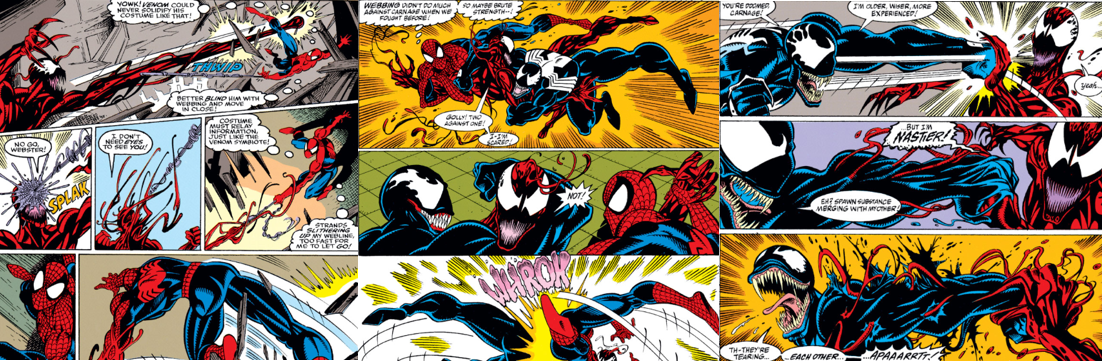
Carnage’s threat is so great that even Spider-Man and Venom combined have trouble defeating him.

This is apparent from Carnage’s appearance, with him seemingly formed from Kasady’s own blood, and Kasady’s decision to write warnings and messages in his blood. Portrayed as a psychotic, crazed serial killer, Kasady is also described as a polite and quiet man who pays his bills and doesn’t cause trouble. This is all a façade, however, as Kasady is deeply disturbed and clearly burned his childhood orphanage down, killing at least one person, and regresses to an unnerving, childish voice when in solitude. Kasady is almost comically without sympathy, painted as a cruel and sadistic killer who delights in causing random mayhem. Carnage is seemingly emblematic of the youth at the time, enjoying horror and heavy metal music and ranting against “the man”, to the point where a bunch of rockers are ready to kill purely on his word! Spider-Man is horrified by Kasady’s crimes, callous disregard for life, and incredible strength, which drives him to disregard M.J. and the Human Torch’s concerns and turn to Venom for help. This partnership is the highlight of the story as Venom continuously unnerves Spidey and makes him question his decision, singing “Strangers in the Night” and seemingly ready to snap at any moment. Spider-Man takes a huge risk partnering with Venom and undoing the ruse he tricked him with, but it turns out to be beneficial as Venom’s more concerned with eliminating his offspring than destroying his hated enemy. Venom proves invaluable, providing additional insight into the symbiotes, sensing Carnage’s presence, and holding the killer off so Spider-Man can think up a more permanent solution. “Carnage” doesn’t outstay its welcome (these days, it would probably be an eight-part story) but could probably have done with an extra issue to further explore Kasady’s backstory, though this would’ve unnecessarily humanised him. It’s not as deep or as impressive as other Venom or Carnage stories, but it’s a notable story for introducing one of Spidey’s most violent foes (and for its beautiful artwork!)

My Rating:

Rating: 4 out of 5.

Great Stuff

What did you think of Carnage’s violent debut? Were you a fan of Cletus Kasady or did you find him too random and crazy? Did you enjoy the team up between Spidey and Venom? Were you impressed by how different and psychotic Carnage was? What are some of your favourite Venom and Carnage stories and how are you celebrating Venom’s debut this month? Whatever your thoughts on Venom and Carnage, share them below, support me on Ko-Fi, and check out my other Venom and Spider-Man content.

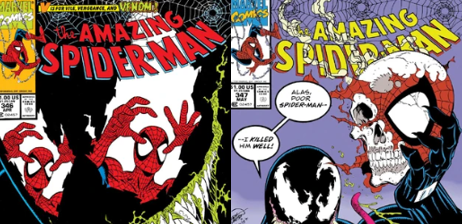
Back Issues [Venom Day]: The Amazing Spider-Man #346/347


To celebrate the release of Venom: Let There Be Carnage (Serkis, 2021), Sony Pictures declared September 27 “Venom Day”, a fitting date to shine the spotlight on one of my favourite anti-heroes, who made their first full debut in May 1988 and have gone on to become one of Marvel’s most iconic characters.


Writer: David Michelinie – Artist: Erik Larsen

Story Title: “Elliptical Pursuit”
Published: 12 February 1991 (cover-date: April 1991)

Story Title: “The Boneyard Hop!”
Published: 12 March 1991 (cover-date: May 1991)

The Background:
Back in 1982, Jim Shooter, then editor-in-chief for Marvel Comics, purchased Randy Schueller’s illustration of Peter Parker/Spider-Man in a slick black outfit for a cool $200. It was writer Tom DeFalco and artist Ron Frenz who made the costume a living organism and Spidey’s new duds appeared without explanation in The Amazing Spider-Man #252, with it later revealed that he picked up the suit in Marvel Super Heroes Secret Wars #8. Over the next year or so, Spidey revelled in the costume’s unique ability to form both clothing and organic webbing but was horrified when Doctor Reed Richards/Mister Fantastic revealed it was a living symbiote. Spidey summarily rid himself of the symbiote using a cacophony of church bells and switched to a cloth version, before eventually returning to his classic outfit. A mysterious assailant attacked and stalking Peter throughout 1988 it was revealed that the symbiote had bonded with disgruntled reporter Eddie Brock. Spider-Man’s dark doppelgänger was an immediate favourite of mine and many readers, eventually jumping to different hosts, with his sadistic, even more dangerous offspring, Cletus Kasady/Carnage, being teased in these issues.

The Review:
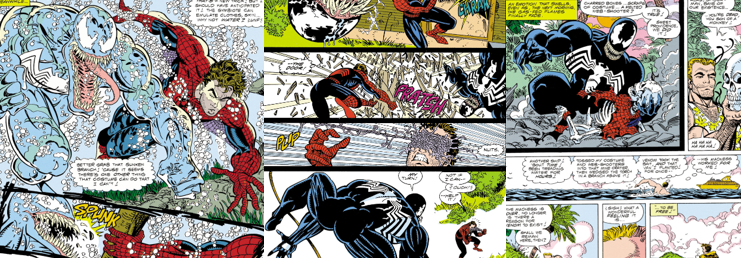
Although Venom’s second big appearance occurred in a two-part story in issues 346 and 346 of The Amazing Spider-Man, similar to their original first appearance, the character featured in a cameo in issue 345. Since it’s actually a pretty big cameo, I’ll quickly cover it before delving into the main story. “Gun from the Heart!” (Michelinie, et al, 1991) sees Spider-Man on the trail of noble, but misguided and violent, vigilante Elias Wirtham/Cardiac, with the added bonus of being promised $5000 by Silvija Sablinova/Silver Sable for apprehending him. The main reason this issue is important is two-fold: first, it shows Eddie Brock escaping from Ryker’s Island when his symbiote comes to bond with him once more. Second, it introduces readers to Brock’s cellmate, demented serial killer Cletus Kasady, who is unknowingly bonded with a small drop of the symbiote and would go on to become the sadistic Carnage. While Spider-Man fails to apprehend Cardiac in the main plot, the issue ends with Venom being reborn and swearing to avenge themselves against the wall-crawler. This perfectly sets us up for “Elliptical Pursuit”, which immediately re-establishes Venom’s warped moral code when they chastise fellow former reporter Sly Fenster for selling confidential files on the downlow before expressing regret when their webbing accidentally suffocates the corrupt reporter. The story then jumps over to Grand Central Station, where Peter’s wife, Mary-Jane Watson-Parker/M. J., is unimpressed at being spirited away to her sister’s. Having heard about Brock’s escape and the symbiote’s breakout from the Baxter Building, and fearing for M. J.’s safety, Peter convinces her to leave lest Venom targets the bombshell redhead like last time.

Venom returns with a vengeance, constantly blindsiding Spidey with their superior strength.

Despite knowing M. J’s safe, Peter’s thoughts dwell on Venom’s threat. Unwilling to put any of his allies in danger, even his former lover and part-time vigilante Felicia Hardy/The Black Cat, Peter resolves to face Venom alone, reasoning that it’s his responsibility since he technically created the creature and their hatred of him. He’s so lost in thought that he forgets that Venom doesn’t trigger his spider-sense and is caught off-guard when Brock accosts him at a coffee shop. Brock calmly convinces Peter to take a walk, expositing how his “other” survived an earlier confrontation with the cancer-inducing Styx and happy to settle their business down a back alley. However, they’re jumped by a mugger, who’s summarily dispatched (non-lethally this time) by Brock, though Peter uses the distraction to flee to a hotel for the night. A seemingly random phone call from Professor Evan Swann inspires Peter to swing on over to Empire State University and check out their cryogenics lab, hoping to find a weapon that can neutralise Venom similar to how extreme heat and sound defeated them before. Once again forgetting his reliance on his spider-sense, Spider-Man is blindsided mid-swing by Venom, who gleefully lays in a beating on the web-slinger. Experience and agility allow Spidey to create some distance, though Venom easily closes it by hurling a girder. With Venom distracted keeping innocent lives safe when their fight causes damage to the Bronx Zoo, Spider-Man goes on the offensive, giving Venom a taste of their own medicine and angering the unstable symbiotic pairing. However, Venom regains the advantage by using their uncanny ability to assume other forms, tricking Spider-Man into entering the cryogenic chamber, where the extreme cold forces the troubled superhero to blackout and be left at Venom’s mercy.

Overpowered, Spidey outwits his foe by faking his death.

In the next issue, Spider-Man slowly dethaws and awakens on a sweltering beach, confused to find himself trapped on a deserted island with (and courtesy of) his most lethal foe. Not willing to allow for any distractions or let innocent bystanders get in the way of their combat, Venom proposes a fight to the death to settle their grudge and relishes chasing his foe through the dense foliage. Though terrified by the creature’s threat, Peter desperately forces himself to adapt to and out-think his foe but is again blindsided by a clever sneak attack when Venom renders themselves invisible and attacks from a stream, nearly drowning Spidey before he fights his way free using a nearby tree branch. Venom’s abilities constantly give them the edge even when Spidey calls upon the Eagle Scout training his former bully-turned friend Eugene “Flash” Thompson tried to teach him and lay traps for his foe. Venom’s ability to blend into their surroundings forces Spidey to rely on his speed and agility instead. Even when Venom is caught in Spidey’s snare trap, the creature easily overpowers him but, when Venom hurls a truck at his hated enemy, he unwittingly causes Spidey to stumble upon an abandoned mine full of gas. After using the mine to escape Venom, Spidey tries to swim to a boat on the horizon, only to end up tangled in Venom’s living webbing. Tackling his way out of the situation with a desperate lunge, Peter stumbles upon some macabre shallow graves and finally realises that their conflict will only end with his death. Spidey thus lures Venom into the jungle with a flaming torch and goads them into hurling another truck, this time resulting in a spectacular explosion that leaves Spider-Man nothing but a shredded skeleton. Overjoyed at having finally defeated their foe, Venom resolves to live out the rest of their existence in peace on the island, blissfully unaware that they’ve been fooled by an obvious trick. Having dressed a skeleton in his costume, Peter faked his death and swam out another passing boat, breathing a sigh of relief knowing that Venom’s menace has forever been put to bed.

The Summary:
After a dramatic and horrifying first appearance, it was pretty exciting to see Venom return, more unhinged and psychotic than ever. What I love about Eddie Brock is that he’s convinced himself that everyone, especially Spider-Man, is to blame for his lot in life. He takes no personal responsibility for the actions that led to his downfall and has convinced himself that he’s on a righteous, God-given mission to protect the innocent and destroy Spider-Man. This twisted ethical code means he’s vehemently against the killing of innocents and will even be distracted from his vendetta to protect them, but also leads to him both knowingly and unknowingly using lethal force to get what he wants. Similarly, he’s not above threatening Peter’s loved ones, which is exactly why Peter sends M. J. away and refuses Felicia’s help since he doesn’t want to be distracted by protecting them or burdened by putting them in danger. Indeed, Peter acknowledges that others have aided him against Venom before and he’s now put himself in greater danger by going solo. This is exacerbated by just how dependent Spidey is on his spider-sense; normally, he can swing around mulling over his personal dramas and always rely on his spider-sense to warn him of danger. But Venom doesn’t trigger it, so they constantly gets the jump on Spider-Man, almost to the point of parody in just these two issues as Peter seemingly never learns to adapt to this, forgets about it, or cannot find a way to compensate for the loss of his spider-sense.

A brutal conflict ultimately results in Venom finding solace in believing they’ve killed their enemy.

Since Venom is bigger, stronger, and completely out of their mind, Spider-Man is forced to stay on the move and rely on his experience and agility. Time and again, this puts him on the back foot; even when he does reach the university labs, he’s easily fooled by Venom’s camouflage ability and rendered unconscious. I loved the island setting for their final confrontation, which essentially put them on even ground since there were no innocents to worry about or tall structures to swing from, but Venom had the advantage because of their familiarity with the island and their unique abilities. Luckily for Spidey, Venom likes to toy with their prey and relishes the chase, giving Peter multiple opportunities to think up plans to subdue and ultimately trick his psychotic foe. Essentially, these two issues are a prolonged chase and fight sequence; Erik Larsen is one of the quintessential Venom artists, closely emulating Todd McFarlane’s style and giving Venom their gruesome teeth and tongue, so the action is always kinetic and visually striking. It’s not enough to tide over the story, though; the sub-plots regarding Felica and M. J.’s worries about Peter, his beloved Aunt May’s romantic life, and the loose thread regarding Cardiac help break up the pace but distract from the main appeal of the stories. It would’ve been nice to see Venom do more to torment Peter, especially in the first issue. They work great as a creepy stalker and that aspect is only briefly touched upon before the two are trading blows between the city skyscrapers. Similarly, the island battle quickly becomes repetitive as Spidey goes on the run, gets blindsided, and goes on the run…only to be blindsided again. These issues seem to have been produced to put Venom’s threat to bed; they’ are content and happy believing they’ve killed Spider-Man. Michelinie even leaves a tease that a version of the symbiote will live on through Kasady, making me wonder if this was supposed to Venom’s last appearance. As is, it’s a decent enough sequel to Venom’s first appearance, most notable for being the first appearance of Kasady, that indirectly leads to one of Spider-Man’s most violent and tedious crossover events later down the line.

My Rating:

Rating: 3 out of 5.

Pretty Good

What did you think to Venom’s big return? Did you ever think Cletus Kasady would become one of Spider-Man’s most notorious rogues? What did you think to Venom’s characterisation as a self-righteous psychopath? Did you find the conflict tedious in Venom’s repeated blindsiding of Spidey? What is your favourite Venom story and how are you celebrating Venom’s dramatic debut? Whatever your thoughts on Venom, share them down below and be sure to check out my other Venom and Spider-Man content.
Back Issues [Venom Day]: Ultimate Venom


To celebrate the release of Venom: Let There Be Carnage (Serkis, 2021), Sony Pictures declared September 27 “Venom Day”, a fitting date to shine the spotlight on one of my favourite anti-heroes, who made their first full debut in May 1998 and have gone on to become one of Marvel’s most iconic characters.


Writer: Brian Michael Bendis – Artist: Mark Bagley

Story Title: “Origins”
Published: February 2003

Story Title: “Today”
Published: April 2003

Story Title: “Inheritance”
Published: March 2003

Story Title: “Still”
Published: May 2003

Story Title: “Legacy”
Published: March 2003

Story Title: “Father’s Pride”
Published: May 2003

The Background:
In 1982, Marvel Comics’ editor-in-chief Jim Shooter purchased Randy Schueller’s illustration of a black-suited Spider-Man for a mere $200; writer Tom DeFalco and artist Ron Frenz then conceived of the costume being a living organism Spidey would acquire in the “Secret Wars” event. After he shed the parasitic symbiote, it bonded with disgraced reporter Eddie Brock and Spidey was tormented by Venom, a twisted double who proved so popular that additional symbiotes and storylines spun out of the character’s lore. First proposed by lawyer Bill Jemas, Ultimate Marvel was a secondary imprint of Marvel Comics that ran alongside the main comic line (known as “Marvel-616”) but told their most popular characters’ stories from a fresh, modern perspective to entice new readers and fans of the live-action adaptations of the time. The imprint was spearheaded by Brian Michael Bendis and Mark Bagley’s Ultimate Spider-Man series, which featured a far younger Peter Parker who encountered many of his most notorious villains while still in high school. The series proved incredibly popular, and even survived the eventual destruction of its universe in the form of Miles Morales, and offered a far different, more scientific incarnation of Venom to its universe. The six-issue “Venom” story arc proved so successful that developers Treyarch revisited and expanded upon it for their moderately successful Ultimate Spider-Man videogame (ibid, 2005), which included this version of Venom as a playable character!

The Review:
I think it’s only fair to start by saying that I was never really a big fan of Ultimate Spider-Man, or the other Ultimate comics; the art work was amazing, and I admired how writers like Bendis were able to capture natural, relatable dialogue and how the comics adopted a dynamic, real-world aesthetic. But, for me, the comics were a little too dark, a little bit extreme at times, and rushed through some of Marvel’s biggest storylines and burned themselves out too quickly as a result. The Ultimate Spider-Man comics were especially difficult for me to get into since Bendis packs so much dialogue onto the page, sometimes having a single splash page of a character talking and a good 80% of the background being dominated by a huge speech bubble. Either that or he’d have characters barely able to string sentences together, which, again, is very realistic and indicative of real-life conversations but can make reading the comics a bit of a chore as relatively simple storylines are dragged out across multiple issues simply for the sake of drama. However, having said all that, Mark Bagley is one of my favourite Spider-Man artists, so I absolutely had to seek out the “Venom” story arc to see him working on the character again and he definitely made this younger, far more flawed Spider-Man all the more impressive and dynamic with his explosive and visually engaging art.

Following a painful break up, Peter reconnects with a childhood friend.

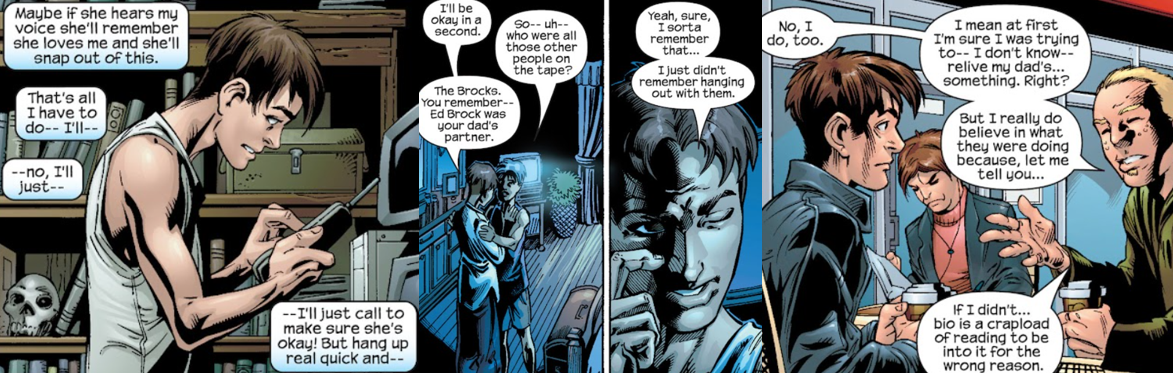
Anyway, the “Venom” arc comes at a time of great upheaval in Peter Parker’s life; already struggling with high school and the guilt of indirectly causing his beloved Uncle Ben’s death, Peter is burdened by his part in the death of heroic police captain George Stacy and has recently been dumped by his long-term friend and on-and-off girlfriend, Mary Jane Watson, since she can’t handle the pressure of worrying about his web-slinging activities (Peter’s duel identity wasn’t the best kept secret in the Ultimate comics). Peter is left devastated and wallowing in self-pity, doubt, and anger at having screwed up with M. J. While struggling with his tumultuous and self-deprecating emotions in his Aunt May’s attic, he stumbles across a box of photographs of his long-dead father, scientist Richard Parker, and a VHS tape depicting him as a small boy with his parents, his Aunt May and Uncle Ben (depicted as more of a free-spirited hippy in Ultimate Spider-Man), and the Brocks, family friends of the Parkers. Eddie Brock Snr was Richard’s partner on the “Venom Project”, while Eddie Brock Jnr was Peter’s best friend as a child; his memory jogged of his long-lost friend, Peter decides to reconnect with Eddie, who also lost his parents in the same plane crash that killed Richard and Mary Parker, and easily tracks him down thanks to the internet. Awestruck by the bustling Empire City University, Peter meets with Eddie, who’s in a bioengineering program at the university but struggling to live up to his father’s legacy thanks to the workload and the expense of university life.

In a bid to complete his father’s work, Peter finds himself garbed in a protoplasmic suit.

When Peter shares the news of his recent break up, Eddie is a little dismissive, but he’s absolutely right when he says that high school drama is nothing compared to the struggles of the bigger, wider world and he encourages Peter to not let it ruin the best years of his life. Touched by Peter sharing a copy of the video tape, Eddie takes him to a high-tech lab where he’s been working on their “inheritance”, a beaker full of black goo that represents their fathers’ life’s work. Thanks to help from Doctor Curtis Conners, Eddie has pieced together that Richard and Eddie Snr were working on a protoplasmic suit that could (theoretically) cure any disease while simultaneously enhancing the wearer’s natural physical strengths. To fund their research, Richard and Eddie Snr turned to Trask Industries, though this meant that anything they discovered or created would no longer be theirs, and Eddie theorises that they were killed when they tried to keep their project from being perverted into a weapon of war. Eddie’s sample is all that’s left, a small quantity that their fathers worked on in secret, one that was created using Richard’s own DNA and which Eddie fully believes could change the world for the better. Stunned by these revelations, Peter rekindles his friendship with Eddie, who picks him and his house mate and friend, Gwen Stacy, up after school, much to the chagrin of the conflicted M. J., who clearly still has feelings for and cares about Peter. Reviewing his father’s notes and video diaries, Peter snaps when he sees just how distraught his father was at having his research stolen or perverted and resolves to finish his father’s work by breaking into the lab as Spider-Man and taking a sample of the goo to run his own tests. However, a small drop of the liquid splatters onto his hand and a startling, agonising transformation occurs that sees Spidey engulfed by the writhing goo, encased in a monstrous cocoon of sorts, and finally emerging in a sleek, form-fitting black costume.

Peter’s elation soon turns to horror when the suit transforms into a hulking monster!

Spider-Man tests out his new duds by first rescuing a shallow, self-obsessed pop star after she’s held hostage by armed forces in her own limo and then making short work of Herman Schultz/The Shocker. The suit not only greatly amplifies Spidey’s already superhuman strength and speed but allows him to instantly heal from point-blank gun shots and fire black webbing from his fingertips and Peter revels in the power and euphoria offered by his father’s incredible invention. However, things quickly take a turn for the worst when he confronts an armed robber who shoots and kills an innocent man in front of his wife and child; overwhelmed by memories of Uncle Ben’s death, Spidey transforms into a hulking, salivating, monster that hungers for blood and drives him into a mindless rage! Peter’s sense returns in time to spare the man’s life and, horrified by the suit’s grotesque appearance and overwhelming appetite, he flees into the rainswept night, desperately trying to remove it. Luckily, his wild thrashing sees him collide with a set of power lines, which burn the suit off his body and leave him dramatically lying (butt-naked) on the grave of his dead uncle and parents. While all of this is going on, Gwen and Eddie were raving at a reggae concert; afterwards, he tries to put the moves on her and is slighted when she rightly refuses his advances since she’s only fifteen. Any further exploration of Eddie’s inappropriate lusts for the younger girl are quickly dashed when he turns on the news and sees Spider-Man’s fancy new black costume; racing back to the lab, he’s stunned to find Peter there but enraged to find that his young friend is planning to destroy their fathers’ legacy since it’s uncontrollable and dangerous.

Turns out Eddie’s a bit of a creep, and a selfish, jealous dick on top of it!

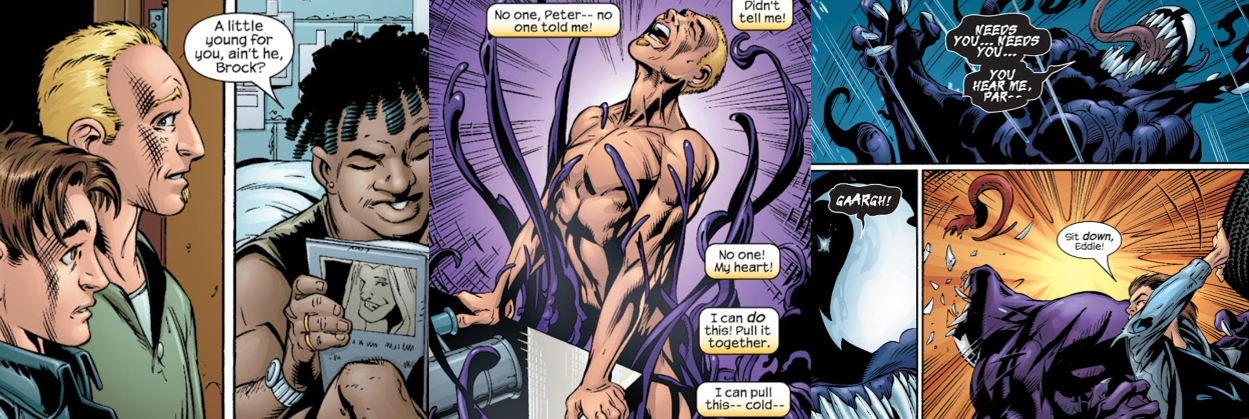
Eddie’s anger is only exacerbated when Peter reveals that he’s Spider-Man and goes on a lengthy tirade about power, responsibility, and his experiences with just a small sample of the suit. Devastated to learn that his father’s legacy is a volatile and potentially life-threatening substance, Eddie reluctantly allows Peter to take the remainder of the goo and destroy it, apparently convinced of his friend’s sincerity by the little white lie Peter tells that nobody else knows about his secret identity. However, as Gwen so astutely puts it, Eddie is a “bad guy” deep down and, soon after Peter leave, he mutters a bunch of insults at Peter, disgusted by the belief that he’s a Mutant, and willingly exposes himself to a separate sample of the protoplasm he secretly had locked away. Potentially because he lacks Peter’s spider-strength, the transformation is far more unstable and gruesome for Eddie; suffering from extreme cold and overwhelmed with an insatiable hunger, Eddie is bombarded with cruel and negative emotions, and the sheer panic at the realisation that the suit is feeding on him! By focusing on his anger and pain, Eddie is able to force the suit under some measure of control, but he quickly loses his focus when guards show up and transforms into a slobbering, clawed beast that devours people whole! Tormented by nightmarish memories, Peter finally snaps and visits M. J. and the two have a heart to heart in which he tells her that he loves her, but they far from reconcile despite her obviously still having feelings for him. Because of her intimate knowledge of Peter and his abilities as Spider-Man, she’s the only one who notices when he’s distracted by this spider-sense, which alerts him to the presence of the suit on the school grounds; chastising himself for not making sure the suit was completely destroyed, and theorising that it has some kind of “biological memory”, he races out to control it in his street clothes, completely unaware of Eddie’s fate.

Peter is left distraught when Eddie attacks him and appears to die.

Indeed, when Eddie is revealed to be within the thrashing, monstrous suit, Peter is both shocked and appalled that his old friend would willingly subject himself to the suit’s influence. Unlike the mainstream version of Venom, Ultimate Venom is a volatile and almost mindless beast; a pulsating, brutish monster with teeth and spikes dotted throughout its body and whip-like tentacles, it oddly lacks the spider symbol so associated with the character (despite this appearing on the issue’s covers and Spider-Man having it when he wore the suit…and it randomly appearing in one panel…) and is constantly consuming Eddie’s body, feasting upon and fostering his rage and dark emotions to sustain itself. Lashing out in a jealous and embittered rage, Eddie attacks Peter, easily swatting him aside and half-choking him with his tendrils, all while Peter desperately tries to talk sense into his half-crazed friend. Realising that Eddie is out of control and that the suit is simply mimicking his spider abilities and driving him into a murderous fury, Peter leads Ultimate Venom away from the school grounds, lamenting the friends and loved ones he’s lost to “this super hero crap” and wondering whether the suit drove Eddie crazy or if he was always like that deep down. Regardless, they clash on a rooftop, quickly plummeting through some power lines and to the streets below. With Eddie stunned, the suit tries to overtake Peter once more, with Eddie’s distorted rambling claiming that the suit has to kill Peter in order to be whole since Eddie isn’t strong enough to sustain it. The timely arrival of New York’s finest see both peppered with gun fire, which drives Ultimate Venom back towards a live power line and, in a flash of light, apparently incinerates both the suit and Eddie before Peter’s eyes in suitably anti-climatic fashion. Naturally, Peter is also fired upon and, wracked with guilt and pain, he retreats home and ends the story exactly where he started: distraught and in utter anguish at having lost another friend and ruined his life even more thanks to his duel identity.

The Summary:
So, yeah, Ultimate Venom does suffer from some of those negatives that I find off-putting about the Ultimate Spider-Man comics; there’s a lot of dialogue, much of it rambling and disconnected, with at least one page being Peter babbling on and on to Eddie, which really isn’t all that interesting to see or read since we already know everything he’s saying and it just seems like padding. Any time Richard and Eddie Snr are discussing their work, you can expect a whole bunch of speech bubbles to be dotted all over the pages and panels, and there are a few instances where characters are completely static and art work is repeated between panels with the characters just saying different things. It’s a weird one for me as, like I say, I do appreciate and admire the way Bendis captures real, natural, often haphazard character dialogue but sometimes it’s a bit much. One thing that both works for and against the Ultimate comics is how cinematic they often are; panels and events are presented very much like a movie, showing rather than telling in some instances, and then snapping back to a massive exposition dump, with dynamic and exciting action sequences and visuals to help keep things interesting. On the plus side, Ultimate Spider-Man is arguably, subjectively, easier to read than some of the comics from the sixties and seventies since they’re not bogged down with outdated dialogue and such (though there is some of that here, particularly in Gwen’s dialogue) and the presentation is far more energetic, but I can understand why some people don’t really care of these comics as they’re very angsty, teen drama like a high school show.

Peter is definitely full of angst, which sadly limits his Spidey action.

Anyway, that aside, there’s a decent amount to like here; the art, especially, is incredible. Mark Bagley did some of his best work on Ultimate Spider-Man and really makes this younger, more troubled teenaged Spider-Man visually distinct from his mainstream counterpart not just in his haircut but in the physical depiction of Spidey as this gangly, inhuman superhero. Unfortunately, Bagley seems to struggle a bit with faces; a lot of the characters look the same, facially, and there’s a noticeable lack of Spider-Man in this arc. He only suits up a couple of times, and he’s only in the black suit for one issue! This is what I mean by Ultimate Spider-Man rushing through things; 616-Peter had the black suit for four years before its true nature was revealed and, at that point, he was in his early twenties. Here, Peter’s still in high school and has already had impactful encounters with some of his most memorable villains, and he’s in the suit for what seems like only a few hours before it tries to consume him, and he frantically rids himself of it. I’ve read a lot of mainstream Spider-Man stories and Peter is absolutely known for being riddled with guilt, pressure, and angst but his Ultimate counterpart is far more dramatic and melancholy; he’s driven into a self-deprecating, morose depression after M. J. dumps him (which I can totally relate to) and has been pushed to the edge by recent events, which cause him to recklessly experiment with the goo and thus almost be killed when the suit goes mental on him. Realising that he’s made a serious mistake and heartbroken to find that his father’s life’s work is volatile and dangerous, Peter immediately backpedals and tries to make everything right by destroying his dad’s research, which means exposing himself to Eddie and desperately trying to convince his childhood friend to go along with this despite how difficult the truth is to hear.

Eddie’s a bit of a weirdo, but Ultimate Venom is nothing more than a mindless beast.

Eddie himself is quite different here. A scientist rather than a discredited reporter, he’s a slender hipster who seems to have really valued his friendship with Peter and who is absolutely fixated on completing his father’s research so that his legacy can live on. There are some red flags raised when it comes to Eddie from the moment Peter meets him at his dorm room, which is a bit of a mess for one thing and shared with another student who has nothing good to say about Eddie. The exact depths of his depravity aren’t revealed until later, however, when he flirts with Gwen and tries to kiss her, then spitefully calls her a tease and dismisses her after she understandably rejects him. Although Peter defends his friend and believes that he’s a good person deep down, this incident is enough to convince Gwen otherwise, and it turns out she’s absolutely right as he’s a bit of a depraved, disturbed young man; bigoted towards Mutants (like most of the Ultimate universe) and ridiculing Peter’s naïvety, Eddie maliciously exposes himself to the goo simply to both prove Peter wrong and to assume the power he described for himself. Instantly, however, Eddie is consumed and driven to madness by this extremely removed version of Venom; little more than a voracious, cancer-like substance, Ultimate Venom is more an amplifier of emotions and abilities than it is a symbiotic life form and simply drives Eddie to confront and devour Peter in order to sustain its unstable and monstrous form out of an innate need for self-preservation rather than any kind of twisted vendetta. This results in a creature that is more of a hulking, primeval brute rather than a sadistic villain looking to make Peter’s life a living hell, though there are some similarities in that Ultimate Venom has apparently copied Spider-Man’s abilities. Ultimately, however, it’s more like a protoplasmic clone of Peter, one spewing teeth and tentacles and going on insatiable rampage, spouting nonsensical accusations and threats but being a far less interesting and layered character in its own right since it’s just a parasitic lifeform that overtakes Eddie.  

My Rating:

Rating: 3 out of 5.

Pretty Good

Have you read Ultimate Spider-Man’s “Venom” arc? What did you think to this new depiction of Venom? Were you a fan of the changes made to Eddie’s character and his more disturbing nature? Were you also disappointed that Peter’s time in the black suit was cut so dramatically short and that he didn’t fight Ultimate Venom as Spider-Man? Did you enjoy the Ultimate comics, specifically Ultimate Spider-Man and, if so, what were some of your favourite moments from those comics? What is your favourite Venom story and how are you celebrating Venom Day today? Whatever your thoughts on Venom, feel free to leave them below.

Screen Time [Venom Day]: Spider-Man (1994): “The Alien Costume” (S1: E8-10)


To celebrate the release of Venom: Let There Be Carnage (Serkis, 2021), Sony Pictures declared September 27 “Venom Day”, a fitting date to shine the spotlight on one of my favourite anti-heroes, who made their first full debut in May 1988 and have gone on to become one of Marvel’s most iconic characters.


Season One, Episodes Eight to Ten:
The “Alien Costume” Saga

Air Date: 29 April 1995 to 13 May 1995
Network: Fox Kids Network
Stars:
Christopher Daniel Barnes, Hank Azaria, Roscoe Lee Browne, Don Stark, Jim Cummings, and Edward Asner

The Background:
Given that Marvel’s resident wall-crawling hero proved to be popular enough to receive his own self-titled comic book barely a year after his blockbuster debut, it’s perhaps no real surprise that Peter Parker/Spider-Man has featured in a number of cartoons over the years. Nowadays, it seems like Spidey gets a new cartoon every other day of the week but, when I was a kid, his 1994 to 1998 cartoon was a must-watch piece of weekly entertainment. Produced by Saban following their success with the X-Men animated series (1992 to 1997), Spider-Man (or Spider-Man: The Animated Series) was a fresh and fun adaptation of many of the web-head’s greatest adventures, even if it was a little hampered by some unnecessary censorship. Given that I was super into Venom at the time, it’s no surprise to me that the cartoon’s introduction and depiction of the character rank as some of its best episodes; so popular were Venom at the time that they were introduced in the first three-part saga of the series (and well before the creators adapted the “Secret Wars” comic) and even returned for a two-part follow-up a year later.

The Plot:
After rescuing astronaut Colonel John Jameson (Michael Horton) from a shuttle crash, Spider-Man (Barnes) finds his costume and abilities augmented by a mysterious black goo. When Wilson Fisk/The Kingpin (Browne) sends a number of super-powered goons to retrieve the “Promethium-X” Jameson brought back to Earth, Spidey finds his aggression and character altered by the suit, which is revealed to be a symbiotic organism! After ridding himself of it, Spidey is confronted with one of his worst foes imaginable with the symbiote bonds with disgruntled reporter Eddie Brock (Azaria) and transforms them into Venom!

The Review:
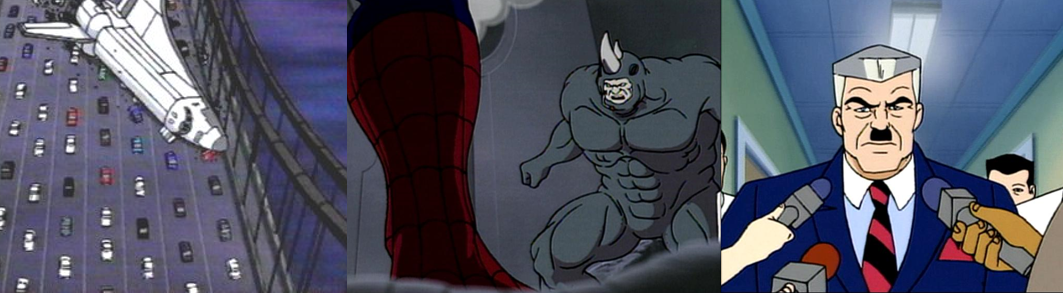
The “Alien Costume” arc begins with astronaut John Jameson digging up a mysterious black rock from the surface of the Moon; after narrowly escaping a Moonquake, he makes it back to the shuttle and his return to Earth with the newly-discovered isotope, Promethium-X, attracts the attention of the Kingpin since it promises to be more powerful and valuable than Plutonium. However, John’s return is hampered when the rock secretes a seemingly-sentiment, tar-like substance that attempts to consume the astronauts and leaves the shuttle on a collision course with New York City!

The shuttle crash and the acquisition of Promethium-X forms the central conflict of the arc.

Despite the imminent danger, Kingpin’s lead scientist, Alistair Smythe (Maxwell Caulfield), assures him that the shuttle will land without causing any damage to the city so he (as in the Kingpin) contacts Aleksei Sytsevich/The Rhino (Stark) to retrieve the Promethium-X once the shuttle makes its emergency landing on the George Washington Bridge. There, he comes into conflict with Spider-Man and, thanks to his superior size and strength and the shuttle’s precarious position, is able to best the wall-crawler and make off with the isotope. Although he saves John and his co-pilot, Peter is aghast when he is fingered as the one responsible for stealing the Promethium-X thanks to John’s incoherent rambling, his father J. Jonah Jameson’s (Asner) unrequited hatred for Spider-Man, and disgraced photographer Eddie Brock selling J. J. pictures that incriminate the web-head. Having been introduced in previous episodes as an embittered man desperate to regain his job at the Daily Bugle, Brock jumps at the chance to capitalise on Jameson’s hatred of Spider-Man with his photos.

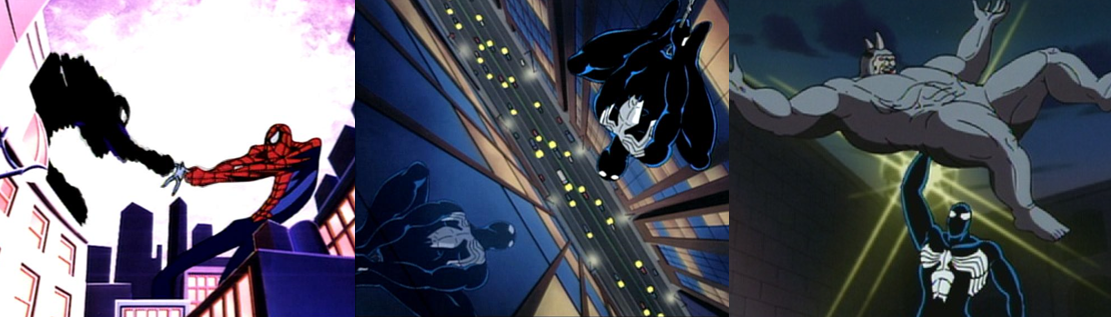
The black suit overtakes Spider-Man and augments his strength and negative emotions.

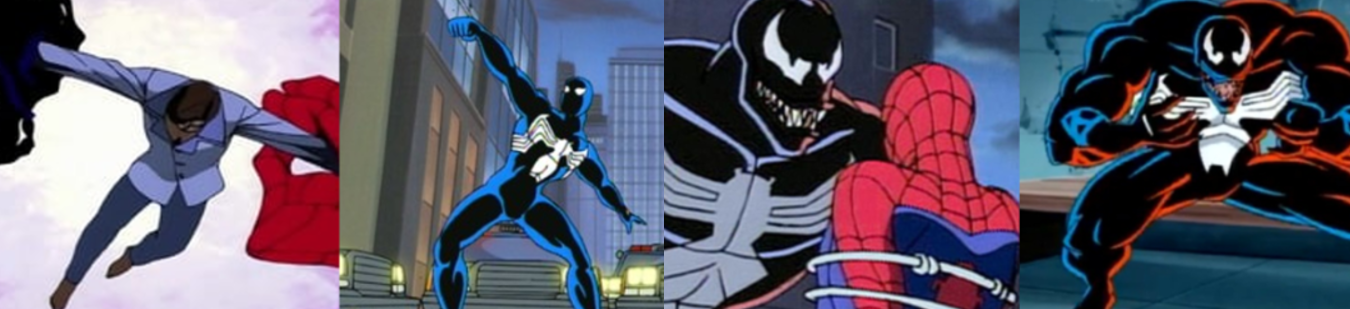
This results in Jameson placing a $1 million bounty on Spider-Man’s head, forcing Peter to lay low. However, while he sleeps, the mysterious black substance from the shuttle is revealed to have attached itself to his costume and, following a harrowing nightmare, the goo overtakes Peter, who wakes to find himself garbed in a sleek black costume that dramatically augments his speed and strength. Overwhelmed at the suit’s capabilities, Spider-Man discovers he can now shoot organic webbing and change his appearance by simply thinking about it, but it quickly becomes apparent that the alien substance is also affecting his personality. Far more confident than ever before, even Spider-Man’s voice is slightly altered when he’s wearing the black suit, making him sound tougher and more aggressive than usual. Equally quick to anger, Peter threatens Eugene “Flash” Thompson (Patrick Labyorteaux), snaps at his doting Aunt May (Linda Gary), and comes close to killing destroying the Rhino after handily dominating their rematch. Although he manages to get a hold of himself, Peter’s demeanour continues to degrade into an enraged fury as he is hounded at every turn thanks to Jameson’s bounty; his overconfidence and anger causes him to become sloppy, however, and he learns the hard and painful way that the alien costume is vulnerable to high-intensity sonic waves. Spider-Man does himself few favours when he confronts Brock and Jameson, threatening them in the Daily Bugle and driving him to visit his friend, Doctor Curt Connors (Joseph Campanella), to find out more about the suit.

While Spidey disregards Connors’ advice about the symbiote, he uses to science to outwit the Kingpin.

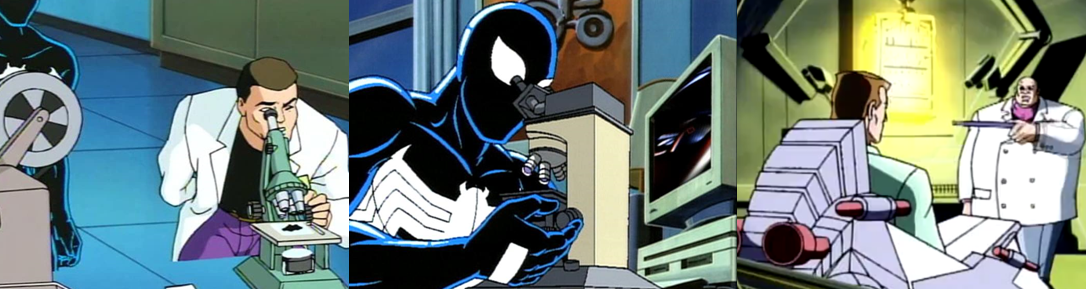
As you might expect, Connors reveals that the suit is actually a living, alien symbiote that is seeking to permanently bond with Peter. Although he stresses the very real danger of the alien costume, Connors is unable to convince Spider-Man to remove to suit since he needs it to recover the Promethium-X. When John corroborates Spider-Man’s story of a guy in a rhino suit, Jameson angrily lays into Brock for lying to him, fires him, and is begrudgingly forced to withdraw his bounty on Spider-Man. Embittered by this development, Brock’s mood is further soured when he is also evicted from his apartment and when he is targeted by the Kingpin, who sends Herman Schultz/The Shocker (Cummings) after him to tie up the loose ends from the shuttle robbery. After saving Brock from being blasted into dust, Spider-Man tracks the Shocker to Smythe’s laboratory and finally recovers not only proof of his innocence from Brock’s apartment but the Promethium-X from Smythe. While the Kingpin was more concerned with selling the rock to the highest bidder, Spider-Man takes the time to properly investigate the Promethium-X and discovers that, while it is incredibly powerful and dangerous, its radioactive half-life is ridiculously small, which results in the Kingpin being left humiliated and with an inert rock in his possession.

After ridding himself of the symbiote, Spidey unknowingly births his greatest foe: Venom!

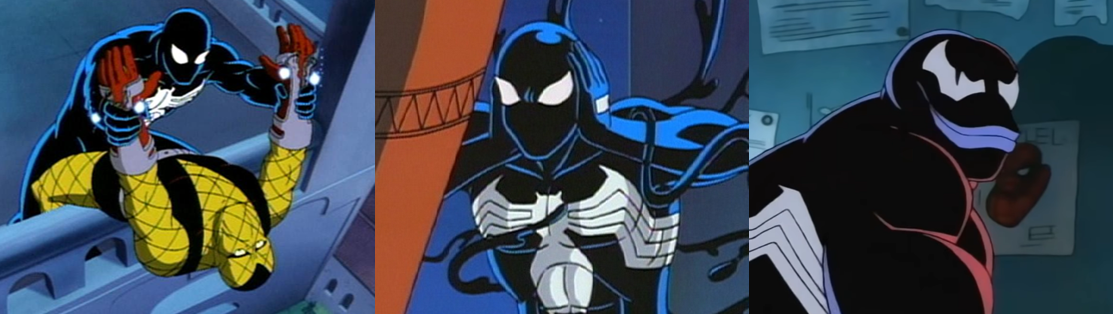
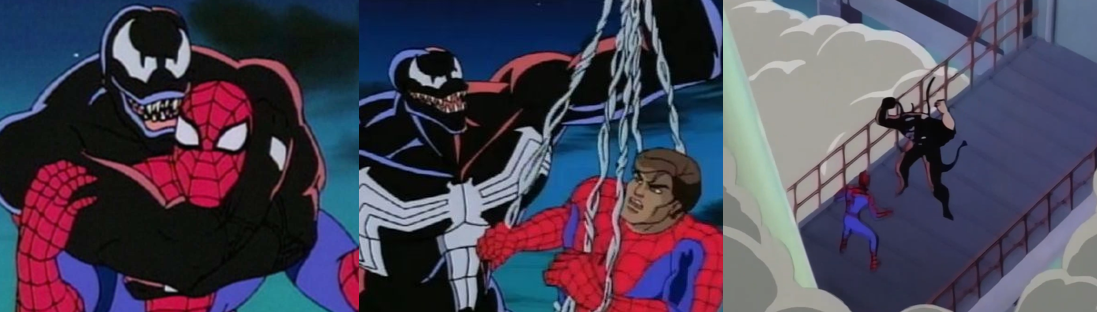
However, Spider-Man’s tumultuous emotions are driven to the edge when Smythe lures him to a bell tower by taking John hostage in order to recover the isotope; overcome with rage, Spider-Man destroys the Shocker’s gauntlets and is seconds away from doing the same to the mercenary before memories of his beloved Uncle Ben remind him that “with great power comes great responsibility”. Guilt-ridden and desperate to be rid of the alien suit, Spider-Man frantically tries to remove the symbiote but his efforts prove useless until he takes advantage of the church bell to cause the creature enough pain to separate itself from his body. However, Brock (who followed Spider-Man in a desperate attempt to extract a measure of revenge against the well-crawler), finds himself enveloped by the injured and enraged creature as he hangs helpless beneath the church bell. The result is a muscular, embittered, monstrous union of man and symbiote, Venom, who vows to destroy Spider-Man for ruining both of their lives. Venom makes their presence known as Spider-Man is settling the score with the Shocker and the Rhino on a rooftop; Venom actually saves Spider-Man just as he’s about to be destroyed simply to have the honour for themselves. In the process, Venom proves to be far stronger than Spider-Man, immune to his spider sense, privy to his secret identity, and possessing all of his physical and superhuman abilities but augmented thanks to Brock’s rage and workout routine.

Overwhelmed by Venom’s superior strength, Spidey is left relying on his wits to triumph.

Hopelessly outmatched, Spider-Man is left physically overpowered; his attempts to appeal to Brock’s better nature fall on deaf ears and Spidey finds himself at Venom’s mercy. Venom threatens to target, and reveal Spider-Man’s identity to, Peter’s loved ones and even leaves him dangling over a rooftop without his mask on at one point! Narrowly escaping with his identity intact, Peter is stalked by Brock at every turn and starts seeing Venom everywhere; with no choice but to take the fight to his foes, Spider-Man taunts Brock with newspaper clippings of his failures and baits Venom into following him across the city to the launch of another shuttle at a military base outside of New York. There, the two have a final confrontation up the support gantry that ultimately ends with the symbiote being driven from Brock’s body when the shuttle launches. Spider-Man then webs the writhing creature to the shuttle, sending it back into space, and leaves Brock in police custody, finally free of his alien nightmare… for the time being.

The Summary:
As much as I enjoyed, and still enjoy, the 1994 Spider-Man cartoon, there are some elements of it that obviously haven’t aged too well. The video transfer to DVD isn’t the best and the animation can be a little jerky at times. The editing is quite rushed here and there, meaning that episodes can quickly gloss over and bounce around certain scenes despite being fully capable of telling a well-paced story at other times, and there is a bit of dodgy CGI and the music gets very repetitive. Still, these concerns are largely minor and can be said of almost any cartoon produced in the nineties (or ever, for that matter) and, for the most part, the episodes are bright, action-packed, and well animated. Fittingly, the animation and presentation benefits Spider-Man the most of all the characters in the cartoon; vibrant and athletic, Spider-Man is a very dynamic character in the cartoon and capable of many superhuman feats despite not being allowed to throw a punch. Peter, despite closely resembling Nicholas Hammond, oddly looks bigger than his web-slinging counterpart but Spider-Man is expressive and vibrant throughout. The depiction of his black suit is equally top-notch; one of the arc’s stand-out scenes is Peter’s disturbing nightmare where Kaiju-sized versions of the black and classic costumes battle over Peter’s soul and he’s left hanging upside down in the middle of the city garbed in the sleek, sexy black suit. “The Alien Costume” may also be the first instance of the symbiote augmenting Spidey’s superhuman abilities and characteristics as this didn’t really happen in the original comics (at least not to the extent as it does in other media) and the three episodes definitely set the standard for Peter’s struggles with the symbiote going forward.

Spidey looks great, despite some dodgy animation, and Venom benefits from the multi-part arc.

Brock’s introduction is handled far better in the cartoon compared to the comic since he was actually introduced, and featured, in a handful of episodes prior to these three; angry and bitter, he’s been the victim of a string of bad luck and bad decisions that cause him to grow increasingly resentful of Spider-Man. Consequently, his transformation into Venom empowers him, driving him even more maniacal thanks to the symbiote’s power and abilities. Unlike in the comic books (at least at the time of these episodes), the symbiote is revealed to be incredibly old, well-travelled, and possessing knowledge of the wider universe and numerous worlds, indicating that it’s far more than just a near-insane parasitic lifeform. Venom looks fantastic in the cartoon, sporting their trademark fangs, talons, and long tongue as well as a hulking physique and a distorted, monstrous voice that, again, set the standard for how Venom are portrayed outside of comics. The episodes also do a pretty decent job of portraying C-grade villains like the Rhino and the Shocker as formidable threats; thanks to the influence of the black suit, Spider-Man’s anger and emotions are constantly in flux throughout the arc and are only exacerbated by the duo’s tenacity. Still, once Venom enters the picture, they make all other villains irrelevant; possessing knowledge and physical abilities that make them superior to Spider-Man in every way, Venom plays mind games with Peter, taunting and stalking him and overwhelming him both physically and emotionally. Just like in their first comic book encounter, Spider-Man is forced to use his initiative and wiles to outsmart his maniacal foes rather than trying to match them blow-for-blow. The end result is a far grander conclusion to their confrontation since Spidey utilises a shuttle launch rather than simply wielding a sonic blaster, which is a fittingly dramatic (if temporary) end to Venom’s threat as their story started in space and technically ends in space.

My Rating:

Rating: 4 out of 5.

Great Stuff

What did you think to the “Alien Costume” arc? Did you watch Spider-Man when it first aired or did you discover it later, perhaps on Disney+? What did you think to the depiction of Spider-Man’s black costume and how it influenced his powers and personality? What did you think to Venom’s depiction in the cartoon? What is your favourite Venom story or adaptation? How are you celebrating Venom’s dramatic debut today? Whatever your thoughts on Venom, feel free to sign up to leave them below or drop a reply on my social media.

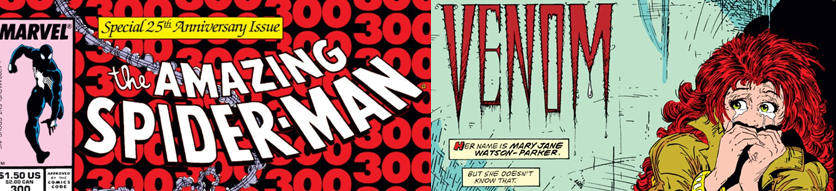
Back Issues: The Amazing Spider-Man #300

Story Title: “Venom”
Published: May 1984
Writer: David Michelinie
Artist: Todd McFarlane

The Background:
In 1982, Marvel Comics’ editor-in-chief Jim Shooter took a liking to an illustration from reader Randy Schueller that depicted Spider-Man in a smooth, black outfit with a large red spider motif across the chest; after purchasing the concept for a mere $200, writer Tom DeFalco and artist Ron Frenz conceived of the costume being a living organism and Spidey’s new black suit debuted without explanation in The Amazing Spider-Man #252 before Marvel Super Heroes Secret Wars #8 revealed that Spidey acquired the suit during the “Secret Wars” event. Over the next year or so, Spidey revelled in the costume’s unique and helpful ability to form both clothing and organic webbing until Doctor Reed Richards/Mister Fantastic revealed its true nature as a symbiotic lifeform. Out of fear, Spidey rejected the symbiote, using the cacophony of church bells to drive it from his body and began wearing a cloth version of his black suit. At the conclusion of Web of Spider-Man #24, though, a mysterious assailant attempted to push Peter in front of an oncoming train and a shadowy figure was clearly stalking him throughout 1988 before the symbiote, now known as Venom, made its full and dramatic reappearance. Since then, Venom has evolved from a gruesome, twisted killer into a violent anti-hero and a more morally righteous hero, with the symbiote jumping from numerous hosts and spawning a number of similarly-powered offspring. Acting as Spider-Man’s dark doppelgänger, Venom was an immediate favourite for me and many readers thanks to their knowledge of Spidey’s true identity, resistance to his spider-sense, and having all of Spidey’s powers (and more) but being far for vindictive, sadistic, and lacking Peter’s strong moral compass.

The Review:
“Venom” opens with the startling image of Mary Jane Watson-Parker, Peter’s former fling turned wife, huddled in the corner of their apartment nearly out of her mind with fear. When Peter returns home, still garbed in his cloth black costume, initially Mary Jane recoils in horror before gratefully embracing Peter. Peter, though disturbed by Mary Jane’s condition and the fact that she was attacked in their apartment, is even more troubled by her description of her attacker and worries that the alien costume might have survived their dramatic break-up. Mary Jane, ever the feisty and capable woman, is largely back to her old self after a good night’s rest in a hotel and immediately makes arrangements for them to move so she can put the whole thing behind her.

The usually strong-willed and brazen Mary Jane is left a trembling wreck by Venom.

However, overcome with his characteristic worrisome nature, Peter retrieves a Sonic Blaster from the Fantastic Four (a formidable weapon against the symbiote, which is highly vulnerable to sonic waves and intense heat), but is too highly strung to notice a mysterious stranger stalking him or to properly socialise with his friends and family, despite Mary Jane’s best efforts to perk him up. It’s an extremely effective way to introduce Venom without even seeing them on-panel; although Venom doesn’t physically hurt or molest Mary Jane, their mere presence and alien nature are enough to reduce her to a shivering wreck. Her condition greatly disturbs Peter, who points out through his internal monologue what a strong, impendent, and capable woman Mary Jane usually is; she’s always been very brazen and outspoken so to see her reduced to little more than a frightened child is a chilling moment for him (and us, the reader). At their house-warming party, Peter suddenly leaves after spotting his alien costume swinging around town and is immediately blind-sided by a muscular doppelgänger of himself baring a horrific grin. Although the reader was introduced to Eddie Brock, a large, stone-faced, muscle-bound man who is in possession of the alien costume, earlier, we don’t actually learn who he is or any of his backstory until this moment. Previously, we saw that he lives in a rundown apartment full of weightlifting equipment and newspaper clippings of Spider-Man, openly converses to the symbiote (though it doesn’t answer him back), and that he religiously pumps iron to increase both his physical strength and the strength of the symbiote.

Brock was driven to the edge before bonding with the symbiote and becoming Venom.

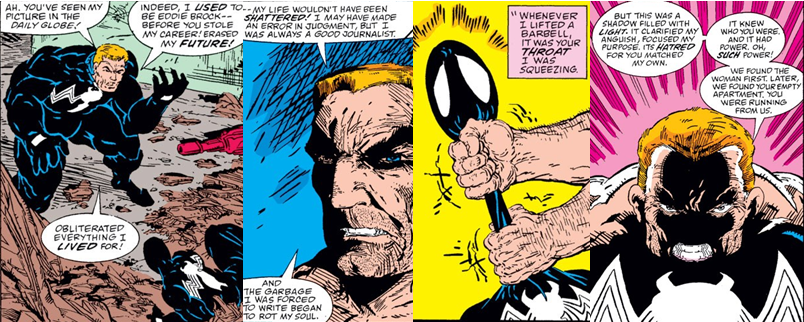
Peter, however, recognises not only the symbiote but also Brock, who is revealed to have been a respected reporter whose reputation was tarnished when he was duped by a compulsive confessor. Because Spider-Man captured Stan Carter/The Sin-Eater, Brock’s big story was discredited and he blamed Spider-Man for the sudden downturn in his fortunes. Brock’s mania was so complete and had blinded him so completely that he was driven first to strenuous exercise and, finally, to suicide; however, right as Eddie was contemplating the worst sin imaginable to his Catholic upbringing, the symbiote found him and, joined in their hatred of Spider-Man, they formed a bond so complete that Venom was born.

Spidey’s mercy proves to be his downfall as Venom are easily able to overpower and defeat him.

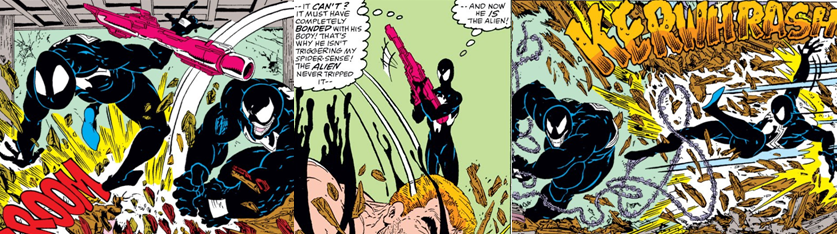
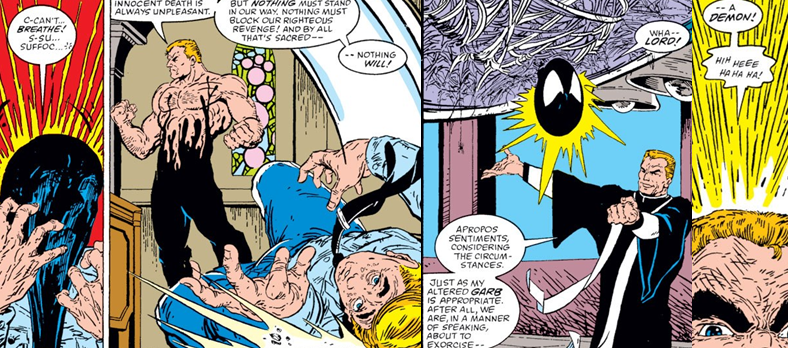
Though Spidey tries to use Brock’s monologue to edge his way towards his Sonic Blaster, Venom easily overpowers him with their superior strength. Spidey is, however, able to knock Venom down with a massive girder and blast him with the Sonic Blaster; Spidey hesitates, though, when he realises that the two have formed an unbreakable symbiotic bond and that further exposure to the high-intensity sound waves could kill Brock and decides to regroup and think of a new plan. This is all the hesitation Venom needs to recover, though, and with one massive blow, they knock Spidey out. When he awakens some hours later, Spidey finds that he has been webbed up to a church bell by Venom’s far stronger and much thicker webbing. Brock, now garbed in a priest’s robe, revels in the delicious irony and fitting nature of Spidey’s impending death since Peter tried to use the same massive bells to destroy his “Other”. Like any good, overconfident villain, Venom leaves Spider-Man to his fate and, as such, misses their chance to keep Peter from using his sheer force of will and brute strength to keep himself from being pounded into mush and breaking free of Venom’s webbing.

Spidey outsmarts Venom by forcing them to expend their webbing and tire out.

Unable to match Venom’s strength and at a serious disadvantage since Venom doesn’t set off his spider-sense and appears to have all of his strengths and abilities, Spidey decides to outsmart Venom by forcing them to expend their webbing and tire themselves out, draining the symbiote’s energy and sending Brock crashing to the street below. The story ends with Brock, and the symbiote, being held captive at Four Freedoms Plaza, the high-tech home of the Fantastic Four; there, encased within a cylinder and rendered inert by a constant barrage of sonic waves, Venom’s threat is effectively neutralised. Upon safely returning to Mary Jane, Peter and his wife agree that it is no longer appropriate for him to wear the black costume given Venom’s sadistic nature and he finally returns to the classic red and blue for the first time in about four years.

The Summary:
“Venom” is a really great introduction for one of Spider-Man’s most complex and vicious foes; this story took place during the much lauded Micheline/McFarlane pairing, which results in some absolutely fantastic and detailed artwork. McFarlane always drew a brilliant Spider-Man, emphasising the complexity of his webs, the inhuman positions and poses he would strike while web-slinging, and giving every character an edgy, nineties make-over to help them stand out a little more. Venom, in comparison, is far more subdued, visually, than he would later be, appearing as simply a jet-black, muscular version of Spider-Man with a demonic grin; it wouldn’t be until Mark Bagley came onto the title that Venom would take on some of their more recognisable characteristics, such as the writing tentacles, mass of teeth, and long, drooling tongue.

Brock is a hypocrticial, deluded, sadistic individual in his debut.

Still, Eddie Brock makes for a unique and interesting new addition to Spidey’s rogues gallery; Brock is one of a handful of Spidey’s villains who actually knows his secret identity and the only one (at the time) able to use that information to his full advantage thanks to his ability to circumvent Peter’s spider-sense and the many attributes of his alien costume. Brock is, of course, a complete madman here and in his early appearances; slighted by Spider-Man’s involvement, he blames all of his failings on Spidey rather than admit to being duped by a compulsive confessor. Eddie believes that Spider-Man is an evil and malevolent individual and that it is his sacred duty to put an end to his (Spidey’s) menace; his obsessive mania is so complete that he kills an innocent police officer and then justifies it as being necessary to his “righteous revenge”. He openly admits to being disgusted by innocent death but is all-too-happy to torment Mary Jane, stalk Peter, and attack Spider-Man with a maniacal glee.

Despite all their power, Venom are defeated quite easily through Spidey’s guile and cunning.

If there’s a downside to the story, it’s simply that Venom is defeated rather anti-climatically; the Sonic Blaster proves effective but Peter is too concerned with Brock’s well-being to press his advantage and, unable to match Venom’s brute strength (which is on par with Spidey’s and further augmented thanks to Brock’s intense physical training), Spidey simply has the symbiote exhaust itself and that’s it. However, Venom’s threat wouldn’t end here by a long shot and this is a simple way to leave the door open for their subsequent, far more impressive return and defeats. Furthermore, this tactic shows how blinded by his rage and spite Venom are and how adaptable and intelligent Peter can be; he doesn’t win through sheer mindless brute strength, as Venom are attempting to do, and must instead rely on his wiles and intelligence to overcome Venom’s very real and lethal threat.

My Rating:

Rating: 4 out of 5.

Great Stuff

Have you read “Venom”? Did you purchase a copy of The Amazing Spider-Man’s landmark 300th issue back in the day? What did you think to Venom’s introductory story; were you a fan of the concept and character or do you feel they are a product of a darker time in comics? What did you think to Spider-Man’s black costume and the revelation that it was an alien symbiote? What is your favourite Venom story? How are you celebrating Venom’s dramatic debut today? Whatever your thoughts on Venom, do please leave a comment below.