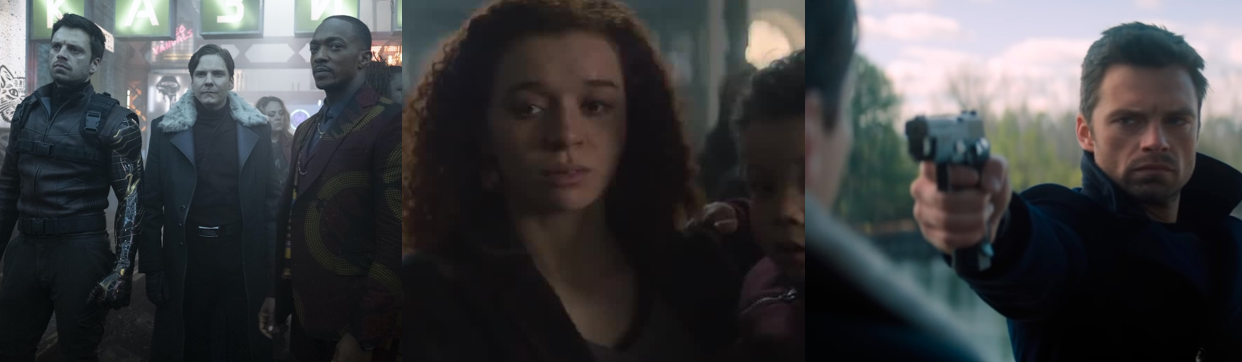
Movie Night: Thunderbolts* / The New Avengers

Released: 2 May 2025
Director: Jake Schreier
Distributor: Walt Disney Studios Motion Pictures
Budget: $180 million
Stars: Florence Pugh, Lewis Pullman, Sebastian Stan, David Harbour, Wyatt Russell, and Julia Louis-Dreyfus

The Plot:
When Contessa Valentina Allegra de Fontaine (Louis-Dreyfus) seeks to erase the evidence of her malicious experiments, she unwittingly assembles a rag-tag team of losers and mercenaries, led by Yelena Belova (Push), to stand against her and her secret superpowered agent…

The Background:
Back in the nineties, Marvel Comics were not just in a financial state but the “Onslaught Saga” led to some of their most popular characters being presumed dead for a while. In their place, Peter David created an all-new superhero team, the Thunderbolts, who debuted in 1997 as typically excessive heroes who were secretly the villainous Masters of Evil in disguise. The idea of bringing this concept to the blockbuster Marvel Cinematic Universe (MCU) can be traced back to the production of Guardians of the Galaxy (Gunn, 2014) when director James Gunn expressed interest in a big-screen adaptation. Although the idea was shelved when Warner Bros. produced a similar concept, it regained steam when MCU projects teased Valentina assembling a team of anti-heroes and soon evolved into a starring vehicle for Florence Pugh. Once officially announced, a tumultuous development began as rumours and script rewrites did the rounds, drastically altering key plot points and surprisingly offing one of the main cast for shock value. Writer Eric Pearson was keen to introduce Robert “Bob” Reynolds, arguably Marvel’s most notable Clark Kent/Kal-El/Superman proxy, to tackle mental health issues like depression and addiction, with Lewis Pullman cast after scheduling conflicts forced Steven Yeun to back out. Much speculation surrounded the mysterious asterisk in the film’s title, which quickly saw Marvel re-branding the film to The New Avengers shortly after its release, as was always intended. While this bold decision divided some fans, Thunderbolts* was met with widespread critical acclaim and made over $382 million at the box office. Reviews praised the misfit action, Pugh’s elevation to a lead role, its exploration of depression, and the mixture of action and comedy, though many were dissatisfied with the unceremonious showing for Olga Kurylenko’s Antonia Dreykov/Taskmaster.

The Review:
Although the marketing for Thunderbolts* had me believe that Junior Congressman and ex-Winter Soldier James Buchanan “Bucky” Barnes (Stan) was the central character in this film, I was surprised and delighted to find that former Black Widow Yelena Belova takes the lead. In many ways, Thunderbolts* is as much a sequel to Black Widow (Shortland, 2021) as it is a continuation of The Falcon and the Winter Soldier (Skogland, 2021), reuniting Yelena with her eccentric and overbearing super soldier surrogate father, Alexei Shostakov/The Red Guardian (Harbour), delving a little more into Yelena’s backstory courtesy of some traumatic visits to a nightmare dimension known as the “void”, while also significantly building upon the character of disgraced military veteran and former Captain America turned hot-headed mercenary, John Walker/U.S. Agent (Russell). Still grieving the loss of her surrogate sister, Natasha Romanoff/Black Widow (Scarlett Johansson), Yelena begins the film in a place of apathy. Yelena now works as a black ops agent for Valentina, the director of the Central Intelligence Agency (CIA) who’s currently under heavy investigation regarding all her shady experiments and dealings. However, despite throwing herself into her work and being an accomplished assassin, Yelena is unfulfilled and bored with the day-to-day mediocrity of her assignments. Feeling directionless and empty, she attempts to find some direction by talking through her feelings with Alexei, a disgraced and overweight former Soviet hero who’s left living in squalor and running a limo driving service. Despite his significant fall from grace and his boisterous personality, Alexei emphasises that the greatest calling he ever had was being an adored hero and encourages Yelena to step out of her comfort zone and take on a more public, heroic role like her late sister. Though hesitant, Yelena decides to give it a shot, if only to change her daily routine, and Valentina agrees to reassign her if she completes one last job. Namely, the infiltration of a secret underground O.X.E. facility that’s in danger of being robbed (and thus exposing Valentina’s dirty secrets) by Ava Starr/Ghost (Hannah John-Kamen), a tortured soul who can become intangible for short bursts.
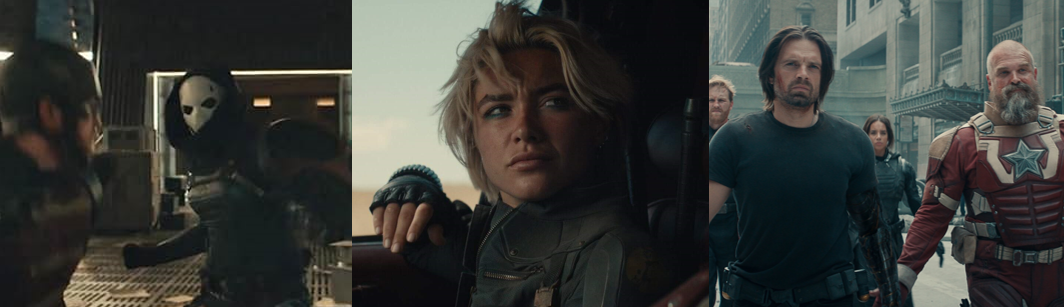
Although Taskmaster’s screen time gets cut short, Pugh steals the show with her layered performance.

However, when Yelena accesses the facility, she’s blindsided by Walker, who’s been contracted to kill her. Walker’s then attacked by master fighter Taskmaster, who’s been hired to kill him, and a four-way melee kicks off as they try to take each other out. Though Yelena immediately sees they’ve all been double-crossed, it takes the sudden, dramatic, and down-right insulting execution of Taskmaster for the fighting to stop. Well, that and the strange appearance of the anxious, confused, and seemingly harmless Bob after he was accidentally released from stasis. Though the pig-headed Walker is reluctant to believe Valentina would turn on him, he’s forced to begrudgingly work with the others to escape the facility, which first threatens to incinerate them and then trap them forever. Despite none of them having the powers or equipment to scale the impossibly large shaft, Bob suggests they clamber up back-to-back and, despite Walker’s selfish arrogance, the group fumbles their way to the surface. Unfortunately, Valentina’s long-suffering assistant, Mel (Geraldine Viswanathan), alerts her boss to their actions – and Bob’s presence – meaning the group are met by a heavily armed response team. Thanks to masquerading as Valentina’s goon squad, the group slip past the barricade, but the grateful and kind-hearted Bob decides to risk his life by covering their escape, resulting in him being peppered by bullets. Instead of dying, he emerges unscathed, blasts into the sky, and crashes to the ground with a massive explosion, inadvertently giving his newfound acquaintances the chance to escape and placing him in Valentina’s excited hands. Thanks to having chauffeured Valentina and Mel, Alexei races to retrieve them and excitedly encourages them to stick together as a team, accidentally nicknamed “Thunderbolts” after a passing mention of Yelena’s school sports team, though the group are less than enthusiastic about working together and are visibly disgusted at having had to rely on each other for so long.
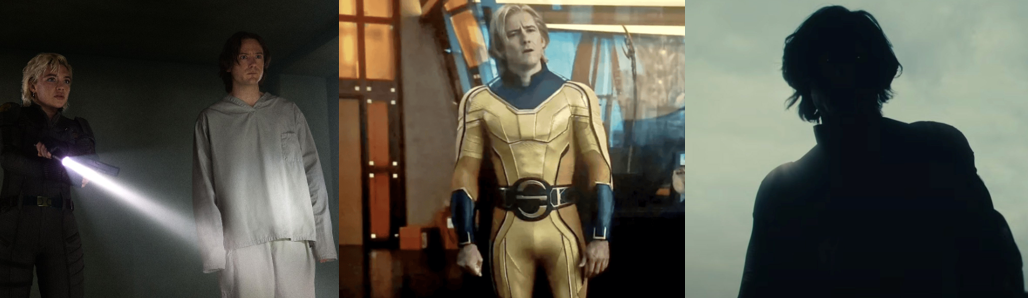
Emotionally damaged Bob turns out to be perhaps the greatest threat the world has ever known…

While all this is going on, Bucky seeks to uncover concrete evidence to expose and impeach Valentina, working his charm on Mel to get the inside track and racing to rescue the group when Alexei’s limo is attacked. Despite Alexei’s joy at meeting a Soviet hero and fellow super soldier, Bucky takes no chances and binds the group, seeking to have them testify against Valentina, but is forced to cut them loose and join forces with them when Mel corroborates their wild claims about Bob. As indicated by paperwork found in the facility, the seemingly unassuming Bob is actually a neurotic and emotionally unstable drug addict and survivor of horrific childhood abuse who, in a desperate attempt to feel powerful and significant, signed up to one of Valentina’s secret drug trials. While all the other subjects died, Bob became a full-blown indestructible superman, capable of flight and exhibiting awesome psychic powers, though his dark side also received a superhuman boost. With a touch, or at his command, Bob sends targets to the void, a dark dimension where they relive their most painful memories. However, Valentina brainwashes Bob with platitudes and strokes his fragile ego, promising to make him the world’s mightiest superhero in the absence of the Avengers and having him become the Sentry. While Bob is reluctant to turn on his newfound friends, he embraces the chance to be more than an insignificant nobody, but quickly becomes drunk on his power, rejecting Valentina’s orders and seeking to take the world for himself. While Mel puts the Sentry down with a kill switch, this merely suppresses Bob’s neurotic (but nonetheless harmless) personality and unleashes his dark side, the Void, who impassively terrorises New York City to plunge humanity into a glorious nothingness. Despite being powerless against the Sentry and going their separate ways, the chaos inspires the reluctant Thunderbolts to save civilians and rally against the Void, with Yelena desperate to appeal to Bob’s humanity by willingly returning to the void and facing his dark past.
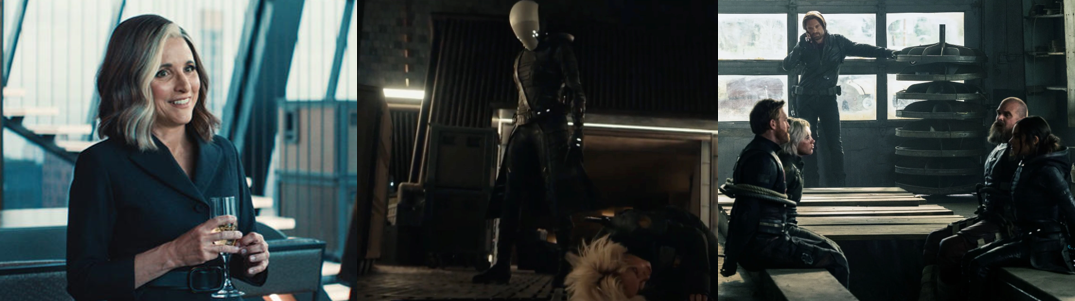
While Valentina is a deplorable puppet master, the misfit team is their own worst enemy.

Although Valentina is gleefully presented as a despicable and thoroughly unlikeable villain, I do think she suffered from not featuring more prominently in previous Marvel movies as a dark counterpart to Nick Fury (Samuel L. Jackson). Luckily, the titular Thunderbolts are all largely dislikeable or morally dubious characters and their bickering and in-fighting means they’re their own worst enemies. Indeed, it’s only the fact that they have a common enemy that the group sets aside their egos and dislike of each other to even work together, though Bucky and Alexei go a long way to galvanising the team. Still, “dysfunctional” is putting it mildly when it comes to these guys, especially considering how abrasive and unlikeable Walker is. His temper and arrogance paint him as a typical jock, but he undergoes a surprising redemption arc throughout as he tries to atone for his past and turn his life around. Though sadly not featured as prominently as she should be, Ghost seems to carry some guilt about murdering Taskmaster and, despite frequently clashing with Walker, sticks with the group simply because she’s lived so much of her life alone. As Alexei observes, Yelena feels the same emptiness lifted thanks to the team’s presence. Despite them constantly butting heads, she takes a leadership role and is constantly the voice of reason amongst them, pushing them to focus on their true enemy and to do some good for a change. Naturally, Alexei enjoys the chance to be a hero once more and Harbour’s enthusiastic and bombastic energy really cements Thunderbolts* as one of the best MCU movies of the modern era. Finally, there’s Bucky, a guy who seems uncomfortable in his political role and who immediately reverts to type the first chance he gets. Without a doubt, though, this is Bob’s show as, through him, the MCU tackles the serious and soul-crushing weight of abuse and depression and forces it to the forefront as he discovers, masters, and then loses himself to his incredible powers.

The Nitty-Gritty:
Unfortunately, despite the film’s marketing, Taskmaster really got the shaft here, she appeared onscreen for one fight, gets one line, and then is suddenly executed with little to no fanfare. Yelena basically shrugs it off since she’s so impassive and Taskmaster is barely brought up afterwards, which is a shame as her new suit was cool and I would’ve liked to see her character get a shot at redemption. They could’ve at least had her live until the team escaped the facility, perhaps have Bob accidentally obliterate her in his first unexpected show of power. Similarly, I’m not sure what the benefit of having Bucky be a congressman was if it was going to be dropped immediately. Nothing he did tied into that role and he could’ve worked Mel and helped his fellow congressman (Wendell Pierce) without having a political role. While it was also a shame we never got to see how the others fared in the void, it did provide some additional tragedy to Yelena (who was forced to see her fellow Black Widow recruits tortured and killed during her training) and touched upon the shame that fuels Walker and explains his brash personality. The void truly shines when exploring Bob’s traumatic past, however, as Yelena witnesses Bob’s father emotionally and physically abuse him, his drug addict mother shun him, and briefly witnesses his own struggles with addiction. When in his default personality, Bob talks about how he sometimes has highs and then suffers crushing lows that drove him towards drink and meth but also, seemingly to the point where he didn’t care if he lived or died. This led him to Valentina’s “Sentry Project”, which remarkably made him everything she hoped for, but also empowered his dark thoughts and made him extremely emotionally unstable. Seeing Bob wallow in his childhood bedroom (the quietest, nicest room in the void as long as you don’t mind seeing and hearing your parents fight and belittle you) was heart wrenching and Pullman really ran the gamut of emotions in his portrayal of Bob.
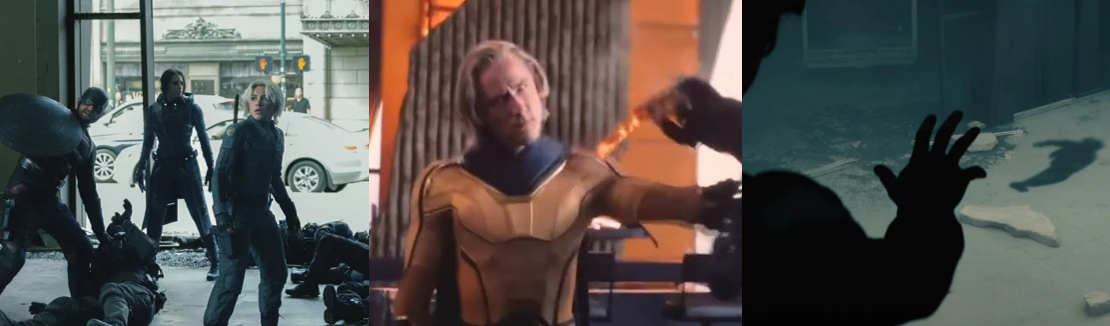
Amidst the action and banter, there’s a chilling and emotional exploration of depression.

This culminates in a spectacular (if brief) display of power from the Sentry in the former Avengers Tower. Garbed in a golden outfit and showcasing superhuman speed and strength, the Sentry easily overpowers his friends, with even the super soldiers barely making Bob flinch and him overwhelming them all while appearing bored. His transformation into the Void is equally impressive, with Pullman being enveloped in darkness. He speaks in a hushed, impassive tone, with only his silvery eyes glittering from the darkness, and sends targets to the void with a wave of his hand in a chilling visual. While much of Thunderbolts* revolves around the rag-tag team trying to co-exist without killing each other, the group finds a common language in combat. Despite them all pretty much just punching and shooting, each brings something a little different, such as Walker wielding his shield, Bucky utilising his mechanical arm, and Ghost phasing in and out of reality. Although Walker scoffs at Yelena taking charge of the group and a combination of bad luck and miscommunication means their plans often fail or quickly fall apart, the group fights well together. Crucially, when the Void envelops the city, these largely selfish anti-heroes don’t hesitate to jump in and save who they can, leading the crowd to safety and earning their appreciation, much to Alexei’s delight and the others’ surprise. Action-packed moments like Bucky’s Terminator 2: Judgment Day (Cameron,1991) style motorcycle intervention, the team storming Valentia’s tower, and their ill-fated showdown with the Sentry are juxtaposed with some fun humour and banter and some poignant moments, particularly between the grieving and emotional Yelena and Alexei. Angry at her “father” for not staying in touch more and still struggling after Natasha’s death, Yelena breaks down in Alexei’s arms at how lonely she is and he does his best to comfort he, just as Yelena finds a kindred spirit in Bob, whom she senses is both lonely and damaged and in need to help and reassurance.
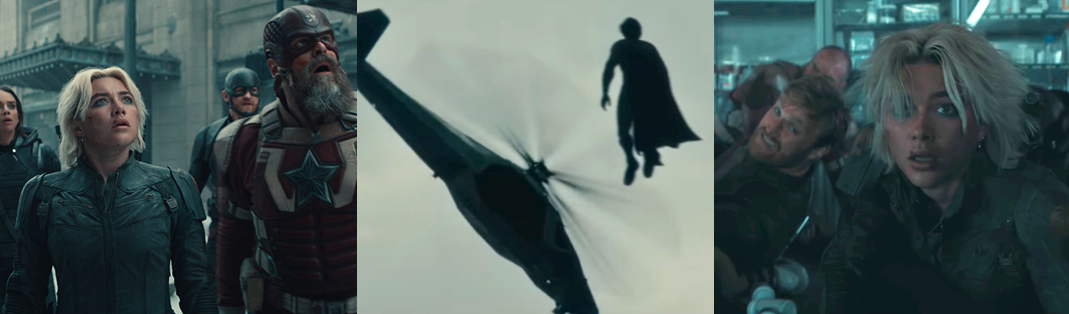
These unlikely heroes step up to meet the challenge when the Void engulfs the city in darkness.

This, as much as her inherent heroic nature, is what drives Yelena to stop running from the Void and willingly return to his dark dimension. There, she ignores her own traumatic past and desperately searches for Bob, eager to appeal to his reason, and discovers the sheer depth of his emotional trauma. Having resigned himself to the void and feeling as powerless to fight it as he was to stand up to his parents, Bob is reluctant to stand against his dark side and, though bolstered by Yelena’s genuine concern, is touched when the rest of the team brave their nightmares to reunite with them. At Yelena’s suggestion, Bob brings them to the worst “room” in the void, the place where he was transformed into a superhuman, and the team discovers that the effect on his psyche was near instantaneous. They also encounter the Void, a spiteful and all-powerful force that belittles Bob, tortures his friends, and maliciously mocks Bob’s insecurities. When Bob lashes out in anger, attacking the Void and mercilessly beating him, Yelena sees that this threatens to erase his compassionate side altogether and, despite the environment itself trying to stop her, she rushes not to stop or kill Bob, but to embrace him. The others do the same, embracing their damaged comrade and affirming their belief in him and their showcase of affection is enough to quiet the Void, returning everyone lost to the darkness and leaving Bob seemingly with no memory of what happened (and, sadly, no longer wearing his awesome Sentry suit). In the aftermath, the group seeks retribution upon Valentina, only to be blindsided when she leads them into a press conference and introduces them as the New Avengers. Though Valentina’s dismayed when the group begrudgingly accept the moniker (and when Yelena asserts dominance over her), she accepts the compromise as it means she can remain in a position of power. Unfortunately, the credits and post-credit scenes immediately deride the unlikely new Avengers, with headlines and news stories questioning them and even Sam Wilson/Captain America (Anthony Mackie) said to be suing them over the name! Still, the team relishes the chance to prove their credentials when they receive word of a strange, extradimensional craft entering Earth’s atmosphere…

The Summary:
I purposely avoiding using any spoiler warnings for this film, and including both titles, since Marvel Studios let the cat out of the bag just a few days after its release. While I was surprised to see the team be revealed as the New Avengers, it was a pretty fun way to end the movie, though I do wonder how prominent the team will be in the sixth phase of the MCU considering how packed the slate is. Regardless, Thunderbolts* was a surprisingly good time. I say “surprisingly” as the team has very little to do with their comic book counterparts and I wasn’t expecting all that much of it, especially after we had two similarly themed DC movies, but it turned out to be very entertaining and surprisingly touching. As a deconstruction of mental illness, Thunderbolts* (more specifically Lewis Pullman) knocks it out of the park, with Bob perfectly encapsulating the insecurities, incredible highs, and soul-destroying lows of depression. While he’s apathetic as the Sentry, Bob is chillingly impassive as the Void and so powerful that he completely neuters his more reasonable side. I also loved how Yelena came to the forefront here as a leader and her own search for meaning, and the evolution of her relationship with Alexei. While it was a damn shame Taskmaster got shafted, I would’ve liked to see Valentina used more leading up to the film, and I was hoping for more Bucky, I really enjoyed the dysfunctional team dynamic and how even an asshole like U.S. Agent could turn his life around with the right motivation. Thunderbolts* was a definitely step in the right direction for the MCU and I’m excited to see how its events will impact future MCU movies, especially regarding the Sentry, and I would absolutely say it’s a must-see for fans of this sprawling cinematic universe.

My Rating:

Rating: 4 out of 5.

Great Stuff

What did you think to Thunderbolts* and the surprise reveal of the film’s true nature? Were you disappointed that a more comic accurate team wasn’t used? What did you think of the unceremonious execution of Taskmaster? Were you impressed by the Sentry and the film’s discussion of mental health? What do you hope is next for the team in the MCU? Tell me your rating of Thunderbolts* in the comments, support me on Ko-Fi, and go check out my other Marvel content.

Screen Time: The Falcon and the Winter Soldier

Air Date: 19 March 2021 to 23 April 2023
Director: Kari Skogland
Network: Disney+
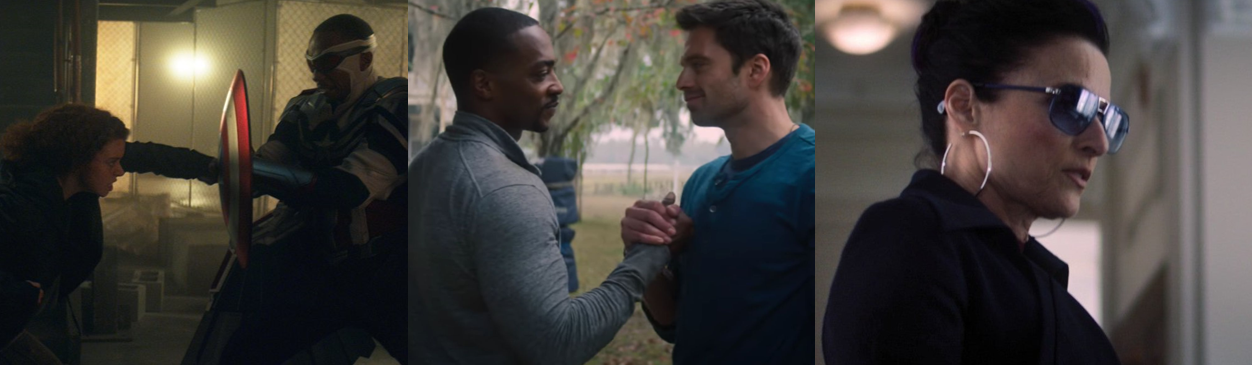
Stars: Anthony Mackie, Sebastian Stan, Wyatt Russell, Erin Kellyman, Daniel Brühl, and Emily VanCamp

The Background:
Unquestionably, the Marvel Cinematic Universe (MCU) has become more than a success; from humble beginnings, it has evolved into a nigh-unstoppable multimedia juggernaut that has brought some of Marvel Comics’ most beloved, and obscure, characters to life in a way that no one could have ever predicted. Only a handful of the films produced by Kevin Feige and Marvel Studios have met with any kind of negativity or mixed reaction, and in a world that is becoming increasingly bleak and cynical the MCU achieved an impossibility by making the Star-Spangled Avenger himself, Captain America, a blockbuster movie franchise. Although Marvel Studios had dabbled in television ventures before, most notably with Agents of S.H.I.E.L.D. (2013 to 2020) and their various Netflix shows, they really ramped up their focus on TV productions to coincide not just with the MCU’s fourth phase but also the release of Disney+, the streaming service of their parent company. Unlike other MCU TV shows, these shows were spearheaded by Feige and focused heavily on maintaining and expanding the continuity of the MCU going forward. One of the first pitches for this concept was a “buddy cop” series the focused on the dysfunctional friendship and grating banter between Sam Wilson/The Falcon (Mackie) and James Buchanan “Bucky” Barnes (Stan); the series aimed to not only explore this relationship and Sam’s struggles with accepting the mantle of Captain America, but also tackle relevant social issues such as racism and coping with grief and change. Although delayed due to the COVID-19 pandemic, The Falcon and the Winter Soldier eventually released weekly on Disney+ starting from 19 March 2021 and was the most-watched show on the service for some time. Critically, The Falcon and the Winter Soldier was extremely well-received, with reviewers praising the show’s depiction of racism and the dynamic between the two leads, though some criticised the show’s pacing and execution. Still, the show was successful enough to earn not only a second season but also a fourth Captain America movie that continued the plot threads left hanging at the end of the season.

The Plot:
Six months after Avengers: Endgame (Russo and Russo, 2019), Sam Wilson struggles to live up to the mantle of Captain America and Bucky is still recovering from his brainwashing as the Winter Soldier. The two are forced to begrudgingly join forces with not only each other, but one of their worst enemies, to investigate a terrorist group in a worldwide adventure that tests both their abilities and their patience.

The Review:
I am a bit late to the party when it comes to Disney+ and their various original content. The main reason for that is the sad fact that neither my television nor my service provider actually carry the app, and I didn’t really want to be watching the shows on a smaller screen. Ordinarily, I would wait for the home media release but it seems as though we might have to wait a while for that, or might not get it at all, so I finally decided to get started on working through them earlier this year and was excited to finally sink my teeth into The Falcon and the Winter Soldier since it was the one that looked most like what I enjoy about the MCU. Naturally, given the title, The Falcon and the Winter Soldier primarily focuses on Sam and Bucky and the fallout from Avengers: Endgame. At the start of the show, Sam continues to run missions for the United States military as the Falcon, quickly making an enemy out of Georges Batroc (Georges St-Pierre), and enjoying the chance to make a positive difference in people’s lives. Sam is determined (obsessed, almost) with helping people, trying to offer his services and council, and protecting others, even when it’s beyond him, but he is conflicted about taking on the mantle of Captain America.

Sam gives up the shield, feeling he can’t live up to expectations, and tries to help his family.

Believing that he’s not able to live up to Steve Rogers’ (Chris Evans) legacy, Sam delivers an emotional speech in Washington, D.C. at a ceremony (more like a eulogy) at the Smithsonian Museum for Captain America where he entrusts the shield to the museum so it can be displayed as a symbol of hope and unity. In a recurring motif throughout the show, Colonel James “Rhodey” Rhodes/War Machine (Don Cheadle) questions this decision, believing that times have changed, and that the world is “broken” and in need of fixing, and that Captain America is more important than ever before. Sam, however, remains steadfast in his decision to give up the shield since he can’t shake the feeling that it doesn’t belong to him, and instead tries to direct his attentions to reconnecting with his family. Sam’s sister, Sarah (Adepero Oduye), and his nephews Cass (Chase River McGee) and AJ (Aaron Haynes), maintain the family fishing business in Louisiana, but fell on hard times during the Blip and have struggled to stay afloat since the snapped were returned. While Sam is still somewhat stuck in the pre-Blip past, Sarah is faced with the cold, hard fact that she is out of options thanks to getting into debt; Sam, however, is determined to help, despite her cynicism, and is sure that he can help broker a new deal/loan at the bank and turn the business around. However, despite the adulation of the bank clerk for his heroics, Sam faces greater hurdles than he expected; things changed after the Blip, Sam’s income is questionable (apparently Tony Stark (Robert Downey, Jr) didn’t pay the Avengers, which I find odd), and the Wilson’s don’t have the collateral or standing to qualify for a loan. However, there’s also an undercurrent of racial prejudice throughout this meeting; though Sam refuses to quit, Sarah isn’t surprised that they got turned away and somewhat resents Sam’s absence (whether by choice or by fate) and efforts to swoop in and save the day when she’s been struggling so hard for so long, by herself, to keep the business afloat.

Bucky and Sam clash over the shield, but are forced to unite against a new breed of super soldiers.

Already greatly troubled by these burdens, Sam is clearly conflicted when the United States government opt to reactivate the shield and pass the mantle of Captain America on Captain John Walker (Russell). The former Winter Soldier, Bucky Barnes, isn’t quite as shy about hiding his feelings regarding the matter, however. Although he’s received a full pardon for his past crimes, Bucky is legally mandated to attend regular therapy sessions with Doctor Christina Raynor (Amy Aquino) and continues to be haunted by vivid, explicit memories of his heinous past. Although he routinely lies to and criticises her, Dr. Raynor sees through his bullshit and he reluctantly relates that he’s been going through a list of his victims and trying to make amends with their families or bring those responsible for his conditioning to justice according to Raynor’s strict series of rules that prohibit him from killing, harming others, or doing anything illegal in order to help stave off his nightmares. Bucky is aggravated that Sam gave up the shield; he believes that Steve trusted in Sam, that he believed in him, and that Sam threw it all away like it was nothing and his stoic demeanour cracks when he states that if Steve was wrong to believe in Sam then maybe he was wrong to believe in him (as in Bucky) as well. This causes a great deal of tension between the two, who already had a pretty frosty relationship to begin with, which only escalates as they investigate a terrorist group known as the Flag Smashers. Led by Karli Morgenthau (Kellyman), the Flag Smashers believe that society was better during the Blip and want to restructure the world to remove all borders, both political and social, but are radical in their methods. Karli, and seven of her followers, have been granted superhuman strength and durability thanks to a new version of the super soldier serum, and use that power to launch a campaign against the oppressive governments and conglomerates, particularly the Global Repatriation Council (GPC), who seek to return the world to the way it was before the Blip. Sam is first alerted to the group by his military liaison, Joaquin Torres (Danny Ramirez), who is badly injured trying to fight Karli during a bank robbery in Switzerland, and the bulk of the series revolves around his efforts (and the efforts of others) to track them down. Karli comes across as very sympathetic and morally grey antagonist; her idea for a united world free from corruption is an admirable one, but she enforces her ideals through extremism and violence, which clearly puts her in the wrong. With slightly different methods and motivations, she could have rallied people into a productive force for good but, instead, she is a revolutionary posing as a freedom fighter. In a very short time, she has amassed a cult-like following of people only too eager to offer them food, shelter, and resources and Karli is determined not to let the same people who were in power before the Blip return to positions of authority, and to go to any lengths necessary to bring about “One world, One people”.

Walker is made the new Captain America, but his psyche deteriorates from the pressure.

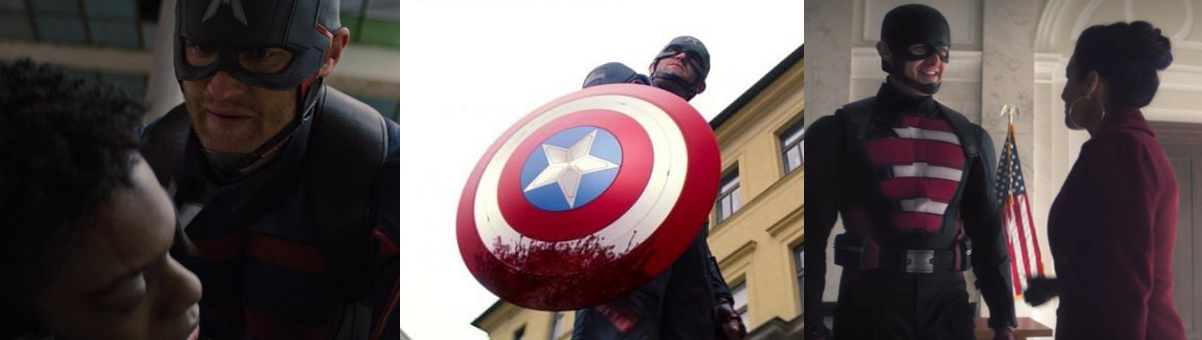
While Sam actively sympathises with Karli’s plight, and makes every effort to try and talk her down, neither Bucky or Walker share his unique approach to the situation; a former high school football star, decorated soldier, and American patriot, Walker initially struggles with the weight of expectation placed on him by assuming this mantle of Captain America. His wife, Olivia (Gabrielle Byndloss), and best friend, Sergeant Major Lemar Hoskins (Clé Bennett), offer him their utmost encouragement and support and Walker quickly takes to the public limelight, signing autographs and appearing live on Good Morning, America, and coming across as humble and appreciative of the opportunity (despite his impressive military record, physical fitness, and intelligence quotient) and selling himself not as a super soldier, but as a brave man looking to continue Steve’s legacy. Walker’s position as Captain America causes a great deal of friction between him and Sam and Bucky; although he helps them to (unsuccessfully) fight Karli and the Flag Smashers, his repeated attempts to work with them are met with reluctance and hostility (especially from Bucky, who quickly senses something is off about Walker). Bucky and Sam’s resentment of Walker is only exacerbated by his increasing arrogance and bravado; Walker’s mental stability is fractured further when he’s repeatedly left one step behind (or out of the loop) in the pursuit of Karli, is met with scorn and disrespect by the Flag Smashers, and is repeatedly bested in combat by both super soldiers and the Wakandan special forces, the Dora Milaje. He’s resentful of those with enhanced abilities, and the judgement he faces from the likes of Sam, and being forced to sit on the side lines, which causes him to blunder into situations full of piss and vinegar and even disrupts Sam’s attempts to talk Karli down.

Walker is driven to the edge by Lemar’s death, but given a new opportunity by the mysterious Val.

Walker is joined in the field by Lemar, who fights by his side as Battlestar. While Bucky is ready to simply force Walker to give up the shield, Lemar acts as the voice of reason and not only manages to keep Walker focused but tries to keep the peace between them and Sam and Bucky to better pool their resources. When Walker is distraught at being so handily beaten by the Dora Milaje, Lemar admits that he would jump at the chance to take the super soldier serum since the benefits would far outweigh any side effects, arguing that they could have saved lives (and spared themselves a lot of bloodshed) during their time in Afghanistan. This is all the convincing Walker needs to take the serum for himself, but his already unstable mind and quick temper are only exacerbated by the serum, and by Lemar’s death at Karli’s hands. Walker’s grief quickly turns to outrage, and he takes his anger and pain out on Nico (Noah Mills), Karli’s close friend, beating him to death with the shield in front of numerous bystanders, many of whom record the incident on their phones. Walker is so traumatised by these events that he actually tries to justify them as being part of his duties as Captain America, and a brutal fight breaks out between him, Falcon, and Bucky when Sam tries to reason with Walker and Walker’s paranoia kicks in. Walker rips Falcon’s wings off, half-crazed by ego and madness, and Falcon is forced to break Walker’s arm to get the shield off him. Although Walker avoids a court martial for his actions thanks to his service record, he’s stripped of his rank, benefits, and the mantle of Captain America. Understandably, Walker is outraged at this betrayal but is given a second (well, third, technically) chance by Contessa Valentina Allegra de Fontaine (Julia Louis-Dreyfus), who sympathises with his plight and offers him a new assignment as the U. S. Agent.

Zemo adds an extra dimension to the show, offering a twisted but logical perspective on the world.

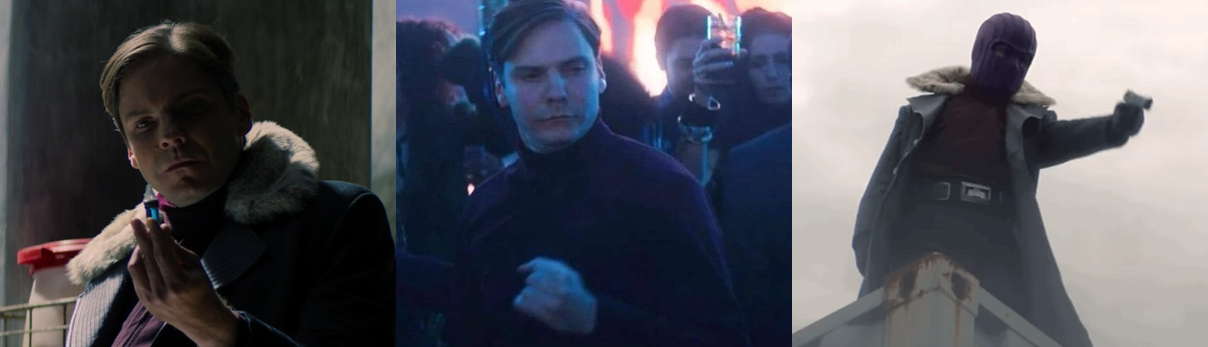
Walker’s instability isn’t helped by Sam and Bucky’s decision to turn to Helmut Zemo (Brühl) for help; although Zemo is a dangerous radical and terrorist who cannot be trusted, he knows more about super soldiers than anyone left alive, but even Sam is aghast when Bucky orchestrates Zemo’s escape from prison and convinces him to aid them based on their common enemy. Zemo is only too eager to help rid the world of super soldiers, who go against everything he believes in, and the two reluctantly agree to utilise Zemo’s wealth and resources as a baron (not to mention his knowledge of Hydra and the super soldier serum). Zemo adds an extra dimension to the abrasive relationship between the two leads, riling up both Bucky and Sam with his mind games and taunts; Zemo questions the logic behind giving symbols and people too much power as you forget their flaws and it brews conflict. Despite being a bigot and a terrorist, Zemo makes some great points about the parallels between good and bad, heroes and tyrants; Zemo argues that his willingness to murder Hydra scientist Doctor Wilfred Nagel (Olli Haaskivi) shows he has the will to complete their mission, indicating his intention to kill Karli, whose attacks are becoming more and more frequent and dangerous. He also makes a convincing argument that to be superhuman is to be a supremacist, that Karli will not be able to stop herself escalating her methods and her goals, and basically comparing the Avengers to the Nazis and other supremacist powers on principal alone, while also expressing respect for Captain America for his strength of character. Zemo’s poisonous philosophies and mind games continually grate on Sam and Bucky, and his very presence causes controversy, especially when Ayo (Florence Kasumba) and the Dora Milaje come looking for him. Ayo only allows Bucky (whom she still refers to as the “White Wolf”) eight hours to make use of Zemo out of a fraying sense of respect, however while nobody trusts Zemo (and rightfully so), he actually proves to be super useful to the group’s investigation: he leads them to Madripoor, a desolate, neon-drenched haven for disreputable types run by the mysterious “Power Broker”, and to Nagel’s knowledge of the new super soldier serum. He often slips away from conflict and is ordered to stay out of the way, but actually goes out of his way to help Sam and Bucky, even donning his iconic ski mask to clear a path for his unlikely allies.

Both the Dora Milaje and the jaded Sharon disapprove of Zemo, but Sharon is hiding a dark secret.

Zemo’s even able to use Turkish Delight and his way with children to lead them to Karli, but doesn’t show his whole hand to maintain his leverage, which riles Bucky up almost as much as Zemo’s smug, self-righteous, condescending hospitality. Still, his single-minded campaign against super soldiers causes some problems for the more righteous heroes; he not only executes Nagel, but he wounds Karli and angrily destroys the majority of her serum vials, which only serves to galvanise her extremism further. Zemo is instrumental not just in aiding Sam and Bucky but also in granted Bucky some of the closure he desperately needs; his code words no longer trigger Bucky’s conditioning, and Bucky opts to spare him so he can face imprisonment, and the two even part ways with a kind of mutual respect and understanding for each other. Zemo actually proves to be more of an asset than Sharon Carter (VanCamp), who was driven off the grid to Madripoor after helping Sam and the other Avengers during Captain America: Civil War (Russo and Russo, 2016). Resentful that she was left without the aid of the Avengers and to fend for herself, Sharon is less than welcoming to them, especially Zemo, because she’s been forced to live on the run, without contact with friends and family, and has been alone this whole time. Begrudgingly, she offers them shelter and has set herself up as the owner and proprietor of an art gallery filled with stolen, priceless pieces; recent events have left her cynical of the whole hero gig and she openly criticises their devotion to a cause she no longer believes in. Distrustful and bitter, Sharon agrees to help in return for Sam’s help in clearing her name and returning her home; while Sharon brokers a deal with some clients, the three blend in at her party, resulting in the now-infamous clip of Zemo partying down to some beats! Although Sharon’s information proves fruitful, and she’s instrumental in stopping Karli and the Flag Smashers in the finale, she is repeatedly shown to be somewhat shady and untrustworthy throughout the show, making suspicious phone calls and even hiring Batroc to add a wild card to the final episode. When Sam, Bucky, and Walker join forces to chase Karli down, Sharon is revealed to be the Power Broker in a tense showdown that sees her gun down Batroc for having the insolence to blackmail her and then shoot Karli to save Sam’s life after his attempts to reason with her fall on deaf ears. Despite her odd behaviour, Sam arranges for her to receive her full pardon, but, while she gratefully returns to a governmental role, she makes a suspicious call to an unknown party promising to deliver full access to the government’s resources going forward.

A central theme of the show is racism and overcoming oppressive labels and bigotry.

A central theme throughout The Falcon and the Winter Soldier is of racism and the power of symbols, labels, and Captain America; racist struggles and undertones permeate every aspect of the show, from Sarah’s efforts to keep the family business afloat to Sam being referred to as “Black Falcon”, and there’s even an unsettling scene were some cops randomly accost Sam, with the implication that they only backed down after realising that he’s the Falcon. These racial tensions are explicitly emphasised through the introduction of Isaiah Bradley (Carl Lumbly), an African American veteran super soldier who fought, and defeated, the Winter Soldier in the Korean War. Jaded and betrayed by his country, Isaiah was imprisoned and experimented on for thirty years to help replicate the super soldier serum, leaving him a cynical and tortured individual. Sam is angered that a Black super soldier existed and has been buried and forgotten, and how many people got screwed over just to make the shield and Captain America a thing, regardless of how much good both have done. Isaiah bitterly talks about the oppression faced by Black people everywhere, especially soldiers who put their lives on the line for their country only to face bigotry and hatred upon returning. Isaiah reveals that his wife died while he was in prison, and that a bunch of prisoners such as himself were subjected to super soldier experiments and sent on missions even if they were unstable. After some of them got captured, Isaiah learned that the higher-ups were planning on destroying the camp rather than let their dirty little secret get out and rescued his comrades, only to be left a lab rat whose only salvation came from a sympathetic nurse. Sam is moved by his tale, and desperate to use every resource he has to tell it to the world, but Isaiah doesn’t share Sam’s optimism since Black people have been oppressed and erased for generations; he maintains that “they” will never let a Black man be Captain America, and that no self-respecting Black man would want to represent such a flawed symbol.

Sam finally embraces the Captain America mantle and delivers an impassioned speech about responsibility.

Although Isaiah’s tale causes Sam to contemplate if he should destroy the shield, Bucky emphasises that the shield is a symbol of hope to many, including himself. When Sam calls in the favours owed to his family by the neighbourhood, even Bucky gets stuck in with fixing up the family boat, and apologises for judging Sam’s decision. He helps Sam train with the shield and Sam encourages him to find his own path in life rather than looking to other people to guide him, and to “do the work” to make amends for his past by offer his victims closure, or a service, to properly put his sins to rest and, in that moment, they forge their friendship (though they still maintain their grating banter). Bucky’s support helps Sam to conclude that, while Isaiah may have a point, he owes it to all of those who suffered and sacrificed to stand up and keep fighting…and take on the shield, which he eventually manages to get the hang of after an inspirational training montage. This culminates in Sam making a dramatic appearance in the finale garbed in his all-new Captain America costume, courtesy of Wakanda, which is heavily based on his Cap suit from the comics and incorporates elements from his Falcon outfit, including the wings. As faithful as the suit is, though, I do feel like it’s a bit “busy”; it’s got white and blue and red and all kinds of different parts and details to it, which is fine, but it does seem like it could be streamlined and simplified going forward. Crucially, while Cap has (presumably Vibranium) wings and his additional technology and abilities allow for particularly exciting chase and action sequence involving a helicopter and a rematch with Batroc, Sam refuses the super soldier serum and uses his position to make an impassioned speech to the GRC representatives, the crowd, and the press about the dangers of labels and the importance of asking why people do the things they do. In a poignant address, Cap emphasises that that they all have a chance to make real change, to help those in need, and acknowledges that people will hate and judge him for being a Black Captain America but, despite that, he’s still there, a simple man with a strong belief that people can do better and the importance of setting a strong example and wielding power responsibly.

After much loss, Sam and Bucky form a real partnership, while Val prepares her own schemes…

This comes after a dramatic and tragic final confrontation with Karli and the Flag Smashers, who launch an attack on a GRC conference; earlier in the series, Nico expressed his belief that the world needs heroes that “look like them”, that can relate to their plight, and even suggests that Karli has the potential to be as influential as Captain America because of her willingness to fight for those in need and to get her hands dirty in the process. Karli believes that the shield is “a monument to a bygone era” and serves as a reminder only of the people history forgot, and that the serum is the only way to bring about real change, and as part of that she only plans on killing people that “matter”, like John Walker and even Sam, as it will send a stronger message. This dismissive attitude raises the ire of Walker in the finale, but Sam consistently sympathises with Karli’s plight; for five years, the world completely changed the way it operated, offering aid and co-operating in a way that had never been seen before, but things have returned to normal and that is a jarring transition for many, especially the poor, underprivileged, and oppressed, who see Karli as a freedom fighter. Sam attempts to reach out to her, and convince her to come along peacefully, and is met with aggression and resistance; Karli rejects the notion that she’s a supremacist because she’s fighting against big, oppressive corporations but Sam argues that she’s killing recklessly, and heading down a dark path. Even when Karli threatens Sam’s family, he continues to try and reason with her and, when they go head-to-head in the finale, he refuses to fight her…or to back down…even as when she flies into a rage and mercilessly attacks him. After Karli is fatally shot by Sharon, she dies in Cap’s arms, leaving him with only an apology and regret at the unnecessary loss of life, and that tragedy fuels his big speech at the end.

The Summary:
I really enjoyed The Falcon and the Winter Soldier; everything about it was indicative of a top-notch MCU production, from the music to the presentation, characterisation, and world-building. It was literally like watching a six-hour long movie rather than an episodic show, and a lot of that is due to how well the two leads characters are written. Sam and Bucky share some relatable and entertaining banter and dick measuring regarding their knowledge of pop culture, the craziness of their superhero lives, and it’s clear that they have a begrudging, grating, almost brotherly relationship. Bucky despairs of Sam’s reluctance to make or share his plans and goes out of his way to match his efforts, even leaping out of a plane at two-hundred feet without a parachute just to prove a point. When Karli threatens Sam’s family, Bucky insists on suiting up with him and has his back, despite the two having an abrasive relationship; this is best seen in an amusing moment where Dr. Raynor forces the two to sit down for some therapy and they push back against Dr. Raynor’s methods, rile each other up, and are forced to confront their issues. Although the two agree to part ways and never see each other again following this, they are soon bonded by their mutual respect and come to trust and even help each other with their doubts and issues. Bucky even has a little flirty banter with Sarah (which Sam warns him about) and, by the end, is laughing and enjoying himself with Sam’s family and neighbours. Their dysfunctional, brotherly, odd-couple dynamic is one of the highlights of the show and it’s great to see them ending the season as trusted allies.

Walker becomes increasingly unhinged, but it remains to be seen if he’s truly redeemed himself.

A clear standout of the show was also John Walker, who gave a great turn as an unstable, violent, and unhinged version of Captain America. At first, he’s the humble, dutiful poster boy but it doesn’t take long for cracks to begin to show in his façade; the pressure of living up to Cap’s legacy weighs heavily on his shoulders and his ego and anger are only exacerbated by the disrespect and lack of recognition he receives from Sam, Bucky, and others. Walker has a tumultuous relationship with Sam and Bucky, who both see him as unworthy of the shield, and their attempts to join forces almost always become a war of words and very nearly lead to them coming to blows. The super soldier serum only escalates things further, finally granting Walker the power he so desperately craved but also driving him to sully his image by literally staining the shield with blood. However, Walker remains a complex and layered character; a tool of the system, he was used and abused just like countless other soldiers and left hanging after the government that made him washed their hands of him. After being stripped of the shield, Walker fashions his own, far less durable one and heads into the finale looking to kill Karli to avenge Lemar, but ultimately chooses to abandon his crusade in order to help save a truck load of hostages. Despite Sam and Bucky’s very valid reservations about Walker, he comes through in the end, but the series ends on a slightly ominous note with him rebranded to U. S. Agent and signed up to whatever Valentina has in store for him.

The longer run time allows for a deeper exploration of these complex and flawed characters.

Other highlights of the show obviously include Zemo, thanks to his moral ambiguity and his twisted philosophies that actually make a great deal of sense; his inclusion was a masterful addition and really added to the dynamic between Sam and Bucky, as well as allowing the character to shift gears towards a more comic-accurate depiction, and it was fun seeing him rile the two leads up. Equally, Karli proved to be a surprisingly sympathetic and relatable antagonist; just as Zemo predicted, she grows increasingly bolder and more violent in her methods, eventually becoming willing to die and execute hostages for her cause, which unsettles even her followers. Yet, even when pushed right to the edge, she has a vulnerability to her; her adopted mother gave her shelter and love, and she’s just looking to provide for those in need and to stand up for the oppressed, but has turned her crusade against corporate or governmental propaganda and symbols like Captain America and her physical strength more than matches the strength of her beliefs thanks to the super soldier serum, making for an extremely dangerous and unpredictable enemy to unite these unlikely allies. Another emotional highlight was Bucky’s quest for redemption; haunted by this past and lost in a world that has passed him by, Bucky is desperately trying to find some purpose in life but finds himself constantly hampered by his violent actions. Not even a cute little date with a waitress (Miki Ishikawa) helps to alleviate his guilt and it’s only through fighting alongside Sam and that he’s able to start to come to terms with his sins. This comes to a head in the finale when he finally heeds Sam’s advice and finds the courage to confess his part in death of his friend Yori Nakajima’s (Ken Takemoto) son; it’s clear that he’s still got a long way to go to find the peace he wants but he ends the show in a far better place that he started it thanks to the partnership (and friendship) he builds with Sam.

Sam resolves to use the shield as a positive for for real change, and to help Bucky through his trauma.

The Falcon and the Winter Soldier is full to the brim with the biting, witty banter you’d expect from an MCU production and some exhilarating and exciting action sequence; Falcon dives and barrel-rolls through the air in freefall, Bucky throws bombs with his cybernetic arm, and action scenes are given a real punch (no pun intended) thanks to the Flag Smashers being augmented by the super soldier serum. Sam’s refusal to enhance himself in this way might be a questionable decision given he’s taking on the mantle of Captain America, but it goes a long way to keeping him humble, vulnerable, and relatable; he’s just a normal man striving to do better, without the shortcuts that Walker takes. Ayo and the Dora Milaje also contribute to some epic fight scenes, particularly in the way they humble Walker and even subdue Bucky by disabling and removing his Vibranium limb. Even more impactful, though, are the socially relevant themes in the show, such as racism and the power of labels and symbols; it’s no surprise that Isaiah’s story is framed as a dark parallel to Steve’s, and it’s deplorable to hear about what he went through while Steve was heralded a hero for similar deeds. It thus carries a significant impact when Isaiah ultimately gives Sam his begrudging approval and respect after being won over with Sam’s determination to be a symbol of his people and all those who suffered to make America the country it is today. Isaiah is moved when he sees that Sam has made good on his promise and arranged for him and his fellow soldiers to finally be recognised and honoured at the Smithsonian’s Captain America wing, and I applaud the show for tackling these unsettling issues head-on, even if Sam’s big speech might be a bit on the nose. Overall, this was a fantastic experience; it was literally like a fourth Captain America movie and really helped to flesh out Sam and Bucky and the changes brought to the MCU following Avengers: Endgame. I do wonder how explicitly subsequent movies and productions will relate to the events of this show, but it was a fun journey to go on and I’m excited to see how all the loose threads will be connected together going forward and for Sam’s big-screen debut as the new Captain America.

My Rating:

Rating: 5 out of 5.

Fantastic

Did you enjoy The Falcon and the Winter Soldier? What did you think to the banter between Sam and Bucky, and the dynamic added to the duo by Zemo? Were you happy to see Sam accept the mantle by the end or would you have preferred Bucky become the new Captain America? What did you think to Karli and her motivations, and did you enjoy the moral ambiguity of the show’s characters? Did you enjoy the introduction of U. S. Agent to the MCU and what do you think the future holds for him? Are there any Captain America stories and villains you would like to see make it to the MCU? How have you been celebrating the Star-Spangled Avenger’s debut this month? Whatever your thoughts on The Falcon and the Winter Soldier, or Captain America in general, sign up to let me know below or drop a comment on my social media.