On this day in 1963, the longest-running and most successful science-fiction television series ever, Doctor Who, first aired. Since then, the rogue Time Lord has gone through numerous incarnations, travelled throughout the entirety of time, and is widely celebrated as one of the most iconic and recognisable mainstream cultural icons.


Director: Barry Letts
Air Date: 2 January 1971 to 23 January 1971
UK Network: BBC One
Stars: Jon Pertwee, Katy Manning, Roger Delgado, Nicholas Courtney, Richard Franklin, and Michael Wisher
The Background:
Back in 1963, BBC Head of Drama Sydney Newman commissioned a show to appeal to both children and adults to fill a gap in the BBC’s schedule. Thanks to writer Cecil Webber and a successful debut episode, Doctor Who wowed audiences with its historical, scientific, and fantastical stories. While the titular Time Lord changed faces over the years and was eventually banished to Earth as a cost-saving measure, he still opposed numerous evil forces, with perhaps the Doctor’s most personal, persistent, and most devious enemy yet making his debut during this time. Created by producer Barry Letts and script editor Terrance Dicks, the Master (Various) was intended to be the “Professor James Moriarty” to the Doctor’s “Sherlock Holmes”, a dark opposite to the benevolent Time Lord who was as wicked as the Doctor was righteous. “Terror of the Autons” was well–regarded and the Master continued to plague the Doctor during this era and beyond. Constantly escaping death, scheming, and seeking to destroy his foe, the Master would return time and again (even when it made little logical sense) and has cemented his place as the Doctor’s archenemy, second only to the Daleks.
The Plot:
While trapped on Earth and assisting the United Nations Intelligence Taskforce (UNIT), the Third Doctor (Pertwee) opposes an alien invasion instigated by his fellow renegade Time Lord, the Master (Delgado).
The Review:
“Terror of the Autons” takes place when the Doctor was exiled to Earth as punishment by his race, the enigmatic and officious Time Lords, for disregarding their rules about interfering in time and space. While he still has access to and operates out of this TARDIS, the machine no longer functions and his knowledge of how to make it work has been forcibly removed by the Time Lords. The Doctor busied himself as a scientific advisor for UNIT, assisting the uptight and exasperated Brigadier Lethbridge-Stewart (Courtney) with the many bizarre threats conveniently faced by humanity during this time. In between these adventures, the Doctor worked tirelessly on the TARDIS, only to repeatedly fall short, contributing to his rather cantankerous mood in this serial. Indeed, when we first catch up with the Doctor, he’s briefly infuriated when UNIT trainee Josephine “Jo” Grant (Manning) interrupts him, mistakenly extinguishing what she sees as a fire and ruining his work. Although the Doctor’s attitude toward Jo cools as he both composes himself and is softened by her innocent and kindly demeanour, he’s initially unimpressed by her presumptuousness and lack of qualifications and experience. Still, Jo’s eager to impress on the Doctor as his new assistant and the Brigadier insists that the Doctor must take her on (especially as he’d been complaining about needing an assistant) or dismiss her himself. Like many of the Doctor’s companions, Jo’s main role is to ask questions and get into trouble, and be a pretty face for him to rattle off his thoughts. She’s even attacked by one of the Auton’s living dolls and threatened by the Master in the finale when he tries to retrieve his own TARDIS’s dematerialisation circuit from the Doctor.
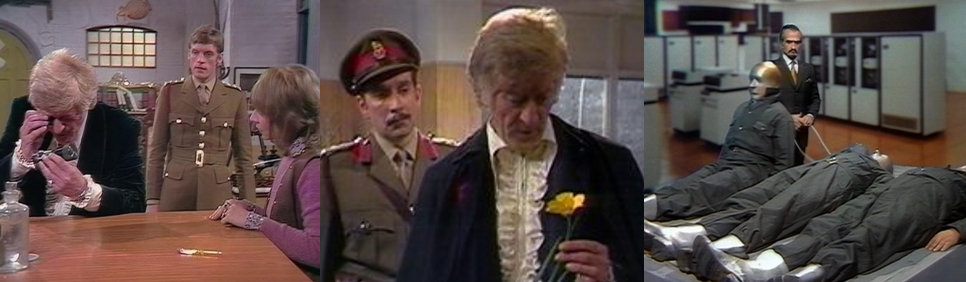
Begrudgingly pulled from his work and saddled with Jo and Captain Mike Yates (Richard Franklin) constantly badgering him, the Doctor investigates the theft of an energy unit and discovers technician Albert Goodge (Andrew Staines) mysteriously (and comically) shrunken down and stuffed into his lunchbox. The Doctor’s curiosity is further piqued when Adelphi (David Garth), a fellow Time Lord, warns him of the Master’s presence on Earth. The Doctor quickly realises that the Master is in league with the Nestene Consciousness (a cephalopod-like energy being) and is creating Autons (plastic robots and automations) to prepare for their invasion. While investigating a local plastics factory to find the Master, Jo is unwittingly hypnotised by the Master and almost sets off a bomb in UNIT headquarters, though she cannot offer the Doctor any insight due to suffering amnesia once freed from the Master’s spell. Despite him being furious at her for disobeying him, the Doctor is reluctantly grateful when Jo rescues him when he’s captured by the brainwashed Luigi Rossini (John Baskcomb) while searching the Master’s TARDIS. Despite narrowly evading a rabid mob, a gaggle of Autons, and his frustration at discovering the Master’s dematerialisation circuit is incompatible with his TARDIS, the Doctor consoles himself with the knowledge that he has effectively stranded his old foe by stealing the component. The Doctor then investigates the strange dolls and plastics recovered by UNIT, piecing together through his keen mind and the Master’s remote attacks that the Master’s using short-wave radio transmitters and heat to activate inconspicuous everyday objects to target 450,000 people and sending the country into disarray ahead of the Nestene Consciousness’s arrival. It’s clear that the Doctor is relishing the battle of wills with his murderous counterpart, even when baffled by certain events or outraged by the senseless violence, as it gives him the opportunity to test his mettle against a foe every bit as inventive as he is, yet one with a distinct lack of morals.
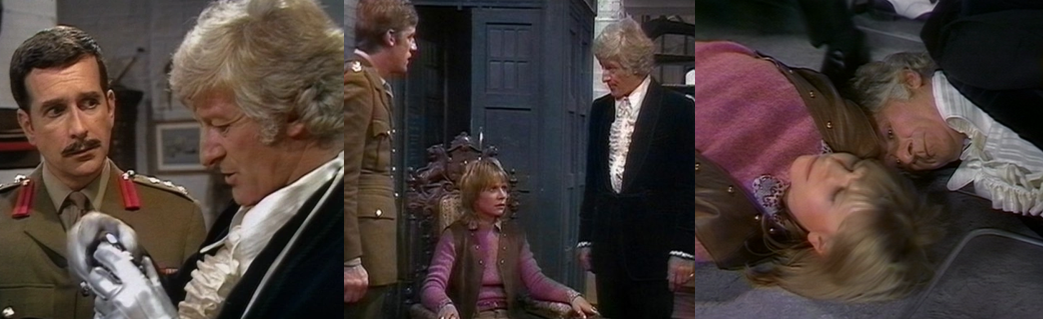
While the Doctor is somewhat dismissive of Jo, Mike treats her very well, happy to have another witness to the Doctor’s wild state and impulsive behaviour. Mike seems to have a crush on Jo as he hangs around her a lot and even saves her from one of the Master’s killer dolls. As ever, the Brigadier continues to be both awe-struck and irritated by the Doctor, who rarely treats him, his men, or their technology with any respect, regularly criticises their militaristic attitudes (and mankind’s tendency towards conflict), and compulsively disregards UNIT procedure. Indeed, the Brigadier insists on accompanying the Doctor to the plastics factory, organising his troops to corner the Master, co-ordinates an airstrike with the Royal Air Force, and even joins the Doctor in confronting the Master in the radio telescope control room. Despite having encountered the Autons and other strange alien threats before, and his familiarity with the Doctor and his ways, the Brigadier remains a somewhat sceptical, by-the-book military commander frequently baffled by the Doctor’s eccentric nature. Still, the Brigadier trusts the Doctor enough to ask his opinion (and for his help) and to act when the Doctor advises, even if the threat is something inconspicuous like ugly toy dolls. The Brigadier also saves the Doctor from being throttled by the Master’s living phone cord and even calls off the airstrike when he spots the Doctor and Jo being taken hostage. Although she doesn’t make a great first impression, Jo eventually impresses the Doctor with her affable personality, her fearless nature, and her unexpected skills of escapology. She almost dies when inspecting one of the Auton daffodils, however, to say nothing of how easily the Master enthrals her. However, she largely follows the Doctor’s lead and helps in her own way, eventually causing him to accept her as his new assistant.
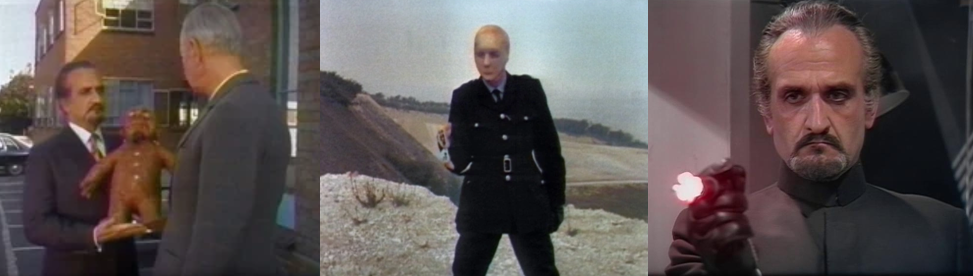
Honestly, the Auton threat is pretty laughable, even by classic Doctor Who standards. The faceless, plastic robot men look cheap and ungainly despite their surprisingly violent concealed hand cannons. The Master’s bizarre toy dolls and laughable inflating chair are almost as comical as his plot to kill thousands with plastic daffodils and the strange and obvious green screen to show scale when he’s bringing Autons to life in the plastics factory (as if there wasn’t a warehouse they could shoot in!) The Autons are largely lifeless, yet still know when they’re beaten, something the Master refuses to accept. They’re also the pawns of the Nestene Consciousness, which is built up as a fearsome entity but ends up being a vague distortion effect. Luckily for me, the main threat is the devious Master, a scheming, charismatic Time Lord who hypnotises the weak-willing with a glare and shrinks foes to death with his Tissue Compression Eliminator. The Master is the anthesis of the Doctor, gleefully killing where the Doctor protects, manipulating where he collaborates, and desiring power where the Doctor champions peace. The Master easily coerces Rex Farrel (Wisher), taking over his plastics factory to create Autons while posing as “General Masters”. If his silver tongue fails, the Master simply hypnotises or kills to get what he wants, sure that the Nestene Consciousness will reward him. Every bit as intelligent and charismatic as the Doctor, the Master relishes pitting his intellect against his foe, desiring first to kill the Doctor and then watch him suffer, before realising that the Nestene Consciousness will view him as expendable once it arrives. Still, though stranded and defeated, the Master flees after using Farrel as a patsy, ensuring future encounters between him and the Doctor.

The Summary:
The Third Doctor has always been a favourite of mine, largely thanks to the novelisations of his adventures I read as a kid and because his stories were the first to get re-runs back in the day. He’s a very energetic and intelligent incarnation who doesn’t suffer fools gladly and who is clearly frustrated at being stranded on Earth. This gives the Third Doctor a unique disposition as he clearly loves Earth and enjoys working with UNIT and the Brigadier, but he misses his freedom and is clearly tetchy at being stranded. This causes him to lash out irritably at times, labelling the Brigadier a “fool” and admonishing him for saddling him with Jo while also unable to turn down the chance to investigate strange occurrences. While it was undeniably disappointing to limit the Doctor Earth, I really enjoy the relationship between him and the Brigadier, with them getting on each other’s nerves and having very different moral and ethical perspectives and yet still defending the greater good. I enjoy seeing the Doctor in a lofty position at UNIT and his banter with Mike and Jo, who are amazed by his abilities and compelled to help. This was Jo’s debut episode, so she’s not especially fleshed out and is little more than a naïve, pretty face, but she did okay. While she tried to impress with her credentials and almost got killed a couple of times, her kind personality, bravery, and adaptability eventually won the Doctor over. Still, it might’ve been nice to give her more to do, something more relevant to the plot, like being a plastics or materials expert or maybe a coroner? I’m not sure, exactly, but just a little something extra to help her stand out beyond her doe-like eyes and naive enthusiasm.
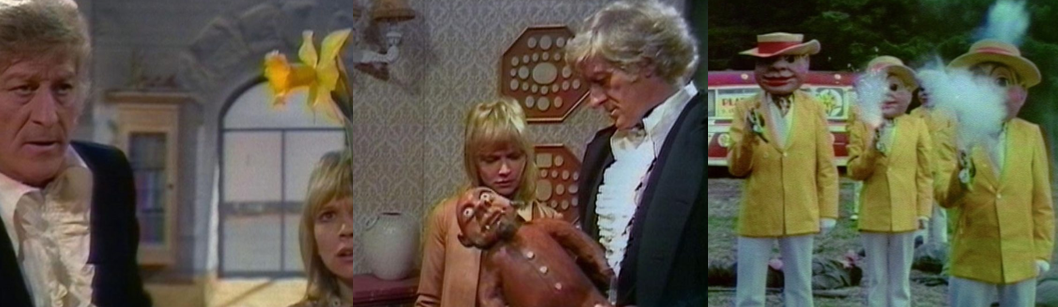
There’s a distinct charm to these classic Doctor Who episodes, which cobble together aliens and technology on a shoe-string budget and always earn points for creativity, even if the execution is handicapped by the time period. “Terror of the Autons” is especially unimpressive in this regard, however, simply because the Autons are so basic and boring. They’re basically lame Cybermen, plodding about and exhibiting superhuman strength and dangerous weaponry, but failing to inspire the same fear as the Daleks or the Cybermen. There’s some potential in their life-like skin masks, but this aspect is poorly implemented (which is a shame as it could’ve led to them impersonating the Brigadier or Mike or even the Doctor!) The Master’s plot to create dolls, daffodils, and killer chairs is especially bonkers and seems like a waste of time. Why not create Auton duplicates of key personnel to spread discord or even access the antenna array or those weapons the Doctor’s so against? Instead, the Master offs people with ravenous inflatable chairs and toy dolls, an oddly elaborate plot considering he can simply brainwash most people or shrink them to death with his little gizmo. It doesn’t help that the Nestene Consciousness is barely seen but is talked about with such fear and reverence that it can’t help but be disappointing when it appears as a static mess. I’m not expecting anything too elaborate, of course, but some kind of masked face superimposed on the sky would’ve been better, I think. I was impressed by the body count in “Terror of the Autons” and the Master’s plan for mass murders, but the execution was so bizarre that it felt like the writers were just making stuff up as they went along according to whatever props they had lying around backstage at the BBC.
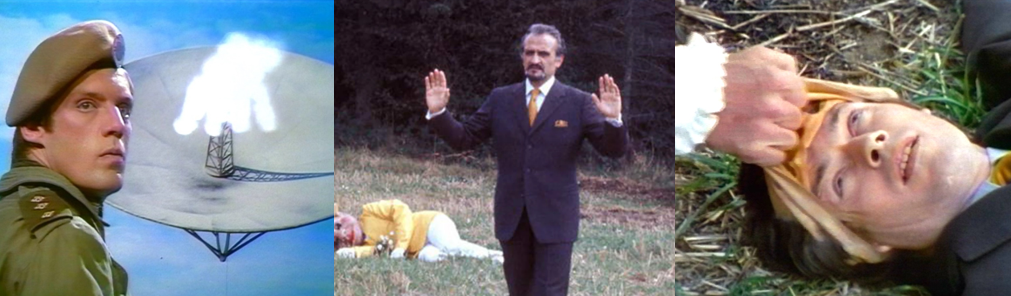
Thankfully, “Terror of the Autons” limps along through Jon Pertwee and Roger Delgado’s enigmatic performances. I wonder if making the Doctor a bit tetchy was a conscious decision to show that he has a mean streak like the Master, who fully embraces his dark side and matches the Doctor’s charm and sophistication with a murderous impulse. While he enjoys killing and seeks the destruction of the Earth, the Master’s not above subterfuge and generally tries to win over his victims before resorting to his hypnotic glare or shrink ray. This is probably because his hypnotism isn’t reliable, with the elder Farrel (Stephen Jack) resisting and the Master’s other victims shaking off his influence with enough time and distance. The Master’s plot may be extremely convoluted but this appears to be a purposeful decision as he enjoys manipulating those around him like chess pawns and pitting his intellect against the Doctor’s controlling others just to exert power and threatening the Doctor from afar just to get one up on him. Their showdown at UNIT headquarters is a great meeting of the minds as the two perfectly balance each other, the Master savouring having his foe on the back foot and not above threatening the Doctor’s friends to get what he wants. Ultimately, however, the Master’s most concerned with saving himself and sets aside his hatred of the Doctor to do so, slipping away like a coward. Roger Delgado shines as the quintessential standard barer for the Master, being every bit the Moriarty to the Doctor’s Holmes, something clearly evoked in their dialogue with each other. This aspect carries “Terror of the Autons” to a three-star rating and even that’s being generous as it’s somewhat of a disservice that such a fantastic villain is saddled with such a ridiculous plot.
My Rating:
Pretty Good
Did you enjoy the Master’s debut in “Terror of the Autons”? Was the Third Doctor your favourite incarnation? What did you think to the dichotomy of pitting the Doctor against an intellectual rival? Do you agree that Jo needed a little more to do here? What are your opinions on the Autons and the larger plot of their invasion? Which incarnation of the Master is your favourite? How are you celebrating Doctor Who Day today? Let me know your thoughts on Doctor Who and the Master’s debut in the comments, check out my other Doctor Who reviews, and donate to my Ko-Fi to suggest future episodes for me to cover.








 Dr. K's Waiting Room
You must be logged in to post a comment.