Movie Night [Sci-Fanuary]: The Blob (1988)


January celebrates two notable dates in science-fiction history: “National Science Fiction Day” on January 2 to coincide with the birth of world renowned sci-fi writer Isaac Asimov, and 12 January being when Arthur C. Clarke’s HAL 9000 was created. Accordingly, I dedicate January to celebrating sci-fi in all its forms.


Released: 5 August 1988
Director: Chuck Russell
Distributor: Tri-Star Pictures

Budget: $10 million
Box Office: $8.2 million
Rotten Tomatoes Scores: 69% / 59%

Quick Facts:
This rightfully celebrated remake of the 1958 cult classic reunited screenwriter Frank Darabont with director Chuck Russell and saw Lyle Conway, Stuart Ziff, and Tony Gardner collaborate on the gruesome and inventive special effects, which utilised silk bags filled with Methyl cellulose. Though widely praised as a more cynical piece evocative of the more rebellious 1980s, attempts at another remake have constantly stalled.

The Review:
Shifting its setting to Arborville, California The Blob initially begins in a similar fashion to the 1958 original, though with some fun twists. In place of Steve McQueen we have star quarterback Paul Taylor (Donovan Leitch), a gifted youngster from a wealthy background who, despite nursing what looks like a concussion, attracts shapely cheerleader Megan “Meg” Penny (Shawnee Smith). Despite his bravado, Paul’s wingman, Scott Jeskey (Ricky Paull Goldin), gets cold feet when buying condoms ahead of his late-night tryst with Vicki DeSoto (Erika Eleniak) when football loving Reverend Meeker (Del Close) corners him in the local chemist. Wishing to appear virtuous rather than a creep who practically date rapes girls, Scott paints Paul as a wayward soul, much to the disgust of pharmacist Tom Penny (Art LaFleur). This lands Paul in hot water when he pops over (in his letterman jacket, of course) to pick up Meg and realises Tom is her father, though Meg mostly laughs it off while apologising for her bratty little brother, horror fanatic Kevin Penny (Michael Kenworthy). Unfortunately for Paul and Meg, Paul accidentally knocks down a panicked old hermit (Billy Beck). Like in the original, the vagabond investigated a flaming meteorite that crashed into the woods, poking it with a stick and ending up screaming in agony when a strange, slime-like substance latched on to his hand. Luckily for the “old dude”, ruffian Brian Flagg (Kevin Dillon) was fixing his motorcycle nearby and helped, though his presence immediately rubs Paul and Meg the wrong way as Flagg’s a known troublemaker who’s been in and out of juvenile detention centres and is very much an outsider amongst his peers and the town.
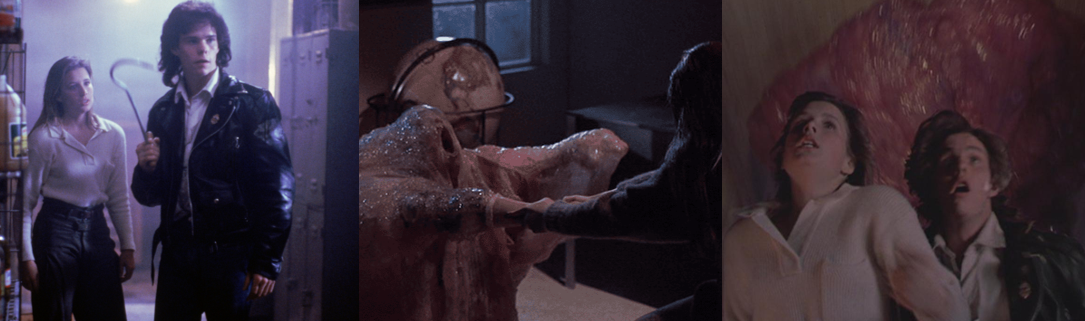
Unlikely duo Flagg and Meg must come together when a violent, voracious blob threatens their town.

Genuinely caring for the old man, who had applauded his earlier failed attempt to jump a busted bridge with his motorcycle, and to ensure Paul doesn’t pin the incident on him, Flagg accompanies them to the doctor’s office but quickly leaves after being frustrated by red tape. Paul is horrified to discover the hermit’s skin bulging alarmingly. Panicked, he pleads with the doctor (Jack Nance) for help, only to discover the old man dissolved from the torso down! Alarmed, Paul frantically calls Sheriff Herb Geller (Jeffrey DeMunn) but his chances at being a leading man like McQueen are dashed when the titular “Blob”, now vastly grown, envelops him and leaves Meg unconscious and hysterical after she walks in on him being consumed by the organism. Unfortunately, Paul had time to name-drop Flagg, so the moody outsider is apprehended and grilled by Deputy Bill Briggs (Paul McCrane), who’s convinced that Flagg was involved despite it being literally impossible for him to have melted the two to a mess of meat. Knowing this, Sheriff Geller sets Flagg free and he’s quickly sought out by a desperate Meg, who wants to verify what she saw. While at Fran Hewitt’s (Candy Clark) diner, Flagg dismisses Meg’s wild stories and gives her nothing but resentment, but his disbelief shatters when he hears a commotion and finds Fran’s cook, George Ruiz (Clayton Landey), literally being pulled down the drain by the Blob! Horrified, Brian and Meg take shelter in the freezer, discovering that the Blob is sensitive to the cold, and seek out Sheriff Geller once the coast is clear, oblivious that he, Scott, Vicki, and Fran have all been consumed by the amorphous, acidic creature.
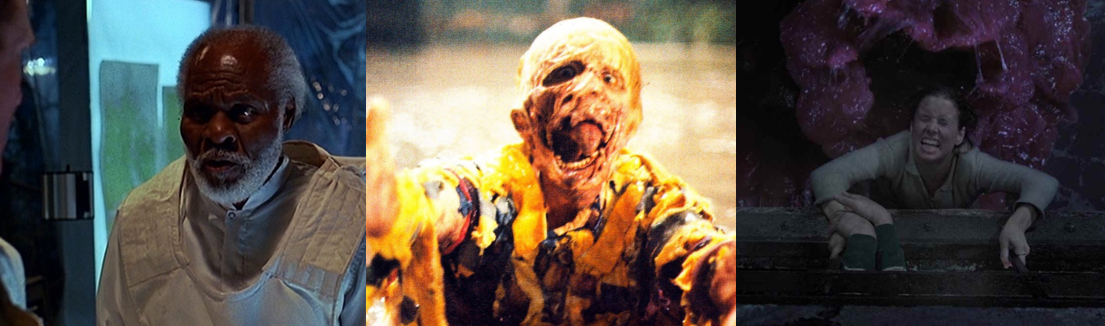
The mutated, man-made parasite excites Dr. Meaddows but spells gory doom for a small town.

However, Flagg and Meg learn that Briggs is at the crash site. Looking for answers, they head over and find Doctor Christopher Meddows (Joe Seneca) leading a military operation of shady government types in haz-mat suits. While Dr. Meaddows is courteous, Flagg is a sceptical, wary bad boy who doesn’t trust or like authority figures so he’s unconvinced by Dr. Meaddows’ explanation that the Blob is an alien bacteria that once wiped out the dinosaurs. Of course, Flagg’s right to be suspicious. After escaping, Flagg overhears a conversation between Dr. Meaddows and Colonel Templeton Hargis (Jack Rader) that reveals the film has reimagined the Blob as a man-made parasite, an advanced form of warfare created during the Cold War that was launched into space in a satellite. Space radiation caused it to unexpectedly mutate and crash to Earth and Dr. Meddows is super excited at the prospect as it means one-upping those pesky Russkies. Accordingly, Dr. Meaddows orders Arborville be pacified with talk of a quarantine from a potential infection and then isolated to contain the Blob, even if it kills the town. Despite his better judgement, Flagg races to warn people using the town’s vast sewer pipes, reuniting with Meg after she was forced to flee down there with Kevin and his friend, Eddie Beckner (Douglas Emerson). Kevin and Eddie’s wholesome midnight screening of a slasher was interrupted by the Blob, which sent the cinema patrons fleeing or consumed them in a far more gruesome and bloody reimagining of the iconic scene from the original film. The Blob then doubles down by melting poor Eddie, leaving Flagg, Kevin, and shellshocked soldier (Bill Moseley) trapped in the sewers ahead of the explosive finale.
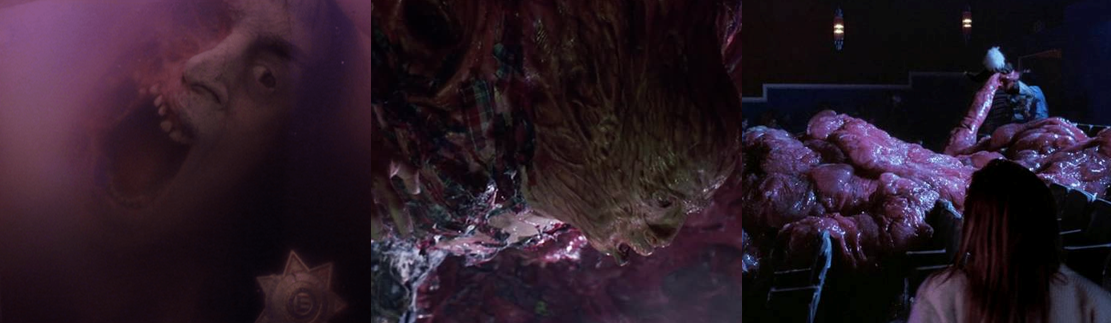
The Blob is bigger, meaner, and more dangerous than ever thanks to fantastic practical effects.

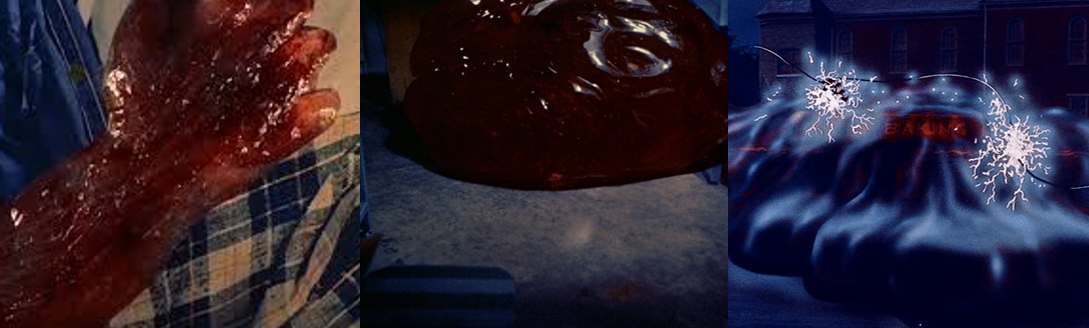
Although its origins are different, the Blob is still an amorphous, voracious creature driven only to consume and grow. Even when small, the Blob is tenacious, latching onto the hermit’s hand with a corrosive grip and melting him inside out. This sees it grow large enough to engulf poor Paul, who’s left a screaming, suffocating, melting mess within the creature’s jelly-like body. While the Blob was disappointingly absent for most of the 1958 film, it’s a persistent threat here, stalking through the grass to invade Vicki from the inside out, collapsing her in on herself to attack Scott with writhing tentacles. The Blob is far more versatile here thanks to improved practical and visual effects, appearing in various forms and sizes thanks to miniatures, animatronics, rear projection, and puppetry. Accordingly, it utilises tentacles to ensnare its prey, like when it entangles itself on Meg’s hair or yanks George down the drain. Other times, it simply engulfs its targets, slithering over the telephone booth to absorb Fran while still digesting lovelorn Sheriff Geller. The Blob’s increased screen presence delivers some fantastically gory kills and moments: Paul’s arm is ripped off and lies twitching and melting on the floor, a projectionist (Unknown) gets plastered to the ceiling and left gasping as he dissolves into the creature, and poor Eddie gets melted to a screaming, half-skeletal mush! The Blob grows “at a geometric rate” as a result, eventually becoming large enough to swat solders with giant tentacles, shrug off C4 and flamethrowers (leaving Reverend Meeker horribly burned), and growing thrashing appendages so strong they snap Briggs in half! Dr. Meaddows’ insane attempt to contain the creature and somehow turn it to his advantage see him disregard all civilian and military lives, leading to his deserved end when the Blob snags him through a manhole and leaves him a bloodstain within his suit.
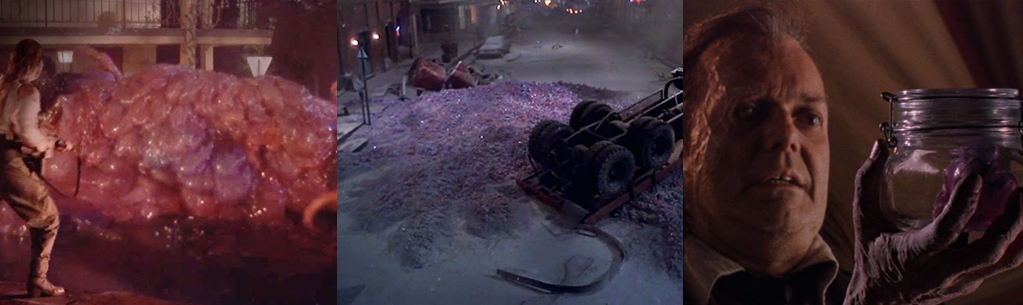
While C4 and a snow truck reduce the Blob to frozen fragments, its threat remains lingering by the end…

Flagg’s rebellious nature and distrustful attitude see his hunch about Dr. Meaddows pay off in the worst way and, despite him planning to leave town, Flagg’s compelled to go back (he even chastises himself for having his head turned by a cheerleader!) Despite saving Meg, Kevin, and the soldier, Flagg is met with suspicion by the town thanks to Briggs’ prejudice and Dr. Meaddows insisting that Flagg is infected by some unknown pathogen and a danger to them. Flagg manages to instil some doubt into Briggs but, luckily for him, the Blob soon convinces the civilians of the true threat. After Colonel Hargis orders the Blob to eat some C4, the creature emerges bigger than ever and goes on a rampage, scooping up, swatting, and consuming everything in its path as the terrified residents flee to the town hall. Thanks to Meg, they fend off the Blob with fire extinguishers, buying Flagg time to commandeer one of Moss Woodley’s (Beau Billingslea) beloved snow making trucks and blast the Blob with freezing cold liquid nitrogen. The Blob reacts violently, overturning the snow truck and threatening to consume Flagg, so Meg completes her evolution into a forthright action heroine by distracting it with an assault rifle and priming some C4 attached to the snow truck. Though both are momentarily imperilled due to being snagged on wires or seatbelts, the two race to safety just as the explosive goes off, flash-freezing the Blob into thousands of ice crystals and bathing the town square in snow. Flagg and Meg embrace as the relieved residents come out of hiding and Moss helps transport the remains to the icehouse. However, Revered Meeker is left badly scarred and traumatised by the ordeal, which he saw as a sign of the apocalypse. Thus, some time later, he preaches of the Rapture and a coming doomsday and is seen to possess a single, writhing piece of the Blob, hinting that the creature may return for seconds…

Final Thoughts:
I was probably way too young when I first saw The Blob, but I don’t regret it one bit. This is another example of a remake done right as it takes everything that worked about the original and dials it up to eleven, with the twist that The Blob takes its premise very seriously and is much more of a monster movie/body horror than a cheap (if ambitious) B-movie. As over the top as Flagg’s roguish depiction is, I really liked his characterisation as an outsider who’s been abandoned by his family and is constantly misjudged but who has a good heart and rises to the occasion. Shawnee Smith did a decent job being more than just a pretty, screaming face but I did find her a bit weak compared to Kevin Dillon, though Flagg and Meg made for a good odd couple. I really enjoyed how closely the film sticks to the premise of the original but puts little twists on things, like having the bad boy be the lead protagonist, featuring the creature more to showcase the effects, and altering its origin to make it a man-made parasite as an example of humanity’s hubris and war-like nature. Every complaint I had about the original is addressed here as we see the Blob in full glory for each kill, which are suitably ghastly and disturbing thanks to some truly remarkable practical effects. I loved how the Blob consumed its victims, engulfing them and melting their flesh and bone and leaving them shrieking, helpless messes of meat within its churning body. The Blob was extremely aggressive, sprouting tentacles and changing form to overwhelm its prey and truly depicted as unstoppable rather than being downplayed as a prank. The Blob even has the balls to kill off a kid, something rarely seen in horror, and never fails to entertain me no matter how many times I see it.

My Rating:

Rating: 4 out of 5.

Great Stuff

Do you agree that The Blob is one of the best horror remakes out there? Were you a fan of bad-boy Flagg and his rebellious attitude? Did you like the changes made to the Blob’s origins or do you prefer it to be a purely space-bound creature? Were you impressed by the gruesome special effects and gory kills? Are you disappointed that we never got a sequel to this film? What sci-fi movies are you watching this January? Tell me what you think about The Blob in the comments, check out my other sci-fi reviews, and donate to my Ko-Fi to suggest more sci-fi content for the site.

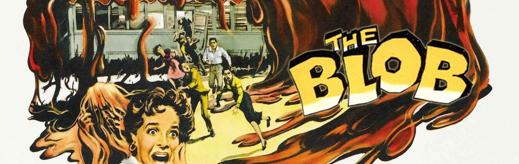
Movie Night [Sci-Fanuary]: The Blob (1958)


January celebrates two notable dates in science-fiction history: “National Science Fiction Day” on January 2 to coincide with the birth of world renowned sci-fi writer Isaac Asimov, and 12 January being when Arthur C. Clarke’s HAL 9000 was created. Accordingly, I dedicate January to celebrating sci-fi in all its forms.


Released: 10 September 1958
Director: Irvin S. Yeaworth Jr.
Distributor: Paramount Pictures

Budget: $110 million
Box Office: $4 million
Rotten Tomatoes Scores: 67% / 52%

Quick Facts:
Based on 1950 reports of a strange substance falling from the sky and undergoing several title changes, The Blob was a showcase for rising star Steve McQueen. The special effects were created by Valley Forge Films using silicone mixed with red vegetable dye, time-lapse photography, and miniatures. A critical flop at the time, this cult classic inspired a far worse 1972 sequel, a well-regarded 1988 remake, and an annual “Blobfest” celebration and re-enactment in Phoenixville, Pennsylvania.

The Review:
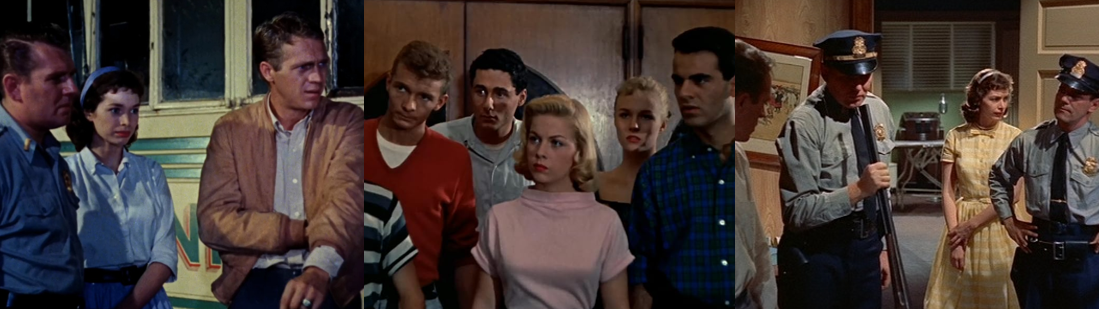
What starts as a cosy night in the forest for “teenagers” Steve Andrews (Steven McQueen) and Jane Martin (Aneta Corseaut) quickly turns into an exasperating experience trying to convince their small Pennsylvania town of an unusual threat. Initially, Steve and Jane’s biggest concerns are making sure their relationship is legitimate. Jane seems reluctant to go too far with smooth talking Steve and he’s anxious to prove he’s not a hot-shot frat boy, dutifully keeping his hands to himself and offering to drive her back to town so he can apologise. However, Steve almost hits a panicked old man (Olin Howlin), who stumbles into the road after investigating a nearby meteorite crash. While poking around the red-hot rock, the old man witnessed the titular “Blob” seeping from the rock, which quickly affixed itself to his hand, driving him into a frenzy. Naturally eager to help, Steve loads him into his prized car and races to Doctor T. Hallen’s (Stephen Chase) office, unwittingly insulting fellow “teens” Tony Gressette (Robert Fields), “Mooch” Miller (James Bonnett), and Al (Anthony Franke) by outpacing Tony’s car. Although Steve gets the old man to Dr. Hallen in time, the doctor is stumped by the strange, parasitic growth on his hand, which has doubled in size and appears to be absorbing and dissolving the limb. After anesthetising the old man, Dr. Hallen asks Steve to find some clue as to what happened, causing Steve to attract kindly but authoritative Police Lieutenant Dave Barton (Earl Rowe) after accepting Tony’s challenge for a drag race. Luckily, Steve sweet talks his way out of it and makes amends with Tony’s crew, who reluctantly join Steve and Jane in discovering the remnants of the meteorite.

Steve and his fellow “teenagers” struggle to convince the town of the Blob’s threat.

While Tony and the others head to the cinema, Steve finds Dr. Hallen being consumed by the now larger and more voracious Blob. Rattled, Steve races to the police station for help, only to be met by aggressive scepticism from war veteran Sergeant Jim Bert (John Benson), who believes Steve’s talk of murder and monsters is an elaborate hoax. Dismissing Bert’s accusations, Dave checks out the doctor’s office with Steve, Jane, and Bert, finding it ransacked and Dr. Hallen missing, which only furthers Bert’s suspicions. Steve’s so flustered by what he saw and Bert’s accusations that he briefly questions himself, concerned that he somehow imagined the Blob, though Jane strengthens his resolve and he goes to recruit Tony’s crew in warning the town. Steve’s concerns only double when he spots his father’s (Hugh Graham) grocery store unlocked and he and Jane encounter the far larger and more bulbous Blob inside. They hide in the meat freezer and decide to set off the air raid sirens to get the town to listen. Surprisingly, most of The Blob is focused on this adolescent drama as Steve and the others desperately try to convince the town of the danger, with only Dave taking them seriously as Steve’s a good (if cheeky) kid who’s clearly terrified. Bert, however, is as unconvinced as the townsfolk, who constantly dismiss Steve’s warnings and regard the kids as delinquents pulling an elaborate prank. Jane’s father, Henry Martin (Elbert Smith), is particularly aggrieved by it all, seeing Steve as a bad influence, and Tony and his crew don’t help with that perception. Ironically, Tony and his friends are instrumental in stopping the Blob in the finale, working alongside Henry and even Bert to gather the town’s fire extinguishers. However, as many as forty deaths occur prior to that, primarily because the kids weren’t taken seriously.

Sadly, the titular Blob is largely absent and its effects haven’t aged very well.

And, I mean, why would they be? These “kids” all seem to be in their late twenties for starters and all they do is lounge around, having drag races and rotting their brains with bad horror movies (that, ironically, even the older townsfolk enjoy). Even when the townsfolk are warned of the danger, they’re more concerned about having their sleep disturbed and how they should dress for the crisis. It doesn’t help that Steve cannot accurately describe what he saw, mainly because it was so surreal and he barely caught a glimpse of the Blob as it devoured Dr. Hallen. There’s also no trace of the creature in the doctor’s office and any who encounter it (like an unsuspecting mechanic (Ralph Roseman)) are simply absorbed by the gelatinous creature. The Blob is an unknowable, mysterious thing that crash-lands in the forest near Steve and Jane. Silent and caustic, the Blob appears to be a parasite rather than a thinking, malicious alien organism, consuming living flesh and adding to its mass simply on instinct rather than actively stalking its prey. We barely see what the Blob is capable of as it mostly attacks offscreen, meaning we’re left relying on Steve’s shaken explanations and a few brief glimpses of the Blob. Although it’s accompanied by a jazzy theme song that’s as tone-deaf as some of the acting, the Blob largely disappears for a huge chunk of the movie as Steve runs around trying to convince people of the threat. Unsurprisingly, the amorphous creature’s effects have aged as badly as the re-dubbing peppered throughout the film, largely seen attacking miniatures or as stop-motion-esque goo badly spliced into the film. The creature is immediately said to be unstoppable after only minimal attempts to stop it. Bullets do about as much against it as acid, live wires, and fire, and that’s about all the townsfolk have to use, meaning they’re powerless to keep the animated glob from enveloping a diner Steve, Jane, and her well-meaning but naïve little brother, Danny Martin (Keith Almoney), shelter in.

Luckily, all it takes to stop the Blob are some fire extinguishers and the hope that the Arctic stays cold…

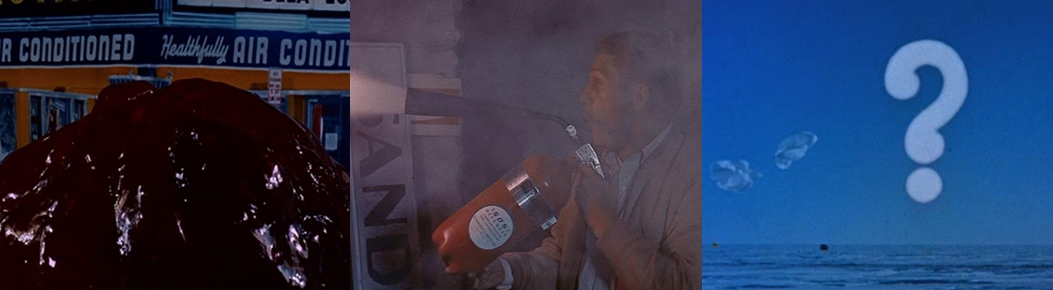
Of course, The Blob’s big showcase moment is its attack on the local cinema, where Tony and his crew enjoy a cheesy black-and-white horror flick with their girlfriends. Although they saw the remains of the meteorite, they’re clueless to the Blob’s threat but are begrudgingly convinced to help Steve and Jane warn the town, though their efforts are largely wasted until they cause a ruckus. While most of the town gathers outside in the shopping district, the cinemagoers remain glued to their film, unaware that the Blob has seeped through the vents and attacked the projectionist (Eugene Sabe). They soon realise what happened when the movie abruptly stops and the Blob oozes from the projectionist’s area, sending them fleeing and screaming into the streets. Sadly, we never get to see what the Blob does to those too slow to escape; we only hear from Dave that it’s a gruesome site. Enlarged to gigantic proportions, the Blob seeps from the cinema, finally convincing Bert of its threat, and summarily traps Steve, Jane, and Danny in the diner. Though Dave tries to electrocute the Blob, this just sets the diner ablaze, threatening a grisly end for those trapped inside. Luckily, Steve recalls that the Blob recoiled from the cold in the freezer and manages to radio Dave and have him gather up all the fire extinguishers they can find and aim them at the creature, successfully causing it to recede and freeze in record time. The film then abruptly ends with the frozen Blob being dumped in the Arctic by the Air Force and then shoehorns in a forced environmental message that warns that global warming will cause the creature to revive and threaten the world anew. Although the meat freezer scene established the Blob’s aversion to the cold, this is an extremely sudden and anti-climactic ending to a disappointingly dull B-movie that stretches logic to breaking point and leaves the movie on a cliff-hanger was certainly an ambitious choice, to say the least.

Final Thoughts:
I vaguely remember watching The Blob many, many years ago. Or, at least, parts of it. But I grew up with the 1988 remake, which was a gruesome piece of body horror cinema that I still regard as one of the best remakes. Watching the 1958 original only reinforces that as this is a ridiculously dull and toothless B-movie sci-fi flick. While Steve McQueen makes for a good leading man, I didn’t believe for a second that he was a teenager, and his performance is hampered by the comical, overly theatrical performances rampant in 1950s movies. Jane was essentially a blank piece of wood, there to worry about Dr. Hallen’s dog, cling to Steve when frightened, and bolster his resolve when it faltered. I quite liked Tony and his crew; they were fun anti-heroes who came through in a pinch, but extremely underdeveloped as characters. Bert was the dirt worst, judging the kids as delinquents due to his prejudices and embodying the town’s dismissive and apathetic attitude towards the youngsters, who are seen as nothing but troublemakers. Sadly, we’re stuck with these boring-ass characters for most of the film as the Blob disappears after eating that mechanic and is only talked about until Steve spies it in the grocery store, grinding the film to a halt as we watch these “kids” desperately try to warn the town of the creature’s threat. When the Blob does appear, it’s an impressive and ambitious series of special effects that haven’t aged too well but are still more entertaining to watch than the lead actors. The cinema sequence is an all-time moment, for sure, but I liked the gooey Blob effects when it attacked people and slithered under doors. Sadly, The Blob is largely forgettable beyond this. The ending comes out of nowhere and is a masterpiece of convenience, the environmental message is lacklustre and tacked on, and the overall plot of the kids having to prove themselves just didn’t grab me.

My Rating:

Rating: 2 out of 5.

Could Be Better

Do you consider The Blob a sci-fi classic? Did you enjoy the focus on the teens trying to prove the creature’s threat or did you always find it boring? Were you impressed by the Blob’s special effects or were you disappointed by its lack of screen time? Would you poke alien goop with a stick? Have you ever attended Blobfest? Would you like to see a new version of The Blob and how are you celebrating sci-fi this January? Leave a like and a comment with your thoughts, check out my other sci-fi reviews, and donate to my Ko-Fi to suggest other sci-fi content you’d like to see.

10 FTW: Surprisingly Good Horror Remakes

We’ve heard it all a thousand times by now: “when will Hollywood stop with the remakes!?”, “Why can’t Hollywood come up with new ideas!?”, “Remakes suxxorz1!!” Honestly, while some films should never be re-made and some remakes do baffle the mind, remakes aren’t the plague of cinema that a lot of people like to think they are. In fact, some are pretty damn good.

If you’re one of those bleeding heart Twitter people, though, who just like to decry remakes in general, maybe you should take a moment to consider this small list of horror remakes that are not only surprisingly good but, in some cases, actually surpass their originals:

Halloween
10 Halloween (Zombie, 2007)

We’re kicking things off with quite the controversial choice here. I’ll argue until the end of time that John Carpenter’s Halloween (Carpenter, 1978) is the forefather of all modern horror, particularly the slasher genre. It’s a subtle, atmospheric piece with a fantastic, mysterious antagonist and the truly frightening prospect that random unspeakable acts of horror can happen in a suburban environment. Rob Zombie’s take, however, is a loud, frenetic, uncomfortably gruesome take on the property. Michael Myers (Daeg Faerch/Tyler Mane) is an incredibly disturbed young boy from a violent and abusive family who becomes a remorseless, emotionless, unstoppable tank of a killing machine. Zombie delves right into his own take on Michael’s backstory, presenting in grotesque detail the exact events that turn Michael into a nigh-supernatural killer.

In many ways, the initial focus of the film acts as a kind of prequel to the events of Carpenter’s original, as the remainder of the film’s runtime is devoted to recreating Michael’s killing spree in Haddonfield, with the primary difference being that nearly the entirety of the film is told from Michael’s perspective. Sure, Malcolm McDowell, great as he is, cannot hope to compete with the fantastic Donald Pleasence but the film is bolstered by the incredibly cute Scout Taylor-Compton (who is arguably more attractive and relatable to modern audiences than Jamie Lee Curtis) and even appearances by Brad Dourif and Danielle Harris (and what an appearance hers is!) While it’s unlikely to be as iconic or influential as Carpenter’s benchmark film, for those who find the original and its sequels dated and slow, Rob Zombie’s remake is a much-needed kick up the ass that, for better or worse, dragged Halloween kicking and screaming out of obscurity.

Poltergeist
9 Poltergeist (Kenan, 2015)

I know, right? How could Hollywood ever even entertain the idea of remaking Tobe Hooper/Steven Spielberg’s 1982 horror classic? Well, they did, and don’t be mistaken; it’s not actually that bad. While it lacks probably my favourite scene from the original, where corpses rise from the Freeman’s unfinished swimming pool, the remake is just as terrifying and engaging as the original, with the added bonus of having a modern-day make-over that is far more accessible than the now-dated original. Don’t get me wrong, the original is still a classic, but Sam Rockwell and Kennedi Clements put in some great performances, easily on par with those of Craig T. Nelson and the late JoBeth Williams. Did Poltergeist necessarily need a remake? Probably not, and the fact that numerous haunted house stories since the original have all pulled from or mirrored Hooper’s seminal horror classic probably didn’t help to differentiate Kenan’s new take on the property, but I feel it’s a largely misrepresented film that is nowhere near as bad as some people think.

It
8 It (Muschietti, 2017)

Although I spoke about this film quite recently, it is deserving enough to make this list. Watching Tommy Lee Wallace’s 1990 miniseries, great as it is and as amazing as Tim Curry’s performance in that is, you can’t help but think that Stephen King’s novel deserved to be told without the restraints of a television miniseries. Focusing exclusively on the child side of King’s story, and bringing the events forward to the 1980s rather than the 1950s, Muschietti adheres closely to King’s text while still putting his own spin on events. Bill Skarsgård’s take on Pennywise is suitably unsettingly and otherworldly; what he lacks in Curry’s charisma he more than makes up for by being genuinely creepy and a fearsome menace. Muschietti also focuses on the friendship and troubles of his child protagonists incredibly well, anchoring them to the film’s central narrative and allowing King’s themes of childhood and loss of innocence to play out beautifully. With a lengthy runtime and concluding on a fantastic tease for a second chapter, this new version of It, while not without its issues (primarily regarding screen time for the many characters), did not disappoint in realising the gruesome potential that the miniseries could only hint at.

7 Dawn of the Dead (Snyder, 2004)

Released at the peak of Hollywood’s new-found fondness for zombie films in the early-to-mid-2000s, largely spearheaded by 28 Days Later (Boyle, 2002) and the God-awful Resident Evil (Anderson, 2002) and its decent-enough sequel, Resident Evil: Apocalypse (ibid, 2004), Zack Snyder’s remake of George A. Romero’s massively-influential 1978 film of the same name takes the general themes and premise of its source material and ramps them up with some incredible action, grotesque gore effects, and a much-needed modern day gloss. While zombie purists may lament the inclusion of the fast-moving, animalistic undead introduced in 28 Days Later, Snyder’s rapid editing and penchant for style over substance make the creatures more vicious and scary than in Romero’s original film. With some great supporting performances by the likes of Ving Rhames and Michael Kelly (and even a brief cameo by Ken Foree, repeating his iconic line from the original film), Snyder’s Dawn of the Dead is a non-stop masterpiece of zombie cinema that never slows down to the snail’s pace that Romero’s introspective original prefers to adopt.

Texas Chainsaw Massacre
6 The Texas Chainsaw Massacre (Nispel, 2003)

One of the primary reasons I was inspired to make this list, The Texas Chain Saw Massacre (Hooper, 1974) was a film that desperately needed this remake! Seriously, the original might have been shocking and gruesome at the time but, since then, it has not aged well; it’s a slow, dull piece of cinema that drags on way too long, with questionable acting and a lifeless soundtrack. The only redeeming quality comes from the maniacal Sawyer family, and even they are a hooting, loud bunch of camp. Produced by Michael Bay’s Platinum Dunes, which would go on to be responsible for a variety of horror remakes, The Texas Chainsaw Massacre is much better than it had any right to be. With an uncomfortable gradient, shocking soundtrack, and even some decent performances by Jessica Biel and Eric Balfour, Nispel’s remake downplays the cannibalistic nature of the franchise in favour of grotesque torture-porn levels of horror.

While the film reintroduces Leatherface (Andrew Bryniarski), one of horror’s most iconic figures, and even suggests a tragic backstory for the character, Nispel’s Chainsaw brought us one of the most despicable and significant horror icons in years in the form of Sherriff Hoyt (masterfully embodied by the great R. Lee Ermey). Hoyt, a tobacco-chewing, foul-mouthed sadist, drives the plot of this remake, raises its quality to another level, and his popularity was arguably responsible for the equally-enjoyable prequel, The Texas Chain saw Massacre: The Beginning (Liebesman, 2006). On a side note, though, am I the only one shocked that, including remakes and reimaginings, the Chainsaw franchise is made up of eight separate movies? Crazy!

The Blob
5 The Blob (Russell, 1988)

Now we’re getting somewhere! Irvin Yeaworth’s original 1958 film, starring Steve McQueen, was a campy piece of B-movie mush that has come to resemble a comedy more than a science-fiction piece. Channelling the likes of David Cronenberg and John Carpenter, Chuck Russell’s reimagining, however, takes the story of the bulbous alien lifeform to far more grotesque levels. Incorporating some incredibly disgusting practical effects, the population of a small town is literally dissolved by the titular amoeba. Although some of the composite shots are obviously dated by today’s standards, an entirely CGI rendition of the Blob would probably have aged incredibly poorly by now. Instead, The Blob retains a level of camp in its premise but, with its gruesome effects and no-nonsense attitude, is a great example of how effective and impactful practical effects can be.

Friday the 13th
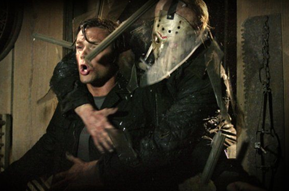
4 Friday the 13th (Nispel, 2009)

We’re back with Marcus Nispel and Platinum Dunes for this masterfully well-crafted remake of not only the original 1980 classic but, also, the first three sequels. Similar to Halloween, for those who find the original movies to be dated and cut-and-pasted, by-the-numbers slasher films with very little to differentiate them from each other until Friday the 13th Part V: A New Beginning (Steinmann, 1985) then this is the film for you! In fact, I often encourage newcomers to watch this film and then jump straight to Jason Lives! Friday the 13th Part VI (McLoughlin, 1986); not because the continuity would tie together but, by doing that, you watch one kick-ass film with loads of gratuitous mid-2000s sex (which is far more graphic, enjoyable, and realistic than sex scenes from the 1980s) and horror imagery that sums up the first four entries of the franchise incredibly well and then you can delve into the enjoyable nonsense of zombie Jason Voorhees.

Beginning with the brutal decapitation of Mrs. Voorhees (Nana Visitor) and detailing how Jason (Caleb Guss/Derek Mears) witnessed her murder and grew up alone in the wooded forests of Camp Crystal Lake, as well as detailing Jason’s transformation from the lesser-known burlap sack look to the now-iconic hockey mask, Friday the 13th is filled with some incredibly gruesome kills as Jason uses bear traps, snares, and other tricks to entrap and kill hapless teenagers all over the shop. Add to that some strong performances by Danielle Panabaker, Aaron Yoo, and Jared Padalecki and you have an intense, non-stop horror film that, like Jason, comes at you a mile a minute. Honestly, the only bad thing I have to say about this film is that, despite making $92.7 million on a budget of $19 million, we never saw a sequel; even Rob Zombie’s Halloween got a shitty sequel!

The Thing
3 John Carpenter’s The Thing (Carpenter, 1982) and The Thing (Heijningen Jr, 2011)

Here’s some more controversy for you: I actually liked Matthijs van Heijningen Jr’s version of The Thing. It starred Mary Elizabeth Winstead, who I absolutely adore, and, while marketed as a remake, was actually, ingeniously, a prequel to John Carpenter’s 1982 horror/sci-fi classic. Based exclusively on a brief scene from Carpenter’s film, van Heijningen Jr’s The Thing details how a Norwegian research team unearth an extraterrestrial craft and unwittingly awaken a shape-changing, parasitic alien lifeform and concludes with the survivors attempting to hunt down and eliminate the creature’s final form, which leads directly into the beginning of Carpenter’s The Thing.

Drawing loosely from both Christian Nyby’s 1952 B-movie classic The Thing From Another World! and the story that inspired it, Who Goes There? (Campbell, 1938), John Carpenter’s The Thing is one of the quintessential examples of the effectiveness of practical special effects to the horror genre. Kurt Russell and Keith David lead the charge when their small Antarctic outpost is slowly assimilated by the titular alien creature, leaving the survivors to descend into distrust and anarchy as they struggle to fight off the ever-growing menace both outside and within their number. Carpenter’s film features some truly incredibly moments of practical effects wizardry, from a torso sprouting razor sharp teeth, to a severed head growing spider-like appendages and a dog literally splitting in two as tentacles blast out from its head; yet, while its similarly-impressive practical effects were tampered with in post-production, I never felt like Heijningen Jr’s The Thing was sub-par to Carpenter’s film. Instead, it works amazing well as a companion piece, allowing one to binge-watch both movies side-by-side and be suitably entertained.

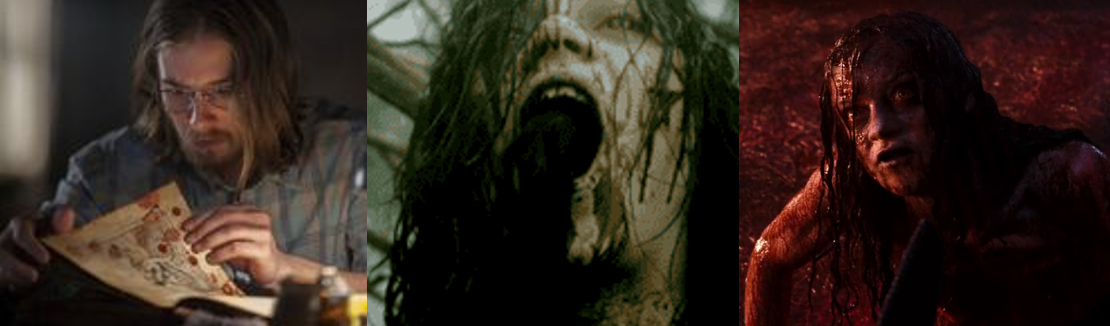
2 Evil Dead (Alvarez, 2013)

Similar to The Texas Chain Saw Massacre, Sam Raimi’s landmark 1981 horror film The Evil Dead was in desperate need of a remake. Sure, the stop-motion, puppetry, and practical effects were great considering the limited time and budget Raimi had available to him but, over time, neither they nor the acting have aged incredibly well. In fact, for me, Evil Dead II: Dead by Dawn (Raimi, 1987), which retells the events of the original in its opening moments, already surpassed Raimi’s original film by leaps and bounds: Ash (epitomised by Bruce Campbell) is a far more capable, well-rounded character, the effects are much better, and the film adopts a quirky style of black comedy that was sorely missing in the original. Fast forward to 2013 and, rather than attempt to emulate Raimi’s black comedy style, Fede Alvarez approaches his remake with an intense seriousness.

The horror is brutal and horrendous to look at; there’s no laughing deer heads here. Instead, characters saw their arms off, are attacked by nail guns, get beaten by crowbars, and are forced to tear their arms off at the elbow in gruesome fashion. The plot is largely the same, with a group of largely likeable characters accidentally awakening an ancient evil, but the stakes are much higher; here, the evil seeks to take on a physical form and bring about the apocalypse whereas in Raimi’s original film it simply wanted to claim the souls of those trapped in the cabin. While it lacks a character as iconic as Ash, Evil Dead makes up for it with some truly difficult to watch moments that are both sickening and perversely entertaining; even Raimi’s controversial tree rape scene is included and utilised in a far more effective and plot-relevant way and that alone is reason enough to place this film over the original, in my view.

The Fly
1 The Fly (Cronenberg, 1986)

This is it, the quintessential argument that not all remakes are bad and that they can, in some cases, vastly surpass their originals. While Kurt Neumann’s 1958 film of the same name may be closer to the original story and is still a pretty decent piece of 1950s science-fiction, despite its now campy tone, Cronenberg took the idea of a man teleporting himself with a fly and took it to whole new levels. Before, the man bore the head and arm of the fly as a result of the accident and slowly deteriorated into madness; here, though, thanks largely to an absolutely stellar performance by the always-amazing Jeff Goldblum, Cronenberg details the physical and mental degradation of his main character, Seth Brundle, in painstakingly brutal detail. Brundle, a brilliant scientist, initially embraces his newfound physical attributes before realising that he has been stricken by an infection on a cellular level not unlike AIDS or cancer. Soon, his body deteriorates at an alarming rate, with top-notch special effects being employed to make Goldblum practically unrecognisable through heavy make-up and full-body prosthetics.

As he alienates those around him, Brundle’s mind also begins to depreciate; initially desperate to reverse the effects, he soon comes to believe that he was never a man to begin with and prepares a gruesome legacy for himself whereby he will merge his crippled body with that of his lover (a strong, heartwrenching performance by Geena Davis) and his unborn child. In the process, he not only dissolves his rival’s hand and foot with corrosive fly vomit but literally bursts out of the remains of his decrepit human skin to emerge as a grotesque fly-like creature, before finally, tragically, forcing his lover to end his torment. The Fly transcends boundaries; it is a horrific tale of science gone wrong, a body horror with terrifying consequences but, at its heart, it is also an extremely tragic love story. Cronenberg did what many fail to do with their remakes; he took the original concept and not only put his own spin on it but also transformed it into something entirely separate from the source material and yet vastly superior to it in many ways.

Arguably, remakes like A Nightmare on Elm Street (Bayer, 2010) (which attempted to put a unique spin on the franchise and ended up becoming a carbon-copy retelling of Wes Craven’s seminal 1984 original), Total Recall (Wiseman, 2012), RoboCop (Padilha, 2014) could really learn a thing or two from The Fly, and many of the remakes on this list. If you’re going to remake a movie, don’t just retread the same material as before; go back to the source, back to the text, and either produce a more faithful adaptation or extrapolate the core themes and general premise and produce a great movie, rather than a simple, insulting cash-grab.