

Released: August 1994
Developer: HeadGames
Also Available For: Game Gear and Master System
The Background:
Following his debut in “Devil May Hare” (McKimson, 1954) as a dim-witted and voracious foil to Bugs Bunny (Mel Blanc), my absolute favourite Looney Tunes (1930 to present) character, the Tasmanian Devil (or simply “Taz”), became a recurring character in subsequent Looney Tunes cartoons before graduating to his very own show, Taz-Mania (1991 to 1995), as part of the Looney Tunes renaissance of the nineties. Although technically not tied into that cartoon or a sequel to Taz-Mania (Recreational Brainware/Various, 1992), and a fundamentally very different game altogether, Taz in Escape from Mars is emblematic of the character’s enduring popularity. Unlike the previous title, which I was inspired to play after enjoying the Master System version, Taz in Escape from Mars has always been a daunting prospect for me; the game’s reputation is somewhat mixed and I remember it being a tough experience the few times I borrowed it as a kid. However, given my love for the character, I was looking forward to sitting down and actually putting some real time into the game and seeing if I could overcome it after all these years.
The Plot:
Having amassed a collection of strange and wondrous alien creatures, Marvin the Martian comes to Earth to kidnap the insatiable Taz and cage him in a special zoo on Mars. Unimpressed at his predicament, Taz breaks free and goes on a rampage in a desperate attempt to return home.
Gameplay:
Like its predecessor, Taz in Escape from Mars (or Escape from Mars Starring Taz, as the title screen states) is a 2D, sidescrolling action/platformer which places you in the role of Taz, the ravenous Tasmanian Devil of Looney Tunes fame. Despite sharing many of the same sprites and fundamental mechanics as that game, however, Escape from Mars is a much bigger and more entertaining adventure with more interesting and varied mechanics, a faster pace, and much more freedom of movement (you can now freely move the screen’s camera up and down, for example).
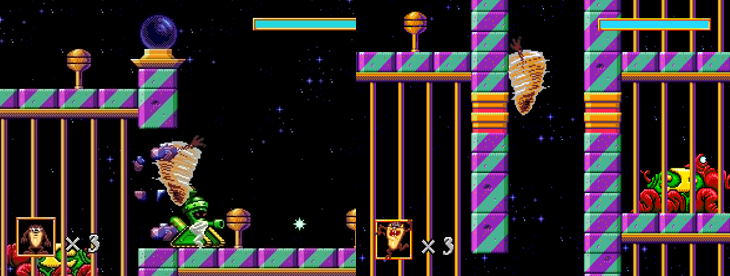
As before Taz can pick up and use objects and use levers and other mechanisms with A, spin like a tornado with B, and jump with C. Unlike in the last game, Taz cannot defeat enemies or damage bosses by jumping on them but his spin attack is much faster and more useful this time around as you can use it to bounce Taz up narrow walls to reach higher areas. You can also hold down the B button to race across certain surfaces, including walls and ceilings, and to break through certain walls to avoid attacks and progress further.
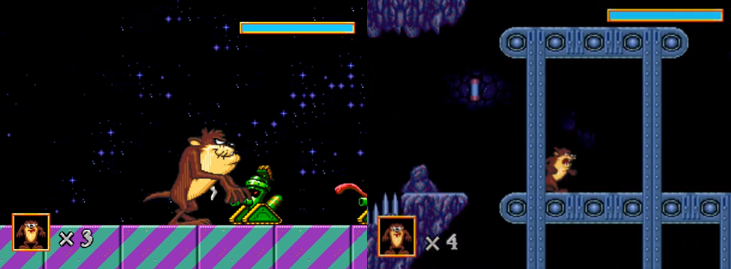
Taz, though still lacking in jumping and walking frames, also moves much faster and the controls, in general, are much tighter and more responsive. Best of all, Escape from Mars appears to be completely free of bottomless pits and instant death traps and has far more variety in the presence of teleporters, grow rays, and shrinking potions. When temporarily super-sized, Taz loses his spin attack but is invulnerable and can stomp his enemies into dust and, while shrunk, he can fit through smaller passageways (though he cannot attack or pick up items of food). Taz can also use his spin attack to tunnel through the dirt in Moleworld and you’ll notice that the game’s worlds and enemies are much more vivid, wacky, and memorable this time around.
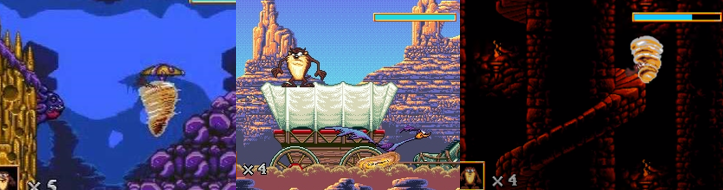
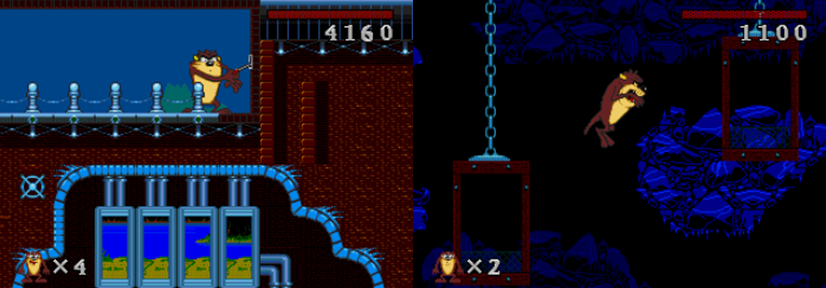
Not only is there more depth to the game’s environments, there are more interesting gimmicks in place, such as moving and temporary platforms, floating platforms, using mushrooms to ascend around spiked mazes, and jumping from cow to cow in the Mexican desert to say nothing of encountering more Looney Tunes characters, such as the Roadrunner and Yosemite Sam. You can also use Taz’s spin to go up and down spiral staircases in the Haunted Castle, traverse environments on floating cubes, and there are even some gravity-based mechanics at work in Marvin’s House. Taz can even enter an alien device and be duplicated a few times in this level and you’ll need to hop onto the doppelgänger’s head to reach higher areas. Having said that, though, the game manages to balance out all the improvements it makes on its predecessor with some annoying enemy and hazard placements (there are now two types of bombs, for example, that Taz will happily gobble down and get blown up for his troubles); some enemies, like the aforementioned Yosemite Sam, can’t be defeated and will attack you relentlessly. It can also be frustrating to enter the background through doorways only to instantly get stuck or become lost as you either can’t see where you need to go or there is nowhere to go, making the mechanic a bit pointless. By far the most annoying gimmick in the game are the lasers that instantly turn you to ash in Marvin’s House; you’ll have to desperately float and flail about using the gravity mechanics and attacking the laser generators from precariously small platforms in the hopes of reaching (and eating) the coveted exit sign.
Graphics and Sound:
Taz in Escape from Mars takes the charming, cartoony aesthetic from the previous game and expands upon it in every way. Taz’s sprite remains mostly the same except for a new coat of paint, which is a little disappointing as his jump is still lacking in frames and the developers didn’t even program him a new idle animation. They seem to have tried to make up for this by expanding and shrinking him, which is pretty neat, but these mechanics aren’t seen very often (I only grew big once in the entire game) so it would have been nice to see Taz’s sprites and range of motion expanded a bit more alongside his speed and abilities.
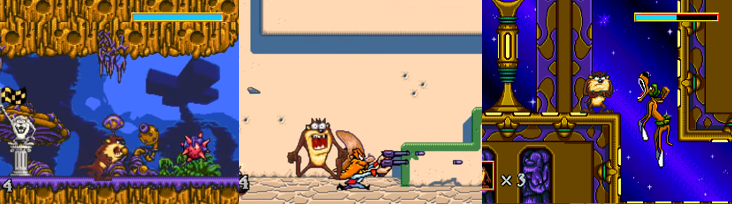
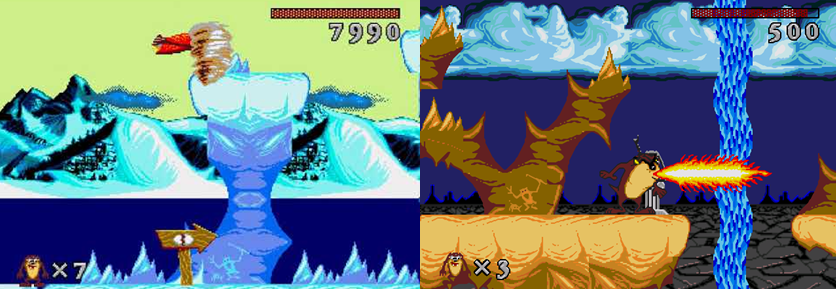
Taking Taz off-world, though, vastly improves the appeal of the game’s environments; big, colourful, and full of wacky enemies and elements, Escape from Mars’ levels are far more unique and appealing as Taz hops from planet to planet in an effort to get home. Taz’s journey takes him from Marvin’s zoo on Mars, to the purple sands of Moleworld, where he’ll be pursued by a giant drilling machine in a desperate auto-scrolling chase that is easily one of the more frustrating and nerve-wracking parts of the game. Planet X is one of the game’s more distinct locations; an alien, mushroom-filled world that features spiked walls and more than a few of those never-ending water slides that require you to jump off at the right moment to progress further. Eventually, Taz makes it back to Earth, specifically Mexico, where he has to jump across a stampede and then navigate through the maze-like city while bandits shoot at him, before ending up in what initially appears to be a quite out of place castle but soon transforms into a mad scientist’s dungeon.
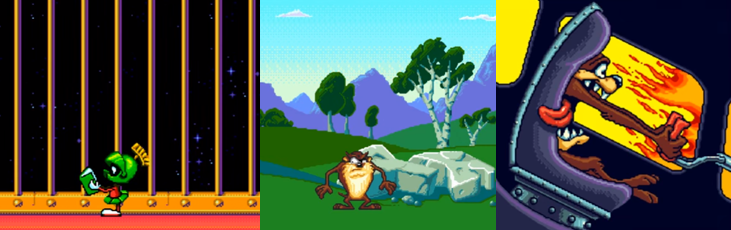
Unlike the previous game, Escape from Mars skips using dialogue and awkwardly-drawn panels for its story and, instead, relies far more on in-game graphics and pantomime, which is all of great benefit as everything has a more cohesive and appealing aesthetic as a result. The music and sound effects are also much improved but, while you’re no longer bombarded with annoying sounds and weirdly-composed tunes, neither are anything particularly catchy or memorable, which is a bit of a shame as that was another area that needed much improvement.
Enemies and Bosses:
Another area where Escape from Mars out-does Taz-Mania is in the variety and appeal of its enemies; while no characters from Taz’s cartoon appear apart from Taz himself, the game makes up for this by swapping out bats and weird rock monsters for a handful of crazy alien foes who explode in a swirl of smoke when hit with Taz’s spin.

Marvin’s zoo and house, especially, are populated by weird alien frog-like creatures, robots, and his oft-seen minions, the Instant Martians, and his dog, K-9. You’ll also battle a variety of bandits, weird alien snails, raging bulls, and come across Yosemite Sam both in a gun-firing rage and protected by suits of armour. Witch Hazel even makes an appearance in the Haunted Castle, and what appear to be semi-cybernetic moles will blast at you with electrical bolts on Moleworld, and even Roadrunner and Wile E. Coyote will damage you if you slip off your stampeding convoy.
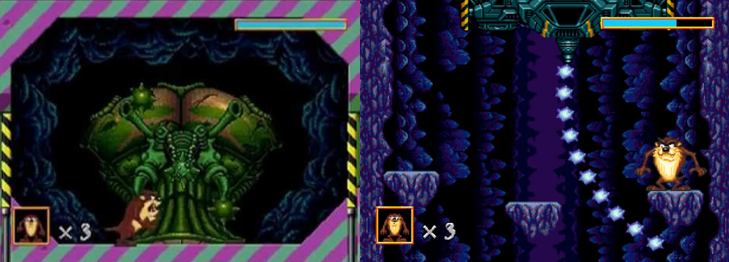
It’s all very surreal and this is reflected in the game’s bosses, which are much bigger and require a bit more that just spinning into (and jumping on to) them this time around. The first boss is a massive alien elephant thing that swings its trunk at you in a clockwise and anti-clockwise motion and spits spiked balls into the arena. Thankfully, as I mentioned, Taz’s spin will now carry him along walls and ceilings, which allows you to avoid damage and ricochet into the creature’s antenna-like eyes when they briefly appear in order to damage it. The second boss is a giant drilling machine which attacks you in free fall. Using small and otherwise precarious platforms, you must dodge its laser-like whip and missile attacks and spin into the pilot when he pops out from the cockpit. Thankfully, if you fall from your platform, the battle simply continues and I strongly recommend landing on a bigger platform to give yourself more freedom of movement.
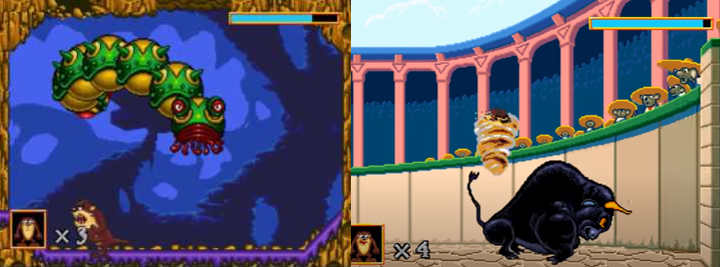
On Planet X, you’ll battle a gigantic worm-like creature than bursts out from the walls of the arena but sports a big, flashing weak spot on its rear end. Spin into this and you’ll destroy each segment of the worm, making it faster and more aggressive as the fight goes on until only the head remains for the final blow. Things take a bit of a turn for the worst in Mexico, however, where you’ll battle the posturing Toro the Bull; Toro charges at you in a rage and will send you flying into the air with its horns before stopping and posing but don’t think that this is your window to attack! Instead, you have to stand in place while Toro charges his attack and then dash away from him and jump over him right at the last minute so that he runs head-first into the walls of the arena, which can be really difficult to do as he moves very quickly and tends to simply stop right before the wall.

Easily the most confusing and annoying boss comes at the end of the Haunted Castle, however. Here, you are charged at and punched by the big red furry monster Gossamer while a mad scientist blasts at you with laser bolts. Gossamer is completely invulnerable except for in the eyes; you must spin into its eyes a few times until it’s stunned and, hopefully, get it to collapse into one of the seats in the background. Once it’s sat down, dash over to the other seat and pull the lever and you’ll swap bodies with Gossamer, which will allow you to destroy the laser device and end this perplexing boss battle.
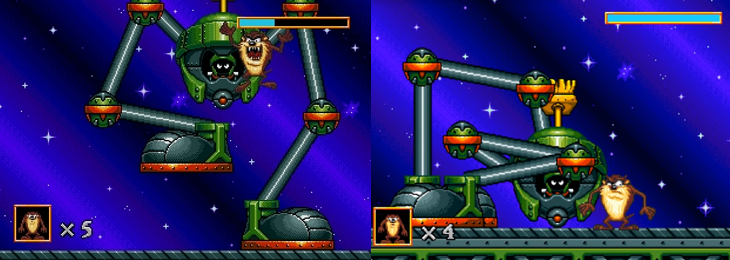
The finale sees you taking on Marvin the Martian in a giant mech made in his image. The mech stamps around the arena and tries to kick at you but it also likes to stop and dance about with one of its massive feet. This is one of the trickier bosses as you must quickly jump up the platforms on its feet and legs and then launch a spin attack at the yellow plume on the “head” of the mech in order to damage it. Do this enough times and Marvin’s mech will collapse in a heap and Taz will finally be able to return to his peaceful life back in Tasmania.
Power-Ups and Bonuses:
As in Taz-Mania, Taz will automatically eat any items he comes across and you can blast them away with his spin attack. This means that he will explode if he eats bombs but will regain health if he eats junk food or first-aid kits and earn an extra life by chomping down on Taz icons. This time around, there seems to be a lot less health and far more bombs so, while there are a lot more opportunities to go blasting ahead, be sure to be mindful of your surroundings or you might miss some health when you need it the most. Also, don’t eat the cakes as they contain sticks of dynamite!
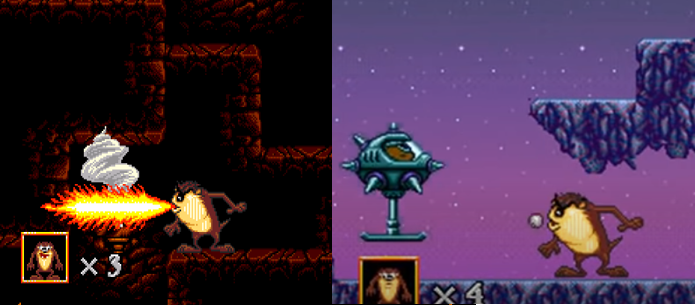
Taz can still breathe fire but, this time around, he has to gobble a can of gasoline rather than eating chili peppers. He can also eat boxes of rocks and spit a limited number of rocks at enemies as well, which is useful for taking out goofy aliens from afar and these projectile-based attacks are the only way of defeating some enemies, though there is no longer an invincibility star this time around.
Additional Features:
Unlike Taz-Mania, there are no difficulty options in Escape from Mars; what you see is what you get and you’ll just have to deal with it. However, like the last game, you can take advantage of a few cheats by holding A and B on controller one and B and C on controller two when on the SEGA logo screen. If you did it right, you’ll hear a bark and, when you pause the game and press A, a debug menu will appear that allows you to refill your health, skip to any level in the game, and activate “XY” mode that lets you move Taz around the level freely.
The Summary:
Taz in Escape from Mars is an improvement on its predecessor in almost every way; the core mechanics remain the same but expands upon them in just enough ways to make it a far more enjoyable experience. It’s funny because I distinctly remember this game being incredibly difficult back in the day but it was actually a lot more accessible than Taz-Mania, affording Taz a few new abilities and a greater range of movement and dramatically improving upon the level and enemy variety. Best of all, the game features no cheap deaths, bottomless pits, or instant death traps but it is populated by far more enemies and hazards. Sadly, a lot of the issues of the last game are still present and even made worse; sure, Taz is faster and more capable but he’s still a big, lumbering goof and levels might be more vibrant and interesting but they can still be frustrating and the music is still a let-down. Ultimately, Escape from Mars is a decent enough cartoony platformer to waste an hour or so on but it’s still a step behind other 16-bit games of the same genre and ends up being, in my opinion, about as enjoyable as its predecessor even with all the much-appreciated improvements.
My Rating:
Pretty Good
Were you a fan of Taz in Escape from Mars? How do you think it compared to Taz-Mania and other 16-bit platformers? Were you a fan of Taz’s expanded moveset and the wackier levels and enemies of the game or were you disappointed to see the concept veer away from the Taz-Mania cartoon? Which Looney Tunes character and which of the old Looney Tunes videogames is your favourite? No matter what you think, leave a comment down below and let me know.








 Dr. K's Waiting Room
You must be logged in to post a comment.