Mini Game Corner [Sci-Fanuary]: Strider (Mega Drive)


January celebrates two notable dates in science-fiction history: “National Science Fiction Day” on January 2 to coincide with the birth of world renowned sci-fi writer Isaac Asimov, and 12 January being when Arthur C. Clarke’s HAL 9000 was created. Accordingly, I dedicate January to celebrating sci-fi in all its forms.


Released: 29 September 1990
Developer: Capcom
MobyGames Score: 7.6

Also Available For: Arcade, Amiga, Amstrad CPC, Atari ST, Commodore 64, Master System, MS-DOS, Nintendo Entertainment System (NES), Nintendo Switch, Nintendo Wii (Virtual Console), PC, PC Engine.TurboGrafx-16, PlayStation, SEGA Mega Drive Mini, ZX Spectrum

Quick Facts:
Back when arcade machines were at their peak, Capcom were one of the premier names thanks, in no small part, to Street Fighter II: The World Warrior (1991). With Capcom’s popular and varied efforts cementing their legacy, they teamed with manga studio Moto Kikaku on the arcade Strider, its solid (if forgotten) NES port, and a manga adaptation. Director Kouichi “Isuke” Yotsui capitalised on the ninja fad of the era with Strider Hiryu, best known for his acrobatics and climbing abilities. This Mega Drive port was praised for sticking closely to its arcade roots, though Strider was largely relegated to cameo appearances even after a warmly received 2014 reboot.

The Review:
Essentially a remake and reimagining of the original arcade game, its ports, and its sequels, Strider is a 2D arcade-style hack-and-slash title. Players guide top assassin Strider Hiryu through five stages (set in the far-flung future of 2048) to assassinate Grandmaster Meio, who has established a dictatorial rule with his robots and cyborgs. Though he lacks any idle poses or victory animations, Strider is a visually impressive character, sporting a purple/blue/silver attire, a shock of red hair, and somersaulting about with his floaty jumps. Gameplay options are a simple as you could want, with Strider performing his aforementioned jump with either A or C and slashing enemies with his sword with B. You can crouch and attack, attack in mid-air, and press A and C or C and B together to performing a leaping attack. Strider clings to walls and ceilings with a pair of hooks to clamber up surfaces and shimmy over enemies. Pressing down and either A or C sees Strider slide under hazards, projectiles, and some enemies (though I always took damage if I hit an enemy) and you can extend the reach and power of your sword attacks with certain pick-ups. Others grant you an extra life or make you temporarily invincible (both of which you’ll desperately need!), restore some or all of your health or extend your health bar, or award points. You earn extra lives with a high score and you’ll get some temporary help from robot allies if you’re lucky. The Dipodal Saucer may weaken your energy bar, but it attacks with electrical blasts when you slash your sword to attack other enemies, the Terapodal Robo-panther fights alongside you on the ground, and the Hawk Robot circles above striking nearby enemies. You often grab these items by destroying robot drones and they nearly always land in precarious positions, meaning you’re likely to injure yourself grabbing them!
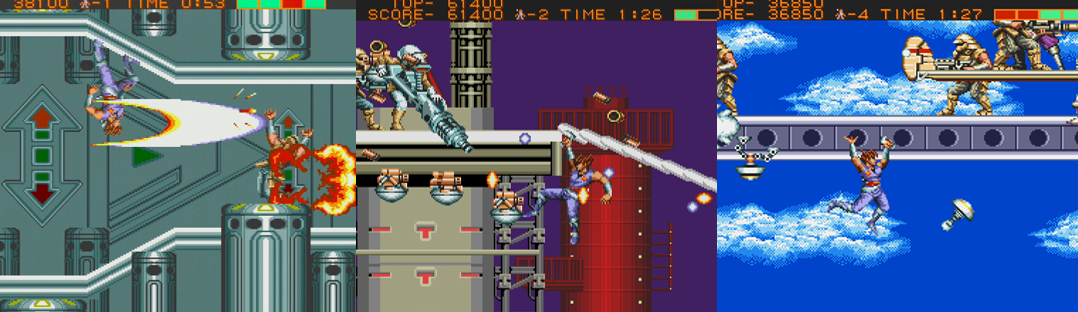
Run, jump, slash, and climb through and past enemies and obstacles alike.

Strider offers three difficulty settings and allows players to set the number of lives they start with. Each stage contains a few different areas to battle through, with the game being surprisingly generous with its checkpoints, and betrays its arcade roots by pitting you against a timer. This refills when you defeat mini bosses, but it can be quite tight to reach each checkpoint with the many hazards and projectiles in each screen. Strider may be nimble but he’s a very big, often slow target and it’s extremely easy to be hit in mid-jump or when sliding under projectiles. It doesn’t help that the enemies flood the screen, constantly respawning and swarming you, or that this slows the action with sprite flickering, screen tearing, and stuttering as the game loads each area. While fun to control on the ground and often tasked with outrunning explosions and other hazards, leaping across chasms or hopping to moving platforms, Strider is very finnicky when affixed to walls and ceilings. His controls go a bit wonky, he hangs there as an obvious target, and it’s very easy to simply slip or be knocked down one of the game’s many bottomless pits. Some stages feature a gravity gimmick, forcing you to battle on the ceiling and turning the sky into a hazard. Others have you hopping to flying platforms and hanging beneath them to avoid bombs dropped by the Ballrog battleship. Drill-like spikes, piranha-infested waters, unreliable springy platforms, explosive munitions, spiked walls, and hidden boosters that send you flying into the abyss are commonplace, so you must constantly be vigilant. While each stage is quite large and varied, they’re also paradoxically short and there are no bonus games to mix up the action, such as a sidescrolling shooter where you get to control Strider’s awesome, high-tech glider. Instead, you must settle for some bonus points at the end of the stage.
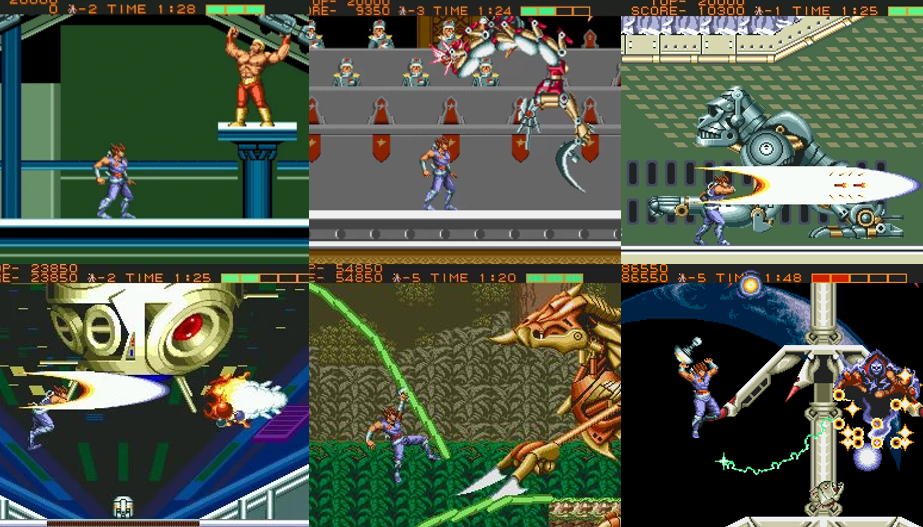
If there’s one thing Strider has going for it, it’s some bizarre and challenging bosses.

Although Strider often struggles with all the action and many enemies sport basic attack animations, the game throws loads of enemies in your path and they’re all annoying! From swarms of seemingly never-ending drones to cybernetic soldiers carrying pulse rifles, to spider-like robots and chicken-like mech walkers, the game’s enemies are relentless, constantly respawning and filling the screen with projectiles. You’ll also encounter many mini bosses and peculiar large mechanical guardians, with many littering the screen with flames or projectiles upon defeat. Stage 1 pits you against a theatrical wrestler who blocks your sword and judo tosses you overhead, a security robot traps you in an enclosed space and fires lasers that ricochet off every surface. A gaggle of onlookers turns out to be a large, sickle-wielding robot centipede whose back you must jump and cling to to pummel its head! Stage 2 has you battle a giant (but limited) mechanical ape (who bursts into hazardous flames upon defeat), desperately landing hits as he fires homing missiles, darts offscreen, and take out three kung-fu ladies to gain control of the Ballrog. While on the battleship, you’re sent flying around an antigravity chamber attacking the floating central control sphere, which is protected by smaller spheres and often sees you take damage without even realising it. A titanic mechanical dinosaur awaits in the jungle, which taxes the Mega Drive hardware and sees you using the high ground to attack its head and avoid its spiral flame shot and extendable claws. Most bosses return for a gauntlet in the final stage, with you battle the floating sphere, security robot, the mechanical ape (alongside constantly respawning but largely harmless Tyrannosaurs rexes), and the robot dinosaur (this time forced to time your jumps since there’s no platform). After besting the flying gunner again and being carried across a void by the robot centipede (and then destroying it again), you finally confront the grandmaster. This cloaked nuisance floats around an antenna, with a bottomless pit below and various projectiles to dodge. Luckily, you can grab some health here and there’s a chance you can stun-lock the grandmaster to make short work of him, but it’s pretty challenging since Strider’s such a huge target.
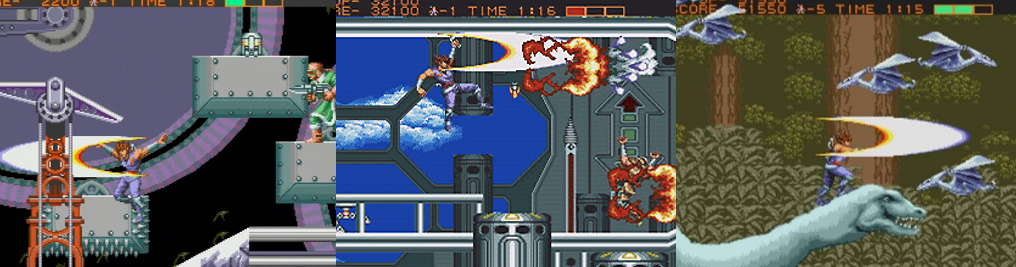
While visually impressive, Strider is handicapped by staying too close to its arcade origins.

While Strider initially impresses, with Strider slicing apart the title screen background, there is no pre-game story cutscene or context to be found. Interludes pop up between stages, featuring the bad guys mocking you and praising Grandmaster Meio, but the game’s surprisingly light on story considering how rich its visuals are. Indeed, while the music didn’t exactly wow me and many backgrounds were disappointingly sparse, resembling the plain voids often seen in Master System titles, there’s a fair bit happening in every stage. You start off in the vaguely-Russian city of Kazufa, battling past the twinkling city lights, searchlights, and towering, Byzantine-esque buildings which hide futuristic weapons factories. There are always platforms to hop to, cling to, or pull yourself up m, with many being slanted and sporting hordes of mechanical enemies. Turrets line the walls and ceilings, drones hover from above, and giant gears turn platforms as you progress. Stage 2 places you in the frigid Siberian mountains, where wolves and an avalanche force you into a robot factory, where large dynamos flash intermittently to turn everything black and fill the screen with lightning bolts. Upon scaling the mountain, Strider finds himself on the heavily armed, steampunk-esque Ballrog battleship, whose outer hull is defending but turrets and a massive, tank-like cannon that sends you flying it you don’t quickly destroy it. Strider must smash his way inside, running and then frantically wall jumping to avoid being crushed, before making his way to the control cockpit. Stage 4 takes a bizarre detour into the Amazon jungle, where Tarzan-like natives toss boomerang-like projectiles, swarm from bendy branches, and friggin’ dinosaurs stomp past! You can hop on the backs of Brachiosaurus to fend off flocks of Pterodactyls and avoid being torn apart in the dangerous waters below. As if that fever dream wasn’t surreal enough, the game ends with you storming the grandmaster’s main base on “The Third Moon”, a space station teeming with deadly hazards, defences, and sending you reeling with its gravity gimmick. You’ll hop to giant satellite dishes, desperately cling to slanted platforms, be jostled about in another antigravity chamber, and end up clambering up an antenna to face the big bad himself. The game’s ending is barely worth it, with Strider looking upon the destruction he’s caused and flying off victorious past an enemy roll call as the credits play, with the game offering no high score table for your efforts.

Final Thoughts:
I was really excited to get my hands on Strider, a very affordable and often visually impressive early title for the Mega Drive, primarily because of how cool the title character looks somersaulting about and slashing foes with his giant sword. Unfortunately, the game sticks a little too close to its arcade roots, throwing a timer, hordes of nigh-endless enemies, and a slew of unfair pitfalls and hazards at you. With limited lives and no continues, you’re probably better off taking advantage of some of the push button codes or even modern ports of the game, which include rewinds and save states. Still, I was impressed by Strider in a lot of ways. Strider looks great, the foregrounds, especially, are incredibly detailed and varied, and I enjoyed the cyberpunk aesthetic that permeates every area (except for that random jaunt into a prehistoric jungle…I don’t know what that was about!) Unfortunately, the game might be a little too ambitious as the Mega Drive struggles to render everything at an acceptable speed and consistency, slowing the action and assaulting you with flickering and stuttering. I loved the giant and creative mini bosses, but they were painfully limited and artificially made more challenging by restricting you to tight corridors where Strider’s hit box works against him. power-ups were few and far between and it’s way too easy to take damage when slicing through enemies, severely limiting the action. This means you can neither blast through the game at high speed or afford to take your time, as the clock and the enemies are always against you. I enjoyed the stage variety, though, and gimmicks like the exploding floors and walls, but many of the backgrounds were far too basic for a 16-bit behemoth like the Mega Drive. Honestly, you’re probably better off emulating the arcade version as at least then I assume you can keep pumping in coins to push through tougher sections, but this home console port is a little too unforgiving to be as enjoyable as it could be.

My Rating:

Rating: 3 out of 5.

Pretty Good

Did you ever play the Mega Drive version of Strider? Were you impressed by how close it was to the arcade version? What did you think to Strider’s appearance and sword attack? Which of the game’s bosses did you find the most ludicrous? Did you manage to clear the game legitimately? What are some of your favourite sci-fi-orientated videogames? Whatever your experiences with Strider, feel free to share them below, check out my other sci-fi and retrogaming content, and donate to my Ko-Fi to suggest other games for me to review.


Game Corner: Strider (2014; Xbox One)

GameCorner
Strider2K14Logo

Released: February 2014
Developer: Double Helix Games and Capcom Osaka Studio
Also Available For: PC, PlayStation 3, PlayStation 4, and Xbox 360

The Background:
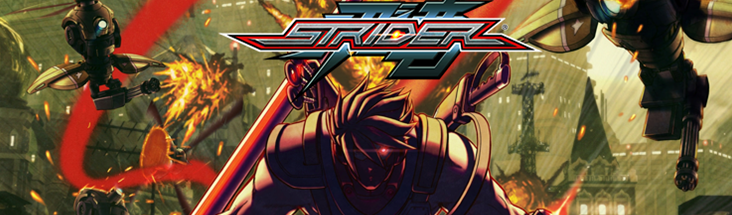
Capcom’s fast-paced, slash-‘em-up Strider (Capcom, 1989) first debuted as an arcade game; notable for its frenetic hack-and-slash action, the series saw numerous ports and sequels released to home consoles throughout the years, with main protagonist Strider Hiryu often cropping up in other Capcom titles. Thanks to Strider’s popularity, Capcom decided to produce a reboot of the series back in 2014. Rather than being a linear experience, this Strider expanded on the length of the game through “Metroidvania” elements such as backtracking and upgrades to Strider’s abilities. I’ve known about Strider Hiryu for a long time, primarily due to his inclusion in Marvel vs. Capcom 2: New Age of Heroes (Capcom/Backbone Entertainment, 2000), and this version of Strider caught my eye back in the day on the PlayStation 3 thanks to its futuristic, neon aesthetic and frenzied action but it’s only recently that I actually got around to playing the title.

The Plot:
Ostensibly a remake and reimagining of the original arcade game, its ports, and its sequels, top assassin Strider Hiryu is sent to Kazakh City to assassinate Grandmaster Meio, who has established a dictatorial rule over the city and its inhabitants with his robots and cyborg operatives.

Gameplay:
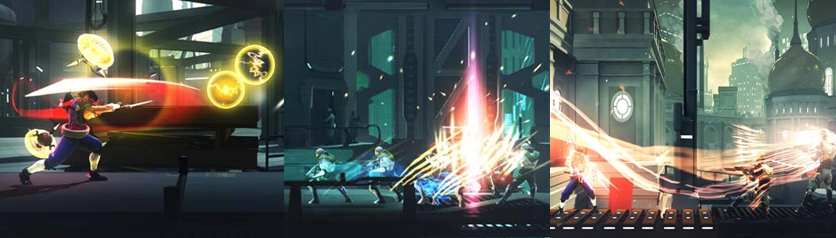
Strider is a 2.5D action/platformer with minor role-playing elements. Players control Strider Hiryu, a visually stunning character who dashes at high speeds through a dystopian city, leaping across rooftops, sliding through air ducts, and attacking Grandmaster Meio’s robotic minions with his plasma sword, Cypher. As Strider barges ahead at full speed, he can slash away at his foes with quick swipes of the Cypher; he can also charge an attack to break through enemy shields and, in time, gains the ability to throw kunai blades at his enemies and activate switches from a distance. Strider also uses these blades to clamber up walls and across ceilings and can acquire additional technology (known as “Options) to reach previously-inaccessible areas of the game. This means that, as you acquire new abilities and upgrade Strider’s arsenal, you’ll have to do a fair amount of backtracking not just to fulfil new objectives but also to find the game’s many hidden power-ups, unlockables, and upgrades to Strider’s health, energy, and weapons.

Strider2K14Combat
Strider slashes enemies apart with his plasma sword.

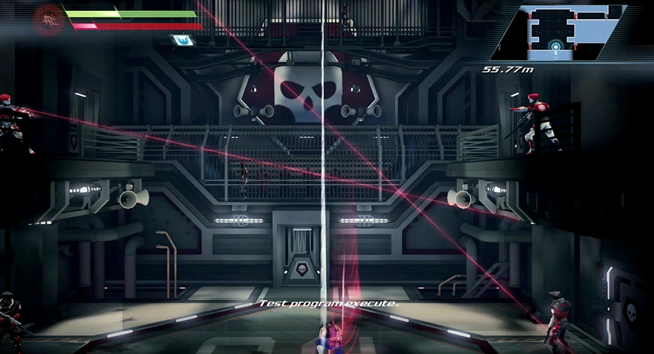
However, the amount of backtracking is actually quite limited if you just want to finish the game’s primary story mode; you’re mainly tasked with using Strider’s new abilities to take the long way round to your next objective, after which you’ll be able to take a shorter route back to the next objective. Wash, rinse, repeat. As Strider dispatches his enemies, he powers up the meter for his Cypher blade and the abilities offered by the “Option” power-ups. There are numerous checkpoints and save points scattered throughout the game’s large and inter-connected map, which is broken down into different areas and environments, but Strider can also replenish his health by breaking capsules that are generously scattered in each area.

Strider2K14Options
The “Options” allow Strider to perform more powerful attacks.

It pays to use the game’s simple-but-effective mini map to explore a bit, though, to find upgrades to Strider’s health bar as, while the common foot soldiers you encounter are dispatched easily enough, you’ll soon come up against more troublesome enemies, mechs, robots, bosses, and hazards that will drain your health to nothing in no time flat. By the time you storm Grandmaster Meio’s citadel, you’ll be required to make full use of all of Strider’s abilities to overcome the enemies and environments you come across. This often requires you to cycle through the different Cypher plasmas with a press of the directional pad in order to combat certain enemies and get past certain obstacles. While, at its core, the game is extremely fun, fast-paced hack-and-slash action, there’s quite a bit of platforming involved; luckily, you’ll soon upgrade to a double jump and a mid-air dash which makes these much easier but, while I found falling to my death a common occurrence (generally thanks to being blasted out of the air), there’s nothing too taxing or unfair here thanks to Strider’s superhuman flexibility and the range of options available to him.

Graphics and Sound:
Strider is a bit of an oxymoron; it’s a visually stunning and appealing videogame thanks to its largely anime-inspired, Blade Runner (Scott, 1982) aesthetic; the game’s dystopian city is rugged, lived in, and interspersed with neon lights and dynamic lightning choices that often bathe environments in darkness broken only by flashing lights. Yet, at the same time, the majority of the areas you visit are largely uninspired; the majority of the game is spent exploring and traversing Kazakh City, which means a lot of rooftops and street-level action which, while impressive, gets old pretty quickly. The game moves at a fast pace, though, so you’ll soon be making your way through seemingly endless, nearly identical high-tech corridors and buildings, then fighting through the semi-steampunk sewers and industrial areas of the city, before the game finally breaks up the monotony of its environments with an all-too-brief section that takes place in the skies above the city.

Strider2K14Variety
While Strider looks great, most of his enemies are quite bland.

Similarly, while Strider looks absolutely fantastic and moves and animates like greased lightning, most of the enemies he encounters are a massively uninspiring lot. Once the bigger mechs and robots start becoming more commonplace, things get a bit more interesting but fighting these enemies can be a chore as you’ll have to cycle through all of Strider’s different abilities and weapons to take them down. I was likewise unimpressed with the game’s soundtrack; Strider mostly uses ambiant sound and subdued melodies when you’re playing the game and these are often drowned out by the sound effects of Strider’s attacks, so I can’t say the soundtrack really left much of an impression on me. The game features a few cutscenes to relate its story and, while they’re not especially impressive in the way they’re animated, the voice acting is fantastically over the top and cheesy, which really works with the game’s tech-noir aesthetic.

Enemies and Bosses:
Strider will cut his way through a whole slew of Grandmaster Meio’s cyborg minions in his quest to liberate Kazakh City. Most of these will be dispatched in just a few swings of Strider’s Cypher blade but, eventually, even these will become more troublesome as you progress further through the city. All too soon, enemies start holding up shields to block your attacks, take pot shots at you with sniper rifles, and bust out the heavier machinery (such as explosive bolts that stick to you and energy staffs). Some of the more annoying enemies include ones that incessantly teleport across the area and ones that can freeze Strider in energy-draining blocks of ice. Strider will also dismantle a wide variety of robots and mechs as he explores Kazakh City; some simply float about and shoot at you, others are turrets attached to walls and ceilings, but the more troublesome robots are the larger variants that cause massive damage to Strider and take a lot of his skills to put down.

Strider2K14Gorilla
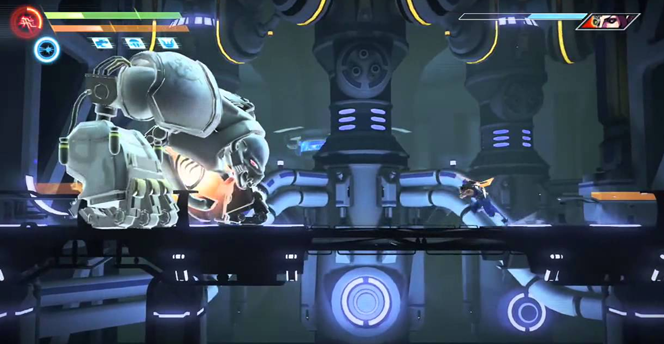
Yeah, a mechanical gorilla. Perfectly normal.

You’ll also come up against a decent variety of bosses in this game; you’ll battle Ouroboros, a large mechanical dragon, a couple of times (the first sees Strider running across the machine’s back amidst high winds, electrical blasts, and a slew of enemies, while the second sees Strider confined to some city ruins and contending with the Ouroboros’ ice attacks), Mecha Pon (a gigantic mechanical gorilla) in one of the game’s penultimate battles, and take part in series of faster-paced battles against the Wind Sisters. Just as you’ll be tested against gauntlets of enemies later in the game, so to will you eventually have to engage all of the Wind Sisters at once but, by that point, your abilities should be more than up to the challenge.

Strider2K14FinalBoss
The final boss is an eldritch nightmare…and in space…

At the end of the game, Strider faces off with Grandmaster Meio in a two-stage final boss battle. The first is a relatively run of the mill affair against the Grandmaster as he teleports around the arena firing energy bolts and lighting at you but, once he is defeated, you’ll be transported into the upper atmosphere to battler Meio’s true final form, Meio Prime, a gigantic Biblical monstrosity that would make Sephiroth blush in its pretentiousness. Yet, for all its bluster, Meio Prime is easily dispatched provided you can avoid its flailing tentacles and dodge its electrical bolts, which are easily its more annoying and hard-hitting attacks.

Power-Ups and Bonuses:
As mentioned, Strider can upgrade his Cypher Blade after defeating certain bosses. He begins the game with the standard red plasma, which allows him to hack-and-slash his enemies, but this is eventually upgraded to deal a downward blow, reflect blaster bolts, set enemies on fire, encase them in ice, or toss out homing blades, each time giving the plasma a new hue (blue, yellow, and purple). Strider can also charged his kunai with these different plasma types of the Cypher blade to also set enemies ablaze or freeze them on the spot. The “Options” Strider gains not only allow him to reach new areas of the game but also allow him to perform more powerful techniques in battle; performing these drains Strider’s power meter but, as this automatically replenishes with time and when you defeat enemies, it’s not often you have to worry about running out of energy (and this bar can be increased when you find hidden upgrades). The most useful of these techniques is easily Option C, which sees a robotic hawk deal massive damage to enemies and was super useful for whittling down the health bar of troublesome bosses. As you explore your environment, you’ll find further upgrade pods to increase Strider’s health and energy bars, throw more kunai, unlock additional costumes for Strider, and unlock concept art and levels for the game’s “Challenge” mode. These aren’t too difficult to stumble across but the game’s map will let you know if there are any in the immediate vicinity; the one downside, however, is that if you fail to find them all before you enter Meio’s citadel, you will have to start a new save file from the beginning to find them as you’re unable to replay a completed save file.

Additional Features:
Strider has three difficulty levels to choose from and, if you want to unlock all of the game’s Achievements, you’ll have to take on and best the game’s highest difficulty. Speaking of Achievements, there are a handful of relatively easy ones to unlock here; mostly, these are unmissable but there are a few that require a bit more effort from you (such as defeating twenty consecutive enemies without being hit, or twenty enemies with Strider’s Panther ability). In addition, the game features two “Challenge” modes: “Beacon Run”, which sees Strider racing to checkpoints as quickly as possible, and “Survival”, in which Strider must survive against wave-upon-wave of enemies. As you pick up secret items in the game, you’ll unlock these modes and additional maps for each mode and, upon successful completion, you can upload your score and time to the online leaderboards.

Strider2K14Conclusion

The Summary:
Strider is simple, fast-paced fun; Strider controls like a dream and the game’s hack-and-slash combat is smooth as silk. The environments and common enemies may be bland but the game is still, visually, very appealing; Strider’s world feels very lived in and layered rather than just being a typical, desolate dystopian future and, while he’s not especially layered in terms of his personality, at least Strider looks and plays very well. Unfortunately, there’s not a lot here to come back to; the game feels long when you’re playing it, mainly due to the fact that you’re largely navigating a bustling, multi-layered city, but it’s hard to get a sense of progression when a lot of the areas look the same. Even with some of Strider’s later time-saving abilities, it definitely feels as though the developers chose to artificially extend the game’s playtime by having you run from one area to the next and always take the longest route to your next objective. Additionally, while some boss battles are grandiose, others are not; some are frustratingly annoying, while others are over in an instant. The lack of consistency drags the game down a bit and not being able to replay a completed save to find everything you missed was a real annoyance for me but, despite some of its flaws, it was a fun, entertaining sprint to play through and I could see myself revisiting Strider in the near future to find everything I missed the first time through.

My Rating:

Rating: 3 out of 5.

Pretty Good

Did you ever play this version of Strider? What did you think of the game’s unique aesthetic and attempt to reboot the Strider franchise? What is your favourite Strider videogame, or appearance of Strider Hiryu? Whatever you think about Strider, feel free to drop a comment below.