Movie Night [May the Sith]: Star Wars: Episode VI: Return of the Jedi (2019)


While May 4th is known the world over as Star Wars Day, many also choose to extend the celebrations of the course of three days, with one of them being the “Evil Star Wars Day” of May 6th (as in “Sith”). This year, I’ve been using the three Star Wars Days as the perfect excuse to go back over the Original Trilogy.

Released: 22 September 2019
Originally Released: 25 May 1983
Director: Richard Marquand
Distributor: Walt Disney Studios Home Entertainment
Original Distributor: 20th Century Fox
Budget: $32.5 million
Stars: Mark Hamill, Harrison Ford, Carrie Fisher, Anthony Daniels, Kenny Baker, Peter Mayhew, David Prowse/James Earl Jones, Billy Dee Williams, and Ian McDiarmid

The Plot:
After rescuing Han Solo (Ford) from the clutches of Jabba the Hutt (Scott Schumann), Jedi Knight Luke Skywalker (Hamill) prepares himself for a showdown with his father, Darth Vader (Prowse/Jones) while Princess Leia Organa (Fisher) and the Rebel Alliance prepare for one final, all-or-nothing assault on the partially-constructed Death Star II in the hopes of ridding the galaxy of the Emperor (McDiarmid) once and for all.

The Background:
By 1983, George Lucas’s science-fiction “space opera” had developed into an extremely successful series of films and multimedia merchandise; yet, though the wave of books, action figures, and videogames that were released back then was prominent, it merely only hinted at the nigh-unstoppable reach of the franchise. After Star Wars: Episode V: The Empire Strikes Back (Kershner, 1980) proved an incredible, if divisive, box office success, Lucas began financing a third film and looking at potential directors (including Steven Spielberg). Eventually, he settled on Richard Marquand but was frequently on set offering advice and assistance. Originally produced under the title Revenge of the Jedi, Lucas eventually altered the title and would clash somewhat with star Harrison Ford over the fate of Han Solo: Ford wanted Solo to die but Lucas was vehemently against it and, eventually, talked the former carpenter around. Although Return of the Jedi didn’t make quite as much at the box office as its predecessor, it was still an incredible financial success, making over $475 million at the box office and finishing first at the box office for six of its first seven weeks of release. The film’s critical reception appears to have been the opposite of Empire’s, with critics of the time largely praising the film and modern audiences generally regarding the film as the weakest of the Original Trilogy for its more child-friendly inclusions and derivative elements. As with the other films in the Original Trilogy, Lucas later revisited and augmented the film using modern technologies which has resulted in one of the most derided inclusions of all the alterations Lucas has made to his influential trilogy.

The Review:
I touched upon this in my review of Empire but when I was a kid, I knew about Star Wars and I liked what I saw but I hadn’t really ever had the opportunity to watch any of the films from start to finish; they never seemed to be on television (we only had the basic four channels back then) and the VHS tapes were quite hard to come by until the 1997 Special Editions were released. As a result, while I can recall snapshots and snippets of each film, the first one I remember sitting down and watching from start to finish (or, at least, enjoying all the way through) was Return of the Jedi and, for a long time, it was my favourite of the Original Trilogy until I came to find a deeper appreciation for The Empire Strikes Back’s bleak brilliance. Still, there is a lot to like about Return of the Jedi; the effects, for one thing, are at their peak in the Original Trilogy and it represents the culmination of each character’s journey and arc since we were first introduced to them.

Leia puts her love for Han ahead of her commitment to the Rebellion and fights by his side.

Unfortunately, a lot of it is a bit redundant as we’ve already seen a fully operational Death Star before so returning to that well was a bit derivative and it lacks both the gritty, “lived-in” feel of Star Wars: Episode IV: A New Hope (Lucas, 1977) and the large scale impact of Empire but what we’re left with is still a pretty decent rollicking space adventure when you focus on Luke’s journey and the desperate battle against the partially-constructed Death Star II. When Jedi begins, the Rebel Alliance are in a bit of disarray; though the threat of a new Death Star lingers ominously in the background, Princess Leia risks everything to deviate from concocting an assault on the space station to infiltrate the sordid palace of the disgusting and nefarious slug-like crime lord Jabba the Hutt in order to rescue her beloved Han. I mentioned when reviewing Empire how, in the previous film, Leia’s militaristic and pragmatic façade was slowly and methodically stripped away as her more human, vulnerable, and emotional side came to the forefront through her burgeoning feelings for Han and nowhere is that best expressed than in her putting aside her commitment to the Rebel Alliance to rescue Han. Once he is safely back amidst the Rebel Alliance, she then steps away from her more diplomatic role as a co-ordinator and commander to join Han in the mission to knock out the Death Star II’s shield generator, now fully embracing both her proactive, action-orientated abilities and her softer, more empathetic side.

Luke’s powers and confidence have grown significantly but he’s far from a flawless character.

Leia’s infiltration is just a mere part of the grand plan to rescue Solo, however, and it’s all been devised by Luke Skywalker. Now a far cry from the wide-eyed, naïve farmboy of A New Hope, Luke is garbed head to toe in black and Jedi robes, confidant in his ability to use the Force and sure that he has the power and ability to rescue Solo with a minimum of fuss. As impressive as Luke’s newfound abilities are, however, he’s not without flaws; he doesn’t bank on Jabba resisting his Jedi mind tricks or Han emerging from the slab of carbonite with temporary blindness. His concern for the well-being of his friend, particularly his treasured Leia, also causes him to receive a blaster shot to his cybernetic hand during the rescue though they are, nevertheless, successful. Somewhere between movies, Luke has grown considerably and, despite receiving only a crash course in Jedi training, is all-but a Jedi Knight when Jedi begins. However, upon returning to his wizened master Yoda (Oz), Luke learns that he must confront and defeat Darth Vader if he is ever to become a true Jedi. Luke is aghast at the suggestion, sure that he is unable to kill his father, and his doubts are further compounded when the spirit of his first mentor, Obi-Wan Kenobi (Alec Guinness), reveals that Leia is actually his twin sister. Rather than dwell on the romantic and sexual feelings and moments they shared in the previous films, Luke resolves to instead attempt to turn his father from the Dark Side and redeem him rather than kill him and is so convinced that Vader is in conflict between his good and bad feelings that he’s even willing to die in this attempt.
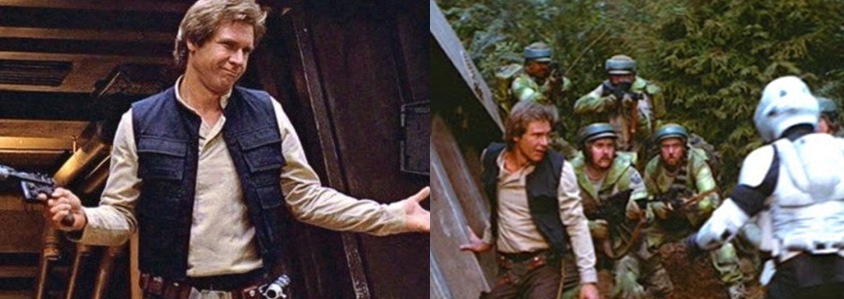
Though still a loveable rogue, Han has matured into a full-blown team leader.

After being freed from the carbonite and recovering from his vision loss, Han fully commits to the Rebel Alliance and their desperate crusade against the Death Star II; to show just how far his character has grown over the years, rather than simply laughing off or walking away from the Rebel cause, he voluntarily agrees to lead the ground assault against the shield generator and takes up a commanding position with ease and grace. He’s still the most charismatic of the characters and actors, however, and maintains that gruff, rugged edge that made him so likeable but he’s also clearly developed as a character, showing layers of vulnerability and leadership, respectively, where he previously only showed selfishness. Han reluctantly hands the keys to the Millennium Falcon over to his former smuggling buddy Lando Calrissian (Williams); it’s not addressed onscreen why Han immediately trusts Lando considering he was betraying him to Vader and the bungling bounty hunter Boba Fett (Jeremy Bulloch) in the previous film but, regardless, Lando is now an accepted and integral part of the Rebellion and trusted enough with leading the head-on assault against the second Death Star. Still emitting a cool, smooth charm, Lando fulfils the role of a principal figure in the Rebellion as easily as Han, as though he was merely hiding from his greater destiny all this time. Once again, our heroes are supported by the droids C-3PO (Daniels), R2-D2 (Baker), and the Wookie, Chewbacca (Mayhew); this time around, Threepio gets a bit more of the spotlight as he is revered as a God by the tribal-like teddy bears known as Ewoks and shines in his comedic contributions and an abridged, adorable retelling of the saga so far. Artoo, meanwhile, doesn’t really get a whole lot to do beyond being Luke’s unquestioning confidant and getting the Rebels into the shield generator stronghold and, similarly, Chewbacca is taken away from the space action to join Han’s ground party where he humourously bonds with the Ewoks and commandeers an All-Terrain Scout Transport (AT-ST) walker during the big forest battle.
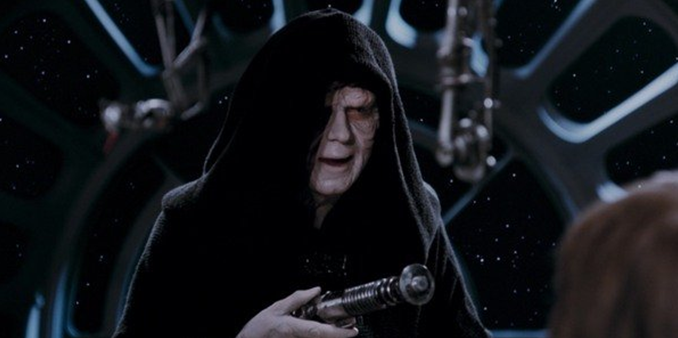
Either Luke kills the Emperor or he kills Vader; either way, the Emperor wins.

Although the Emperor was retroactively inserted into Empire, he was first introduced in the flesh here in Jedi. After the Force and their kind were openly mocked and treated with scorn in A New Hope, its humbling and affecting to see that the Imperials fear the Emperor almost as much, if not more so, than Vader himself. A cackling, manipulative, wizened crone in a dark robe, the Emperor’s words are full of confidence and poison and he is so convinced of his victory that he willingly leaks information about the Death Star II to the Rebels in order to lure them into a trap. Seated in his enigmatic throne aboard the second Death Star, the Emperor taunts and cajoles Luke in order to fuel his anger and affect his turn towards the Dark Side; everything the Emperor says is designed to push Luke further and further and he even leaves himself completely defenceless, seemingly ready to die so that Luke can turn to the Dark Side and succeed him. His true motivation, of course, can be read through subtext; the Emperor wants Luke to battle, kill, and ultimately replace Vader as his apprentice and he (the Emperor) doesn’t really try to hide this motivation. As for Darth Vader, he is at his most conflicted in Jedi; in A New Hope, he was a mere puppet, almost bored with the mundane routine of his life, but he was a driven, focused force of nature in Empire. In Jedi, we see just how committed and devoted to his Emperor Vader is; he willingly bows in the Emperor’s presence, speaks for him to the Imperial subordinates, and seems in awe (or fear) of the Emperor’s power and ability in the Dark Side of the Force. In Empire, Vader offered Luke the chance to join him so that they could overthrow the Emperor and you can tell, even with the featureless helmet and after shunning Luke’s assertions of his inner conflict, that Vader truly desires to unite with his son to displace the Emperor’s authority.

The Nitty-Gritty:
Return of the Jedi really ups the ante when it comes to practical and special effects; it’s truly a shame to see what a mess Lucas made of the Prequel Trilogy by relying so heavily on computer-generated characters and effects when the standards for the suits and puppets and stop motion work were so high in Jedi. Jabba makes an immediate impression thanks to being a huge, tangible puppet; slimy and disgusting, he’s little more than a lackadaisical slug but is so expressive and lifelike that you really buy into his presence and menace.
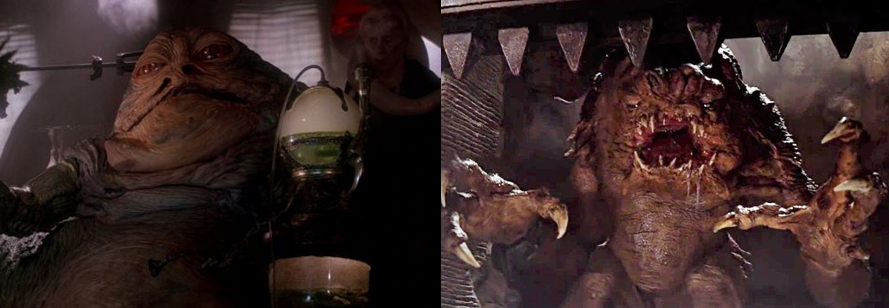
Return of the Jedi‘s puppets and practical effects were the best in the series at that point.

Similarly, the effects on the Rancor are still commendably impressive; a large, bipedal, nightmarish monster, we’ve never seen a character engage with a monster like the Rancor in the Star Wars films before and it’s very impressive the way the filmmakers pulled it off. Similarly, the integration of the Imperial Walkers into the more complex environment of the forest moon of Endor is equally impressive, marred only by the poor effects seen in the speeder bike chase. Return of the Jedi also features the best space battle of the saga so far as the entire Rebel fleet converges on the second Death Star and the second biggest twist of the series is revealed when the Death Star starts blowing up their frigates with its super laser. What follows is an intense, suicidal mission as the outnumbered and outgunned Rebels desperately engage with countless TIE Fighters and numerous gigantic Star Destroyers until Han’s group manages to bring down the shield and allow Lando to lead the assault into the space station’s superstructure. It’s a big, visually impressive space battle and leagues beyond the more gritty skirmish we saw in A New Hope; because of the sheer amount of ships and destruction happening onscreen at any one time, you really get a sense of the urgency and overwhelming odds that the Rebels are up against and that ths is their last chance at defeating the Empire for good.
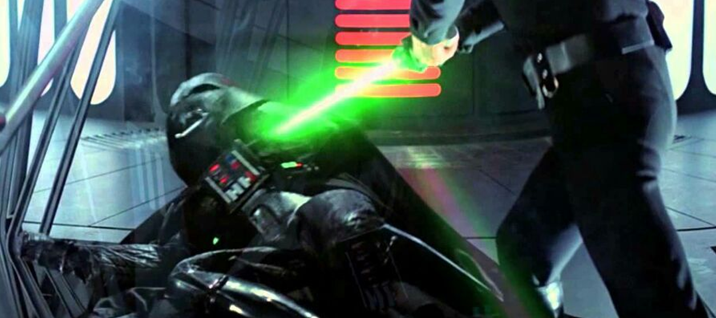
Vader is overwhelmed and overpowered when Luke explodes into a relentless rage.

Ultimately, though, Vader willingly engages his son in the most brutal and emotionally charged lightsaber battle of the saga so far; like the Emperor, Vader taunts Luke, threatening his friends and sister to goad him into giving in to his hatred and anger. This works a little too well, however, as Luke flies into a rage and relentlessly pummels Vader, severing his cybernetic arm and rendering him beaten and helpless. Now held at the mercy of Luke’s lightsaber in a thematic reversal of the conclusion to their last battle, Vader wheezes helplessly on the floor, even holding a hand up as if to ward off Luke’s wrath and it is only when Luke compares his own cybernetic hand to Vader’s prosthetics that he realises how alike they truly are and he dramatically casts aside his lightsaber and refuses to kill his father. Insulted and angered, the Emperor unleashes his full power on Luke and reveals a peak at the true destructive potential of the Force; prior to Jedi, the Force was an abstract concept with a multitude of uses but never truly tangibly seen onscreen but the Emperor’s devastating Force Lightning changes that and it’s extremely unsettling to see him cackling away and taking such pleasure in roasting Luke alive.

One act is apparently enough to atone for a lifetime of genocide…

Darth Vader is deeply perturbed by these events; literally turning his head to his suffering son and his all-powerful master, physically evoking the conflict deep within his dark heart. Ultimately, Vader chooses to turn on his master, hoisting the Emperor up and casting him down a vast chasm to his death and absorbing the full, lethal force of his master’s lightning at the same time. Many like to argue that this one act redeems Vader (and Jedi goes out of its way to show this as the case as Vader, now restored to the form of Anakin Skywalker (Hayden Christensen), appears alongside Obi-Wan and Yoda as a Force ghost at the film’s conclusion, now content and happy) but I actually take issue with this. It’s a poignant and moving seen seeing Vader’s scarred and vulnerable true face as he has one last heartfelt moment with his son but does one act, no matter how pivotal, truly make up for the years of torture and genocide that Vader personally revelled in? I would argue that it doesn’t and that it takes the focus off of Luke who, for me, is the true “Chosen One” of the saga and that Anakin’s destiny was to sire the Chosen One rather than be it himself.

The Summary:
Many people like to rag on Star Wars: Episode VI: Return of the Jedi and I can understand why: the plot is largely derivative, the inclusion of the cute and cuddly Ewoks was a bit jarring, and it seems like a much shorter, far less intense film of the most part. For me, personally, I have no real issue with the Ewoks as they help to expand the Star Wars universe and tell a decent story of primitive cultures triumphing over superior forces (acting as a pretty on the nose allegory for the Rebellion itself in many ways) and the film’s intensity ramps up considerably once the big space battle and the culmination of Luke’s journey begins. No, for me, Return of the Jedi’s flaws lie in the disappointing trend it set for further Star Wars films to focus more on call-backs and redundant elements than trying something new; not only does the Death Star return, the first portion of the film returns to the bleak, barren, boring landscape of Tatooine and, while it does something new with this environment, it’s disappointing to me how many subsequent Star Wars films re-used this desert landscape or returned to the idea of a planet-killing super weapon. Still, that aside, there’s a lot to like in Return of the Jedi, particularly if you focus on the assault against the Death Star II and Luke’s emotional confrontation with his father and it’s easily the second best film in the Original Trilogy for me.

My Rating:

Rating: 4 out of 5.

Great Stuff

Where do you rank Star Wars: Episode VI: Return of the Jedi against the Original Trilogy, and the other films in the Star Wars saga? What did you think to the inclusion of the Ewoks and bringing the Death Star back into the story? How about the Emperor; what did you think of him and of Darth Vader’s sacrifice in the film’s finale? Do you feel that one act redeemed Vader or do you agree that one act cannot be weighed against a lifetime of evil deeds? What did you think to the revelation that Leia is Luke’s sister? How are you celebrating May the Sith today? Whatever you think, drop a comment below and let me know and thanks for joining me in revisiting the Original Trilogy over the last three days.

Movie Night [Revenge of the 5th]: Star Wars: Episode V: The Empire Strikes Back (2019)


Although May 4th is known the world over as Star Wars Day, many also choose to celebrate the popular, generation-spanning science-fiction saga on May 5th as a play on the word “Sith”. This can extend Star Wars Day into three day celebration of the influential science-fiction series and, as a result, I am using each of these days to look back at the Original Trilogy!


Released: 22 September 2019
Originally Released: 17 May 1980
Director: Irvin Kershner
Distributor: Walt Disney Studios Home Entertainment
Original Distributor: 20th Century Fox
Budget: $33 million
Stars: Mark Hamill, Harrison Ford, Carrie Fisher, Anthony Daniels, Kenny Baker, Peter Mayhew, David Prowse/James Earl Jones, Billy Dee Williams, and Frank Oz

The Plot:
Three years after destroying the Death Star, Luke Skywalker (Hamill), Han Solo (Ford), and Princess Leia Organa (Fisher) and the Rebel Alliance have been constantly hounded by the Galactic Empire. Having been driven from their hidden base, the Rebellion is scattered, with Luke journeying to refine his Jedi sills and Han and Leia relentlessly pursued by Darth Vader (Prowse/Jones).

The Background:
George Lucas’s science-fiction “space opera” was a near-immediate hit upon release and, almost immediately, talks began of producing a sequel. Despite the filming of Star Wars: Episode IV: A New Hope (ibid, 1977) proving a harrowing experience, Lucas wasn’t finished with his story and soon relented to the demand for a follow-up but had to navigate the minefield of sci-fi films and media that Star Wars had subsequently inspired. Having financed much of the film himself in order to maintain creative control, creating his own film studio in the process, Lucas turned directing duties over to Irvin Kershner, and filming began on 5 March 1979. Filming ran into a few snags when star Mark Hamill was injured in a car accident and Harrison Ford first voiced his desire for his character, Han Solo, to be killed off, both of which necessitated a number of rewrites. Conversely, the film’s now-iconic twist was kept a closely-regarded secret, with only a handful of cast and crew being in on the dramatic revelation, ensuring that audiences were shocked at the reveal. For me, even now, The Empire Strikes Back is the best Star Wars film in the entire saga, with Rogue One: A Star Wars Story (Edwards, 2016) a close second. Fittingly, the film was massively profitable, making over $550 million at the box office but, interestingly, opinions on the film were divided when it first released, with many critics dismissing it outright. Since then, the film’s reputation was increased and it has, rightfully, been lauded as one of the greatest films ever made. Although Lucas would return to the film, restoring, augmenting, and remastering it, of the three films in the Original Trilogy it has received the least amount of alterations and changes, which, to me, says a lot about the standard to which The Empire Strikes Back was made.

The Review:
So I said in my review of A New Hope that, while I like Star Wars, I don’t really think that much of the first film Lucas released; it’s far simpler, narratively, and lot of its characters and concepts seem jarringly out of place with the rest of the saga. Today, I have another confession: I actually preferred A New Hope over The Empire Strikes Back as a child. If I’m being totally honest, Star Wars: Episode VI: Return of the Jedi (Marquand, 1983) was my favourite as a kid and was, as I recall, the first Star Wars movie I actually watched from start to finish (or, at least, the first one I remember enjoying). Over the years, however, my opinion has changed and I have come to regard Empire as the greatest Star Wars film of them all for its bleaker tone and the way it raised the stakes against our heroes.

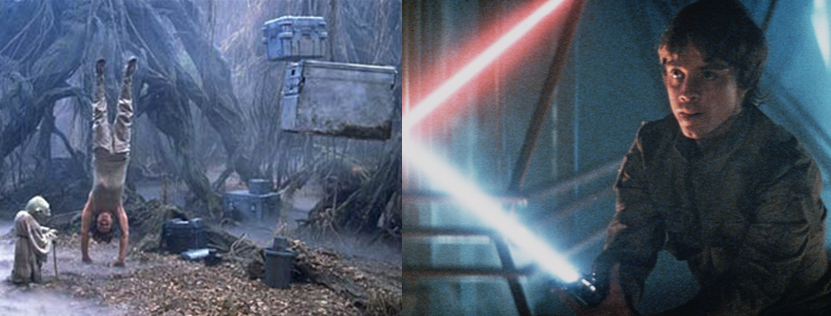
Luke undergoes gruelling training in anticipation for his revenge against Darth Vader.

Luke Skywalker is back, a little older and a little less naïve than in the last film; now a Commander in the Rebel Alliance, he has attained a degree of notoriety amongst his peers (and the Empire) for destroying the Death Star and is no longer the wide-eyed, inexperienced farmboy we knew. That’s not to say that he’s become this battle-hardened soldier, though; Luke remains this adventurous, optimistic character through whom we are introduced to the complexities of the Force. Guided by the spirit of his deceased mentor, Obi-Wan Kenobi (Alec Guinness), Luke splits off from the Rebellion to travel to Dagobah and seek out another Jedi Master to further refine his skills. On the desolate swamp planet, he encounters the wizened Yoda (Oz), a curious little hermit of a creature who speaks in riddles and vagaries regarding the true nature of the Force and what it means to be a Jedi. Luke’s training is physically and mentally gruelling as he is forced to learn harsh lessons about his distracted ways and the anger boiling inside of him. Still, he learns much from Yoda and in a comparatively short length of time, certainly enough to motivate him to interrupt his training to rush to the aid of his friends. This, it turns out, proves to be his harshest lesson so far but, again, Luke’s motivations are clouded by his desire to help the ones he loves and to get a measure of revenge against the man who killed his father and his mentor: Darth Vader.

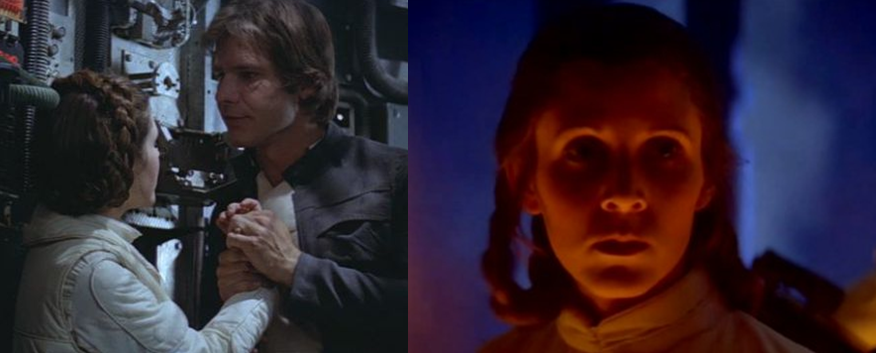
Through her growing feelings for Han, Leia’s pragmatic façade starts to slip.

Having undergone perhaps the most significant character arc in the last film, Han Solo’s arc in Empire is intertwined with that of Leia’s as both characters are now in denial of their true feelings towards one another. Luke throws a spanner into the works as he is still infatuated with Leia but, luckily (especially in retrospect…), the film doesn’t dwell on or descend into a bitter love triangle thanks, largely, to our main characters being separated for the majority of the film. Accordingly, though now a Captain in the Rebellion and actively aiding their cause, Han is anxious to leave to pay off his debts but finds himself fleeing the Rebel base on the ice planet Hoth with Leia in tow and forced into a dramatic cat-and-mouse game with the pursuing Empire thanks to damages to his ship, the Millennium Falcon. This will-they-won’t-they attraction between Han and Leia helps to flesh her character out a bit more, too; still a competent and devoted leader in the Rebellion, Leia’s outspoken nature and forthrightness is revealed to be a front for her true feelings. Having denied or suppressed her personal desires due to her complete focus on bringing down the Empire, her interactions with Han allow her façade to slip and show her as a more vulnerable and layered character. Ultimately, when faced with what could be Han’s death, she is unable to hold back her true feelings and expresses them with a passionate kiss and cry of “I love you” to which Han, ever the loveable rogue, simply replies: “I know”, indicating that they were both in love for a long time, perhaps forever, but unable to properly express it due to their nature and commitment to playing a certain role (the competent, unemotional leader and the daredevil smuggler, respectively).

While Artoo assists Luke, Chewie tries to repair Threepio and the Falcon…with mixed results.

Once again, our heroes are supported by the bickering droids C-3PO (Daniels) and R2-D2 (Baker) as well as the loveable Wookie, Chewbacca (Mayhew). Each play a pivotal role in supporting the main narrative and the arcs of the main characters: C-3PO is the awkward comic relief always ruining potentially romantic moments between Han and Leia and ultimately learns of a betrayal against his companions, R2-D2 is the blank slate Luke can convey his concerns and doubts to on Dagobah and later finally repairs the Millennium Falcon’s hyperdrive so the character’s can beat a hasty retreat, and Chewbacca is shown to be much more than a brutish, growling bodyguard as he desperately tries to repair the Falcon, puts his mechanical ability to better (and more comedic) use trying to repair the damaged Threepio, and explodes into anger and anguish when they are betrayed and Han meets a bitter fate.

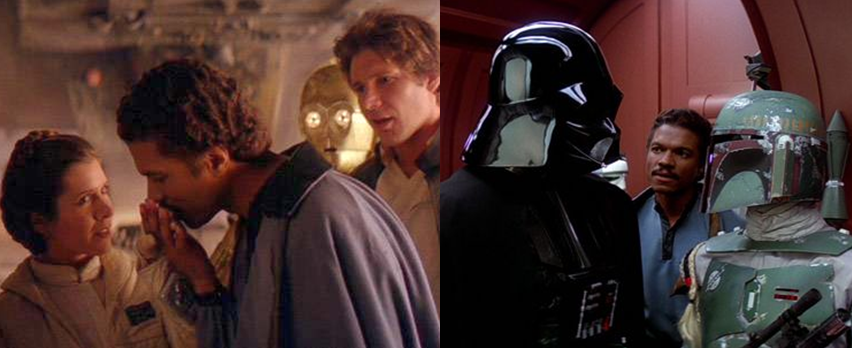
A smooth talking charmer, Lando is in cahoots with, and screwed over by, the Empire.

This latter plot point is due to the film’s other new addition, Lando Calrissian (Williams), a smooth talking former smuggler turned respectable businessman whom Han is forced to turn to for repairs and shelter. Williams excels in the role, exuding a slick and flawless charisma while still appearing somewhat disreputable and shady due to the nature of his past and his business. Ultimately, of course, he is forced to betray Han and the others to the Empire to keep the Empire from interfering with his business but this immediately backfires on him when Darth Vader continuously alters the terms of their agreement. Similar to Han in the last film, Lando is then forced to re-align himself with the Rebellion and join their cause in order to remove the Empire from Cloud City and try to rescue his old smuggling buddy. That proves much harder than first anticipated thanks to Darth Vader employing the services of a number of unnamed bounty hunters, chief among them an individual who would go on to become one of the franchise’s most popular characters: Boba Fett (Jeremy Bulloch/Temuera Morrison). Now, I like Boba Fett, don’t get me wrong; he has a cool look, a cool voice, and is a very mysterious and enigmatic character but I’ve never really understand why he is so popular amongst Star Wars fans. Taken in a bubble, using only the two films he appears in as a reference, he is only ever portrayed as competent once and that’s in this film and largely because Darth Vader allows him that chance. Otherwise, he’s just a nameless, faceless grunt who pursues the Millennium Falcon and takes possession of Han’s frozen corpse by the film’s finale.

Vader is driven, focused, obsessed with getting his hands on Luke Skywalker!

Thankfully, however, Darth Vader is greatly expanded upon in Empire; no longer a mere puppet of the Empire, Vader is proactively leading the Imperials seen in the film and even has his own Super Star Destroyer, the Executor, which is, like, three times the size of other Star Destroyers. The obsession with finding the one responsible for destroying the Death Star has, apparently, reawakened Vader’s passion and he is a far more intimidating and threatening presence in this film. Quick to anger at the incompetence of his subordinates (and no longer on the leash of other high-ranking Imperials), Vader doesn’t hesitate to kill those who fail him (he even utters a dry quip while doing so at one point). However, Vader isn’t just a cold, merciless machine; he promotes Captain Piett (Kenneth Colley) and entrusts him with hunting down the Millennium Falcon and makes a point to order his bounty hunters (in particular Boba Fett) that he desires his prisoners, especially Luke, to be captured alive. When meeting with the Emperor (Ian McDiarmid),Vader is even able to subtly steer his master towards attempting to turn Luke to the Dark Side of the Force rather than kill him and all of this comes to a head when the film’s big twist is revealed. During his dramatic and engaging lightsaber duel with Luke, Vader is far more aggressive and competent as a swordsman than before and, in revealing the truth to Luke, reveals yet more layers to his personality; you get a sense that he is absolutely overwhelmed, almost addicted, to the power of the Dark Side and he appears visibly shaken when Luke escapes his clutches at the lasts second, all of which does wonders for expanding on what was previously little more than a one-dimensional character with a cool look and an intriguing past.

The Nitty-Gritty:
The Empire Strikes Back takes everything that worked about A New Hope and expands upon it masterfully; the galaxy is opened up much wider to include such locations as the desolate ice world of Hoth, the putrid swamps of Dagobah, and the beautiful copper-red skies of Bespin. Thanks to a far larger array of memorable characters and locations, we finally get a sense of the scope of Lucas’ galaxy; strange alien creatures don’t just walk the streets, they inhabit entire asteroids and take up such lucrative professions as bounty hunters, all of which only adds to the “lived-in” feeling of the world Lucas established in A New Hope. Furthermore, the film’s special effects and action sequences are easily 100% better than those in A New Hope; the Millennium Falcon doesn’t just lazily list to the left during space scenes, it spins and darts and flies all over the place to outmanoeuvre not just the smaller, faster TIE Fighters but the massive Star Destroyers as well. Space battles are actually few and far between in Empire in favour of more character-building moments, lightsaber combat, and ground-based action, meaning that the Falcon is left to carry the entirety of the film’s space battles and, thanks to its improved manoeuvrability and the tension-building sequences in the asteroid belt, it does so wonderfully.

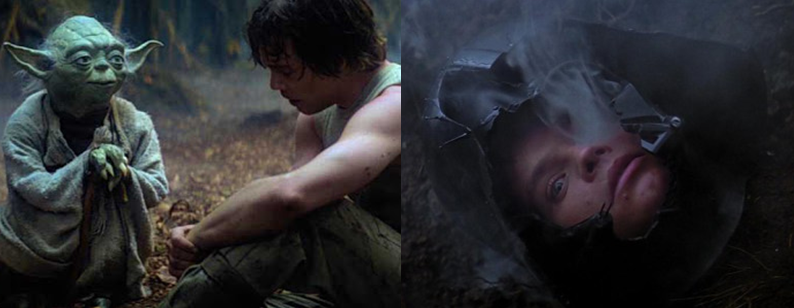
Yoda has some harsh lessons to teach Luke about patience and the Force.

I mentioned the ground battles earlier and I would be remiss to not spend some time talking about easily one of the film’s most impressive effects sequences, the battle of Hoth, in which the Rebel Alliance is set upon by gigantic All-Terrain Armoured Transport (AT-AT) and All-Terrain Scout Transport (AT-ST) walkers; these incredibly well-constructed machines are brought to life through a combination of models and traditional stop motion techniques and really make an impact, decimating the Rebel base and forcing them to flee into the vastness of space. Aside from Lando and Boba Fett, Empire also introduces another pivotal character to the saga in Yoda; a wizened old crone, Yoda reveals more about the intricacies of the Force and guides Luke’s training, however reluctantly. Like Obi-Wan, Yoda is clearly haunted by the mistakes and events of a vaguely-defined past and is continually disappointed by Luke’s impatience and conflicting feelings of attachment, fear, and anger. This comes to a head when Luke battles a vision of Darth Vader and, reacting out of instinct and emotion, sees himself literally reflected in Vader’s gruesome visage and, after Luke rushes off to help his friends, Yoda is left despondent but secure in the knowledge of “another” who could be trained to take Luke’s place.

Vader casually drops one of cinema’s all-time greatest plot twists!

Similarly, as mentioned, lightsaber combat is significantly improved in Empire; although we only really get one actual lightsaber battle, it is leagues above the plodding, awkward affair seen in A New Hope thanks to Luke’s youthful exuberance and desire for revenge. The fight has many layers to it, too, with Vader clearly toying with Luke in the early going and somewhat taken aback by Luke’s tenacity; in the end, though, while Luke is able to land a glancing blow on Vader, experience and ruthlessness allow Vader to easily (and literally) disarm Luke with a mere swing of his red-tinted lightsaber. It is in this moment, while Luke is in agony and overwhelmed by fear and anger, that Vader drops perhaps the biggest twist in movie history: not only did Obi-Wan lie about the fate of Luke’s father, Anakin, but Vader himself is Luke’s father! It’s a startling, shocking revelation given so much poignancy thanks to John William’s booming, iconic score (the unforgettable “Imperial March” debuts in this film, which elevates it even more in my opinion) and Luke’s agonising reaction. Shaken by this revelation, Luke willingly plummets to an unknown fate, apparently perfectly willing to die and only saved by luck or the will of the Force and the film ends with Luke’s hand being replaced with a cybernetic prosthetic, Han a prison of Boba Fett and encased in carbonite, and the Rebel Alliance in tatters. Luke’s faith in everything he was told is shaken and he and his friends gaze out into an unknown future, ending the film on an incredibly bleak cliff-hanger that masterfully sets the stage for the final showdown with both Vader and the Empire.

The Summary:
Star Wars: Episode V: The Empire Strikes Back is still the best Star Wars film ever made. It just is and that’s all there is to it but, if you want to get technical, just look at what it offers: the effects are bigger and better, the score is more iconic and bombastic, the characters are more nuanced and layered, and the lore is greatly expanded upon to show that there is so much more than even the titbits we were fed in A New Hope. With its far grittier, more mature, and bleak atmosphere and ending, some of the saga’s most memorable characters and, of course. one of the greatest reveals in movie history, The Empire Strikes Back stands head and shoulders above its predecessor, offering exciting space and sci-fi action, an emotionally charged and engaging lightsaber battle, and far more intriguing themes regarding destiny and portrayals of the futility of battling against a superior force. Empire very much sets the tone for the remainder of the Star Wars saga and many of the subsequent films and spin-off media would take their cue from its revelations and direction, for better or worse, and its influence to the franchise cannot be understated.

My Rating:

Rating: 5 out of 5.

Fantastic

Where does Star Wars: Episode V: The Empire Strikes Back rank against the Original Trilogy, and the other films in the Star Wars saga, for you? Do agree that it is the best film in the Original Trilogy and the saga or do you, perhaps, prefer a different Star Wars film? Are you a fan of Boba Fett? If so, what is it about his character as portrayed in this movie that you find so appealing? What did you think of the other characters introduced in this film, like Lando and Yoda, and the way existing characters were developed? What was your reaction upon hearing Darth Vader’s revelation for the first time? How are you celebrating Revenge of the 5th today? Whatever you think, comment below and let me know, and be sure to check out my review of the final part of the Original Trilogy.

Movie Night [May the Fourth]: Star Wars: Episode IV: A New Hope (2019)


May 4th is known the world over as Star Wars Day thanks to it acting as perhaps one of the most fitting and amusing puns ever devised (“May the Fourth be with you” in place of the traditional “May the Force be with you”). The first and most popular of what can easily become a three day celebration of the influential science-fiction series, the day stands as the perfect excuse for Star Wars fans to celebrate the beloved franchise in a variety of ways and, this year, I’ll be celebrating with a three day review of the Original Trilogy!


Released: 22 September 2019
Originally Released: 25 May 1977
Director: George Lucas
Distributor: Walt Disney Studios Home Entertainment
Original Distributor: 20th Century Fox
Budget: $11 million
Stars: Mark Hamill, Harrison Ford, Carrie Fisher, Anthony Daniels, Kenny Baker, Peter Mayhew, David Prowse/James Earl Jones, Peter Cushing, and Alec Guinness

The Plot:
For twenty years, the galaxy has been held in the grip of the malevolent Galactic Empire. Although captured by the wicked Darth Vader (Prowse/Jones), Princess Leia Organa (Fisher) manages to spirit away the plans for the Empire’s superweapon. When unassuming farm boy Luke Skywalker (Hamill) unwittingly acquires these, he is suddenly swept into a conflict against the Empire and their all-powerful, planet-destroying battle station: the Death Star!

The Background:
Nowadays, everyone knows about Star Wars; the science-fiction “space opera” film has become a near-unstoppable multimedia juggernaut, branching off into numerous sequels, prequels, spin-offs, novels, videogames, comic books, and more. But, back in 1977, it was merely the brainchild of a very young director called George Lucas, who was just coming off of the commercial failure of his debut feature, THX 1138 (ibid, 1971). Inspired by pulp science-fiction serials like Flash Gordon (Stephani, 1936), Lucas’s initial drafts for The Star Wars held the nucleus for what would become a generation-spanning franchise but was, at the time, a low-budget, risky venture for film studios to bank on. After refining the script into something more closely resembling the film we actually got, Lucas formed his own visual effects company to bring to life his vision for an ambitious galactic conflict and managed to secure veteran actors Peter Cushing and Alec Guinness (who, paradoxically, so believed in the film that he signed on to receive 2.25% of the royalties but also disliked the undue attention the film’s success brought him), and filled out the cast with a bunch of relative unknowns (and some carpenter who I’ve never heard of…) Despite the pressure and stress of filming negatively affecting Lucas’s health, Star Wars made over $10 million at the box office and became a cultural phenomenon almost immediately upon release. The critical reception was overwhelmingly positive and the film won numerous Academy Awards. Star Wars would go on to have numerous sequels, prequels, and spin-offs but Lucas returned to the film numerous times over the years to use modern computer-generated imagery and special effects to expand, improve, and remaster his classic film. While these changes have been debated by long-term series fans, many of these changes have been for the better, such as restoring long-lost scenes and improving the film’s noticeably-dated effects.

The Review:
I’m going to kick this one off with a controversial statement: as much as I like Star Wars, I am not really the biggest fan of A New Hope. Of the three films in the Original Trilogy, it ranks the lowest for me because, as visually impressive and exciting as it is, it doesn’t quite feel like it “fits” in the overall saga because of the concessions Lucas made to consolidate his original ideas. Things like Darth Vader acting so neutered and out of character really stick out for me; I never get the sense that he’s supposed to be the “hero” of the franchise or really anything more than an intimidating, mysterious henchman of Grand Moff Tarkin and a lot of the film’s effects and lore are sub-par compared to what we see in later sequels. Crucial, for me, is the fact that the Death Star is destroyed at the end; this is the Empire’s greatest weapon, capable of destroying planets, no doubt staffed with thousands of their people, and it’s hard to really top that or believe that their forces are as formidable after it’s destroyed. Still, it is an appealing space/fantasy film and it works really well in a bubble; its themes and world were greatly expanded and improved upon in subsequent films, though, meaning that whenever I watch A New Hope (particularly in a Star Wars marathon) I can’t help but notice that it just sticks out a bit from the others and it doesn’t surprise me at all that Lucas added and expanded so much of the film in subsequent re-releases to try and better align it with existing continuity.

Though largely motivated by his libido, Luke eventually becomes a hero of the Rebellion.

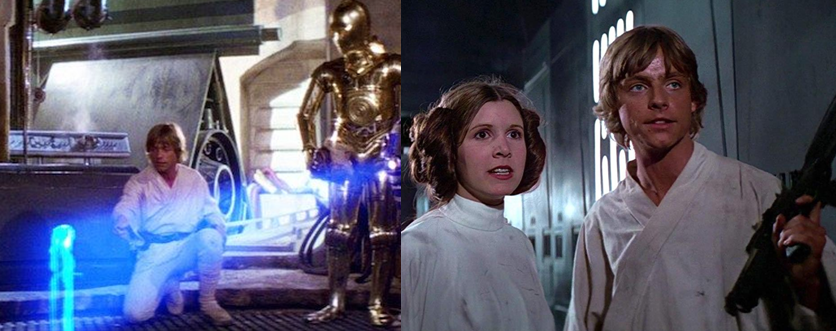
Anyway, A New Hope is basically the story of Luke Skywalker, a wide-eyed farm boy from a back-water, desert world who longs to escape the monotony of his everyday life and find adventure and excitement out in the big, wide galaxy just like his long-dead father, whom he idolises with a naïve hero’s worship. Luke acts as the audience surrogate for the most part; cut off from the rest of the galaxy and ignorant to many of the greater conflicts and nuances of life, we learn bits and pieces of this world as he does and are drawn into the conflict alongside him, and view the majority of the film’s events through the eyes of this unassuming farm hand. Luke is primarily motivated by his libido; after stumbling across Leia’s holographic plea for help, he becomes immediately infatuated with her and, though torn between his desire to meet and help her and to explore the galaxy and his duties to his uncle, Owen Lars (Phil Brown), he jumps at the chance to accompany Obi-Wan Kenobi (Guinness) on his journey to assist the Rebel Alliance after the Empire slaughters the only family he has ever known, turning his motivation also into one of hatred and revenge for the Empire and everyone in it. Accordingly, the minute he infiltrates the Death Star alongside his newfound friends and gets a blaster in his hand, he is more than happy to blast away at the myriad of nameless, faceless Stormtroopers and the first one to jump into the cockpit of an X-Wing to take on and destroy the Death Star to deal a crippling blow against the Empire he hates so much.

Obi-Wan’s sacrifice pushes Luke towards his greater destiny.

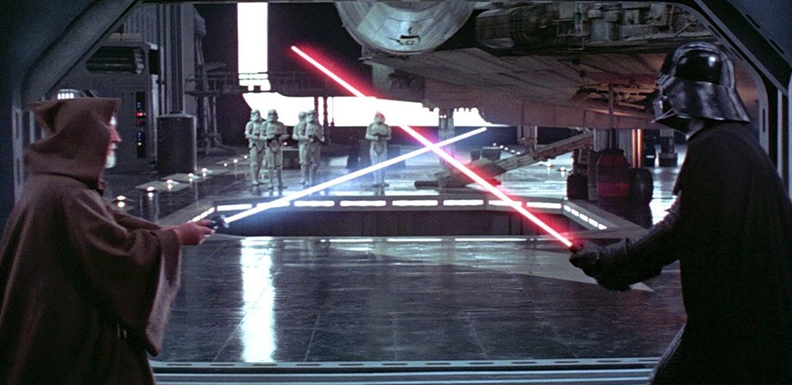
Obi-Wan (posing as an old hermit with the ridiculously paper thin pseudonym of “Old Ben Kenobi”) acts as Luke’s wise old mentor and father-figure; having fought alongside Luke’s father, Anakin, in the “Clone Wars”, Obi-Wan is Luke’s sole remaining (and strongest) link to the father he never knew. Obi-Wan talks of Anakin with reverence and respect, passes his lightsaber down to Luke, and is extremely enthusiastic about training Luke as a Jedi so that he can follow in his father’s footsteps. Though old and clearly haunted by events from the past, Obi-Wan is a patient and sage character, able to use the Force (the mystical energy that binds the galaxy together and can be manipulated by Jedi and Force-sensitive individuals) to influence (or manipulate, I guess) the minds of the “weak minded” (which, arguably, also includes Luke…) and resorting to conflict only when absolutely necessary. Obi-Wan also adds to Luke’s motivation not only by fostering and encouraging his desires for adventure but by fuelling his personal vendetta against the Empire through his self-sacrifice; aboard the Death Star, Obi-Wan has a confrontation with Darth Vader, a former pupil of his who he claims betrayed and murdered Anakin, and the two have a…lacklustre duel that is absolutely devoid of the hatred and animosity that there is supposed to be between these characters, which is disappointing when you consider the calibre of later lightsaber battles in the saga. Still, the point of this duel is to kill off Obi-Wan so that he can ascend to a higher state of existence and to push Luke further towards his destiny and it remains a surprisingly affecting scene as Obi-Wan is one of the most compelling and interesting characters thanks to the backstory he hints at and Guinness’s quiet, veteran screen presence.

Leia assumes many roles and is more than capable of holding her own in a fight.

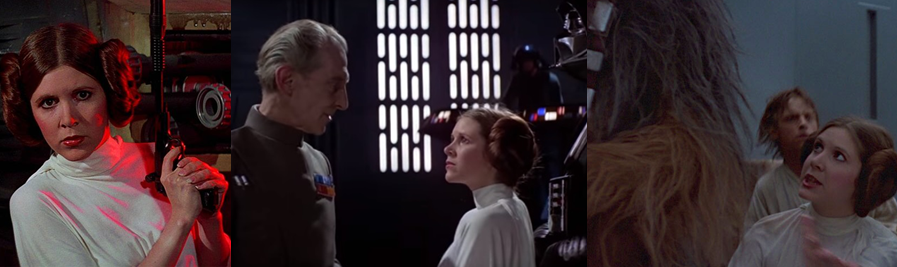
As the only prominent female character in the film beyond Luke’s Aunt Beru (Shelagh Fraser), it falls to Leia to carry the film as a strong-willed, independent female character. Though she appears to be a mere helpless damsel in distress who is dependant on a gaggle of misfit men to rescue her, she immediately takes charge of their escape from the Death Star, berating Han Solo’s (Ford) recklessness and immaturity and throwing snark at him, Luke, and even the mighty Chewbacca (Mayhew). Fully capable of holding her own in a firefight, she’s also human and sympathetic enough to console Luke after Obi-Wan’s death and respected and influential enough to be a commanding figure in the Rebel Alliance once they finally reach the Rebel base on Yavin 4. We don’t really learn a huge amount about her (truthfully, we don’t about any character save Luke and vague hints of life prior to the film from Obi-Wan) but her actions speak louder than words; she’s clearly a very complex and layered character as she has deceived the Empire (and Darth Vader) into thinking she is a loyal supporter of their cause while actually being a principal figurehead in the Rebellion and her commitment to bringing down the Empire drives her character through and through.

Star Wars is populated by a variety of memorable characters.

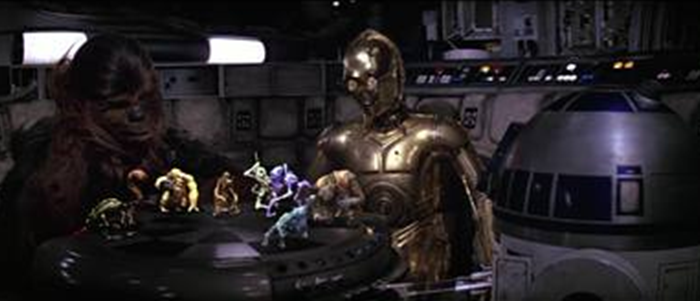
The linchpins for the film’s entire plot are, of course, probably the most famous droid duo in cinema history, C-3PO (Daniels) and R2-D2 (Baker); Threepio is an overly polite and helpful protocol droid who has no time for drama or adventures but is swept up into perhaps the biggest space adventure ever, whittling and complaining and despairing the entire way, and Artoo is the unsung hero of the film (and the entire saga) whose entire personality is brought to life very effectively despite the fact that he can only communicate through “beeps” and “boops” and at Threepio’s discretion. For the most part, they exist as mere supporting characters and the film’s comic relief but, without them, the movie couldn’t happen; similarly, Chewbacca, despite his great size and communicating only through growls or Han’s translation, isn’t much more than a supporting character but makes an immediate impact thanks to his unique design and screen presence.

Han is easily the film’s most appealing protagonist thanks to his loveable, rugged charm.

Speaking of which, easily the film’s most likeable character is, of course, Han Solo. World-weary and cynical, Han is a loveable, self-serving rogue who is only motivated by the money and has little time for the Rebellion’s futile efforts against the Empire or “hokey religions” like the Jedi and disparate concepts like the Force. Where Luke is young and naïve, Han is well travelled and has experienced the very worst that the galaxy has to offer; it helps that Ford brings a natural, relatable, and likeable charisma to the role and that, as a result, Han is the most “normal” of the film’s heroes and his “Everyman” persona is immediately appealing. His character arc is, obviously, that he comes to sympathise with the Rebellion’s plight and you really get the sense that he comes to care for Luke as a surrogate younger brother and it’s still a fantastic moment when he dramatically swoops in in the Millennium Falcon to clear Luke’s path in the film’s finale, proving that he has a moral compass and a heart of gold after all.

Though a threatening, impressive presence, Vader is little more than Tarkin’s puppet.

Finally, there is the film’s antagonistic force, the Empire, represented by Tarkin and, of course Dark Vader. Tarkin is the voice of “the Emperor”, an unseen figurehead who is behind the Empire and their iron grip on the galaxy; with his straight-laced, officious tones, Tarkin immediately commands and demands respect and attention from all of his peers…and that includes Darth Vader. Of course it helps that Tarkin is masterfully portrayed by the late, great Peter Cushing, whose screen presence and veteran ability commands attention; when Tarkin walks into a room or speaks, you pay attention and the film does a great job of showing how disconcertingly quiet and sadistic he is through his unwavering decision to torture Leia and destroy her home planet without hesitation. In the end, though, pride is Tarkin’s downfall; like many of the other Imperial officers, he believes so completely in the Death Star’s power and impenetrability that he refuses to heed the warnings and is killed alongside countless others when the Death Star is destroyed. Which brings us, at last, to Darth Vader…and this isn’t the complex, terrifying character we would come to know in subsequent sequels. Though he cuts an intimidating figure with his cold, emotionless suit and booming voice and wields mysterious powers that the ignorant cannot comprehend, Vader is little more than Tarkin’s puppet in this film. There are attempts to show him as a threatening presence and a malevolent force through the way Obi-Wan talks about him and his callous murdering and terrorising of those around him but it seems as though Vader is overwhelmed by apathy and boredom in this film (perhaps understandably so, in retrospect). He seems to lack the passion and drive we would see in later films and is a hollow character for it; thankfully, his personality, characterisation, and backstory are expanded upon significantly as the saga goes on but, for me, Vader sticks out the most as the film’s most out of place personality.

The Nitty-Gritty:
For a sci-fi fantasy that deals with a conflict that spans galaxies, A New Hope is surprisingly limited in terms of its locations; thanks to the film’s small budget, we only really spend any significant time on one alien world and it is, for me, the worst kind of environment to see in a film as it is little more than a dry, arid, boring desert. As soon as our heroes dramatically escape from Tatooine and head towards the Death Star, the film really picks up and gets interesting and that’s a bit of an odd thing to say considering how bland and uniform the Death Star’s grey and black corridors look. Still, it’s way more visually appealing than a desert and we get to see a lot of different locations on the Death Star before joining Luke and Rogue Squadron for their thrilling assault on the space station.

Star Wars has some of the most iconic starships in cinema history.

Although the effects in A New Hope are probably the most dated of all of those in the Original Trilogy, even after all of Lucas’s re-edits and digital tweaks, it’s still commendable and impressive how detailed and visually interesting all of the film’s models and ships and such are. Everything has a very practical, “lived-in” feel to it, as though it’s been around for some time and characters have had to make do or the focus has been placed on purely practical, military equipment. The standouts are, obviously, the Millennium Falcon and the Death Star; probably one of the most, if not the most, iconic ship in sci-fi history, the Millennium Falcon is as rugged and crude as Han and you really get the sense that it is just barely holding together despite Han’s boasts and its impressive capabilities. Compare that to the sleek, quiet ominous Death Star, which hovers against a blanket of darkness and stars like a foreboding eye. The Death Star’s planet-destroying power is a terrifyingly immediate threat and one that, I feel, was perhaps too great for the first (or fourth, whatever) film in a series but that is, again, the benefit of hindsight; if you watch A New Hope as a standalone feature, it works really well and the film even ends with the suggestion that the Empire has been irrevocably crippled. As part of a saga, it then works as the first real, decisive blow against the Empire but the Death Star’s threat was never really topped in subsequent films, only duplicated and expanded, such is the influence of that impressive battle station.

A New Hope takes the first steps into a much wider and more complex world.

Finally, we have the film’s more disparate elements and world-building; it is primarily through Obi-Wan that we learn of the Force but both Tarkin and Vader also provide a few snippets of insight into this abstract concept. The suggestion is that those who can truly harness the power of the Force were once known as Jedi Knights and that the Force’s power renders even the capabilities of the Death Star obsolete; we don’t really see any of that in the film (or any Star Wars film, to be honest) but that’s mainly because the Jedi are all-but-extinct and the Force is largely perceived as an “ancient religion” that has died out, become a folk talk, or is a source of derision. Far more proactive and useful than simple blind faith, the Force allows Obi-Wan to manipulate the minds of others, move objects with his mind, feel the death of Leia’s home world, and ascend to a higher plane of existence from where he can continue to advise and direct Luke. Trusting in the Force over his targeting computer and more tangible senses allows Luke to make the all-but-impossible shot that destroys the Death Star, thus putting him on the path towards his destiny of following in his father’s footsteps and becoming a Jedi Knight.

The Summary:
There is a lot to like about Star Wars: Episode IV: A New Hope; the world-building and concepts introduced and hinted at are intriguing and Lucas presents just enough to both wet our appetite for expansion of this lore and tell a simple sci-fi fantasy with a beginning, middle, and end. The characters are all distinct and likeable in their own way, with each one hinting at having a particularly interesting and exciting life prior to the film except for Luke, who longs to be a part of an interesting and exciting life and, through the will of the Force, gets his wish in more ways than he could have bargained for. And, yet, for all the respect and praise I have for A New Hope, it remains, for me, the weakest of the Original Trilogy and one of the weaker entries in the entire Star Wars saga. It’s just too simple, is the thing, too limited in its scope and so at odds with the films that come after it. As a standalone movie, it absolutely works but it’s as though Lucas struggled to fit A New Hope into his wider narrative in retrospect as the film’s portrayal of Darth Vader, the Force, and the groundwork it lays for the Clone Wars are all decidedly at odds with what we later experience and was unsatisfactorily waved away by a throwaway line from Obi-Wan in the third (sixth? Whatever!) film. It may be a classic piece of cinema but the sequel takes everything that worked about A New Hope and expands upon it in ways that make it, and even subsequent follow-ups, superior in many ways as the narrative has been clearly established rather than being distilled into one single film.

My Rating:

Rating: 3 out of 5.

Pretty Good

What do you think about Star Wars: Episode IV: A New Hope? Where do you rank it in the Original Trilogy and against the other films in the Star Wars saga? Do you think I’ve committed a cardinal sin by expressing my dislike of the film over others in the saga or do you, perhaps, agree that it’s a weaker entry compared to its sequels? What do you think about Darth Vader’s portrayal in this film and the way the Force and the Clone Wars are presented? Which character was your favourite and why? How are you celebrating Star Wars Day today? Whatever your thoughts, good or bad, feel free to leave a comment below and be sure to check out my review of the far-superior sequel!