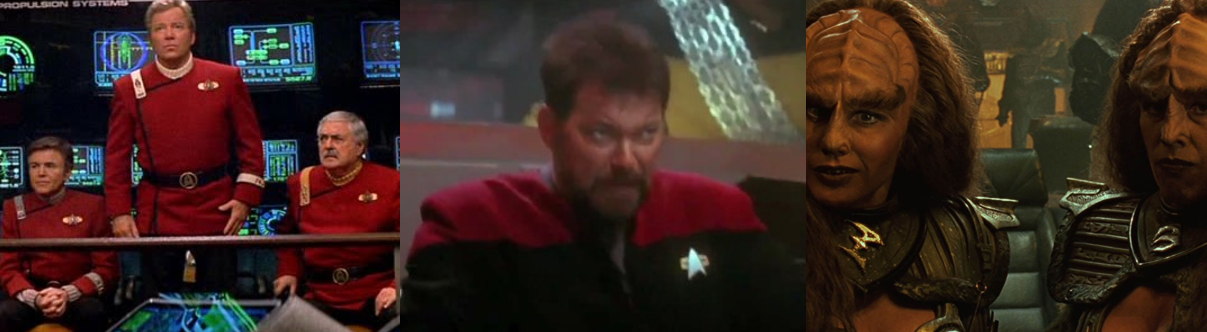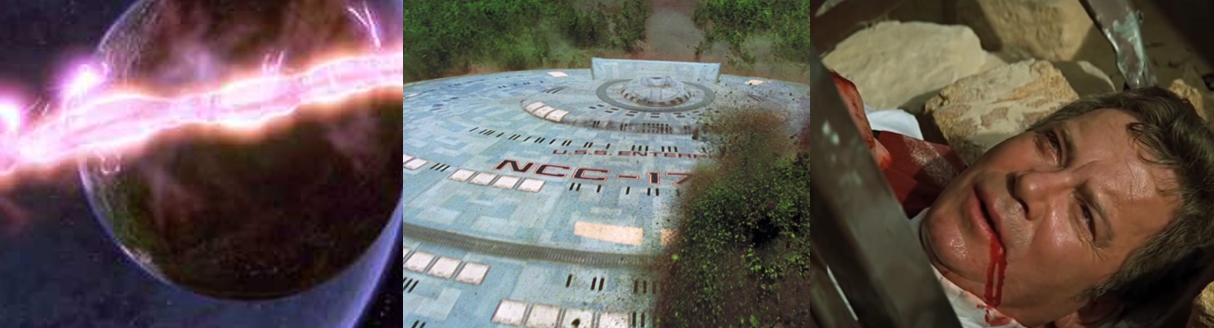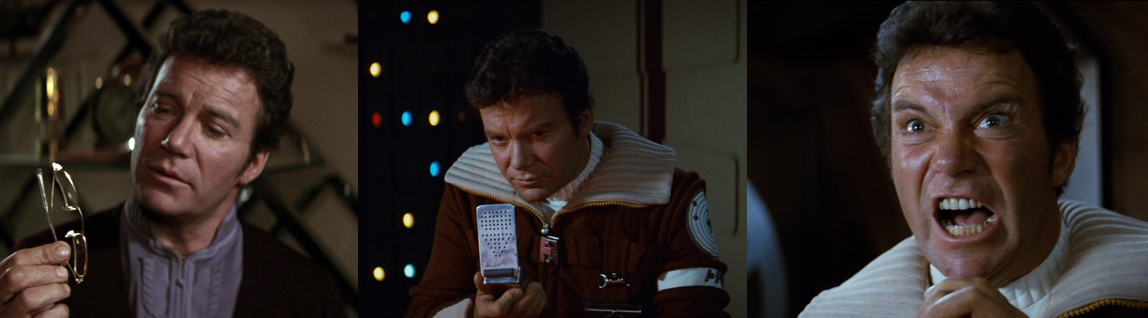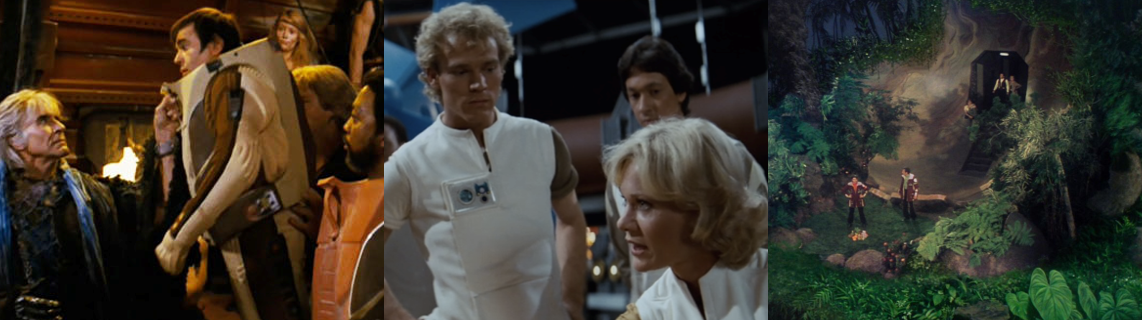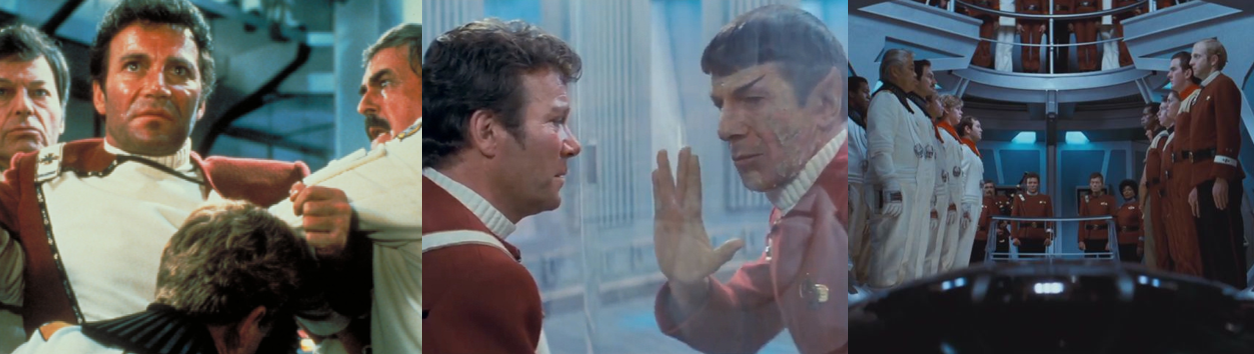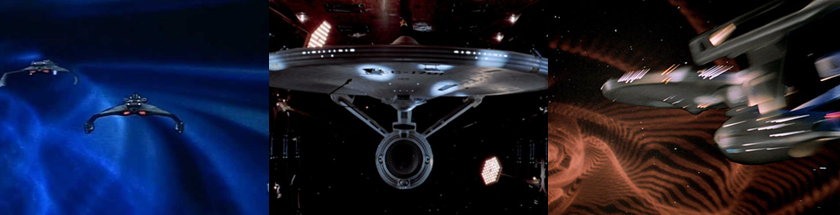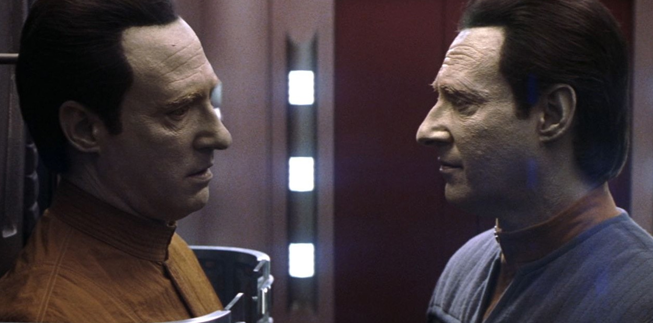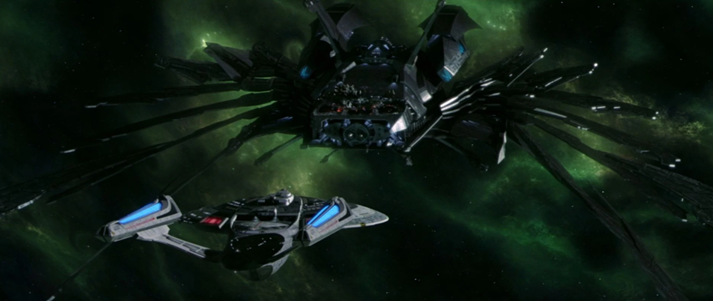
Movie Night [Star Trek Day]: Star Trek V: The Final Frontier


On 8th September 1966, the first episode of Star Trek (1966 to 1969), “The Man Trap” (Daniels, 1966), first aired. Since then, Star Trek has become a massive cultural phenomenon, spawning numerous continuations and spin-offs to become, perhaps, the most influential science-fiction franchise of all time. Accordingly, the 8th of September has been deemed “Star Trek Day”, the perfect excuse to celebrate this massive sci-fi franchise.


Released: 9 June 1989
Director: William Shatner
Distributor: Paramount Pictures
Budget: $26 million
Stars: William Shatner, Laurence Luckinbill, Leonard Nimoy, DeForest Kelley, George Takei, and James Doohan

The Plot:
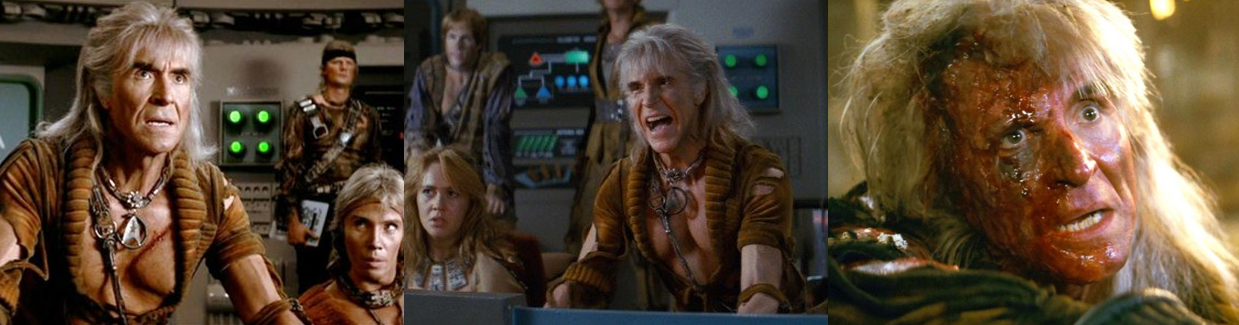
When Mister Spock’s (Nimoy) hitherto-unknown half-brother Sybok (Luckinbill) takes the USS Enterprise hostage with his empathic powers, Captain James T. Kirk (Shatner) must prevent him from a seemingly suicidal mission to find God at the centre of the universe.

The Background:
Despite a worldwide gross of almost $140 millionStar Trek: The Motion Picture (Wise, 1979) was a critical disappointment that Paramount blamed on Star Trek creator Gene Roddenberry. Thankfully, the franchise recovered with Star Trek II: The Wrath of Khan (Meyer, 1982), commonly considered one of the best Star Trek movies, and Paramount eagerly capitalised with what became the then-lowest-grossing third entry, Star Trek III: The Search for Spock (Nimoy, 1984). Still, positive reviews justified a fourth film, which saw star and director Leonard craft a light-hearted time travel romp, Star Trek IV: The Voyage Home (ibid, 1986), which proved a critical and commercial success. Thanks to his contract, star William Shatner was promised the chance to direct the next Star Trek film and took inspiration from charismatic, but misguided, televangelists for the story. In his initial drafts, Sybok was known as Zar and the biblical elements were further emphasised in the conclusion when “God” transformed into a more Satanic form. Producer Harve Bennett insisted on changing the script, which Roddenberry also had issues with, and subsequent redrafts and budgetary concerns excised the rock monsters planned for the finale. Shatner allegedly favoured a grittier and more realistic aesthetic and the production team apparently redesigned many sets, including the Enterprise bridge. The film’s effects were handled by Associates and Ferren, with the budget increasing due to Shatner’s insistence on viewing much of the test footage. Sean Connery turned down an offer to star as Sybok so the role went to Laurence Luckinbill when Shatner was impressed by his portrayal of President Lyndon B. Johnson. Star Trek V: The Final Frontier’s $63 million box office fell way short of Star Trek IV’s and made it the lowest-grossing of all the feature films! This was reflected in the overwhelmingly negative reviews that criticised Shatner’s direction, the inconsistent tone, and the poor special effects. Luckinbill’s performance was praised, however, but even Shatner expressed dissatisfaction with the finished product, which is often considered one of the worst in the franchise. That didn’t stop Paramount greenlighting a sixth film the following year, though it did lead to a brief scramble to recover from The Final Frontier’s poor reception.

The Review:
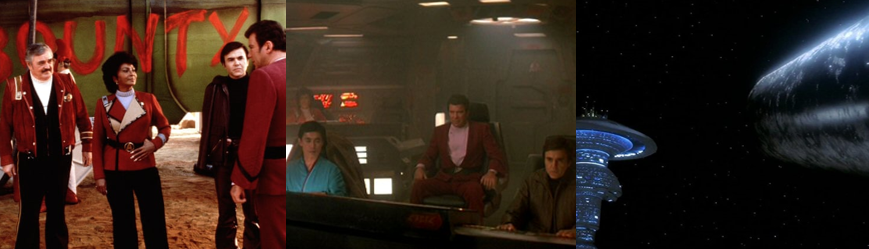
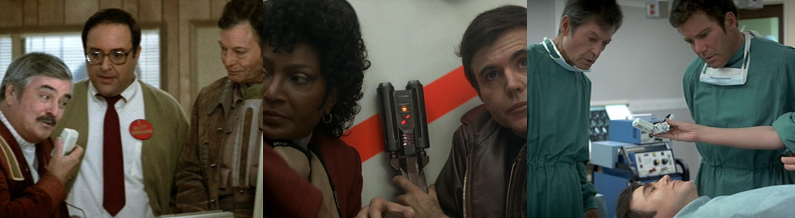
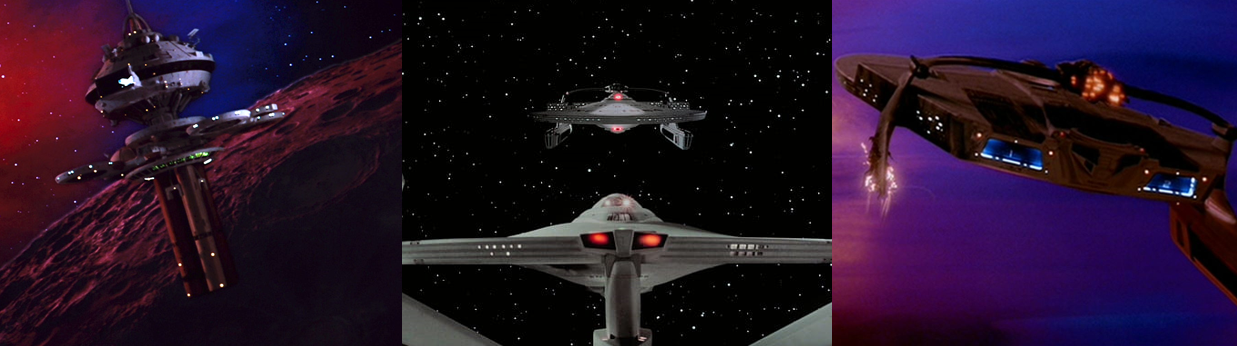
The Enterprise-A crew starts The Final Frontier in the midst of a well-deserved shore leave. Well, except for poor Commander Montgomery “Scotty” Scott (Doohan), who misses out on a vacation with blossoming love interest Commander Nyota Uhura (Nichelle Nichols) to help get the comically malfunctioning Enterprise-A up to scratch. The state of the Enterprise-A is a recurring issue throughout the film and primarily serves as both a comical situation (Kirk struggles with the turbolift doors), an obstacle to be overcome (Scotty works tirelessly to fix the inoperable transporters), and as a convenient way to handicap the crew for dramatic impact. Kirk and his away team cannot be beamed out, for example, and rely on shuttlecraft to journey to and from the Enterprise-A and the questionable nature of the ship’s weapons and shields means even Klingon Captain Klaa’s (Todd Bryant) outclassed Bird of Prey is a potential threat. Unfortunately, this threat remains a secondary concern; we never see the Enterprise-A battle Klaa so it’s a moot point. The ship’s also more than capable of travelling at warp speed and all its sensor systems are operational, so it’s only systems that would limit the film’s action that erupt in a shower of sparks. The film also, surprisingly, hand waves the recurring trope of the Enterprise constantly being called to dangerous situations, no matter their condition. When Kirk mentions the “mess” that the Enterprise-A is in, Fleet Admiral Bob (Harve Bennett) states he has “no experienced Captains” in close proximity to Nimbus III and “needs Jim Kirk”.
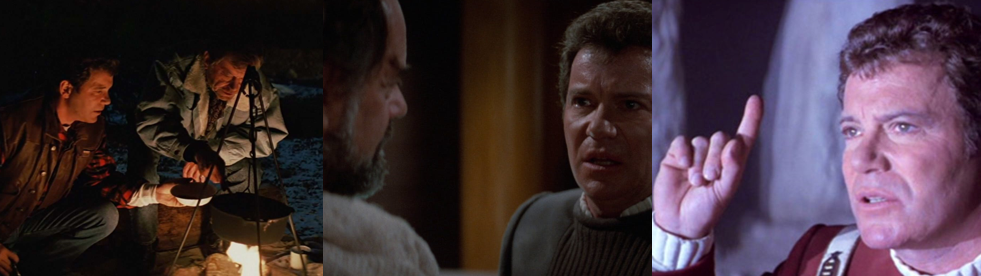
The morbid Kirk vehemently rejects Sybok’s powers and even questions “God”.

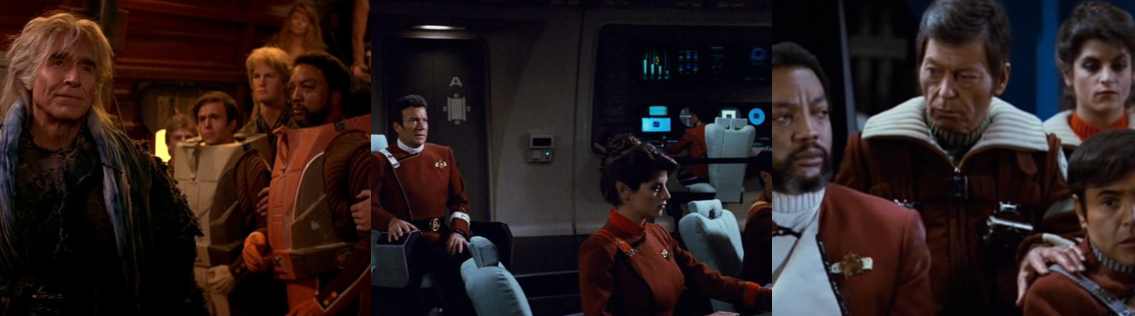
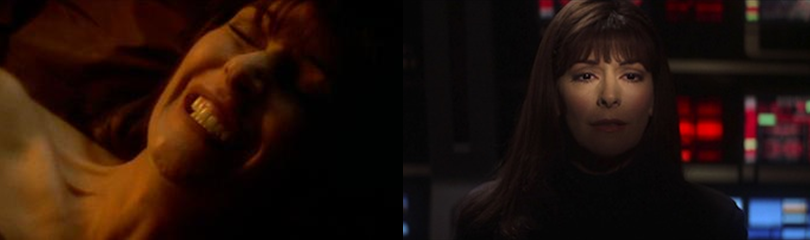
Though in a far better place, mentally, than in previous films, age is still taking its toll on Captain Kirk. Whereas “other men” have families to spend shore leave with, he spends his camping in Yosemite National Park with Spock and the miserly Doctor Leonard “Bones” McCoy (Kelley) since they don’t have anyone else. While Kirk fills his time with unnecessary risk-taking and Bones chastises Kirk’s foolhardy disrespect for life, Spock prefers to test his hoverboots and contemplate the lyrics of “Row, Row, Row Your Boat”. It’s while subtly mocking Spock’s misunderstanding of Earth customs that Kirk reveals a morbid belief that he’s destined to die alone, something which has left him somewhat emotionally empty and fearless. Despite his protestations about taking the malfunctioning Enterprise-A to address the hostage situation on Nimbus III, Kirk follows orders and finds new ways to get around the limitations of the script ship. He leads the away team in infiltrating the capital, only to find the hostages – the bitter St. John Talbot (David Warner), the disgraced General Korrd (Charles Cooper), and the alluring Caithlin Dar (Cynthia Gouw)) – have fallen under Sybok’s sway. Outmanned and outgunned, Kirk has no choice but to allow Sybok and the entranced diplomats safe passage to the Enterprise-A, where Sybok demonstrates his unique empathetic abilities. Even when faced with Sybok’s power, which causes visions of a person’s “hidden pain” to manifest visually, Kirk remains defiant. In one of the film’s best scenes (and of Shatner’s Star Trek career), Kirk launches into an impassioned tirade and vehemently rejects Sybok’s offer: “I don’t want my pain taken away! I need my pain!” Convinced that Sybok is a “con man”, at best, and “mad” at worst, Kirk both refuses to join him or co-operate and adamantly tries to talk him out of breaching the “Great Barrier” since Sybok claims to be on a mission from “God”. Kirk’s scepticism is briefly rocked when the Enterprise-A breaches the Great Barrier, but only for a moment. Just as he shrugged off Sybok’s allure, Kirk questions the authority and legitimacy of the “God” (George Murdock) they find on Sha Ka Ree. Again, Kirk feels untouchable, even when faced with a supposed deity, simply because he has not only seen more than enough to make him fearless and also because he’s “not alone” and therefore cannot die.
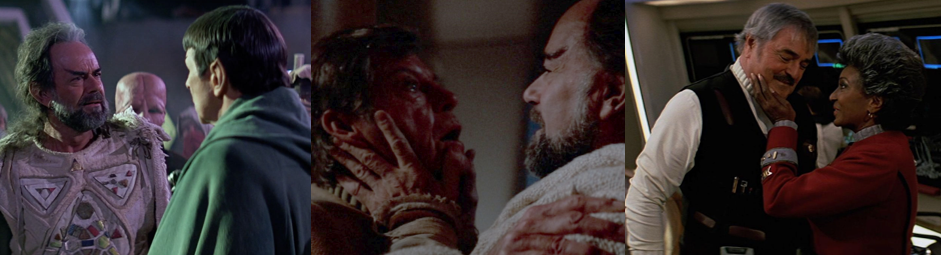
Sadly, Sybok’s relationship with Spock and the extent of his abilities isn’t explored as much as I’d like.

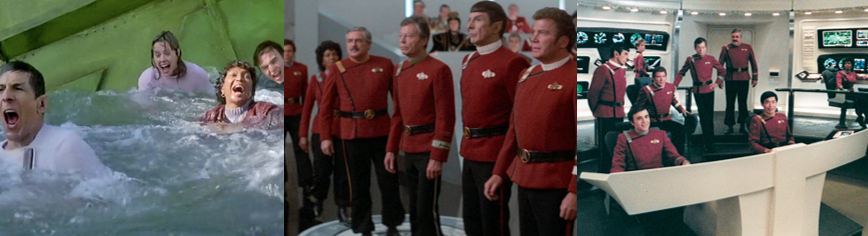
The Final Frontier is pretty significant for Spock since it not only explores aspects of his childhood he actively chooses not to discuss but also revolves around the complex relationship between him and his hitherto-unknown brother. Unfortunately, these elements aren’t as developed as I’d like and it’s telling that Sybok has never been mentioned again in Star Trek lore (as far as I know). What little we learn of their past is told through vague exposition and a surprisingly emotional confrontation when, after being forced to relive the pain of his father’s (Jonathan Simpson) disapproval of his half-human nature, Spock also rejects Sybok’s repeated offers to join him. Though he condemns Sybok for betraying the logical principals of Vulcan culture and violating Federation law, Spock still hesitates when ordered to kill his half-brother, showing he’s not at completely above emotion, and clearly grieves for Sybok in the finale. Bones is mostly played as the comic relief and peacekeeper of the three, scolding Kirk for reprimanding Spock’s hesitation and offering bitter commentary on their poor social lives. However, Sybok reveals that Bones’ cantankerous personality stems from a tragic and horrific event in his past where his sick father (Bill Quinn) begged to be spared of his slow, painful death. Though conflicted, Bones ultimately disregarded his Hippocratic Oath, only for a cure to be found shortly after. It’s a harrowing scene that explains a lot about McCoy’s curmudgeonly disposition, and is effectively related, especially when Sybok criticises Kirk for not realising the dark pain residing in his friends. We also get a recurring sub-plot where Scotty avoids Sybok’s influence and helps Kirk and the others escape from the brig, and a fun moment where Commander Pavel Chekov (Walter Koenig) commands the Enterprise-A. Otherwise, beyond Uhura showing her naked allure and suddenly being hot for Scotty and Lieutenant Commander Hikaru Sulu (George Takei) acting as Sybok’s right-hand once the charismatic Vulcan gets his claws into him, the rest of the crew assume their usual roles and get slightly less to do as the film’s geared more towards philosophical and moral debates rather than space battles.
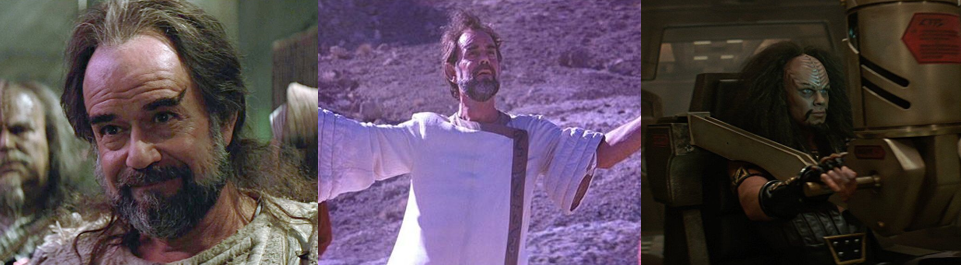
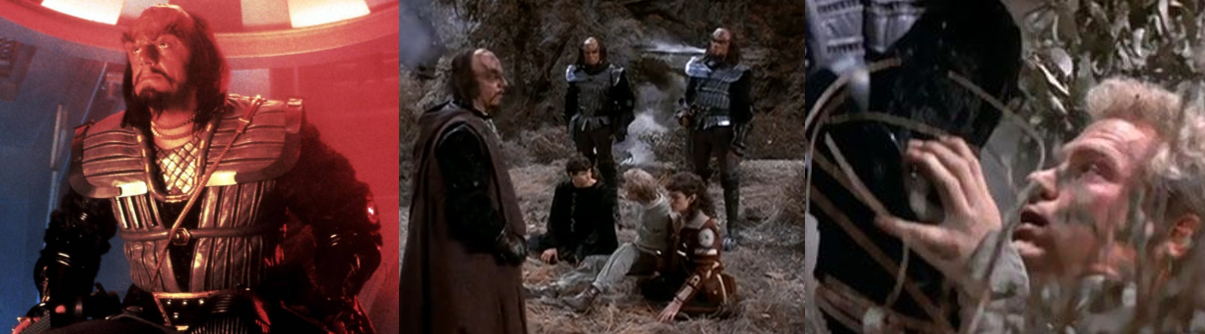
While the charismatic Sybok steals the show, it wouldn’t be classic Star Trek without a Klingon threat.

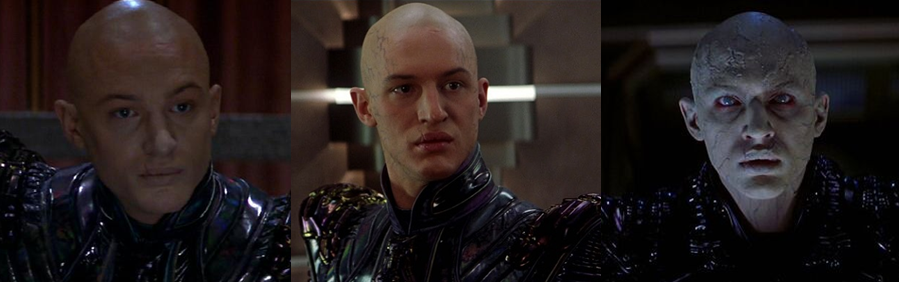
Sybok has an alluring charisma, for sure. Even without his empathic abilities, the Vulcan has a silver tongue and easily talks down armed foes with his captivating words. Influencing individuals on an emotional level, Sybok encourages them to “share their pain” in what’s essentially an extension of the traditional Vulcan mind meld. Using his empathic abilities, Sybok brings out a person’s deepest pain and encourages them to face it, share it, and be free of it, leaving them so grateful to be free of their burden that they pledge themselves to his mad cause, abandoning loved ones and principals in the process (but, crucially, retaining their core personalities). Seen as a renegade, Sybok was cast out from Vulcan for embracing emotion and has embarked on a lifelong quest for Sha Ka Ree (what we would call “Eden”). Having been sent visions and instructions from “God”, Sybok recruits followers to breach the Great Barrier and commune with the All-Mighty to understand the meaning of life, and then spread that wisdom to others. Thus, Sybok is not a traditional villain or a violent man; he chastises Chekov for inciting violence in Nimbus III, practically begs Kirk and the others to follow him, and uses reason and words rather than weapons. Sybok is no less dangerous in Kirk’s eyes, however, since the sceptical Captain believes they’re heading for disaster following Sybok’s mad ambition. Because Sybok represents a more philosophical and moral villain, The Final Frontier once again relies on the Klingons as a more traditional threat. Unfortunately, the upstart Klass is a far cry from the cold menace of Captain Kruge (Christopher Lloyd). Bored of destroying space debris, Klaa intercepts the Enterprise-A to test his mettle against a real opponent. Klaa’s threat adds a time limit to most scenes, forcing Sulu to manually dock the shuttlecraft so the Enterprise-A can escape to warp, but the two ships don’t engage in a space battle and Klaa’s threat is easily neutralised once Spock demands Koord reprimand his arrogant subordinate.

The Nitty-Gritty:
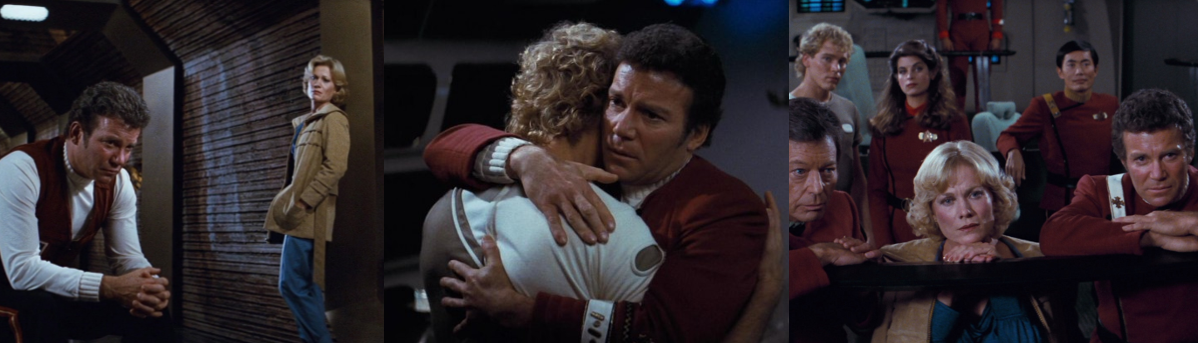
It’s tiresome to mention it, but there’s a popular notion that odd-numbered Star Trek movies are worse than the even-numbered one. While I mostly agree, I disagree in this case. It’s definitely not as good as the last three movies, but I’d much rather watch it than the next two and I’ve always had a soft spot for it. Part of this is Laurence Luckinbill magnetic performance (he makes for a charming and loquacious antagonist), part of it is the melancholy, haunting score courtesy of Jerry Goldsmith, and part of it is the relationship between Kirk, Spock, and Bones. The Final Frontier offers some of their best filmic moments, from Bones worrying over Kirk’s safety to Spock being weighed down because of the “marshmelons” they ate, to the anger Kirk throws towards Sybok when Bones is tempted by the Vulcan’s power. I’m glad they spend most of the film as a bickering threesome as it really emphasises how they’re like family.Kirk even refers to Spock as his “brother” by the end and acknowledges that they’ve become a substitute family. I love how they’re so familiar with each other that they disregard rank (though Spock does this reluctantly) and that Bones uncharacteristically defends Spock when he refuses to kill Sybok. The scenes of the three locked in the brig and escaping up the turbolift shaft are both light-hearted fun and an engaging glimpse at their relationship since Kirk is personally upset that Spock never told him about his half-brother. While we get some insight into Spock and Sybok’s past, with the implication that Sybok had always been a manipulative influence who bullied Spock, we don’t get as much detail as I’d like. A flashback or two over Nimoy’s narration would’ve been nice, but much of this relationship is tainted by the fact that it’s never brought up again, as though Star Trek would rather we forget about Sybok and this film. The best evidence of this is that the Enterprise-A travels to the centre of the universe in just under eight hours, something we know is impossible based on the perilous and lengthy journey of the USS Voyager, lending credibility that much of The Final Frontier are open to interpretation.
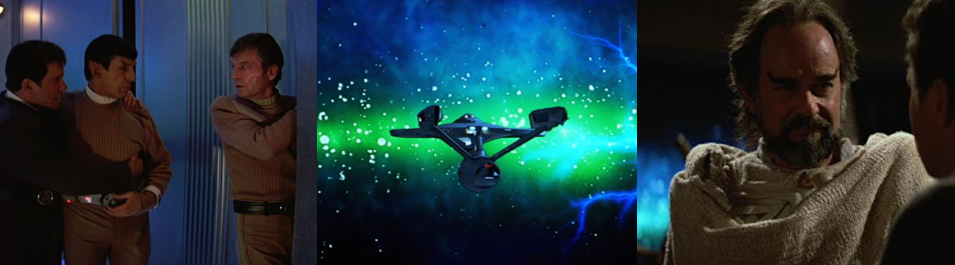
Some questionable effects aside, I really dig the philosophical debate.

The Final Frontier’s reputation probably isn’t helped by some questionable effects. While the models all look great, they are recycled from the previous movies and it’s tiresome seeing the Enterprise-A threatened by another Klingon Bird of Prey (and that the well-seasoned crew are continually stumped when the ship cloaks). The composition effects are woefully subpar so it’s probably a good thing we don’t really get a space battle. Even Spock’s hoverboots are a laughable effect, used alongside an obviously slanted camera angle or a suspicious turbolift shaft that’s clearly hiding cables to move the actors. There is a big action set piece on Nimbus II, however, where Kirk and the away team storm the city and get into a firefight with Sybok’s acolytes (on horseback, no less). Kirk even tangles with a bizarre cat woman (Linda Howard) to give Shatner a fight scene, though is just kinda ends when he tosses her into a water tank. Sybok captures Kirk and the others with ridiculous ease since he has more men and weapons, encounters no resistance on the Enterprise-A (as it conveniently has a skeleton crew), and isn’t involved in any physical altercations with the crew due to his pacifist nature. Instead, he and Kirk (and Spock, to a degree) debate their beliefs, with Kirk disputing the fantasy of Sha Ka Ree and Sybok talking to Kirk as though he were a confused and naïve child. Though incensed at having his ship taken from him, Kirk is powerless to intervene beyond defiantly escaping the brig and trying to alert Starfleet Command. However, his undeniable curiosity and desire to “boldly go where no man has gone before” sees him willingly return to the bridge once the Enterprise-A reaches the Great Barrier where, ironically, Sybok gratefully returns command of the ship to him, if only so Kirk can see that the unreasonable Vulcan was right all along.
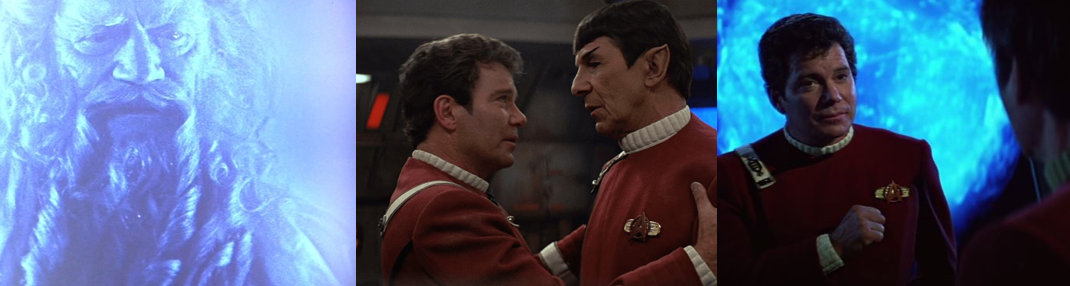
Kirk defies “God”, is saved from death once more, and recognises his friends as his true family.

To the amazement of the crew, the raging cosmic storm at the Great Barrier proves to be an illusion and, upon breaching it, the Enterprise-A reaches Sha Ka Ree, a fabled holy land where creation is said to have originated. Curious, Kirk has Spock, Bones, and Sybok travel with him to the surface, discovering a barren wasteland. Just as even Sybok begins to doubt his journey, the earth quakes and a gigantic, semi-holographic visage appears bathed in an ethereal light. “God” assumes the guise of kindly old manto to “meet their expectations”. While Bones is stunned by the All-Mighty and Spock is quietly fascinated, Sybok is overjoyed to see that God is not only real, but everything he expected Him to be. As “God” compliments Sybok, it asks how the group penetrated the Great Barrier and becomes intrigued by their starship. Blinded by his faith, Sybok promises that the Enterprise-A will serve as the deity’s “chariot”, so that “God” spread wisdom to the galaxy, however their jubilation is interrupted by Kirk’s simple question: “What does God need with a starship?” When “God” questions Kirk’s identity, Kirk’s cynicism increases and, angered by the mortal’s disbelief, the deity blasts Kirk with its eyebeams. Shocked at this cruelty, both Bones and Spock repeat Kirk’s question, earning similar reprisals and leaving Sybok horrified that his God would act so callously. The being reveals that it’s some unknowable, eldritch creature that’s been trapped on Sha Ka Ree for an eternity and yearns to be free. Assuming Sybok’s form, mirroring the Vulcan’s arrogance and blind ambition, the creature threatens to kill them all unless the Enterprise-A is brought closer. Dejected by his mistakes and desperate to make amends, Sybok begs his brother for forgiveness and embraces the creature, sacrificing himself to overwhelm it with his pain. This is only a temporary reprieve for the shellshocked crew, however, as is the barrage of phaser fire from the Enterprise-A, as the creature returns and turns its wrath on Kirk after he has Bones and Spock beamed out. Luckily, General Koord orders Klaa to stand down, saving Kirk’s life when he was sure he would die, and leaving the three to ruminate on the true nature of God and return to their shore leave.

The Summary:
I’m fully aware that I’m in the minority of people who like Star Trek V: The Final Frontier, and I’m okay with that. It’s definitely better than the first and sixth movies, for me, and probably about on par with the third, honestly. Like The Voyage Home, it’s a bit more of a light-hearted adventure for the most part, with an emphasis on the banter and bickering between Kirk, Bones, and Spock to emphasise that the Enterprise-A crew (especially these three) are a tight-knit surrogate family. Yet, for all the pratfalls with Spock’s hoverboots and Scotty bashing his head, there are some deep ruminations on mortality and what it means to be human. Kirk’s dour outlook on his inevitable, lonesome end really speaks to the life he’s chosen for himself. I personally find it very inspiring that he chooses to live with his pain rather than take an easy fix since all his experiences, good and bad, have shaped his personality. Sadly, this theme is somewhat underbaked, as are many aspects of The Final Frontier, specifically Spock’s relationship with his random half-brother. I’d love to see this explored further somewhere so if there’s a book or something that delves into their past a bit more, please let me know, as Sybok was a fantastic character. I loved his enthusiastic and exuberant presence, his boastful confidence and pacifist nature, and the idea that he’s riding a fine line between confidence and madness. I do think the Klingon threat could’ve been removed, perhaps in favour of the Romulans or additional screen time showing Kirk and the others trying to overthrow Sybok’s control of the Enterprise-A. It’s a bit suspicious how easily they reach and breach the Great Barrier but I’ve always enjoyed the showdown with “God”, Kirk’s fearless defiance of the creature, and the endlessly quotable script in this horribly under-rated Star Trek movie. It could’ve been better, for sure, but it’s a personal favourite of mine and I do think it needs a bit more love for the positives and that the negatives need to be better explained to me as I just don’t think it’s as bad as people say!

My Rating:

Rating: 3 out of 5.

Pretty Good

Are you also a fan of Star Trek V: The Final Frontier? What did you think to Kirk’s bleak outlook on his inevitable death? Did you enjoy the additional focus on the Kirk/Spock/Bones dynamic? What did you think to Sybok and the snippets of exposition we get into his past with Spock? Were you also frustrated to see another Klingon threat? What does God need with a starship? Which Star Trek captain, crew, show, or movie is your favourite and why? How are you celebrating Star Trek Day today? No matter what you think, leave your thoughts down below, support me on Ko-Fi, and go check out my other Star Trek content.

Screen Time [Captain Picard Day]: Star Trek: Picard (Season Two)


As seen in the Star Trek: The Next Generation (1987 to 1994) episode “The Pegasus” (Burton, 1994), the crew and children of the U.S.S. Enterprise-D celebrates “Captain Picard Day” on Stardate 47457.1, which roughly translates to June 16th. While they bewilder Captain Jean-Luc Picard (Patrick Stewart) with drawings, I see it as a good excuse for some more Picard and Next Generation content.


Season Two

Air Date: 3 March 2022 to 5 May 2022
Network: Paramount+
Stars: Patrick Stewart, Alison Pill, Jeri Ryan, Michelle Hurd, Santiago Cabrera, Brent Spiner, and John de Lancie

The Background:
After the disappointing critical reception of Star Trek: Nemesis (Baird, 2002) cancelled plans for further films focused on the popular Next Generation cast, the Star Trek franchise (1966 to present) shifted to other shows and a lauded reboot series. After the franchise saw a resurgence, showrunner Alex Kurtzman pushed to revisit Captain Jean-Luc Picard. Alongside writer/director Akiva Goldsman, Kurtzman convinced Stewart to return to his famous role for Star Trek: Picard (Various, 2020), a highly successful venture that proved popular enough to warrant a second season, as was always intended. Afforded an unprecedented $20.4 million in tax credits by the California Film Commission, season two was developed back-to-back with season three, though filming briefly stalled due to the COVID-19 pandemic. Aiming to continue exploring Picard’s character and mortality, the writers chose not only to revisit the mysterious Q (de Lacie) but also drew inspiration from Star Trek IV: The Voyage Home (Nimoy, 1986) for its time travel plot. Once it started streaming, season two of Star Trek: Picard proved quite popular and the overall critical reception was very positive. Reviews praised the exploration of Picard’s character and the performances and the execution of the introspective narrative. Though some found season two to be derivative of previous Star Trek stories, it proved successful enough to build anticipation for the third and final season one year later.

The Plot:
After returning to inspire a new age of prosperity in the United Federation of Planets, Admiral Jean-Luc Picard and his allies are unexpectedly deposited in a dystopian timeline by the malevolent Q and must travel to the 21st century to not only restore reality, but also face their personal demons.

The Review:
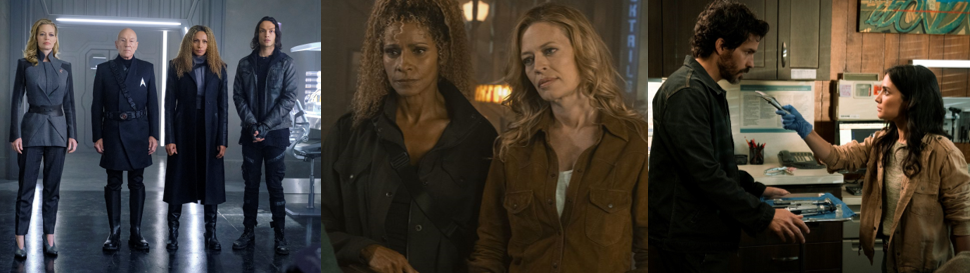
As a lifelong fan of the Next Generation show and movies, I was excited when Star Trek: Picard was  announced. As much as I enjoyed the rebooted movies, I’ve not really been that interested in the Star Trek shows that have come out since as they all explore a pre-Next Generation timeline, something I think has been done to death. Star Trek: Picard represented a unique opportunity to return to the main timeline and see how the universe had changed since Star Trek: Nemesis, but I was surprised to find Picard bitter and alone, familiar characters changed and somewhat jaded, the once tolerant and righteous Starfleet a stubborn and destructive xenophobic regime, and an overall unsettling bleakness to the franchise. Many characters (including Picard) dropped curses with surprising regularity and harboured a resentment towards Picard that needed to be mended over the course of the season. Season one primarily focused on Picard’s age, his failing health and sense of mortality, and his efforts to assist Soji Asha (Isa Briones), the “daughter” of his old friend, Lieutenant-Commander Data (Spiner), cobbling together a new rag-tag crew and ending up in a new synthetic body, seemingly ready for new adventures in the cosmos. Season two begins with Picard back on his family vineyard but still very much involved with Starfleet, having regained his passion now they’ve stopped ostracising synthetics like Soji. This vigour is only further reinvigorated since his crewmates Cristóbal “Chris” Rios (Cabrera), Doctor Agnes Jurati (Pill), Raffaela “Raffi” Musiker (Hurd), and surrogate son Elnor (Evan Evagora) have all joined (or rejoined, in some cases) Starfleet. Rios is now Captain of Picard’s first commission, the USS Stargazer, and Elnor celebrated as the first-ever fully Romulan Starfleet graduate.

Thanks to Q’s machinations, Picard is forced to confront his past traumas while fighting for reality.

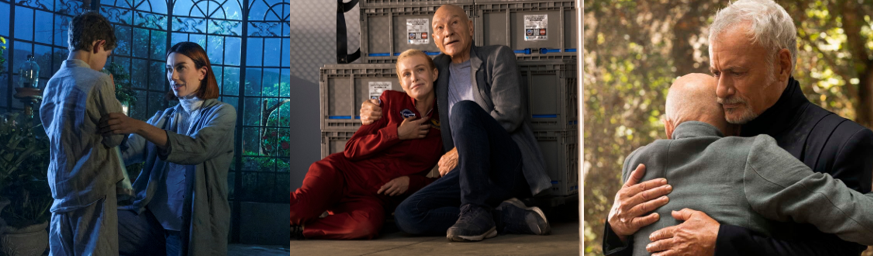
Despite being cured of his fatal illness and gaining a synthetic body, Picard enjoys all the ailments that come with his advanced age. This includes doubts and a resistance towards forming long-term romantic engagements despite the advances of his Romulan housekeeper, Laris (Orla Brady). As long-lived as Picard is, his old Enterprise confidante Guinan (Whoopi Goldberg) remains on hand to offer sage advice, and much of the show is focused on Picard learning to let go of his past and embrace his humanity and the happiness offered by love. Indeed, this is later revealed to be Q’s primary motivation. Although he initially appears as a malevolent figure, a sanctimonious, pompous, malicious demigod seeking to further “test” Picard (and the human race) by forcing him to witness a dystopian timeline where he’s a genocidal madman, Q’s newfound mortality drives him to help Picard face some haunting demons from his past in his own unique way. This season reveals that, as a boy, Picard (Dylan Von Halle) witnessed his abusive father, Maurice (James Callis), drive his loving mother, Yvette (Madeline Wise), to suicide. Q’s manipulation – and Picard’s jaunt to 2024 – force him to see his mother suffered from an unspecified mental illness that made her paranoid and unstable, ultimately driving her to suicide. This event shaped Picard’s entire life, driving him to protect others, stand against injustice, and seek out the truth. However, it weighs heavily on Picard’s conscience and his journey of self-discovery – and forgiveness – is as important as his quest to undo Q’s damage and restore the timeline.

The time travel jaunt sees Picard’s crewmates discovering new aspects to their personalities.

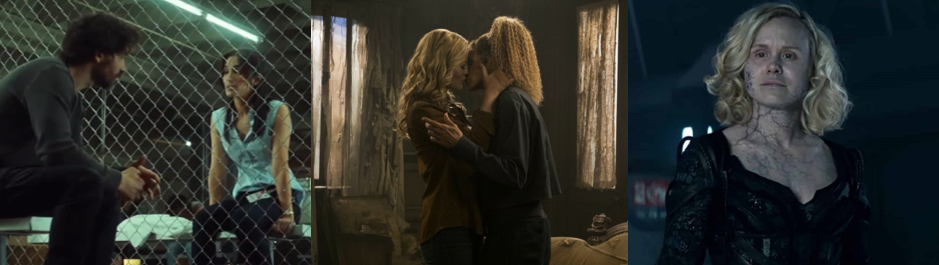
Although they scattered across the galaxy after the first series, Picard’s new crew is reunited by his long-standing nemesis, the Borg. When a gigantic and mysterious Borg craft calls for a parlay, Picard is asked to negotiate, an unusual situation which former Borg Seven of Nine (Ryan) lends her own understandably biased opinion on. Captain Rios is unable to resolve this unexpected situation, however, thanks to Q’s intervention, which sees Picard’s crew deposited in a dystopian alternate timeline where only they retain memories of the way things should be. In this dark world, non-human life is conquered, enslaved, eradicated, and publicly executed by the Confederation of Earth, with Seven (as Annika) as the President and Picard as her military commander. We don’t spend too long in this timeline but it’s enough to establish how awful it is compared to the real world and give Seven a strange euphoria as she finds herself truly human for the first time in decades. When the crew travel to 2024 to undo Q’s interference, Seven explores her newfound humanity. She’s far more cautious, especially compared to hot-headed Raffi, and showcases genuine motion for a change. Seven and Raffi’s partnership leads to some of the show’s most interesting and engaging action sequences and banter as they bicker over the best course of action and balance each other’s different methods towards saving and securing the timeline. This results in them growing so close that they share a kiss by the end, which felt a little out of left field for me. Similarly, the trip to the past has radical implications for Rios, who finds himself separated from his friends and defending Doctor Teresa Ramirez (Sol Rodríguez), her son Ricardo (Steve Gutierrez), and her clinic from overly aggressive immigration officers, falling for her in the process and finding a true home and family for himself at the same time.

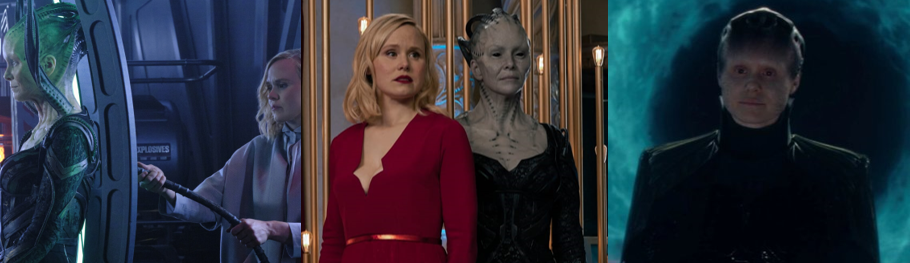
The Borg Queen manipulates Agnes, but soon develops a genuine connection with her.

I was happy to see that Picard is treated much better in this season. Not only does Starfleet treat him with the respect he deserves, but his crew now defer to his wisdom and admire his tenacity. However, there are some wrinkles to this: since the incapacitated Borg Queen (Annie Wersching) is their only hope of saving the future, the crew risk their lives to save one of their most dangerous enemies and coerce her into helping them. This results in Elnor’s death as Picard is forced to prioritise saving the Queen over his former ward. This briefly earns him Raffi’s resentment and, though she soon focuses on the mission, much of her aggression stems from this loss and she’s as haunted by Elnor’s death as Picard is by his own past. Concurrently, Agnes is haunted by her past actions. Although she, like Rios, takes solace in her surrogate family, she can’t help but feel alone and somewhat lost, no matter how hard she tries to help. While the others search 2024 for the elusive “Watcher”, Agnes is left on their damaged craft with the weakened Borg Queen, with whom she’s forced to partially assimilate herself with to direct her team. This leads to the Borg Queen emotionally manipulating Agnes, tempting her with full assimilation to give her the sense of belonging she so desires before infiltrating her mind and her personality. This turns Agnes into a secondary antagonist for the last few episodes as the Borg Queen hijacks her body and creates an imperfect Borg army for herself in a bid to take advantage of her unique position and usher in a new age of Borg dominance. This is prevented not just by the intervention of Agnes’ friends but also Agnes asserting her personality over the Borg Queen, ultimately resulting in them merging into a new entity that heads out into the galaxy to create a new sub-species of Borg, one defined by individuality and co-operation rather than emotionless dominance.

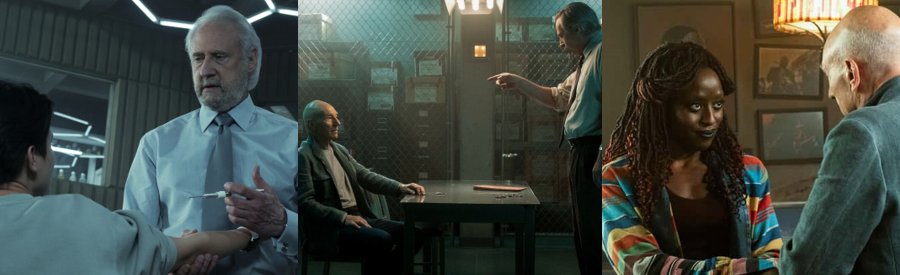
Picard needs the reluctant help of a young Guinan to stop Soong and escape Agent Wells.

Considering how much time season one spent focused on Soji and established her importance to Star Trek lore, she’s basically a non-factor in season two, appearing only very briefly and not even joining the crew for their time travel adventure. Isa Briones appears more prominently in 2024 as Kore Soong, the human (if genetically created) daughter of Doctor Adam Soong (Spiner), the ancestor of the man who would one day create Data. Soong acts as the primary antagonist after his genetic research is lambasted, his funding revoked, and his attempts to cure Kore of her debilitating and fatal genetic illness fail. This drives him to desperation and near madness, allowing Q to offer him the chance to build a legacy in the future by preventing the Europa expedition, thereby creating the dystopian timeline briefly visited at the start of the series. When Kore rejects him after she discovers her true origins, Soong’s perfectly happy to indulge his latent psychotic urges by aligning with the Borg Queen and targeting not just Picard and his allies but also Picard’s ancestor, troubled astronaut Renée Picard (Penelope Mitchell), whose death will usher in Soong’s oppressive legacy. Although Picard galvanises Renée’s spirit and counters Q’s psychological abuse m, his mission is jeopardised by xenophobic Federal agent Martin Wells (Jay Karnes), a man convinced that the Earth is threatened by aliens. Luckily, just as Picard is guided through his own personal traumas by Talinn, Laris’ ancestor who has spent years observing and protecting Renée, so too is he assisted – and ultimately coerce Wells into assisting him – by the young Guinan (Ito Aghayere), a jaded and outspoken younger woman ready to give up on humanity before meeting Picard. This melting pot of motions is only exacerbated by Q. Disgusted by humanity and believing they need to be constantly tested, his sights are firmly set on Picard as the bastion of human determination, Q takes every opportunity to try and break Picard’s spirit and spitefully set time itself against him. This is his misguided way of teaching Picard to embrace the past and move forward stronger for everything he’s suffered through, a test that Picard comes to appreciate, even embracing the dying Q as an old friend before they’re returned to their original timeline, changed but, presumably, stronger despite their losses.

The Summary:
Considering the focus of season one, I was surprised that season two is largely set in 2024 and is, essentially, a remake of Star Trek IV: The Voyage Home spliced with the main plot of Star Trek: First Contact (Frakes, 1996). I didn’t expect this, and I’m not entirely sure how much I enjoyed it. I liked the callbacks to The Voyage Home: the abrasive bus punk (Kirk Thatcher) returns, some of the dialogue (especially Rios’s) is revisited, as is his relationship with Teresa, and many of the plot points are repeated, such as the cloaked ship and Picard and Guinan’s capture. However, I think it might’ve been better to spend half the season in the dystopian future, exploring that world and giving the cast more time to play dual roles (Stewart, especially, revels in masquerading as his militant counterpart). Spending so much time in 2024 makes season two feel decidedly less visually impressive, though does allow for some introspective character development for all involved, especially Picard, who’s forced to relive, confront, and ultimately come to terms with his traumatic past. Equally, as mentioned, Seven explores her humanity in ways we’ve never seen before. I also liked the twist given to Agnes, where she becomes a semi-willing vessel for the Borg Queen, but there’s ultimately not much in season two that we haven’t seen in those aforementioned movies or previous time travel and character-centric episodes of Star Trek.

Some character arcs didn’t land for me or felt undercooked due to lack of focus.

The major themes of season two are confronting the past, finding a place in the present, and embracing the potential of the future. While Rios has found himself as a Starfleet captain and sees Picard as a father figure, he only truly feels a sense of belonging once he settles in 2024 and bonds with Teresa and Ricardo. Although this is his primary (and, arguably, only) character arc in the season, it doesn’t get much of the spotlight. Rios feels a kinship to them out of gratitude, respect, and a sense of injustice after seeing how aggressively they are targeted by immigration officers, but I still felt like his decision to stay in the past was a bit rushed and that the three didn’t connect much despite their obvious chemistry. I felt the same way about the apparent romantic relationship between Seven and Raffi. I must have missed the bisexuality of these characters in the last season and I was more focused on the fun contrast of personalities they exhibited here, so their sudden kiss surprised me as I thought the point of their partnership was to see their personalities grow. Seven conveys much more emotion and her arc is focused on her hatred of the Borg and euphoria at finally being human, culminating in her accepting her renewed Borg implants when Agnes uses the Borg Queen’s technology to save her life and considering a career in Starfleet upon returning to the main timeline. Raffi’s arc is primarily one of revenge: she’s incensed and haunted by Elnor’s death, meaning Seven acts as a counterbalance to keep her emotions in check, but Raffi’s conflicted by the finale as she can’t kill the Borg Queen without losing Agnes. Although I found it surprising that Agnes fell under the Borg Queen’s sway considering all Picard’s advice and her own experiences in the Queen’s consciousness, it makes sense given her personal insecurities and the Queen’s machinations. Their relationship becomes surprisingly mutually beneficial, however, as Agnes enjoys the power and sense of belonging offered by the Borg Queen and the Queen comes to see friendship, co-operation, and emotion as a strength rather than a weakness. This ultimately sees them become a new gestalt entity that hints at a Borg partnership with Starfleet to protect the universe from an unspecified threat.

Though an intriguing dive into Picard’s character, season two fell a little flat for me.

Unlike season one and season three, season two is less a Next Generation reunion and more a character study of its titular protagonist and his crewmates. Yet, there’s time for a quick cameo by former ensign Wesley Crusher (Wil Wheaton), who offers Kore a place with the Travellers, Guinan, and even a new role for Brent Spiner, who’s given another chance to showcase his range as he portrays another maniacal and dangerous Soong variant. As expected, this is Picard’s show, through and through. Freed from his bitterness, but no less burdened by guilt and past trauma, Picard is determined to restore the timeline and thwart Q’s diabolical plot but is surprised to learn new discoveries about himself through Q’s final test. Although vehemently opposed to the demigod throughout the show, Picard ultimately expresses gratitude to his old frenemy and ensures he doesn’t meet his end alone since Q’s actions, though questionable, allowed Picard to accept that his past and opens his eyes to a future with Laris and an alliance with Agnes’s Borg contingent. Ultimately, however, I can’t say that season two is any better or worse than the first. The potential of these new characters and the direction of this season is somewhat squandered by the plot, which is simply a rehash of The Voyage Home, and the season seems to have been engineered to write out many of Picard’s newfound crew rather than bring them closer together. It was a fascinating exploration of Picard, and an interesting twist on the Borg dynamic, but fundamentally lacking in terms of visuals and offering something more explicitly new for long-time Star Trek fans.

My Rating:

Rating: 3 out of 5.

Pretty Good

What did you think to the second season of Star Trek: Picard? Were you disappointed that the plot rehashed The Voyage Home or did you enjoy the time travel jaunt? Did you like that Rios stayed in the past, that Agnes became the Borg Queen, and the evolution of Seven’s character? Were you happy to see Q return and by the revelations into Picard’s childhood? What threat do you think is posed by the transwarp conduit? How are you celebrating Captain Picard Day this year? Whatever your thoughts on Star Trek: Picard, let me know in the comments down below.

Movie Night [Star Trek Day]: Star Trek IV: The Voyage Home


On this day, 8th September 1966, the first episode of Star Trek (1966 to 1969), “The Man Trap” (Daniels, 1966), first aired. Since then, Star Trek has become a massive cultural phenomenon that still endures to this day, spawning numerous continuations, spin-offs, and ancillary media to become, perhaps, the most influential science-fiction franchise of all time. Accordingly, the 8th of September has been deemed “Star Trek Day” and is thus the perfect excuse to dedicate some more time to, and celebrate, this massive sci-fi franchise.


Released: 26 November 1986
Director: Leonard Nimoy
Distributor: Paramount Pictures
Budget: $26 million
Stars: William Shatner, Leonard Nimoy, Catherine Hicks, DeForest Kelley, Walter Koenig, and James Doohan

The Plot:
After resurrecting their crewmate, Captain Spock (Nimoy), Admiral James T. Kirk (Shatner) and the USS Enterprise crew face a court martial for mutiny. However, when an alien probe threatens the Earth, Kirk seeks redemption by time travelling back to the 20th century to acquire the only thing capable of stopping it: long-extinct humpback whales.

The Background:
Although Star Trek: The Motion Picture (Wise, 1979) grossed almost $140 million, it was met with mixed to negative reviews that a disappointed Paramount blamed on Star Trek creator Gene Roddenberry. Luckily, the franchise bounced back with Star Trek II: The Wrath of Khan (Meyer, 1982), widely considered one of the best Star Trek movies, and Paramount was eager to capitalise with a third entry. Although Star Trek III: The Search for Spock (Nimoy, 1984) was the lowest-grossing Star Trek movie at the time,  positive reviews encouraged the development of a fourth film. Although Nimoy was granted additional creative input, star William Shatner was initially unwilling to return, leading to talks of a prequel movie. When Shatner signed on, Nimoy aimed to craft a fun, light-hearted time travel adventure and initially planned for Eddie Murphy to have a starring role before Shatner insisted on having a love interest. Industrial Light & Magic created the film’s models and optical effects, including the mysterious alien probe, though many sets and effects were allegedly reused from previous films. The Voyage Home was the first Star Trek movie to extensively film on location, specifically in and around San Francisco, though the whales were brought to life using cutting edge robotics courtesy of Walt Conti. With a box office of $133 million, The Voyage Home proved to be a financial success. Reviews were equally positive, with the film’s comedic tone, performances, and insightful message counting it amongst the best of the franchise.

The Review:
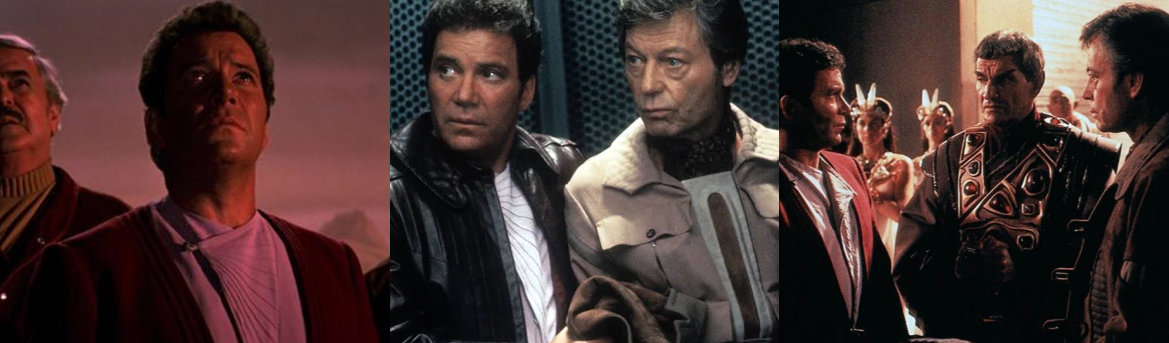
Following a touching dedication to the tragic fate of the Challenger and the title sequence (featuring a suitably bombastic and celebratory score by Leonard Rosenman), The Voyage Home opts to recap the events of the last two films by way of a Starfleet tribunal concerning Kirk and his crew’s actions. Thanks to footage from the previous movies somehow being presented as video evidence, the Klingon ambassador (John Schuck) reframes Kirk as a terrorist who murdered a Klingon crew and stole their ship and accuses him of developing the Genesis Device as a weapon of mass destruction against the Klingon people. Luckily for Kirk, Spock’s father, Ambassador Sarek (Mark Lenard), is on hand to defend Kirk’s actions and equally condemn the aggression of his Klingon enemies. Although Kirk is guilty of violating many Starfleet regulations, the Klingon is dissatisfied and disgusted and vows that there will never be peace between the Klingons and Starfleet “as long as Kirk lives!” We then return to the planet Vulcan, where Kirk and his crew have been exiled for the last three months. In that time, they’ve made some modifications to the Bird of Prey they commandeered in the last film, christened it the HMS Bounty, and have unanimously agreed to return home to face the consequences of their actions.                           

The crew’s voyage home is obstructed by a destructive alien probe.

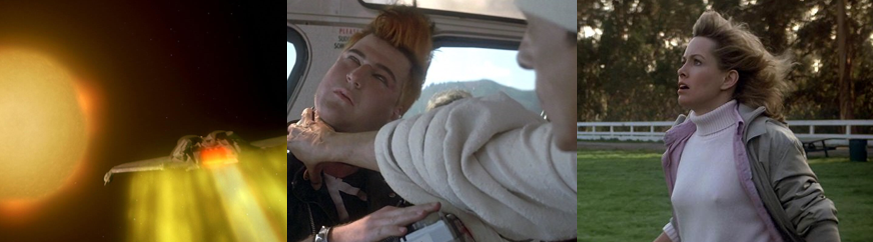
Seemingly no longer burdened by his midlife crisis, Kirk is more weighed down by the inevitable dishonourable end of his Starfleet career than even the death of his son. We get one scene where Lieutenant Saavik (Robin Curtis) tells Kirk about David Marcus’ (Merritt Butrick) bravery and Kirk looks a little forlorn and that’s pretty much it. He doesn’t seem traumatised or grieving and is instead focused on atoning for his actions and helping Spock to reacclimatise to the crew. Since his resurrection, Spock has been testing his intelligence and reasoning ability to retrain his mind and get himself back up to speed. Though seemingly the same logical half-human Vulcan as ever, he’s still a little out of sorts. He’s perplexed by the relevance of his feelings and the illogical nature of his humans, who sacrificed everything to save him only for him to have regressed slightly thanks to his rebirth. While Kirk is confident that Spock will regain his full memories and personality, cantankerous Doctor Leonard “Bones” McCoy (Kelley) isn’t so sure and is the first to point out how unnerving it is that the status quo has been restored like nothing happened. Feeling a sense of kinship with his Vulcan companion that he’s never had before and curious to discuss his experience with death, Bones is aghast to find Spock as stubborn as ever, a quality the Vulcan shares with Kirk as both are seemingly dead set on ignoring the doctor’s wry commentary on and objections to their situation. Interestingly, The Voyage Home is the first Star Trek movie since the dreadful first film to have an otherworldly threat that doesn’t that humanoid form. The alien probe (a pretty basic, cylindrical structure) floats through space continuously broadcasting an incomprehensible signal that is eventually identified as being whale song.

While back in 1986, Kirk enlists the help of a cetologist to acquire some whales.

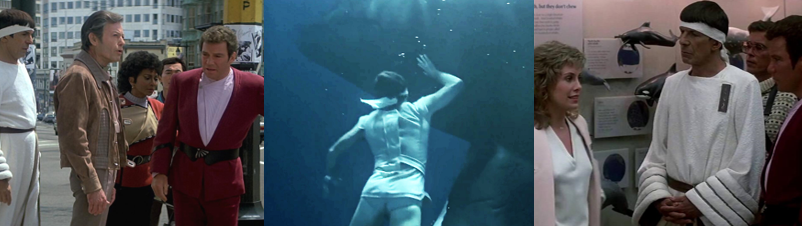
The mysterious probe defies all known sensor readings and explanations and disables the power systems of every ship that comes into contact with it, leaving them powerless and adrift and slowly succumbing the asphyxiation. After disabling both starships and spacedocks, the probe arrives at Earth and wreaks havoc with the atmosphere. This not only devastates all technology and power systems but also whips up destructive planetary storms and causes a thick cloud to block out the sun. With the Earth ravaged by the probe’s attack, Starfleet command have no choice but to warn all ships to stay away from the planet since they’re unable to communicate or engage with the probe. Though equally baffled by the probe’s signal, Spock theorises that it isn’t inherently hostile and that it’s actually trying to communicate with an aquatic lifeform. This allows Commander Nyota Uhura (Nichelle Nichols) to filter the signal and confirm Spock’s suspicions that only whales can respond to the probe. Since humans have hunted whales to extinction and an attack on the probe is deemed futile, the crew have no choice but to pull off a “time warp” by slingshotting the Bounty around the Sun at incredible speeds, a strangely simple concept that is almost laughable in its execution but, thanks to Spock’s “computations”, brings the crew to San Francisco, 1986. Determined to keep a low profile, Kirk and Spock head into the city to locate the source of the whales. Luckily, a bus billboard directs them to Cetacean Institute, a whale-themed facility where “George” and “Gracie” are under the care of cetologist Doctor Gillian Taylor (Hicks). Disgusted by man’s proclivity for hunting whales to the brink of extinction and the ineffectual means of preventing such heinous actions, Gillian greatly cares for George and Gracie, who have been kept in captivity since wandering into San Francisco Bay as calves. Gillian is heartbroken that the whales will soon be released into the wild due to budgetary concerns, which will put them at risk, and is astounded when Spock not only enters the whale enclosure but reveals that the whales are equally fond of her, and that Gracie is pregnant.

The other crew actually get something to do and get into all sorts of bother as a result.

Spock’s mind meld allows him to explain the situation to the whales and gain their consent, and sparks Gillian’s curiosity to the point where she throws caution to the wind and relates her concerns about the whales’ safety. Despite Spock’s amusingly blunt honesty and his notable charisma, Kirk is forced to tell Gillian the truth to win her over and she’s surprisingly chill about his crazy story, primarily because it’s the only viable option she has to keep her beloved whales safe. One positive about The Voyage Home is that it actually gives the rest of the crew something to do for a change; the crew split into teams and sent across San Francisco with specific tasks relating to the success of their mission. Commander Montgomery “Scotty” Scott (Doohan) teams up with Bones and Lieutenant Commander Hikaru Sulu (George Takei) to reconfigure the Bounty’s cargo bay into a whale enclosure, while Commander Pavel Chekov (Koenig) and Uhura are tasked with locating Naval ships to recharge the crude Klingon Dilithium crystals that power the Bounty. Though confused by the era and time displacement, the crew eventually bungle their way to success despite the natives being confused by Chekov’s questions regarding “nuclear wessels”. Alongside Bones, Scotty poses as a professor and meets with Plexicorp manager Doctor Nichols (Alex Henteloff) and provides him the formula for “transparent aluminium” in exchange for using his facilities to build the whale tank in an assumed example of a predestination paradox (i.e. Scotty was fated to provide the formula). While Sulu is relegated only to acquiring and piloting a helicopter to transport this tank, Chekov ends up hospitalised while acquiring the nuclear photons, resulting in a brief bit of drama as the crew infiltrate the hospital so Bones can wake him from his coma.

The Nitty-Gritty:
The Voyage Home is clearly a far more light-hearted film than its predecessors. After battling to defend the Earth from certain death, facing down a deeply personal enemy, and sacrificing everything for their comrade, it’s nice to have a fun, whimsical adventure that offers wry commentary on the state of society in the obnoxiously excessive 1980s. Despite this more light-hearted tone, there’s a strong environmental message at work here. Humanity is doomed to destruction in the far future thanks to overhunting humpback whales and their arrogance to assume that extraterrestrial life would only be interested in communicating with humans, and there’s a clear commentary on the beauty and wonder of these magnificent creatures that that are still tragically low in number. However, despite the catastrophic threat posed by the alien robe, there’s a distinct lack of stakes here. Wonky time travel logic means that the crew don’t even face the danger of a ticking clock and can effectively take as long as they like to acquire the whales since they can just travel back to the future at any time. Thus, the drama comes from them bungling through 1986 culture to recharge and prepare the Bounty and Kirk’s attempts to woo Gillian into aiding them in bringing George and Gracie to the 23rd century before they’re let loose into the wild.

Unfortunately, most of the film takes place in 1986 and focuses on comedy rather than space action.

One aspect of The Voyage Home that has always irked me is how cheap the production is; almost everything is recycled from the last two films, including the crew’s wardrobe, the sets, and the models. I can’t totally begrudge this as it makes sense, in continuity, to carry these elements over but you’d think that Kirk and the others would’ve had some Vulcan clothing after spending three months there! This is most obviously felt in the fact that the film largely takes place in 1986 thanks to some janky time travel physics, meaning a lack of space action and battles. This is a bit of a shame as the model work and practical effects remain as charming as ever and the depiction of time warp, through the use of surreal imagery and conflicting sound bites, is very interesting. I also liked seeing the crew on the dingy Bounty and forced to adapt to its less refined Klingon specifications, and that the ship was almost shaken to pieces by travelling at such impossible speeds, but it spends most of the film parked and cloaked in Golden Gate Park since the focus is more on the comedic shenanigans of placing the crew in the primitive then-modern day. There’s a fair bit of comedy to be had in this setting, though; the crew are like fish out of water and are confused that whales are in the city (since I guess zoos aren’t a thing in the future), puzzled by the clothing and “colourful metaphors” of the less civilised inhabitants, and with little idea of the concept or value of money and the primitive technology of the time. This leads to some of my favourite scenes of the film, such as Kirk and Spock encountering a particularly abrasive bus passenger (Kirk Thatcher), Scotty trying to communicate to the PC through the mouse, Chekov’s madcap infiltration of a military submarine and subsequent interrogation, and Bones’ grumbling disregard for the primitive medicine of these “Dark Ages”. Still, it is a bit disappointing that so much of the film is set in 1986; it makes for some fun moments, but it hardly screams big-budget sci-fi adventure, and the focus is more on comedy and awkward interactions between the crew and the inhabitants of the time.

Kirk’s time travel shenanigans result in him being reinstated as Captain and back on the Enterprise.

Although Kirk could head to the open sea to get the whales they need, he’s determined to take George and Gracie since it’s not only “better” for everyone but also much easier. Scotty makes the modifications to the Bounty, Sulu acquires a helicopter, and Uhura successfully recharges the Dilithium crystals, but Chekov is injured escaping military custody and the window for acquiring the whales becomes narrower when they’re unexpectedly released early. Gillian is finally convinced to trust Kirk when she learns of the whales’ early release; beamed aboard the Bounty, Gillian quickly overcomes her confusion and awe of the future technology to provide Kirk with the means to track the whales. However, he makes a detour to rescue Chekov from the hands of “butchers” (with even Spock voicing his approval of the effort since it is the “human thing to do”). Although Kirk insists that Gillian can’t come with them, she leaps into his transporter beam and accompanies the crew as they track George and Gracie to Alaska, where they arrive in time to defend the whales from pirates, transport them aboard, and successfully return to the future based on Spock’s “best guess”. Upon arrival, the Bounty is immediately crippled by the probe and crashes into San Francisco Bay where, after a dramatic pause, they answer the probe and cause it to leave Earth space, thus ending its threat and restoring power to the ships it crippled. In the aftermath, Kirk and his loyal crew face the court martial but, in light of their heroic activities, Starfleet shows leniency. Kirk is demoted to Captain and given command of a new ship, the USS Enterprise-A. After bidding farewell to Gillian as she disappears forever to join the crew of a science vessel, Kirk and his crew return to the bridge of their iconic ship and prepare for new adventures into the great beyond.

The Summary:
I’ve never really been much of a fan of Star Trek IV: The Voyage Home. Even as a kid, I felt like it was a bit of a step back since I mainly watch Star Trek for fun, space-based actin and adventure rather than comical jaunts to the past or dull political intrigue. Still, there’s a lot of heart and charm to this film; the cast are all clearly having a lot of fun wandering the city streets and interacting with everyday people, and this is reflected even in the normally stoic Spock, who can’t help but show his joy in the finale. The environmental message is very on the nose, but I think it works as a bit of a wakeup call regarding our place in the world, and the universe. The very animals we hunt to extinction could be all that’s saving us from destruction, which is a relevant message, but the film delivers it a little awkwardly. For instance, George and Gracie’s bloodline probably won’t last long enough to defend the world if the alien probe returns and it’s a bit impractical to keep time travelling for more whales. Luckily, I don’t think Star Trek ever returned to this plot point, or used Gillian again, but this sadly makes The Voyage Home even less relevant. I would’ve liked to see more emotion from Kirk, maybe explore his grief over his son’s death, and a bit more emphasis on Spock’s renewed life. The status quo was restored a little too fast, robbing the film and characters of some potential depth, and the reliance on comedy only exacerbates that. I like the feeling of light-hearted relief, but I’m hardly invested in the mission as there’s no sense of urgency or threat. Ultimately, The Voyage Home is like an extended epilogue to the last film that serves only to restore the crew to their rightful ship and ranks. The message is poignant, and the film is enjoyable at times; I liked that most of the crew actually got something to do and had some little side missions. However, I prefer the more intense space operas of the other entries so I can’t rank this one much higher.

My Rating:

Rating: 3 out of 5.

Pretty Good

Are you a fan of Star Trek IV: The Voyage Home? What did you think to the tonal shift towards comedy? Did you enjoy the time travel plot or did you also think it was a bit of a cheap follow-up? What did you think to the environmental message and the depiction of time travel? Would you have liked to see more focus on Kirk’s grief and Spock’s rebirth? Which Star Trek captain, crew, show, or movie is your favourite and why? How are you celebrating Star Trek Day today? No matter what you think, leave your thoughts down below or leave a comment on my social media and check out my other Star Trek content.

Movie Night [Captain Picard Day]: Star Trek: Insurrection 


As amusing detail in the Star Trek: The Next Generation (1987 to 1994) episode “The Pegasus” (Burton, 1994) is that the crew and children of the U.S.S. Enterprise-D celebrate “Captain Picard Day” on Stardate 47457.1, which roughly translates to this day, the 16th of June. They do this by producing drawings, models, and paintings that the bewildered Captain Jean-Luc Picard (Patrick Stewart) must then judge. I, however, am using this as another good excuse to delve into some more Picard and Next Generation content.
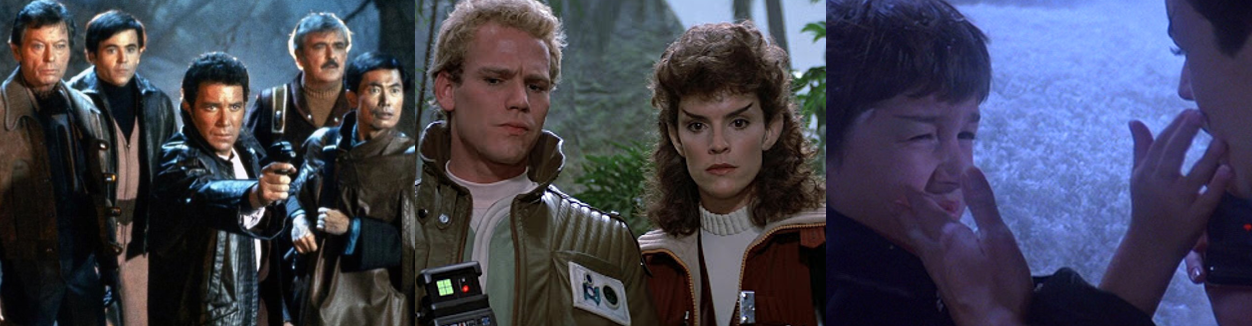

Released: 11 December 1998
Director: Jonathan Frakes
Distributor: Paramount Pictures
Budget: $70 million
Stars: Patrick Stewart, F. Murray Abraham, Brent Spiner, Donna Murphy, Jonathan Frakes, Marina Sirtis, and Anthony Zerbe

The Plot:
When Captain Picard uncovers a Starfleet conspiracy to steal the rejuvenating properties of the peaceful Ba’ku, the crew of the U.S.S. Enterprise-E rebels to protect the functionally immortal adopted inhabitants from being forcibly relocated by corrupt Admiral Matthew Dougherty (Zerbe) and the warmongering Ahdar Ru’afo (Abraham).

The Background:
Once the popular Star Trek: The Next Generation series came to an end, the crew followed in their predecessors’ footsteps and moved on to the big screen. Although the highly anticipated meeting between Captain Picard and Captain James T. Kirk (William Shatner) failed to live up to the potential of its premise, it did well at the box office. However, while the sequel (one of my favourite Star Trek movies), Star Trek: First Contact (Frakes, 1996), outdid its predecessor considerably with its $30 million gross, Paramount wished to lighten to tone for the next film. After some deliberation, writer Michael Piller based the story around the quest for everlasting youth; one draft saw Lieutenant Commander Data (Spiner) killed off, and star Patrick Stewart was adamant that the script remain true to his arc from First Contact by fighting an ethical battle. Star Trek: Insurrection was the first Star Trek film to replace traditional model shots with CGI sequences, though fifty-five full sets were constructed to build the Ba’ku village and the Son’a were brought to life through extensive prosthetics and make-up effects. With a worldwide gross of over $117 million, Star Trek: Insurrection made a bit less than its predecessor and was met with mixed reviews. Critics noted that the film was little more than an extended episode of the TV series and a sluggish experience, though others were impressed by the performances and character moments. Of course, the Next Generation crew would return regardless for an unmitigated critical and commercial, leading to a franchise reboot in 2009 before the cast and crew finally reunited almost twenty years after their last adventure.

The Review:
It’s a commonly held belief that all the odd-numbered Star Trek movies are bad, and all the even-numbered Star Trek movies are good; while this is naturally subjective (I prefer the fifth movie to the sixth, for example), I can’t deny that Star Trek: First Contact is one of my favourites in the franchise. After the snore-fest that was Star Trek Generations, First Contact delivered all the action and intrigue I’d expect from a Next Generation film so I was naturally excited to see what the crew would get up to in their next film. Imagine my disappointment to find that Star Trek: Insurrection was a more light-hearted, character-driven romp that was both a re-framing and a contradiction of the Next Generation episode “Journey’s End” (Allen, 1994). Don’t get me wrong, I fully understand that Star Trek is about much more than just space battles and action-orientated plots, but some of the worst episodes across the franchise are those that focus more on politics, philosophy, and slower, less engaging plots so I’ve often had a contentious relationship with this film. Ironically, Star Trek: Insurrection forgoes a lengthy title sequence and instead displays the titles while introducing us to the Ba’ku, who live a simple live free of technology. They’re people of the land who grow their own food and work together in peace and harmony, and have no idea that Starfleet are secretly monitoring them using special cloaked suits and a cloaked outpost. However, the Ba’ku are alerted to their presence when Lieutenant Commander Data suffers a sudden malfunction, attacking Starfleet’s officers and their Son’a allies, exposing them to the locals and terrifying children like Artim (Michael Welch).

When Data malfunctions, Picard investigates and uncovers a startling Starfleet conspiracy.

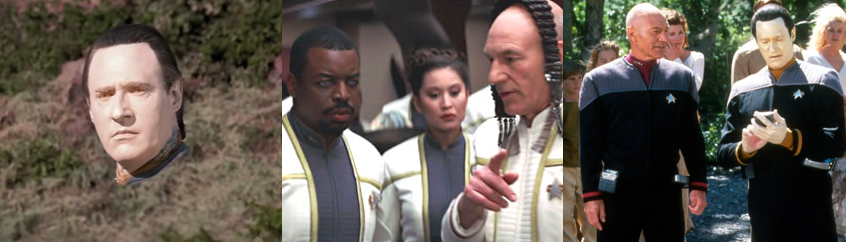
When we catch up with Data’s crewmates, they’re in the midst of welcoming a new, if technologically underdeveloped, race into the United Federation of Planets to help replenish the Federation’s losses at the hands of the Borg and the Dominion. This, sadly, just makes me wish that we’d had a Next Generation/Deep Space Nine (1993 to 1999) film that focused on the conflict with the Dominion. Not only was this a catastrophic and significant story in Star Trek lore, it also would’ve given the Deep Space Nine cast some time in the spotlight. Instead, we’re left with Picard’s awkward (if amusing) interactions with the relatively primitive Evora and an explanation for Lieutenant Commander Worf’s (Michael Dorn) presence that’s so weak the characters simply interrupt him rather than dwell on it. Luckily for Picard, Admiral Dougherty pulls him away from these diplomatic duties to request Data’s schematics; although Picard supplies this information, his concern for his friend and crewmate sees him disregard Dougherty’s suggestion to avoid coming in person because of “environmental concerns”. When they arrive, Data is said to have taken hostages and has stolen a Federation shuttle and Dougherty is under pressure from his Son’a ally, Ahdar Ru’afo, to destroy the android. Picard convinces the Admiral to let him and Worf attempt to shut Data down by distracting him with an amusing chorus from H.M.S. Pinafore; or, The Lass That Loved a Sailor (Sullivan and Gilbert, 1878), only to be embarrassed when Data’s “hostages” have been treated as guests by Anij (Murphy) and Sojef (Daniel Hugh Kelly). Picard is both disgusted to find that Starfleet have been wilfully disregarding the “Prime Directive” of non-interference by spying on the Ba’ku and surprised to find the Ba’ku are a warp-capable race with considerable knowledge of technology, they just choose not to employ it in favour of enjoying the tranquillity of their adopted world and the “metaphasic particles” that bestow rejuvenating effects upon them.

Both Picard and Data connect with the Ba’ku and strongly opposed Starfleet’s plans to relocate them.

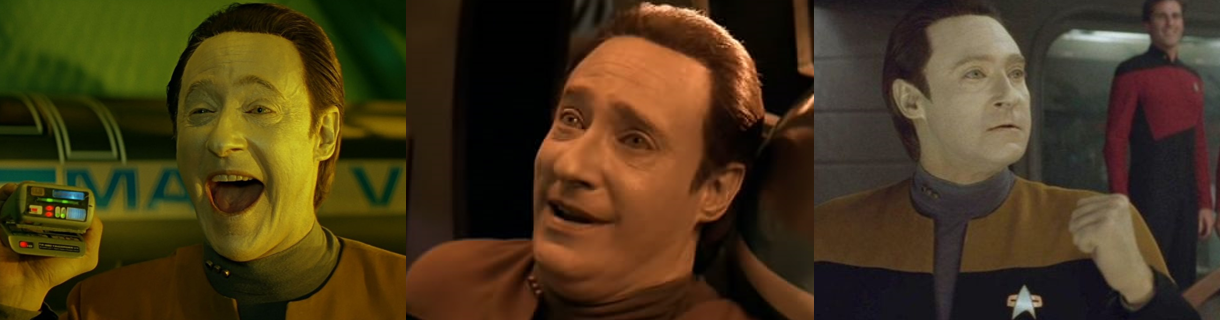
Picard feels a renewed vigour thanks to the Ba’ku and an intense admiration for the culture, alongside an obvious attraction to Anji that drives him to learn more about their people and their journey. Sojef reveals that the Ba’ku were once on the verge of self-annihilation and fled to establish a peaceful sanctuary some 309 years previously, and Picard is disgusted by the plot to relocate the Ba’ku, who refuse to take up arms and lower themselves to war. Thankfully, Picard is outraged by the blatant disregard for Starfleet’s guiding principles and is on-hand to fight for their continued survival. He’s in awe of their unique affliction, which enables them to live longer, healthier lives, continuing an ongoing theme of his advancing years and mortality that’s laced throughout the Next Generation movies. Although tempted to bask in the Ba’ku’s power, Picard’s knowledge of human history drives him to oppose Dougherty’s schemes; aghast by the Federation Council’s claim upon the Ba’ku, Picard has an impassioned, defiant confrontation with Dougherty and essentially goes rogue from Starfleet to prevent past atrocities happening gain. While initially somewhat hostile towards Picard, Anji is unique amongst her people in that she has a fascination for technology; she’s horrified to discover that the Federation are planning to covertly take her people off-world but warms to Picard after being amused by his curiosity. She encourages him to take the time to embrace the moment, to stop analysing and just give himself fully to life, a perception heightened by the Ba’ku and which allows them (and, eventually, Picard) to effectively slow down a single moment in time in order to appreciate life and survive fatal injuries. Although he’s now capable of expressing emotions, Data remains as curious and socially awkward as ever. Star Trek: Insurrection explores new layers of his humanity and character growth through his relationship with Artim, a Ba’ku boy both fascinated and afraid of the android’s capabilities since he’s grown up devoid of technology. Although it takes some effort for Data to convince Artim that he’s not a threat, Artim eventually teaches Data the value of playing and having fun, allowing Data to experience a degree of the light-hearted focus of the film despite not being affected by the metaphasic particles. Data also proves invaluable in setting the plot in motion since it’s his brief malfunction that attracts Picard to the Ba’ku, is instrumental in getting Picard and Anji to safety by acting as a flotation device, and he who exposed the Federation plot.

The rejuvenating effects of Ba’ku affects the crew in emotional and comedic ways.

The Ba’ku’s metaphasic particles have a rejuvenating effect on the rest of the crew as well (strangely even before the Enterprise-E reaches Ba’ku), though it’s primarily played for laughs through Worf’s struggles withs Klingon boils and rising “aggressive tendencies” due to essentially suffering through Klingon puberty. The planet’s influence also gives Commander William Riker (Frakes) and Counsellor Deanna Troi (Sirtis) the chance to rediscover their passion for each other with carefree, adolescent playfulness. This not only sees Troi shave Riker’s trademark beard (in a sensual bubble bath, no less) after reacting with impish disgust to his facial hair and rekindle their romantic relationship, injecting a little flirtatious sexuality into the usually less romantically inclined Next Generation narrative. In addition to joining Picard’s rescue team, Doctor Beverly Crusher (Gates McFadden) reveals the extent of the planet’s rejuvenating effects to the captain through examinations of the crew, noting increased metabolism and energy from exposure to the metaphysic particles. She’s also the one who delivers crucial exposition into the Son’a, revealing that they and the Ba’ku are one and the same. Concerned for his friend’s welfare, Lieutenant Commander Geordi La Forge (LeVar Burton) puts his engineering expertise and knowledge of Data’s systems to work to discover that the android was damaged by a Son’a phaser after he discovered the elaborate holoship they plan to use to smuggle the Ba’ku off the planet. Throughout the film, Geordi struggles with his cybernetic optical implants, but sadly misses out on exploring the emotional potential of his restored eyes in any depth; however, Burton expresses profound emotion in conveying Geordi’s appreciation at seeing a sunrise with his own eyes for the first time in his life. Although Picard fully intends to go solo in his mission to defend the Ba’ku, Worf, Data, Troi, and Crusher rebel alongside him while Riker and Geordi appeal to the Federation Council. Although reluctant to rely on technology to safeguard his people, Sojef mobilises a mass evacuation to the tunnels in the surrounding mountains while Picard and his crew defend them from the Son’a attack

Dougherty allies with the Son’a, unaware that they wish to destroy their benevolent kinsmen.

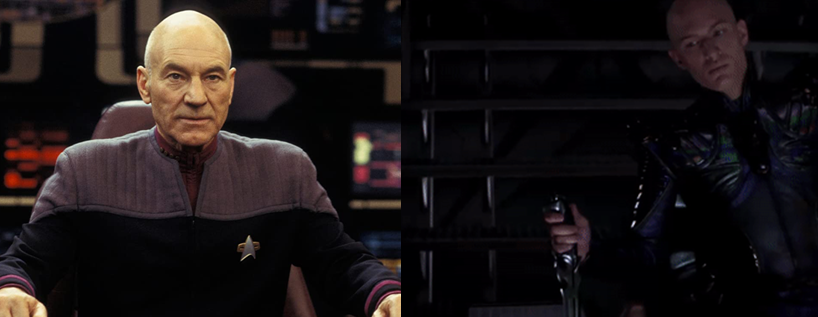
Dougherty has allied with the Son’a and their leader, Ahdar Ru’afo, in a bid to monitor and safely displace the Ba’ku so as to harness the metaphasic particles for wider use. This is an alliance of convenience since only the Son’a have the means to harvest the particles, but Dougherty sees Ba’ku as a chance to save and improve countless lives despite the fact that this will essentially leave the planet a barren wasteland. While Dougherty fully believes that he has every right to do this since the Ba’ku barely number six-hundred and aren’t indigenous to their world, he’s adamant that the mission falls within strict Federation procedures, meaning he values subterfuge and patience to avoid unnecessary attention and bloodshed. Ru’afo finds Dougherty’s insistence on rules and regulations first amusing and then increasingly aggravating since he believes it’s slowing things down when brute force would achieve the same means much faster. Riker and Troi’s research show the Son’a to an aggressive, oppressive, war-like race who conquer and subjugate others for riches and power, but Dougherty is forced to rely on their weapons and expertise since the Son’a are exiles from the Ba’ku people and thus offer unique insight into the planet’s metaphasic properties. Ru’afo’s frustration not only comes from his jealousy and desire to avenge himself on his former people, but also a desperate need to bask in the Ba’ku’s rejuvenating properties since he’s reached the limits of genetic manipulation and many of his people cannot afford to wait for the particles to naturally improve their condition. Ru’afo and his people are dangerous and driven, but essentially outcast adolescents lashing out at their parents; we see this in Ru’afo’s right-hand man, Gallatin (Gregg Henry), who begins to doubt their mission as Ru’afo’s mania increases. Played with an intense, psychotic glee by accomplished stage actor F. Murray Abraham, Ru’afo’s true nature is exposed as his aggravation increases. While he goes along with Dougherty’s plan to covertly relocate the Ba’ku, he convinces the Admiral to sign off on an attack on the Enterprise-E (in one of my favourite exchanges in the film) when they refuse to leave the area and violently ends their partnership when Dougherty and his “procedures” get in his way once too often, leaving Ru’afo free to harvest the metaphasic particles with destructive force.

The Nitty-Gritty:
I mentioned earlier about the themes of mortality; the idea of Picard’s days being numbered and time being against him permeates the Next Generation films and is a clear holdover from the Original Series movies, where the advancing age of these characters was often at the forefront. Star Trek: Insurrection gives the whole crew the chance to rediscover their youth; renewed by the Ba’ku, there’s a playful energy on the Enterprise-E that sees even Picard revelling in his newfound energy. Picard, who has spent most of his life in space going from mission to mission, is severely tempted to slow down and settle on Ba’ku, whose people are free from the burdens of responsibility, and feels more alive than ever thanks to the planet’s influence. This is in stark contrast to the Son’a; exiled from the planet after a destructive rebellion, the Son’a are bitter and twisted and clinging to life by any means necessary, desperate to avenge themselves on their parents like raging children. Finally, a huge aspect of Ru’afo’s frustration with Federation procedures is predicated on his belief (and that of many during this time) that Starfleet, like Dougherty, is “old”. Extremists such as he recognise that the Federation has suffered crippling losses recently and is losing support, allowing him to aggressively influence the Admiral’s reluctant approval for the Son’a to intercept the Enterprise-E.

What little space action there is here is, like many effects, spoiled by poor CGI.

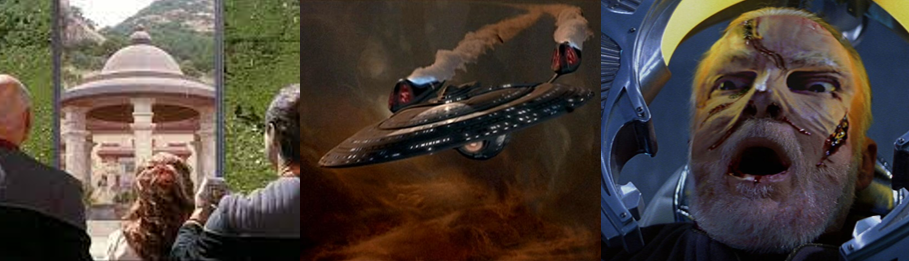
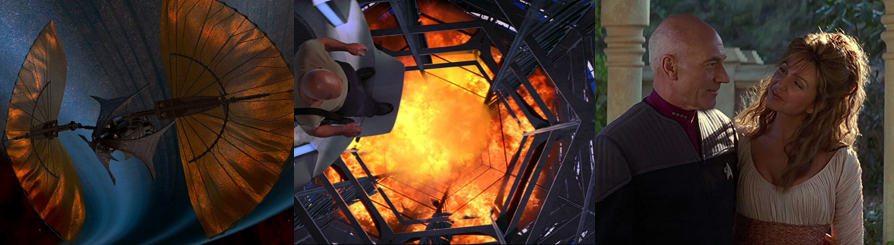
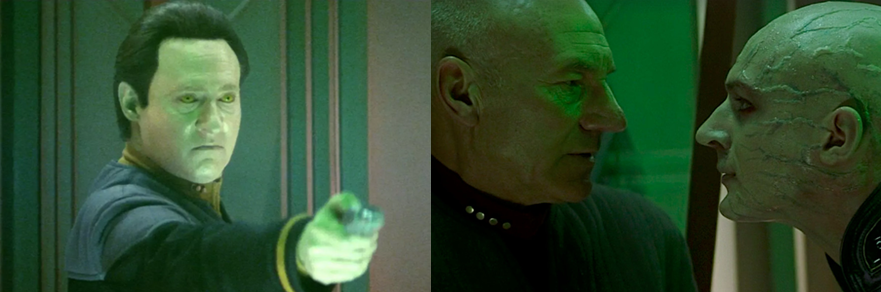
Star Trek: Insurrection does offer a few new visuals amidst its mostly middling plot; the opening sequence, in which Data attacks Starfleet personnel while partially cloaked, showcases some fun invisibility effects, as does the massive cloaked holoship that fascinates both Artim and Anji and reveals to Picard the blasphemous extent of Dougherty’s plan. However, I can’t help but notice that the ships and space action have taken a dramatic step back; CGI seems to have replaced all the traditional model shots and it looks down-right cartoonish at times, robbing Ru’afo’s flagship and its skirmishes with the Enterprise-E of a lot of their appeal. Once again Riker is left in command of the Enterprise-E and, once again, he’s hampered by environmental factors; the “Briar Patch” that surrounds Ba’ku makes space combat extremely dangerous, and the Son’a’s employment of a “subspace weapon” leaves Geordi with no choice but the eject the warp core to save the ship and Riker forced to manually highly volatile “metreon gas” to destroy the Son’a ships. However, most of  action sequences take place on the planet’s surface; Picard and Data have a brief shoot-out with a Son’a guard aboard the holoship but the most prominent action sequences come as Picard and the others desperately defend the Ba’ku. This sees the village bombarded by phaser shots as the Son’a target the transport inhibitors, has Picard and the others fending off Son’a drones that forcibly transport the Ba’ku, and leaves Anij near death from the Son’a attack. Conversely, the Son’a are presented as one of the more unsettling Star Trek species; without the rejuvenating effects of Ba’ku, the Son’a have taken on a decrepit, almost mummified appearance. They’re forced to rely on genetic tampering and surprisingly gruesome cosmetic surgery to prolong their lives, warping and stretching their skin to the point where they are almost unrecognisable from their people, the Ba’ku, and often suffer from splits and lesions when they become too emotional. Although the CGI used to render their skin-stretching technology leaves a lot to be desired (especially compared to the more practical effects used to achieve the same means), it does result in a gruesome death scene for Admiral Dougherty when Ru’afo forces him into the machine and tears his face apart.

Although tempted to stay after Ru’afo’s defeat, Picard chooses to continue fighting oppression.

Despite Picard, Worf, and Data’s best efforts to get the Ba’ku to safety, most of them are abducted by the Son’a, including Anij and Picard, who’s more than ready to face a court martial if it means exposing Dougherty’s plot and reveals that the Admiral has gotten mixed up in a blood feud between the exiled Son’a. With the misguided Dougherty dead, Ru’afo orders the deployment of the “collector” (a set of sadly laughable CGI solar sails), despite Gallatin’s reservations about annihilating their former people. Picard appeals to Gallatin’s humanity and convinces him to aid him in opposing Ru’afo’s plan. Data then distracts Ru’afo with tachyon bursts to his flagship, forcing Ru’afo to reset their shield frequencies to avoid being destroyed by the “thermolytic reaction” the collector will produce. This creates an opening for an entertaining deception that sees the Son’a transported, en masse, to the holoship and momentarily fooled by a holographic simulation. Ru’afo quickly discovers the trick and is enraged; he transports himself directly to the collector to restart the process and Picard is forced to confront him, one-on-one, in the collector’s surprisingly sparse control room. After giving Ru’afo the runaround, Picard prepares to meet his end to destroy the collector and save the Ba’ku; luckily, the Enterprise-E arrives just in time to beam him to safety, leaving Ru’afo to go up in flames with his diabolical aspirations. Thanks to Riker, Starfleet halt the Ba’ku relocation plan and launch a full investigation and the remaining Son’a surrender, allowing Gallatin to bashfully reunite with his parents on Ba’ku. Although tempted to stay on the planet, and with Anij, Picard vows to continue protecting the universe from threats both foreign and domestic to ensure that the Federation doesn’t lose its way and repeat the worst mistakes of human history, and the crew return to the ship victorious, reinvigorated, and ready for their next adventure.

The Summary:
Even now, I remain conflicted about Star Trek: Insurrection: on the one hand, it’s a decent, surprisingly emotional adventure for the crew and a far more light-hearted escapade than the last film but, on the other hand, Star Trek: First Contact set a pretty high standard and Insurrection doesn’t come close to matching it. Fundamentally, they are two different films, however, just as different episodes of Star Trek told different stories and had different aspects that made them appealing. Some prefer the character-based stories; others the diplomatic stories or ruminations on age, humanity, and morality; and others prefer the more action-orientated episodes. For me, a Star Trek movie needs to hit all of those beats to have the most appeal and, while Star Trek: Insurrection does try to do this, it falls a little flat for me and comes across as a far too subdued production as a result. It’s a shame as there are some interesting elements here; the continued narrative of Picard’s age, for one thing, and the presentation of Starfleet as a less benevolent entity. Picard shines through his staunch defence of the Ba’ku but it’s interesting to learn that he had completely different stance on the same matter in “Journey’s End”. I liked seeing the crew be affected by the metaphasic particles, even if it is largely just played for laughs, and it’s mildly adorable to see Data explore what it means to be a child and Picard to consider settling down, even if neither of these plot points carry through to the next film. F. Murray Abraham was great as the conniving, desperate Ru’afo; I loved his frustration with Dougherty and his rules, but it’s not enough to salvage the film for me, especially when you remember the lacklustre special effects. Ultimately, it’s a more subdued and grounded Star Trek adventure but one I rarely find myself revisiting or really thinking about, so I’d still choose to watch Star Trek: First Contact any day.

My Rating:

Rating: 2 out of 5.

Could Be Better

What did you think to Star Trek: Insurrection? Where does it rank against the other Next Generation and Star Trek films for you? Do you prefer its more light-hearted, grounded story? What did you think to Ru’afo and the gruesome depiction of the Son’a? Did you enjoy seeing the crew be more playful and relaxed? What did you think to the idea that Starfleet would so brazenly abandon their principles? How are you celebrating Captain Picard Day today? Whatever your thoughts on Star Trek: Insurrection, or Star Trek in general, go ahead and share them below and be sure to check out my other Star Trek reviews.

Movie Night [Star Trek Day]: Star Trek III: The Search for Spock


On this day, 8th September 1966, the first episode of Star Trek (1966 to 1969), “The Man Trap” (Daniels, 1966), first aired. Since then, Star Trek has become a massive cultural phenomenon that endures to this day, spawning numerous continuations, spin-offs, and ancillary media to become, perhaps, the most influential science-fiction franchise of all time. Accordingly, the 8th of September has been deemed “Star Trek Day” and is thus the perfect excuse to dedicate some more time to, and celebrate, this massive sci-fi franchise.


Released: 1 June 1984
Director: Leonard Nimoy
Distributor: Paramount Pictures
Budget: $16 million
Stars: William Shatner, Christopher Lloyd, DeForest Kelley, Robin Curtis, Merritt Butrick, and Leonard Nimoy,

The Plot:
Still reeling from the death of his friend, Captain Spock (Nimoy), Admiral James T. Kirk (Shatner) is shocked to learn that Spock placed his “katra” in the mind of Doctor Leonard “Bones” McCoy (Kelley). Determined to reunite Spock’s spirit with his restored body on the Genesis planet, Kirk defies Starfleet’s direct orders but soon comes into conflict with a hostile Klingon, Kruge (Lloyd), who wants Genesis’s secrets for himself.

The Background:
Despite grossing almost $140 million, Paramount were disappointed with Star Trek: The Motion Picture (Wise, 1979), which was met with mixed to negative reviews. Since the studio placed most of the blame on Star Trek-creator Gene Roddenberry, it fell to Harve Bennett to pen the far more critically lauded sequel. Although Star Trek II: The Wrath of Khan (Meyer, 1982) made less at the box office than its predecessor, it was incredibly influential and is widely considered one of the best Star Trek movies. Paramount’s eagerness to capitalise on Wrath of Khan’s success was matched by Nimoy’s renewed interest in his iconic character and the actor readily agreed to return and to direct the third film. Bennett and Nimoy collaborated on the script to come up with a plausible way to bring Spock back from the dead using inspiration from the television show, and it was Bennett who came up with the idea to destroy the Enterprise to subvert audience expectations. With a slightly bigger budget than Wrath of Khan, the filmmakers were given more money for special effects scenes; Industrial Light & Magic produced the effects and models for the film, including an elaborate Spacedock and a large and threatening Klingon Bird of Prey, though many of the interiors were redressed sets to save money. While friendship, specifically the bond between Kirk and Spock, was at the heart of the film, Nimoy wanted The Search for Spock to be operatic in its scope, and to develop the Klingon species beyond the television show to be allegorical stand-ins for Soviet Russia. With a worldwide box office of $87 million, The Search for Spock was the lowest-grossing Star Trek movie at the time; reviews, however, were generally positive. Its grandiose scope was praised, as was the direction and chemistry between the actors, though the film has been criticised for being overplotted and arbitrary. In the years since, The Search for Spock has gained something of a cult following; while I often regard it as inferior to The Wrath of Khan, some believe it’s an under-appreciated entry in the series and have attempted to sing its praises as a result.

The Review:
I hate to be cliché, but The Wrath of Khan is definitely my favourite of the classic Star Trek movies (although, truth be told, I have a soft spot for Star Trek V: The Final Frontier (Shatner, 1989), which I feel is an under-rated entry). I think a lot of this is because The Motion Picture was so dreadfully God-awful, and the second film just nailed the characterisations and atmosphere that I was looking for in a Star Trek film. It also helps that Spock’s death was so tragic; Kirk’s eulogy is still one of the most heart-breaking scenes in cinema for me, even though I know full well that Spock returned just two years later. It’s interesting to me that The Wrath of Khan included a tease for this; it’d be so easy to retroactively extend the recap of the last film at the start of this one with new footage of the “Remember” moment between him and Bones, but the producers clearly never intended Spock’s death to be permanent when they made Wrath of Khan, which you could argue diminishes Spock’s sacrifice somewhat but I’d still say it’s a deeply emotional scene regardless. If Spock’s death hit me hard, it practically cripples Kirk; in the last film, it was stated that Kirk had “never faced death” and that he didn’t believe in a “no-win situation”, meaning he was arrogant enough (even in his advancing age) to think that he could think, fight, or talk his way out of any situation to avoid having to face such a loss. Consequently, Spock’s death hit Kirk like a brick wall and he’s still carrying the grief and guilt of that loss at the start of this film, despite having discovered and built a fledgling relationship with his recently discovered son, Doctor David Marcus (Butrick).

Determined to undo his greatest failure, Kirk defies orders to reunite Spock’s soul with his restored body.

Already struggling to cope with the loss of his dear friend, and feeling like he’s left a part of himself on the Genesis planet with Spock’s corpse, the suggestion from the last film’s finale that Kirk has rediscovered his zest for life has been replaced with a sullen despair at how empty the Enterprise feels with Spock dead and David and Lieutenant Saavik (Curtis) off exploring Genesis. In addition to these concerns, and the strange behaviour of Bones, Kirk is astounded to learn from Admiral Morrow (Robert Hooks) that the Enterprise is to be decommissioned rather than refit since Starfleet feels “her day is over”. This continues the themes of age established so well in the last film and, when his attempts at diplomacy are rebuked since Starfleet has designated the Genesis planet as top secret, Kirk is compelled to steal his ship to reunite Spock’s spirit with his body. This mission is only made possible thanks to the arrival of Spock’s father, Sarek (Mark Lenard), who initially believes Spock passed his katra to Kirk and rebukes the Admiral for leaving his son’s body behind. Reviewing footage from the last film and realising that Spock’s soul dwells in McCoy, Kirk is once again reinvigorated and happily defies Starfleet orders to try and make up for his previous failure and restore his beloved friend. Kirk is stunned when Bones starts begging (in Spock’s voice) for help and to be returned “home” to Vulcan. Bones’s mind has been fractured by Spock’s consciousness, which intrudes upon his normally grouchy demeanour and results in some amusing scenes where Bones (who was routinely aggravated by Spock’s cold, logical nature) despairs over the illogical nature of alcohol and unsuccessfully attempts to perform the Vulcan nerve pinch. The Search for Spock gives Bones the rare opportunity to be more than the cantankerous ship’s doctor; Kelley now channels Nimoy’s mannerisms and line delivery into his performance, and Bones is left both perplexed by his condition and resentful towards Spock for lumbering him with such a burden in, what he sees as being “revenge for all those arguments [Spock] lost” to him.

The ruthless Kruge will do anything to get his hands on Genesis, even killing Kirk’s son!

Honestly, it’s been tough for every subsequent movie since Wrath of Khan to top the malicious menace and scene-stealing threat of Khan Noonien Singh (Ricardo Montalbán) but The Search for Spock certainly gives Kirk’s most infamous rival a run for his money with Kruge. Although Star Trek movies overly relied on the Klingons as a persistent antagonistic force, this maniacal Klingon commander is probably their most memorable villain thanks to the grandiose and operatic performance by Christopher Lloyd. Barely recognisable under the Klingon’s heavy make-up, Lloyd exudes menace and is absolutely captivating in every scene thanks to a barking, sinister eloquence. Kruge’s cold-blooded ruthlessness is established right away during his introduction when he casually executes his lover, Valkris (Catherine Shirriff) since she viewed the Genesis data. A cruel and calculating villain who is determined to bring honour to himself, his crew, and the Klingon Empire, Kruge commands absolute authority onboard his monstrous Bird-of-Prey; when his gunner (Bob K. Cummings) lands a “lucky shot” on the Grissom, Kruge is outraged and vaporises the Klingon since he “wanted prisoners” (this immediately paints him as going against Klingon tradition as Kirk stated in the last film that “Klingon’s don’t take prisoners”). Having witnessed the destructive potential of the Genesis Device, Kruge is obsessed with obtaining the secrets of Genesis for himself and use it as a weapon to establish himself as the premier Klingon force in the galaxy. So consumed by this desire is Kruge that he refuses to listen to pleas for mercy; gleeful at having David and Saavik as leverage to force Kirk to give in to his demands, he thinks nothing of ordering one of them killed and, in that moment, earns Kirk’s wrath after his proxy (Dave Cadiente) murders David in cold blood.

While the rest of the crew don’t get much to do, David and Saavik try to help the restored young Spock.

Spock’s death is like a heavy weight baring down on the entire Enterprise crew; Commander Pavel Chekov (Walter Koenig) reluctantly takes Spock’s place as interim Science Officer for their journey back to Spacedock, made possible thanks to chief engineer, Commander Montgomery “Scotty” Scott (James Doohan). Although the Enterprise suffered massive damage in the last film, Scotty fixes it up for the trip back and promises to fully repair it within two weeks (rather than eight). Despite receiving a promotion to Captain and being assigned to Starfleet’s greatest ship yet, Excelsior, Scotty is dismayed about the Enterprise’s decommissioning since he has put so much of himself into the ship and is only too happy to assist Kirk in stealing the Enterprise. Although Commander Nyota Uhura (Nichelle Nichols) and Lieutenant Commander Hikaru Sulu (George Takei) are instrumental in freeing Bones from Starfleet custody (Sulu even gets a quick fight scene out of it) and stealing the Enterprise, the crew still don’t get much to do other than stand around, frantically pilot the ship, and react with dismay when David is killed, though they willingly stand by Kirk out of sheer loyalty despite knowing that they will all face a severe court-martial for their actions. Since the Genesis planet is such a scientific wonder and a controversial subject, Morrow forbids any talk or travel to the planet. David and Saavik are onboard the science vessel Grissom and marvel at the various terrain, weather, and geological properties of the planet. Notably absent is David’s mother, Doctor Carol Marcus (Bibi Besch); Kirk takes her place as the narrator of the Genesis Device and David is now the principal scientist behind the technology, which is revealed to have used experimental “protomatter” to stabilise the device and create “life from lifelessness”. Despite her cold, Vulcan logic, Saavik is clearly disgusted by David’s recklessness, which has resulted in the planet becoming violently unstable and teetering on the bring of destruction, spawning mutated parasitic lifeforms, and had the unexpected side effect of restoring Spock’s body and forcing him to rapidly advance from a child, to a youth and, finally, to a full-grown adult. Essentially a mindless, agonised, and confused form, Spock is comforted throughout his tumultuous changes by Saavik but incapable of anything other than tortured screams as his body rapidly changes and he suffers the painful effects of “Pon Farr”. The Search for Spock introduces some interesting twists to Vulcan society; it is apparently the way of their species to transfer their consciousness to another before death, but it’s not made clear how their katra is normally restored to their body as the ritual is said to not have been performed since “ages past”(“and then only in legend”, hardly inspiring confidence) and it’s not as if dead bodies are routinely restored to life like Spock’s was here.

The Nitty-Gritty:
The Search for Spock was probably the most ambitious Star Trek movie to date in terms of its visual effects; model shots and traditional cinematic techniques like matte paintings and practical props are aplenty here, though admittedly many ships are repurposed from previous Star Trek movies. While the space battles aren’t as prominent as in the last film since the Enterprise is in no condition for combat and is manned by a skeleton crew, Kruge’s Bird-of-Prey still makes an impact with its fearsome design and destructive phaser blasts. Much of the film is set on the tumultuous Genesis planet, a man-made world best by chaos; snow, desert, forests, and mountains are scattered haphazardly across the surface and conditions constantly change in violent ways. The planet appears to be directly tied to Spock’s physical and mental wellbeing, meaning when he suffers the agony of Pon Farr the climate shifts and ominous thunderstorms blare overhead. This allows for a great deal of variety in the film’s locations, and we even get to see a little variety off-planet as Bones tries to charter a ship in a seedy bar and Kirk and the others have to liberate him from a holding cell at Spacedock. Spacedock itself is finally explored as well, and much grandeur is made of the Excelsior, which results in some amusing scenes when Scotty sabotages the trans-warp ship and the Enterprise barely manages to escape from Spacedock before crashing into the doors.

Kirk’s mission results in him suffering even greater losses in the pursuit of being reunited with his friend.

Despite having devoted himself to the ideals and expectations of Starfleet, Kirk doesn’t hesitate to defy Morrow’s direct order; although he emphasises that he doesn’t expect his loyal crew to follow him further than to the Enterprise, he’s grateful for their support in journeying to Genesis even though he knows that it means they’ll all face punishment for their mutinous actions. Still, the chance to reunite Spock’s immortal soul with his restored body is seen by Kirk as worth the risk but comes to cost Kirk more than he bargained for. Although the Enterprise manages to put up a fight against Kruge’s Bird-of-Prey, a stalemate ensues when Kruge threatens his hostages to learn the secrets of Genesis. When the Klingons attempt to kill Saavik in a demonstration of power, David desperately defends her and is killed in the process. This loss hits Kirk hard; seeing Kirk collapse in stunned shock, his distressing cries of “Klingon bastards…you’ve…killed my son!”, is disturbing not just to his crewmen but also the audience. After a lifetime devoted to gallivanting across the stars and having missed out on most of David’s life, Kirk was just finally starting to build bridges with the misguided scientist when Kruge’s order ripped him away from him with a violent callousness that only galvanises Kirk’s hatred for the Klingon species for years to come. As if this tragedy wasn’t bad enough, Kirk is forced to sacrifice his beloved ship; since the Enterprise is still suffering from her battle with Khan, the ship ends up summarily disabled by Kruge’s firepower and Kirk is forced to activate the self-destruct sequence to take out Kruge’s boarding party. Thus, for the second film in a row (and for a second time in a row), Kirk (and the audience) are forced to endure a disastrous loss; the visual of seeing the iconic starship burst apart and then careen through the sky as a flaming husk is a powerful one, one that is just as harrowing for Kirk as the loss of his friend and son since he’s literally giving up the most important aspects of himself to bring Spock back.

Ultimately Kirk bests Kruge and Spock’s spirit is restored, much to the joy of his crewmates.

Still, the sacrifice enables Kirk and his crew to beam safely to the Genesis planet, where they’re stunned to see Spock restored and suffering from his unnatural aging. Despite the planet being ravaged by severe storms, Kirk takes the time to cover up his son’s body, and then lures the callous Klingon commander to the planet’s surface by promising him the knowledge he desires. Although Kirk convinces Kruge to beam the others to the Bird-of-Prey, Kruge spitefully refuses to take Spock along and, refusing to back down even though the planet is literally being torn apart around them, a final confrontation between Starfleet’s most celebrated commander and the vindictive Klingon ensues. Naturally, Kirk is no physical match for the superior Klingon, but he’s fuelled by a need to avenge his son and protect his restored friend; this, in addition to the constantly shifting, “exhilarating” landscape, essentially means the two are almost on equal ground. With flames and lava spewing around them and the ground cracking apart, Kirk ultimately sends his hated enemy plummeting to the molten rock below when Kruge refuses Kirk’s attempt to save his life. Feigning Klingon, Kirk and Spock are beamed to safety and his crew easily take control of the Bird-of-Prey and pilot it to Vulcan. There, much to Sarek’s dismay at Kirk’s losses and gratitude for his heroics, the Enterprise crewmen witness an ancient ritual in which a wizened Vulcan priestess, T’Lar (Dame Judith Anderson), successfully transfers Spock’s katra from Bones’s mind and into Spock’s restored body. Although T’Lar stresses that the “fal-tor-pan” poses a great danger to both Bones and Spock, the re-fusion is successful with very little fuss and fanfare and, while understandably confused, Spock soon recognises his friends and crew as they joyfully gather around him, grateful to have their companion returned to them despite the heavy price they paid.

The Summary:
There’s a stigma that all the odd-numbered Star Trek movies are “bad”. I can somewhat understand this given how terrible the first film was and how some seem to suffer more than others, but I’ll never concede that the ultra-dull Star Trek VI: The Undiscovered Country (Meyer, 1991) is better than The Final Frontier (because…it’s not!) and, similarly, The Search for Spock also bucks the trend a bit. I think the biggest issue facing this film is that it followed the universally lauded Wrath of Khan, and the entire thrust of its plot is undoing one of the most memorable and impactful moments of that film (and in all of Star Trek), all of which place the film at a severe disadvantage from the get-go. I think viewing it now, with the benefit of hindsight and in the grand scheme of things, helps to elevate The Search for Spock’s stock somewhat; the film is a great continuation of the themes and characterisations established in the last film, and aims to be a feel-good coda to Wrath of Khan’s dour ending. The conclusion of The Search for Spock largely delivers on this, with the crew’s elation at Spock’s return being evident but the film is actually one of he bleakest and most tragic Star Trek movies. David, a character who really got the shaft and could’ve been moulded into a young, fresh-faced addition to the aging cast, is unceremoniously killed before we ever really get the chance to know him and what could be more impactful than the death of a beloved character like Spock than seeing the Enterprise go down in flames? The film also seems to undo or walk back many of the messages of the last film, with the needs of the one now outweighing the needs of the many, but the underlining message of The Search for Spock seems to be one of hope. If you have a chance to redeem a mistake or save a loved one, you must do everything in your power to fulfil that, whether that means defying your superiors or sacrificing your livelihood. It’s a poignant theme that definitely underscores the bond between Kirk and Spock, but I can understand how it’s a little muddled amidst all the tragedy that befalls Kirk in service of this mission. Ultimately, The Search for Spock is a pretty decent third entry; it’s worth it for the amusing moments, Christopher Lloyd’s stellar performance, and the continuation of Kirk’s character development into a more jaded individual. While it doesn’t quite live up to the standards of the last film, I still rather enjoy it as one of the more under-rated Star Trek films.  

My Rating:

Rating: 3 out of 5.

Pretty Good

Where does Star Trek III: The Search for Spock rate for you amongst the other Star Trek films? What did you think to it as a follow-up to The Wrath of Khan and do you think it succeeded, or failed, to match its predecessor? Did you enjoy Christopher Lloyd’s portrayal of Kruge? What did you think to his ruthless methods, the killing of David, and the destruction of the Enterprise? Were you happy to see Spock’s return or do you feel like the cost was too great? Which Star Trek captain, crew, show, or movie is your favourite and why? How are you celebrating Star Trek Day today? No matter what you think, leave your thoughts down below or leave a comment on my social media.

Movie Night [Captain Picard Day]: Star Trek Generations


As amusing detail in the Star Trek: The Next Generation (1987 to 1994) episode “The Pegasus” (Burton, 1994) is that the crew and children of the U.S.S. Enterprise-D celebrate “Captain Picard Day” on Stardate 47457.1, which roughly translates to this day, the 16th of June. They do this by producing drawings, models, and paintings that the bewildered Captain Jean-Luc Picard (Patrick Stewart) must then judge. I, however, am using this as another good excuse to delve into some more Picard and Next Generation content.
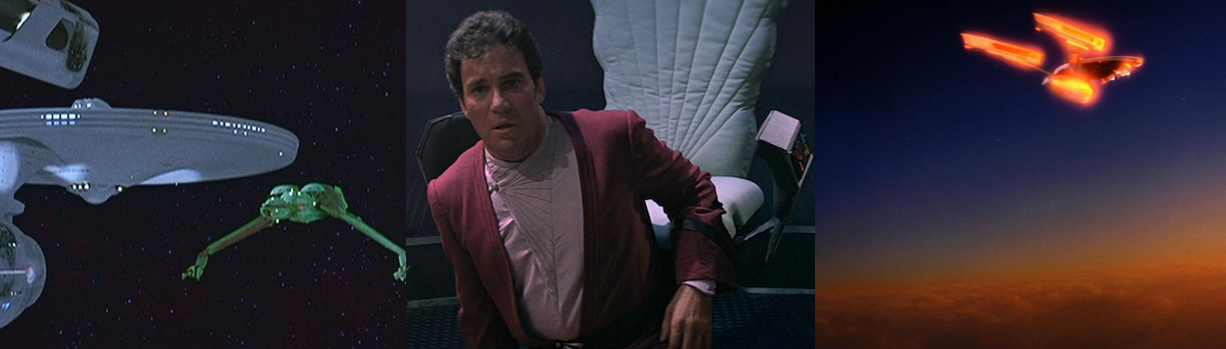

This review has been supported by Chiara Cooper.
If you’d like to support the site, you can do so at my Ko-Fi page.

Released: 18 November 1994
Director: David Carson
Distributor: Paramount Pictures
Budget: $60 million
Stars: Patrick Stewart, Malcolm McDowell, Brent Spiner, Jonathan Frakes, Levar Burton, and William Shatner

The Plot:
When Captain Jean-Luc Picard (Stewart) and his crew investigate a Romulan attack and rescue Doctor Tolian Soran (McDowell). Soran forces the Enterprise-D into a conflict with the Klingons so that he can return to an extra-dimensional realm known as the “Nexus”, a plot that threatens to destroy entire worlds and sees Picard entering the Nexus to recruit the help of the legendary Captain James T. Kirk (Shatner).

The Background:
Once the popular Star Trek: The Next Generation wrapped up, the crew, like their predecessors, featured in a series of feature-length films. Writers Ronald D. Moore and Brannon Braga were recruited mid-way through The Next Generation’s sixth season to pen the script for the crew’s first big-screen outing, which was always framed around the idea of the Original Series (1966 to 1969) crew passing the torch, or outright doing battle with, their Next Generation successors, though the writers struggled to find a way to have the multi-generational crews meet face-to-face. Determined to aim high, the writers and producer Rick Berman hit upon the idea of killing the iconic Captain Kirk, a decision which both the studio and Shatner had some concerns about. For the transition to the silver screen, production designer Herman Zimmerman improved many of the Next Generation sets, giving them a new coat of polish and designing an elaborate new area, stellar cartography, for a key scene in the narrative, while Bill George gave the Enterprise-D a touch up for cinema screens. Star Trek Generations also marked the first use of extensive CGI for many of the model, space, and battle scenes, which very quickly became the norm for future Star Trek projects. Star Trek Generations grossed $118 million at the box office, making it a financial success, but was met with mixed reviews; critics complained that it felt more like a longer episode of the TV series and relied too much on audience familiarity, and many criticised the film for killing Kirk in such an underwhelming fashion. What should have been an iconic meeting of two prominent Star Trek characters was seen as a disappointing waste of potential, with Patrick Stewart generally regarded as the superior actor of the two, and many of the film’s other plot points were seen as equally disappointing. These days, Star Trek Generations remains divisive, but it did result in a series of bonkers novels written by Shatner that returned his famous character to life for further adventures.

The Review:
I’ve talked a bit about this before, but I was firmly a Next Generation fan as a kid; my only real experience to the Original Series came from the films, as the show just wasn’t on terrestrial television when I was growing up, so it was Next Generation and onwards for me. Still, I was fascinated by the concept of the Original Series and had been won over by the cast and characters from the majority of their feature-film adventures, so the idea of seeing interactions between them both was very exciting for me as a Star Trek fan. I believe I’d seen the two-part Next Generation episode “Unification” (Landau; Bole, 1991) prior to this, or not long after, which offered a rare cross-generational moment when Picard encountered Ambassador Spock (Leonard Nimoy), but it seemed like it would be all-but-impossible to get the Enterprise-A and Enterprise-D in the same place at the same time due to the massive time gap between the generations, so Star Trek Generations had a hell of a lot of potential and promise in its premise alone.

Picard is distraught when his family is killed but is the only one strong enough to reject the idyllic Nexus.

Following a dramatic opening sequence in which he learn that Kirk was presumably lost when the ridiculously unprepared Enterprise-B was damaged by a destructive energy ribbon later identified as the “Nexus”, Star Trek Generations jumps ahead to the then-present day some eighty years later to find the crew of the Enterprise-D celebrating the promotion of Lieutenant Worf (Michael Dorn) to Lieutenant-Commander on a holodeck simulator. Unfortunately, Picard’s jovial mood soon takes an unexpected and crushing blow when he receives word that his brother and nephew, Robert (Jeremy Kemp/Ian Abercrombie) and René (David Tristan Birkin/Christopher James Miller), have perished in a fire at Château Picard. This leaves Picard in an extremely vulnerable place for the majority of the film; struggling to process his grief, he becomes irritable and snaps at his crew, most notably Commander William Riker (Frakes) and Lieutenant-Commander Data (Spiner). Sympathy from Counsellor Deanna Troi (Marina Sirtis) allows him to open up (in actual fact, he breaks down in an uncomfortably awkward sequence) about the fire, but he remains somewhat shell-shocked by the realisation that his family line has effectively ended with the death of his young nephew. Consequently, he has a contentious relationship, to say the least, with the concept of time; feeling his age and the weight of what could have been baring down on top of him, he’s fascinated by the allure of the Nexus, which promises its occupants their ideal life at the cost of denying the reality of the outside world. Despite his pain and doubts, Picard remains a stern, but fair, commanding officer and throws himself whole-heartedly into trying to predict and ultimately stop the ribbon’s destructive path. He’s also the only one of the three Nexus occupants to actively reject the paradise dimension through the sheer force of his conviction to making a difference in the galaxy and living a life worth remembering while he has the time, regardless of what he does or doesn’t leave behind.

After a social faux pas, Data installs an Emotion Chip but struggles with the new sensations it brings.

As is generally the case with the Next Generation feature-films, it’s Data who receives the biggest sub-plot out of the rest of the Enterprise-D crew; just as Picard struggles with his emotions, Data finds himself perplexed at his continued inability to grasp basic human concepts such as “humour” and is so disturbed at having misunderstood the concept and upsetting Doctor Beverly Crusher (Gates McFadden) that he resolves to install the “Emotion Chip” (retrieved from his twin “brother”, Lore (also Spiner), in the episode “Descent, Part II” (Singer, 1993)). Data’s struggles to process and adapt to the sudden influx of emotions is a recurring element of the film, and a significant character arc for him; at first, he’s excited at exploring positive emotions and his increased range of comprehension and emotion, and this gives Spiner a chance to be much more whimsical with the normally logical android and leads to some of the film’s more amusing moments as Data is hit with a case of the giggles and does a little sing-song when asked to scan for lifeforms. However, he soon becomes overwhelmed by them, and the accompanying negative emotions, when the chip overloads his positronic relay. After being crippled by fear, Data is left guilt-ridden when his friend, Commander Geordi LaForge (Burton), is captured by the Klingons and begs to be deactivated until the chip can be removed so he can be spared his pain. This, however, acts as a thematic parallel to Picard’s own pain and the Captain encourages Data to work through his emotions since learning to process the good and the bad is all part of being human, which includes making mistakes and learning how to overcome fear and doubt. Ultimately, Data resolves to continue on and make amends for his mistake, though Geordi shows no ill-will towards his friend, which results in him ending the film as a far more emotionally expressive character than the one we followed in The Next Generation, which would continue to be seen in subsequent Next Generation movies.

Having had a taste of the Nexus. Dr. Soren is obsessed with returning to the virtual paradise it offers.

The film’s primary, tangible antagonist is Dr. Soren, played with scenery chewing (if sadly underutilised) malice by the fantastic Malcolm McDowell. McDowell certainly has the menace and acting chops to match wits with Stewart/Picard, but Dr. Soren doesn’t really make for an especially intimidating villain, despite the fact that his obsession with the Nexus has led to the destruction of numerous starships and even entire planets. Like Guinan (Whoopi Goldberg), Dr. Soren is a long-lived El-Aurian whose race were decimated by the Borg and scattered throughout the galaxy; prior to this, he was a gentle and kind-hearted man, but the Borg attack and the loss of his beloved wife and children changed him, scarred him, for life. Dr. Soren came to regard death as in inevitability and time as a predatory animal hunting every lifeform in existence, and actively sought to defy both by losing himself to the Nexus. Having experienced a taste of paradise about eighty years previously before being torn away by the Enterprise-B, Dr. Soren has explored every possibility to re-enter the Nexus and concluded that the only way to guarantee that he survives the cross-dimensional trip is to forcibly direct the energy ribbon towards Veridian III, an action that will cause (and has caused) the cataclysmic destruction of entire worlds. Dr. Soren, however, cares little about this; he even allies with the Klingon sisters Lursa (Barbara March) and B’Etor Duras (Gwynyth Walsh) to stave off the Enterprise-D (using Geordi as an unwilling spy) long enough for him to destroy the Veridan star and enact his plan and refuses to listen to Picard’s pleas for sanity. Dr. Soren is a driven, single-minded villain who is absolutely fixated on returning to the Nexus whatever the cost; he cares nothing for the death and destruction his actions will cause, or how reprehensible his wife would find his actions, and is simply consumed by not only his selfish and maniacal desires but also his fear regarding the inevitability of death.

Kirk is convinced to leave the Nexus on the promise of making a difference to the galaxy once more.

As is only fitting, Kirk – and his Original Series cohorts Commander Montgomery “Scotty” Scott (James Doohan) and Commander Pavel Chekov (Walter Koenig) – is treated with reverence and respect by John Harriman (Alan Ruck), Captain of the Enterprise-B, and are mobbed by adoring reporters, all of whom regard the trio as “living legends”. In keeping with much of his characterisation throughout the Original Series movies, Kirk is a man at a crossroads; very much retired, he is literally itching to get back into action and only stops himself from interfering in Harriman’s actions out of a begrudging respect for the fact that he (as in Kirk) is no longer in command. While his experience and knowledge clearly outweigh those of Harriman, Kirk only gets involved when all other options are exhausted; once he does, he immediately comes up with a variety of possible solutions using the Enterprise-B’s limited capabilities to try and rescue the ships threatened by the Nexus, and even appears to die when successfully helping the ship escape the ribbon’s destructive path. However, it’s revealed that Kirk’s actually been transported to the Nexus; although Kirk’s been presumed dead for almost eighty years, from his perspective he only just arrived in the paradise dimension and, once there, his priorities immediately shift. Kirk sees the otherworldly nirvana as a second chance to make good on all the things he ignored in favour of galivanting across the galaxy and vehemently resents Picard’s suggestion that he’s turning his back on his duties as a Starfleet officer. Kirk feels he has more than paid his dues and that “the galaxy owes [him] one” but sees a lot of himself in Picard; straight-laced and obsessed with “duty and obligation” at the expense of his personal life and wants, but the pull of adventure ultimately lures Kirk into one last hurrah. The interactions between Kirk and Picard are easily the best part of the film, and the verbal jousting and banter they share for the entirety of the final act is incredibly surreal and enjoyable; Kirk represents what Picard could become if he doesn’t realise that he needs to appreciate life outside of Starfleet, and Picard offers Kirk one last chance to “make a difference” like he used to on a near-daily basis and to experience the excitement and danger he felt as Captain of the Enterprise rather than languish in a dream-like dimension.

The Nitty-Gritty:
It’s hard to argue with those who were disappointed that Star Trek Generations just feels like a longer, mediocre episode of The Next Generation; the film drags unnecessarily with many of its plot points and, especially, in its pacing. Not only are the film’s uniforms wildly inconsistent, constantly shifting between the Next Generation and Star Trek: Deep Space Nine (1993 to 1999) outfits, but it doesn’t even feature the iconic Star Trek theme until the closing credits and begins with a long, drawn out, sombre title sequence in which nothing of any great interest happens and we’re not even treated to a rousing score to get us excited. Obviously, it would be a bit misleading to act as though the film was going to be this action-packed spectacle, but the point is that Star Trek Generations could’ve, and should’ve, been so much more and it fumbles the ball right off the bat. The clue’s in the title: “Generations”, and yet we barely get much interaction between Kirk and Picard and they’re pushed together in one of the most contrived ways imaginable. Maybe it’s just me, but I would have much preferred seeing all of the Original Series crew back in action, in the Enterprise-A, and going head-to-head and battling alongside their Next Generation counterparts.

Sadly, there’s not much for the others or Klingons to do, and Riker even destroys the ship!

Unfortunately, many of the Original Series cast declined to join the production, primarily because they were reduced to glorified cameos in the opening. Consequently, while it’s fun seeing Scotty and Chekov again, it’s nothing compared to what could have been had the entire crew been a part of the film. Sadly, as is often the case, many of the supporting characters are pushed aside so the film can focus on Picard, Data, and the main antagonist. I’m no fan of Riker but Picard’s enigmatic First Officer really doesn’t get all that much to do here; he’s concerned for Picard’s welfare after the Captain is uncharacteristically snappy with him and leads the away teams that investigate the Amargosa observatory, but Generations isn’t a great character moment for Riker as the Enterprise-D is crippled, and ultimately unsalvageably downed, by a twenty-year-old Bird of Prey when he’s left in command! Still, at least he’s at the forefront of that; Deanna tries to console Picard after learning of his loss but has little else to do, Dr. Crusher is primarily there to facilitate Data’s decision to install the Emotion Chip, and Worf may as well not even be in the film since he’s mainly there for a bit of comic relief at the start and offering a tiny piece of advice regarding the aforementioned Bird of Prey (this does result in the Enterprise-D destroying their foe, but I imagine the crew would have figured out how to do that without Worf). Geordi gets a minor sub-plot after he’s captured by the Klingons and Dr. Soren installs a hidden monitoring device in his visor so the Klingons can penetrate the Enterprise-D’s shields (something I really don’t think their obsolete ship should’ve been able to do), and a surprising amount of screen time is given to Guinan, who proves to be much more than a simple bartender when she’s able to give Picard information about the Nexus since she also experienced a taste of it during the opening scene. Finally, there’s the Duras sisters, two Klingon villainesses previously encountered by Picard in the two-part episode “Redemption” (Bole; Carson, 1991) and seemingly included in a desperate attempt to inject some much-needed action and suspense into the otherwise dull main plot and because it’s tradition to have antagonistic Klingons in Star Trek.

Although Dr. Soren’s mad obsessions are ended, the Enterprise-D is destroyed and Kirk dies in the process.

Star Trek Generations is rife with many themes that fans of the Original Series will be more than familiar with; Kirk, more than anyone, embodies a sense of regret over putting his space adventures ahead of more grounded needs, such as having a family and a life of his own. He’s astounded to find that his former helmsman, Captain Hikaru Sulu (George Takei), found the time to start a family and raise a child, Ensign Demora Sulu (Jacqueline Kim), and continues to be torn between wishing he’d done things differently and the allure of being in a position of command on a starship. Family is another important theme in Generations; Dr. Soren’s entire mission and descent into villainy was precipitated by the loss of his family and Picard’s sullen demeanour is brought about by the realisation that his family line will end with him. When he’s in the Nexus, Picard is literally bombarded by the idyllic family life he has long been denied and is momentarily overwhelmed by the illusion, but ultimately rallies against it because not only is it not “real” but there are countless lives at stake should he choose to remain there. This, more than anything, is what convinces Kirk to also leave the Nexus and help Picard oppose Dr. Soren in the finale; originally, Picard was unable to deactivate Dr. Soren’s solar missile and subdue the El-Aurian since he was but one man, but Kirk’s presence is enough to change events in their favour and allow Picard the chance to rig the missile to explode on its launching pad, taking Dr. Soren with it and allowing the Nexus ribbon to harmlessly pass by. Unfortunately, not only is the Enterprise-D left irreparably damaged but Kirk is killed during the fracas when he’s literally crushed under a bridge. While it’s an admittedly anti-climatic death for Star Trek’s most iconic character, it’s still a poignant scene when Kirk dies knowing that he made a difference one last time and it’s pretty heart-breaking to see him realise that death has finally caught up with him. Oddly, Picard chooses to honour Kirk by burying him on Veridian III, but he returns to the Enterprise-D wreckage with a newfound respect for life and determined to make his mark while he still has the time rather than being consumed by his regrets and losses.

The Summary:
I’m a little torn when it comes to Star Trek Generations; it was the first Next Generation movie I saw and, having grown up watching that series more than any other Star Trek show, it was exciting to see a feature-length adventure for “my crew”, especially one that promised to include a meeting between them and their Original Series predecessors. I don’t think the plot should’ve been like “Trials and Tribble-ations” (West, 1996) but I think more effort could’ve gone into making equal roles for each generation of crewmen and bringing them together. Like, maybe the Nexus caused havoc in the past and present, and both crews were encountering and investigating it simultaneously, causing a rift in space/time that allows a brief battle and some fun interactions to take place before both ships join forces against Dr. Soren. This also would have potentially allowed the producers to avoid killing off Kirk and served as an actual passing of the torch between the two generations rather than the more private and subdued team-up between the two Captains, which arguably comes at the cost of interesting sub-plots and actions for most of the Enterprise-D crew. Instead of this, or something actually exciting and engaging, we get a largely mediocre and forgettable Star Trek film that completely fumbles the potential of its premise and doesn’t really give us any interesting space action to compensate. While its ruminations of family, loss, and obsession are interesting, and it offers significant character development for Picard and Data, there’s ultimately very little here to really make much of an impact. Thankfully, the follow-up would make up for this with some intense action sequences and equally poignant moments, but this only serves to highlight how disappointing the Next Generation’s debut feature was not just for those characters but also as a swansong for Captain Kirk.

My Rating:

Rating: 2 out of 5.

Could Be Better

What did you think to Star Trek Generations? Where do you rank it against the other Next Generation and Star Trek films? Were you also disappointed by Kirk’s anti-climatic death and the mediocre meeting of him and Picard? What did you think to Dr. Soren and his obsessive mania? Were you a fan of Data’s struggle with his newofund emotions, and what did you think to the destruction of the Enterprise-D? Would you like to see another go-around for the Next Generation crew or do you prefer to see new, unique takes on the franchise? How are you celebrating Captain Picard Day today? Whatever your thoughts on Star Trek Generations, or Star Trek in general, share them below or drop a comment on my social media.

Movie Night [Star Trek Day]: Star Trek II: The Wrath of Khan


On this day, 8th September 1966, the first episode of Star Trek (1966 to 1969), “The Man Trap” (Daniels, 1966), first aired. Since then, Star Trek has become a massive cultural phenomenon that still endures to this day, spawning numerous continuations, spin-offs, and ancillary media to become perhaps the most influential science-fiction franchise of all time. Accordingly, the 8th of September has been deemed “Star Trek Day” and is thus the perfect excuse to dedicate some more time to, and celebrate, this massive sci-fi franchise.


Released: 4 June 1982
Director: Nicholas Meyer
Distributor: Paramount Pictures
Budget: $12 million
Stars: William Shatner, Ricardo Montalbán, Leonard Nimoy, DeForest Kelley, Kirstie Alley, Bibi Besch, and Merritt Butrick

The Plot:
In the midst of dealing with a mid-life crisis, Admiral James T. Kirk (Shatner) and the crew of the starship U.S.S. Enterprise face their greatest threat yet when the genetically engineered tyrant Khan Noonien Singh (Montalbán) escapes from a fifteen-year exile to exact revenge on Kirk and acquire a powerful terraforming device named “Genesis”.

The Background:
Although Star Trek: The Motion Picture (Wise, 1979) grossed nearly $140 million, Paramount were disappointed that it didn’t perform better and Star Trek’s first big-screen outing was met with mixed to negative reviews. Paramount placed the blame for The Motion Picture’s failure on Star Trek-creator Gene Roddenberry’s many rewrites and, after rejecting his idea for a time travel plot for the sequel, removed him from the follow-up’s production and left him with the purely ceremonial position of “Executive Consultant”. Thus, it fell to Harve Bennett to put together the idea for the sequel, which would be much more focused on themes of old age and friendship. After familiarising himself with the television show, Harve settled on the character of Kahn (who first appeared in the episode “Space Seed” (Daniels, 1967)) as the natural choice for a compelling villain. The script went through numerous revisions, the most significant of which coming after the script was leaked; while many of the sets and models from The Motion Picture were repurposed and reused, the Starfleet uniforms underwent a dramatic redesign to fit the film’s more nautical atmosphere. Although Star Trek II: The Wrath of Khan’s $97 million worldwide gross actually meant that it made less than its predecessor, it also cost a lot less to make and was received far better as critics praised the character interactions, Montalbán’s performance, and Captain Spock’s (Nimoy) poignant send-off. The film went on to be incredibly influential and is widely considered to be one of the best Star Trek movies.

The Review:
The film famously opens with what can retroactively be seen as one of the most layered and blatant pieces of foreshadowing in all of cinema; Vulcan newcomer Lieutenant Saavik (Alley) commands the Enterprise in the infamous Kobayashi Maru, a purposely-unwinnable scenario design to teach Starfleet recruits that they will inevitably face a no-win situation when out in the field. Opting to cross the Neutral Zone and thus provoke conflict with the warmongering Klingons, Saavik’s decision sees the death of the entire bridge crew and the destruction of the Enterprise. When James T. Kirk, still an admiral like in the last film, ends the simulation to provide his feedback, he explains to Saavik that it was more a test of character to see how she (and the other trainees) cope in the face of mortal danger, but also cynically states to Doctor Leonard “Bones” McCoy (Kelley) that “galloping around the cosmos is a game for the young”.

Kirk, feeling the pressure of his advanced age, finds himself tested by an old foe.

Immediately, then, we’re introduced to a couple of themes that become increasingly important: the first is that Kirk, despite all of his close calls and adventures, has never truly faced his own death (we later learn that, while he’s the only Starfleet officer to have ever bested Kobayashi Maru, he did so by cheating since he doesn’t believe in a no-win situation) and that Kirk is struggling with his feelings of inadequacy and redundancy. Indeed, the film begins on Kirk’s birthday, an event that Bones likens more to a funeral than a celebration; Kirk is despondent to learn that his eyesight isn’t what it once was and that he now requires glasses to read and feels too old and worn out to be where he belongs (i.e. at the command of a starship). Bones candidly calls Kirk out and encourages him to get back his command before it’s too late; Kirk’s reluctance to entertain the notion is soon rendered mute, however, when he is ordered by Starfleet Command to reassume command of the Enterprise to answer a distress call from the Regula I space station (as always, the Enterprise is the closest ship in range). Unlike in the first film, where Kirk muscled his way back into a position of command when he was unsuitable for the role and floundered with the ship’s new capabilities, here he is initially willing to allow Spock to remain as the ship’s captain but it’s clear that Kirk feels a spark of his old self once he sits back in his chair.

Spock is training a new Enterprise crew that is bolstered by a few familiar faces.

Speaking of Spock, a few things have changed for the loyal Vulcan; first, he’s now the captain of the Enterprise and is directly training the ship’s new crew. Saavik, being a Vulcan, is something of a protégé of his and he seems far more comfortable and less conflicted in his loyalties to Vulcan and Starfleet. Ever the logical pragmatist, he remains on the Enterprise while Kirk and the others beam onto Regula I but is the only one smart enough to recognise a flaw in Khan’s attack patterns that helps Kirk turn the tide against his foe during their climatic space battle. McCoy gets a little more play as he accompanies Kirk to the space station, while Hikaru Sulu (Takei) and Lieutenant Nyota Uhura (Nichelle Nichols) don’t really get all that much to do beyond their standard roles as helmsman and communications officer, respectively. Similarly, Montgomery “Scotty” Scott (James Doohan) spends the majority of the film battling to re-route power and keep the Enterprise from falling apart from the engineering room, but expresses heartbreak at the toll Khan’s attack has taken on the ship.

Chekov is horrified to discover Khan, who wishes to use the destructive Genesis device to his own ends.

Surprisingly, it’s Pavel Chekov (Walter Koenig) who gets a fair amount of screen time in the film’s early going; now a first officer aboard the Reliant, Chekov is the one who picks up signs of life on a planet he (and the rest of the Reliant) believe to be Ceti Alpha VI and, since Doctor Carol Marcus’ (Besch) terraforming Genesis device requires a completely lifeless planet for its deployment, he accompanies Reliant captain Clark Terrell (Paul Winfield) to the surface of the barren, chaotic world that is ravaged by tumultuous sandstorms. Considering that Chekov wasn’t actually seen in “Space Seed”, it’s something of a blunder that he first recognises the wreckage of the Botany Bay and then the man himself (in hindsight, maybe swapping Chekov for Sulu would have eliminated this mistake), but it allows the under-rated Russian officer to play a pivotal role in the film’s early going by helping to exposit information on Khan both to the audience and the Kirk. As for Carol, she’s one of Kirk’s many former flames now devoted to the unlimited potential of the Genesis device, which promises to create life from death and turn barren worlds and moons into lush, hospitable environments. Her son, David (Butrick), is equally instrumental in Genesis’ construction but is wary of Starfleet; he fears that they (or someone else) may try to appropriate the device as a weapon and is initially antagonistic towards Kirk since he has no idea of his true parentage.

Khan is obsessed with avenging himself on Kirk and proving his physical and intellectual superiority.

David’s fears become all too real when Khan learns of the device from Chekov and Terrell; an enigmatic and charismatic villain, Khan is both eloquent, charming, and loquacious while being absolutely out of his mind. Sadistic and cruel, he delights in lording his physical and intellectual superiority over others and uses any means at his disposal (from disturbing, mind-controlling eels to commandeering the Reliant for his own uses) to achieve his goals. Gifted with genetically engineered strength and intellect, Khan is eager to relive his glory days from over two centuries ago and believes that he is destined for conquest and power. His men, especially Joachim (Judson Scott), have sworn to live and die at is command and obey his orders without question; however, Khan’s obsession with besting Kirk blinds him to all other concerns. Indeed, Joachim plays Devil’s advocate by suggesting that escaping their exile is proof enough of Khan’s superiority and that they should take the chance to flee unopposed into the galaxy but Khan adamantly refuses to deviate from his obsession with avenging himself upon Kirk. Believing that Kirk is testing him, and consumed by his fanatical desire to make Kirk pay for outsmarting him and unintentionally causing the death of his wife, Khan initially plots not to kill his foe, but to hurt him and leave Kirk as helpless as Khan as his crew were on Ceti Alpha V.

The Nitty-Gritty:
One of the many ways that Star Trek II excels and set the standard for subsequent Original Series movies is in the greater focus on the amusing and complex friendship between Kirk, Bones, and Spock. Each of them share a degree of banter and familiarity that makes for a very relatable and realistic relationship between the three; while they maintain a degree of professionalism in the line of duty, Bones isn’t afraid to call Kirk out in front of other officers and Spock is duty-bound to point out any logical observations even when they imply a greater threat to the crew. Additionally, the banter between the crotchety Bones and the impassive Spock makes for some entertaining exchanges between the two, and also gives Bones an opportunity to speak out against the destructive and moral implications of the Genesis device (indeed, it’s somewhat odd that Starfleet would allow such a device to be created since Carol is effectively playing God and potentially creating a weapon of mass destruction). Of course, it’s Spock who shines the most of the three; he willingly insists on handing over the Enterprise to Kirk (since, as a Vulcan, he “has no ego to bruise”) and, like Bones, submits his opinion that Kirk made a mistake in accepting his promotion since it’s his best destiny to command a starship. Finally, Spock showcases a great deal of emotion throughout the film; he is clearly protective and proud of his trainees, expresses grief at the losses suffered from Khan’s attack, bends the rules to deliver exaggerated repair times to Kirk, and surprisingly declares his affection and appreciation for the captain in a touching scene between the two.

The sets and uniforms are much more visually interesting and became the standard going forward.

Since we spend a great deal of time onboard the Enterprise, Reliant, and Regula I, it’s a good job that the sets look so good; though similar (or, in many cases, practically identical) to the first film, they’re shot and presented in a way that’s far more pleasing to the eye. In the first film, everything seemed too panoramic and brightly lit for such bland and uninspiring locations. Here, though, the bridge is seeped in an almost ominous darkness that allows the blinking lights and glowing consoles to really pop out and separates it from the more colourful Reliant and Regula I. Since I grew up watching science-fiction films of this era, I’ve always had a fondness for the impractical anachronisms of early-Star Trek; they hadn’t completely abandoned actual buttons and levers and the technology looked far less futuristic as a result, giving everything a tangible reality that helps to sell the illusion. At the same time, Star Trek II feels much more like a big-budget version of the show with its sets and environments; the first film felt like it was trying too hard to be different and change things up for the cinema screen, but Star Trek II hits the right balance between familiar and cinematic. It also helps that the Starfleet uniforms look far better in this film; no longer the bland, dull, uninspiring grey and beige attire seen in the first film, the crew are decked out in a striking maroon red ensemble that (despite the old-fashioned bell bottoms) would become the standard for the remainder of the Original Series films. The deviation more towards a naval/military look for the uniforms also helps Khan and his men stand out even more; having been marooned on a desolate planet for fifteen years, they’re decked out in shredded clothing that gives them the appearance of primitive savages that not only betrays their cunning and guile but also makes for a stark contrast once they seize control of the Reliant for themselves.

While some model shots are a little dodgy, the cat and mouse between Kirk and Khan is suitably intense.

Of course, it’s 1982 so some of the film’s special effects still look a little dodgy; while they’re far better overall compared to the last film, some shots of space and planets like Ceti Alpha VI don’t hold up as well as others but that’s to be expected and I’m hardly going to knock the film for the technology of the time. Plus, one of the biggest complaints I had about the first film was the lack of any actual, exciting space battles and Star Trek II more than makes up for that once Khan takes control of the Reliant; since Kirk has no reason to suspect that his old foe is controlling the ship, he and the Enterprise are taken completely off-guard when the Reliant opens fire on them, crippling the Enterprise and causing a number of deaths. Both ships, and space stations like Regula I, are of course represented by extremely impressive model shots; the Enterprise and Reliant circle and engage each other like humongous warships adrift at sea, which is only fitting given the film’s thematic parallels to Moby-Dick; or, The Whale (Melville, 1851), and Kirk and Khan more than make up for their lack of actual screen time together through an ever-escalating game of cat and mouse between their two ships and their respective captains. However, if you need further proof of the superiority of this film over the original, you need look no further than Kirk’s arrival on the Enterprise for inspection and the ship’s departure from the space dock; in the first film, this took about two ice ages but, here, it’s just a quick sequence for us to marvel at the depiction of the Enterprise before the plot gets underway.

Kirk is reunited with an old flame and discovers a son, and his zest for life, in the process.

Kirk is stunned when Carol sends a garbled transmission accusing him of trying to steal her work; like Spock and Bones, he’s fascinated by the implications of Genesis but is clearly torn between reuniting with Carol as their relationship fell apart when she distanced not only herself from him and his spacefaring adventures but also her son. The film implies that Kirk knew that he had a son out there in the galaxy all this time, but he’s seen to be more than startled to find David on Regula; David is initially antagonistic towards Kirk because he believes Kirk is responsible for the death and chaos wrought by Khan, which stems from a deep-rooted distrust for Starfleet and their military. Seeing how much David hates him deeply hurts Kirk, who sees in the boy a life he could have had if he hadn’t been busy chasing around the galaxy. However, when Khan leaves them marooned in the centre of the planet, the two begin to bond and David’s mere presence and existence has a rejuvenating effect on Kirk, who finally has a lasting legacy to leave behind. I always felt like David got dealt a raw deal in the Star Trek films; he really had the potential to breathe new life into Kirk’s character and to potentially lead to a new generation of Starfleet officers taking command of the Enterprise but was unfortunately robbed of any of this by being unceremoniously killed off in the very next film simply to foster additional animosity between Kirk and his foe.

Spock makes the ultimate sacrifice to save the ship, forcing Kirk to truly face death for the first time.

Although Khan appears to be victorious and takes control of Genesis, Kirk is able to outwit him and then taunt him into taking the Reliant into a dangerous nebula. With their experience in navigating and battling in three-dimensional space, the Enterprise is finally able to land a crippling blow to the Reliant that mortally wounds Khan and kills his crew; forced into his own no-win situation, Khan refuses to give up and activates the Genesis device, determined to take his hated enemy with him. As the Enterprise has no hope of escaping the blast without their warp drive, Spock takes it upon himself to enter the engine room and restore power to the ship, incapacitating Bones and subsequently ignoring the doctor and Scotty’s warnings of the lethal radiation leaking from the core. Thus, the film comes full circle as Kirk is forced to look death in the face; separated by a pane of transparent glass, Kirk is helpless to help his dying friend, who delivers a heartful goodbye in which he reaffirms his affection for his captain and asks him not to grieve before succumbing to radiation poisoning. In the aftermath, Kirk is deeply affected by Spock’s noble sacrifice, delivering an emotional eulogy in which he pays tribute to Spock’s humanity and bravery, but finds his zest for life and adventure reinvigorated from the entire experience; finally being forced to face death has made Kirk all the stronger, and he has new reason to keep going in the form of David…and to hope, since Spock’s body is jettisoned down to the surface of the lush and vibrant world that formed from the Genesis device.

The Summary:
There’s a reason Star Trek II: The Wrath of Khan is so beloved among Star Trek fans; its themes of life, death, and rebirth are as prominent now as they were when it first released and it delivers both as a fantastic Star Trek film and an engaging and poignant sci-fi film. This makes it a far better introduction to the film series, and the franchise in general, than the first film thanks to it dropping the slow, introspective pacing of its predecessor in favour of an emotionally charged, intense showdown between Kirk and one of his most influential and persistent foes. Although Khan and Kirk sadly never meet in person in the film, it’s hardly a negative as there’s something far more powerful in them trading threats and taunts through the viewscreen and matching their wits against each other in space combat. Arguably, Ricardo Montalbán’s performance as Khan has never been surpassed in subsequent Original Series films and he makes an immediate and lasting impression even without knowledge of his prior appearance in the show. Furthermore, Kirk’s vulnerability and relatability as a character makes him far more layered and human than in the first film (where he was a condescending egomaniac) and even the series (where he was a charming and arrogant womaniser); seeing him feeling the effects of his advanced age and losing his zest for life is incredibly significant to grounding the film in relatable themes and it’s a nice change of pace to see him both face his worst nightmare and gain a son in his quest to reignite his enthusiasm. Of course, Star Trek II earns its reputation through Spock’s emotional sacrifice alone; although this was immediately undone in the very next film, it doesn’t detract from the character’s touching end and went a long way to adding actual stakes to the Enterprise’s conflicts beyond disposable “red shirts”. Honestly, if you only watch one Original Series film, it’s got to be this one; Kirk and the crew would go on to have a few more film outings, a couple of which were pretty decent, but it’s hard to deny that this is the best of their six dedicated cinematic outings and it’s just as great now as it was when I first watched it as a kid.

My Rating:

Rating: 5 out of 5.

Fantastic

Where does Star Trek II: The Wrath of Khan rate for you amongst the other Star Trek films? What did you think to Khan’s dramatic return to the series; were you familiar with his previous appearance or, like me, were you introduced to him here? Were you a fan of the film’s themes of age, the inevitability of death, and the allusions to Moby-Dick? What did you think to the cat and mouse game between Kirk and Khan and would have have liked to see them face off in person? How did Spock’s death affect you at the time and do you think he should have stayed dead? Which Star Trek captain, crew, show, or movie is your favourite and why? How are you celebrating Star Trek Day today? No matter what you think, sign up to leave your thoughts down below or leave a comment on my social media.

Screen Time [Captain Picard Day]: Star Trek: Picard (Season One)


As amusing detailed in the Star Trek: The Next Generation (1987 to 1994) episode “The Pegasus” (Burton, 1994), the crew and children of the U.S.S. Enterprise-D celebrate “Captain Picard Day” on Stardate 47457.1, which roughly translates to this day, the 16th of June. They do this by producing drawings, models, and paintings that the bewildered Captain Jean-Luc Picard (Patrick Stewart) must then judge. I, however, am using this as another good excuse to delve into some more Picard and Next Generation content.
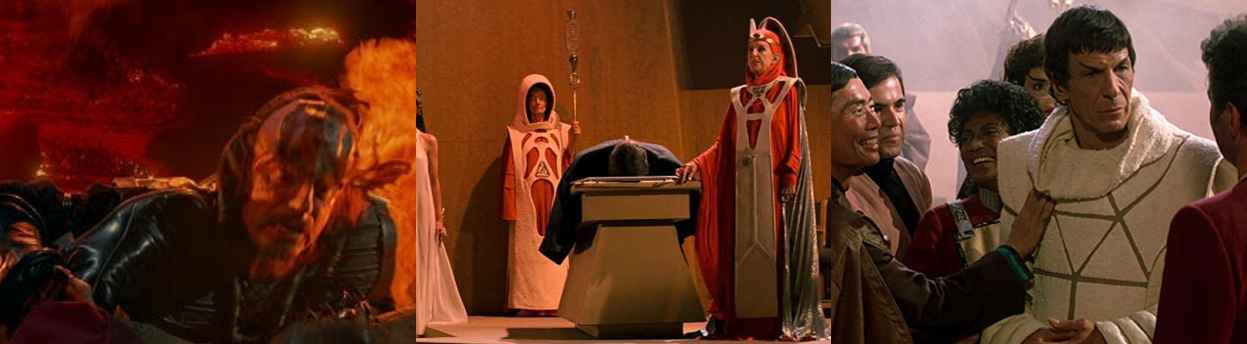

Season One

Air Date: 23 January 2020 to 26 March 2020
UK Distributor: Amazon Prime Video
Original Network: CBS All Access
Stars: Patrick Stewart, Isa Briones, Alison Pill, Michelle Hurd, Santiago Cabrera, Evan Evagora, Harry Treadaway, Jeri Ryan, and Brent Spiner

The Background:
After the lacklustre critical performance of Star Trek: Nemesis (Baird, 2002) scarpered plans for further films featuring the lauded cast of Star Trek: The Next Generation (1987 to 1994), the Star Trek franchise (1966 to present) moved on to other shows before being expertly rebooted with Star Trek (Abrams, 2009). Star Trek returned to the series’ roots while still paying homage to the rich history and lore of the franchise with its split timeline. While the franchise saw something of a resurgence following this that generally explored the early days of Star Trek lore, showrunner Alex Kurtzman pushed to revisit the character of Captain Jean-Luc Picard in the original timeline and, alongside writer/director Akiva Goldsman, were able to convince Stewart to return to his famous role with the strength of their pitch. Upon being released, Star Trek: Picard immediately set a new streaming record on CBS All Access and was met with largely positive reviews. The show’s dark vision of Star Trek’s future was met with praise, as was Stewart’s performance, though some took exception to the pacing of the show; still, overall, the first season proved successful enough to justify the production of two further seasons.

The Plot:
Twenty years after the events of Star Trek: Nemesis, Jean-Luc Picard, former admiral and captain of the U.S.S. EnterpriseE, has resigned from Starfleet and retired to an obscure life at his family vineyard. However, when the mysterious Dahj Asha (Briones) visits him seeking sanctuary, Picard is intrigued to find that she is an android created from the remains of Lieutenant Commander Data (Spiner) and drawn into a conspiracy to suppress all synthetic life.

The Review:
The season opens with Picard playing poker with Data on the Enterprise-D in an amusingly heart-warming scene that depicts two old friends engrossed in a friendly game; Picard is desperate for the game not to end but is woken from this dream by the violent destruction of Mars. Disturbed and haunted by this vision, Picard awakes on his vineyard in France where he lives in solitude with his faithful dog, Number One (Dinero) and a couple of Romulan aides, Laris (Orla Brady) and Zhaban (Jamie McShane), for company. They help prepare him for his first-ever sit-down interview to commemorate the day that Romulus was destroyed by a supernova (as seen in Star Trek), an event that he was tragically unable to prevent. When the interviewer calls into question his efforts to aid one the Federation’s most lethal enemies, and the subsequent actions of a rogue group of synthetics in destroying Mars, Picard defends his motivations to save lives and vehemently opposing the ban on synthetics, and adamantly condemns Starfleet’s dishonourable actions during both events. Meanwhile, in Boston, the gorgeous Dahj is suddenly attacked by insurgents who attempt to kidnap her and end up absolutely decimated when she showcases superhuman strength and speed. Confused, scared, and hurt, Dahj is suddenly bombarded by visions of Picard following this incident and, after seeing Picard’s emotional outburst while walking the streets, Dahj seeks him out and desperately asks for his help.

Picard is devastated when Dahj is killed but soon learns that she has a twin sister in the galaxy.

Sympathetic to her plight, Picard is intrigued by her visions and familiarity with him and immediately takes her in and cares for her, exuding a grandfatherly warmth towards her. Picard’s visions of Data lead him to his archives at Starfleet and the discovery that Dahj is his (as in Data’s) “daughter”; Dahj is overwhelmed by this as androids have been vilified over the last twenty years and she is frightened at the prospect of being a synthetic, but Picard reassures her that her “father”, Data, was one of the most courageous and human men he ever knew and vows to protect her and guide her towards the truth. Dahj’s pursuers are revealed to be Romulans and soon track them down; though she viciously attacks them, she is immolated when one of them spits corrosive blood on her and causes her to explode. Heartbroken and distraught, Picard laments his wasted years sitting in solitude and vows to get to the root of Dahj’s origins; to that end, he visits Doctor Agnes Jurati (Pill) at the Daystrom Institute, who explains that Dahj was the result of an experiment by her colleague, Doctor Bruce Maddox (John Ales), to create synthetic lifeforms in organic bodies from the remains of Data’s neural pathways using “fractal neuronic cloning”, which was summarily shut down after androids produced by the Daystrom Institute caused massive devastation on Mars that saw the creation of synthetics forbidden.

Soji works as part of a groundbreaking project to bring relief and help to former Borg drones.

This information leads Picard to discovering that Bahj was one of a pair and he begins to formulate a plan to track down her “sister”, Soji Asha (Briones), Dahj’s exact duplicate, who works in a Borg Cube (referred to as the “Artifact”) that has been reclaimed by Romulan refugees. Unlike Dahj, who was a frightened and confused girl, Soji is a lot more mischievous and confident, though she has a real empathy towards the deceased drones (derogatorily referred to by others as “The Nameless”) within the Cube. An inherently trusting individual, Soji forms a relationship with Narek (Harry Treadaway) and the two of them assist with the Romulan’s efforts to harvest and remove the Borg’s cybernetic technology from the Artifact and the drones. When her dedication and empathy attracts the attention of the Borg Reclamation Project’s director, Hugh (Jonathan Del Arco), she is given the opportunity to interview Ramdha (Rebecca Wisocky), a Romulan girl who has also been freed from the Borg, in an attempt to construct a shared mythical framework as a therapeutic tool for the reclaimed Borg. However, Ramdha becomes distressed during this session and tries to kill herself while claiming that Soji is “The Destroyer”, which greatly disturbs Soji and leads her to discovering her true nature. Meanwhile, Picard is told by his old friend, Doctor Moritz Benayoun (David Paymer), that he is suffering from a terminal illness; though clearly moved by the news of his impending death, Picard remains resolute to track down Soji to protect her from the clandestine “Zhat Vahs” organisation (a group of Romulan fanatics who hate all forms of synthetic life) and get to the bottom of the recent events in his life. However, his newfound mission is obstructed by Admiral Kirsten Clancy (Ann Magnuson), who vehemently refuses to give him a starship after being angered at his comments in his interview and his comments about the state of Starfleet.

After recruiting the warrior Elnor, Picard’s crew of misfits is assembled and ready to go.

Undeterred, Picard pays a visit to his former first officer, Rafaella “Raffi” Musiker (Hurd). Jaded, bitter, and resentful of Picard, she initially adamantly refuses to get involved after he walked away from her and refused to support her in the intervening years but, does, reluctantly, research his story and gives him the name of a freelance pilot: Cristobal “Chris” Rios (Santiago Cabrera). Rios, a rogue who holds a resentment towards Starfleet due to the horrific losses he suffered while serving in the Federation, is eventually persuaded to assist Picard by both the promise of profit and by the many holograms (also Cabrera) that make up his crew. After saving Picard from an attack by the Zhat Vahs, Jurati joins Picard’s crusade on Rios’s ship, La Sirena, though she initially has some trouble acclimatising to the monotony of space travel. Picard is also overjoyed when Raffi decides to come along on the mission, which first takes the ship to the planet Vashti to recruit a young Romulan warrior, Elnor (Evan Evagora), to join their misfit team. Despite having relocated millions of Romulan refugees to Vashti in the past, Picard is disturbed at the civil and societal unrest on the planet, to say the least, and Elnor, resentful at being abandoned by Picard as a child, initially refuses to “bind his sword” to Picard’s cause. However, when Picard’s presence inspires anger and bitterness in a group of Romulans who resent the Federation for deserting them to their fate, Elnor doesn’t hesitate to defend him with brutal efficiency and joins his crew since the mission promises to be a lost cause worthy of his blade. Picard, however, is incensed at Elnor’s use of lethal action and demands that he promises only to act when Picard gives the order. A strange combination of Lieutenant Commander Worf (Michael Dorn) and Mister Spock (Leonard Nimoy), Elnor’s social awkwardness and naivety are used for some comedic relief and offset by the cold, brutal efficiency of his combat skills.

The Zhat Vahs are determined to eradicate synthetic lifeforms by any means necessary.

Their journey also causes them to cross paths with Seven of Nine (Ryan), a former Borg drone who was once part of the crew of Voyager and now operates as a “Fenris Ranger”, something of a bounty hunter, who leads them to the neon-and-hologram-drenched world of Freecloud, where Maddox is being held by a black market dealer, Bjayzl (Necar Zadegan). Seven uses herself as bait to get close enough to Bjayzl to kill her to avenge Icheb (Manu Intiraymi), another former drone who was basically Seven’s surrogate son and whom Bjayzl ripped apart for his Borg implants after betraying her. At the same time, Raffi attempts to reconnect with her estranged son, Gabriel “Gabe” Hwang (Mason Gooding), who is also on Freecloud; however, Gabe is unable to forgive Raffi for her abandonment and obsession with the conspiracy against the synthetics and refuses to forgive her or to entertain her desire to make amends, so she returns to La Sirena heartbroken, turning to drink and substances to numb her pain. Seven parts ways with the crew amicably and gives Picard the means to contact her but, when they finally get Maddox to safety, he is murdered by his lover, Jurati, in an action that leaves her devastated by complex feelings of grief and regret. Struggling after killing her lover, Jurati begins a physical relationship with Rios and it is eventually revealed that she was manipulated by the half-Romulan Commodore Oh (Tamlyn Tomita), Starfleet’s security chief, who is a member of the Zhat Vahs and in league with Narissa (Peyton List) to hunt down the androids as part of a prophecy the Romulans discovered that foretold of a future where synthetics are the dominant lifeform and have destroying all organic life. In a bid to stop this future from coming to pass, Oh terrified Jurati with visions of this future and her Zhat Vahs allies, Narissa and Narek, work to locate the synthetic’s homeworld of Coppelius through manipulation and brute force. Narek seduces and deceives Soji into uncovering the planet’s location while Narissa brutally slaughters Hugh’s deassimilated drones aboard the Artifact.

Picard reunites with Riker and Troi and Soji bonds with their daughter, Kestra.

Relentlessly hunted by these forces, Picard and Soji escape to Nepenthe for sanctuary at the home of his old friends and crew mates, former Captain William Riker (Jonathan Frakes) and Commander Deanna Troi (Marina Sirtis); Troi immediately senses Picard’s illness using her empathetic abilities and, upon embracing Picard, Riker activates the defence measures of their quaint little home and offers him sanctuary without question. Unquestionably loyal to Picard, Riker and Troi have lived with the grief of the death of their son, Thad, who was denied a lifesaving procedure because of the Federation’s ban on synthetics. Confused and hurt by the recent revelations in her life, Narek’s betrayal has left Soji broken and traumatised; feeling that everyone is lying to or using her, even through acts of kindness, she struggles with an existential crisis because her trusting nature has led to her being deceived and manipulated despite her forming forming a fast bond with Kestra Troi-Riker (Lulu Wilson), a quirky and likeable young girl playing the role of a wild maiden of the woods while with Soji. Though fearing for the safety of Kestra, Riker and Troi shelter him and Soji until La Sirena arrives to pick them up; Riker is intuitive enough to figure out that Picard is on the run from Romulans and desperate to protect Soji, who he instantly recognises as being Data’s progeny, and Deanna admonishes Picard for not recognising Soji’s pain and encourages him to be his true, compassionate self in order to earn her trust. Still, Soji’s presence causes Rios to suffer a sudden panic attack because she resembles a girl he travelled with during a traumatic mission that saw his beloved captain kill two people being committing suicide, an act that scarred Rios. However, Raffi puts together that these were actually synthetics and the crew head to Coppelius to protect her home and her family (her fellow androids) from the Zhat Vahs.

Picard is finally able to say goodbye to Data and then awakens in a renewed synthetic body.

Upon arriving, however, they find a colony of synthetics living in peace with Altan Inigo Soong (Spiner), the son of Data’s creator and Maddox’s partner, who guilt-trips Jurati for killing Maddox and offers her the chance at redemption to help him complete his work on transferring an organic mind to a synthetic body. Another of Soji’s duplicates, Sutra, manipulates her (and the other synthetics) into constructing a beacon to summon mysterious, Lovecraftian synthetic beings to eliminate all organic life before they can destroy them and Picard is forced to battle against his failing health and overwhelming odds before Riker arrives with the Federation armada and he (as in Picard) is able to finally convince Soji to shut down the beacon. Sadly, Picard’s ailment overcomes him and he dies peacefully while surrounded by his newfound friends. Thanks to Jurati and Soong’s work, however, Picard’s consciousness is salvaged and maintained in a “massively complex quantum simulation”, where he’s finally given the chance to properly say goodbye to Data (whose consciousness still lingers thanks to the efforts of Maddox and Soong and who requests that Picard shut him down for good) before awakening in his own synthetic body. Given a second chance at life in an artificial body that functions exactly like a human one rather than making him augmented or immortal, Picard fulfils Data’s last request (terminating the last strings of his consciousness to finally allow him to “die”); the Federation finally lifts the ban on synthetics and Picard returns to La Sirena with his new crew to continue his journey throughout the galaxy.

The Summary:
Star Trek: Picard is very different from other iterations of Star Trek that I have ever seen; returning to the original timeline is a breath of fresh air after all this time spent lingering on exploring and reinterpreting the events of the Original Series (1966 to 1969) and it’s pretty fantastic to see what happened post-Star Trek. This is, however, a vastly different world than we remember; normally, the Federation is all about peace and tolerance but, here, they’ve kind of lost their way a bit. Picard resigns as a last-ditch effort to try to convince them to aid the Romulan evacuation and they refuse, which seems incredibly out of character for them, and then they foster widespread xenophobia towards synthetics after the events on Mars rather than properly investigating it. You can tell that the world has taken a sudden shift away from the usual utopian depiction because Star Trek: Picard features an alarming amount of casual swearing; words like “shit”, “asshole”, “bullshit”, “fuck”, and “fucking” are dropped all over the place and even Picard says the phrase “pissing me off” at one point. I’m not sure I really appreciate that; I think maybe it would’ve been better to just have characters like Rios use curse words but, instead, everyone, even Starfleet admirals, toss out the “fucks” like nobody’s business.

Picard’s story is one of atonement and he finds a cause worth living, and dying, for.

Still, this is very much Picard’s story and his return to action; having walked away from the galaxy for some twenty years, Picard is haunted by his mistakes but jumps at the chance to do some good once again in an effort to atone for his past. Picard’s mental state is often called into question; characters comment on his seemingly irrational actions and suggest, more than once, that he is suffering from dementia or insanity. While he is suffering from a terminal illness of the brain throughout the season, he remains steadfast in his vow to get to the bottom of the mystery surrounding the Asha androids. Stubborn and fully believing that his actions are both just and noble, he uses his vaulted charisma and diplomatic abilities to sway even the most hardened rogues to his cause; even those like Raffi and Elnor, who have every reason to refuse to assist Picard, are convinced to aid him due to his reputation and conviction. Interactions with Soji help give Picard a measure of closure when she reveals that Data loved him and his relationship with her (and Dahj and many of the other new characters) is very similar to that of a father to a daughter; his desire to protect her and to make amends for walking away from his responsibilities is the driving force of his character and informs all of his actions and, in the process, he finds not only a reason to live once more but also to die.

Some familiar faces from the past show up radically changed in Picard.

Star Trek: Picard also sees the return of many other familiar faces in supporting roles to aid Picard on his quest; while it’s disappointing that B-4 was just scrapped and tossed aside rather than exploring the potential for Data to live on through his younger “brother”, it was great to see Data return as a figment of Picard’s imagination, a spiritual guide of sorts to hint at the events of the season, but his presence and legacy are very much at the heart of the story thanks to Dahj and Soji and the controversy surrounding synthetic life. Similarly, I enjoyed seeing the return of Riker, Troi, and Seven after all these years; older and very different from the last time we saw them, many of the characters have become hardened, jaded personalities. Only Riker and Troi are content to step away from the drama of space action and exploration to focus on their family life and truly seem content and happy for it; to be fair, Picard attempted this but, by his own admission, was simply hiding from the wider galaxy. Seven is a much different character than we last saw in Voyager; a rogue vigilante of sorts, she has carved a reputation for herself as notorious Ranger and seems to have settled into the life of a wanderer while still trying to avoid killing in cold blood. Riker and Troi, though, are perfectly happy living their idyllic family life; despite the grief at the loss of their son, they’re dedicated to keeping Kestra safe and take precautions to safeguard their home but, when Picard arrives, aid him without question out of their loyalty and friendship to him and Riker doesn’t hesitate to assist him in the finale.

Picard’s new crew includes some interesting characters, though some had unexplored potential.

Picard is also supported by a whole crew of entirely new characters. Obviously his fatherly relationship with Soji is a primary focus of the season but he has an interesting relationship with the rest of La Sirena’s crew: Raffi’s faith in Picard is shaken and she is carrying a lot of emotional baggage from the fallout of her previous relationship with him; Rios’ loyalty is often in doubt because of him having a resentment towards Starfleet; Jurati seems trustworthy and turns out to have been manipulated by Oh; and while Elnor seems to almost be a surrogate son to Picard, this isn’t really developed or focused on all that much and I feel his potential as a character was a bit wasted. A lot of this comes to a head in the final two episodes where many of these supporting characters take a backseat to the larger focus on Picard’s end and his relationship with Soji, which makes sense given that those are two pivotal aspects of the season, but it is a bit of a shame that there wasn’t a bit more for them to do in the end (though it was great to see them end the season as a full functioning unit rather than strangers forced to work together).

Enemies both deceptive, radical, and domestic dog Picard and his crew throughout the season.

Finally, there’s the season’s antagonists; Narissa and Narek are an interesting brother/sister who have complex relationships with many of the main characters. Narek’s choice to use seduction and deception to trick Soji and betray her trust makes him quite the reprehensible, slimy asshole but he actually ends up joining forces with the protagonists for the finale to stop the common threat posed by Sutra. Narissa, however, is a bad piece of work through and through; directly responsible for the death of a beloved Star Trek character, Narissa has no redeemable qualities at all and, like Bjayzl, fully deserved to be executed for her reprehensible actions. The main antagonistic race for the season is, of course, a contingent of Romulans but the officious and out of character nature of Starfleet also causes headaches for the main characters, to say nothing of the synths, who are easily swayed into conjuring God-knows-what to pre-emptively strike back at organics. There’s a lot happening and a lot of subterfuge at work in Star Trek: Picard but I was, for the most part, intrigued by the complexities of the villains and the Zhat Vash organisation and I’m interested to see where future seasons take the prophecy concept.

My Rating:

Rating: 3 out of 5.

Pretty Good

What did you think to the first season of Star Trek: Picard? Were you happy to see Patrick Stewart return to his iconic role and to finally return to the original Star Trek timeline or did the plot, swearing, and dark turn of the world put you off? Which of the returning and original characters was your favourite? What did you think to the prophecy regarding a nightmarish future for the characters? What other Star Trek characters would you like to see get their own spin-off? How are you celebrating Captain Picard Day this year? Whatever your thoughts on Star Trek: Picard, let me know in the comments down below.

Movie Night [Star Trek Day]: Star Trek: The Motion Picture


On this day, 8th September 1966, the first episode of Star Trek (1966 to 1969) first aired, that being “The Man Trap” (Daniels, 1966). Since then, Star Trek has become a massive cultural phenomenon that still endures to this day, spawning numerous continuations, spin-offs, and ancillary media to become, perhaps, the most influential science-fiction franchise of all time. Accordingly, the 8th of September has been deemed “Star Trek Day” and is thus the perfect excuse to dedicate some more time to, and celebrate, this massive sci-fi franchise.


Released: 7 December 1979
Director: Robert Wise
Distributor: Paramount Pictures
Budget: $44 million
Stars: William Shatner, Leonard Nimoy, DeForest Kelley, Stephen Collins, and Persis Khambatta

The Plot:
Some time has passed since the conclusion of Star Trek; James T. Kirk (Shatner) has been promoted to admiral and the U.S.S. Enterprise is now under the command of Captain Willard Decker (Collins). When a mysterious and destructive alien cloud known as V’Ger approaches Earth, Kirk reassumes command of the ship, reuniting with his crew in the process, in a desperate attempt to discover V’Ger’s origins and intentions.

The Background:
I’ve mentioned previously that a big question facing many Star Trek fans is the choice between the Original Series and Star Trek: The Next Generation (1987 to 1994) and, thus, between Kirk and his successor, Captain Jean-Luc Picard (Patrick Stewart). As the Original Series never seemed to be on television when I was a kid, I mainly watched The Next Generation and its subsequent spin-offs so the majority of my exposure to the original crew came through the feature-films. Although Star Trek performed well during its original run, it gained significantly more popularity during re-runs; however, production of a feature-length continuation was met with considerable difficulties and took so long to get off the ground that creator Gene Roddenberry even started shopping around a follow-up series, Star Trek: Phase II. The success of sci-fi epics like Close Encounters of the Third Kind (Spielberg, 1977) and Star Wars (Lucas, 1977) convinced executives that they could benefit from a big-budget, feature-length Star Trek film, which was largely adapted from an unproduced script for Phase II. Necessitating the construction of extremely expensive sets, the film’s script underwent numerous rewrites and changes, often with the input and under the scrutiny of the returning cast members. Although the film grossed nearly $140 million, Paramount were disappointed that it didn’t perform as well as they had expected and the film was met with mixed to negative reviews. Even now, the film is largely considered a disappointment and one of the worst in the franchise but, if nothing else, its negative backlash led to a dramatic course correction in how subsequent films were written and produced.

The Review:
Star Trek: The Motion Picture opens promisingly enough by introducing us to the all-new, far more alien and threatening designs for the Klingons that would go on to define the alien race in all subsequent Star Trek media. An aggressive, war-like race, their first thought upon encountering the V’Ger cloud is to open fire, which promptly results in the destruction of their crafts. While this is a decent enough way to introduce V’Ger and sell the entity as a threat, it’s not much of an engaging or entertaining sequence and this is largely to order of the day for the film. With V’Ger inexorably approaching Earth (and with the Enterprise, of course, the only ship capable of meeting it in time), Kirk manages to convince his superiors to give him back command of the ship in order to investigate the entity. Kirk, now and admiral, appears to have reassumed command of the Enterprise primarily to fuel his ego and to have a command once more as much as because of his experience with the strange and unknown. This, of course, brings him into conflict with the Enterprise’s current captain, Decker, who resents Kirk taking control away from him and believes (rightfully so) that Kirk’s previous experience with the Enterprise is no longer valid due to the ship’s recent refit; this turns out to be the case as Kirk gets a little lost touring the ship and is unfamiliar with its systems and capabilities since they’ve changed so much.

Spock rejoins the crew after becoming aware of, and fascinated by, V’Ger’s consciousness.

You might notice that Mister Spock (Nimoy) is not among the crew members for nearly an hour; indeed, Spock has left Starfleet and is labouring on Vulcan at the beginning of the film and only joins the crew after sensing V’Ger’s consciousness. Having worked to suppress his emotions in the ritual of Kolinahr, Spock’s character at first seems to have taken quite a dramatic step back as he is initially cold towards his crew mates, almost seeming like a stranger amongst them, but he eventually reacclimatises to the crew. As pragmatic and logical as ever, Spock becomes so fascinated by V’Ger’s unique form of consciousness and composition that he takes it upon himself to attempt to make direct contact with the entity and is overwhelmed by the influx of information in the process. Indeed, V’Ger’s cold, logical composition is a direct parallel to Spock’s often unemotional nature but, after mind-melding with the entity, it is revealed that the difference is that Spock’s capacity for emotion separates him from the entity, which is confused and incapable of understanding emotion or appreciating beauty.

The unique friendship between Kirk, Spock, and Bones has very few chances to shine.

While Doctor Leonard “Bones” McCoy (Kelley), Lieutenant Commander Montgomery “Scotty” Scott (James Doohan), Lieutenant Pavel Chekov (Walter Koenig), Lieutenant Uhura (Nichelle Nichols), and Lieutenant Commander Hikaru Sulu (George Takei) all return in their familiar roles, there’s not a whole lot for most of them to do. Scotty gets a fair amount of time to shine in the early going as he introduces Kirk to the refitted ship and struggles to fix up the damaged engines and, while Bones only agrees to come along out of loyalty to his former captain, he plays a relatively influential role in pointing out Kirk’s disingenuous reasons for commandeering the Enterprise and commenting (in his trademark abrasive nature) on his rivalry with Decker. Unfortunately, there are far few moments for Kirk, Spock, and McCoy to interact, robbing the film of their amusing and love/hate relationship and making The Motion Picture a decidedly stale experience.

V’Ger finds a voice by transforming Ilia into a robotic duplicate.

Instead, the Enterprise is manned by a larger unfamiliar crew, the most prominent of which is Lieutenant (Junior Grade) Ilia (Khambatta), a Deltan who acts as the ship’s navigator and has a previous relationship with Decker. Unfortunately, any chance of this relationship being rekindled, or of exploring Ilia’s personality, are quickly dashed when V’Ger abducts her, apparently kills her, and has a robotic duplicate assume her form and act as its emissary. Though now a robotic lifeform, the probe contains Ilia’s memories and experiences, which it is briefly able to reignite through Decker’s influence. The antagonistic force of the film, V’Ger, is the original “cosmic cloud”; a mysterious, incredibly powerful, and seemingly malevolent force that contains a form of consciousness far beyond anything previously encountered. Capable of launching devastating energy attacks, it overcomes its difficulties in communicating with its Ilia double and appears to be a sort of vast ship whose design and concept are more than a little reminiscent of the Borg. V’Ger’s goal is based upon a misinterpretation of the programming of Voyager 6 by an alien race of living machines to assimilate information and then return to Earth and “The Creator”, meaning that the entity is far from malicious and is, instead, a titanic machine that has gained sentience and is simply trying to understand its purpose and is little more than a demanding child. However, when V’Ger’s attempts at communicating with its creator go unanswered, it comes to believe that “carbon lifeforms” have infested the Earth and threatens to eradicate the infestation to fulfil its mission to return to its creator.

The Nitty-Gritty:
I think one of the things that always bugged me about this movie is that so much has changed between the Original Series and the Motion Picture. All of the familiar uniforms for gone, replaced with a dull, uninteresting outfits that are mostly grey and uninspired and, while you might think it’s good that the Enterprise has undergone a dramatic refit as it makes for bigger and far more elaborate sets (and, indeed, these are impressive), the film wastes so much time in introducing us to the ship. The model effects are top-notch, don’t get me wrong, and it really helps sell the awe, ambiance, and iconography of the Enterprise but my God! I still feel like I’m watching it even now, it went on for that long!

The model shots are great, which is good as the film spends a lot of time dwelling on them.

This is, of course, symptomatic of the era that the Motion Picture was made; sci-fi films, especially those set in space, loved their long, lingering shots and to build a sense of atmosphere and grandeur and I can respect that but it constantly grinds the film to a halt and gets in the way since the film seems more interested in showing off its impressive (if, obviously, dated) special effects and model shots than it does with actually moving the plot along. Pacing is a real problem in the film, especially in the first hour or so; it plays very much like an extended episode of the series, with the crew encountering numerous random obstacles in their otherwise straightforward journey and the film constantly featuring Kirk recording his thoughts in the Captain’s Log. Because of the refit, the Enterprise is in chaos as the crew try to get the ship ready for launch, immediately selling the idea that this isn’t the same Enterprise we knew from the Original Series and necessitating a quick tour of the film’s impressive sets. The downside to this, though, is that the transporters are dangerously malfunctioning, and the ship’s capabilities are limited, which mainly exists simply to fuel the animosity between Kirk and Decker since Kirk’s decisions almost get the crew killed when they randomly come across a wormhole.

V’Ger’s core and interior are certainly impressive and mysterious.

The special effects are impressive and ambitious for the time, admittedly; as I said, there’s some lovely model shots at work and the Star Trek concept clearly benefits from having a much larger budget. Sadly, the film opts to have a rather underwhelming antagonist at face value; V’Ger is literally just an ethereal cloud of blue lights but, once the Enterprise penetrates its energy field, it is revealed to be a complex biomechanical entity, of sorts, that is extraordinary to look at and clearly took a lot of time to construct but its more abstract nature makes V’Ger more like a force of nature. This is best seen during Spock’s absolute head-trip of a journey into V’Ger’s vast core, where he witnesses all of the knowledge and experience V’Ger has accumulated over the years. This all culminates in a journey to V’Ger’s core, a frankly extraordinary set that is as grand and complex as it is bland; despite this, it’s a suitably cold, alien environment, with the remains of Voyager 6 sat at its core, that dwarfs the cast. In the end, Kirk and the others figure out that V’Ger requires a now-archaic signal in order to complete its mission but, having learned all that there is to learn (a somewhat contradictory assertion since V’Ger has somehow learned nothing of emotion or carbon lifeforms), it requires tactile human contact in order to “evolve” and, thus, Decker sacrifices himself to facilitate this. Yes, in the end, Star Trek: The Motion Picture basically becomes a rip-off of 2001: A Space Odyssey (Kurbrick, 1968) and Kirk, Spock, and McCoy are left to muse on the ramifications of this new, undisclosed lifeform.

The Summary:
God, what a bore-fest! I feel like I lost two hours of my life and fell into some kind of coma watching this film. There’s a reason that I haven’t seen it in about ten years; it’s just so boring, cold, and clinical…so drab and uninteresting. I can fully understand and appreciate that the seventies were a different time and that seventies sci-fi, especially, was very much about establishing an atmosphere and revelling in the vest intergalactic ambiance of outer space but Star Trek: The Motion Picture pretty much embodies all the worst aspects of Star Trek. Needlessly mired in philosophy and scientific curiosity it sacrifices not just action but characterisation in service of its plot and it’s truly a shame as there are glimmers of the rapport between Kirk, Spock, and McCoy that were so entertaining in the show and subsequent movies and the plot is actually rather fascinating. The idea of a living machine attempting to reconnect with its creator and evolve into a higher form is intriguing and the revelation that it was all because of an old Earth space probe and the suggestion of some vast race of sentient machines all has a lot of potential but it’s so poorly executed. For Star Trek’s big feature-film debut, The Motion Picture just played things way too safe and sucked all the fun and adventure out of Star Trek and no amount of impressive and ambitious sets, models, and special effects can save this one.

My Rating:

Rating: 1 out of 5.

Terrible

Are you a fan of Star Trek: The Motion Picture? If so…why? What is it, exactly, about the film that you enjoy? If you’re not a fan, what was it that turned you off about the film? What did you think to Kirk’s portrayal as an egotistical, self-serving asshole? Did you like the new designs for the Enterprise’s interiors and the new characters the film introduced? What did you think to V’Ger; do you think it should have been officially recognised as being involved in the Borg’s origin or do you think it’s best left as one of those incredible space phenomena? Which Star Trek captain, crew, show, or movie is your favourite and why? How are you celebrating Star Trek Day today? No matter what you think, feel free to leave a comment down below.

Movie Night [Captain Picard Day]: Star Trek: Nemesis


As amusing detail in the Star Trek: The Next Generation (1987 to 1994) episode “The Pegasus” (Burton, 1994) is that the crew and children of the U.S.S. Enterprise-D celebrate “Captain Picard Day” on Stardate 47457.1, which roughly translates to this day, the 16th of June. They do this by producing drawings, models, and paintings that the bewildered Captain Jean-Luc Picard (Patrick Stewart) must then judge. I, however, am using this as another good excuse to delve into some more Picard and Next Generation content.


Released: 13 December 2002
Director: Stuart Baird
Distributor: Paramount Pictures
Budget: $60 million
Stars: Patrick Stewart, Tom Hardy, Brent Spiner, Jonathan Frakes, and Marina Sirtis

The Plot:
After locating an earlier version of Lieutenant Commander Data (Spiner), B-4, in Romulan space, the crew of the U.S.S. Enterprise-E soon discovers that the Romulan Empire has been taken over by Praetor Shinzon (Hardy), a young clone of Picard, who threatens to destroy both the Romulans and Starfleet with his highly advanced and unstable battleship, the Scimitar.

The Background:
Following the conclusion of the popular Star Trek: The Next Generation, the crew, like their predecessors, moved into a series of feature-length films. Although the much anticipated meeting between Captain Picard and Captain James T. Kirk (William Shatner) failed to really deliver on the potential of its premise, it performed decently at the box office. The sequel (and one of my favourite Star Trek movies), Star Trek: First Contact (Frakes, 1996) performed much better, beating its predecessor by some $30 million, but the follow-up, Star Trek: Insurrection (ibid, 1998) failed to exceed at the box office or impress critics. For the fourth Next Generation movie, long-term cast member and director Jonathan Frakes was replaced as director by Stuart Baird, who wasn’t too familiar with the long-running franchise. Indeed, after numerous scenes depicting more character-based moments ended up being cut from the finished film to focus on action and many cast members questioned Baird’s suitability as director. For a film that was supposed to be the grand finale of the Next Generation crew, Star Trek: Nemesis was a crushing financial disappointment at the box office, with critics, and even with its main star. The film’s paltry worldwide gross of just of $67 million made Star Trek: Nemesis not just a box office bomb but also the lowest-grossing Star Trek film to date; it also saw any plans for a follow-up to be cancelled, and led to a major reboot of the franchise in 2009.

The Review:
Star Trek: Nemesis begins without the usual Star Trek fanfare and drops us immediately into the political intrigue that forms the basis for the movie’s overall plot by opening with peace between Romulus and Remus being debated within the Romulan senate. Of course, this peace would be achieved through an imperial alliance under Praetor Shinzon that would allow the Romulan Empire to openly and directly oppose the might of the United Federation of Planets and, when the proposal is resoundingly rejected, the council is summarily executed. We then re-join the crew of the Enterprise-E at the long-awaited wedding between Commander William Riker (Frakes) and Counsellor Deanna Troi (Siritis), which also finally sees Riker being promoted to a position of captaincy and Data replacing him as Picard’s first officer. Picard’s best man speech is a particular highlight, emphasising his rapport with his crew and the central theme of the film: family. Picard sees his crew as family, his ship as home, out of both pride and necessity, since he is the last of his family line.

Data is shaken by B-4’s existence but attempts to help his brother realise his potential.

The wedding, of course, helpfully reunites the crew with Lieutenant Commander Worf (Michael Dorn), who picks up B-4’s positronic signal. The implications of such a signal intrigue Picard on Data’s behalf and (thanks to the ion storm of Kolarus III) gives him, Worf, and Data the perfect excuse to bust out a futuristic dune buggy. It’s not often we get so see wheeled vehicles in Star Trek so it’s a nice moment of levity for Picard, who begins the film in a far more jovial and mischievous mood than usual thanks to the wedding, and leads to a pretty decent, old-fashioned car chase and shoot out. Unlike Data and Lore, B-4 is an inquisitive, naïve, child-like being; a precursor to his big brothers, B-4 has the potential to be as advanced and evolved as Data but is limited by his less sophisticated technology and childish demeanour. His existence creates something of a crisis for Data, who begins to question his creation and life and the meaning of his own existence and raises interesting questions regarding our capacity for intelligence and how important experience and personality are to our development. The film briefly explores this by downloading Data’s memories and experiences into B-4 but it doesn’t immediately affect B-4 or allow him to evolve in the same way; for the most part, it seems to be a failure but, of course, by the end we’re left with the suggestion that B-4 could, in time come to be as advanced and experienced as his older brother.
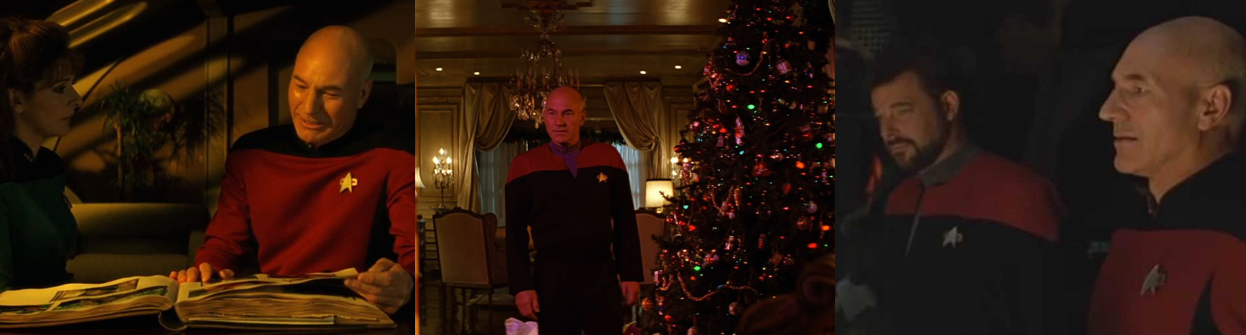
The Scimitar is a forboding and intimidating warship that dwarfs the Enterprise-E.

Normally, it’s massively convenient that the Enterprise-E just happens to be the “closest ship” to the current crisis but, in this case, it actually does make sense since the ship was heading that way, drawn to nearby Romulan space by B-4’s signal, and it’s later revealed that the ship was specifically lured there by Shinzon. Shinzon is given quite a bit of build up prior to his actual appearance; as a Remun, a race bred to simply be cannon fodder and slaves for the Romulans, it is unusual that he has reached such a vaulted position but his threat is immediately established in the dramatic reveal of his supped-up warship, the Scimitar, and the monstrous appearance of his Reman viceroy (Ron Perlman).

Shinzon’s physical appearance degrades as his true twisted is revealed.

Shinzon’s reveal is a stunning blow to the crew but especially for Picard; in Shinzon, he sees himself as a younger man, the son he always yearned for and the life he could have had were he exposed to the same traumas and horrors as the Reman warrior. As if it wasn’t immediately clear, Shinzon is a clone of Picard, bred to be placed as a destructive mole within the Federation, and exists as Picard’s obvious dark opposite. The crux of the film, and Picard’s arc, is reconciling that Shinzon’s true nature has been twisted, skewed by his experiences; to begin with, he believes he has finally found the chance to nurture a son and continue his legacy but, very quickly and harshly, learns that Shinzon desires nothing but power, destruction, and vengeance upon not just his Romulan overlords but the Federation itself. Shinzon is a charismatic and alluring antagonist; eloquent and calculating, he is perfectly capable of subtle manipulation and subterfuge and aggressive, uncompromising fury. Immediately after his introduction, we see that he has no interest in peace; he is merely curious by Picard’s existence but determined to destroy his enemies, viewing the Romulans, the Federation, and especially Picard with disgust and hatred. This is an intriguing element and really throws Picard for a loop but it’s unfortunately very underdeveloped as, almost immediately, we learn that Shinzon is a destructive, aggressive force, resentful of Picard and his other enemies, so he may as well have been introduced as a villain right away rather than through half-hearted subterfuge.

The Nitty-Gritty:
I can understand why people disliked Star Trek: Nemesis; for me, the film’s glaring flaw is the pacing. The film is very short and wastes a lot of its potential; it’s not often we get to really peel back the layers of Picard’s officious and complex personality and seeing him vulnerable, somewhat helpless against his dark doppelgänger was genuinely intrigued…for all of ten minutes or so. Similar to Star Trek Generations, the film squanders its potential but, unlike that film (which is largely a snore-fest), Star Trek: Nemesis does, at least, have a lot of action sequences packed into its run time. I mentioned in my review of Star Trek: First Contact that one of the few flaws of that film is the lack of space-based combat and, while Star Trek: Nemesis doesn’t really have a space battle until the finale, it does include an entertaining chase sequence and a shoot out between Picard, Data, and the Remuns aboard the Scimitar.

Troi’s traumatic experience isn’t as big of a focus as you might expect.
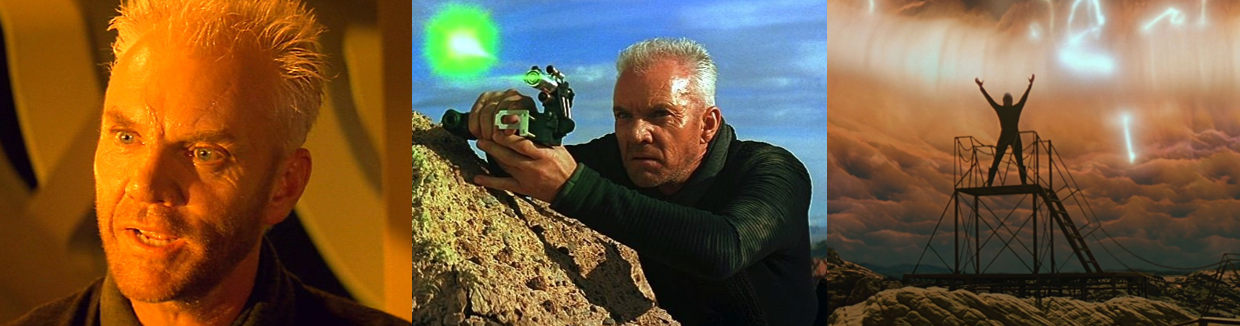
Again, though, the bulk of the film’s focus is on Picard and Data; given the plot of the film, this isn’t entirely unsurprising but it is still a bit disappointing. Riker and Troi’s long-overdue wedding is a central focus of the early part of the film but, very quickly, Riker is pushed to the background as simply a voice of concern among Picard’s crew. Troi gets an interesting sub-plot where Shinzon, enamoured by her appearance, initiates a mental invasion of her mind via his viceroy that is a very blatant allegory for rape but, again, this is only briefly touched upon. Clearly Troi is affected by this experience and she does get to extract a measure of revenge against her tormentors, but she also disappears for a lot of the film between these two events. Similarly, Doctor Beverly Crusher (Gates McFadden) is barely in the film, Lieutenant Commander Geordi La Forge (LeVar Burton) exists mainly to debate the merits of B-4’s potential, and Worf doesn’t really get much of anything to do but man (Klingon?) the phaser banks.

While Picard exorcises his dark half, Data makes the ultimate sacrifice for his surrogate family.

As I mentioned, this isn’t entirely surprising and the film’s primary narratives revolving around Picard and Shinzon and Data and B-4 do go some way to making up for this. Picard is heartbroken and enraged at how selfish and disappointing his “son” is and the final confrontation with his doppelgänger is as much a fight for his (Picard’s) survival as it is against himself and the dark side that dwells deep beneath his morals and ethics. Similarly, Data is saddened by his younger brother, his childish nature, and his position as Shinzon’s slave. I mentioned earlier that family is a central theme of the film and that’s true; the idea is that the bond between a surrogate family of close friends and colleagues is just as strong as those between blood relatives. This is even reflected in Shinzon, who literally needs Picard’s blood to survive and who only truly confides and trusts in his viceroy, treating everyone else as disposable and expendable filth. In the end, both Picard and Data choose their surrogate family over their actual family, with Picard exorcising his dark half and Data willingly sacrificing his existence to ensure the survival of his family.

Nemesis explores Picard’s more vulnerable side but, sadly, fails to really capitalise on its potential.

Of course, this ending draws immediately and blatant parallels to the classic finale of Star Trek II: The Wrath of Khan (Meyer, 1982); while Data’s sacrifice kind of comes out of nowhere, so did Spock’s (Leonard Nimoy), if we’re being really honest, and both relate to the aforementioned themes of family and sacrifice that are prevalent in both movies. It’s a sudden and heart-breaking end to a beloved character but one, perhaps, long overdue since Spiner had desired to be killed off for some time. Like Spock, Data is able to create a kind of back-up or failsafe to ensure his legacy lives on, in some way, through B-4. The similarities don’t end there either, really: Shinzon is a more blatant dark mirror of Picard but Khan Noonien Singh (Ricardo Montalbán) was also a dark reflection of Kirk, his ship a dark opposite of the Enterprise, and his motivations similarly based on horrific experiences that he largely blamed his opposite for. It’s a deeply personal story for Picard, one that ties into themes that have brewing since, at least, Star Trek Generations and demonstrates that the difference between nature and nurture is often an extremely blurred line.

The Summery:
I can understand, to a degree, why Star Trek: Nemesis wasn’t received all too well but, honestly, I find it to be the second-best of the Next Generation films. It’s not a complete bore-fest like Star Trek Generations or Star Trek: Insurrection, featuring a lot more action and thought-provoking narrative elements but it’s still not quite on the same level as Star Trek: First Contact. Sadly, however, the film does squander a lot of its potential; the pace is very brisk and the film just doesn’t focus itself in the right ways. There’s a very intriguing story here, a deeply personal one, for the normally composed Picard but the potential of that story is thrown out the window all too fast as any question about Shinzon’s motivations is immediately rendered mute shortly after we’re introduced to him. Shinzon is, in many ways, a fascinating antagonist; he has every reason to hate his enemies and his motivations are as understandable as they are abhorrent but, sadly, not enough is done with the concept of him as Picard’s dark mirror. Still, I feel Star Trek: Nemesis is an underappreciated and overlooked film in the franchise; it’s worth a view for the potential of the Picard/Shinzon story and Data’s ultimate, poignant sacrifice alone and it’s easily the most aesthetically impressive of the Next Generation movies so I’d say it’s worth a bit more consideration that it got upon release.

My Rating:

Rating: 3 out of 5.

Pretty Good

What did you think to Star Trek: Nemesis? Where does it rank against the other Next Generation and Star Trek films for you? Do you agree that the film isn’t as bad as people made it out to be or do you think it deserves its negative reputation? What did you think to Shinzon and his position as Picard’s dark mirror, and to Data’s sacrifice? Do you think these elements were warranted or do you feel they were squandered? Would you like to see another go-around for the Next Generation crew or do you prefer to see new, unique takes on the franchise? How are you celebrating Captain Picard Day today? Whatever your thoughts on Star Trek: Nemesis, or Star Trek in general, go ahead and share them below.