
Over the years, there have been many theories about when the world will end but one of the more prevalent was the mistaken belief that doomsday would befall us on December 21st 2012 based on the Mayan calendar ending on this day. Of course, not only did this not happen but it wasn’t even based on any actual fact to begin with. Still, doomsday scenarios and depictions of the end of the world have been an enduring genre in fiction so I figure today was a good day to dedicate some time to this popular concept.


Released: 29 July 2013
Director: Bong Joon-ho
Distributor: CJ Entertainment/Lionsgate
Budget: $40 million
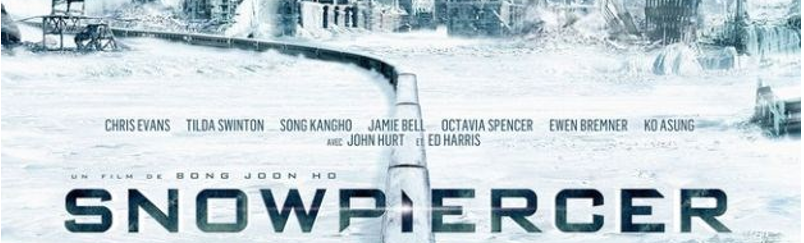
Stars: Chris Evans, Song Kang-ho, Jamie Bell, Tilda Swinton, John Hurt, and Ed Harris
The Plot:
After an attempt to reverse global warming causes an ice age to render the Earth uninhabitable, the remnants of humanity are crammed into a circumnavigational train, the Snowpiercer, where the elite thrive in the extravagant front cars and the poor struggle in squalid tail-end compartments. With tensions rising, Curtis Everett (Evans) prepares to lead an uprising against the train’s domineering authority, represented by Minister Mason (Swinton).
The Background:
Snowpiercer began life as a French language graphic novel, Le Transperceneige (Lob, et al, 1982); after discovering a copy in a South Korean comic book shop in 2005, director Bong Koon-ho was immediately fascinated by the story’s depiction of social classes desperately vying for survival in a claustrophobic, post-apocalyptic scenario. Despite his fascination with the graphic novel, and having secured the rights to a live-action adaptation thanks to his friendship with fellow director Park Chan-wook, development of the film took a great deal of time to get off the ground. Star Chris Evans came on board (no pun intended) in 2012; although he brought with him a mainstream star power thanks to his prominence in the Marvel Cinematic Universe, Bong had to employ some clever filmmaking techniques to hide the actor’s muscular physique during filming. Featuring some complex practical and computer effects to render the titular train’s numerous cars and the desolate frozen wasteland of the outside world, Snowpiercer had the largest film budget of all time for any film with Korean investors but its theatrical release was limited to South Korea at the time. Still, while Snowpiercer’s box office may not have been the most spectacular, the film received largely positive reviews, was widely regarded as one of the best films of 2014, and eventually led to a television adaptation in 2020.
The Review:
Snowpiercer presents a unique spin on the concept of a global disaster movie; while we’ve seen ice ages and frozen Earth films before, I’m hard pressed to think of one where we were directly, unequivocally responsible for the planet becoming a block of ice and snow much less one where the few remnants of humanity were crammed inside a world-spanning, perpetual motion train.
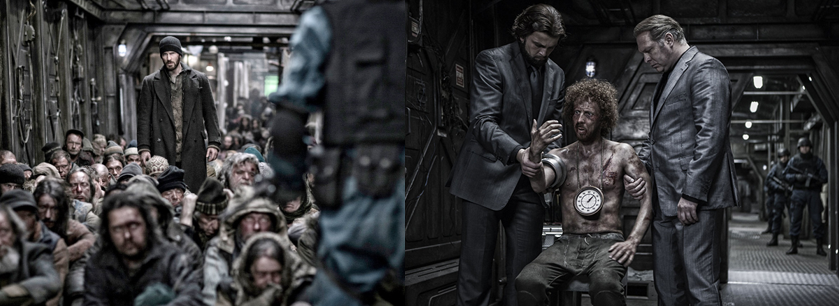
Immediately, the film’s depiction of class and social segregation is made explicitly clear; Curtis, his young friend Edgar (Bell), and his fellow lower classes are forced to live in abject poverty and extremely cramped, disgusting conditions like homeless vagrants. Muddy, dishevelled, and little more than meek, subservient cattle, the lower ends are fed nauseating protein blocks and held at the mercy of the upper classes and the train’s armed guards, who do not hesitate to beat them mercilessly or tear children away from their mothers. Curtis, a principal figurehead amidst the dregs of the train, is very much a reluctant leader and uncomfortable with his position after a traumatic experience in the past. Indebted to Gilliam (Hurt), the aged, half-crippled true leader of the resistance movement, Curtis begrudgingly uses his powers of observation and force of will to help co-operate with prisoner Namgoong “Nam” Minsoo (Kang-ho) in a desperate attempt to storm the train’s length to seize control of the engine (and, thus, the “world”), and kill its operator, Wilford (Harris).

Much to Curtis’s chagrin, Edgar worships him as a hero and leader and sees him as something of an older brother; optimistic and full of fight, Edgar is willing to follow Curtis into the fray, which greatly disturbs Curtis as he believes that Edgar is willing to die for nothing. Their relationship is one based on both necessity and a lifetime of lies as Curtis carries tremendous guilt after he nearly killed and ate Edgar when he was just a baby. Such abject mania and cannibalism was rife in the early days of the train and many of the back-end’s inhabitants, such as Gilliam, are missing limbs after being willingly (or forced) to offer sustenance to their fellow passengers.

Snowpiercer features an extremely diverse cast, with many of the supporting characters being South Korean actors; the most prominent of which is Curtis’s contact, Nam, and his seventeen-year-old daughter, Yona (Ko Asung). Both are addicted to a coal-like waste by-product, Kronole, which offers abusers a hallucinogenic high, yet Nam is instrumental to their efforts since he designed all the doors and locks on the train and his daughter exhibits some degree of clairvoyance. Since Namgoong mainly communicates in Korean, Curtis and the others are forced to communicate with him through the use of an unreliable mechanical translation device, though there are many instances of subtitles as well.

The upper classes are condescending, well-kept, and ruthless individuals who regularly lord their position and power over the lower classes; none embody Wilford’s order or the will of the upper class more than the detestable Minister Mason. A comical figure in many ways, sporting a pompous Yorkshire accent, an elaborate sense of style, and a self-righteous attitude, she stresses the importance of social order and subjugation through capital punishment and fully believes that everyone, and everything, must adhere to their pre-ordained place to maintain society and order.
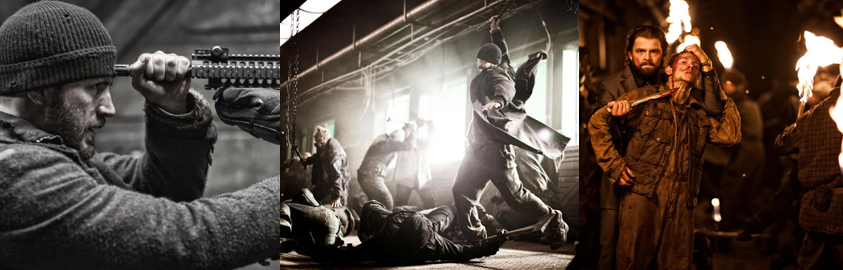
Even after decades of suppression and failed revolutions, which have resulted in countless deaths and mutilations, the lower classes maintain a degree of resistance and fighting spirit; thankfully, those same years have taken their toll on the upper classes, who have not only become complacent but have also run out of bullets over the years. As a result, Curtis’s campaign to seize the train takes the guards completely off-guard and is, initially, somewhat successful. Along the way, they discover to repulsive truth behind the protein bars and are enamoured by seeing the sun, the outside world, and the opulence of the upper classes. Much death and violence accompany this push to the front, however, resulting in the sudden death of Edgar and turning Curtis’s mission into one of revenge as much as liberty.
The Nitty-Gritty:
Snowpiercer is an extremely bleak and claustrophobic tale, full of dark, desolate lighting and a surprising variety of environments considering the entire film takes place on overcrowded train carts. The back end is a grim, gloomy area that is little more than a slum but, as Curtis’s revolution proceeds through the train, environments become much more elaborate and ornate as we see the luxury and indulgence that the upper class surround themselves in.

This includes a fully-functioning school (which teaches the children of the upper class to respect and pay reverence to the train and to Wilford as though they are some kind of religious icon), lavish first-class cabins equipped with lighting, heating, and actual cooked food, and such extravagances as musicians and even a greenhouse, aquarium, and hot tubs. Of course, as with many post-apocalyptic tales, there are some questions raised by Snowpiercer’s concept and left unanswered: the train is, by definition, a perpetual motion engine that circles the world endlessly thanks to being powered by small children but, while we see it precariously clinging to the tracks throughout the film, it’s pretty obvious that the train, its tracks, or the many bridges would surely have degraded or been destroyed by the extreme cold.

Still, I can forgive a lot of these questions mainly because the film does go to some lengths to address some of the main ones (by explaining that Wilford had the foresight and the capital to prepare his train tracks and engine before the world went to Hell) and the rest are best left to one side as a degree of suspension of disbelief is necessary to allow the film to actually happen. Additionally, the overall concept of the subjugated lower classes rising in a desperate suicide mission to take control of the train is compelling enough to carry the film even through its more preposterous ideas. After a particularly bloody and costly battle through the train, Curtis secures safe passage through the train by taking Mason hostage and is disgusted to see the extent to which the upper classes indulge themselves. At the mercy of the lower classes, Mason’s previously haughty attitude and lofty position is shattered as she is force-fed the protein blocks and sells out her beloved Wilford purely to save her own wretched hide. Thankfully, as satisfying as it is to see her reduced to a blubbering wreck, she gets her ultimate comeuppance when she is duly executed by Curtis not only for the deaths and suffering she has willing taking part in over the years but also for indirectly being responsible for Gilliam’s death.

There are a number of dramatic twists that await Curtis at the head of the train; the first is that Gilliam and Wilford conspired to inspire Curtis’s rebellion simply to maintain the train’s delicate and ghastly self-sustaining ecosystem by killing off a large portion of the tail section. The second is that Wilford, seeing the need for a successor, offers Curtis the opportunity to take over as the train’s operator but, while he is tempted, having lost everything and in the face of mass executions, Curtis violently refuses when Yona reveals that the engine is powered by children from the tail section. In that moment, Curtis finally sacrifices not just a limb for his fellow passengers but also himself to derail the train and leave Yuna and the boy, Timmy (Marcanthonee Reis), to an uncertain future in a world that may be slowly thawing.
The Summary:
Snowpiercer is a fantastically dreary and depressing tale about the decaying and desperate remnants of humanity being forced into a claustrophobic space, separated by class and social standing, and forced to either scramble for survival and scraps and eek out a pathetic existence in the tail end or indulge in their every desire and whim at the front end. Trapped under the thumb of their oppressors and driven by hunger and desperation, Curtis is determined to see his mission through simply because of the suffering and death he has witnessed first-hand and his hatred of both himself and Wilford for forcing them to live in such conditions. As far as post-apocalyptic tales go, you could do a lot worse than Snowpiercer, which expertly focuses its narrative on this fragile ecosystem and presents a desolate, desperate tale of survival within a suffocating, oppressive space that separates it from its competition and results in a bleak and intense story of desperation and survival.
My Rating:
Pretty Good
Are you a fan of Snowpiercer? How do you feel it holds up against other post-apocalyptic tales? Were you a fan of the social and class issues represented in the film and or did its bleak atmosphere put you off? Have you read the original graphic novel and, if so, how do you feel Snowpiercer works as an adaptation? Perhaps you were more a fan of the later television adaptation; if so, why is that and how does it compare to the film? How are you celebrating the end of the world today? Whatever your thoughts on Snowpiercer, feel free to leave a comment down below.

 Dr. K's Waiting Room
You must be logged in to post a comment.