
Screen Time: Secret Invasion

Air Date: 21 June 2023 to 29 July 2023
Director: Ali Selim
Network: Disney+
Stars: Samuel L. Jackson, Ben Mendelsohn, Kingsley Ben-Adir, Don Cheadle, Emilia Clarke, Olivia Colman, and Cobie Smulders

The Background:
January 1962 saw legendary duo Stan Lee and Jack Kirby introduce the Skrulls to Marvel Comics readers. This race of warmongering shape-shifters have long hounded Marvel’s heroes but are perhaps best known not just for their long-standing conflict against the Kree but also the divisive Secret Invasion story arc (Bendis, et al, 2008 to 2009), an eight-issue story accompanied by multiple tie-ins and spin-offs that detailed a lengthy and aggressive infiltration of Earth’s mightiest heroes, Following their live-action debut in Captain Marvel (Boden, 2019), the Skrulls have appeared sporadically throughout the Marvel Cinematic Universe (MCU) but took centre stage in this series, which MCU head honcho Kevin Feige claimed would impact future MCU productions. The series was also produced as a means to explore the potential of Nick Fury (Jackson), a character mainly utilised in a supporting or administrative role, and evoke the atmosphere of classic Cold War/espionage thrillers (rather than load the narratives with superpowered imposters) by playing into the paranoia and distrust of the original storyline. Although Secret Invasion received heavy backlash for utilising AI for its opening title sequence, the series was praised for its darker, more mature direction; the tension and drama evoked through the narrative was equally praised, as was Jackson’s performance, though some found Secret Invasion to be a dull and tedious affair.

The Plot:
Nick Fury, former director of the Strategic Homeland Intervention, Enforcement, and Logistics Division (S.H.I.E.L.D.) returns to Earth to investigate and intercept a faction of shape-shifting Skrulls who have infiltrated all aspects of human life and society.

The Review:
Secret Invasion is a six-part miniseries that takes its title from the action-packed Marvel event of the same name. In many ways, the plot of this series is what I originally envisioned would permeate the MCU when Captain Marvel’s first trailer dropped. Before the movie recast the Skrulls as sympathetic refugees, I imagined we’d see an extended plot concerning their infiltration of human society throughout Marvel’s movies, however that didn’t actually happen. On the one hand, I was glad of this as plots like that annoy me for how cliché they are but, on the other hand, it’s resulted in this miniseries that takes that basic concept and significantly downplays its scope to deliver what’s actually more of a character inspection of Nick Fury than a significant shake-up of the MCU status quo. At first, though, it seems like this isn’t the case; the opening sequence of the series sees recurring MCU side character Everett Ross (Martin Freeman) pursued and killed by Talos (Mendelsohn), revealing him to have been a Skrull in disguise, and this same episode ends with frequent Avenger ally Maria Hill (Smulders) dead and Fury himself publicly blamed for her murder thanks to the actions of Skrull revolutionary Gravik (Ben-Adir). However, although Colonel James “Rhodey” Rhodes/War Machine (Cheadle) co-stars, now working as an advisor to the United States President Ritson (Dermot Mulroney), he’s the only Avenger-level inclusion in Secret Invasion, which reframes the paranoia and subterfuge of the source material into less of a colourful classic of bombastic superheroes and more of a political thriller in the same vein as Captain America: The Winter Solder (Russo and Russo, 2014) and The Falcon and the Winter Soldier (Skogland, 2021). In fact, this last comparison is startlingly apt as much of Gravik’s plot to wipe out humanity and the motivations of his Skrull loyalists is reminiscent of Karli Morgenthau (Erin Kellyman) and her Flag Smashers; the show even has a similar visual style and focus on grounded and practical explosions, again keeping things gritty and intriguing but perhaps at the cost of being a visually engaging, unique, or exciting narrative.
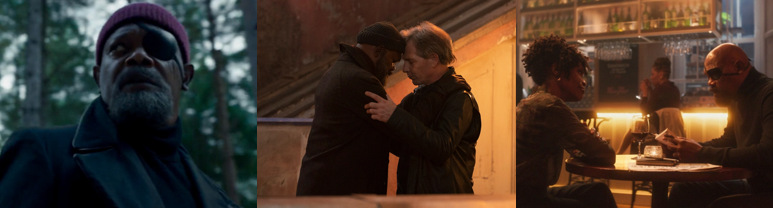
Nick Fury takes centre stage, showcasing a more nuance and vulnerable side to his character.

Fury returns to Earth after being absent for some time; he’s spent what’s said to be years out in deep space aboard the S.A.B.E.R. space station, working with Skrulls to establish an outer space defence network for the Earth. However, what he’s really been doing is hiding; ever since returning from the Blip, Fury is noted to have changed. His age is constantly brought up, and even he admits that the years he spent gone have caused him to lose more than a step or two; his appearance is dishevelled for most of the series, meaning it’s a thematic celebration when he visits one of his many gravesites and retrieves his iconic eye patch and coat, and much of the series focuses on exploring Fury in a way we’ve never seen before. Far from the influential spy of spies, Fury is recontextualised as a simple agent who got lucky; Talos tears into Fury, telling him that he owes his entire career to the information and assistance offered to him by the many Skrulls who agreed to act as his eyes and ears in return for a safe haven and we get to see a far more nuanced and vulnerable side to Fury. Specifically, flashbacks and de-aging effects show him in his younger days, forging an alliance with Talos and the Skrulls and even falling in love with the Skrull Varra (Charlayne Woodard), who takes the form and life of Priscilla and eventually marries him. Feeling a deep sense of obligation and respect towards the Skrulls, Fury promised to find them a new home in return for acting as his personal spy network, but was unable to deliver on this promise, infuriating Gravik and many of his followers, and therefore Fury has a personal stake in outing the Skrull infiltration since he’s largely responsible for their antagonism towards humans. Fury and Talos were united in their belief that the Skrulls would be accepted by humanity if they were willing to compromise; if they defended the Earth and kept their true selves hidden, they would be safe and able to thrive, but many came to resent having to hide themselves and joined Gravik in scheming to wipe out humankind. While Fury’s main concern is safeguarding the world, he maintains the belief that Skrulls and humans can co-exist throughout the series and constantly pleads with Gravik to end his vendetta despite how personal he makes their conflict. Ultimately, it’s a much deeper characterisation of Fury; we see him more relaxed, less authoritative, incredibly vulnerable, and relying on a handful of trusted allies to curb Gravik’s threat before it’s too late, while exploring how utterly broken he was following the Blip and his inability to prevent such a disaster.
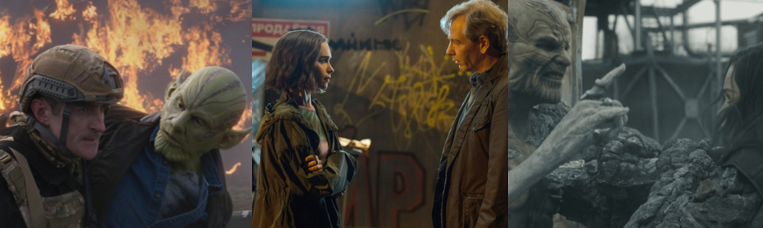
Talos sacrifices everything to campaign for human/Skrull relations, which inspires G’iah.

One of the best aspects of Secret Invasion is the relationship between Talos and Fury; since their first adventure, the two became close friends and were united in their love of humanity and the belief that the Skrulls need to work together with humans to be accepted and safe. Unfortunately, there’s a bit of resentment between them in Fury’s absence; Talos is frustrated that Fury refuses to open up to him about his near-death experience and feels slighted that Fury would use his people to his own ends, but they maintain a begrudging mutual respect since they both know they need each other to oppose Gravik. Talos is grieving the loss of his wife, Soren (Sharon Blynn), at Gravik’s hands, his ousting from the Skrull council in favour of Gravik’s more fanatical ways, and the fracturing of his relationship with his daughter, G’iah (Clarke), who’s signed up to Gravik’s cause both to spite her father and because she resents having to hide away. Talos’s motivations in stopping Gravik are thus as multifaceted as Fury’s; his personal vendetta against Gravik sees him explode in a violent and uncharacteristic rage on more than one occasion and he’s left heartbroken and frustrated when G’iah continues to give him the cold shoulder even after she learns the truth about Gravik and his plan and decides to work against him from the inside. Talos is convinced that the Skrulls will be accepted by humanity if they prove themselves through heroic deeds, so much so that he teams up with Fury to defend President Ritson from Gravik’s attack and ends up fatally wounded as a result. Although the series initially makes it a bit unclear, this sees Talos killed before he can reconcile with G’iah and leaves Fury devastated; on the plus side, G’iah connects with Priscilla, who performs a traditional (if sadly intimate) funeral for her father and his death is enough to push G’iah into fully standing against Gravik, if only to get revenge. Spirited and forthright, G’iah is also young, brash, and quite bratty; she joins with Gravik mainly out of spite and continues to subscribe to the belief that the Skrulls deserve their own home rather than to hide amongst people who hate and fear them. However, the sheer magnitude of Gravik’s plot is enough to shake her faith in his deals, especially as he becomes more unstable; to that end, she’s forced to expose herself to Gravik’s “Super-Skrull” machine to grant herself additional superpowers to both survive his reprisals and confront him in the final.
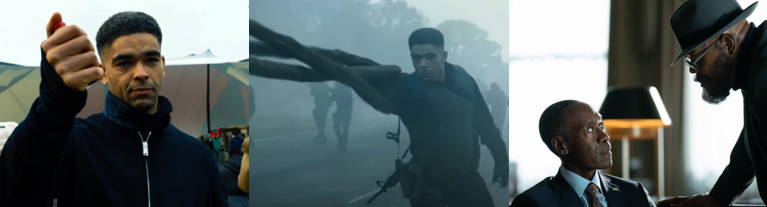
Gravik feels slighted by Fury and, alongside his followers, is determined to destroy humanity.

Though also young and headstrong, Gravik is equally passionate and violent in his beliefs; recruited into Fury and Talos’s cause from a young age, Gravik initially carried out his orders without hesitation, killing in the name of Fury and his people in the firm belief that Fury would find them a home. However, as the years passed, the guilt and the blood on his hands mounted up, and Fury became increasingly absent, meaning bitterness and resentment took root in Gravik and turned him against all humans, but especially Fury, whom he sees as the embodiment of humankind and against whom much of his aggression is targeted. Gravik goes to great lengths to mess with Fury, having his followers impersonate people close to Fury and even assuming his form to frame him for Hill’s murder, all to show the world that this legendary figure is a fallible, untrustworthy, broken-down old man. As much as he desires power, granted to him by both the Skrull Council and Doctor Rosa Dalton’s (Katie Finneran) work in constructing his Super-Skrull machine, Gravik wishes to break Fury’s spirit, have him witness both his greatest failure and the death of his people, and then kill him for going back on his word. To facilitate this, Gravik has placed his followers in key roles within the world’s superpowers and is stoking the flames of conflict between the United States and Russia from a glorified refugee camp dubbed “New Skrullos” and sitting in a deeply irradiated area of Russia, where his people are safe from reprisals and live simple lives as farmers or take more active roles as soldiers. However, Gravik’s desire for revenge sees him place the settlement right in the line of fire and willing to sacrifice (or out-right execute) his own people to achieve victory, something many of his followers are unable to speak out against thanks to his ruthlessness and being imbued with various superpowers from his experiments. Undeniably, Gravik’s chief agent in encouraging President Ritson to strike back against Russia is Rhodey, who’s revealed to be a Skrull in disguise; an arrogant, pompous sellout, Rhodey continually dismisses Fury’s claims of a Skrull invasion and takes great pleasure in both firing him and labelling him a criminal and constantly gets in Ritson’s ear about the Russian/Skrull threat against the United States, bringing the world on the brink of annihilation simply through choice words and evidence supplied by Gravik himself. Naturally, this doesn’t end well for Rhodes; like many of the rebellious Skrulls loyal to Gravik’s cause, he’s ultimately killed to prevent this catastrophe, but Gravik’s followers are more than willing to give up their lives if it means dying as their true selves rather than pretending to be something they’re not.
The Summary:
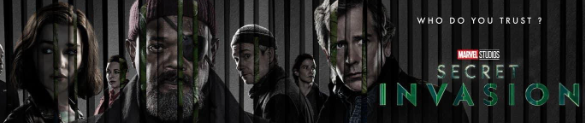
Oddly, Secret Invasion’s episodes get shorter as the series progresses, starting at around an hour and going as short as just over half an hour, indicating to me that there wasn’t as much story as other Marvel shows. Episode two was the longest at nearly an hour, while most episodes (including the finale) were less than forty minutes. Indeed, I wonder if this could’ve been a two-hour streaming film or cut down to four episodes if some of the padding, like Priscilla, was omitted. Priscilla definitely adds new layers to Fury’s character; there was never a hint that he was married or had much of a personal life before, but here we get to see his secluded home, his loving and equal relationship with Priscilla, and see him as more of a man, all masks cast aside. Naturally, their relationship isn’t perfect; Priscilla also notes a change in Fury and has even been somewhat swayed to Gravik’s cause in her husband’s absence, ultimately causing their relationship to fall apart until they reconcile in the finale. Again, this allows for a looser, less uptight characterisation for Fury but it somewhat bogs down the series; I wonder if expanding on his relationship with Hill might’ve been a better option, or perhaps spending more time developing his past with MI6 agent Sonia Falsworth (Coleman), an unnervingly polite and yet surprisingly devious ally of his who is happy to blatantly torture and murder Skrulls to get information on Gravik’s plot. Even saying that makes me wonder what the point of Falsworth really was when the show could’ve easily slotted Valentina Allegra de Fontaine (Julia Louis-Dreyfus) into this role to explore her vaguely defined relationship with Fury and offer to help G’iah in the finale for her own unscrupulous ends.
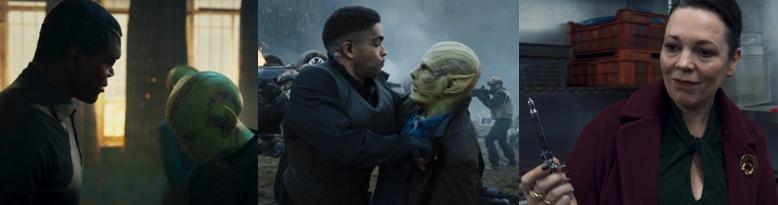
Themes of trust, race, and political intrigue are rife in this gritty, if small-scale, thriller.

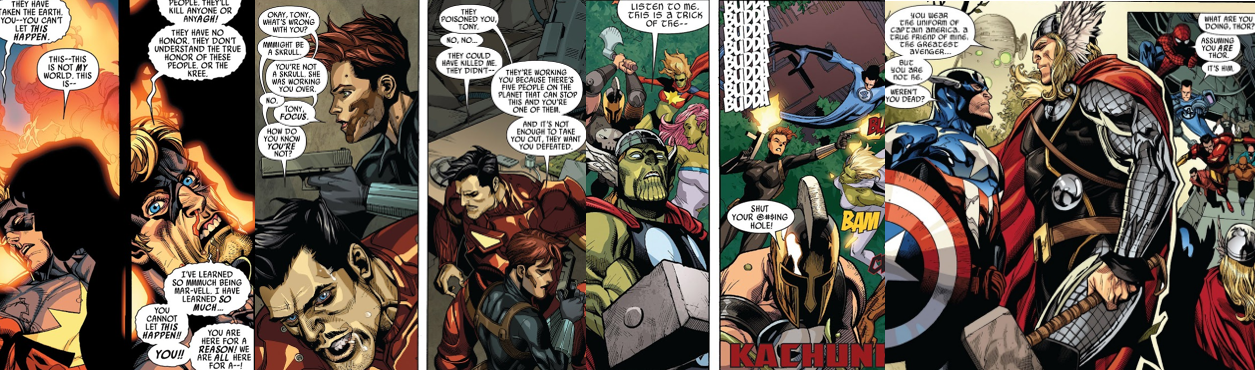
Still, I did enjoy Fury’s characterisation here; his interactions with Talos, in particular, Priscilla, G’iah, and even Gravik show a man who’s been worn down by secrets, conflict, and bigotry and is striving to find a way for humanity to co-exist with extraterrestrial beings in a mutually beneficial way, even if it means compromises on both sides. He openly plays the race card when talking with Rhodey in an attempt to convince him to believe him, reinstate him, and take the Skrull threat seriously only to be met with hostility, and likens the Skrull’s displacement to the same persecution his people went through in the past (and even today). This adds an extra layer onto his motivations for helping the Skrulls as he feels a kinship to them, but he couldn’t help but use their unique shape-shifting powers to his benefit to ensure global security. As Talos mentions, this makes Fury quite the hypocrite since he had no problem exploiting the Skrulls for a “good” reason, making him thematically similar to Gravik, who exploits them for a “bad” reason. Rather than have the Skrull campaign against the Earth be religiously motivated and their people impersonate key superhero figures, Gravik and his followers are entrenched within the world’s governments and want to destroy humanity to claim the Earth for themselves. With a million displaced Skrulls hiding on Earth, many have every right to fear for their lives and to resent having to hide themselves, which sees those loyal to Gravik branding Talos as weak and a traitor, sentiments largely echoed by G’iah until she reluctantly comes to see how extreme Gravik’s plot has become. While Secret Invasion is built around the fundamental question of trust, there are very few Skrull reveals that surprised me or made me care; I think everyone assumed Rhodey would be a Skrull, though I wasn’t expecting Ross to be one until he showed up in the first episode, and everyone else who’s shown to be a Skrull is a new character for the show to avoid messing up the status quo, which is predictably restored in the finale when the real Rhodey and Ross are rescued by G’iah since the Skrulls conveniently need to keep their hosts alive to better maintain their façade and leech off their memories, experiences, and personalities.

Ultimately, Gravik’s plan is foiled but the Skrull presence is perceived as a nationwide threat.

On the one hand, I do like that Secret Invasion opted for a more grounded, gritty thriller story; it would be unrealistic to expect some of the MCU’s biggest names to appear and be revealed as Skrulls and the intimate nature of the narrative helps to make things more personal and raw. Car chases, explosions, and fire fights feel more visceral and real as, mostly, the series has two feet firmly on the ground if you ignore the sparing use of shape-shifting aliens. When the Skrulls do utilise their powers, or more fantastical elements like Extremis or that holographic-mask technology are employed, it’s treated as a big deal since, for the most part, we’re just following two old blokes trying to coerce or beat information out of people. However, a lot of this is done away with in the last episode; by then, G’iah has already gained additional powers from Gravik’s machine and Gravik himself uses the “Harvest” to gain the powers of all the Avengers and multiple of superpowered and alien entities to become a Super-Skrull. This means the ending comes down to a big ol’ fist fight between G’iah and Gravik and Fury and Falsworth exposing Rhodey’s true nature to the baffled and horrified President Ritson. One is an overly elaborate CGI punch-up that ends in anti-climactic fashion and the other is tense showdown that ends with the Rhodey-Skull dead because of his own hubris and President Ritson so rattled by the Skrull invasion that he openly declares war against all Skrulls, leading to a brief montage of trigger-happy bigots gunning down suspected Skrulls whether they’re innocent or not. This leads Fury and Priscilla (who reassumes her Skrull name and form) to return to S.A.B.E.R. to negotiate a peace treaty with the Kree and Falsworth offering G’iah the resources to fight back against Ritson’s campaign, essentially ending the series where it started with Fury off-world, Skrulls in hiding, and tensions high within the world’s governments. Sadly though, as much as I liked the peek into Fury’s private life and seeing him take centre stage, Secret Invasion felt like a mixed bag to me. Although Gravik’s plot is to kickstart World War Three, the stakes never felt very high and it was difficult to care when characters died as they were either expendable, had outlived their usefulness (Hill), were revealed to still be alive (Ross and Rhodey), or their deaths were strangely rushed to the point where I’m sure they’ll be revealed to be fake later (Talos). The relationship and banter between Fury and Talos was great, I enjoyed Gravik’s impassioned speeches and maniacal bent, and it’ll be interesting to see where Super-Skrull G’iah factors into the MCU going forward but this felt like a series you could easily skip over without missing anything and I’ll be surprised if it actually has any lasting impact on the MCU since it goes to such lengths to restore the status quo by the end.

My Rating:

Rating: 2 out of 5.

Could Be Better

What did you think to Secret Invasion? How do you think it compares to the source material and Marvel’s other Disney+ shows? What did you think to the deeper dive into Nick Fury’s characterisation and personal life? Did you enjoy his relationship with Talos and kinship with the Skrulls? What did you think to Talos and G’iah’s resentment towards him? Were you impressed with Gravik and his plan or did you find it a bit too derivative? What did you think to what few Skrull reveals we got, and would you have preferred to see this narrative stretched out throughout the MCU rather than rushed in a miniseries? Whatever you think about Secret Invasion, feel free to drop a comment below or share your thoughts on my social media pages and don’t forget to check out my other MCU reviews across the site!

Back Issues: Secret Invasion

Published: June 2008 to January 2009
Writer: Brian Michael Bendis
Artists: Leinil Francis Yu

The Background:
In January 1962, legendary duo Stan Lee and Jack Kirby introduced Marvel Comics readers to the Skrulls, a race of warmongering shape-shifters who have long hounded Marvel’s heroes, particularly the Fantastic Four, by assuming their identities and powers. Experimented on by the all-mighty Celestials and launching aggressive campaigns against both the Earth and their hated enemies, the Kree, the Skrulls have been at the forefront of numerous Marvel stories over the years in addition to featuring as villains in various videogames and animated ventures before making their live-action debut, in a decidedly different manner, in Captain Marvel (Boden, 2019). Perhaps one of their most prominent storylines was the Secret Invasion arc that ran through these eight issues and multiple tie-ins and spin-offs; the brainchild of writer Brian Michael Bendis, Secret Invasion had not only been hinted at for some time and was heavily advertised as a means of changed up the perception of legacy Marvel characters and even return some to mainstream publication. Reviews of the storyline were mixed, with some noting that it was an anti-climatic Marvel event and others praising the marketing and artwork while criticising the religious undertones and spotty dialogue. Still, an adaptation of the story made its way into the Avengers: Earth’s Mightiest Heroes cartoon (2010 to 2012) and it also formed the basis of a six-episode, live-action series of the same name on Disney+.

The Review:
This eight-issue event series begins “years ago” after the destruction of the Skrull throneworld, a cataclysmic, prophesied event that leads the few survivors back to their queen, Veranke, who kicks the story’s narrative in motion by seeding Skrull agents throughout our world. It took years for this to be uncovered, and it was revealed in dramatic fashion when it turned out that the resurrected assassin Elektra Natchios was a Skrull in disguise, a revelation that alerted Tony Stark/Iron Man (then the conceited and self-righteous director of the Strategic Hazard Intervention Espionage Logistics Directorate (S.H.I.E.L.D.) following the game-changing events of Civil War (Millar, et al, 2006 to 2007)) to the depths of the Skrull’s infiltration. Recognising that even his armour’s sensors can’t be trusted to identity friend from foe, Stark drafts in his allies – Doctor Reed Richards/Mister Fantastic and Doctor Henry “Hank” Pym/Yellowjacket – to perform an autopsy in an attempt to figure out how the Skrull was able to remain completely undetected to technology, magic, and Mutant probing. Conveniently enough, a Skrull ship chooses this exact moment to come crashing into Earth’s atmosphere and make landfall in the Savage Land, taking Iron Man away from the operating room so he can investigate. Concerned that this could be the full-scale invasion they fear, Jessica Drew/Spider-Woman calls in the renegade “New” Avengers (those who refused to sign up to the ludicrous Superhero Registration Act in Civil War), which leads to Luke Cage/Power Man, Peter Parker/Spider-Man, James “Logan” Howlett/Wolverine, Danny Rand/Iron Fist, Clint Barton/Ronin, and Maya Lopez/Echo subduing Black Widow/Natasha Romanova and stealing her Quinjet to beat Iron Man and his government-sanction Mighty Avengers – Iron Man, Spider-Woman, Black Widow, Carol Danvers/Ms. Marvel, Janet van Dyne/The Wasp, Ares, Simon Williams/Wonder Man, and Robert “Bob” Reynolds/The Sentry – to the crash site. Both sets of Avengers are aware of the potential Skrull threat, which drives an even greater wedge between them as not only are the Secret Avengers being actively hunted by their former comrades, but they can’t even trust each other to be who they say they are.

While the Skrulls cripple Earth’s defenses, the fractured Avengers battle their classic counterparts.

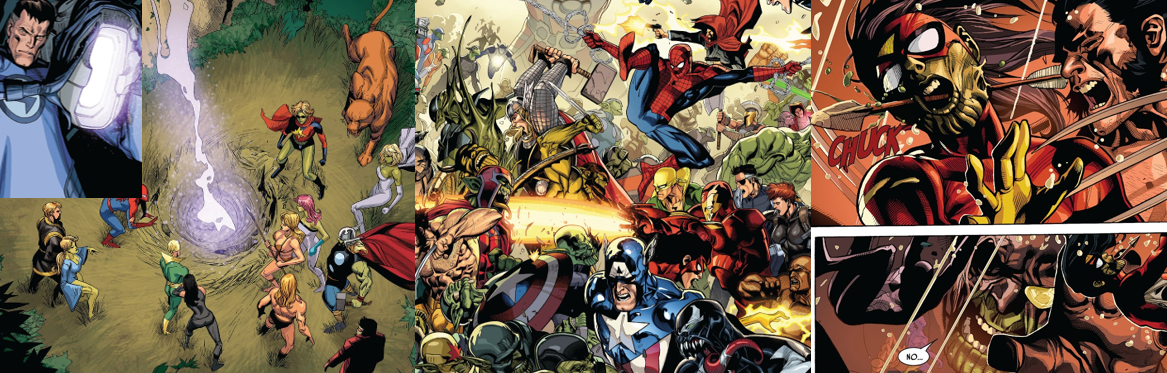
After being brought down by one of the Savage Land’s rampaging dinosaurs, the New Avengers prepare to open up the crashed ship, but they’re intercepted by the Mighty Avengers, with Iron Man immediately trying to arrest them and Luke Cage obviously telling him and his jumped-up thugs to go kick rocks. Iron Man’s attempt to keep the rogue superheroes from overstepping the mark are scuppered when Timothy “Dum Dum” Dugan and his trusted butler, Edwin Jarvis, unexpectedly sabotage not only the orbiting the Sentient World Observation and Response Department’s (S.W.O.R.D.) satellite base but also Stark’s armour and S.H.I.E.L.D.’s Helicarriers and bases, effectively disabling the armoured Avenger and crippling the superhero community’s resources and communications. Additionally, maximum security prisons the Raft and the Cube are suddenly hit by mass breakouts and Mar-Vell/Captain Marvel and Susan Storm/Invisible Woman disable the villainous Thunderbolts and the rest of the Fantastic Four, with each of these supposed heroes flashing ominous eyes and assuring their victims that “He loves [them]”. Meanwhile, a Skrull armada bares down on Earth and Mr. Fantastic finds himself reduced to an elasticated mess right as he figures out the key behind the Skrull’s newfound undetectability, the victim of a shot from Pym, who’s revealed to also be the Skrull Citri Noll! Momentarily setting aside their differences to get Tony Stark to aid, the two Avengers groups are startled when a slew of classic-styled, currently deceased or long-changed superheroes emerge from the Skrull ship; Captain Steve Rogers/Captain America, the Vision, Thor Odinson, Doctor Jean Grey/Phoenix, Doctor Henry “Hank” McCoy/The Beast, Wanda Maximoff/Scarlet Witch, Jessica Jones/Jewel, Emma Frost/The White Queen, and Barbara “Bobbi” Morse/Mockingbird appear alongside classic versions of Spider-Man, Power Man, Wonder Man, Iron Man, Hawkeye, Ms. Marvel, Wolverine, and the Invisible Woman. Naturally, a tense showdown ensues in which both groups assume the other are Skrulls in disguise; guys like Wolverine, Spider-Man, Emma Frost, and the Vision struggle to get any kind of reading on their counterparts beyond sensing their distrust while Ronin is stunned to see his former flame, Mockingbird, alive and well but, despite Ares trying to convince his allies that it’s a trap, tensions boil over and an all-out brawl kicks off!

As more characters enter the fray, internal distrust is as rife as the escalating war with the Skrulls.

With Stark in agony from the alien virus that’s crippled his armour, Ms. Marvel flies him to safety as the others duke it out; the two Spider-Men trade quips and punches, the Vision uses the Sentry’s fear of his destructive and malevolent alter ego, the Void, to disable his God-like power, and Ronin steals his counterpart’s weapons to subdue their attackers but the arrival of a raging Tyrannosaurus rex disrupts the fracas. Trampled to death by the dinosaur, the classic Spider-Man and Hawkeye are revealed to be Skrulls, and Wolverine intuits that the Skrulls are setting them against each other to wipe out any resistance to their invasion plan. However, when he tries to eviscerate Mockingbird, Ronin intervenes and questions her; she’s adamant that she’s not a Skrull and even reveals personal information that only she and Clint would know, which is enough to convince him to trust her. This offers Luke Cage the hope that the Cap and Iron Man aboard the ship are the real deal, which would certainly explain Stark’s recent manic behaviour and allow the recently deceased Cap to still be alive, but Wolverine’s far from convinced. Meanwhile, back in New York City, a portal opens up and a whole slew of Avengers-inspired Super-Skrulls attack; there’s Skrulls combining the powers of various X-Men, a Fantastic Four Super-Skrull, one that’s a mixture of Spider-Man villains, and even an Illuminati hybrid, meaning the Young Avengers – Eli Bradley/Patriot, Dorrek VIII/Hulkling, Billy Kaplan/Wiccan, Tommy Shepherd/Speed, Kate Bishop/Hawkeye, and their mentor, the Vision – are completely overwhelmed despite Hulkling’s efforts to talk down their attackers with his royal status. Thankfully, they receive some back-up in the timely arrival of fledgling superheroes, the Initiative – Joseph Green/Gauntlet, Rachel Leighton/Diamondback, Cassandra “Cassie” Lang/Stature, David Alleyne/Prodigy, Anthony Masters/Taskmaster, Geldoff/Proton, Z’Reg/Crusader, Jimmy Santini/Batwing, Fahnbullah Eddy/Gorilla Girl, Wallace Jackson/Red 9, Delilah Dearborn/Geiger, Melee, Andrea Roarke/Sunstreak, and Alexander Ellis/Annex. Though the Skrull forces prove ruthlessly formidable, and the Vision is lost in the battle, even more help arrives when the Secret Warriors – Colonel Nick Fury, Yo-Yo Rodriguez/Slingshot, Daisy Johnson/Quake, Alexander Aaron/Phobos, J.T. Slade/Hellfire, Jerry Sledge/Stonewall, and Sebastian Druid/Druid – add yet more names and the bodies to the chaotic artwork and conflict.

Heroes and villains set aside their differences to take the fight to the invading Skrull army.

The Skrull threat is doubled thanks to the distrust between the world’s heroes, with even Nick Fury abandoning Ms. Marvel because of her alien DNA. Meanwhile, as a weakened Stark desperately attempts to repair his armour, Spider-Woman reveals herself to be the Skrull Queen, Veranke, and tries to convince him that he’s a Skrull agent so deep undercover that he’s forgotten his true nature. Before her poison (both literal and figurative) can take hold, Black Widow causes her to flee and Stark reveals that the key to victory lies with Mr. Fantastic, who’s currently being tortured aboard a Skull ship. Thankfully, S.W.O.R.D. director Abigail Brand bluffs her way onto the ship and flushes the Skrull into space to rescue him; Reed then fashions a device that exposes the Skrulls’ real forms, arriving just in time to stop another conflict in the Savage Land and revealing not only that the classic Emma Frost, Invisible Woman, Thor, Ms. Marvel, and Jessica Jones are Skrulls but that Mockingbird is as well, enraging Clint. The real Thor transports everyone to New York for a final confrontation, which even the Watcher, Uatu, shows up to observe and also sees Parker Robbins/The Hood’s criminal syndicate and Doctor Norman Osborn’s Thunderbolts pitch in with the nearly-incomprehensible brawl. While Mr. Fantastic and Iron Man try to take out Veranke (still disguised as Spider-Woman) to demoralise the Skrulls, the Wasp targets Citri Noll, who apes Pym’s Giant-Man form, though it’s Stature and the assassin Bullseye who end up taking him out. Iron Man is forced to withdraw so he can sort out his messed-up armour, Fury’s forces save Mr. Fantastic from being torn apart by multiple Skrulls posing as the Invisible Woman, the real Jessica Jones joins the fray, and Kate Bishop ends up gravely injured amidst the chaos. Although Wolverine tries to take out Veranke, the bio-electrical powers she stole from Spider-Woman keep him at bay, meaning it’s an arrow through the face courtesy of the vengeful Ronin that ultimately subdues her.

Although the Skrulls are defeated, the general distrust in Stark allows Osborn to seize power!

With Veranke compromised, Citri Noll activates a device that causes Janet to enlarge uncontrollably and unleash a chemical agent designed to kill humanity and Skrulls alike. With no other choice available, Thor whips up a hurricane with his magical hammer, one so powerful that is destroys the enlarged Janet and dissipates the weird black spots that threaten everyone’s lives. Although Wolverine seeks to make Veranke pay for Janet’s death, it’s Norman Osborn who gets the kill shot, then Iron Man finally gets his shit together and leads an all-out assault on the remaining Skrull ships, with the now disillusioned and leaderless armada being easy pickings. Iron Man also frees everyone the Skrulls impersonated since the shape-shifters conveniently needed the original versions alive in order to make the deception more convincing, meaning Elektra and Mockingbird return to “life”, Reed is finally reunited with his family, and the true versions of the likes of Spider-Woman re-join society. Unfortunately, this also means that Jessica Jones left her and Luke’s baby, Danielle Cage, in the care of the Skrull-Jarvis, a plot thread left unresolved in this story. Although recent tensions are eased in the aftermath and ensuing celebration, there’s an unshakable sense of hesitation given how long the Skrulls had been a part of Earth’s society and superhero community; Thor also condemns Stark’s recent actions and refuses to associate with him. Thanks to having publicly executed Veranke, Osborn is able to manipulate the President of the United States into equally losing faith in Stark, his methods, and his technology; the President thus ousts Stark as director of S.H.I.E.L.D. and names Osborn as the new overseer of any and all superhuman and defensive measures under a new organisation, H.A.M.M.E.R., unaware that this is exactly the opportunity the scheming madman and his Cabal of allies (Emma Frost, Doctor Victor Von Doom/Dr. Doom, The Hood, Prince Namor McKenzie/The Sub-Mariner, and Lady Loki) were waiting for.

The Summary:
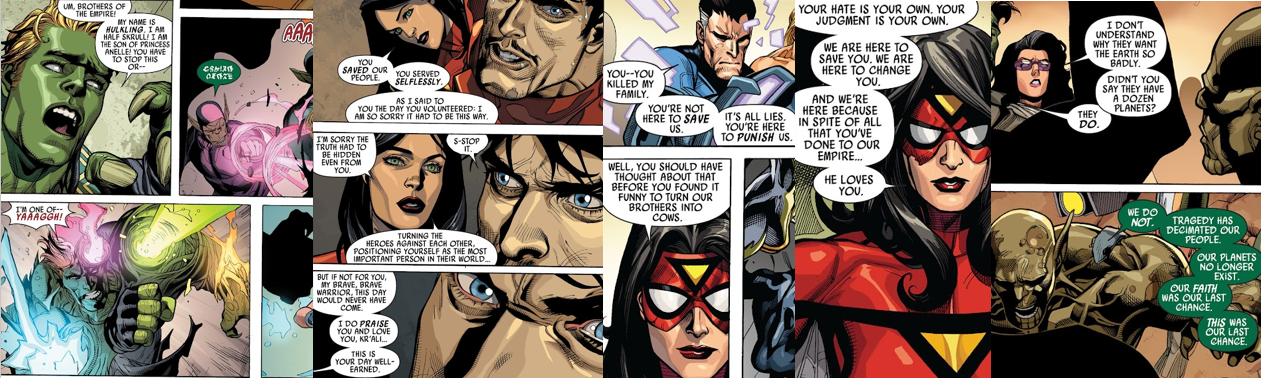
Now, I am by no means an expert on the Skrulls; I know of them, primarily as an antagonistic, shape-shifting race of aliens who are almost constantly at war with the Kree and getting into scuffles with the Fantastic Four, but they’re generally on the periphery of most Marvel stories I’ve read. Secret Invasion is probably, to date, their most prominent story, at least in my experience, and it definitely adds some nuance to them that I didn’t expect. Normally, I see them as a warmongering race who live to conquer through both subterfuge and force but, here, they’re motivated by a fanatical devotion to their God (the “He” they keep referring to) and their invasion is seen almost as divine intervention. The Skrulls swamp television screens with their pseudo-religious propaganda, hijacking every telecommunications device across the globe and assuming the guise of various political figures, celebrities, and superpowered monarchs like Erik Lehnsherr/Magneto and Dr. Doom, and insist that they’re there to bring glory to our world and that their might cannot be opposed. Given the strength of their invasion and that their Super-Skrulls have mimicked the combined powers of many of Marvel’s heroes, it’s perhaps not surprising that Marvel’s ridiculously fickle citizens embrace their alien overlords, though this scene showcases that the Skrulls aren’t simply defending themselves or there to usher in a new age for mankind as they claim and are hell-bent on conquering the planet.

Having lost everything, the Skrulls throw themselves at Earth with fanatical desperation.

This campaign is spearheaded by their queen, Veranke, a figure of worship for the Skrulls and who has placed herself on the frontline, earning the trust of Tony Stark by posing as Spider-Woman and becoming privy to many of Earth’s defences. Stark even reflects on his role in the invasion and the shame he feels about not recognising the threat sooner in a show of guilt that was somewhat uncharacteristic of him at this time; this is a man who was so blinded by his belief that superhumans needed to register with the government that he actively fought and imprisoned his fellow heroes and abandoned many of them, and his morals, in favour of an uncompromising, borderline fascist mentality that only led to further conflict and resentment Indeed, Veranke revels in the irony of having twisted Earth’s technology and heroes towards her agenda, something she was easily able to do thanks to Stark being so dead-set about forcing or punishing his peers to register their true identities and powers. However, as much as Veranke likes to preach that hers is a Holy mission, she’s actually equally motivated out of revenge, specifically against Mr. Fantastic and the Fantastic Four after they tricked a contingent of Skrulls into believing they were cows decades prior. Since the Skrull home world has been lost and their once-prosperous empire lies in ruins, the Skrulls follow her without question and throw everything they have at Earth; they’re even willing to give their lives in the process, and in a last-ditch effort of mutually assured destruction, only to be defeated and left dejected. Veranke’s death leaves the Skrulls directionless and all their once-formidable might is as nothing; those that survive are left demoralised as they saw this as their last chance at survival and glory. Thus, Veranke’s quest for vengeance and conquest leaves her people devastated and more worse off than ever as a sizable portion of their armada is destroyed and the last thing they had in all the universe, their faith, is also shattered by their defeat.

The Skrulls are so deeply entrenched that the already frayed heroes are strained to breaking point.

I’m generally not a fan of imposter storylines; it’s a tired cliché and one that quickly outstays its welcome, but it actually works quite well in Secret Invasion. Many of the Skrulls seem to be completely unaware of their true nature; the Mockingbird-Skrull believes that she’s the real deal right up until the end and is begging Clint to listen to her even as he attacks her in a rage. This is also true of Captain Marvel, who believed so strongly that he was the deceased former hero that he couldn’t bring himself to kill and was convinced by Norman Osborn, of all people, to turn on his race; he even died begging the Kree warrior Noh-Varr/Marvel Boy to carry on the fight in his stead, so complete was his conditioning. It’s not revealed exactly how the Skrulls have the memories they do but it’s one of the big reasons why so many of them went undetected; however, many of the Skrulls posing as classic Avengers continued to believe they were the real deal after their true nature was revealed rather than immediately attacking the heroes in service of their God, which definitely paints much of this conflict in a morally grey area. The Skrulls pick the perfect time to strike the Earth; its heroes are divided and at war with each other and easy to manipulate, and seeing the return of dead heroes like Captain America, Mockingbird, and Captain Marvel, as well as the original version of Iron Man, only fuelled the flames of conflict between them thanks to Stark’s actions during Civil War leading to many deaths, including Captain America’s. It would’ve been so easy to explain away Stark’s recent actions as being the work of the Skrulls but, interestingly, that doesn’t turn out to be the case and, similarly, Cap’s death isn’t immediately undone with the presence of his classic counterpart. Instead, we’re left with a world where Stark is still shouldering the burden of his actions and where Cap’s mantle has been taken up by his friend, James Buchanan “Bucky” Barnes; there are no quick-fixes in this story to explain away the events of Civil War and there isn’t really a sense that bridges have been mended by the end of it as distrust is still rife and the status quo remains unchanged.

A decent story with some interesting wrinkles but a bit overstuffed and manic at times.

Ultimately, I quite enjoyed this story; it’s hard to read as an eight-issue standalone as you need some knowledge of prior Marvel events, especially Civil War, and it’s clear that there’s a lot of additional story and conflict in supplementary collections and books, but the narrative works just as well if you only read these eight issues. I enjoyed seeing the Mighty and New Avengers be forced to set aside their differences when faced with their classic counterparts and the reveals of which characters were Skrulls, even if none of the major players were aliens in disguise. The quasi-religious bent to the Skrull invasion was an interesting twist, as was them siphoning and combining the powers of Marvel heroes into an army of Super-Skrulls, and the art was pretty consistent and easy to follow throughout. Unfortunately, the biggest issue I had with Secret Invasion was the sheer number of characters jammed into it; it was hard to keep track of it all at times and it’s obvious that teams like the Young Avengers, Thunderbolts, and Secret Warriors all had bigger parts to play in spin-off stories, but I think they could’ve been downplayed a little here. There’s a Skrull-Galactus with absolutely no context or consequence to the story and even Uatu shows up, which is generally a short-hand to indicate that the events are of cosmic importance but, again, it doesn’t actually factor into the story in a meaningful way. Stark spends most of the arc out of action thanks to the Skrull virus messing up his armour, which is great for leaving him vulnerable and in pain and unable to participate in the wider conflict but then he just shows up in an older armour with a throwaway line for the finale. Similarly, Thor just pops in out of nowhere, formally prominent characters like Wolverine and Spider-Man get lost in the shuffle, and late appearances from Jessica Jones and Norman Osborn are simply there to set up the next big Marvel events and stories. Overall, it was pretty enjoyable and not as much of a mess as some Marvel events, but the action got a little too chaotic at times and there were too many characters wedged into these issues, which I think would’ve been far stronger if they’d focused on, say, eight or ten main characters and then just showcased the others in supplementary materials.

My Rating:

Rating: 3 out of 5.

Pretty Good

Did you enjoy Secret Invasion? Were you shocked to find out which characters were Skrulls in disguise? Were you hoping that some of the classic Avengers would turn out to be the real heroes? Which of the teams featured was your favourite? Did you think there were too many teams and characters in the story and which of the spin-off books did you enjoy? What did you think to Veranke, the pseudo-religious slant to the Skrulls, and the Skrull invasion? Were you also frustrated by Tony Stark’s characterisation during this time, or did you enjoy seeing Marvel’s heroes in dispute? What are some of your favourite Skrull-centric stories? Whatever your thoughts on Secret Invasion, feel free to share them below or leave your thoughts on my social media.

Back Issues: Fantastic Four #2

Story Title: “The Fantastic Four Meet the Skrulls from Outer Space!” (includes “Part 2: Prisoner of the Skrulls”, “The Fantastic Four Fight Back!”, and “The Fantastic Four…Captured!”)
Published:
28 September 1961 (cover-dated January 1962)
Writer: Stan Lee
Artists: Jack Kirby

The Background:
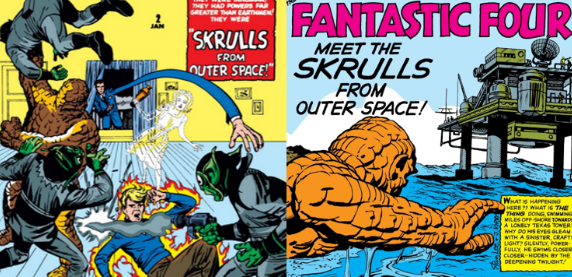
In 1961, Marvel Comics readers were introduced to the Fantastic Four (Doctor Reed Richards/Mister Fantastic, Susan Storm/The Invisible Girl, Ben Grimm/The Thing, and a new version of the Human Torch, Johnny Storm), a dysfunctional family of superhumans just as likely to trade blows with each other as they were with their enemies! While the story of their creation has been disputed, the collaboration between writer Stan Lee and artist Jack Kirby popularised the “Marvel Method” of comic creation and this all-too-human “First Family” of superheroes went on to introduce characters and concepts that would forever influence Marvel Comics in the decades that followed. The first of these premiered in the team’s second issue and took the form of shape-shifting aliens known as Skrulls; also created by Lee and Kirby, these malicious, reptilian war-mongers have been a prominent antagonistic force in Marvel Comics ever since. Not only have they menaced the Fantastic Four and other superheroes through their sheer numbers, devastating technology, and copied their powers with their various “Super-Skrull” variants, they also engaged in a horrific war against the Kree, tried to surreptitiously invade Earth, and have popped up in cartoons and videogames as enemies of the Foursome and other Marvel heroes over the years.

The Review:
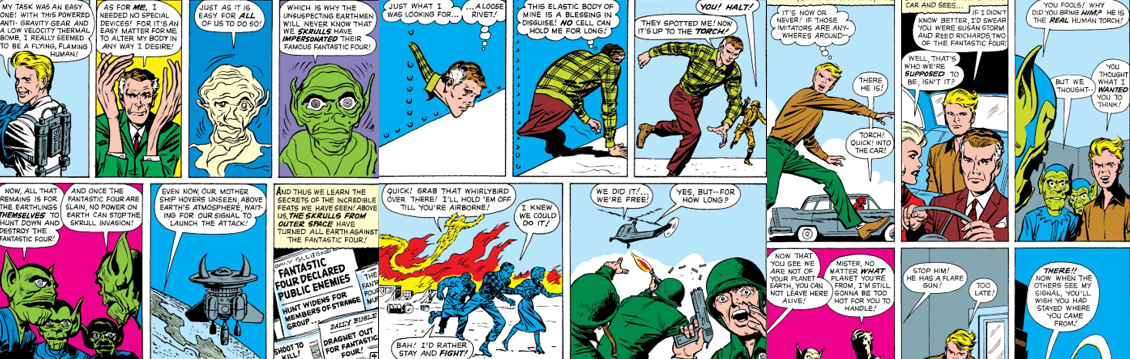
Our story begins with the Thing swimming far out to sea towards a “lonely Texas Tower”, which I’m just going to call an oil rig going forward. The Thing dives under the waves and shreds one of the oil rig’s support legs, causing the entire structure to topple into the water and forcing the workers to race to safety in lifeboats, where they spot the Thing swimming away and rightly assume that he caused the wreckage. The story then cuts to a jewellery store, where Sue has gone all dressed up to have a look at a particularly large and ridiculously expensive gemstone; plucking the sparkling jewel up, she promptly turns invisible and makes off with the gem, leaving the store owner and the inept guards baffled. Next, the unveiling of a priceless statue of solid marble is reduced to molten slag by the Human Torch and Mr. Fantastic uses his disturbingly stretchy arms to shut off all the power n New York City. The gleeful Foursome meet up to congratulate each other on their evil deeds but, as if something wasn’t already a miss, their overly expository dialogue reveals that they committed these acts not using their superpowers, but by means of technology: the Thing had a concealed detonator in his wrist (why it needed to be concealed beyond fooling the reader is beyond me as no one saw him beneath the sea), the Invisible Girl actually reduced her size rather than turn invisible, the Human Torch made use of anti-gravity gear and a low velocity thermal bomb, and Mr. Fantastic simply used his inherent physical abilities since he, like the other three, is actually a form-changing Skrull! The four imposters shift to their natural forms as goblin-like, reptilian aliens and revel in their actions, which have caused the media and public to turn against the Fantastic Four and therefore allowed the impending Skrull invasion to take place unopposed!

When the Fantastic Four are framed by the Skrulls, they take drastic measures to lure out their foes.

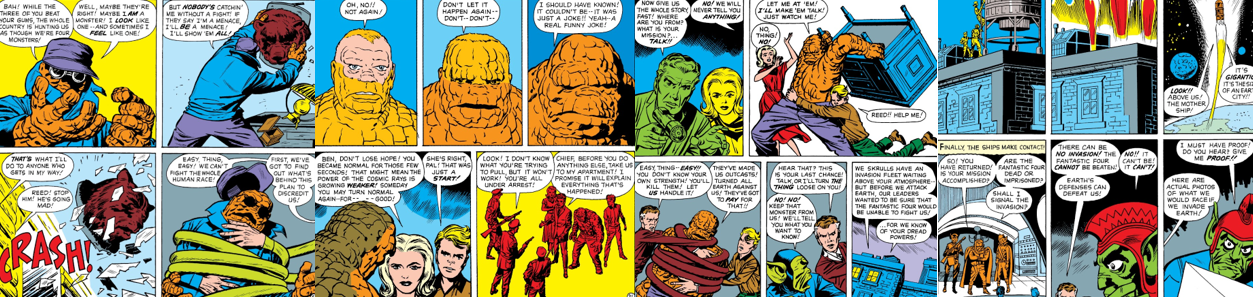
The actual Fantastic Four are off in a secluded lodge having a bit of vacation time hunting in the woods when they learn of what’s happened; while Johnny is confident that Reed will figure out who’s been impersonating them, the news report triggers the Thing, who briefly blows his lid and is ready to fight the entire human race in his mindless rage. When Reed tries to calm him down, the Thing just launches into a tirade lamenting his existence and becomes so consumed by the need to lash out that he starts to sound like Doctor Bruce Banner/The Hulk, it’s very uncharacteristic and odd to see but presumably the Thing’s personality hadn’t quite been worked out at this point. Reed assumes full responsibility for the Thing’s aggressive demeanour; after all, as his obligatory recap of their origin reminds us, he is responsible for Ben being reduced to a rock-covered monster, though none of this brings them any closer to figuring out a plan of action, meaning they’re easily surrounded and captured by the United States military. The Fantastic Four surrender peacefully and are locked up in special cells said to be capable of containing their awesome powers, though this is, of course, just an excuse to pad the story out with visual reminders of what they’re capable of: Sue easily slips out of her cell when the guards foolishly open the door to provide her with food (!), Johnny rips up the flooring to find an air vent, Reed disturbingly squeezes himself out through a single loose rivet, and Ben simply smashes his way out with brute strength in no time at all. They flee in a stolen helicopter and reconvene at one of their “many secret apartment hideouts”, where Johnny and Ben almost come to blows over which one of them will willingly sabotage a space shuttle launch to draw out their doppelgängers. Ultimately, the Thing’s rage is quelled, and the Human Torch attacks the launch site and finds himself picked up by the Skrull impersonators; Johnny learns of their alien nature and plans for world conquest and signals for his teammates, who arrive just as Johnny is facing certain destruction at the Skrulls’ hands.

The Skrulls are easily warded off, the Four are cleared, and their impersonators duly punished.

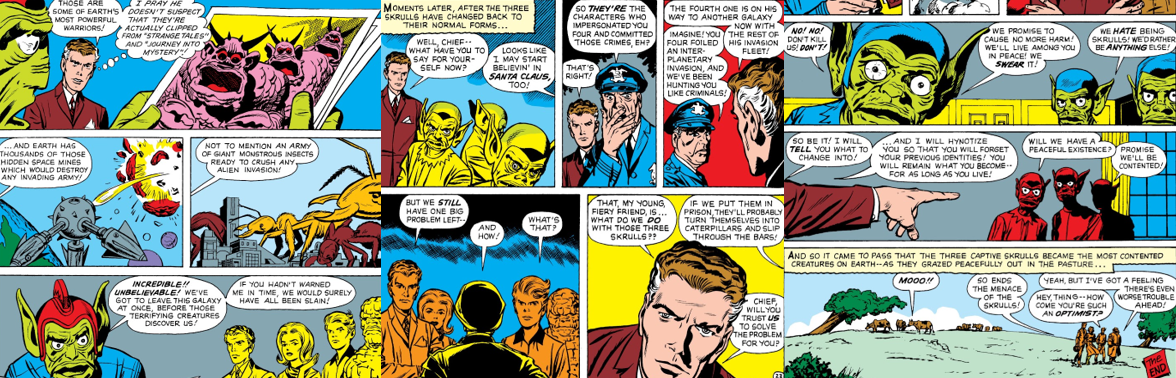
Thanks to Sue tripping one of them, Reed disarming another, and Ben’s brute strength, the Skrull are subdued and willingly spill the beans when they see the extent of the Thing’s rage towards them; the Skrulls explain that there’s a Skrull invasion fleet waiting to attack and Reed decides that their only course of action is to turn the tables on their doppelgängers by commandeering their shuttle (which is disguised as a water tower) and heading up to the city-sized mothership to try and destroy the fleet. There, they masquerade as their impersonators and tell tales to the Skrull Commander about the might of not just the Fantastic Four, but Earth’s monstrous forces, giant ants, and weaponry hidden in the atmosphere. Incredibly, not only does this dupe work, convincing the Skrull Commander to pull back the entire fleet, but the Fantastic Four are also able to avoid having to shift back to their Skrull forms with a flimsy excuse and are even awarded for their bravery when they volunteer to stay behind and remove all traces of the race from the planet. However, as the Fantastic Four are left to drift back to Earth, the shuttle happens to pass through the same radiation belt that gifted them their powers, which inexplicably returns the Thing to his normal, human form! Upon exiting the shuttle, though, they are immediately placed under arrest and Ben’s joy at finding himself human once more is immediately undone when he just turns back into the Thing within a space of a few panels. Although the police chief refuses to listen to Reed’s explanations, he and the other cops are suitably convinced when they’re attack by a giant snake, a bulbous, spiky-rock-monster-thing, and a large vulture. The Fantastic Four easily subdue these three Skrulls and are exonerated by the flustered police chief; as for the Skrulls, Reed opts not to kill them or take the chance of locking them up or to trust that they can exist amongst humans peacefully as they claim and instead decides to hypnotise them into spending the rest of their lives believing that they’re cows!

The Summary:
Generally speaking, I really don’t enjoy stories where characters or heroes are framed for crimes by an impersonator; I find they can be very repetitive and frustrating, but I actually think “The Fantastic Four Meet the Skrulls from Outer Space!” was quite a fun twist on the concept. It’s interesting that the Skrulls regard the Fantastic Four as the sole threat to their invasion plan; everything they do is geared towards removing the Fantastic Four from the battlefield by ruining their reputation, something that’s ridiculously easy to do in Marvel Comics thanks to their fickle civilians. I actually quite enjoyed that Johnny and the others barely even bat an eyelid when they find out that they were being impersonated by goblin-like aliens; they just took it in stride and it’s only their second issue and Marvel hasn’t even had a chance to think up some of the bizarre cosmic shit that they’re known for! Another positive was that Sue didn’t get written like a complete airhead in this issue; sure, she barely did anything except trip a few people, but at least she wasn’t being shallow or idiotic or getting yelled at by Reed. This issue also spent a good deal of time showing how combustible the relationship between the Fantastic Four can be, particularly Johnny and Ben, who argue and almost come to blows a few times throughout the story. It also placed a great emphasis on the agony and despair Ben feels about being trapped in a grotesque, rocky hide. While his characterisation is a bit suspect at times and he’s written to almost evoke the Hulk on more than one occasion with his mindless rage, this aspect of the character, that he feels ostracised and tormented by his appearance, has become a defining trait of the Thing’s personality over the years so it was interesting to see it being spotlighted here, even if it’s set off with little provocation.

While the Skrull’s aren’t much of a threat, the story does a good job of fleshing out the title characters.

This led directly into him clashing with the more laidback Johnny, which in turn allowed Reed and Sue to be further fleshed out as the cooler heads and parental figures of the group while also exploring the guilt Reed feels for causing Ben’s condition. While I was okay with the recap of their origin as it tied into this and didn’t take up much space, the brief detour where they’re captured by the military was a bit of a waste, especially as we could’ve seen them battling the shape-shifting Skrulls instead. The Skrulls are depicted as patient and methodical; their plan isn’t to directly engage the Fantastic Four, but see to it that the world turns against them and does the work for them, though this plan is riddled with holes if you actually stop and think about it. If the Fantastic Four are their only threat, why don’t the Skrulls just use their massive fleet to attack New York City, obliterating their enemies in the process? Also, we don’t really get to see much of the Skrulls abilities or threat here; sure, they can mimic the Fantastic Four’s appearances and abilities and turn into monstrous creatures, but they’re easily defeated and their commander is duped with just a few photos and wild stories, severely diminishing whatever threat they might pose. It’s a bit of a shame, as they have a fun design and it would’ve been cool to see them showcase their power and technology in a proper fight, but it does sell the Fantastic Four as being both intelligent and physically capable. Overall, this was a pretty fun and surreal tale; it helped to flesh out the characterisation of the Fantastic Four both individually and as a group, gave them a chance to showcase a bit more of their powers and personalities, and introduced an intriguing alien race that would eventually be depicted as a far more capable menace than what is seen here. The art was colourful and popped nicely, even if the Thing and the Human Torch still look a bit basic here, and the writing was actually pretty good for a change so I’d definitely say that I enjoyed “The Fantastic Four Meet the Skrulls from Outer Space!” more than I expected.

My Rating:

Rating: 3 out of 5.

Pretty Good

Have you ever read “The Fantastic Four Meet the Skrulls from Outer Space!”? What did you think to it? Were you impressed by the first appearance of the Skrulls or do you agree that they weren’t presented as much of a threat? What did you think to the characterisation of the Fantastic Four here? Which of the four team members is your favourite and why? Are you a fan of imposter stories? What are some of your favourite stories that include the Skrulls? Whatever you think about the Fantastic Four and the Skrulls, go ahead and leave a comment down below or on my social media, and be sure to check out my other Fantastic Four reviews on the site.