Movie Night: The Fantastic Four: First Steps

Released: 25 July 2025
Director: Matt Shakman
Distributor: Walt Disney Studios Motion Pictures
Budget: $200 million
Stars:
Pedro Pascal, Vanessa Kirby, Joseph Quinn, Ebon Moss-Bachrach, Julia Garner, and Ralph Ineson

The Plot:
On a 1960s-inspired retro-futuristic parallel Earth, the celebrated superpowered adventures, the Fantastic Four, are called to save the world when a mysterious silver entity (Garner) heralds the arrival of the planet-consuming Galactus (Ineson).

The Background:
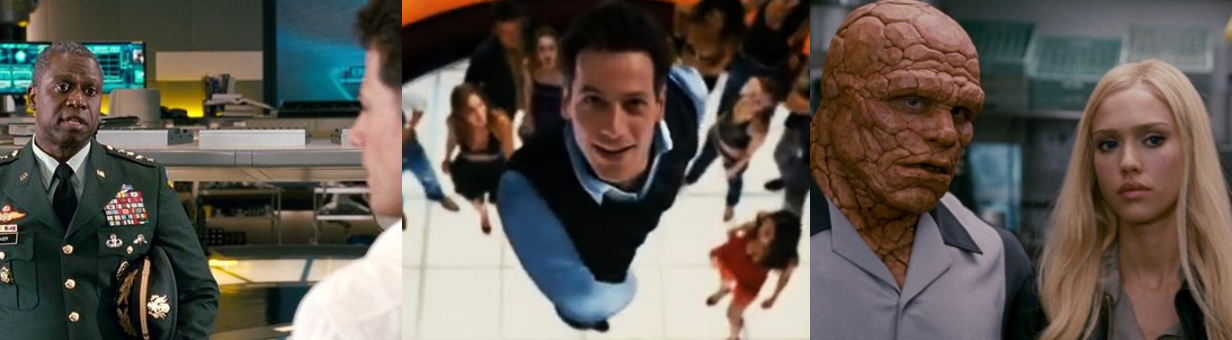
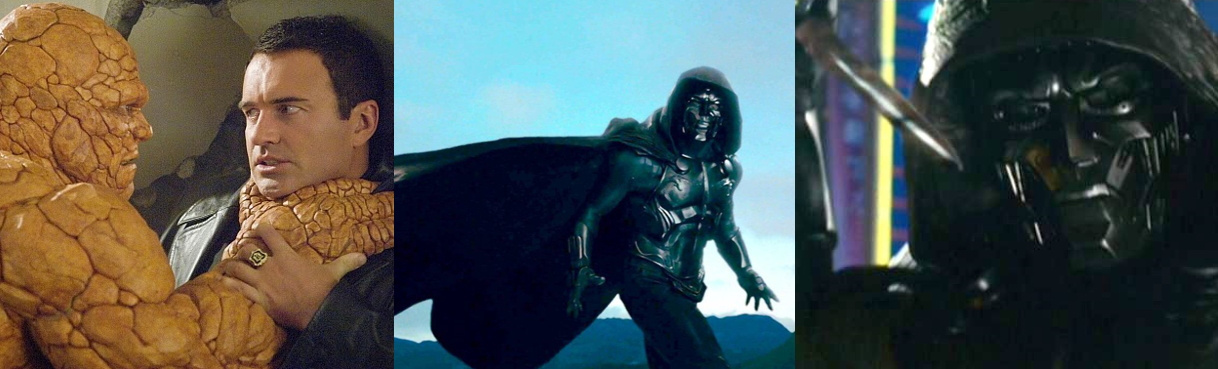
Considering the controversy behind the creation of Marvel’s dysfunctional First Family of superheroes, it’s poetic that Stan Lee and Jack Kirby’s colourful adventurers have had some ups and downs on the big screen. German producer Bernd Eichinger’s first attempt at an adaptation saw the production shut down and the negatives confiscated, Tim Story’s efforts were modest successes met with mixed reviews, and Josh Trank’s gritty reboot was a universally panned box office flop. 20th Century Fox thus quietly removed a sequel from their slate and the characters became the property of Marvel Studios when Disney purchased 20th Century Fox in 2017, eventually leading to a new reboot set in the Marvel Cinematic Universe (MCU). MCU head honcho Kevin Feige was excited to do the characters justice and Jon Watts was initially tapped to direct, before stepping away from superhero films and being replaced by Matt Shakman, who was attracted to the sci-fi elements and family dynamic. Although John Krasinski and Chris Evans portrayed variants of Doctor Reed Richards/Mister Fantastic and Johnny Storm/The Human Torch in the MCU, Pedro Pascal took over as Reed after an extensive search and Joseph Quinn took on Johnny. The filmmakers went to great lengths to find the perfect actress for Susan Storm/The Invisible Woman, attracted mindless bigots by featuring the Shalla-Bal incarnation of the Silver Surfer, and surprised audiences by including Galactus right away. Pitched as a retro-futuristic family drama, the film chose to gloss over the team’s origin and utilise practical effects wherever possible, leading to star Ralph Ineson being fitted into a fully practical armoured suit to portray the world-devourer. Alongside a box office gross of over $470 million, The Fantastic Four: First Steps broke the trend of its predecessors by being widely praised. Reviews praised that the film jumped right into the action with a pre-established team, the unique setting of the movie, and the riveting performances by the lead actors.

The Review:
In keeping with the whole “Multiverse Saga” the MCU was going through at the time, The Fantastic Four: First Steps takes place on an alternative version of Earth, Earth-828, a world that’s essentially a live-action version of The Jetsons (1962 to 1963; 1985 to 1987). This world is very much trapped in the swinging sixties, but with a super fun sci-fi twist. Flying cars are everywhere and the Fantastic Four’s Baxter Building is kitted out with all sorts of funky, throwback tech, including their adorable and much appreciate robot helper, Humanoid Experimental Robot B-Type Integrated Electronics/H.E.R.B.I.E. (Matthew Wood). This world doesn’t seem to have any superheroes apart from the titular team, who are so beloved and world renowned that they’ve monopolised space travel and saved the world countless times from the likes of the sadly excised Ivan Kragoff/Red Ghost (John Malkovich) and the maniacal Harvey Elder/Mole Man (Paul Walter Hauser). The Fantastic Four are more than just superheroes, though; they’re celebrities and even politicians, establishing the “Future Foundation” to share their knowledge with other world leaders and broker peace dealers while also hosting science programmes and advertising products. In a welcome change of pace, their origin is largely glossed over with a montage: four years ago, Doctor Reed Richards (Pascal) led his wife, Susan Storm (Kirby), her hotshot brother Johnny (Quinn), and ace pilot Benjamin “Ben” Grimm (Moss-Bachrach) on a space expedition and, due to an unforeseen event, the group were forever changed by cosmic radiation. In another nice change of pace, the team has been active for four years at the start of the film and well acclimatised to both their powers and their celebrity status. Thus, while it’s clear Mister Fantastic still carries a lot of guilt for his friend’s transformation into a gruesome rock-thing (and it’s implied this is why the team hasn’t returned to space since their ill-fated voyage), Ben has accepted his appearance and is a cherished national treasure.
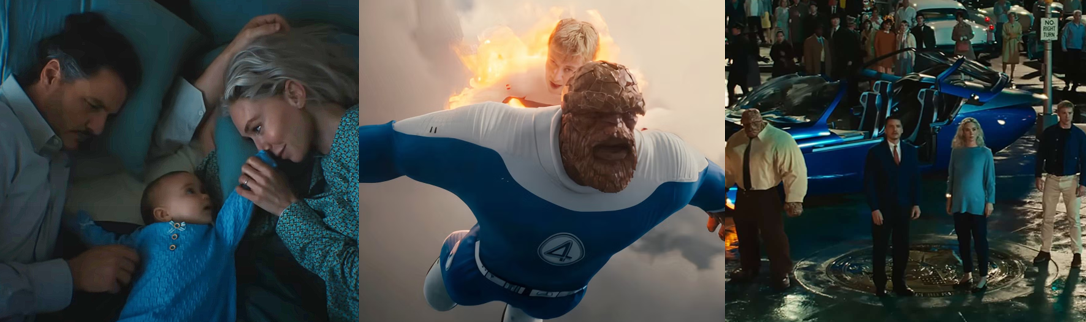
The dynamic between the team is not only at the forefront, but better and richer than ever before.

As the team live in the limelight, it’s no surprise that the world is deeply invested in the Invisible Woman’s surprise pregnancy, an event that brings Reed much joy but also sees his over analytical brain kick into overdrive babyproofing the building and running countless tests to ensure their baby hasn’t been negatively affected by their mutated DNA. This concern also comes from a place of guilt (he clearly worries his mistakes may harm Sue and the baby) but also doubt as he finds himself out of his depth concerning fatherhood and Reed, being the smartest man alive, is thrown off when he doesn’t know all the answers. The Human Torch and the Thing delight in ribbing Reed about this, which is just one way First Steps perfectly captures the spirit of these characters being more than a team: they’re a family. Rather than Johnny being a mean-spirited prankster or an egotistical skirt-chaser, he’s seen to be surprisingly smart in his won right, approaching problems from a different angle and figuring out a way to communicate with the implacable Shalla-Bal/Silver Surfer when she comes heralding the destruction of the world. While Johnny and Ben bicker at times, it’s nowhere near as hostile as in previous films and is very light-hearted, with Johnny giving backhanded compliments about Ben’s rock beard that see him rock the unconventional look. The group has fantastic chemistry together, with Reed and Sue working perfectly as a duo and yet still butting heads when contemplating Galactus’s outrageous demands. Nowhere is the team’s dynamic more apparent than when they take the Excelsior into space to confront Galactus and work in harmony to guide and maintain the ship. Later, they work in unison to collaborate with the world’s governments on defence plans, though they constantly underestimate Johnny and are therefore stunned when he figures out the Silver Surfer’s native tongue and attempts to parlay with her.
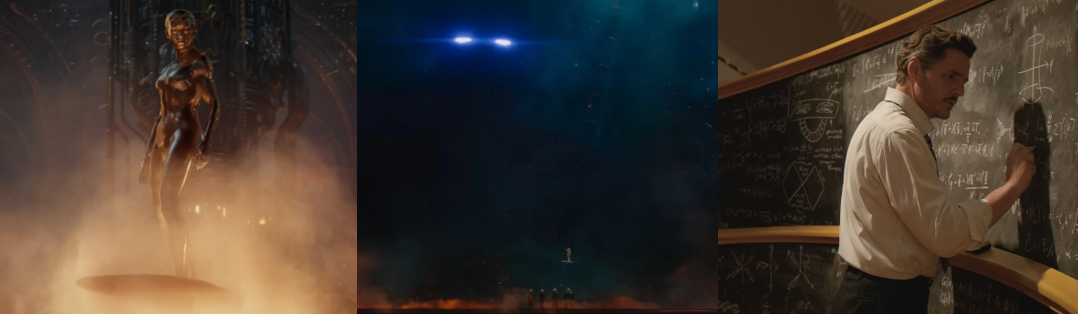
When the Silver Surfer heralds Galactus, the team desperately try to find solutions to the threat.

The Fantastic Four’s elation at their pending arrival is dashed when the Silver Surfer suddenly arrives to warn the planet of its eventual destruction at the hands of Galactus. While immediately smitten by the stoic, metallic alien, Johnny tirelessly goes over recordings to learn her origin and try to save the world from another angle. With the world under threat, Reed reluctantly agrees to refit the Excelsior and utilise his faster-than-light technology to get intel on Galactus, assuring the world that they will confront and defeat the treat as ever. Despite Sue being heavily pregnant, she joins them for the jaunt, arriving in time to see a faraway world decimated by Galactus’s titanic world-breaker. The Silver Surfer greets them and dispassionately allows them to converse with her master, easily evading their futile attacks and chasing them through a wormhole when they flee following Galactus’s demands, yet she vehemently defends her master when the team oppose him. It’s only when Johnny reminds her of her tragic past and the bargain she made with Galactus, and the countless lives she’s ended in serving him, that the Silver Surfer is taken off the board (no pun intended). Rather than being some stupid space cloud or shying away from his outrageous appearance, Galactus is a towering, God-like celestial being who is intrigued by the Fantastic Four’s curiosity and bravery but nonetheless determined to devour their world since he’s driven by an insatiable hunger. However, Galactus offers to spare the Earth if the four hand over Sue’s child. Franklin (Various/Ada Scott), whom the world-eater sees is a being of such vast cosmic power that he could be his successor. Naturally, Sue and the others strongly reject this offer, causing the world to turn against them since they refuse to sacrifice one life for billions. While Sue is outraged that Reed would even consider the possibility of acquiescing, he steadfastly refuses to entertain the idea, and she eventually placates the masses with the promise that the team will do whatever it takes to fend off the looming threat.

The Nitty-Gritty:
I was surprised to find that First Steps is sent entirely on Earth-828 and that the team appear to be natives of this world. I suspected that they would’ve been trapped there somehow and even speculated that they’d fail to save their world and be driven to the mainstream MCU by the end. Instead, the Fantastic Four inhabit this retro sci-fi world and act is its guardians and leaders, with the Thing exchanging pleasantries with the Yancy Street locals, Sue acting as a diplomat, Johnny being a poser boy, and Reed teaching science. This world has become so reliant on the fantastic Four that they’re almost powerless without them as they dictate politics and defend the masses from numerous supervillains. The world is thus amazed to learn that the team couldn’t defeat Galactus and turn to anger and resentment when a shellshocked Reed makes the bizarre choice to tell them of Galactus’s demands. This raises many ethical and moral quandaries that the film briefly touches upon, with the public largely calling for Franklin to be sacrificed and the team desperately exploring other options. Reed finds himself at a loss to think of alternative plans but ultimately embraces the uncertainty about Franklin’s destiny and fatherhood, taking inspiration from Sue’s speech to adapt his teleportation technology in a desperate bid to move the Earth. This sees the second act of the film emulate classic doomsday movies as the team scramble to assemble giant devices and conserve energy to enact the plan, only for it to be immediately undone when the besmirched Silver Surfer returns from a black hole and wrecks their toys. I love seeing Reed’s hopeless desperation as he struggles to conjure up the formulas to present alternatives, and that Ben and Johnny remained optimistic, searching for other ways to defend themselves and eager to take the fight to Galactus if necessary.
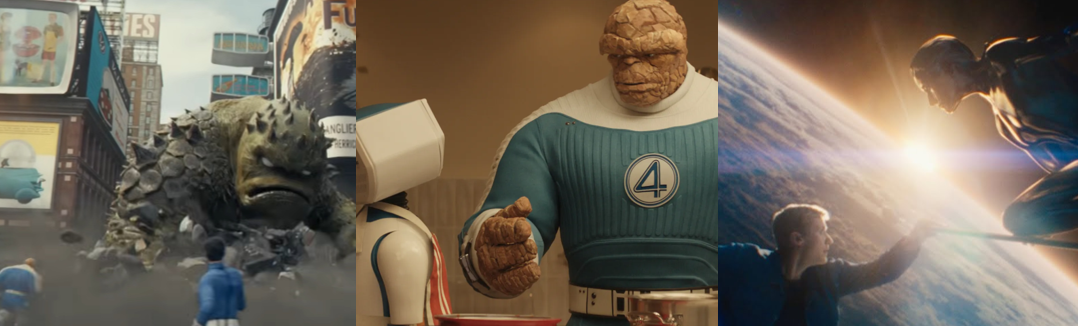
For the first time, these bizarre characters were done justice in live-action.

Though it’s a shame the Fantastic Four aren’t based in the mainstream MCU, this unique world allows them to take centre stage and steal the show. For the first time since the 1994 movie, the team have been ripped right out of the comic books, sporting throwback outfits that appear functional and comfortable. While I usually prefer practical suits wherever possible, the Thing has never looked better, perfectly emulating Jack Kirby’s art style and sporting some nifty threads throughout the film (including his iconic trenchcoat and hat). While First Steps largely deals with the interpersonal drama between the team and preparing for Galactus’s arrival, they do get a chance to shine in fun montages, including a recreation of their first appearance and numerous good deeds. Of all the team, Sue really impressed here. Not only was she a strong-willing and believable matriarch and team member, but she displayed some awesome feats of power, being so desperate to protect Franklin that she threw even mighty Galactus off-balance. Sue’s powers are represented wonderfully here, appearing as shimmering tricks of light rather than cartoonish bubbles or blue aura, while Johnny’s flame effects also looked better than ever. Reed was a little short-changed as his stretching powers are used sparingly, but his genius intellect and leadership skills were emphasised instead. Reed is a little awkward and analytical at times, but he also isn’t afraid to tackle Galactus when diplomacy fail, strategically targeting vents on the giant’s back to slow him down and get his attention. Reed’s smarts also enable the construction of the main generators the team initially hope to use to teleport Earth to safety, led to the creation of the versatile H.E.R.B.I.E., and see the team fly around in a super sleek modified Firebird IV. However, it was Galactus that caused me to smile from ear to ear as we finally got to see him in all his glory and watching him nonchalantly stride through the streets of New York City, absently swatting away the Fantastic Four’s attacks, was like seeing Alex Ross’s beautiful artwork come to life.
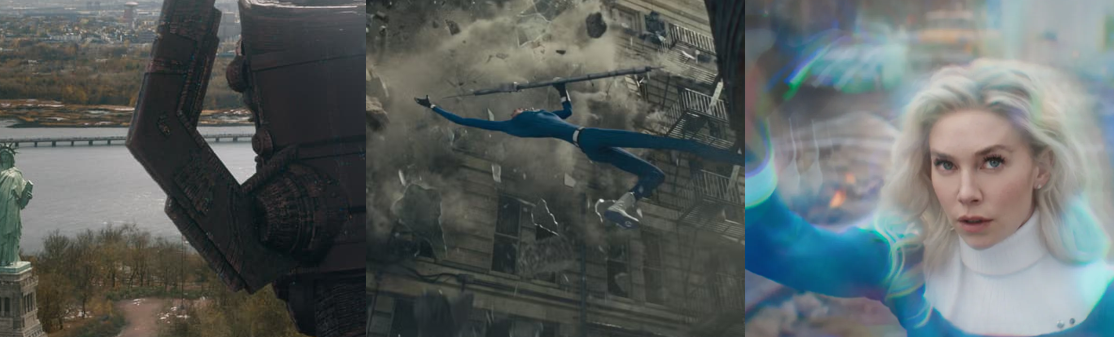
After refusing Galactus’s demands, the team pushes their fantastic abilities to the limit to fend him off.

Desperate to come up with a solution that doesn’t involve handing their newborn son over to a cosmic being, Reed hits upon the idea of co-ordinating the world’s resources into building teleporter relays to get the Earth to safety. When the Silver Surfer destroys all but one of these and flees after being grief-stricken by the Human Torch, Sue begrudgingly agrees to use Franklin as bait and the team enact a risky plan to first convince the Mole Man to shelter the city’s inhabitants and then lure Galactus onto the teleporter pad and send him to parts unknown. At first, the plan works: Galactus heads to baby Franklin despite the obvious signs of a trap, barely registering when the team attack him. Thanks to Sue’s forcefield, Johnny temporarily blinds Galactus, allowing Franklin to be switched for a decoy. Right at the last second, almighty Galactus senses something’s wrong and reacquires his target, easily snatching Franklin from the Baxter Building and finally readying himself to be free of his cursed existence. In a fit of motherly rage, Sue unleashes her full power upon Galactus, restraining him long enough for Reed to rescue the baby and then overexerting herself to force Galactus into the teleporter. When Galactus attempts to reemerge in a rage, Johnny prepares to sacrifice himself for his family, only for the Silver Surfer to take his place, determined to atone for presumably eons of death caused by her master. Though Galactus and the Silver Surfer are teleported away, Sue’s efforts prove fatal and, despite Reed’s desperate attempts, she dies on the street. However, it turns out Franklin really does have some cosmic significance as his mere touch brings Sue back to life, much to the relief of her family. Although the team is uncertain what the future holds for Franklin, they resolve to face it together and spend the next four years raising him as a normal boy, only for Sue to be shocked when a cloaked, iron-masked figure (Robert Downey Jr.) suddenly appears before the boy in the mid-credits sequence…
The Summary:
I was really looking forward to The Fantastic Four: First Steps and the team’s introduction to the MCU, having previously speculated on casting and the direction the film should go. While the movie obviously went in a very different direction, I think this was for the best as it allowed the movie to be solely focused on the team, their relationship with each other, and how they react to the crisis at hand. The retro sci-fi aesthetic of Earth-828 resulted in a unique visual treat, one that expertly brings Jack Kirby’s characteristic art to life while also showcasing the Fantastic Four’s incredible powers.  was surprised, maybe even sceptical, when Galactus was chosen as the antagonist, but I was so happy to finally see him brought to life with near-perfect fidelity to the source material. Depicted as a somewhat tragic and apathetic force of nature, Galactus simply is and I really enjoyed how disinterested he was in “little people”, at least until he senses Franklin’s awesome potential. The sense of scale given to Galactus was honestly awe-inspiring and terrifying and it was super fitting to see the middle half of the film resemble end of the world movies. I also liked the twist of using Shalla-Bal as the Silver Surfer and Julia Garner captured the tortured essence of the herald well. The chemistry between the four leads was easily the best we’ve ever seen from live-action interpretations of the characters, with them portrayed as a well-established and celebrated group and a functioning team and family dynamic. I loved the changes made to Johnny’s character, how he was a quick study and not just some hotshot with a hard on, and that Ben had fully come to terms with his position while still showcasing some regret when tempted by beautiful schoolteacher Rachel Rozman (Natasha Lyonne). Reed and Sue were the main draws for me, though. Sue was such a strong character, both in her convictions and her raw power, and I loved seeing Reed struggle with considering the worst decisions and being at a loss to think of alternatives. For me, this was the most faithful filmic adaptation of Marvel’s First Family to date, one that perfectly represented their unique family dynamics and presented them as an intelligent, quirky, and formidable team to hopefully make an unforgettable impact in the wider MCU.

My Rating:

Rating: 4 out of 5.

Great Stuff

Did you enjoy The Fantastic Four: First Steps? How do you think it compared against the previous live-action films? Were you surprised to find it set on an alternative Earth? Did you enjoy the cast, their chemistry, and the way their powers were represented? Were you glad to see Galactus finally brought to life in full armour? Would you have given up your child to save the world? Where would you like to see the MCU take the Fantastic Four? Let .e know your thoughts on The Fantastic Four: First Steps in the comments, go check out my other Fantastic Four content, and donate to my Ko-Fi to support the site.

Back Issues [National Superhero Day]: Marvels


In 1995, Marvel Comics created “National Superhero Day” and, in the process, provided comics and superhero fans the world over with a great excuse to celebrate their favourite characters and publications.


Story Titles: “A Time of Marvels”, “Monsters”, “Judgment Day”, and “The Day She Died”
Published: 9 November 1993 (cover-dated: January 1994) to 22 March 1994 (cover-dated: April 1994)
Writer: Kurt Busiek
Artist: Alex Ross

The Background:
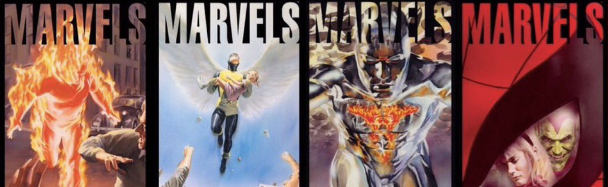
In 1939, pulp-magazine publisher Martin Goodman created Timely Productions, expanding his reach into the increasingly popular medium of comic books. Timely’s first publication, Marvel Comics #1, was spearheaded by the first appearances of Jim Hammond/The Human Torch and Prince Namor McKenzie/The Sub-Mariner, and went on to sell over 900,000 copies. This success was followed by Captain America Comics #1 selling over a million copies just two years later, the same year that Goodman’s wife’s sixteen-year-old cousin, Stanley Lieber, was named interim editor under the pseudonym “Stan Lee”. Though superheroes declined in popularity after the Second World War, Goodman continued to publish Westerns, horror, and war comics under Atlas Comics before rebranding to Marvel Comics in 1961. Stan Lee and Jack Kirby then ushered in the “Marvel Age” of comics with the Fantastic Four, kick-starting a slew of costumed superheroes and Marvel’s distinct narrative style. These colourful heroes caught the eye of artist Alex Ross from an early age; known for his startlingly photorealistic artwork, Ross later cemented his position in the industry with Kingdom Come (Waid, et al, 1996). However, his big break came when he teamed with writer Kurt Busiek to produce this four-issue miniseries that reframed many of Marvel’s most iconic moments through the eyes of a common man. Marvels was an award-winning, widely praised miniseries that inspired a much grimmer counterpart story in 1995, a follow-up series in 2008 (though Alex Ross did not return), and a sister-series in 2021.

The Review:
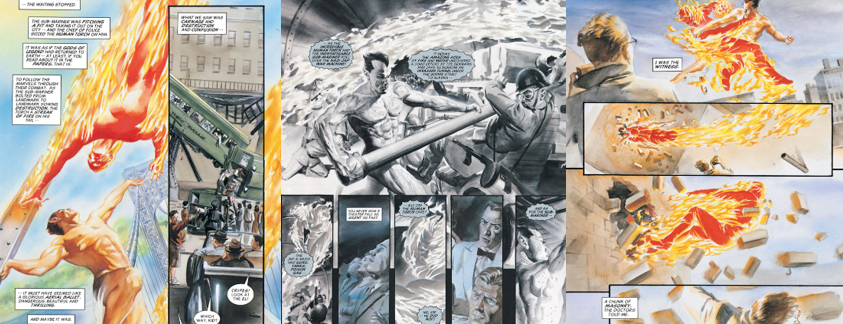
Marvels followers budding photographer Phil Sheldon who, at the beginning of the story in 1939, is eager to go to Europe and make a name for himself as a war photographer. While his friend and fellow cub reporter, a youthful J. Jonah Jameson, scoffs at the futility of the war, he shares his own lofty aspirations of one day owning the Daily Bugle and making his own headlines. While Jameson heads off to cover a labour dispute, Sheldon attends a press conference hosted by noted scientist Phineas T. Horton, who unveils his revolutionary “synthetic man”, a robotic creation indistinguishable from the real thing except that it bursts into flame when exposed to oxygen. While the reporters initially mock the demonstration as an elaborate hoax, they react in horror when this “Human Torch” moves and appears sentient. Subsequent sensationalist headlines – the “power of the press”, as Sheldon puts it –   slander Professor Horton and see him bury his creation lest it prove to be a danger. While shopping for a gift for his betrothed, Doris Jacquet, Sheldon rushes to investigate a disturbance, hopeful for the big break that’ll get him shipped to Europe, only to the find the Human Torch running amok through the streets of New York City. While the ridiculously fickle New Yorkers brush the event off as an elaborate prank, Sheldon is shaken by his second sight of the flaming man and is therefore the only person to take reports of a “Sub-Mareener” seriously. Over the next few panels, both the Human Torch and the Sub-Mariner raise the ire of everyday folk with their antics, but they captivate Sheldon, who turns down the chance to cover to war to stay and follow these ever-prominent “Marvels”. As awe-struck as he is by such costumed super-men, Sheldon can’t help but question what their presence means for mankind, who suddenly seem secondary in the evolutionary chain. Thus, when the Human Torch and the Sub-Mariner inevitably come to blows in what’s likened to a battle between Gods, Sheldon shares the same fear as his fellow citizens, despite protests from the likes of officer Betty Dean, who vouches for Namor’s character.

Photographer Phil Sheldon witnesses the terrifying and awesome debut of the “Marvels”.

As the two titans battle, hijacking the airwaves and causing a great deal of property damage, Sheldon is angered at them for making humanity feel so helpless. The conflict is ultimately resolved by Officer Dean, who cools the differences between the two, though Sheldon echoes the same bitterness of his peers at both superhumans escaping any punishment for their actions. In the face of his helplessness, and intuiting that such occurrences will only escalate, Sheldon reluctantly suggests pushing back the wedding and, resenting him, Doris opts to call the whole thing off until he feels more like a “man”. By winter, the press was alive with reports of Captain Steve Rogers/Captain America’s colourful adventures; kids and adults alike revelled in his Axis-smashing antics. While at the cinema, Sheldon’s musings that Cap is so accepted because he’s not perceived as a threat are given further credence when the entire audience (him included) applaud news reports of the Human Torch and the Sub-Mariner teaming up to battle the Nazis. Just like that, the Marvels are celebrated, national heroes; the public debates which of them is better and stronger and Sheldon’s perspective has changed enough to rekindle his relationship with Doris. His elevation is short-lived, however, when it’s suddenly reported that Namor has turned on the Allies and waging his own war against America, a war that sees him flood New York with a catastrophic tidal wave! The Human Torch confronts him and Sheldon’s right there to snap some pix, now revelling in witnessing such a titanic clash, only to be injured by flying debris and lose an eye in the process. Surprisingly, he feels no ill will towards the Marvels and instead chooses to focus on the bigger picture – the war and his impending wedding, specifically. After the wedding, Sheldon finally gets to cover the war in Europe and is right there when Cap, the Human Torch, Namor, and the rest of their superpowered Invaders, storm a Nazi compound, noting in a letter to Doris that the Marvels aren’t some temporary fad; they’re here to stay.

While the Avengers and Fantastic Four are celebrated, even Sheldon hates and fears Mutants.

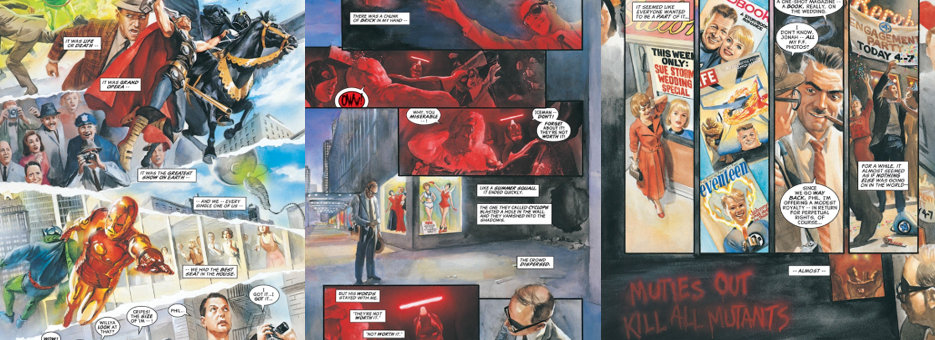
Some decades later, an older and more experienced Sheldon is convinced to cover a battle between the Avengers and the Masters of Evil. Cap has just returned from his icy sabbatical, inspiring the awe and admiration of Sheldon and the public. By this time, sights such as Anthony “Tony” Stark/Iron Man, Thor Odinson, and Doctor Hank Pym/Giant-Man cutting through the city skyline and dwarfing mere mortals are commonplace but no less impressive. Sheldon hopes to publish a book of his photos of their heroics, convincing his publisher to take a shot on the idea based on how inspirational Marvels like the Fantastic Four are. While mulling over his opening text, Sheldon’s swept up by an angry mob who descend upon the X-Men, convinced that the Mutant teenagers tried to kill an innocent construction worker. Sharing the sentiment that the Mutants are dangerous killers, Sheldon literally casts the first stone, left shaken by the words of Scott “Slim” Summers/Cyclops (“They’re not worth it”) and pondering why Mutants illicit such hatred and distrust compared to the other Marvels. He concludes it’s because Mutants are genetically predisposed to be the next step in human evolution, thereby conjuring fears of death and redundancy in everyday folk. Ruminating these matters at home with his kids (who idolise the Marvels), Sheldon is gifted a writing assignment covering an art exhibition hosted by blind sculptress Alicia Masters. He’s also right there for when Doctor Reed Richards/Mister Fantastic announces his engagement to Susan Storm/The Invisible Girl, landing Sheldon another book deal with Jameson for every photo he takes of the colourful couple and landing him on the guest list for the wedding. With major shake-ups occurring in the Avenger’s roster and the likes of Matt Murdock/Daredevil making a splash downtown, to say nothing of the wedding drama, Sheldon almost forgets about the Mutant problem…save for the abundance of anti-Mutant graffiti plastered around town.

Sheldon sees the worst of humanity when the Mutant problem escalates into all-out paranoia.

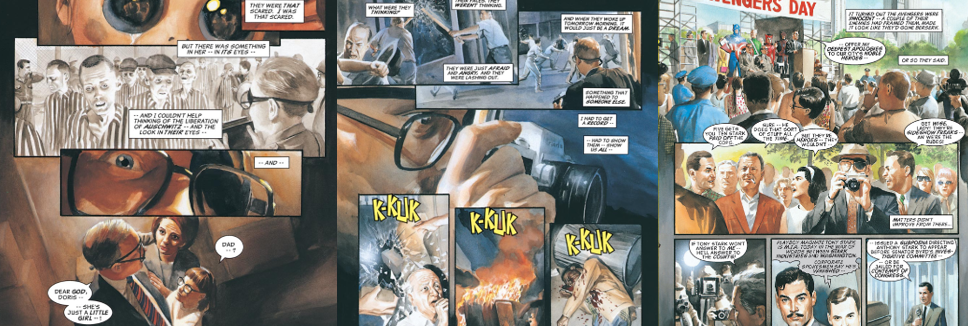
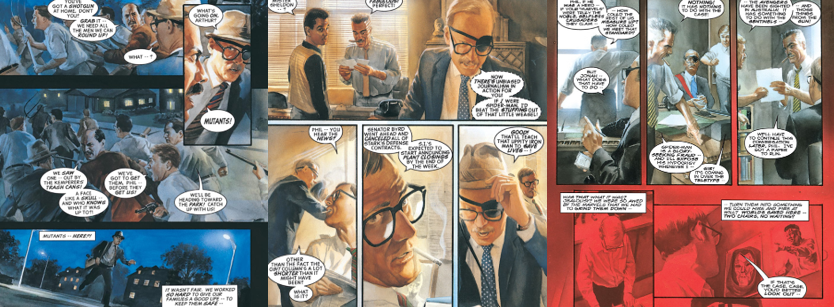
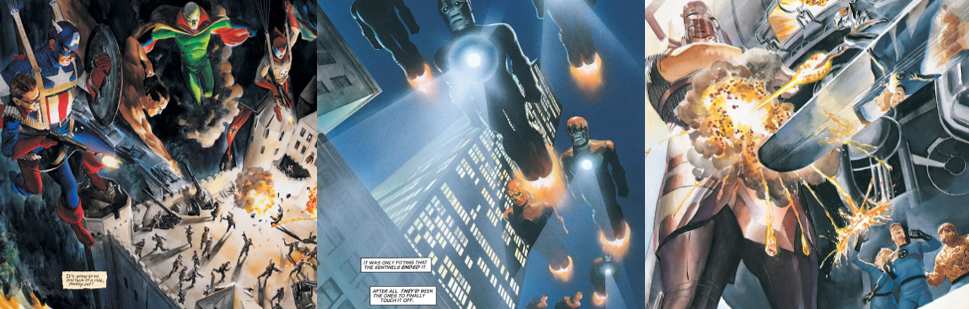
Sheldon’s stunned when he returns to his quiet suburb and finds an angry mob literally grabbing pitchforks to hunt down a Mutant in the area. His first thought is his family but Sheldon’s shocked to come home and find his children sheltering a Mutant child, Maggie, a frightened little girl who’s the anthesis of everything Sheldon had so firmly believed about her species. Suddenly likening the persecution of the Mutants to the horrors of Auschwitz, Sheldon resolves to protect the girl from their friends and neighbours, who wouldn’t think twice to burn their house down to get to her. While his family keep Maggie safe, Sheldon reads up on Mutants and tries to find some way to help her, only to be met with dead ends and realise that the government wants to lock them up, at best, and execute them, at worst. Sheldon realises that the X-Men could help but falters, worrying they would remember him as another angry human, and meanders through even Reed and Sue’s wedding, his thoughts so preoccupied by Maggie’s fate. His concerns are only exacerbated when a television debate between Professor Charles Xavier/Professor X and Bolivar Trask sees the unveiling of his Mutant-hunting Sentinel machines and the outing of Professor X as a Mutant. Driven into a frenzy by fear, hated, and paranoia, an all-out riot breaks out. Sheldon’s right there, recording evidence of man’s inhumanity to man, as the monstrous Sentinels fly overhead, and is distraught to return home and find Maggie left to keep them safe and unable to comfort his kids when they worry about her safety. Within a mere two months, the fickle public begin to turn on the Marvels, holding them accountable for their actions and questioning their methods. Their primary target is Tony Stark, who bankrolls the Avengers and pays Iron Man to be his personal bodyguard, and the Avengers, who had recently been framed by evil doppelgängers. Disturbed by how sordid the Marvels have become, Sheldon throws himself into his work, determined to keep his family fed and sheltered, but unwittingly drives a wedge between him and Doris and the girls.
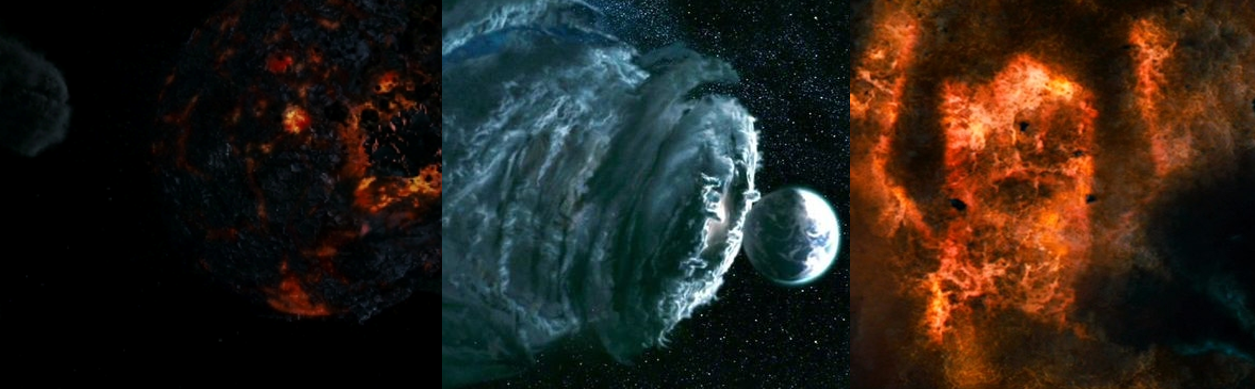
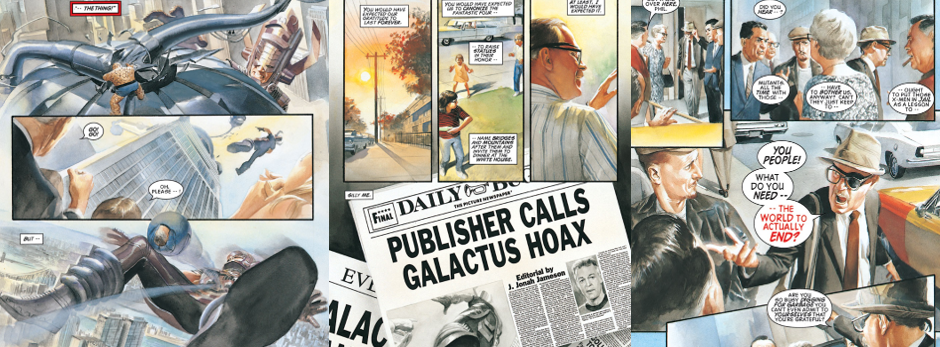
Sheldon’s incensed when the public slanders the Marvels even after they defeat Galactus.

The Marvels’ bad press is only escalated by Jameson’s personal vendetta against Peter Parker/Spider-Man and Sheldon comes to question his perception of the Marvels once more. However, he and the entire city are horror-struck when the skies burst into flames, asteroids fill the horizon, and a mysterious “Silver Surfer” arrives, seemingly heralding the onset of judgement day. Once again, despite their distrust and slander, the people must put their faith in the Marvels and be mere spectators as the Fantastic Four raced to confront the Silver Surfer, only to be dwarfed by the might and terror of the titanic Galactus! To the stunned horror of the public, the Fantastic Four lose the battle and none of their other defenders appear to help, leaving them to contemplate their end and watch, helplessly, as Galactus constructs an elaborate device around the Baxter Building. The people celebrate as the Fantastic Four and the Silver Surfer attack Galactus in full force, but Sheldon decides to leave the scene and be with his family, realising that the Marvels could fail and that he would rather be with his loved ones at the end. Luckily for him, and everyone, the Fantastic Four fend Galactus off with the Ultimate Nullifier but, rather than being celebrated as heroes, the team – and all Marvels – are further slandered by Jameson’s derogatory headlines. Sheldon’s protests fall on deaf ears and even he’s disgusted to find teenage photographer Peter Parker gleefully selling incriminating photos of Spider-Man to Jameson. His contempt for the public reaches a boiling point as Sheldon heads to cover a battle between the X-Men and Count Luchino Nefaria, snapping at them for slandering the very people, even Mutants, who save their lives. Still, by the 1970s, the public turn to his book of photographs for comfort after the Avengers are stuck in another galaxy determining the fate of all reality, begrudgingly guilty for questioning their methods. Now feeling his age, Sheldon takes on an assistant, Marcia Hardesty, though even this can’t help lighten his increasingly sour mood as he repeatedly sees the Marvels questioned, persecuted, and smeared by the courts, the public, and Jameson.
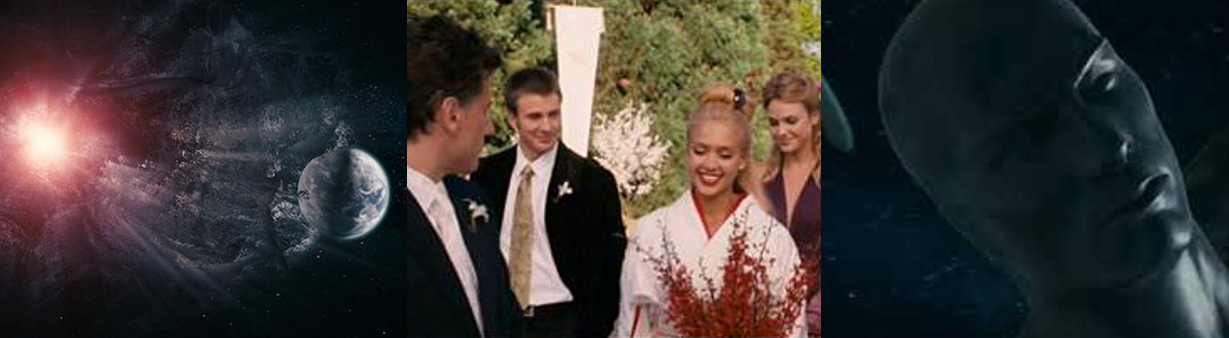
Sheldon ultimately decides to leave the awe and drama of the Marvels behind.

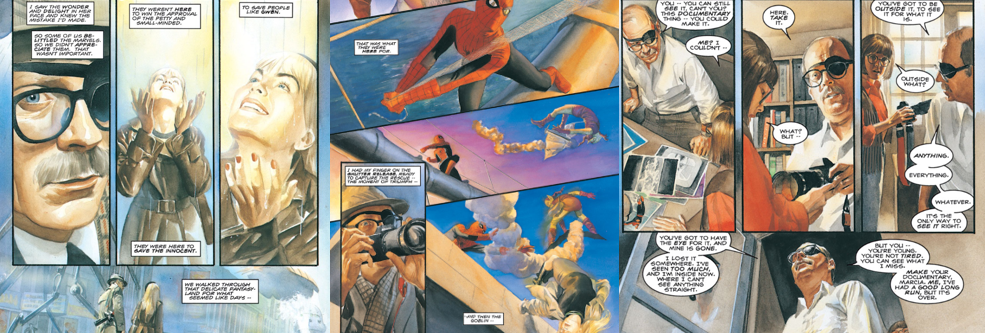
After the Fantastic Four again fend off Galactus, Sheldon desperately tries to turn opinion in favour of the Marvels, only to be dismissed as an overworked old man. Sheldon resolves to use his skills as a reporter to clear Spider-Man of Captain George Stacy’s death, interviewing a bystander who unashamedly blames Stacy’s death on Spider-Man. Sheldon’s as sceptical as the cops he meets with; however, while they have evidence that suggests Doctor Otto Octavius/Doctor Octopus caused Stacy’s death, they can’t prove anything without questioning Spidey. Confident that the underappreciated Marvels will handle a crisis happening at the Sun, Sheldon interviews some more people, all of whom believe Spidey’s a menace, and even questions Jameson, revealing the cantankerous publisher feels inadequate against such Marvels and is therefore determined to besmirch them, guilty or not. Jameson’s attitude makes Sheldon seriously consider an offer to write for the Daily Globe and he takes the first boat to Ryker’s Island to talk with the captive Dr. Octopus, only to find the stubborn scientist unwilling to co-operate with his inquiries. With no roads left, Sheldon visits Stacy’s daughter, Gwen, finding that, while she did initially blame Spider-Man, she no longer does. Reinvigorated, Sheldon regularly meets with Gwen; she’s with him when Namor invades New York with an army of mechanical attack craft. Rather than being terrified, Gwen marvels at their beauty and Sheldon realises that lives like hers are what the Marvels are fighting for and resolves to rework his new book into championing the heroes, flaws and all. Sheldon’s conviction turns to dread when he goes to Gwen’s to pick up some of her father’s journals and witnesses her being kidnapped by Norman Osborn/The Green Goblin. Sheldon follows in a taxi and witnesses the brutal battle between Spidey and the Goblin, sure that good would triumph over evil, and is crushed when Gwen’s knocked from the bridge and dies when Spidey tries to save her. Angered that Gwen’s death is buried under Jameson’s anti-Spidey campaign and left disillusioned by the Marvel’s failure, Sheldon loses interest in his book and grows resentful of the world moving on without a care. However, he realises that Marcia still sees the good in the Marvels and ultimately hands the assignment to her, retiring to be with his family and leaving the Marvels behind.

The Summary:
I’ve long criticised the hypocrisy of Marvel Comics’ everyday citizens. The people, especially New Yorkers, are a fickle and judgemental bunch, easily swayed by a few headlines and news reports. They can literally be dodging Galactus’ footsteps one day and then will laugh it off as a hoax the next. They can witness Spider-Man saving people from a burning building and yet fully believe Jameson’s claims that the wall-crawler started the blaze. They’ll come out in droves to cheer the wedding of Reed and Sue and applaud the star-spangled heroics of Captain America, but hurl bricks at Mutants and accuse them of all sorts in the same breath. They are a terrible, unappreciative, unreliable bunch of ingrates who don’t appreciate that these heroes put their lives on the line to save not just them, but the entire world and even the whole universe! Marvels is a perfect examination of this phenomena, with our equally culpable main character witnessing first-hand as Joe Public fear the likes of the Human Torch and the Sub-Mariner because they’re “different” and then cheer them on when they fight to defend America’s interests. Much of the public’s fickle nature isn’t just because of Jameson’s outrageous headlines, either; people, even Sheldon, feared the Marvels in the 1930s simply because of the existential threat they presented. This evolved and escalated once Mutants came along, with the species inarguably representing the next step in humanity’s inevitable extinction and thus causing the public to hate and fear them out of paranoia of being replaced (or the simple fear of death). Yet, Marvel’s civilians can never be appeased; they even turn on celebrated heroes like the Avengers for “abandoning” them and treat many of the Marvels as disposable celebrities. Their everyday, awesome feats lose their grandeur for many, who just become inconvenienced by their battles, and public opinion wildly fluctuates throughout the decades represented here as a result, even spilling over into paranoid violence when Mutants and shapeshifters become commonplace.

Flawed photographer Sheldon finds his awe of the Marvels tested over time.

At the heart of it all is flawed photographer Phil Sheldon. Phil’s a complex character, for sure, echoing the awe and fear of his peers at the sight of the Marvels and feeling small, insignificant, against these God-like figures. His opinion regarding the Marvels fluctuates throughout the story, with him praising and celebrating them during their “Golden Age” and profiting from their antics, never losing his faith in their good deeds even when it costs him an eye. Yet, like the public, Sheldon hates and fears Mutants. Unlike the average Joe, Sheldon contemplates why this is and realises he doesn’t really know, beyond that aforementioned existential dread. When he discovers Maggie hiding in his house, fully accepted by his well-meaning kids, he finally realises that he’s as guilty of persecution as the Nazis he once so heartily rallied against and privately defends Mutantkind. His perception changed for the better, Sheldon comes to see the worst in humanity: while they accuse Mutants of being dangerous, he sees only heroes trying to defend the innocent and angry mobs tearing their neighbourhoods apart out of sheer paranoia. Haunted my Maggie’s unresolved fate, time and weariness with the public’s everchanging opinions takes its toll on Sheldon. He remains in awe of the Marvels but focuses on them so much that he neglects his family, desperate to figure out what it is about them that distracts him so much. When Galactus arrives and the end of the world seems nigh, Sheldon realises that none of that matters; all that matters is being with the ones you love. This attitude leads into him becoming very short-tempered when people question or slander the Marvels, snapping at the unappreciative public for not realising that they owe their lives to the same people they’re dragging over the coals. Unfortunately, Sheldon lives long enough to see the best and worst of both humanity and the Marvels, realising with gut-wrenching finality that these “Gods” are as flawed as the everyday man. He comes to put all his faith in Gwen’s innocence and is thus heartbroken when Spider-Man fails to save her, but comes to see that his time with the Marvels has come to an end and that it’s time to let those concerns go to focus on what really matters.

Alex Ross’s beautiful artwork brings some of Marvel’s most epic moments to glorious life.

Of course, what really makes Marvels shine is Alex Ross’s frankly gorgeous artwork. Every panel is painstakingly hand-drawn and painted to bring these colourful, outlandish superheroes to life. Unlike many of his peers, especially later in life, Alex Ross doesn’t try to reinvent these characters or make them more “realistic”; he simply presents photorealistic interpretations of their classic costumes, with the sole exception that he depicts Namor as being completely naked. This can be hit and miss; Spider-Man, for example, looks phenomenal under Ross’s penmanship but Thor and Iron Man struggle somewhat with their more outlandish designs. Still, Ross delivers some gorgeous full-page spreads, recreating Reed and Sue’s wedding, showing the battles between Namor and the Human Torch, and bringing these incredible moments to life from a street level perspective. Nowhere is this represented better than in Galactus’s arrival. Despite being faithful to Jack Kirby’s original design, Galactus cuts an intimidating and awe-inspiring figure here, towering over skyscrapers and constantly framed as though a Titan has risen from the Earth. While the story primarily focuses on Sheldon’s family life during this bout, the glimpses of the Fantastic Four and the Silver Surfer’s battle against Galactus deliver a sense of scale and realism not often seen in comics. This is further echoed in the coming of the Sentinels and Spider-Man’s battle with the Green Goblin, events where Sheldon is merely a bystander amongst the faceless masses watching history unfold, powerless to intervene. Ross fills every panel with little cameos and an amazing attention to detail, basing many characters’ likenesses off real-world celebrities and figures, and his work really makes you appreciate the craft and effort put into every panel, no matter how small. Marvels is a dramatic and compelling distillation of the first thirty-years-or-so of Marvel Comics, linking major events on a realistic timeline and giving us a glimpse at how these heroes, Gods, and villains are perceived by the common man. It’s a startlingly bleak tale at times, criticising our hypocrisy and inclination towards hatred and violence, but also an uplifting story. Sheldon, and many characters, celebrate and are inspired by the Marvels, championing them even when a small, volatile minority try to slander them. It’s the perfect snapshot of what life in Marvel’s New York City can be like and a great way to witness such iconic moments from a street-level perspective.

My Rating:

Rating: 4 out of 5.

Great Stuff

Have you ever read Marvels? If so, what did you think to it? Are you a fan of Alex Ross’s artwork? What did you think to the presentation of Marvel’s fickle public? Did you relate to Sheldon as a protagonist and enjoy his growth throughout the series? Which “Marvel” is your favourite? How are you celebrating National Superhero Day today? Whatever your thoughts, leave a comment below and be sure to check out my other superhero and comic book content.

Back Issues [F4iday]: Fantastic Four #48-50


In November 1961, Marvel Comics readers witnessed four intrepid explorers be forever changed by mysterious cosmic rays. Marvel’s “First Family” of superheroes were the first of many colourful superheroes for Marvel Comics and are more than deserving of some attention today.


Writer: Stan Lee – Artist: Jack Kirby

Story Title: “The Coming of Galactus!”
Published:
9 December 1965 (cover-dated March 1966)

Story Title: “If This Be Doomsday!”
Published: 11 January1966 (cover-dated April 1966)

Story Title: “The Startling Saga of the Silver Surfer!”
Published:
10 February 1966 (cover dated May 1966)

The Background:
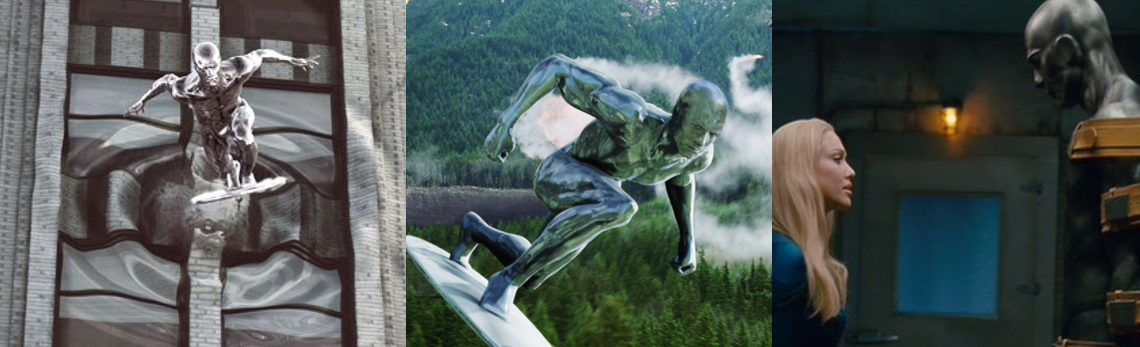
In 1961, Stan Lee and Jack Kirby introduced readers of Marvel Comics to the dysfunctional Fantastic Four in a direct response to DC Comics’ Justice League of America. While the team’s creation has been contested by both, Lee and Kirby popularised the “Marvel Method” of writer/artist collaboration and brought comic fans real and relatable characters who introduced pivotal Marvel staples in the following years. Perhaps none are more crucial than the cosmic devourer of worlds himself Galactus. Created by Lee and Kirby and debuting in this trilogy of issues, the entity once known as Galan had Biblical connotations and was specifically designed to challenge pre-conceived notions of “good” and “evil”. Many subsequent stories have characterised Galactus as a force of nature, if not the universe, as inevitable and necessary as life and death. A complex being who spreads genocidal destruction to satiate his never-ending hunger, Galactus is typically served by equally mighty “heralds”, most notably Norrin Radd/The Silver Surfer, and either at the forefront or lurking in the background of Marvel’s cosmic crossover events. Galactus has brought to life in Marvel’s various animated ventures, often appears in Marvel videogames, and was notoriously represented as an indistinct swirling cloud in Fantastic Four: Rise of the Silver Surfer (Story, 2007) before finally being brought to life in live-action in the Marvel Cinematic Universe in 2025.

The Review:
The Fantastic Four’s greatest threat begins with them still struggling against Marvel’s newest batch of bizarre costumed superhumans, the Inhumans. Specifically, Maximus Boltagon/Maximums the Magnificent (or, more accurately, Maximus the Mad) has set off the dreaded “Atmo Gun”. While this has no effect on his Inhuman brethren, it’s caused deadly planet-wide vibrations that threaten all human life. While even the hyper-intelligent Doctor Reed Richards/Mister Fantastic cannot fathom the cause of such an event, Blackagar Boltagon/Black Bolt, leader and monarch of the Inhumans, immediately confronts his insane brother, a creature so vile and spiteful that he’d happily destroy every human just so the Inhumans could walk the Earth uncontested. For his mad schemes, Maximus earns a swift backhand from the dangerously mute Black Bolt and is both astonished to find the Fantastic Four still alive and dismayed when his brother easily disables the Atmo Gun’s effects. Regardless of the pleas of the beautiful, red-headed Inhuman Medusalith Amaquelin/Medusa, who’s pledged her life, heart, and loyalty to Black Bolt, Maximus refuses to accept any similarities between the two races. Stubborn to the end, he throws off the Inhumans restraining him and lunges for the Atmo Gun once, more, maliciously reversing its effects before anyone can stop him. The result is the entire Inhuman sanctuary, Attilan, being encased within an impenetrable “Negative Zone”. Thinking fast, the Fantastic Four race to safety and escape before they are also trapped inside, leaving Johnny Storm/The Human Torch heartbroken at being separated from Crystal Amaquelin, Medusa’s pretty little sister who Johnny immediately fell for and who unwittingly brought the two groups together in the first place. Johnny reacts with anger, desperate to burn his way back into Attilan and pleading with Reed to find some way to be reunited with Crystal. However, Johnny’s left to despondently realise that there’s no hope and, sympathetic to his plight, Ben Grimm/The Thing secretly vows that none of them will ever give up hope that the two can see other someday.

Johnny’s anguish at being separated from crystal is supplanted by Galactus’ dreaded arrival.

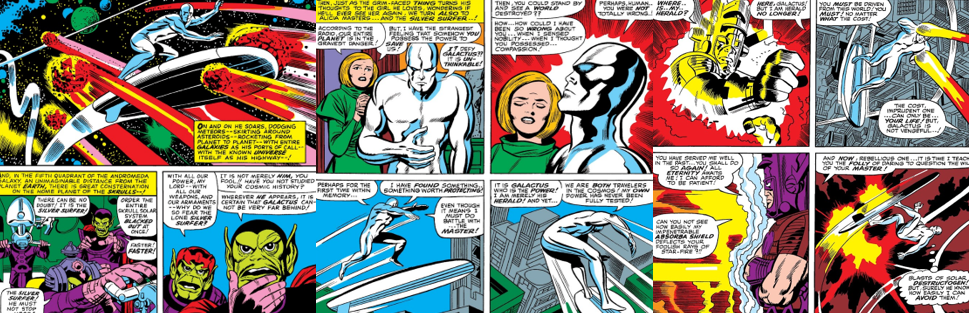
With the Inhuman saga wrapped up for now, the story then switches to the vast depths of the cosmos where we’re introduced to the enigmatic Silver Surfer for the first time. Deftly dodging a meteor shower as he rides through the void, the Silver Surfer catches the watchful eyes of the Skrulls, who react with panic at detecting his presence, knowing that where the Silver Surfer rides, mighty Galactus is sure to follow. Using their incredible technology, the Skrulls “[black] out” their solar system, apparently causing the dreaded Silver Surfer to pass by. Thus, the Silver Surfer rockets to our solar system, spotting a lush and fertile planet that will satisfy his master’s needs. Meanwhile, while returning from Attilan, the Fantastic Four are stunned to see a second Sun appear in the sky and then flames seemingly engulf the atmosphere. When the Human Torch investigates, the predictably fickle and understandably panicked New Yorkers blame him for the phenomenon and attack. Thankfully, Reed, Ben, and Susan Storm/The Invisible Girl arrive on a suitably Kirby-esque sky cycle and the Thing quickly quells the enraged mob, and Reed ushers them back to his lab to investigate further. A time jump apparently occurs between panels as Reed is suddenly sporting some five o’clock shadow and working himself into a stress, snapping at Sue for interrupting him and, predictably, upsetting her since he’s too busy trying to figure out what’s going on to pay attention to his wife. More concerned for her husband’s wellbeing than the mysterious rocks that’ve now appeared in the sky and determined to not be shut out, Sue forces her way into his lab and is stunned to find Uatu the Watcher has been causing the strange events using his “Matter Mobilizer”. Though normally unable or unwilling to interfere in human history, Uatu has tried to shield the Earth from the Silver Surfer, knowing that catastrophe that will come if he arrives. Unfortunately, the Watcher was unsuccessful; the Silver Surfer arrives, easily evades the Human Torch, and signals for Galactus.

Even the Fantastic Four are powerless to oppose Galactus, who seeks to devour the Earth.

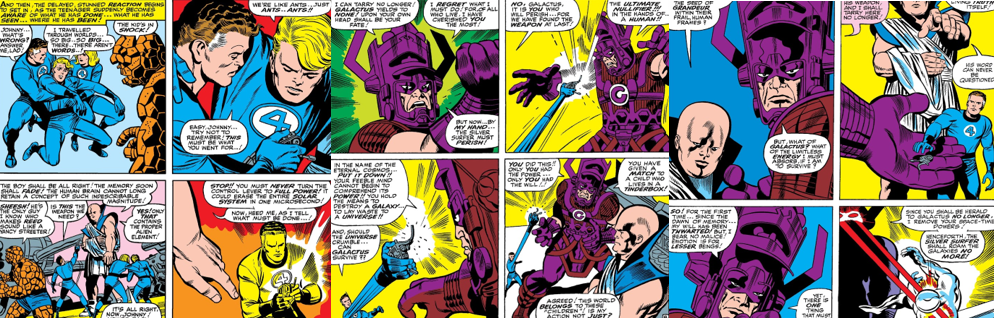
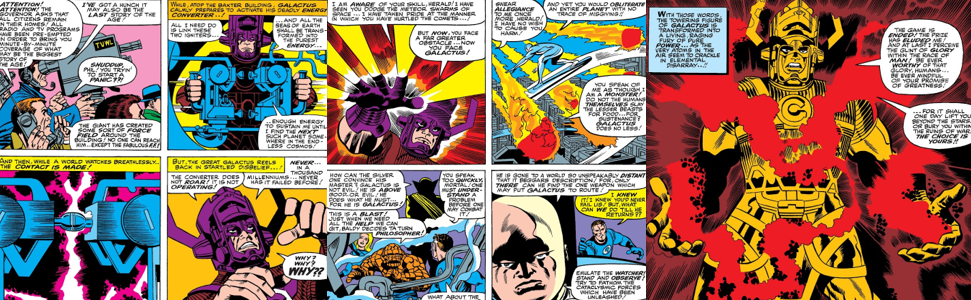
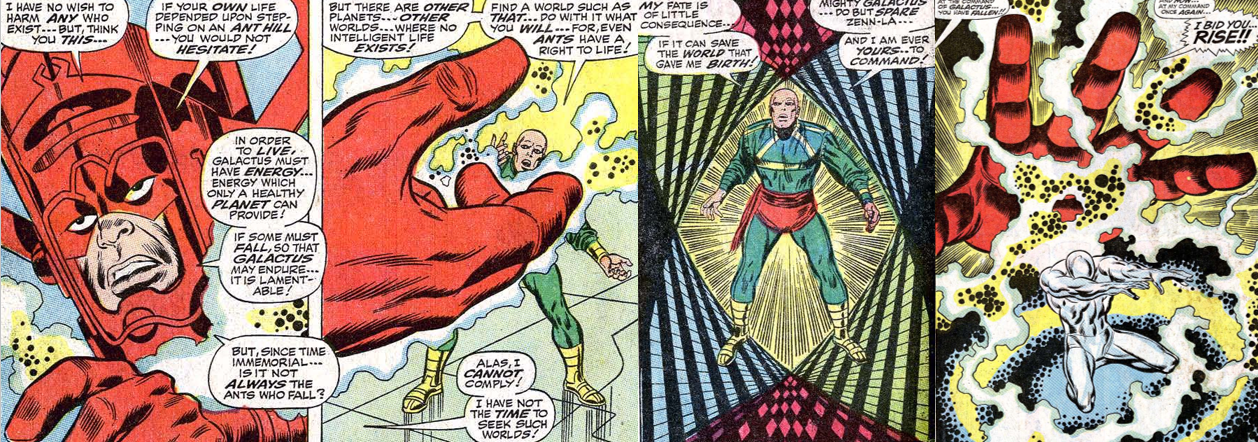
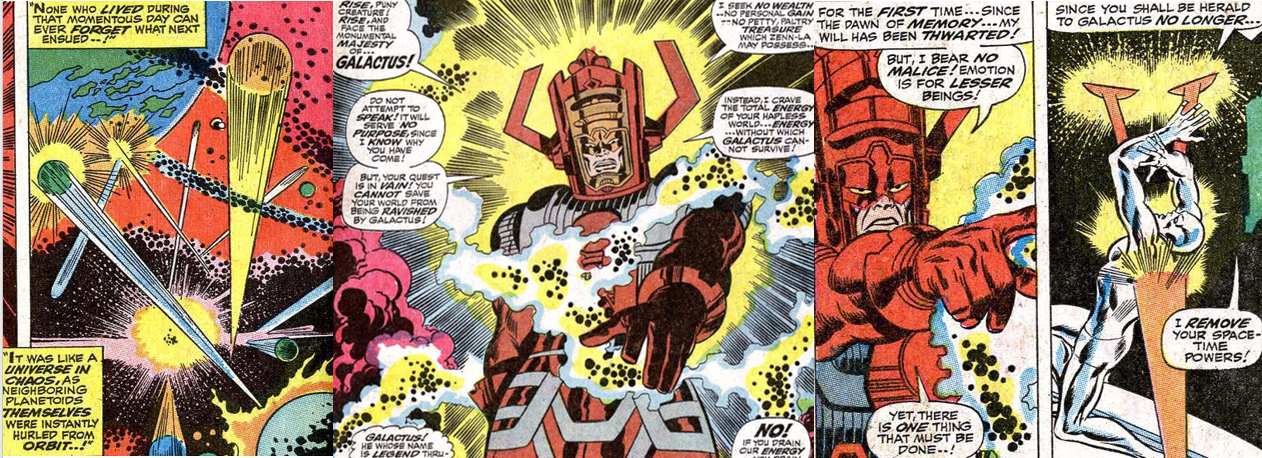
Although the Thing gives the gleaming alien a good clobberin’, the Silver Surfer simply uses the attack as a good excuse to depart and prepare for his master’s arrival, which comes moments later courtesy of an oddly surreal, photorealistic depiction of the being’s incredible technology. A gigantic ship then lands and from it steps forth not the purple/blue, armour clad devourer you may recognise by a massive titan decked out in green and red with a big, stupid “G” on his chest. This colour issue is corrected in the next issue (and can be explained by the Watcher’s statement that “[Galactus] is what he wishes to be!”), in which the giant ignores the Fantastic Four as though they were less than gnats and argues morals with the defiant Watcher. Galactus immediately reveals himself to be a creature of surprising depth by expressing his displeasure at having to harm living creatures, though he’s no less determined to destroy the Earth to sustain his vast energy and quell his never-ending hunger. Displeased by the Thing’s insolent tone, Galactus refuses to find a suitable dead world and, when the enraged Thing dares to strike him, gasses the stony superhero like an insect. Despite the Watcher’s warnings, the Human Torch tries his luck, only to be blasted by Galactus’ eye beams and have his flame doused by soot and ash. Humbled, the Fantastic Four regroup within the Baxter Building, bickering with each other as they lick their wounds, completely unaware that the unconscious Silver Surfer has collapsed into blind sculptor Alcia Marsters’ apartment. Ben’s caring, concerned love immediately tends to the stranger and reveals himself to be a melancholy creature, one baffled by Earth customs and seemingly resigned to sweeping such lives away in service of his demanding master. Galactus sets to work achieving this by constructing an elaborate machine – the “Elemental Converter” – around the Baxter Building, one that will siphon Earth’s very elements into his being as a source of sustenance. The Fantastic Four are horrified when the Watcher shows the destructive impact this weapon will have, reducing the Earth first to a lifeless husk and the shattering the remains before Galactus searches for another world to repeat the process.

It’s only when the Silver Surfer is convinced to help that the battle turns in Earth’s favour.

Alicia is similarly horrified to learn this from the impassive Silver Surfer. She lashes out at him with an emotional outburst, emphasising the strength of the human heart and questioning his aloof servitude. For a moment, the Silver Surfer falters, admiring her courage and feeling the first stirrings of an emotion, one he soon identifies as pity as he sees the panicked masses react to Galactus. The titan is enraged, however, when the Thing delays his plan by trashing a vital part of the Elemental Converter. Angered and insulted when Mr. Fantastic dares to strike him, Galactus summons the Punisher (no, not that one), a strange, frog-like android, to deal with the impudent mortals while he repairs the damage. Though Johnny is eager to help his family in the fight, he’s held back by the Watcher, who has a plan to stop Galactus that requires Johnny’s abilities. Trusting the stoic overseer, Johnny is teleported across space and time to Galactus’ massive, mechanical space station at “the center of infinity”. While the pig-headed Thing tests his mettle against the Punisher’s raw power, Sue keeps the creature at bay with her forcefield long enough for Galactus to tire of the conflict and withdraw his pet. Meanwhile, the Silver Surfer is aghast at the suggestion that he use his great Power Cosmic to defy his master; yet he cannot deny that Alicia’s belief in his quiet nobility has some merit. Thus, having found a world worthy of his protection, the Silver Surfer pleads with Galactus to spare the human race. However, mighty Galactus is unimpressed by his newfound compassion, forcing the Silver Surfer to turn his powers against his master. Amazed by his herald’s betrayal, Galactus is trapped within a vortex and encased within a cocoon, for the Silver Surfer wishes only that they leave the Earth rather than to harm his master. Unfortunately, Galactus is not so easily caged and quickly breaks free, enraged and easily deflecting his herald’s attacks, bombarding him with flaming meteors and offering to spare him harm if he but reaffirm his allegiance.

Galactus begrudgingly leaves to avoid his destruction. but not without punishing his herald.

Powerless to aid their new ally, the Fantastic Four place their faith in the Watcher, a faith rewarded when the Human Torch arrives back on the Earthly plane, briefly overwhelmed by the cosmic wonders he’s seen, and hands Reed a mysterious device he acquired from Galactus’ space station. The Watcher immediately advises caution lest Reed foolishly annihilate the entire solar system trying to explore the machine, which Galactus identifies as the “Ultimate Nullifier”. The Silver Surfer fights valiantly, despite his blasts having no effect on Galactus, who effortlessly conjures giant icicles and threatening to turn his wrath against the humans. Tired of the conflict, Galactus prepares to destroy his once loyal herald, only to react with shock when Reed threatens him with the Ultimate Nullifier. Astonished to see a mere human wielding a weapon so powerful that it could destroy the entire universe, Galactus demands that Reed relinquish the weapon and then chastises the Watcher, stunned that he would “[give] a match to a child who lives in a tinderbox!” However, the Watcher simply affirms that humanity has the right to defend themselves and emphasises their great courage. Weary of the battle and in need of sustenance, Galactus agrees to spare the Earth in return for the weapon. Reed hands it over peacefully as the Watcher swears Galactus to stay true to his word, however the world devourer makes sure to punish his herald before departing. With a blast of his eye beams, Galactus removes the Silver Surfer’s ability to roam the galaxies and banishes him to the planet he defended so bravely. And, with that, Galactus disappears in a brilliant flash of light, leaving the Fantastic Four relieved and amazed. In the aftermath, Ben is distraught by how captivated Alicia seems by the eloquent Silver Surfer and falls into a depression. The Silver Surfer departs to explore his new world, Reed continues to anger Sue by focusing on his work, and Johnny heads off to college, meeting the annoying Wyatt Wingfoot for the first time and still pining for Crystal.

The Summary:
The “Galactus Trilogy” is unquestionably one of the most important story arcs not just for the Fantastic Four, but for Marvel Comics in general. It wraps up the initial Inhumans arc, trapping them in Attilan for a spell and adding some significant character growth for Johnny, who spends his days pining over his lost love. While I question how he can be so attached to Crystal despite barely knowing her, it’s a humbling experience for the outspoken Human Torch, who reacts with equal parts and anger and despair, and this informs his defiance of Galactus. Indeed, he shows an unprecedented emotional maturity when he willing goes along with the Watcher’s plan to steal the Ultimate Nullifier, despite being transported to a part of the universe so unknowable and strange that it briefly warps his mind. His characterisation is more akin to the Thing’s at times, since Ben is so often decrying his monstrous appearance and feeling like an outcast. This isn’t a factor until the final parts of the story, where he feels incomparable to the articulate and mysterious Silver Surfer. His reaction, however, comes from his own insecurities and the commonplace reaction to his appearance rather than being reflective of Alicia’s true feelings. Though she finds the Silver Surfer alluring and wishes to foster his emotions and humanity, Alicia breaks a common cycle in comics from this time by not instantly falling in love with the mysterious stranger and is instead more focused on encouraging him to turn on his master and spare the planet. Relationships are a focal part of this arc, as is often the case with the Fantastic Four. As ever, Sue is constantly, selfishly slighted by Reed pouring more of his time into his research than her, a characterisation I normally can’t stand but I enjoyed the wrinkle that Sue is concerned for his welfare rather than simply being upset at being ignored. Though Reed works tirelessly to understand what’s happening, he’s as astonished and powerless as the others against Galactus’ threat. While Ben and Johnny are happy to attack without thinking, Reed holds back and tries to think up a more viable plan, only to end up relying on the Watcher to provide a solution to their unbeatable foe.

The mysterious, enigmatic Silver Surfer is convinced to defy his all-powerful master.

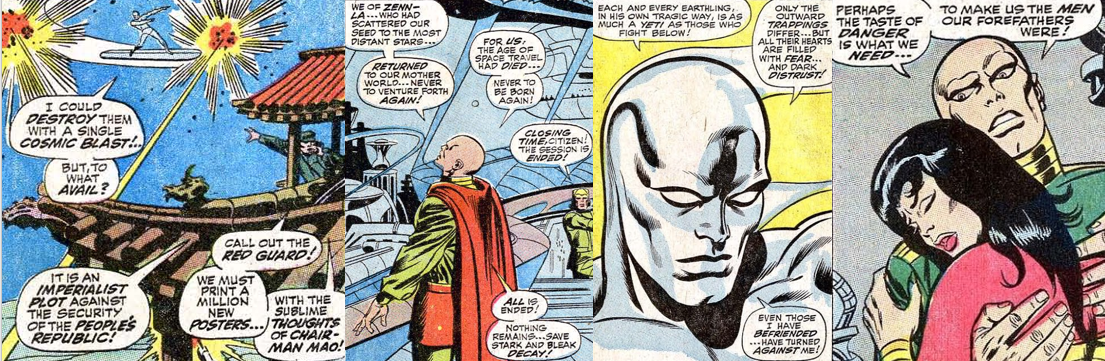
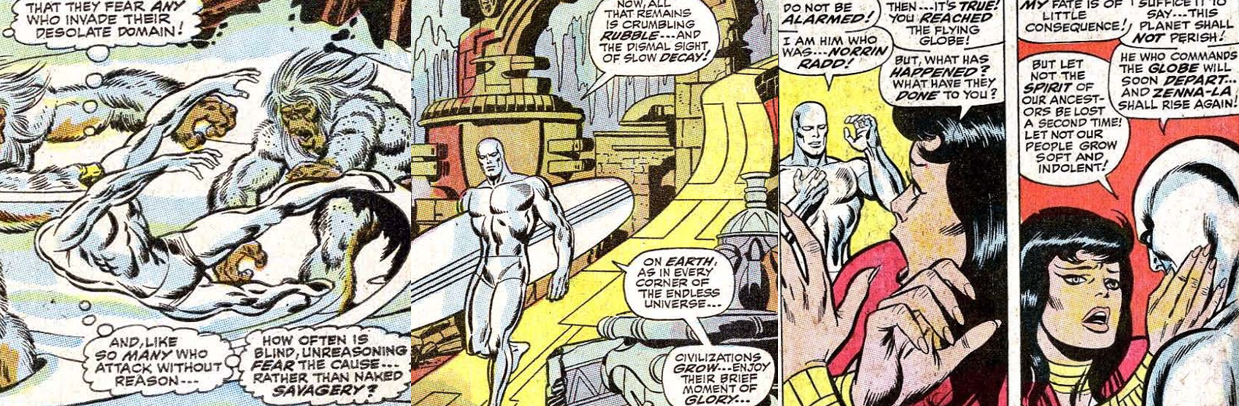
Before I talk about Galactus, let’s discuss the Silver Surfer a bit. An impassive and stoic individual, we learn nothing of the Silver Surfer’s origins here. Indeed, he doesn’t even speak until partway through the second part, though his mere presence is enough to terrify even the mighty Skrull empire. The Silver Surfer’s powers are vast and unquantifiable; slicing through the skies and the cosmos on his signature board, his very appearance summons a being beyond human understanding and, once Galactus arrives, the Silver Surfer simply lets nature take its course. Unlike their previous exploits, the Silver Surfer makes an emotional connection with Alicia. Though confused by human customs such as eating and emotions, Alicia’s mere presence stirs feelings in him long forgotten and, having heard her pleas and seen the panic in the streets, the Silver Surfer comes to admire the human heart and spirit. Thus, he does the unthinkable and turns his powers against his master. These powers are, of course, vaguely defined; he has no need for air or sustenance and simply converts matter into energy to sustain himself, but it’s enough to stun and even briefly imprison his titanic master. Despite Galactus regarding humans, and even the Fantastic Four, as mere annoyances and little more than insects, he’s aghast when his herald turns on him. Indeed, Galactus goes to great lengths to avoid injuring or killing the Silver Surfer during his attack, showing that he does care for and value his herald, but even Galactus’ patience has its limits. Thus, though Galactus admires his herald’s passion, he spitefully banishes him to Earth to teach him a lesson, proving that Galactus triumphs even in defeat. Of course, the star of the show here is Galactus himself, a being so powerful and terrifying that the Skrulls choose to hide themselves rather than risk his attention and the Watcher, a cosmic being sworn never to interfere in human lives, breaks his sacred vows to defend the Earth. Bizarre colourations and stupefying “G” emblem aside, Galactus is an awe-inspiring being, a creature said to be capable of altering his appearance at will and who travels the space ways in a spherical craft around the size of our Moon.

Galactus is a terrifying, complex cosmic being who defies general conventions.

Galactus is an imposing presence, one so vast that he barely acknowledges the presence of humans, even ones as awesome as the Fantastic Four. He sees them as peons, meaningless lives beneath his stature, and refuses to listen to their pleas, much less those of the Watcher. While he and the Watcher don’t come to blows, Uatu does provide the Fantastic Four with the means to deter Galactus, showing that even a being as mighty as he fears utter annihilation. In fact, Galactus shows a lot of depth, far more than you might expect from a cosmic, world-devouring being. He doesn’t relish or enjoy snuffling out billions of lives and has no interest in conflict, shrugging or swatting away attacks or unleashing his cybernetic lapdog on the Fantastic Four when they interfere with his Elemental Converter. Though the Punisher probably could’ve broken through Sue’s forcefield (her strength was already weakening during its attack), Galactus calls it off. Similarly, he tires of the debate and conflict at the end and simply acquiesces. However, he does this on the condition that Reed hand over the Ultimate Nullifier, a small weapon powerful enough to lay waste to the entire universe. Faced with the very real possibility of his destruction and weary from hunger and moral debates, Galactus leaves, promising never to return. While the public naturally debate whether the whole thing was some elaborate hoax, Galactus fundamentally changes the nature of the Marvel Universe, not least because he remains a viable threat but also because the Silver Surfer ends up trapped on Earth. Thus, Marvel’s characters and readers were introduced to two of the most powerful and important beings in this colourful universe. The story is essentially a humbling experience for the Fantastic Four, who are powerless to intervene without the Watcher’s aid, and a debate on the morality of the fickle and dangerous human race. The conflict between the heroes and Galactus is enjoyably one-sided and devolves into a Mexican standoff, with Reed having to bluff his way to a temporary victory, and Galactus is presented as a strangely compelling, morally dubious force of nature, making him a fresh (if ungainly designed) take on the standard depiction of a villain.

My Rating:

Rating: 3 out of 5.

Pretty Good

What did you think to the first appearance of Galactus and the Silver Surfer? Were you impressed by his stature and complex characterisation? What did you think to the Silver Surfer’s change of heart and the battle between him and Galactus? Were you surprised at how powerless the Fantastic Four were against Galactus? Can you name some of your favourite Galactus stories and moments? Whatever you think about Galactus or the Fantastic Four, go ahead and leave a comment below and check out my other Fantastic Four content.

Game Corner [F4iday]: Fantastic 4: Rise of the Silver Surfer (Xbox 360)


In November 1961, Marvel Comics readers witnessed four intrepid explorers be forever changed by mysterious cosmic rays. Marvel’s “First Family” of superheroes were the first of many colourful superheroes for Marvel Comics and are more than deserving of some attention today.


Released: 15 June 2007
Developer: Visual Concepts
Also Available For: Nintendo DS, Nintendo Wii, PlayStation 2, PlayStation 3

The Background:
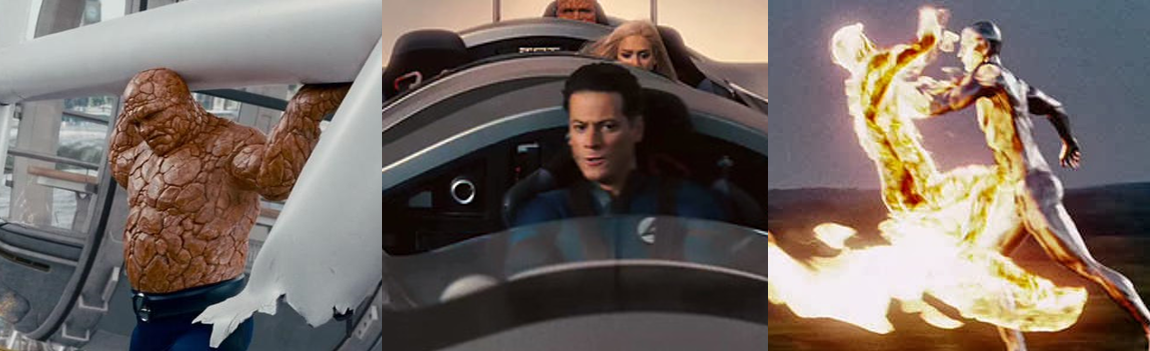
Stan Lee and Jack Kirby’s family of dysfunctional superheroes finally made it to the big screen in 2005 after a chaotic journey; their 1994 movie was never released, but Fantastic 4 (Story, 2005) was a modest box office success despite mixed reviews and earned itself a sequel in 2007. Fantastic 4: Rise of the Silver Surfer (ibid, 2007) was also a somewhat lacklustre critical and commercial release that led to a disastrous reboot some eight years later, but it did result in another rare standalone Fantastic Four videogame being released. This was, of course, at the peak of the time when every single cinema release was accompanied by a hastily created videogame tie-in, but the Fantastic Four have had a couple of videogame adaptations in the past, the first being an obscure and obtuse text-and-image based adventure and the second being a universally derided brawler. While the Fantastic 4 videogame tie-in was published by Activision and received slightly-above-average reviews, Rise of the Silver Surfer was published by 2K Games, with this version being developed by Visual Concepts, a studio more known for their sports tie-ins, and its marketing was built around the four-player co-op, destructible environments, and “Fusion Attack System”. Sadly, the best this adaptation could hope for was mixed reviews, if that; the game was widely regarded as being another disappointingly cheap, repetitive, tie-in that failed to offer anything engaging or unique for gamers to get to grips with.

The Plot:
World-renowned superheroes and scientists the Fantastic Four find their lives interrupted when an extraterrestrial dubbed the “Silver Surfer” causes havoc with their powers and revives their old nemesis, Victor Von Doom/Doctor Doom, all while preparing the world for consumption by a cosmic being known only as “Galactus”.

Gameplay:
Fantastic 4: Rise of the Silver Surfer is a third-person, team-based brawler in which players pick from each member of the titular team (Doctor Reed Richards/Mister Fantastic, Doctor Susan Storm/The Invisible Girl, Johnny Storm/The Human Torch, and Ben Grimm/The Thing) and battle through six distinct levels ripped both from the movie the game is based on and the original source material. The game supports up to four players in simultaneous co-operative play, and players can jump in at any time to assume control a character, but a single player is more than capable of playing through the game without any difficulties thanks to a relatively competent partner A.I. and the ability to switch between the characters using the directional pad. While each character has their own superpowers that give them slightly different playstyles, they share the same basic control commands: A and X allow pull off weak and strong attacks, respectively, and you can string these button inputs together to perform simple combo attacks, Y allows you to jump (and you can do jumping attacks, naturally), while B unleashes an “area attack” or is used to grab and use objects. The Left Bumper allows you to block incoming attacks, while the Right Bumper lets you change your team’s tactics; tapping it will cycle through commands like aggressive and defensive and holding it will see your teammates form up on your current position.

Each member of the team has different attacks and special moves according to their powers.

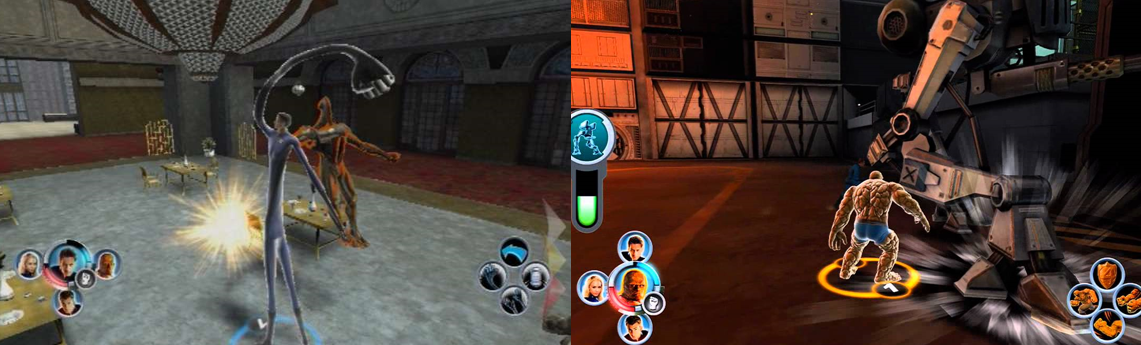
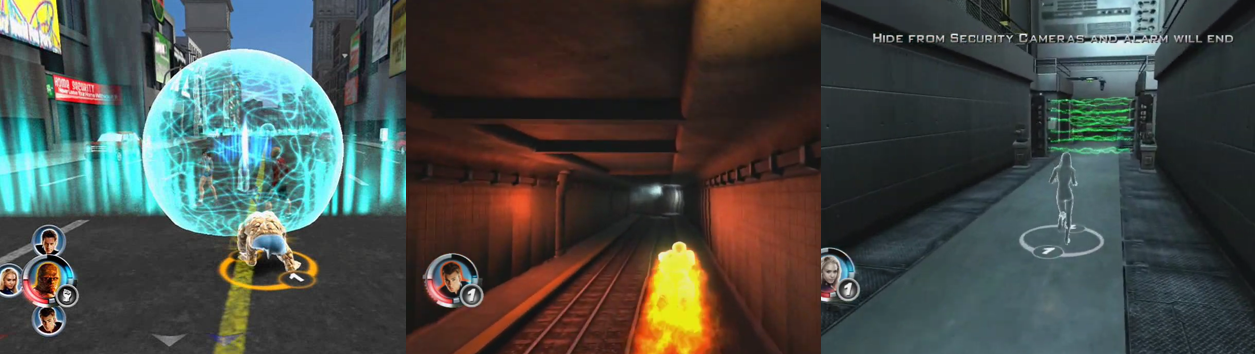
Not only does each character have different attack animations (with the Thing favouring slow, strong punches and the Invisible Girl pulling off roundhouse kicks and spinning attacks, for example), they also have their own unique superpowers that slightly change how they play and affords them different capabilities in combat or puzzle solving. You can perform these by holding the Right Trigger and pressing A, B, X, or Y but doing so will drain your “Cosmic Meter” and you’ll need to either give this a few seconds to refill or collect “Cosmic Orbs” from downed enemies or smashed crates. Reed Richards is elastic, giving him decent reach by default but this also allows him to perform a “Periscope Punch” to hit switches or control boxes that are high up on walls or ceilings, slip through laser traps with his stretchy evade, slingshot enemies across the arena, or toss a grenade to send enemies flying. Sue can fade from sight, allowing her to temporarily slip past enemies and security cameras undetected, but she can also (oddly) use “telekinesis” to move and hurl enemies and certain objects, toss energy discs for a ranged attack, erect a shield that protects her and anyone in it, and can redirect light beams to melt crystals and solve puzzles. Johnny is the Human Torch, so naturally he bursts into flame whenever he uses his powers; this allows him to fly over energy barriers (effectively making him the only character with a double jump), toss fireballs, scorch enemies with a flamethrower attack, and protect himself with a wall of flame. The Thing just loves to fight, so he gets a super useful ground pound (seriously, I spammed this move over and over), a powerful shoulder charge, can cover himself in a temporary protective aura, and can pick up objects the others can’t (like cars and lampposts) and swing or hurl them at enemies. There are times when a specific character’s ability is required to progress, such as using the Thing to smash through boulders or Mr. Fantastic to deactivate switches, and these are marked by a silver 4 symbol and you’ll often find yourself needing to switch between a few different characters to lower barriers and open doors so you can progress.

Combine the Four’s powers or use their unique abilities to get past barriers and other obstacles.

All these super powers, in addition to some other basic, overall stats, can be upgraded at the cost of the coins dropped by enemies or found when smashing the environment, and the Fantastic Four can also combine attacks by holding down the Left Trigger and pressing the corresponding face button when close by to pull off a super-powerful, super draining “Fusion Attack” that allows for fun combinations of their abilities, like filling up Sue’s forcefield with fire to effectively create a bomb and tossing Reed’s rubbery body at enemies. While you’ll need to collect health orbs to restore your health, characters will only be temporarily knocked out if their health is completely drained; you can’t revive them, but they’ll recover after a few seconds and re-join the fight, but it is easy to get overwhelmed and see some, or all, of your team mates knocked out, leaving you frantically running around avoiding damage until they spawn back in. The game is pretty generous with its checkpoints, but that’s probably because its levels are soooo long; levels stretch on forever and consist of multiple areas, separated by lifts and doors and barriers or other obstacles you either have to activate, ride, or break through with the Fantastic Four’s powers. It’s not long before you’ve seen most of what the game has to offer, however; cave-ins need clearing with the Thing, barriers need flying over or passing through with the Human Torch and the Invisible Girl, respectively, and laser traps need stretching through with Mr. Fantastic. Often, you’ll need to activate consoles to lower lifts or open doors, or smash control boxes to disable turrets; sometimes, you’ll need to power up generators using Johnny’s fireballs, use Sue’s telekinesis to bring floating transports closer, or avoid getting too trigger happy and risk taking damage from explosive barrels.

Occasionally, you’ll need to use a solo hero to progress past obstacles or chase down the Silver Surfer.

Easily the most frustrating puzzles are found in the Himalayas, where you’ll need to smack around spherical rocks or move weird crystals to redirect light and open new ways to progress. It can be tricky figuring out which crystals to move and to where, and you’ll often have to use Sue’s shield to bounce light beams to crystals, all to ring bells so you can move on to the next area. Occasionally, you’ll control a character for a solo mission; Reed must use his evade to get through laser traps on a Russian space station, taking out turrets and enemies as he goes, while Ben gets locked into a fighting arena for a brief period. Johnny gets the majority of these sections, however, as he’s tasked with flying down rock tunnels, through the city streets and underground, blasting enemies or pursuing the Silver Surfer. These can be quite fun as you boost along with A and toss fireballs with X, dodging traffic and other hazards, but both of these abilities are tied to your Cosmic Meter, which can severely hamper you, though it’s not exactly difficult to keep up with the Surfer and pass the mission successfully. By far the worst section of all of these, and the entire game, was guiding Sue through a heavily guarded military base. This means using your invisibility to slip past security cameras and trigger-happy robots, while also destroying turrets and awkwardly using her telekinesis to smash control panels to lower barriers. There are no checkpoints in this poor attempt at a stealth section so it can be extremely frustrating to slip past the robots and turrets (which absolutely barrage you with laser fire if they spot you) and finally reach the control panel, only to fail right before the exit because you were surprised by another robot or ran out of juice for your superpowers.

Graphics and Sound:
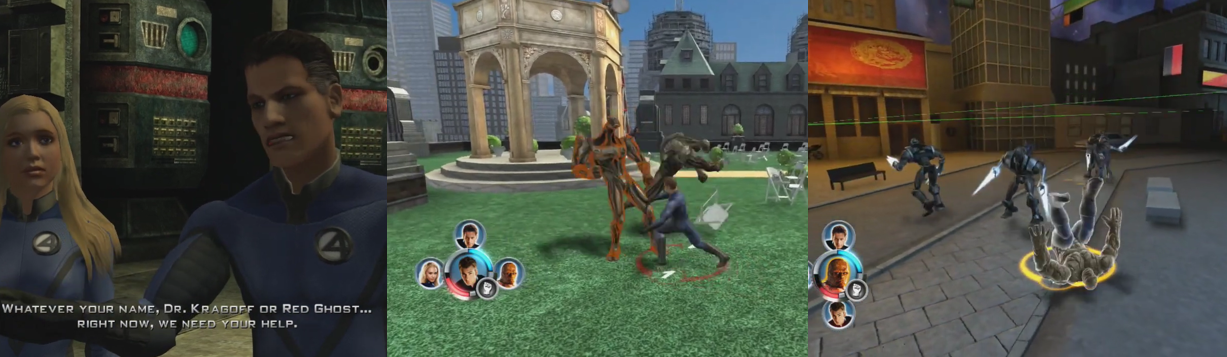
To be fair, the in-game graphics of Fantastic 4: Rise of the Silver Surfer aren’t all that bad. Bland as all hell, for sure, but not that bad. Each character is modelled pretty closely to their live-action counterparts and feels very different to control, with the Thing being slower and heavier and the Human Torch being slipperier and more agile. When left idle, they’ll offer commentary and, honestly, I was pleasantly surprised by their banter and voice work; so often these tie-in games feature stilted, phoned-in performances, but there’s actually a lot of fun and fitting dialogue here that’s sometimes more interesting than what we saw in the movies. Sadly, this praise doesn’t extend to the pre-rendered cutscenes, which are a plasticy, ugly mess that continues this generation’s tendency to render characters as though they were action figures. The music is equally not much to shout about, being comprised of generic tunes and samples from the film’s soundtrack. The game also has very little to do with the move it’s based on; the Silver Surfer barely shows up, Galactus is mentioned but never seen, and the focus is more on enemies from the group’s comic books and Dr. Doom.

While the dialogue is okay and character models work well, environments can be a bit bland.

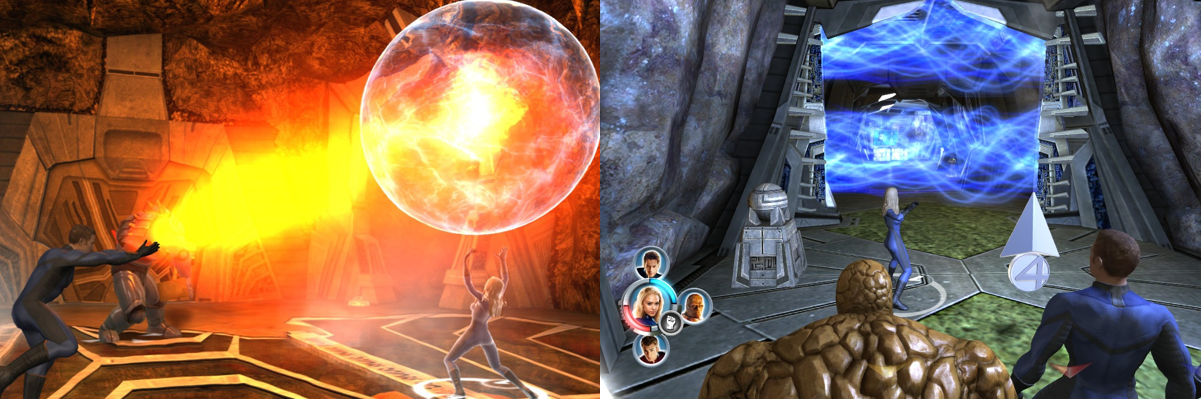
On the one hand, this means we get to explore far more diverse locations than we ever saw in the live-action movies; you’ll venture into a lava-filled cavern where the shapeshifting Skrulls have taken root and onto a very dark, steampunk-like Russian space station to battle against Doctor Ivan Kragoff/The Red Ghost and his genetically enhanced Super-Apes. The game does recreate some locations from the movie as well, however, specifically Sue and Reed’s rooftop wedding venue, the streets of New York City, and the military base where the Silver Surfer is held captive (although it’s vastly different from the film version, featuring electrical barriers and robotic sentries). The game also takes the team to the crystal caves and misty clifftops of the Himalayas where they have to fight off rock monsters and to the streets of Shanghai for a final showdown with Dr. Doom, and every environment features a lot of destructible elements for you to smash your way through. Unfortunately, they’re also painfully linear, so much so that the game doesn’t even provide you with a mini map or radar; despite this, it can be easy to get a little turned around as some locations are so dark and similar that it’s easy to get lost and the game gives you no indication when you’re heading in the wrong direction or where you need to go if you miss that an elevator lowered just offscreen or a door opened one screen back. Compounding matters is just how long levels are; they just go on and on, making each section a chore to play through and really stunting your motivation to tackle the game’s harder “Fantastic” mode.

Enemies and Bosses:
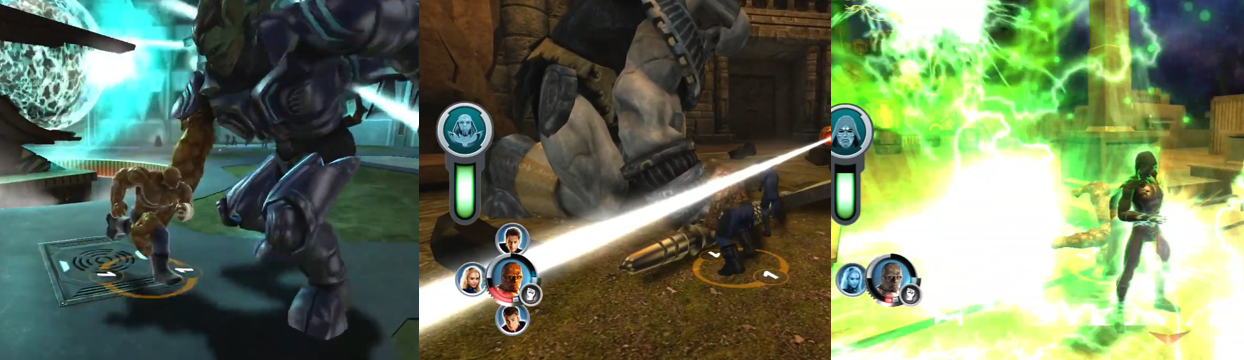
The Fantastic Four will wade through a number of nameless, faceless, disposable grunts as they race to track down the Silver Surfer. However, while the enemies you face in each location are visually distinct, they share many traits that quickly make them very dull and predictable, no matter how fantastical or faithful they are to the source material. You’ll fight off Skrulls, weird silvery alien…things, chicken-like robots and hovering drones, Doombots, rock monsters, and Super-Apes, many of whom can block your attacks, attack up close or from afar with pistols or missiles, or who come in larger variants that can tank your attacks. Many enemies can be picked up and thrown, and you’ll often get to hurl them off bridges or cliff edges to their immediate death, so I recommend doing this whenever possible to help with crowd control. The larger Skrull variant swings a large pillar at you while a gaggle of annoying, regular Skrulls swarm around you, but it can be useful to pummel him with Johnny’s fireballs from a safe distance. Larger rock monsters also dog your progress in the crystal caves, but the Thing is more than capable of smashing them and their smaller cousins to pieces, especially if you’ve upgraded his ground pound attack. You’ll first encounter the massively annoying turrets when on the Red Ghost’s space station; these can be destroyed with your attacks if you can get close to them, but it’s generally easier, faster, and safer to disable them by activating or destroying a nearby control box. Finally, heavily armed robots and Doombots await you in the military base and the streets of Shanghai; these are much tougher than other enemies and sport cheap long-ranged attacks, so it’s advisable to have upgraded some of your stats and abilities to help even the playing field.

Until you face Cosmic Doom, most bosses follow a simple rinse-and-repeat strategy.

When you eventually make it to the end of each location, you’ll generally have to face off with a boss. The first is Kl’rt/The Super-Skrull who sports the Fantastic Four’s powers, allowing him to perform a ground pound like the Thing and disappear from the battlefield like the Invisible Girl. Protected by an endless swam of regular Skrulls, the only way to damage the Super-Skrull is by throwing enemies or your projectiles into the huge spherical shield generator in the centre of the room; once it’s overloaded, the Super-Skrull will be stunned and be left open to your attacks, and you’ll need to repeat this tactic over and over, tediously waiting for him to reappear while fending off the endless enemies. After fighting through the strangely deserted streets of New York City, you’ll come across a large, spiked alien craft that sucks up cars and launches them at you while sending you flying with its annoying laser beam. You can throw cars back at it, and your other projectiles, to damage it, but it’s easy to get stun-locked into an annoying cycle from its projectiles. You won’t actually fight the Red Ghost, however; instead, you simply pursue him down a hallway, fending off his Super-Apes and turrets, making for a decidedly anticlimactic ending to a largely frustrating level. Similarly, you won’t battle the Silver Surfer; instead, you fight off his minions and chase after him as Johnny, first through a subway tunnel and then through an underpass, avoiding trains, traffic, and low-hanging signs and his energy-draining trail. You will, however, battle another of Galactus’s heralds, Terrax the Tamer, in the Himalayas; this massive rock-like being tosses his huge axe across the arena, which is really difficult to avoid and can leave you knocked on your ass for some time. Even worse is the fact that you have to contend with a never-ending gaggle of rock monsters and complete those annoying light puzzles to stun him so you can damage him, making this easily the most annoying and tedious boss battle in the game. Larger mechs (very much akin to All-Terrain Scout Transport (AT-ST) walkers) await in the military base, but they’re easily bypassed with your upgraded abilities, though Dr. Doom is a far more aggravating enemy. Having stolen the Silver Surfer’s near-limitless Power Cosmic, Dr. Doom flies about raining energy bolts down and the only way to damage him is to activate a nearby power generator and blast him out of the sky but, even then he can absorb and dish out a great deal of punishment, to say nothing of his massive electrical area attack, shield, and ability to shrug off your attacks. Your best bet here (and in all of these boss battles) is to quickly cycle between each character and spam your Fusion Attack, retreating to safety, when necessary, until he finally goes down.

Power-Ups and Bonuses:
Unfortunately, there aren’t any temporary power-ups to find in Fantastic 4: Rise of the Silver Surfer. Smash all the crates and boulders and what-not you like and all you’ll uncover are health and energy restoring orbs, coins, and the odd collectible. You should still smash everything you see, however, and let those coins fly into you as you’ll need them to power-up the characters and their superpowers; everything from their attack, defence, recovery and meter regeneration time to the cost, range, and impact of their individual abilities can be upgraded at the cost of these coins. Unfortunately, the cost increases as you spend, meaning you’ll need to farm and replay areas to collect all the coins you need, so you can either power characters up a little bit to make things easier to save them all up and blow them on fully upgrading a single character…or put yourself through the agony of a second playthrough.

Additional Features:
There are nineteen Achievements to earn in Fantastic 4: Rise of the Silver Surfer, with nine poppin simply for clearing each level and defeating their bosses. Oddly, there are no Achievements for playing with other players or anything fun (like, I dunno…destroying Reed and Sue’s wedding venue) or tedious (like defeating 100+ enemies). You’ll get an Achievement for beating the game on both “Normal” and the harder “Fantastic” mode, one for performing a single Fusion Attack, one for upgrading every character, and three more for finding every collectible and unlocking all the bonus content. Bonus content is unlocked by finding Fantastic 4 symbols and destroying Dr. Doom’s tiny, barely noticeable spybots; doing so will unlock cinematics, comic covers, concept art, and four alternative costumes that come with extra perks (like increasing your attack or defence by default), which is a nice touch. Once you beat the game, you can access a level select and the game restarts with all your upgrades intact, but I suspect you have to start a whole new game from the ground up if you choose a different difficulty mode. As I had no desire to play this game once I’d finished it and unlocked as many Achievements as I could, I can’t speak to that, but you could try playing with a friend or two to see if that helps improve the experience.

The Summary:
I had low expectations for Fantastic 4: Rise of the Silver Surfer; I’d not really heard much about it except the usual vague chatter about how it was another tedious, cheap tie-in to a big budget movie and, unfortunately, I can’t argue with that. Fundamentally, it’s not really that insulting; the titular foursome are all represented pretty well, even if I favoured the Human Torch and the Thing (but that’s just personal preference on my part), with some fun superpowers to experiment with using the Fusion System. I get why you’d tie this to a regenerating meter, but it drains so quickly that you’ll be relying on the lacklustre combo strings more than anything. The dialogue and expansion on the movie’s story are also quite enjoyable and the game tries to show some new and visually interesting areas, but it never quite capitalises on any of the mechanics it includes beyond the bog-standard brawling. It’s fun chasing around as the Human Torch, but these sections are very brief and don’t ask much of you than to spam A or X as often as possible and avoid obstacles, and don’t even get me started on Sue’s God-awful “stealth” section. What really drags this game down, though, is just how long and boring the levels are and the lack of replayability; the unlockable costumes are pretty good (and it’s nice to see more than one included for a change) but I really don’t think anyone will be excited to slog through this on the harder difficulty or grind to upgrade and unlock everything as it’s such a time-consuming and monotonous experience. The bosses are also a massive let down and the game misses opportunities to have you recreate scenes from the film; like, why not shorten a couple of the levels and put in a forest mission where you need to activate those generators to bring down the Silver Surfer? Or, better yet, why not include a Silver Surfer auto-racer/shooter for the climax where you fend off Galactus’s attack? Instead, we get a very rushed and cobbled together, uninspiring brawler that’s only worth a playthrough to increase your Gamer Score with some relatively simple Achievements.

My Rating:

Rating: 2 out of 5.

Could Be Better

What did you think to Fantastic 4: Rise of the Silver Surfer? Did you enjoy the Fusion Attacks and the variety of superpowers on offer? What did you think to the levels and boss battles, and were there any elements from the movie you felt were missing from the game? Did you ever unlock everything in this game? Would you like to see another, better Fantastic Four videogame some day? How have you been celebrating the debut of Marvel’s First Family this month? Whatever you think, sign up to share your thoughts on Fantastic 4: Rise of the Silver Surfer in the comments below.

Movie Night [F4iday]: Fantastic 4: Rise of the Silver Surfer


In November of 1961, readers of Marvel Comics readers witnessed four intrepid explorers be forever changed by mysterious cosmic rays. On that day, they became known as the Fantastic Four, Marvel’s “First Family” of superheroes, and went on to be the first of many colourful superheroes for Marvel Comics as well as feature in numerous cartoons, videogames, and live-action movies. This year, I’ve been dedicating every Friday in November to commemorating the debut of Marvel’s most famous dysfunctional family.


Released: 15 June 2007
Director: Tim Story
Distributor:
20th Century Fox
Budget: $120 to 130 million
Stars:
Ioan Gruffudd, Jessica Alba, Chris Evans, Michael Chiklis, Julian McMahon, and Doug Jones/Laurence Fishburne

The Plot:
Doctor Reed Richards/Mister Fantastic (Gruffudd) and Susan Storm/The Invisible Girl (Alba) find their attempts to get married constantly interrupted by a media circus and the extraterrestrial “Silver Surfer” (Jones/Fishburne), who catches Victor Von Doom/Doctor Doom’s (McMahon) attention when it prepares the world for consumption by a cosmic being known only as “Galactus”.

The Background:
Stan Lee and Jack Kirby’s family of dysfunctional superheroes have had quite the chaotic journey to the big screen; their 1994 movie was never released and the eventual big-budget adaptation was met with mixed reviews after being in Development Hell for around ten years. Still, Fantastic 4s (Story, 2005) modest box office success of $333.5 million saw not only the release of an Extended Edition but also the return of director Tim Story and the entire cast for a sequel. Screenwriters Mark Frost and Don Payne came onboard to pen the screenplay and the duo drew significant inspiration from both the original “Galactus Trilogy” (Lee, et al, 1966) and an altered version of that same story seen in Ultimate Marvel (Ellis, et al, 2004 to 2006). The duo aimed to focus more on the enigmatic Silver Surfer than the Devourer of Worlds and there was a lot of speculation and anticipation surrounding the design of Galactus. Much of the film’s promotion was also focused around fan-favourite elements from the original Marvel Comics, such as the Fantasti-Car and the wedding between Reed and Sue, and practical elements such as Ben Grimm/The Thing’s suit were redesigned to allow actor Michael Chiklis to slip it off between takes. The titular Silver Surfer’s digital effects were the work of Weta Digital, who not only completely replaced stuntman Doug Jones with a sleek CGI model but also contributed to the design of Galactus. Fantastic 4: Rise of the Silver Surfer made about $32 million less than its predecessor, coming in with a box office of $301.9 million; though the film’s average review score is higher than the first film, it was also met with mostly mixed reviews, although the general consensus was that it was at least more entertaining than the first film. Plans for a sequel and a spin-off for the Silver Surfer were eventually quashed due to the overall lacklustre response to Story’s films. Thankfully, after a mediocre tie-in videogame and the disastrous decision reboot the franchise some eight years later, the Fantastic Four returned to prominence in the Marvel Cinematic Universe in 2025.

The Review:
Fantastic 4 wasn’t really a bad film, really, just quite underwhelming considering some of the outlandish cosmic adventures Marvel’s First Family often get up to. Do I expect them to battle the likes of Galactus and Kang the Conqueror in their first movie? No, of course not, but maybe exploring the Negative Zone and encountering someone like Annihilus could have been possible with a script re-write (Reed discovers the Negative Zone and that’s where they get their powers from, rather than them going to space) while building towards a showdown with Dr. Doom for the sequel (since he was so underutilised and bland in the first film) and maybe, maybe Galactus for the third and final movie. I can’t, however, say that I’m too surprised that Fantastic 4 got a sequel; back then, mediocre movies were getting sequels all the time and it just seemed natural to do, though I definitely am not a fan of the overly long and wordy “Rise of…” title (Fantastic Four: Doomsday would’ve been better in my opinion, but what the hell do I know, right?)

Reed and Sue’s wedding is disrupted by the arrival of the Silver Surfer, who causes global havoc.

Since the end of the last film, the Fantastic Four have become wildly beloved, popular, and successful superheroes; while Johnny Storm/The Human Torch (Evans) continues to revel in their celebrity status and indulge himself with merchandising and sponsorship deals, Sue is troubled by the constant media storm that surrounds their lives. It’s bad enough that the interference of the press has caused Reed and Sue to continuously postpone their wedding, but Sue worries about what sort of impact the attention they bring and the circus of their day-to-day lives will have on any children she and Reed may have in the future. Sue’s characterisation seems to have taken a bit of a step back in this regard; she actually seems to think it’s acceptable to prioritise her wedding day over the fate of the world, arguably costing Reed valuable time in finding a way to track the entity causing worldwide havoc, and while Alba seems more comfortable in the role of the team’s matriarch, something seems a bit…off about her this time around (I think it’s her dazzling contact lenses). The world is thrown into chaos when the mysterious entity known as the Silver Surfer arrives; wielding the same cosmic powers that gifted the Fantastic Four and Doom with their abilities (a neat little wrinkle that I actually really enjoyed), the Silver Surfer is able to dramatically affect weather patterns across the globe, drying up lakes, bring snowstorms to deserts, and disrupting electrical devices the world over.

General Hager isn’t impressed with Reed, or the four, whom he views as freaks.

Reed is troubled by the disruptions; despite promising Sue that he is going to focus on the wedding, he can’t help but investigate the disturbances and is intrigued to find a link between the cosmic radiation and their powers. Johnny is able to turn Reed’s fascination with the ongoing global disturbances to his advantage and blackmail Reed into having a bachelor party, and though Reed adamantly turns down General Hager’s (Andre Braugher) request that he and the four lend their expertise in solving the global crisis, he ultimately goes back on his word and develops a way of tracking the anomalies out of his desire to help and sheer scientific curiosity. Obviously, Sue is angered by this as she’s obsessed with having that one perfect day even if the entire world is being thrown into chaos around them; Reed is trying to please everyone, as always, but ultimately chooses to stand up to Hager’s abrasive nature and demand a little respect for him and his team if the military actually want them to help. When he sees how upset Sue gets by the whole media circus, however, Reed proposes that they leave it all behind after the wedding, but ultimately they’re both able to come to terms with their crazy lives by the conclusion of the film. The Thing, easily the heart of the team, is in a far better place this time around; having taken to wearing an array of clothes and noticeably much more comfortable with himself and being out in public, he’s developed a brotherly relationship with Johnny and has absolute faith in Reed, even when he predicts the end of the world and suggests the team go their separate ways.

Doom is still somewhat underutilised but comes across a bit better in this film.

Although Reed discovers that the Silver Surfer has been preparing worlds for their eventual destruction all across the universe, the entity’s arrival has a more direct impact on the team when it passes over Latveria and awakens Victor Von Doom. A scarred and ruined mess of a man, Doom begins the film in a much more fitting place than he left it (holed up in a grand castle, glaring at an array of monitors, filled with egotistical mania, and fully embracing his role as a scheming and bitter supervillain). After encountering the Silver Surfer, though, Doom’s appearance is sadly restored by the Surfer’s cosmic powers, ruining any menace he may have had in his armoured guise, and he goes right back to being a sleazy, suit-wearing scumbag. Doom even weasels his way into studying the Silver Surfer further by sharing his data with Hager, who orders him to work alongside the Fantastic Four, much to their chagrin. Of course, Doom’s intentions are far from virtuous; realising that the Silver Surfer draws his powers from his “board”, Doom seeks to separate the silver-hued entity from it, depowering the once-might Sentinel of the Spaceways, so that he can claim it for himself. This allows Doom to briefly come close to matching the formidable threat he poses in the comics, and even don a far more impressive and visually interesting set of armour and spit his famous “Richards!” line, but once again it’s too little too late and Doom gets far too little time in the spotlight.

Contact with the Silver Surfer causes Johnny to swap powers with his teammates.

Instead, much of the film is focused on exploring the impact that the Silver Surfer has on the Human Torch; although he seems perfectly happy living a shallow life of materialism and still likes to crack jokes at both Reed and the Thing’s expense as often as possible, Johnny doesn’t hesitate to take off after the Silver Surfer when he disrupts Reed and Sue’s wedding and finds himself changed as a result of physical contact with the entity. Consequently, Johnny switches powers whenever he touches his teammates, which allows the Thing a brief return to his human form (something that never comes up again, despite Ben’s promise) also causes chaos when the Fantastic Four try to intercept the Silver Surfer in London. Feeling isolated because of the danger he now poses to the team, Johnny is distraught to learn that Reed and Sue are willing to break up the band so that they can lead “normal” lives and is forced to learn to set aside his ego and put the team before himself. This all culminates in him absorbing the powers of the entire team in order to match Doom’s stolen cosmic powers in the finale, basically transforming him into a version of Kl’rt/Super-Skrull and kind of negating his character arc since it takes one individual with all of the team’s powers to defeat Doom rather than the combined efforts of the team proper.

The Nitty-Gritty:
Strangely, considering that Rise of the Silver Surfer essentially deals with the impending destruction of the entire world, the film’s tone is as light and whimsical as the last film, for the most part, but the comedy definitely lands a lot better this time around. Johnny’s wisecrack about the Thing’s blind girlfriend, Alicia Masters (Kerry Washington), potentially dying in a rockslide is hilarious, as is Sue using her powers to force Reed to listen to her, her “I’m on fire!” exchange with Reed, and Johnny’s all-too-brief transformation into a Thing-like creature. Having lived and operated together for some time now, the team has settled into their dysfunctional family dynamic quite nicely; out in the field, they tend to quarrel and discuss their personal dramas, which angers Hager, who sees them as freaks who can’t take threats seriously as they’re too busy bickering with each other. This leads to an impressive moment for Reed as he finally stands up for himself, and his team; in fact, Reed has adjusted to his role as the team’s leader extremely well compared to his characterisation in the first film. He’s still an easily distracted and awkward nerd, but he’s much more confidant in directing the team and keeping them focused in the field, at least until Johnny’s new powers cause disruption amongst the team.

The Silver Surfer prepares the world for this master’s arrival, who he dare not defy.

Sue ends up playing a pivotal role in humanising and characterising the mysterious Silver Surfer; a stoic and wholly alien lifeform, the entity is like living liquid metal, reflecting everything around him in his silvery skin and slicing through the air and even the vastness of space with a fluid-like ease. Impossibly fast and incredibly powerful, the Silver Surfer can not only cause chaotic events to happen all over the world and create ominous craters in the planet’s very crust, he’s also easily able to shrug off Doom’s electrical bolt, out-pace and exhaust Johnny in the upper atmosphere, and pass through Sue’s invisible barrier. Fascinated and intrigued by the Silver Surfer’s beauty, Sue questions the entity as to his motivations, which causes enough of a distraction to separate the Silver Surfer from his board and allow him to be captured by Doom and Hager. While the Silver Surfer has never exhibited such an obvious weakness in the comics, as far as I am aware, it’s necessary to render him vulnerable and exposit key information about the Silver Surfer’s master, the malevolent Galactus. Helpless and powerless without his board, the Silver Surfer reveals to Sue that he was once known as Norrin Radd and is bound to lead the entity to worlds for it to devour in order to spare his own, but takes no pleasure in this fact and finds himself besotted by Sue as she reminds him of his lost love. The Silver Surfer also reveals that his board draws Galactus closer, but initially refuses to use its power to repel his master since he dare not defy the World Devourer.

Some big set pieces and special effects keep things interesting, with the Silver Surfer being the highlight.

Surprisingly, the Fantastic Four’s costumes haven’t really been changed all that much from the last film; they seem a little darker, and maybe a little more refined here and there, but mostly appear to be identical, which is very unusual as superhero sequels usually always introduce new costumes for the characters. Thankfully, Doom definitely looks much better this time around; I could have done without seeing him return to normal in the middle there, but he definitely makes up for it in the finale with his more regal and detailed armour. The four have firmly established themselves in the Baxter Building and no longer have any money troubles; instead, they have all the resources they could ask for thanks to Reed’s patents and Johnny’s endorsement deals to franchise the team out to anyone and everyone. Reed’s focus is still on the science, and using his genius and the team’s abilities to help others, but he’s not above creating new toys for the team to use, such as the futuristic and criminally underused Fantasti-Car. While the Thing looks just as good as ever thanks to the impressive practical suit, some of the CGI and special effects have taken a bit of a hit, most notably Reed’s stretching powers (though this could just be because they’re showcased more often here). Still, the film has some impressive action set pieces on offer, such as the team’s efforts to repair the damaged London Eye, and the effects used to bring the Silver Surfer to life are absolutely top-notch. The Silver Surfer appears unsettlingly alien and unnaturally fluid; the chase between him and Johnny is quite exhilarating and the way he just kind of hovers and slips into frame is incredibly unnerving, and I think it was a wise move to spend more of the film focusing on the Silver Surfer as an antagonistic and mysterious force rather than the Devourer of Worlds.

Galactus may have just been a disappointing cosmic cloud but at least they tried to bring him to life.

Speaking of which, you can’t talk about this film without mentioning Galactus; one of Marvel’s most iconic and destructive cosmic entities, Galactus gained notoriety for being represented as a gigantic, abstract space cloud. I can understand the backlash about this as Galactus represents one of the most morally grey entities in the Marvel universe (he has to “eat” worlds in order to satisfy his great hunger, and does so not out of malice or evil but simply because he has to in order to survive and his existence is part of the cosmic balance of death and rebirth) and reducing him to a swirling, indistinct mass of cosmic energy is quite an insult to die-hard comic book fans. I can also understand the apprehension; these Fantastic Four movies are clearly drawing inspiration from Fox’s original X-Men trilogy (Various, 2000 to 2006) and going for a more grounded take on the comic’s more fantastical elements and the filmmakers definitely seem to have thought that a gigantic humanoid clad in purple armour stomping around New York City was probably a step too far. I, however, disagree and think these films (and any future Fantastic Four films) should totally embrace the more bonkers aspects of the source material, but I do have to applaud the filmmakers for even using Galactus in the first place. They didn’t have to do that and it’s pretty ballsy to jump into the character for the team’s second movie as how the hell do you top a world-devouring entity? Also, they seem to have pulled inspiration from “Gah Lak Tus”, the Ultimate version of the character that was a swarm of robotic drones rather than one massive being; the shadow and fiery silhouette of Galactus and his ship can also be briefly seen, hinting that the cloud is masking the being’s true form, and the proposed Silver Surfer spin-off was also supposed to reveal the character in full. Additionally, seeing  Galactus’ smoky tendrils devour that world at the start, watching it ominously advance through the galaxy and learning about its destructive history, and the shot of it preparing to swallow the Earth whole are all really effective at building a sense of awe and dread around the entity. I can definitely see that the filmmakers had some good intentions with the character but the execution does fall a bit flat; I think maybe it would have sufficed to see a gigantic hand reaching out from the cloud, or see hints of Galactus’ helmet poking through the storm and maybe his eyes glistening, but, again, I admire that they even tried to use the character, if nothing else.

After repelling Galactus, Reed and Sue finally marry and the Silver Surfer is freed from his master.

Despite the threat of Armageddon looming ever closer, Doom manipulates events to get his hands on the Silver Surfer’s board; conveniently cobbling together a wrist-mounted device that somehow allows him to assume control of the board, and thus the Surfer’s Power Cosmic, Doom kills Hager in spectacular fashion and refuses to give up his newfound power even in the face of worldwide destruction. In the process, Doom kills Sue when she takes a shot to protect the Silver Surfer, which finally convinces him to rebel against Galactus. After Johnny absorbs the abilities of his teammates in order to separate Doom from the board in an all-too-brief fist fight, thus restoring the Silver Surfer to full strength, the Silver Surfer uses the Power Cosmic to resurrect Sue and heads up into the atmosphere to confront Galactus as the titanic cloud prepares to drain all life and energy from the planet. There, in the centre of the swirling, chaotic mess of cosmic energy, he renounces his service and uses all of the board’s power to dissipate Galactus in a very obvious Christ metaphor, presumably transporting it away or destroying it outright, and is assumed dead from the exertion. In the aftermath, Johnny is returned to normal (though I think it would have been a nice touch to allow Ben to change to and from the Thing at will as a result of contact with the Silver Surfer), Reed and Sue finally marry in a small ceremony away from prying eyes, and the team resolves to stick together, even with the chaos of the superhero fame, while the Silver Surfer is revealed to have survived in the depths of space.

The Summary:
Well, this was certainly a step up from the last film; the cast, dialogue, and world definitely all seems to feel a lot more comfortable and work a lot better, and overall Fantastic 4: Rise of the Silver Surfer feels like a much more enjoyable movie since it doesn’t have to be bogged down with an origin story or explaining and exploring the team’s powers. The characters all seem very familiar with each other and gel as a dysfunctional family, operating as a cohesive team in the field while still bickering and having interpersonal dramas regarding their superhero celebrity status. The banter between Ben and Johnny remains the clear highlight of the four, though I much preferred Reed this time around (leadership definitely suits him), with Sue remaining the weak link for me just because of the way Jessica Alba is presented and the fact that she’s so woefully miscast as the Invisible Girl. Doom looked and acted a bit more like his boastful comic book counterpart, but was again way too underutilised for a villain of his stature, but thankfully the film does a brilliant job of bringing the Silver Surfer to life. Mysterious, powerful, and inhuman, the Silver Surfer is also vulnerable and tragic and a true visual marvel. Yes, it’s massively disappointing that one of Marvel’s most enigmatic and iconic entities is reduced to a mere cloud, but I do admire the filmmakers for daring to even utilise Galactus and it’s clear that they had plans to do him justice in a later film, but again I feel like if you’re going to go big like that just go all-in and leave it all on the table.

My Rating:

Rating: 3 out of 5.

Pretty Good

What did you think to Fantastic 4: Rise of the Silver Surfer? Did you feel it was an improvement over the last film or were you just as disappointed with this effort? What did you think to the sub-plot of Johnny being able to absorb the team’s powers? Did you like the depiction and characterisation of the Silver Surfer or do you feel he was a little underpowered compared to the source material? What was your reaction when Galactus appeared as a giant cloud and would you like to see the character done justice in the Marvel Cinematic Universe some day? How have you been celebrating the debut of Marvel’s First Family this month? Share your thoughts on Fantastic 4: Rise of the Silver Surfer in the comments below.

Back Issues [Sci-Fanuary]: The Silver Surfer #1


January sees the celebration of two notable dates in science-fiction history, with January 2 christened “National Science Fiction Day” to coincide with the birth date of the world renowned sci-fi writer Isaac Asimov, and HAL 9000, the sophisticated artificial intelligence of Arthur C. Clarke’s seminal 2001: A Space Odyssey (1968), being created on 12 January. Accordingly, I’ve been spending every Sunday of January celebrating sci-fi in all its forms.


Story Title: “The Origin of the Silver Surfer!”
Published: August 1968
Writer: Stan Lee
Artist: John Buscema

The Background:
In 1961, comic readers everywhere were introduced to Marvel’s “First Family” of superheroes, the Fantastic Four. Doctor Reed Richards/Mister Fantastic, Susan Storm/The Invisible Girl, Johnny Storm/The Human Torch, and Ben Grimm/The Thing were characterised as a dysfunctional, but loving, family of superpowered scientists and adventurers and their creation was not only the first collaboration between the legendary Stan Lee and Jack Kirby but also the beginning of the unique “Marvel Method” of writer and artist collaboration. In 1966, the team faced their greatest challenge yet when they faced the God-like Galactus, who came to Earth looking to devourer it and satiate his unending hunger for worlds. When Kirby turned in his artwork for the story, he included a brand-new character that had not been part of his previous discussions with Lee; Kirby crafted a herald for the all-mighty being and, tired of drawing spaceships, had this silvery being ride a surfboard instead. Though initially hesitant, Lee ran with the idea and, following the conclusion of the Galactus arc, the Silver Surfer received his own self-titled series in 1968 that, while short-lived, was one of Lee’s favourites to work on. Since then, the Silver Surfer has appeared consistently within Marvel Comics; he’s been a part of the Defenders, joined and fought against his old master numerous times, and featured not only in the Fantastic Four’s animated and live-action adaptations but also received his own self-titled cartoon that ran for thirteen episodes in 1998.

The Review:
When he was introduced in the pages of The Fantastic Four, the Silver Surfer was a mysterious and enigmatic cosmic entity about whom we learn very little; he was painted as Galactus’ obedient herald and servant, wielded vast and ill-defined cosmic powers, and was compelled to defy his master’s intentions to consume the Earth after a desperate plea from Alicia Masters. Having grown to care for the fate of the human race, if primarily out of pity, the price for the Silver Surfer’s defiance was to be forever (well, obviously not forever as nothing in comics is ever “forever”) banished to Earth by his master and, accordingly, The Silver Surfer #1 finds the cosmic entity still bound to the world he chose to save.

The conflict he encounters on Earth leads the troubled Silver Surfer to recall his own home world.

In the opening pages, the Silver Surfer immediately acts to save the life of Colonel Jameson, whose space capsule crash-lands in the ocean depths. Of course, for the Sentinel of the Spaceways, things such as water, air, and metal are of little concern and the Silver Surfer is easily able to dive beneath the ocean and rescue the Colonel. Despite returning the astronaut to a military vehicle, the Silver Surfer finds himself hounded by fighter jets and, similarly, as he streaks across the skies of the planet he now calls home, the Surfer is attacked by missiles and encounters only discord and war. Lamenting the foolishness of men that would seek to harm the lush and fertile world that has captured his heart and imagination, the Silver Surfer is compelled to recall his own home world, a planet far across the galaxy called Zenn-La which, unlike the Earth, had long ago eradicated war, crime, and disease after ten thousand centuries of conflict. Back then, the Silver Surfer was known as Norrin Radd and was simply a man who, though he lived in a virtual nirvana, was left despondent that his people and world no longer had any drive or ambition to achieve anything new. Having inherited the peace and advanced technology of their forefathers, Zenn-La’s inhabitants are largely happy to indulge in the luxuries and benefits of these; they have lost the spirit of adventure and seem content to simply allow technology to fulfil tasks they would have once sweated over.

Memories of his distant and recent past haunt the Silver Surfer and cause him much strife.

Restless and eager to understand why only he seems to find their utopia so stagnating, Norrin reviews the history of his world through advanced virtual reality and discovers that an age of enlightenment put an end to all conflict and that his people ventured far out into the universe before eventually settling on staying put on their home world. Back in the present, the Silver Surfer comments that the Earth is at a similar crossroads between destroying themselves through war and being united in a common cause; even while being randomly attacked by savage yetis, the Silver Surfer laments the innate sense of distrust and fear that touches the hearts of men and turns even beasts such as those (and Doctor Bruce Banner/The Hulk, whom the Silver Surfer once hoped would be an ally as they have both been unfairly ostracised by humanity) into hate-filled barbarians. Similarly the Silver Surfer recalls how Doctor Victor Von Doom/Doctor Doom easily duped him and briefly stole the mysterious “Power Cosmic” from him, an event that caused the Silver Surfer to never again trust another human lest their selfish and manipulative nature get the better of him.

Rejecting his society’s complacency, and despair, Norrin heads out to confront their invader.

Stumbling upon the ruins of an ancient civilisation now forever lost to the ravages of time and the elements, the troubled Silver Surfer is again haunted by his lost world, and his beloved Shalla Bal. Despite Shalla’s plea that he turn his focus back to the wonders offered by Zenn-La, Norrin finds himself alone in a world where indulgence is the norm, knowledge is simply gifted rather than earned, and the citizens want for nothing. However, Norrin’s lamentations and concerns for the stagnation of his people are interrupted when a gigantic spacecraft breaches the planet’s “nuclear defences” and the people are warned to prepare for an invasion; while Shalla weeps at the prospect of war, especially as Zenn-La has no space fleet or weapons to speak of, Norrin practically relishes the idea of such an event forcing his complacent people into action. With the people giving in to panic, Zenn-La’s computer system decrees only one course of action: the deployment of the “Weapon Supreme”, a solution that literally rips the neighbouring planetoids from their orbits and hurls them at the orbiting craft with such force that it devastates the entire infrastructure of Zenn-La. This devastating solution is ultimately futile, however, as the invading probe simply slipped into the fourth dimension to avoid being damaged and, having decimated their world and with no hope left, the entire planet gives in to despair. All, save for Norrin Rad who, fuelled by the spirits of his ancestors, urges the remnants of Zenn-La’s scientific community to craft him a ship so that he can commune with the craft as he refuses to lose hope.

To spare his world, Norrin volunteers to become Galactus’ herald and is reborn as the Silver Surfer!

Drawn within the mighty spherical craft, Norrin is overwhelmed by his insignificance next to the craft’s size and technology and is then driven to his knees by a blast from the ship’s owner and operator, all-mighty Galactus! Though he has no desire to, and takes no pleasure in, destroying Norrin’s people, the World Devourer is adamant that his quest cannot be assuaged as he is compelled to feed his unending hunger lest he be consumed by it. Harbouring no malice or ill-will, Galactus compares his mission to that of a man casually stepping on an ant hill and states that it simply is, but Norrin pleads with him to spare Zenn-La and instead feed upon a world devoid of sentient life. When Galactus laments that he has not the time to seek out such a world since even he is but one being, Norrin offers to become the World Devourer’s herald, to seek out lifeless worlds in order to appease Galactus’ hunger, and gladly sacrifices his personal well-being in order to be transformed by the all-mighty’s vast cosmic powers. Reborn as the Silver Surfer, Norrin is rendered immune to the ravages of space and gifted his trademark board with which he can swiftly travel the stars to seek out ne worlds for Galactus to consume. Thrilled to have a lifetime of adventure and exploration amongst the stars finally within his grasp, Norrin bids an emotional farewell to his beloved and departs Zenn-La fully committed to serve his new master, alone and haunted by Shalla’s face in every star and sun he comes across. The Silver Surfer finds his pain eased as he successfully spares worlds teeming with sentiment life from Galactus’ ravages but had no choice but to lead his master to Earth as the gnawing hunger grew unbearable for the God-like being. And it is there that his story ends, with Galactus stoically removing his herald’s ability to travel amongst the stars and the man once known as Norrin Rad left exiled to another world he hoped to spare from destruction.

The Summary:
“The Origin of the Silver Surfer!” is indicative of many of Marvel’s tales from back in the day; featuring a number of references, flashbacks, and cameos, the story is as much a recap of the Silver Surfer’s prior appearances as it is an exploration of his beginnings. Crucially, though, it’s not just the Silver Surfer’s unconquerable cosmic powers that separate him from other Marvel superheroes; the character is perhaps the most loquacious of Stan Lee’s comics characters (matched only by the verbose Dr. Doom) and probably the second most conflicted character he’s created next to Peter Parker/Spider-Man. But, whereas Dr. Doom boasts only of himself and his needs and Peter laments such day-to-day problems as money and relationships, the Silver Surfer’s concerns are with being denied access to the vast cosmic skies and observing the sheer animosity that threatens to consume his adopted world.

Norrin is one of the most loquacious and complex characters in Marvel’s line-up.

The Silver Surfer’s previous life as Norrin Rad was hardly a carefree existence either; while the inhabitants of Zenn-La were perfectly content to life stagnated lives where they wanted for nothing and had sacrificed ambition and advancement for peace and tranquillity, Norrin finds himself concerned for the long-term welfare and overall development of their society since they no longer need to apply themselves to do or achieve anything. Everything around them was left to them by previous generations; knowledge is simply downloaded directly into their brains and all of the thinking and decisions are made by advanced computer systems and a puppet government. Where once Zenn-La had fought tooth and nail for survival and reached out beyond the universe, now they were content to simply indulge their whims and life lives free from the burden of struggle or failure. Amongst the entire planet, only Norrin feels as though the world has lost its way and should strive for more and thus it is only he who has the temerity to face their would-be conqueror head on.

Galactus, though destructive, does not delight in his need to feast on worlds.

As is generally always the case, Galactus is presented as a force of nature; something unconquerable and inexorable and a force beyond any in the known universe, and certainly beyond the peaceful people of Zenn-La. Ironically, it isn’t Galactus that leaves Zenn-La in ruins but the people themselves as they decimate their world by tearing small planets out of their very orbit, making them, for all their enlightenment, no better than the World Devourer himself. Indeed, while Galactus doesn’t act out of any malice or emotion, the same can’t be said for Zenn-La’s people, who first react in violent fear and panic and then give in to despair entirely; Galactus takes no pleasure in his destructive existence but must consume worlds to survive and even he is willing to listen to reason. Galactus makes Norrin his herald not because he is won over by his desperate plea but simply because it makes logical sense for him to have a herald out there finding new worlds for him to consume and to spare lives from his nature because, while Galactus does consume inhabited worlds, it’s only because he is forced to by his great hunger.

Delving into the Silver Surfer’s past adds much more emotional depth to his decision to aid Earth.

In the end, this was a poignant and fascinated story; the Silver Surfer makes for one of the most emotionally complex and layered characters in all of Marveldom, especially in his earliest appearances where he is both captivated by the Earth and saddened by our propensity towards destruction and violence. Seeing Norrin Rad as a man dissatisfied with utopia and craving the thrill of scientific and societal advancement was an interesting twist and witnessing him sacrificing his very being and all he knows in order to spare his people only adds further context to the Silver Surfer’s somewhat abrupt decision to aid humanity in his debut arc. The comic is beautifully rendered by John Buscema, who perfectly evoked the grandeur of Jack Kirby’s artwork to deliver wondrous and imaginative technology and surroundings, to say nothing of his awesome rendition of the towering Galactus, who fittingly appears both fearsome and God-like in his regality. While I haven’t actually read a great deal of the Silver Surfer and can understand people having trouble connecting with him due to his near-limitless powers, I’ve always had a bit of a soft spot for the Sentinel of the Spaceways, especially his early appearances where he was exiled to Earth, and found this to be a captivating glimpse into his unique backstory.

My Rating:

Rating: 4 out of 5.

Great Stuff

Have you ever read Silver Surfer #1? If so, what did you think to the title character’s origin story? What did you think to Zenn-La and Norrin Rad’s troubles with his society? What did you think to Norrin Rad’s sacrifice to save his people? What are your thoughts on Galactus, his motivations and his characterisation? Are you a fan of the Silver Surfer? If so, what is it about him you like and, if not, why is that? Who would you like to see portray the Silver Surfer in the Marvel Cinematic Universe? Whatever you think about the Silver Surfer, leave a comment below and thanks for joining me for Sci-Fi Sunday.