Screen Time: Batwoman (Season One)

BWLogo
Season One

Air Date: October 2019 to May 2020
UK Network: E4
Original Network: The CW
Stars: Ruby Rose, Rachel Skarsten, Meagan Tandy, Nicole Kang, Camrus Johnson, and Dougray Scott

The Plot:
Three years after Bruce Wayne (Warren Christie) disappeared from Gotham City, taking his vigilante persona Batman with him, Kate Kane (Rose), Wayne’s cousin, returns to Gotham to confront her childhood demons and ends up becoming Gotham’s newest vigilante protector, Batwoman.

The Background:
Ever since the “Arrowverse” began with the first episode of Arrow (2012 to 2020), we have seen hints and references towards Gotham City and its resident bat-themed vigilante. Nowhere was this more explicit than in Arrow, where Oliver Queen/The Hood/The Arrow/Green Arrow (Stephen Amell) mostly occupied himself not with being a left-wing protector of the socially handicapped and more with being a pseudo-Batman, adopting not only many of the Dark Knight’s more grim and stoic mannerisms but also the majority of his rogue’s gallery. By the time the Arrowverse eventually swelled to the point where they were actually able to pull off a pretty decent adaptation of Crisis on Infinite Earths (Wolfman, et al, 1985 to 1986), things had changed quite considerably. Not only had an unconnected show, Gotham (2014 to 2019) delved into the origins of almost every one of Batman’s popular villains, Batman (Alain Moussi and Maxim Savarias) and Bruce Wayne (Iain Glen) had appeared and featured quite prominently in Titans (2018 to present) and, prior to the Arrowverse’s “Crisis on Infinite Earths” (2019 to 2020) crossover, Kate Kane/Batwoman had been introduced in the CW’s previous crossover, “Elseworlds” (2018). Unfortunately, like many other DC television projects, the Arrowverse is slightly handicapped by not currently being able to include Bruce Wayne or Batman in any direct capacity. I honestly feel like, were The CW allowed to use Batman, we would have gotten nine years of the Caped Crusader rather than the Emerald Archer but, despite this block (which, to be honest, makes no sense because of Titans and Gotham), the Arrowverse had been able to make sly nods to familiar elements of the Batman mythos. Kevin Conroy even appeared as an aged, disillusioned alternative version of Batman in “Crisis on Infinite Earths” but it’s safe to say that the shadow of the Bat loomed heavily over not just the Arrowverse but, somewhat obviously, over Batwoman especially.

The Review:
It’s no secret that I am a massive fan of Batman and, yet, I’ve struggled a bit with the way he’s represented in live-action. I got into Arrow quite late into its run but really came to resent how it transposed Batman’s characteristics and rogues onto Green Arrow, even though it worked in the context of the Arrowverse where Oliver’s more stoic and serious approach to crimefighting juxtaposed with the more optimistic approach of Barry Allen/The Flash (Grant Gustin). While I am also somewhat familiar with Batwoman from the comics, I can’t say I’m a massive expert on her beyond the basics and basically went into Batwoman hoping more for an interesting female-led superhero show. I couldn’t really get into Supergirl (2016 to present), despite how good Melissa Benoist looks and is as the titular Supergirl/Kara Danvers or the inspired decision to cast Jon Cryer as Lex Luthor in its later seasons; honestly, the show seemed to be filled with way too much sexual tension between Supergirl, her female co-stars, and basically between every female character in the show…which is weird as I never got that vibe from the male-led Arrowverse shows. Batwoman, however, has the distinction of already being a lesbian character; not only that, she’s quite a guarded, tough character, meaning that the show is less about her desperately trying to repair failed relationships with her friends to the point where you suspect she is in love with them and more about her standing up, loud and proud, as being an equal to the men in her life. As such, Ruby Rose is a great choice for Kate Kane/Batwoman; she looks fantastic in the suit (when its shot in minimal lightning and kept in shadow), and has a tough-as-nails demeanour about her made all the more apparent by her signature snark, scowl, and abundance of tattoos. Unfortunately, like Supergirl, Batwoman faces many comparisons to Batman throughout the show; episodes are frequently intercut (and, in my view, ruined) by voiceovers from media gossip Vesper Fairchild (Rachel Maddow), who comments on Batwoman’s hair, wardrobe, and effectiveness compared to Batman and Kate is constantly asking Luke Fox (Johnson) for input on how Batman would handle certain situations (she even had to have her Batarangs “recalibrated” to account her for having shorter, weaker arms).
BWArrowAlice
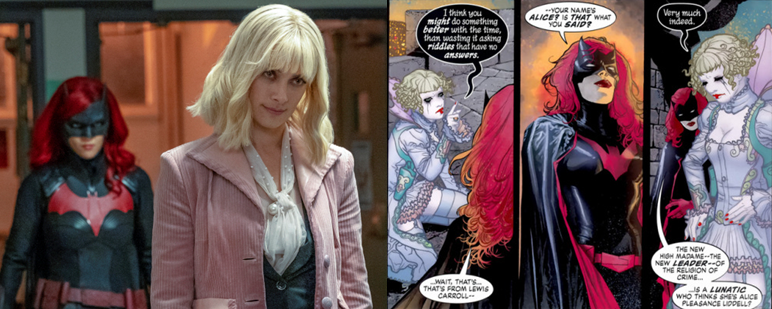
Batwoman‘s main plot is adapted from the “Elegy” story.

Despite this, Kate is very much her own character; she never sought to become Batwoman and, instead, utilised a modified version of Bruce’s suit and technology to assist in her investigation into Alice (Skarsten), a mentally unstable maniac who themes her crimes after her namesake from Alice’s Adventures in Wonderland (Carroll, 1865). You might think having the show’s main villain being a knock-off of D-list Batman villain the Mad Hatter is a mistake but, it turns out, that the link between Batwoman and Alice was a big part of the “Elegy” (Rucka, et al, 2009 to 2010) storyline during Batwoman’s time in Detective Comics (1937 to present). As a result, the main plot of Batwoman focuses on Kate’s discovery that Alice is actually her long-lost, long-presumed-dead twin sister, Beth. Like Arrow, the story of Kate and Beth’s childhoods and pasts is told through flashbacks, through which we see how Batman (in broad daylight, the first of many issues this show has) failed to properly secure the car young Kate (Gracyn Shinyei) and Beth (Ava Sleeth) were in, resulting in the death of their mother and Beth ending up a prisoner of the sadistic August Cartwright/Dr. Ethan Campbell (John Emmet Tracy and Sebastian Roché) and forced to befriend his disfigured son, Jonathan Cartwright/Mouse (Sam Littlefield). Unfortunately, after only a few episodes, I kind of lost interest in Alice as a character and a villain; she’s just crazy for the sake of being crazy and is more annoying than anything, especially as she often flip-flops between being a full-on murderous sadist and being a scared girl desperate for help. As a villain, she’s just not that compelling and it gets very annoying how she is constantly captured, only to escape, or seems to be on the road to rehabilitation only to immediately do a 180 and Kate falls for her act every. single. time.

BWDougray
Dougray Scott is a welcome addition to the cast.

Left mentally unbalanced by her time in captivity, Alice leads the Wonderland Gang in targeting her estranged father, Commander Jacob Kane (Scott); quite how Batwoman managed to snag Dougray Scott is beyond me but he’s a great addition to the show, lending a gravitas and feeling of professionalism that is sorely missing due to Batman, Alfred Pennyworth, and Commissioner James Gordon all being absent. Jacob heads up a private security agency known as the “Crows”; for all intents and purposes, they are Gotham’s police department as, while they work with the Gotham police, they’ve basically transplanted them in Batman’s absence. Scott has great chemistry with Rose; the two have a frosty relationship with many wrinkles and a lot of friction as Kate believes her father gave up on Beth and turned his attention to blaming, and hating, Batman instead. She also strives to be seen as an equal and beneficial to his cause, though repeatedly turns down his offers to join the Crows as she comes to accept her role as Batwoman. Eventually, their relationship improves but his views and opinions on Batwoman begin to sour, with the season ending with Kane declaring all-out war on Batwoman and any who aid and abet her. Rounding out the cast, and the drama, is Kate’s ex Sophie Moore (Mandy), who denied all knowledge of their same-sex affair in order to graduate from military academy and join the Crows. Kate is heartbroken when she returns to Gotham and finds Sophie married to fellow Crows agent Tyler (Greyston Holt) and much of the show’s wonky relationship drama hinges on their “will-they, won’t-they” back and forth as Kate attempts to move on to other relationships and finds a decent distraction in her vigilante activities. This becomes more complicated when Sophie’s relationship breaks down after her past with Kate is revealed to Tyler and when Sophie inexplicably becomes attracted to Batwoman (who publically outs herself as a lesbian, thus becoming instantly attractive to all lesbians).

BatwomanJulia
Julia is pretty and bad-ass but ends up being a bit of a stereotype.

The seeds for this were planted a few episodes in with the inclusion of Alfred’s little-know-of daughter, Julia Pennyworth (Christina Wolfe), a semi-cockney, bad-ass spy who Kate has a past sexual relationship with, because if it’s one thing that is true across not only the Arrowverse but all fictional television, all gay people are immediately and uncontrollably attracted to each other. This is exemplified further when Julie starts making semi-regular appearances; circumstances see her working alongside Sophie and growing closer to her and, of course, a sexual relationship builds between them. We’ve also got Kate’s younger stepsister, Mary Hamilton (Kang), who operates perhaps the most well-known illegal clinic where she treats castaways from Gotham’s hospitals and basically functions as Batwoman’s medical support as the show goes on. Once Alice is revealed to be Beth, Mary and Kate’s relationship begins to suffer and comes to a breaking point after Alice fatally poisons Mary’s mother (and Kate’s stepmother), Katherine Hamilton-Kane (Elizabeth Anweis), and she dies in Mary’s arms. Kate is then torn between her desire to both reach Beth, bring Alice to justice, repairing her relationship with Mary, and the fact that Alice has ensured that Jacob is framed for the crime, which shakes the city’s faith in the Crows and has them clamouring for Batwoman instead. Eventually, however, Mary figures out Kate’s dual identity and feels slighted for some time at her step-sister keeping her in the dark about her actions; this relaxes somewhat after she is officially let in on the secret and then desperately tries to become part of Kate’s Bat-Team. Honestly, far too many people find out Kate’s identity over the course of the season, which really compromises her integrity as Batwoman for me.
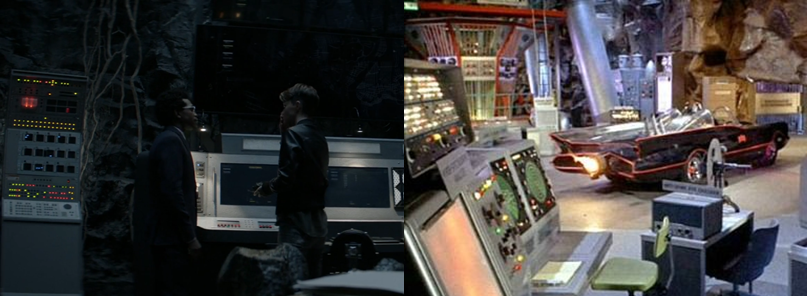
BWBatCave
Batwoman‘s Batcave is like an updated version of the 1960’s ‘cave.

As a result, Batwoman becomes a far more public figure than I am honestly comfortable with for a Bat-branded vigilante. It is very heavily implied that Batman was just as publically celebrated and the subject of news reports but Batwoman straight-up ends up plastered all over social media and even explicitly outs herself as gay when the city begins to “ship” her with Samuel “Slam” Bradley (Kurt Szarka), an attractive hero cop who makes a brief appearance. Other characters from the Arrowverse also appear in the series’ tie-in to the “Crisis on Infinite Earths” crossover which, honestly was the only reason I actually watched this show week to week. Moving on from the casting, I have to talk about the show’s aesthetic; first, while the Bat-Signal is present, it has to be the lamest iteration I’ve ever seen. Normally, it’s this massive floodlight but, in Batwoman, it’s this piddling little thing that looks like it’s struggle to light a hallway much less cast the iconic Bat embalm into the night sky. Second, like Arrow, much of Batwoman takes place in cityscapes. This means there’s a lot of offices, conveniently abandoned warehouses, and scenes that take place on the city streets. Despite the fact that Gotham has been without Batman for three years, the city has, arguably, never looked cleaner and more well-kept; similar to how Gotham appeared flawless during the daytime scenes of The Dark Knight (Nolan, 2008), Batwoman’s Gotham seems like a relatively safe place to life for the most part. This is implied to be because of the presence of the Crows and the convenient absence of Gotham’s more colourful super criminals but, still, I kind of expect my Gotham to be just as dark and dirty as Star City was in Arrow, which was rarely ever shown in the daytime. Like all of her Arrowverse cohorts, Batwoman has a secret base of operations where she can suit up and monitor events in the city. You might have heard of it; it’s called the Batcave. Batwoman’s Batcave, though, is perhaps the cleanest and most simplified version of the ‘cave I’ve ever seen. Even the Arrow’s Arrowcave, with all its obnoxious high-tech furnishings, looked more like a Batcave than Batwoman’s, which seems to be a cross between the Bat-bunker from The Dark Knight and the iconic Batcave from the 1960’s Batman television series (1966 to 1968) with its sixties-style flashing lights and terminals (it even has a little toy Tyrannosaurs rex which, to be honest, is a nice little allusion to the impractically gigantic T-Rex Bruce likes to keep in he Batcave).
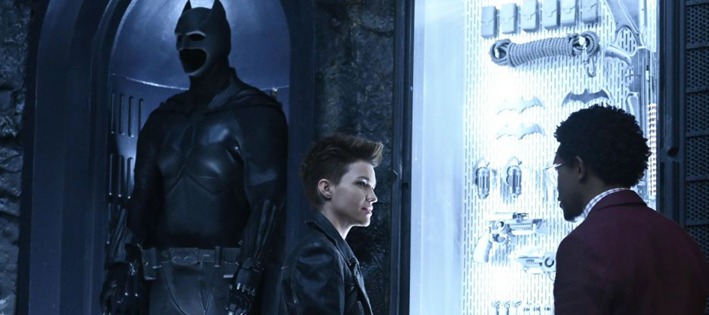
BWSuit
Luke adapts the Batsuit to fit Kate’s…specifications…

Luke Fox practically lives in the ‘cave, functioning as Batwoman’s tech support and “guy in the chair”; you’d think this would be a great way to introduce the wheelchair-bound Barbara Gordon/Oracle and inject some sexual tension between her and Kate but, instead, we have a hybrid of Lucius Fox and Alfred. In the comics, Luke became the Bat-themed vigilante Batwing and I wouldn’t be surprised if Luke doesn’t take up this codename at some point in the show’s run; hell, if Jimmy (sorry, “James”) Olson (Mehcad Brooks) can suit up as the vigilante Guardian over on Supergirl than anything is possible. While Fox is initially relegated to Batwoman’s tech support (developing her gadgets and suit, monitoring and communicating with her when she’s out in the field, and so forth), he gets a bit more focus as more and more people join their team and, especially, when he feels compelled to confront the man who killed his father (yeah, Lucius Fox is also dead in this series…) right when Kate is struggling with having taken a life. Fox is apparently some kind of genius as Batwoman’s suit is apparently so sophisticated that it’s full of technology that monitors her heartbeat, oxygen levels, and all kinds of stuff that I find difficult to believe is weaved into a far more form-fitting outfit than anything Batman is known to wear. Initially, Kate wears a modified version of the standard Batsuit as she takes to the streets and is thought to be Batman but, after she sees all the good she’s doing and the hope she’s bringing, she has Fox alter it further to include a wig and her signature red colouring and is officially announced as Batwoman.
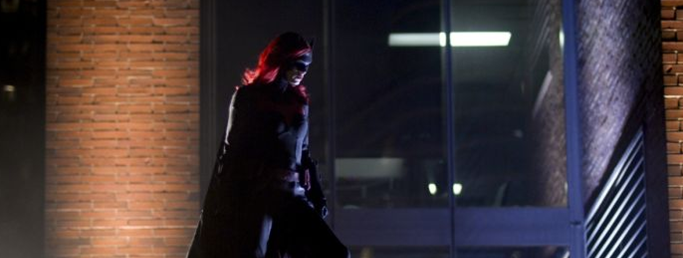
BWHero
The Bats are publicly celebrated as heroes and saviours rather than myths.

This is one of the things I actually have an issue with in the show; when Batwoman was introduced in “Elseworlds”, Batman was a myth so powerful that even Oliver Queen didn’t believe that he was real. Jump over to Batwoman, though, and not only is Batman openly the subject of media gossip and coverage, he’s a widely known and celebrated hero of Gotham City. The Crows, especially Jacob, despise Batman for his anonymity and for abandoning the city and even Kate was distrustful of the Caped Crusader until she found out who he was; once she did, she was inspired by his legacy and began continuing Bruce’s journals to chronicle her own journey. My issue here is the idea of Batman as a “hero”; as I prefer Batman to be an urban legend, feared by criminals, distrusted by the police, and a figure of mystery to the general public, something about gossip columnists openly discussing his methods and the entire city acknowledging his presence and celebrating him as they would the Flash rubs me the wrong way. Even Arrow handled this aspect of its titular vigilante better, with Oliver’s hooded alter ego not really being publicly acknowledged or celebrated for some years so it’s a bit weird for me to see Gotham’s citizens “crying out” for their hero’s return. And then there’s Batwoman’s portrayal of Bruce Wayne; through dialogue with Fox, Kate learns more about Bruce’s motivations, how he handled the burden of his duel identity, and the reasons behind him walking away from Batman and Gotham. To begin with, Bruce/Batman is almost this mythic figure, some lofty ideal that Kate can only dream to live up to, much less match. But then some cracks begin to form, the first being when Fox reveals that Bruce commissioned the creation of a gun that could penetrate the Batsuit, with the implication being that, were his technology to fall into the wrong hands, Bruce would be happy to kill the perpetrator. The second, and most egregious, is the revelation later in the series that Bruce quit being Batman after he killed the Joker (here also referred to as Jack Napier).

BWKill
Batwoman wasn’t too shaken when she killed the alternate Bruce Wayne…

Let that sink in for a second: Batman was not only willing to kill to stop someone who stole his Batsuit, he also killed the Joker, and felt he had to quit being Batman because of it. While I don’t actually mind Batman killing, it’s unsettling when so much emphasis is put on Bruce’s uncompromising moral standing only to throw it all away by him creating a gun and killing his greatest enemy. Worse still is that Fox only reveals this to Kate after she has strangled August Cartwright to death for what he did to her sister and mother. Now, again, I don’t mind Batman killing under the right circumstances; I grew up with Michael Keaton’s fantastically haunting portrayal of the character so I’m used to a Batman who is willing to cross the line now and then and fully believe that, in his line of work, casualties and fatalities are bound to happen. It’s also worth noting that Batwoman is a former soldier and, especially in the comics, is not adverse to killing when it’s absolutely necessary. Over the space of three episodes or so, though, Kate struggles with her actions in a way that, again, Oliver Queen never really did; when he first returned to Star City, Oliver killed specific targets and his enemies without a second’s thought. Later on, he tried to “do better” by not killing but easily went back to shooting arrows through people’s hearts not long after and he’s no less a hero for it, so why would Batwoman (or Batman, for that matter) be? Still, Batman’s code against killing is an important aspect of the character and going against that is always going to ruffle a few feathers; it also seems like a really lame, super easy excuse to write Bruce/Batman out of the show. It’s also worth noting that it was taking a life that led to the aged Bruce becoming a remorseless killer in “Crisis on Infinite Earths” and that Kate killed him (whether by accident or design) during a fight and showed very little remorse over this.
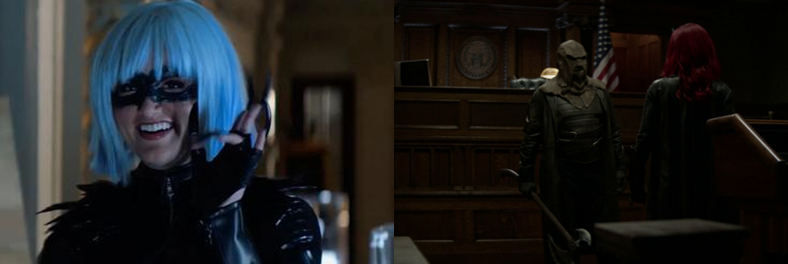
BWVillains
Batwoman featured a few of Batman’s D-list rogues.

Moving on, though, the show features a small selection of Batman’s D-list rogues; though she has no ties to the Mad Hatter, Alice’s mere presence alludes to his existence; the Joker, as mentioned, is disappointingly dead; and a version of the Executioner (Jim Pirri) also appears. Being that this is a female-led show, and a lot of the show’s plot is focused on female empowerment, there are a few female villains in Batwoman (the oft-forgotten Magpie (Rachel Matthews) and Nocturna (Kayla Ewell), for example) but most episodes revolve around Alice in some way, shape, or form, and her efforts to get revenge on Kate and her father and temptation towards redemption. Thomas Elliot (Gabriel Mann) also shows up early in the season as a friend and rival of Bruce’s but is quickly revealed to have deduced Bruce’s identity as Batman and to be as crazy as a bag of cats so he ends up in Arkham Asylum. Thankfully, though, Batwoman is full of face transplants and glorified plastic surgeons and, through the influence of Alice and Mouse, Elliot breaks out of Arkham, gets his face sliced off, and ends up wrapped up in bandages and taking on the persona of Hush. Unfortunately, though, Elliot is both just another crazy guy and another rich guy in a suit, so he’s far from the physical or intellectual threat as the comic book Hush, though the season does end with a massive cliff-hanger as Elliot applied a patchwork skin to his face to assume Bruce Wayne’s identity. Something Batwoman likes to employ, for whatever reason, is the implementation of licensed songs to punctuate its more dramatic (read: soap opera) moments. Songs like these may have fit into teen dramas like Smallville (2001 to 2011) but they seem massively out of place in a Bat-centric show. Luckily, Batwoman takes its lead more from Arrow for its action sequences and fight scenes; generally, episodes will open with some kind of chase, kill, or action sequence. Kate (and/or Jacob) will then investigate something, or have some kind of confrontation, and then she’ll hit the streets as Batwoman, maybe take out some goons, before working towards a finale against whomever is the main threat of the episode. Fight scenes are far more hands on and up close and personal than in Arrow, though, as Batwoman favours hand-to-hand combat over a bow and arrow. Like Green Arrow, Kate masks her voice with a voice synthesiser, which I always prefer over the idea of the Bat-characters putting on a voice (despite how good these voices have been), but this doesn’t stop multiple characters guessing or knowing her identity within only six episodes.
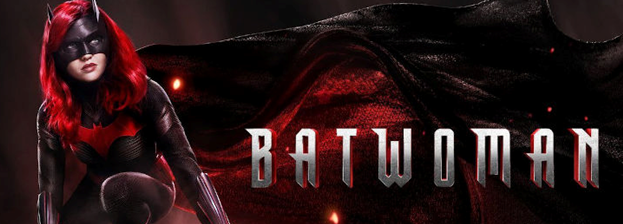
BWConclusion

The Summary:
Ultimately, the season started off quite well and had a lot of promise but fell off a cliff very quickly; after a few episodes, Batwoman becomes very formulaic, makes some questionable decisions regarding Batman’s legacy and the inclusion (or exclusion) of famous Bat­-characters, and ended on a massive cliff-hanger that, by the looks of it, we either won’t get resolved in a second season or it will be significantly different because of the behind the scenes shenanigans. After flip-flopping about a hundred times, Alice decides she hates Kate and Batwoman as they betrayed her and got her locked up in Arkham Asylum. Thankfully, she makes fast friends with Thomas Elliot, who has snapped and basically believes Bruce Wayne to be his best friend, and she and Mouse concoct a bizarre plan to cut off Elliot’s face (and have him disguise himself ((because face transplants are super easy and impossibly convincing in Batwoman)) so they can get out of there. The remainder of the season focuses on Alice trying to acquire, and then decode, Lucius’ journal so she find out how to penetrate the Bat-Suit and kill Batwoman…despite the fact that she had a means to do this earlier in the season.
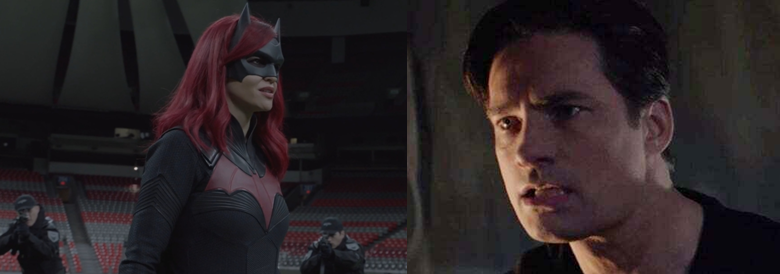
BatwomanFinale
Batwoman ends on quite a cliffhanger that will probably have a poor resolution in Season Two.

In a contrivance that makes my head spin, it turns out the Kate’s suit is so incredibly bullet proof that the only thing in the world that can penetrate it (beyond the special bullet introduced earlier in the season that the writers forget about) is…Kryptonite. This presents a problem as Supergirl (whom Batwoman has a very rushed but quite charming, friendship with) entrusted Kate with a shard of Kryptonite to use against her if she ever went rogue. Although Luke compresses the only other shard into powder, Alice is heartbroken when she is forced to kill Mouse as he threatens to leave without her and swears to kill Kate once and for all. This coincides with Elliot assuming the role of Bruce Wayne and Jacob’s vow to end the Bat infestation in Gotham City to keep vigilantes from supplanting his organisation and leaves Batwoman on a massive cliff-hanger but most likely will get swept under the carpet when the series returns to television. I was interested in Batwoman for a couple of reasons: first, I wanted to see the second part of “Crisis on Infinite Earths” and the legendary Kevin Conroy as a live-action Bruce Wayne and, second, I was interested to finally see a Bat-themed show as part of the Arrowverse. Unfortunately, despite some decent casting, action sequences, and costume design, Batwoman started to lose me around the third episode (basically the moment it was revealed that Bruce had developed that Batsuit-ending gun).

BWSupergirl
Seriously, these two need to just get a room!

It wasn’t as annoying as Supergirl or as pointless as DC’s Legends of Tomorrow (2016 to 2020) but it’s still not on the same level as The Flash (2014 to present) or even Arrow; I pretty much only dip in and out of Legend of Tomorrow because they made the smart decision to put John Constantine (Matt Ryan) on the team and completely gave up on Supergirl after the show devoted all of its runtime to Kara desperately trying to repair her relationship with Lena Luthor (Katie McGrath), which descended to the point of parody when it seemed like they were desperately in love with each other but in vehement denial over it. Yet, I feel the same thing is going to happen with Batwoman; it wasn’t as explicit with its comparisons of Batwoman to Batman or at pushing its pro-female agenda, so it’s much easier to watch than Supergirl, but a lot of its narrative decisions were questionable. Not having Bruce Wayne/Batman in the show really hurts it, in my opinion; this would have been a great opportunity to combine the Arrowverse series with Titans and have Iain Glen reprise his role in an older, mentor role after being incapacitated. Instead, Bruce is just…gone and, while his retirement kind of worked for Nolan’s films, it never sits well with me when Batman just gives up his life-long crusade. And what about Dick Grayson? Jason Todd? Tim Drake? All the rest of Batman’s cast of characters, both friend and enemy? Where are all of them in this world? The questions Batwoman raise far overshadow any of its positives and I can’t say that Batwoman really impressed me in its first season and, considering that Ruby Rose has decided to walk away from the show and the role will be completely recast and supplanted, I doubt that it’ll be a suitable replacement for Arrow, no matter how many seasons it runs for.

My Rating:

Rating: 1 out of 5.

Terrible

What did you think of season one of Batwoman? Are you interested in seeing subsequent seasons and appearances by Ruby Rose in the Arrowverse or would you rather the CW pulled the plug on this show? What are your thoughts on the way Batwoman handled the portrayal of Bruce Wayne/Batman and Gotham City? Whatever you think about Batwoman and the Arrowverse, feel free to leave a comment below.

Screen Time: That ’70s Marvel Cinematic Universe

Superheroes may dominate television screens these days, but it all started back in the seventies. Long before the Marvel Cinematic Universe (MCU) took cinemas by storm and drummed up enough cash to sink a small cruise liner, Marvel Comics had ventured into live-action adaptations of their comics books by licensing their properties to studios like CBS and Universal Television. This produced the iconic Incredible Hulk (1977 to 1982) television show that firmly entrenched the Green Goliath in the cultural consciousness and produced tropes that became synonymous with the character for years to come.

You wouldn’t like him when he’s angry…

However, The Incredible Hulk wasn’t the only live-action adaptation of a Marvel Comics property to be produced in the seventies; in fact, there were so many productions (or, at least, so many Marvel characters) around this time that a version of the MCU can be seen to have existed long before Iron Man (Favreau, 2008) graced cinema screens. So, today, I’m going to take a quick look back at some of these productions and have a chat about the MCU we very nearly saw come together back in the days of Pink Floyd, frayed jeans, and mullets…

70sMarvel

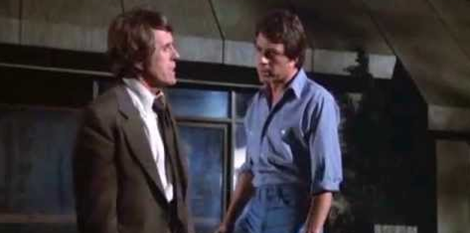
As I mentioned, The Incredible Hulk kicked all of this off; starring Bill Bixby as Dr. David Bruce Banner, the show depicted a scientist recklessly experimenting on himself with gamma radiation in a bid to unlock the hidden strength and potential of the human body. When he absorbs too much gamma radiation, moments of stress and anger cause him to transform into the green, bestial Hulk (Lou Ferrigno), a creature of limited intelligence, immense rage, and incredible strength.

70sMarvelMcGee
McGee relentlessly hounded Banner.

Believed dead at the Hulk’s hands, Banner is forced to wander around the country in search of a cure, helping those in need with both his intelligence and the strength of the Hulk when pushed too far, all while being relentlessly pursued by reporter Jack McGee (Jack Colvin). The show was famous for coining the phrase: “Don’t make me angry. You wouldn’t like me when I’m angry”, which has since become so synonymous with the character that it has appeared in most Hulk adaptations. Equally popular was both Bixby’s portrayal of Banner as a wandering nomad, desperate to cure himself of his alter ego and return to normal life, and Ferrigno’s portrayal of the Hulk (a role that Arnold Schwarzenegger auditioned for and that originally went to mammoth actor Richard Kiel).

70sMarvelFerrigno2
Ferrigno always had a place in Hulk adaptations.

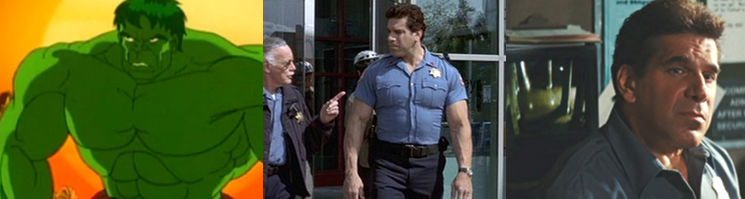
Ferrigno has since become so associated with his role as the Hulk that he went on to not only voice the character in the animated Incredible Hulk (1996 to 1997) television series but also collaborated with Mark Ruffalo in voicing the Hulk in the MCU and cameoed in both Hulk (Lee, 2003) and The Incredible Hulk (Leterrier, 2008), a movie that was heavily influenced by the ‘70s television show. If there’s any downside to the show, and Ferrigno’s performance, it’s that they both popularised the notion that the Hulk is a feral, growling creature rather than a semi-to-impressively articulate individual. While Stan Lee himself may have signed off on this at the time (“I had the Hulk talking like this: “Hulk crush! Hulk get him!” […] that would have sounded so silly if he spoke that way in a television show” (Lee, quoted in Greenberg, 2014: 19 to 26)), I feel this was more a case of Lee signing off on anything for the licensing revenue. This portrayal even carried over into the MCU, where the Hulk was capable of rudimentary speech (one or two growling lines here and there) but did not properly articulate until Thor: Ragnarok (Waititi, 2017); to compare, Bradley Cooper was snarking up cinema screens as Rocket Raccoon in Guardians of the Galaxy (Gunn, 2014) before Hulk was allowed to properly talk.

The Incredible Hulk returned with a bang.

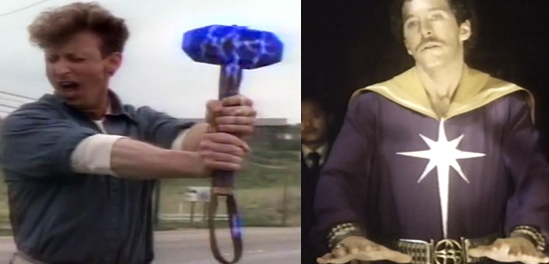
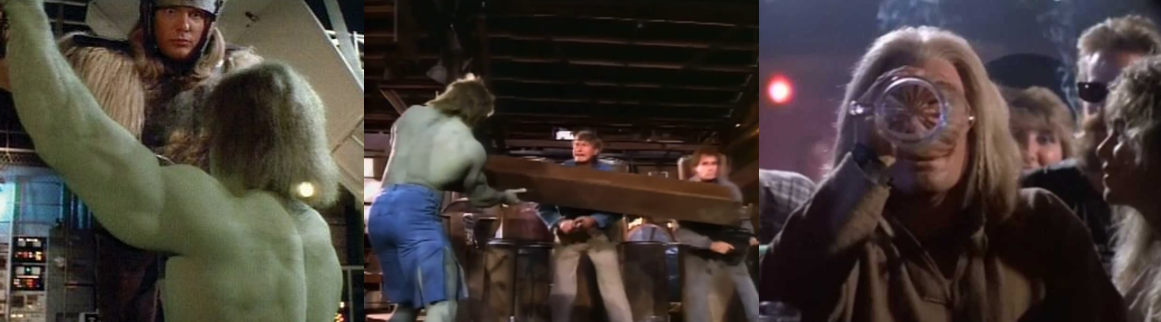
In any case, The Incredible Hulk ran for eighty episodes before finally coming to an end on 12 May 1982. Banner’s adventures, however, continued in the made-for-television film The Incredible Hulk Returns (Corea, 1988). While the TV show shied away from including any Marvel characters aside from Banner and the Hulk, much less his fellow Marvel cohorts, The Incredible Hulk Returns featured two of the most unlikely inclusions you could imagine given the show’s relatively rounded approach to its source material. After successfully suppressing the Hulk for two years, Banner’s idyllic life is turned upside down when an old student of his, Donald Blake (Steve Levitt), seeks him out. Right as Banner is on the cusp of finalising a potential cure in the Gamma Transponder machine, Blake reveals that he discovered an enchanted hammer in Norway that, upon his command, releases the mighty immortal warrior Thor (Eric Kramer) from Valhalla.

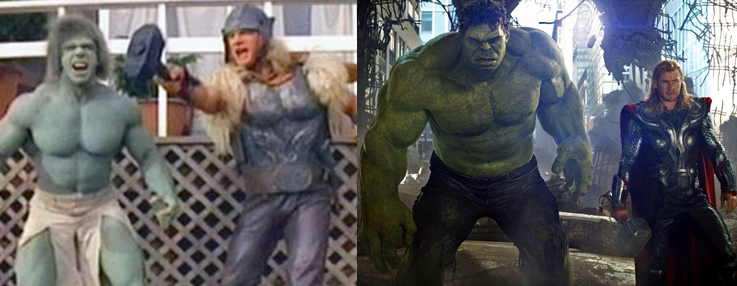
70sMarvelHulkThor
I honestly can’t tell the difference…

When Thor upsets Banner, he briefly battles with the Hulk and damages Banner’s the Gamma Transponder, but the two (three, I guess) are forced to work together to stop criminals from stealing Banner’s research and harming his life interest, Dr. Margaret Shaw (Lee Purcell). In the end, while Shaw is rescued, Banner is forced to destroy a vital component to the Gamma Transponder and, with the Hulk’s presence catching McGee’s attention, promptly returns to the road to seek out a new cure for himself. When I was a kid, I never got the chance to watch The Incredible Hulk, so one of my first exposures to it was with The Incredible Hulk Returns, which I found to be hugely enjoyable largely because of the thrill of seeing the Hulk in live-action and the banter between Blake and Thor. Rather than transforming into Thor, as in the comics, Blake instead brings Thor forth with the hammer and is charged with guiding him in life and in the fulfilment of a number of heroic deeds so he can take his place at Odin’s side in Valhalla. It’s absolutely mental, especially as a continuation of the TV show, but Kramer is so much fun as the loud-mouthy, arrogant, meat-headed Thor that you can’t help but smile when he’s onscreen, especially when he’s drinking and fighting in a bar or battling with (and alongside) the Hulk.

Banner forms a kinship with Daredevil.

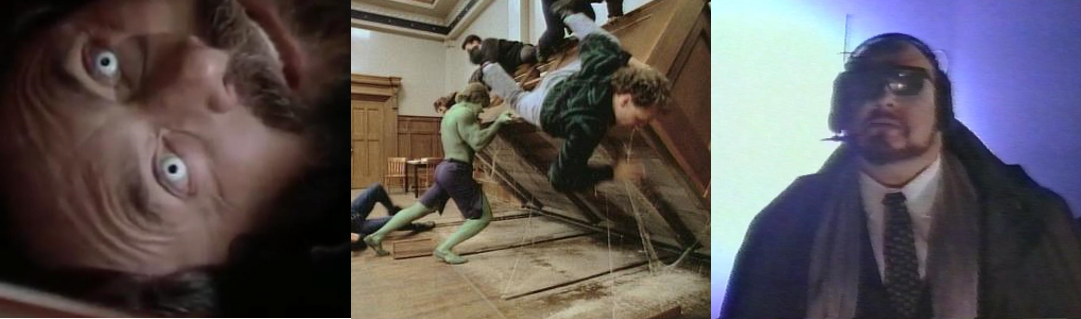
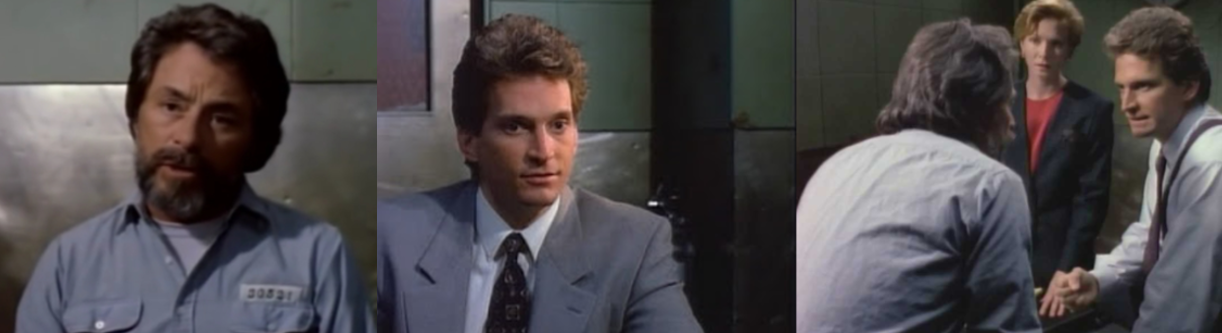
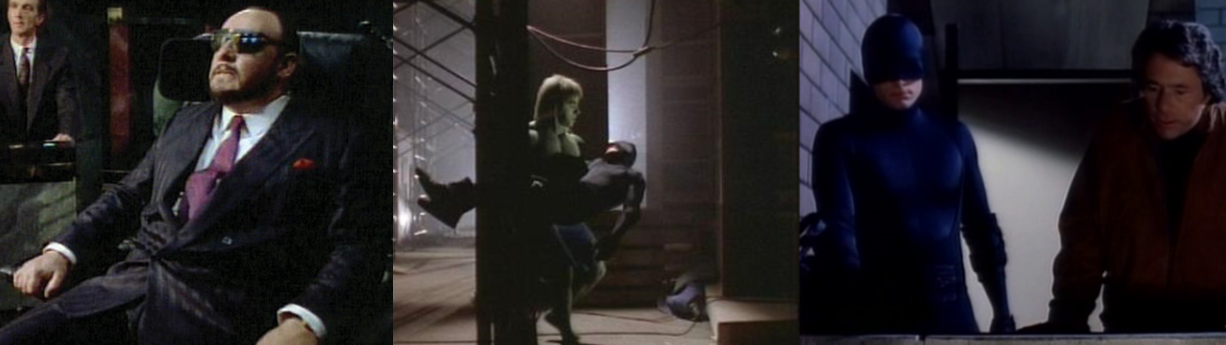
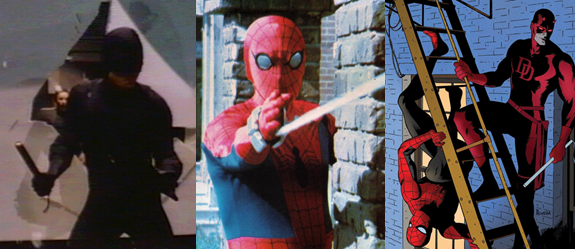
I said I never really watched the show but, in truth, my first ever exposure to the Bixby and Ferrigno team was the follow-up movie, The Trial of the Incredible Hulk (Bixby, 1989), in which Banner, now a desolate soul who’s lost all hope, wanders into a city and, after disrupting a mugging on an underground train, is wrongfully imprisoned. As luck would have it, his appointed attorney is none other than Matt Murdock (Rex Smith), a blind lawyer who also patrols the streets at night as the black-clad vigilante Daredevil. Murdock is pursuing evidence against Wilson Fisk (John Rhys-Davies), an entrepreneur whom Murdock (rightfully) believes is a dangerous crime boss. While Banner is content to stay safely locked up in jail, the idea of being put on trial causes him to Hulk out and, eventually, team up with Murdock/Daredevil in bringing Fisk to justice.

John Rhys-Davies was great as Fisk.

The Trial of the Incredible Hulk is notable for a couple of reasons; it features Stan Lee’s first-ever live-action cameo in a Marvel production, it heavily adapts elements of Frank Miller’s iconic run on the Daredevil comics, and the titular trial only actually takes place in a nightmare Banner has while imprisoned. Nevertheless, Rhys-Davies is exceptional as Fisk; he’s never referred to as the Kingpin onscreen but that doesn’t stop him being a cool, calculating puppet master of a villain; his eventual escape (in a God-damn rocket ship!) is a loose end that was never tied up as the final TV movie, The Death of the Incredible Hulk (Bixby, 1990), chose to bring an end to the Incredible Hulk series and did not feature any additional Marvel characters.

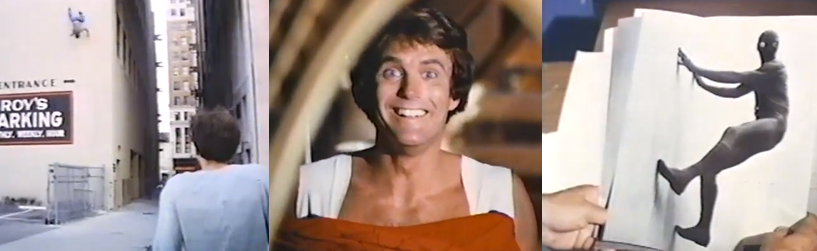
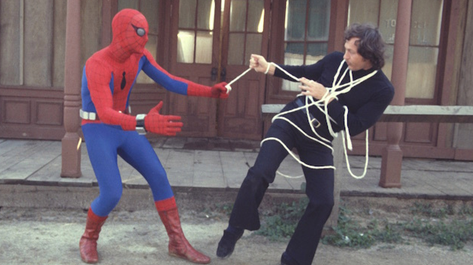
Hammond was a decent Peter Parker…and he had a great stunt double.

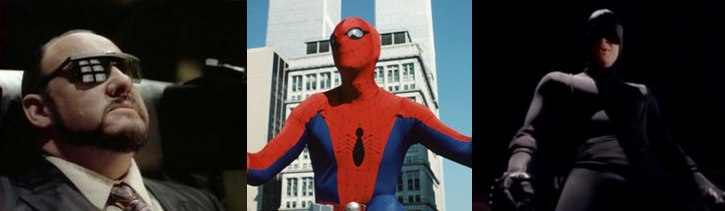
Hulk wasn’t the only one to get his own live-action TV show though; after the feature-length pilot, Spider-Man (Swackhamer, 1977), proved popular, Marvel’s web-head got his own thirteen episode series in the form of The Amazing Spider-Man (1977 to 1979). In addition, episodes of the show were edited (“cobbled”, is probably a better word) together into two made-for-television movies, Spider-Man Strikes Back (Statlof, 1978) and Spider-Man: The Dragon’s Challenge (ibid, 1981), both of which (along with the pilot) are the only exposure to this show I’ve had. The Amazing Spider-Man starred Nicholas Hammond as Peter Parker (with the show’s stunt co-ordinator, Fred Waugh, taking the role of Spider-Man, which was pretty obvious given their wildly contrasting size and builds) and, if you thought that this show took more from the source material than The Incredible Hulk then you’re going to be woefully disappointed.

70sMarvelSpiderFights
I mean…they did the best the could…

Jonah Jameson (played by both David White and Robert F. Simon) featured quite prominently but Robbie Robertson (Hilly Hicks) and Peter’s Aunt May (Jeff Donnell) only appeared in the pilot episode and, though Spidey tussled with hypnotists, terrorists, and gangs, he never once butted heads with any of his colourful rogues gallery. Spidey (and Parker) also initially ran afoul of Police Captain Barbera (played with gruff, loveable glee by Michael Pataki), but this character was sadly dropped for the show’s second season. The Amazing Spider-Man was an ambitious project, especially for the seventies; Spider-Man is a character who requires a lot of effects and stunt work to pull off correctly and is arguably far more dependent on modern computer effects than the likes of even the Hulk. As a result, while the show featured an incredibly faithful recreation of Spidey’s origin, costume, and web shooters and did its best to portray Spidey’s wall-crawling and web-slinging through wires, pulleys, and other camera tricks, the show always came across as being far more absurd than its Universal counterpart.

70sMarvelDrStrange
For whatever reason, Doctor Strange got a movie too.

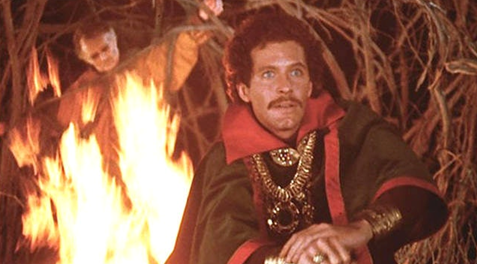
There was more to come from Universal Television, however, as they also produced a Dr. Strange (DeGuere, 1978) made-for-television movie that featured Peter Hooten in the title role (I guess Tom Selleck was unavailable…) and Jessica Walter as Morgan Le Fay. This one’s especially obscure and many have probably never heard of or seen it; it actually got a DVD re-release in 2016, coincidentally around the same time as Doctor Strange (Derrickson, 2016) was released in cinemas. Interestingly, Stephen Strange is portrayed as a psychiatrist rather than a physician and stumbles into his destiny as the Sorcerer Supreme when Le Fay possesses one of his patients, Clea Lake (Eddie Benton). The movie also featured other recognisable faces from the source material, such as Wong (Clyde Kusatsu) and the Ancient One (Michael Ansara), which is already a bit of a leg up on the Hulk and Spider-Man outings. What scuppered Dr. Strange, though, was, again, the fact that it was produced at a time when special effects simply were not up to the task of doing the character justice. It also didn’t help that the film was criticised for being overly long and boring and lacking any real urgency. In all honesty, there really isn’t much to see here that’s worth you rushing out to watch except the novelty of seeing a C-list character like Strange get a live-action movie well before his time.

70sMarvelCapBikeKITT
Yeah, I don’t think K.I.T.T. had anything to worry about…

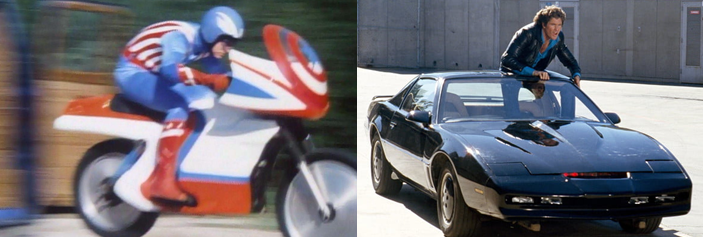
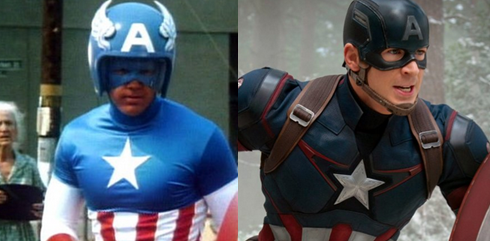
CBS also had one another Marvel character to offer the seventies; Captain America (Holcomb, 1979) brought the star-spangled Avenger to life on television screens and…dear Lord, is this a sight to behold! Reb Brown starred as Steve Rogers, a former marine-turned-artist living in the present day whose patriotic father was known as “Captain America”. After he’s nearly killed by an attempt on his life, he’s inexplicably chosen to be administered with the super-serum F.L.A.G. (Full Latent Ability Gain), which turns him into a superhuman. He then decks himself out in a horrendous version of the Captain America costume and takes to the streets on a modified super-cycle so massively over-the-top with gadgets and features than even K.I.T.T. would blush! Luckily, by the end and the sequel, Captain America II: Death Too Soon (Nagy, 1979), Rogers adopts a more faithful version of the costume and uses his abilities to oppose the plans of General Miguel (inexplicably played by Christopher Lee!), who desires to create a dangerous chemical. I’m actually far more familiar with the equally-lambasted Captain America (Pyun, 1990), which is still a guilt pleasure of mine. Nevertheless, both films were released on DVD and, while Dr. Strange was lost to the mists of time and obscurity, these films appear to have at least partially influenced the MCU as Cap (Chris Evans) does favour a motorcycle (but, to be fair, so did the comics Cap…).

70sMarvelDaredevilThor
I would’ve watched a show with either of these two in.

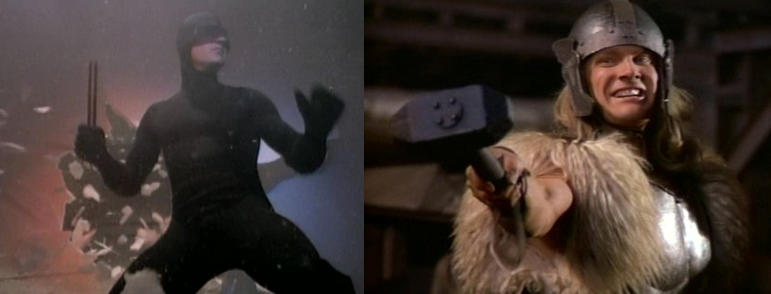
Both The Incredible Hulk Returns and The Trial of the Incredible Hulk introduced Thor and Daredevil with the intention of setting them up for spin-off shows of their own but, for a variety of reasons, this never came to be and that’s a bit of a shame. Smith is no Charlie Cox but, while his Murdock was quite dull and boring, he gave a pretty good turn as Daredevil and it would probably have been easier and far cheaper to produce a Daredevil TV show than a Hulk or even Thor one. Similarly, I love the portrayal of Thor in Trial; sure, he doesn’t look or act anything like his Marvel Comics counterpart, but it could have been pretty fun to see him tossing fools around, getting into bar fights, and learning lessons in humility on an episodic basis. One thing that is equally unfortunate about all this is that the inclusion of Thor and Daredevil really took a lot of the focus off of Banner and the Hulk; sure, in the show, he was often a supporting player in a bigger story and other character’s lives, but these movies devoted so much of their runtime to pushing and establishing their new characters that it’s easy to forget that Banner and Hulk are even in them. The Death of the Incredible Hulk rectified this, but at the cost of killing both characters off in what was, while emotional (as a child, anyway), probably the lamest way imaginable.

70sMarvelTeamUp
All these guys co-existed at about the same time…

Unfortunately, there hasn’t been much love shown to The Amazing Spider-Man over the years; it’s never been released on home media outside of a few VHS tapes and, while Hammond appears to have been the basis for Parker’s design in the Spider-Man (1994 to 1998) animated series, he’s never returned to the character or the franchise again, not even for a quick cameo or a voice role (though I’m hoping the sequel to Spider-Man: Into the Spider-Verse (Persichetti, Ramsey, and Rothman, 2018) will rectify that). Interestingly enough, there were apparently talks in 1984 to produce a movie that would see Spider-Man cross paths with Banner and the Hulk, with Spidey even donning the black costume during the film. There were, apparently, also talks of an additional made-for-television Hulk movie, The Revenge of the Incredible Hulk, which would have seen Banner (somehow) revived and forced to recreate the accident that turned him into the Hulk (or be reborn as the Hulk with Banner’s intellect, depending on what you read) but neither of these ideas ever came to fruition and were ultimately halted when Bixby sadly died in 1993.

70sMarvelMagic
Magic linked these shows together, however tenuously.

However, none of this changes the fact that, sometime around 1978 to 1979, there were all these Marvel characters running around on television screens at about the same time, all produced by two studios and, in some cases, airing on the same networks. What this effectively means, then, is that it’s easy to imagine an alternative world where negotiations never broke down and the shows and movies proved popular enough for Spider-Man to crossover with the Hulk and, by extension, interact with Thor and Daredevil. So, what if…? What if there were a threat so big, so far beyond petty street crooks and one-note villains that these heroes would be forced to band together? Dr. Strange was heavily steeping in magic and mysticism, which was already (however unfitting) be proven to be a part of The Incredible Hulk’s world; hell, even The Amazing Spider-Man dabbled in the paranormal at times.

70sMarvelFiskVigilantes
It’s easy to image these guys existing in the same place and time.

Perhaps the threat would involve Fisk waging a war against Daredevil and all costumed heroes? The city is never named in The Incredible Hulk Returns but it could easily be New York City, the same New York City that Spider-Man swings around in. Perhaps this would be a chance to do a supervillain team-up, of sorts, between Fisk and Le Fay or to introduce other classic Marvel villains, such as Loki and the Red Skull. I would have loved to have worked Nick Fury (David Hasselhoff) into this imaginary Marvel team-up but it’s difficult to do that seeing as Bixby died in 1993 and Nick Fury: Agent of S.H.I.E.L.D. (Hardy, 1998) didn’t release until 1998 but what if…? What if Bixby hadn’t suffered from cancer, or had beaten the disease and Banner had been resurrected in The Revenge of the Incredible Hulk? Perhaps we would have seen a version of the Professor Hulk or Grey Hulk personas, one that merged the brawn and the strength together, and Fury could have banded these heroes together to fight a common enemy.

70sMarvelSpideyDaredevil
Spidey and Daredevil often work well together.

Personally, though, I would have preferred to see Banner and Hulk as they were portrayed in the television series; Bixby would have been the veteran actor who held this team up together and I would have limited his Hulk outs to two or three occurrences. Have him be the team’s moral compass, the hesitant advisor who learns to reconcile with his enraged alter ego through working with the other heroes. Murdock, as the older of the two, could have also acted as a kind of mentor to Spider-Man as the two are often portrayed as friends in the comics and have a lot in common with their “everyman” approach to super heroism. While the effects would not have allowed us to properly see the two swing across the New York rooftops, I think they could have cobbled together enough to produce some semi-decent, maybe even slightly acrobatic, fight scenes between the two.

70sMarvelCapCompare
These guys are worlds apart.

You’d obviously think that Captain America would be the natural leader of this group but, remember, this isn’t the war-tested superhero we all know and love and I am not proposing an Avengers movie; Brown’s Cap is more of a secret agent, an enhanced super soldier who hasn’t nearly a fraction of the combat experience that Cap is usually known for. Because of that, I’d imagine him as the public face of the group and (in the absence of S.H.I.E.LD.), a source of the group’s intelligence resources. Perhaps Cap prefers to work alone and he has to learn to work with a group, rather than tackling everything head-on.

Thor still had a lot to learn about humility.

Instead, I’d have Doctor Strange be the de facto leader of the team by virtue of his age and power as the Sorcerer Supreme. His arc, perhaps, would have revolved around him needing to shift his focus from the bigger picture to factoring in the smaller issues that his peers face on a daily basis, effectively making himself both a public figure of the superhero community and improving his interpersonal skills. And then there’s Thor (and Blake, of course); Thor would be the group’s hot-headed jock, the guy who runs in, hammer swinging, trying to fix every problem with brute strength. This team up would be the perfect opportunity to teach Thor proper humility, to accept that he must work alongside mortals and lead by example rather than being a blundering buffoon. While he learned some of this in The Incredible Hulk Returns, it was clear that there was more to tell with his story and, perhaps, this team up and his learning of humility would be the final heroic act that would earn him his place in Valhalla, allowing Blake to, however sorrowfully, begin his life anew.

70sMarvelConclusion

In the end, for as hokey and cringe-worthy as a lot of these seventies Marvel shows were, it does disappoint me that we never got, at least, to see Spider-Man, Hulk, and Banner crossover onscreen. There was a lot to like about each of these, from the impressively realised costumes to the heart-felt emotion, to even the woeful action scenes and I would honestly have loved to see all of these characters come together to battle a common enemy. What do you think about Marvel’s television show and movies from the seventies? Do you have fond memories of The Incredible Hulk? Do you also wish that The Amazing Spider-Man would get a release on DVD? Perhaps you hated the monotony and ridiculousness of these shows. Whatever your opinion, leave a comment below and get in touch.

Screen Time: Superheroes on Television

Okay, I’ll admit: I’ve never been a big fan of superhero properties on television. Growing up, I never watched The Incredible Hulk (1977 to 1982) as it was never on television when I was a kid – the closest I got were the three made-for-television movies that came out of it (which, incidentally, I liked as a kid). Similarly, the only exposure I had to the old Amazing Spider-Man television show (1977 to 1979) was from the three “movies” that came out of it. In fact, probably the only superhero television show I was regularly exposed to as a kid was, of course, the 1960’s Batman show and even that was primarily through the movie. No, as a kid, I grew up watching superheroes in animation: Batman: The Animated Series (1992 to 1995), the ‘90’s Spider-Man cartoon, ad basically all of the Marvel properties at the time. That was where it was at; animation was much, much closer to the comic books than anything in live action at the time, even compared to the live action movies that were coming out as I grew up. When Smallville (2001 to 2011) first started airing, I pretty much gave it the pass by. I watched a few of the early episodes, but not much more. This really came out at a time when I was in my mid-teens, I believe, when loads of teen-centric shows were on E4 and the like (One Tree Hill (2003 to 2012), Dawson’s Creek (1998 to 2003), all that stuff) and I didn’t have time for any of it. Smallville easily fit into those categories, which was enough for me to ignore it, but when I did flick on to it over the years I became increasingly turned off by the deviations from the source material and the creative licensing taking place on the show.

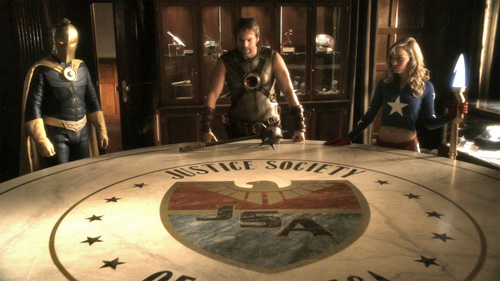
SuperTVJSA.png
Smallville got way more interesting once it included more comic book elements.

Ironically, I believe that Smallville actually did improve over time, especially by referencing and including more comic book-related stuff, but when I realised it had hit the ninth series and Clark Kent (Tom Welling) was no longer living in Smallville, was working at the Daily Planet, basically married to Lois Lane (Erica Durance), and saving lives daily in multiple variations of his eventual Superman costume, and yet despite all this he was not Superman, I was irked, to be frank. I never quite understood the logic of making a show that is about a young Clark Kent, that charts his journey from an unsure teen to the eventual saviour of humanity, and yet never actually evolved into a Superman show for the last season even though it practically was given that Clark was battling Davis Bloome/Doomsday (Samuel Witwer), of all people, and chumming around with Oliver Queen/Green Arrow (Justin Hartley). The final episode finally capitalised on this and had Clark assume his birthright to defeat Darkseid, but many were disappointed that we never got a decent shot of him as Superman. I guess they were trying to avoid degenerating into Lois & Clark: The New Adventures of Superman (1993 to 1997) but, surprisingly, I enjoyed that show as a kid – it struck a very similar balance between drama and superheroics and didn’t have half of the comic book inclusions as Smallville and, if I’m not mistaken, was pretty popular and successful at the time.

SuperTVArrow
I didn’t start watching Arrow right away.

Anyway, after Smallville ended, I watched a few re-runs and my 50/50 split of the show only increased. Simultaneously, there were persistent rumours that Warner Bros. were trying to fill the gap with a potential Batman prequel show, following a young Bruce Wayne (apparently this was even the initial pitch for Smallville but Batman was toxic at the time due to Joel Schumacher), one that charted a pre-Robin Dick Grayson, an attempt at an Arthur Curry/Aquaman and Bart Allen/The Flash spin-off, and even a Green Arrow series! Ultimately, only one came to fruition but, rather than a spin-off featuring Hartley’s Green Arrow, we got an entirely new, unconnected series depicting the origin and evolution of the Emerald Archer. Again, I don’t recall actually watching much of Arrow when it first aired as it conflicted with work and my life and such, but I did watch the first episode at least, an a few episodes here and there. My resistance to Arrow stems from the fact that Warner Bros. seem to desperately want to make a Batman television show but were unable to due to Christopher Nolan’s Dark Knight films (2005 to 2012), so they used Green Arrow as a substitute. This rubbed me the wrong way, as Green Arrow – or “The Hood”, or “The Arrow”, or “The Archer”, or “Steve” – (Stephen Amell) would frequently clash not with classic Green Arrow villains but with Batman villains – Deathstroke (Manu Bennett) was a prominent villain in the fist season, just as he had been in Smallville and Teen Titans. Now, in the comics, Green Arrow initially did start out as a rip off of Batman – he had an Arrow-Cave, an Arrow-Mobile, a kid sidekick, and even an Arrow-Signal. However, for far longer, Green Arrow has been portrayed as a street-level vigilante who targets the corrupt and those untouchable by law, frequently killing them, and protecting the “little people”. This has existed alongside the more adventurous version that was a member of the Justice League; Green Arrow’s right-wing sensibilities and strong moral beliefs often clashed with other, more conservative superheroes, and his everyday life as Oliver Queen, multi-millionaire, often facilitated his vigilante actions through urban renewals and the like. Arrow follows some of this tangent, with Queen returning to “Starling City” after being marooned on an island (and, later, in Hong Kong) and surviving against nature and a clandestine organisation using the impractical weaponry of a simple bow and arrow. Queen’s mission is to take down the corrupt of the city and avenge his father’s death, which means he kills a great deal of people in the name of the greater good, which I agree with and like – Green Arrow has often been portrayed as a slightly more morally-unhinged version of Batman and, for all their similarities, they have often clashed because of this.

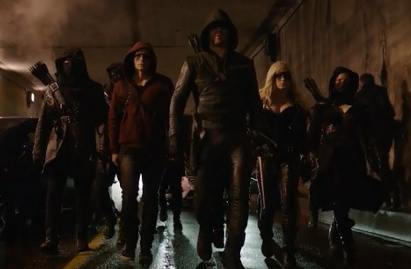
SuperTVTeamArrow.png
Arrow became much more of a team-based affair.

As Arrow went on, I largely ignored it because I didn’t agree with the seeming lack of faith Warner Bros. had in the character or the series. Like Smallville before it, the show avoids naming its titular hero even though he was popularly known as Green Arrow in Smallville. I’m sure there’s the case for this, that the show is meant to show Queen’s progression from a simple vigilante to the city’s hero (things like him upgrading his tech, adopting an actual mask, and renouncing killing support this) but why not just call him Green Arrow?  Ironically, I actually dislike the Green Arrow moniker as it’s kind of redundant – he wears green and shoots arrows, no shit!  Much like Green Lantern, I have an aversion to superheroes who preface their name with a colour and much prefer the show’s moniker of “The Hood” as it’s far more fitting. I got more into Arrow as the second season drew to a close due to the inclusion of Roy Harper/Arsenal (Colton Haynes) and the series-changing events initiated by Slade Wilson/Deathstroke (Manu Bennett). With Deathstroke having practically levelled the city and Queen basically poor, the show had raised its stakes for season three. Additionally, Queen had built a tight-knit group of allies, with Roy actually adopting the suit and outfit of Arsenal to become his sidekick! After years of Batman movies dodging, avoiding, criticising, and suppressing Robin, we finally had a depiction of a young teen sidekick that fit and actually made sense. My hope is that Arsenal’s inclusion and increased exposure will relax the embargo surrounding Robin and Nightwing at Warner Bros. and allow for their inclusion in their stupidly-unconnected series of DC films.

SuperTVSHIELD
Agents of S.H.I.E.L.D. is still tenuously related to the larger MCU.

Now, a big part of the reason I avoided Arrow was also because of the growing Marvel Cinematic Universe, which eventually spread into television with Agents of S.H.I.E.L.D. (2013 to 2020). After the events of The Avengers/Avengers Assemble (Whedon, 2012) Agent Phil Coulson (Clark Gregg) is revealed to be alive and builds a team of agents to investigate supernatural, paranormal, extraterrestrial, and superhuman incidents across the globe. The main thrust of the first series was the team coming together, leaning to trust each other, and the quest for answers regarding Coulson’s resurrection. However, this soon overlapped with the emergence of Hydra agents within the Strategic Homeland Intervention, Enforcement, and Logistics Division (S.H.I.E.LD.), which crossed over with the events of Captain America: The Winter Soldier (Russo and Russo, 2014), which saw the destruction of S.H.I.E.LD. Many supporting characters, and main character Grant Ward (Brett Dalton), were revealed to have been Hydra agents, and the unlimited resources available to Coulson were stripped away by the end of season one. Simultaneously, it is revealed that Director Nick Fury (Samuel L. Jackson) used an experimental serum and procedure, derived from an as-yet-unnamed alien source (it was recently revealed to be of Kree origin), to facilitate Coulson’s resurrection – this same serum drove HYDRA double agent Dan Garrett (Bill Paxton) mad and gave him superhuman abilities. Season one also included a side plot detailing the origin of a version of Mike Peterson/Deathlok (J. August Richards), a cyborg created to assist Garrett who eventually overcame his programming. Season two features a smaller team, with new characters, who are attempting to rebuild S.H.I.E.L.D. and uncover further truths behind their pasts, and future, as Coulson continually suffers from episodes induced by the alien serum that lead him, like Garrett, to scrawl strange alien symbols.

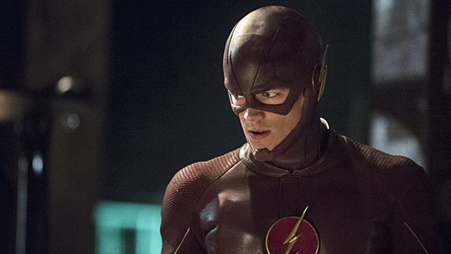
SuperTVFlash.png
The Flash became my favourite of the DC TV projects.

Truthfully, Marvel’s Agents of S.H.I.E.L.D. is far from perfect, or great. The best things about the show are the dialogue, which is witty and clever and full of Whedon-isms, the references and inclusion of lesser-known comic books characters (again, Deathlok…Deathlok, of all people!), and the fact that it ties directly in to the largely Marvel Cinematic Universe. Events from the films are often referenced directly in the show, supporting characters often appear, and it really feels as though the show is helping to build and expand upon the Marvel Cinematic Universe even though it is highly unlikely that any of the characters featured on the show will appear in the films. As a result, the show doesn’t feel “pointless”, unlike Warner Bros.’ efforts. After guest starring in Arrow, Grant Gustin returned as Barry Allen in his own spin-off, The Flash, which I initially decided to watch over Arrow as I was pretty sure there was no way they could shoe-horn in unfitting Batman elements into the show. The Flash is, in many ways, a carbon copy of Arrow; very quickly (hah!), like Queen’s base at Verdant, Barry based his team in Scientific and Technological Advanced Research Laboratories (S.T.A.R. Labs) nd has a team of specialists and supporting characters helping him that are analogous to Team Arrow and Oliver’s associates. The principal difference is The Flash’s inclusion and portrayal of metahumans. Barry gained superhuman speed after being struck by lightning during an explosion at S.T.A.R. Labs, which resulted in a wave of radiation emanating out from Dr. Harrison Wells’ (Tom Cavanagh) particle accelerator. The wave affected many members of Central City, bestowing them with superhuman abilities, and it is up to Barry and his team to subdue or assist all of them. This is in contrast to Arrow, which largely avoids metahumans for corrupt officials, ninjas, and grounded, street-level threats. Exceptions are usually the case of serums and scientific experiments, or clandestine organisations like the League of Assassins (another Batman-orientated organisation!). The Flash aired alongside Arrow’s third season, and the two frequently overlap and interact – characters often appear on both shows, which has increased my stake in both and, alongside the fact that they both air on days I can watch them, means I can now follow both.

SuperTVGotham
I wasn’t a fan of Gotham

Alongside The Flash, Warner Bros. finally got their Batman-prequel series underway with Gotham, which follows a young James Gordon (Ben McKenzie) in a pre-Batman Gotham City. This series is completely unrelated to The Flash and Arrow, however, and the three do not occupy the same continuity. Like The Flash, however, Gotham (2014 to 2019) had numerous problems with pace, particularly in the first episode. Both debut episodes threw so much at the viewer, introduced so many characters, plot lines, and comic book references that even I, an avid comic book fan, felt overwhelmed and actually a little insulted. Arrow took its time establishing Queen, his city, and his crusade – despite how much it annoys me that he isn’t known by the right name and constantly feels like a Batman substitute, I can’t fault Arrow for pace. Like Smallville before it, the show has been around a while now and has established a tone, pace, and atmosphere and can now afford to become more “comic book” and introduce more comic book elements – Ray Palmer (Brandon Routh) debuted in season three, hinting at the possibility of The Atom appearing at some point. The Flash, however, opened by throwing everything at us all at once: Barry’s mother was killed by a mysterious man-in-lightning when he was a boy, his father (John Wesley Shipp, from the old Flash TV series!) was arrested for it, Barry was raised by Detective Joe West (Jesse L. Martin) alongside his daughter, Iris (Candice Patton), whom Barry has been in love with for years. Barry grew up to become a forensic scientist, he was struck by the lightning, went into a coma, and when he woke up, Iris was dating Joe’s partner, Eddie Thawne (Rick Cosnett), and Barry secretly began working with Dr. Wells and his team to subdue metahumans…oh and, also, there’s all the mystery surrounding Wells’ true motivations.

SuperTVPenguin.png
Gotham‘s Penguin doesn’t really do it for me.

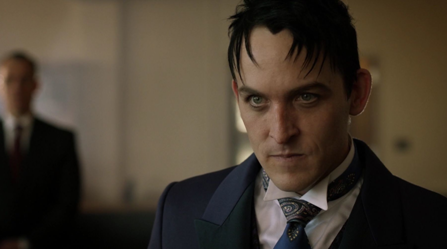
Think that’s a lot to take in in one episode? Try Gotham, which debuted with the murder of Bruce Wayne’s (David Mazouz) parents, Gordon’s initial partnership with the corrupt detective Harvey Bullock (Donal Logue), the tension between Gordon and his girlfriend regarding both his police work and her past as a lesbian, the suspicious of the Major Crimes Unit about Gordon, the length and breadth of Gotham’s corruption, the introduction of Selina Kyle (Camren Bicondova) as a cat-like street urchin, Edward Nygma (Cory Michael Smith) as a riddle-spouting forensic scientist, Oswald Cobblepott (Robin Lord Taylor) as a limping “Penguin” who angers his mob bosses, and Wayne’s stern-yet-protective butler Alfred Pennyworth (Sean Pertwee). Gordon, moved by Bruce’s plight, pledges to find his killer and is set up to kill a patsy, the father of a girl who greatly resembles Pamela Isley/Poison Ivy, by the mob. The mob consists of Carmine Falcone (John Doman) and Salvatore Maroni (David Zayas), who have both the police department and the mayor on the payroll, but is principally represented by “Penguin’s” boss, Fish Mooney (Jada Pinkett Smith), who is scheming to usurp Falcone’s power. “Penguin” learns of this and Gordon is forced to kill him to prove his loyalty. Gordon fakes the act, leaving “Penguin” to embark on a revenge plot and casting doubt on Gordon’s stature as a police officer. Meanwhile, young Bruce has decided to turn detective and investigate his parent’s killing, believing it to be a conspiracy, and also begin to train himself not to feel fear.

Damn, that is a lot to take in in one episode!

Thankfully, The Flash calmed it down after an episode or two and established a comfortable routine: Barry acts awkward with Iris and has come kind of self-doubt, a metahuman emerges, fight, Wells acts suspicious, the end. This “monster-of-the-week” formula dominates the show even to this day, but the show mixes it up with side-plots concerning the mysterious death of Barry’s mother, Iris’s obsession with “The Streak” (the show took quite a while to brand Barry as the Flash yet…despite all of his metahuman villains have carried their names) and their later romance, Wells’ suspicious nature, the presence of mysterious evil speedsters, exploring the multiverse, etc. Gotham, on the other hand, was far more violent and apparently attempting to channel police-procedural shows like CSI: Crime Scene Investigation (2000 to 2015), only with multiple references to Batman and Batman villains thrown at us in the most unsubtle way possible every episode. My continuation with the show was based on Sean Pertwee, whose presence as Alfred made the show somewhat bearable but I can’t say that I was too upset when it was finally concluded.

SuperTVLegends
Man, screw this show!

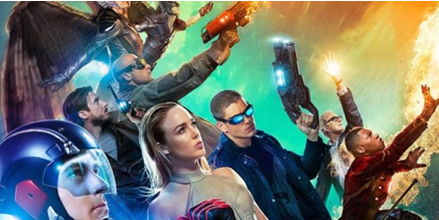
Warner Bros. also produced Supergirl (2015 to 2021) and DC’s Legends of Tomorrow (2016 to present). Easily the weakest offerings of their television line-up, DC’s Legends of Tomorrow is a direct spin-off of Arrow and The Flash, featuring characters introduced shows. However, the show is largely loud, overly complex, and suffers from even more pacing issues. Not only was the first episode a convoluted mess that rushed through its character introductions to set up the on-going narrative, every episode is a rush of plot conveniences, hammy dialogue, and poor scripting. In the first season, for instance, the team travel through various points of time and space in an effort to save the future from Vandal Savage (Casper Crump) but…if they have a time machine, why bother wasting time going back to various points to prevent him accumulating his power when they could travel back to just before his takeover and kill him then? Indeed, in the case of DC’s Legends of Tomorrow, the only stand-out characters for me were Leonard Snart/Captain Cold (Wentworth Miller) and Mick Rory/Heat Wave (Dominic Purcell), whose gruff, anti-hero ways and pre-existing partnership set them apart from the rest of the stilted, awkward group. Both actors chewed the scenery and stole the show at every opportunity, and Mick gained a decent character arc where the heroic sacrifice of his partner made him more accepting of his otherwise more naturally heroic partners.

SuperTVSupergirl.png
Supergirl was fun but a little too annoying for me.

Supergirl, however, is a horrific mess. I have times where I can be pretty pro-feminist but this show really grinds my gears. It seems as though Supergirl is incapable of conveying strong, independent female characters without making them soft, overly effeminate, or lesbians. Seriously, this show is rife with explicit lesbianism; even heterosexual female characters carry a lesbian vibe from them. This boggles my mind; Arrow, a show largely aimed more at the male demographic, doesn’t feature a load of gay males or in-your-face sexual tension between the males so why does a female-driven show feel the need to do so? Also, throughout the first season, Kara Zor-El (the titular Supergirl, portrayed by the sweet, cute, and incredibly likeable Melissa Benoist) is constantly playing second fiddle to her more famous cousin (later portrayed by Tyler Hoechlin); Supergirl is constantly having to prove herself and to live up to Superman’s legacy and constantly compared to him, and judged by how much more impressive he is. I find this quite disturbing, to be honest. Today’s society is much more female-dominated and driven than ever before; woman are in positions of power and have far more equality than ever before, yet Supergirl prefers to send the message to young girls that they will constantly be held down by those around them until they prove that they are just as good, if not better, than males. Plus…she constantly keeps fiddling with her glasses! Even when she is around people who are aware of her duel identity!

SuperTVArrowverse
One big happy family.

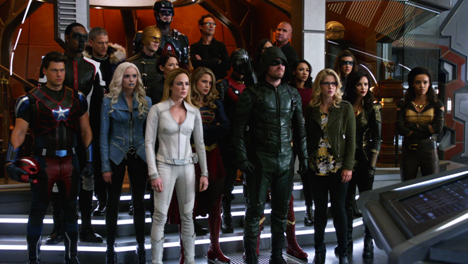
Additionally, although set on an alternative Earth, Supergirl has crossed over with The Flash (and, by extension, its other shows) by utilising the multiverse aspects introduced in season two of The Flash , unlike Marvel, whose shows all take place within the larger cinematic universe, none of Warner’s DC properties tie in, or relate in any way, to their own cinematic universe that tentatively began with Man of Steel (Snyder, 2013) and continued with Batman v. Superman: Dawn of Justice (ibid, 2016). In fact, Warner Bros. included the Flash in their upcoming cinematic line-up and, as they often have concerning Green Arrow’s inclusion, have consistently gone on record as stating that the character’s will be entirely separate from those on television. Similarly, Gotham does not serve as a prequel to Ben Affleck’s Batman; as a result, we have a situation similar to when Superman Returns (Singer, 2006) came out whilst Smallville was still on the air in that conflicting versions of the same character will co-exist at the same time onscreen. For us comic book fans, this is not a problem: comic book aficionados are well versed in handling multiple, conflicting portrayals of the same characters, but the general audience…not so much. Indeed, Warner Bros. often reference the DC multiverse when justifying this decision, which is crazy beyond belief as the DC multiverse is a concept so confusing that they’ve had to destroy and rebuild it about three times in the last five years! Surely Arrow’s popularity alone, which arguably has helped to facilitate a DC Cinematic Universe, justifies its place in the oncoming cinematic canon?

SuperTVSHIELD2.png
A bit more continuity between TV and film would be nice.

This ties back in to my early remark about Marvel’s Agents of S.H.I.E.L.D. not feeling “pointless”. Sure, the show has flaws. Sure, the characters may not reintegrate with the Marvel Cinematic Universe for some time, if at all. But events matter. What happens in a Marvel Studios movie will impact another character, and those events may often be referenced in Marvel’s Agents of S.H.I.E.L.D. When the Arrowverse collides in their crossovers, it has little impact on the big-screen offerings, which also never really factor into their television counterparts in a meaningful way. This is what separates my enjoyment of current superhero television shows: continuity. It’s important for consistency, it’s important to maintain audience (especially the generally, non-comic book audience), and it’s important for integrity. It’s why I can forgive Marvel’s Agents of S.H.I.E.L.D.’s flaws, because the show is expanding upon and a direct part of Marvel’s larger cinematic universe, and it’s why I can forgive Arrow constantly portraying “The Arrow” as a bastardised version of Batman, because it’s integrating with The Flash is the closest thing we have to continuity between DC properties at the moment. Whether or not the films will offer an equal alternative remains to be seen.