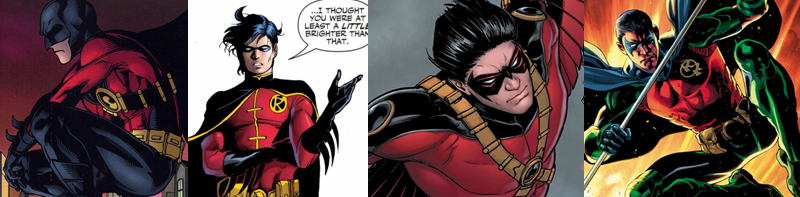
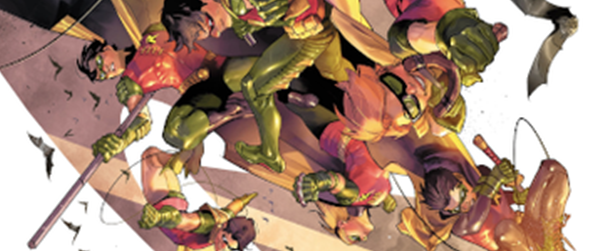
Movie Night [Robin Month]: Batman & Robin


In April of 1940, about a year after the debut of arguably their most popular character, Bruce Wayne/Batman, DC Comics debuted “the sensational find of [that year]”, Dick Grayson/Robin. Since then, Batman’s pixie-boots-wearing partner has changed outfits and a number of different characters have assumed the mantle as the Dynamic Duo of Batman and Robin have become an iconic staple of DC Comics. Considering my fondness for the character and those who assumed the mantle over the years, what better way to celebrate this dynamic debut than to dedicate an entire month to celebrating the character?


Released: 12 June 1997
Director: Joel Schumacher
Distributor: Warner Bros. Pictures
Budget: $160 million
Stars: George Clooney, Chris O’Donnell, Arnold Schwarzenegger, Uma Thurman, Alicia Silverstone, Jeep Swenson, and Michael Gough

The Plot:
Gotham City is under siege from Doctor Victor Fries/Mister Freeze (Schwarzenegger), who is intent on freezing the city in order to save his critically-ill wife, Nora (Vendela Kirsebom). At the same time, Pamela Isley/Poison Ivy (Thurman) finds herself endowed with a poison kiss and irresistible pheromones, which she uses to turn Bruce Wayne/Batman (Clooney) and Dick Grayson/Robin (O’Donnell) against each other and distract them from her plot to turn nature against humanity.

The Background:
With the release of Batman (Burton, 1989), “Batmania” swept across the world as part of Batman’s much-needed reinvention into a far darker and grittier interpretation. When the sequel, Batman Returns (ibid, 1992), upset parents and sponsors with its macabre content, Warner Bros. turned to Joel Schumacher to lighten up their live-action Bat-franchise with the often under-rated Batman Forever (Schumacher, 1995), the success of which spurred them to immediately greenlight a sequel. When Warner Bros. again shot down Schumacher’s plans for a darker, more cerebral follow-up, the director begrudgingly acquiesced to their desire for a lighter, more kid-friendly movie by leaning into the campy styling of the classic 1960s television show and comic books. With the troublesome Val Kilmer absent from the title role due to “scheduling conflicts”, the up-and-coming and popular George Clooney was picked as his replacement specifically to portray a lighter version of the character and Arnold Schwarzenegger was convinced by a hefty $25 million salary to portray the film’s primary antagonist. Thanks to the sequel’s rushed production and deadline, shooting was a chaotic time for the cast and crew, with Schumacher repeatedly urging the actors to treat the film as little more than a live-action cartoon and toy companies being heavily involved in the look and content of the film. All of this came to be reflected in the film’s dismal box office and scathing critical reception, which derailed plans for a potential follow-up. In the years since, Clooney has never been shy about voicing his disdain for the film and the late Joel Schumacher would (perhaps unfairly, due to him being under immense pressure at the time from Warner Bros. to deliver a specific interpretation of Batman) shoulder much of the blame for the film’s failings.

The Review:
Although it’s easy to pretend that Schumacher’s films are in their own bubble, that they’re not related to Tim Burton’s early, far darker efforts, Batman & Robin is clearly a sequel to Batman Forever and still in the same (loose) continuity as the Burton films. Think of these older Batman films like the James Bond franchise; some actors change, some stay the same, but there are enough references and allusions to the previous films to keep them in the same wonky timeline. For example, because Edward Nygma/The Riddler (Jim Carrey) destroyed the Batcave and the Batmobile in Batman Forever, it makes sense for there to be new toys suits and vehicles and such. The Riddler and Harvey Dent/Two-Face’s (Tommy Lee Jones) costumes can even be seen in Arkham Asylum, further tying the films together, though there’s strangely no mention of Doctor Chase Meridian (Nicole Kidman); Bruce is, instead, dating Julie Madison (Elle Macpherson) and has been for a long time. It’s a minor inclusion in the film that really serves no narrative purpose and it would have been much simpler to not have a woman on Bruce’s arm at all, to be honest.
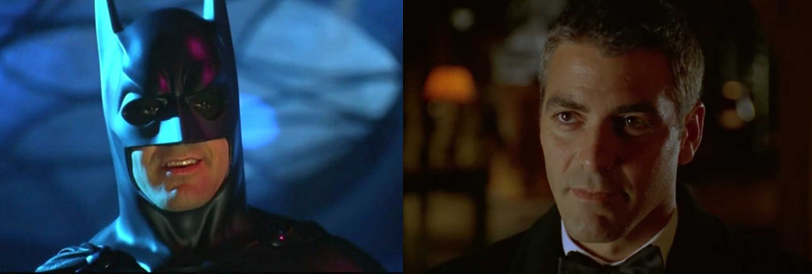
The only distinction between Clooney’s Batman and Bruce is the anatomically correct rubber suit.

Val Kilmer might not be everyone’s cup of tea in Hollywood but he was a far more fitting choice for the dual role of Batman and Bruce Wayne than Doctor Doug Ross. Clooney’s Batman can be seen as an evolution of Kilmer’s since, in Batman Forever, Bruce came to terms with his pain and grief but he’s at the extreme other end of the spectrum, basically having transformed into the Adam West Batman; he’s chatty, polite, makes numerous public appearances, and is a revered superhero through and through. Despite being the only Batman to truly have a “no kill” policy in place (and even that is debatable when you factor in the big chase sequence between Batman, Robin, and Mr. Freeze), Clooney is pretty much the worst Batman ever in a lot of ways; he lacks the physical stature of Kilmer and the raw intensity of Keaton. He’s also pretty short and uninspiring in the role, despite the work of his stunt man, and there’s no real distinction between his Bruce Wayne voice and his Batman one except that, as Batman, he’s a little more…I don’t know, professional, maybe? Either way, the lines between the two are marginal, at best, and the only thing he brings to the role is an impressive emulation of Adam West’s iconic portrayal of the character. You can really see this in all the little nuances and inflections he utilises as Batman but, what makes his portrayal stand out is the unique narrative he gets in his building tension with Dick and his emotional arc with his father-figure, Alfred Pennyworth (Gough).
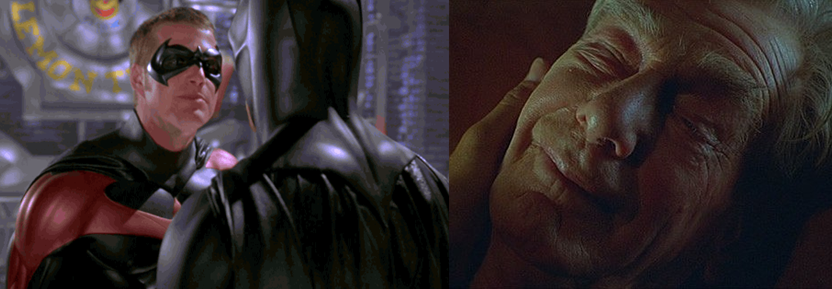
The film explores Bruce’s partnership with Dick and relationship with Alfred.

Dialogue between Bruce and Alfred reveals that Bruce doesn’t trust Dick to not get hurt and the crux of Bruce’s arc in this film; he’s afraid to trust, afraid to love, and afraid of the concept of them being a true family and partnership. He initially balks at this since he trusts Alfred but Alfred gently advise that he “shan’t be [there] forever”. He desperately tries to talk sense into Dick, whose resentment is fuelled by Poison Ivy’s influence, and his arc is about recognising the family dynamic they all have and trusting Dick to be responsible in his own way. Similar to Kilmer’s arc in Forever, though, the resolution to this is somewhat anti-climatic as Bruce is eventually able to get Dick back on side by repeating his own words about trust and family back to him in an exchange that includes a standout line (“She wants to kill you, Dick”) that never fails to get a snort of laughter out of me. Ultimately, though, there are a lot of Clooney apologists out there who will swear blind that he is capable of putting in a good performance as the character with a better script or direction; well, I would counter argue that these beliefs are based on Clooney’s abilities today; back in 1997, he was a goofy, bland choice (even he admitted that he was miscast in the role) clearly motivated by the actor’s popularity on ER (1994 to 2009) and, while his inclusion isn’t the worst part of the film, it’s certainly a significantly disruptive cog that left the franchise dead in the water and no amount of accolades or improvements in his ability can ever shake my dislike for Clooney as an actor.
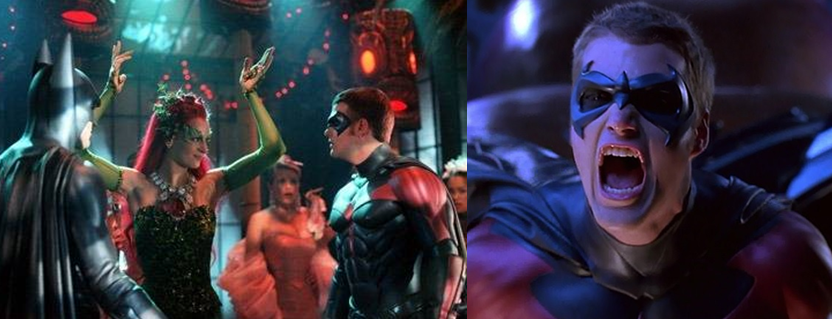
Poison Ivy’s influence exacerbates Robin’s feelings of resentment towards Batman.

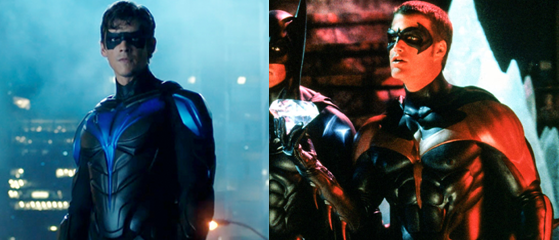
Luckily, though, Stephen Amell Chris O’Donnell returned as Dick Grayson, now portraying Nightwing in everything but name and sporting a fantastic red-themed replica of his suit and all his own gadgets and such. Far from the angst-filled biker boy of the previous film, Dick has matured into a respectable young man and hero in his own right and much of his conflict with Bruce stems from the fact that he is on the cusp of breaking away from Batman’s shadow and becoming his own man. While they work well together as partners, Batman is shown to be overly critical and condescending towards Robin, admonishing him for nearly breaking a priceless vase, leaving him to tackle Mr. Freeze’s thugs, and even reprimanding him when he comes to save him from Freeze’s ridiculous rocket ship. Ultimately, the first real signs of tension between the two come after Robin is frozen by Mr. Freeze after acting on his reckless impulses. Bruce punishes him by ordering him to spend “ten hours in the simulation training” (though it’s unclear if this is a virtual reality simulation or a real-life simulator of sorts), which frustrates Dick since he believes that he’s being unfairly punished for making a simple mistake and that Bruce doesn’t trust him. In Bruce’s defence, Bruce would mostly likely take a small mistake just as seriously and train himself to do better both to improve and as a form of punishment. Still, Poison Ivy’s subsequent influence over both of them (but especially Robin) exacerbates Robin’s feelings of resentment towards Bruce into aggression; in these heated exchanges, we see that Dick feels that Bruce is holding him back and keeping him from being all he can be and being overly protective. All he wants is Bruce trust and respect and for them to work together on equal ground but his hot-headedness, intensified by Ivy’s manipulations, brings all these deep-rooted feelings to the surface and results in a series of arguments and even the two coming to blows.
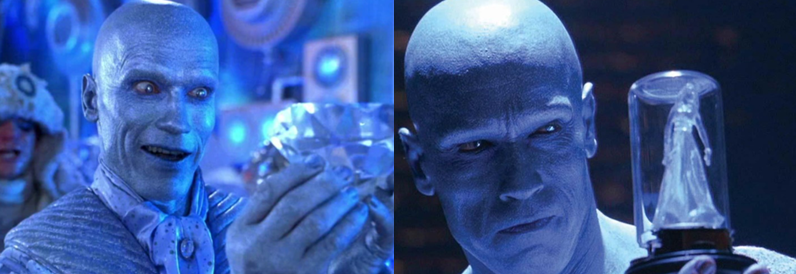
Mr. Freeze is, thematically, all over the place, switching from mania to pathos on a dime.

All of this serves as additional drama amidst the unrelenting crime spree of Mr. Freeze, a character largely more concerned with making every ice-pun in the book and revelling in destruction rather than exuding the intelligence and pathos audiences came to expect from the character after the excellent “Heart of Ice” (Timm, 1992) episode of Batman: The Animated Series (1992 to 1999). Instead, Freeze is a bombastic cartoon villain for kids and Arnold is clearly having a good time in the role but it’s difficult to believe that this man was ever a Noble Prize-winner scientist or a doting, loving husband. It’s similar to Two-Face, who was so maniacal and over the top and introduced already as a crazed supervillain so we never got a chance to see or truly appreciate the true tragedy of the character. Instead, we’re left with a Saturday morning cartoon villain garbed in fantastical intricate and well-crafted suit of armour. Still, Mr. Freeze is such a weird dichotomy of extremes; he’s this cringey supervillain, forces his minions to sing in his frozen lair, is a relatively eloquent and sophisticated man at times (especially when puffing on a big fat cigar and relating his plans to steal diamonds and hold the city to ransom with his giant freezing cannon), and also a tragic figure haunted by his past and his wife’s condition. One minute he’ll be yelling and acting like a petulant child but the next he’s weeping icy tears and pining for his cryogenically frozen wife. It’s a chaotic mess of conflicting emotions and makes any sympathy we might feel completely redundant because he’s so over the top! The film even tries to pull at the same heartstrings as “Heart of Ice” but it fails miserably even as an imitation of that ground-breaking episode, which really should have been the template for Freeze’s characterisation and motivation. Again, like in Batman Forever, the film would have worked much better if everything had been played completely straight (but especially Freeze), with only Ivy as the zany, madcap villain to allow the comedic elements to come naturally out of the straight-faced camp.
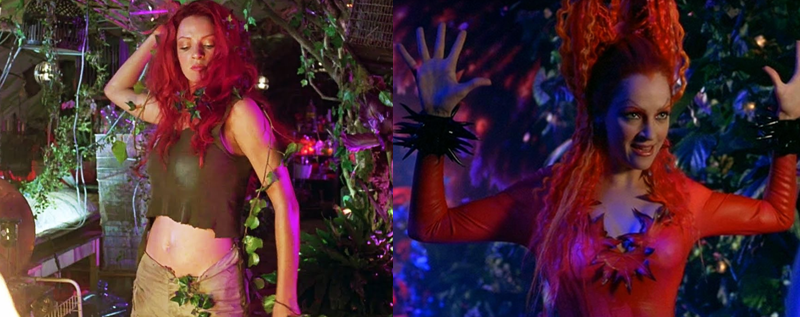
Rather than being killed by toxins, Isley becomes a sultry femme fatale with a deadly kiss.

Getting on to Poison Ivy, like the Riddler in the last film she is actually afforded an origin story and first introduced as Pamela Isley, a kooky and awkward scientist obsessed with genetically crossbreeding plants with animals so that they can fight back against the “thoughtless ravages of man”. She seals her fate when she happens upon her boss, Doctor Jason Woodrue (John Glover), using a bastardised version of her research to transform the deranged serial killer Antonio Diego (Michael Reid MacKay) into a mindless super-soldier Woodrue christens as “Bane” (Swenson). The idea that Woodrue had this whole evil lair right beneath Isley’s laboratory is ridiculous and it’s insane that she never stumbled across it until Woodrue was in the middle of showcasing his formula and auctioning Bane off to a group of terrorists and other unscrupulous individuals. Still, Woodrue’s subsequent attempt to kill Isley results in the poisons and toxins genetically altering her into Poison Ivy, a pheromone-induced supervillainess with a deadly kiss who begins a crusade against Bruce Wayne since he once funded their work. Whereas Nygma was already a bit of a nutjob before being spurned by Bruce Wayne and exposed to his “Box”, this transformation instantly alters Isley into an alluring, confident, half-crazed femme fatale who is obsessed with using her newfound abilities to manipulate men into aiding her cause to allow plants to overtake the world. Ivy’s “pheromone dust” is an effective way of stoking the tension between Batman and Robin and she’s not quite as maniacal as Freeze, Two-Face, or the Riddler but she’s still a massively over-dramatic, cartoony villain who monologues at every opportunity, cackles with glee, and even throws in an elaborate cry of “Curses!” when she’s defeated. Ivy is willing to kill millions of people to allow the planet, and plants, to thrive once more; like with Nygma, Bruce is patient and sympathetic to her cause but cannot sanction any action that causes such a death toll and, although Pamela’s presence appears to have an alluring effect on him, it’s at the auction where she, as Poison Ivy, truly begins to influence both him (as Batman) and Robin with her pheromones.
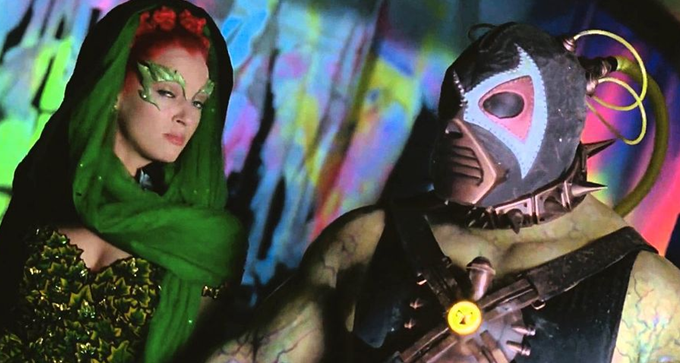
Bane, a neutered shadow of his usual self, was little more than a glorified henchman.

So smitten by her allure are they that they begin a very public, very childish bidding war for her services, resulting in one of the most cringe-worthy moments in not just a Batman movie but all of cinema…yet, in a bubble that sees this as an extension of the bright, campy sixties Batman, you can see this as a fun (as in “daft”) scene. When Mr. Freeze crashes the party, Ivy is immediately in awe of his strength, conviction, and direct approach; when her pheromones have no influence on him, she becomes even more interested in him as a potential partner and, just as Robin is infatuated by her, she comes to be enamoured with Freeze. To that end, she and Bane break Freeze out of the ridiculously elaborate Arkham Asylum (literally a gothic castle on a storm-swept island!) and, when he continually shoots down her advances, she kills off his wife out of jealousy and to sway him into an alliance to freeze first Gotham, and then the world, and have her animal/plant hybrids rule what’s left alongside them. Far from the intellectual mastermind of the comics, Bane is a hulking, mindless brute who follows Ivy’s commands simply…because (she’s never shown using her pheromones on him so it’s unclear exactly why he submits to her). As in many interpretations, Venom is both his strength and weakness, making him simultaneously superhuman but also reducing him to a quivering, helpless wreck when his tubes are severed. He exists simply because Bane was popular at the time thanks to the influential Knightfall storyline (Dixon, et al, 1993 to 1994) but could easily have been any other Bat-brute; I’m thinking Waylon Jones/Killer Croc would have been a far better fit.
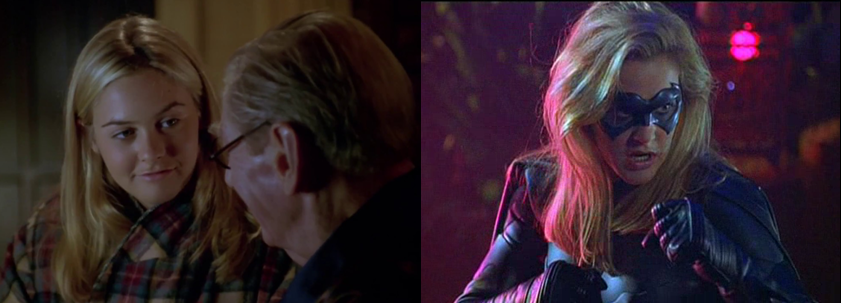
She’s not much more than eye candy but Alicia was servicable enough as Batgirl.

To help even the odds a bit, Batman & Robin brings a version of Batgirl into the fold; traditionally, it is Commissioner Jim Gordon’s daughter, Barbara Gordon, under the cape and cowl of Batgirl but, here, it’s Barbara Wilson (Alicia Silverstone), Alfred’s hitherto-unknown niece. A minor change, to be sure, but one that I’m actually onboard with since Gordon (Pat Hingle) is so inconsequential in this film and it helps to both make her slightly more relevant to the story and reveal hidden layers to Alfred’s character and backstory since he’s never mentioned her or his extended family before because of his stringent commitment to decorum. While the experience was quite harrowing, to say the least, for Silverstone, it can’t be denied that she doesn’t exactly impress with her acting chops and is easily the weakest link in the film, but she’s fantastic as eye-candy and plays the part of both flighty, innocent schoolgirl and bad girl racer well enough, Barbara’s intentions are also quite interesting in that she arrives at Wayne Manor to liberate Alfred from what she sees as a life of servitude; she initially doesn’t understand or appreciate the family dynamic Alfred has with Bruce and Dick and takes part in dangerous, illegal street races to win the money she needs to take him away from his life. Naturally, Dick is immediately attracted to her; she mostly deflects his advances and obvious flirting, preferring to focus first on racing for money and her love for Alfred and then her commitment to helping Batman and Robin as Batgirl. Essentially, Batgirl exists to sell more toys and to allow for a fight scene with Poison Ivy; Batman and Robin are never seen even throwing a punch Ivy’s way so this allows for a more “even” fight to occur between the two females.
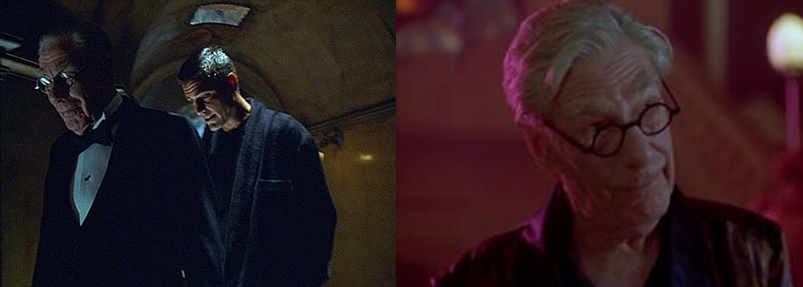
Alfred’s emotional side-plot really belongs in a better Batman movie…

Finally, there is the whole sub-plot regarding Alfred’s advancing age, illness, and mortality; although we see Alfred flinching in obvious pain and discomfort during the film’s bombastic opening, it’s only after Barbara arrives that the true extent of his illness is brought to light. This sub-plot is the true heart of the film as Bruce, Dick, and Alfred himself must come to terms with Alfred’s mortality; seriously ill, he makes preparations to have his brother takeover his duties but is unable to reach him and (similar to his actions with Dick in Batman Forever) surreptitiously puts Barbara on the path to becoming Batgirl. The film’s standout moments come in the heart-warming (and heart-breaking) exchanges between Alfred and Bruce about the merits of family and trust, with the two sharing a truly emotional scene where they profess their love and admiration for each other. It’s a fantastic side plot that really belongs in a better movie and there’s a twist, and nuance, to this side story as Bruce is haunted by flashbacks of his childhood with Alfred rather than the traumatic deaths of his parents, which is a refreshing change.

The Nitty-Gritty:
Essentially, Batman & Robin is almost beat-for-beat the same movie as Batman Forever: the score is largely unchanged; there’s a suit-up scene at the start with a cringey one-liner; a big, explosive fight with the new supervillain; a cliché villain team-up, a falling out between Bruce and Dick; and a new Bat-character is introduced, learns of their identities, before joining them for a big, climatic showdown featuring new suits and vehicles. Honestly, I actually dig the film’s costume design; the Batsuit isn’t that great but I actually like that it’s lacking any yellow colouring, Robin’s Nightwing suit is picture perfect, and Batgirl’s tight outfit is great for showing off her curves. Yes, the suits have nipples and clearly resemble rubber more than armour but I kind of get what Schumacher was going for with the design and it’s honestly not as distracting as some people make out. Frankly, if you’re spending your time fixated solely on Batman and Robin’s nipples then I think you might have a bit of a problem since there’s a lot of worse stuff in the film (the zany, madcap presentation, for example, is far worse since it’s just a hyperactive kids’ movie and little more than an expensive advertisement for a new line of Batman toys).
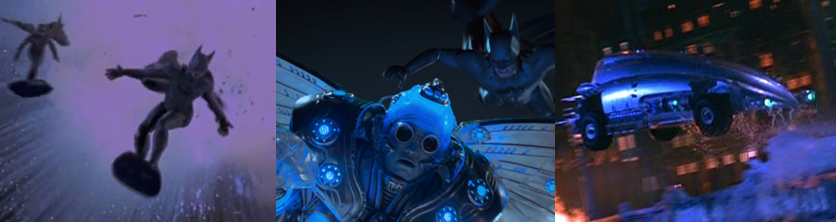
The film’s action sequences are completely cartoony and over the top!

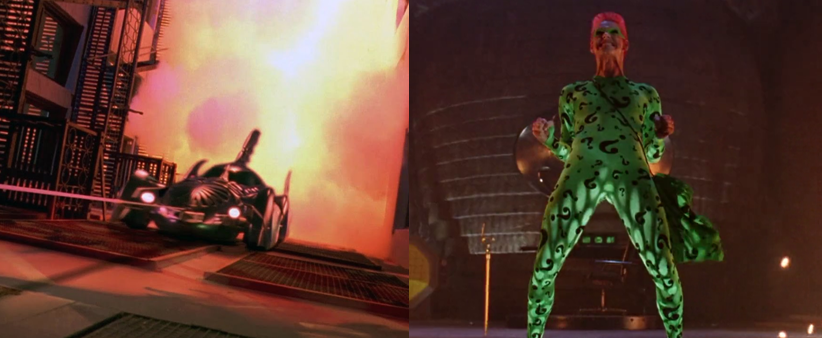
Each of the film’s action sequences is like some kind of chaotic acid trip! Take the opening sequence, for example: Batman and Robin intercept Mr. Freeze at the Gotham Museum, contending with “the hockey team from hell”, performing all manner of physics-defying stunts and tricks, and conveniently sporting ice skates in their boots! Mr. Freeze freezes a dinosaur statue to cover his escape in a rocket that fires from his absolutely ridiculous Freezemobile! Batman follows and is left to freeze to death in space before Robin rescues him and they surf through the night sky on doors of the rockets to pursue Freeze, who sprouts wings from his armour! Having said that, though, the Batmobile/Redbird chase against the Freezemobile and Mr. Freeze’s goons is pretty good but would be even better if they weren’t racing across the building, iron biceps of a gigantic statue!
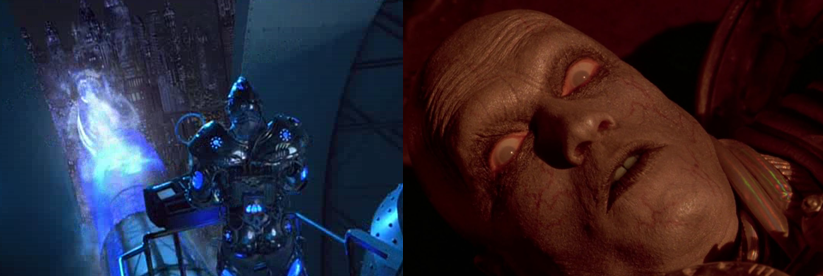
Mr. Freeze puts Gotham on ice but Batman eventually defeats him and appeals to his better nature.

However, as bombastic and over the top as Batman Forever’s finale was, Batman & Robin’s really takes the cake with Mr. Freeze using his diamond-powered gizmo to transform Bruce’s massive new telescope into a giant freezing cannon and cover the city in ice. Batman, Robin, and Batgirl race across the frozen city streets in their fancy new toys vehicles, scale the mountainous telescope, and then battle both Bane and Mr. Freeze over control of the telescope, maddeningly using satellites to…somehow…reflect sunlight from across the globe (why was satellite control even programmed into the telescope’s controls? Mr. Freeze wouldn’t have needed it for his plan and I don’t see how moving satellites would help with observing stars and planets…) to thaw out the city and put an end to Mr. Freeze’s mad designs. In the end, though, Batman takes pity on Mr. Freeze and appeals to his better nature, securing both a cure for Alfred and arranging for Freeze to continue his research at Arkham Asylum. I find it very interesting that the filmmakers utilised Mr. Freeze, of all of Batman’s rogue’s gallery, and can’t help but think that Doctor Jonathan Crane/The Scarecrow would have made for a far better villain (why is he even called “Mr. Freeze” anyway? The guy’s got a PhD! He’s underselling himself! He should be “Dr. Freeze!”). They could have consolidated Freeze and Ivy’s storylines into one villain, since both of their goals are easily adapted to suit Scarecrow, and told a far more grounded, intricate story about fear and overcoming it but that probably wouldn’t sell anywhere near as many toys now would it? While Batman doesn’t partake in any direct instances of murder in this film, Mr. Freeze is quite dark at times, declaring at one point his intention to “pull Batman’s heart from his body and watch it freeze in [his] hands” and there’s a lot of double entendre sand innuendo involving Poison Ivy that I find amusing was deemed acceptable by all those soccer moms who complained about how dark and inappropriate Burton’s films were.
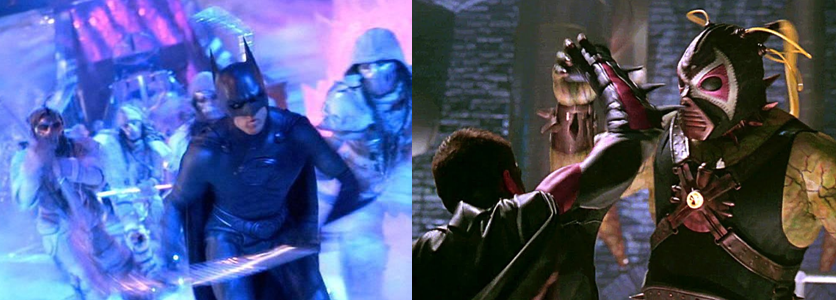
Fight scenes are often spoiled by their cartoony nature and zany sound effects.

Gotham City is more neon-drenched and outrageous than ever, filled with even more giant statues, cramped streets, ornate skyscrapers, and other impractical architecture (even Bruce Wayne’s observatory is a garish, steampunk-like construction built into a mountain!) Fight scenes, though comical, are fast and frenetic and full of unfeasible physical stunts and actions but, again, at least we’re seeing a physically capable Batman and Robin. Sadly, fights are often spoiled by their cartoony nature, which includes accompanying zany sound effects wherever possible. Gotham is populated by a garish variety of street thugs; the neon-clad gang for Batman Forever return and a variety of undesirables are present at the underground race, from Clockwork Orange (Kubrick, 1971) lookalikes to punks and biker gangs. While the public, and police, are massively dependant upon Batman and Robin, more so than ever before, and revere the two as protectors and heroes (they are called in at the first sign of trouble and even make highly publicised appearances at things like auctions and police crime scenes), these types of gangs and criminals don’t get much focus in this film. Like in Batman Forever, street criminals are no longer Batman’s focus since he’s too busy fighting supervillains as a “superhero” rather than being the scourge of criminals across the city. The implication is that criminals are afraid of Batman enough that they no longer cause violent crimes but the gang was clearly planning to rape that girl in Batman Forever and the bike race is extremely dangerous in this film so you’d think Batman would put some effort into curtailing these criminal elements but…apparently not. This is kind of why I dislike the idea of Batman as a “superhero”; his focus should always be street level and against corruption and organised crime first. Sure, supervillains exist in Gotham but I feel like they’ve overshadowed Bruce’s original mission, which was to protect others from random acts of violence like the one he witnessed as a kid; Batman & Robin is a glaring example of the extreme other end of the spectrum and I wish I could say modern Batman stories aren’t routinely obsessed with large-scale, supervillain threats to Gotham but the sad truth is that they often are. Give me a dark, gritty tale focusing on corruption, street crime, and maybe the machinations of a colourful/maniacal rogue over city/world-dominated plots any day.
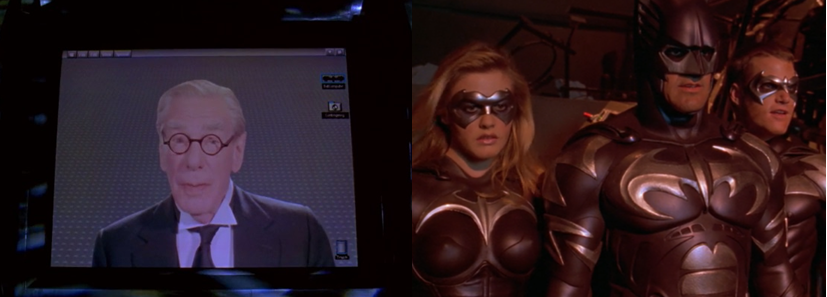
It’s clearly a product of a different time but its themes of family and trust are surprisingly poignant.

Annoyingly, the Bat-Cave still opens up and activates when there’s an intruder only now it’s even worse since a Max Headroom (Matt Frewer) version of Alfred politely greets any intruders. Though only a brief inclusion, the very idea that Alfred was somehow able to “program his brain algorithms into the Batcomputer” is both ludicrous and startling in its implications. I also love that Robin renders Ivy’s poison kiss mute with rubber lips when, arguably, it’s the saliva from her kiss that is venomous rather than just skin-on-skin contact but, to be fair, the film does present it as this latter way rather than the former so I guess it’s okay…? Finally, Batman is far more accepting of Barbara as Batgirl than he was of Dick as Robin, potentially because they are heading into the cartoony finale of the film so there’s no real time to focus on his reaction to her dynamite debut, instead accepting it right away and with a couple of one-liners. If I’m Robin, I’d be a bit annoyed at this since Barbara has far less training and experience and is something of a liability for all her enthusiasm (she clearly flounders in her fight with Ivy before winning with ridiculous ease because the script says she must). Still, she takes to her new role amazingly well and is easily able to use all of her suit’s gadgets, and to hold her own in fights against Poison Ivy and Bane. She then shows the unique talent she brings to the role in her computer skills, though I find it hard to believe that Batman, of all people, wouldn’t be able to handle such a task. The scene, however, is framed in a way to show Batman accepting of the help of others and the two of them as his partners and family.
The Summary:
As a kid, I remember seeing this film at the cinema and absolutely loving it; I was firmly of the belief that the Batman movies just got better and better with each new film, adding more and more characters, villains, and recognisable elements from the comics I so enjoyed. I watched all the live-action films, the sixties movie, and was reading Batman stories from the sixties to nineties at the time and never had any trouble distinguishing between them. It was just Batman in different forms, and I was excited to see more of him, especially with Robin by his side. As an adult, it’s much harder to excuse the film since it’s a far cry from the dark, brooding Batman that is generally favoured but, when you view it as a love letter to the sixties Batman television series and bright, campy comics of that same era, you can kind of excuse a lot of its more glaring faults. It’s supposed to be a fun, mindless kids’ film; a live-action cartoon intended to sell toys and reap the rewards of its many and varied merchandise opportunities. It’s far from the guilty pleasure that Batman Forever is and it’s not the Batman I would prefer to see and I don’t like to hate on it because, for all its faults, at least it had the balls to use Robin and to tell an interesting story with both him trying to become his own man and hero and the side plot involving Bruce and Alfred.

My Rating:

Rating: 1 out of 5.

Terrible

Whew, well, that’s Batman & Robin, a divisive film, to say the least. What is your opinion on the film, its cast, and Schumacher’s unique direction for the character and franchise? Do you think George Clooney was a poor choice for Batman or do you also believe he could do the role justice with a different script? What did you think of the film’s portrayal of Mr. Freeze, interpretation of Batgirl, and Robin’s character arc? Would you have liked to see another Batman film under Schumacher’s direction? Whatever your thoughts, good, bad, or indifferent, please feel free to leave a comment below and come back next Tuesday for the last entry in Robin Month.

Movie Night [Robin Month]: Batman Forever


In April of 1940, about a year after the debut of arguably their most popular character, Bruce Wayne/Batman, DC Comics debuted “the sensational find of [that year]”, Dick Grayson/Robin. Since then, Batman’s pixie-boots-wearing partner has changed outfits and a number of different characters have assumed the mantle as the Dynamic Duo of Batman and Robin have become an iconic staple of DC Comics. Considering my fondness for the character and those who assumed the mantle over the years, what better way to celebrate this dynamic debut than to dedicate an entire month to celebrating the character?


Released: 9 June 1995
Director: Joel Schumacher
Distributor: Warner Bros. Pictures
Budget: $100 million
Stars: Val Kilmer, Tommy Lee Jones, Jim Carrey, Nicole Kidman, Chris O’Donnell, Michael Gough, and Pat Hingle

The Plot:
As Gotham City is terrorised by former district attorney turned acid-scarred supervillain Harvey Dent/Two-Face (Lee Jones) and Edward Nygma/The Riddler (Carrey), Bruce Wayne/Batman (Kilmer) struggles with his life’s mission and to discourage Dick Grayson (O’Donnell) from following the same dark path.

The Background:
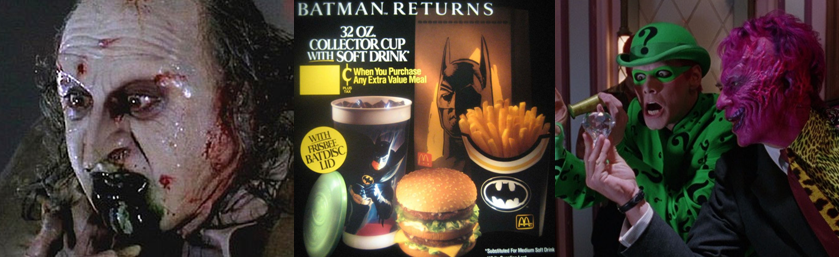
Batman (Burton, 1989) was a massively successful adaptation of the DC Comics character, whose popularity had been somewhat waning and was in the midst of a dark, gritty reinvention. Although director Tim Burton was initially not interested (to say the least) in returning for a sequel, he was persuaded when Warner Bros. afforded him substantial creative control over the film’s production. However, while Batman Returns (ibid, 1992) brought in over $280 million in worldwide revenue against a $65 to 80 million budget, the film was criticised for its far darker presentation. While the film enjoyed mostly positive reviews, Warner Bros. were dissatisfied with its box office compared to the first film, parents were outraged by the film’s dark, macabre content, and McDonald’s were equally upset at being associated with such a gruesome movie. In response to this, Warner Bros. made the decision to replace Burton with a new director, eventually settling on the late Joel Schumacher, while keeping Burton on in a token producer role.

Returns‘ more ghastly aspects frightened investors, leading to a more light-hearted Bat-romp.

Although Schumacher initially wanted to produce an adaptation of Batman: Year One (Miller, et al, 1987), Warner Bros’ weren’t too keen on this idea and pushed, instead, for a more light-hearted affair that would sell toys and be more akin to the popular Batman television show of the sixties. This approach held little appeal for Michael Keaton, the star of the previous two Batman movies, and the role was recast with the notoriously-difficult, but far more physically-imposing, Val Kilmer assuming the mantle. Despite the wildly different tone of the film, Batman Forever contained a number of allusions, call-backs, and references to the previous films to set it in roughly the same continuity (save for recasting Harvey Dent from smooth-talking Billy Dee Williams to the maniacal Tommy Lee Jones). Warner Bros’ new approach appeared to be successful, with the film making over $330 million at the box office and pleasing parents and corporate sponsors, though the film garnered a somewhat divided critical reception. Much has been made of Schumacher’s aesthetic choices and direction, though the film but has earned a cult following compared to its grandiose sequel, with many calling for the release of an extended version to restore many of the excised scenes that added a darker subtext and scenes to the film.

The Review:
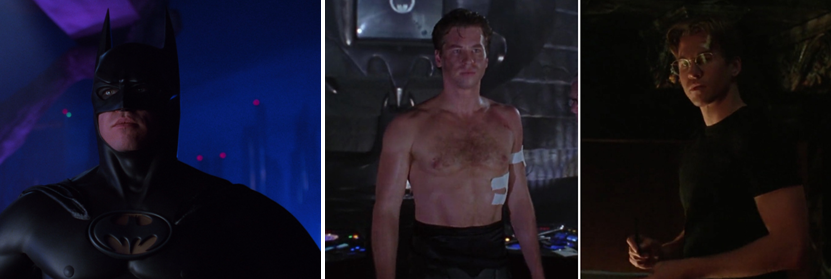
Right from the moment Batman Forever begins, you can tell it’s a very different film to its predecessors; gone is Danny Elfman’s iconic theme, the Gothic, enclosed sets, and the vast majority of the cast, replaced by an admittedly heroic and boisterous (if a bit over-played) score, a vast, near-incomprehensible Gotham City filled with neon, towering skyscrapers, and impractical architecture, a host of new faces, and, of course, a whole load of new toys. First, there’s the new Batsuit; though no longer as armour-plated as the Burton-era suits, this suit seems much more form-fitting and famously included nipples to give it a more anatomically-correct look. Unlike in the previous films, where Keaton was forced to be very stiff and was heavily restricted by this suit, Kilmer (and his stunt and fight double) move much more freely. He’s still not able to move his head, sure, but he’s far more agile and capable in his fight scenes, delivering easily the best live-action Batman fights at that point in time. With a new suit comes new gadgets, a new Batcave, and a new Batmobile, all of which are far more stylised and elaborate than in Burton’s movies and are introduced in a pretty cool “suiting up” scene during the opening credits. However, as much as I defend this movie, I do feel this scene is tarnished a bit by that cringey “I’ll get drive thru” line which, while amusing and I’m sure made McDonald’s happy, is a bit out of place. A simple “Don’t wait up” would have sufficed.

Kilmer was a pretty decent, physically imposing Batman and haunted Bruce Wayne.

I haven’t had much exposure to Val Kilmer in my life but, as much as I love Keaton’s intensity and the dark edge he brought to the role, Kilmer is actually pretty good as Batman. In Batman Returns, we saw that Gotham City was starting to become acclimatised to Batman but, in Forever, he’s very much in the public spotlight as a widely celebrated “superhero”. To clarify, I feel there’s a difference between a superpowered superhero like Clark Kent/Superman and a street level vigilante like Batman or Oliver Queen/Green Arrow. They are, technically, superheroes but I feel they shouldn’t be publically celebrated or acknowledged in-world like a Superman; in these Batman movies, though, Batman is pretty much the only masked crimefighter out there and, here, we see that he openly works with Commissioner Jim Gordon (Hingle) and appears in public, when necessary. Like Keaton, Kilmer assumes a deeper, gravelly “Bat Voice” for the role that is somewhere between a growl and a whisper. He tries to emulate Keaton’s intense glare but, where he fails in that regard, he succeeds in his imposing physical stature, appearing far more physically fit for the role than the slighter, shorter Keaton. Kilmer’s Batman is also much chattier than his predecessor, sporting a dry wit and a pragmatic drollness that would be amusing if not for the film’s excessive, over-the-top and cartoonish humour elsewhere. Kilmer is also pretty decent as Bruce Wayne; he doesn’t betray much emotion but he’s both awkward and charming when interacting with Doctor Chase Meridian (Kidman), arranges for full benefits for Fred Stickley (Ed Begley Jr) and his family after his apparent suicide, and is very patient with the fanatical Nygma when they first meet.

Carrey channels Gorshin’s spirit for his zany turn as the Riddler.

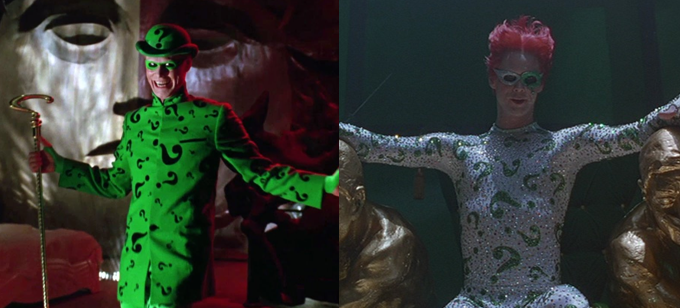
Speaking of Nygma, if you’re not a fan of Jim Carrey than a) What’s wrong with you? and b) This really isn’t the film for you. This was peak Carrey, with the actor riding a wave of well-received comedies, and he really gives it his all here, stealing every scene he’s in with a madcap, zany performance that is part Frank Gorshin and part classic Carrey. As Nygma, Carrey is a hyperactive and overly-enthusiastic employee who is completely obsessed with Bruce Wayne. Carrey brings a natural manic energy to the role, hogging the spotlight and stealing every scene he’s in with his rubber-faced antics and you really get that this guy is a fanatical individual who is infatuated with Bruce Wayne and desperate to showcase his mind-manipulating invention. This proves to be his downfall, however, as Bruce cannot in good conscience approve Nygma’s brain-altering invention, which crushes Nygma’s spirit and turns his heroic worship of Bruce into a sadistic mania. Nygma takes to sending Bruce threatening riddles (though Bruce is able to solve each one almost immediately, he spends the majority of the film completely stumped as to who sent them and what they really mean) but doesn’t descend into full-blown supervillain territory until seeing Two-Face in action. As the Riddler, Nygma is a completely unhinged maniac, teaming up with Two-Face to put his 3D “Box” in every house in the city to increase his intelligence and wealth. Amusingly, as Nygma transforms into a successful businessman and bachelor, he begins to borrow Bruce’s look and mannerisms but becomes increasingly unhinged as the Riddler, eventually setting himself up on a ridiculously elaborate island and freely partaking of the knowledge of all those connect to his Box.

For a guy who “couldn’t sanction” Carrey’s buffoonery, Jones sure does ham it up!

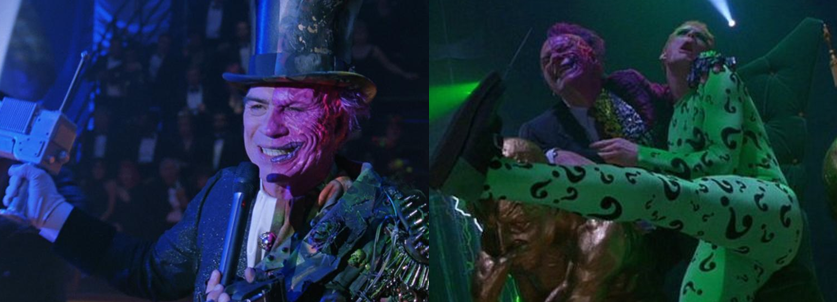
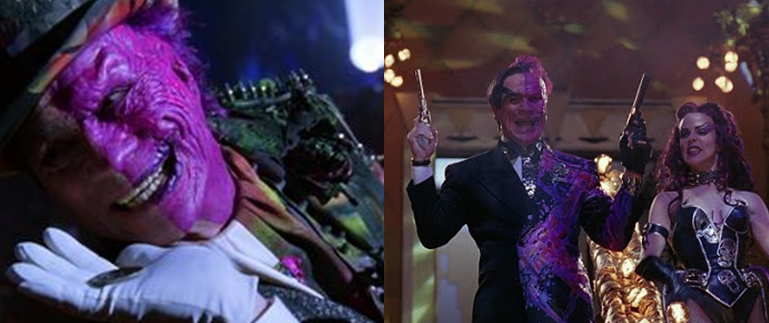
While the Riddler gets much of the film’s focus, Two-Face’s tragic origins and complex relationship with Bruce and Batman is almost completely glossed over; we’re introduced to Two-Face (annoyingly and constantly referred to as “Harvey Two-Face” for no discernable reason) after he’s already suffered his horrific scarring (here rendered in a far less disturbing manner, with a ridiculous straight line literally splitting Harvey’s face in two) and there’s only ever the briefest hint towards the character’s nuance and fall from grace. Instead, we’re left with a frenzied clown, a character far removed from the dark, tragic supervillain of the source material and more akin to the Joker, for lack of a better comparison. Ruled by his obsession with duality, his double-headed coin (which he is perfectly happy to flip over and over again until he gets the result he wants), and killing Batman (since he blames Batman for his condition), Two-Face is a ludicrous, flamboyant carton of a villain who would make Cesar Romero blush. I can only assume that it was Schumacher’s decision to make Two-Face this overexcited buffoon since Tommy Lee Jones, apparently, detested Carrey’s ostentatious antics and yet seems to be going out of his way to try and match Carrey’s far more amusing and far less grating physical humour.

Dick grows from an angry bad boy with an attitude to a selfless costumed hero.

Two-Face’s inclusion, though, allows Batman Forever to do something I will forever hold it in high regard for and that is introducing Dick Grayson/Robin. As a kid, I grew up watching the sixties Batman TV show and reading a number of different Batman comics, many of which included Robin in various forms and I remember being super excited about Robin’s inclusion here. In a fantastic example of adaptation, Robin is a combination of Dick (name/origin), Jason Todd (bad boy attitude), and Tim Drake (costume); garbed in motorcycle gear, with a piercing in his ear, he’s clearly an angst-ridden rogue who has no time for the luxury of Bruce’s lifestyle and wishes only to avenge the death of his family. Even better, the film does a great job of retelling Batman’s origin through the parallel of the deaths of Grayson’s family, which triggers Bruce’s flashbacks of his own parents’ deaths and delivers a haunting scene where, in relating the parallels between the two events to Alfred Pennyworth (Gough), Bruce slips on his wording and mutters “I killed them”, providing a glimpse into the survivor’s guilt and responsibility he feels. Bruce sympathises with Dick and takes him in; though he is angry and hungry for revenge, Dick is convinced to stay through a combination of Bruce appealing to Dick’s love for motorcycles and Alfred guilt-tripping the troubled acrobat with hospitality. Alfred plays quite the sly role this time around, offering Dick understanding and comfort but also subtly influencing his discovery of the Batcave and transformation into his own masked persona. Dick’s first instinct, though, is obviously to steal the Batmobile and take it on a joy ride; after taking his anger and pain out on some colourful street thugs, Dick directs these same emotions towards Batman when he arrives to confront him, blaming him for his family’s murder but, having vented his emotions, becomes insistent on Bruce training him to be his partner to give him the means to bring Two-Face to justice. Bruce is angered at the very idea and discourages him at every turn, not wishing Dick to go down the same path as he, much less commit murder.

Chase is the horniest psychologist you’ll ever meet. It’s fantastic!

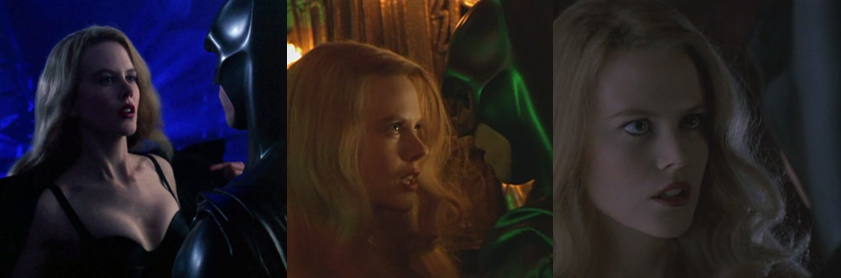
Finally, there’s Chase Meridian; Kidman is absolutely gorgeous, of course, but man is her character one horny bitch! Chase is immediately fascinated, sexually and psychological, by Batman; she, like pretty much all of the public, isn’t deterred by Batman’s appearance and is, instead, in awe of his presence and attracted to his mystery and physique and even goes so far as to use the Bat-Signal as a “beeper” to tell him things about Two-Face that he already knows and are painfully obvious and to explicitly voice her interest in Batman in her attempt to seduce him right there on the rooftop! She is overwhelmed by the sexual magnetism and allure of Batman as the “wrong kind of man” and the mystery about what drives him to do what he does but is just a enamoured by Bruce, seeing him as something of an enigma who is haunted and hiding more than he lets on. It’s not the same as her attraction to Batman, which is very primal and sexual, but it eventually grows into the more “grown up” choice on her part and she is clearly elated to find that the two are one and the same.

The Nitty-Gritty:
Batman Forever is a loud, bombastic action film; essentially, it’s a live-action cartoon, with every set and action sequence having a garish, over-the-top presentation. The film starts off, as Two-Face says, with a bang; the sequence of Batman hanging from Two-Face’s helicopter looks pretty shit but I can appreciate the blending of practical stunts, early-CGI, miniature sets, and the age of the film, to let it go and the entire set piece of Batman’s chase after him is explosive and frantic and really helps open the film with a huge amount of energy, albeit energy that screams “live-action cartoon featuring a lauded superhero” rather than a dark, broody piece about an urban vigilante. Also, people think that Schumacher’s Batman films were all light-hearted and campy and, yes, they are but while Batman isn’t as vicious or brutal as before and is much more of a “superhero” than a brooding vigilante, he still directly and indirectly causes a lot of death and destruction, including the death of Two-Face (something he specifically ordered Dick not to pursue).

There’s maybe a little too much bombastic slapstick and cartoony elements, to be sure.

Easily the star of the show, for me, is Jim Carrey as the Riddler. While I think Batman Forever would have benefitted all the more if Nygma had been the only elaborate comedic element in a film full of straight men, I am a massive fan of Carrey and his work in the nineties and the way he hogs every scene is just fabulous to me. I just love his many garish costumes, his elaborate movements, the way he emulates Bruce Wayne, and how he switches between manic energy and a sinister glee on a dime. Ultimately, neither Riddler or Two-Face are much of a physical threat to Batman and, far from the master of puzzles and conundrums of his comic counterpart, Riddler opts to force batman into making the now-cliché “choice” between the love of Bruce’s life and his crimefighting partner. Having faced his demons throughout the film and been reminded of why he became Batman, Bruce chooses to save both, reducing Nygma to a gibbering, crazed wreck in the process and finally putting to rest the demons that have haunted him all his life. Of course, it’s naïve to pretend like Batman Forever is perfect; it’s mindless entertainment for kids, to be sure, but is maybe a little too loud, bombastic, and slapstick for parents or hardcore Batman fans. There are a few narrative inconsistencies as well, such as Bruce inexplicably deciding to retire Batman and settle down with Chase. I never quite got the logic here; Bruce seems to think Batman is no longer needed but it also seems like he’s willing to give up his crusade to be with Chase since he can’t justify being Batman anymore (despite the fact that, as Dick says, “there’s monsters out there” like Two-Face and the Riddler). Then there’s the ridiculously cartoony security guard from the start of the film, the garish new Batmobile, the way in which the Batcave opens up and comes alive every time there’s an intruder, the ludicrous moment where the Batmobile drives up a wall to safety (how the hell did it get down from there?), the sheer ineffectiveness of Gotham’s police department (seriously, the cops are completely useless and call for Batman at the first sign of any trouble), and the overly cartoony sound effects that punctuate a lot of Carrey’s scenes and the fight sequences.

Two-Face is easily the weakest and most annoying part of the film.

For me, though, the weakest part of Batman Forever is clearly Two-Face; he’s just a grating, annoying villain who goes way, way over the top at every moment. He’s also an absolute idiot; he holds the circus hostage under the belief that Batman is present or that someone there knows who Batman is, which is a bit of a reach, constantly goes against his modus operandi, and ends up being tricked to his death in the simplest way possible. The only positive to his inclusion is that it fuels Dick’s need for vengeance; Bruce lectures Dick about how killing Two-Face won’t take away his pain, how he’ll end up becoming an obsessed vigilante taking his anger and pain out on countless others if he kills Two-Face, but Dick’s only wish is to kill Two-Face for what he did and it’s only in sparing Two-Face’s life that he (Dick) comes to evolve into the same selfless hero we saw him to be when he risked his life to save the circus from Two-Face’s bomb.

It’s fantastic to see Robin done in live-action and used as a thematic parallel to Batman.

Make no mistake about it, this is a great film if you’re a fan of Robin and Stephen Amell O’Donnell perfectly encapsulates the “mad, broody youth” vibe they were going for. After Dick forces himself into Batman’s business, Bruce is livid at Dick’s recklessness and continually attempts to talk him out of pursing the same life as him. In the end, though, with Chase in need of rescue and his motivations resolved (Bruce remembered that he promised his parents that no one would ever have to suffer like he would, that he would take his revenge upon all criminals to safeguard others no matter the cost), Batman throws on his “sonar” suit and is in the middle of choosing between his Batwing and Batboat (all new toys for kids to buy/pine for) when Dick, now Robin, arrives and the two reconcile. Personally, I love this moment; the two basically acknowledge that each other were right, that each of them has their own path, and that they have converged into one destiny. Robin even admits that he can’t promise he won’t kill Harvey but Batman accepts this, and that Dick must walk his own path, and they solidify their partnership with a firm handshake…only to immediately be separated upon reaching Nygma’s island. Regardless, I’m continually entertaining by film’s smart use of Robin as a thematic parallel to Bruce. I’d love to see this concept revisited in a new Batman movie one day; skip retelling Batman’s origin again and, instead, have a darker, more jaded Batman begin to stray from his path but be brought back from the brink by adopting Dick, whose origin can be used as a direct analogy for Batman’s. Sadly, it doesn’t look like we’ll be seeing that in a film any time soon but Titans (2018 to present) has done a really good job, in my opinion, of exploring similar ground with an even better version of Dick/Robin and taking that to its logical conclusion (the debut of Nightwing).

The Summary:
Batman Forever is a hugely entertaining kids’ movie which has a lot of potential that is sadly squandered by its execution. A lot of time is spent exploring Bruce’s psyche and motivations; not as much as was originally intended but far more than we had seen in live-action up until that point. The film suggests that Bruce has become so lost, so blinded by his pain, anger, and guilt, that he’s forgotten why he became Batman in the first place (to protect the innocent) and is, instead, lashing out at criminals out of habit. Dick is expertly used as a parallel to Bruce’s life and background; his anger is raw and in need of guidance. Bruce was guided by the bat he encountered as a child but Dick simply wants to kill Two-Face and has no clear focus beyond that. Bruce knows first-hand that killing the man responsible won’t bring Dick the peace or closure he so desperately seeks and that he’ll end up exactly like him, “Running out into the night to find another face. And another. And another!” It’s not massively dwelled upon but the film suggests that Bruce can use his experience to guide Dick in such a way to focus his rage and pain in a more productive way, one that sees him walk the same path but not so tainted by darkness and heartache. This turns out to be the case as Dick refuses to kill Two-Face, turning away from becoming a mindless killer and towards being an agent of true justice, which is something Bruce also learns to do through his relationship with Dick and Chase, which finally sets him towards a more productive path. Sadly, though, the film’s themes and explorations are hampered somewhat by the madcap nature of Schumacher’s world; thanks to several subtle references, this is clearly the same world as Burton’s Batman movies but much bigger, grander, and more…operatic. Gotham City is awash in garish neon and giant, impractical statues and skyscrapers and the film has a manic energy thanks not only to Carrey’s scene-stealing antics but the infantile characterisation of Two-Face and his goons. Cartoonish sound effects permeate many of the film’s action sequences and I can’t help but think the film would have been more appealing if everyone played it entirely straight except for Carrey. Clearly, Schumacher is leaning heavily towards the sixties television show, which is fine since that is a classic in every way and a guilty pleasure, but what made that show work was that everyone played it straight, which only served to make the ridiculousness more entertaining. Here, it’s ridiculous for the sake of being ridiculous so when there are moments or genuine humour (mainly from Batman and Alfred and Carrey’s less zany moments) they get drowned out by the overabundance of cartoonyness and Tommy Lee Jones’ grating performance as Two-Face.

My Rating:

Rating: 4 out of 5.

Great Stuff

What are your thoughts on Batman Forever? Where does it rank against the other Batman movies of its era, or even now? What did you think of the cast, particularly Kilmer, Carrey, and Jones? Were you excited to see Robin brought into the franchise or do you prefer Batman to “work alone”? What did you think of Schumacher’s version of Batman, his world, and his rogues? Would you like to see an extended cut of the film or do you think it’s best left as it is? Whatever your thoughts, go ahead and drop a comment below and be sure to come back next Tuesday for my review of the much-maligned sequel!

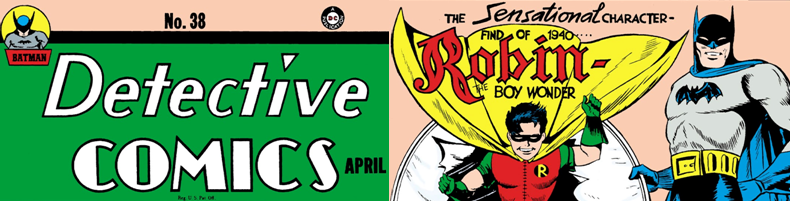
Back Issues [Robin Month]: Detective Comics #38


In April of 1940, about a year after the debut of arguably their most popular character, Bruce Wayne/Batman, DC Comics debuted “the sensational find of [that year]”, Dick Grayson/Robin. Since then, Batman’s pixie-boots-wearing partner has changed outfits and a number of different characters have assumed the mantle as the Dynamic Duo of Batman and Robin have become an iconic staple of DC Comics. Considering my fondness for the character and those who assumed the mantle over the years, what better way to celebrate this dynamic debut than to dedicate an entire month to celebrating the character?


Story Title: Technically untitled but presented as: “The Batman Presents The Sensational Character Find of 1940…. Robin – The Boy Wonder”
Published: April 1940
Writer: Bill Finger
Artists: Bob Kane and Jerry Robinson

The Background:
Since his debut in Detective Comics #27 in 1939, Batman had become a popular staple of DC Comics; the masked crimefighter began as a mysterious individual and, over time, acquired many of the supporting characters and gadgets that would become synonymous with the character thanks, largely, to the understated influence of writer Bill Finger, who greatly expanded upon many of the ideas of artist Bob Kane. However, to make Batman more accessible to younger readers and to give him someone to talk to rather than simply relying on monologues or thought balloons, Kane, Finger, and fellow creator Jerry Robinson came up with the concept of introducing a kid sidekick for Batman. With the character’s look inspired by illustrations of Robin Hood, the appropriately-named Robin not only significantly altered Batman’s dynamic and portrayal, casting him as a less darker and violent vigilante and more as a Sherlock Holmes-type father figure, but also dramatically increased sales and interest in the character upon his debut.

The Review:
The issue kicks off right away by introducing us to the Flying Graysons, John, Mary, and their young son Richard (or “Dick” as he prefers…feel free to make jokes in the comments), a family of trapeze artists for Haly’s Circus who regularly wow the crowd with their high-flying antics, particularly their “death-defying […] triple spin”. One night, whilst backstage, Dick overhears a couple of criminals threatening the owner of the circus, Mr. Haly, who balks at their attempts to force him to pay them protection money, though they promise him that “accidents will happen”. The next night, right as John and Mary are performing their headline act, their trapeze ropes snap in mid-air and they plummet to their deaths off panel but right before Dick’s very eyes!

The Batman finds a kindred spirit in Dick, who is only too eager to join his crimefighting cause.

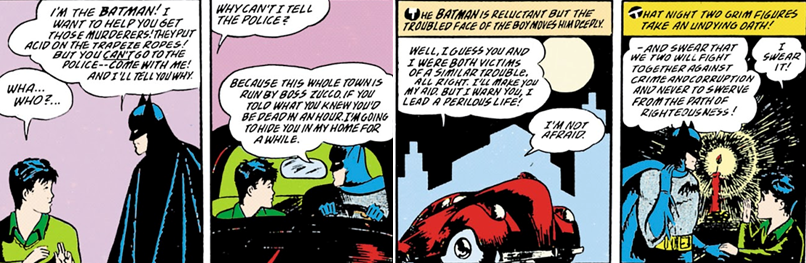
After being briefly comforted by Bruce Wayne, who was in attendance that same night, Dick overhears the gangsters confess to causing the accident, which is enough to both scare Haly into paying them protection money and to convince Dick to go to the police. However, he is stopped by the timely arrival of the Batman, Gotham’s legendary vigilante, who takes Robin with him in order to spare him from reprisals since the entire town is run by mob boss Tony Zucco and ratting out Zucco’s men would surely mean death for Dick. Batman shares with Dick a truncated version of his own childhood trauma and Dick immediately volunteers to join his cause. Though Batman warns him of the dangers of his vigilante life, Dick is unafraid and, with what now appears to be very little convincing, Batman swears Dick to an undying oath to dedicate himself to the fight against crime and corruption.

Dick excels at his training and is soon out on the streets gathering information on Zucco.

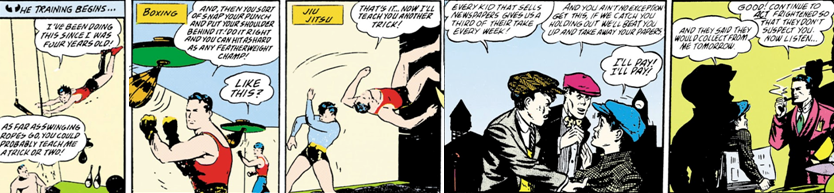
Having revealed his true identity to Dick (off panel, of course), Bruce begins training the boy for his new life; thanks to his circus background, Dick excels at rope swinging and takes to his training in the likes of boxing and “jiu jitsu” with an eagerness and talent over a period of many months. Finally, Dick is ready to play a part in Bruce’s crusade and, for his first assignment, Bruce has Dick impersonate a grubby-faced newsboy in order to attract the attention of Zucco’s thugs and track them back to their lair. With the information provided to him by Dick, Batman is able to intercept and disrupt Zucco’s operation, taking out his thugs across town and smashing up the mob boss’s gambling house. Each time, he tells his prey to give Zucco one simple message (“The Batman”) and dispatches Zucco’s cohorts with both ease and a snappy wit. Batman then delivers a threatening note to Zucco, who is so wound up by Batman’s antics that he falls completely for Batman’s bait and heads to the Canin Building (along with a number of his goons) to personally put an end to the Batman’s interference. However, instead of the Batman, Zucco and his minions are targeted by Dick in his new costumed guise of Robin.

Overexuberance puts Robin in danger but it’s nothing a little murder can’t solve…

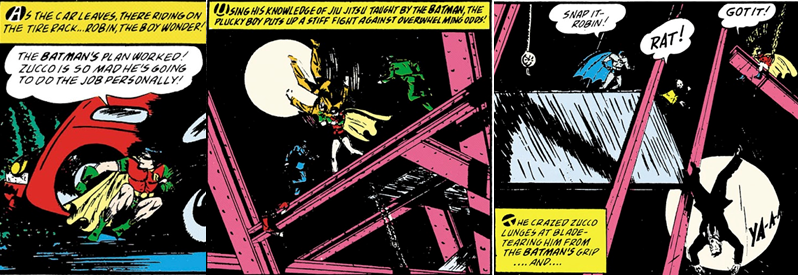
Striking fast and hard, Robin tackles one of Zucco’s men, causes another to (apparently) fall to his death by throwing a stone at his head, and handily takes out the rest using his speed, acrobatics, and the element of both surprise and misdirection. However, perhaps because of his youthful exuberance (Dick is clearly relishing the chance to beat up some thugs), Robin slips on a girder and is left dangling hundreds of feet in the air at the mercy of one of Zucco’s men. Fortunately, Dick’s circus training pays off and he is able to twist himself around to send the gunman falling to his death and Batman arrives to take out Zucco before he can get a shot at the Boy Wonder. Batman than threatens Zucco’s remaining henchman, Blade, into signing a confession (…he just happened to have this on him, presumably in his utility belt) about their involvement the deaths of the Graysons and willingly allows Zucco to send Blade falling to his death in order to capture evidence of Zucco killing a man. Batman then assures Zucco that both the confession and the picture will be enough to see him tried and sentenced to summary execution and, having orchestrated events so that Dick could avenge the deaths of his parents, returns to Wayne Manor with Dick to await their next “corker” of an adventure.

The Summary:
Okay, so, maybe Batman didn’t immediately turn into a child-friendly character all at once. Indeed, if you judge this story by most modern metrics of the character and his much-lauded “no kill rule”, you might be surprised to see Batman being so complicit and stoic about things such as mobsters being tossed off a building by a young boy. Of course, you can make the argument that Batman technically doesn’t murder anyone in this story; instead, he orchestrates events so that others do the dirty work for him but it’s quite astounding to see Dick go from a fun-loving, carefree young circus acrobat to a masked killer in just a few months.

Robin revels in the opportunity to fight at Batman’s side.

Of course, the entire point of this story is to introduce and sell us on the idea of Batman adopting (in the literal sense rather than the legal one) a young sidekick; Robin’s origin is a thematic parallel to Batman’s, having witnessed his parents’ deaths at the hands of criminals, but he’s a much different character to Bruce. He’s younger, obviously, faster and far more agile and, thanks to his circus background, takes to his new vocation with vigour and enthusiasm. Though he takes a vow to commit himself to justice, for Dick, being a crimefighter is a thrill and a privilege and, clearly, the entire point of the character is to exist as a form of wish fulfilment for all youngsters out there who wish they could swing through the city and fight thugs alongside the Caped Crusader.

My Rating:

Rating: 4 out of 5.

Great Stuff

What did you think about Robin’s sensational debut? What do you think about the idea of Batman having a kid sidekick? Do you prefer Batman to work alone or do you like the dynamic he has with his colourful partners? What are your thoughts on comics characters brazenly killing or willingly allowing children to be involved in such a violent life? Which of the Robins is your favourite, or least favourite, and why? How are you celebrating the debut of Robin this year? Whatever you think, feel free to leave a comment about Robin below and pop back next week for the next instalment of Robin Month.
Back Issues: Ranking Robins

BackIssues

Call me crazy, but I have a real fondness for the character of Robin. It really irks me when people (especially movie directors) rag on Batman’s colourful sidekick; debuting in 1940, about a year after Batman’s momentous first appearance, Robin has been an essential staple of Batman’s world for over eighty years so to suggest that he’s somehow “unsuitable” is, in my opinion, laughable. Over the years, numerous individuals have taken up the red tunic and green tights, some with more success than others. Yet, the iconic imagery evoked by the term “Batman and Robin” cannot be denied and, when talking about Robin, one of the first questions anyone will ask is: Who was the best Robin? So, with that in mind, I figured I’d do my own ranking and shine a bit of spotlight on this under-rated and criminally under-represented (in movies, at least) character.

RobinsElseworlds
8 Elseworlds Robins

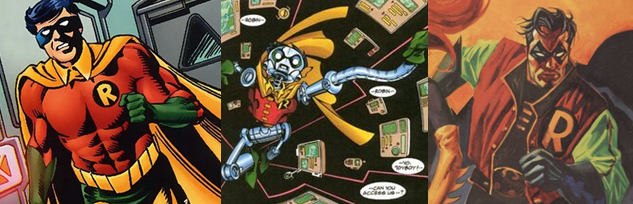
Over the years, there have been many different interpretations of Batman’s kid sidekick in DC’s Elseworlds titles and in out of continuity stories that have since been rendered non-canon. Perhaps two of the most famous are the Dick Grayson of Earth-Two, who never grew out of the role and instead continued to fight crime in a garish Robin outfit into adulthood, and the “Toy Wonder”, a little robotic Robin who assisted the mysterious Batman of the DC One Million (Morrison, et al, 1998) crossover. Yet, we’ve also seen Batman’s faithful butler, Alfred Pennyworth, take on the Robin codename in Batman: Dark Allegiances (Chaykin, et al, 1996), Bruce Wayne’s son assume the role in the Superman & Batman: Generations (Byrne, et al, 1989 to 2004) series, an ape equivalent in Batman: Dark Knight Dynasty (Barr, et al, 1997), and even a story in 1955 that had a young Bruce Wayne take on the mantle during his early days of trying to learn the skills that he would eventually hone as Batman. I’m obviously lumping all of these kinds of interpretations together as, while DC may revisit and bungle the Multiverse concept more often than they have hot dinners, none of these versions of Robin have ever managed to get a footing in true DC canon and are generally regarded as being outside of mainstream continuity.

RobinsCarrie
7 Carrie Kelley

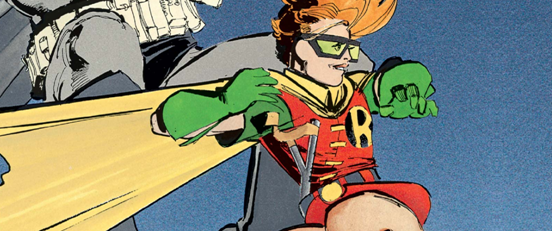
While you could make an argument that Carrie doesn’t deserve her own entry considering her introduction and most famous appearances have been in Frank Miller’s (thankfully) out of continuity Dark Knight (1986 to 2017) stories, I’d say she deserves to get her own entry on any Robin ranking simply for being the first, full-time female iteration of the character. Yet, I can’t rank Carrie much higher than this because of a few reasons: one is my obvious dislike for Miller’s Dark Knight works but, that aside, Carrie’s tenure as Robin is extremely brief. After being saved by Batman, Carrie is inspired to buy a Robin costume and fight petty thugs with a slingshot and firecrackers. Yet, despite earning Batman’s seal of approval and joining him in the resurrection of his never-ending war on crime, Carrie progressed to Catgirl and, eventually, Batwoman. She might have been a trend-setter by being the first true female Robin but it didn’t take her long to switch to a different identity and was easily one of the least prepared to assume the long-standing mantle of Batman’s partner.

RobinsWeAre
6 We Are Robin

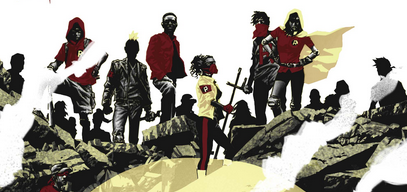
After Batman was believed to be dead at the conclusion of the “Endgame” (Snyder, et al, 2014 to 2015) storyline, a whole bunch of Gotham City’s youthful decided to take on the mantle of Robin to keep the streets safe in the Dark Knight’s absence. I actually really like the concept of teenagers of all shapes, sizes, backgrounds, and abilities taking to the streets as a vigilante force and feel this concept could have real legs in a live-action interpretation of Robin. Yet, this group is most notable for introducing Duke Thomas to the DC Universe, a character who would go on to break away from the Robin moniker and become the Signal. Unfortunately, neither Duke nor his gang of Robins can rank much higher as DC seems to have forgotten about them all in recent years; Duke eventually developed metahuman abilities and seems to have fallen out of prominence as Batman’s partner and his fellow Robins have fallen by the wayside as DC prefers to focus on the Bat Family of characters rather than this sub-team.

RobinsSteph
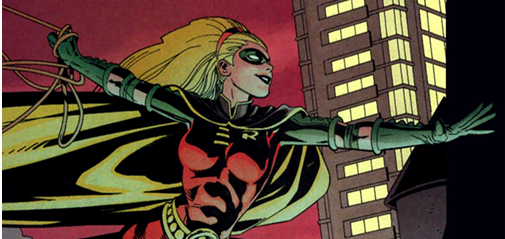
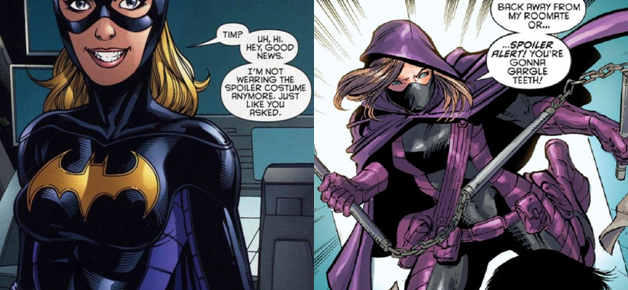
5 Stephanie Brown

Daughter of a Z-list villain and Riddler knock-off, the Cluemaster, Stephanie Brown originally fought crime as the Spoiler to foil her father’s plots. Eventually, she became associated with the Bat Family when she started dating Tim Drake, though Batman (famous for opposing vigilantes not approved by him) openly disproved of her vigilante career. Yet, Batman turned to Steph and offered her the mantle of Robin after Tim was forced to retire from the role by his father. Lacking the experience and ability of previous Robins, Steph struggled in the role and, eventually, unwittingly initiated a gang war in an attempt to earn Batman’s respect, an action that led to her being tortured by Black Mask and eventually dying from her wounds.

RobinsStephBatgirl
Steph is fine as Spoiler but she was a great Batgirl.

It later transpired that her death was faked and Steph returned to active duty as Batgirl, for a time, a role that reflected her growth and maturity as a character…until DC made the inexplicable decision to reset continuity, force Barbara Gordon back into the Bat tights, and relegate Steph back to being Spoiler. Steph’s time as Robin may have been brief but, man, did she look good in the suit and her exuberance and enthusiasm could have made for a return to the 1960’s depiction of Robin as this hyperactive, fast-talking bundle of energy. Unfortunately, Steph became Robin during one of the darkest, grittiest, and grimmest times in DC Comics and, for the longest time, her death tainted many a Bat character.

RobinsJason
4 Jason Todd

Initially portrayed as a near-identical copy of Dick Grayson, Jason Todd was eventually retconned as being a wise-talking kid from the streets who stole the tyres off the Batmobile and was a disobedient, arrogant, angry little kid who was constantly at odds with Batman during his tenure as Robin. This isn’t necessarily the case but it is the story DC likes to tell these days; flashbacks will generally always show Jason being disobedient, violent, and moody rather than being as accomplished a Robin as Dick was. Nevertheless, Jason can’t take a top three spot as he’s most famous for being beaten with a crowbar and then blown up by the Joker.

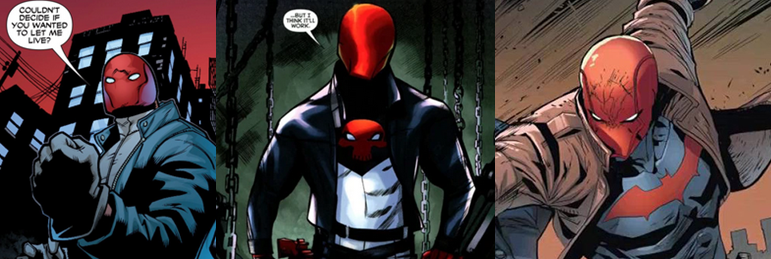
RobinsRedHood
Red Hood eventually became a full-fledged Bat buddy.

Indeed, Jason was far more popular in death, a memorial in the Batcave, and a reminder of Bruce’s greatest failure in his career as Batman, and after his return to life under the guise of the gun-toting vigilante, Red Hood. Red Hood has been everything from a sadistic antagonist to a begrudging anti-hero but is, generally, now regarded as the black sheep of the Bat Family but one who is nevertheless an essential ally of Batman’s; he even wears the Bat logo on his chest these days though, if you ask me, he should have been Hush all along.

RobinsGrayson
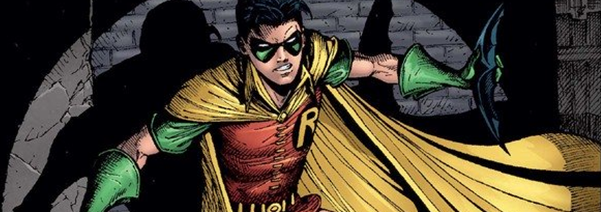
3 Dick Grayson

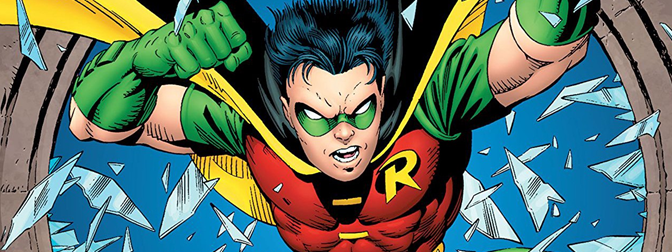
For many, Dick is the quintessential Robin; he was the first to take on the mantle, after all, and whenever you talk about Robin or see him in other media (cartoon, television shows, movies, and the like), Robin is pretty much always shown as being the alias of Dick Grayson. Yet, while Dick pioneered the role and excelled in it in every way, unlike other characters who have taken on the Robin identity, Dick successfully managed to grow out of the role and assume the identity of Nightwing. As Nightwing, Dick led the Teen Titans and defended the nearby city of Blüdhaven and, while he’s dabbled with other roles since then (including Agent 37 of Spyral and becoming Batman for an all-too-brief period), he’s far more associated with the role of Nightwing than Robin these days.

RobinsNightwing2
Nightwing forms the basis of Grayson’s growth as a character.

Even Dick himself has gone on to praise subsequent Robins for being more suitable to the role than he is and, having been Nightwing pretty consistently for over thirty years now, Dick has largely separated himself from being Batman’s “sidekick”. The fantastic Titans (2018 to present) show went in-depth into Dick Grayson’s (Brenton Thwaites) journey from Robin to Nightwing and even the diabolical Batman & Robin (Schumacher, 1997), has Dick Grayson/Robin (Chris O’Donnell) don an outfit that is visually very similar to Nightwing’s as part of his desire to establish his crimefighting career out of Batman’s (George Clooney) shadow.

RobinsDamian
2 Damian Wayne

The illegitimate son of Bruce Wayne and Talia al Ghul, daughter of the functionally immortal Ra’s al Ghul, Damian Wayne was initially considered to be a character that existed outside of mainstream DC continuity until he was officially made a part of DC canon in Batman and Son (Morrison, et al, 2006).

RobinsDamian2
Damian was a massive jerk for quite a while.

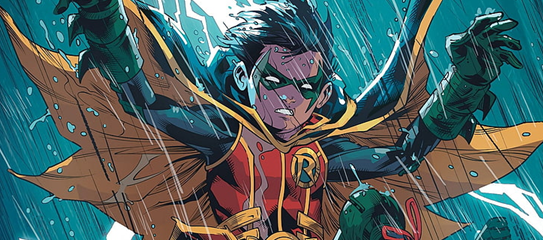
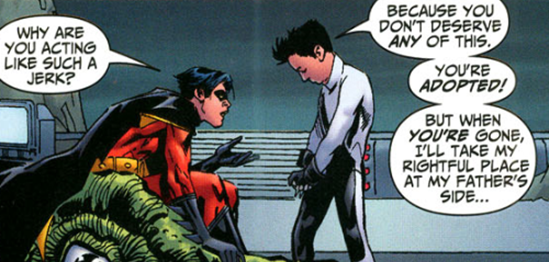
Trained from birth by the League of Assassins, Damian was initially portrayed as a bratty, violent young boy who was arrogant, rude, disrespectful, and had no compunction about killing his opponents. He believed that, as Batman’s true son, the role of Robin was rightfully his and nearly killed Tim Drake just to prove it. Eventually, though, Damian softened and earned his place in the Bat Family; after Bruce Wayne appeared to die in the awful Batman R.I.P. (ibid, 2008), Dick Grayson briefly operated as Batman and took Damian as his Robin. While this initially created an interesting reversal of the Batman and Robin dynamic (with Dick being a more light-hearted Batman and Damian as a grim and stoic Robin), Damian has since excelled in the role, having joined the Teen Titans, returned from the dead, and forged friendships with both John Kent/Superboy and others in the Bat Family.

RobinsTim
1 Tim Drake

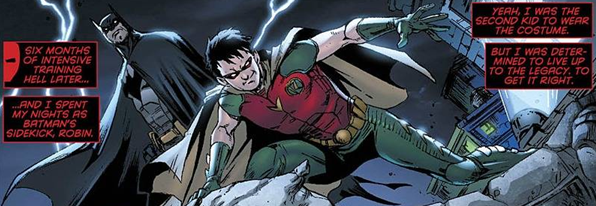
Damian may very well be on the path to being the most accomplished of all the Robins but he’s still relatively new to the role. His fighting proficiency and augmented knowledge and intelligence make him a formidable opponent but it seems as though Damian’s destiny is to one day break away from Batman’s shadow and either become Batman himself or forge a new identity. Therefore, while he has since gone on to assume the role of Red Robin and…Drake…Tim Drake is still the definitive Robin for me. Introduced some time after Jason’s death, when Batman was in a violent downward spiral, Tim wanted nothing more than to reunite Dick and Bruce as Batman and Robin and wound up assuming the mantle for himself. A keen detective and computer whiz, Tim brought something new to the role; for one thing, he was the first to ditch the short-shorts and pixie boots and wear a functional, respectable Robin costume and, for another, he was far more grounded and relatable than other Robins.

RobinsRedRobin
Tim had a lengthy career as Red Robin.

Although he never aspired to be anything other than Robin, Tim did briefly assume the mantle of Batman after Batman R.I.P. and has been shown, on multiple occasions, to eventually become a violent Batman in the future. However, Tim is probably most well-known for having taken up the identity of Red Robin; while I find the “Red” portion of this identity redundant and wish he had, like Dick, forged an entirely separate code-name, it showed that Tim still very much considered himself Robin first and foremost (except for that weird period when he inexplicably took the identity of “Drake”). Tim was also the first Robin to get his own ongoing comic book series and that he is, for all intents and purposes, probably the most successful of the full-time Robins at really making the identity his own as Batman’s sidekick, a solo hero, or as part of the Teen Titans and Young Justice.

RobinsBanner

What are your thoughts on Robin? Do you feel he’s too bright and cheerful for the normally grim and gritty Batman or is he an essential part of the Batman mythos? Who was your favourite Robin? Let me know your thoughts in the comments.