To celebrate the release of Justice League (Snyder/Whedon, 2017), DC Comics named November 18 “Justice League Day”. Setting aside all the drama surrounding that movie, this provides a perfect excuse to spotlight DC’s top superhero team, which set the standard for super teams.
Writer: Mark Waid –Artist: Howard Porter
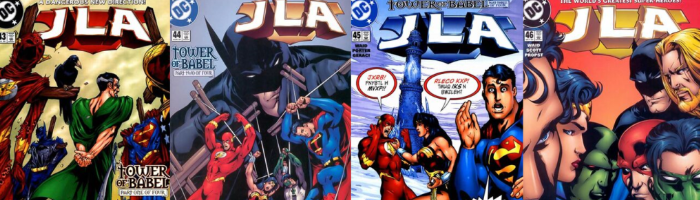
Story Title: “Tower of Babel, Part 1: Survival of the Fittest” Published: July 2000
Story Title: “Tower of Babel, Part 2: Seven Little Indians” Published: August 2000
Story Title: “Tower of Babel, Part 3: Protected by the Cold” Published: September 2000
Story Title: “Tower of Babel, Part 4: Harsh Words” Published: October 2000
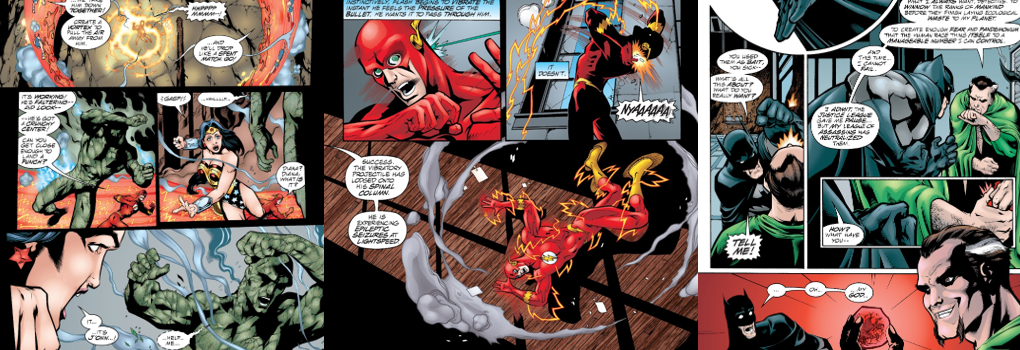
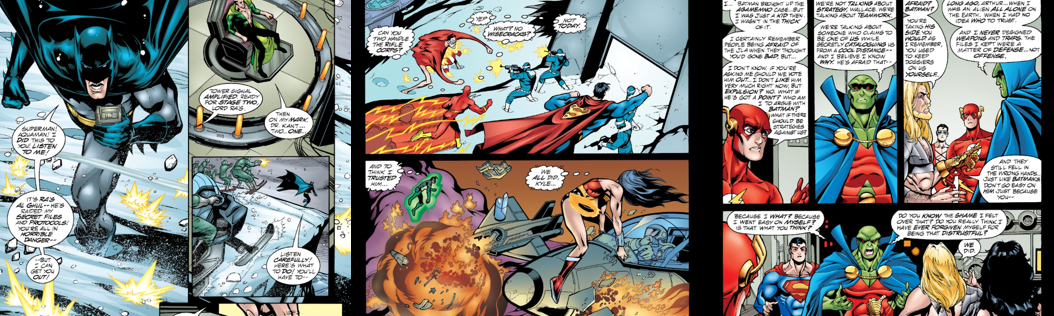
The Review: Although I grew up reading odd issues and random annuals from the 1970s and 1980s, this is the Justice League I mostly closely associate with. Superman (fresh off his brief stint as an energy being), Batman, Wonder Woman, Wally West/The Flash, Kyle Rayner/Green Lantern, Aquaman (in his best, most intimidating look), and even Patrick O’Brian/Plastic Man being included for some visual variety and laughs made for an impressive and powerful incarnation of the team. “Tower of Babel” pits this team against Rā’s al Ghūl, the “Demon’s Head” who fronts the League of Assassins and believes humanity is a danger. His anger at an aide accidentally dooming the Javan tiger to extinction only precipitates his latest plan to wipe out humankind, which begins with him playing spiteful mind games with his respected adversary, the Batman (whom he reverentially refers to as “The Detective”), by exhuming his parents. Rā’s then dispatches his daughter, Talia, to strike the Martian Manhunter with an explosive shell of strange nanites. Nearby, the Flash and Wonder Woman desperately fight a mysterious and aggressive forest fire, only to be amazed and horrified when the source turns of to be J’onn, his body engulfed in perpetual flames that the Flash extinguishes with his fantastic speed. Aquaman and Plastic Man are then attacked within the United Nations, Aquaman being gassed by a substance that makes him deathly afraid of water and Plastic Man frozen and shattered into a dozen pieces!
Batman’s horrified when Rā’s targets the JLA using his secret contingency plans!
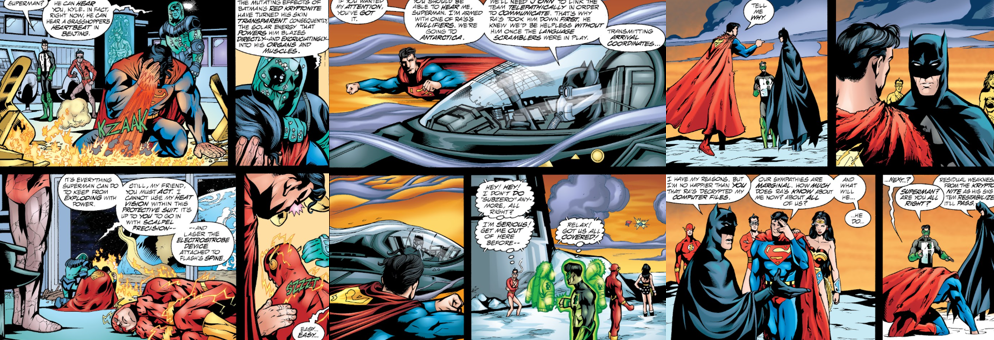
The injured or affected JLA members are brought to their Watchtower space satellite by their teammates. Superman analyses the nanites infecting the Martian Manhunter and discovers they’ve forced his body to combust in air. Crippled by fear toxin, Aquaman’s condition deteriorates as he rapidly dehydrates and, though the Flash pieces Plastic Man back together, they’re unable to restore him. Realising that the JLA is being targeted, Superman coordinates with John Henry Irons/Steel and Barbara Gordon/Oracle to keep their reserve members are safe but Batman abruptly refuses to help. After switching to Clark Kent to use his sources at the Daily Planet for a possible lead, Superman and the staff are astonished to find that all text has become incomprehensible! Superman races to curb the ensuring madness, learning from Oracle that the aphasia’s caused by ultrasound waves, which he successfully disrupts by retrofitting some Brainiac tech. Finally, Wally and Diana find Kyle woke up suddenly blind, which understandably causes the artist great distress. Although Aquaman figures out that the League of Assassins are tracking their signal devices, his warnings come too late and Diana is trapped within a never-ending battle simulation courtesy of a virtual reality chip. The Flash is also shot with a “vibrational projectile” that induces epileptic seizures at lightspeed and Kyle, directionless and berserk without his eyes, is easily subdued by a begrudging Talia. The world is plunged into chaos as the stock exchange collapses, gang wars break out, planes narrowly avoid collision, military services grind to a halt, and hospitals are rendered useless. The Batman angrily confronts Rā’s in his modern-day Tower of Babel, where Rā’s relishes the chaos and threatens offers to resurrect the Waynes using his rejuvenating Lazarus Pits.
The JLA is left aghast and traumatised by Batman’s betrayal.
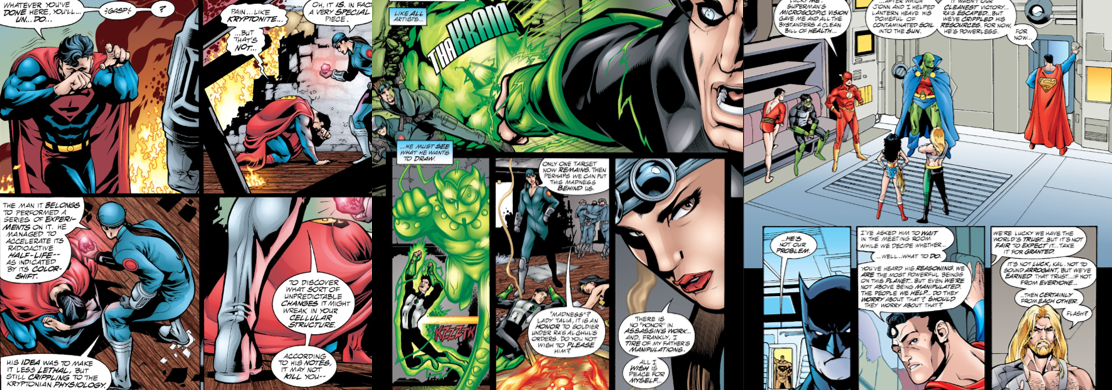
Despite clearly being tempted and overwhelmed by the proposition of being reunited with his parents, the Batman attacks in a rage but is horrified when Rā’s brandishes synthetic red kryptonite. Subdued by Rā’s’s troops, Batman fails to warn Superman who is caught completely off-guard when he arrives to help Wally, Diana, and Kyle with Martian Manhunter (wearing a special Atlantean water suit). Although Batman escapes Rā’s and Talia seems displeased at being her father’s lapdog, Superman’s crippled with agony when the rock turns his skin transparent and overloads him with solar energy. Alarmed that Rā’s has stolen his secret contingency files and turned them on his allies, Batman desperately tries to contact Aquaman with a solution, only for Rā’s to further disrupt communications. Luckily, Batman fools his pursuers with a fake death and Plastic Man finally pulls himself back together to teleport the JLA back to the Watchtower. There, Arthur is sustained by a telepathic illusion courtesy of J’onn, Plastic Man removes the chip lodged in Diana’s brain, and Superman focuses long enough to destroy the device tormenting the Flash. Finally, Diana and J’onn work with Kyle to deduce that his ring was slipped on him during sleep and that his blindness was caused by a post-hypnotic suggestion; by focusing, Kyle’s sight returns. The shellshocked JLA discuss Batman’s actions, their faith in their teammate shattered, with Superman feeling especially betrayed. Despite knowing the JLA distrust him, the Batman gathers them in Antarctica to infiltrate Rā’s’s tower, demanding the team work together to end the worldwide disruption. The battle is incredibly brief as Superman simply explodes in a burst of power, bringing the tower down and demanding an explanation from his comrade, only to be stonewalled by Batman’s stubborn nature.
Although Rā’s is stopped, the JLA are fractured by Batman’s questionable actions.
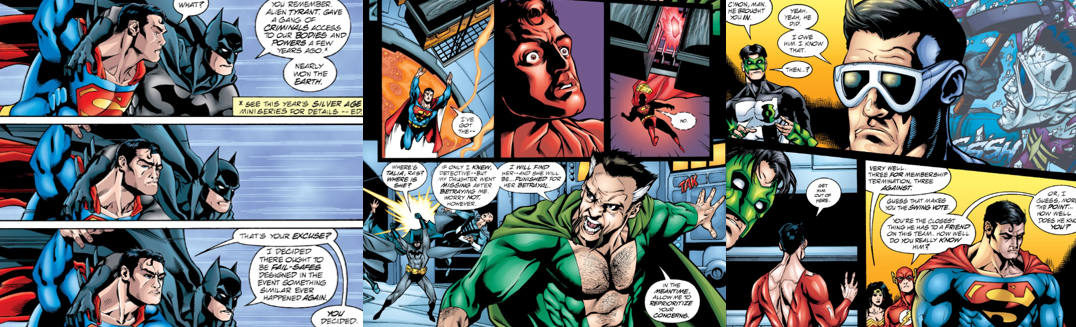
Despite the tower’s destruction, a disgruntled Talia informs the JLA that Rā’s is still a threat, leading Batman to split the fractured team up to handle each crisis. While Green Lantern, Plastic Man, the Flash, and Wonder Woman stop a chemical attack in Rhapastan, Batman explains to Superman that he created fail-safes after the alien tyrant Agameno swapped their consciousnesses with a gang of criminals. Finding little comfort in that explanation, Superman echoes Plastic Man’s uncharacteristically stoic and enraged demeanour by leading Batman through Rā’s’s stronghold. Though Rā’s prepares to retreat in frustration and Superman’s held off by the red Kryptonite, he covers his escape by dropping the Waynes’ coffins! Luckily, the restored Aquaman and Martian Manhunter pull both Superman and Batman’s parents from danger, leaving Batman free to pursue his adversary. While Rā’s escapes, his assistant, Doctor Kant, isn’t so lucky and takes the brunt of Batman and Aquaman’s retaliation, while Wonder Woman convinces Rā’s’s agent out of unleashing his chemical agent. With the danger over and the JLA back to full strength, the team debate what to do about Batman. While the Dark Knight awaits their decision, Superman questions whether they should have safeguards against their powers being manipulated. Aquaman believes the team should be based on trust, the Flash reluctantly thinks Batman has a point, and J’onn somewhat echoes this sentiment. When Arthur challenges J’onn’s loyalty to the Batman, pointing out that he once had similar dossiers, a fight almost breaks out between them, though J’onn ultimately votes in favour of Batman. While Kyle’s also not happy about what happened, he recognises that their powers are potentially dangerous and also votes to keep Batman on the team. However, while Wonder Woman agrees in principle, she refuses to fight alongside someone she can’t trust and Plastic Man coldly agrees. Although the deciding vote comes down to Superman, Batman makes the decision for them and quits the team without a word while they’re debating.
The Summary: Like I said, this was a great time to be a JLA fan. The artwork was always really good in these comics and the team gelled really well together visually and with their contrasting personalities. It’s a very nineties period for the JLA, of course, with guys like Aquaman and newcomer Kyle Rayner offering very different interpretations of classic characters. I’ve always loved this version of Aquaman, though, with the harpoon hand and dishevelled appearance. Kyle is and will always by my favourite Green Lantern and I enjoyed the dichotomy he brought to the team as he obviously felt a little out of his depth and often deferred to his superiors as a result. These are characteristics reminiscent of Wally’s early days as the Flash, which led them to eventually form a tight friendship, but much of Kyle’s characterisation at this time was proving (or at least realising) that he’s worthy to hang with the big boys. Plastic Man was something of a wild card, for sure, especially due to his goofy nature and bizarre abilities. “Tower of Babel” showed that there was more to him than just being a wise-ass, though, as he’s so traumatised by being frozen and shattered (and by the Batman’s actions) that he drops the jokes and dismissively votes against Batman. Indeed, this story shakes the foundations of the JLA as, up until this point, they’ve all fought together on the understanding that they can trust each other. I’m pretty certain they all know each other’s strengths, weaknesses, and secret identities, for example, and feel they’re more than just colleagues. Thus, when they discover that Rā’s al Ghūl’s plot is due to Batman’s secret contingency plans, the team rightfully feels betrayed and angry, with Superman noticeably upset since he knows Batman the best and has worked with him the longest.
The JLA is divided and rattled by Batman’s betrayal and questions his trustworthiness.
Thus, the main enemy in “Tower of Babel” is essentially Batman, while technically also being the group’s insecurities, and more accurately being the devious Rā’s, who disrupts them to facilitate his latest scheme. The JLA is caught completely off-guard when Talia and her troops ambush them, wielding weapons designed specifically to neutralise their powers or otherwise subdue them. While I believe Batman’s plan was always to non-fatally pacify his teammates if they go rogue or were manipulated, some of his contingencies are very questionable. J’onn, for example, bursts into flame when exposed to air, something that would be both physically and emotionally traumatic for him considering his fear and weakness to fire. Aquaman is almost killed by dehydration when fear toxin variant made him deathly afraid of water, forcing J’onn to put him at ease with a telepathic vision so he could be safely placed in water. The Flash had it pretty bad, too, forced to endure what felt like days of torturous seizures in less than half an hour, while Superman’s powers raged thanks to red kryptonite. Similarly, it seems Wonder Woman would’ve eventually been so lost in her endless combat that she would’ve perished and Kyle was extremely distressed when he was duped into making himself blind. Seems to me that Batman could’ve just as easily used virtual reality environments for all his allies for a similar end, so it’s likely Rā’s al Ghūl perverted his countermeasures. Either way, the JLA are outraged at both the experience and the betrayal, believing Batman misled them and cannot be trusted. Even if he was right, since the JLA are mind controlled every other week and have extremely dangerous powers, the characters are angry at the deception. I doubt their reaction would’ve been much better had they known about Batman’s fail-safes, but it certainly would’ve lessened the sting since they put a lot of trust in him as their strategist and smartest mind.
A classic story that deconstructs the JLA and had far-reaching consequences.
This ethical quandary hangs over “Tower of Babel”, creating tension and animosity within the group for the finale, where they can barely function as a cohesive unit and are extremely reluctant to listen to Batman. Though he’s horrified by what Rā’s al Ghūl has done, Batman offers no apology and little explanation. He believes he was right to create contingencies and won’t be swayed from the belief, kick-starting a long-tunning theme of Batman being a stubborn, paranoid, and somewhat unethical character whose efforts to prepare for every scenario alienated his nearest and dearest. Interestingly, “Tower of Babel” doesn’t suggest what Batman’s back-up plan was if he went rogue (though it’s implied to be the remaining JLA) and barely gives him a chance to counteract Rā’s al Ghūl’s actions since the Demon’s Head keeps messing with their communications. I would’ve liked to see more of the world being plunged into chaos but I think “Tower of Babel” wisely focuses on the JLA and how they’re affected by Batman’s actions. The entire point is to fracture DC’s greatest superhero team, which literally happens by the end when the Batman walks away without hearing a verdict, but has knock-on ramifications as tensions are high amongst the others. I enjoyed seeing the team struggle to decide Batman’s future since they were personally disgusted and angered by the betrayal but recognised the need for fail-safes, and also how black-and-white the decision was for Aquaman and Wonder Woman, who felt the betrayal outweighed the risk. “Tower of Babel” easily ranks as one of the top JLA stories for a reason and it’s a great deconstruction of the team and exploration of their powers, weaknesses, and the fragile ethics that hold them together. It had far-reaching consequences for all involved and is well worth a read, especially for fans of this era of DC Comics.
My Rating:
⭐⭐⭐
Rating: 3 out of 5.
Pretty Good
What did you think of “Tower of Babel”? Do you consider it a classic JLA story or do you think it’s over-rated? Which of Batman’s contingencies do you think was the worst to suffer through? Did you enjoy this incarnation of the JLA or do you prefer a different line-up? Do you think Batman was right to have contingency plans or do you agree that he crossed a line? How are you celebrating Justice League Day this year? Whatever your thoughts on the JLA, feel free to share them below, check out my other Justice League reviews, and go donate to my Ko-Fi to suggest other JLA stories for me to cover.
In the decades since his first dramatic appearance in the pages of Detective Comics, Bruce Wayne/Batman has become a mainstream, worldwide, pop culture icon. The brainchild of writer Bob Kane, Batman was brought to life by artist Bill Finger and has been a popular staple of DC Comics and countless movies, videogames, and cartoons over the years. “Batman Day” falls on September 16 this year and I figured this was a perfect excuse to spend every Saturday celebrating comic’s grim and broody vigilante.
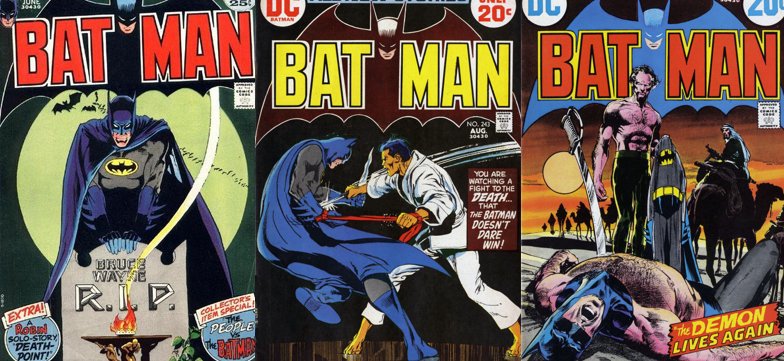
Story Title: “Bruce Wayne — Rest in Peace!” Published: June 1972 Writer: Dennis O’Neil Artist: Irv Novick and Dick Giordano
Story Title: “The Lazarus Pit!” Published: August 1972 Writer: Dennis O’Neil Artist: Neal Adams
Story Title: “The Demon Lives Again!” Published: September 1972 Writer: Dennis O’Neil Artist: Neal Adams
The Background: Following their success with Clark Kent/Superman, National Comics Publications tasked Bob Kane with creating another masked crimefighter to add to their repertoire. Thanks to the invaluable and long-suppressed talent of artist Bill Finger, the “Bat-Man” quickly became one of DC Comics’ most popular characters and a mainstream cultural icon. Over the years, the Batman defended Gotham City from many costumed supervillains, but perhaps his most captivating and intriguing villain is “The Demon’s Head”, Rā’s al Ghūl. Created by editor Julius Schwartz, writer Dennis O’Neil, and artist Neal Adams during DC Comics’ reinvention of the Batman to downplay the camp trappings of the sixties, Rā’s al Ghūl was an enigmatic criminal mastermind not unlike a James Bond villain. His expansive criminal empire, lofty goal of ending worldwide conflict by any means necessary, and international flavour made him a dark counterpart to the Dark Knight. Following his first appearance, Rā’s al Ghūl continually plagued Batman thanks to the rejuvenating properties of his “Lazarus Pits”, which were introduced in these three issues and restored him from death at the cost of his keen intellect. Rā’s was a pivotal figure in DC Comics thanks to his daughter, Talia, who birthed Batman’s volatile son, and numerous appearances outside of comics. He was excellently brought to life by the eloquent David Warner, Matthew Nable, Alexander Siddig, and Liam Neeson. These issues also inspired some of these interpretations of Rā’s, with the story and visual of the two (or a Batman proxy) battling bare-chested and/or with swords being evoked in the DC Animated Universe, Batman Begins(Nolan, 2005), and Arrow(2012 to 2020).
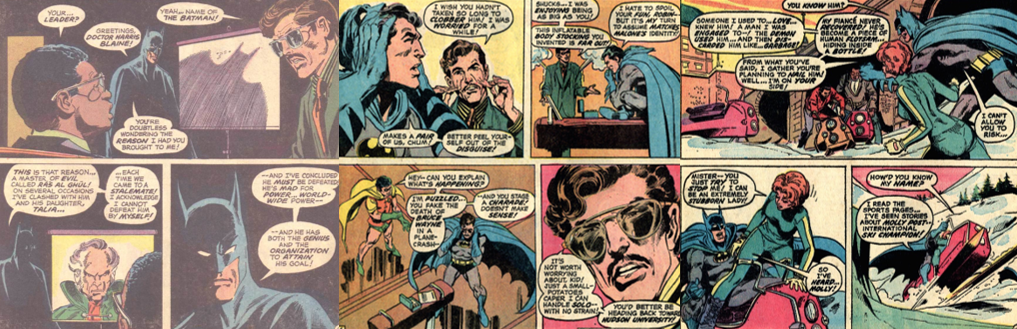
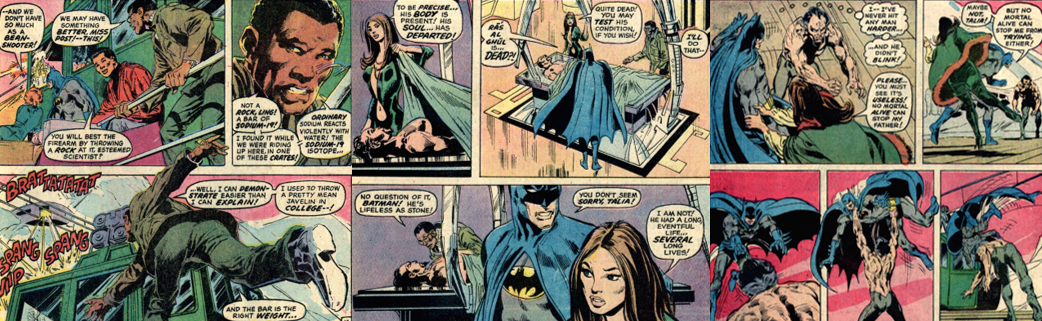
The Review: This three-part story kicks off with quite the sensational headline: “Bruce Wayne Vanishes!” In Commissioner James “Jim” Gordon’s office, the world-weary commissioner discusses the millionaire’s presumed death with the Caped Crusader, obviously oblivious that the Batman is Bruce Wayne. Both men lament Wayne’s assumed death before the Batman leaves, informing Gordon that he’ll be out of the country for some time. As the Batman swings through the city, we learn that he faked his alter ego’s death as a mysterious villain apparently knows of his dual identity and the Batman doesn’t want to risk endangering those closest to him. Begrudgingly, the Batman realises he needs help combating this threat and thus swoops into a downtown café to chat with crime boss “Matches” Malone. However, Malone sics his goons on the Batman and flees into the café’s kitchen. Cornered, Malone opens fire and apparently shoots Batman dead! Thus, the story follows Malone (whose gimmick, who may have guessed, is repeatedly lighting matches with his thumb) as he follows Doctor Harris Blaine through the Gotham Arms Hotel. When Dr. Blaine is attacked by an unknown assailant, Malone repays the favour and carries the unconscious doctor to a nearby building to meet the Batman, alive and well and grimly revealing that Rā’s al Ghūl – the seemingly immortal head of the worldwide criminal organisation the League of Assassins – has targeted Dr. Blaine due to his as-yet-unknown research. Dr. Blaine’s attacker, Lo Ling, interrupts the meeting and spontaneously reveals some of his backstory (he was saved by Rā’s and thus owes him his servitude) and that Rā’s’ daughter, Talia, disagrees with his vendetta against the Batman, all before tossing a knife right into the Dark Knight’s chest! Malone is so enraged by this that he accidentally topples over the projector Batman was using to show Dr. Blaine slides, temporarily blinding Dr. Blaine and allowing Lo Ling to vanish…along with the Batman’s corpse!
The Batman assembles a rag-tag team to track Rā’s al Ghūl to the Swiss alps.
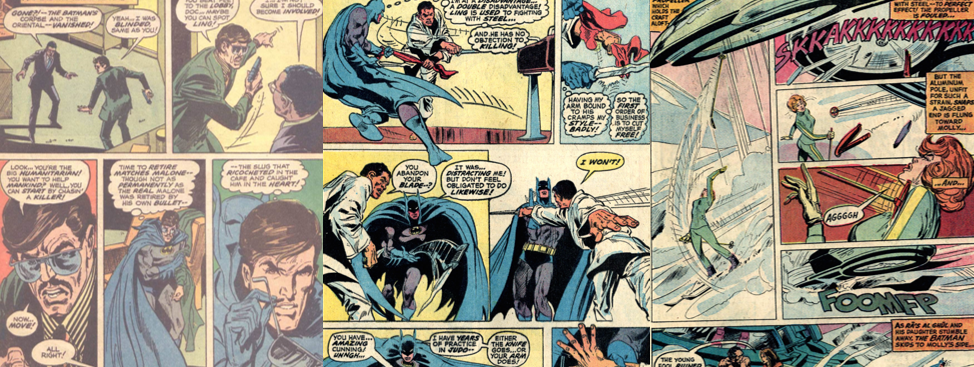
Malone orders Dr. Blaine to the lobby and then races after Lo Ling. With Dr. Blaine out of sight, Malone removes his clever disguise and reveals that he was the Batman all along, the Dark Knight assuming the mobster’s identity after he accidentally killed himself and setting up a dummy for his meeting with Dr. Blaine. Lo Ling is so shocked to see the Caped Crusader alive that he slips from the rooftop, though the Dark Knight catches him mid-fall by racing to a lower-floor window. Now owing his life to the Batman as much as Rā’s al Ghūl, Lo Ling is drafted into Batman’s crusade, though insists on fighting him in respectful combat first. This time, Dick Grayson/Robin assumes Malone’s identity as the two battle, with Batman abandoning his blade and overpowering Lo Ling with his superior judo skills and earning Lo Ling’s eternal servitude. Despite needing allies for his war with Rā’s al Ghūl, the Batman sends Robin back to Hudson University to avoid endangering the Teen Wonder and to ensure that the Batman’s legacy can continue if he falls. Dr. Blaine and Lo Ling then meet with Malone (who’s Batman in disguise, keep up!) at a private airfield and take a plane to the Swiss alps, where it’s rumoured Rā’s al Ghūl is located. Upon landing, Lo Ling randomly spots Talia al Ghūl and rushes to capture her, eager to please his new master, only to be knocked out by Talia’s hulking bodyguard, Ubu. The Batman intervenes and quickly takes the brute down, only to be blasted by international ski champion Molly Post, who misread the situation and thought Batman was attacking Talia. This allows Ubu to kick the shit out of Batman, but Talia calls him off since she’s still got the hots for the Masked Manhunter.
Although Batman and his allies find Rā’s dead, the Demon’s Head rises again, stronger than ever!
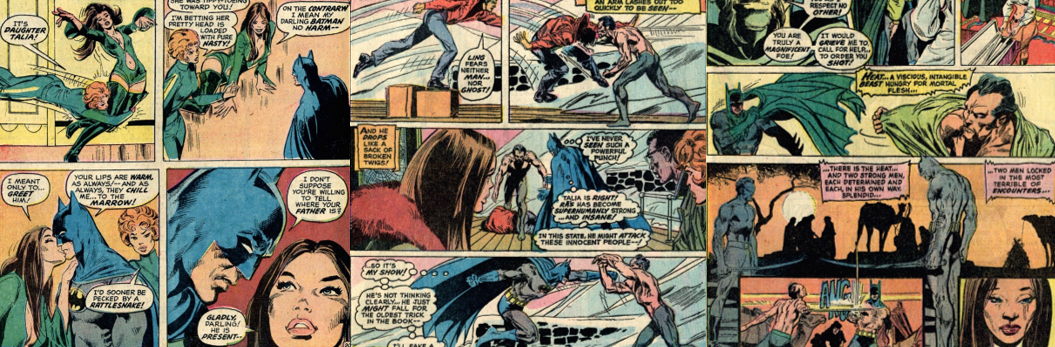
After apologising for her blunder, Molly insists on accompanying the three in hunting Rā’s al Ghūl since the Demon’s Head manipulated her fiancé so badly that he turned to alcoholism. Upon reaching Rā’s al Ghūl’s private cable car, Batman and Lo Ling KO two guards (much to Dr. Blaine’s chagrin) and have Molly and Dr. Blaine assume their identities, while Batman and Lo Ling cling to the outside of the cable car, to bypass the inept snipers. As swift as the Dark Knight and his ally are, however, the goons open fire, causing the group to be pinned down by machine gun fire from a nearby World War Two bunker that serves as Rā’s al Ghūl’s Swiss headquarters. Despite claiming to be a pacifist, Dr. Blaine resolves the situation by hurling a bar of Sodium-19 (which was being transported in the cable car) into the bunker, causing a massive explosion that the doctor is strangely confident their attackers will have survived. Eager to discover what Rā’s is planning for the Sodium-19, the Batman leads the group onwards, lamenting that he must endanger such brave and feisty lives, easily breaking into Rā’s’ stronghold and taking Ubu down with a flying kick. Although Molly tackles Talia, believe her to be a threat, Talia not only reaffirms her love for the Batman but also reveals that Rā’s is dead. Dr. Blaine confirms it by examining the body and Batman offers his condolences. Although Talia dismisses Batman’s sympathies and agrees to be arrested, the group miss that she activates a hidden switch that lowers Rā’s al Ghūl’s corpse into a bubbling, putrid green liquid – the Lazarus Pit. True to its name, the mysterious liquid reanimates Rā’s, returning him to life with the strength of ten men and the madness of an animal! Accordingly, the crazed, half-naked Rā’s races into the frigid cold to confront the group, laying Lo Ling out with a single punch and shrugging off the Batman’s most powerful blow! Refusing to back down even in the face of such a mighty madman, the Batman is easily manhandled and tossed into the cable car.
Following a beautiful sword fight, Batman KO’s his foe and takes him into custody.
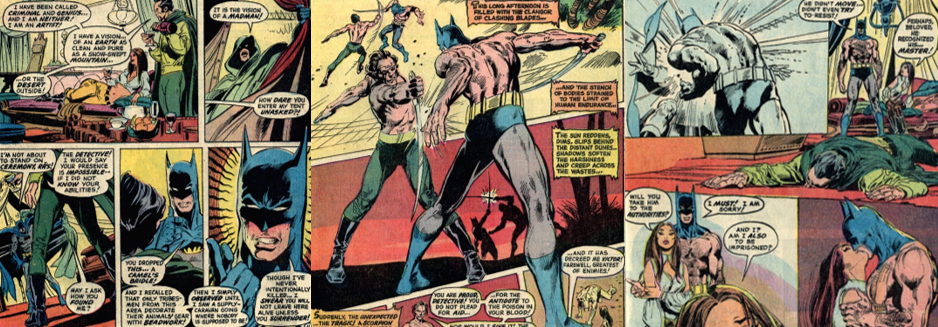
After Dr. Blaine wrecks the cable car’s controls, Talia talks some sense into her father and flees with him to their hovercraft, leaving Batman to shake off his injuries and Dr. Blaine insisting they get the wounded Lo Ling to a hospital. Upon seeing Rā’s al Ghūl’s futuristic hovercraft blast away, the Batman is stunned when Molly gives chase on her skis, forcing him to follow to protect her. Though astonished by her recklessness, the Batman can’t help but admire her skill and bravery, and he’s even more impressed when Molly hurls one of her skis into the hovercraft’s propeller, forcing a crash landing, though she’s wounded from debris. This is all the distraction the al Ghūl’s need to flee and, after getting Molly to safety, the Batman returns during the night to inspect the downed hovercraft and discovers a camel’s bridle. With all his allies on the shelf, Batman heads to the desert of an unspecified nation to confront Rā’s, whose regained his senses and determined to rebuild his empire. Determined to stop Rā’s, Batman agrees to a duel to the death and the two face each other, topless and armed with swords, in the sweltering desert. As a weeping Talia watches her lover and her father clash, Batman and Rā’s battle long into the afternoon but the fight unexpectedly ends when Batman is stung by a scorpion. Declaring himself the victor, Rā’s abandons his foe to his fate, though a kiss from Talia revitalises Batman and counteracts the poison. Driven by rage and instinct, the Batman stalks to Rā’s’ tent and lays him out with a single punch, with Rā’s too humble and horrified to offer any resistance. Although the Batman carries Rā’s al Ghūl off to be the authorities, he lets his emotions get the better of him and spares Talia, leaving her with a final kiss.
The Summary: These three stories (generally referred to as “The Demon Lives Again!”) have become iconic moments in the Batman’s long and storied career mainly due to the visual of the bare-chested Dark Knight duelling with the Demon’s Head in the arid desert. For me, this is peak classic Batman since I grew up with the writing and art of Dennis O’Neil and Neal Adams, which portrayed him as a well-rounded, intelligent, and stable individual more focused on crime solving than bashing heads or being a paranoid control freak. While the Batman loathes asking for help and putting others in danger to track down Rā’s al Ghūl, he feels compelled to do so to protect those he cares about (such as Robin and, assumedly, his mentor and father figure, Alfred Pennyworth). While the Batman is clearly rattled to have his civilian identity be targeted, to the point where he fakes Bruce Wayne’s death to operate autonomously as the Batman, it’s not clear what Rā’s al Ghūl’s goal is in this story arc. He targets Dr. Blaine for unspecified reasons and is stockpiling Sodium-19, but it’s not revealed why or what the endgame is beyond Rā’s wishing to strengthen his already powerful criminal empire. The assumption is that whatever Rā’s al Ghūl is planning can’t be good since he’s essentially a threat to the entire world by default, but it might’ve been nice to get some idea about what the stakes were beyond this vague threat. It’s also not revealed how and when Rā’s al Ghūl died. The Batman doesn’t seem to have known about this, so I doubt it happened in a previous story, and it raises questions regarding Talia. While she’s clearly conflicted between her loyalty to her father and her love for the Batman, it’s heavily implied that she’s begrudgingly carrying out his posthumous orders and is therefore the true threat of the story arc.
Batman’s allies and methods are questionable, adding little to the plot and ultimately being unnecessary.
Naturally, she hides it well, talking down Ubu, kissing the Dark Knight, weeping at the iconic clash between the two, and making no explicit moves against him, but Talia clearly can’t be trusted and carries out her father’s orders, willingly or not. The Batman’s plan is to assemble a team to hunt the Demon’s Head, though I’m not entirely sure what the benefit of assuming “Matches” Malone’s identity was since his underworld ties didn’t have any impact on their journey. I guess it helped to distract Lo Ling, who was fooled by the dummy Batman, but Malone didn’t seem necessary to the plot to me. It would’ve made more sense for “Bruce Wayne — Rest in Peace!” to revolve entirely around Batman masquerading as Malone to figure out who Rā’s al Ghūl is planning to target and then abandoning the disguise once Dr. Blaine was saved. I quite liked Lo Ling; he seemed like a tortured soul torn between his loyalties, like Talia, and was a useful ally in combat. It definitely would’ve made more sense for him to toss that Sodium-19 bar and for that to have killed Rā’s’ men, bringing some conflict between Lo Long’s methods and the Batman’s. It also would’ve made more sense for Lo Ling to guide Batman through the Swiss alps; he should know the location of Rā’s al Ghūl’s base, after all, meaning the inclusion of Molly Post also a questionable one. I liked that she impressed Batman time again, how resourceful, determined, and fearless she was, and that he was obviously taken by her, but I fail to see how she added anything to the story. Lo Ling and the Batman could’ve easily filled her role and it’s not like Molly and Batman become an item by the end. Additionally, Lo Ling and Molly are both grievously wounded in the final issue, which also takes Dr. Blaine out of the picture since he needs to see to her, meaning Batman faces Rā’s al Ghūl alone in the end…which was the exact opposite of his plan!
Batman’s relationship with Talia and rematch with Rā’s are the two highlights of this arc.
Therefore, the primary focus of this story arc (tracking down and stopping Rā’s al Ghūl’s mysterious plot) is a bit flimsy for me. However, these issues still stand as a landmark moment in the Dark Knight’s history simply because of how alluring and nuanced Rā’s al Ghūl and Talia are. Rā’s al Ghūl poses a significant threat to both the world and the Batman because of his resources and knowledge of Bruce Wayne’s identity, while Talia represents seductive temptation. Both the al Ghūl’s deeply respect and admire the Batman and wish him to join their cause, though they refuse to alter their methods to appeal to him and even Talia only defies her father so much. These issues not only reintroduce Rā’s al Ghūl but also introduce the concept of the Lazarus Pit, a mysterious, ancient substance that not only restores the dead to life but briefly bestows them with superhuman strength, though at the temporary loss of their sanity. When he rises from the dead, Rā’s al Ghūl is a mindless, animalistic force who easily fells Lo Ling and overpowers the Batman, only coming to his senses when confronted by his daughter. By the time the Batman intercepts them in EgyptAfghanistan whatever desert they flee to, Rā’s al Ghūl has fully regained his composure and is ready to battle to the death to settle his differences with the Dark Knight. While the Batman outright refuses to kill Rā’s al Ghūl, he also refuses to leave without the Demon’s Head in custody and accepts the challenge, providing the arc’s most powerful and sexually charged imagery. The actual sword fight, however, is surprisingly disappointing; neither competent draws blood, there’s no back and forth between the two, and it randomly ends when a scorpion stings Batman. Rā’s is incredibly pleased by this victory, claiming that nature itself has willed him as the victor, but so startled to see his foe fully recovered that he offers no resistance when the enraged Batman comes for him. In the end, these are decent enough stories, but I feel it could’ve been cut down to a two-part tale by removing some unnecessary characters and moments. This might’ve freed some panels to better explore Batman’s relationship with Talia and Rā’s al Ghūl’s plan, but there’s no denying the appeal of their sword fight and the juxtaposition between the Dark Knight and the Demon’s Head.
My Rating:
⭐⭐⭐
Rating: 3 out of 5.
Pretty Good
What did you think of Rā’s al Ghūl’s rematch with the Dark Knight? Do you agree that the additional characters bogged down the narrative or were you a fan of Lo Ling and the “Matches” Malone identity? Did you enjoy the bare-chested sword fight between the two? What are some of your favourite Rā’s al Ghūl stories? Which interpretation of the Rā’s al Ghūl, whether animated, pixelated, or live-action, is your favourite? Whatever you think about the Rā’s al Ghūl, share your thoughts below, support me on Ko-Fi, and check out my other Batman content!
In the decades since his first dramatic appearance in the pages of Detective Comics, Bruce Wayne/Batman has become a mainstream, worldwide, pop culture icon. The brainchild of writer Bob Kane, Batman was brought to life by artist Bill Finger and has been a popular staple of DC Comics and countless movies, videogames, and cartoons over the years. “Batman Day” falls on September 16 this year and I figured this was a perfect excuse to spend every Saturday celebrating comic’s grim and broody vigilante.
Story Title: “Daughter of the Demon” Published: June 1971 Writer: Dennis O’Neil Artist: Neal Adams
The Background: Following the huge success of Clark Kent/Superman, National Comics Publications set Bob Kane to work creating another masked crimefighter to add to their repertoire. Thanks to the long-suppressed influence of artist Bill Finger, the “Bat-Man” soon became not only one of DC Comics’ most popular characters but also a mainstream cultural icon. In the years that followed, the Batman defended Gotham City from numerous costumed supervillains, but perhaps none have been more captivating and intriguing than “The Demon’s Head” himself, Rā’s al Ghūl. Created by editor Julius Schwartz, writer Dennis O’Neil, and artist Neal Adams during a time when DC Comics were reinventing the Batman to shake off the camp trappings of the sixties, Rā’s al Ghūl was an enigmatic criminal mastermind akin to a James Bond villain. His vast criminal empire, lofty goal of ending all worldwide conflict by any means necessary, and international flavour made him both a dark mirror of the Dark Knight and an evolution of the Fu Manchu stereotype. A new villain for a new era in comics, Rā’s al Ghūl would continually plague Batman over the years thanks to the rejuvenating properties of his “Lazarus Pits”, which allowed him to stave off injuries and death and the cost of his keen intellect, and he was a pivotal figure in DC Comics thanks to the influence of his daughter, Talia, with whom Batman would have a volatile son. Rā’s al Ghūl has made numerous appearances outside of the comics, usually as a master manipulator; he was excellently voiced by the eloquent David Warner in the DC Animated Universe, often cropped up as a puppet master in various Batman videogames, and made appearances in DC’s live-action television shows (however ill-fitting these might have been) courtesy of Matthew Nable and Alexander Siddig. Liam Neeson expertly brought the character to life in Batman Begins(Nolan, 2005) and Rā’s al Ghūl has consistently been regarded as one of Batman’s most dangerous and formidable villains due to his complex nature and the influence of his League of Assassins.
The Review: “Daughter of the Demon” takes place during a transitional time in the Caped Crusader’s life and portrayal; in an effort to curb ludicrous claims about the Dark Knight’s sexuality and to simplify his entire persona, Bruce Wayne moved into a luxury penthouse in the middle of Gotham City alongside his faithful butler and father-figure, Alfred Pennyworth, and Dick Grayson/Robin grew into the “Teen Wonder” and moved away to Hudson University. This provides some context for the opening panels of the story, which see the colourful youth sneaking back into his dormitory and being dramatically gunned down by two unseen assailants! As horrified as Bruce is to learn that Dick hasn’t been seen for a few days, he’s even more startled when a photograph of the captured (but seemingly alive) teen arrives at his penthouse with a threatening note addressed to the Batman! Bruce wastes no time in suited up as Gotham’s grim avenger and swinging his way over the Wayne Manor in order to run tests on the note and the photograph at the Batcave. It seems that, when they moved, they didn’t initially kit the penthouse up with all their crime-fighting equipment as Batman is forced to make the trip using his trusty Batrope rather than the Batmobile, but such concerns are immediately forgotten when Batman is greeted by the enigmatic figure of Rā’s al Ghūl and his hulking bodyguard, Ubu.
When Robin and Talia are kidnapped, Batman teams up with Rā’sto find them.
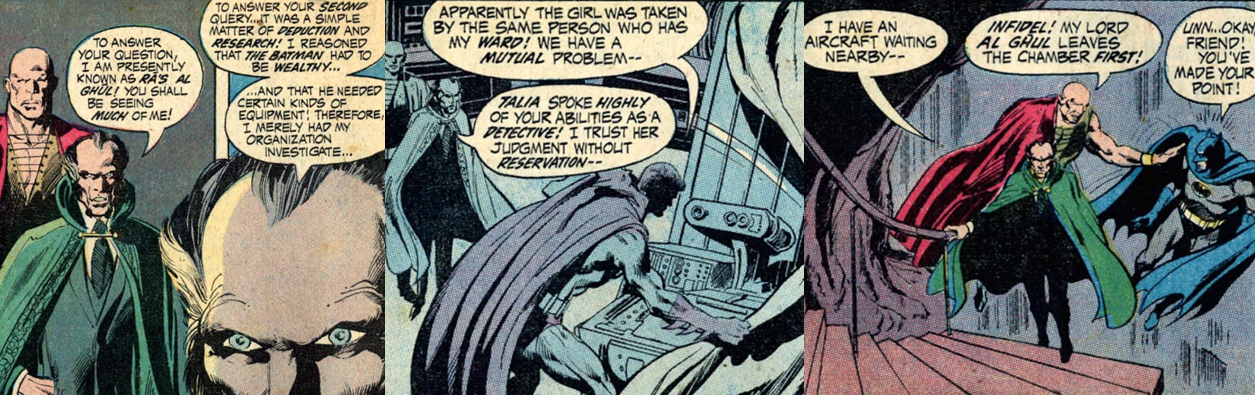
Having deduced that Bruce Wayne and the Batman are one and the same through deduction, research, and observation (being the Batman requires wealth and resources, after all, a “hole” that Batman vows to “plug” in the future), Rā’s comes to Batman seeking his aid since he received a similar note showing that his daughter, the beautiful Talia al Ghūl, has also been kidnapped. Having encountered the Batman in a previous story, Talia spoke highly of his deductive skills, making him the natural choice to seek for assistance and Bruce lives up to his reputation by analysing both pictures under a “microscopic spectograph” [sic] and discovering small traces of a certain herb used in ceremonies by an Eastern cult known as the Brotherhood of the Demon, who operate out of Calcutta. The three board Rā’s’ plane (with Batman noting the strength and loyalty of the overzealous Ubu) and, on the long flight to India, Rā’s comments on Batman’s stoic demeanour and Bruce grimly responds that he is compartmentalising on the task at hand and will grieve later, if necessary which, of course, detours the story into a flashback of how young Bruce Wayne saw his parents murdered before his eyes. Of course, we all know the story: Dedicating his mind and body to the eradication of crime, he was inspired by the appearance of a bat to become the Batman and then found a kinship in young Dick Grayson, whom he trained to become his crimefighting partner. Once they land in Calcutta, Batman begins his investigation in earnest, benefitting from the terror his unfamiliar guise evokes in the local street scum and even threatening them with death for information on the Brotherhood of the Demon. This bluff pays off and leads the three to a building at the end of a nearby alleyway, wherein Batman is set upon by a ravenous leopard! Acting swiftly, he locks the cat’s jaws open with his elbow, overpowers it, and nonchalantly breaks its neck with only minor wounds.
Batman outs Rā’sand is stunned to find he’s being groomed as the villain’s successor!
Remarking that the leopard had been well trained to act as a guard, the Batman discovers a convenient map pointing them in the direction of the Himalayan Mountains, and the three make haste to the frigid heights of Mount Nanda Devi. Easily picking up the trail, the Batman makes use of some handholds that have recently been hacked into the ice and leads the expedition up the mountain, only for them to be shot at by a sniper; while Ubu tends to his master, the Batman spectacularly swings into action to punch out the shooter. Afterwards, Batman notes the presence of a helicopter and several other armed guards, but his inner monologue suggests that he’s figured out what’s really going on; he calls the gunmen’s bluff and easily makes his way into an elaborate chamber, where he frees Robin and launches into an angered tirade against the so-called Brotherhood of the Demon that reveals Rā’s was behind everything. He was immediately tipped off when Rā’s showed up at the Batcave right after Robin was kidnapped, and when Ubu insisted that his master go ahead…unless there was immediate danger nearby, and finally because the two brought them to the exact mountain they needed to investigate despite the map not specifying the Brotherhood’s precise location. Furious and insulted by the deception and the run-around, Batman relishes in taking his anger out on the Brotherhood’s minions alongside Robin, unmasking their “Supreme Leader” as none other than Ubu and engaging with the musclebound brute in a short, but decisive, clash that sees the Batman effortlessly avoid the big man’s swings and lay him out with an uppercut to the jaw! Rā’s commends the Batman’s physical and mental prowess and reveals his intentions behind the whole charade: Talia is in love with the Dark Knight and Rā’s wishes to retire from his vast organisation and have Batman take his place as his successor…and son-in-law!
The Summary: When I was a kid, comic books weren’t that easy to come by in the United Kingdom so I mainly got my Batman fix from yearly annuals, with many of them being from the seventies and eighties. Consequently, Denny O’Neil and Neal Adams’ version of Batman was the one I knew best, so “Daughter of the Demon” ticks a lot of boxes for me. The artwork is spectacular, with large, well-defined, and realistic depictions being at the forefront; while I’m not a fan of the Batman’s yellow oval symbol or blue-and-grey ensemble, Adams always drew him in dynamic and powerful poses, even when he’s just standing their with his caped wrapped around him or sitting and brooding. Having said that, it’s a bit weird that the Batman doesn’t have his car or at least a makeshift Batcave a little close to his penthouse; having to swing all the way across Gotham and out to Wayne Manor seems unnecessarily laborious, but it’s barely a factor in the story, though it might’ve saved some panels and been just as easy to simply have Rā’s and Ubu show up at Bruce’s penthouse. Rā’s himself is a well-spoken and mysterious figure; appearing to be a wealthy and influential man of culture and of high intelligence, it seems almost too convenient for him and the Batman to join forces but, in the context of the story, it makes sense as Bruce is clearly impressed and stunned that someone was finally able to figure out his true identity.
A startling debut for one of Batman’s greatest foes let down only be a weak finale.
We later find out that he knew all along that Rā’s was behind the whole plot and had simply been playing along to rescue Robin; along the way, Batman dishes out some sass to the brutish Ubu and demonstrates his keen mind and attention to detail alongside his unmatched physical prowess. This is enough to impress Rā’s in the end, but we wouldn’t actually see a resolution to this dangling plot thread for some time; the following issue doesn’t continue this story and next time Rā’s showed up, it was a similar test of Batman’s fortitude and skills. They wouldn’t have their iconic shirtless sword fight until over a year later either, meaning that all the intrigue and excitement this story builds around Rā’s is kind of squandered as it doesn’t really go anywhere. This is a bit of a disappointment as it was an interesting debut for one of Batman’s most cunning and ruthless foes; the idea of someone, especially a well connected individual like Rā’s, being privy to Batman’s dual identity is shocking and something that helped set him apart from the Dark Knight’s other rogues, but we wouldn’t learn more about the Demon’s Head, his organisation, or his motivations and physical skills for some time, retroactively making this story a bit random and unfulfilling in a lot of ways.
My Rating:
⭐⭐⭐⭐
Rating: 4 out of 5.
Great Stuff
Have you ever read “Daughter of the Demon”? What did you think of Rā’s al Ghūl’s first appearance and his surprising knowledge of Batman’s true identity? Did you cotton on that Rā’s was behind everything? What are some of your favourite Rā’s al Ghūl stories? Which interpretation of the Rā’s al Ghūl, whether animated, pixelated, or live-action, is your favourite? Whatever you think about the Rā’s al Ghūl, share your thoughts below or leave comment on my social media, and be sure to check out my other Batman content!
In the decades since his first dramatic appearance in the pages of Detective Comics, Bruce Wayne/Batman has become a mainstream, worldwide, pop culture icon. The brainchild of writer Bob Kane, Batman was brought to life by artist Bill Finger and has been a popular staple of DC Comics and countless movies, videogames, and cartoons over the years. Accordingly, September celebrates “Batman Day” and is just another perfect excuse to celebrate comic’s grim and broody vigilante and, this year, I’m dedicating every Wednesday of September to Gotham’s Dark Knight Detective.
Released: 18 October 2011 Developer: Rocksteady Studios Also Available For: PC, PlayStation 3, PlayStation 4, Wii U, Xbox One, Xbox Series S/X
The Background: Batman quickly became a successful and dynamic character after his 1939 debut in DC Comics; over the years, the character’s world and mythos has grown considerably to include numerous spin-off comics and adaptations into not just cartoons and movies but also videogames. While Batman has fared rather well in that department, it can’t be denied that there were a few stinkers as well before Eidos Interactive acquired the rights to make a Batman game and brought in both Rocksteady Studios and celebrated Batman scribe writer Paul Dini to create the critically and commercially successful Batman: Arkham Asylum(ibid, 2009) at a time when the character was hot off a resurgence thanks to the recent success of The Dark Knight (Nolan, 2008). Development of a sequel began work before Arkham Asylumhad even been completed; despite apprehensions about system limitations, Rocksteady had big ideas for the sequel, which would move away from the claustrophobic trappings of Arkham Island and into more open world territory. Having learned from their mistakes and feedback from the first game, the developers greatly expanded Batman’s arsenal, animations, and gadgets to make him a more capable character and significantly expanded the range of exploration and side missions available to players in the much-larger game world. All of that hard work paid off as Arkham City became one of the fastest selling videogames in history. Critically, the response was universally positive; critics lauded the voice acting and additional features and the high quality of the game’s mechanics and content. The game was so successful that it was released in multiple editions with access to different downloadable content (DLC) and won numerous awards for the sheer expansiveness of its included, and additional, content.
The Plot: After the events of Arkham Asylum, the city’s criminals have been locked up inside a walled off section of Gotham City known as Arkham City, where supervillains and TYGER mercenaries under the command of Doctor Hugo Strange enforce martial law. Infiltrating the prison to investigate Strange’s unlawful incarceration of those who spoke out against him, the odds against Batman increase when the Joker shows up, apparently dying from TITAN poisoning, and infects Batman with his blood, forcing him to delve into the city’s underworld to find a cure.
Gameplay: Like its predecessor, Batman: Arkham City is a third-person, action/adventure game but, this time, you’re prowling the streets and rooftops of “Old Gotham”, a dilapidated and rundown area of Gotham that has been encased in high perimeter walls sporting gun turrets to house the city’s undesirables. Arkham City’s game world is five times the size of the one seen in Arkham Asylum and features even more recognisable landmarks from Batman’s famous city and areas to explore, as well as an endless supply of inmates and lowlifes to get your fists on. One of the best things about Arkham City is how the control scheme and core mechanics remain exactly as in the first game, just expanded considerably. Once again, Batman’s main method of traversal is his operatic cape and grapnel gun, which can now be used in conjunction and upgraded to allow him to effortlessly zip across the city. You can also dive bomb while gliding to take out enemies or pull up and gain additional height and length on your glide, allowing you to traverse the city prison in no time at all.
Combat and stealth are more fluid and satisfying than ever thanks to additional animations and options.
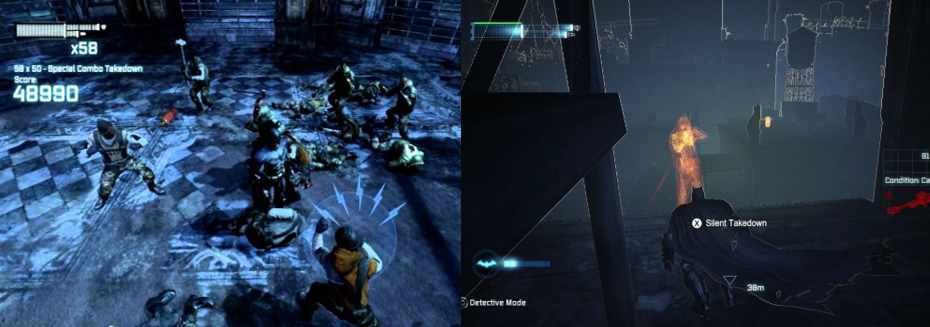
This more than makes up for Batman’s continued inability to jump and allows him to easily dart out of danger when spotted; Batman can still crouch with the Right Trigger and toss a quick Batarang with the Left Trigger, but now he can also quick-fire other gadgets, which is incredibly useful in combat and for solving the myriad of brain-teasing puzzles scattered around the city by Edward Nashton/Edward Nygma/The Riddler. The “freeflow combat” mechanic of the previous game returns intact but greatly expanded thanks to the addition of more attack animations and combos; X allows you to strike in quick succession while a well-timed press of Y (indicated when the “counter” indicator appears) will allow you to block and counter incoming attacks and rack up a bigger and more fluid combo. The higher your combo, the more damage you’ll deal and the more dynamic the perfectly-placed fight camera will move to allow you to lunge at other enemies before they can land a blow. Since the streets are crawling with a seemingly inexhaustible supply of thugs this time around, there are far more opportunities to sneak up on them and perform a “Silent Takedown”, but this time you can perform a “Knockout Smash” (though this will attract nearby enemies) and you can even perform takedowns from floor grates, double or even triple counters and takedowns when in combat, attack parts of the environment (like fire extinguishers and electrical boxes) to disorientate or disarm opponents, and even slam inmates into walls or dangle them over ledges during combat or interrogations.
New additions to the Predator sections increase the threat to Batman and his takedown options.
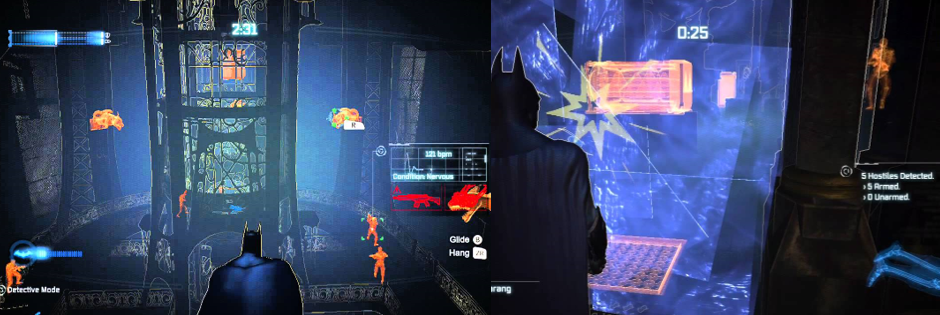
Also returning is the stealth-based “Predator” mechanic; in addition to sneaking up on enemies, Batman can grapple up to stone gargoyles and other high ledges to review rooms of armed thugs using the x-ray and thermal vision offered by his “Detective Mode”. A simple press of the Left Bumper and you’ll be able to see enemies by their body heat, their current condition, and any interactable parts of the environment. Batman’s new array of gadgets (easily accessed using the directional pad) can also be used in new ways to lure enemies into traps or take them down and, while traversing the city, you’ll need to make liberal use of these (and Batman’s new smoke pellets) to dart away from gunfire and dispatch gun-toting enemies. Again, Batman is tough but can’t take sustained gunfire or explosions; however, his health will replenish after you clear out all nearby enemies, solve riddles, or find the many Riddler Trophies. These same criteria will earn you experience points (XP) to improve Batman’s armour, abilities, and weaponry once more but the game definitely mixes things up by having enemies be able to jam your Detective Vision and electronics and lay traps of their own.
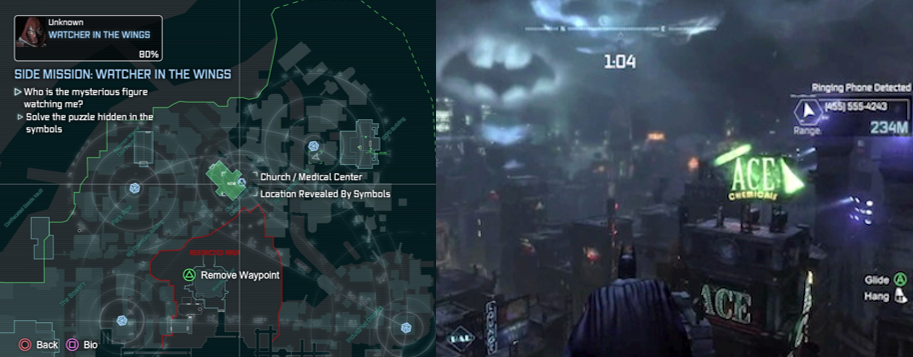
Navigation is easier than ever thanks to a comprehensive map, waypoint, and compass system.
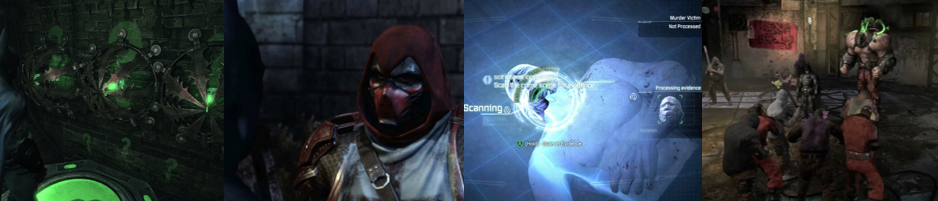
If you thought Arkham Asylum had a lot of riddles and Riddler Trophies, then Arkham City will blow your mind! The Riddler has placed his trophies not just out in the open but hidden behind walls, in cages, and a myriad of pressure pads and context-sensitive puzzles that will require all of Batman’s skills and gadgets to acquire. Similarly, there are riddles to find across the city and you can solve them by tapped LB to scan the environment when you spot glowing green question marks or the answer to the riddle. This time, there are also far more destructible elements to snag you some XP; the chattering Joker teeth return but you’ll also be destroying TYGER security cameras, balloons, and massive bobbleheads of Doctor Harleen Quinzel/Harley Quinn, which all adds to the fun, as well as more opportunities to use your gadgets to open vents or shut off steam from pipes. The map screen returns, far more expansive and user friendly (as are all of the menus) than before; you can now set waypoints to your next mission or any other location on the map and a very useful onscreen compass and Bat-Signal will direct you towards your location with a minimum of fuss. Take note, though, that these features are suppressed when you have Detective Mode activated but, again, there are some opportunities to track targets using this vision mode.
The streets are crawling with more baddies than ever and they’ll repopulate areas as you progress.
Like the first game, Batman: Arkham City gets progressively difficult as you play but this is expanded upon greatly. You might come across a gang of Harvey Dent/Two-Face’s minions and engage them in combat, only for more and more nearby inmates to hear the fight and join in, for one thing. These enemies will, eventually, repopulate areas after you’ve cleared them out so you constantly have to be aware of enemies on the streets and rooftops and, like in the last game, enemies will increase in their aggressiveness and capabilities as you progress through the story. Also, like before, you can select different difficulty levels to play the game on from the start, with “Hard” mode including counter indicators this time but increasing the damage enemies will put out, but there are no Achievements tied to playing on Hard mode so you may as well play on “Easy” or “Normal” since “New Game Plus” offers an even tougher challenge than the game’s Hard mode. Where Arkham City excels, though, is in its sheer size; Arkham City is full of buildings to enter, Easter Eggs and references, riddles to solve, and side quests to keep you busy. For a returning player like me, it’s really easy to get distracted with side quests on your way to the main story objective and you can keep track of all outstanding missions from the main menu. From here, you can also view stories and character biographies, review Batman’s moves and abilities (and even view a tutorial if you need a refresher), and check up on any outstanding riddles and such. In fact, the only real downside to Arkham City is, again, the inability to quickly exit an area, which can be particularly bothersome when deep in the bowels of the city subway or the forgotten steampunk city, Wonder City, as it can still be a tad laborious to find your way back out sometimes.
Graphics and Sound: Batman: Arkham Asylum managed to hold up impressively well over time and Arkham City holds up even better; it was already a big step up in terms of graphical quality and visual presentation so it’s only natural that it’s aged even better. As before, it’s a very dark game and takes place in one night so you might be relying on your Detective Vision or brightness settings to navigate in some areas but, thanks to many of the game’s locations taking place in indoor, more suburban (if equally dilapidated) areas, there are far more opportunities to bask in the impressive art direction of the game. Arkham City is split into different regions, with each one being primarily controlled by gangs of thugs affiliated with a different supervillain (Oswald Cobblepott/The Penguin, Two-Face, and the Joker) and having a distinctive feel to them.
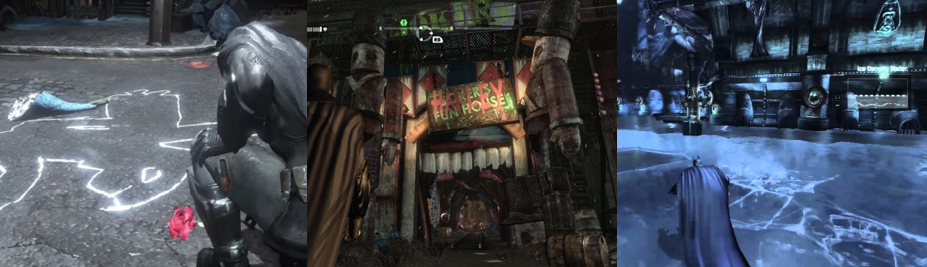
Each region of Arkham City is controlled by a different villain and has a different look to it.
Because the game takes place within a walled off cityscape, it must be said that it’s not immediately as visually distinctive compared to its predecessor as you’re surrounded by skyscrapers but I can forgive this as there are far more opportunities to see and explore the wider mythos of Batman’s world. You’ll stumble across Crime Alley, explore the remains of the old Gotham City Police Department (complete with Bat-Signal on the roof), fight through the museum and into the Penguin’s Iceberg Lounge, and take on the Joker’s gang at the dilapidated remains of the Sionis steel mill over on Amusement Mile. Similar to Arkham Island (which you can still see lingering in the misty distance), the city prison is a rundown, desolate place full of graffiti, burned out cars, litter, and chaos and there’s a real sense that the dogs have been literally let loose within its high walls and have turned the city into a veritable war zone. As you might expect, there are some more intricate and elaborate areas of the city, too. You can venture down into the abandoned subway and, of course, navigate through some stony catacombs and sewers beneath the city but, luckily, the game is far bigger and makes much better use of these environments when it comes to utilising Batman’s abilities so there’s far less awkward jumping and climbing and much more emphasis on the Line Launcher and grapnel boost, though you will need to get used to the new dive bomb mechanic in order to swoop in through some tight areas and get 100% completion.
Some nightmarish sequences, jump scares, and chilling encounters add to the world’s mythos.
Things definitely start to take a more visually interesting turn once you venture into the abandoned Wonder City, a town populated by deactivated robots and lost to the midst of times, and scale Wonder Tower to confront Hugo Strange. Sadly, there aren’t the same dynamic sections as those involving Doctor Jonathan Crane/Scarecrow from the last game but Arkham City does go to some lengths to recreate these sections when the plot demands that Batman suffer the effects of his poisoning. Later, during a side quest involving Jervis Tetch/The Mad Hatter, you’ll experience a much more similar, twisted nightmare world but the game does include far more elaborate and layered areas to explore that change as the story progresses. The GCPD will freeze over because of Doctor Victor Fries/Mister Freeze, the steel mill needs to be cooled down and then you have to enter through a different entrance that involves navigating past giant machinery and drills, Julian Day/Calendar Man is imprisoned beneath the courthouse, and the museum contains a gigantic frozen pool with a very large and unfriendly denizen awaiting you.
The attention to detail, new villains, and cameos are even better than ever this time around.
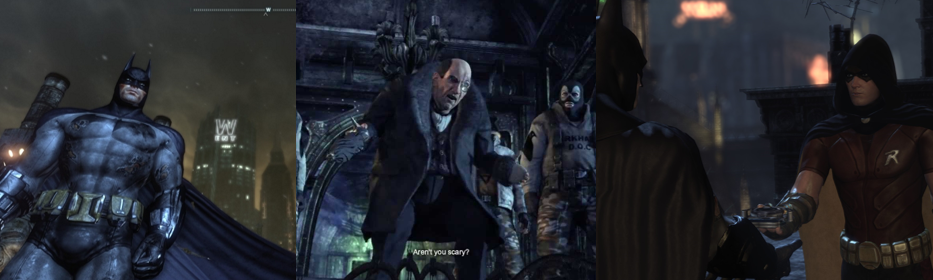
Thanks to the diversity in the game’s inmates, enemies have a lot more visual variety this time around as they wear different colourings and outfits. There is also a lot more chatter as Batman picks up on his enemy’s radio signals and broadcasts, with both Joker and villains like Penguin taunting you and issuing commands to their underlings. Batman’s suit, while visually very similar to the last one, still takes on battle damage as the story progresses and, as you’d expect, both Kevin Conroy and Mark Hamill knock it out of the park with their stellar work as Batman and Joker, respectively. Like before, Batman stops to converse with Barbara Gordon/Oracle but he also talks with his faithful butler and father-figure, Alfred Pennyworth, who sends additional equipment and offers council. The game also features far more references to Batman’s cast of characters and the wider DC universe and there’s even a much-appreciated cameo from a really well-designed version of Tim Drake/Robin for good measure. Cutscenes still make liberal use of the in-game graphics, which are even closer to the higher quality cinematics, and you’ll now see a helpful little recap of the story and your current outstanding missions when reloading a save.
Enemies and Bosses: With Arkham Asylum gone, its inmates and the rest of Gotham’s criminals have been tossed into Arkham City instead; for the most part, the bulk of the game’s enemies are the same scumbags you fought in the last game but in different clothing and with more jeers to throw your way. Inmates will throw punches, grab weapons, toss items at you, and attack with both knives, guns, grenades (in a new twist), electrical batons, and will even pick up car doors to use as shields and ram you. Eventually, you’ll also have to contend with snipers, enemies wearing collars that will attract their allies when they’re downed, enemies that can jam your technology, ones that take hostages, and thugs will even use thermal vision to spot you and start destroying the ledges you’re hiding on if you linger too long or fail to stay hidden. While the crazed lunatics from the last game are gone, the TITAN monsters make a return and some inmates with be decked out in protective armour. A simple Batarang to the face is no longer enough to dispatch these goons; this time, you must use three cape swipes to stun them and mash X to beat them into submission while also countering incoming attacks. You’ll also have to contend with the one-armed Abramovici twins a number of times; these big bastards swing huge sledgehammers or scythes and must be blasted with a bolt from Batman’s Remote Electrical Charge gun to inflict damage on nearby enemies and pummelled with your attacks as they can’t be stunned so you have to strike, hop over to avoid their swings, and strike again to defeat them.
Solomon Grundy more than makes up forTwo-Face and Penguin’s lack of physical challenge.
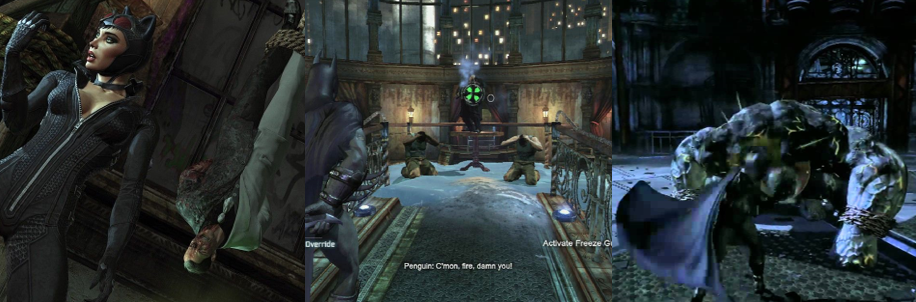
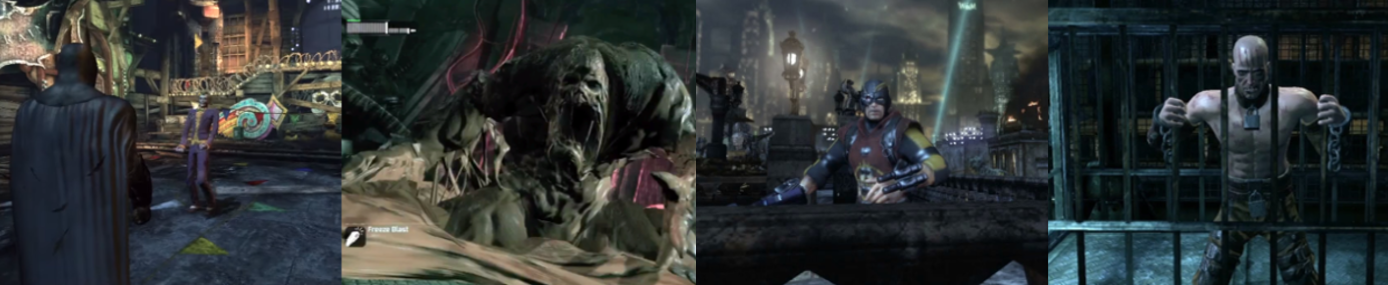
Arkham City is populated by a number of Batman’s most notorious rogues, basically all of them being new additions to the roster of bosses. The first you’ll encounter is Two-Face, who has taken over the courthouse and held Selina Kyle/Catwoman hostage. This is more of a tutorial for the basics of combat and Dent is dispatched by Catwoman in a cutscene rather than in an actual boss fight, and the following encounter with the Penguin is quite similar. This is basically the culmination of a side mission that sees you rescuing frozen police officers, freeing Mr. Freeze, and acquiring tech from his suit to deactivate his freezing gun (which the Penguin is using to keep you at bay). In fact, the first real physical challenge you have (aside from gladiatorial bouts against swarms of inmates or fights against one of the Abramovici twins) follows this encounter with the Penguin, which sees you facing off against the hulking zombie Solomon Grundy. You fight Grundy in a kind of gothic laboratory and must use your quick-fire explosive gel to close up three holes on the floor that regenerate Grundy’s health with lightning (while dodging said lightning) and allow you to put a beating on Grundy. This continues into the next phase, where Grundy tries to crush you with leaping attacks and two giant wrecking balls and sends weird little mice-things scuttling towards you. The third phase is more of the same but Grundy has one arm trapped in a machine; this time, the floor holes open sporadically for even shorter bursts and you need to avoid the shockwaves Grundy produces. Once he’s finally defeated, you have to dodge out of the way of the Penguin’s missile to punch him out once and for all, all of which is more interesting and engaging than the final boss of the last game.
While Rā’s tests your reflexes, you’ll need to use all of Batman’s skills and gadgets to bring down Mr. Freeze.
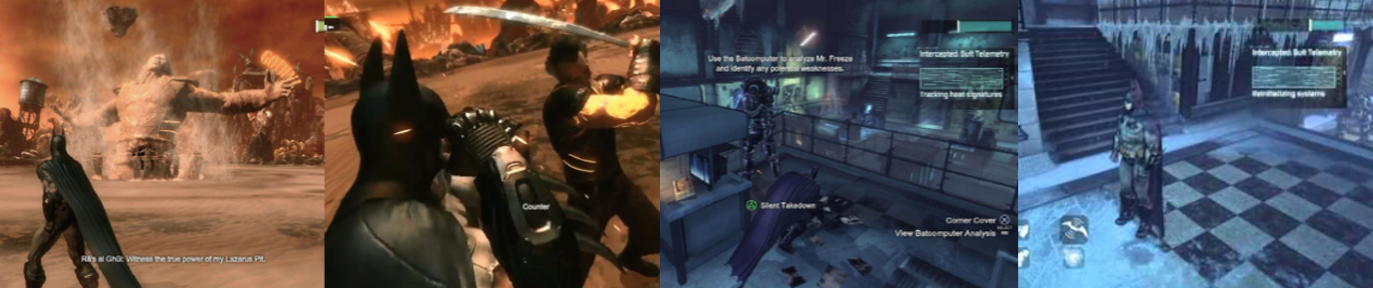
The next main story boss you’ll battle is Rā’s al Ghūl but, before this, you must first track down one of his ninja assassins by her blood trail, get past more of them in Wonder City (they can dodge your strikes and teleport in puffs of smoke before attacking with sword swipes), and endure the “Demon Trials” (gliding sections through a twisted hellscape where you can’t touch anything but the highlighted areas). You’ll face Rā’s in a desert that is part delusion, part reality, and have to take out hoards of sand men while he dashes at you from out of nowhere. Once you get past them, you must dodge the shurikens and blades he sends your way while blasting at him through his human shield with your Disruptor, and then mash Y to counter his attacks. The speed and aggressiveness of his attacks increases as the fight goes on but the final blow comes down to a well-timed toss of the reverse Batarang and Rā’ later meets a very gruesome end for his part in the game’s events. Next, you’ll have to take on easily the most intricate and complex boss of the game (or most games, for that matter) as Mr. Freeze betrays you and forces you into a confrontation. Depending on the difficulty you’re playing on, you may be forced to use every single one of Batman’s gadgets and abilities to deal damage and leave him vulnerable for a beatdown as Mr. Freeze learns and adapts his strategy as the fight progresses. Mr. Freeze will plod around the laboratory searching for you and sending heat-seeking globes to seek you out; you can use Batman’s glide attack, takedowns, and gadgets (like the explosive gel and Remote Electrical Charge gun) to deal damage but he’ll take action to ensure that you can’t do this twice (he freezes the ledges, grapple points, and vents, destroys parts of the environment, erects a shield, among other defensive measures), which forces you to think on your feet and explore options you might not normally use.
After stopping Strange and defeating Clayface, you’ll find some other villains to take down.
In the game’s finale, Strange activates the mysterious “Protocol 10” and commences a strategic bombardment of Arkham City; this briefly forces you to hack into circling helicopters in order to get inside of Wonder Tower and shut Strange down but, after you do, you’re forced into a confrontation with the Joker, who seems revitalised and has taken Talia al Ghūl hostage. Earlier in the game, you actually fight the Joker in his base form while his goons and out of control dodgem cars fill the arena but, when you confront him at the end, it’s revealed to have been Basil Karlo/Clayface in disguise; thus, the finale is, again, a battle against a hulking enemy. This time, you have to dodge Clayface’s cannonball attack and swinging arms while repeatedly spamming Freeze Blasts to whittle his health down. In the second phase, you grab a sword and slice up the mud men he spawns while repeating these tactics and avoiding his big sledgehammer shot in order to take him down. In between each of these main mission boss fights, you’ll come across a number of side missions that will draw you into confrontations with more of Batman’s rogues gallery: Floyd Lawton/Deadshot has been killing targets all over the city but Batman eventually tracks him down and must sneak past his one-shot rifle-arm to take him down; Victor Zsasz/Mister Zsasz has been killing people by luring them to ringing phones so Batman has to listen to his macabre life story to triangulate his location and then sneak around him in a partially flooded area to rescue his hostages; the Mad Hatter abducts you and forces you to battle waves of demonic rabbits; and the Riddler has also taken five hostages and placed them in Saw (Wan, 2004)-like traps. These hostages can only be saved by finding the Riddler’s Trophies, solving riddles, and interrogating his informants (highlighted in green) to gain access to his “Enigma Device” and locate each one in turn using the Cryptographic Sequencer.
Power-Ups and Bonuses: As before, Arkham City features a level-up progression system; every time you defeat enemies, solve riddles, or pick up Riddler Trophies and destroy cameras and such, you’ll gain XP. Upon levelling-up, you can again upgrade Batman’s armour (now separated into one that improves damage from melee attacks and one from gunfire) to gain additional health, add more elaborate takedowns to his repertoire (including a swarm of disorientating bats, bone-breaking takedowns, and weapon disarmaments), and upgrade his various gadgets to improve their range and efficiency. Again, it’s pretty easy to fully upgrade all of Batman’s abilities if you engage with enemies and search out riddles on a regular basis, and it’s best to mix and match your upgrades for a balanced playthrough but you can choose to focus on making Batman more durable if you so wish.
Batman’s new toys let him charge power points and create temporary platforms, among other things.
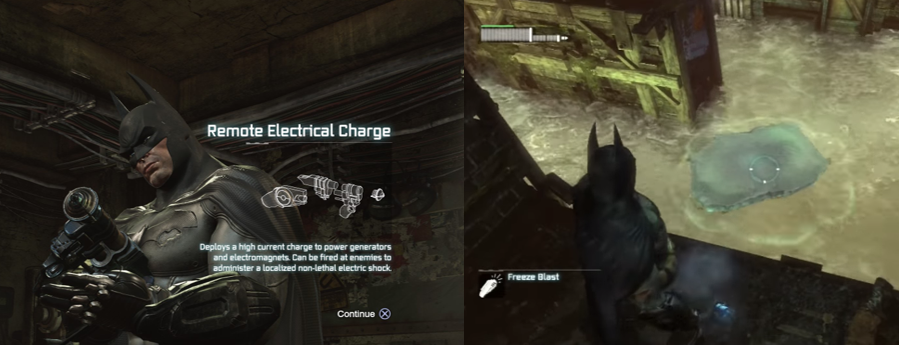
Batman begins the game with many of the gadgets he had at the end of the last one, making him far more equipped for the rigours of Arkham City; many of his weapons, such as the grapnel gun and explosive gel, can now be used as quick-fire attacks to mix up your combos to allow for more diverse combat. Although Batman can no longer rip down walls with his grapnel gun, the Line Launcher can be upgraded to fire a second line and allow Batman to walk along it like a tightrope and he also has access to some new toys. The smoke pellets allow him to disorientate enemies and make an escape if needed, the Remote Electrical Charge gun allows him to power up electrical appliances, the Disruptor deactivates mines and renders up to two enemy guns useless, and the Freeze Blast (and upgraded Freeze Cluster) can plug up steam pipes and form ice floats on bodies or water to allow Batman to float around by grappling onto conveniently-placed hooks around the environment.
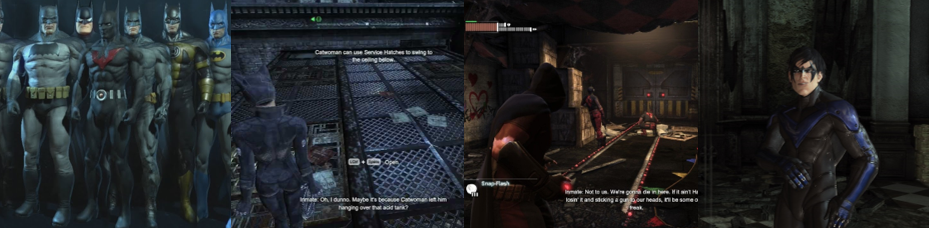
Additional Features: Batman: Arkham City has fifty Achievements to earn, with the bulk of these popping simply by playing through the story, meeting certain objectives, and defeating bosses. One has you fiddling with the Xbox’s internal date and time in order to hear Calendar Man ’s chilling acts while most of the others are tied specifically towards starting or completing the game’s many side missions rather than solving or finding riddles (although this is a factor since you need to do this to rescue the Riddler’s hostages). No matter what difficulty you complete the game on, you’ll unlock a New Game Plus mode that offers and additional difficult challenge, mixes up the enemy placements, allows you to play the story with any additional DLC costumes, and carries over all of your gadgets and upgrades to a new game file. You’ll also be able to return to your original save file in a post-game world where the inmates will comment on the dramatic conclusion of the game and be freely able to switch to Catwoman at certain points on the map.
Alongside the Riddler challenges, there are a number of additional side quests to occupy your time.
This is super useful if you have any outstanding side missions to complete; not only are there some diving simulations to complete and a bunch of Riddler challenges tied to performing combat and gameplay manoeuvres, there are many other mysteries and villains out there to confront, such as tracking down Thomas Elliot/Hush (who has been mutilating victims to impersonate Bruce Wayne), figuring out the motives of the mysterious Michael Lane/Azrael, saving a number of political prisoners from random acts of violence, locating and reunited Nora Fries’ cryogenically frozen body with Mr. Freeze, and destroying TITAN containers in a fragile alliance with Bane. Additionally, there are way more Riddler Trophies hidden throughout Arkham City, many of which require precision gliding, pressing pressure pads, and using a variety of Batman’s gadgets to pick them up. Catwoman also has her own Riddler Trophies to pick up and, while there are no audio tapes to find this time, you can still unlock biographies, news stories, and audio clips by solving and finding riddles. As before, the game features a Challenge Mode, now rebranded as “Riddler’s Revenge”, which allows you to take on self-contained combat and predator challenges based on encounters in the game. You’ll battle a few waves of increasingly difficult enemies and rack up points by sustaining and varying your combos and pick off goons from the shadows while handicapped by a number of modifiers (such as disabling your Detective Mode, shielding enemies from damage, or having reduced health).
Arkham City makes up for the last game with a whole bunch DLC skins, characters, and challenge maps.
There is also a new series of “Campaign” maps that mix up the two challenges to present a sort of adjacent side story to the main game and you can compare your high scores against friends and other using the online leaderboards. These challenge maps, and the main game itself, can be expanded by purchasing the many different DLC packs for the game. As mentioned, Catwoman was a big selling point of the game and those who pre-ordered Arkham City or purchased her DLC can switch to playing as Catwoman during the story to follow a side mission involving Poison Ivy and stealing from Hugo Strange. The DLC for Arkham City is such a massive step up compared to the last game, adding twenty Achievements to collect and numerous costumes for Batman to use in New Game Plus and on challenge maps, and, best of all, the ability to play as Robin and Dick Grayson/Nightwing in the challenge maps. Each of the four playable characters plays a little differently (Catwoman is faster but weaker, slashes with her claws and tosses bolas; Robin uses his bo staff, riot shield, and faster (but shorter) version of the Batclaw; and Nightwing batters thugs with batons and utilises his acrobatic skill to take out enemies) and has their own gadgets but, sadly, only Catwoman is available to play as in the main game. Robin does take centre stage in a post-game DLC story, “Harley Quinn’s Revenge”, that sees him infiltrating the steel mill to rescue Batman; I had all of this DLC on the PlayStation 3 and greatly enjoyed the variety offered by the skins and each character but I do wish that the studio had allowed these additional characters to be used in the actual main game.
The Summary: I was massively impressed with Batman: Arkham City when I first played it on the PlayStation 3; the game was just so much bigger and better than the original thanks to expanding the scope of the game world and the range of Batman’s abilities and gadgets. Everything that worked in the original game is back and improved upon, making combat even more fluid and diverse and truly defining the essence of Batman to set the standard for the remainder of the series. Rather than being confined to a claustrophobic, gothic prison, Batman is freely able to roam and fight around a dilapidated, walled off section of the city full of Easter Eggs, references, inmates to fight, secrets to find, and side missions to keep you busy for far longer than the first game. Best of all, the game is packed full of post-game and additional content thanks to these side missions, the New Game Plus mode, the expanded Challenge Mode, and the impressive abundance of DLC. Including additional skins, a short post-game story, and two of my favourite Batman characters in Robin and Nightwing really helps to expand the lore of this interpretation of Batman’s world and offers far more replay value. For me, Arkham City is still the gold standard for the Batman: Arkham series (Various, 2009 to 2015) and, while Arkham Asylum finally offered all of Batman’s abilities in a fun and engaging way, Arkham City expanded on them to the nth degree and truly defined what it means to play as Batman in an open world environment and it definitely deserves all of the praise it earned upon release and even to this day.
My Rating:
⭐⭐⭐⭐⭐
Rating: 5 out of 5.
Fantastic
What did you think about Batman: Arkham City? How do you feel it holds up compared to the original games and its sequels? Did you enjoy that the game world was expanded into a city-sized open world or did you prefer to more claustrophobic aesthetic of the first game? Which of Batman’s new gadgets and rogues were your favourite to use or fight against and why? Did you ever track down all of the Riddler’s trophies and secrets? Which of the side missions was your favourite to complete? What did you think to the game’s DLC and would you have liked to see Robin and Nightwing playable in the main game? How are you planning on celebrating Batman Day this year and what is your favourite Batman videogame? Whatever you think about Batman: Arkham City, or Batman in general, please leave a comment below and check back in next Wednesday for my review of the next Arkham videogame!












 Dr. K's Waiting Room
You must be logged in to post a comment.